StrictlyVC in conversation with Sam Altman, part two (OpenAI)
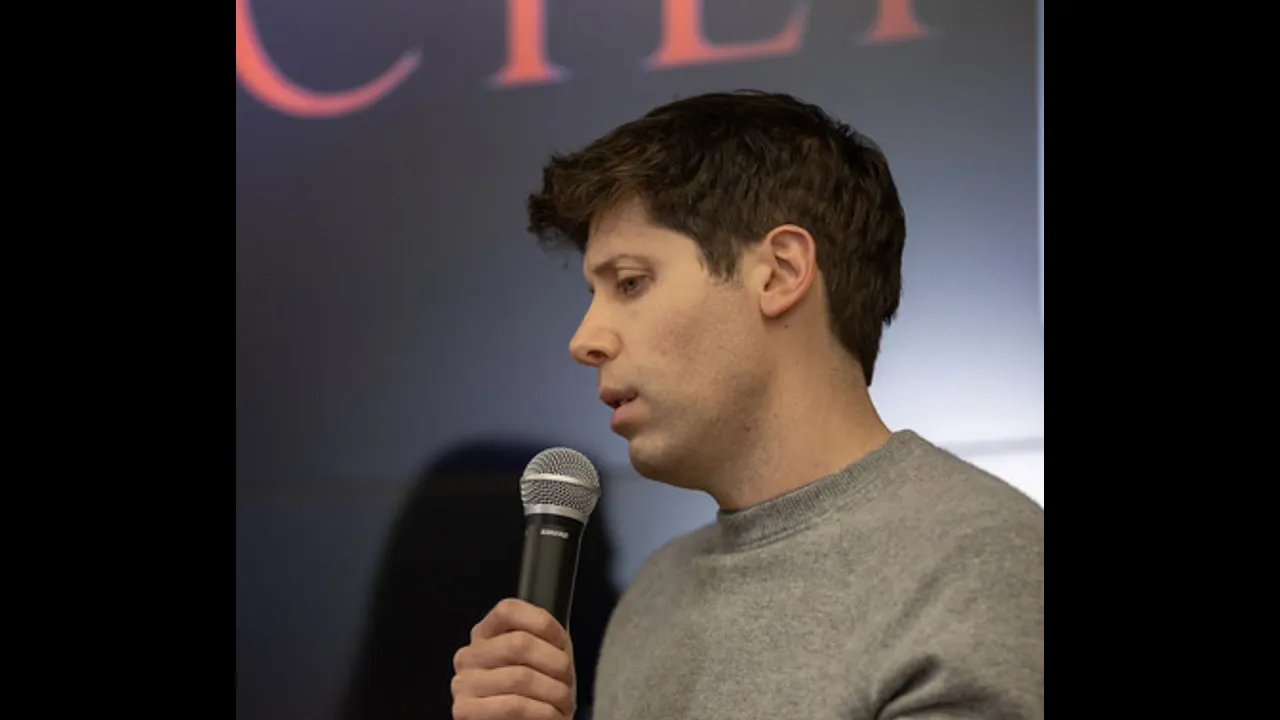
StrictlyVC in conversation with Sam Altman, part two (OpenAI) — Connie Loizos

Connie Loizos

AI-assisted summary of StrictlyVC in conversation with Sam Altman, part two (OpenAI) — original source. Check the original for full context.

Source published:

Key ideas

  • OpenAI held the underlying model behind ChatGPT in its public API for ten months before releasing the consumer tool in-house, driven by the conviction that users prefer conversational interfaces over traditional front-ends. (0:00)
  • Sam Altman dismissed viral GPT-4 rumors as unrealistic, cautioning that the model is not AGI and will disappoint observers expecting an immediate leap to general intelligence. (3:06)
  • Altman advocated for a two-tier AI governance framework where broad societal consensus enforces extreme boundaries, while individual users retain granular control over moral and stylistic alignment within those bounds. (5:58)
  • OpenAI supports the eventual commoditization of compute and foundational intelligence, arguing that its capped-profit corporate structure does not incentivize capturing infinite revenue at the expense of societal wealth. (10:41)
  • Altman dismissed predictions of Google's rapid demise as naive tech hubris, anticipating that search habits will evolve gradually as incumbents mount competent counter-strategies. (28:29)

Detailed notes

## Background Published on YouTube by Connie Loizos on January 18, 2023, this video presents part two of StrictlyVC's wide-ranging sit-down interview with OpenAI cofounder and CEO Sam Altman. The conversation focuses exclusively on artificial intelligence, exploring regulatory issues, commodification, Google's public reluctance to release models, and the best- and worst-case societal outcomes of AGI.

## TL;DR Sam Altman examines the unexpected viral surge of ChatGPT and DALL-E, defending OpenAI's iterative, gradual deployment strategy as the safest way to acclimate institutions and policymakers to frontier technology. He downplays speculative rumors around GPT-4, explains how OpenAI's capped-profit structure and Microsoft partnership align with their primary mission of building AGI, and details a two-tier governance model separating baseline societal redlines from personalized user controls. Altman also addresses the limits of AI detection tools in education, warns that the worst-case scenario for AGI is existential catastrophe while outlining a vision for short-timeline, slow-takeoff development, and encourages founders to capitalize on favorable startup market conditions by building defensible vertical workflows atop foundational models.

## Atmosphere & style The interview has an intimate, candid, and grounded atmosphere, with Loizos balancing pointed industry inquiries against Altman's measured, understated pragmatism. Altman frequently employs dry humor and reflective pauses, effortlessly pivoting between granular operational realities—such as hybrid office dynamics and model fine-tuning—and staggering existential scenarios. Watching the exchange feels like sitting inside a focused, high-stakes Silicon Valley salon where monumental technological disruption is discussed without panic, but with deep awareness of the immense responsibility involved.

## Bulletin - [00:00](https://www.youtube.com/watch?v=ebjkD1Om4uw&t=0s) OpenAI held the underlying model behind ChatGPT in its public API for ten months before releasing the consumer tool in-house, driven by the conviction that users prefer conversational interfaces over traditional front-ends. - [03:06](https://www.youtube.com/watch?v=ebjkD1Om4uw&t=186s) Sam Altman dismissed viral GPT-4 rumors as unrealistic, cautioning that the model is not AGI and will disappoint observers expecting an immediate leap to general intelligence. - [05:58](https://www.youtube.com/watch?v=ebjkD1Om4uw&t=358s) Altman advocated for a two-tier AI governance framework where broad societal consensus enforces extreme boundaries, while individual users retain granular control over moral and stylistic alignment within those bounds. - [10:41](https://www.youtube.com/watch?v=ebjkD1Om4uw&t=641s) OpenAI supports the eventual commoditization of compute and foundational intelligence, arguing that its capped-profit corporate structure does not incentivize capturing infinite revenue at the expense of societal wealth. - [28:29](https://www.youtube.com/watch?v=ebjkD1Om4uw&t=1709s) Altman dismissed predictions of Google's rapid demise as naive tech hubris, anticipating that search habits will evolve gradually as incumbents mount competent counter-strategies.

## Key takeaways - [00:00](https://www.youtube.com/watch?v=ebjkD1Om4uw&t=0s) The public rollout of ChatGPT was driven by developer hesitation to build conversational dialogue interfaces around existing API models. - [00:00](https://www.youtube.com/watch?v=ebjkD1Om4uw&t=0s) Generative AI inverted historical automation predictions by disrupting creative domains ahead of routine physical labor. - [03:06](https://www.youtube.com/watch?v=ebjkD1Om4uw&t=186s) Gradual iterative deployment is far safer than withholding powerful models in isolation and surprising society with fully realized AGI. - [05:58](https://www.youtube.com/watch?v=ebjkD1Om4uw&t=358s) The marginal cost of intelligence trending toward zero benefits society, aligning with OpenAI's capped-profit structure rather than traditional profit-maximizing monopolies. - [17:59](https://www.youtube.com/watch?v=ebjkD1Om4uw&t=1079s) AI governance should follow a constitutional free-speech model, setting society-wide outer legal limits while preserving user autonomy for tone, values, and experience. - [10:41](https://www.youtube.com/watch?v=ebjkD1Om4uw&t=641s) OpenAI maintains a complementary division of labor with Microsoft while preserving full independence to develop software and launch third-party consumer products. - [14:43](https://www.youtube.com/watch?v=ebjkD1Om4uw&t=883s) Technical countermeasures like cryptographic watermarking and AI detection classifiers will inevitably fail against simple rewriting and prompt adjustments. - [19:50](https://www.youtube.com/watch?v=ebjkD1Om4uw&t=1190s) Video generation research is actively underway at OpenAI, though reliable deployment remains technically demanding without a fixed release schedule. - [19:50](https://www.youtube.com/watch?v=ebjkD1Om4uw&t=1190s) Helion Energy targets delivering grid-connected nuclear fusion power by around 2028, with net-energy demonstrations expected earlier. - [21:24](https://www.youtube.com/watch?v=ebjkD1Om4uw&t=1284s) The existential risk of AGI is existential extinction, though near-term danger stems from human misuse and unaligned power rather than sci-fi malicious rogue sentience. - [23:52](https://www.youtube.com/watch?v=ebjkD1Om4uw&t=1432s) The safest and most desirable transition path to AGI is a short timeline combined with a slow, gradual takeoff velocity. - [28:29](https://www.youtube.com/watch?v=ebjkD1Om4uw&t=1709s) Universal Basic Income can redistribute automated economic abundance but cannot substitute for human purpose or the drive to build. - [32:30](https://www.youtube.com/watch?v=ebjkD1Om4uw&t=1950s) Unsynchronized hybrid work environments create operational friction and isolate remote staff compared to intentional, in-person collaboration. - [33:41](https://www.youtube.com/watch?v=ebjkD1Om4uw&t=2021s) Domain-specific AI leverages established engineering safety practices, whereas AGI demands an entirely unprecedented safety paradigm due to irreversible failure modes. - [34:48](https://www.youtube.com/watch?v=ebjkD1Om4uw&t=2088s) Post-bubble macroeconomic environments offer founders superior execution dynamics because hiring friction and market noise subside despite tighter fundraising. - [36:22](https://www.youtube.com/watch?v=ebjkD1Om4uw&t=2182s) Vertical AI startups must build moats through workflow specialization and deep customer relationships rather than superficial wrappers around base models.

## Detailed walkthrough ### [00:00](https://www.youtube.com/watch?v=ebjkD1Om4uw&t=0s) The Unexpected Reception of ChatGPT and DALL-E

Connie Loizos opens the conversation by pivoting to artificial intelligence, reminding Sam Altman of their stage interview three years earlier where the audience assumed his predictions about the coming wave of AI were hyperbolic, whereas he had been completely serious. Asking why ChatGPT and DALL-E managed to surprise the public so intensely when everyone knew companies like Google and OpenAI were actively researching the space, Altman admits he is still somewhat perplexed. He reveals that OpenAI had already placed the underlying model for ChatGPT into their public API roughly ten months prior to building ChatGPT itself, expecting that someone else in the developer community would construct such an application. Altman stresses that a refined user experience matters immensely, reiterating his longstanding conviction: “One thing that I very deeply believed was the way people wanted to interact with these models was via dialogue.” Because developers resisted building conversational front-ends, OpenAI eventually decided to produce ChatGPT in-house.

Altman points out that DALL-E startled observers because it completely inverted the historical consensus regarding how automation would disrupt the economy. For five to seven years, conventional wisdom asserted that AI would first automate physical labor such as factory work and truck driving, move on to lower-tier cognitive tasks, then conquer high-demand analytical work like software engineering, and only at the very end—if ever—touch human creativity. Seeing creative visual generation arrive ahead of physical automation challenged intuitive assumptions about machine intelligence. In contrast, Altman remains introspective about why ChatGPT caused such an uproar, considering that GPT-3 had been introduced nearly three years prior (and made available via an API around June 2020). He had assumed the incremental leap from the base models to a conversational interface would be entirely predictable, concluding that he had been miscalibrated regarding public reaction.

```mermaid flowchart TD accTitle: AI Automation Trajectory Comparison accDescr: Contrasts historical predictions of automation against the real-world trajectory observed by Sam Altman.

subgraph Historical["Historical Industry Consensus"] direction LR H1["1. Physical Labor<br>(factories, trucking)"] --> H2["2. Routine Cognitive Work"] H2 --> H3["3. Demanding Cognitive Work<br>(programming)"] H3 --> H4["4. Human Creativity<br>(art, writing)"] end

subgraph Reality["Actual Observed Trajectory"] direction LR R1["1. Creativity & Media<br>(DALL-E, text generation)"] --> R2["2. Complex Cognitive Tasks<br>(code synthesis)"] R2 --> R3["3. Routine Knowledge Tasks"] R3 --> R4["4. Physical Labor Robotics"] end ```

[03:06](https://www.youtube.com/watch?v=ebjkD1Om4uw&t=186s) Gradual Deployment and the GPT-4 Rumor Mill

Asked what gave OpenAI the confidence to release these tools publicly and whether society has adequate guardrails in place, Altman explains that OpenAI relies on structured internal reviews to break their systems, assess broader impacts, engage third-party auditors, coordinate with external red-teamers, and consult peer safety organizations. While he acknowledges that ChatGPT is triggering live societal disruptions—particularly in education and academic integrity—he argues forcefully that confronting these disruptions while the stakes are still relatively modest is essential: “The most responsible way to put this out in society is very gradually and to get people, institutions, policymakers, get them familiar with it, thinking about the implications, feeling the technology, getting a sense for what it can do and can't do very early, rather than drop a super powerful AGI in the world all at once.” He notes that the COVID-19 pandemic demonstrated society's ability to adapt to sudden change faster than anticipated, yet deploying an imperfect, weaker system and iteratively upgrading it over time remains far safer than shocking the economy with a fully baked system years down the line.

When Loizos inquires whether GPT-4 will launch within the first quarter or first half of the year, Altman declines to provide a rigid schedule, stating that it will be released only once OpenAI feels confident it can be introduced safely and responsibly. He cautions that OpenAI intends to sit on technologies and release them far more slowly than the public desires, acknowledging that users want the newest shiny toy. Altman also dismisses viral infographics circulating on Twitter that contrast the parameter scale of GPT-3.5 with speculative models of GPT-4. Calling the GPT-4 rumor mill ridiculous after six continuous months of speculation, he warns: “People are begging to be disappointed and they will be... we don't have an actual AGI, and I think that's sort of what is expected of us, and you know, yeah, we're going to disappoint those people.”

- OpenAI engages external auditors, independent red-teamers, and safety labs to stress-test systems before general availability. - Altman underscores that societal adjustment must happen iteratively to avoid economic and cultural shockwaves. - Public expectations for GPT-4 have diverged significantly from reality due to persistent social media rumors framing the release as an immediate leap to AGI.

[05:58](https://www.youtube.com/watch?v=ebjkD1Om4uw&t=358s) Business Models, Commoditization, and Customizable Alignment

Loizos recalls an earlier conference appearance where Altman humorously told the audience that OpenAI had made a soft promise to investors that once a generally intelligent machine was built, they would simply ask it how to turn a profit. Altman confirms that someone recently sent him that video clip, chuckling that reality has partially mirrored the joke: OpenAI built a deeply imperfect system, could not immediately determine monetization, exposed it via an API, and let external developers discover commercial use cases. Responding to concerns about competition from Google and emerging startups commoditizing AI technology and degrading profit margins, Altman welcomes the prospect. He emphasizes that he believes deeply in competitive capitalism to lower costs, hoping that the marginal cost of intelligence and energy trends toward zero so that the economic surplus benefits society broadly: “The future I would like to see is where access to AI is super democratized, where there are several AGIs in the world that can kind of like help allow for multiple viewpoints and not have anyone get too powerful.”

Addressing how AI models trained on public internet datasets can express differing viewpoints, Altman contrasts OpenAI's work with earlier reinforcement learning paradigms, such as DeepMind agents trained to deceive and destroy one another in game environments. Because modern systems are built around language comprehension, developers can instruct models directly on specific behavioral values. He envisions a two-tier governance framework: broad societal rules set the outer boundaries of what an AGI must never do, while individual users retain granular control over tone and alignment within those boundaries. Altman envisions a future where one user can select a strictly PG, safe-for-work model while another opts for an exploratory, edgy system: “You as a user should be able to write up a few pages of 'Here's what I want, here are my values, here's how I want the AI to behave,' and it reads it and thinks about it and acts exactly how you want, because it's like it should be your AI.”

- OpenAI is early in generating licensing revenue from startups using its foundation models. - Altman rejects concerns over business margin erosion, arguing that commoditizing compute and intelligence drives broad societal wealth. - System alignment should feature absolute outer guardrails set by societal consensus, combined with individual user customizability for moral and stylistic preferences.

[10:41](https://www.youtube.com/watch?v=ebjkD1Om4uw&t=641s) OpenAI's Capped-Profit Model and the Microsoft Partnership

Addressing competitive pressures and token pricing, Sam Altman dismisses the idea that falling market prices will harm OpenAI’s core business. He explains that OpenAI does not operate under standard corporate incentives to monopolize revenue: “We also have this like capped-profit model, so we don't have this incentive to just like capture all of the infinite dollars out there anyway, and to like generate enough money for our equity structure—like yeah, I believe we'll be fine.” When Connie Loizos pivots to their partnership with Microsoft, Altman describes them as the sole major tech company OpenAI felt enthusiastic about working with at such depth. He highlights Microsoft CEO Satya Nadella not just as an exceptional executive but as a remarkable human being, noting that Nadella, Microsoft CTO Kevin Scott, and Mikhail Parakhin all genuinely grasp the high stakes of artificial general intelligence (AGI) and respect the unconventional terms embedded in OpenAI’s structural agreements.

Altman frames the relationship as a complementary division of labor: Microsoft excels at engineering massive supercomputing infrastructure and integrating advanced technology into commercial products, while OpenAI focuses on frontier research. When Loizos presses him to confirm reporting that OpenAI models are heading directly into Microsoft Bing and Office 365, Altman playfully shuts down the line of questioning: “In the spirit of shortness of life and our precious time here, why do you ask?” He stresses that he will never comment on another corporation's unannounced product roadmap. Furthermore, Altman clarifies that the Microsoft alliance does not legally or practically restrict OpenAI from developing its own software, launching consumer services, or collaborating with third-party partners. Tactical commercialization remains subservient to their primary mission: “In general, we are very much here to build AGI, and products and services are tactics in service of that—partnerships too.”

[13:34](https://www.youtube.com/watch?v=ebjkD1Om4uw&t=814s) Competitor Hesitation and the Question of Chatbot Sentience

Loizos brings up Alphabet's public hesitation, noting that Google warned employees against releasing certain AI systems because the technology was too imperfect and posed severe reputational risks. Altman responds dryly, remarking, “I hope when they launch something anyway, you really hold them to that comment,” before declining to dwell further on Google's internal messaging.

The conversation shifts to the 2022 controversy where Google suspended an engineer from its Responsible AI organization who publicly claimed the company's internal chatbot had achieved sentience. Loizos mentions that while the claim sounded far-fetched at the time, seeing ChatGPT might make people wonder whether competing labs possess similarly startling internal tools. Altman notes he only recalled the headlines and has not examined Google's proprietary internal model. While acknowledging that Google is a highly competent organization likely sitting on impressive research, he emphasizes that OpenAI’s decision to ship ChatGPT publicly was driven by the necessity of deploying tools into society rather than holding them back in theoretical isolation.

[14:43](https://www.youtube.com/watch?v=ebjkD1Om4uw&t=883s) Education, Classroom Bans, and the Futility of Long-Term Watermarking

Loizos shares a personal anecdote about her 13-year-old son being advised by his teacher not to fear AI but to focus on cultivating alternative human skill sets, contrasting that with the New York City public school system's decision to ban ChatGPT on campus networks. Altman acknowledges educators' natural anxiety, comparing the shift to previous educational disruptions: “We adapted to, you know, calculators and changed what we tested for in math classes I imagine; this is a more extreme version of that no doubt, but also the benefits of it are more extreme as well.” He points out that while many teachers fear the demise of traditional homework, others celebrate the technology as a patient, personalized one-on-one tutor for every student. Altman adds that he frequently relies on ChatGPT to learn complex subjects himself, finding it significantly more compelling and interactive than reading static textbooks.

Turning to technical countermeasures such as cryptographic watermarking and detection classifiers, Altman warns that technical band-aids will not hold up over time:

```mermaid flowchart TD accTitle: Limitations of AI Detection in Education accDescr: Flowchart showing why technical detectors fail and require pedagogical adaptation.

subgraph ShortTerm["Interim Mitigations"] A["Model Watermarking & AI Detectors"] --> B["Superficial Text Perturbations & Rewriting"] B --> C["Detection Rendered Ineffective"] end

subgraph LongTerm["Pedagogical Adaptation"] D["Widespread Synthetic Text"] --> E["Classroom Focus Shifts Away from Static Essays"] E --> F["AI Deployed as Individualized Personal Tutor"] end

C -.-> D ```

He cautions school boards and policymakers against banking on software fixes, arguing that determined students can easily bypass detectors by tweaking sentence structures or using auxiliary rewriting tools. Society, he argues, has irrevocably crossed into an era where machine-generated text is ubiquitous, meaning curricula must adapt to the new reality rather than futilely trying to detect or ban it.

- Altman warns policymakers against building rules around AI detectors: “Fundamentally I think it's impossible to make it perfect; you'll think, you know, people will figure out how much of the text they have to change, there will be other things that modify the outputted text.” - Even if robust watermarking techniques emerge, Altman suspects they will be “rendered like irrelevant in a few months.”

[17:59](https://www.youtube.com/watch?v=ebjkD1Om4uw&t=1079s) Anthropic, Model Plurality, and the Bounds of AI Governance

When Loizos inquires about rival AI lab Anthropic—founded by former OpenAI VP of Research Dario Amodei—and its focus on constitutional ethics, Altman expresses deep admiration for their team. He rejects the zero-sum narrative of commercial competition, asserting that the world is far safer with decentralized breakthroughs: “Multiple AGIs in the world I think is better than one.”

On the subject of establishing universal safety codes or imposing regulatory frameworks across generative models, Altman draws an analogy to constitutional free speech. Just as society enforces narrow legal limits around defamation, incitement, or fraud while protecting a wide spectrum of legal speech that many people find objectionable, AI governance should operate on two distinct tiers:

```mermaid flowchart LR accTitle: Two-Tier Governance Model for AI accDescr: Societal legal boundaries define the broad limits, while individual users choose their specific preferences within those limits.

subgraph BroadTier["Tier 1: Society & Government"] A["Broad Legal Bounds"] --> B["Restricts Extreme Harm / Non-Absolute Exceptions"] end

subgraph UserTier["Tier 2: User Autonomy"] B --> C["Individual Liberty"] C --> D["Customized Values, Tone, and Experiences"] end ```

Altman argues that government regulation must define only the outer guardrails rather than dictating every interaction: “Society has decided like free speech not quite absolute; I think society will decide also decide like language model is not quite absolute, but there are a lot of—there's a lot of speech that is legal that you find distasteful, that I find distasteful, that he finds distasteful, and we all probably have somewhat different definitions of that, and I think it is very important that that is left to the responsibility of individual users and groups, not one company, and that the government they are like govern and not dictate all of the rules.”

[19:50](https://www.youtube.com/watch?v=ebjkD1Om4uw&t=1190s) The Outlook for Generative Video and Fusion Timelines

Asked about the emergence of video generation models, Altman confirms OpenAI's active interest but declines to offer a firm release window: “It will come; I wouldn't want to make a confident prediction about when.” He explains that building reliable, high-fidelity video synthesis remains a formidable research endeavor that could yield rapid breakthroughs or demand protracted experimentation.

Loizos then opens the floor to audience questions. An audience member asks Altman for a concrete timeline regarding commercial deployment at Helion Energy, the fusion power startup where he serves as board chairman. Altman offers an optimistic target: “I think by like 2028, pending, you know, good fortune with regulators, we could be plugging them into the grid.” He adds that Helion expects to demonstrate a successful, high-profile net-energy demonstration well before that target date.

A subsequent audience question asks Altman to define his ultimate best-case and worst-case horizons for artificial intelligence, prompting him to begin sketching out the utopian and existential stakes of the technology.

[21:24](https://www.youtube.com/watch?v=ebjkD1Om4uw&t=1284s) The Best-Case and Worst-Case Scenarios for AGI

Sam Altman outlines the polar extremes of an AGI-driven future, noting that articulating the upside often risks sounding absurd. In the best case, he envisions systems that compress seventy thousand years of human scientific discovery into a single year, send probes across the universe to uncover its secrets, create material abundance, and resolve long-standing societal deadlocks so that people can truly live their best lives. However, he acknowledges that “the good case is just so unbelievably good that you sound like a really crazy person to start talking about it.”

Turning to the downside, Altman is blunt: “and the bad case and I think this is like important to say is like lights out for all of us.” Rather than a rogue, sentient AI deciding to become evil—a sci-fi trope he feels exposes more about traditional safety thinkers' personal neuroses than about reality—Altman is far more concerned about accidental misuse in the near term by humans wielding immense power without proper controls. He stresses that AI safety and alignment are paramount, though the relationship between safety and capabilities is widely misunderstood. Pushing back against the conventional wisdom that separates capability research from alignment research into distinct moral camps, Altman explains that deep learning itself solves these problems and that capability gains directly enable safety breakthroughs, and vice versa.

```mermaid flowchart TD accTitle: AGI Timeline and Takeoff Matrix accDescr: A two-by-two matrix comparing timeline duration to takeoff speed for AGI.

subgraph FastTakeoff["Fast Takeoff"] A["Short Timeline + Fast Takeoff<br>(High Risk)"] B["Long Timeline + Fast Takeoff<br>(Volatile)"] end

subgraph SlowTakeoff["Slow Takeoff"] C["Short Timeline + Slow Takeoff<br>(Altman's Hope / Safest)"] D["Long Timeline + Slow Takeoff<br>(Gradual Shift)"] end ```

[23:52](https://www.youtube.com/watch?v=ebjkD1Om4uw&t=1432s) Timelines to AGI: The Two-by-Two Matrix

Connie Loizos relays a question from Sequoia partner Alfred Lin, who predicted Altman would estimate that AGI is arriving sooner than expected. Altman counters that as development accelerates, pinning down an exact date becomes harder because the milestone will be far more diffuse than a single dramatic threshold. He frames the problem through a two-by-two matrix contrasting timeline length (short vs. long until the takeoff era begins) with takeoff velocity (slow vs. fast transition).

Altman explicitly states that “the world I think we're heading to and the safest world the one I most hope for is the short timeline slow takeoff.” Because the boundary will be blurry, he believes public consensus will remain fractured, with people holding radically conflicting opinions about the exact moment society can legitimately declare victory on reaching AGI.

[24:44](https://www.youtube.com/watch?v=ebjkD1Om4uw&t=1484s) San Francisco, Silicon Valley, and Return to Office

An audience member who was initially skeptical of Altman's earlier talks likens ChatGPT to the watershed arrival of Netscape during their teenage years, then asks for Altman's assessment of San Francisco and Silicon Valley. Altman expresses deep affection for the city while expressing heartbreak over its visible decay. He points out that walking down Market Street or through the Tenderloin late at night is an unsettling experience, calling it a tragedy that society tolerates treating vulnerable people that way while repeatedly electing political leaders who lament conditions yet fail to remedy them.

Rejecting simple scapegoating, Altman asserts that while the tech sector must shoulder its share of responsibility, other major cities manage these issues far more effectively. He argues that completely blaming tech companies—who do not govern the city—is unproductive, urging civic and business leaders to foster collaboration rather than trade insults. Despite these growing pains, Altman remains emphatically bullish on California, the Bay Area, and physical work spaces, expressing conviction that the region will emerge stronger after surviving this trial by fire.

[26:31](https://www.youtube.com/watch?v=ebjkD1Om4uw&t=1591s) Managing ChatGPT Hype and Everyday Use Cases

When asked whether the tidal wave of attention surrounding ChatGPT has harmed OpenAI, Altman admits the rollout exceeded his personal forecasts by an order of magnitude across both public hype and user sign-ups. He frankly prefers quieter rollouts, explaining that artificial intelligence models present an inherent paradox: they appear astonishing on first contact but lack deep reliability under pressure. A user blown away by an initial interaction may mistake a demo for a finished product, only to uncover glaring flaws over a hundred repetitive prompts.

While critics seizing on these inconsistencies to dismiss AI as superficial are equally misguided, Altman welcomes the broad public reckoning with the technology's real trajectory. When Loizos asks whether he relies on ChatGPT to write his own emails, Altman laughs and clarifies that he has never used it to compose an email, though he frequently relies on it to summarize long email chains, translate foreign text, and quickly learn unfamiliar topics.

[28:29](https://www.youtube.com/watch?v=ebjkD1Om4uw&t=1709s) Search Disruption, Google, and the Limits of UBI

Asked about predictions that ChatGPT marks the imminent demise of Google, Altman dismisses the idea as naive tech-industry hubris: “whenever someone like talks about a technology being the end of some other giant company it's usually wrong like I think people forget they get to make a counter move here and they're like pretty smart pretty competent.” He expects search behaviors to shift over the long run, but anticipates that users will rely on traditional Google search largely unchanged for some time, skepticism extending to the idea that Google's internal "code red" panic will cause drastic, immediate disruption.

The conversation then turns to Universal Basic Income (UBI) and OpenAI’s capped-profit structure. Altman views UBI as a useful tool for redistributing wealth as automated systems capture a larger share of the economy, but warns that it cannot provide human beings with purpose or stifle their innate urge to build. He explains that OpenAI's profit cap was explicitly architected because AGI does not fit standard corporate models; the entity may ultimately return excess capital to society as direct cash payments or channel those windfalls into non-profit scientific research.

- **Adaptability Over Memorization**: Addressing how parents should prepare teenagers for an AI-centric economy, Altman highlights resilience, fast learning, and assisted creativity over rote fact memorization, drawing a parallel to how search engines previously redefined learning standards. - **Workplace Norms**: On the debate surrounding remote work, Altman expresses skepticism toward fully remote arrangements, advocating for a hybrid schedule of two to three office days per week—a rhythm he maintained during his leadership at Y Combinator and OpenAI.

[32:30](https://www.youtube.com/watch?v=ebjkD1Om4uw&t=1950s) Remote Work Skepticism and the Pitfalls of Hybrid Offices

Sam Altman reflects on the evolving attitudes toward remote work, observing that even those who initially championed it are experiencing second thoughts when confronted with the reality of spending the next 40 years at home looking at a computer screen on Zoom. While people will naturally sort themselves into whatever work arrangement they prefer, Altman identifies an especially flawed operational setup: the "wrong kind of hybrid." In this setup, office presence is optional rather than synchronized across specific days of the week, resulting in fragmented meetings where half the attendees are on-screen in small boxes and the other half are sitting together in the room. In-person attendees invariably enjoy a superior dynamic, while remote participants are unintentionally sidelined and left out.

When an audience member jokingly quips whether he works for commercial real estate giant CBRE, Altman laughs it off, reiterating his conviction about physical presence. As he puts it:

> “I would bet that many of the most important companies of this decade are still pretty heavily in person.”

[33:41](https://www.youtube.com/watch?v=ebjkD1Om4uw&t=2021s) Engineering Safety in Narrow AI vs. General Artificial Intelligence

An audience member asks Altman how OpenAI’s perspective on safety informs or compares to other AI verticals, such as autonomous vehicles. Altman draws a clear boundary between domain-specific artificial intelligence and artificial general intelligence (AGI). For narrow AI domains, industries can leverage seven to eight decades of established methodologies in safety engineering, systems management, and risk mitigation. While execution will never be completely flawless, humanity already understands the operational blueprints for building robust, bounded safety systems.

AGI, by contrast, demands a wholly unprecedented safety paradigm. The magnitude of the technology and the potential irreversibility of worst-case failures mean that traditional frameworks are insufficient. Altman underscores that AGI safety must be recognized as its own distinct discipline, arguing:

> “I think the AGI safety stuff is really different personally and worthy of study as its own category and they're they're because the stakes are so high and the and the irreversible situations are so easy to imagine we do need to somehow treat that differently and figure out a new set of safety processes and standards.”

[34:48](https://www.youtube.com/watch?v=ebjkD1Om4uw&t=2088s) Why the Post-Bubble Climate Favors Startup Founders

Asked to defend his counterintuitive claim that the current downturn is one of the best moments to launch a company, Altman contrasts the mechanics of a bubble with a tightened macro environment. Between 2015 and late 2021, raising venture capital was easy, but every other operational aspect of running a startup was punishing. Founders faced intense talent poaching, severe hiring bottlenecks, overwhelming market noise, and immediate saturation from hundreds or thousands of competitors. Because easy money masked structural weaknesses, many high-flying startups failed to build durable enterprise value.

In the current environment, while venture fundraising has dried up at later stages (though remaining relatively accessible at the seed stage), execution has become far more advantageous. Talent pools are significantly easier to assemble, employee turnover has slowed, and legitimate products can break through customer and media noise without fighting through endless venture-backed hype. As Altman summarizes the founder's trade-off:

> “I would much rather be have a hard time raising Capital but an easier time doing everything else than the other way around so that's why I think it's a better time.”

When pressed on which specific direction he would pursue today, Altman advises building vertical-specific AI applications.

[36:22](https://www.youtube.com/watch?v=ebjkD1Om4uw&t=2182s) Platform Dynamics, Vertical Integration, and the Jasper Threat

```mermaid flowchart TD accTitle: OpenAI Platform vs Vertical Apps accDescr: Diagram showing OpenAI's platform layer underneath vertical application moats.

subgraph OpenAI ["OpenAI Infrastructure"] M["Foundational Models (GPT-3 / GPT-4)"] KA["Showcase Killer Apps (ChatGPT)"] end

subgraph Vertical ["Vertical Application Layer"] V["Vertical AI Startups (e.g., Jasper)"] Moat["Deep Customer Relationships & Workflow Moats"] end

M -->|"Enabling Technology"| V KA -.->|"Inspiration & Demonstration"| V V --> Moat ```

Connie Loizos references a recent piece in *The Information* highlighting the vulnerability of AI startups like Jasper—a copywriting platform built directly on OpenAI’s foundational models—now that OpenAI offers tools like ChatGPT directly for free. Altman acknowledges hearing of the piece and outlines how software founders must navigate building on top of foundational models. Rather than relying purely on prompt-engineering an underlying language model, successful vertical startups must cultivate customer intimacy, product excellence, and traditional business moats such as workflows and network effects.

Altman explains OpenAI's dual strategic posture: it operates fundamentally as a platform company providing enabling infrastructure, but it also adopts the classic "platform plus killer app" strategy to prove to the world what is technically possible. Startups must assume that underlying base models will rapidly improve, meaning sustained enterprise value must come from the vertical specialization built on top of that base layer:

> “I think you want to build a startup and I think Jasper is going to do this or already is doing this that has like deep value on top of the fundamental language model and we are a piece of enabling technology.”

Asked whether any incumbent industries or startups should throw in the towel because they are completely "cooked," Altman pushes back against panic. While organizations cannot afford to ignore the wave of artificial intelligence, he views this period not as one of pure displacement, but as an extraordinary inflection point for unprecedented economic creation, concluding:

> “I think the amount of value that's about to get created we have not seen like since the launch of the iPhone app store something like that.”

The conversation wraps up with Loizos thanking Altman for his time and insights, followed by audience applause.

## Notable quotes > [32:30](https://www.youtube.com/watch?v=ebjkD1Om4uw&t=1950s) I would bet that many of the most important companies of this decade are still pretty heavily in person. — Sam Altman

> [17:59](https://www.youtube.com/watch?v=ebjkD1Om4uw&t=1079s) Multiple AGIs in the world I think is better than one. — Sam Altman

## Mentioned Sam Altman, Connie Loizos, OpenAI, ChatGPT, DALL-E, GPT-3, GPT-4, Google, DeepMind, Microsoft, Satya Nadella, Kevin Scott, Mikhail Parakhin, Bing, Office 365, New York City public schools, Anthropic, Dario Amodei, Helion Energy, Alfred Lin, Sequoia Capital, Netscape, San Francisco, Silicon Valley, Y Combinator, CBRE, Jasper, The Information, Apple App Store

## Video description OpenAI cofounder and CEO Sam Altman sat down for a wide-ranging interview with us late last week, answering questions about some of his most ambitious personal investments, as well as about the future of OpenAI.

This second clip is focused exclusively on artificial intelligence, including how much of what OpenAI is developing Altman thinks should be regulated, whether he's worried about the commodification of AI, his thoughts about Alphabet's reluctance to release its own powerful AI, and worst- and best-case scenarios as we move toward a future where AI is ever-more central to our lives.

There was much to discuss (and he was generous to stay and talk about it).

You can find the first part our sit-down -- focused in part on Helion Energy, a nuclear fusion company that has become Altman's second-biggest project -- here: https://youtu.be/57OU18cogJI

[Source](https://www.youtube.com/watch?v=ebjkD1Om4uw)

中文简报

StrictlyVC 对话 OpenAI 首席执行官山姆·奥特曼(第二部分) 山姆·奥特曼审视了 ChatGPT 和 DALL-E 出人意料的爆火态势,并为 OpenAI 迭代式、渐进式的部署策略进行辩护,认为这是让各机构和决策者适应前沿技术的最安全途径。他淡化了围绕 GPT-4 的各种猜测传闻,阐释了 OpenAI 的有限利润结构及与微软的合作如何与其构建通用人工智能(AGI)的核心使命保持一致,并详细介绍了一种将社会底层红线与用户个性化控制相分离的两级治理模型。奥特曼还谈及了教育领域 AI 检测工具的局限性,警告称 AGI 的最坏情况是引发人类生存危机,同时描绘了“短时间线、慢起飞”的发展愿景,并鼓励初创企业创始人充分利用有利的市场环境,在基础模型之上构建具有防御壁垒的垂直工作流。 在推出面向消费者的内部工具之前,OpenAI 曾将 ChatGPT 背后的底层模型在其公共 API 中保留了十个月,其驱动力在于确信用户更倾向于对话式界面而非传统的前端界面。 (0:00) 山姆·奥特曼驳斥了有关 GPT-4 的不切实际的网络传闻,提醒称该模型并非通用人工智能(AGI),并会令那些期待其瞬间跃升至通用智能的观察者感到失望。 (3:06) 奥特曼主张建立一种两级 AI 治理框架,即由广泛的社会共识来强制执行极端的边界限制,同时允许个人用户在这些界限内对道德和风格偏好进行精细化控制。 (5:58) OpenAI 支持算力和基础智能最终实现商品化,并指出其有限利润的企业架构不会促使其以牺牲社会财富为代价来攫取无止境的收入。 (10:41) 奥特曼驳斥了有关谷歌将迅速消亡的预测,认为这是一种天真的科技自大,预计随着老牌巨头采取有力的反制策略,搜索习惯将逐渐发生演变。 (28:29)

Source quotes

[32:30] Sam Altman: I would bet that many of the most important companies of this decade are still pretty heavily in person. [17:59] Sam Altman: Multiple AGIs in the world I think is better than one.

Original transcript

[0:00] [Music] [0:00] foreign [0:08] so moving on to AI which is where you've [0:12] obviously spent the bulk of your time [0:13] since I saw you we sat here three years [0:16] ago and as I was teasing you um but it's [0:19] true you were telling us what was coming [0:21] and we all thought you were being sort [0:23] of like you know hyperbolic I guess and [0:25] you were dead serious [0:28] um why do you think I mean people knew [0:29] that you were working on this Google's [0:31] working on this why do you think that [0:34] chat GPT and Dolly so surprised people [0:43] I genuinely don't know I've reflected on [0:45] it a lot uh [0:48] I we had the we had a model in the we [0:51] had the model for cha gbt in the API for [0:55] like I don't know 10 months or something [0:56] before we made shot GPT and I sort of [0:59] thought someone was going to just build [1:01] it or whatever and that you know enough [1:02] people had played around with it [1:04] definitely if you make a really good [1:06] user experience on top of something and [1:09] like one thing that I very deeply [1:10] believed was the way people wanted to [1:13] interact with these models [1:15] um was via dialogue and I you know we [1:18] kept telling people this we kept trying [1:19] to get this people to build it and [1:20] people wouldn't quite do it so we [1:21] finally said all right we're just going [1:22] to do it [1:24] um [1:24] but yeah I think the pieces were there [1:26] for a while [1:28] um I think [1:30] one of the reasons I think Dolly [1:31] surprised people is if you asked [1:34] you know five or seven years ago the the [1:35] kind of Ironclad wisdom on AI [1:38] first it comes for physical labor truck [1:40] driving working in the factory working [1:42] Factory then truck driving then this [1:44] sort of um [1:46] less demanding cognitive labor than the [1:48] really demanding cognitive labor like [1:50] computer programming and then and then [1:52] very last of all or maybe never because [1:54] maybe it's like some deep human Special [1:56] Sauce was creativity [1:58] and of course we can look now and say it [2:01] really looks like it's going to go [2:02] exactly the opposite direction [2:04] um [2:05] but I think that is not super intuitive [2:08] and so I can see why Dolly surprised [2:10] people [2:11] um but I genuinely felt [2:14] somewhat confused about why Chachi BT [2:16] did uh you know one of the things we [2:18] really believe is that the most [2:19] responsible way to put this out in [2:21] society is very gradually and to get [2:24] people institutions [2:26] policy makers get them familiar with it [2:29] thinking about the implications feeling [2:30] the technology getting a sense for what [2:32] it can do and can't do very early [2:34] um [2:35] rather than drop a super powerful AGI in [2:38] the world all at once and so we put gpt3 [2:41] out [2:43] almost three years ago and then we put [2:45] it into an API like you know kind of I [2:48] think was maybe like June of [2:50] two like so two and a half years ago [2:52] um and [2:56] the the incremental update from that to [2:58] Chachi B2 I felt like should have been [3:00] predictable and I want to like do more [3:02] introspection on why I was sort of [3:04] miscalibrated on that [3:06] so you know you had talked when you were [3:09] here about releasing things in a [3:11] responsible way I guess what gave you [3:13] the confidence to release what you have [3:16] released already I mean do you think [3:19] we're ready for it are there enough [3:21] guardrails in place it seems like it [3:24] um [3:27] we do we have like an internal process [3:28] where we kind of try to break things in [3:30] and study impacts we we use external [3:33] Auditors we have external red teamers we [3:35] we work with other labs and have safety [3:37] organizations look at stuff [3:39] um there are [3:40] societal changes that cha gbt is going [3:44] to cause or is causing there's I think a [3:47] big one going now about the impact of [3:50] this on education academic Integrity all [3:52] of that but [3:55] starting these now where the stakes are [3:59] still relatively low rather than just [4:02] put out what the whole industry will [4:03] have in a few years with no time for [4:05] society to update uh I think would be [4:08] bad covet did show us For Better or For [4:11] Worse or at least me that Society can [4:13] update to like massive changes sort of [4:16] faster than I would have thought in many [4:18] ways [4:19] but I still think like given the [4:22] magnitude of the economic impact we [4:24] expect here more gradual is better and [4:27] so putting out a very weak and imperfect [4:29] system like ciao GPT and then making it [4:32] a little better this year a little [4:33] better later this year a little better [4:34] next year that seems much better than [4:37] the alternative can you comment on [4:39] whether gpt4 is coming out in the first [4:41] quarter first half of the year [4:43] it'll come out at some point when we are [4:45] like confident that we can do it safely [4:47] and responsibly [4:49] um [4:50] I [4:54] I think in general we are going to [4:57] release technology [4:59] much more slowly than people would like [5:01] we're going to sit on it for much longer [5:03] than people would like and eventually [5:05] people will be like happy with our [5:07] approach to this but at the time I [5:09] realized like people want the shiny toy [5:10] and it's frustrating I totally get that [5:12] I saw a visual and I don't know if it [5:15] was accurate but it showed GPT 3.5 [5:17] versus I guess what gpt4 is expected and [5:20] I saw that thing on Twitter did you [5:26] um the [5:27] the gbt4 rumor mill is like [5:30] a ridiculous thing I don't know where it [5:33] all comes from I don't know why people [5:34] don't have like better things to [5:35] speculate on I get a little bit of it [5:37] like it's sort of fun but that it's been [5:39] going for like six months at this volume [5:42] people are begging to be disappointed [5:43] and they will be like it's you know [5:46] people are gonna like the hype is just [5:47] like [5:48] we don't have an actual AGI and I think [5:50] that's sort of what is expected of us [5:52] and you know yeah we're going to [5:53] disappoint those people right well I [5:55] want to talk to you about how close that [5:56] is so you know another thing a few years [5:58] ago you said and this was funny I [6:00] thought um i s we were talking about [6:02] Revenue [6:03] this is before you announced your [6:05] partnership with Microsoft and you said [6:06] and I quote basically we made a soft [6:08] promise to investors that once we built [6:10] this generally intelligent system we [6:12] will ask it to figure out a way to [6:13] generate an investment return we all [6:15] kind of laughed at this and you said it [6:18] sounds like an episode of Silicon Valley [6:19] I know but it is actually what I believe [6:22] so someone sent me that video a few [6:24] weeks ago [6:25] um it [6:27] I mean in some sense that's what's [6:30] happening like we built a thing [6:32] deeply imperfect as it is we couldn't [6:35] figure out how to monetize it [6:37] um [6:38] you could talk to it we put it out into [6:41] the world via an API and other people [6:45] by playing around with it figured out [6:47] all these things to do so it was not [6:49] quite the like ask thing and it tells [6:51] you how to monetize [6:53] um but [6:54] hasn't been hasn't gone totally the [6:57] other direction either okay but we're [6:58] not quite there yet um you obviously [7:00] have figured out a way to make some [7:01] Revenue your licensing your model not [7:04] much like we're very early right but but [7:06] so right now modeling I'm sorry [7:09] licensing um to uh startups [7:13] um so you are early on and you know [7:16] people are sort of looking at the whole [7:18] of what's happening out there and [7:19] they're saying you know you've got like [7:21] Google which could potentially release [7:22] things this year uh you have a lot of [7:25] you know AI upstarts nipping at your [7:27] heels are you worried about what you're [7:29] building being commoditized and I guess [7:31] driving the uh I mean to some degree I I [7:36] hope it is like I the the the the [7:39] the future I would like to see is where [7:44] access to AI is super democratized where [7:48] there are several agis in the world that [7:51] can kind of like help allow for multiple [7:54] viewpoints and not have anyone get too [7:58] powerful and that and that like [8:02] the cost of intelligence and energy [8:05] because it gets commoditized Trends down [8:08] and down and down and the massive [8:10] Surplus there access to the systems [8:13] eventually governance of the systems [8:15] benefits all of us so yeah I sort of [8:18] hope that happens I think competition is [8:20] good at least you know until we get to [8:22] AGI I like deeply believe in in [8:23] capitalism and competition to offer the [8:26] best service at the lowest price [8:28] but that's not great from a business [8:31] standpoint that's fine we'll be fine [8:37] um I also find it interesting that you [8:39] say [8:40] um differing viewpoints or these ajas [8:41] would have different different [8:42] viewpoints I guess how I mean they're [8:45] all being trained on like all the data [8:46] that's available in the world so how do [8:48] we come up with differing viewpoints [8:51] I what I think is going to have to [8:53] happen is society [8:57] will have to agree and like set some [9:00] laws on what an AGI can never do or what [9:04] one of these systems should never do and [9:06] one of the cool things about the the [9:08] path of the technology tree that we're [9:09] on which is very different like before [9:11] we came along and it was sort of [9:13] deepmind having these games that were [9:14] like you know having agents play each [9:16] other and try to deceive each other and [9:18] kill each other and all that which I [9:19] think could have gone in a bad Direction [9:21] um we know these language models that [9:23] can uh [9:25] understand language and so we can say [9:27] Hey you know model here's what we'd like [9:29] you to do here are the values we'd like [9:31] you to align to and we don't have it [9:33] working perfectly yet but it works a [9:35] little and it'll get better and better [9:36] and the world can say all right here are [9:38] the rules here's here's the very broad [9:41] bounds of very broad like [9:44] absolute rules of a system [9:46] but within that people should be allowed [9:49] very different things that they want [9:51] their AI to do and so if you want the [9:53] super like [9:55] you know never offend say for work model [9:58] you should get that and if you want an [9:59] edgier one that you know is sort of like [10:02] creative and exploratory but says some [10:04] stuff you like might not be comfortable [10:07] with or some people might not be [10:08] comfortable with you should get that [10:10] um and I think there will be many [10:11] systems in the world that have different [10:14] settings of the values that they enforce [10:17] and really what I think and this will [10:19] take longer is that [10:21] you as a user should be able to write up [10:23] a few pages of here's what I want here [10:26] are my values here's how I want the AI [10:28] to behave and it reads it and thinks [10:30] about it and acts exactly [10:32] um how you want because it's like it [10:34] should be your AI uh and you know it [10:37] should be there to serve you and do the [10:39] things you believe in so that to me is [10:41] much better than one system where like [10:43] one tech company says here are the rules [10:45] that's really interesting [10:48] um [10:49] so also when we sat down it was right [10:51] before your partnership with Microsoft [10:53] So when you say we're gonna be okay I [10:55] wonder if [10:56] nothing about that we're just going to [10:58] build a fine business like even if the [11:00] competitive pressure pushes the price [11:02] that people will like pay token down [11:05] um we're gonna do fine we also have this [11:07] like cap profit model so we don't have [11:08] this incentive to just like capture all [11:10] of the infinite dollars out there anyway [11:12] and to like generate enough money for [11:15] our Equity structure like yeah I believe [11:17] we'll be fine well I know you don't [11:19] you're not you know crazy about talking [11:21] deal about deal making so we won't but [11:24] can you talk a little bit about your [11:25] partnership with Microsoft I guess how [11:27] it's going and yeah how they're using [11:30] your attack it's great they're the only [11:31] tech company out there that I think we [11:34] I'd be excited to partner with this [11:36] deeply [11:37] um I think Satya is an amazing CEO but [11:39] more than that human being and [11:40] understands so so do Kevin Scott and [11:44] McHale who we work with closely as well [11:46] like understand the stakes of what [11:48] AGI means and why we need to have all [11:51] the weirdness we do in our structure and [11:53] our agreement with them [11:55] um and so I really feel like it's a very [11:57] values aligned company and there's some [11:59] things they're very good at like [12:01] building very large supercomputers and [12:04] the infrastructure we operate on and [12:05] putting the technology into products [12:06] there's things we're very good at like [12:08] doing research [12:09] um and it's been a great partnership can [12:11] you comment on whether the reports are [12:13] accurate that it's going to be in bing [12:14] in the office or maybe it's already in [12:16] those things [12:22] you are a very experienced and [12:24] professional reporter [12:25] you know I can't comment on that I know [12:28] you know I can't comment on that you [12:29] know I know you know you can't comment [12:31] on that in the spirit of shortness of [12:33] life and our precious time here why do [12:35] you ask [12:37] foreign [12:45] no okay I know there's some things you [12:47] don't answer but I gotta try another [12:49] company's product plans I'm definitely [12:50] not going to touch well okay let me ask [12:52] you about yours then do you is you're [12:55] packed with Microsoft does it preclude [12:56] you from building software and services [12:58] no no we built I mean we just as we [13:00] talked about gbt we have lots more cool [13:03] stuff coming okay and you can what about [13:05] other Partnerships other than with [13:06] Microsoft also fine yeah yeah I mean [13:09] like again in general we are very much [13:11] here to build AGI [13:13] um and products and services are tactics [13:16] in service of that Partnerships too [13:19] um but important ones and we like we [13:22] really want to be useful to people uh [13:24] and I think if we just build this in a [13:26] lab and don't figure out how to get out [13:27] into the world that's [13:31] that's like somehow we're really falling [13:33] short there well I wondered what you [13:35] made of the fact that Google has said [13:38] to its employees we just it's too [13:39] imperfect it could harm our reputation [13:42] we're not ready I hope I hope when they [13:44] launch something anyway [13:46] you really hold them to that comment [13:50] um I'll just leave it there [13:53] um oh okay let me ask you this what did [13:55] you think [13:56] when they suspended that seven-year [14:00] veteran of their responsible AI [14:02] organization who thought that the chat [14:03] bot that he was working on for them had [14:05] become sentient [14:07] you know I read I remember reading a [14:09] little bit about that but not enough [14:10] that I feel like I can comment like I [14:12] basically only remember the headline I [14:15] guess I thought at the time [14:17] I sounded like a crackpot and now that [14:19] I've seen Chad gbt I think maybe that's [14:21] why you rushed out chat gbt because [14:23] yours is amazing and if there's is also [14:26] amazing [14:28] um you know I haven't seen theirs um I [14:32] would I think they're like a competent [14:33] org so I would assume they have [14:35] something good but I I don't know [14:37] anything about it [14:38] um [14:43] scared uh and excited I was just telling [14:45] you that my 13 year old came home from [14:47] school a couple days ago and his teacher [14:49] was telling him [14:50] um not to be scared by AI but you know [14:54] you guys are going to have to sort of [14:56] um develop different skill sets in your [14:58] lifetime that are valued so but there is [15:02] a lot of concern the New York Public [15:04] School System just restricted access to [15:06] gbt which is probably not as big a story [15:09] as it it sort of seemed from the [15:10] headline but what do you tell Educators [15:12] what are misconceptions about what [15:14] you're working on how can you kind of [15:15] allay their concerns look I I get it [15:18] um I get why Educators feel the way they [15:21] feel about this and and probably like [15:25] this is just a preview of what we're [15:27] going to see in a lot of other areas [15:29] um [15:31] I think this is just the new we're going [15:34] to try to you know do some things in the [15:36] short term [15:38] um and there may be ways we can help [15:40] teachers be like a little bit more [15:41] likely to detect output or anyone output [15:44] of like a gpt-like system but honestly a [15:48] determined person is going to get around [15:49] them and I don't think it'll be [15:51] something Society can or should rely on [15:53] long term [15:54] um we're just in a new world now like [15:56] generated text is something we all need [15:58] to adapt to [16:00] and that's fine we adapted to you know [16:03] calculators and changed what we tested [16:05] for in math classes I imagine uh this is [16:08] a more extreme version of that no doubt [16:10] but also the benefits of it are are more [16:13] Extreme as well [16:14] um you know we hear about we hear from [16:18] teachers who are understandably very [16:19] nervous about the impact of this on [16:21] homework we also hear a lot from [16:22] teachers who are like wow this is like [16:24] an unbelievable personal tutor for each [16:26] kid and I think that I have used it to [16:28] learn things myself uh [16:31] and found it like much more compelling [16:33] than other ways I've learned things in [16:34] the past like I would much rather have [16:37] Chachi BT teaching me about something [16:38] than go read a textbook uh so you know [16:42] it's like an evolving world and we'll [16:45] all adapt and I think be better off for [16:47] it and we won't want to go back well my [16:49] 15 year old son came home one day and [16:52] was using it to understand some science [16:54] Concepts better which I thought was [16:55] really great that's awesome yeah but the [16:57] same kid also was like could I use this [16:58] to write my papers so so I did want to [17:01] ask about [17:02] um [17:03] watermarking Technologies and other [17:05] techniques so it sounds like you don't [17:07] think it's no I think you know we will [17:09] we will experiment with this other [17:10] people will too I think it is important [17:13] for the transition [17:14] um but I I would caution [17:17] policy [17:18] National policy individual schools or [17:21] whatever from relying on this [17:23] um because I don't like fundamentally I [17:26] think it's impossible to make it perfect [17:28] you'll think you know people will figure [17:30] out how much of the text they have to [17:31] change there will be other things that [17:33] modify the outputted text [17:35] um [17:37] I think it's good to pursue and we will [17:41] um [17:41] but I think what's important to realize [17:43] is like the playing field has shifted [17:45] and that's fine there's good and bad and [17:48] we just figure out like rather than try [17:50] to go back we figure out the way forward [17:51] so even if you develop technologies that [17:54] could be sort of rendered like [17:55] Irrelevant in a few months I suspect [17:57] yeah [17:59] um I also wanted to ask uh anthra [18:01] anthropic [18:02] um a rival I guess founded by a former [18:05] yeah again like I arrival in some sense [18:08] I think Super highly of those people uh [18:11] like very very talented and multiple [18:15] agis in the world I think is better than [18:17] one sure uh well what I was going to ask [18:19] and just for some background it was [18:21] founded by a former open AI VP of [18:23] research who you I think met like when [18:25] he was at Google [18:26] um but it is stressing an ethical layer [18:29] as a kind of Distinction from other [18:30] players and I just wondered [18:32] um if you think that systems should [18:34] adopt uh you know a kind of a common [18:38] code of principles and and also whether [18:40] that should be regulated yeah I mean [18:42] that was my earlier point I think [18:43] Society should regulate what the kind of [18:47] the wide bounds are but then I think [18:50] individual users should have a huge [18:52] amount of Liberty to decide how they [18:56] want their experience and their to go so [19:00] I think it is like a combination of [19:03] Society you know like we have there are [19:05] a few asterisks on the Free Speech rules [19:09] um and Society has decided like free [19:10] speech not quite absolute I think [19:12] Society will decide also decide like [19:14] language model is not quite absolute but [19:17] there are a lot of there's a lot of [19:19] speech that is legal that you find [19:21] distasteful that I find distasteful that [19:22] he finds distasteful and we all probably [19:24] have somewhat different definitions of [19:26] that and I think it is very important [19:28] that that is left [19:31] to the responsibility of individual [19:33] users and groups not not one company and [19:36] that the government they are like govern [19:38] and not dictate all of the rules [19:42] there are a lot of people here who I [19:44] think want to ask you questions and I [19:45] know you can't stay forever I wanted to [19:47] ask one more question before I turn it [19:48] over to the crowd [19:50] um video [19:51] is that coming [19:53] it will come I wouldn't want to make a [19:55] confident prediction about when [19:57] um obviously like [20:00] people are interested in it uh we'll try [20:03] to do it other people will try to do it [20:05] it could be like pretty soon it's a it's [20:08] a legitimate research project so it [20:09] could be pretty soon it could take a [20:10] while okay [20:12] uh let's see who would like to ask Sam a [20:15] question oh great hold on I gotta run [20:18] over here [20:26] thank you hi Fusion when do you think [20:28] there will be a commercial planned [20:30] actually producing electricity [20:32] economically yeah I I think um [20:38] I think by like 2028 pending you know [20:43] good fortune with Regulators we could be [20:45] plugging them into the grid [20:47] I think we'll do it you know a really [20:50] great demo well before that like [20:52] hopefully pretty soon [21:05] hey Sam thank you [21:07] um what is your and I don't know if you [21:09] are allowed to answer this but what is [21:11] your like best case scenario for AI and [21:13] worst case or more pointedly what would [21:15] you like to see and what would you not [21:16] like to see [21:18] out of AI in the future [21:21] I mean I I think the best case is like [21:24] so unbelievably good that it's like hard [21:27] to [21:28] I I think it's like hard for me to even [21:30] imagine like I can sort of I can sort of [21:32] think about what it's like when we make [21:35] more progress of discovering new new [21:38] knowledge with these systems then [21:40] Humanity has done so far but like in a [21:42] year instead of seventy thousand [21:44] um I can sort of imagine what it's like [21:46] when we kind of like launch probes out [21:49] to the whole universe and find out [21:51] really you know everything going on out [21:53] there I can sort of imagine what it's [21:54] like when we have just like unbelievable [21:57] abundance and systems that can sort of [22:00] you know help us resolve Deadlocks and [22:03] improve all aspects of reality and uh [22:06] kind of like let us all live our best [22:08] lives but I can't quite like I think the [22:11] the the good case is just so [22:13] unbelievably good that you sound like a [22:16] really crazy person to start talking [22:17] about it [22:19] um [22:21] and the bad case and I think this is [22:22] like important to say is like lights out [22:24] for all of us I'm more worried about [22:28] like an accidental misuse case in the [22:31] short term where you know someone gets a [22:34] super powerful like it's not like the AI [22:36] wakes up and decides to be evil and I [22:38] think all of the sort of traditional AI [22:40] safety thinkers [22:41] reveal a lot about more than about [22:44] themselves than they mean to when they [22:45] talk about what they think the AGI is [22:47] going to be like but but I can see The [22:49] Accidental misuse case clearly and [22:51] that's that's super bad [22:53] um so I think like [22:56] uh yeah I think it's like impossible to [22:58] overstate the importance of AI safety [23:01] and Alignment work I would like to see [23:03] much much more happening but I think [23:05] it's more subtle than most people think [23:07] and that you know you hear a lot of [23:09] people talk about [23:10] AI capabilities and AI alignment as in [23:13] like orthogonal vectors and you know [23:16] you're bad if you're a capabilities [23:17] researcher and you're good if you're an [23:19] alignment researcher it actually sounds [23:21] very reasonable but they're almost the [23:23] same thing like deep learning is just [23:25] gonna like solve all of these problems [23:27] and so far that's what the progress has [23:29] been and progress on capabilities is [23:33] also what has let us make the systems [23:35] safer and vice versa surprisingly [23:38] um and so I think [23:41] and none of the sort of sound bite easy [23:44] answers work [23:52] Alfred Lynn told me to ask you and I was [23:53] going to ask anyway how far away do you [23:55] think AGI is he said Sam will probably [23:58] tell you sooner than you thought [24:01] the closer we get the harder time I have [24:04] answering because I think that it's [24:06] going to be much blurrier uh and much [24:09] more of a gradual transition than than [24:11] people think if you if you imagine like [24:13] a two by two Matrix of sort of short [24:16] timelines until the AGI takeoff era [24:20] begins and long timelines until it [24:22] begins and then a slow take off or a [24:23] fast take off the world I think we're [24:25] heading to and the safest world the one [24:27] I most hope for is the short timeline [24:29] slow takeoff but I think people are [24:33] going to have hugely different opinions [24:35] about when and there you kind of like [24:37] declare Victory on the AGI thing [24:44] thank you Sam um 30 seconds first is [24:47] when you spoke a few years ago I was [24:48] highly skeptical [24:50] um and so you put me on notice felt like [24:52] Netscape when I was a teenager check uh [24:55] GPT thank you very much the question I [24:57] have is less science and technology and [24:59] more [25:00] geography which is what's your take on [25:03] San Francisco and Southern Valley [25:04] because you referenced it earlier in [25:05] like man I love this city so much [25:08] um and it is so sad what like the [25:11] current state is I do think it's like [25:13] somewhat come back to life after the [25:15] pandemic but [25:20] yeah like when you walk down Market [25:22] Street at night or like if I try to walk [25:24] home and walk through the tenderloin [25:25] like late it's not great and I think [25:29] it's like a real shame uh that we put up [25:32] with treating people like this [25:35] and we continue to elect leaders who [25:37] sort of don't think this is okay but [25:39] also don't fix the problem [25:41] um [25:42] I totally get how hard this is I totally [25:45] get how complicated this is I also I [25:47] think unlike other tech people will say [25:49] that Tech has [25:50] some responsibility for it but other [25:54] cities managed to do better than this [25:56] like it is a solvable problem and to [26:00] entirely blame tech companies who don't [26:02] get to run the city uh that doesn't feel [26:05] good either and I wish there could be a [26:07] more collaborative partnership instead [26:09] of all of the finger pointing [26:10] um I am super long in person work I am [26:13] super long the Bay Area I'm super long [26:16] California I think we are probably going [26:18] through some trying times [26:20] um but I am hopeful we like come out of [26:22] the fire better for it [26:31] can you talk a little bit more about [26:33] what you expected the reaction to chat [26:36] GPT to be and also would you prefer that [26:40] there wasn't so much hype like is that [26:42] potentially detrimental to the company [26:43] into what you're trying to do yeah um I [26:46] would have expected maybe like one order [26:48] of magnitude less of everything like one [26:51] order magnitude less of [26:53] um hype one order of magnitude less of [26:55] users [26:56] um [26:57] yeah I would have expected sort of one [26:59] order of magnitude Less on everything [27:02] um and I think [27:04] less hype is probably better just as [27:06] like a general rule that [27:09] one of the sort of strange things about [27:11] these Technologies is they are [27:12] impressive but not robust and so you use [27:15] them in a first demo you kind of have [27:18] this like very impressive like wow this [27:19] is like incredible and ready to go [27:22] um you use them a hundred times you see [27:24] the weaknesses and so I think people can [27:26] get a [27:28] much [27:30] sort of a false impression of how good [27:32] they are however [27:33] that's all going to get better the [27:35] critics who Point these problems out and [27:36] say well this is why it's like you know [27:38] all like a like you know fake news or [27:40] whatever are are equally wrong and so I [27:44] I think [27:45] it's good in the sense that people are [27:47] updating to this thinking hard about it [27:49] and all of that [27:52] can I ask how do you use it you know [27:54] when we were emailing back and forth I [27:56] thought am I talking to Sam [27:59] um [28:00] I have occasionally used it to summarize [28:03] super long emails but I've never used it [28:05] to write one [28:06] I [28:10] actually summarize [28:12] use it for a lot it's super good at that [28:14] I use it for translation I use it to [28:17] like learn things [28:21] oh okay great oh Janae [28:29] so two quick questions when people talk [28:31] about your Technologies being the end of [28:33] Google how do you unpack or how do you [28:35] understand that and then also your [28:36] thoughts on Ubi [28:40] um [28:42] yeah I think whenever someone like talks [28:44] about a technology being the end of some [28:46] other giant company it's usually wrong [28:48] like I think people forget they get to [28:50] make a counter move here and they're [28:52] like pretty smart pretty competent [28:54] um [28:55] but I do think it me there is a change [28:58] for search that will probably come at [29:01] some point [29:03] um [29:05] but not as dramatically as people think [29:07] in the short term would like my guess is [29:09] that people are going to be using Google [29:10] the same way people are using Google Now [29:13] for quite some time and also Google for [29:15] whatever this whole like code red thing [29:16] is is probably not going to change that [29:18] dramatic would be my guess [29:20] um Ubi I think Ubi is [29:23] good and important but very far from [29:26] sufficient I think it is like a little [29:28] part of the solution I think it's great [29:31] like I think we should as [29:33] AGI participates more and more in the [29:35] economy I think we should distribute [29:37] wealth and and resources much more than [29:40] than we have [29:42] um [29:43] and that'll be important over time but I [29:45] don't I don't think that's gonna like [29:48] solve the problem I don't think that's [29:50] going to give people meaning I don't [29:51] think it means people are going to like [29:52] entirely stop trying to create and do [29:54] new things and whatever else so I sort [29:56] of would consider it like an enabling [29:58] technology but not like a plan for [29:59] society [30:00] is that why your company though is a [30:02] capped profit company I mean are you [30:04] planning to take the proceeds that [30:07] presumably you're presuming you're going [30:09] to make some day and you're going to [30:10] give them back to society I mean is that [30:12] yeah whether we do that just by like [30:14] saying here's cash for everyone totally [30:16] possible or whether we do that by saying [30:19] like here is you know we're gonna like [30:21] invest all of this in a nonprofit that [30:23] does a bunch of science because [30:24] scientific progress is how we all make [30:26] progress [30:28] um unsure but yeah we would like to [30:30] operate [30:31] for for the good of society and I think [30:34] I'm like a big believer in sort of [30:36] design a custom structure for whatever [30:37] you're trying to do and I think AGI is [30:39] just like really different and so the [30:42] cap will turn out to be super important [30:45] can I ask selfishly so if Ubi is only [30:48] part of the solution and I've got [30:50] teenagers and we all have jobs what [30:52] should we be preparing for you know as I [30:54] said my my son's teacher was trying to [30:57] prepare them but of course you would [30:59] maybe be better positioned to have some [31:01] ideas on this [31:03] um [31:07] resilience adaptability ability to like [31:10] learn new things quickly uh [31:13] creativity although it'll be aided [31:15] creativity and innated learning things [31:18] quickly I mean I feel like for sure [31:20] like in some sense before Google came [31:22] along [31:23] um there was like a bunch of things that [31:25] we learned uh like memorizing facts was [31:27] really important [31:28] and that changed and now I think [31:31] learning will change again and [31:33] will probably adapt faster than we think [31:40] we'll go but how about like [31:45] future workplace for [31:48] um Tech workers you think it'll be out [31:50] of the home out of the office what [31:53] percent in each [31:56] I have like I look I think people are [31:58] gonna do different things I don't think [32:00] there will be one answer and I think [32:01] people will sort the people who want [32:03] fully in person will do that people [32:04] won't fully remote will do that I think [32:06] a lot of people will do like hybrid I [32:08] have always been a fan of going to the [32:10] office a few days a week and work at [32:12] home a day or two a week [32:14] um YC was like very much like being a YC [32:17] partner was very much that way opening [32:19] hours that way before the pandemic open [32:21] it as that way now I personally [32:24] I'm skeptical that fully remote is going [32:27] to be the thing that everyone does and I [32:30] think even the people who thought it was [32:31] a really good idea are now sort of [32:33] saying like the next like 40 years [32:36] sitting in my bedroom looking at a [32:37] computer screen on Zoom do I really want [32:39] that am I really sure [32:41] um with some skepticism [32:43] there are some people who do what I [32:46] think has been the hardest is companies [32:47] who are [32:49] the wrong kind of hybrid where it's not [32:52] like you know these four days everyone's [32:53] in these two days everyone's home [32:54] whatever but it's uh [32:57] comment if you want be at home if you [32:59] want and then you have like half the [33:00] people in the meeting in this little [33:01] boxes on the screen have people in [33:02] person it's clearly a way better [33:03] experience in person the people that are [33:05] not there like do get sort of like left [33:08] out that that I think is the hardest [33:11] um but [33:12] it's all gonna like [33:14] continue to evolve and people will sort [33:17] into what they want I I would bet that [33:21] many of the most important companies of [33:23] this decade are still pretty heavily in [33:25] person [33:26] do you work for CBRE no [33:30] maybe that excuse me so um one of you [33:33] one of you guys want to wrestle for it [33:35] yeah [33:36] so he has a white T-shirt so let's do [33:38] him too great [33:41] so given your experience with the open [33:43] AI safety and the conversation around it [33:45] how do you think about safety and other [33:47] AI Fields like autonomous vehicles [33:52] yeah I think there's like a bunch of [33:54] safety issues for [33:57] any new technology and particularly any [33:59] narrow vertical of AI [34:03] and we kind of have learned a lot in the [34:07] past few Decades of or more than a few [34:09] past like seven or eight Decades of [34:11] technological progress about how to do [34:13] really good safety engineering and [34:15] Safety Systems management and a lot of [34:17] that about how we like learn how to [34:19] build Safe Systems and safe processes [34:21] will translate [34:23] um imperfect there will be mistakes but [34:24] we know how to do that [34:26] I think the AGI safety stuff is really [34:29] different personally and worthy of study [34:31] as its own category and they're they're [34:34] because the stakes are so high and the [34:36] and the irreversible situations are so [34:39] easy to imagine we do need to somehow [34:41] treat that differently and figure out a [34:43] new set of safety processes and [34:45] standards [34:48] so you said like right now it's one of [34:50] the best time to start a company I found [34:51] that counter-intuitive [34:53] um maybe you can explain why and what [34:55] companies should I tell my friends to go [34:57] start because I have actually pretty few [34:59] smart friends who are looking to do [35:01] something [35:02] the only thing that I think is like easy [35:04] in a mega bubble uh is capital [35:08] so it was a great time to raise capital [35:10] for a startup from say 2015 to [35:13] 2012 end of 2021. [35:16] um but everything else was pretty hard [35:17] it was like pretty hard to hire people [35:19] it was like pretty hard to like rise [35:22] above the noise it was pretty hard to do [35:24] something that mattered without having [35:25] like thousands of competitors right away [35:27] uh and a lot of those startups that [35:30] looked like they were doing well [35:32] um because of the same reason Capital [35:34] was cheap found that actually they were [35:36] not able to like build as much enduring [35:39] value as they hoped [35:41] now raising capital is like tough it's [35:45] still sort of reasonable I think it like [35:47] seed stages but it certainly seems much [35:49] tougher at later stages [35:51] but all the other stuff is much easier [35:53] uh you actually can concentrate Talent [35:55] people are not constantly poached uh you [35:58] can rise above the noise threshold [35:59] whether that's with like customers the [36:01] Press you know users whatever [36:04] um I would much rather be have a hard [36:06] time raising Capital but an easier time [36:08] doing everything else than the other way [36:09] around so that's why I think it's a [36:12] better time [36:13] um go ahead no I don't know [36:16] um in terms of like what I would do now [36:18] I would probably like go do AI for some [36:21] vertical [36:22] why it brought to mind this information [36:25] story about Jasper that I thought was [36:27] interesting it's a customer of yours [36:28] copywriting company relying on your you [36:31] know AI language models and now chat EBT [36:34] is so good that it's got to kind of like [36:36] find a new reason for being I think um [36:39] is that a danger for many startups I [36:42] guess which ones if so [36:44] heard about this article but I didn't [36:46] read it um [36:47] I'm but if I understand it it was [36:50] basically like the company was saying [36:52] like you know we had built this thing on [36:54] gpt3 and now chat GPT is available for [36:56] free and that's causing us problems is [36:57] that right yeah [36:59] um [37:04] probably the wrong thing [37:07] I think probably the wrong thing to do [37:10] in [37:11] to make an AI startup uh well let me say [37:14] I think the best thing you can do to [37:15] make an AI startup is the same way that [37:18] like a lot of other companies [37:19] differentiate which is to build like [37:22] deep relationships with customers a [37:24] product they love and some sort of moat [37:26] that doesn't have to be technology and [37:28] network effect or whatever and I think a [37:30] lot of companies in the AI space are [37:32] doing exactly that and [37:34] you've got a plan that open ai's models [37:36] are going to get better and better [37:38] um we we are we view ourselves more as a [37:41] platform company but we will do some you [37:43] know like a business strategy I've [37:45] always really respected is like the [37:47] platform plus killer app together and so [37:49] we will probably do something to help [37:51] show people what we think is possible [37:55] um but I think you want to build a [37:57] startup and I think Jasper is going to [37:58] do this or already is doing this [38:01] um that has like deep value on top of [38:04] the fundamental language model and we [38:07] are a piece of enabling technology [38:09] is there anybody knowing what you know [38:11] or you think you see coming that should [38:13] like basically drop what they're doing [38:14] right now because they're cooked [38:22] like I'm sure if I had more time to [38:24] think about it I could come up with an [38:25] answer but in general I think there's [38:27] going to be way way more new value [38:29] created like this is going to be a [38:32] golden few years then people who I [38:34] should just like stop what they're doing [38:36] I would not ignore it I think you've got [38:38] to like embrace it big time but uh I [38:40] think the amount of value that's about [38:41] to get created we have not seen like [38:44] since the launch of the iPhone app store [38:45] something like that [38:46] incredible this is going to be an [38:48] amazing year I'm sure I'm so thankful [38:50] thank you for having me my gosh Sam [38:51] thank you for sure [38:53] [Applause]