Tesla Founders Dispute Musk Origin Story While Crediting Early Bets
CNBC
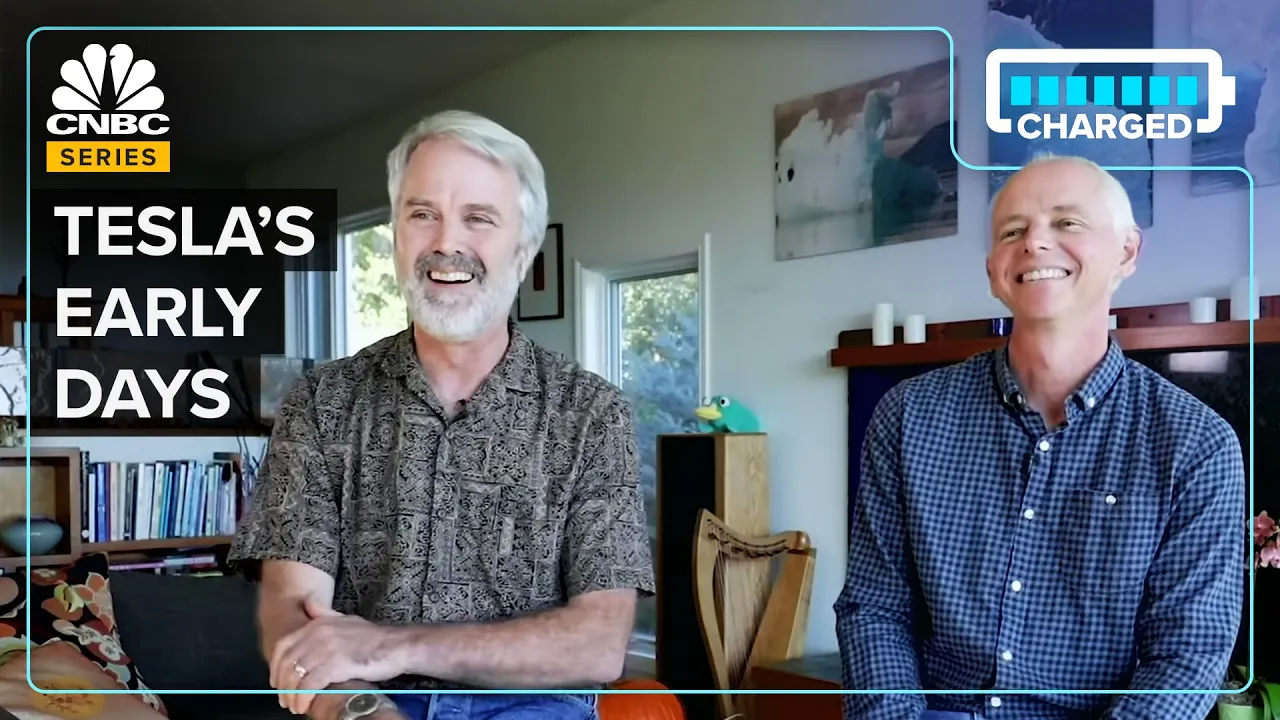
While Martin Eberhard and Marc Tarpenning reject Elon Musk's claim to have founded Tesla, they credit his appetite for extreme personal and technical risk with turning their original sports-car roadmap into reality.
AI-assisted summary of Tesla's Founders On Elon Musk And The Early Days — original source. Check the original for full context.
Source published:
Key ideas
- Tesla Motors was founded in 2003 by Martin Eberhard and Marc Tarpenning, with Elon Musk entering as an early Series A investor before eventually becoming its fourth CEO and second board chairman. (0:01)
- Elon Musk anchored Tesla's April 2004 Series A round with a $6.35 million personal investment, backing the founders' plan to scale consumer cylindrical lithium-ion cells based on their previous engineering work on the Rocket eBook. (9:47)
- Severe battery safety trials—triggered by a deliberate thermal runaway explosion in Eberhard's backyard—led Tesla to invent its non-propagation pack architecture and establish ultrasonic wire bonding as an EV manufacturing standard. (11:00)
- Tesla's progression from a niche high-performance sports car to a luxury sedan and an eventual mass-market vehicle was mapped out in the founders' original 2003 business plan to manage startup capital constraints. (21:00)
Detailed notes
## Background Published by CNBC on YouTube on February 6, 2021, this video features an in-depth interview with Tesla Motors' original founders and executives, Martin Eberhard and Marc Tarpenning. According to the page description, CNBC sat down with the pair to explore the 2003 founding of the company, the development of its lithium-ion battery technology, the creation of the original Roadster, and Elon Musk's true role in the early days.
## TL;DR Original founders Martin Eberhard and Marc Tarpenning clarify that they established Tesla Motors in 2003, well before Elon Musk joined as a Series A investor and eventual fourth CEO. They recount developing their top-down market strategy—starting with a high-performance sports car to shatter electric vehicle stereotypes—and mastering consumer lithium-ion pack safety through rigorous non-propagation testing. The founders also candidly address early manufacturing hurdles, the painful boardroom politics that led to Eberhard's 2007 ouster, and Musk's hyper-focused, risk-tolerant management style. Despite their exits, both express immense pride that Tesla successfully crossed the chasm into mass-market adoption and catalyzed the global shift away from fossil fuels.
## Atmosphere & style The interview carries a candid, reflective, and gently vindicating tone as the forgotten architects of Tesla set the historical record straight with measured composure rather than bitter resentment. Eberhard and Tarpenning display a natural, seasoned camaraderie, recounting harrowing startup memories—from deliberate backyard battery explosions to Arnold Schwarzenegger walking into an unfinished pavilion—with humor and engineering pragmatism. It feels like an intimate, authentic debrief on a technological revolution, balancing the sting of corporate heartbreak against deep, enduring pride in their foundational work.
## Bulletin - [00:01](https://www.youtube.com/watch?v=eblPwXFb7TE&t=1s) Tesla Motors was founded in 2003 by Martin Eberhard and Marc Tarpenning, with Elon Musk entering as an early Series A investor before eventually becoming its fourth CEO and second board chairman. - [09:47](https://www.youtube.com/watch?v=eblPwXFb7TE&t=587s) Elon Musk anchored Tesla's April 2004 Series A round with a $6.35 million personal investment, backing the founders' plan to scale consumer cylindrical lithium-ion cells based on their previous engineering work on the Rocket eBook. - [11:00](https://www.youtube.com/watch?v=eblPwXFb7TE&t=660s) Severe battery safety trials—triggered by a deliberate thermal runaway explosion in Eberhard's backyard—led Tesla to invent its non-propagation pack architecture and establish ultrasonic wire bonding as an EV manufacturing standard. - [21:00](https://www.youtube.com/watch?v=eblPwXFb7TE&t=1260s) Tesla's progression from a niche high-performance sports car to a luxury sedan and an eventual mass-market vehicle was mapped out in the founders' original 2003 business plan to manage startup capital constraints.
## Key takeaways - [00:01](https://www.youtube.com/watch?v=eblPwXFb7TE&t=1s) Martin Eberhard and Marc Tarpenning incorporated Tesla Motors on July 1, 2003, whereas Elon Musk joined later during the Series A round and became the company's fourth CEO. - [01:19](https://www.youtube.com/watch?v=eblPwXFb7TE&t=79s) Rigorous 'well-to-wheel' mathematical modeling across multiple energy sources proved to the founders that electric powertrains decisively beat internal combustion, clean diesel, and hydrogen fuel cells. - [03:07](https://www.youtube.com/watch?v=eblPwXFb7TE&t=187s) The core battery architecture originated from lessons learned at NuvoMedia, where the founders previously switched the handheld Rocket eBook from nickel-metal hydride to lithium-ion cells. - [05:15](https://www.youtube.com/watch?v=eblPwXFb7TE&t=315s) To bypass the prohibitive cost of building a car from scratch, the founders secured a letter of intent from Lotus Cars to supply vehicle chassis and assembly expertise. - [09:47](https://www.youtube.com/watch?v=eblPwXFb7TE&t=587s) Elon Musk invested $6.35 million in Tesla's April 2004 Series A funding round and assumed the role of chairman of the board after conventional venture capitalists passed on the concept. - [11:00](https://www.youtube.com/watch?v=eblPwXFb7TE&t=660s) Following backyard explosion experiments, Tesla established a non-propagation safety rule requiring that a runaway event in any single cell must never ignite neighboring cells. - [11:00](https://www.youtube.com/watch?v=eblPwXFb7TE&t=660s) Tesla pioneered ultrasonic wire bonding to connect nearly 7,000 cylindrical cells inside the Roadster battery pack after traditional resistance welding proved unreliable. - [15:29](https://www.youtube.com/watch?v=eblPwXFb7TE&t=929s) Customer deposits and pre-orders began unintentionally when early enthusiasts offered up to $100,000 upfront, which Marc Tarpenning tracked manually on a personal spreadsheet. - [17:23](https://www.youtube.com/watch?v=eblPwXFb7TE&t=1043s) Tier-1 automotive suppliers initially refused to supply critical safety components like airbags and seatbelts due to Tesla's minuscule production volume, requiring Lotus to broker relationships. - [17:23](https://www.youtube.com/watch?v=eblPwXFb7TE&t=1043s) Martin Eberhard was ousted as CEO in the summer of 2007 amid board disputes and severe transmission bottlenecks, leading to Elon Musk taking over as CEO in October 2008. - [20:11](https://www.youtube.com/watch?v=eblPwXFb7TE&t=1211s) Marc Tarpenning departed Tesla during the initial development of the Model S, citing family priorities, the multi-year commitment required, and the cultural shift following Eberhard's exit. - [21:00](https://www.youtube.com/watch?v=eblPwXFb7TE&t=1260s) Starting with a sports car allowed Tesla to alter the sluggish public perception of electric vehicles while benefiting from affluent buyers who tolerated rudimentary interiors and mechanical quirks. - [22:35](https://www.youtube.com/watch?v=eblPwXFb7TE&t=1355s) The founders attribute Elon Musk's impact to his extraordinary tolerance for personal financial risk and technical immersion, despite the organizational fallout his style often produces. - [24:31](https://www.youtube.com/watch?v=eblPwXFb7TE&t=1471s) Both founders remain Tesla shareholders and consider the company's ultimate legacy to be proving electric vehicles viable enough to force the global auto industry away from fossil fuels.
## Detailed walkthrough ### [00:01](https://www.youtube.com/watch?v=eblPwXFb7TE&t=1s) Who Actually Founded Tesla?
CNBC introduces Martin Eberhard and Marc Tarpenning as the original founding executives of Tesla Motors, addressing a misconception held by many members of the public who believe Elon Musk created the company. Eberhard and Tarpenning clarify that while Musk was an early Series A investor, an active board member, and deeply supportive financially, he came in well after the company had already been established. In fact, Musk was Tesla's fourth CEO and its second chairman of the board. Both founders readily acknowledge Musk’s extraordinary accomplishments in taking Tesla to historic heights alongside his achievements at SpaceX, but they express confusion over his insistence on claiming the "founder" title.
Martin Eberhard highlights this discrepancy directly: “I'm not sure why he has to also say that he was a founder when he wasn't.” Marc Tarpenning points out that while Musk has achieved undeniable feats, “he wasn't the founder in the sense of he wasn't you know, we started it.”
- Martin Eberhard and Marc Tarpenning founded Tesla in 2003. - Elon Musk entered during the Series A funding round. - Musk was historically the fourth CEO and second board chairman of Tesla Motors.
---
[01:19](https://www.youtube.com/watch?v=eblPwXFb7TE&t=79s) The Epiphany: Sports Cars, Middle East Oil, and "Well-to-Wheel" Math
Martin Eberhard and Marc Tarpenning first met in the 1980s. In 1997, they co-founded NuvoMedia, where they invented the Rocket eBook, one of the earliest handheld e-readers. The spark that led to Tesla arose from Eberhard’s personal life and passion for sports cars. Following a divorce, Eberhard found himself shopping for a serious performance car, but he felt intensely conflicted. The vehicles he loved delivered barely 18 miles per gallon at a time when overseas conflicts in the Middle East were visibly linked to oil dependence, and evidence for climate change was mounting. He concluded that he could not morally justify purchasing a gas-guzzler.
Eberhard looked into buying an electric vehicle like the GM EV1, but California's Zero Emission Vehicle (ZEV) mandate had just been gutted by automotive lobbying. Legacy car manufacturers responded by pulling leased electric cars off the road and literally sending them to the crusher. When Eberhard proposed building an alternative, Tarpenning met the idea with healthy skepticism, challenging him to verify what technology could truly beat internal combustion. Eberhard responded by calculating the complete "well-to-wheel" efficiency across every viable vehicle powertrain: gasoline, clean diesel, biofuels, hydrogen fuel cells, and electric drivetrains powered by diverse generation sources (coal, natural gas, and petroleum). The mathematical outcome was decisive: in every analyzed scenario, electric power comprehensively outperformed the alternatives.
As Eberhard recounted the realization: “And it was a surprise to both of us that every which way I did the numbers, the electric cars were a lot better than everything else.”
---
[03:07](https://www.youtube.com/watch?v=eblPwXFb7TE&t=187s) AC Propulsion and the Move to Lithium-Ion
Neither Eberhard nor Tarpenning possessed prior automotive manufacturing experience. In surveying the landscape for anyone building niche electric platforms, Eberhard uncovered AC Propulsion, a boutique outfit in Southern California that had assembled just three units of a rudimentary, go-kart-style electric vehicle called the tzero. AC Propulsion was on the verge of bankruptcy; its revenue stream had relied on contract development and demonstration prototypes for legacy automakers, work that vanished the moment California relaxed the ZEV mandate. Eberhard intervened by personally injecting capital into AC Propulsion to keep them afloat, hoping to commission a car for himself.
The existing AC Propulsion vehicle ran on heavy lead-acid batteries, which severely limited range and proved temperamental and unsafe. Drawing on their engineering experience at NuvoMedia—where the Rocket eBook team transitioned from nickel-metal hydride (NiMH) to lithium-ion chemistry between generations—Eberhard proposed swapping lead-acid cells for modern lithium-ion batteries. Eberhard funded the conversion, creating a crude yet functional lithium-ion battery pack inside the tzero. This platform served as the critical technical proof of concept for Tesla’s future powertrain.
Marc Tarpenning outlined their core operational division of labor: “Silicon Valley does those first things really, really well. So I was pretty convinced working with Martin and we were looking through the numbers and it was going to be possible to make the thing that made the car go. But I was very concerned we weren't going to be able to make the car to go around it.”
```mermaid flowchart LR accTitle: Evolution of Early Tesla Powertrain Concept accDescr: Diagram tracing the early hardware progression from NuvoMedia battery lessons to the AC Propulsion tzero lithium-ion proof of concept.
subgraph ConsumerElectronics["Consumer Electronics (NuvoMedia)"] N1["Rocket eBook Gen 1<br/>(Nickel-Metal Hydride)"] --> N2["Rocket eBook Gen 2<br/>(Lithium-Ion Pack)"] end
subgraph EVProofOfConcept["Automotive R&D (AC Propulsion)"] A1["tzero Sports Car<br/>(Heavy Lead-Acid Cells)"] N2 -.->|"Chemistry expertise"| A2["Converted tzero Prototype<br/>(Lithium-Ion Pack)"] A1 -->|"Eberhard funding & redesign"| A2 end
A2 --> FinalProof["Proven Powertrain Architecture<br/>for Tesla Motors"] ```
---
[05:15](https://www.youtube.com/watch?v=eblPwXFb7TE&t=315s) Crashing the Lotus Booth and Securing an Auto Partner
While the founders felt confident designing the computers, electric motors, and battery management systems, building an automotive chassis and exterior body presented an enormous challenge. Researching industry practices revealed that established auto manufacturers frequently outsourced key development and assembly functions. Seeking a specialty coachbuilder and sports-car manufacturer, Eberhard and Tarpenning flew to the 2002 Los Angeles Auto Show, tracked down the Lotus exhibition, and cornered their executives with an unsolicited pitch.
Intrigued by the Silicon Valley pair, Lotus leadership invited them to visit their headquarters in Hethel, England—a move Tarpenning described as an intentional filter to weed out unserious hobbyists. Eberhard and Tarpenning flew to Hethel immediately. The trip paid off: Lotus provided an official letter of intent indicating that if the venture secured funding and reached technical readiness, Lotus would explore acting as their vehicle assembly and engineering partner. Although legally non-binding, that letter gave the founders the external industrial credibility needed to convince skeptical venture capitalists.
On July 1, 2003, Eberhard and Tarpenning officially incorporated Tesla Motors.
---
[06:35](https://www.youtube.com/watch?v=eblPwXFb7TE&t=395s) Pitching Skeptical VCs and Partnering with Elon Musk
The initial phase was bootstrapped using Eberhard’s savings along with contributions from family and close friends. When the founders approached Sand Hill Road venture capital firms, they repeatedly ran into structural roadblocks. While the dedicated technology partners understood the computing and electrical architecture, unanimous or near-unanimous partner support was standard, and presentations were routinely torpedoed by unrelated partners—such as biotech leads—who fancied themselves automotive connoisseurs. Tarpenning joked that “almost every VC is actually an expert on cars,” with every partner convinced they were an above-average driver.
Eberhard and Tarpenning had crossed paths with Elon Musk earlier as early lifetime members (members 14 and 15) of the Mars Society, where Musk had delivered a guest lecture before he founded SpaceX. Meanwhile, AC Propulsion's leadership had been independently pitching Musk for investment capital, but the interpersonal chemistry between them deteriorated. Once AC Propulsion threw in the towel on Musk, their president informed Eberhard that Musk was fair game.
Eberhard emailed Musk, referencing their Mars Society introduction and requesting a pitch meeting. The founders traveled to Hawthorne to present to Musk at SpaceX’s original headquarters. Pitching someone engaged in orbital rocketry changed the entire dynamic; while traditional VCs viewed building a high-performance electric roadster as impossibly risky, Musk immediately grasped the scale and technical ambition.
Martin Eberhard framed their core mission to Musk: “In our original presentation, we said, look, we need to change the way the world thinks about electric cars, OK? Today, people think about electric cars as little ugly things that nobody wants to drive. And we know we can make an electric car that's very different.” Musk bought into the vision without hesitation.
[09:47](https://www.youtube.com/watch?v=eblPwXFb7TE&t=587s) Musk's Series A Investment and the Rocket eBook Battery Blueprint
To overturn the entrenched public perception that electric vehicles were sluggish, golf-cart-like compromises, Martin Eberhard and Marc Tarpenning knew their entry into the automotive world had to be radical. Their strategy was to launch with an uncompromising, high-performance sports car that would completely shatter existing stereotypes, and then systematically leverage that momentum to move downmarket into higher-volume, mainstream passenger cars as technology and scale permitted. When they pitched this top-down market strategy to Elon Musk, he grasped the logic instantly. In April 2004, Musk backed the vision by investing $6.35 million of his own fortune into Tesla Motors' Series A financing round, stepping into the role of chairman of the board.
The technological foundation of that vehicle was worked out in casual Silicon Valley fashion. Eberhard and Tarpenning met at a local coffee shop, armed as always with their engineering pads, to sketch out an audacious concept: scaling up the battery management principles they had mastered while designing the handheld Rocket eBook at NuvoMedia into an automotive-scale power plant. Though calculating the math on paper napkins and gridded pads seemed crazy to outsiders, the calculations proved to them that chaining thousands of commodity consumer cells into an integrated, actively managed system was entirely feasible.
As Eberhard explained of their strategic approach when pitching the concept: “And so we like to make something as a High-Performance sports car to to to destroy that old image of what electric cars were and then follow that up with with more mainstream cars getting more moving down market as it becomes more more possible.”
- **Musk's Series A check:** $6.35 million in personal funds invested in April 2004. - **Board role:** Musk assumed the position of chairman of the board upon closing the round. - **Origins of the pack:** Scaled directly from battery management systems developed for the Rocket eBook.
---
[11:00](https://www.youtube.com/watch?v=eblPwXFb7TE&t=660s) Backyard Explosions, Bay Fire Pads, and the Non-Propagation Rule
Building a car battery out of consumer lithium-ion cells had never been attempted at scale, and the team was inventing mechanical and thermal architectures entirely from scratch. Right around that time, dramatic videos of laptop battery fires were circulating widely on the internet. To understand the danger firsthand, the Tesla engineering crew took individual cells outside, charged them, and deliberately forced them into thermal runaway. Seeking a real-world test of a multi-cell module, Eberhard dug a deep pit in the backyard of his home in the hills, dropped in a sub-scale mock-up of the planned battery pack along with a camera, weighed it down with a heavy sheet of plywood, and remotely triggered thermal runaway. The ensuing blast caused an immediate halt to the company’s engineering milestones.
The dramatic backyard test convinced leadership that safety could not be treated as a secondary feature; they froze all long-term milestones into a day-by-day survival schedule until the lithium-ion safety puzzle was solved. They ceased testing in residential yards, renting a specialized industrial test pad on San Francisco Bay regulated by the local fire marshal. Eberhard instituted an uncompromising design principle across the entire engineering department: the pack had to be engineered under the baseline assumption that any single cell could spontaneously explode for completely unknown reasons, and the surrounding structure had to guarantee that runaway would never propagate to adjacent cells.
Solving non-propagation required creating an unprecedented manufacturing architecture from scratch. Traditional resistance welding—the standard method for connecting lithium-ion cells at the time—proved dangerously unreliable because engineers could not verify weld integrity during assembly. Tesla abandoned resistance welding in favor of ultrasonic wire bonding, an approach that has since become the standard benchmark copied across the EV industry. The team spent months experimenting with specialized adhesives, insulation barriers, and custom extruded liquid cooling tubes snaking between the cells. When Tesla announced it was packing nearly 7,000 individual cylindrical cells into a single vehicle floorpan, industry veterans thought the concept was sheer madness, yet that exact architecture laid the blueprint for every modern production electric vehicle.
```mermaid flowchart TD accTitle: Tesla Early Battery Safety and Thermal Runaway R&D accDescr: Flowchart illustrating the evolution of Tesla's battery pack development from initial safety fears to industry standard architecture.
subgraph Problem["Thermal Runaway Crisis"] A["Viral laptop fires raise safety alarm"] --> B["Deliberate runaway test in Eberhard's backyard"] B --> C["Schedule frozen: day-by-day safety priority"] end
subgraph Testing["Systematic Protocol"] C --> D["Testing moved to Bay fire pad under fire marshal"] D --> E["Golden Rule: Assume cell failure, prevent propagation"] end
subgraph Solutions["Pack-Level Innovations"] E --> F["Liquid cooling tubes snaking between cells"] E --> G["Wire bonding replaces unreliable resistance welding"] E --> H["Packaging nearly 7,000 cylindrical cells safely"] end ```
Eberhard emphasized the absolute safety standard he mandated for the battery team: “And this is where, you know, basically, I said as the company's gold standard that you have to prove on the battery design that that you should be able to assume that any of your cells in your battery system will, for reasons you don't understand, go into thermal runaway. And you have to prove that when it does, it does not propagate to itself.”
- **Backyard test location:** Eberhard's home in the hills, featuring a dug-out hole, camera, and weighted plywood cover. - **Controlled facility:** Subsequent destructive fire tests were relocated to a dedicated bay-side fire pad supervised by the fire marshal. - **Cell count:** Nearly 7,000 individual cylindrical lithium-ion cells packed together in the Roadster battery. - **Welding breakthrough:** Abandoned traditional resistance welding due to undetectable flaws; adopted wire bonding as the permanent production standard.
---
[13:58](https://www.youtube.com/watch?v=eblPwXFb7TE&t=838s) The 2006 Roadster Unveiling and Arnold Schwarzenegger's Early Arrival
Tesla officially unveiled the Roadster prototype to the world in July 2006 inside a massive event tent packed with crowds, blaring music, and deafening excitement. For the founders, it was both a technical milestone and an intensely personal family event. Eberhard brought his young children, recalling his daughter dressed up in a white dress and his son beaming with pride in a miniature tuxedo. As prototypes whisked VIPs and journalists around for demonstration rides, Eberhard spent hours on stage explaining the car's mechanics, welcoming attendees, and encouraging everyone to experience electric torque firsthand until the entire crew was completely exhausted.
The most vivid anecdote from the launch happened two full hours before the doors were scheduled to open. While the venue was completely empty and technicians were still setting up gear, a rumor floated around that California Governor Arnold Schwarzenegger might make an appearance. While Tarpenning and another engineer were busy dragging chairs across the empty tent floor, Schwarzenegger unexpectedly strode into the pavilion surrounded by an entourage of black cars. Completely caught off guard and realizing they were hours away from show readiness, the stunned engineers could not even utter a word—they merely pointed silently toward the prototype. Schwarzenegger walked over, climbed directly into the cockpit, and marveled at the vehicle.
Reflecting on the surreal encounter while setting up the venue, Tarpenning recounted: “And in walks Schwarzenegger and his sort of entourage of other cars. And he comes out and that neither of us we were both it was such a surprise and it was hours before we were ready and we just kind of pointed.”
---
[15:29](https://www.youtube.com/watch?v=eblPwXFb7TE&t=929s) Accidental Pre-Orders and Open-Book Engineering
Customer deposits and advance reservations, which later became a core pillar of Tesla’s business model, were never part of the original go-to-market plan. While the company was still in stealth mode, it held informal show-and-tell receptions at its San Carlos research and development facility. Leadership maintained an unusually transparent open-book policy with early patrons, displaying photos of bare internal chassis assemblies and candidly admitting engineering mistakes and development delays. This extreme honesty transformed prospective buyers into passionate participants who felt deeply invested in the mission rather than traditional automobile shoppers.
As word leaked beyond the inner circle, wealthy enthusiasts began showing up demanding to secure a place in line. Early angel investors insisted on handing over checks for the entire $100,000 purchase price upfront years before factory deliveries could begin, demanding to know their exact numerical spot on the waiting list. Tesla had no formal reservation system in place, forcing Tarpenning to create a quick spreadsheet on his personal computer to track deposit sequences. Realizing the immense working capital and organic market validation represented by these inbound requests, the founders quickly converted the ad-hoc spreadsheet into an official customer pre-order program.
Tarpenning described the unexpected enthusiasm of their early community: “Like, this is the most exciting thing I've been involved in, even though in some level they just wrote a check. But they were. But they they believed in the vision enough to write that check. And now they're participating in this process that we were going through.”
- **Facility location:** Tesla's early R&D center and offices were located in San Carlos, California. - **Deposit size:** Customers paid upfront sums as high as the full $100,000 vehicle price to reserve early build slots. - **Tracking system:** The original Tesla reservation list was a simple spreadsheet maintained directly on Marc Tarpenning's personal computer.
---
[17:23](https://www.youtube.com/watch?v=eblPwXFb7TE&t=1043s) Supplier Resistance, Founding Team Debates, and Eberhard's Ouster
The greatest challenge in bringing the Roadster to life was not the software or the powertrain, but the harsh reality of automotive supply chains. Early plans called for off-the-shelf components—such as conventional manual door handles—before the team opted for increasingly complex custom elements like electronic latches. Tier-1 automotive suppliers looked at Tesla's order volumes with outright skepticism. A run of specialized safety hardware like airbags, seatbelt pre-tensioners, and door latches for the Roadster totaled fewer units than an established automaker would blow through during a throwaway internal crash-test run. Suppliers saw zero commercial upside and massive product-liability risk from an underfunded startup. Without existing component relationships from Lotus Cars, which brokered introductions and vouched for the program, sourcing critical safety hardware would have been nearly impossible.
The early company culture was also marked by personal friction over internal credit and titles. Reflecting on early contributors, Eberhard dismissed later revisions to the founding story, pointing out that software engineer Genevieve Trevison joined the payroll on the exact same day as JB Straubel. If Straubel was retroactively awarded the title of company founder, Eberhard noted, Trevison had every right to the exact same distinction for her foundational contributions, yet had chosen to live a quiet private life outside the limelight.
By the summer of 2007, boardroom relations fractured beyond repair. Eberhard was abruptly stripped of the CEO title and forced out of the company in what he described as being voted off the island in a rude manner, culminating in contentious legal filings and confidential settlements. Musk subsequently took over as the company's fourth CEO in October 2008. At the time of Eberhard’s departure, the vehicle's core architecture was essentially finished, though development remained stalled by severe power electronics revisions and a notoriously fragile multi-speed transmission design that pushed Tesla to the brink of financial collapse.
Recalling his painful departure from the automaker he co-founded, Eberhard said: “Well, you know, I was voted off the island and in a rather rude way. And it wound up with some lawsuits and some settlements. And I, you know, it's history now, so I can't say a lot about it.”
- **Supplier volume hurdle:** Roadster parts orders were smaller than the prototype test fleets major automakers crash without ever selling to the public. - **Critical intermediary:** Lotus Cars provided the vital industry supplier connections required to purchase airbags, seatbelts, and latches. - **CEO transition:** Eberhard was ousted as CEO in the summer of 2007; Elon Musk assumed the chief executive role in October 2008 as Tesla's fourth CEO. - **Critical launch bottlenecks:** Redesigned power electronics and a fragile dual-speed transmission system nearly bankrupted the company before volume production could launch.
[20:11](https://www.youtube.com/watch?v=eblPwXFb7TE&t=1211s) Marc Tarpenning's Departure and the Shift to Model S
After surviving one of Tesla's early near-death experiences, the engineering teams began winding down their work on the Roadster design and shifting focus over to the company's new sedan initiative, the Model S, which had already been in low-level development for about a year. For co-founder Marc Tarpenning, this transition marked a natural inflection point. He looked at his life, realized he had three small children at home, and reflected on having spent five intense years doing nothing but Tesla. Taking on the sedan would mean committing to at least another five-year cycle.
Furthermore, Martin Eberhard had already departed the company, and without his longtime partner there, Tarpenning felt the environment simply was not as much fun anymore. He decided it was time to move on, leaving without bitterness or second thoughts. Looking back on the whole journey, Tarpenning viewed the experience as an extraordinary chapter that encompassed both the worst hardships and the greatest achievements of his career. As Marc Tarpenning reflected on walking away: “The whole thing was wonderful from the beginning to the end.”
- **Transition to the Sedan:** Engineers rolling off the Roadster design program were systematically transferred to what became the Model S project. - **Family and Time Commitments:** Tarpenning had three young kids and had dedicated five nonstop years to Tesla, anticipating that the sedan program would demand another five years of the same intensity. - **Absence of Eberhard:** Martin Eberhard's prior exit significantly altered the internal culture and enjoyment for Tarpenning, accelerating his decision to leave.
---
[21:00](https://www.youtube.com/watch?v=eblPwXFb7TE&t=1260s) The Original Business Plan and Starting with a Sports Car
Both founders emphasize that Tesla effectively restarted the modern electric vehicle revolution, transforming the entire global automotive industry from the groundwork laid in San Carlos. Eberhard points out that Tesla's modern trajectory directly mirrors the strategy laid out in their original business plan: prove the concept with the high-end Roadster, use that foundation to fund a premium large sedan or luxury SUV, and finally move down-market into a high-volume, smaller sedan segment. To have a massive global impact, entering that high-volume segment was mandatory, but trying to start there would have been fatal because the capital requirements were astronomical and the early company lacked manufacturing know-how.
```mermaid flowchart LR accTitle: Tesla Phased Vehicle Strategy accDescr: Three-phase product rollout moving from low volume to mass market
subgraph Phase1["Phase 1: Proof of Concept"] R["Tesla Roadster"] RNotes["Small market / High price<br/>Forgiving buyers<br/>Develop technology"] end
subgraph Phase2["Phase 2: Luxury Expansion"] S["Model S / Model X"] SNotes["Large premium sedan & SUV<br/>Bigger volume<br/>Scale manufacturing"] end
subgraph Phase3["Phase 3: Mass Market"] M3["Model 3 / Mass EV"] M3Notes["Enormous market size<br/>Capital intensive<br/>Broad global impact"] end
Phase1 --> Phase2 Phase2 --> Phase3 ```
Targeting the niche sports car market first was a calculated design choice. Beyond dramatically altering the stodgy public perception of electric vehicles, sports car buyers offered an indispensable buffer for an inexperienced automaker. Sports car enthusiasts are uniquely tolerant of crude, minimalist interiors, unpowered manual seats, and rudimentary infotainment systems; they often embrace quirks as character and readily forgive mechanical defects or recalls as long as customer service treats them with respect. As Martin Eberhard summarized the impact of their creation: “Without Tesla, there would not be electric cars today.”
- **Predictive Roadmap:** The founding business plan explicitly mapped out the progression from a low-volume sports car to an expensive sedan or SUV, followed by an entry-level mass-market car. - **Capital Barriers:** A startup could not initiate operations with a mass-market sedan because the financial burn and technological learning curve required preliminary stepping stones. - **Customer Tolerance:** Early Roadster buyers accepted sparse cabins, simple entertainment units, and manual seats because sports car consumers prize performance and uniqueness over utilitarian luxury.
---
[22:35](https://www.youtube.com/watch?v=eblPwXFb7TE&t=1355s) Assessing Elon Musk: Risk, Detail, and Collateral Damage
When asked whether the Elon Musk of today resembles the investor they first pitched in 2003, Eberhard and Tarpenning note with a laugh that his defining traits have simply amplified, observing that his “Elon-ness has increased over the years.” Tarpenning points out that Musk defies concise summarization because of his sheer complexity. He is exceptionally intelligent and immerses himself into the granular weeds of every project—a double-edged sword that drives innovation while simultaneously prompting puzzling demands that leave engineers wondering why specific trivial items are being contested.
What truly separates Musk, in their view, is his extraordinary tolerance for personal financial risk and technical exposure. He routinely bets everything on extreme, unorthodox ideas that appear entirely out of bounds to conventional business minds. While this approach inevitably leaves substantial organizational fallout in its wake, the high-stakes gamble often yields unprecedented breakthroughs when it succeeds. As Marc Tarpenning put it when assessing Musk's style: “He's willing to take on risks, you know, financial risks for himself personally and and technology risk when he's working on something new that are a little out there.”
- **Extreme Hands-On Focus:** Musk's tendency to delve into minute engineering details can either unlock rapid progress or introduce baffling complications. - **Risk Appetite:** Musk puts his own capital on the line and commits to high-wire technical bets that traditional corporate executives avoid. - **Execution Style:** While Musk's volatile methodology produces considerable internal collateral damage, it remains an undeniably effective engine for forcing difficult results into existence.
---
[23:34](https://www.youtube.com/watch?v=eblPwXFb7TE&t=1414s) Crossing the Chasm into the Mainstream
Tesla succeeded in building an intensely devoted following whose loyalty allows the brand to weather controversies that would cripple other automakers. The company has successfully navigated the difficult technology adoption chasm, evolving from an insular circle of mission-driven early adopters into mainstream consumer appeal. Tarpenning notes that many contemporary buyers purchase a Model 3 simply because it is an outstanding vehicle, not necessarily out of ideological environmentalism.
Even among casual drivers who have no idea who founded Tesla, Tarpenning frequently encounters an emotional attachment to the car that exceeds traditional brand affinities, including sports car legacies like Porsche. The visceral driving dynamics of an electric drivetrain—immediate torque and low-center-of-gravity handling—instantly set it apart from conventional internal combustion cars. As Martin Eberhard remarked regarding the brand's shift into widespread adoption: “And of course, a lot of people now who are buying the cars are just buying a car in some sense, which is in a way better.”
- **Devoted Fanbase:** Tesla built a community of enthusiasts eager to participate in a broader mission, extending extreme goodwill toward the product. - **Crossing the Chasm:** The transition from early adopters to ordinary consumers purchasing the Model 3 represents the crucial validation of the initial vision. - **Drivetrain Dynamics:** The instant acceleration and handling differences ensure drivers realize immediately that an electric vehicle does not handle like a legacy gasoline car.
---
[24:31](https://www.youtube.com/watch?v=eblPwXFb7TE&t=1471s) Preserving the Mission and Al Gore’s Wake-Up Call
Despite their past clashes and eventual departures, both Eberhard and Tarpenning state unambiguously that they remain shareholders and continue to root enthusiastically for Tesla's ongoing success. For them, financial returns align directly with the original imperative that motivated them to incorporate the company in 2003: proving that electric transport can alter the trajectory of climate change and clean energy adoption across the world.
To illustrate how deeply that purpose was woven into the company's DNA, Eberhard recalls an evening in the early days before Al Gore released *An Inconvenient Truth*. Gore was touring the country delivering his climate presentation, and the Tesla team attended a lecture at Stanford University. Walking out into the night afterward, a shaken Tesla colleague named Ron turned to Eberhard and insisted passionately that they had to find a way to do something about the crisis. As Martin Eberhard recounted: “And I said, Ron, what do you think we're doing? That's the whole point of the company.”
- **Active Supporters:** Both founders remain invested as shareholders and continue to cheer on Tesla's operational and financial milestones. - **Stanford Climate Lecture:** An early company outing to hear Al Gore lecture on global warming reinforced the existential urgency behind their engineering work. - **Mission-Driven Core:** The ultimate measure of Tesla's success for its original creators is whether it forces the global automotive industry to permanently abandon fossil fuels.
## Notable quotes > [21:00](https://www.youtube.com/watch?v=eblPwXFb7TE&t=1260s) Without Tesla, there would not be electric cars today. — Martin Eberhard
## Mentioned Martin Eberhard, Marc Tarpenning, Elon Musk, Tesla Motors, CNBC, SpaceX, NuvoMedia, Rocket eBook, General Motors EV1, AC Propulsion, AC Propulsion tzero, Lotus Cars, Mars Society, Arnold Schwarzenegger, Genevieve Trevison, JB Straubel, Tesla Roadster, Tesla Model S, Tesla Model 3, Al Gore, Stanford University, Porsche
## Video description Elon Musk is the most famous CEO of Tesla, but he's not the company's founder. Martin Eberhard and Marc Tarpenning founded the company in 2003 and were the original executives. CNBC sat down with them to talk about the idea for Tesla Motors, the battery, Elon Musk and building its first car, the all-electric Roadster.
» Subscribe to CNBC: https://cnb.cx/SubscribeCNBC » Subscribe to CNBC TV: https://cnb.cx/SubscribeCNBCtelevision » Subscribe to CNBC Classic: https://cnb.cx/SubscribeCNBCclassic
About CNBC: From 'Wall Street' to 'Main Street' to award winning original documentaries and Reality TV series, CNBC has you covered. Experience special sneak peeks of your favorite shows, exclusive video and more.
Connect with CNBC News Online Get the latest news: https://www.cnbc.com/ Follow CNBC on LinkedIn: https://cnb.cx/LinkedInCNBC Follow CNBC News on Facebook: https://cnb.cx/LikeCNBC Follow CNBC News on Twitter: https://cnb.cx/FollowCNBC Follow CNBC News on Instagram: https://cnb.cx/InstagramCNBC Subscribe to CNBC PRO: https://cnb.cx/2NLi9AN
#CNBC
Tesla Founders On Elon Musk And The Early Days
[Source](https://www.youtube.com/watch?v=eblPwXFb7TE)