Stallman Attacks Corporate DRM, Demands Ten-Year Copyright Limit
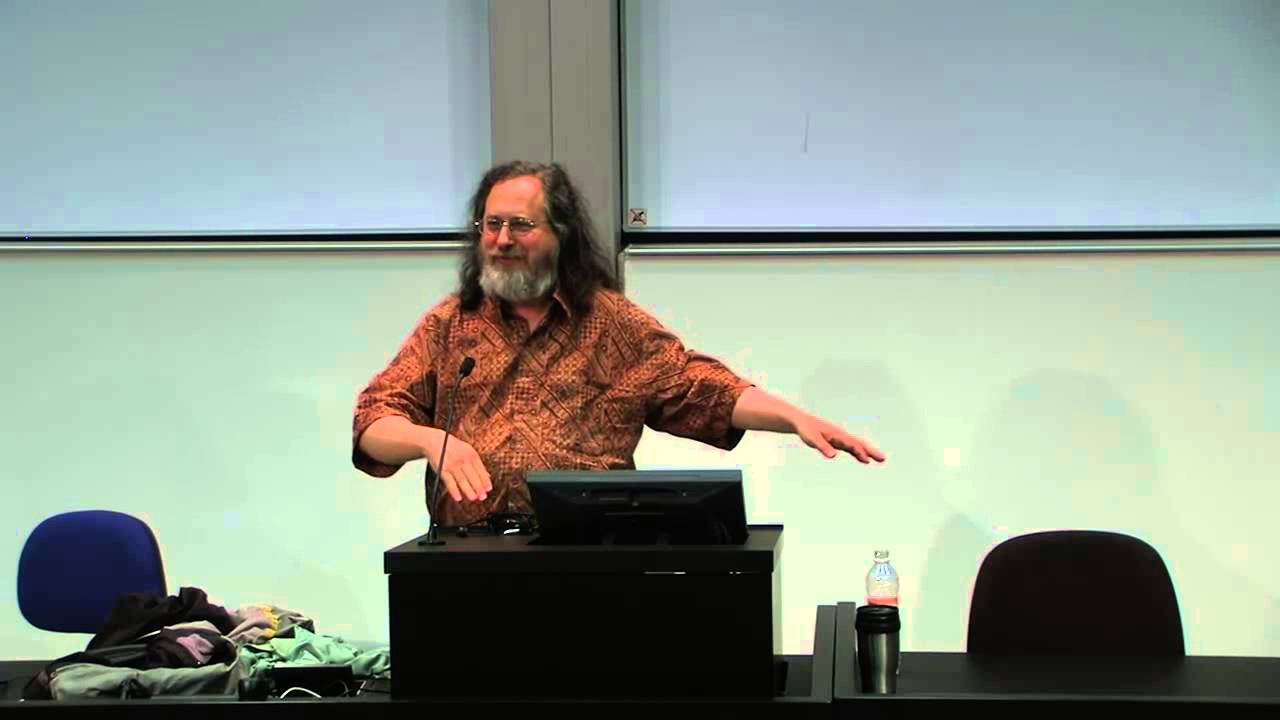
RU Computer Science
Because digital networks make copying effortless, enforcing modern copyright requires draconian surveillance that destroys public freedom unless terms are slashed to ten years and non-commercial sharing is legalized.
AI-assisted summary of Richard Stallman: Copyright vs. Community — original source. Check the original for full context.
Source published:
Key ideas
- Richard Stallman argues that copyright law has inverted from an industrial regulation on printing presses into an oppressive restriction on private citizens, requiring draconian surveillance and punishments to enforce. (26:29)
- To restore balance in the digital age, Stallman proposes reducing commercial copyright duration to a flat ten-year period from the date of publication. (62:36)
- Stallman delineates creative works into three distinct categories: functional works must be completely free (granting the Four Freedoms), works of opinion must protect against unauthorized alteration while permitting verbatim sharing, and artistic works should permit remixing and non-commercial copying. (67:35)
- To support working artists without enforcing artificial digital scarcity, Stallman advocates for public funding distributed via a cube root popularity formula alongside anonymous voluntary micropayments. (89:18)
Detailed notes
## Background Published on YouTube by the RU Computer Science channel on June 29, 2013, this video presents Richard Stallman's lecture delivered at Reykjavik University on November 7, 2012. According to the description, the talk explores how copyright laws originally tailored to the centralized technology of the printing press clash with modern computer networks, arguing that corporate lobbying for draconian punishments must be reversed to serve the public interest.
## TL;DR Stallman contends that computer networks have inverted the historic function of copyright, transforming an industrial regulation into an invasive system of surveillance and control directed at private citizens. He critiques abusive industry practices such as digital restrictions management (DRM), perpetual term extensions, and corporate malware, citing incidents like the Sony CD rootkit and Amazon's remote e-book deletions. To protect human rights and digital liberty, Stallman proposes legalizing non-commercial verbatim sharing, shortening copyright terms to a maximum of ten years, and ensuring functional works like software remain completely free. To sustain artists without corporate exploitation, he outlines alternatives including anonymous voluntary micropayments and a tax-funded public system distributed using a progressive cube-root formula.
## Atmosphere & style The presentation carries an austere, uncompromising, and deeply principled atmosphere, defined by Stallman's meticulous rules of engagement and dry, biting humor. Stallman speaks with righteous moral clarity, setting aside diplomatic pleasantries to frame the defense of digital autonomy not as a casual intellectual debate, but as an existential war against corporate encroachment. The lecture feels intimate yet combative, where blunt condemnations of tech giants give way to exacting, highly structured policy analysis and no-nonsense audience exchanges.
## Bulletin - [26:29](https://www.youtube.com/watch?v=eginMQBWII4&t=1589s) Richard Stallman argues that copyright law has inverted from an industrial regulation on printing presses into an oppressive restriction on private citizens, requiring draconian surveillance and punishments to enforce. - [01:02:36](https://www.youtube.com/watch?v=eginMQBWII4&t=3756s) To restore balance in the digital age, Stallman proposes reducing commercial copyright duration to a flat ten-year period from the date of publication. - [01:07:35](https://www.youtube.com/watch?v=eginMQBWII4&t=4055s) Stallman delineates creative works into three distinct categories: functional works must be completely free (granting the Four Freedoms), works of opinion must protect against unauthorized alteration while permitting verbatim sharing, and artistic works should permit remixing and non-commercial copying. - [01:29:18](https://www.youtube.com/watch?v=eginMQBWII4&t=5358s) To support working artists without enforcing artificial digital scarcity, Stallman advocates for public funding distributed via a cube root popularity formula alongside anonymous voluntary micropayments.
## Key takeaways - [02:44](https://www.youtube.com/watch?v=eginMQBWII4&t=164s) Free software is defined by user liberty rather than price, resting on four essential freedoms: the freedom to run, study and change, redistribute exact copies, and distribute modified versions of a program. - [06:32](https://www.youtube.com/watch?v=eginMQBWII4&t=392s) Proprietary software routinely subjugates users by embedding malicious capabilities, including surveillance spyware, digital restrictions management (DRM), and universal remote back doors. - [21:04](https://www.youtube.com/watch?v=eginMQBWII4&t=1264s) Copyright originated historically as a state censorship monopoly under the printing press and was framed in the US Constitution strictly as an industrial regulation to serve the public interest, not as an inherent natural right of authors. - [26:29](https://www.youtube.com/watch?v=eginMQBWII4&t=1589s) Computer networks restored the decentralized copying dynamics of antiquity, leading corporate publishers to demand intrusive home surveillance and anti-circumvention laws like the DMCA to maintain centralized control. - [30:05](https://www.youtube.com/watch?v=eginMQBWII4&t=1805s) Retroactive copyright term extensions, such as the Sonny Bono Copyright Term Extension Act, cannot incentivize past creation and serve primarily to secure perpetual corporate monopolies over public domain culture. - [35:44](https://www.youtube.com/watch?v=eginMQBWII4&t=2144s) Digital Restrictions Management creates artificial technical cartels that deliberately strip general-purpose computers and consumer electronic devices of functional capabilities. - [52:15](https://www.youtube.com/watch?v=eginMQBWII4&t=3135s) E-book ecosystems like the Amazon Kindle undermine fundamental human rights and traditional property ownership through surveillance dossiers, remote deletion back doors, and restrictive end-user licensing agreements. - [01:02:36](https://www.youtube.com/watch?v=eginMQBWII4&t=3756s) Copyright terms should be shortened to ten years from publication, which comfortably accommodates standard three-year commercial distribution cycles while enriching the public commons. - [01:07:35](https://www.youtube.com/watch?v=eginMQBWII4&t=4055s) Functional works—including computer programs, educational textbooks, recipes, reference encyclopedias, and fonts—must grant all four software freedoms because society requires practical tools to be freely adaptable. - [01:11:24](https://www.youtube.com/watch?v=eginMQBWII4&t=4284s) Non-commercial redistribution of exact copies must be completely legalized across all categories of published works to halt the war on sharing and the escalation of draconian punishments. - [01:52:17](https://www.youtube.com/watch?v=eginMQBWII4&t=6737s) The phrase 'intellectual property' should be rejected because it confuses public discourse by conflating entirely distinct legal frameworks, such as copyrights, patents, trademarks, and trade secrets. - [01:29:18](https://www.youtube.com/watch?v=eginMQBWII4&t=5358s) A cube root distribution model for public arts funding prevents wealth concentration among top celebrity superstars and shifts financial resources to mid-tier working creators. - [01:32:04](https://www.youtube.com/watch?v=eginMQBWII4&t=5524s) Voluntary online patron micropayments can effectively fund creators if payment infrastructure is built with strict cryptographic anonymity to protect citizens from financial surveillance. - [01:41:56](https://www.youtube.com/watch?v=eginMQBWII4&t=6116s) Scientific and academic literature must be published freely with rights to reanalyze and build upon research, rejecting proprietary journal paywalls.
## Detailed walkthrough ### [00:06](https://www.youtube.com/watch?v=eginMQBWII4&t=6s) Introduction and Preliminary Requests
Björn, Dean of the School of Computer Science at Reykjavik University, introduces Dr. Richard Stallman on behalf of the university and the local Free Software Foundation chapter. He highlights Stallman’s role as the founder of the Free Software Foundation and the creator of essential research tools, including GNU Emacs, the GNU Compiler Collection (GCC), the GNU Debugger (GDB), and the GNU General Public License (GNU GPL).
Taking the stage, Stallman clarifies that although he is primarily invited to speak because of his work in free software, this presentation addresses a question frequently asked at the end of his talks: whether these principles apply to areas beyond software. Before delving into the core subject, Stallman makes two explicit personal requests to the audience regarding privacy and distribution formats:
- **No Facebook photos**: Attendees must not upload photos of him to Facebook. Describing Facebook as a “surveillance engine,” Stallman notes that it tracks both users and non-users alike: “If you put the photo of someone in Facebook, you give Facebook another opportunity to collect information about that person.” - **Distribution in free formats only**: Any recordings of the lecture distributed publicly must use formats friendly to free software, specifically Ogg formats or WebM. Stallman explicitly forbids proprietary formats or wrappers such as MP3/MP4, Adobe Flash, RealPlayer, Windows Media Player, and QuickTime. - **Licensing**: Because the presentation reflects his personal opinions, Stallman requests that recordings be distributed under a Creative Commons Attribution-NoDerivs license.
---
[02:44](https://www.youtube.com/watch?v=eginMQBWII4&t=164s) The Four Essential Freedoms of Free Software
Stallman provides a foundational overview of free software, emphasizing that it concerns liberty rather than price: “free as in freedom, not as in price,” or “free speech, not free beer.” When software is non-free, he labels it proprietary or “user-subjugating software,” as it operates as an instrument of unjust power where the developer or vendor subjugates the user. Stallman posits a strict binary choice governing all computer software:
> “With software there are just two possibilities: either the users control the program or the program controls the users.”
```mermaid flowchart TD accTitle: User Control vs Program Control accDescr: Diagram illustrating the two possibilities in software control according to Richard Stallman.
A["Software Choice"] --> B["Users Control Program"] A --> C["Program Controls Users"]
subgraph Free ["Free Software"] B --> D["Individual Control<br>(Freedoms 0 & 1)"] B --> E["Collective Control<br>(Freedoms 2 & 3)"] end
subgraph NonFree ["Proprietary Software"] C --> F["Owner Controls Program"] F --> G["Unjust Power & Malicious Features<br>(Spyware, DRM, Backdoors)"] end ```
To establish genuine user control, software must grant four essential freedoms:
1. **Freedom 0**: The freedom to run the program as you wish. 2. **Freedom 1**: The freedom to study the source code and change it so the software performs your computing as you wish. 3. **Freedom 2**: The freedom to redistribute exact copies to others when you wish. 4. **Freedom 3**: The freedom to distribute modified versions to others when you wish.
Freedoms 0 and 1 deliver individual control, allowing a person to determine what the program does on their own machine. However, Stallman explains that individual control alone is insufficient: non-programmers cannot write code, and even skilled programmers lack the time to inspect and modify thousands of separate programs. Therefore, Freedoms 2 and 3 provide necessary collective control, empowering groups of users to cooperate, modify code together, and share the results. When any of these four freedoms are denied, the software controls the user, and the owner exercises unjust leverage over the software’s users.
---
[06:32](https://www.youtube.com/watch?v=eginMQBWII4&t=392s) Malicious Features in Proprietary Software
Stallman warns that when an owner holds unchecked power over users, the temptation to exploit that power becomes inevitable. Pointing to corporate behavior, he remarks that “corporations are psychopaths by their structure,” meaning they will naturally abuse their leverage for profit without hesitation. Consequently, proprietary software is routinely infected with malicious features, which Stallman categorizes into three primary forms: surveillance features (spyware), digital handcuffs (Digital Restrictions Management or DRM), and remote back doors.
He provides numerous real-world examples across modern computing platforms:
- **Microsoft Windows**: Contains spyware, digital restrictions management, and a universal back door capable of remotely installing arbitrary software modifications without the owner's permission. - **Apple macOS and iOS devices**: Stallman refers to Apple's mobile hardware as “iThings” and “monsters,” noting they incorporate surveillance, DRM handcuffs, and remote back doors. - **Adobe Flash Player**: Acts as malware containing both surveillance capabilities and DRM restrictions. - **Angry Birds**: Designed with tracking features intended to harvest user location data and report it back to a central server. - **Amazon Kindle**: Nicknamed the “Amazon Swindle” by Stallman because its software strips readers of traditional literary freedoms through surveillance and DRM. - **Mobile phones**: Most portable cellular phones contain tracking capabilities and universal back doors that can remotely convert the hardware into listening devices capable of eavesdropping across a room.
In contrast, free software provides a collective defense against malicious functionality. While an individual non-programmer might not identify hidden exploits, the wider free software community includes programmers who audit the source code. If malicious code is discovered, developers can remove it and release a clean, corrected version that the public can adopt.
---
[11:03](https://www.youtube.com/watch?v=eginMQBWII4&t=663s) History of GNU and Applying Freedoms to Physical Hardware
Stallman recounts founding the free software movement in 1983 with the goal of creating an entirely free operating system. He underscores that an operating system must be 100% free software, because even a single proprietary component deprives the user of their freedom: “it's got to be 100% free software, not just 99% free software.” He began developing the GNU system in January 1984. The final missing component was filled in February 1992, when the kernel Linux was released under a free software license, resulting in the complete GNU/Linux operating system.
Following the success and adoption of GNU tools, audience members began asking whether the Four Freedoms could be applied to physical objects and hardware. Stallman begins examining how these freedoms translate to tangible goods, starting with Freedom 0:
- **Freedom 0 for physical objects**: This represents the freedom to use the physical object as you see fit. Under standard property norms, consumers already enjoy this freedom. Physical manufacturers typically do not impose software-like end-user license agreements dictating how an object may be handled. - **Differentiating misuse from licensing**: While certain actions (such as fraud) are illegal, the restriction stems from general statutory law rather than a manufacturer's contractual license. Stallman notes: “fraud is illegal, but a pen doesn't come with a license saying you may not use this pen to commit fraud.” The prohibition applies equally whether one commits fraud with a pen, a pencil, a computer, or by drawing in the sand with a finger.
[14:13](https://www.youtube.com/watch?v=eginMQBWII4&t=853s) Adapting Software Freedoms to Physical Objects and Published Works
Richard Stallman examines how the core freedoms defined for software apply when translated to material goods. Freedom 1—the freedom to study and modify source code—must be adapted for physical objects as the freedom to study and alter the object itself. While purchasers generally possess this legal freedom, physical constraints dictate what is actually possible. Modifying an object depends heavily on its material: a wooden chair is relatively easy to adapt for practical use, whereas items made of metal or plastic pose severe technical difficulties. Electronic microchips represent the extreme limit of this constraint, where any attempt at physical modification results in total destruction. As Stallman remarks, “A chip is impossible to change if you tried you would just destroy it and this is not anybody's not due to anybody's malice it's just the nature of chips that they are that way not anybody's fault.”
Freedoms 2 and 3—the rights to copy, redistribute, and distribute modified versions—encounter an even sharper wall in the material realm. Physical copiers do not exist outside science fiction, with the minor everyday exception of key duplicators. Consequently, physical objects allow Freedom 0 (using the object) and Freedom 1 in theory, but practical material limits restrict modification, while Freedoms 2 and 3 are effectively irrelevant. The debate over making things non-free does not truly apply to physical goods. Instead, it becomes urgent for published works stored on computers, where digital tools empower users to duplicate, distribute, and alter content at will. Determining whether society permits users to exercise these capabilities is the central focus of the address.
- **Material modifiability spectrum**: Wood is relatively workable; metal and plastic present increasing difficulty; microchips are structurally impossible to modify without destroying them. - **Physical copying constraints**: Aside from key-cutting machines, physical duplication remains speculative fiction, rendering Freedoms 2 and 3 moot for physical items. - **The digital distinction**: Unlike physical artifacts, digital works permit effortless copying and manipulation, turning user freedom into an urgent regulatory question.
---
[16:48](https://www.youtube.com/watch?v=eginMQBWII4&t=1008s) Technology, Principles, and the Consequences of Actions
Interrupted by the stuffiness of the lecture hall, Stallman pauses briefly to request that someone open a door to let in the cool outside air. Resuming his argument, he focuses on how copyright law serves as the primary legal mechanism governing what individuals may do with non-software creative works. To evaluate what copyright law ought to prescribe, he argues that one must trace the intertwined evolution of legal statutes and copying mechanisms. Technological advancements do not overturn fundamental moral principles, but they dramatically reshape the real-world outcomes of specific actions, thereby altering moral and legal assessments of those acts.
To illustrate how technology shifts consequences without altering core ethics, Stallman offers a humorous hypothetical regarding resurrection technology. If medical science could unfailingly bring murder victims back to life, the crime of murder would lose much of its existential weight. Instead of imposing life sentences or execution, a judge might simply order the killer to pay the financial costs of manufacturing a replacement body. In that scenario, Stallman quips, Americans would find themselves buying "uninsured killer insurance," whereas in civilized countries, public healthcare systems would routinely absorb the expense. As Stallman summarizes the philosophical point: “Now changes in technology do not alter our basic principles because our basic principles are too deep to be reached by superficial things like technology but when we apply our principles to a specific question we do it by looking at the various things we might do and what their consequences would be and we judge those consequences.”
---
[19:25](https://www.youtube.com/watch?v=eginMQBWII4&t=1165s) Decentralized Copying in the Ancient World
Stallman traces the history of copying back to antiquity, when the sole method of reproduction was reading one copy and manually writing out another. Although this manual labor was slow and inefficient, it possessed crucial structural characteristics. It exhibited no economies of scale, meaning producing ten copies required exactly ten times the labor of writing a single copy. Furthermore, it required no specialized machinery or industrial infrastructure beyond standard writing implements, and demanded no skills beyond basic literacy.
Because of these low barriers to entry, manual copying formed an inherently decentralized system. Whenever an individual possessed a manuscript and the desire to transcribe it, reproduction took place locally. No legal apparatus resembling copyright existed in the ancient world. While rulers occasionally suppressed specific texts, such interventions were purely political or religious suppression rather than intellectual property enforcement. As Stallman explains, “In the ancient world if you had a copy and you wanted to make another nobody tried to stop you except in the case where the local potentate didn't like that book in that case he might do horrible things to you but that wasn't copyright that was censorship.”
- **Ancient copying dynamics**: Linear labor requirements (ten copies took ten times the effort of one), decentralized execution, and universal dependence on ordinary reading and writing skills. - **Absence of copyright**: Copying was unrestricted for ordinary readers; state interference took the form of monarchical or theological censorship rather than commercial monopoly enforcement.
---
[21:04](https://www.youtube.com/watch?v=eginMQBWII4&t=1264s) The Printing Press and the Origins of Copyright
The invention of the movable type printing press represented a massive leap in efficiency, but Stallman stresses that its benefits were profoundly non-uniform. The press revolutionized mass production, yet provided zero benefit to one-off copying; transcribing a single copy by hand remained faster than setting individual lines of type. Setting type required significant upfront labor and capital, but once established, the press yielded hundreds or thousands of identical pages rapidly and cheaply. Printing demanded heavy capital investment in specialized, expensive machinery—the press and type foundries—alongside specialized mechanical skills that ordinary literate citizens did not possess. This technological shift replaced antiquity's decentralized copying with a centralized production model, where texts were mass-produced in specialized workshops and physically shipped across commercial distribution networks.
Modern copyright emerged directly from this centralized industrial reality. Stallman traces the legal tradition to sixteenth-century England, where the Crown instituted copyright in 1557 as a formal mechanism of state censorship. Rather than protecting authors, the crown granted publishers a perpetual monopoly over approved books in exchange for state oversight. When this censorship mechanism lapsed in the 1680s, publishers lobbied parliament to regain their exclusive printing monopolies. Parliament responded in 1710 with the Statute of Anne, which restructured the monopoly around the author rather than the publisher, established a limited term of 14 years (renewable once if the author survived), and reframed copyright as an incentive scheme to foster writing. As Stallman observes, “Copyright began in the age of the printing press.”
```mermaid flowchart TD accTitle: Evolution of Copying Paradigms accDescr: Diagram illustrating the shift from ancient decentralized copying to centralized printing presses and finally to digital computer networks.
subgraph Ancient ["Ancient World: Manual Scribes"] A["Low-tech reading & writing"] --> B["Decentralized copying"] B --> C["No economies of scale; no copyright"] end
subgraph PrintAge ["Print Era: Printing Press"] D["Capital-intensive press & type"] --> E["Centralized industrial printing"] E --> F["Industrial regulation of publishers"] end
subgraph DigitalAge ["Modern Era: Computer Networks"] G["Universal digital copying"] --> H["Decentralized one-off replication"] H --> I["Publishers enforce restrictions onto general public"] end
Ancient --> PrintAge PrintAge --> DigitalAge ```
---
[24:03](https://www.youtube.com/watch?v=eginMQBWII4&t=1443s) Copyright as Industrial Regulation for Public Benefit
When the United States Constitution was drafted, delegates explicitly rejected proposals granting authors a natural property entitlement to their writings. Instead, the framers crafted the Copyright Clause (Article I, Section 8, Clause 8) to grant Congress the optional power to create a statutory copyright system. The clause made the public interest explicit: the sole constitutional justification for copyright was promoting progress in science and useful arts, granted strictly for limited times, rather than enriching creators. As Stallman points out: “Instead what the US Constitution says is that Congress can optionally establish a copyright system if it does the purpose of the system the stated explicit purpose is to promote progress in other words a benefit for the public not for the author and the copyright has to last a limited time.”
Under the technological conditions of the printing press, copyright operated smoothly as an industrial regulation. It targeted commercial publishers rather than private individuals, making enforcement straightforward: investigators needed only to inspect commercial bookstores to identify unauthorized editions. Because it did not police private homes or ordinary readers, the system remained largely uncontroversial. Society accepted a bargain in which ordinary citizens surrendered a theoretical natural right to operate a commercial printing press—a right they lacked the capital or machinery to exercise anyway—in exchange for the tangible societal benefit of an enriched literary commons.
- **U.S. Constitutional mandate**: Copyright is discretionary for Congress, exists solely to serve public progress, and must be strictly time-limited. - **Enforcement ease**: Compliance was audited at public bookstores and commercial printing houses, avoiding intrusive surveillance of private citizens. - **The historical bargain**: The public surrendered abstract, unexercisable mass-printing privileges in return for more published literature.
---
[26:29](https://www.youtube.com/watch?v=eginMQBWII4&t=1589s) The Digital Age and the Inversion of Copyright Law
Stallman emphasizes that if society remained anchored in the age of movable type, he would have no reason to criticize copyright frameworks. However, the rise of computer networks represents another profound technological discontinuity. Unlike the printing press, digital networks dramatically democratize one-off copying. While high-volume mass production remains marginally more efficient, the efficiency gulf between single-copy reproduction and mass duplication has essentially vanished. Digital systems restore the decentralized distribution dynamics of the ancient world, but supercharge them with instantaneous speed and near-zero marginal cost.
This technological transformation completely upends the social function of copyright law, even when statutory language remains unaltered. Because personal computers allow ordinary readers to duplicate and share texts, publishers seek to expand copyright enforcement beyond commercial presses directly into private homes, personal computers, and internet connections. Rather than regulating commercial intermediaries for the collective benefit of society, modern copyright operates as an intrusive control mechanism imposed directly onto the populace. As Stallman concludes regarding this institutional shift, “It's now a restriction on the general public controlled by the Publishers principally in the name of the authors.”
[28:33](https://www.youtube.com/watch?v=eginMQBWII4&t=1713s) The Breakdown of Copyright: No Longer Uncontroversial, Easy, or Beneficial
When copyright law is turned away from regulating industrial publishers and directed instead at ordinary readers, listeners, and viewers, the foundational assumptions that made the system tolerable collapse. Richard Stallman argues that the historical reasons for considering copyright acceptable are no longer relevant because society is confronting an entirely different phenomenon. Under this new dynamic, copyright fails three basic tests: it ceases to be uncontroversial, it is no longer easy to enforce, and it stops being beneficial to society. It is no longer uncontroversial because governments and corporations are actively seeking to restrict ordinary people, sparking widespread resentment and even giving rise to new political parties created specifically to fight copyright overreach. It is no longer easy to enforce because policing the entire population requires invasive surveillance into citizens' private homes, personal computers, and internet connections. Finally, it ceases to be beneficial because citizens can now directly exercise the natural freedoms to copy and share—rights that were previously traded away only because individuals lacked printing presses.
Stallman emphasizes that a healthy democratic government would respond to digital networks by returning those rights to the public and paring back copyright power. Instead, the opposite is happening across the globe. As Richard Stallman observes: “We can measure the sickness of democracy around the world by the tendency of governments to do the exact opposite.” Rather than adapting the law to safeguard citizens' natural liberties, governments cater to corporate lobbies and aggressively expand copyright monopolies.
[30:05](https://www.youtube.com/watch?v=eginMQBWII4&t=1805s) Extension in Time: The Time Machine Fallacy and Mickey Mouse
```mermaid flowchart TD accTitle: Copyright Expansion Dimensions accDescr: Flowchart illustrating the two dimensions of corporate copyright expansion: Time and Breadth.
subgraph Time["Dimension of Time"] T1["Historical baseline<br/>(Author's life + 50 years)"] --> T2["1998 Sonny Bono Act<br/>(+20 years added)"] T2 --> T3["Rolling 20-year extensions<br/>(Stealth perpetual copyright)"] T3 --> T4["Extreme cases<br/>(e.g., Mexico: life + 100 years)"] end
subgraph Breadth["Dimension of Breadth"] B1["Print era exceptions<br/>(Public domain baseline)"] --> B2["Pay-per-view universe<br/>(Total control over all uses)"] B2 --> B3["Digital restrictions management<br/>(DRM via proprietary software)"] B3 --> B4["Anti-circumvention laws<br/>(Criminalizing software tools)"] end ```
The expansion of copyright occurs along two distinct axes, beginning with the dimension of time. Around the world, terms of copyright protection have repeatedly been lengthened. The European Union implemented a major term extension on sound recordings and previously stretched textual copyright from 50 years after the author's death to 70 years. In 1998, the United States passed the Sonny Bono Copyright Term Extension Act—derisively dubbed the "Mickey Mouse Copyright Act"—adding an extra 20 years of coverage to both future and already existing works. Stallman attacks the constitutional pretext of the American law, pointing out that under the US Constitution, copyright exists exclusively to encourage the creation of new works for public progress.
Mocking the retroactive extension of past works, Stallman wonders how an extension today could possibly stimulate artistic production in the past without science fiction technology. As Richard Stallman dryly notes: “How can they encourage the making of more works in the past by extending copyright past works? They'd need a time machine, and if they have a time machine, strangely they haven't used it.” Extending rights on future works is equally bankrupt economically: calculating the discounted present value of potential earnings starting 50 years after an author's death yields a sum far too negligible to influence any rational working creator. The true motive, Stallman explains, was simple corporate rent-seeking:
> “In the US Congress, laws are for sale.”
The Walt Disney Company saw its exclusive monopoly on the earliest depictions of Mickey Mouse approaching expiration. Despite harvesting immense wealth from public domain fairy tales, Disney was determined never to permit its own works to enrich the public commons. By buying a 20-year reprieve, corporate interests bought time, but Stallman cautions that when 2018 arrives, they will inevitably demand another 20-year extension. While movie studios have admitted they want perpetual copyright, doing so openly would violate the US Constitution's requirement for "limited times." Instead, they pursue perpetual copyright on the installment plan, adding 20 years every two decades so nothing ever falls into the public domain again. Stallman cites Mexico as the most egregious existing case, where copyright lasts for 100 years after the author's death, virtually ensuring that a creator can die before a citizen is born and remain copyrighted until that citizen dies.
[35:44](https://www.youtube.com/watch?v=eginMQBWII4&t=2144s) Extension in Breadth: Digital Handcuffs and the DVD Conspiracy
The second and far more dangerous expansion lies in the dimension of breadth—which specific uses of a work copyright actually controls. In the printing press era, copyright functioned as a narrow set of legal exceptions carved out of a vast realm of unrestricted public activities; reading, lending, or reselling a book remained unencumbered freedoms. In the digital age, however, commercial publishers perceive an opportunity to claim absolute authority over every single interaction with a published work. Their ultimate goal is to impose a universal, metered "pay-per-view universe."
To realize this total dominion, publishers turn to malicious features built directly into consumer hardware and software, known as Digital Restrictions Management (DRM), or what Stallman terms "digital handcuffs." Stallman stresses that DRM is intrinsically tied to proprietary, non-free software, because only non-free code allows developers to subjugate the user. If an engineer placed digital handcuffs into free software, users would simply inspect the source code, remove the restriction, and share the liberated version. As Richard Stallman argues: “You can't restrict people by respecting their freedom; you only restrict people by taking away their freedom.”
The broader public first ran into DRM on video DVDs. DVD technology was deliberately engineered around proprietary, secret encryption algorithms. Under what Stallman characterizes as the "DVD conspiracy," manufacturers who wanted to build players were legally compelled to join an industry cartel, swear to keep the decryption algorithm secret, and deliberately cripple their players with uniform playback restrictions. This artificial barrier fell apart when independent programmers reverse-engineered the format and distributed a free software program to decrypt DVD video. For the first time, individuals could play legally purchased DVDs on their computers using entirely free software—and make digital copies.
- In 1998, the US government backed movie studios by passing the Digital Millennium Copyright Act (DMCA), making it illegal to develop or distribute software capable of breaking digital handcuffs. - Stallman argues that through anti-circumvention legislation, the state formally took the side of corporate publishers against the rights of its own citizenry.
[39:31](https://www.youtube.com/watch?v=eginMQBWII4&t=2371s) Global Anti-Circumvention Laws and the Arms Race of Blu-ray and Streaming
Following the precedent set by the United States, anti-circumvention mandates spread internationally. The European Union adopted its own version via a 2002 directive, an outcome Stallman cites as a compelling reason why independent countries should be wary of joining the EU. Furthermore, the US government systematically exported these draconian measures to other sovereign nations, including New Zealand and Colombia, by embedding them inside bilateral agreements that Stallman labels "free exploitation treaties."
Despite legal bans, users continued to share decryption utilities online, leading media conglomerates to engineer even more aggressive technical countermeasures. For Blu-ray discs, the industry deployed the Advanced Access Content System (AACS). Although programmers successfully cracked AACS and published working decrypters alongside leaked processing keys, the industry retaliated by implementing rotating encryption keys and additional layers of protection that alter every three months. Stallman laments that the free software community lacks the endless reverse-engineering resources required to sustain an arms race against quarterly encryption overhauls. Consequently, he cautions consumers against welcoming hostile consumer electronics into their lives. As Richard Stallman warns: “You should never use any product that was designed to attack your freedom unless you personally have available the means necessary to break the handcuffs.”
This hostile dynamic is magnified by internet video streaming platforms. Unlike physical discs, remote streaming providers deliver video through proprietary encrypted streams that can change the underlying encryption schemes within minutes if circumvention tools appear. Because any community effort to liberate the media can be neutralized instantaneously by the server, Stallman urges the public to outright reject streaming services that rely on digital handcuffs.
[42:36](https://www.youtube.com/watch?v=eginMQBWII4&t=2556s) Corrupt Music Discs and the Attack on Computers
The recording industry similarly attempted to restrict user freedom by imposing digital handcuffs on audio media around a decade prior. Major record labels began releasing physical discs that superficially resembled standard compact discs but deliberately violated official CD Red Book specifications. Stallman explains that activists began calling these media "corrupt discs" rather than compact discs, because publishers intentionally corrupted the disc layouts to prevent them from reading properly inside computer drives.
In response, consumers began compiling boycott lists to warn the public away from unstandardized releases. Stallman notes that this resistance pushed labels toward increasingly duplicitous engineering tricks. Rather than merely pressing squiggly, unreadable physical data tracks on the disc surface to confuse standard optical drives, companies looked for software-level interception methods, setting the stage for Sony's infamous rootkit scandal.
[43:24](https://www.youtube.com/watch?v=eginMQBWII4&t=2604s) The Sony Rootkit and Double Felonies
Richard Stallman details how Sony implemented copy protection by altering audio CDs. While the audio tracks were written standardly, Sony placed a software program on the disc that automatically ran upon insertion into a computer. The program took control of the machine, modified the operating system, and inserted code to restrict access to disc data. To hide its tracks, it actively tampered with core system utilities: it altered the command used to inspect system files so the software would remain invisible, and it modified the deletion routines so attempts to erase it would fail. Stallman emphasizes that this behavior is identical to malware: “If this starts sounding like a virus to you that's no coincidence, this is what viruses do.” He identifies this software as a rootkit used to hijack computers, stressing that deploying it constituted a felony that could have carried years of prison time.
```mermaid flowchart TD accTitle: Sony BMG CD Rootkit Execution Flow accDescr: Diagram illustrating how the Sony BMG audio CD executed a rootkit, altered the host OS, and violated the GNU GPL. subgraph CD["Infected Audio CD"] Disc["Audio Tracks + Auto-run Program"] end subgraph Infection["OS Compromise"] Rootkit["Rootkit Takes Control"] Mask["Alters System Commands (Hides Files)"] Persist["Interferes with Deletion Commands"] DRM["Restricts Audio Data Usage"] end subgraph Legal["Legal Consequences"] Felony1["Computer Tampering Felony"] GPLViolation["Commercial Copyright Infringement (GPL Violation)"] end
Disc -->|"Inserted into PC"| Rootkit Rootkit --> Mask Rootkit --> Persist Rootkit --> DRM Rootkit -->|"Uses GPL code without source"| GPLViolation Rootkit -->|"Unauthorized system takeover"| Felony1 ```
A second felony compounded the offense: portions of the rootkit code were copied directly out of a program licensed under the GNU General Public License (GPL). While explaining that the GNU GPL is just one of dozens of free software licenses listed on `gnu.org/licenses/license-list.html`, Stallman notes that it uniquely enforces copyleft: anyone redistributing or incorporating that code must release their derivative work under the GNU GPL to pass on the same freedoms. Because Sony incorporated copyleft code into proprietary restrictions without complying with the license, they committed commercial copyright infringement—which, ironically, had been made a felony by a 1996 statute lobbied for and purchased by corporations like Sony.
Stallman underscores the double standard in prosecution: “Of course Sony was never prosecuted because government officials in the US understand that the purpose of these laws is to maintain the power of companies like Sony over the people.” When victims sued Sony, Stallman laments that they focused narrowly on the underhanded engineering methods rather than the underlying evil purpose of restricting users. As a result, Sony settled by simply promising that future restrictive products would not rely on those specific stealth techniques.
- Dozens of licenses qualify as free software, but the GNU GPL is defined by its copyleft requirement to pass downstream freedoms forward. - The 1996 United States copyright law purchased by major media corporations made commercial copyright infringement a criminal felony. - Sony avoided criminal prosecution for both computer tampering and copyright infringement because corporate power is sheltered by state enforcement.
[46:46](https://www.youtube.com/watch?v=eginMQBWII4&t=2806s) PlayStation 3, Feature Downgrades, and the Boycott of Sony
Sony applied the lessons learned from the rootkit scandal directly to the PlayStation 3, pre-installing digital restrictions into the hardware before sale and designing them to be impossible to remove. This included AACS (Advanced Access Content System). When an independent developer managed to bypass these locks, Sony retaliated by stripping owners of functionality through forced updates. When the console was originally sold, buyers had the choice to run Sony's proprietary operating system and connect to the PlayStation Network, or install an alternative operating system (such as GNU/Linux).
Sony eliminated that choice by pushing a firmware update—which Stallman characterizes as a "downgrade." Users were placed in a coercive double-bind: install the update to retain access to the gaming network while permanently forfeiting the ability to run other operating systems, or refuse the update and be cut off from online gaming. Stallman calls this bait-and-switch outright swindling: “Now is that swindling or what?” Later, when another hacker succeeded in jailbreaking the hardware to restore control, Sony called in law enforcement against him. This hostile legal retribution prompted the Free Software Foundation to launch a global boycott against Sony products that remains active. Stallman directly urges the audience: “Don't buy anything from Sony.”
[48:21](https://www.youtube.com/watch?v=eginMQBWII4&t=2901s) Music DRM, Streaming Traps, and the Spotify Model
Stallman shifts to music distribution, recalling how digital rights management (DRM) on digital downloads largely vanished after record labels discovered that their contracts with Apple were unfavorable. Major labels experimented with DRM-free sales, discovered that "the sky didn't fall," and broad industry use of music DRM briefly receded. However, digital restrictions reemerged through music streaming platforms like Spotify.
Platforms like Spotify rely on proprietary client software specifically to impose digital handcuffs. Stallman points out that the single most natural, obvious feature of any digital audio client is saving an incoming stream to a local audio file. Streaming companies intentionally omit this capability, serving audio in proprietary, encrypted streams that require proprietary client code specifically built to withhold user agency. Stallman rejects industry claims that streaming media inherently prevents downloading: “And they want people to think that somehow because it's streaming you couldn't have this feature, that's ridiculous, of course you could; they just don't want to and they don't want to be blamed for their own decision, so they try to pretend it's not a decision.”
[49:45](https://www.youtube.com/watch?v=eginMQBWII4&t=2985s) The Evolution of E-Books and Stallman's Biography
The push to impose DRM also targeted books. Around the year 2000, publishers launched aggressive global public relations campaigns to push digital readers and encrypted e-books. Seeking to launch an e-book line targeted at technology enthusiasts, one publisher approached Richard Stallman to participate in an authorized biography of his life. Stallman laid down strict preconditions: the book had to be sold completely free of encryption, could not require non-free software to read, and readers had to retain the legal freedom to share it. When the publisher refused, the project was torpedoed.
A few months later, another publisher agreed to Stallman's ethical requirements, issuing the biography in traditional print while simultaneously releasing the digital text under the GNU Free Documentation License (GFDL), guaranteeing the four essential freedoms. After the original publisher ceased publication, the Free Software Foundation printed a revised second edition, authored by Sam Williams and updated with notes by Stallman. Stallman jokingly describes this edition as his unique "semi-autobiography," where his perspective is balanced against the original author's viewpoints, directing readers to `fsf.org` to purchase copies.
- Early e-books failed in the early 2000s primarily due to practical user inconveniences, not because consumers actively stood up for digital rights. - Because consumers rejected the early wave for usability rather than ethical reasons, Stallman accurately predicted that tech publishers would return with more restrictive systems.
[52:15](https://www.youtube.com/watch?v=eginMQBWII4&t=3135s) The Amazon "Swindle" and Human Rights Threats
Publishers returned to the market with dedicated hardware, which Stallman derides with mocking names: the "Sony Shredder," the "Barnes & Noble Schnook" (Nook), and the "Amazon Swindle" (Kindle). These devices systematically strip readers of the traditional liberties inherent to printed physical books.
```mermaid flowchart TD accTitle: Traditional Books vs. Amazon Swindle Comparison accDescr: Flowchart illustrating how traditional reader liberties are curtailed by Amazon's digital Kindle ecosystem. subgraph Traditional["Printed Physical Book"] Cash["Anonymous Cash Purchase"] Lend["Freedom to Lend, Gift, or Resell"] Permanent["Perpetual, Inalienable Possession"] end subgraph Swindle["Amazon 'Swindle' Ecosystem"] Track["Mandatory Identity Logging"] DRM_EULA["DRM + End User License Agreements"] Backdoor["Remote Administrative Backdoor Deletion"] end
Cash -.->|"Replaced by"| Track Lend -.->|"Replaced by"| DRM_EULA Permanent -.->|"Replaced by"| Backdoor ```
Stallman systematically catalogues the traditional freedoms destroyed by Amazon's architecture: 1. **Anonymous acquisition:** Physical books can be bought anonymously using paper currency. Amazon forbids cash purchases and mandates account identification, constructing comprehensive dossiers documenting every title a user purchases and reads. Stallman warns: “The existence of such a list threatens human rights, we cannot tolerate the existence of such a list anywhere.” 2. **Freedom to lend, share, or resell:** Physical books can be handed to a friend, donated, or sold to a used bookshop. Amazon strips these capabilities via DRM encryption combined with End User License Agreements (EULAs) claiming customers never own the book, merely licensing access subject to arbitrary terms. Stallman critiques Amazon's corporate mindset, observing that they do not genuinely believe in private property: “Amazon's idea of private property is everything belongs to us, which is not private property.” 3. **Freedom to keep a book permanently:** Amazon preserves a silent administrative back door to the devices. In 2009, Amazon demonstrated this power by remotely wiping authorized, legitimately purchased copies of George Orwell's *1984* from thousands of customer devices overnight. Stallman underscores the chilling irony of an authoritarian corporate wipe of a novel that coined "Big Brother" and warned against historical erasure. Following public backlash, Amazon issued an empty apology stating it would not repeat remote deletions unless legally compelled by the state—a caveat that Stallman finds deeply alarming.
[55:30](https://www.youtube.com/watch?v=eginMQBWII4&t=3330s) Author Overreach and the Harry Potter Boycott
To illustrate state-mandated censorship and arbitrary property control, Stallman recounts his boycott of J.K. Rowling's *Harry Potter* products. Desperate to maximize commercial hype, Rowling's publishers organized tightly synchronized global release dates. However, due to a retail handling error in Canada, one bookstore accidentally stocked and sold copies prior to the designated hour. Customers bought the books in good faith, and the retailer had no record of their identities.
Infuriated by the slip, the author secured a Canadian court injunction ordering citizens who had purchased the book not to read it. Stallman expressed utter disgust at an author and court ordering citizens not to read physical books they had paid for: “Literally that's what the court said: the people who had bought the book were ordered not to read the book.” Stallman promptly declared a boycott against purchasing Harry Potter merchandise. He clarifies that he does not urge people to avoid reading the stories—quipping that he leaves telling people what not to read to the author and the courts—but insists that ethical consumers should refuse to enrich the franchise and should instead borrow copies from a library or friends.
[57:39](https://www.youtube.com/watch?v=eginMQBWII4&t=3459s) The "Swindle" and the Threat of Remote Book Deletion
Stallman pauses briefly to ask the audience if someone could fetch him some water before resuming his critique of e-readers. He explains how Amazon's infrastructure fundamentally alters the balance of power between readers and authorities. In a traditional print world, if a court were to order a book banned or recalled, authorities could not simply enter people's homes to confiscate their copies, primarily because they had no record of who had bought, borrowed, or received them. With the Amazon Kindle—which Stallman deliberately refers to as the "Swindle"—the company maintains a direct record of purchases tied to user identities. In an analogous legal dispute, an authority or court can simply order Amazon to remotely purge the offending text from everyone's device.
Stallman warns that even absent an overt, 1984-style totalitarian regime, governments and courts may mandate remote deletions simply as a precautionary legal measure. Readers must protect themselves by refusing to store books on hardware with remote administrative back doors and by declining to identify themselves when acquiring reading material. Turning to George Orwell's classic novel, he underscores the supreme irony of Amazon having remotely deleted copies of *1984* from users' devices. He jokes about the etymology of the product's official branding: “Kindle means to start a fire, apparently a suggestion that the real purpose of this product is virtual book burning.”
- Stallman advises that readers should never keep books on devices featuring vendor back doors. - Readers must avoid identifying themselves during book purchases if they wish to prevent authorities from tracking and seizing their reading material. - While everyone should read *1984*, Stallman insists they should “clearly not [read it] in the Swindle.”
---
[59:45](https://www.youtube.com/watch?v=eginMQBWII4&t=3585s) Corporate DRM Conspiracies and the Defective by Design Campaign
Across all forms of digital media, Stallman argues, technology is systematically weaponized against users, turning personal devices into prison guards. While individuals must reject digital handcuffs unless they know how to break them, individual resistance alone is insufficient. Media conglomerates and technology vendors do not operate in isolation; they coordinate collective cartels designed to restrict the public's access to technology. These arrangements are not hidden secret cabals because the participating corporations are fully aware that state regulatory bodies support their agenda.
Stallman points directly to public consortiums such as the Advanced Access Content System (AACS), the encryption standard governing Blu-ray and HD DVD. He recalls reading the official AACS specification rules, which mandated that analog video outputs on compliant player devices would be completely forbidden after a specified deadline (around 2011 or 2013). Stallman contends that colluding to strip functional capabilities from consumer electronics should be treated as a severe crime comparable to price-fixing: “A conspiracy of companies to restrict the public's access to technology ought to be a grave crime, just like a conspiracy to fix prices—after all, attacking us in our freedom is even worse than attacking our wallets.” Because legal systems protect these corporate agreements rather than punishing them, the public must mobilize directly. To organize protests and expose DRM-laden systems, the Free Software Foundation created the Defective by Design campaign, hosted at `defectivebydesign.org`.
```mermaid flowchart TD accTitle: Corporate DRM Restriction Pipeline accDescr: Diagram illustrating how corporate consortiums enforce DRM restrictions with state backing and how the public resists via organized campaigns.
subgraph Industry["Corporate Cartels"] A["Consortiums & Licensing Bodies<br>(e.g., AACS)"] B["Mandate Anti-Features<br>(e.g., Banning Analog Outputs)"] A --> B end
subgraph Enforcement["Legal & Market Control"] C["State Backing & Non-Intervention"] D["Hardware Lock-In / Digital Handcuffs"] B --> D C --> D end
subgraph Resistance["Public Counter-Response"] E["Individual Boycott / Circumvention"] F["Collective Protest<br>(Defective by Design)"] D -.->|"Requires Collective Action"| E E --> F end ```
---
[01:02:36](https://www.youtube.com/watch?v=eginMQBWII4&t=3756s) Shortening the Duration of Copyright to Ten Years
Turning from existing corporate practices to policy solutions, Stallman asks what a genuinely democratic government would do. Instead of constantly expanding proprietary rights, a democratic legislature would reduce copyright powers to restore vital public liberties. The first reform must address the dimension of time: copyright terms currently last far too long and must be drastically curtailed. Stallman proposes reducing the copyright term to a flat ten years, beginning strictly on the date a work is published.
Stallman explains why the term must commence at publication rather than creation: until an author chooses to publish, the public possesses no copies, so restricting copying is irrelevant. Granting authors unlimited preparation time until publication causes no harm to the public sphere, but once the work is released, the ten-year timer begins. Stallman justifies the ten-year window by citing commercial publishing realities. The standard publishing cycle typically lasts only three years, after which the vast majority of books fall out of print. A ten-year term offers more than triple that window, providing ample commercial runway for the overwhelming majority of authors.
---
[01:04:14](https://www.youtube.com/watch?v=eginMQBWII4&t=3854s) Why Working Authors Demand Shorter Copyright Terms
Stallman recounts presenting his ten-year copyright proposal during a panel discussion with professional fiction writers. Rather than meeting resistance from an author demanding longer protections, an award-winning fantasy novelist on the panel immediately objected that ten years was excessive, insisting on: “nothing more than five.” Stallman admits that until that encounter, he had been partially taken in by publisher propaganda. Major publishers routinely justify copyright extensions under the pretext of defending "artists"—or "creators," a term Stallman disdains because it elevates authors into demigods who supposedly merit absolute dominion over ordinary citizens.
Publishers frequently showcase a tiny minority of ultra-wealthy celebrity authors to lobby for ever-harsher restrictions, leading the public to assume all creators share those views. In reality, ordinary working authors are exploited under publisher contracts. The fantasy novelist on the panel revealed that under his contract, all publishing rights would revert to him if the book went out of print. When eager fans wrote to him asking how to buy his book, the publisher refused to print new copies but simultaneously refused to formally declare the book out of print. The publisher used the copyright against the author to bar him from distributing his own story. Stallman emphasizes that while superstar authors like J.K. Rowling amass immense fortunes and become corrupted by maximizing profits, ordinary authors primarily want their works to be read and appreciated. For them, copyright terms exceeding five years provide no tangible economic benefit and serve only to obstruct their relationship with readers. Stallman explains that his own ten-year proposal is an intentionally conservative starting point aimed at minimizing radical disruption rather than pushing for the shortest possible duration.
- Major publishers exploit the elevated term "creators" to make authors sound like deities who deserve special regulatory privileges over the public. - The vast majority of authors never earn enough money to become corrupted by greed and prioritize having their creative work read and valued. - Long copyright terms allow publishers to hold works hostage when they let them languish out of print without formally reverting the rights to the author.
---
[01:07:35](https://www.youtube.com/watch?v=eginMQBWII4&t=4055s) The Scope of Copyright: Functional Works vs. Works of Thought
Moving beyond duration, Stallman analyzes the breadth of copyright: which activities and uses of a work should the law legitimately regulate? He divides creative works into three distinct categories based on their qualitative contributions to society:
1. Works used to do practical tasks (functional works). 2. Works that present what specific people think (works of opinion, thought, or testimony). 3. Artistic and entertainment works.
For functional works—which include computer software, cooking recipes, educational materials, reference encyclopedias, text fonts, and 3D printer blueprints for useful physical objects—the primary criterion is whether they successfully accomplish a practical job. While these works can exhibit secondary aesthetic appeal, their utility is paramount. Because users require complete control over the tools they rely upon to manage their daily lives, functional works must be completely free. Stallman insists that the public must enjoy the exact same Four Freedoms (to run, study, redistribute, and modify the work) for functional educational and technical materials as they do for free software.
By contrast, the second category consists of works that present the personal opinions, ideas, or witness testimony of individuals. Stallman argues these works do not need to be free in the same way, because they are not used as practical tools. Modifying an author's stated thoughts without consent amounts to public misrepresentation: “To publish a modified version of one of these works is to misrepresent somebody else, unless he gave you permission.” If an author consents to an edit as an accurate reflection of their thoughts, the modification is lawful without reforming copyright. Consequently, Stallman maintains that modified versions and commercial distribution of opinion pieces should remain restricted under copyright, with one non-negotiable exception: the public must have the unconditional legal right to share exact, non-commercial copies.
[01:11:24](https://www.youtube.com/watch?v=eginMQBWII4&t=4284s) The War on Sharing and Draconian Punishments
Richard Stallman clarifies how copyright should treat different types of uses: commercial uses should remain covered by copyright, as should modified versions, but noncommercial redistribution of exact copies—sharing—must be legalized for all published works. He argues that what has made copyright intolerable today is the aggressive war launched by publishers to prevent sharing, despite sharing being both inherently good and, thanks to digital technology, extremely easy. Because they seek to suppress something natural and beneficial, publishers must resort to increasingly cruel and disproportionate enforcement methods.
```mermaid flowchart TD accTitle: Escalation of Copyright Enforcement accDescr: Diagram illustrating the progression of draconian measures used to suppress digital sharing. A["Digital Handcuffs (DRM)"] --> B["Suing Teenagers for Hundreds of Thousands"] B --> C["Punishment on Mere Accusation (Abolishing Fair Trials)"] C --> D["ISP Collusion Schemes & Extreme Criminal Penalties"] ```
These measures began with digital handcuffs (DRM) that turn personal technology against the user. Enforcement then escalated to suing teenagers for hundreds of thousands of dollars, followed by punishing individuals based on mere accusations of sharing, entirely discarding due process. Stallman highlights the UK system where individuals are penalized without a trial: “Trials are irrelevant, proof that someone's guilty irrelevant; this is a matter of maintaining an unjust Empire's power, justice is irrelevant.” In the United States, an informal arrangement was established between major ISPs and publishers, orchestrated under President Barack Obama, wherein ISPs agree to informally punish their own subscribers upon receiving repeated publisher complaints. Stallman notes similar policies pushed onto other nations like Colombia (which faced Supreme Court scrutiny) and Japan, where unauthorized downloading of a single copy carries a sentence of two years' imprisonment. Mocking the trajectory of these measures, Stallman remarks that if these punishments fail, governments might resort to sending drones to fire rockets at people who share.
- In Japan, downloading a single unauthorized copy is penalized with up to two years of imprisonment. - Stallman argues that these extreme measures are not an accident: they are cruel precisely because they are trying to stop something that is fundamentally good.
[01:15:38](https://www.youtube.com/watch?v=eginMQBWII4&t=4538s) Artistic Works, Integrity, Shakespeare, and Remix
Stallman addresses the third category of creative works: artistic and entertainment works. Resolving whether modifications should be permitted is more complex because valid arguments exist on both sides. On one hand, an artistic work possesses an integrity that modification could destroy. While acknowledging that many authors willingly let Hollywood butcher their work for money, Stallman respects authors who refuse out of genuine artistic integrity. On the other hand, modifying existing art is a vital driver of artistic progress, exemplified by the traditional folk process where multiple artists incrementally transform a work into something rich.
He cites William Shakespeare, who frequently lifted stories from works published only decades earlier and refashioned them:
> “And if today's copyright law had been in effect then, that would have been forbidden, and of course those works would never have been written, and so the copyright holders would have said, 'Copyright's doing a good job, it's preventing Shakespeare making these cheap ripoffs of my work.'”
Because Shakespeare's works exist, we know they were profound contributions to human literature. To reconcile this tension, Stallman proposes that copyright on artistic works cover modifications and commercial uses for only 10 years, while permitting noncommercial sharing from day one. Because waiting a decade to publish a derivative adaptation is not an urgent emergency, the work can enter the public domain after 10 years, freeing anyone to produce modified versions.
However, Stallman distinguishes derivative modifications from remixing. Remix involves taking fragments of various works and assembling them into something fundamentally different from the source materials. Blocking remix perverts copyright's constitutional objective of encouraging new creative works. To protect remixing and broader public culture, Stallman argues that the United States doctrine of fair use should be adopted internationally and strengthened: rather than functioning merely as an affirmative legal defense raised in court, fair use should be an explicit, guaranteed statutory exception that the public can depend on.
[01:20:29](https://www.youtube.com/watch?v=eginMQBWII4&t=4829s) EULAs, Record Labels, and the Corporate Death Penalty
Stallman insists that end-user license agreements (EULAs) must not be permitted to strip away the remaining statutory rights that copyright law leaves to readers and listeners. When publishers and major record labels claim that sharing is "stealing from the musicians," Stallman calls it absurd:
> “The record companies took everything from the musicians, leaving nothing we could take if we wanted to.”
He explains that under standard record industry contracts, artist royalties are offset against production and publicity costs structured as an advance. Because sales virtually never suffice to repay these inflated recoupable expenses, artists almost never receive royalties beyond their initial advance—even if an album goes platinum. Instead, musicians make their living through live concert admissions and merchandise (fan gear). The primary benefit artists ever gained from record deals was publicity, a function that personal word-of-mouth and the internet can now provide without relying on what he terms the "hype industrial complex."
Stallman explains his personal practice of buying music exclusively on physical CDs. He refuses to download music over the internet because commercial platforms force users to identify themselves and bind them to restrictive EULAs, leaving them with fewer rights than owning a physical CD. While he has no quarrel with companies that manufacture and sell CDs—and wishes there were more local record stores—he reserves harsh judgment for the major labels:
> “The major record companies, the ones that lobbied for unjust laws and digital handcuffs, the ones that had their their tentacles sue teenagers for hundreds of thousands of dollars, what those companies deserve is to to be destroyed; they deserve the corporate death penalty.”
He concludes that copyright law should be restructured so that labels are actually forced to pay artists, before turning his attention to the astronomical sums involved in the production of movies.
[01:25:03](https://www.youtube.com/watch?v=eginMQBWII4&t=5103s) Movie Production, Hollywood Accounting, and "Systematic Crap"
Addressing skeptics who wonder whether big-budget films could still survive under his proposed copyright reforms, Richard Stallman deconstructs the claimed financial realities of filmmaking. A film producer once revealed to him that more than half of the staggering budget figures cited by studios does not actually go toward producing the film at all, but rather into marketing and publicity. The actual production costs are less than half of reported budgets, and even those numbers are routinely inflated using clever Hollywood accounting tricks. Furthermore, because commercial distribution and public exhibitions would still be restricted under his reduced copyright model, the industry would retain substantial revenue streams. At worst, studios might simply need to postpone using ultra-expensive visual effects for five years until the technology becomes cheap and accessible.
Even if Hollywood found itself unable to produce high-budget films under these changes, Stallman questions whether society would genuinely suffer any cultural loss. While emphasizing that he is unequivocally opposed to censorship—noting that no matter how disgusting a work may be, censorship is always far more disgusting—he insists that preserving human freedom takes precedence over underwriting mediocre entertainment. As Stallman sharply puts it: “Hollywood systematically makes crap.” He underscores that he deliberately chose the word "systematically" rather than "usually," because the studio system itself is designed to reliably generate low-quality work. Expanding on this judgment, Stallman concludes: “Rather the question is whether we should give up freedom we need to help them keep making crap; I'm not willing to.”
[01:26:57](https://www.youtube.com/watch?v=eginMQBWII4&t=5217s) Rejecting "Compensation" in Favor of Supporting Artists
Moving past movie studios, Stallman acknowledges that while his proposed system would continue funding artists in the same imperfect way copyright does today, society ought to find better mechanisms to support them directly. However, he adamantly rejects the vocabulary commonly used by copyright lobbies, starting with the phrase "compensating rights holders." In practice, "rights holders" almost never means the working artists; it means the commercial publishers who collect the vast majority of the money.
Stallman also dissects the underlying moral implications baked into industry jargon. "Compensation" inherently presumes that someone has suffered an unjust loss for which the listener is responsible and indebted. Yet when an individual listens to or appreciates a copy of a creative work, no tangible property is taken, and nobody suffers an injury. Similarly, "remuneration" describes payment owed in exchange for agreed-upon labor—such as paying hired musicians who play at a private party. Enjoying recorded music creates no moral or financial debt. As Stallman argues: “Those terms, compensation, remuneration, must be rejected because those imply that appreciating a work gives you a debt of money that you have to pay, but it's good to support artists.” Society should focus on constructive ways to fund artistic creation rather than framing culture as an unpaid bill.
[01:29:18](https://www.youtube.com/watch?v=eginMQBWII4&t=5358s) Public Funding and the Cube Root of Popularity
To replace restrictive copyright enforcement while ensuring creators can thrive, Stallman outlines the first of two proposed alternative funding models: a publicly funded distribution system. Under this framework, governments would raise revenue through the general national budget or targeted fees, such as a modest tax on internet connectivity. The collected funds would then be distributed among creative artists based on their popularity, as determined by statistical sampling and polling methods.
```mermaid flowchart TD accTitle: Stallman's Proposed Systems for Supporting Artists accDescr: Flowchart illustrating two parallel mechanisms to fund artists without restricting digital sharing: public funding distributed via a cube root formula and anonymous voluntary micropayments.
subgraph Method1["System 1: Public Funding via Cube Root"] A["Public Tax Revenue<br/>(Internet Fee or General Budget)"] --> B["Measure Artist Popularity<br/>(via Statistical Polling)"] B --> C["Calculate Payout using Cube Root<br/>(1,000x Popularity = 10x Payout)"] C --> D["Funds Shift to Mid-Tier Artists<br/>(Stars Receive Modest Share)"] end
subgraph Method2["System 2: Voluntary Micropayments"] E["Built-in Device Payment Button<br/>(e.g., $0.50 Nominal Fee)"] --> F["Fully Anonymous Payment Mechanism<br/>(Payer Identity Protected)"] F --> G["Sustainable Direct Support<br/>(Proven by DRM-free Bundles)"] end ```
The critical mathematical challenge lies in how payouts scale with popularity. Stallman rejects linear distribution—where an artist with twice the audience receives twice the payout—because superstardom creates massive statistical disparities. A celebrity performer might easily be a thousand times more popular than a talented, respected mid-tier artist. Under a linear payout, the superstar would soak up a thousand times more funding, directing virtually the entire public fund to wealthy celebrities who do not need it. Instead, Stallman proposes distributing funds in proportion to the cube root of an artist's popularity. Because the cube root of 1,000 is 10, a megastar a thousand times more popular than a working artist would receive only ten times as much money. Popularity still yields higher earnings, but the distribution curve tapers off rapidly:
- “So the effect of the cube root is to transfer money from the stars to the artists of medium popularity.” - The overwhelming bulk of the tax fund flows into the pockets of the large base of working, moderately popular artists where it does genuine economic good. - The tiny elite of superstar artists receives only a minor fraction of the total public pool, ensuring the system efficiently promotes the arts as a whole.
[01:32:04](https://www.youtube.com/watch?v=eginMQBWII4&t=5524s) Voluntary Micropayments, Anonymity, and the Humble Ebook Bundle
Stallman's second proposal relies on voluntary micropayments enabled directly by consumer technology. He envisions digital playback devices equipped with a universal payment button that lets users send a nominal sum—around fifty cents in the United States, or an optimized local equivalent in countries like Iceland—directly to the creator whenever they enjoy a work. The fee would be calibrated so that it is small enough for citizens to click once a day or once a week without financial strain. No one would be forced or legally penalized for skipping payments, and low-income individuals would never be pressured to contribute, since the non-poor majority can easily sustain the ecosystem on goodwill.
Real-world evidence already proves the viability of voluntary models. Stallman cites the inaugural Humble eBook Bundle released a month prior by prominent science fiction authors, which offered digital books free of digital restrictions management (DRM) and end-user license agreements under a pay-what-you-want model. Stallman notes: “They got a million dollars in two weeks of voluntary payments.” The organizers reported that their earnings rivaled those of New York Times bestsellers, purely through voluntary patron support.
However, Stallman identifies a major systemic failure in existing digital sales systems: the utter lack of transactional privacy. He insists that any payment mechanism must protect user freedom:
- “This button has to send an anonymous payment, at least anonymous as regards who's paying it.” - When Stallman contacted participating author Cory Doctorow to ask how readers could send anonymous payments via postal money orders, Doctorow replied that the project's volunteers lacked the administrative time to process paper mail. - Stallman retorts that with a million dollars in revenue, the organizers could easily afford to hire staff to handle money orders. - Because Stallman strictly refuses to engage in online commerce unless transactions can be made completely anonymously, he will not use credit cards or trackable web checkouts.
[01:36:22](https://www.youtube.com/watch?v=eginMQBWII4&t=5782s) FSF Involvement, Political Activism, and Transition to Q&A
Concluding the prepared portion of his lecture, Stallman points the audience to `gnu.org` and the Free Software Foundation's website at `fsf.org` for resources, political campaigns, and organizational information. He urges attendees to formally join the Free Software Foundation as associate members. For audience members who avoid online commerce, he offers an immediate offline alternative: they can hand him cash for their membership dues in person right after the talk.
Stallman clarifies a common misconception about contributing to the free software movement: non-programmers are needed just as urgently as coders. As Stallman emphasizes: “Well we, there are a lot of programming tasks we'd like people to do, but what we need even more is political activism and organizing; you don't need to know how to write code in order to volunteer to help us.” He invites anyone interested to consult `gnu.org/help` or speak with him directly about getting involved.
Transitioning to the audience question-and-answer period, Stallman sits down and tests the room's microphone. He warns attendees that he is partially hard of hearing, specifically when it comes to distinguishing spoken consonants. He asks that anyone posing a question speak slowly and loudly so that he can clearly understand and respond.
[01:38:19](https://www.youtube.com/watch?v=eginMQBWII4&t=5899s) Q&A Ground Rules, Hardware Freedom, and Scholarly Publishing
Richard Stallman opens the question-and-answer period by instructing attendees to enunciate clearly, stay brief, and dispense with opening pleasantries: “Carefully pronounce each consonant so I can tell what your question is and please be brief please don't start with apologies please don't start with praise just go straight to the point.” When an audience member asks about the laptop he uses on stage, Stallman identifies it as a Lemote Yeeloong, chosen specifically because its BIOS is completely free software. While Lemote is no longer producing that model, he hopes a suitable successor will appear by the following year. A lingering drawback of the Yeeloong was that it originally shipped with a non-free GNU/Linux distribution that had to be replaced; Stallman notes he hopes future manufacturers can be persuaded to pre-install fully free distributions so the Free Software Foundation (FSF) can officially endorse them.
A university library worker then asks how institutions can cope with crushing license fees for academic journals. Stallman answers bluntly: “The solution is scholarly publications must be free.” He recounts that he previously believed scholarly works only needed to be legally sharable. However, Michael Eisen of the Public Library of Science (PLOS) convinced him that scientific progress requires broader rights: modifying, reanalyzing, and building upon papers beyond simple verbatim copying. Stallman urges universities to adopt unyielding mandates requiring faculty and staff to publish only where free publication is permitted—at most within one year, though immediate free publication is far better.
Stallman acknowledges that 50 years ago, paper distribution was the only viable mechanism to disseminate research, meaning journal publishers were necessary and unblameworthy. Today, however, research belongs on the internet, and publishers that continue to lock articles behind paywalls and restrict reuse are “predatory dinosaurs” that must be discarded. He also rejects the widely used label "Open Access," arguing that the term centers on passive access rather than the public's affirmative right to reuse, remix, and redistribute research.
- Laptop hardware: Lemote Yeeloong, notable for running free software down to the BIOS level. - Policy recommendation: University mandates prohibiting non-free publication clauses, enforcing immediate or within-one-year public release. - Key figure: Michael Eisen (co-founder of PLOS), who persuaded Stallman that scientific literature requires full freedom of reuse, not just verbatim redistribution. - Terminology: Rejection of "Open Access" in favor of "free publication."
[01:42:33](https://www.youtube.com/watch?v=eginMQBWII4&t=6153s) Copyright Extensions, Rehashing Works, and Nuanced Legal Categories
An audience member asks whether extending copyright terms could theoretically incentivize artists to invent entirely new works instead of simply rehashing older material. Stallman dismisses the premise, explaining that commercial reuse—such as standard Hollywood adaptations and trope recycling—routinely avoids copyright infringement anyway: “If you're a professional you know what which aspects you could reuse and which at what level you'd have to write it afresh and you'll notice in fact that lots of use of old stories goes on in Hollywood uh copyright doesn't prevent that.” Long copyright terms merely dictate who pays licensing fees to whom; they do not curb derivative storytelling.
Addressing a broader question about how the law should handle differing kinds of creative output—such as utilitarian software, artistic works, and works expressing personal viewpoints—Stallman defends legal complexity against those who want a single, blanket rule. While some worry that judges would face difficult borderlines, Stallman insists that sorting out nuances is precisely what judiciaries exist to do: “To make simplicity be the highest priority means we have to make bad laws.” Applying uniform rules to inherently different types of works results in unjust and poorly targeted policy.
```mermaid flowchart TD accTitle: Legal Categorization vs Uniformity in Copyright accDescr: Diagram contrasting simplistic uniform laws against nuanced category-specific legal policy.
subgraph Flawed["Flawed Objective: Absolute Simplicity"] U["Uniform Blanket Law"] -->|"treats all works identically"| E["Inflexible Decisions"] E --> Bad["Bad Laws & Injustice"] end
subgraph Nuanced["Proper Objective: Tailored Treatment"] D["Judicial & Legislative Distinctions"] D --> C1["Functional Works<br>(Software)"] D --> C2["Artistic / Creative Works"] D --> C3["Opinion & Perspective Works"] C1 & C2 & C3 --> Fair["Appropriate Public Protections & Freedoms"] end ```
[01:45:44](https://www.youtube.com/watch?v=eginMQBWII4&t=6344s) The Danger of Proprietary Software and Social Media Surveillance
When asked how software developers can be incentivized to spend time and money writing programs without proprietary restrictions, Stallman rejects the premise outright: “Proprietary software is a trap that invites us to give up our freedom it shouldn't exist at all so uh any policy that enables a company to profit by making proprietary software is a bad policy we should make sure there is no proprietary software.”
The discussion moves to social networks, where an attendee points out that over 90% of Iceland’s population uses Facebook and similar platforms. Stallman makes a sharp distinction between services: while he views Twitter as comparatively benign, he condemns Facebook primarily for massive corporate surveillance, directing the audience to his personal site (`stallman.org`) for detailed critiques.
When pressed on whether any technology corporations can be trusted, Stallman clarifies that institutional trust is an unhelpful framing. What matters is analyzing specific actions. He concedes that some proprietary programs may lack deliberately malicious code (such as backdoors or spyware), but they remain inherently unethical because non-free code deprives users of control and invites corporate abuse: “Proprietary software is a scheme that gives the company power over people that's where it's bad so there shouldn't be proprietary software and as long as there is we should be wise enough to refuse to have it.”
[01:49:35](https://www.youtube.com/watch?v=eginMQBWII4&t=6575s) Electoral Politics, Wikileaks, and the Critique of "Free Information"
After briefly negotiating question-taking logistics with the event organizers, Stallman is asked about the concurrent U.S. presidential election between Barack Obama and Mitt Romney. Stallman reveals he voted for Green Party candidate Jill Stein: “I voted for Jill Stein the Green Party candidate because I refuse to vote for either of the two Republican candidates either Romney or Obama.” He argues that the Democratic Party has steadily drifted so far to the right that Obama stands to the right of Richard Nixon and, in certain respects, Ronald Reagan. Stallman strongly rejects "lesser of two evils" voting, warning: “Nah if you do that it keeps getting more and more evil as as long as Democrats figure that people will vote for these right-wing policies that they don't support just because the other choice seems to be somebody even worse they'll keep getting worse.”
Finally, Stallman touches on Wikileaks and transparency activism. While expressing admiration for Wikileaks' work exposing state wrongdoing, he cautions against vague slogans like "free information." He emphasizes that individuals deserve strict data privacy, revealing that he refuses to own a mobile phone because mobile networks function as pervasive tracking systems. State secrecy must be rolled back to protect democracy, but personal data must never be collected or exposed in the name of information freedom: “If you advocate free information it sounds like you're saying everybody's personal information should get published and I don't believe our personal information should even get collected.”
[01:52:17](https://www.youtube.com/watch?v=eginMQBWII4&t=6737s) Rejecting "Free Information" and the Fallacy of "Intellectual Property"
When asked about the concept of "free information" and how software patents fit into the discussion, Richard Stallman draws a hard conceptual boundary. He explains that he avoids using the phrase "free information" because it creates a facile, misleading analogy with free software. The ethical considerations, legal frameworks, arguments, and conclusions are completely distinct and have nothing in common. Similarly, he declines to bundle software patents into a lecture focused on copyright. Despite widespread public confusion, patents and copyrights have virtually nothing to do with each other; their legal mechanisms, durations, and social consequences operate in fundamentally different ways.
Stallman attributes this widespread confusion to the bogus umbrella term “intellectual property,” a phrase he refuses to utter without verbal scare quotes. The term lumps together a dozen disparate areas of law—such as copyrights, patents, trademarks, and trade secrets—that share no common legal history or social purpose. Because of this artificial grouping, the public mistakenly presumes these laws must share underlying principles. In law school, as Stallman points out, students learn immediately how completely different these statutes are. For his part, he prefers the term "computational idea patents" because it accurately depicts the threat software patents pose, pointing listeners to his articles on `gnu.org/philosophy` and a recent piece he published in *Wired* magazine outlining strategies to protect programmers.
```mermaid flowchart TD accTitle: The Mirage of Intellectual Property accDescr: Diagram illustrating how the umbrella term intellectual property misleadingly groups completely unrelated legal frameworks.
subgraph Propaganda["Misleading Generalization"] IP["'Intellectual Property'<br/>(Confusing umbrella term)"] end
subgraph RealLaws["Distinct Legal Frameworks"] CR["Copyright Law<br/>(Literary & artistic works)"] PAT["Patent Law<br/>(Functional ideas & inventions)"] TM["Trademark Law<br/>(Consumer source-identification)"] TS["Trade Secrets<br/>(Confidential commercial info)"] end
IP -.->|"Misleadingly lumps together"| CR IP -.->|"Misleadingly lumps together"| PAT IP -.->|"Misleadingly lumps together"| TM IP -.->|"Misleadingly lumps together"| TS ```
- When asked to identify the downloadable book project he mentioned earlier in the lecture, Stallman confirms its official title: the *Humble eBook Bundle*. - “Every time someone uses that term he's talking about a dozen or so unrelated laws that do totally different things,” Stallman observes regarding "intellectual property."
---
[01:55:23](https://www.youtube.com/watch?v=eginMQBWII4&t=6923s) Why Debating Corporate Lobbyists Is a Trap: "This Is War"
An audience member asks whether Stallman would ever share a platform or debate stage with corporate spokespeople representing the copyright and publishing industries. Stallman answers that he almost certainly would not. He notes that corporate narratives already dominate mainstream news outlets and are inculcated into the public to such an extent that everyday citizens can recite them by heart. Putting a corporate representative on stage does not produce an enlightened exchange; instead, skilled debaters who care about winning rather than truth or justice deliberately introduce irrelevant details and red herrings. Facing obscure factual claims on the fly, Stallman notes that he could not verify or debunk them on the spot, leaving the false impression that he was uninformed even if he could completely dismantle the arguments a week later.
Furthermore, Stallman refuses to lend his name and credibility to amplify corporate opposition. If an industry adversary is already famous, they will never agree to debate; if they are unknown, Stallman’s participation merely serves as free publicity to draw an audience to hear anti-freedom propaganda. Rejecting the framing that public advocacy is merely an entertaining spectator sport, Stallman views corporate encroachment on computing and sharing as a direct assault on civil liberties.
- “I don't consider this, this is not like a sporting event: This is war,” Stallman insists. “They started the war and we're fighting to defend ourselves.”
---
[01:58:00](https://www.youtube.com/watch?v=eginMQBWII4&t=7080s) Sustaining Free Software Careers and Navigating Politics
The dialogue turns to economic survival: how can students graduating from computer science programs build viable, sustaining careers while writing exclusively free software? Stallman highlights several practical economic models. Crowdfunding platforms are demonstrating increasing success in financing independent free software development. Public procurement represents an even larger lever: governments spend enormous sums on custom software contracts and should implement binding policies requiring all taxpayer-funded software to be released to the public under free licenses. Beyond original software creation, technical fields like systems administration face severe labor shortages; a skilled GNU/Linux systems administrator in the United States, for instance, commands a high salary.
When a participant asks how local activists can persuade their own government to adopt free software policies, Stallman declines to offer a tactical political roadmap. He explains that while he can readily provide the ethical and utilitarian arguments, navigating specific legislative machinery depends entirely on local circumstances. As a visitor, he does not know the nuances of Icelandic parliamentary politics. By contrast, he observes grimly that in his own home country, the American political establishment remains thoroughly captured by corporate power, rendering conventional legislative lobbying largely futile.
- “Governments fund a lot of software development and they could just as well take the position that all software they fund will be released as free software unless there's some very special reason why not to release it at all,” Stallman argues.
---
[02:00:35](https://www.youtube.com/watch?v=eginMQBWII4&t=7235s) Video Games, Surveillance Advertising, and the 10-Year Copyright Rule
Audience members raise several specific implementation questions spanning digital entertainment, copyright duration, and online commerce. An attendee asks about video game developers who use proprietary end-user license agreements (EULAs) and restrictive architectures to enforce matchmaking rules and prevent cheating. Stallman replies that technical restrictions do not even succeed on their own terms, as dedicated cheaters routinely circumvent them anyway. More fundamentally, justifying restrictions on the grounds of fair play cannot excuse stripping users of software freedom. His advice is simple: refuse to play proprietary video games or massively multiplayer online games (MMOs). Instead, gamers should run free games and play with friends they know and trust rather than relying on digital shackles to police strangers.
Other audience questions address commercial practices on the web: - **The 10-Year Copyright Term:** An author asks what happens if a writer publishes successive editions of an ongoing work. Stallman clarifies that under his proposed 10-year term limit, each distinct version or edition carries its own 10-year copyright. Once the initial 10-year period expires for the first edition, members of the public are free to copy, modify, and expand upon that original text. - **Anonymous Payments:** Asked whether anonymous payments on the web are viable, Stallman emphasizes that cryptographic tools and technical mechanisms have existed for years; the obstacle is political and organizational resistance from financial institutions, not a lack of technology. - **Steam and In-Game Advertising:** Stallman notes that Valve's Steam platform is unacceptable because it functions primarily to distribute non-free games. Regarding advertisements, Stallman clarifies that he does not oppose advertising in itself—especially since users of free software retain the freedom to modify the code to strip ads out. What he fiercely opposes is the pervasive surveillance apparatus deployed by modern advertising networks to track users. - “I have nothing against showing me different ads, but I am against the surveillance,” Stallman emphasizes.
---
[02:04:19](https://www.youtube.com/watch?v=eginMQBWII4&t=7459s) Is Cyberspace Liberation Possible?
As the two-hour lecture draws to a close, a final listener asks a sobering question: given that the vast majority of computer users appear too spoiled by convenience to boycott proprietary systems or resist corporate control, do digital rights advocates have any genuine chance of winning this struggle?
Stallman offers a nuanced, pragmatic perspective on victory. While the overarching mission must always remain the total liberation of all cyberspace, success is not an all-or-nothing proposition. Carving out individual autonomy, maintaining personal digital freedom, and building self-reliant communities using free software represent meaningful victories in their own right, even when the broader society remains locked within proprietary ecosystems. Every person who breaks free weakens the corporate enclosure and proves that an ethical computing lifestyle is achievable.
- “The goal is the liberation of all of cyberspace, but if we manage to win some freedom for ourselves that's worth doing,” Stallman concludes before the audience erupts into applause.
## Notable quotes > [02:44](https://www.youtube.com/watch?v=eginMQBWII4&t=164s) With software there are just two possibilities: either the users control the program or the program controls the users. — Richard Stallman
> [59:45](https://www.youtube.com/watch?v=eginMQBWII4&t=3585s) A conspiracy of companies to restrict the public's access to technology ought to be a grave crime, just like a conspiracy to fix prices—after all, attacking us in our freedom is even worse than attacking our wallets. — Richard Stallman
> [39:31](https://www.youtube.com/watch?v=eginMQBWII4&t=2371s) You should never use any product that was designed to attack your freedom unless you personally have available the means necessary to break the handcuffs. — Richard Stallman
> [00:06](https://www.youtube.com/watch?v=eginMQBWII4&t=6s) If you put the photo of someone in Facebook, you give Facebook another opportunity to collect information about that person. — Richard Stallman
> [02:00:35](https://www.youtube.com/watch?v=eginMQBWII4&t=7235s) I have nothing against showing me different ads, but I am against the surveillance — Richard Stallman
> [02:04:19](https://www.youtube.com/watch?v=eginMQBWII4&t=7459s) The goal is the liberation of all of cyberspace, but if we manage to win some freedom for ourselves that's worth doing — Richard Stallman
## Mentioned Richard Stallman, Björn, Reykjavik University, Free Software Foundation, GNU Emacs, GNU Compiler Collection (GCC), GNU Debugger (GDB), GNU General Public License (GNU GPL), GNU, Linux, GNU/Linux, Facebook, Twitter, Apple, Microsoft Windows, macOS, iOS, Adobe Flash, RealPlayer, Windows Media Player, QuickTime, Angry Birds, Amazon, Amazon Kindle, Barnes & Noble, Nook, Sony, Sony BMG, PlayStation 3, PlayStation Network, Spotify, Steam, Valve, George Orwell, 1984, J.K. Rowling, Harry Potter, William Shakespeare, Barack Obama, Mitt Romney, Richard Nixon, Ronald Reagan, Jill Stein, Green Party, Wikileaks, Cory Doctorow, Michael Eisen, Public Library of Science (PLOS), Humble eBook Bundle, Lemote, Lemote Yeeloong, Wired, Defective by Design, Advanced Access Content System (AACS), Digital Millennium Copyright Act (DMCA), Sonny Bono Copyright Term Extension Act, Statute of Anne, Walt Disney Company, Mickey Mouse
## Video description On the 7th of November 2012, Richard Stallman held a lecture at Reykjavik University, entitled "Copyright vs. Community".
The following is the abstract of the lecture:
"Copyright developed in the age of the printing press, and was designed to fit with the system of centralized copying imposed by the printing press. But the copyright system does not fit well with computer networks, and only draconian punishments can enforce it.
The global corporations that profit from copyright are lobbying for draconian punishments, and to increase their copyright powers, while suppressing public access to technology. But if we seriously hope to serve the only legitimate purpose of copyright--to promote progress, for the benefit of the public--then we must make changes in the other direction."
The above work is licensed under a Creative Commons Attribution-NoDerivs 3.0 Unported License (http://creativecommons.org/licenses/by-nd/3.0/deed.en_US).
This lecture is also available here: http://upptokur.ru.is/stallman2012/ - encoded using formats approved by Stallman.
[Source](https://www.youtube.com/watch?v=eginMQBWII4)