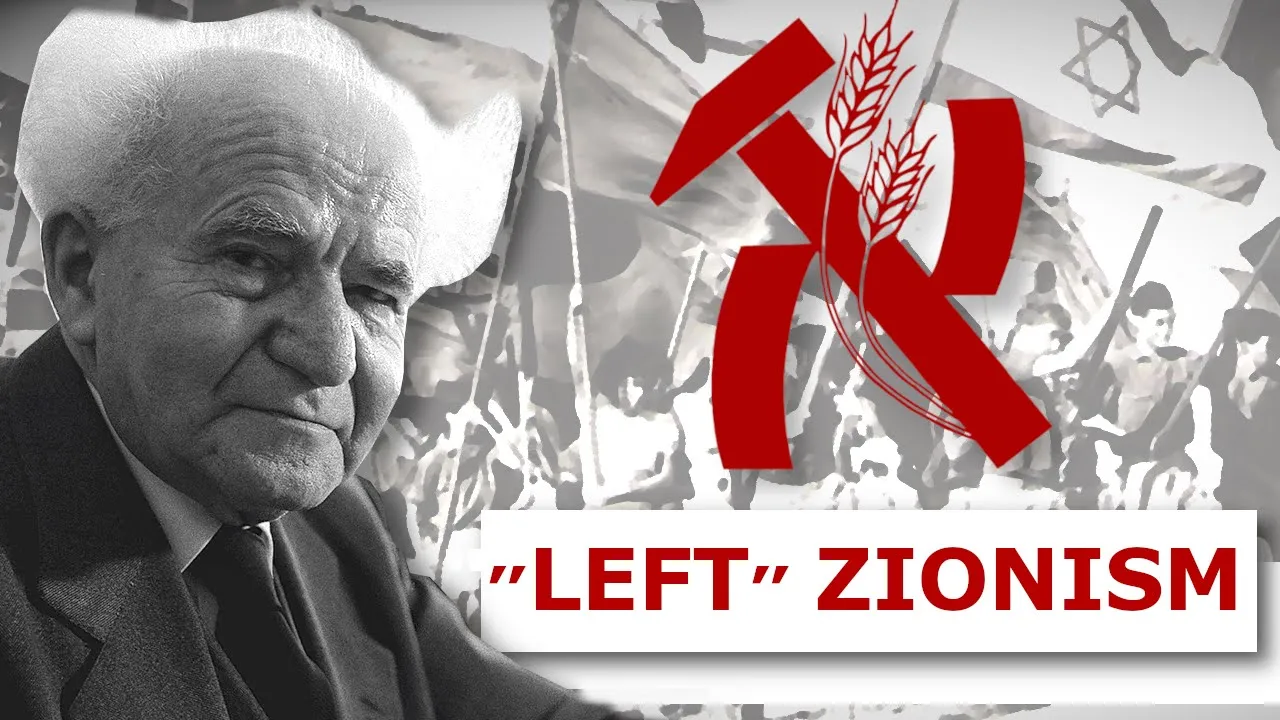
Ben-Gurion Used Socialist Rhetoric to Displace Palestinian Labor
Bes D. Marx
The colonization of Palestine and the 1948 Nakba were spearheaded by labor Zionists who mobilized egalitarian slogans to establish exclusionary institutions, paramilitary forces, and state structures.
AI-assisted summary of The Dark History of "Left-Wing" Zionism — original source. Check the original for full context.
Source published:
Key ideas
- Labor and 'socialist' Zionism, rather than right-wing extremism, served as the principal ideological and structural driver behind early colonization in Palestine, building state institutions and directing the 1948 Nakba. (0:00)
- Early Marxist organizations, including Vladimir Lenin and the anti-Zionist Jewish Labor Bund, consistently opposed Zionism as a reactionary colonial movement that diverted Jewish workers away from class struggle in their home countries. (2:17)
- Key Labor Zionist institutions like the Histadrut trade union and the Haganah militia enforced economic segregation through 'Hebrew Labor' boycotts and aggressive displacement decades prior to the formal establishment of the Israeli state. (42:12)
- British imperial support, culminated in the 1917 Balfour Declaration, was motivated by strategic efforts to secure the Suez Canal buffer zone and divert Jewish migration away from Britain. (32:16)
Detailed notes
## Background This video was published on YouTube by creator Bes D. Marx on February 18, 2024. Drawing from a extensive bibliography of historical texts by scholars such as Ilan Pappé, Gershon Shafir, and Benny Morris, the presentation examines the origins and historical role of Labor and socialist Zionism in the colonization of Palestine.
## TL;DR The video deconstructs the common political narrative that the dispossession of Palestinians is merely the product of modern right-wing Israeli extremism, arguing instead that Labor Zionism was the primary ideological and institutional driver of the settler-colonial project. It traces the movement from late 19th-century debates against the anti-Zionist Jewish Labor Bund and early Russian Marxists, through Ber Borochov's ideological synthesis and David Ben-Gurion's practical campaign for Hebrew Labor. The documentary outlines how socialist rhetoric was deployed to justify national segregation, the establishment of exclusionary institutions like the Histadrut and the Haganah militia, and pragmatic alliances with British imperialism. Ultimately, it demonstrates that structures like the kibbutz and the Jewish Agency functioned as mechanisms to capture land, displace native Palestinians, and lay the groundwork for the 1948 Nakba under a progressive veneer.
## Atmosphere & style The presentation carries an austere, intensely analytical, and polemical tone, operating as a rigorous historical counter-narrative against liberal assumptions. The narration is measured, dry, and unrelenting, stripping away romanticized settler imagery to methodically examine archival writings, diaries, and policy records. Listening feels like attending an uncompromising political history lecture that deliberately exposes internal contradictions, contrasting egalitarian socialist slogans with raw colonial realpolitik and racialized violence.
## Bulletin - [00:00](https://www.youtube.com/watch?v=ehp9PZo4UR0&t=0s) Labor and 'socialist' Zionism, rather than right-wing extremism, served as the principal ideological and structural driver behind early colonization in Palestine, building state institutions and directing the 1948 Nakba. - [02:17](https://www.youtube.com/watch?v=ehp9PZo4UR0&t=137s) Early Marxist organizations, including Vladimir Lenin and the anti-Zionist Jewish Labor Bund, consistently opposed Zionism as a reactionary colonial movement that diverted Jewish workers away from class struggle in their home countries. - [42:12](https://www.youtube.com/watch?v=ehp9PZo4UR0&t=2532s) Key Labor Zionist institutions like the Histadrut trade union and the Haganah militia enforced economic segregation through 'Hebrew Labor' boycotts and aggressive displacement decades prior to the formal establishment of the Israeli state. - [32:16](https://www.youtube.com/watch?v=ehp9PZo4UR0&t=1936s) British imperial support, culminated in the 1917 Balfour Declaration, was motivated by strategic efforts to secure the Suez Canal buffer zone and divert Jewish migration away from Britain.
## Key takeaways - [00:00](https://www.youtube.com/watch?v=ehp9PZo4UR0&t=0s) The popular liberal narrative attributing the Israeli-Palestinian conflict exclusively to modern right-wing extremists obscures how left-wing and Labor Zionism designed the original settler-colonial framework. - [02:17](https://www.youtube.com/watch?v=ehp9PZo4UR0&t=137s) During the Second Aliyah (1904–1914), only about 3% of the two million Jewish refugees fleeing the Russian Empire migrated to Palestine, while the vast majority settled in the United States. - [04:19](https://www.youtube.com/watch?v=ehp9PZo4UR0&t=259s) The General Jewish Labor Bund championed 'Doikayt' ('hereness'), organizing workers in Yiddish to fight autocracy within Eastern Europe rather than pursuing colonial statehood in Palestine. - [07:25](https://www.youtube.com/watch?v=ehp9PZo4UR0&t=445s) Ber Borochov synthesized Marxist rhetoric with nationalist settlement for Poale Zion, relying on the 'no-territory' theorem and colonial assumptions that indigenous Arabs would assimilate into a European economic model. - [11:32](https://www.youtube.com/watch?v=ehp9PZo4UR0&t=692s) David Ben-Gurion explicitly discarded Marxist class struggle in favor of Jewish nationalism, prioritizing 'Hebrew Labor' (Avoda Ivrit) to exclude indigenous Arab workers. - [15:25](https://www.youtube.com/watch?v=ehp9PZo4UR0&t=925s) Early Zionist paramilitary bodies like Hashomer created an enduring ideological myth of defensive victimhood, even while early leaders internally recognized that European settlers were the active aggressors. - [18:12](https://www.youtube.com/watch?v=ehp9PZo4UR0&t=1092s) Socialist contemporaries such as Moshe Olgin and Karl Kautsky condemned Zionist colonization, affirming that Palestine rightfully belonged to its native Arab inhabitants. - [22:06](https://www.youtube.com/watch?v=ehp9PZo4UR0&t=1326s) Secular Zionist leaders instrumentalized biblical claims as geopolitical mandates and directly compared their colonization of Palestine to English settlement in North America and Dutch settlement in South Africa. - [25:02](https://www.youtube.com/watch?v=ehp9PZo4UR0&t=1502s) British backing for Zionist settlement was shaped by antisemitic immigration curbs like the 1905 Aliens Act and geopolitical maneuvers to guard the Suez Canal and imperial routes to India. - [35:37](https://www.youtube.com/watch?v=ehp9PZo4UR0&t=2137s) The 1917 Balfour Declaration promised a national home for Jewish people in a land where native Palestinians constituted roughly 94% of the population, conflicting with Britain's prior promises of Arab independence. - [42:12](https://www.youtube.com/watch?v=ehp9PZo4UR0&t=2532s) Founded in 1920 by Ben-Gurion's Ahdut Ha'Avoda, the Histadrut operated not as a standard trade union, but as a state-building tool enforcing boycotts and violence against Arab labor and goods. - [46:15](https://www.youtube.com/watch?v=ehp9PZo4UR0&t=2775s) The kibbutz movement served as an operational vehicle to resolve urban concentration, capturing rural territory and displacing Palestinian villagers under the guise of egalitarian communal agriculture. - [46:15](https://www.youtube.com/watch?v=ehp9PZo4UR0&t=2775s) Chaim Weizmann likened the Jewish Agency to early modern chartered colonial monopolies like the British East India Company, tasked with administering colonization without formally being a sovereign government.
## Detailed walkthrough ### [00:00](https://www.youtube.com/watch?v=ehp9PZo4UR0&t=0s) The Myth of "Progressive Zionism"
A common political framing suggests that the Israeli-Palestinian conflict is simply the fault of right-wing extremists: if Benjamin Netanyahu and his fascistic coalition were replaced by enlightened leftists, peace and coexistence would naturally follow. Under this liberal Zionist worldview, Zionism itself is innocent, and the catastrophe unfolding in Palestine is framed as nothing more than a series of unfortunate policy blunders by right-wing coalitions. However, the history of the Zionist movement shows the exact opposite: "socialist" or Labor Zionism was not a benign alternative, but the dominant, driving force behind the colonization of Palestine throughout most of the 20th century. It was this faction that spearheaded the early territorial expansion, built the core state institutions, and ultimately orchestrated the 1948 Nakba, which dispossessed and displaced over 80% of the indigenous Palestinian population.
Left-wing and liberal Zionism have historically served a crucial propaganda purpose: wrapping a settler-colonial project in the respectable veneer of Western progressivism, enlightened values, and socialist egalitarianism. Proponents claimed to reconcile Marxism with settler conquest, touting collective institutions like the kibbutz while actively dispossessing the native population. Understanding the history of modern Palestine requires peeling back this progressive facade to examine how Labor Zionism corrupted socialist rhetoric to justify national chauvinism and colonial replacement.
As the narrator emphasizes when diagnosing this political misconception: > “One of the, if not the greatest myth preventing people to arrive at a correct analysis and position regarding the Israeli occupation in Palestine, is that there's a progressive Zionism, and that the genocide on the Palestinian people is the fault of an impractical, bad policy decision of the right-wing alliance government.”
---
[02:17](https://www.youtube.com/watch?v=ehp9PZo4UR0&t=137s) The Second Aliyah and Early Marxist Opposition
Between 1904 and 1914, during the Second Aliyah, approximately 35,000 Jewish settlers moved from the Russian Empire to Ottoman Palestine. Unlike the religious or philanthropic settlers of the First Aliyah, many of these arrivals were radicalized by the explosion of Marxist and socialist organizing sweeping Eastern Europe following the intensified crises and violent anti-Jewish pogroms of 1903. Yet, those who believed that the solution to anti-Semitism lay in colonizing Palestine were a distinct minority. Of the two million Jewish people who fled the Russian Empire between 1882 and 1914, a mere 3% chose Palestine; the overwhelming majority chose to migrate to the United States. Many who did make the trek to Palestine found the climate and living conditions so grueling that they quickly left.
For the vast majority of Jewish socialists at the time, liberation was to be won through internationalist working-class struggle at home, not by dispossessing people halfway across the world. Far from supporting the Zionist program, early Russian Marxists recognized its colonial and reactionary character almost immediately. Back in 1886, Russian Jewish socialist Ilya Rubanovich issued a scathing critique of early Zionist pioneer Yehuda Leib Lilienblum, asking what right Zionists had to claim Palestine and warning: > “Woe unto you if, under the protection of international bandits and by the manipulation of international intrigue and corrupt diplomacy, you force the peaceful Arabs to defend their rights.”
In 1903, the leader of the Russian Bolsheviks, Vladimir Lenin, cut to the core of the debate, stating bluntly: > “The Zionist idea is absolutely false and basically reactionary.”
- **Migration Numbers (1882–1914):** Approximately 2 million Jews left Eastern Europe, but only about 3% went to Ottoman Palestine. - **Second Aliyah (1904–1914):** Brought roughly 35,000 immigrants, predominantly from the Russian Empire, infused with socialist terminology. - **Early Critiques:** Socialists like Ilya Rubanovich warned as early as 1886 that invoking "hereditary claims" under the patronage of imperialist powers would lead to indigenous resistance, while Lenin identified the ideology as inherently counter-revolutionary.
---
[04:19](https://www.youtube.com/watch?v=ehp9PZo4UR0&t=259s) The Jewish Labor Bund Versus Political Zionism
In the Russian Empire, factory owners often preferred Christian workers over Jewish workers because Jewish proletarians were notoriously class-conscious, militant, and quick to organize strikes. This militancy coalesced in 1897 with the founding of the General Jewish Labor Bund, an anti-Zionist socialist party committed to fighting autocracy alongside other oppressed nationalities in the Russian Empire. That same year, Theodor Herzl convened the First Zionist Congress in Basel, setting the two movements on a collision course for the soul of the Jewish working class.
The Bund rejected Zionism as an anti-socialist, bourgeois distraction that abandoned the actual struggle against Tsarist oppression in favor of colonial adventure. The rapid growth of the Bund terrified early Zionist leaders. Chaim Weizmann, who would later lead the World Zionist Organization and become Israel's first president, lamented the Bund's immense appeal among youth in 1903, writing: > “Our hardest struggle everywhere is against the Bund.”
Bundist leader Vladimir Medem recalled in his memoirs how hundreds of young Jewish men abandoned religious yeshivas to dive into the secular revolutionary underground. Unlike the Zionists, who revived ancient Hebrew as an official language of colonial statecraft, the Bundists organized in Yiddish—the living vernacular of the Jewish working poor—and composed songs mocking Zionist colonization schemes in Palestine as pipe dreams orchestrated by bourgeois charlatans.
```mermaid flowchart TD accTitle: Ideological Split in Eastern European Jewish Politics accDescr: Diagram showing the divergence between the anti-Zionist Bund and Labor Zionism at the turn of the 20th century.
Crisis["Tsaris Crises & 1903 Pogroms"] --> Radicalization["Working-Class Radicalization"]
subgraph Bund ["The General Jewish Labor Bund (1897)"] B1["Class struggle at home (Doikayt / 'Hereness')"] B2["Language: Yiddish (vernacular of the poor)"] B3["Vehemently anti-Zionist & anti-colonial"] end
subgraph LaborZionism ["Labor Zionism / Poale Zion (1900s)"] LZ1["National chauvinism + socialist rhetoric"] LZ2["Language: Modern Hebrew"] LZ3["Territorial concentration & colonization of Palestine"] end
Radicalization --> Bund Radicalization --> LaborZionism ```
- **The Bund's Foundational Principle:** *Doikayt* ("hereness")—the belief that Jews should struggle for emancipation and socialism where they lived, rather than fleeing to colonize another land. - **Language Conflict:** The Bund championed Yiddish as the authentic, democratic language of the masses, while Zionism promoted Hebrew as an instrument of national revival and state formation. - **Countering Socialism with Chauvinism:** Confronted with the Bund's surging popularity, right-wing and nationalist elements scrambled to invent synthetic organizations that could merge socialist buzzwords with colonial nationalism to prevent radicalized workers from defecting entirely to the internationalist left.
---
[07:25](https://www.youtube.com/watch?v=ehp9PZo4UR0&t=445s) Ber Borochov and the Ideological Mechanics of Poale Zion
To counteract the Bund's influence, nationalist organizers formed Poale Zion ("Workers of Zion") at the start of the 20th century. Its primary theoretician, Ber Borochov, attempted to construct a Marxist rationale for the colonization of Palestine. Borrowing from Moses Hess—a 19th-century contemporary of Marx who prioritized race and national struggle over class struggle, viewing Jews as a civilizing vanguard destined to bring European science to the "primitive" peoples of Asia—Borochov sought to formulate a dialectical justification for settler colonialism in his 1905 work *Nationalism and Class Struggle*.
Borochov was critical of the First Aliyah's Rothschild-funded private plantations because their capitalist owners relied on cheap, exploited Arab agricultural labor, which he argued hindered the formation of an exclusively Jewish national economy. Instead, he insisted: > “Jewish migration must be transformed from immigration into colonization.”
To provide this colonial drive with a pseudo-Marxist underpinning, Borochov devised his "no-territory" theorem: he argued that Jewish workers in the diaspora were economically marginalized and excluded from heavy industry, leaving them without a stable strategic base to conduct class struggle. Therefore, capitalism would inevitably compel Jewish workers to migrate and concentrate in their own territory. Because Borochov could not rely on theological arguments to justify taking Palestine, he resorted to racist colonial tropes, depicting the indigenous Arab population as culturally fractured, incapable of developing the productive forces, and bound to assimilate into the superior European-imported economy. Regarding the native population's supposed inability to resist, Borochov claimed: > “They very easily and quickly adapt themselves to every cultural model higher than theirs brought from abroad.”
In reality, Borochov never once set foot in Palestine, and his mechanical predictions collapsed. Jewish workers overwhelmingly chose to migrate to the industrial centers of the United States to fight genuine class struggles, while the Palestinian people organized coherent, resilient anti-colonial resistance to defend their land. Nevertheless, Borochov's ideological acrobatics served an indispensable purpose: they provided a materialist, progressive-sounding camouflage that allowed secular Jewish intellectuals to endorse settler conquest under the guise of socialist liberation.
[11:32](https://www.youtube.com/watch?v=ehp9PZo4UR0&t=692s) The Rise of David Ben-Gurion and the Fight Against the Bund
The common denominator among early Jewish radicals was often an anti-Zionist socialist movement. However, one young, ambitious, and fierce anti-Bundist named David Grün—who would later change his name to David Ben-Gurion—sought to exploit the popularity of socialist ideas for nationalist ends. Joining the Poale Zion, he quickly became its most charismatic and successful leader, heading the broader Labor Zionist current for several decades. He would eventually become the chief architect of the ethnic cleansing of Palestine and the founder of the State of Israel.
Ben-Gurion's entry into Zionist politics was marked by pragmatism rather than ideological purity. Witnessing the 1905 Russian Revolution, he concluded that Jews would only waste their lives fighting for a hopeless cause, believing that while a revolution might liberate Russia, it would never truly liberate the Jewish people. Recognizing the immense power of Marxist ideas among young Jewish radicals, he used Poale Zion as an instrument to draw socialists toward the Zionist project, despite his own ideological divergence. As he flatly admitted, "I am not a Marxist."
To defeat the anti-Zionist Bundists, Ben-Gurion adopted their organizing tactics, particularly their use of defense squads against pogroms in Poland, but turned this energy against them. He frequently challenged Bundists to public debates, which often devolved into intense hostility. Highlighting the bitter factionalism of the era, one Bundist publication reported that during a heated debate, Ben-Gurion began shouting like a maniac, declaring, “We have weapons and we will kill you all like dogs.”
```mermaid flowchart TD accTitle: Jewish Socialist Ideological Split accDescr: A flowchart showing the divergence between the anti-Zionist Bundists and the nationalist Poale Zion led by David Ben-Gurion.
A["Jewish Socialist Movement (Early 1900s)"] --> B["The Bund (Anti-Zionist)"] A --> C["Poale Zion (Labor Zionist)"]
B --> B1["Class Struggle in Diaspora"] B --> B2["Opposed Colonization of Palestine"]
C --> C1["David Ben-Gurion (David Grün)"] C1 --> C2["Nationalist Struggle Over Class Struggle"] C1 --> C3["Avoda Ivrit (Exclusive Jewish Labor)"] ```
[13:06](https://www.youtube.com/watch?v=ehp9PZo4UR0&t=786s) Arrival in Palestine and the "Conquest of Labor"
In 1906, Ben-Gurion emigrated to Palestine. On the ship ride over, he encountered Arabs for the first time in his life. In a letter to his father, he patronizingly wrote, “They are nearly all good-hearted and are easily befriended. One might say they are like big children.” Upon arriving in Jaffa, he focused entirely on his nationalist dream, ignoring the local population. Like most Second Aliyah settlers, he had no interest in the existing Arab residents, writing to his father that he did not like the city because "Jaffa is not pretty."
Ben-Gurion walked from Jaffa to Petah Tikva, an agricultural settlement established during the First Aliyah and sponsored by Edmond de Rothschild. What he discovered there deeply shocked and disgusted him: the widespread employment of Arab workers. He viewed Palestinian workers and farmers as a *Beit Mihush*—an infested hotbed of pain. Other settlers shared this sentiment, with one reporting, "I was disgusted to find out that in Hadera, part of the houses were occupied by Arabs."
To counter this, Ben-Gurion argued that Jewish farmers must exclusively hire Jewish workers to serve the nationalist cause, insisting that national solidarity must override class solidarity. He justified this economically by claiming that Jewish workers, coming from developed capitalist economies, were superior to Arab workers from a "feudal," underdeveloped economy. He maintained that even though Jewish laborers cost more, they would yield a higher return for employers because the Jewish laborer is "more intelligent and diligent than the Arab." This racialized view of labor reflected the broader European colonial mindset of the Zionist movement. Ben-Gurion openly embraced this identity, stating: “We have come here as Europeans. We bring with us European civilization and we would not want to sever our connections and those of the country with the civilization of Europe.”
[15:25](https://www.youtube.com/watch?v=ehp9PZo4UR0&t=925s) Segregation, the Ramleh Program, and the Myth of "Self-Defense"
At a congress of the Poale Zion in Palestine—then renamed the Jewish Social Democratic Workers Party in the Land of Israel—Ben-Gurion served as chairman and actively campaigned against Jewish-Arab labor cooperation. Instead, he championed *Avoda Ivrit* (exclusively Jewish labor) and worked to exclude Palestinian workers from lands owned by the Jewish National Fund. This was the practical implementation of *Kibbush HaAvoda* (the conquest of labor), which sought to establish a "dictatorship of the Hebrew laborer."
By the following year, the party formally committed to the total segregation of the Arab and Jewish economies. They published a Hebrew adaptation of the Communist Manifesto known as the Ramleh Program, which declared that the party aspired to the political independence of the Jewish people in Palestine. Ben-Gurion successfully integrated national struggle alongside class struggle in the party's platform, a synthesis that ultimately discarded socialism altogether. Decades later, in 1951, he would explicitly confirm this ideological hierarchy, stating: “Our state is neither capitalist nor socialist. It was simply a Jewish state, neither capitalist nor socialist.”
This nationalist deviation from socialist principles is not unique to Zionism; similar patterns of self-described socialists denying self-determination to oppressed nationalities can be seen historically in Spain against the Basques, in Turkey against the Kurds, in Serbia against Albanians, and in Sri Lanka against the Tamils.
Furthermore, the foundational Israeli myth that Jewish settlers faced immediate, anti-Semitic terror from Palestinians is contradicted by historical evidence. Israeli historian Ilan Pappé points to the diaries of early Zionists, which are filled with accounts of Palestinians welcoming foreign Jewish arrivals, offering them shelter, and teaching them how to cultivate the land. Violent resistance only emerged when it became clear that the settlers did not come to live alongside Palestinians, but to replace them. In response to this resistance, Poale Zion leaders established *Hashomer*, a Jewish militia designed to defend the colonial enterprise, cementing a myth of "self-defense" that continues to justify expansion to this day.
[18:12](https://www.youtube.com/watch?v=ehp9PZo4UR0&t=1092s) The Socialist Critique of Zionism: Olgin and Kautsky
As Palestinian resistance to expanding settlements grew, Ben-Gurion began writing about the severity of the "Arab problem." Rather than recognizing the material reality of colonization, he attributed the conflict to the "Arab temperament," claiming that violent incidents were simply natural to Arabs, occurring "commonly among the Arabs themselves, between one tribe and another or one village with another." He argued that if Jews worked the land in Palestine, it rightfully belonged to them—a logic he believed successfully countered the arguments of the Bundists.
However, anti-Zionist Jewish socialists saw through this rhetoric. The Bundist Moshe Olgin mocked Ben-Gurion's framing of a "mysterious enemy," writing: > “Jewish settlement in Palestine is built upon the ruin of the Arabs. Who are these Arabs? The Jewish settlers fell in battle with the Arabs, but who is this mysterious enemy? Is he a tyrant who has enslaved the country like the Tsar of Russia? Is he a foreigner who rules the country as the Englishman rules Ireland? Or are these Arabs simply a band of robbers and murderers? No, the Arabs are not at all like that. They are the established inhabitants of Palestine, who lived there for hundreds of years before the arrival of the Zionist settlers.”
Similarly, the prominent German Social Democrat Karl Kautsky rejected Zionist claims to the land from a Marxist perspective in 1910. Kautsky argued that Judaism could not claim Palestine under the guise of democratic self-determination or the right of labor, writing: “Today, Palestine does not belong to the Jews of Vienna, London, or New York, who claim it for Judaism, but to the Arabs of the same country, the great majority of the population.”
[19:58](https://www.youtube.com/watch?v=ehp9PZo4UR0&t=1198s) European Social Democracy and the Roots of Left-Zionism
The rise of "left-wing" Zionism was heavily aided by a right-opportunist shift within European social democracy, particularly within the German Social Democratic Party (SPD), the largest Marxist party of the era. As the SPD abandoned revolutionary politics and supported German imperialism in World War I, it also began supporting Zionism under a leftist guise. The *Sozialistische Monatshefte* (Socialist Monthly Bulletin), the main organ of the SPD's revisionist right wing, openly celebrated Zionist land appropriation in Palestine as a form of "socialist colonial policy" and a triumph of "cultural humanity."
In June 1914, Ludwig Quessel, a Social Democratic Reichstag member and advocate of wartime class collaboration, promoted Jewish colonization in Palestine as a necessary step to prevent the "impoverishing of cultural humanity." Even Eduard Bernstein, one of the primary revisers of Marxist theory, argued that rising anti-Semitism was actually beneficial for Zionism, concluding that Zionism could function as an emancipatory movement. This historical alliance explains why many modern liberal opportunists within the self-proclaimed anti-capitalist left continue to criticize Israel's right wing while making excuses for liberal and left-wing Zionism.
Meanwhile, Ben-Gurion continued to construct a nationalist mythology. In 1912, he changed his name from David Grün to David Ben-Gurion, naming himself after Yossef Ben-Gurion, a first-century Hebrew leader who led a revolt against the Romans. Idealism, myth, and biblical framing were central to his strategy. Despite not personally believing in the religious stories of the Bible, he recognized their political utility, later telling British authorities: “The Bible is our mandate.”
- **Key Historical Figures:** - **David Ben-Gurion (David Grün):** Leader of Poale Zion, advocate of *Avoda Ivrit*, and founder of Israel. - **Moshe Olgin:** Prominent Bundist who exposed the colonial reality of Zionist settlement. - **Karl Kautsky:** Influential German Marxist who defended Palestinian self-determination against Zionist claims. - **Eduard Bernstein & Ludwig Quessel:** German Social Democrats who revised Marxism to support colonial Zionism. - **Key Concepts:** - ***Avoda Ivrit* (Hebrew Labor):** The policy of boycotting Arab labor to build an exclusively Jewish economy. - ***Kibbush HaAvoda* (Conquest of Labor):** The strategic takeover of the Palestinian labor market by Zionist settlers. - ***Hashomer*:** The early Zionist paramilitary organization established to protect settler colonies. - **The Ramleh Program (1907):** Poale Zion's platform that synthesized class struggle with Jewish national independence.
[22:06](https://www.youtube.com/watch?v=ehp9PZo4UR0&t=1326s) Religious Myth, Candid Colonialism, and the Conquest of Land
Religious myths have routinely served to legitimize colonial conquest across history, and Zionism proved to be no exception to this pattern. The speaker quotes the Israeli academic Ilan Pappé (referencing a quip often linked to Amnon Raz-Krakotzkin), summarizing the secular Zionist paradox: “God doesn't exist, but he promised us the land.” For the indigenous population of Palestine, it made virtually no difference whether the arriving settlers were carrying the works of Karl Marx or copies of the Hebrew Bible—their displacement was predetermined. While contemporary liberal and pseudo-leftist commentators frequently frame Zionism through a decolonial lens as an indigenous return to an ancestral home, early Zionist architects openly and unapologetically described their mission as a colonial project designed to supplant the local population.
David Ben-Gurion himself was remarkably candid in private and public assessments regarding the nature of the encounter. As the speaker highlights, Ben-Gurion explicitly admitted the colonial reality of their campaign: “Let us not ignore the truth among ourselves. Politically, we are the aggressors and they defend themselves. The country is theirs because they inhabit it, whereas we want to come here and settle down.” Later, addressing a Poale Zion convention in Cleveland during World War I, Ben-Gurion directly equated the Zionist enterprise to Western settler-colonial expansions across the globe: “The land of Israel will be built solely by the hands of an industrious people, rich in material and spirit, who will come to it from outside, equipped with modern scientific and technical instruments, and ready at any cost to turn the desert and wasteland into a flourishing oasis, fruitful, culturally rich, and populated, like what the English immigrants did in North America, and the Dutch immigrants in South Africa, and like what the Jews began to do in the land of Israel itself.”
To translate this ideology into territory, the Zionist Organization utilized the Jewish National Fund (JNF) to systematically purchase tracts from absentee landlords residing outside of Palestine, promptly evicting the indigenous Palestinian tenant farmers who lived on and worked the land. On these evacuated plots, the Zionist movement constructed supposedly socialist, collective agricultural communes—the kibbutzim—thereby uniting the ideological doctrine of the "conquest of labor" with the physical "conquest of land." Yet, early left Zionists faced a decisive structural bottleneck: their settler-colonial program could never fully succeed without the backing of a major imperial patron. While Ottoman legal barriers had previously curtailed direct Zionist land acquisitions, the decline of the Ottoman Empire and the arrival of British imperial rule removed those obstacles entirely.
- **Colonial Parallels:** Ben-Gurion explicitly modeled Zionist settlement on English colonization in North America and Dutch settlement in South Africa. - **Eviction Mechanism:** The JNF acquired lands primarily from elite absentee owners, resulting in the direct removal of Palestinian peasant tenant farmers. - **Institutional Alignment:** The collective kibbutz system operated not merely as a socialist experiment, but as an operational instrument for securing territorial control and enforcing segregated labor.
---
[25:02](https://www.youtube.com/watch?v=ehp9PZo4UR0&t=1502s) British Imperial Machinations and the "Civilizing" Pretext
Modern imperialist backing for Israel is commonly cloaked in humanitarian rhetoric, depicting the state as an oasis of democratic values and a safe haven in the Middle East. However, the historical record reveals that imperial Britain’s alignment with Zionism stemmed strictly from imperial strategy, realpolitik, and domestic political pressures. Faced with an influx of Jewish refugees fleeing Russian pogroms, British politicians—led by figures like Prime Minister Arthur Balfour (infamously dubbed "Bloody Balfour" by the Irish)—sought to restrict domestic Jewish immigration. Theodor Herzl and subsequent Zionist leaders deliberately tapped into this prevalent European anti-Semitism, presenting Zionist migration to Palestine as a convenient solution for European states wanting to divert Jewish refugees away from their own borders.
During World War I, as the Allied powers worked to dismantle the Ottoman Empire, the British made duplicitous and contradictory commitments. In the 1915 McMahon–Hussein Correspondence, Sir Henry McMahon promised Sharif Hussein of Mecca that Great Britain would recognize Arab independence across a vast region—including Palestine—in exchange for an Arab armed revolt against Ottoman authority. While many Arabs rebelled against Turkish domination, Britain had no genuine intention of granting self-determination. This cynical playbook mirrored Britain’s 1882 invasion of Egypt, which was undertaken to secure bond debt repayments and imperial interests but publicly packaged as a benevolent campaign for "human rights" and "women's liberation." Evelyn Baring (Lord Cromer), who directed the occupation of Egypt, weaponized gender politics to justify foreign subjugation, writing: “Islam as a social system has been a complete failure. The degradation of women in the East is a canker that begins its destructive work early in childhood and has eaten into the whole system of Islam.”
Cromer argued that Muslims must “be persuaded or forced into imbibing the true spirit of Western civilization,” even while he actively led the Men's League for Opposing Woman Suffrage back in Britain to strip British women of voting rights. The speaker argues that contemporary Western liberals and Eurocentric leftists reproduce this exact dynamic today: they praise progressive domestic policies in high-income imperial nations while pointing fingers at conservative religious attitudes among the colonized, conveniently ignoring how centuries of imperial exploitation and military domination deliberately sabotage sovereign, self-determined economic development in the Global South.
```mermaid flowchart TD accTitle: British Imperial Strategy in the Middle East accDescr: Diagram tracing British domestic pressures and foreign wartime pledges to colonial consolidation in Palestine.
subgraph Domestic["British Domestic Pressures"] A["Russian Anti-Jewish Pogroms"] --> B["Refugee Influx to Britain"] B --> C["British Aliens Act / Balfour Restrictions"] C --> D["Desire to Divert Jewish Emigration Abroad"] end
subgraph ImperialWartime["Wartime Imperial Objectives (WWI)"] E["Defeat Ottoman Empire"] --> F["Secure Suez Canal & Trade Routes"] F --> G["1915 McMahon-Hussein Agreement<br/>(Promise of Arab Independence)"] F --> H["Zionist Alliance as Regional Guard"] end
subgraph Outcome["Colonial Realpolitik"] D --> I["British-Zionist Partnership"] H --> I G -.->|"Betrayed & Subordinated"| I I --> J["Imperial Hegemony over Palestine"] end ```
---
[28:20](https://www.youtube.com/watch?v=ehp9PZo4UR0&t=1700s) Weizmann, Lloyd George, and the Imperial Bargain over Palestine
By the 1910s, Zionist leadership had passed to Chaim Weizmann, a chemist who proved to be an extraordinarily adept diplomat. Weizmann recognized that to win over the British political establishment, Zionism had to be framed not as an act of charity, but as a vital geopolitical asset for the British Empire. Writing to the editor of the *Manchester Guardian*, Weizmann laid out the strategic utility of Jewish colonization in stark terms: “We can reasonably say that should Palestine fall within the British sphere of influence, and should Britain encourage Jewish settlement there as a British dependency, we could have in 20 to 30 years a million Jews out there, perhaps more. They would develop the country, bring back civilization to it, and form a very effective guard for the Suez Canal.”
While Weizmann deceptively assured the British public in a 1917 letter to *The Times* that “The Zionists are not demanding in Palestine monopolies or exclusive privileges,” the Zionist Organization had privately submitted a memorandum to the British government just a year earlier demanding exclusive privileges on the grounds that “The present population requires the introduction of a new and progressive element in the population.” Weizmann found crucial allies within the British Cabinet, most notably Home Secretary Sir Herbert Samuel, whose commitment to the Zionist project outpaced even that of many Zionists. Samuel lobbied Foreign Secretary Sir Edward Grey by arguing that British control of Palestine was indispensable for guarding the empire's lines of communication.
The sitting Prime Minister, H. H. Asquith, was initially skeptical of these schemes and saw through the pious pretexts of his colleagues, noting caustically: “Curiously enough, the only other partisan of this proposal is Lloyd George, who I need not say does not give a damn for the Jews or their past or future, but thinks it will be an outrage to let the holy places pass into the possession under the protectorate of agnostic atheistic France.” David Lloyd George, then serving as Minister of Munitions, was won over partly by Weizmann’s scientific breakthrough in synthesizing acetone—a critical solvent for cordite explosive production—famously remarking: “Acetone converted me to Zionism.”
When Asquith’s government collapsed in December 1916, Lloyd George ascended to Prime Minister, and Arthur Balfour was appointed Foreign Secretary. Alongside figures like Sir Mark Sykes—who viewed Zionism as a tool to rally American Jewish opinion to push the United States into the war—the British imperial leadership moved swiftly to lock down Palestine. Crucially, the Zionists possessed neither an army nor a navy; their ambitions were entirely contingent on British state power. Sykes negotiated directly with the Zionists, unconcerned with the Palestinian population and focused instead on sidelining France’s competing claims to Syria and Palestine. Following the 1917 Bolshevik Revolution, which knocked France's Russian ally out of the war and shifted the balance of power, France was compelled to abandon proposals for the internationalization of Palestine, paving the way for exclusive British control.
- **The Strategic Value of the Suez Canal:** British-French ownership of the Suez Canal made Palestine an indispensable military buffer zone for protecting Britain's maritime trade artery to India. - **Acetone and Military Munitions:** Chaim Weizmann's chemical contributions to the British war industry provided him unique direct leverage with key wartime ministers like David Lloyd George. - **Diplomatic Realignment:** The exit of Tsarist Russia following the October Revolution weakened French leverage, allowing Great Britain to discard plans for an internationalized condominium over Palestine in favor of a British-Zionist sphere of influence.
[32:16](https://www.youtube.com/watch?v=ehp9PZo4UR0&t=1936s) British Imperial Strategy and Churchill’s Antisemitic Zionism
Palestine held immense geopolitical, historic, and symbolic value for the British Empire, but British officials routinely cloaked their strategic ambitions in high-minded or transactional pretexts. Politicians claimed they backed Zionism to court the influence of American Jews during World War I or to reward Chaim Weizmann for his chemical contributions to the British war effort. Handing over an indigenous population's homeland as a gesture of gratitude struck contemporary observers as peak imperial cynicism. As historian Joseph Jeffries acidly noted, “If land was the only possible recompense, there were the Isle of Wight and other British places in Britain's free gift, ready to be handed over.”
British support was driven by figures whose enthusiasm for Zionism dovetailed directly with personal antisemitism and reactionary politics. Winston Churchill, who openly lauded Italian fascism in Rome as providing “an ultimate means of protection against the cancerous growth of Bolshevism,” viewed Zionism through an explicitly anti-communist lens. Obsessed with the idea that Bolshevism was a Jewish conspiracy driven by a disproportionate presence of Jewish revolutionaries, Churchill penned a 1920 article titled *Zionism versus Bolshevism: A Struggle for the Soul of the Jewish People*. In it, Churchill framed Zionism as a conservative vehicle to divert European Jews away from revolutionary socialism:
> “From the days of Spartacus Weishaupt to those of Karl Marx and down to Trotsky, Bela Kun, Rosa Luxemburg, and Emma Goldman, this worldwide conspiracy for the overthrow of civilization and for the reconstitution of society on the basis of arrested development of envious malevolence and impossible equality has been steadily growing.”
Churchill championed Zionism because he saw it as standing “in violent contrast to international communism.” Years later, testifying before the Palestine Royal Commission (the Peel Commission), Churchill unvarnishedly defended the dispossession of Palestinians using white-supremacist colonial logic, declaring: “I do not admit, for instance, that a great wrong has been done to the Red Indians of America or the black people of Australia. I do not admit that a wrong has been done to these people by the fact that a stronger race, a higher grade race, a more worldly, wise race, to put it that way, has come in and taken their place.” This ideological kinship was widely recognized at the time; the president of the Anglo-Jewish Association pointed out that it was “very significant that anti-Semites are always very sympathetic to Zionism.” Similarly, Foreign Secretary Arthur Balfour—who had previously championed the Aliens Act of 1905 to curb Jewish immigration from Eastern Europe into Britain—welcomed the Zionist program as a mechanism to divert Jewish refugees away from the West, an argument reinforced by American Zionist leader and Supreme Court Justice Louis Brandeis during discussions with Balfour and the Wilson administration.
[35:37](https://www.youtube.com/watch?v=ehp9PZo4UR0&t=2137s) The Balfour Declaration, the Secret Pacts, and Colonial Realignment
On November 2, 1917, British backing culminated in a single-sentence statement sent by Arthur Balfour to Walter Rothschild, 2nd Baron Rothschild, officially pledging British support for “the establishment in Palestine of a national home for the Jewish people.” While elevating the national claims of a tiny minority, the declaration completely ignored the Palestinian population that comprised 94% of the land at the time. Palestinian historian Rashid Khalidi characterizes the document as nothing less than a formal declaration of war against the indigenous inhabitants. Palestinian exiles voiced their devastation in a letter to the Versailles Peace Conference, protesting: “This country is our country.” To overcome the staunch opposition of assimilated, non-Zionist British Jews who feared the declaration would undermine their status as equal citizens in their home countries, the British government drafted and revised the text six times, retreating from explicit early phrasing designating Palestine as an outright "Jewish republic" to the deliberately ambiguous phrase "a national home for the Jewish people in Palestine." Across the Atlantic, David Ben-Gurion celebrated the victory before a gathering of 2,000 supporters at Cooper Union's Great Hall in Manhattan.
```mermaid flowchart TD accTitle: Imperial Alliances and Zionist Consolidation accDescr: Flowchart tracing British colonial policy, Zionist factional splits, and the formation of the Haganah and Histadrut.
subgraph ImperialBacking["British Colonial Policy"] Balfour["Balfour Declaration (1917)"] --> Mandate["British Civil Mandate (1920)<br>Sir Herbert Samuel"] SykesPicot["Sykes-Picot Agreement"] -.-> Mandate end
subgraph PoaleZionSplit["Poale Zion Split (1919)"] PZ["Poale Zion"] --> LPZ["Left Poale Zion<br>(Rejected by Comintern; banned 1928)"] PZ --> Ahdut["Ahdut Ha'Avoda<br>(Ben-Gurion / Right Faction)"] end
subgraph ZionistInstitutions["Mandate-Era Infrastructure (1920)"] Ahdut --> Histadrut["Histadrut<br>(Hebrew Workers' Economy)"] Ahdut --> Haganah["Haganah Paramilitary<br>(Replaced Hashomer)"] Histadrut --> Haganah end
Mandate --> Histadrut ```
The imperial duplicity underpinning the mandate was soon laid bare when the newly installed Bolshevik government published the secret tsarist diplomatic archives. The leaks exposed the 1916 Sykes-Picot Agreement, in which British diplomat Sir Mark Sykes and French negotiator François Georges-Picot agreed to partition the Ottoman Arab provinces between Britain and France. This revelation broke the assurances of independence previously made to the Sharif of Mecca in the McMahon–Hussein Correspondence. While later British apologists and Zionist historians contended that Palestine had been excluded from the areas promised Arab independence, Sir Henry McMahon had made no such geographical exclusion in the actual text. Beyond the personal calculations of imperial diplomats, Israel's foundation rested on material and geopolitical convergence: serving as an imperial outpost in the Middle East, initially under the aegis of the British Empire and later sponsored primarily by the United States.
- **Demographic Reality (1917):** Native Palestinians made up roughly 94% of the total population of Palestine when the Balfour Declaration was issued. - **Redrafting the Declaration:** The text underwent six distinct revisions to tone down its colonial language in response to pushback from prominent anti-Zionist British Jews. - **The Sykes-Picot Leak:** Exposed by the Bolsheviks upon taking power in Russia, proving Britain and France had secretly carved up Arab lands while publicly pledging Arab sovereignty.
[38:36](https://www.youtube.com/watch?v=ehp9PZo4UR0&t=2316s) Mandate Rule, the Poale Zion Schism, and the Haganah
Following the collapse of the Ottoman Empire, the British military administered Palestine until 1920, when the League of Nations formalized the British Mandate under a civil administration headed by High Commissioner Sir Herbert Samuel, an ardent Zionist who immediately set about suppressing Arab political organizing while nurturing Zionist state-building. In 1919, liberal Zionist businessmen founded the newspaper *Haaretz*, growing out of an earlier publication influenced by socialist Zionists and subsidized by the British military authorities. While *Haaretz* would occasionally publish dissenting perspectives, it functioned primarily as the mainstream voice of left-liberal Zionism, frequently generating bizarrely contradictory editorial positions.
That same year, the labor Zionist movement Poale Zion fractured along the fault lines dividing the Second and Third Internationals. The right-wing faction, led by David Ben-Gurion, broke off to establish Ahdut Ha'Avoda (Labour Unity), rejecting alignment with the Bolshevik Communist International (Comintern) and opting instead to tether itself to the bourgeois World Zionist Organization and reformist European social democracy. Vladimir Lenin characterized this tendency within the broader workers' movement as the labor aristocracy and the real agents of the bourgeoisie among the working class. European social democrats embraced this faction, choosing to defend Labor Zionism as an egalitarian, socialist experiment threatened by neighboring Arab populations. Conversely, the Left Poale Zion faction attempted to join the Comintern. Moscow firmly rejected their bid to join as a collective entity, and when the group refused to dissolve into local Communist parties, the Comintern designated them an enemy of the workers' movement; the Soviet state subsequently repressed and officially banned the organization by 1928.
Ahdut Ha'Avoda wasted no time developing its military architecture. With the explicit consent of the British authorities, it disbanded the Hashomer militia in 1920 and established the Haganah ("The Defense"). Adopting defensive branding for an aggressive settler-colonial enterprise, the Haganah was armed and trained under British supervision, eventually providing the foundational structure for the modern Israel Defense Forces (IDF). As Palestinian resistance mounted against land purchases and demographic replacement, Zionist strategists openly recognized that settler colonialism could only prevail through military superiority. Ze'ev Jabotinsky, the father of Revisionist Zionism, laid bare this principle in his famous 1923 essay *The Iron Wall*:
> “Zionism is a colonizing adventure and therefore it stands or falls by the question of armed force.”
Jabotinsky insisted that colonization against indigenous will was impossible without an unyielding military garrison, arguing: “If you wish to colonize a land in which people are already living, you must provide a garrison on your behalf, or else give up your colonization. For without an armed force which will render physically impossible any attempts to destroy or prevent this colonization, colonization is impossible, not difficult, not dangerous, but impossible.”
[42:12](https://www.youtube.com/watch?v=ehp9PZo4UR0&t=2532s) The Formation of the Histadrut
In December 1920, Ahdut Ha'Avoda joined forces with allied labor groups to construct another structural pillar of the future state: the General Organization of Hebrew Workers, widely known as the Histadrut. Rather than functioning as a standard trade union aimed at organizing all local labor, the Histadrut was explicitly structured to build an exclusionary, all-Jewish labor economy in Palestine through the policies of "Hebrew Labor" and "Hebrew Product." The Haganah was placed directly beneath the Histadrut's administrative umbrella, wedding the labor federation to the Zionist paramilitary apparatus. David Ben-Gurion returned from his organizing efforts in New York to serve as the Histadrut's first general secretary, cementing his leadership over the emerging proto-state institutions that would dominate the pre-state Yishuv and subsequently govern Israel for its first three decades. Today, the Histadrut remains Israel's primary national trade union federation.
[42:53](https://www.youtube.com/watch?v=ehp9PZo4UR0&t=2573s) The Histadrut and the Subcontracted Infrastructure of Apartheid
The Histadrut retains millions of members and continues to play a direct role in land grabs and settlement expansion, supported internationally by reformist trade unions such as Germany’s DGB and the United States’ AFL-CIO. From its inception, the union was structured to enforce the “conquest of labor” through explicit segregation and physical coercion. Haganah member and prominent Labor Zionist leader David Hacohen openly acknowledged the brutal, coercive reality required to maintain an exclusively Jewish labor economy:
> “I remember being one of the first of our comrades to go to London after the First World War. There, I became a socialist. In Palestine, I had to fight my friends on the issue of Jewish socialism. To defend the fact that I would not accept Arabs in my trade union, the Histadrut. To defend preaching to the housewives that they not buy at Arab stores. To prevent Arab workers from getting jobs there. To pour kerosene on the Arab tomatoes. To attack Jewish housewives in the markets and smash the Arab eggs they had bought. To praise to the skies the Jewish National Fund that sent Yehoshua Hankin to Beirut to buy land from absentee landlords and to throw the peasants off the land.”
This historical record illustrates that Zionist settler colonialism and apartheid were never carried out solely by official state organs. Apartheid and military occupation were systematically subcontracted to civil society, commercial enterprises, and parastatal bodies long before the formal proclamation of the state. The establishment of Israel was merely the logical culmination of these entrenched institutional mechanisms across Zionist society.
- **International Alignment:** Class-collaborationist trade union federations like the German Trade Union Confederation (DGB) and the American AFL-CIO continue to maintain alliances with the Histadrut. - **Enforcement Tactics:** Coercive measures included boycotting Palestinian goods, picketing businesses employing Arab workers, pouring kerosene on produce, physically assaulting Jewish consumers who purchased Arab groceries, and coordinating with the Jewish National Fund (JNF) to evict Palestinian tenant farmers.
---
[44:28](https://www.youtube.com/watch?v=ehp9PZo4UR0&t=2668s) The Suppression of Joint Labor and the Illusions of Left Zionism
Despite persistent institutional pressure, early Jewish workers and Palestinian laborers frequently established joint businesses and trade union alliances out of practical necessity, since Palestinians lived and worked across the entire country. However, these grassroots instances of working-class solidarity were aggressively targeted, undermined, and marginalized by the central Zionist apparatus. Even liberal or self-described left-wing Zionists who initially advocated for binational coexistence invariably capitulated. For example, Histadrut co-founder Berl Katznelson publicly argued for binationalism throughout the 1930s, yet surrendered his position in 1940 to back the demand for an exclusively Jewish state.
Assessing the material reality of Zionism requires looking at its structural practices rather than the rare rhetorical pleasantry of a solitary settler. Settler colonial movements inherently deny the indigenous population the right to determine their own country's future. Modern left Zionists often mirror this contradiction by allowing criticism of specific right-wing Israeli governments, while labeling any structural critique of Zionism or Israeli society as antisemitic. They accuse anti-colonial critics of abandoning working-class internationalism, deliberately ignoring the fact that Israeli society was constructed upon a foundation of colonial conquest and racial hierarchy.
> “When we speak about what Zionism is, we must speak about Zionist reality and not quote the one in a hundred Zionists who said something nice about Arabs.”
---
[46:15](https://www.youtube.com/watch?v=ehp9PZo4UR0&t=2775s) Institutional State-Building: The Jewish Agency and Mapai
In 1929, at the 16th Zionist Congress in Zurich, the World Zionist Organization founded the Jewish Agency as its operative executive body. This move centralized pre-state administrative operations and brought military formations like the Haganah under unified command. Backed by Article 4 of the British Mandate, the Jewish Agency received quasi-governmental legal authority and international diplomatic standing before forums like the League of Nations. In stark contrast, the British imperial administration systematically denied comparable institutional or diplomatic representation to the Palestinian Arab majority, underscoring that the Zionist state project could not have succeeded without British patronage.
```mermaid flowchart TD accTitle: Pre-State Zionist Institutional Consolidation accDescr: Diagram illustrating the structural hierarchy between British Imperial authority, the Jewish Agency, Mapai, and executive field bodies like the Histadrut and Haganah.
subgraph ImperialFramework["British Imperial Framework"] BM["British Mandate (Article 4)"] end
subgraph ExecutiveCore["Zionist Command Center"] WZO["World Zionist Organization<br/>(16th Congress, 1929)"] JA["The Jewish Agency<br/>(Led by David Ben-Gurion, 1935–1948)"] MP["Mapai Party<br/>(Founded 1930 via Ahdut HaAvoda merger)"] end
subgraph OperationalArms["Subcontracted Operational Organs"] HN["Haganah<br/>(Paramilitary wing)"] HD["Histadrut<br/>(Labor exclusion & economic conquest)"] JNF["Jewish National Fund<br/>(Land acquisition & eviction)"] end
BM -->|"Grants quasi-governmental status"| JA WZO -->|"Establishes operative branch"| JA JA --- MP JA -->|"Directs & coordinates"| HN JA -->|"Coordinates colonization"| HD JA -->|"Coordinates land settlement"| JNF ```
David Ben-Gurion assumed the chairmanship of the Jewish Agency's executive committee in 1935, holding the post until 1948, when the Agency transitioned into the apparatus of the newly declared state and Ben-Gurion became Israel's first prime minister. Zionist Organization President Chaim Weizmann directly likened the Jewish Agency's colonial function to early modern European chartered monopolies:
> “All of you will remember the East India Charter Company. The Jewish Agency, which had the function of a charter company, which had the function of a body which would conduct the colonization, immigration, improvement of the land, and do all the work which a government usually does without really being a government.”
In 1930, Ben-Gurion engineered the merger of Ahdut HaAvoda with another faction to create Mapai, serving as its undisputed leader. Although frequently characterized by contemporary mainstream sources as center-left, Mapai became the primary political architect behind the 1948 Nakba, the subsequent military occupation, systemic apartheid, and continued dispossession, before eventually reconstituting itself as the Israeli Labor Party in 1968.
---
[48:39](https://www.youtube.com/watch?v=ehp9PZo4UR0&t=2919s) The Contradiction of Socialist Zionism and the Prelude to the Kibbutz
The historical record strips away the ideological pretenses of Labor Zionism, revealing an irreconcilable contradiction at its core. Socialism cannot be harmonized with a settler colonial enterprise designed to displace an indigenous population and capture their land. Any political formulation that strips Marxist terminology of its commitment to resisting national oppression inevitably becomes an instrument of colonial chauvinism, working-class deception, and counter-revolution.
> “Just like there's no anti-fascist fascism or anti-racist racism, there can be no socialist Zionism.”
By the 18th Zionist Congress in 1933, Labor Zionists secured electoral control over the World Zionist Organization, solidifying their dominance over the global diaspora movement as well as the institutions in Palestine. With the Jewish Agency firmly under Ben-Gurion's helm, the infrastructure for the systematic ethnic cleansing of Palestine was virtually complete. However, a major structural problem remained: the overwhelming majority of incoming European Jewish settlers congregated inside urban centers rather than moving into the countryside. To manufacture territorial facts on the ground and validate sweeping land claims, the Zionist movement required settlers dispersed throughout rural Palestine. This logistical crisis gave birth to the agricultural commune: the kibbutz, a utopian collective framework engineered to displace Palestinian rural communities behind a progressive, egalitarian façade.
## Notable quotes > [38:36](https://www.youtube.com/watch?v=ehp9PZo4UR0&t=2316s) Zionism is a colonizing adventure and therefore it stands or falls by the question of armed force. — Ze'ev Jabotinsky
> [48:39](https://www.youtube.com/watch?v=ehp9PZo4UR0&t=2919s) Just like there's no anti-fascist fascism or anti-racist racism, there can be no socialist Zionism.
> [18:12](https://www.youtube.com/watch?v=ehp9PZo4UR0&t=1092s) Today, Palestine does not belong to the Jews of Vienna, London, or New York, who claim it for Judaism, but to the Arabs of the same country, the great majority of the population. — Karl Kautsky
> [07:25](https://www.youtube.com/watch?v=ehp9PZo4UR0&t=445s) Jewish migration must be transformed from immigration into colonization. — Ber Borochov
> [02:17](https://www.youtube.com/watch?v=ehp9PZo4UR0&t=137s) The Zionist idea is absolutely false and basically reactionary. — Vladimir Lenin
> [22:06](https://www.youtube.com/watch?v=ehp9PZo4UR0&t=1326s) Politically, we are the aggressors and they defend themselves. The country is theirs because they inhabit it, whereas we want to come here and settle down. — David Ben-Gurion
> [44:28](https://www.youtube.com/watch?v=ehp9PZo4UR0&t=2668s) When we speak about what Zionism is, we must speak about Zionist reality and not quote the one in a hundred Zionists who said something nice about Arabs.
## Mentioned AFL-CIO, Ahdut Ha'Avoda, Amnon Raz-Krakotzkin, Arthur Balfour, Benjamin Netanyahu, Ber Borochov, Berl Katznelson, Chaim Weizmann, David Ben-Gurion, David Hacohen, David Lloyd George, Edmond de Rothschild, Eduard Bernstein, Edward Grey, Evelyn Baring (Lord Cromer), François Georges-Picot, General Jewish Labor Bund, German Trade Union Confederation (DGB), H. H. Asquith, Haaretz, Haganah, Hashomer, Herbert Samuel, Ilan Pappé, Ilya Rubanovich, Israel Defense Forces (IDF), Israeli Labor Party, Jewish Agency, Jewish National Fund (JNF), Joseph Jeffries, Karl Kautsky, Left Poale Zion, Louis Brandeis, Ludwig Quessel, Mapai, Moses Hess, Moshe Olgin, Poale Zion, Rashid Khalidi, Sharif Hussein of Mecca, Sir Mark Sykes, Social Democratic Party of Germany (SPD), Vladimir Lenin, Vladimir Medem, Walter Rothschild, 2nd Baron Rothschild, Winston Churchill, World Zionist Organization, Yehoshua Hankin, Yehuda Leib Lilienblum, Ze'ev Jabotinsky
## Video description Support the Channel on Patreon: https://www.patreon.com/BesDMarx
Feedback and Questions on my Twitter: https://twitter.com/BesDMarx
Sources (to be updated soon): - A History of Modern Palestine One Land, Two Peoples (2006) - Ilan Pappe - Crisis, Revolution, and Russian Jews (2009) - Jonathan Frankel - Decolonizing Israel, Liberating Palestine Zionism, Settler Colonialism, and the Case for One Democratic State (2021) - Jeff Halper - Israel and South Africa the many faces of Apartheid (Pappe, Ilan) - Land, Labor and the Origins of the Israeli-Palestinian Conflict, 1882-1914 (1996) - Gershon Shafir - Might over Right How the Zionists Took over Palestine (Adel Safty) - Rethinking Israel and Palestine Marxist Perspectives (Oded Nir (editor), Joel Wainwright (editor)) - Righteous Victims A History of the Zionist-Arab Conflict, 1881-2001 (Benny Morris) - Ten Myths About Israel (Ilan Pappe) - The Class Origins of Zionist Ideology (Stephen Halbrook) - The Ethnic Cleansing of Palestine (2007) - Ilan Pappé - The Gaza Strip The Political Economy of De-development (Sara Roy) - The Hundred Years War on Palestine (Rashid Khalidi) - The Idea Of Israel A History Of Power And Knowledge (Ilan Pappe) - The Invention of the Land of Israel From Holy Land to Homeland (Sand, Shlomo) - The Myths of Zionism (John Rose) - Zionism and the Arabs, 1882-1948 A Study of Ideology (Yosef Gorny) - Zionist Colonialism in Palestine (1965) - Fayez Sayegh - Zionism a very short introduction (Michael Stanislawski)
------------------------------------------------------------------------------------------------------------------------------------------------ This video is for educational purposes. If you have any copyright issues, send me an e-mail and I will remove this video right away or we will find another solution.
[Source](https://www.youtube.com/watch?v=ehp9PZo4UR0)