Greenwald Defends Snowden Leaks, Accuses UK of Press Intimidation
BBC Politics
Greenwald asserts that Western intelligence agencies use anti-terror pretexts to hide mass surveillance and economic espionage against allies, while the British state relies on authoritarian intimidation to silence journalists.
AI-assisted summary of Glenn Greenwald full interview on Snowden, NSA, GCHQ and spying - Newsnight — original source. Check the original for full context.
Source published:
Key ideas
- Glenn Greenwald defended The Guardian's handling of the Snowden archive, rejecting government claims of compromised national security and arguing that intelligence agencies, rather than journalists, suffered catastrophic operational security failures. (0:03)
- Leaked intelligence documents revealed economic espionage against non-terrorist entities, including Brazilian energy giant Petrobras and the Organization of American States, undermining official claims that mass surveillance exists solely to thwart terrorism. (2:58)
- Greenwald condemned the UK government's heavy-handed tactics, highlighting the nine-hour detention of David Miranda under the Terrorism Act and the state-supervised physical destruction of hard drives in The Guardian's basement. (7:23)
- Snowden remains stranded in Moscow only because the US State Department revoked his passport during transit, with Greenwald asserting that the underlying archive remains protected by encryption uncrackable by Russian intelligence. (10:50)
Detailed notes
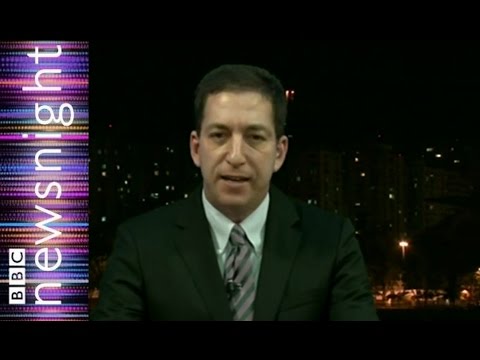
## Background This interview was published on YouTube by BBC Politics on October 3, 2013. According to the show description, it features an exclusive BBC Newsnight interview with journalist Glenn Greenwald addressing Edward Snowden, the PRISM revelations, and mass surveillance.
## TL;DR In a pointed exchange, Glenn Greenwald vigorously defends his publication of Edward Snowden's leaked intelligence files, rejecting official accusations that the reporting damaged national security or assisted terrorists. Greenwald argues that the archive exposed systemic surveillance directed against innocent citizens, international allies, and corporate entities rather than dangerous extremists. He condemns the British government's aggressive tactics, contrasting the detention of David Miranda and the physical destruction of Guardian hard drives with First Amendment protections in the United States. Finally, Greenwald recounts his clandestine initial meeting with Snowden in Hong Kong and maintains that Snowden's data remains uncompromised despite his enforced stay in Russia.
## Atmosphere & style The interview crackles with combative, high-stakes tension as the Newsnight presenter subjects Greenwald to an adversarial cross-examination regarding national security risks and operational recklessness. Greenwald counters with blistering, rapid-fire pushback, exuding moral certainty while displaying open disdain for British state intimidation and government-fed narratives. The mood briefly shifts in the closing minutes from a sharp, forensic clash into a suspenseful, spy-thriller reflection as Greenwald describes identifying Snowden in a Hong Kong hotel by looking for a Rubik's Cube.
## Bulletin - [00:03](https://www.youtube.com/watch?v=f1Zvo8N3G94&t=3s) Glenn Greenwald defended The Guardian's handling of the Snowden archive, rejecting government claims of compromised national security and arguing that intelligence agencies, rather than journalists, suffered catastrophic operational security failures. - [02:58](https://www.youtube.com/watch?v=f1Zvo8N3G94&t=178s) Leaked intelligence documents revealed economic espionage against non-terrorist entities, including Brazilian energy giant Petrobras and the Organization of American States, undermining official claims that mass surveillance exists solely to thwart terrorism. - [07:23](https://www.youtube.com/watch?v=f1Zvo8N3G94&t=443s) Greenwald condemned the UK government's heavy-handed tactics, highlighting the nine-hour detention of David Miranda under the Terrorism Act and the state-supervised physical destruction of hard drives in The Guardian's basement. - [10:50](https://www.youtube.com/watch?v=f1Zvo8N3G94&t=650s) Snowden remains stranded in Moscow only because the US State Department revoked his passport during transit, with Greenwald asserting that the underlying archive remains protected by encryption uncrackable by Russian intelligence.
## Key takeaways - [00:03](https://www.youtube.com/watch?v=f1Zvo8N3G94&t=3s) Greenwald rejects the accusation that he unilaterally decides what enters the public domain, citing a collaborative, line-by-line editorial vetting process with veteran Guardian journalists. - [00:03](https://www.youtube.com/watch?v=f1Zvo8N3G94&t=3s) The argument that surveillance disclosures aid terrorists is dismissed as absurd, since hostile actors already assumed electronic surveillance while ordinary citizens were kept entirely in the dark. - [02:58](https://www.youtube.com/watch?v=f1Zvo8N3G94&t=178s) Disclosures of espionage against Brazil's Petrobras and the Organization of American States demonstrate that the surveillance dragnet extends far beyond counterterrorism and serious crime. - [04:46](https://www.youtube.com/watch?v=f1Zvo8N3G94&t=286s) Greenwald emphasizes that GCHQ and the NSA were the entities that failed operational security by giving tens of thousands of staff access to raw files, unlike journalists who secured them with heavy encryption. - [04:46](https://www.youtube.com/watch?v=f1Zvo8N3G94&t=286s) The UK government's claim that David Miranda carried accessible passwords was directly contradicted by its own court affidavits, which conceded that only about 75 files could be decrypted. - [07:23](https://www.youtube.com/watch?v=f1Zvo8N3G94&t=443s) Greenwald clarifies that his Portuguese comments after Miranda's detention were mistranslated, denying allegations of 'revenge journalism' and insisting state intimidation requires deeper journalistic scrutiny. - [07:23](https://www.youtube.com/watch?v=f1Zvo8N3G94&t=443s) British officials forcing the physical destruction of computer hard drives inside The Guardian's offices was characterized as an act of authoritarian state censorship. - [09:31](https://www.youtube.com/watch?v=f1Zvo8N3G94&t=571s) A sharp legal divide exists between the US and UK: Greenwald cites First Amendment safeguards as protecting his return to America, while criticizing British authorities for aggressively undermining press freedoms. - [10:50](https://www.youtube.com/watch?v=f1Zvo8N3G94&t=650s) Edward Snowden secured his classified archive with extreme cryptographic layers that make foreign or Russian intelligence compromise impossible. - [10:50](https://www.youtube.com/watch?v=f1Zvo8N3G94&t=650s) Snowden's presence in Russia was involuntary, caused by the US revoking his passport and pressuring allies to prevent his transit to Latin America. - [12:53](https://www.youtube.com/watch?v=f1Zvo8N3G94&t=773s) The initial rendezvous in Hong Kong was arranged without Greenwald knowing Snowden's identity, relying on a Rubik's Cube in Snowden's hand as the visual recognition signal. - [12:53](https://www.youtube.com/watch?v=f1Zvo8N3G94&t=773s) Widespread global recognition of Snowden's actions as public-interest whistleblowing has complicated US government efforts to apprehend and quietly imprison him.
## Detailed walkthrough ### [00:03](https://www.youtube.com/watch?v=f1Zvo8N3G94&t=3s) Public Interest, National Security, and the Scope of the Leaks
The interview opens with the presenter challenging Glenn Greenwald, speaking via satellite from Rio de Janeiro, over what gives him the right to be the sole arbiter of what constitutes the public interest versus what threatens national security. Greenwald immediately rejects that framing, explaining that he works collaboratively alongside a large team of *Guardian* editors and seasoned national security reporters. He argues that the fundamental purpose of journalism is to serve as an independent check on authority by exposing what those in power attempt to conceal. When the presenter cites official claims that Edward Snowden took around 58,000 British documents—and reminds Greenwald that former GCHQ director Sir David Omand compared the fallout unfavorably to the notorious Philby, Burgess, and Maclean spy ring, calling it an impending "car crash"—Greenwald dismisses reliance on government statistics. Drawing a parallel to the flawed official claims preceding the Iraq War, he insists that raw document counts are irrelevant; what matters is how the material is handled. Every published piece undergoes rigorous line-by-line editorial scrutiny, and Greenwald maintains that not a single word published could plausibly be argued to compromise national security.
```mermaid flowchart TD accTitle: Editorial Process vs Government Accusations accDescr: Diagram contrasting the government accusations of intelligence breaches with the journalistic vetting process applied to the Snowden archive.
subgraph GovClaims["Official Accusations"] A["58,000+ UK Documents"] --> B["Equated to Philby, Burgess & Maclean spy ring"] B --> C["Allegations of a national security 'car crash'"] end
subgraph EditorialProcess["Journalistic Vetting"] D["Snowden Archive"] --> E["Line-by-line editorial review with The Guardian"] E --> F["Filtering content vs metadata"] F --> G["Publication limited strictly to public interest"] end ```
The presenter counters by suggesting that publishing detailed information about metadata collection inherently aids terrorists, who will inevitably adapt their communication tactics to bypass intelligence dragnets. Greenwald brands this assertion “completely ludicrous.” He notes that the disclosures go vastly beyond passive metadata into the direct content of private conversations, online chats, emails, and internet browsing histories of ordinary, innocent citizens. Furthermore, he points out that any operative with basic competence has long assumed Western intelligence agencies attempt to monitor their channels. The revelations, he argues, did not teach terrorists that spies exist; they informed regular democratic citizens that the surveillance machine is directed at them.
- Sir David Omand, former director of GCHQ, warned that the Snowden disclosures were worse than the Cold War espionage of Philby, Burgess, and Maclean. - The UK government claimed the leaked archive included roughly 58,000 British intelligence documents. - Glenn Greenwald retorted: “Of course every terrorist who's capable of tying their own shoes has long known that the UK and US governments are trying to monitor their communications.”
---
[02:58](https://www.youtube.com/watch?v=f1Zvo8N3G94&t=178s) Challenging the Terrorist Narrative: Spying on Allies and Corporations
Pressed repeatedly by the presenter on whether he can definitively guarantee that his reporting has not made it easier for terrorists to operate, Greenwald challenges the logical premise of being asked to prove an absolute negative. Rational journalism, he states, requires weighing competing evidence, and the documentation in their possession demonstrates pervasive spying on law-abiding individuals rather than novel methods against terrorists. When the presenter suggests the public might not be surprised by espionage and could even find broad intelligence operations reassuring, Greenwald points to the fundamental dishonesty of state officials who reassure the public that surveillance targets only terrorists and pedophiles while evidence proves otherwise.
Greenwald cites specific investigations that puncture the official anti-terror narrative. Reporting by his team revealed that GCHQ and the NSA actively conducted economic espionage against Petrobras, the massive Brazilian state-controlled oil enterprise whose earnings fund domestic public and social programs. Similarly, intelligence agencies monitored internal deliberations within the Organization of American States (OAS) during trade and economic negotiations. He questions whether the presenter genuinely believes there are terror cells inside Brazilian energy companies or child exploiters in trade delegations, maintaining that journalists must dismantle deceptive government pretexts used to justify the systematic erosion of privacy rights.
- When asked to prove that the disclosures haven't aided terrorists, Glenn Greenwald stated: “I would like to find a journalist or a human being who says I would rather remain ignorant about what my government is doing in a democracy that is not how a healthy democracy functions.” - Revelations revealed surveillance targeting Petrobras, the Brazilian oil giant, triggering diplomatic tensions between Brazil and Western governments. - Intelligence files showed intercepts aimed at economic diplomacy within the Organization of American States (OAS).
---
[04:46](https://www.youtube.com/watch?v=f1Zvo8N3G94&t=286s) Security of the Files and David Miranda’s Heathrow Detention
The interview turns tense as the presenter probes the physical and digital security of the unpublished documents, asking bluntly whether Greenwald keeps them in his Rio bedroom or on a USB memory stick in his pocket. Greenwald dismisses the invasive line of questioning regarding his living quarters, highlighting the irony of the accusation: the only parties who demonstrably lost control of classified national security data are GCHQ and the NSA itself. He details how UK intelligence agencies transferred sensitive files to an NSA internal database accessible to tens of thousands of personnel, whereas *The Guardian* has safeguarded its entire archive using high-grade encryption without suffering any loss of control.
```mermaid flowchart LR accTitle: Information Security Comparison accDescr: Flowchart contrasting intelligence agency data sharing against the security of journalist archives.
subgraph StateAgencies["Intelligence Failures"] GCHQ["GCHQ Files"] -->|"Uploaded to wide-access network"| NSA["NSA Database (Tens of thousands with access)"] NSA -->|"Breached from within"| Leak["Snowden Whistleblowing"] end
subgraph Newsroom["Guardian Safeguards"] Files["Snowden Material"] --> AdvancedCrypto["Advanced End-to-End Encryption"] AdvancedCrypto --> SecureStorage["Zero Breaches / Fully Maintained Custody"] end ```
The presenter presses further, bringing up the detention of Greenwald’s partner, David Miranda, at London’s Heathrow Airport, alleging that government court submissions showed Miranda was carrying plaintext passwords alongside encrypted drives. Greenwald calls that claim a blatant falsehood peddled by the British government to justify illegal acts in the middle of a high-stakes lawsuit. To debunk the government's claim, Greenwald points directly to the state's own filed legal affidavits, which stated that authorities could only decrypt approximately 75 out of thousands of documents because the material was so heavily fortified by encryption.
- David Miranda was detained for nine hours at Heathrow Airport under Schedule 7 of the UK's Terrorism Act 2000 while transporting materials. - Greenwald pointed out that the UK government's own court affidavit conceded the seized files remained “heavily encrypted,” with authorities only able to reconstruct roughly 75 documents. - Emphasizing the agencies' operational failures, Glenn Greenwald argued: “The only ones who have lost control of the documents through horrific operational security is the GCHQ and the NSA.”
---
[07:23](https://www.youtube.com/watch?v=f1Zvo8N3G94&t=443s) Retaliation Accusations vs. Journalism Under State Intimidation
The presenter brings up Greenwald’s public reaction immediately following Miranda's nine-hour detention, quoting remarks where Greenwald appeared to warn that he would become far more aggressive, publish significantly more files on England’s surveillance apparatus, and ensure the British authorities would "be sorry for what they did." The presenter suggests this posture resembles political activism or a vendetta of "revenge journalism" rather than objective reporting. Greenwald corrects the timeline and context, clarifying that the interview in question took place roughly four weeks prior in Portuguese and had suffered from distorted translation. Rather than issuing personal threats, he had been asked how the UK’s actions would be perceived internationally; his response was that targeting journalists and their families would be widely viewed in genuine democracies as thuggish, counterproductive, and an embarrassment that British officials would ultimately come to regret.
Far from being an act of revenge, Greenwald insists that investigative scrutiny must intensify whenever governments overreach. He contrasts the behavior of the British state with authoritarian regimes, pointing out that UK officials entered *The Guardian*’s offices to supervise the physical destruction of computer hard drives—an act of state censorship one would anticipate in Iran, Russia, or China, not a Western democracy. Subjecting a journalist’s partner to anti-terror interrogation laws for nine hours was an overt effort at state intimidation, reinforcing why uncompromised, aggressive investigative journalism is urgently needed.
- Reporting on GCHQ's surveillance of Petrobras had already been broadcast on Brazil's *Fantastico* news program following Miranda's release. - UK security agents oversaw the physical destruction of hard drives in *The Guardian*’s basement to suppress reporting. - Framing his journalistic philosophy, Glenn Greenwald declared: “My view of journalism is that the more people in power abuse that power, the more accountability and transparency they prove that they need through journalism.”
[09:31](https://www.youtube.com/watch?v=f1Zvo8N3G94&t=571s) Personal Safety and the Contrast Between US and UK Press Freedoms
The conversation turns to Glenn Greenwald’s personal safety following the publication of the National Security Agency leaks. Greenwald dismisses personal anxiety, noting that he does not dwell on danger because journalists frequently face difficult circumstances. The Brazilian government has offered and provided him with security in Rio de Janeiro, leaving him content with his current situation.
```mermaid flowchart TD accTitle: Greenwald Travel Risk Assessment accDescr: Diagram comparing Greenwald's legal risks when traveling to the US versus the UK.
subgraph US["United States"] US_Const["First Amendment Constitutional Protections"] US_DOJ["Former DOJ Officials Call Journalist Prosecution Unthinkable"] US_Outcome["Plans to return when sensible"] US_Const --> US_DOJ --> US_Outcome end
subgraph UK["United Kingdom"] UK_Acts["Detained partner under Terrorism Act"] UK_Media["Forced The Guardian to destroy hard drives"] UK_Threats["Active threats of criminal investigation"] UK_Outcome["High caution / avoids visiting"] UK_Acts --> UK_Outcome UK_Media --> UK_Outcome UK_Threats --> UK_Outcome end ```
When asked whether he feels safe traveling to the United States and the United Kingdom, Greenwald draws a sharp distinction between the legal regimes of both countries. He expresses full confidence in returning to the United States whenever he chooses, citing the First Amendment: “Well I am going to return to the United States as soon as I I decide that it makes sense to do so because unlike in the UK there's actually a constitutional guarantee of a free press and I think lots of even former Obama Justice Department officials have said it's unthinkable that the Obama Administration would prosecute the journalist in this case.” By contrast, he describes British authorities as operating with hostility toward media freedoms.
- Greenwald notes that the UK government has “proven that they are willing to very thuggishly run roughshod over press freedoms.” - Specific British actions cited include threatening criminal investigations against reporters, detaining his partner (David Miranda) under the Terrorism Act 2000 at Heathrow Airport, and forcing *The Guardian* to physically smash its hard drives and laptops. - Greenwald concludes with a dismissive remark regarding travel restrictions to the UK: “Not being able to visit the UK is not really something I regard as a particularly great punishment.”
---
[10:50](https://www.youtube.com/watch?v=f1Zvo8N3G94&t=650s) Contact with Snowden, Data Security, and Russian Asylum
The discussion moves to Edward Snowden's status in Russia and whether Greenwald maintains communication with him. Greenwald confirms that they speak regularly, describing him not just as a source but as someone he cares about personally. The interviewer presses him on whether Snowden has been forced to yield classified information in exchange for protection from Russian authorities, especially given his travel through Hong Kong and arrival in Moscow.
Greenwald rejects the allegation, arguing that Snowden's statements have proven completely true throughout their reporting, whereas American and British official accounts have repeatedly fallen apart. He explains that Snowden implemented extreme cryptographic barriers to protect the cache: “I know for a fact that he has protected the data that he has with extreme levels of encryption that not even the NSA let alone the lesser Russian intelligence agencies can crack and he didn't unravel his life to fight surveillance in order to then go to the Russians and help them surveil.”
When the interviewer challenges that Greenwald cannot prove Snowden surrendered nothing, Greenwald turns the interviewer’s earlier logic on its head, reminding him that one cannot prove a negative. He insists that all available evidence demonstrates zero intelligence compromise, and admonishes reporters for speculating without backing: “There's zero evidence that they have and any responsible journalists would refrain from suggesting that that happened when they have no evidence that it did.”
Addressing Snowden’s security given that Russia had only granted a temporary one-year asylum—and citing the grounding of Bolivian President Evo Morales’s plane in European airspace when Western agencies suspected Snowden was on board—Greenwald reminds the program of the real circumstances of Snowden's presence in Moscow: - Snowden never intended to remain in Russia; he was attempting to transit to Latin America when the US State Department revoked his passport and coerced allied nations into blocking transit routes. - Faced with the alternative of serving decades in a maximum-security institution, Greenwald remarks: “Given the alternative which is a supermax prison in United States where he's disappeared for the next 40 years I think he's quite content to be where he is.”
---
[12:53](https://www.youtube.com/watch?v=f1Zvo8N3G94&t=773s) Meeting in Hong Kong and Snowden's Ultimate Fate
The interviewer shifts to the dramatic spy-thriller atmosphere surrounding the initial reporting, asking Greenwald how he first recognized Snowden in Hong Kong. Greenwald recalls arriving in the city with no knowledge of his source's appearance, name, or age. Snowden arranged a rendezvous in a designated public area of his hotel, instructing Greenwald and documentarian Laura Poitras to look for an operative carrying an iconic prop.
Snowden was not present at the first scheduled meeting time, forcing them to return for a secondary backup window. Minutes later, Snowden appeared holding a Rubik's Cube in his hand, which served as the prearranged visual signal confirming his identity to the journalists.
Turning to the long-term outlook, the interviewer asks whether Snowden will ultimately end up inside an American penitentiary. Greenwald reflects on how much public perceptions have shifted since their initial meetings in Hong Kong, when capture appeared virtually guaranteed:
> “Well when we were in Hong Kong he had assumed I think we were all assuming that that was going to be the likely outcome of the brave choice that he had made which is what made it so brave. I think now it's a lot more difficult because the his reporting is considered heroic by huge numbers of people around the world and I think it's made it much more difficult for the US government to get their hands on him and and basically disappear him and make it so that he's never heard from again.”
## Notable quotes > [07:23](https://www.youtube.com/watch?v=f1Zvo8N3G94&t=443s) My view of journalism is that the more people in power abuse that power, the more accountability and transparency they prove that they need through journalism. — Glenn Greenwald
> [00:03](https://www.youtube.com/watch?v=f1Zvo8N3G94&t=3s) Of course every terrorist who's capable of tying their own shoes has long known that the UK and US governments are trying to monitor their communications. — Glenn Greenwald
## Mentioned Glenn Greenwald, Edward Snowden, David Miranda, Sir David Omand, Laura Poitras, Evo Morales, Barack Obama, The Guardian, BBC Newsnight, GCHQ, NSA, US Department of Justice, US State Department, Petrobras, Organization of American States (OAS), PRISM, Terrorism Act 2000, First Amendment to the United States Constitution, Philby, Burgess, and Maclean, Fantastico
## Video description BBC Newsnight exclusive interview with journalist Glenn Greenwald on Edward Snowden, the PRISM revelations and mass surveillance
[Source](https://www.youtube.com/watch?v=f1Zvo8N3G94)