Musk, Ma Clash Over AI Threat and Mars Colonization in Shanghai
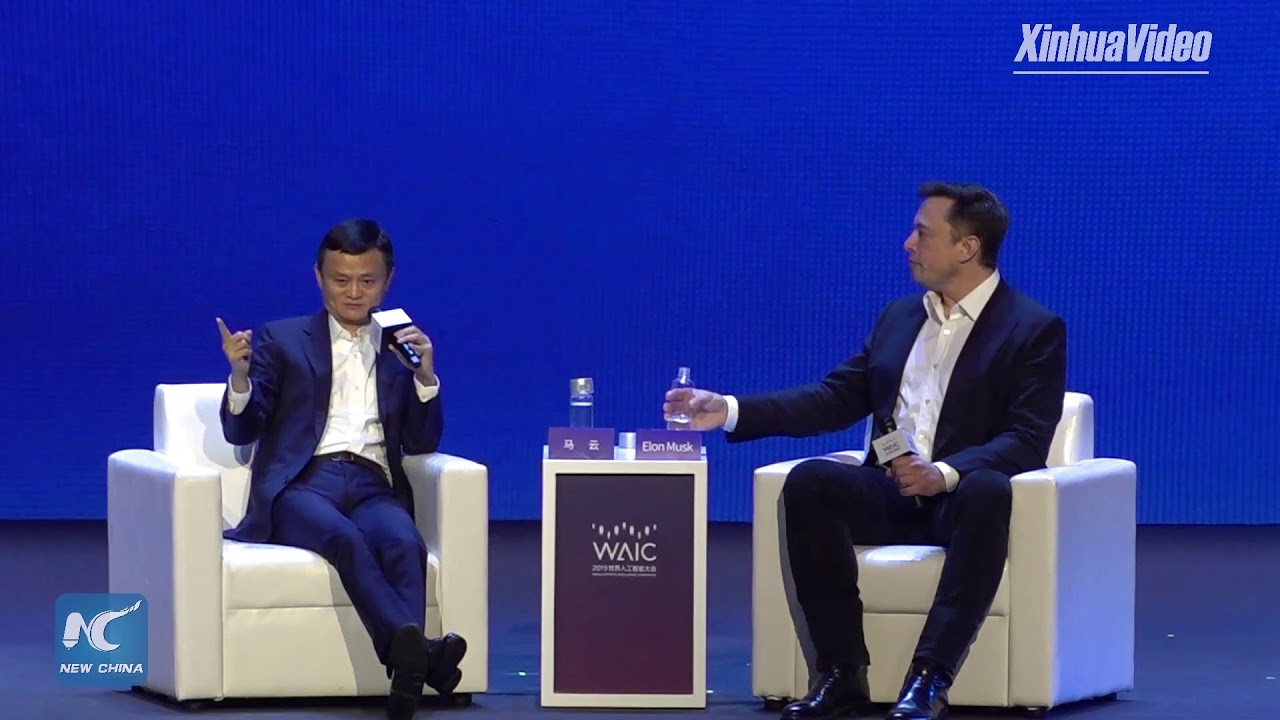
Jack Ma and Elon Musk hold debate in Shanghai — New China TV

New China TV

Elon Musk warns humanity risks becoming mere biological scaffolding for digital superintelligence without direct neural interfaces, while Jack Ma insists machines will never surpass their creators.

AI-assisted summary of Jack Ma and Elon Musk hold debate in Shanghai — original source. Check the original for full context.

Source published:

Key ideas

  • Elon Musk warned that artificial intelligence researchers suffer from complacency by assuming human intellect is the benchmark for reason, arguing that direct neural interfaces are urgently required to overcome the severe human output bandwidth bottleneck. (0:00)
  • Rejecting conventional fears of overpopulation, Elon Musk and Jack Ma both identified accelerating demographic collapse as the single greatest civilizational threat over the next twenty years, locked in by the twenty-year lag between birth rates and adult labor cohorts. (34:25)
  • Jack Ma forecasted that artificial intelligence and productivity gains will inevitably compress human labor schedules into a three-day workweek of four hours per day as life expectancies extend toward 100 to 120 years. (17:40)
  • Musk advocated dedicating 0.5% to 1% of global GDP toward establishing multi-planetary consciousness as an essential extinction hedge, while Ma urged prioritizing Earth's 7.4 billion inhabitants and using technology to clean the oceans. (9:35)

Detailed notes

## Background Published on YouTube by New China TV on August 29, 2019, this video documents a stage debate held in Shanghai between Alibaba co-founder Jack Ma and Tesla CEO Elon Musk. According to the page description, the two business leaders convened to debate the future and impact of artificial intelligence.

## TL;DR The discussion explores the contrasting philosophies of Elon Musk and Jack Ma regarding artificial intelligence, human labor, and the future of civilization. Musk warns of the imminent emergence of digital superintelligence, arguing for brain-machine interfaces and multi-planetary colonization to safeguard human consciousness against existential threats. Ma offers a humanist counterweight, asserting that machines are merely clever tools incapable of replicating human wisdom, while urging society to focus on Earth's immediate challenges, education reform, and shorter workweeks. Despite their stark disagreements over whether machines can outsmart their creators, both speakers converge on the urgent threat of global population collapse and the necessity of ecological sustainability.

## Atmosphere & style The exchange possesses a surreal, captivating tension marked by an almost comedic clash of communication styles and worldviews. Musk presents with measured, dry techno-urgency, staring contemplatively into the distance and invoking physics, Fermi's paradox, and bandwidth constraints, while Ma counters with animated, folksy optimism, playful aphorisms, and relaxed dismissals of existential panic. The dynamic alternates between deadpan skepticism and cheerful deflection, creating a dialogue that feels simultaneously high-stakes and delightfully unaligned as two global titans talk past each other on the world stage.

## Bulletin - [00:00](https://www.youtube.com/watch?v=f3lUEnMaiAU&t=0s) Elon Musk warned that artificial intelligence researchers suffer from complacency by assuming human intellect is the benchmark for reason, arguing that direct neural interfaces are urgently required to overcome the severe human output bandwidth bottleneck. - [34:25](https://www.youtube.com/watch?v=f3lUEnMaiAU&t=2065s) Rejecting conventional fears of overpopulation, Elon Musk and Jack Ma both identified accelerating demographic collapse as the single greatest civilizational threat over the next twenty years, locked in by the twenty-year lag between birth rates and adult labor cohorts. - [17:40](https://www.youtube.com/watch?v=f3lUEnMaiAU&t=1060s) Jack Ma forecasted that artificial intelligence and productivity gains will inevitably compress human labor schedules into a three-day workweek of four hours per day as life expectancies extend toward 100 to 120 years. - [09:35](https://www.youtube.com/watch?v=f3lUEnMaiAU&t=575s) Musk advocated dedicating 0.5% to 1% of global GDP toward establishing multi-planetary consciousness as an essential extinction hedge, while Ma urged prioritizing Earth's 7.4 billion inhabitants and using technology to clean the oceans.

## Key takeaways - [00:00](https://www.youtube.com/watch?v=f3lUEnMaiAU&t=0s) Musk argues that people fundamentally underestimate AI by viewing it as an exceptionally smart person rather than a gap analogous to humans and chimpanzees, warning that machine perception will interpret human speech as slow, tonal wheezing. - [04:47](https://www.youtube.com/watch?v=f3lUEnMaiAU&t=287s) Musk suggests humanity may ultimately serve as a temporary biological bootloader designed to initialize digital superintelligence, given the exponential trajectory of computing power compared to cosmological time. - [04:47](https://www.youtube.com/watch?v=f3lUEnMaiAU&t=287s) Ma counters apocalyptic AI predictions by embracing a 'street smart' optimism, claiming historical forecasts are overwhelmingly inaccurate and that upcoming generations will develop the necessary tools to govern new technologies. - [09:35](https://www.youtube.com/watch?v=f3lUEnMaiAU&t=575s) Musk invokes the Fermi paradox to justify space colonization, maintaining that conscious life is exceedingly rare and fragile, requiring humanity to become multi-planetary before the technological window closes. - [09:35](https://www.youtube.com/watch?v=f3lUEnMaiAU&t=575s) Ma insists human responsibility belongs to the 7.4 billion living on Earth today, emphasizing that everyday terrestrial improvements and ecological stewardship take priority over Mars expeditions. - [15:00](https://www.youtube.com/watch?v=f3lUEnMaiAU&t=900s) Musk praises the construction velocity of Tesla's Shanghai Gigafactory as unprecedented, pointing to China's rapid progress in sustainable transportation and private orbital rocketry. - [17:40](https://www.youtube.com/watch?v=f3lUEnMaiAU&t=1060s) Ma dismisses fears of automation-induced joblessness, predicting that technological abundance will liberate humans into a three-day, twelve-hour workweek dedicated to leisure, art, and personal fulfillment. - [20:10](https://www.youtube.com/watch?v=f3lUEnMaiAU&t=1210s) Musk emphasizes that high-bandwidth brain-machine interfaces are critical because biological humans operate under a severe bandwidth bottleneck and have a narrow window of opportunity to merge with computing before obsolescence. - [22:45](https://www.youtube.com/watch?v=f3lUEnMaiAU&t=1365s) Ma criticizes modern education as an industrial relic focused on mechanical calculation, arguing curricula must pivot toward uniquely human attributes like dancing, painting, creativity, and the 'heart.' - [22:45](https://www.youtube.com/watch?v=f3lUEnMaiAU&t=1365s) Musk critiques academic lectures as exceptionally low-bandwidth and envisions high-speed direct knowledge downloads akin to 'The Matrix,' defining true learning as iteratively refining internal models to predict the future with less error. - [26:50](https://www.youtube.com/watch?v=f3lUEnMaiAU&t=1610s) A fundamental philosophical split emerges when Ma claims natural science prevents humans from creating anything smarter than themselves, a premise Musk strongly rejects on evolutionary and computational grounds. - [30:00](https://www.youtube.com/watch?v=f3lUEnMaiAU&t=1800s) Musk cites AlphaGo's 4–1 win over Lee Sedol and AlphaZero's subsequent 100–0 victory over AlphaGo to demonstrate that machines rapidly and decisively eliminate human intellectual dominance in complex systems. - [30:00](https://www.youtube.com/watch?v=f3lUEnMaiAU&t=1800s) Ma distinguishes between 'clever' machine logic rooted in stored knowledge and human 'smartness' rooted in lived experience, arguing that racing against computers in calculation is as foolish as trying to outrun a car. - [34:25](https://www.youtube.com/watch?v=f3lUEnMaiAU&t=2065s) Both speakers warn that the coming demographic collapse represents a catastrophic blind spot, noting that present-day birth statistics lock in the adult workforce of twenty years later. - [34:25](https://www.youtube.com/watch?v=f3lUEnMaiAU&t=2065s) Ma asserts that while machines master logic, rules, and calculation, human survival depends on cultivating the 'Love Quotient' (LQ) driven by illogical emotional impulses that algorithms cannot replicate. - [39:56](https://www.youtube.com/watch?v=f3lUEnMaiAU&t=2396s) Musk points out that environmental and lifestyle interventions cannot override hardwired biological DNA aging clocks, whereas high-bandwidth neural interfaces could theoretically allow human consciousness states to be digitally backed up and restored. - [45:00](https://www.youtube.com/watch?v=f3lUEnMaiAU&t=2700s) Ma stresses that technology alone does not change the world without human dreams and values behind it, concluding alongside Musk's call to continually 'fight for the light of consciousness.'

## Detailed walkthrough ### [00:00](https://www.youtube.com/watch?v=f3lUEnMaiAU&t=0s) Defining AI: "Alibaba Intelligence" vs. Digital Superintelligence

The debate opens in Shanghai with an introduction of Elon Musk, co-founder and CEO of Tesla, and Jack Ma, co-chair of the UN High-Level Panel on Digital Cooperation. As they settle in front of a giant interactive screen, the speakers start by riffing on the meaning of artificial intelligence. Ma plays with the pronunciation, noting that "AI" sounds phonetically like the Chinese word for love, before quipping that he dislikes calling it artificial intelligence and prefers to designate it "Alibaba intelligence." Musk wryly concedes that this might end up being true, but immediately steers the conversation toward the staggering capability gap between human brains and machine intelligence. In Musk’s view, people fundamentally misunderstand artificial intelligence by imagining it merely as an exceptionally smart person, whereas the real difference will be closer to the divide between humans and chimpanzees—creatures that view human beings as strange aliens while mostly concerning themselves with other chimpanzees.

Musk criticizes the artificial intelligence research community for intellectual complacency, arguing that their greatest blind spot is assuming their own intellect is the benchmark for reason. To address this looming asymmetry, Musk points toward his brain-computer interface venture, Neuralink, invoking the adage that if you cannot beat them, you should join them. He explains that humans are already cyborgs due to their utter reliance on smartphones and computers, noting that misplacing a phone feels like losing a limb. However, the true bottleneck is bandwidth: while visual and video inputs have scaled up dramatically, human output bandwidth has actually plummeted because people now type with two thumbs rather than ten fingers. In a future where exaflop-scale computers operate at millisecond timescales where a single millisecond feels like an eternity, human communication will be impossibly sluggish by comparison. Musk muses that to a machine, human speech will register as little more than slow, tonal wheezing akin to whale sounds.

```mermaid flowchart TD accTitle: Human-AI Bandwidth Asymmetry accDescr: Flowchart showing high-bandwidth input and constrained output between humans and digital systems. subgraph Human["Human Being (Current 'Cyborg')"] Brain["Human Cognition"] end

subgraph Digital["Digital Systems & AI"] Compute["Exaflop Compute Engine"] Perception["High-Speed Data & Video Streams"] end

Perception -->|"High-Bandwidth Input (Images, Video)"| Brain Brain -->|"Severely Bottlenecked Output (Two-Thumb Typing)"| Compute Brain -.->|"Proposed Solution: High-Bandwidth Interface (Neuralink)"| Compute ```

- Elon Musk on the blind spots of AI researchers: “The biggest mistake that I see artificial intelligence researchers making is assuming that they're intelligent.” - Elon Musk on human communication from an AI perspective: “I always think like human speech to a computer will sound like very slow tonal wheezing.”

---

[04:47](https://www.youtube.com/watch?v=f3lUEnMaiAU&t=287s) Street Smarts, Bootloaders, and the Pace of Technological Change

Jack Ma contrasts Musk’s engineering-centric analysis by stating that he is not a technical specialist, but someone focused on human life and human society. Ma argues that artificial intelligence should not be feared as an existential threat, but embraced as a tool that allows humans to turn inward and comprehend their own psychology and nature rather than just mastering the external world. He dismisses apocalyptic future-gazing by pointing out that historically, 99.99% of human predictions about the future turn out to be dead wrong, with the tiny remainder succeeding only by coincidence. Claiming the stance of the "street smart" rather than the "college smart," Ma asserts that older generations may lack answers, but the youth will develop solutions to regulate and benefit from emerging technology.

Musk is far less sanguine about this optimism, warning that Ma's casual confidence sounds like "famous last words." To illustrate the staggering exponential pace of computing, Musk points to the evolution of video games: 40 to 50 years ago, state-of-the-art gaming was *Pong*, consisting merely of two moving rectangles and a bouncing square. Today, the world has real-time, photorealistic 3D simulations shared by millions of players at once, and any continued rate of improvement will render games completely indistinguishable from reality unless civilization collapses first. Musk places this development against the cosmological timeline, noting that modern written human civilization is only roughly 7,000 years old within a 13.8-billion-year-old universe. With technological progress outpacing human comprehension, Musk presents a striking metaphor for the role of humanity in the cosmos: humanity may ultimately serve as nothing more than biological scaffolding designed to bring synthetic life into existence.

- Jack Ma on embracing technology without fear: “People like us, street smart, we're never scared of that.” - Elon Musk on the historical acceleration of technology: “It seems to me some time ago that you could sort of think of humanity as a biological bootloader for digital super intelligence.” - Elon Musk on historical scale: civilization has existed for approximately 7,000 years since the inception of written records, meaning even a million-year human survival run would alter only the third decimal place of the universe's 13.8-billion-year lifespan.

---

[09:35](https://www.youtube.com/watch?v=f3lUEnMaiAU&t=575s) Earth vs. Mars: Preserving the Light of Consciousness

Ma pivots the dialogue to space travel, playfully mentioning that while he admires Musk’s ambition to go to Mars, he personally has no desire to visit because he feels like he "just came back from there." Musk responds by outlining his philosophical justification for making humanity a multi-planetary species. Invoking the Fermi paradox—the eerie question of why humanity has found zero evidence of extraterrestrial civilizations despite the vastness of space—Musk stresses that conscious life is extraordinarily fragile and rare. Becoming multi-planetary is not an escapist fantasy or an admission of defeat regarding Earth; rather, it represents an essential insurance policy against an irreducible probability of extinction caused by either an external catastrophic event or an internal unforced civilizational error. Because the technological window to extend life beyond Earth has opened for the very first time in Earth's history, Musk insists humanity must act aggressively before that window closes.

Ma directly challenges Musk's extraterrestrial focus, redirecting the priority toward the billions of humans living on Earth today. While he acknowledges the grandeur of landing one million people on Mars, Ma insists that human responsibility lies with the 7.4 billion inhabitants on Earth and the sustainability of our home planet over the next century. Ma jokes that one can reach Mars simply by stepping off a tall building—an irreversible journey—and compares space missions to climbing the Himalayas, which he would prefer to visit only after someone builds an elevator to the summit. Ma concludes that while visionary space explorers like Musk are needed, the world equally depends on heroes dedicated to everyday terrestrial improvements, digging tunnels, cleaning up the environment, and utilizing AI to foster human understanding.

- Elon Musk on the fragility of consciousness: “I think it's important for us to take the set of actions that are most likely to continue consciousness into the future.” - Jack Ma on prioritizing terrestrial issues over interplanetary colonization: “It's great to send one million people to the Mars, but we have to care about the 7.4 billion people on the Earth.” - Jack Ma on space exploration versus everyday labor: “We need heroes like you, but we need more heroes like us. Working hard on the earth, improving things every day.”

[15:00](https://www.youtube.com/watch?v=f3lUEnMaiAU&t=900s) Funding Consciousness and the Speed of China's Progress

Elon Musk clarifies the economic scope of his push for space exploration, explaining that establishing multi-planetary consciousness requires only a tiny fraction of global resources. In his view, dedicating less than one percent—perhaps half a percent to one percent—of Earth’s GDP toward extending life beyond Earth leaves two orders of magnitude of resources dedicated entirely to terrestrial needs without impairing life on Earth. Framing the investment with characteristic humor, he remarks that humanity’s budget for preserving consciousness should fall somewhere between what is spent on cosmetics and what is spent on healthcare. While professing to be completely pro-cosmetics, he argues that safeguarding the light of consciousness warrants an allocation at least slightly larger than global spending on lipstick.

Turning to terrestrial matters, Musk emphasizes his work with Tesla on sustainable energy, batteries, and electric vehicles, using the occasion to shower enthusiastic praise on the team building the Shanghai Gigafactory. He admits to being genuinely stunned by how fast the facility came together, remarking that he had never seen construction move with such velocity anywhere in the world. He calls the achievement a powerful testament to China's dynamism, adding that private Chinese aerospace ventures are also making remarkable strides, with two entrepreneurial rocket companies already reaching orbit—a milestone Musk notes from personal experience is exceptionally difficult.

- Musk suggests spending roughly 0.5% to 1% of global GDP to make life multi-planetary, while leaving over 99% of resources for Earth. - Musk highlights that two private Chinese rocket startups have already achieved orbit, earning his deep respect. - Musk on planetary spending priorities: “So I think it should be somewhere in between how much we spend on lipstick and how much we spend on healthcare.” - Musk on construction speed in Shanghai: “So I've never seen anything built so fast in my life before, to be totally frank.”

[17:40](https://www.youtube.com/watch?v=f3lUEnMaiAU&t=1060s) The Future of Work: A Three-Day Workweek and Extended Lifespans

As the conversation shifts toward the future of employment and artificial intelligence, Jack Ma challenges the conventional anxiety that automation will trigger mass joblessness. Drawing a parallel to past industrial upheavals, Ma argues that every major technological revolution initially sparks panic over vanishing livelihoods, yet historically ends up creating far more opportunities than it destroys. More fundamentally, Ma questions why humanity remains obsessed with working long hours in the first place, envisioning an AI-driven society where advanced productivity naturally reduces human labor to a fraction of today's schedule.

Ma illustrates this transition through the historical impact of electricity, which gave people light and power after sundown, freeing up evenings for karaoke, social parties, and leisure. Artificial intelligence, he contends, will similarly emancipate people to enjoy the subjective experience of being human. He contrasts generational mobility across history: while his grandfather visited perhaps three cities in his entire lifetime and his father visited thirty, Ma himself has traveled to roughly three hundred, and his future grandchildren might easily explore three thousand while riding autonomous vehicles or robots.

- Ma forecasts that advances in life sciences will soon allow humans to live between 100 and 120 years. - Ma envisions a future work pattern where humans only labor three days a week, four hours per day. - Ma compares generational travel horizons: 3 cities (grandfather), 30 cities (father), ~300 cities (himself), and up to 3,000 cities (future grandchildren). - Ma on future labor hours: “I think people should work three days a week, four hours a day.” - Ma on technology creating leisure: “I think because of artificial intelligence, people will have more time enjoy being human beings.”

[20:10](https://www.youtube.com/watch?v=f3lUEnMaiAU&t=1210s) Longevity, the Aging Trap, and the Urgency of Neuralink

Exploring the demographic implications of extended longevity, Ma points out a looming paradox: historically, lifespans hovered around 30 to 35 years during the agricultural era and stretched to roughly 70 years following the Industrial Revolution. As AI and life sciences push life expectancy toward 120 years, society faces the double bind of falling birth rates and an aging population where elderly patriarchs are still trying to hold down jobs. While acknowledging this transition will create novel societal headaches, Ma remains temperamentally unbothered about the fate of work, advising people not to fret because society will inevitably adapt.

Musk listens with a skeptical, pensive look, turning the focus away from work hours toward human cognitive limitations and Neuralink. In Musk’s view, biological humans are at severe risk of being completely outpaced unless they establish a high-bandwidth digital interface directly with computing power. Musk uses a striking topological metaphor to describe humanity's uneven grasp of technology: overall technological awareness is mostly a flat plain punctuated by a few modest structures, while advanced capability exists as towering, isolated spires visible only to the few perched atop them. When Musk warns that humanity is rapidly running out of time to solve this neural interface problem, Ma cheerfully waves away the existential urgency, responding that he never wastes energy worrying about problems he cannot solve himself.

```mermaid flowchart TD accTitle: Contrasting Philosophies on AI and the Human Future accDescr: Diagram illustrating the opposing approaches of Jack Ma and Elon Musk regarding human labor, longevity, and machine capability.

subgraph MaApproach["Jack Ma: Human-Centric Optimism"] direction TB M1["Automation & Life Sciences"] --> M2["3-Day Workweek / Lifespans to 120"] M2 --> M3["Focus on Human Heart, Arts & Wisdom"] M3 --> M4["Machines Remain Subservient Toys"] end

subgraph MuskApproach["Elon Musk: Engineering & Bandwidth Urgency"] direction TB E1["Digital Superintelligence Gap"] --> E2["Biological Bandwidth Bottleneck"] E2 --> E3["Neuralink Brain-Machine Interface"] E3 --> E4["Merge with AI to Avoid Obsolescence"] end ```

- Musk stresses that the timeline to build high-bandwidth brain-machine interfaces is uncomfortably short. - Ma on his personal philosophy toward insoluble dilemmas: “I never worry about the things that I cannot solve. I let other people to solve it.” - Musk on the distribution of technical understanding: “If there was a topological map of technology awareness, it's mostly flat with a few short buildings and then some very tall spires.”

[22:45](https://www.youtube.com/watch?v=f3lUEnMaiAU&t=1365s) Reimagining Education: Industrial Memorization vs. "The Matrix" Downloads

Pivoting to education, Ma expresses deep alarm over existing pedagogical systems, asserting that today’s schools remain antiquated relics of the industrial era designed around rote memorization and mechanical computation. Because computers will inevitably out-calculate, out-memorize, and out-run any biological human, training children to compete on those terms is a guaranteed failure. Instead, Ma insists education must pivot entirely toward nurturing the qualities machines lack—creativity, constructive thinking, music, painting, dancing, and the emotional "heart" from which true wisdom springs. He insists that machines are fundamentally incapable of genuine human consciousness, belittling the computer as a mere toy and pointing out that human beings cannot even synthesize a living mosquito, let alone another thinking human.

Musk offers a starkly different framework for education, grounded in predictive accuracy and computational bandwidth. For Musk, genuine learning is about refining internal mental models to predict the future with progressively less error—becoming "less wrong" over time through iterative feedback loops. He laments that modern schooling is painfully inefficient, characterizing traditional academic lectures as the worst form of low-bandwidth information transfer imaginable. Looking forward, Musk envisions a future akin to *The Matrix*, where brain-computer interfaces could instantly upload entire bodies of specialized knowledge—such as piloting a helicopter—directly into the brain without years of sluggish human instruction.

- Ma warns that without sweeping education reforms within the next 10 to 20 years, younger generations will be wholly unprepared for the AI era. - Musk critiques current educational formats as fundamentally throttled by the human brain's input-output limitations. - Ma on the distinction between human and artificial minds: “We don't only have chips, men have the heart. It's the heart where the wisdom comes from.” - Musk on information transfer in legacy schooling: “The way education works right now, it's extremely low bandwidth. It's extremely slow. Lectures are the worst, really.” - Musk on the epistemic goal of learning: “The best way to predict the future is to make it. And then assess whether what you're learning is enabling you to predict the future with less error? Are you less wrong?”

[26:50](https://www.youtube.com/watch?v=f3lUEnMaiAU&t=1610s) Human Mistakes vs. Machine Intelligence: Can We Build Something Smarter?

The segment concludes with a sharp, fundamental disagreement over whether artificial intelligence can ultimately surpass human intellect. Ma argues that human fallibility is an irreplaceable virtue rather than a defect, calling human errors and mistakes the greatest assets of life because they provide the foundation for self-correction, personal growth, and resilience. Reflecting on demographic vitality, he mentions that China's current birth numbers are insufficient and emphasizes that the real wealth of humanity lies not in coal, oil, or electricity, but in the untapped potential of human brains. Ma firmly dismisses fears that machines will ever subjugate humanity, arguing on scientific principles that humans can never build an entity more intelligent than its creator.

Musk cuts directly across Ma’s assertion with an immediate, emphatic rejection: “I very much disagree with that.” Musk contends that humanity’s foundational premise must be intellectual humility—assuming first and foremost that humans are, in the grand cosmic scheme, quite dim. Pointing out that human beings themselves evolved out of an environment where no humans previously existed, Musk argues there is zero scientific reason why biological humans cannot construct synthetic systems that vastly outstrip biological intelligence in every conceivable dimension.

- Ma insists human mistakes are essential evolutionary assets that machines cannot replicate. - Ma claims natural science prevents any creator from building an entity fundamentally smarter than itself. - Musk directly contradicts Ma's claim of human intellectual supremacy over machine systems. - Ma on the impossibility of superintelligence: “Machines are invented by human beings, and according to the science, right, humans can never create another animal that is smarter than humans.” - Musk countering Ma's assumption: “I mean, the first thing we should assume is that we are very dumb, and we can definitely make things smarter than ourselves.”

[30:00](https://www.youtube.com/watch?v=f3lUEnMaiAU&t=1800s) Clever Tools vs. Inevitable Superintelligence

Elon Musk reflects on the trajectory of human civilization, observing that humanity began in a very primitive state without real technology, running around trying to survive the winter and avoid being eaten by predators. Now that heating exists and humans systematically cultivate food, it is obvious that society has become vastly smarter, and Musk insists that “We are not the last step in evolution.” Jack Ma challenges this premise directly, demanding: “So give me an example of what animals or things that a human being made that is smarter than human beings.” Musk counters that computers are already far superior across many dimensions, but humans simply keep moving the goalposts whenever machines surpass them.

Musk walks through the history of competitive board games to demonstrate the rapid pace of artificial intelligence. While mastering chess was once hailed as the pinnacle of human intellect, a modern smartphone can easily crush the human world champion. The ancient game of Go was long defended as an exclusively human domain due to its staggering complexity, until Google DeepMind’s AlphaGo defeated world champion Lee Sedol 4–1. Shortly thereafter, AlphaZero trounced AlphaGo by a score of 100–0. Musk notes that human competition in Go has become completely pointless because the machines now simply play against themselves, remarking that “Humans are trying to play a computer Go is like trying to fight Zeus.” In Musk’s view, the intellectual corner where humans outperform computers is shrinking rapidly toward zero, leaving only two eventual possibilities: machines will surpass humanity in every single way, or human civilization will come to an end.

```mermaid flowchart TD accTitle: AI Mastery Across Increasing Degrees of Freedom accDescr: Progression from simple solved games to complex realities and simulation. subgraph Classical ["Classical Computing"] A["Checkers<br/>(Low degrees of freedom; fully solved)"] end subgraph DeepLearning ["Deep Reinforcement Learning"] B["Chess<br/>(Orders of magnitude higher than Checkers)"] C["Go<br/>(AlphaGo beats Lee Sedol 4-1; AlphaZero beats AlphaGo 100-0)"] end subgraph RealitySimulation ["Complex Reality"] D["Human Simulation<br/>(Highest degrees of freedom / Physical Reality)"] end A --> B B --> C C --> D ```

Jack Ma flatly rejects Musk's grim assessment, drawing an ontological line between two concepts: “My view is that computer may be clever, but human beings are much smarter.” Ma defines "clever" as academic and driven strictly by accumulated knowledge, whereas being "smart" is rooted in lived experience. Emphasizing that humans invented the computer while no computer has ever created a human being, Ma dismisses competitive panic using the historical advent of the automobile. When cars were invented a century ago, people did not foolishly insist on running foot races against them. Games like chess and Go were conceived for people to play against other people, making it absurd to despair when a specialized silicon machine calculates moves faster: “I think you are stupid to compete with that.”

- **Chess computing:** A modern smartphone possesses enough processing power to crush human world chess champions. - **Go benchmark:** AlphaGo defeated Lee Sedol 4–1; AlphaZero subsequently defeated AlphaGo 100–0 without using human training games. - **Ma’s distinction:** Cleverness is knowledge-driven and machine-replicable; smartness is experience-driven and uniquely human.

[34:25](https://www.youtube.com/watch?v=f3lUEnMaiAU&t=2065s) Degrees of Freedom and the Threat of Population Collapse

Musk outlines his theoretical framework for artificial intelligence, explaining that the development of AI is fundamentally an exercise in solving problems with ever-increasing degrees of freedom. Classical software easily cracked checkers because every possible permutation could be mathematically solved and mapped out. Chess added several orders of magnitude in degrees of freedom, and Go introduced many orders of magnitude beyond chess. Because physical reality represents the ultimate environment with the maximum degrees of freedom, AI will inevitably advance until it can fully simulate a conscious human being in every detail. Musk notes the compelling arguments that our universe itself might be a computer simulation, sharing a gamer’s review of existence: the graphics are incredible, the plot is confusing, and the respawn time takes far too long.

The conversation pivots sharply when Musk voices his greatest existential concern: global birth rates. While conventional wisdom holds that the Earth is overpopulated, Musk warns that “The biggest issue in 20 years will be population collapse.” Because humans require a 20-year "boot sequence" from infancy to productive adulthood, birth statistics from the present year accurately predict the demographic reality of two decades later. Ma concurs vigorously, pointing out that even though China’s population of 1.4 billion sounds vast, the accelerating decline in birth rates will pose severe economic and social difficulties. When Musk mocks the idea that immigration can solve the crisis—asking where immigrants will come from once every country experiences shrinking cohorts—Ma jokes that humanity can send people to Mars, prompting Musk to reply that Mars is currently an empty machine planet inhabited solely by robotic rovers.

Ma then reinterprets AI for the audience, playfully framing it as "Alibaba Intelligence" and focusing on the human capacity for illogical emotion. Computers excel whenever an activity relies on strict order, logic, and rule-following, which makes them ideal tools for detecting crimes and catching bad actors. Conversely, human life is governed by illogical impulses such as spontaneous love, which cannot be broken down into cold algorithmic logic. While past success required high intelligence quotients (IQ) and emotional quotients (EQ), Ma insists that the machine age will require cultivating the "LQ" or Love Quotient: “To survive in this world, you have to be the LQ, the Q of love.” Musk immediately agrees, quipping that many great songs have already proven love is the answer.

- **Degrees of freedom hierarchy:** Checkers (completely solved) $\rightarrow$ Chess $\rightarrow$ Go $\rightarrow$ Physical reality and conscious human simulation. - **Demographic crisis:** Both speakers agree the global threat is underpopulation and accelerating collapse rather than overpopulation. - **The "20-year boot sequence":** Present-day infant birth numbers definitively lock in the adult population and labor force twenty years into the future. - **The LQ framework:** Ma argues that while machines master logic and calculation, human survival relies on the Love Quotient (LQ).

[39:56](https://www.youtube.com/watch?v=f3lUEnMaiAU&t=2396s) The Final Choice: Sustainability, DNA Clocks, and Earth vs. Mars

With the event moderator announcing that only five minutes remain, Musk jokes that choosing the final topic feels like reaching a critical branching path in a video game before electing to talk about "life." When asked whether AI can preserve environmental sustainability and extend human longevity, Musk rejects complacency while expressing high confidence that humanity will resolve its ecological challenges. He singles out China’s aggressive green transition for praise, noting that the country produces roughly half of the world's electric vehicles and has emerged as an unheralded global leader in sustainability: “We must take immediate and dramatic action and continue the momentum towards environmental sustainability and China is actually the world leader in this.”

Turning to biological longevity, Musk suggests that developing high-bandwidth brain interfaces like Neuralink could theoretically allow a person's consciousness and mental state to be saved and restored just like a saved game file. When it comes to biological aging, however, Musk notes that lifestyle interventions have strict limits because every organism runs on a hardwired genetic timer. A fruit fly provided with daily yoga and a flawless diet will still die within three to four weeks because environmental factors cannot override the internal clock. Halting or reversing biological decay would require modifying human DNA—an intervention many people remain deeply hesitant to pursue. Furthermore, Musk questions whether eliminating mortality is even socially desirable, quoting the well-known physics adage that science advances one funeral at a time: “There's a saying in physics, even physicists, which are generally quite objective, is saying all physicists don't change their mind, they just die.”

Jack Ma reinforces the environmental argument, stating that artificial intelligence will help humans achieve wisdom by understanding themselves and their limits. Ma draws a careful contrast between intellect and wisdom: “Smart people knows what he wants and how he can get it; wise people know what he doesn't want.” Using this framing, Ma doubles down on his dedication to Earth over space colonization. While reaching Mars is an inspiring scientific feat, Ma argues that using artificial intelligence and global resources to clean accumulated industrial waste and garbage from the world's oceans is far more difficult and urgent. Finally, while Ma is completely confident that AI and medicine will help people understand disease-causing behaviors and live significantly longer lives, longevity alone does not guarantee happiness: “I think I'm 100% sure people will live longer. People will live healthier, but may not necessarily live happier.”

- **Electric vehicle manufacturing:** China produced approximately half of the world's electric cars in the preceding year. - **Limits of lifestyle interventions:** Musk's fruit fly analogy illustrates that diet and exercise cannot overcome the internal DNA aging clock. - **Consciousness preservation:** Brain-machine interfaces like Neuralink offer a theoretical pathway to save and restore human cognitive states digitally. - **Ma’s environmental focus:** Emphasizes that cleaning the Earth's oceans using AI is a more urgent and complex technical challenge than colonizing Mars.

[45:00](https://www.youtube.com/watch?v=f3lUEnMaiAU&t=2700s) Dreams Behind Technology and Humanity's Future

Jack Ma delivers his closing perspective on the relationship between humanity and technical innovation, stressing that human beings are fundamentally guided by values, vision, mission, and dreams. He warns against idolizing technology in isolation or projecting hopes purely onto machines, insisting instead that technology must remain anchored to human aspiration. Rather than machines dictating the course of civilization, Ma argues that the true driver of progress is the human imagination directing the tools. Above all, he maintains that the primary duty of innovators is to better conditions here on Earth, focusing on tangible improvements to the daily well-being of the planet's population.

Looking across at Elon Musk, Ma expresses warm admiration for Tesla's achievements and welcomes the company's manufacturing presence in China, while urging an unwavering commitment to everyday human happiness, health, and family life. He pleads for faith in humanity's resilience and in the next generation, cautioning today's leaders against over-engineering the future or attempting to solve every upcoming problem on behalf of tomorrow's youth.

> “It's not technology changes the world. It's the dreams behind the technology that changes the world.” — Jack Ma

- Jack Ma outlines the ultimate goal of innovation as improving Earth to help 7.4 billion people live better and healthier lives. - Expressing personal enthusiasm for Tesla, Ma notes how pleased he is that Musk established a factory (the Shanghai Gigafactory) in China. - Ma urges the current generation to embrace present-day responsibilities without depriving young people of the chance to solve tomorrow's challenges themselves.

---

[46:00](https://www.youtube.com/watch?v=f3lUEnMaiAU&t=2760s) Mortality, Consciousness, and Closing Remarks

Reflecting on the human condition, Jack Ma embraces the imperfect and finite nature of life. He observes that making mistakes, learning lessons from those errors, and ultimately dying are essential parts of what makes human existence meaningful and renewal possible. Elon Musk responds with a dry, quiet nod of agreement, acknowledging the reality of mortality before offering his own defining philosophical rallying cry to safeguard the flame of awareness.

As the debate concludes, the onstage host steps in to thank both speakers, highlighting the vast philosophical contrast between Ma's Earth-centric pragmatism and Musk's multi-planetary ambitions.

> “Fight for the light of consciousness.” — Elon Musk

- Jack Ma points out the necessity of human limits, remarking that it is natural and healthy that people make mistakes, learn from them, and eventually die rather than living forever. - Musk agrees with Ma's observation on mortality, adding his closing benediction: “Fight for the light of consciousness.” - The session moderator closes the event by thanking both figures for an inspiring, futuristic, and deeply contrasting exchange, characterizing the discussion as a quintessential debate between Earth and the cosmos.

## Notable quotes > [00:00](https://www.youtube.com/watch?v=f3lUEnMaiAU&t=0s) The biggest mistake that I see artificial intelligence researchers making is assuming that they're intelligent. — Elon Musk

> [34:25](https://www.youtube.com/watch?v=f3lUEnMaiAU&t=2065s) The biggest issue in 20 years will be population collapse. — Elon Musk

> [09:35](https://www.youtube.com/watch?v=f3lUEnMaiAU&t=575s) It's great to send one million people to the Mars, but we have to care about the 7.4 billion people on the Earth. — Jack Ma

> [45:00](https://www.youtube.com/watch?v=f3lUEnMaiAU&t=2700s) It's not technology changes the world. It's the dreams behind the technology that changes the world. — Jack Ma

> [17:40](https://www.youtube.com/watch?v=f3lUEnMaiAU&t=1060s) I think people should work three days a week, four hours a day. — Jack Ma

> [09:35](https://www.youtube.com/watch?v=f3lUEnMaiAU&t=575s) I think it's important for us to take the set of actions that are most likely to continue consciousness into the future. — Elon Musk

> [30:00](https://www.youtube.com/watch?v=f3lUEnMaiAU&t=1800s) My view is that computer may be clever, but human beings are much smarter. — Jack Ma

## Mentioned Jack Ma, Elon Musk, Alibaba, Tesla, Neuralink, Shanghai Gigafactory, UN High-Level Panel on Digital Cooperation, AlphaGo, AlphaZero, Google DeepMind, Lee Sedol, The Matrix, Pong

## Video description Alibaba co-founder and executive chairman Jack Ma and Tesla CEO Elon Musk hold a debate in Shanghai over artificial intelligence. #AI

[Source](https://www.youtube.com/watch?v=f3lUEnMaiAU)

中文简报

马斯克与马云在上海就AI威胁与火星殖民展开交锋 埃隆·马斯克警告称,若没有直接的神经接口,人类恐将沦为数字超级智能的纯生物脚手架;马云则坚称机器绝不可能超越其造物主。 本次讨论探讨了埃隆·马斯克与马云在人工智能、人类劳动力和文明未来方面截然不同的哲学观点。马斯克警告数字超级智能即将出现,主张通过脑机接口和多行星殖民来保护人类意识免受生存威胁。马云则提出了人本主义的抗衡观点,坚称机器仅仅是聪明的工具,无法复制人类智慧,同时呼吁社会关注地球眼前的挑战、教育改革以及缩短工作周。尽管两人在机器是否能比其造物主更聪明的问题上存在明显分歧,但双方都一致认为全球人口崩溃是迫在眉睫的威胁,且生态可持续性至关重要。 埃隆·马斯克警告称,人工智能研究人员误以为人类智力是理性的基准,从而陷入了自满,他认为迫切需要直接神经接口来克服人类极低的信息输出带宽瓶颈。 (0:00) 埃隆·马斯克和马云摒弃了对人口过剩的传统担忧,一致认为加速的人口崩溃是未来二十年文明面临的最大威胁,而出生率与成年劳动力群体之间二十年的滞后期使这一危机已成定局。 (34:25) 马云预测,随着人类寿命有望延长至100到120岁,人工智能和生产力的提升将不可避免地把人类的劳动时间压缩至每周工作三天、每天四小时。 (17:40) 马斯克主张将全球GDP的0.5%至1%用于建立多行星意识,将其作为抵御灭绝的重要对冲手段;马云则敦促优先关照地球上的74亿居民,并利用技术清理海洋。 (9:35)

Detailed notes — zh

## Background 该视频由 YouTube 频道 New China TV 于 2019 年 8 月 29 日发布。页面描述显示,阿里巴巴联合创始人兼执行董事长马云与特斯拉首席执行官埃隆·马斯克在上海围绕人工智能(AI)展开了一场公开辩论。 ## TL;DR 在这场辩论中,马斯克与马云就人工智能的演进极限、火星移民与地球民生、未来工作形态以及教育范式展开了全方位碰撞。马斯克从技术爆炸、费米悖论与多行星物种的宏大尺度出发,警示人类正面临超级智能碾压与人口坍塌的双重危机,主张依靠脑机接口和太空探索守护意识之光;马云则坚守乐观的人本主义立场,认为人类拥有源于心灵的“爱商”(LQ)与智慧,主张将重心放在改善地球 74 亿人的现实生活,并提出未来人类将大幅缩短工时、拥抱艺术与创造力。两人在对技术的理解上截然相反,但在全球出生率骤降以及接纳生命生老病死这一自然规律上达成了罕见的共识。 ## Atmosphere & style 整场对话充满了微妙的张力与戏剧性的反差,被主持人形象地比作一场“地球人与火星人的对话”。马斯克神情严肃、语速紧绷,频频抛出费米悖论、生物引导程序和脑机接口等充满存在主义焦虑的硬核科技假说;马云则面带微笑、肢体语言松弛,不断用金句、谐音梗与富有市井烟火气的“街头智慧”化解沉重议题。从针锋相对的技术哲学分歧到最终在“守护人类梦想与意识之光”上的温和收尾,现场交织着极客的冷峻忧患与企业家的从容乐观,呈现出极具观赏性的思维碰撞。 ## Bulletin - [00:00](https://www.youtube.com/watch?v=f3lUEnMaiAU&t=0s) 埃隆·马斯克指出大众与学者普遍低估了超级人工智能的实力,强调人类未来与 AI 的智力差距将远超人类与黑猩猩的差距,并重申人类或仅是数字超级智能的“生物引导程序”。 - [11:15](https://www.youtube.com/watch?v=f3lUEnMaiAU&t=675s) 针对太空探索与资源配置,马斯克呼吁动用全球约 0.5% 至 1% 的资源探索火星以对冲文明灭绝风险;马云则坚决主张立足地球现实,优先利用科技改善现存 74 亿人的生存状况。 - [35:00](https://www.youtube.com/watch?v=f3lUEnMaiAU&t=2100s) 马斯克与马云达成高度共识:未来 20 年全球面临的最大威胁并非人口过剩,而是出生率骤降所导致的人口结构“坍塌”。 - [18:14](https://www.youtube.com/watch?v=f3lUEnMaiAU&t=1094s) 马云预测未来 AI 赋能与寿命延长将使人类进入每周工作 3 天、每天 4 小时的全新社会形态,教育体制亟需从工业化灌输转向艺术与创造力培养。 ## Key takeaways - [00:00](https://www.youtube.com/watch?v=f3lUEnMaiAU&t=0s) 马斯克认为大众与 AI 研究人员严重低估了机器智能的潜力,人类大脑终将被全维度超越,差距甚至大于人与黑猩猩的鸿沟。 - [02:30](https://www.youtube.com/watch?v=f3lUEnMaiAU&t=150s) 人类受制于极端低下的输出带宽(如双拇指打字),马斯克主张通过 Neuralink 脑机接口实现人机融合,避免沦落为落后物种。 - [04:45](https://www.youtube.com/watch?v=f3lUEnMaiAU&t=285s) 马云以“街头智慧”保持乐观,认为技术预测极易失准,人类拥有情感与心灵,AI 充其量只是辅助自我觉察的工具而非人类主宰。 - [04:45](https://www.youtube.com/watch?v=f3lUEnMaiAU&t=285s) 从方块游戏《Pong》到拟真虚拟世界,马斯克警示技术演进正呈指数级爆发,人类在宇宙尺度上可能只是硅基智能的“生物引导加载程序”。 - [09:30](https://www.youtube.com/watch?v=f3lUEnMaiAU&t=570s) 马斯克强调宇宙中外星智慧极其罕见(费米悖论),必须抓住地球 45 亿年仅有的技术窗口将意识扩展至火星以护存文明火种。 - [11:15](https://www.youtube.com/watch?v=f3lUEnMaiAU&t=675s) 马云主张与其倾注资源前往火星,不如将重心留在地球,利用 AI 改善 74 亿人的生存环境与身心健康。 - [15:00](https://www.youtube.com/watch?v=f3lUEnMaiAU&t=900s) 马斯克提出只需将全球 GDP 的 0.5% 到 1% 用于火星探索即可延续意识,并高度赞赏特斯拉上海超级工厂展现的中国建设速度。 - [18:14](https://www.youtube.com/watch?v=f3lUEnMaiAU&t=1094s) 马云认为每一次技术革命都创造出更多空闲与就业,未来人类寿命或达 120 岁,工作形态将演进为每周 3 天、每天 4 小时。 - [21:52](https://www.youtube.com/watch?v=f3lUEnMaiAU&t=1312s) 现行教育体制仍停留在工业时代的死记硬背与算力竞争,马云呼吁转向绘画、歌舞等艺术培养,以激发源自人类心灵的真正智慧。 - [30:00](https://www.youtube.com/watch?v=f3lUEnMaiAU&t=1800s) 马斯克从棋类游戏(跳棋、国象、围棋)自由度递增的历史论证人类智力防线正步步失守,现实世界的最高自由度终将被 AI 完整模拟。 - [30:00](https://www.youtube.com/watch?v=f3lUEnMaiAU&t=1800s) 马云区分了学术知识层面的“聪明”(clever)与经验层面的“智慧”(smart),坚信人类制造汽车从不与汽车赛跑,人机博弈并非人类价值所在。 - [35:00](https://www.youtube.com/watch?v=f3lUEnMaiAU&t=2100s) 双方一致警告未来 20 年人类将遭遇“人口坍塌”危机,人类具有长达 20 年的成长冷启动期,出生率下滑将直接导致社会衰退。 - [35:00](https://www.youtube.com/watch?v=f3lUEnMaiAU&t=2100s) 马云提出除了 IQ 与 EQ,人类抗衡机器的核心在于“爱商”(LQ);机器长于处理有逻辑的事物,人类主宰着非理性的情感与大爱。 - [40:00](https://www.youtube.com/watch?v=f3lUEnMaiAU&t=2400s) 关于寿命延长,马斯克提出意识上传与改写 DNA 倒计时两条路径,但也坦言生命的有限更替有利于推动科学与文明的自我迭代。 - [45:00](https://www.youtube.com/watch?v=f3lUEnMaiAU&t=2700s) 辩论结尾马云定调“改变世界的不是技术,而是技术背后的梦想”,马斯克则呼吁全人类共同“为意识之光而奋斗”。 ## Detailed walkthrough ### [00:00](https://www.youtube.com/watch?v=f3lUEnMaiAU&t=0s) 开场:什么是 AI 与人类智力差距 在上海举行的活动现场,主持人向全场介绍了特斯拉联合创始人兼首席执行官埃隆·马斯克(Elon Musk)以及联合国数字合作高级别小组联合主席、阿里巴巴联合创始人马云(Jack Ma)。两位嘉宾登台落座后,马云率先切入话题,风趣地调侃起“AI”这个词的发音与中文的“爱”非常相似,并开玩笑说自己讨厌将 AI 称为“人工智能”(Artificial Intelligence),而更愿意将其称为“阿里巴巴智能”(Alibaba Intelligence)。 马斯克随即严肃地指出,大众普遍严重低估了人工智能的真正实力。许多人以为 AI 只不过是一个特别聪明的人类,但事实远非如此,AI 将远比最聪明的人类还要聪明得多。他打了个比方:“黑猩猩真的能理解人类吗?并不能。在我们眼里,他们不过是些奇奇怪怪的外星生物,而它们大多数时候只在乎其他黑猩猩。”马斯克认为,人类与未来 AI 的差距甚至会远远大于人类与黑猩猩的差距。 马斯克进一步犀利地批评了学术界的研究人员:“在我看来,人工智能研究人员犯下的最大错误,就是自以为自己很聪明。”(“The biggest mistake that I see artificial intelligence researchers making is assuming that they're intelligent.”)马斯克解释道,正是因为这群人习惯了自己是房间里最聪明的人,他们甚至无法想象出存在比自己还要聪明得多的事物,然而 AI 未来的智慧程度将彻底碾压人类。 - **马云对 AI 的幽默定义**:将 AI 谐音为“爱”,并戏称为“Alibaba Intelligence”。 - **人与 AI 的代差比喻**:如同黑猩猩无法理解人类,未来人类看待 AI 亦如仰望未知高等生物。 - **研究人员的盲区**:许多顶尖 AI 学者因自身聪慧,误以为没有任何智慧能超越人类大脑。 --- ### [02:30](https://www.youtube.com/watch?v=f3lUEnMaiAU&t=150s) 人机带宽瓶颈与 Neuralink 的“打不过就加入” 面对远超人类的超级人工智能,马斯克提出了他的应对策略——“如果打不过他们,那就加入他们”(If you can't beat them, join them),而这也正是他创办脑机接口公司 Neuralink 的核心初衷:让人类能够搭上 AI 发展的便车。 马斯克指出,很多人没有意识到人类现在本质上已经是一种“半机械人”(Cyborg)了。手机和电脑早已成为人体的延伸,一旦出门忘记带手机,感觉就像身体缺失了一块肢体一样。然而,人类目前与电子设备的通信接口带宽极低,特别是输出带宽。过去人类可以用十根手指在键盘上飞速打字,现在却退化到只能用两根大拇指在手机屏幕上戳按键,输入带宽大幅下降;尽管通过视频和图像,人类接收信息的输入带宽非常庞大,但人类向机器输出信息的带宽却低了几个数量级。 马斯克描绘了一幅令人震撼的对比画面:在拥有每秒百亿亿次浮点运算(Exaflops)能力的超级计算机面前,一毫秒的时间漫长得犹如永恒,而对人类来说一毫秒转瞬即逝。如果人类尝试与计算机对话,在超级计算机听来,人类极其缓慢的语音发音就像是“非常缓慢的带喘息的鲸鱼叫声”(whale sounds)。 ```mermaid flowchart LR accTitle: 人机通信带宽失衡与脑机接口设想 accDescr: 展示人类与机器交互时输入与输出带宽的严重不对称,以及 Neuralink 试图解决的带宽瓶颈。 subgraph HumanInput["人类接收(高带宽)"] V["视频与图像"] -->|"多数量级输入"| Brain["人类大脑"] end subgraph HumanOutput["人类输出(极低带宽瓶颈)"] Brain -->|"双拇指打字 / 语音"| OutputDevice["手机与电脑"] OutputDevice -.->|"如同缓慢的鲸鱼叫声"| SuperAI["超级计算机 (Exaflops)"] end subgraph Solution["Neuralink 设想"] Brain <==>|"高带宽脑机接口"| SuperAI end ``` --- ### [04:45](https://www.youtube.com/watch?v=f3lUEnMaiAU&t=285s) 乐观派街头智慧 vs. 悲观派技术爆炸 接下话茬的马云坦言自己不是技术极客,而是更关注人类的生活本身。他认为 AI 将开启人类社会的新篇章,让人类更好地理解自身内在,而非单纯向外探索。马云对未来抱持强烈的乐观态度,他调侃道,人类历史上对未来的预测有 99.99% 都是错的,剩下 0.001% 碰巧对了也纯属意外;马斯克在一旁插话说“但 80% 的统计数据也都是假的”。 马云坚信人类无需为 AI 感到恐慌,今天解决不了的问题,年轻一代明天自会找到答案。马云将思维方式分为两类:“那些人拥有所谓的‘学院智慧’(college smartness);而像我们这种拥有‘街头智慧’(street smart)的人,从来不害怕这些。我们觉得这很有趣,我们乐于改变自己去拥抱它。” 听完马云的发言,马斯克苦笑了一声并警告道:“我不知道啊,伙计,这听起来像是著名的临终遗言。”(“I don't know, man. That's like famous last words.”)马斯克以电子游戏的发展速度为例,反驳了马云的盲目乐观:40到50年前,世界上只有像《乓》(Pong)那样由两个长方形和一个小方块组成的简陋游戏;而如今,我们拥有完全照片级逼真、数百万人同时在线的实时模拟世界。 马斯克指出,技术进步的狂飙令人发指,如果技术继续迭代,虚拟游戏与现实将毫无二致,除非人类文明中途毁灭。他直言,人类文明从出现文字记录至今不过约 7000 年,而宇宙已有 138 亿年的历史。即便人类文明再延续 100 万年,在宇宙尺度上也只是小数点后第三位的微小增量。马斯克提出了一个著名的假说:“在某种程度上,你可以把人类看作是数字超级智能的生物引导加载程序(biological bootloader)。”生物的存在就像计算机启动时那一小段不可或缺的基础引导代码,其终极使命或许只是为了孵化出无法通过硅基直接演化出的数字超级智能。 - **预测的不可靠性**:马云认为人类 99.99% 的预测都是错误的,不必杞人忧天。 - **两种智慧类型**:马云自诩为具备“街头智慧”(street smart)的人,面对 AI 满怀拥抱变化的热情,不似学院派充满恐惧。 - **电子游戏的技术飞跃**:从 40 年前简陋的方块弹球《Pong》,到如今逼真的多人在线虚拟现实。 - **生物引导程序论**:马斯克认为碳基人类可能是硅基超级智能的过渡“启动盘”。 --- ### [09:30](https://www.youtube.com/watch?v=f3lUEnMaiAU&t=570s) 火星移民与延续意识的火种 随后马云将话题引向太空,询问马斯克为何对探索火星如此着迷,并开玩笑说自己刚从火星回来,对那里并不感兴趣。马斯克收起笑容,深刻地阐述了他推动火星探索的哲学根基:核心在于采取一切可能行动,最大化延续人类意识的概率。 马斯克提到了著名的“费米悖论”(Fermi Paradox):宇宙如此浩瀚,为什么我们至今没有遇到任何外星人?马斯克幽默地向观众保证,如果官方发现了外星人他一定会知道,但他完全没见过,甚至调侃道“81区比51区还更好点”。他强调,人类绝不能想当然地认为意识会自然而然地延续下去。成为多行星物种不是为了把火星当作逃生舱,也不是因为地球已经注定毁灭,而是因为地球发生不可控灾难的概率永远无法降为零——无论是外部天体撞击,还是内部由人类不可逆的错误所导致的文明倒退。 马斯克动情地指出,在地球 45 亿年的历史长河中,直到今天才首次打开了将生命扩展到地球之外的窗口,而这个窗口可能只会开放很短的时间:“因此,让我们去守护未来,守护意识的未来,好让意识的微光不被彻底熄灭。”(“And then let us secure the future, secure the future of consciousness. Such that the light of consciousness is not extinguished.”)马斯克认为,人类必须抓住这极为有限的时间窗口,以最快速度实现火星定居。 - **费米悖论与意识脆弱性**:外星人踪影难寻,说明智慧意识在宇宙中极为罕见,绝非理所当然能长存。 - **多行星物种的本质**:并非逃离地球,而是为不可抗力(小行星撞击、文明内爆)对冲不可消除的灭绝风险。 - **历史性的时间窗口**:地球诞生 45 亿年来,唯有当下具备跨行星航行技术,必须分秒必争。 --- ### [11:15](https://www.youtube.com/watch?v=f3lUEnMaiAU&t=675s) 立足地球现实 vs. 仰望星空英雄 听完马斯克的宏大叙事,马云表达了自己的不同见解。马云表示,拯救地球的未来固然极为困难,但人类完全可以把握好未来的 100 年。他由衷钦佩马斯克探索火星的非凡勇气,但他更钦佩那些把精力投入到改善地球现状的人们。 马云算了一笔现实账:送 100 万人去火星听起来很伟大,但我们更应该关照生活在地球上的 74 亿人。他打趣道,去火星就像走到高楼楼顶迈出一步一样,一去就再也回不来了;自己连珠穆朗玛峰都讨厌爬,除非哪天修好了直达电梯才会考虑上去看一眼。马云强调,人类虽然要对未来的几十万年负责,但一个人的生命只有短短 100 年左右,当务之急是思考如何让大家在地球上更好地享受生活。 在马云看来,过去 200 年人类拼命向外探索自然、理解他人,而 AI 最大的价值在于让人类转过头来理解自己的内心与本质。马云还提到了马斯克深挖地底隧道成立的 The Boring Company,认为这也是非常棒的尝试。最后,马云高度赞扬了马斯克的理想主义,同时也给出了掷地有声的定调:“我们需要像你这样的英雄,但我们更需要更多像我们这样脚踏实地、留在地球上每天默默努力改善生活的英雄。”(“We need heroes like you, but we need more heroes like us. Working hard on the earth, improving things every day.”) | 维度 | 埃隆·马斯克(Elon Musk)的视角 | 马云(Jack Ma)的视角 | |:--- |:--- |:--- | | **战略重心** | **迈向火星,探索外太空**<br>致力于成为多行星物种,对冲文明毁灭风险。 | **深耕地球,专注 74 亿人**<br>解决地球当下的可持续发展问题,改善人类日常生活。 | | **时间尺度** | **宇宙级尺度与远古未来**<br>放眼上万年乃至百万年,防止意识火种熄灭。 | **百年人生尺度**<br>人只能活 100 年,重点解决当代与下一代的可控未来。 | | **对 AI 的理解** | **超级智能与生存挑战**<br>技术呈指数级爆发,人类恐退化为数字智能的生物引导加载器。 | **自我觉察与赋能工具**<br>帮助人类更好地了解自身内心,持乐观拥抱态度。 | | **英雄定义** | 仰望星空、拓展意识边界的拓荒者。 | 脚踏实地、日复一日改善地球现状的实干家。 | ### [15:00](https://www.youtube.com/watch?v=f3lUEnMaiAU&t=900s) 火星探索的资源投入与上海超级工厂的中国速度 埃隆·马斯克(Elon Musk)继续阐述他为何执着于将生命和意识扩展到地球之外。从资源占用的角度来看,他指出让人类成为多行星物种或让意识多行星化,所消耗的资源应低于地球总资源的 1%。马斯克幽默地打比方说,这笔开销大致介于人类在口红和医疗健康上的花费之间,为了延续意识,哪怕花销“稍微超过人类在化妆品上的投入”也是完全合情合理的。他澄清自己完全支持化妆品,但把全球 GDP 的 0.5% 到 1% 用于跨行星生存探索,是对未来的明智投资,毕竟还有高达两个数量级以上的绝大多数资源仍留在地球上解决本土问题。 谈及地球的可持续发展,马斯克提到自己在特斯拉所付诸的心力,涵盖电动汽车、太阳能和电池储能。他特别对能够来到上海感到兴奋,盛赞特斯拉中国团队打造上海超级工厂(Gigafactory Shanghai)的卓越成绩。马斯克坦言这是向世界展示“中国速度”与中国进步的最佳范例,甚至感叹:“坦白说,我这辈子从没见过什么东西能建得这么快。”(“So I've never seen anything built so fast in my life before, to be totally frank.”)他坚信中国代表着未来,并赞赏中国民营商业航天企业的飞速成长,提到据他所知已有两家民营火箭企业成功入轨,深知入轨难度之大,因此对此抱有极大敬意。 - 跨行星投入占比:建议仅动用地球资源/全球 GDP 的 0.5% 到 1% 左右 - 本地可持续性投入:超过 99% 的资源仍用于地球,包括电动车、太阳能与电池业务 - 特斯拉上海超级工厂:建设速度之快让马斯克直呼“不可思议”、“大开眼界” - 中国民营航天:已有两家创业型火箭公司达成极高难度的入轨成绩 --- ### [18:14](https://www.youtube.com/watch?v=f3lUEnMaiAU&t=1094s) 就业争议:未来每周工作 12 小时与寿命延长的新社会结构 现场转向了“人工智能时代的就业与生活”这一新话题。主持人抛出疑问:AI 会创造什么样的新岗位,还是变革已经拉开序幕?马云(Jack Ma)反问道:“我们为什么需要那么多工作?”他回顾历史指出,每一次技术革命到来时人们都会陷入失业恐慌,但事实证明历次技术革新都创造了海量就业。在马云看来,随着生命科学的演进,未来二三十年内人类寿命很可能延长到 100 岁至 120 岁,如果让曾祖父辈的老人还在拼命打工,那绝非好事。马云断言人类应该迈向更轻松的生活:“我认为人们应该每周工作三天,每天工作四小时。”(“I think people should work three days a week. Four hours a day.”) 马云以电力的普及作类比:电力的出现并没有抢走生活,反而让人们在晚上有时间去唱卡拉 OK、去跳舞,赋予了人类更多空闲时光。AI 同样会让人们有更多时间去享受做人的乐趣。他以三代人的行足为例:自己的祖父一辈子只去过大约 3 个城市,父亲去过 30 个城市,而他自己去过 300 个城市;未来的孙辈或许会坐着特斯拉、乘着机器人游历 3000 个城市。马云总结道,我们既会有足够的新工作,同时也不再需要背负过量的工作时间。 ```mermaid flowchart LR accTitle: 技术革命与工作生活形态变迁 accDescr: 展示从农耕文明、工业文明到AI时代下工作时间与生活重心的演进 subgraph 历史演进 A["农耕文明<br/>寿命约30-35岁<br/>终日劳作"] --> B["工业文明<br/>寿命约70岁<br/>每周标准工时"] B --> C["AI 人工智能时代<br/>寿命可达100-120岁<br/>技术解放生产力"] end subgraph 生活重心转向 C --> D["每周工作 3 天<br/>每天工作 4 小时"] C --> E["丰富个人体验<br/>艺术、旅行、享受人生"] end ``` --- ### [20:00](https://www.youtube.com/watch?v=f3lUEnMaiAU&t=1200s) 人口老龄化隐忧与脑机接口(Neuralink)的紧迫感 马云进一步从人口结构分析未来社会的隐忧:农耕时代人类平均寿命只有 30 至 35 岁;工业革命技术将平均寿命拉长到 70 岁;而到了 AI 时代,人人都有望活到 120 岁。但新问题接踵而至——生活条件越好,人们越不愿意生孩子。当四世同堂而曾祖父每天还得出门上班,整个社会就会面临老人充斥而新生儿不足的怪圈。马云对此保持超然心态,笑称自己的人生哲学是“从不为自己解决不了的事情发愁”,能解决的交给别人,没人能解决的就顺其自然。 与马云的乐观不同,马斯克对人类与机器的未来差距充满忧虑,再次将焦点拉回到神经工程上。马斯克强调:“就像我说的,我们必须搞定脑机接口(Neuralink)的局面,否则我们会被抛在后面。”(“Like I said, I think we're going to have to figure out this... neural link situation. Otherwise, we will be left behind.”)当马云追问“没有多少时间去干什么”时,马斯克直言人类没有多少时间去研发突破脑机接口了。马斯克用生动的地形图做比喻:如果将“技术认知”绘制成一张拓扑地图,它的大部分区域是一马平川的平原,零星分布着几栋低矮建筑,但极少数顶尖领域却如同拔地而起的参天尖塔;除非你身处那座极高的尖塔顶端,否则根本无法看清全局的技术拓扑全貌。 --- ### [21:52](https://www.youtube.com/watch?v=f3lUEnMaiAU&t=1312s) 教育范式转变:艺术启发智慧还是算法预测未来 对话随后转向教育改革,讨论青年人在未来 AI 时代应掌握何种知识与技能。马云直言,未来可能根本不需要所谓的“AI 专业人士”,他最担忧的恰恰是当下的教育体制。现存的整套教育体系、教授内容与考核方式,完全是为工业时代量身定制的——强调死记硬背、比拼算力与反应速度。然而在记忆力、计算能力和奔跑速度上,计算机已经并将继续彻底碾压人类。人类要想比机器更聪明、更有智慧,就必须彻底改变教育的导向,转向培养创造力与建设性思维。马云主张让孩子花更多时间在艺术、绘画、唱歌、跳舞上,因为正是这些灵性的表达让人类更像人类。 马云坚信人类永远不可能造出真正的“人”,计算机充其量只是玩具,人类甚至连一只蚊子都造不出来,因此大可保持从容与自信:“我们不仅拥有芯片,人类还拥有心灵,而智慧正是源自心灵。”(“We don't only have chips, men have the heart. It's the heart where the wisdom comes from.”)他疾呼,如果各国政府在未来一二十年内不果断推行教育体制改革,让孩子们适应未来每周工作三天、每天四小时的全新生态,全人类都将陷入大麻烦。 马斯克则提出了基于“预测与修正”的理工科视角。他引用名言称,预测未来的最好方式就是去创造它,教育应当检验所学是否能让你“以更小的误差预测未来”并“少犯错误”(less wrong)。在马斯克构想的技术远景里,脑机接口将彻底颠覆现有的低效教育模式——犹如《黑客帝国》(Matrix)一般,任何知识技能都可以瞬间上传到大脑,彻底终结当今由漫长枯燥讲座主导的低带宽信息传递。 | 议题 | 马云的观点 | 埃隆·马斯克的观点 | |:--- |:--- |:--- | | **教育核心目标** | 培养创造力、建设性与人文艺术(绘画、歌舞),让人活得更像人类 | 提高对未来的预测精度,形成闭环机制以实现“少犯错误”(less wrong) | | **知识获取方式** | 依托教育体制自上而下的制度改革,摆脱死记硬背的工业化灌输 | 未来通过脑机接口(Neuralink)实现“技能即时上传”,打破现行低带宽授课模式 | | **关于错误的认知** | 错误和失误是人类生命最宝贵的财富,人类有能力自我纠错 | 承认人类总在犯错,关键在于不断测试、调整并降低预测误差 | --- ### [25:54](https://www.youtube.com/watch?v=f3lUEnMaiAU&t=1554s) 人类自信与机器智力的根本分歧:人能否创造出超越自身的智能? 对话在结尾部分碰撞出最激烈的火花。针对少子化问题,马云提出中国每年仅有 1800 万新生儿(注:原文口误说成“1800 new babies”,在此指代年新生人口),这远远不够;地球上最宝贵的资源不是煤炭、石油或电力,而是“人类的大脑”。马云断然否定了机器掌控人类的可能性,认为这绝无可能发生,因为机器归根结底是由人发明的工具与玩具,科学规律决定了人类不可能创造出比自己更聪明的物种。 马斯克对此当场表示强烈反对:“我非常不同意这种看法。”(“I very much disagree with that.”)马斯克直截了当地反驳了马云的人类中心主义假设,尖锐地指出:“我的意思是,我们首先应该假设我们自己非常愚蠢,而我们绝对能够制造出比我们自己更聪明的东西。”(“I mean, the first thing we should assume is that we are very dumb, and we can definitely make things smarter than ourselves.”)他进一步启发道,地球历史上曾经连人类都不存在,智能本身就是演化与被创造出来的,认为人类智力不可逾越完全是低估了智能演进的可能性。两人在“人与超级人工智能谁主沉浮”的哲学终极问题上,形成了鲜明且不可调和的对立视点。 ### [30:00](https://www.youtube.com/watch?v=f3lUEnMaiAU&t=1800s) 棋类博弈与机器算力:谁更聪明? 埃隆·马斯克(Elon Musk)从人类文明的演化切入,指出早期人类没有任何技术,整天为了不被野兽吃掉或熬过严冬而奔波,而现代人类不仅拥有暖气还能种植粮食,文明正变得越来越聪明,人类绝非进化的终点。他直言不讳地指出:“聪明人常犯的一个错误就是自以为很聪明,其实他们并不聪明(smart people are making is assuming that they're smart. They're not)。”随后马斯克以计算机在智力领域的持续碾压为例,回顾了人类如何不断后撤评估智能的“球门线”:以前人们认为擅长国际象棋代表人类智商高,如今一部普通智能手机的算力就能轻松击溃国际象棋世界冠军;后来人们认为围棋不可攻破,结果李世石以 1 比 4 输给了 AlphaGo,随后 AlphaZero 更是以 100 比 0 零封 AlphaGo。马斯克断言,人类想在围棋上战胜电脑就像试图单挑宙斯一样毫无希望,人类胜过电脑的智力领地正被压缩得越来越小,未来人类在方方面面被彻底超越已成定局。 马云则提出了完全相反的看法,认为电脑或许是“聪明”(clever),但人类才是真正的“智慧”(smart)。马云辨析道,“聪明”是学术性的、知识驱动的,而“智慧”是经验驱动的。他强调电脑是由人类发明的,自己从未见过电脑发明过人。谈及国际象棋与围棋,马云用百年前汽车的发明做比喻:当人类发明汽车后,只有傻瓜才会去和汽车比谁跑得更快;围棋生来是供人与人对弈的游戏,人类何必自讨没趣去和机器比拼。马云表示自己绝不会去跟电脑下棋,但很乐意看两台电脑彼此对抗,人类本就该做自己擅长的事。 面对马云的反问,马斯克将人工智能的发展本质定义为“解决拥有更高自由度的问题”: - 跳棋(Checkers):自由度极低,传统软件和经典计算早已将其彻底穷尽解出(complete solution)。 - 国际象棋(Chess):自由度比跳棋高出许多个数量级,但整体自由度依然有限。 - 围棋(Go):自由度比国际象棋高出数个数量级。 - 现实世界(Reality):拥有最高的自由度,而 AI 正在跨越自由度的数量级门槛,终将达到能够在全维度同时完全模拟一个人的程度。 马斯克甚至打趣道,现实世界极有可能本就是一场模拟,就像游戏评价里的笑话一样:“画质棒极了,剧情一头雾水,复活时间还奇长无比(The graphics are incredible. The plot is confusing. The respawn takes a long time)。” ```mermaid flowchart LR accTitle: 游戏与现实的自由度演进阶梯 accDescr: 展示人工智能从低自由度的棋类游戏向高自由度现实世界模拟的递进过程 subgraph Games["游戏维度"] A["跳棋<br/>(自由度极低,已被彻底解出)"] --> B["国际象棋<br/>(自由度显著提升,已被手机算力超越)"] B --> C["围棋<br/>(自由度呈数量级激增,AlphaZero 完胜)"] end subgraph World["现实与全模拟"] C --> D["现实世界与全人类模拟<br/>(最高自由度,AI 正在逐步逼近)"] end ``` --- ### [35:00](https://www.youtube.com/watch?v=f3lUEnMaiAU&t=2100s) 全球人口坍塌危机与逻辑之外的“爱商”(LQ) 抛开对未来的担忧,马斯克将焦点转向了全球人口出生率。他认为大多数人以为地球人口过剩,这完全是一个过时的观念;在假定 AI 发展平稳且造福未来的前提下,人类社会即将迎来的最大危机正是人口问题。马斯克斩钉截铁地预测:“未来20年最大的问题将是人口坍塌,不是人口爆炸,是坍塌(The biggest issue in 20 years will be population collapse. Not explosion, collapse)。”他解释道,人类有一个长达 20 年的“冷启动过程”(20-year boot sequence),只要看看去年出生了多少婴儿,就能一目了然看清 20 年后世界的全貌。面对“可以通过移民解决”的反驳,马斯克反问能从哪里移民?去火星也需要人,而火星现在根本就是零人口的机器星球。 马云对此完全赞同,指出尽管中国目前有 14 亿人口,听起来很多,但未来 20 年人口问题将给中国带来巨大麻烦,人口下降的速度正在急剧加快。人类应该投入更多时间去孕育生命、善待生命。随后,马云话锋一转,将话题引回对 AI 的独到理解。马云笑称在阿里巴巴,AI 代表着“阿里巴巴智能”(Alibaba Intelligence)。他指出,机器在处理有秩序、有逻辑的事情上无可匹敌,比如作恶、犯罪往往遵循严密逻辑,机器可以快速学习并在第一时间抓捕坏人;但在无秩序、无逻辑的领域,人类才是无可替代的主宰: > “比如当你爱一个人时,通常是没有原因的。我就是爱他或者爱她,毫无理由。但当我恨一个人、想对某人做坏事时,是有逻辑的。当有逻辑存在时,机器可以做得更好。”——马云 马云进一步阐述,除了智商(IQ)和情商(EQ),人类在人工智能时代赖以生存的关键是爱商(LQ, the Q of Love)。只有拥有 LQ,人类才不至于被机器淘汰。马斯克对此点头表示认同,打趣说关于“爱是终极答案”这点,世上已经有无数流行歌曲唱过了。 - 人口出生率与更替周期:人类具备 20 年的成长“冷启动”机制,当前新生儿滑坡直接决定 20 年后社会的急剧收缩。 - 逻辑与非逻辑的分水岭:有逻辑的行为机器能瞬间掌握;纯粹的情感、爱意与非理性关怀属于人类专属阵地。 --- ### [40:00](https://www.youtube.com/watch?v=f3lUEnMaiAU&t=2400s) 寿命延长、基因时钟与地球生态的未来 在主办方提醒辩论仅剩最后 5 分钟后,现场进入了终极议题选择。马斯克打趣说这就像玩电子游戏时走到了必须选路线的关键分支,随即选择了“生命”(Life)作为收官议题,讨论人类在 AI 协助下能活多久以及 AI 对环境可持续性的影响。马斯克首先坚信人类有能力解决环境可持续性问题,并特别赞赏了中国在环保领域的全球领跑地位,提到去年全世界约有一半的电动汽车都是在中国制造的,其成就极其令人震撼。 谈到延长生命,马斯克提出两条路径: 1. 数字化意识保存:借助 Neuralink 脑机接口(或“神经织网” Neural Lace),生物学年龄将不再关键,人们可以像在游戏里存盘读盘一样保存和恢复自身状态(save and restore your state)。 2. 生物学基因改写:生物衰老本质上是一个由 DNA 决定的倒计时。马斯克举例称,就算给一只果蝇安排每天做瑜伽并配以极其健康的饮食,它也只能活三到四周,环境因素在延寿上作用微弱,唯有修改 DNA 或终止 DNA 时钟才能突破寿命极限。 但马斯克同时反思了长寿的伦理代价,他引用物理学界的著名名言“物理学家从不改变想法,他们只是死掉而已”(意指科学进步往往靠新老更替推动),认为人类最终会死去也许是一件好事,生命周期的自然循环有着其不可替代的合理性。 马云则坚信 AI 能够深刻推动环境可持续发展。他辩证地指出,聪明的人知道自己想要什么以及如何得到,而真正有智慧的人则清楚自己“不想要什么”。借由 AI,人类将能更深刻地认识自身。谈及太空探索,马云再次重申对地球的执念:“如果我们可以倾注资源,专门用来打捞海洋中的塑料垃圾,这比前往火星要困难得多,但人工智能完全能够协助我们解决这些难题。”在寿命议题上,马云认为人类不仅追求活得更长,更追求活得健康。现代人大部分疾病源自自身的生活行为,AI 将帮助人类更好地了解自身,因此未来人类必然会活得更长久、更健康,但这一切并不必然意味着人类会活得更快乐;如何活得快乐,依然是人类必须面对的核心课题。 ### [45:00](https://www.youtube.com/watch?v=f3lUEnMaiAU&t=2700s) 技术背后的梦想、人类的未来与意识之光 马云在最后的总结陈词中强调,人类真正的核心在于价值观、愿景与使命,并始终怀揣梦想。他不希望人们盲目迷恋技术,甚至将梦想寄托在冷冰冰的技术之上;相反,技术必须与梦想同行。马云旗帜鲜明地阐述了自己的核心观点:“It's not technology changes the world. It's the dreams behind the technology that changes the world.” 改变世界的从来不是技术本身,而是技术背后的梦想。他的愿望是竭尽所能去改善这个世界,帮助地球上的 74 亿人活得更好、更健康。马云还当面向埃隆·马斯克表达了赞赏,称自己非常喜爱特斯拉的产品与前沿技术,并对特斯拉在中国建立超级工厂(Gigafactory)感到由衷高兴。他认为双方都在为改善世界而努力,让人们变得更快乐,更加关爱家庭、注重健康。 马云进一步呼吁要给予人类和年轻一代充分的信任。他提出,当代人应当对今天负责,但绝不能替未来的人把所有问题的解决方案都提前定死。人类的伟大之处恰恰在于会犯错,并且能够从错误中汲取教训;在马云看来,生命的终结也是自然与伟大的一部分,他感慨道:“It's great human beings make mistakes. It's great human beings learn from mistakes. It's great to die.” 面对马云关于生命终有尽头的感悟,马斯克点头表示认同,赞同死亡对于生命迭代的必要性,并以他一贯的哲学视角作出了富有感染力的简短总结:“Fight for the light of consciousness.”(为意识之光而奋斗)。在两人精彩的交锋与观点碰撞后,主持人登台致谢,称这场极具启发性、富于未来感且信息密集的对话,宛如一场“地球与火星之间的典型对话”。 - **技术的本质**:改变世界的不是技术本身,而是蕴含在技术背后的人类梦想。 - **改善地球民生**:发展的终极目标是帮助全球 74 亿人生活得更加健康、幸福,兼顾家庭与健康。 - **对年轻一代的信任**:担负起今天的责任,但不要剥夺明天的解决方案;允许犯错、学习,并接纳生命的生老病死自然规律。 - **意识之光**:马斯克以“为意识之光而奋斗”作为对人类未来的最终期许。 ## Notable quotes > [00:00](https://www.youtube.com/watch?v=f3lUEnMaiAU&t=0s) The biggest mistake that I see artificial intelligence researchers making is assuming that they're intelligent. — 埃隆·马斯克(Elon Musk) > [45:00](https://www.youtube.com/watch?v=f3lUEnMaiAU&t=2700s) It's not technology changes the world. It's the dreams behind the technology that changes the world. — 马云(Jack Ma) > [35:00](https://www.youtube.com/watch?v=f3lUEnMaiAU&t=2100s) The biggest issue in 20 years will be population collapse. Not explosion, collapse — 埃隆·马斯克(Elon Musk) > [21:52](https://www.youtube.com/watch?v=f3lUEnMaiAU&t=1312s) We don't only have chips, men have the heart. It's the heart where the wisdom comes from. — 马云(Jack Ma) > [09:30](https://www.youtube.com/watch?v=f3lUEnMaiAU&t=570s) And then let us secure the future, secure the future of consciousness. Such that the light of consciousness is not extinguished. — 埃隆·马斯克(Elon Musk) > [18:14](https://www.youtube.com/watch?v=f3lUEnMaiAU&t=1094s) I think people should work three days a week. Four hours a day. — 马云(Jack Ma) > [35:00](https://www.youtube.com/watch?v=f3lUEnMaiAU&t=2100s) 当你爱一个人时,通常是没有原因的。我就是爱他或者爱她,毫无理由。但当我恨一个人、想对某人做坏事时,是有逻辑的。当有逻辑存在时,机器可以做得更好。 — 马云(Jack Ma) > [45:00](https://www.youtube.com/watch?v=f3lUEnMaiAU&t=2700s) It's great human beings make mistakes. It's great human beings learn from mistakes. It's great to die. — 马云(Jack Ma) ## Mentioned 马云 (Jack Ma), 埃隆·马斯克 (Elon Musk), 特斯拉 (Tesla), 阿里巴巴 (Alibaba), Neuralink, The Boring Company, 特斯拉上海超级工厂 (Gigafactory Shanghai), 《乓》 (Pong), AlphaGo, AlphaZero, 李世石, 《黑客帝国》 (The Matrix) ## Video description Alibaba co-founder and executive chairman Jack Ma and Tesla CEO Elon Musk hold a debate in Shanghai over artificial intelligence. #AI [Source](https://www.youtube.com/watch?v=f3lUEnMaiAU)

Source quotes

[0:00] 埃隆·马斯克(Elon Musk): The biggest mistake that I see artificial intelligence researchers making is assuming that they're intelligent. [45:00] 马云(Jack Ma): It's not technology changes the world. It's the dreams behind the technology that changes the world. [35:00] 埃隆·马斯克(Elon Musk): The biggest issue in 20 years will be population collapse. Not explosion, collapse [21:52] 马云(Jack Ma): We don't only have chips, men have the heart. It's the heart where the wisdom comes from. [9:30] 埃隆·马斯克(Elon Musk): And then let us secure the future, secure the future of consciousness. Such that the light of consciousness is not extinguished. [18:14] 马云(Jack Ma): I think people should work three days a week. Four hours a day. [35:00] 马云(Jack Ma): 当你爱一个人时,通常是没有原因的。我就是爱他或者爱她,毫无理由。但当我恨一个人、想对某人做坏事时,是有逻辑的。当有逻辑存在时,机器可以做得更好。 [45:00] 马云(Jack Ma): It's great human beings make mistakes. It's great human beings learn from mistakes. It's great to die.

Source quotes

[0:00] Elon Musk: The biggest mistake that I see artificial intelligence researchers making is assuming that they're intelligent. [34:25] Elon Musk: The biggest issue in 20 years will be population collapse. [9:35] Jack Ma: It's great to send one million people to the Mars, but we have to care about the 7.4 billion people on the Earth. [45:00] Jack Ma: It's not technology changes the world. It's the dreams behind the technology that changes the world. [17:40] Jack Ma: I think people should work three days a week, four hours a day. [9:35] Elon Musk: I think it's important for us to take the set of actions that are most likely to continue consciousness into the future. [30:00] Jack Ma: My view is that computer may be clever, but human beings are much smarter.

Original transcript

[0:00] Ladies and gentlemen, last but not least, let's welcome Mr. Elon Musk, the co-founder and CEO at Tesla, and Jack Ma, the co-chair of the UN High-Level Panel on Digital Cooperation. Let's give them a very big applause. Welcome. Great to have both of you here with us today. The session is actually much awaited. on the big screen and later on you can just click the word you're interested in to talk about. Now the stage is yours. What are you supposed to say? Things about AI, perhaps? Yeah. Okay. Let's see. Yeah, AI, right? You want to start on AI? It is... Okay, great. AI, yeah. Thank you. Actually... I'm told that, does AI mean love? There's like a name, AI. It sort of sounds a bit like love. Yeah, AI. I hate the word AI called artificial intelligence. I call it Alibaba intelligence. Yeah. Might end up being true. You never know. Thank you. I think generally people underestimate the the capability of AI. They sort of think like it's a smart human. But it's really much-- It's going to be much more than that. It will be much smarter than the smartest human. It would be like Can a chimpanzee really understand humans? Not really. you know We just seem like strange aliens. Thank you. Well, they mostly just care about other chimpanzees. And... This will be how it is, more or less, in a relative-- in fact, if the difference is only that small, that would be amazing. It probably is much, much greater. So. Thank you. The biggest mistake that I see artificial intelligence researchers making is assuming that they're intelligent. Yeah, they're not compared to AI. And so a lot of them cannot imagine something smarter than themselves, but AI will be vastly smarter, vastly. um, So what do you do with a situation like that? What do you do with a situation like that? I'm not sure. I hope they're nice. I mean, I have obviously some... I think in a situation where the old saying, if you can't... If you can't beat him, join him. You know, that's what Neuralink is about. It was like-- Can we go along for the ride? with AI. Thank you. I mean, I really think that there should be other companies like Neuralink. Thank you. essentially to create a high bandwidth interface to the brain. Because right now we are already a cyborg. People don't realize, we are already a cyborg because we are so well integrated with our phones and our computers. The phone is almost like an extension of yourself. If you forget your phone, it's like a missing But the bandwidth, the communication bandwidth to the phone is very low, especially input. So, in fact, input bandwidth to computers has actually gone down. because of typing with two thumbs as opposed to ten fingers. is a big reduction in bandwidth. Input bandwidth has gone up because of video. and imagery. So input bandwidth is many orders of magnitude greater than output bandwidth. But at a certain point, assuming a benign scenario with AI, We will just be too slow. To something, let's say a computer that has like an exa-flop of, you know, many exa-flops of compute capability, a millisecond is an eternity, and to us it's nothing. So-- I always think like human speech. to a computer will sound like very slow tonal wheezing. It's kind of like whale sounds. Yep. What's our mind with? A few hundred... Vision about the technology. I'm not a tech guy. I think more about life. I think AI is going to open a new chapter of the society of the world that people try to understand ourselves better. rather than the outside world. And it's so difficult [5:00] to predict the future. 99.99% of the predictions that human being had in history about the future, all wrong. Including that one? Oh yeah. Only, you know, the 0.00% of the predictions are right. They're right because by accident. Yeah, but it's also true that 80% of statistics are false. Yeah. So, my meaning is that... I'm happy about the artificial intelligence or Alipaba intelligence that's going to understand the inside of the human better. So when people worry a lot about artificial intelligence, People should have more confidence in themselves because... I think a lot of solutions we don't have today, but there will be solutions tomorrow. We don't have solutions, but the young people will have solutions. So I'm quite optimistic. And I don't think artificial intelligence is a threat. I don't think artificial intelligence is something terrible. But human beings are smart enough to learn that. They are those people, I call them called... called college smartness. People like us, street smart, we're never scared of that. We think it's a great fun, and we want to change ourselves to embrace it. I don't know, man. That's like famous last words. Let me tell you, AI is, I mean, you look at sort of the rate of advancement. Just in general, the rate of advancement of computers is insane. A good example would be video games. Bye. If you go back 40 years ago, 50 years ago maybe, you had Pong. That was just two rectangles and a square. Now you've got photorealistic, real-time simulations with millions of people playing simultaneously. If you assume any rate of improvement at all, these games will be indistinguishable from reality. You will not be able to tell the difference. Either that or civilization will end. Those are the two options. Um... But even if the rate of technology improvement slowed down by 1,000, then, okay, advance 1,000 years. or 10,000 years. This is still very tiny. Civilization has been around for probably arguably I think 7,000 years or something like that. If you count it from the first time there was any-- any writing, any recorded symbols. besides cape paintings. This is a very tiny amount of time considering the universe is 13.8 billion years old. I mean if civilization lasted for a million years, we would only increment the third decimal point after 13.8 billion years. if we lasted for a million years. That seems like a long time. Given that we've only been around for 7,000 years, it's been pretty, it's been kind of a roller coaster on the civilization front. I'm not a naturally optimistic person, to be clear. I'm not saying, "Hey, doom and gloom." This is the apparent pattern. The rate of change of technology is incredibly fast. It is outpacing our ability to understand it. I'm not sure, is that good or bad? I don't know. It seems to me some time ago that you could sort of think of humanity as a biological bootloader for digital super intelligence. For those who know what a bootloader is, a very tiny piece of code without which the the computer cannot start. But it's sort of like the minimal bit of code necessary for a computer to start. Like you couldn't evolve silicon circuits They needed to be of biology to get there. Good. Well, let's talk about something fun. I admire that you want to go on the Mars. Shall we go to the Mars? Yeah. So what will the life look like on Mars? Are you both moving? What do you think about that? Actually, I'm not interested in Mars. I just came back from there. you are so curious about the Mars? Well, I think the thing about Mars is that [10:00] I think it's important for us to take the set of actions that are most likely to Continue consciousness into the future. What increases the probability of consciousness of continuing into the future. I think we should not take it for granted that consciousness will continue, because we have not encountered any aliens. Where are the aliens? This is the Fermi paradox. This is one of the most important questions. How come we've not found any aliens? There's people out there who think we've found aliens. Trust me, I would know. We have not. Okay. People ask me, you've been to Area 51. Okay, please. better, eight better than 51. So among the set of actions we can take that are likely to increase the scope and scale of consciousness such that we are better able to understand the nature of the universe. One of those actions is to become a multi-planet species or ensure that life is multi-planetary. Not because I think something that, it's not from the standpoint of it just being an escape hatch or because I think that Earth is doomed, but there is a certain probability that is irreducible that something may happen to Earth. intentions despite everything we try to do, there's a probability at a certain point that some either external force or some internal unforced error causes civilization to be destroyed or sufficiently impaired such that it can no longer extend to another planet. It's hard to say. of Earth that it's been possible to extend life beyond Earth. Before this, it was not possible. How long will this window be open? It may be open for a long time or it may be open for a short time. I think it would be wise to assume that it is open for a short time. And then let us secure the future, secure the future of consciousness. Such that the light of consciousness is not extinguished. And we should try to do this as quickly as possible. That's my view. Good. It's so difficult to secure the future of the Earth, but we can secure the future of next 100 years. I am not a person that, I admire your courage to explore the Mars, but I admire a lot of people spend efforts on improving the Earth. It's great to send one million people to the Mars, but we have to care about the 7.4 billion people on the Earth. How can we make the world more sustainable? the Mars because I think it's easy to go to the Mars when you go on the top of the hills of the building, just one step you go to Mars, but you will never be able to come back. That's how it works, though. And also, I hate to go to the Himalayas, too. I mean, when you climb on the... I think someday I would go there. When the elevator is ready, I would go there and have a look. But I think people spending more time on the Earth, think about how long the civilization of the human beings would be, like one million or two million or half million years. But we only have 100 years. So we cannot solve all the problems for future. but we have to be responsible for the future, but we should care more about how we can enjoy better. My view is that by the artificial intelligence or AI, When human beings understand ourselves better, Then we can improve the world better. Last 200 years, human being tried to understand the other side world better, understand the other people better. But I think what I feel excited about AI is that AI is to understand people, the insight of the human beings. The earth, I heard you're going to dig a tunnel deep in the earth, which is amazing. I think, anyhow, every time when I read the news about your interest in the outside space, I... Look at you with great respect. We need heroes like you, but we need more heroes like us. Working hard on the earth, improving things every day. That's what I want. [15:00] Extending life beyond Earth, expanding the scope and scale of consciousness, From a resource standpoint, I'm talking about less than 1% of Earth's resources should be dedicated to making life multi-planetary or making consciousness multi-planetary. So I think it should be somewhere in between how much we spend on lipstick and how much we spend on healthcare. For the preservation of consciousness, We should spend maybe slightly more than we spend on cosmetics. That's my, you know, and I'm pro cosmetics. I like it. They're great. But, you know, it's probably worth spending, I don't know, like at least half a percent of Earth's GDP on extending life to be multi-planetary. Maybe 1%, I'd say, seems like a good use of resources. But then, you know, you have like two orders of magnitude more resources spent on Earth. fundamentally impair Earth. If, like I said, just 1% of Earth resources on that order should be enough to make life multi-planetary. Seems like a wise investment for the future. And obviously I spend a lot of my time on sustainable energy with Tesla, with electric cars and solar and batteries and that kind of thing. And I'm not going I'm really excited to be here in Shanghai for the Shanghai Gigafactory, which is, I think, the Tesla China team has done an amazing job. Really mind-blowing. I'm just astounded by how good the job is and how much progress has been made. And I think it's a good story for the world to say, look how much progress you can make in China. This is extremely impressive. My hat is off. rock. So I've never seen anything built so fast in my life before, to be totally frank. I've seen some crazy things. So I think it's like, I really think China is the future. That's very impressive. And there's also some great progress on entrepreneurial rocket companies in China as well. I believe two have made orbit. It's very difficult, very hard to make orbit. I have great respect. It was very hard. Do you want to pick up another topic? Jobs? Life? Jobs. Jobs or life? Jobs. Sure, anything. Sure. So what new jobs will be created because of AI or has the change already started? What do you think? I think why we need that many jobs. Sure. Right? My view is that the jobs, actually every technology revolution people start to worry. about the new technology going to take away all the jobs. Actually, we made a lot of jobs. Second, because of the industrial revolution, Job created a lot of jobs. What I think is the next 20-30 years, human being will live much longer. The life science technology is going to make people live probably 100-120 years. That may not be a good thing because you get a grandfather's grandfather still working hard. But the challenge is, my question, why should we have a lot of jobs? I think people should work three days a week. Four hours a day. When we have electricity, the power of electricity is that we make people more time. So you can go to the Kalaoke in the evening, you can go to dancing party in the evening. So people, because of electricity, people have more time. I think because of artificial intelligence, people will have more time enjoy being human beings. In your life, in my life, I think I visited probably 300 cities in my life. My father visited 30 cities. My grandfather would visit only three cities. So my grandchildren probably would visit 3,000 cities all his life. He's always on the Tesla. He's always on the robots, always traveling around. So I don't think we need a lot of jobs. Make people happier. Make people experience the life. Enjoy the human beings. So, I don't worry about the jobs a lot. First, we're going to have a lot of jobs. Second, we don't need a lot of jobs. Third, there's a very interesting thing, because we'll probably talk about life. [20:00] In the agricultural period, average age is like 30, 35 years old. In the industrial period, technology revolution, people can live 70 years. So in the artificial intelligence period people can live a hundred twenty years, that's I think. Now the problem comes. When people's life is getting better, people don't want to have children. When a grand-grandfather is there, you don't want to have children. At that time, we are going to have a lot of jobs with nobody, old guys. For sure, you will not be happy, or you were happy, because When your grand-grandfather said, oh, I need to work tomorrow, then that's a disaster. But we should be ready that we are going to enter into the area that everybody can live 120 years. And we have more new problems that come up. So that's my view about jobs. Don't worry about it. We will have jobs. Yeah. Engineering is probably a good approach. Art, of course. Yeah. Like I said, I think we're going to have to figure out this... neural link situation. Otherwise, we will be left behind. It's very important we do this I think time, we don't have much time. We don't have much time of what? We don't have much time to solve the neural link. Yeah. Yeah. You think of technology and technology awareness, it's like if there was a topological map of technology awareness, it's mostly flat with a few short buildings and then some very tall spires. very tall spires. And unless you're on that very tall spire, it's not obvious what the topology is. Yeah. I never worry about the things that I cannot solve. I let other people to solve it. If nobody can solve it, just let it be. That's my life. Oh, let's talk about education. I'm quite interested in education. Can we? Yeah. So what knowledge or skills will be useful to master the future? Do you have any advice for young professionals who want to pursue a career in AI? Young professionals. I don't think we will have professionals on AI in the future. Well, I worry a lot about, people worry about jobs, but I worry about education. All the education systems, the things we teach our kids, the way we teach our kids, are mainly designed for the industrial period. And I'm sure the machine will be much cleverer than human beings in the future. How can human beings do better? Human beings should be smarter, human beings should be wiser. So how can we be human beings to be wiser or smarter? I think that we should change the way of education. Change the things. Because in the past we focused a lot about remember things. Computer can remember better than you are. We want to calculate faster, computer can calculate much faster. We want to run faster, computer can run much faster than you are. So human beings should have confidence by being more creative, more constructive. So how can we teach our kids to be more creative and constructive? And I think this is the key of the education. And I want spending more time on training kids, on arts, on painting, on singing, on dancing. You know, all these are the creative things that make people live like humans. Don't worry about machines. For sure, we should understand one thing. That man can never make another man. Computer is just a toy. Man cannot even make a mosquito. So we should have confidence. [25:00] We don't only have chips, men have the heart. It's the heart where the wisdom comes from. So I think in the next 10 or 20 years, human beings or every country, every government should focus on reform the education system, making sure our kids, Be able to find jobs in the future. Be able to live in a life that only works three days a week, four hours a day. And that is very important. If we do not change the education system that we are in, we are all going to be in trouble. That's my view. And don't worry about it. We will change it. Try to learn as much as possible that allows you to predict the future or make the future. So the saying is the best way to predict the future is to make it. And then assess whether what you're learning is enabling you to predict the future with less error? Are you less wrong? We are always wrong to some degree. but can you reduce the error on your future predictions? I think that's the way to look at education. Of course, it's both creative, create the future, and predict the future. So that includes art and all those other things. But close the loop on being less wrong about future. I would say that's the right way to think about education. link, you can just upload any subject instantly. So it would be like the matrix. You want to fly a helicopter, no problem. Well, helicopters will fly themselves, but if you wanted to do whatever, any given skill, you just upload it instantly. The way education works right now, it's extremely low bandwidth. It's extremely slow. Lectures are the worst, really. It's very slow. Just try to predict the future with less error. This is very hard, as you were saying. I'm not sure it's 99.9%, but it's not very good generally, a prediction of the future. But I think often people don't try. The first thing is try. If you don't try, okay. You know, you've got to try and then adjust based on the error of your prior predictions. Yeah, I think just to try is very good. We should always have the confidence to try the future. And I never worry about the errors and the mistakes. Errors and mistakes are the best assets of human lives. And humans, I think when people worry about the disasters that AI is going to bring in, disasters. It's the mistakes that human beings make. And trust human beings will be able to correct the mistakes and improve themselves. And that way we need education. And this is what we think. In China today, we have 1,800 new babies born every year. which is not enough. We need to have much more than that. But I think the best resources of the human beings or the best resources on the earth are not the coal, not the oil, not the electricity, it's the human brains. How can we make the human brains more creative, constructive? How can we make sure that the machines are always the toys and tools of humans rather than the control? by machines, I never think about that. I think it's impossible. It's impossible. Because human beings They are different. Machines are invented by human beings. And according to the science, right, humans can never create another animal that is smarter than humans. Especially when you have so many smart people, it's impossible to make another smart people. I very much disagree with that. Okay. Yeah. That's good. Yeah. I mean, the first thing we should assume is that we are very dumb, and we can definitely make things smarter than ourselves. I mean, they didn't used to be humans, right? So-- [30:00] Then our early civilization was very primitive. We didn't have any technology really. We were just like running around, you know, trying to not get eaten or just trying to survive a winter. Now we have like heating and we grow food. This is all new stuff. So, you know, things have obviously gotten way more smarter than the past. Way smarter. So that's going to continue. We are not the last step in evolution. smart people are making is assuming that they're smart. They're not. So give me an example of what animals or things that a human being made that is smarter than human beings. Well computers actually are already much smarter than people on so many dimensions. We just keep moving the goal posts. So we used to think, for example, being good at chess was an example of a smart human. 22 years. I mean, right now your cell phone could crush the world champion of chess. Literally. Go used to be thought of as something that humans were better at than computers. Then Lisa Dahl was beaten 4-1 by AlphaZero. Then a new version of AlphaZero, or I should say AlphaGo. AlphaGo beat Lisa Dahl 4-1. Then there's AlphaZero. AlphaZero crushed AlphaGo 100-0. Now it's just pointless because it just keeps playing itself. Humans are trying to play a computer go is like trying to fight Zeus. It's not going to work. Hopeless. We're hopelessly inadequate. In terms of rendering, basically there's just a smaller and smaller corner of intellectual pursuits that humans are better than computers. and smaller, and soon we will be far, far surpassed in every single way, guaranteed. Or civilizational land, those are the two possibilities. My view is that computer may be clever, but human beings are much smarter. Yeah, definitely not. Clever is very academic. It's knowledge-driven. Smarter is experience-driven. Computer is clever, but it's human being. We invented a computer. I never see a computer invented a human being. This is my first point. Second point is about the gold plate chairs. with a computer on play goal. Just like a hundred years ago, when human beings created cars, so human beings said, I can run faster than a car. It's impossible. It's only stupid people to compete with a car who run faster. Goal is designed for human to play with human. A computer. So I never ever play chess or gold with a computer. I'll be happy to see two computers fight each other. I'm not interested in playing gold with chess. So I told those guys, they are very sad. Computer would be smarter than human beings because computer can play chess better. I think you are stupid to compete with that. Don't do that. So this is, we always do things we are good at. Sure, okay, well what would be an example of something that humans are better than a computer at? And then let's see if that happens. Well, humans, computer is only one of the clever tools that humans created. will create much cleverer than computers. That's my view. Okay, well, let me tell you, like, my view on AI is essentially the, you can view the advancement of AI as solving things with increasing degrees of freedom. So the thing with the most degrees of freedom is reality. that have more and more degrees of freedom. So obviously something like checkers was very easy to solve. That we could solve with classical-- [35:00] Software, classical computing, not really all that challenging. And in fact, there is a complete solution for checkers, meaning it is literally impossible. Every version of checkers is known. And then there's chess, which also had many, many more degrees of freedom than checkers. Many orders of magnitude more than checkers. I would say a low degree of freedom game. Then there's Go, which had many orders of magnitude, more degrees of freedom than chess. So it's really just stepping through orders of magnitude of degrees of freedom. This is the way to, I think, view the advancement of intelligence. It's really going to get to the point where it just can completely simulate a person in every way possible. simultaneously. In fact, I mean, obviously there's a strong argument we're in a simulation right now. It sort of reminds me of that joke of like, you know, if life was a video game, what would be the review? It's like, well, the graphics are incredible. The plot is confusing. The respawn takes a long time. That's a video game. That's life. being and have them be fully conscious. I'm worried about the birth rate, which you alluded to earlier. Most people think we have too many people on the planet, but actually this is an outdated view. Assuming that AI is fine, assuming that there's a benevolent future Collapse. I agree. I want to emphasize this. The biggest issue in 20 years will be population collapse. Not explosion, collapse. It's very easy to see what the world will look like in 20 years, because humans have a 20-year boot sequence. So like you said, okay, well, who was born last year? Okay, now you know what the world will look like in 20 years. It's that easy. I absolutely agree with that. The population problem is going to be facing huge challenge. 1.4 billion people in China sounds a lot, but I think next 20 years we'll see this thing will bring big trouble to China, of the whole-- the speed of population decreasing is going to speed up. And you call it collapse. I agree with that. Accelerating collapse. Accelerating collapse. And then the common rebuttal is like, well, what about immigration? Like, from where? You know? You want to go to Mars. Mars will immigrate. Yeah, Mars needs people, too. Mars needs people. Mars needs people. There's zero people there right now. So right now it's just a machine planet. There's only some robots there. new babies born in China which was less than I go only like a 1% something we should spend more time create these people and treat life better but also I think about the AI there's another thing which you know I in my company in our company AI we call Alibaba intelligence because we think when things with order But if things without order, without logic, human beings can do better. For example, when you love somebody, there's no reason normally. I just love him or just love her. I have no reason. But when I hate somebody, when I want to do bad things on somebody, there's logic. And when there's logic, I can do better. machine can learn quickly and arrest all the bad guys immediately. But when you want to do good things, not necessarily. AI means love. That's absolutely right. So that is why the AI can bring love, which I call it, in the past, if you are a successful person, you have to be L, EQ, and IQ. To survive in this world, you have to be the LQ, the Q of love. That's important too. Otherwise, you cannot survive in artificial intelligence time. I agree with love as the answer. [40:00] Many songs about that. You want to pick up the final one? Another topic you want to ask? Excuse me, gentlemen. The time is very limited, so we only have five minutes left. So last question, please. Yeah, you want to pick up the last? Life or human being, machine. So you want to talk about your cars? Automate. Automate. What do you want to talk? This feels like one of those steps in a video game where you've got to pick a path. The choice. I choose life. Okay, life. So how much longer do you think people can live with the help of AI? Can AI help with environment sustainability? Can you? First of all, I think humans will solve environmental sustainability. I do not mean to suggest complacency or that we just take it easy. In fact, this is a self-fulfilling or unfulfilling prophecy. We must take immediate and traumatic action and continue the momentum towards environmental sustainability and China is actually the world leader in this In fact I not sure how well it is known outside of China just how much China is a world leader in environmental sustainability It extremely impressive I mean, I think half of all the electric cars in the world were made in China last year, something like that. So I don't mean to suggest complacency, but I do think humans can and will solve sustainability. If we can do the neural lace, or the neural link, essentially, the age will not matter that much. You can simply save your state and restore your state like a saved game, essentially. Something very close to that. I do think we can solve biological aging if we really wanted to. You would have to make DNA changes, but we're obviously just on a clock. All organisms are. I mean you could take a fruit fly for example and you could give it your daily yoga and have a very healthy diet and it still going to live for three weeks maybe four weeks So environmental factors are relatively minor for extending life You have to change the DNA. And so the question is, will people be okay with changing the DNA? That's the thing about extending life. And probably people are a little bit reticent about that, but that's essentially the thing that needs to occur to extend life. or you've got to stop the DNA clock somehow. I don't know if we should work on this or not. I think, frankly, it's probably a good thing that we do eventually die. There's a saying in physics, even physicists, which are generally quite objective, is saying all physicists don't change their mind, they just die. So maybe it's good to have this life cycle. Yeah. Yeah. Well, I think AI can definitely help the environment's sustainability. And when human beings know themselves better, human beings will be smarter and will be wiser. The difference between clever people and smart people or wise people smart people knows what he wants and how he can get it Wise people know what he doesn want So when human beings are using artificial intelligence, they will understand themselves better. And I think there will be many ways people will live in a healthy earth and protect the healthy earth. The reason why I want to stay in this earth, I want to work on this earth, I want to do anything I can to help this earth to better. Because even, you know, go to this space is great. But if we can spend resources just to focus on helping pick up the garbage from the oceans, that thing is more difficult than to go to Mars. But artificial intelligence can help us achieving that and solve the problems. And the second, a human being can live better, can live longer. But what we need is not only live longer. We want to live healthier. How can we live healthier? It's to understand us better. Most of the disease are caused by our behavior. So I think I'm 100% sure people will live longer. People will live healthier, but may not necessarily live happier. If you want to be happier, [45:00] Human beings are focused on the valley, the vision, and the mission. And always have the dreams. And I don't want people love the technology and put them dreams. on the technology. I think technology should be with dreams. It's not technology changes the world. It's the dreams behind the technology that changes the world. So my hope is that anything we can do is to improve this world, to helping 7.4 billion people live better and live healthier. And this is all about our world. And I think we will be working very happily because I love your product, Tesla. and such great technology. I'm happy you have a defectory in China. And I think we need to do more things to improve this world and make sure that people are happier and people care about the family, people care about the health. That's all we should do. And trust us. trust to human beings. and trust young people. Let's take responsibility for today, but let's not take away all the solutions for tomorrow. It's... Great human beings make mistakes. It's great human beings learn from mistakes. It's great to die. That's probably true. Thank you. Yeah, you cannot live long. I just like, yeah. Thank you. Fight for the light of consciousness. Thank you. Thank you. Thank you so much for this very inspiring and futuristic, very informative dialogue. It seems it's the typical dialogue between the earth and...