Electrify America BTC Chargers Fail in Freeze as App Masks Outages
Out of Spec Reviews
Catastrophic isolation faults across newly deployed Electrify America hardware show third-party CCS networks remain too unreliable for winter travel, leaving Tesla, hybrids, and gasoline vehicles as the only dependable road-trip choices.
AI-assisted summary of They Don't Work In The Cold... — original source. Check the original for full context.
Source published:
Key ideas
- Electrify America's newly deployed DC fast chargers co-developed with BTC Power suffered complete session failures across multiple Northern Colorado locations in sub-zero temperatures (-6 °F to -10 °F), repeatedly throwing isolation test timeout errors before dispensing current. (1:51)
- Dispensers incapable of charging continued to report as online and fully available in Electrify America's mobile app, masking local station blackouts from drivers and distorting network uptime metrics used in automaker partnership deals. (17:36)
- Legacy ABB dispensers and EVgo-operated Signet and Delta hardware operated reliably in the extreme cold, while an EVgo Delta 350 kW unit successfully delivered power despite actively derating current from 540 amps to a hard 250-amp ceiling. (24:36)
- Due to widespread third-party CCS reliability flaws and slow-downs ahead of federal NEVI funding disbursements, Kyle Conner advises mainstream road-trippers prioritizing seamless reliability to stick with Tesla, plug-in hybrids, or gas vehicles. (42:26)
Detailed notes
## Background Published on YouTube by Out of Spec Reviews on December 22, 2022, this video documents host Kyle Conner discovering that Electrify America's newly installed chargers co-developed with BTC Power fail in freezing weather. Facing an arctic cold snap, he sets out into the night to test alternative DC fast-charging hardware across ChargePoint, EVgo, and older Electrify America locations to see if the issue is universal.
## TL;DR During an extreme sub-zero cold snap in Colorado, Kyle Conner stress-tests public DC fast chargers using a Rivian R1T after brand-new Electrify America BTC Power dispensers repeatedly fail with isolation test timeouts. While older legacy ABB hardware and various EVgo units (both Delta and Signet) successfully deliver power despite frozen cables and derated amperages, the newly deployed Electrify America and ChargePoint Express Plus architectures consistently fail to complete handshakes. Kyle exposes how networks mask these failures behind misleading 100% uptime metrics, stranding winter road-trippers and demonstrating that the CCS charging landscape remains unreliable. Ultimately, he advises mainstream buyers prioritizing seamless long-distance winter travel to stick with Tesla Superchargers, plug-in hybrids, or gas vehicles until third-party networks achieve proper hardware validation.
## Atmosphere & style The video carries an exhausted, biting, and gritty atmosphere as Kyle battles frozen cables, numb hands, and sub-zero blizzard winds in the dead of night between 1:00 AM and 4:30 AM. His delivery shifts from bewildered frustration and biting sarcasm toward Electrify America's uptime claims to genuine relief and technical admiration whenever older or competing units actually deliver power. Watching it feels like joining a solitary, caffeine-fueled diagnostic rescue mission through a winter wasteland, exposing the raw, unglamorous friction of early EV adoption.
## Bulletin - [01:51](https://www.youtube.com/watch?v=fq0RAjJ1PKQ&t=111s) Electrify America's newly deployed DC fast chargers co-developed with BTC Power suffered complete session failures across multiple Northern Colorado locations in sub-zero temperatures (-6 °F to -10 °F), repeatedly throwing isolation test timeout errors before dispensing current. - [17:36](https://www.youtube.com/watch?v=fq0RAjJ1PKQ&t=1056s) Dispensers incapable of charging continued to report as online and fully available in Electrify America's mobile app, masking local station blackouts from drivers and distorting network uptime metrics used in automaker partnership deals. - [24:36](https://www.youtube.com/watch?v=fq0RAjJ1PKQ&t=1476s) Legacy ABB dispensers and EVgo-operated Signet and Delta hardware operated reliably in the extreme cold, while an EVgo Delta 350 kW unit successfully delivered power despite actively derating current from 540 amps to a hard 250-amp ceiling. - [42:26](https://www.youtube.com/watch?v=fq0RAjJ1PKQ&t=2546s) Due to widespread third-party CCS reliability flaws and slow-downs ahead of federal NEVI funding disbursements, Kyle Conner advises mainstream road-trippers prioritizing seamless reliability to stick with Tesla, plug-in hybrids, or gas vehicles.
## Key takeaways - [01:51](https://www.youtube.com/watch?v=fq0RAjJ1PKQ&t=111s) Sub-zero conditions approaching -6 °F exposed a critical failure in Electrify America's next-generation BTC Power chargers, which abort handshakes during the high-voltage isolation test. - [01:51](https://www.youtube.com/watch?v=fq0RAjJ1PKQ&t=111s) Extreme cold slashed the Rivian R1T's real-world winter efficiency down to 1.3 to 1.4 mi/kWh while driving on studded winter tires through snow and freezing wind. - [01:51](https://www.youtube.com/watch?v=fq0RAjJ1PKQ&t=111s) Liquid-cooled charging cables freeze stiff in extreme weather, requiring significant two-handed force to manipulate and latch into vehicle ports. - [05:37](https://www.youtube.com/watch?v=fq0RAjJ1PKQ&t=337s) Electrify America's app displays non-functional stations as available, highlighting how cloud monitoring can mask complete hardware outages from motorists. - [09:08](https://www.youtube.com/watch?v=fq0RAjJ1PKQ&t=548s) Legacy ABB dispensers installed at Electrify America sites activated immediately and sustained high charge rates at sub-zero temperatures, contrasting with the failure of brand-new units. - [17:45](https://www.youtube.com/watch?v=fq0RAjJ1PKQ&t=1065s) Multiple non-Tesla models—including an Audi e-tron, Polestar 2, Kia Niro EV, and Rivian R1T—encountered identical handshake or isolation timeout faults on the new BTC hardware. - [21:33](https://www.youtube.com/watch?v=fq0RAjJ1PKQ&t=1293s) Network uptime standards can be misleading, as operators may report sites as 100% available even when multiple stalls are physically unable to start a session. - [24:36](https://www.youtube.com/watch?v=fq0RAjJ1PKQ&t=1476s) EVgo hardware platforms demonstrated superior sub-zero resilience, with a 350 kW Signet charger and a compact Delta 100 kW standalone unit connecting smoothly without errors. - [29:30](https://www.youtube.com/watch?v=fq0RAjJ1PKQ&t=1770s) Older ChargePoint CPE 250 units functioned reliably up to their ~80 kW limit, whereas the newer 200 kW Express Plus dispenser stalled in a 'Waiting for EV' state. - [33:35](https://www.youtube.com/watch?v=fq0RAjJ1PKQ&t=2015s) Older Electrify America Signet stations were able to deliver 110 kW in -9 °F conditions, despite two of the site's three dispensers being fully offline. - [37:20](https://www.youtube.com/watch?v=fq0RAjJ1PKQ&t=2240s) EVgo's 350 kW Delta dispenser safeguarded its electronics in sub-zero air by transparently derating maximum allowable current from 540 amps to 250 amps. - [37:58](https://www.youtube.com/watch?v=fq0RAjJ1PKQ&t=2278s) Third-party public fast charging remains an unpredictable 'Wild West,' where replacing older units with untested new models can introduce worse failure modes during peak winter travel. - [44:26](https://www.youtube.com/watch?v=fq0RAjJ1PKQ&t=2666s) Adopting the NACS physical plug standard does not solve the root causes of charging failures, such as internal contactor faults, station software bugs, or broken cooling loops. - [44:26](https://www.youtube.com/watch?v=fq0RAjJ1PKQ&t=2666s) Opening Tesla Superchargers to non-Tesla vehicles and expanding corridor networks like EVgo at Pilot Flying J represent the most viable near-term paths toward dependable long-distance EV travel.
## Detailed walkthrough ### [00:00](https://www.youtube.com/watch?v=fq0RAjJ1PKQ&t=0s) Arctic Conditions at the Loveland Charging Station
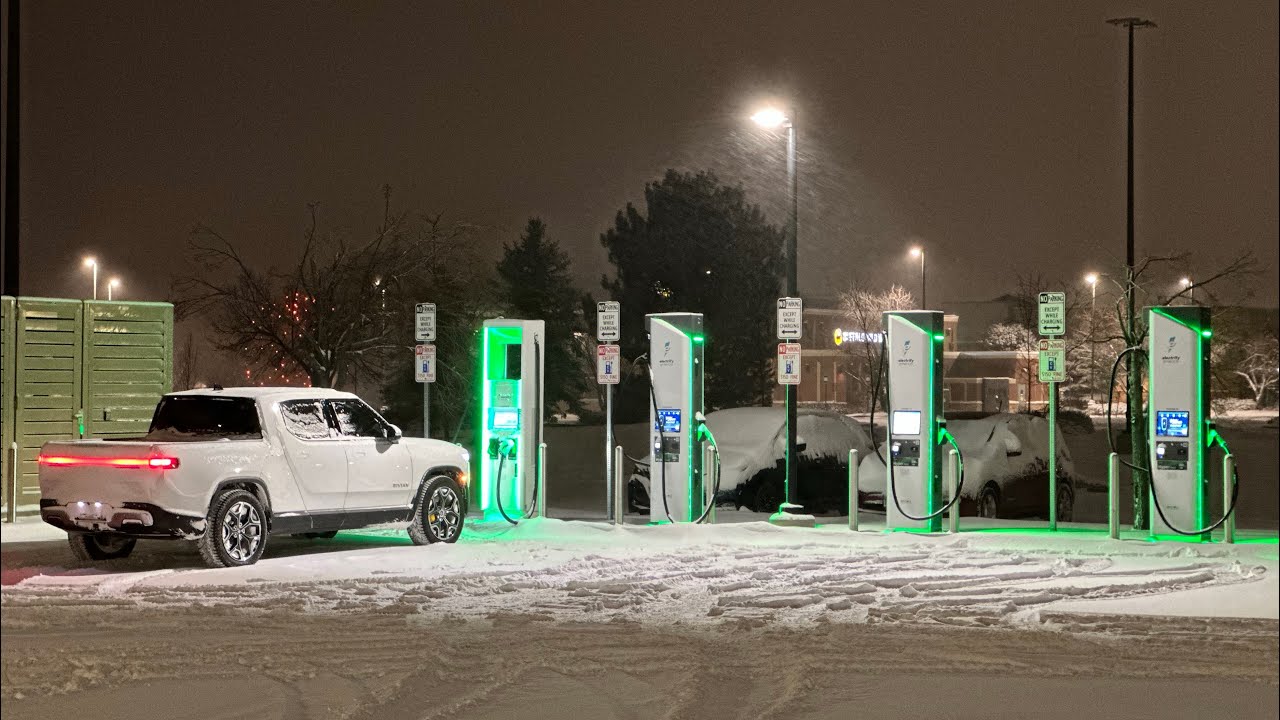
Outside temperatures have plummeted to 0 °F and then down to -6 °F (-21 °C), marking the start of a frigid night where temperatures are forecast to drop further to around -30 °C. This extreme chill approaches the exact minimum operational temperature rating of the DC fast-charging hardware installed at the Loveland, Colorado Electrify America station, which was co-developed and manufactured by BTC Power. Earlier in the day, Kyle Conner had staged two Nissan Leafs behind the chargers to cold-soak them for an upcoming cold-gating experiment. During that drop-off, the station descended into chaos: a queue formed, drivers panicked, and none of the new dispensers would function, forcing an electric Kia Niro and a Polestar to scramble for a working plug.
With his hands already freezing as he films, Kyle returns to investigate whether the earlier stationwide failure was merely user error or an underlying hardware flaw. He arrives behind the wheel of his preconditioned Rivian R1T to systematically test the site's brand-new dispensers in sub-zero weather.
- Ambient temperature at the Loveland site is -6 °F (-21 °C), with an expected overnight low around -30 °C. - The hardware present represents Electrify America’s next-generation equipment manufactured by BTC Power, covering both dispensers and power cabinets. - The site previously featured legacy ABB chargers, leaving only one older unit alongside three newly installed BTC units.
---
[01:51](https://www.youtube.com/watch?v=fq0RAjJ1PKQ&t=111s) Setup and Testing Dispenser Number 3
Cruising down Interstate 25 in Northern Colorado at -6 °F, Kyle demonstrates the Rivian R1T's performance in the cold. While he typically prefers driving in off-road rally mode with stability control turned completely off to initiate slide drifts, he adopts the newly released Snow Mode for normal road operation. Extreme cold takes a severe toll on the truck's efficiency, dragging it down to a meager 1.3 mi/kWh with the battery resting at a 28% state of charge. To prevent the cabin from turning into an icebox while stepping outside, Kyle shares a quick Rivian owner tip: rather than relying on pet mode, which caps maximum interior heat, he navigates to the vehicle service menu to activate Show and Tell mode with parking lights kept normal, ensuring continuous, high-heat climate control.
Kyle backs up to charger number 3, an all-in-one dispenser and power unit vertically integrated by BTC Power, nominally rated for 350 kW balanced power. The liquid-cooled charging cables have frozen stiff in the biting air, requiring substantial two-handed force just to wrestle the plug toward the vehicle's charge port. Once locked into the receptacle, the dispenser attempts to negotiate a Plug & Charge session. Relays inside the cabinet click, and the truck's charge port light momentarily flashes green. However, the session abruptly aborts, flashing red on the truck while the screen throws a fatal communication failure: `charging start error` followed by `isolation test timeout`. Kyle deduces that the dispenser's internal isolation monitoring circuitry or relays have physically frozen, preventing it from verifying that high voltage will not leak to ground.
```mermaid flowchart TD accTitle: Dispenser 3 Connection Failure accDescr: Flowchart illustrating the connection and isolation failure on BTC charger number 3 with the Rivian R1T. subgraph PlugSequence["Physical Plug-In"] A["Wrestle Stiff Frozen Cable"] --> B["Insert CCS Connector into R1T"] end subgraph Handshake["Handshake & Safety Check"] B --> C["Dispenser Initiates Plug & Charge"] C --> D["Internal Relays Click"] D --> E["Start High-Voltage Isolation Test"] end subgraph FaultState["Session Abort"] E --> F["Isolation Test Times Out"] F --> G["Screen Displays 'Charging Start Error'"] G --> H["R1T Port Turns Red / Fails to Charge"] end ```
- Rivian R1T cabin heat trick: Navigate to `Settings` > `Vehicle` > `Service` > `Show and Tell`, allowing full-blast cabin heating while parked outside. - Cold-weather efficiency registered at 1.3 mi/kWh at 28% state of charge. - Dispenser 3 error readout: "Isolation test timeout," terminating the session before any DC current flows.
---
[05:37](https://www.youtube.com/watch?v=fq0RAjJ1PKQ&t=337s) Testing Dispensers Number 2 and 4
Turning away from the failed third unit, Kyle inspects the Electrify America mobile app to authorize dispenser number 2. The app falsely indicates that station 2 is actively in use by another car, despite the parking stall being totally empty and the dispenser screen displaying an available status. Because the cloud backend considers the station engaged, it completely blocks remote activation.
Kyle shifts the Rivian to the final BTC unit on site, dispenser number 4. This stall has historically functioned without issue during milder weather, even successfully feeding heavy draw vehicles like the GMC Hummer EV at up to 500 amps. Kyle initiates the session via the mobile application before plugging in, finding that pre-authorizing often helps mitigate software timing bugs. The physical cable fits easily into the Rivian port, the dispenser recognizes his Pass+ membership account, and the unit goes through its pre-charge checks. Yet history repeats itself: mechanical relays click, the Rivian shows a momentary green status indicator, and the session abruptly crashes with the identical error code: `charging start error: isolation test`.
Reflecting on the scene earlier that afternoon, Kyle recounts how the entire site was paralyzed by this bug. A Polestar and a Kia Niro were stranded without a charge until Kyle unplugged the test Leaf from the solitary legacy ABB station, yielding the plug so both drivers could endure hours of single-stall queueing. In contrast, nearby Tesla hardware had no such vulnerabilities.
> “In my opinion, how can the brand new hardware not be tested to cold temperatures? I don't know how I could ever recommend to you guys to feel confident road tripping one of these things in extreme temperatures with such shitty hardware. It really is just a shame in my opinion, and yeah, I gotta also tell you, I went over to the Tesla Supercharger—not to sound like a Tesla fanboy—but I went over to the Tesla Supercharger, backed up, plugged in, no issues at all, just ripped on charging right there.”
- Dispenser 2 is rendered unusable due to a software state mismatch: the physical pedestal shows "Available," but the backend app reports "In Use." - Dispenser 4 fails in the exact same manner as Dispenser 3, producing an `isolation test` error immediately following relay contact. - Earlier in the day, the single functional plug forced the Polestar to charge to full while the Niro waited over two hours in sub-zero temperatures.
---
[09:08](https://www.youtube.com/watch?v=fq0RAjJ1PKQ&t=548s) Legacy ABB Unit Succeeds Where New Hardware Fails
With all three next-generation BTC units completely dead, Kyle shifts the R1T to stall number 1, the sole surviving legacy ABB dispenser left at the Loveland location. While Kyle has frequently criticized ABB hardware in past reviews for thermal throttling and abysmal uptime during blistering summer heatwaves, cold weather has always been their forte. ABB units are widespread across the Nordic countries, proving reliable in the harsh winters of Finland and northern Norway.
Wrestling the stiff cable with both hands, Kyle seats the connector into the Rivian's port and initiates the session. Without hesitation or isolation timeouts, the ABB charger’s relays engage, negotiate the handshake, and instantly fire up, delivering a steady 137 kW directly into the cold-soaked battery pack.
Kyle expresses deep frustration that Electrify America’s cloud monitoring continues to broadcast the non-functional BTC stations as fully green and available, which artificially inflates corporate uptime metrics provided to automotive manufacturing partners. Determined to find out whether this freezing issue is an inherent defect across all new Electrify America hardware—including the newer SK Signet dispensers—or strictly confined to this specific BTC configuration, Kyle decides at 1:00 AM to embark on a late-night road trip south toward Denver to stress-test other network sites in the cold.
> “A bit of a shame that none of the new units will activate at all, and they all show as available on the screen, they all show as station up in the app. I'm sure EA's reporting them as fully available charging stations according to whatever they need to report their uptime to the automakers they're selling deals to. Man, totally crazy.”
| Dispenser | Hardware Manufacturer | Rated Power | Result at -6 °F | Failure Mode / Behavior | |:--- |:--- |:--- |:--- |:--- | | **Stall 1** | ABB (Legacy) | Balanced / Up to 350 kW | **Success** | Delivered 137 kW immediately with zero faults. | | **Stall 2** | BTC Power (New Gen) | 350 kW Balanced | **Failed** | App locked unit as "In Use" while pedestal sat idle. | | **Stall 3** | BTC Power (New Gen) | 350 kW Balanced | **Failed** | Relay clicked, then threw `isolation test timeout`. | | **Stall 4** | BTC Power (New Gen) | 350 kW Balanced | **Failed** | Repeats `charging start error: isolation test`. |
[10:43](https://www.youtube.com/watch?v=fq0RAjJ1PKQ&t=643s) Successful ABB Charging and the Decision to Head South
While his vehicle charges effortlessly on the older ABB 150 kW unit, Kyle Conner explains the manufacturing split behind Electrify America’s next-generation hardware. Electrify America co-developed the new hardware with both SK Signet and BTC Power (BTCPower). The non-functional site he just left in Loveland relies strictly on BTC Power hardware, whereas another updated location on the west side of Denver in Lakewood is believed to utilize SK Signet equipment. Determined to test both variants and confirm whether the cold-temperature failure is universal, Kyle plans to head south.
Meanwhile, the older ABB station delivers flawless performance. Dispensing 141 kW almost instantly before climbing to 165 kW, the ABB charger runs pegged at its absolute upper threshold despite the bitter cold. As Kyle remarks: “Look, that's the ABB way, baby: always work in the cold.”
Kyle notes that the only way to deliver a fair and balanced evaluation is to sample a variety of hardware across multiple charging networks rather than simply writing off the new units as defective based on a single stop. Satisfied with the ABB session, he prepares to disconnect and head down to the Denver metro area.
- **Charging performance:** Peaked at 165 kW on a nominal 150 kW ABB station. - **Cable flexibility:** Kyle observes that the liquid-cooled cable quickly became pliable once warm coolant flowed through it. - **Hardware variants:** Electrify America’s next-gen installations feature dispensers co-developed with BTC Power and SK Signet, styled by Italdesign.
---
[11:30](https://www.youtube.com/watch?v=fq0RAjJ1PKQ&t=690s) I-25 Drive in the Rivian R1T and Nokian Winter Tires
Disconnecting from the ABB stall, Kyle sets off on a 54-mile drive toward Colorado Mills Mall in Lakewood, Colorado. Interstate 25 had experienced intermittent closures earlier in the evening due to blowing snow and dangerous conditions, but traffic has cleared following the evening commute. Because sub-zero ambient temperatures dramatically reduce range and can cause unannounced road blockages, Kyle prioritizes leaving with substantial battery buffer rather than risking an empty pack near unverified stations. He warns that relying on Electrify America's new dispensers in extreme cold is currently an unacceptable gamble.
Kyle emphasizes the equipment on his Rivian R1T: a set of studded Nokian Hakkapeliitta SUV winter tires. While the metal studs do little on freshly fallen snow without hard-packed ice underneath, they will prove invaluable once traffic compacts the snow into polished ice over the following days. Operating in Rivian’s dedicated "Snow Mode," the truck handles the unplowed lanes effortlessly. However, the extreme sub-zero windchill quickly presents a common cold-weather nuisance: the windshield washer fluid freezes solid directly at the spray nozzles, leaving Kyle peering through a smeared windshield as he presses down I-25.
Reflecting on the widespread deployment of these new dispensers, Kyle voices severe concern about their real-world validation. “I think that's a specific problem with the new EA chargers that, I hate to say it, but I don't really think they did enough cold weather testing on them, which could be a huge disaster,” he argues, stressing that these exact dispensers are slated for broad deployment across freezing climates throughout the United States and Canada.
---
[14:13](https://www.youtube.com/watch?v=fq0RAjJ1PKQ&t=853s) Pit Stop at Love's: Cheap Fuel and Cold-Weather Realities
Halfway into the journey, Kyle pulls off the highway for a quick stop at a Love's Travel Stop to stock up on Red Bull energy drinks for what is shaping up to be an all-night diagnostic marathon. The brutal temperature outside is matched by a sobering realization at the fuel pumps: regular unleaded gasoline is listed at just $2.20 per gallon.
The disparity prompts Kyle to highlight the friction facing electric vehicle adoption when winter road-tripping becomes unreliable. Seeing fossil fuel priced so affordably underscores how steep the uphill battle remains for non-Tesla EV drivers facing infrastructure blackouts. Kyle vents: “Fuel is only $2.20 a gallon here for regular. You've got to be kidding me! What is the reason to drive an electric car if you can get fuel so cheap?”
He laments that venturing into sub-zero weather at midnight to troubleshoot public charging infrastructure feels absurd when EVs still represent less than two percent of total cars on the road. If the broader public is subjected to failing chargers in sub-zero blizzards, mass adoption will stall before mainstream drivers even consider making the switch.
- **Fuel price observed:** Regular unleaded at $2.20/gallon at Love's Travel Stop. - **EV market context:** Kyle highlights that EV market share hovers under 2%, warning that experiences like this actively deter the general public.
---
[15:11](https://www.youtube.com/watch?v=fq0RAjJ1PKQ&t=911s) Arrival at Colorado Mills and Another Electrify America BTC Failure
Kyle arrives at Colorado Mills Mall in Lakewood, negotiating snowdrifts around the mall parking ring. He spots a fully illuminated Tesla Supercharger station across the lot, where a Tesla Model 3 charges without drama. Right beside it sits the Electrify America bank. Just like at the northern site, Electrify America left an old ABB unit in place to maintain CHAdeMO plug compatibility, though Kyle observes that this particular ABB dispenser has been powered down and completely dead for months.
Kyle pulls up to the newly installed dispensers. Inspecting the cabinets, he determines these are also manufactured by BTC Power rather than SK Signet, bearing the distinct Italdesign enclosure. After turning the Rivian's exterior lighting down to parking lamps via the "Show and Tell" service menu, Kyle initiates a charge on Charger #2 using the Electrify America smartphone application. The app lists all stalls as fully operational and available.
The heavy, cold-stiffened CCS cable is wrestled into the Rivian’s charge port. The truck recognizes the connection, the dispenser screen displays a "Welcome Kyle" greeting, and the station's high-voltage contactors audibly snap shut to begin the pre-charge isolation loop. After a few seconds of anticipation, the charger trips out: the Rivian’s charge port turns red and the screen throws an identical isolation test timeout fault.
Frustrated by the repeat failure, Kyle watches the adjacent Tesla driver finish charging and drive away. “I hate to be that guy, superchargers just work,” Kyle says. “I just plugged my Tesla into a supercharger earlier today, just worked, and none of the new units—are you freaking kidding me?”
```mermaid flowchart TD accTitle: Charger Handshake Sequence and Failure Flow accDescr: Sequence diagram illustrating the handshake steps between the Rivian R1T and the Electrify America BTC charger leading to isolation timeout.
subgraph Initiation ["Initiation Phase"] A["App Authorization"] --> B["Plug In Cable"] B --> C["Digital Handshake & User Welcome"] end
subgraph HV_Test ["High Voltage Isolation Test"] C --> D["Main Contactors Snap Shut"] D --> E{"Isolation Check (Megohmmeter)"} end
subgraph Outcome ["Session Result"] E -->|"Cold Temp Fault"| F["Isolation Test Timeout"] F --> G["Truck Port Turns Red (Fault)"] F --> H["Session Aborted (Total Failure)"] end ```
---
[17:45](https://www.youtube.com/watch?v=fq0RAjJ1PKQ&t=1065s) Stranded Audi e-tron, Isolation Timeouts, and Network Uptime Illusions
Faced with yet another complete charging failure, Kyle checks PlugShare to log the issue and discovers that another driver had already documented the site's breakdown. An Audi e-tron owner road-tripping through Colorado had attempted to plug into every single new dispenser at the location. Each stall failed at the identical isolation check phase with a timeout error. Because the driver lacked sufficient range to make it to another hub, he was forced to abandon his travel plans and check into a local hotel to trickle-charge on Level 2 overnight. Kyle laments the irony that a flagship electric vehicle from Volkswagen Group was stranded by Volkswagen Group’s own charging subsidiary.
Kyle refuses to waste time repeating the test across every identical dispenser on-site since the Audi driver's thorough attempts confirmed every new unit was down. Instead, he shifts focus toward isolating the root cause by testing competing hardware in the vicinity. He points out that while BTC Power provided the physical hardware, Electrify America explicitly marketed these units as co-developed in-house and therefore shares full accountability for deploying untested equipment into freezing markets.
Before setting off to test EVgo (Delta and Signet hardware) and ChargePoint (CPE 250 units), Kyle reveals a glaring discrepancy in how fast-charging networks record station health. Despite every new BTC unit at Colorado Mills being incapable of initiating a charging session, Electrify America's app continues to display 100% station availability:
“When automakers partner with a network, one important metric—not to get into too much of the business side of DC fast chargers, but an important metric from a government influence standpoint, but also a free-market automaker partnership situation—is station uptime.”
Because the dispensers remain powered on, running their touchscreens, and communicating with backend cloud servers, the automated monitoring systems report them as healthy, masking a complete regional charging failure from both drivers and regulatory uptime compliance audits.
- **Stranded driver report:** An Audi e-tron road-tripper tested every single new dispenser at Colorado Mills; all threw isolation faults, forcing him into a hotel to charge on Level 2. - **Ambient temperature:** Dropping to -8°F (-22°C). - **Rivian R1T winter consumption:** Averaging 1.4 miles per kWh while pushing through cold air and snowdrifts on 20-inch studded Nokian tires. - **Benchmarking roadmap:** Testing EVgo Delta, EVgo Signet, Electrify America Signet, and ChargePoint Express 250 (CPE 250) units to determine if isolation timeouts affect competing hardware.
[21:33](https://www.youtube.com/watch?v=fq0RAjJ1PKQ&t=1293s) Automaker Deals and the Uptime Reporting Problem
Kyle examines the business dynamics between charging networks and automotive manufacturers. Automakers like BMW, Audi, Volkswagen, Lucid, Porsche, and Hyundai partner with Electrify America to offer free charging packages to vehicle buyers, which is how Electrify America generates significant revenue. Behind the scenes, automakers expect their customers to find functional infrastructure. Yet, while the Electrify America app reports every charger in both Denver and Loveland, Colorado as fully operational, none of the newly deployed chargers activate in the sub-zero cold. The failure persists across multiple vehicles: a customer's Audi e-tron, a Kia Niro EV, a Polestar 2, and Kyle's Rivian R1T.
The core issue lies in how networks define and quantify station uptime. Electrify America's operational standard appears to treat a site as having 100% uptime if merely 50% of its stalls are functional, under the rationale that a driver can simply maneuver to an adjacent stall. Kyle criticizes this misleading metric, noting that charging networks report stations as online and ready even when their dispensers repeatedly throw handshake errors or refuse to initiate a charge session. He characterizes the broader charging landscape as a disordered "Wild West" where uptime claims do not reflect reality, ultimately warning that shoppers seeking effortless long-distance travel without troubleshooting headaches are still pushed toward Tesla or internal combustion vehicles.
“I keep coming to the same conclusion: buy a Tesla or buy a gas car if you go on long trips.” — Kyle Conner
- Automakers offering complimentary charging deals with Electrify America include Volkswagen, Audi, Porsche, BMW, and Lucid. - Network metric disparity: A station can be classified as having 100% uptime even if half the pedestals are out of service. - The app displayed stalls as operational despite consecutive failed handshake attempts on four separate EV models (Audi e-tron, Kia Niro EV, Polestar 2, Rivian R1T). - It is 2:51 AM during testing, with Kyle surviving on an energy drink in the bitter cold.
---
[24:36](https://www.youtube.com/watch?v=fq0RAjJ1PKQ&t=1476s) EVgo Signet and Delta Cold Weather Testing
Kyle pulls into an EVgo charging location during heavy snowfall to test two distinct hardware platforms that EVgo installs: Signet dispensers and Delta units. The ambient temperature sits between -8°F and -10°F (-22°C to -23°C). After clearing blowing snow out of the Rivian's charging port, he plugs into a 350 kW Signet charger named "Jude." The unit connects without error, dispensing power immediately. Starting around 110 kW at 19% state of charge, the charge rate steadily ramps to 140 kW at 350 amps. Because the Rivian's battery pack was cold-soaked from driving through slush, the gradual increase reflects the truck warming up its battery rather than a charger throttle.
Kyle then relocates the truck to an adjacent 100 kW Delta standalone dispenser nicknamed "Pietro." These Delta units feature dual DC fast charging cords—a CCS cable alongside a CHAdeMO lead fitted with an integrated Tesla adapter—and allow simultaneous charging. Upon plugging in, the contactors close smoothly, the Rivian’s light bar turns green, and the unit delivers 81 kW. Kyle is astonished by the mechanical silence of the Delta unit, which produces zero audible fan or transformer noise apart from faint high-frequency power electronics hum. Even the touchscreen interface responds without delay in -10°F conditions.
“Delta makes some good stuff man, I am a fan of these guys I gotta reach out to them; this thing rocks.” — Kyle Conner
```mermaid flowchart TD accTitle: EVgo Cold Test Matrix accDescr: Charting the success of EVgo Signet and Delta hardware in sub-zero weather. subgraph EVgo_Site["EVgo Station (-8°F to -10°F)"] direction TB Signet["Signet 350 kW Dispenser ('Jude')"] Delta["Delta 100 kW Dispenser ('Pietro')"] end
Rivian["Rivian R1T"]
Signet -->|"Instant handshake"| Power1["Ramps from 110 kW to 140 kW (350A)"] Power1 --> Rivian Delta -->|"Silent operation / responsive screen"| Power2["Delivers 81 kW steadily"] Power2 --> Rivian ```
- Hardware comparison: EVgo utilizes power-sharing Signet cabinets paired with dual dispensers, as well as compact standalone Delta pedestals. - Dispenser naming: EVgo assigns human names to individual pedestals ("Jude" for the Signet, "Pietro" for the Delta). - Ambient conditions: Heavy snowfall with outdoor temperatures between -8°F and -10°F. - Performance: Signet reached 140 kW (350 A); Delta delivered 81 kW with virtually silent power electronics.
---
[29:30](https://www.youtube.com/watch?v=fq0RAjJ1PKQ&t=1770s) ChargePoint CPE 250 vs. ChargePoint Express Plus
Departing the EVgo site, Kyle drives to a ChargePoint owned-and-operated test site to compare legacy hardware with next-generation equipment. He begins on an older ChargePoint CPE 250 unit. Despite the cable being very stiff from the cold, requiring two hands to manipulate into the receptacle, the CPE 250 initiates a session without hitch. It quickly maxes out its hardware envelope, delivering 79 kW to the Rivian—right around its rated ~80 kW ceiling.
Next, Kyle moves to the newly installed ChargePoint Express Plus dispenser, a rare setup capable of 200 kW and up to 500 amps, equipped with an ergonomic, liquid-cooled Phoenix Contact cable and overhead management arm. While the connector slips easily into the truck's socket, the session stalls indefinitely. The dispenser screen registers physical connection by transitioning to a "Waiting for EV" screen, yet the handshake never completes. Suspecting blowing snow or frost might be insulating the data pins, Kyle thoroughly cleans the port and performs a complete vehicle reset, but the Express Plus still refuses to begin charging.
“Well it is a few minutes later now, and while the ChargePoint CPE 250s work—those things are kind of workhorses—the ChargePoint Express is not giving us as much luck.” — Kyle Conner
- ChargePoint CPE 250 performance: Stout and reliable workhorse; quickly provided 79 kW at its maximum threshold. - ChargePoint Express Plus specs: Equipped with a flexible Phoenix Contact handle, capable of 200 kW and 500 amps. - Express Plus fault behavior: Trapped in a "Waiting for EV" status screen despite connector cleaning and truck resets.
[32:12](https://www.youtube.com/watch?v=fq0RAjJ1PKQ&t=1932s) ChargePoint Testing Wrap-Up and Rivian Quirks
Kyle finishes diagnosing the failed session at the ChargePoint location. He confirms that the issue is entirely on the station side rather than the vehicle, as the charger outright refuses to initiate a handshake. While he isn't certain whether the failure stems from the brutal cold or the fact that it is a brand-new, unrefined unit in the wild—noting it had already faulted out on his Tesla Model S a few days prior—he considers it unacceptable that fresh hardware behaves this way. At the very least, four other older stations at the site are reporting available, but having the fastest unit fail leaves the site at a 50% success rate in his eyes.
As he prepares to leave, the Rivian truck's charge port suddenly faults out and glows red. Kyle suspects interoperability testing between ChargePoint and Rivian might never have been thoroughly validated, creating an unknown combination of cold-weather bugs and vehicle-specific quirks. Looking on the bright side, he notes that an EV driver wouldn't be completely stranded here, but he decides to move on to see how older hardware holds up.
> “I mean unacceptable just to have brand new hardware not working here's another case of it which it's like come on just like test this stuff make sure it works make sure it works with multiple vehicles...” — Kyle Conner
---
[33:35](https://www.youtube.com/watch?v=fq0RAjJ1PKQ&t=2015s) Electrify America Signet Cold Test at Walmart
Kyle pulls into a Walmart parking lot to test an older-generation Electrify America installation equipped with original Signet units—easily identified by their exterior green glow rings—rather than the newer SK Signet redesigns. The stakes are uncomfortably high: the Rivian’s battery is down to roughly 13% or 14% state of charge, and the bitter cold is forcing the truck to throttle back both motor output and regenerative braking. When Kyle walks up, the site appears near collapse: two full dispensers display unavailable screens, and on the third unit, the CHAdeMO side is broken.
Fortunately, the lone surviving CCS plug on the third dispenser successfully authorizes and connects. At -9°F, the dispenser begins ramping up, delivering around 110 kW into the cold battery at a 10% state of charge. Kyle notes that this output is entirely reasonable and likely limited by the freezing pack itself, which is being chilled from beneath by road snow. Kyle reflects on the frustrating trajectory of charging infrastructure: older Supercharger sites from 2016 often run seven out of eight stalls, whereas brand-new non-Tesla sites struggle to keep even a single cord operational within two years of installation.
```mermaid flowchart TD accTitle: EA Signet Station Hardware Status accDescr: Layout of the three EA Signet charging dispensers at Walmart during cold testing.
subgraph EA_Site["EA Signet Station Status (-9°F)"] Unit1["Dispenser 1: Fully Offline / Unavailable"] Unit2["Dispenser 2: Fully Offline / Unavailable"] subgraph Unit3["Dispenser 3"] CH["CHAdeMO: Offline"] CCS["CCS Plug: Operational (Delivering 110 kW)"] end end ```
- Station ambient temperature: -9°F (-23°C). - State of charge at plugin: 10%. - Initial charge power: 110 kW (pack-limited due to freezing battery). - Overall station status: Only 1 functioning CCS connector out of the entire multi-stall location.
---
[35:20](https://www.youtube.com/watch?v=fq0RAjJ1PKQ&t=2120s) Midnight Dash to EVgo's 350 kW Delta Unit
By 4:10 AM, the temperature has dropped to -11°F. After putting 14 kWh into the Rivian over seven minutes at roughly 113 kW, Kyle makes a strategic call to cut the session short. Because the Rivian software refuses to condition the battery when the charge level is critically low, Kyle plans to spend the drive to an upcoming EVgo station aggressively working the powertrain to generate internal battery heat. The target is an EVgo-branded Delta 350 kW dispenser located along his route home.
Arriving at the EVgo site in the dead of night, Kyle wrestles with the liquid-cooled cables, which have frozen stiff in the sub-zero air. Bending the cord into the charge port turns into an awkward, two-handed wrestling match. As the connector latches with an unsettling, brittle crunch of cold plastic, Kyle ducks inside the cab out of the freezing wind to monitor the handshake. The session starts successfully, but the delivery speed is unexpectedly sluggish—dropping well below what the Signet dispenser had just provided.
> “Holy smokes this cable is frozen it's minus 11 out right now I gotta put the phone down this is a two-handed operation...” — Kyle Conner
- Ambient temperature during connection: -11°F (-24°C). - Cold-weather challenge: Frozen liquid-cooled cables required physical forcing and two hands to manipulate.
---
[37:20](https://www.youtube.com/watch?v=fq0RAjJ1PKQ&t=2240s) Delta Charger Cold Derating and Power Limits
Checking the dispenser display, Kyle uncovers the reason for the sluggish speeds: the Delta 350 kW station is heavily derating its output current due to the cold. While the hardware is nominally rated for up to 540 amps, the screen clearly reports a maximum output cap of only 250 amps. As a result, the dispenser is completely bottlenecking the session, delivering only 80 to 85 kW (peaking momentarily near 100 kW).
Even though the station works without failing, Kyle notes that halving the available amperage severely impedes road-tripping efficiency. However, unlike other units that fail silently or refuse to connect, Kyle appreciates that the Delta unit openly reports its derated operating limits on the display. Concluding that the EVgo Delta site was an educational stop rather than a fast charge, Kyle prepares to head back to the original Electrify America station to perform Nissan Leaf cold-weather testing.
- Nameplate current limit: 540 amps. - Cold-derated current cap: 250 amps. - Actual charge speed: 80–85 kW (fluctuating up to ~100 kW max).
---
[37:58](https://www.youtube.com/watch?v=fq0RAjJ1PKQ&t=2278s) Summary of the Night: The "Wild West" of Public DC Fast Charging
Approaching 4:30 AM, Kyle reflects on the state of non-Tesla charging infrastructure across the nation. Electrify America remains the cornerstone of interstate highway corridor travel, while networks like EVgo, ChargePoint, and Blink fill in regional urban centers. Because long-distance electric travel relies almost exclusively on Electrify America, the network's current hardware transition represents a major setback. By replacing older dispensers with new, vertically integrated BTC hardware that fails to complete basic software handshakes in sub-zero weather, EA has replaced slow-charging headaches with complete session non-starts during peak holiday travel.
Kyle systematically tallies the performance across every station visited throughout the night: - **Electrify America (New BTC Architecture):** Complete failure; dispensers repeatedly refused to activate or initialize sessions across multiple sites. - **EVgo Delta Compact Dispenser:** Flawless operation; activated instantly and ran whisper-quiet. - **EVgo Signet Dispenser:** Performed exceptionally well at high power without apparent temperature caps. - **ChargePoint Express 250 (CPE 250):** Functional, reliable, but inherently power-limited. - **ChargePoint Express Plus:** Failed to handshake with the Rivian; unclear if caused by the freezing temperatures or vehicle incompatibility. - **Electrify America Signet:** Successfully charged at 110 kW, though two out of three site dispensers were entirely out of order. - **EVgo Delta 350 kW:** Fully functional and connected easily, but throttled to a hard 250-amp ceiling.
Kyle concludes that public DC fast charging remains an unpredictable "Wild West." When temperatures plummet, stranded motorists are left booking hotel rooms or scrambling for slow AC chargers simply because new stations were deployed without adequate cold-weather validation.
> “And the fact that they are specking brand new hardware and ripping out the old units to solve problems but introducing worse problems... this won't even connect in cold weather...” — Kyle Conner
[42:26](https://www.youtube.com/watch?v=fq0RAjJ1PKQ&t=2546s) The State of CCS Reliability and Recommendations
Kyle reflects on the widespread hardware and software failures he just witnessed across multiple charging providers, expressing utter disbelief that network operators could deploy hardware on a mass scale without proper cold-weather validation. While acknowledging his thoughts are speculation since he does not work inside Electrify America, he vents his frustration over the sheer incompetence required to roll out non-functional equipment across the country. He points out that while ChargePoint's new Express Plus architecture also failed to perform in these freezing temperatures, ChargePoint has largely kept those units restricted to company-owned and operated pilot sites rather than flooding consumer corridors with untested machinery. Even so, he categorizes the industry's widespread shortcomings as unacceptable, joking that he sounds like he is scolding an unruly dog or complaining like an old man.
```mermaid flowchart TD accTitle: Current EV Buying Decision Flow accDescr: Decision chart detailing vehicle choices based on road trip reliability priorities.
A["Buyer Priority: Seamless Road Trip Reliability?"] -->|Yes| B["Avoid Current CCS Vehicles"] A -->|No / Likes Adventure| C["CCS Enthusiasts / Reviewers"]
B --> D["Tesla (Supercharger Network)"] B --> E["Plug-in Hybrid (PHEV)"] B --> F["Internal Combustion Engine (ICE)"]
C --> G["Rivian R1T / BMW iX / Mercedes EQ"] ```
Given these persistent breakdowns, Kyle lays down a blunt verdict for perspective electric vehicle shoppers: “So at the end of the day if reliability for road trips is your top priority do not buy a CCS vehicle today just point blank I cannot recommend it to you.” While he personally enjoys driving CCS vehicles such as his Rivian R1T, the BMW iX, and various Mercedes-Benz models, he admits that driving them requires embracing a sense of unpredictable adventure and dealing with chronic operational hiccups. He also notes that new high-speed infrastructure deployment across the United States has slowed down significantly, as operators stall pending federal NEVI funding approvals anticipated for the following year. For mainstream consumers needing dependable cross-country mobility, his candid advice remains to buy a Tesla, purchase a plug-in hybrid, or simply stick with an internal combustion engine vehicle.
- ChargePoint's troubled Express Plus hardware appears limited to early-stage, company-owned testing installations, unlike Electrify America's nationwide rollout of problematic units. - Current federal grant programs (such as NEVI) have created a temporary lull in new private station groundbreakings as networks wait for capital disbursements. - Mainstream drivers prioritizing turnkey road-trip travel are advised to bypass CCS until networks dramatically improve uptime.
[44:26](https://www.youtube.com/watch?v=fq0RAjJ1PKQ&t=2666s) Network Opening, NACS Misconceptions, and Hope for EVgo
Addressing potential long-term solutions, Kyle expresses bewilderment over how Tesla consistently maintains such an effortless, reliable charging experience compared to third-party CCS networks. He states that Tesla opening its Supercharger network to non-Tesla vehicles would single-handedly solve the public charging crisis, even if charging speeds on non-800V architectures might end up slightly slower than on native CCS hardware. He also pushes back hard against viewers who claim that transitioning to the North American Charging Standard (NACS) plug is an immediate cure-all for non-Tesla woes. Swapping a physical CCS handle for a NACS connector does absolutely nothing to fix broken power cabinets, failing liquid-cooling loops, unresponsive station backends, or buggy handshake activation protocols.
Looking forward, Kyle finds a silver lining in EVgo, which proved to be the most dependable option throughout his sub-zero testing loop. He shares strong enthusiasm for EVgo’s upcoming national corridor expansion in partnership with Pilot Flying J travel centers, noting that introducing genuine competition to Electrify America's highway dominance is the only way the industry will progress. In closing, he muses on how this volatile era will be viewed down the road: “Right now we'll look back at this in 10 years and either say this is why electric cars didn't work or this is why electric cars almost didn't work but we don't know the future.”
- Switching to the NACS connector design solves physical ergonomic issues, but does not fix underlying dispenser architecture, power conversion electronics, or network communication bugs. - EVgo's corridor network buildout at Pilot and Flying J truck stops is highlighted as the most promising upcoming alternative to Electrify America. - Tesla opening the Supercharger network remains the single fastest path toward giving all EV owners dependable winter long-distance capability.
## Notable quotes > [21:33](https://www.youtube.com/watch?v=fq0RAjJ1PKQ&t=1293s) I keep coming to the same conclusion: buy a Tesla or buy a gas car if you go on long trips. — Kyle Conner
## Mentioned Kyle Conner, Electrify America, BTC Power, ABB, SK Signet, EVgo, Delta, ChargePoint, Tesla, Tesla Supercharger, Rivian R1T, Audi e-tron, Kia Niro EV, Polestar 2, Nissan Leaf, GMC Hummer EV, BMW iX, Volkswagen Group, Porsche, Lucid, Hyundai, Nokian Tyres, Phoenix Contact, PlugShare, Love's Travel Stop, Pilot Flying J, Walmart, National Electric Vehicle Infrastructure (NEVI) Formula Program, North American Charging Standard (NACS), CCS
## Video description Kyle finds out that the new Electrify America chargers that they co-developed with BTC don't work in cold temperatures. He also heads to ChargePoint, EVgo, and other EA chargers to see if they have similar issues in this cold snap.
We would really appreciate it if you subscribe to our channel! The more subscribers we have, the more awesome opportunities we will be able to bring to you!
Find all of our Amazon must-haves here: https://www.amazon.com/shop/influencer-3317696d
Kyle on Twitter: @itskyleconner Kyle on Instagram: @Virtualkyle
For more behind the scenes content: Twitter: @Out_of_Spec Facebook: https://www.facebook.com/outofspecreviews Instagram: @OutofSpecReviews
Inquiries: info@outofspecstudios.com
If you liked this video, we recommend checking out some of our other channels! Out of Spec Motoring: http://youtube.com/outofspecmotoring Out of Spec Reviews: https://www.youtube.com/outofspecreviews
0:00 - Hello & Welcome 1:51 - Trying To Activate New Stations 9:17 - ABB Unit Works 11:22 - Driving To Denver 16:36 - Testing New Units At A Different Location 21:15 - Uptime Reporting / Automaker Partnerships 24:36 - EVgo Delta / Signet Cold Test 29:30 - ChargePoint Cold Test 33:35 - EA Signet Cold Test 36:21 - EVgo Delta 350kW Cold Test 37:58 - Summary & Final Thoughts
#ev #charging #dcfc
[Source](https://www.youtube.com/watch?v=fq0RAjJ1PKQ)