Bill Gates Defends Internet Value Against David Letterman Pushback
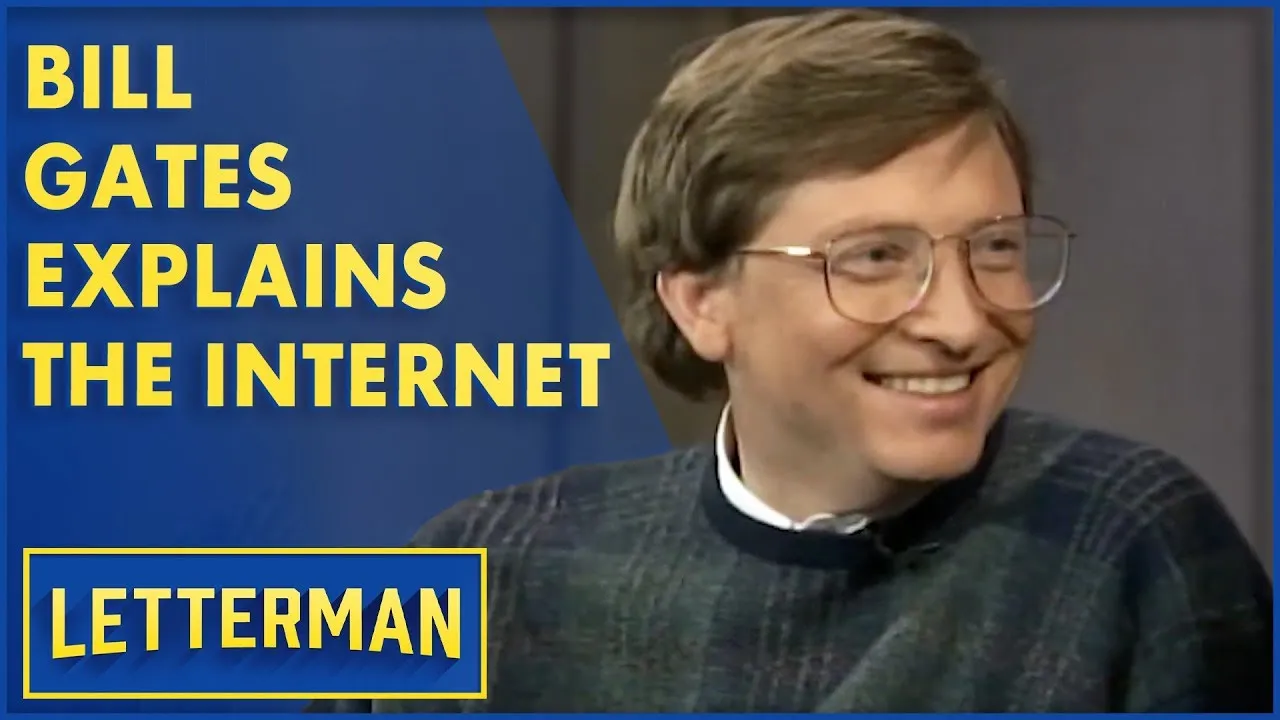
Letterman
Gates argues the internet's true power lies in interactive, decentralized communities rather than traditional analog media, while noting that true artificial intelligence remains an unresolved frontier.
AI-assisted summary of Bill Gates Explains the Internet to Dave (1995) | Letterman — original source. Check the original for full context.
Source published:
Key ideas
- In a 1995 interview, Bill Gates defends the emerging internet against David Letterman's skepticism, distinguishing digital audio and live webcasts from radio and tape recorders through on-demand retrieval and decentralized global publishing. (2:35)
- Gates details his under-construction 50,000-square-foot estate in Medina, Washington, highlighting modern additions such as interactive digital art displays and a dedicated trampoline room. (5:21)
- Assessing the state of artificial intelligence in 1995, Gates labels machine thinking an exceptionally difficult problem with almost no substantive progress made to date. (6:45)
- Gates reflects on Microsoft's founding vision of placing a computer on every desk and in every home, which was sparked by early recognition of exponential microprocessor advancements displacing mainframes. (1:00)
Detailed notes
## Background This clip was published on YouTube by the official Letterman channel on February 1, 2022, featuring an interview originally broadcast on November 27, 1995. According to the video description, Bill Gates explains the origins of Microsoft and tries to convince host David Letterman to purchase a personal computer.
## TL;DR In this 1995 interview, Bill Gates outlines Microsoft's founding ambition to place a computer on every desk and explains the emerging potential of the internet for global publishing, communication, and niche interest communities. David Letterman reacts with playful skepticism, repeatedly comparing online audio streaming and chat rooms to conventional analog mainstays like radio, tape recorders, and telephone hotlines. The conversation also explores Gates's massive 50,000-square-foot high-tech mansion—highlighting its digital art displays and private trampoline room—before turning to the distant hurdles of artificial intelligence and Gates's book, The Road Ahead.
## Atmosphere & style The exchange delivers an entertaining clash between peak 1990s analog skepticism and Silicon Valley techno-optimism, propelled by Letterman's dry, sharp-witted cynicism and Gates's earnest, unflappable explanations. The studio atmosphere is brisk and punchy, filled with enthusiastic audience laughter as Dave mocks the internet's early breakthroughs with grounded, down-to-earth comparisons. In hindsight, watching the world's leading software mogul patiently defend online audio and virtual communities against late-night comedic grilling provides a charming, nostalgic time-capsule of early digital adoption.
## Bulletin - [02:35](https://www.youtube.com/watch?v=fs-YpQj88ew&t=155s) In a 1995 interview, Bill Gates defends the emerging internet against David Letterman's skepticism, distinguishing digital audio and live webcasts from radio and tape recorders through on-demand retrieval and decentralized global publishing. - [05:21](https://www.youtube.com/watch?v=fs-YpQj88ew&t=321s) Gates details his under-construction 50,000-square-foot estate in Medina, Washington, highlighting modern additions such as interactive digital art displays and a dedicated trampoline room. - [06:45](https://www.youtube.com/watch?v=fs-YpQj88ew&t=405s) Assessing the state of artificial intelligence in 1995, Gates labels machine thinking an exceptionally difficult problem with almost no substantive progress made to date. - [01:00](https://www.youtube.com/watch?v=fs-YpQj88ew&t=60s) Gates reflects on Microsoft's founding vision of placing a computer on every desk and in every home, which was sparked by early recognition of exponential microprocessor advancements displacing mainframes.
## Key takeaways - [01:00](https://www.youtube.com/watch?v=fs-YpQj88ew&t=60s) Microsoft's initial founding was anchored on the conviction that rapidly advancing microprocessors would disrupt traditional mainframe computer systems. - [01:25](https://www.youtube.com/watch?v=fs-YpQj88ew&t=85s) Gates recalls using his high school programming role to deliberately modify the class scheduling algorithm to place himself in female-dominated classrooms. - [02:35](https://www.youtube.com/watch?v=fs-YpQj88ew&t=155s) Letterman expresses skepticism toward online media breakthroughs, comparing internet baseball broadcasts to traditional analog radio. - [02:55](https://www.youtube.com/watch?v=fs-YpQj88ew&t=175s) Gates articulates that the fundamental advantage of internet media over traditional analog recording is centralized, on-demand digital retrieval. - [04:22](https://www.youtube.com/watch?v=fs-YpQj88ew&t=262s) Letterman humorously contrasts internet discussion boards for niche hobbies with calling automated telephone hotlines and reading specialized magazines. - [04:35](https://www.youtube.com/watch?v=fs-YpQj88ew&t=275s) Gates argues that the core value of the internet lies in community creation, enabling people with hyper-specific interests to connect across the globe. - [05:35](https://www.youtube.com/watch?v=fs-YpQj88ew&t=335s) Gates's Medina home, spanning over 50,000 square feet, featured on-demand digital art projection systems across high-resolution wall monitors. - [06:45](https://www.youtube.com/watch?v=fs-YpQj88ew&t=405s) In 1995, Gates considered artificial intelligence to be largely unrealized, noting that whether computers could ever truly think remained an open question. - [07:25](https://www.youtube.com/watch?v=fs-YpQj88ew&t=445s) Letterman promotes Gates's newly published book, 'The Road Ahead', examining the future of personal technology and network connectivity.
## Detailed walkthrough ### [00:00](https://www.youtube.com/watch?v=fs-YpQj88ew&t=0s) Windows 95, Flying Toasters, and the R&D Machine
David Letterman opens by joking about his favorite part of Windows 95, pointing at his screen to show the famous flying toasters screen saver and laughing as they get gobbled up. He asks Bill Gates what he thought of the show's "quiz machine" that had exploded earlier in the broadcast. Gates dryly observes that it was a very impressive piece of equipment until it blew up, though he adds that he has "seen better."
Letterman shifts to Microsoft's massive research and development operations, asking Gates what he would do if a product at Microsoft failed as dramatically as the quiz machine. Gates responds that he would recall it, prompting Dave to ask in disbelief whether Gates wouldn't fire a bunch of people first; Gates simply laughs and replies, "No."
- Dave jokes about Windows 95 screen savers, specifically highlighting the iconic flying toasters. - Gates deadpans that the quiz machine was impressive right up until it exploded. - Asked about handling disastrous product failures, Gates's first instinct is a product recall rather than mass firings.
[01:00](https://www.youtube.com/watch?v=fs-YpQj88ew&t=60s) The Vision of Microsoft and High School Scheduling
Letterman asks Gates to explain succinctly what he did first and best to build the foundation of Microsoft. Gates points to the company's defining vision from the start: “well a computer on every desk and in every home.” Dave immediately quips that he has one in neither place.
```mermaid flowchart TD accTitle: Microsoft Founding Vision accDescr: Diagram illustrating Microsoft's early microchip vision evolving over twenty years into personal computing. subgraph EarlyDays["1970s Origins"] A["Emergence of the Microprocessor"] --> B["Small Group of Enthusiasts"] B --> C["Belief: Mainframes Face Disruption"] end subgraph Evolution["Two Decades of Growth"] C --> D["Founding of Microsoft (1975)"] D --> E["Year-over-Year Hiring & Software R&D"] E --> F["Vision: 'A computer on every desk and in every home'"] end ```
Gates explains that twenty years earlier, a small circle of enthusiasts saw how microprocessors were growing exponentially in power. They realized traditional mainframe companies would face serious trouble once computing reached the entire world. Letterman points out that Gates had been ahead of his peers since high school, where the administration hired him to write the school's class scheduling software. Gates admits with a grin that the school had an 80% male and 20% female student body, but he deliberately wrote the algorithm so his own classes were filled entirely with girls: “in my classes they were all girls just you because you worked the schedule into the there you.”
- Gates describes founding Microsoft around the conviction that microprocessors would displace large corporate mainframe systems. - Despite twenty years of explosive growth, Gates notes in 1995 that the company is still not at the full realization of its original vision. - Gates leveraged his teenage programming expertise at Lakeside School to rig his personal schedule so he would be surrounded by female classmates.
[02:35](https://www.youtube.com/watch?v=fs-YpQj88ew&t=155s) Dave’s Assistants and Explaining the Internet
Letterman asks why he does not personally own a computer. Gates counters that Letterman's issue is having too many personal assistants: “they're like human computers they're doing everything for you right uh maybe you should let them have computers.” Dave agrees that his assistants handle his tasks, though he assumes some of them must already use computers.
Dave then turns to the cultural buzzword of the moment: “what about this internet thing do you do you know anything about that sure what what the hell is that exactly?” Gates explains that the internet is rapidly turning into a global publishing platform where companies and individuals publish homepages, share the latest information, and send electronic mail.
Dave remains deeply skeptical of the hype. He recalls reading an announcement heralding a breakthrough where a live baseball game was broadcast over a computer network, prompting him to ask: “I just thought to myself does radio ring a bell you know what I mean?” When Gates counters that on a computer you can listen to the archived game whenever you want, Letterman quickly retorts: “do tape recorders ring a bell?”
| Medium | Dave's Analog Equivalent | Gates's Counterargument | |:--- |:--- |:--- | | **Live Internet Broadcast** | Radio broadcast | On-demand access at any chosen time | | **On-Demand Stored Audio** | Audio tape recorder | Centralized digital retrieval without physical media | | **Online Special-Interest Forums** | Magazines and automated phone hotlines | Direct interactive connection with like-minded individuals worldwide |
[04:22](https://www.youtube.com/watch?v=fs-YpQj88ew&t=262s) Specialized Interests and the "Troubled Loner Chat Room"
Letterman asks what specific value a computer could possibly offer to someone with his personal lifestyle and interests. Gates suggests that Dave could track niche passions such as cigar bars or auto racing statistics. Dave counters that he already satisfies his racing hobby through analog channels: he subscribes to two British motorsport magazines and calls the Quaker State Speed Line twice every half hour.
Gates explains that the real power of the network is community: “oh you could find other people who have the same unusual interests you do.” Letterman draws huge laughs from the audience by concluding: “you mean the troubled loner chat room on the internet absolutely.”
- Dave claims his motorsport needs are fully met by two specialized UK racing magazines and frequent phone calls to the Quaker State Speed Line. - Gates emphasizes that the internet's killer feature is enabling decentralized communities of people sharing hyper-specific hobbies. - Dave jokes about his confusion with graphic user interfaces, comparing following the mouse pointer on screen to taking an eye test.
[05:21](https://www.youtube.com/watch?v=fs-YpQj88ew&t=321s) Gates's 50,000-Square-Foot High-Tech House
Dave asks Gates about his famous under-construction home in Medina, Washington. Gates explains that construction is ongoing and he hopes to move in by late 1996. Asked about his favorite custom features, Gates reveals that he built a dedicated trampoline room. Dave expresses surprise, asking if it is a real trampoline or a "computer trampoline"; Gates confirms, “non virtual this is this is the real deal sure.”
Gates also highlights the custom digital art system: high-definition display screens are installed throughout the home, allowing him to summon images across topics like Renaissance paintings, famous scientists, or Russia wherever he walks. When Letterman presses him on the overall scale of the residence, Gates admits the home spans more than 50,000 square feet. Letterman is flabbergasted, shouting that the Ed Sullivan Theater itself is not that large. Gates defends the footprint by noting that the estate includes dedicated facilities for entertaining guests.
- Target completion date for the mansion was set for the end of 1996. - The property features a dedicated, full-size physical trampoline room. - High-resolution wall monitors throughout the house project thematic digital art galleries on demand. - The total square footage exceeds 50,000 square feet, which Dave notes surpasses the size of the Late Show theater.
[06:45](https://www.youtube.com/watch?v=fs-YpQj88ew&t=405s) The Future of Computing, AI, and *The Road Ahead*
Letterman asks whether the current computing paradigm is the ultimate destination or if an entirely unimagined technology will emerge in the decades ahead. Gates explains that current engineering focuses on refining the computer as a personal tool for communication and learning. Looking further out, Gates addresses artificial intelligence: “eventually we may figure out how to make the computer think but uh that's turns out to be a very tough problem in fact there's been almost no progress made on it so nobody knows when that'll happen some people think it'll never happen.”
Letterman jokes that humanity probably does not want machines to think anyway, calling it a scary thought. Dave wraps up the segment by sarcastically lamenting that it is a shame there is no money to be made in the computer industry, before plugging Gates's newly published book, *The Road Ahead*, and thanking him for participating in the show.
- Gates differentiates computers as utility tools from true artificial intelligence. - In 1995, Gates assesses AI as an unresolved frontier where almost no substantive progress has been achieved. - Letterman promotes Gates's bestselling book, *The Road Ahead*.
## Notable quotes > [06:45](https://www.youtube.com/watch?v=fs-YpQj88ew&t=405s) eventually we may figure out how to make the computer think but uh that's turns out to be a very tough problem in fact there's been almost no progress made on it so nobody knows when that'll happen some people think it'll never happen. — Bill Gates
## Mentioned Bill Gates, David Letterman, Microsoft, Windows 95, The Road Ahead, Ed Sullivan Theater, Lakeside School, Quaker State Speed Line
## Video description Bill Gates explains the origins of Microsoft and tries to convince Dave to get a computer. (Air Date 11/27/1995)
#BillGates #Letterman #Microsoft
Subscribe to Letterman: https://bit.ly/3GeOIAg
Follow Letterman on Social: Facebook: https://www.facebook.com/DavidLetterman Instagram: https://www.instagram.com/letterman/ Twitter: https://twitter.com/Letterman
Welcome to the Letterman YouTube Channel, home to all your favorite clips from Late Night and Late Show - as well as conversations with the writers, producers and performers who helped make it all happen. These highlights have been artisanly-produced, carefully-curated, and chosen completely at random by an old computer that used to pick numbers for the New York Lotto back in the 90’s.
[Source](https://www.youtube.com/watch?v=fs-YpQj88ew)