World's Strongest Magnet!
Veritasium
AI-assisted summary of World's Strongest Magnet! — original source. Check the original for full context.
Source published:
Key ideas
- The National High Magnetic Field Laboratory in Tallahassee holds the world record for the strongest continuous magnetic field electromagnet at 45 Tesla, roughly one million times Earth's natural magnetic field. (0:00)
- To reach 45 Tesla without melting coils or breaking superconductivity, the hybrid magnet pairs an outer 11.5-Tesla superconducting coil with an inner 33.5-Tesla resistive Bitter plate insert driven by 57,000 amps. (17:56)
- The facility draws roughly 8% of Tallahassee's municipal power generation capacity during peak operation, utilizing the city's federally mandated standby reserves with an agreement to shed load instantly during grid emergencies. (21:16)
- Diamagnetic levitation inside 31-Tesla fields demonstrates that common organic items like strawberries, water droplets, and small animals hover stably as external fields weakly repel their water content. (15:12)
Detailed notes
## Background Published by Derek Muller on the YouTube channel Veritasium on March 14, 2023, this video explores the world's strongest continuous magnet at the National High Magnetic Field Laboratory. The page description notes that the record-setting magnet is roughly a million times stronger than Earth's magnetic field, and highlights Google's sustainability initiatives featured in the episode.
## TL;DR Derek Muller tours the National High Magnetic Field Laboratory (MagLab) in Tallahassee, Florida, which operates a continuous 45-Tesla hybrid electromagnet nearly a million times stronger than Earth's magnetic field. Through hands-on experiments, the video demonstrates electromagnetic principles including intense fringe attraction, Lenz's law eddy-current braking, flux-pinned superconducting levitation, and diamagnetic levitation of organic matter like strawberries. It also breaks down the complex engineering required to sustain 45 Tesla—pairing a superconducting coil with water-cooled resistive Bitter plates that consume 8% of the city's power grid—to explain why extreme fields are essential for breakthrough material science.
## Atmosphere & style The presentation crackles with energetic scientific curiosity and an undercurrent of genuine physical danger, underscored by warnings about projectile hazards and sensor-wrecking fields. Muller brings a playful, tactile enthusiasm to the demonstrations, visibly straining against invisible magnetic resistance and firing potato-cannon projectiles alongside amused lab researchers. The tone strikes an engaging balance between high-stakes experimental physics, catastrophic engineering failure stories, and contagious awe at the bizarre ways matter behaves under extreme conditions.
## Bulletin - [00:00](https://www.youtube.com/watch?v=g0amdIcZt5I&t=0s) The National High Magnetic Field Laboratory in Tallahassee holds the world record for the strongest continuous magnetic field electromagnet at 45 Tesla, roughly one million times Earth's natural magnetic field. - [17:56](https://www.youtube.com/watch?v=g0amdIcZt5I&t=1076s) To reach 45 Tesla without melting coils or breaking superconductivity, the hybrid magnet pairs an outer 11.5-Tesla superconducting coil with an inner 33.5-Tesla resistive Bitter plate insert driven by 57,000 amps. - [21:16](https://www.youtube.com/watch?v=g0amdIcZt5I&t=1276s) The facility draws roughly 8% of Tallahassee's municipal power generation capacity during peak operation, utilizing the city's federally mandated standby reserves with an agreement to shed load instantly during grid emergencies. - [15:12](https://www.youtube.com/watch?v=g0amdIcZt5I&t=912s) Diamagnetic levitation inside 31-Tesla fields demonstrates that common organic items like strawberries, water droplets, and small animals hover stably as external fields weakly repel their water content.
## Key takeaways - [00:00](https://www.youtube.com/watch?v=g0amdIcZt5I&t=0s) The 45-Tesla hybrid continuous magnet operates at nearly 1,000,000 times the strength of Earth's magnetic field, concentrated in a one-centimeter sweet spot. - [02:12](https://www.youtube.com/watch?v=g0amdIcZt5I&t=132s) Extreme magnetic fringe fields spontaneously rotate ferromagnetic materials across a 100-Gauss threshold, presenting severe projectile hazards for metallic objects. - [02:12](https://www.youtube.com/watch?v=g0amdIcZt5I&t=132s) Ferrofluids visually trace invisible magnetic field vectors, forming spiked physical structures and scaling container walls against gravity. - [05:20](https://www.youtube.com/watch?v=g0amdIcZt5I&t=320s) Bulk ferromagnetism arises when unpaired electron spins align within microscopic domains, which can be locked into permanent alignment using intense external field pulses. - [07:21](https://www.youtube.com/watch?v=g0amdIcZt5I&t=441s) Lenz's Law causes falling non-ferromagnetic conductors to brake through magnetic fields via induced eddy currents that dissipate kinetic energy as heat. - [12:01](https://www.youtube.com/watch?v=g0amdIcZt5I&t=721s) Pneumatic projectiles with built-in LEDs fired through the magnet fringe field convert launch kinetic energy directly into induced electrical current, lighting the diodes mid-air. - [13:20](https://www.youtube.com/watch?v=g0amdIcZt5I&t=800s) Engineered crystal defects pin magnetic flux lines inside high-temperature superconductors, allowing stable, non-wobbly magnetic levitation capable of supporting human weight. - [15:12](https://www.youtube.com/watch?v=g0amdIcZt5I&t=912s) Diamagnetism weakly repels water and biological tissue regardless of pole orientation, enabling the stable levitation of organic matter such as strawberries and mice. - [17:56](https://www.youtube.com/watch?v=g0amdIcZt5I&t=1076s) Pure superconductors cannot exceed critical field limits and standard copper electromagnets overheat above ~2 Tesla, requiring a hybrid architecture to reach 45 Tesla. - [17:56](https://www.youtube.com/watch?v=g0amdIcZt5I&t=1076s) Francis Bitter's plate design stacks perforated copper discs interleaved with insulators, cooled by thousands of gallons of deionized water per minute to sustain 57,000 amperes. - [17:56](https://www.youtube.com/watch?v=g0amdIcZt5I&t=1076s) Mechanical forces inside the Bitter insert can exceed the yield strength of copper, triggering violent electrical shorts that vaporize multi-stage coil assemblies. - [21:16](https://www.youtube.com/watch?v=g0amdIcZt5I&t=1276s) The MagLab runs on municipal reserve generation capacity, paying $250,000 to $300,000 monthly in power bills while functioning as an ultra-fast grid-stabilizing shedding load. - [22:01](https://www.youtube.com/watch?v=g0amdIcZt5I&t=1321s) Extreme continuous magnetic fields paired with ultra-pure materials reveal novel quantum states and electronic phases by minimizing lattice defect electron scattering.
## Detailed walkthrough ### [00:00](https://www.youtube.com/watch?v=g0amdIcZt5I&t=0s) The National High Magnetic Field Laboratory and 45 Tesla
At the National High Magnetic Field Laboratory (MagLab) in Tallahassee, Florida, researchers operate the world's strongest continuous magnetic field electromagnet—a record the facility has maintained since the year 2000. The environment is notoriously brutal on electronic equipment. High magnetic fields disrupt camera CMOS sensors by redirecting flowing electrons away from their intended paths, which distorts video feeds, corrupts audio, and turns metallic camera wires magnetic. The physical force exerted by the system poses severe hazards; staff recount an incident where an office chair carelessly left in the experimental cell was violently accelerated across the room, completely disemboweling the chair’s internals upon impact. As a safety precaution, comfortable rolling chairs were permanently banned in favor of bare wooden ones.
```mermaid flowchart TD accTitle: Hybrid Magnet System Architecture accDescr: Diagram showing the structure of the 45 Tesla hybrid magnet system down to its narrow bore center. subgraph MagnetStructure["Hybrid Magnet Structure"] A["Outer Superconducting Magnet<br>(47,000 A @ 500 V)"] --> B["Inner Resistive Magnet"] B --> C["Central Bore Cylinder<br>(Clear through top to bottom)"] end subgraph BoreCenter["Field Profile"] C --> D["Field Center: 45 Tesla<br>(Region ~1 cm tall, ~1 m down)"] D --> E["Material Science & Condensed Matter Samples<br>(Chip-sized research specimens)"] end ```
The scale of the field produced by this two-story apparatus dwarfs everyday references. While Earth's natural magnetic field measures approximately 0.00005 Tesla, a household refrigerator magnet runs around 0.01 Tesla, and medical MRI machines typically operate up to 3 Tesla. The MagLab hybrid magnet produces 45 Tesla—nearly a million times stronger than Earth’s field. To hit this threshold, the system combines an outer superconducting magnet with an inner resistive magnet. The peak 45-Tesla sweet spot is concentrated in a tiny zone roughly one centimeter tall, located approximately one meter down the central open bore, which extends straight down through the two-story building. Researchers run experiments on tiny computer-chip-sized samples of material in this tight region.
- Earth’s magnetic field: ~0.00005 T - Standard refrigerator magnet: ~0.01 T - Clinical MRI scanner: Up to 3 T - MagLab Hybrid Continuous Electromagnet: 45 T (roughly 1,000,000× Earth's field)
---
[02:12](https://www.youtube.com/watch?v=g0amdIcZt5I&t=132s) The 100-Gauss Fringe Field and Ferromagnetic Pull
Because the central bore is inaccessible to cameras during full-bore operation, experiments are conducted on the staging platform directly above the apparatus to observe the "fringe field." Although weaker than the 45-Tesla core, this exterior field remains dangerous. In superconducting systems, magnetic flux cannot penetrate the coil windings and must loop through outer space; consequently, larger bores produce vastly broader fringe envelopes. At the marked 100-Gauss threshold line on the floor, shaped ferromagnetic objects spontaneously rotate and pivot on tables to align with magnetic field lines. As Tim warns about foreign items brought near the boundary: “And by the time you notice it's moving, it's already too late.” Staff enforce strict bans on metallic implants, pacemakers, and any ferromagnetic gear across this perimeter.
Ramping the magnet to full power requires roughly an hour and a half as power supplies push 47,000 amps at 500 volts through the superconducting outer electromagnet. To demonstrate the raw pulling power of the fringe field, Derek tests two Nerf footballs—one unmodified foam ball and another slit open, packed with steel washers, and taped shut. The entrance of the magnet bore is capped to prevent dropped objects from plunging into the abyss. When tossed across the platform toward the magnet assembly, the ball weighted with steel washers instantly swerves mid-air, snaps onto the metallic housing, and clings tight against gravity.
A glass dish of ferrofluid—a colloidal suspension of nanoscale magnetite ($Fe_3O_4$) particles coated in surfactants to prevent aggregation—provides visual mapping of the invisible lines. Standing meters back, parallel ripples form across the black fluid. Moving closer to the bore turns the ripples into rigid, upright spikes aligning along local field vectors. Brought near the lip of the housing, the fluid crawls vertically up the walls of the glass dish, imparting a noticeable physical resistance when the dish is manually tilted against the pull.
---
[05:20](https://www.youtube.com/watch?v=g0amdIcZt5I&t=320s) The Physics of Ferromagnetism and Domain Alignment
The history of magnetic study traces back at least 3,000 years to naturally magnetized deposits of magnetite discovered in the region of Magnesia, Greece—giving rise to the words *magnet* and *lodestone*. Ancient observers noted lodestones attracting iron and one another. By the 11th century, Chinese navigators harnessed this behavior to craft navigational compass needles that consistently pivoted toward the planet's magnetic poles, leading to the terms "north-seeking pole" and "south-seeking pole."
At an atomic level, magnetism originates from electron spin. In the majority of elements, electrons exist in paired states with opposing spins that cancel out each other’s net magnetic dipole moment. Elements possessing half-filled outer electron shells harbor unpaired electrons, giving isolated atoms intrinsic magnetic dipoles. However, bulk material only exhibits macroscopic magnetization if atomic dipoles align cooperatively across microscopic regions known as domains, and those domains in turn align along a single vector rather than canceling out. Materials possessing this internal capability are classed as ferromagnetic, most notably iron, nickel, and cobalt.
Unmagnetized ferromagnetic materials can be permanently aligned by exposing them to an intense external field. Using a Helmholtz coil setup, unmagnetized metal blocks that initially exert zero attraction on one another are inserted into the center of the coil; upon delivering a high-energy pulse, the domains snap into unified alignment, instantly converting them into powerful permanent magnets.
---
[07:21](https://www.youtube.com/watch?v=g0amdIcZt5I&t=441s) Lenz’s Law, Eddy Currents, and Thermal Dissipation
The behavior of non-ferromagnetic conductors inside high magnetic fields reveals a completely different phenomenon. When four identical plates—two made of non-conductive plastic, one of solid copper, and one of aluminum—are held stationary on the magnet platform, they experience no magnetic attraction whatsoever. However, the moment they are dropped through the fringe field, their behavior diverges dramatically: the plastic plates drop under normal gravitational free-fall, while the conductive copper and aluminum plates drop at a fraction of that speed, looking as though they are moving through thick syrup.
```mermaid flowchart TD accTitle: Lenz's Law and Eddy Current Braking Mechanism accDescr: Step-by-step physical process of induction, magnetic braking, and heat dissipation in falling non-ferromagnetic conductors. A["Conductive plate drops through non-uniform magnetic field"] --> B["Magnetic flux through plate changes rapidly (dΦ/dt)"] B --> C["Eddy currents induced within metal bulk"] C --> D["Induced currents generate opposing magnetic field (Lenz's Law)"] D --> E["Upward magnetic braking force slows descent"] C --> F["Resistive dissipation (I²R) warms plate"] ```
This retardation is dictated by Faraday's and Lenz's laws of induction. As a conductor falls through a spatial magnetic gradient, the magnetic flux passing through the metal changes over time ($d\Phi/dt$). This changing flux induces swirling loops of electrical current called eddy currents within the body of the sheet. According to Lenz's law, these induced currents create an opposing magnetic field oriented directly counter to the external gradient. If the plate falls toward a north magnetic pole, the eddy currents generate an opposing north face, repelling the plate upward and arresting its fall.
Because the conductor has non-zero electrical resistance, the circulating eddy currents dissipate energy via resistive heating ($I^2R$). Thermal imaging captures a faint temperature rise across the face of a heavy metal plate as it brakes smoothly through the fringe gradient. This induction heating effect mirrors large-scale electromagnetic levitators, such as the demonstration apparatus at the Palace of Discovery in Paris, where intense alternating magnetic fields simultaneously levitate an aluminum plate and induce eddy currents powerful enough to boil water resting on top of the plate.
---
[07:53](https://www.youtube.com/watch?v=g0amdIcZt5I&t=473s) Google Sustainability and Magnetic Materials
The video features a sponsored segment highlighting Google's research and tools surrounding clean energy technologies and electric mobility. Derek emphasizes that high-performance permanent magnets play a central role in green technology, notably inside the high-efficiency electric motors that drive electric vehicles (EVs). According to Google Trends data tracking searches across the United States over a 12-month period, search interest in electric vehicles reached an all-time high as consumers sought ways to cut their environmental impact.
Google itself has matched 100% of its global operational electricity consumption with renewable energy purchases since 2017. To encourage distributed renewable adoption, the company operates Project Sunroof, a public mapping platform that analyzes 3D roof geometry, shade patterns, and historical local weather from Google Maps data to calculate estimated solar energy yields and financial savings for homeowners. Viewers are invited to review these corporate climate initiatives and tools directly at `sustainability.google`.
[10:12](https://www.youtube.com/watch?v=g0amdIcZt5I&t=612s) Lenz's Law and Eddy Current Damping
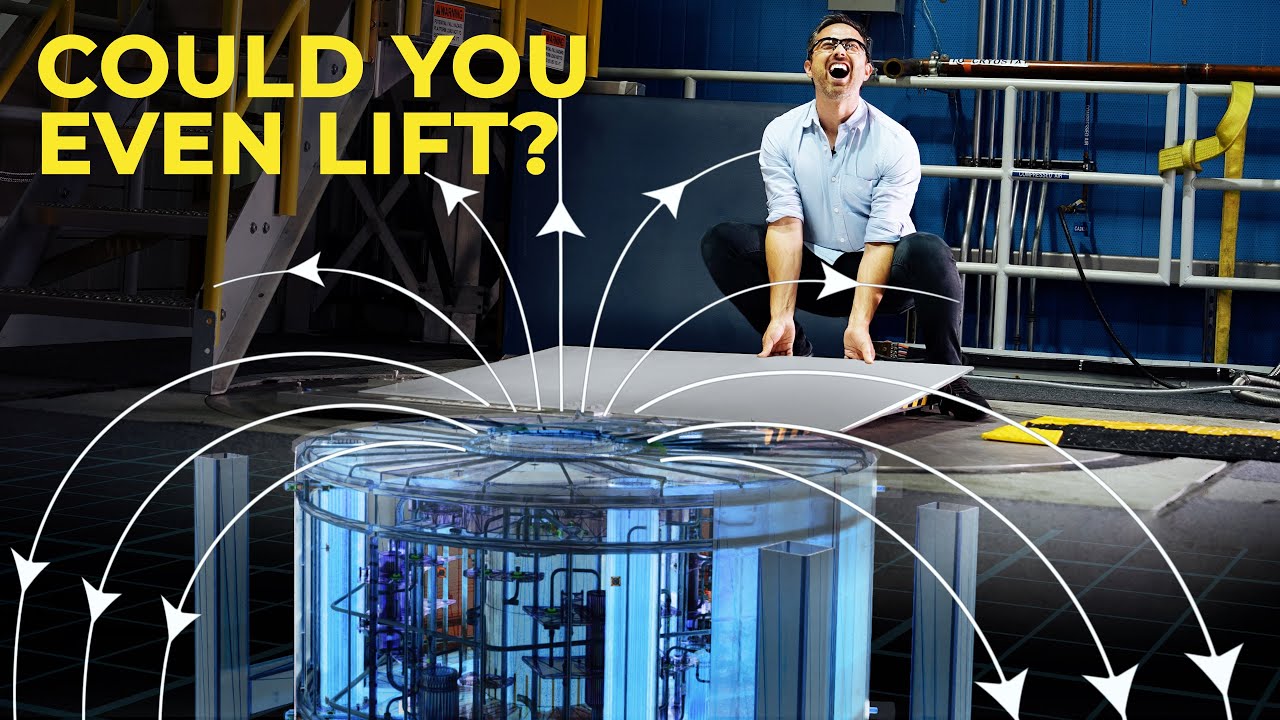
Handling a conductive metal plate near the active magnet, Derek Muller jokes about how hot the material gets before observing a fundamental electromagnetic phenomenon. As he explains: “I like to think of Lenz's Law as the 'No You Don't' Law because whatever you try to do, nature acts to oppose you.” When he drops the plate, eddy currents are instantly induced in the conductor, producing opposing magnetic forces that dramatically cushion and slow its descent. However, trying to rip the plate back off the surface triggers the exact same resistance: nature again says, “No, you don't.” Pulling the plate upward induces an opposing south magnetic pole on its underside, snapping and dragging it back down toward the magnet. Muller strains with all his strength against the invisible resistance, laughing: “They don't know if I'm weak or if this is actually insanely difficult.” A lab colleague cheers him on with, “You're strong like bull,” as Muller discovers that pushing the plate down faster is physically impossible—any attempt to accelerate the motion increases the time rate of change of magnetic flux ($\frac{d\Phi}{dt}$), which directly amplifies the induced eddy currents and tightens the magnetic braking.
```mermaid flowchart TD accTitle: Lenz's Law Feedback Loop accDescr: Diagram illustrating how conductor motion through a magnetic field generates opposing eddy currents.
subgraph Action ["Conductor Movement"] direction TB A["Conductor moved / pushed / dropped"] --> B["Changing magnetic flux (dΦ/dt)"] end
subgraph Reaction ["Electromagnetic Opposition"] direction TB B --> C["Eddy currents induced in conductor"] C --> D["Opposing magnetic field produced"] D --> E["Opposes original motion ('No You Don't')"] end ```
The team experiments with several other non-magnetic, highly conductive items: - A thick solid cylinder of aluminum dropped straight down hits an invisible brake before impact; attempting to roll it across the magnet's top face proves completely fruitless because the cylinder locks up and refuses to turn. - A volleyball wrapped in aluminum foil decelerates significantly when tossed or dropped directly into the magnetic bore, illustrating how even thin surface foils generate sufficient eddy currents to resist the original change in flux.
[12:01](https://www.youtube.com/watch?v=g0amdIcZt5I&t=721s) Potato Cannon Projectiles and the Fringe Field
To probe how violently the fringe magnetic field of the 45-tesla magnet can decelerate moving conductors, the team fires projectiles out of a pneumatic potato cannon directly across the bore opening. A high-speed comparison reveals striking behavior between the baseline test and the magnetized run: without the field, the projectile glides cleanly through the air; with the 45-tesla field energized, the projectile experiences extreme eddy currents the instant it breaches the fringe lines. Rather than simply slowing down uniformly, the induced forces twist and rotate the projectile mid-air so that its body aligns along the field lines, minimizing the total change in flux cutting through its conductive volume.
Taking the experiment a step further, the researchers load custom projectiles containing built-in wire coils hooked to colored LEDs facing the front. A lab researcher describes the circuit design: “So the LEDs are actually biased opposite polarity. So no matter which direction the field is coming in, one of them will be lit. And we're hoping that as it crosses through a field, you'll see the change in color of LED of the nose cone.” As predicted, the projectiles light up brightly upon entering and traversing the field, visual proof that the kinetic energy of the launch is being converted directly into induced electric currents and dissipated as heat and light.
[13:20](https://www.youtube.com/watch?v=g0amdIcZt5I&t=800s) Superconductivity and the Human Levitator
While ordinary conductors dissipate induced electrical energy as heat or light, superconductors below their critical temperature offer zero electrical resistance. When a magnet approaches a superconductor, the induced screening currents persist indefinitely without losing energy, expelling the external magnetic field entirely. In real-world high-temperature superconductors, deliberate microscopic defects are introduced into the crystal lattice to enhance stability. A researcher explains the mechanics of flux pinning: “There's defects that are engineered into the superconductors, a second phase that traps those magnetic field lines and keeps them from moving. It can no longer rise or fall because it's kind of locked in that magnetic configuration.”
To demonstrate this stability, Derek steps onto the MagLab's “human levitator,” a platform consisting of a 90-pound (40 kg) permanent magnet floating stably above a stationary ring of cryogenically cooled superconductors: - As Derek steps onto the magnet, his body weight pushes the magnet down toward the superconducting base. - The resulting increase in flux induces non-decaying currents in the superconductor, generating an opposing field that suspends Derek's full weight in mid-air. - Because the flux lines are pinned through the engineered defects, the platform remains rock-solid without wobbling or slipping out of alignment. - When handed a running leaf blower, Derek uses the air thrust to spin freely while suspended on the frictionless magnetic cushion.
[15:12](https://www.youtube.com/watch?v=g0amdIcZt5I&t=912s) Paramagnetism and Diamagnetic Levitation
Beyond eddy currents, magnetic fields interact with all matter at an atomic level through inherent quantum properties: - **Paramagnetism**: Materials such as liquid oxygen are attracted toward magnetic poles. Dripping liquid oxygen clings to both north and south poles equally because an external field causes the material's internal magnetic moments to align with and amplify the overall field. - **Diamagnetism**: The vast majority of everyday substances—most notably water—are weakly repelled by magnetic fields regardless of polarity. When an external field penetrates water, the molecules reorganize their electron orbitals to act as tiny opposing magnets, causing the surface of water to physically indent beneath a strong magnet.
```mermaid flowchart LR accTitle: Paramagnetism vs Diamagnetism accDescr: Comparison of paramagnetic attraction versus diamagnetic repulsion in an external magnetic field.
subgraph Para ["Paramagnetism (e.g., Liquid Oxygen)"] direction TB P1["External field applied"] --> P2["Internal moments align with field"] P2 --> P3["Attracted toward magnet"] end
subgraph Dia ["Diamagnetism (e.g., Water, Living Tissue)"] direction TB D1["External field applied"] --> D2["Opposing internal field induced"] D2 --> D3["Repelled away from magnet"] end ```
Because biological tissues consist primarily of water, living things are naturally diamagnetic. To film inside the magnet, the MagLab team uses a 31-tesla magnet fitted with an optical periscope. Muller tests common organic items: - A fresh strawberry hovers stably inside the bore; as a researcher points out, the strawberry is always diamagnetic, but ordinary magnets are simply too weak to overcome gravity. - Raspberries and even a small piece of plastic toy pizza levitate cleanly in the sweet spot of the field gradient. - Famous prior experiments have levitated frogs, grasshoppers, and mice to simulate spaceflight weightlessness on Earth without launching rockets.
When asked whether living in extreme magnetic fields causes harm, a researcher details their safety observations: “There are no lasting effects, there are no long-term effects. But we have noticed that there is the possibility of actually polarizing the stones that are in the inner ear. And the effect that that has on the rodent is that the rodent actually spins.” Because the otoliths in the inner ear shift under the gradient, rodents circle on the floor after removal, though the disorientation vanishes within a few minutes.
[17:56](https://www.youtube.com/watch?v=g0amdIcZt5I&t=1076s) Engineering the 45-Tesla Hybrid Magnet and Bitter Plates
Constructing the world's most powerful continuous magnet requires overcoming strict thermodynamic and mechanical boundaries. Superconducting wire cannot reach 45 tesla on its own because supercurrent collapses above an intrinsic upper critical magnetic field—historically limiting pure superconducting coils to nominally 20 tesla. Conversely, conventional electromagnets made of wound copper wire overheat and melt beyond roughly 2 tesla because cooling fluids cannot access the innermost windings.
```mermaid flowchart TD accTitle: The 45-Tesla Hybrid Architecture accDescr: Structural breakdown of the hybrid magnet combining a superconducting outsert and a resistive Bitter-plate insert.
subgraph Hybrid ["45-Tesla Hybrid Magnet"] direction TB subgraph Outsert ["Superconducting Outsert"] SC["Superconducting Coils\n(Generates 11.5 Tesla)"] end subgraph Insert ["Resistive Bitter Insert"] RP["Bitter Plates with Axial Cooling\n57,000 Amps Current\n(Generates 33.5 Tesla)"] end SC & RP --> Field["Maxwell's Equations: Fields Add\nTotal: 45 Tesla Continuous"] end ```
The MagLab achieves 45 tesla by pairing two distinct technologies into a hybrid assembly: - **Superconducting Outsert**: An outer superconducting magnet produces a baseline continuous field of 11.5 tesla. - **Resistive Bitter Insert**: An inner insert creates 33.5 tesla, yielding a combined continuous field of 45 tesla through the linear addition of fields.
The inner insert relies on the design pioneered in the 1930s by Francis Bitter at MIT: - Copper conductor is shaped into thin, flat circular plates perforated with cooling holes rather than cylindrical wire. - Alternating conductive plates and insulator sheets are stacked in a helical staircase, forming an electrical circuit that behaves like a wire coil. - Deionized water is driven axially through the overlapping perforations at several thousand gallons per minute to strip away immense heat generated by currents reaching 57,000 amperes. - The finished plate stack is compressed under roughly 20 tons of hydraulic force using heavy tie rods to lock the electrical contacts firmly together.
The mechanical forces inside the insert are so extreme that components can suffer catastrophic material failure. The staff displays a destroyed insert assembly where the copper surpassed its plastic yield limit and physically bowed outward: - The deformed plate breached its insulating barrier and shorted to ground, flash-vaporizing large chunks of metal. - The failure of the middle “B coil” ruptured inwards to wreck the “A coil” and expanded outwards to ruin the “C coil,” destroying all three concentric stages in an extraordinarily expensive failure. - Today, the 45-tesla continuous field at the Tallahassee MagLab shares the global record with a nearly identical hybrid system recently commissioned in Hefei, China, leaving only two such operational magnets on Earth.
[21:16](https://www.youtube.com/watch?v=g0amdIcZt5I&t=1276s) Powering the MagLab and the Grid Reserve Deal
Running the world's most powerful continuous magnet requires staggering amounts of electrical energy, to the point that the National High Magnetic Field Laboratory consumes a noticeable portion of Tallahassee's municipal power supply. When all four of the facility's massive DC power supplies are operating at full capacity, the lab draws roughly 8% of the entire city's generating capacity. This massive draw translates into a nominal electric utility bill ranging between $250,000 and $300,000 per month.
To manage such immense loads without destabilizing the local power infrastructure, the laboratory negotiated a mutually beneficial arrangement with the city of Tallahassee. The MagLab operates using the city's federally mandated power reserve—contingency generation that every electrical utility is legally required to maintain on standby in case of sudden grid failures, but which they normally cannot sell to conventional customers. By tapping into this buffer, the lab provides the city with a revenue stream from otherwise idle capacity. In return, if the regional power grid experiences an emergency demand surge, the lab can cut its power consumption instantly. As the staff explains: “The flip side is, when they need it, we ramp down, and we can go down much faster than they can spin up a Genny.”
- **Peak electricity demand**: Running all four DC power supplies simultaneously uses around 8% of Tallahassee’s total electrical generation capacity. - **Monthly electricity expense**: Approximately $250,000 to $300,000 per month under nominal operations. - **Grid arrangement**: The lab purchases federally mandated reserve energy and acts as an ultra-fast shedding load that ramps down far quicker than peaking generators can spin up.
[22:01](https://www.youtube.com/watch?v=g0amdIcZt5I&t=1321s) Why 45 Tesla Matters for Material Discovery
When asked why physicists require fields as intense as 45 Tesla, researchers point to the fundamental drivers of modern condensed matter physics and material discovery. Discovering new physical behaviors hinges on three complementary frontiers: synthesizing entirely new compounds, pushing materials into extreme environments (such as intense magnetic fields, strong electric fields, extreme pressures, and millikelvin temperatures), and refining existing materials to unprecedented purity. Purifying a material removes atomic defects and foreign contaminants, which drastically reduces electron scattering inside the crystal lattice. This allows intrinsic quantum behaviors to reveal themselves clearly under extreme conditions.
```mermaid flowchart TD accTitle: Frontiers of Material Discovery accDescr: Three main drivers that push the boundaries of condensed matter physics and material discovery.
subgraph Discovery["Frontiers of Material Discovery"] A["Synthesis"] -->|"growing"| D["Novel Materials"] B["Extreme Environments"] -->|"applying"| E["High Magnetic/Electric Fields, Low Temp, High Pressure"] C["Material Cleanliness"] -->|"eliminating"| F["Impurity Scattering"] end
E --> G["Unprecedented Physical Phenomena Observed"] F --> G D --> G ```
By coupling ultra-clean samples with record-setting continuous magnetic fields, scientists can observe novel quantum states and electronic phases that remain completely invisible under ordinary laboratory conditions. Researchers at the facility view the current era as a historic turning point for physics and engineering, predicting that the discoveries made using these high-field magnets will redefine the field in the decades ahead. As one researcher summarizes: “We've only just barely scratched the surface on what can be done with this. People are gonna look back about 25 years from now and this will be the inflection point, this five year period.”
## Notable quotes > [10:12](https://www.youtube.com/watch?v=g0amdIcZt5I&t=612s) I like to think of Lenz's Law as the 'No You Don't' Law because whatever you try to do, nature acts to oppose you. — Derek Muller
## Mentioned National High Magnetic Field Laboratory (MagLab), Tallahassee, Florida, Derek Muller, Google, Project Sunroof, Google Trends, Francis Bitter, Palace of Discovery, MIT, Hefei, China, National Science Foundation, State of Florida, Minutephysics
## Video description The world's strongest magnet is a million times stronger than Earth's magnetic field. Learn more about sustainability and Google’s efforts at sustainability.google. Part of this video was sponsored by Google.
Trends insights for the past year are based on Google Trends data from 2/10/2022 - 2/10/2023, U.S.
▀▀▀ Thanks to the entire NHMFL team - especially Tim, Stephen, Caroline, Kristin, Sam, Lance, and everyone who helped with the demos - for the great visit. The NHMFL is funded by the National Science Foundation and the State of Florida.
Special thanks to Henry from Minutephysics for lending his magnet animations from our magnet collaboration: https://youtu.be/hFAOXdXZ5TM
▀▀▀ References: Liu, Y., Zhu, D. M., Strayer, D. M., & Israelsson, U. E. (2010). Magnetic levitation of large water droplets and mice. Advances in Space Research, 45(1), 208-213.
Simon, M. D., & Geim, A. K. (2000). Diamagnetic levitation: Flying frogs and floating magnets. Journal of applied physics, 87(9), 6200-6204.
Berry, M. V., & Geim, A. K. (1997). Of flying frogs and levitrons. European Journal of Physics, 18(4), 307.
▀▀▀ Special thanks to our Patreon supporters: Tj Steyn, Meg Noah, Bernard McGee, James Sanger, Elliot Miller, Jerome Barakos M.D., Amadeo Bee, TTST, Balkrishna Heroor, Chris LaClair, John H. Austin Jr., Eric Sexton, John Kiehl, Anton Ragin, Diffbot, Gnare, Dave Kircher, Burt Humburg, Blake Byers, Evgeny Skvortsov, Meekay, Bill Linder, Paul Peijzel, Josh Hibschman, Mac Malkawi, Juan Benet, Sunil Nagaraj, Richard Sundvall, Lee Redden, Stephen Wilcox, Marinus Kuivenhoven, Michael Krugman, Cy 'kkm' K'Nelson, Sam Lutfi
▀▀▀ Written by Derek Muller Edited and Motion Graphics by Trenton Oliver Coordinated by Emily Zhang and Derek Muller Filmed by Derek Muller, Trenton Oliver, Raquel Nuno and Emily Zhang Additional video/photos supplied by Pond5 & Getty Images Music from Epidemic Sound Thumbnail by Ignat Berbeci Produced by Derek Muller, Petr Lebedev, and Emily Zhang
[Source](https://www.youtube.com/watch?v=g0amdIcZt5I)