BBC Team Films Antarctic Orca Wave Attack, Proving 100-Year-Old Log
BBC Earth
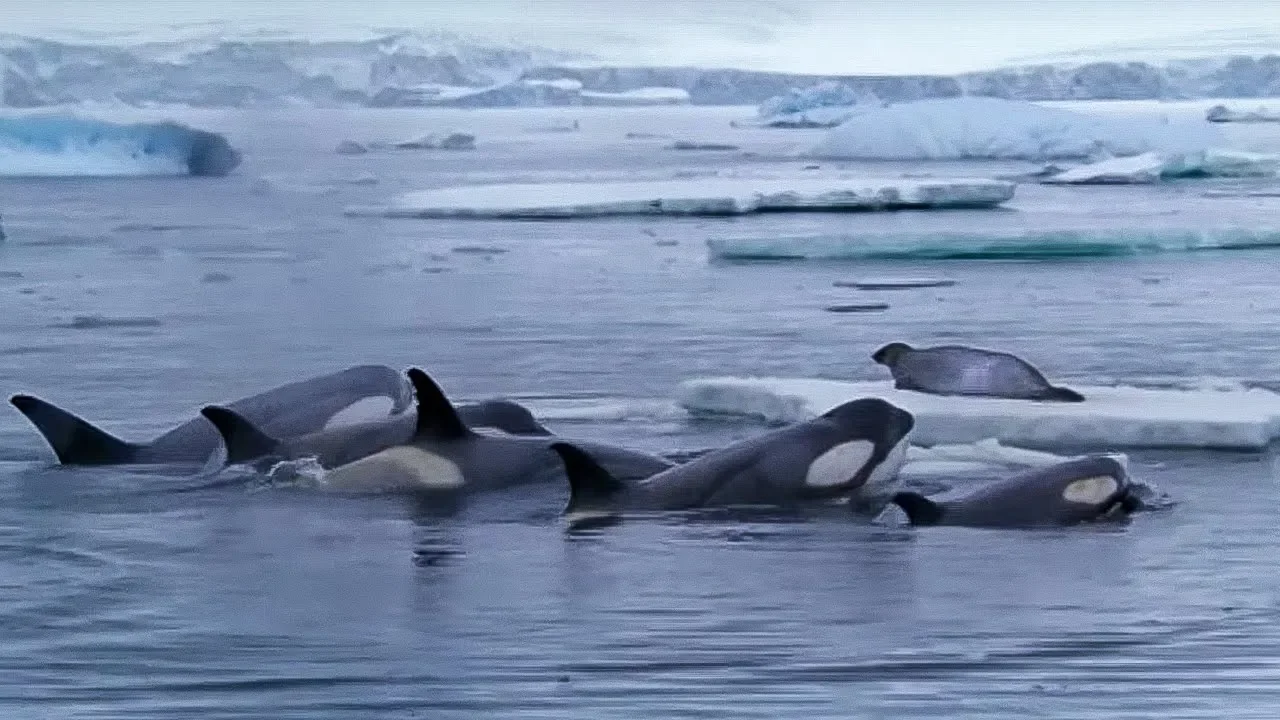
Satellite tracking enabled researchers to follow an Antarctic pod and film killer whales coordinating bow waves to dislodge seals from ice, scientifically verifying Captain Scott’s century-old expedition account.
AI-assisted summary of Killer Whales Working Together to Hunt Seals on Ice | BBC Earth — original source. Check the original for full context.
Source published:
Key ideas
- BBC's Frozen Planet production team successfully documented Antarctic killer whales using coordinated wave-washing attacks to dislodge seals from sea ice, validating accounts dating back to Captain Scott's expedition journals. (0:08)
- The expedition aboard the Golden Fleece crossed the Drake Passage and searched for over a week before onboard scientists successfully attached a satellite tag to track the fast-moving pod through the ice. (1:02)
- The documented hunting strategy involves spy-hopping to spot targets followed by synchronous subsurface swimming abreast to create destructive bow waves that break ice floes. (2:32)
- The camera crew captured two to three complete wave-washing hunting sequences in a single day using a roof-mounted Cineflex camera system. (3:40)
Detailed notes
## Background Published on YouTube by BBC Earth on August 24, 2017, this behind-the-scenes featurette recounts producer and director Kathryn Jeffs' journey to Antarctica to film killer whales for the landmark series Frozen Planet. According to the description, the team set out to investigate an orca hunting technique dating back to Captain Scott's expedition diaries, capturing on camera for the first time what had long been dismissed as an unverified myth.
## TL;DR Producer Kathryn Jeffs and her BBC crew sailed aboard the Golden Fleece across the Drake Passage to document a legendary killer whale wave-washing behavior that had never been filmed. After enduring days of empty searches that dampened team morale, onboard scientists successfully tagged an orca, allowing the vessel to track the pod through the pack ice. Shortly after locating the group, the crew watched in astonishment as the whales spy-hopped to locate seals and charged side-by-side to push massive waves over the ice floes, washing their prey into the sea. The expedition captured several complete hunting sequences on camera, transforming over a century of maritime folklore into documented scientific reality.
## Atmosphere & style The presentation blends reflective documentary storytelling with the quiet thrill of a historic wildlife expedition. Kathryn Jeffs speaks with understated wonder and deep humility, capturing both the bleak tension of braving the Drake Passage and the creeping despondency of days spent finding nothing in the pack ice. The mood rapidly shifts to breathless adrenaline the moment the lookout calls out the charging waves, leaving the viewer with a profound sense of awe at both the intelligence of the orcas and the sheer privilege of witnessing nature at its most cinematic.
## Bulletin - [00:08](https://www.youtube.com/watch?v=g1VEwsI4SlY&t=8s) BBC's Frozen Planet production team successfully documented Antarctic killer whales using coordinated wave-washing attacks to dislodge seals from sea ice, validating accounts dating back to Captain Scott's expedition journals. - [01:02](https://www.youtube.com/watch?v=g1VEwsI4SlY&t=62s) The expedition aboard the Golden Fleece crossed the Drake Passage and searched for over a week before onboard scientists successfully attached a satellite tag to track the fast-moving pod through the ice. - [02:32](https://www.youtube.com/watch?v=g1VEwsI4SlY&t=152s) The documented hunting strategy involves spy-hopping to spot targets followed by synchronous subsurface swimming abreast to create destructive bow waves that break ice floes. - [03:40](https://www.youtube.com/watch?v=g1VEwsI4SlY&t=220s) The camera crew captured two to three complete wave-washing hunting sequences in a single day using a roof-mounted Cineflex camera system.
## Key takeaways - [00:08](https://www.youtube.com/watch?v=g1VEwsI4SlY&t=8s) The mission was considered a high-risk gamble to film a 'holy grail' behavior that many considered maritime folklore rather than confirmed reality. - [00:45](https://www.youtube.com/watch?v=g1VEwsI4SlY&t=45s) The historical basis for the wave-washing behavior originated over a century earlier in the expedition diaries of Captain Robert Falcon Scott. - [00:55](https://www.youtube.com/watch?v=g1VEwsI4SlY&t=55s) Prior to this Frozen Planet shoot, coordinated wave attacks by orcas had never been scientifically verified or captured on film. - [01:02](https://www.youtube.com/watch?v=g1VEwsI4SlY&t=62s) The crew traveled aboard the vessel Golden Fleece, enduring a grueling four-day crossing of the turbulent Drake Passage. - [01:30](https://www.youtube.com/watch?v=g1VEwsI4SlY&t=90s) After roughly seven to eight days without locating the whales, crew morale began to decline significantly. - [01:45](https://www.youtube.com/watch?v=g1VEwsI4SlY&t=105s) Scientists Bob and John provided the breakthrough by spotting the orcas and successfully deploying a satellite tag onto an individual whale. - [02:05](https://www.youtube.com/watch?v=g1VEwsI4SlY&t=125s) Deploying the satellite transmitter was critical because the ship could not match the swimming speed of the pod through the ice on visual tracking alone. - [02:32](https://www.youtube.com/watch?v=g1VEwsI4SlY&t=152s) Orcas initiate the hunt by spy-hopping individually to visually scout ice floes for hauled-out seals. - [02:45](https://www.youtube.com/watch?v=g1VEwsI4SlY&t=165s) Once a target is spotted, the scout signals the rest of the pod, which then converges in small groups around the floe. - [03:15](https://www.youtube.com/watch?v=g1VEwsI4SlY&t=195s) The whales coordinate by charging forward submerged side-by-side, creating a massive directed bow wave that washes over and breaks apart the ice. - [03:35](https://www.youtube.com/watch?v=g1VEwsI4SlY&t=215s) The pod methodically repeats the wave charges until the ice floe disintegrates and the seal is flipped into open water. - [03:55](https://www.youtube.com/watch?v=g1VEwsI4SlY&t=235s) Producer Kathryn Jeffs described witnessing and filming two to three full hunting sequences as one of the greatest privileges of her life.
## Detailed walkthrough ### [00:08](https://www.youtube.com/watch?v=g1VEwsI4SlY&t=8s) Chasing the Antarctic "Holy Grail" Legend
Producer and director Kathryn Jeffs describes traveling south to the Antarctic Peninsula to document killer whales for the BBC series *Frozen Planet* as the single most remarkable and astounding experience of her entire life. The crew set out with an ambitious and risky objective: to capture a behavioral sequence long considered the holy grail of marine wildlife filming. For generations, stories had circulated about Antarctic orcas coordinating complex, pack-based wave attacks to knock prey off sea ice, but researchers and filmmakers still questioned whether it was an authentic natural phenomenon or mere maritime folklore. As Jeffs explained: “We were down there to try to find a holy grail sequence, something that has been talked about for years and years, but no one ever really knew if it was something that really happened or if it was actually sort of, you know, just a legend.”
The origin of the account reached back more than a century to the expedition journals of Captain Robert Falcon Scott. His men recorded a terrifying encounter in which killer whales appeared to coordinate an approach toward the ice edge, deliberately sending a wave crashing over the surface to dislodge members of the party into the sea. Despite that early written record, the behavior had never been scientifically verified or filmed. Jeffs and her crew departed with the daunting awareness that they were dedicating an entire expedition to a hunt that might not even exist.
- **Expedition Mission:** Film killer whale hunting tactics for the landmark natural history series *Frozen Planet*. - **Historical Source:** Scott of the Antarctic’s expedition diaries, which originally noted orcas generating waves against ice sheets. - **Scientific Status:** The behavior had never been rigorously or scientifically documented on camera prior to this expedition.
---
[01:02](https://www.youtube.com/watch?v=g1VEwsI4SlY&t=62s) Crossing the Drake Passage and Tagging the Pod
The expedition journeyed south aboard the *Golden Fleece*, braving the notorious Drake Passage—widely considered one of the most treacherous stretches of open ocean on the planet. For four continuous days, the vessel rolled back and forth through heavy seas before finally emerging into the serene, glassy waters of the Antarctic Peninsula. Navigating past towering icebergs and watching rafts of penguins head out into the morning waters to fish brought an immediate sense of scale and adventure, but the work itself quickly tested the crew's resolve.
After seven or eight days of searching without a trace of the behavior, morale began to slide into despondency. The breakthrough arrived abruptly when the onboard scientists, Bob and John, shouted out that they had spotted killer whales. Realizing that their vessel could never keep pace with the fast-moving pod through the ice on sight alone, the team deployed a satellite tag directly onto one of the whales. Securing that physical link proved to be the turning point of the mission, giving the crew the ability to shadow the family group deeper south into the floe fields.
```mermaid flowchart TD accTitle: Orca Tracking and Hunt Sequence accDescr: Step-by-step coordinated workflow used by the crew and the killer whale pod to locate and hunt seals on ice floes. subgraph Tracking["Expedition Tracking"] A["Attach satellite tag to orca"] --> B["Follow pod south through pack ice"] end subgraph Scouting["Pod Scouting"] B --> C["Individual spy-hopping"] C --> D["Locate seal resting on floe"] D --> E["Signal sent to family group"] end subgraph Attack["Wave-Washing Attack"] E --> F["Pod charges forward in formation"] F --> G["Subsurface charge creates rolling wave"] G --> H["Ice floe breaks and seal is flipped into sea"] end ```
- **Vessel:** The *Golden Fleece*. - **Transit:** Four non-stop days navigating the turbulent Drake Passage. - **Search Duration:** Roughly a week to eight days before making initial contact with the pod. - **Key Scientists:** Bob and John. - **Critical Breakthrough:** Successfully affixing a satellite transmitter to a family member, enabling long-range tracking through the pack ice.
---
[02:32](https://www.youtube.com/watch?v=g1VEwsI4SlY&t=152s) Witnessing the Wave-Washing Hunt
Within the first hour of following the tagged pod, the team observed the animals spy-hopping—deliberately thrusting their heads above the surface one by one to survey the ice floes for resting seals. Whenever a scout located a target, it signaled the rest of the pod. The family would converge around the floe, rising in pairs and trios until the whales suddenly vanished beneath the surface. Unsure of what would happen next, Jeffs began climbing onto the boat’s roof to strip the protective weather cover off their primary Cineflex camera.
Halfway up the ladder, a shout of “Wave!” echoed across the deck. Looking out across the water, Jeffs froze: a colossal, synchronized bow wave generated by the pod was surging directly toward the ice floe. The resting seal woke in shock just as the water smashed over the ice, rocking the floe violently. The crew watched in astonishment as the whales methodically repeated the assault, diving together, swimming abreast beneath the surface, and unleashing wave after wave until the ice broke apart and flipped the prey into the water. The team filmed two or three complete hunts that day, finally transforming an explorer's legend into verified reality. Reflecting on the encounter, Jeffs summarized the emotional impact: “It was the most unbelievable privilege.”
- **Scouting Method:** Orcas individually poke their heads vertically out of the water (spy-hopping) to locate seals before rallying the pod. - **Primary Camera System:** A stabilized Cineflex camera mounted on the roof of the vessel. - **Hunting Mechanics:** The orca pod coordinates their swim strokes side by side just under the surface, pushing a massive wall of water that shatters the floe and washes the prey off. - **Filming Yield:** Two to three full hunting sequences successfully captured in a single day.
## Mentioned Kathryn Jeffs, Frozen Planet, BBC Earth, Captain Robert Falcon Scott, Golden Fleece, Drake Passage, Antarctic Peninsula, Bob, John, Cineflex, Alucia Productions
## Video description Orcas knocking seals off waves was thought to be a myth when Producer/Director Kathryn Jeffs set out to film them in Antarctica for BBC series Frozen Planet. Hear the remarkable story behind capturing this unbelievable behaviour on camera. Subscribe: http://bit.ly/BBCEarthSub
What fascinates you about our oceans? Join the conversation over on Twitter @OurBluePlanet. #OurBluePlanet is a digital project between BBC Earth and Alucia Productions.
This Killer Whales attack behaviour dates back to Scott of the Antarctic’s diary and this was the first time Kathryn Jeffs and her crew saw an Orca Pod using this technique in unison to hunt seals in the Antarctic.
WATCH MORE: New on Earth: https://bit.ly/2M3La96 Oceanscapes: https://bit.ly/2Hmd2kZ Wild Thailand: https://bit.ly/2kR7lmh
Welcome to BBC EARTH! Here you'll find 50 years worth of astounding natural history content.
This is a commercial channel from BBC Studios. Service & Feedback https://www.bbcstudios.com/contact/contact-us/
[Source](https://www.youtube.com/watch?v=g1VEwsI4SlY)