Physicist Deutsch Urges Geoengineering Over Carbon Cuts for Survival
TED
Civilization faces extinction from scarce knowledge rather than scarce resources, requiring active technological problem-fixing instead of precautionary avoidance to survive existential threats.
AI-assisted summary of David Deutsch: Chemical scum that dream of distant quasars — original source. Check the original for full context.
Source published:
Key ideas
- David Deutsch refutes both the 'Spaceship Earth' dogma and Stephen Hawking's assertion that humans are mere 'chemical scum' on an ordinary planet, demonstrating that intergalactic space—not Earth—represents the true typical environment of the cosmos. (0:25)
- The human brain functions as a cosmic hub, generating explanatory knowledge that mirrors the causal structures and mathematical laws of phenomena millions of light-years away, such as quasar jets. (5:46)
- The true limiting factor for civilization's survival across the universe is not a scarcity of resources—which exist abundantly even in intergalactic voids—but the scarcity of explanatory knowledge. (11:07)
- Deutsch argues against purely precautionary approaches to climate change like the Kyoto Protocol, advocating instead for active problem-fixing and technological solutions such as geoengineering. (15:01)
- Humanity's long-term survival hinges on embracing two core philosophical principles: 'Problems are inevitable' and 'Problems are soluble.' (17:00)
Detailed notes
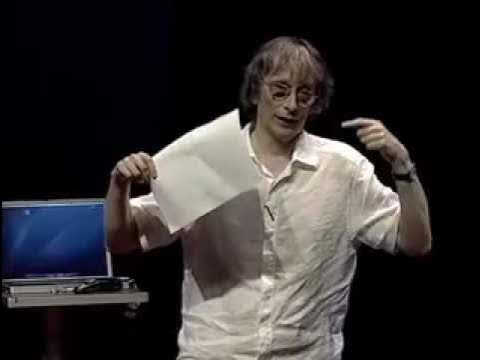
## Background Published on YouTube by TED on January 16, 2007, this talk features theoretical physicist David Deutsch addressing the survival of our species. The talk description notes that Deutsch puts theoretical physics on the back burner to confront urgent civilizational challenges like global warming, asserting that the first step to solving them is admitting that we have a problem.
## TL;DR Deutsch dismantles two pervasive worldviews: the ecological dogma of "Spaceship Earth" as a fragile, uniquely suited sanctuary, and Stephen Hawking's cosmological quip that humans are mere "chemical scum" on an ordinary planet. Showing that intergalactic space is the true cosmic norm, he argues that the human mind uniquely mirrors the causal structure of reality through explanatory knowledge, transforming local matter into cosmic hubs. Because any volume of space possesses ample matter and energy, the ultimate constraint on human survival is never physical resources, but the scarcity of knowledge. Examining global warming and existential risk, Deutsch rejects passive problem-avoidance in favor of active, technological problem-fixing anchored by twin truths: problems are inevitable, and problems are soluble.
## Atmosphere & style The presentation carries a dryly humorous, cerebral, and contemplative tone, blending high-level astrophysics with sharp philosophical wit. Deutsch speaks in a calm, understated manner, engaging the audience with deadpan theatricality—such as plunging the entire auditorium into pitch-black darkness to simulate the intergalactic void or tossing playful asides to Richard Dawkins in the crowd. Watching the talk feels intellectually invigorating and grounded, transitioning from dizzying cosmic insignificance to an empowering, sober call for rational optimism.
## Bulletin - [00:25](https://www.youtube.com/watch?v=gQliI_WGaGk&t=25s) David Deutsch refutes both the 'Spaceship Earth' dogma and Stephen Hawking's assertion that humans are mere 'chemical scum' on an ordinary planet, demonstrating that intergalactic space—not Earth—represents the true typical environment of the cosmos. - [05:46](https://www.youtube.com/watch?v=gQliI_WGaGk&t=346s) The human brain functions as a cosmic hub, generating explanatory knowledge that mirrors the causal structures and mathematical laws of phenomena millions of light-years away, such as quasar jets. - [11:07](https://www.youtube.com/watch?v=gQliI_WGaGk&t=667s) The true limiting factor for civilization's survival across the universe is not a scarcity of resources—which exist abundantly even in intergalactic voids—but the scarcity of explanatory knowledge. - [15:01](https://www.youtube.com/watch?v=gQliI_WGaGk&t=901s) Deutsch argues against purely precautionary approaches to climate change like the Kyoto Protocol, advocating instead for active problem-fixing and technological solutions such as geoengineering. - [17:00](https://www.youtube.com/watch?v=gQliI_WGaGk&t=1020s) Humanity's long-term survival hinges on embracing two core philosophical principles: 'Problems are inevitable' and 'Problems are soluble.'
## Key takeaways - [00:25](https://www.youtube.com/watch?v=gQliI_WGaGk&t=25s) Popular thought is trapped between two contradictory axioms: that Earth is a uniquely hospitable sanctuary ('Spaceship Earth') and that humanity is insignificant 'chemical scum' in an ordinary location. - [02:32](https://www.youtube.com/watch?v=gQliI_WGaGk&t=152s) Earth and its surrounding environment are radically atypical; a truly typical cosmic environment is the pitch-black, near-vacuum of intergalactic space at less than 3 Kelvin. - [02:32](https://www.youtube.com/watch?v=gQliI_WGaGk&t=152s) Even violent events like a nearby supernova become completely undetectable to the human eye when viewed across vast intergalactic distances. - [05:46](https://www.youtube.com/watch?v=gQliI_WGaGk&t=346s) The human brain can instantiate accurate working models that reproduce the causal logic and physical laws governing quasars billions of light-years away. - [09:08](https://www.youtube.com/watch?v=gQliI_WGaGk&t=548s) Knowledge creation relies on three universally available assets: matter for computation, energy to perform operations, and empirical evidence to formulate explanations. - [11:07](https://www.youtube.com/watch?v=gQliI_WGaGk&t=667s) A solar-system-sized volume of intergalactic space contains over one million tons of matter, which is physically sufficient to construct a research base through fusion and transmutation. - [11:07](https://www.youtube.com/watch?v=gQliI_WGaGk&t=667s) Any transformation not forbidden by the laws of physics is achievable given the appropriate knowledge, making progress a function of knowledge rather than physical limits. - [13:07](https://www.youtube.com/watch?v=gQliI_WGaGk&t=787s) Because raw matter and energy exist everywhere, open-ended knowledge hubs can theoretically be established anywhere in the cosmos. - [13:07](https://www.youtube.com/watch?v=gQliI_WGaGk&t=787s) Civilizational survival is not guaranteed; Martin Rees estimates civilization's odds of surviving the 21st century against existential risks at roughly 50 percent. - [15:01](https://www.youtube.com/watch?v=gQliI_WGaGk&t=901s) The historical default for biological species and past civilizations is extinction, and humanity can only transcend this default through explanatory knowledge. - [15:01](https://www.youtube.com/watch?v=gQliI_WGaGk&t=901s) Treating climate change purely through blunt emission reductions incurs massive economic costs to marginally delay problems rather than solve them. - [15:01](https://www.youtube.com/watch?v=gQliI_WGaGk&t=901s) Scientific consensus shifts over time, as illustrated by 1970s warnings of an impending pollution-induced ice age, proving that future threats cannot always be anticipated. - [17:00](https://www.youtube.com/watch?v=gQliI_WGaGk&t=1020s) The precautionary principle and problem-avoidance fail when confronting unforeseen hazards, necessitating a dynamic stance focused on problem-fixing. - [17:00](https://www.youtube.com/watch?v=gQliI_WGaGk&t=1020s) Viable geoengineering solutions, such as orbital solar deflection mirrors and carbon-absorbing aquatic organisms, should be actively pursued alongside mitigation. - [17:00](https://www.youtube.com/watch?v=gQliI_WGaGk&t=1020s) Humanity's foundational outlook must rest upon two complementary truths: 'Problems are inevitable' and 'Problems are soluble.'
## Detailed walkthrough ### [00:25](https://www.youtube.com/watch?v=gQliI_WGaGk&t=25s) Two Prevalent Dogmas: "Spaceship Earth" vs. "Chemical Scum"
David Deutsch opens by noting that speakers are encouraged to take risks and present something unexpected. To set up his counterintuitive argument, he outlines two universally accepted notions about humanity’s place in reality. The first belief—held across most of recorded human history—asserts that planet Earth and the solar system are uniquely tailored to sustain our evolution (or creation, under older religious frameworks), our present existence, and our future survival. In modern parlance, this view is packaged under the metaphor of "Spaceship Earth": the grim premise that outside our planetary vessel lies an implacably hostile universe, while inside is our only refuge. Under this view, humanity has only a single chance, and if we ruin our vessel, we have nowhere else to turn.
Deutsch contrasts this with a second common belief that emerged from modern science: that humans are utterly insignificant. Summarizing this view, Deutsch quotes Stephen Hawking: “As Stephen Hawking famously said, we're just a chemical scum on the surface of a typical planet that's in orbit around a typical star, which is on the outskirts of a typical galaxy, and so on.” Deutsch points out an obvious philosophical clash between these two axioms. One proclaims humanity occupies a profoundly atypical, privileged sanctuary, while the other reduces us to an entirely typical, negligible speck. Deutsch observes that people often adopt both as foundational life truths, despite the apparent contradiction. With dry humor, he resolves the paradox: “But that doesn't prevent them from both being completely false.”
- **Spaceship Earth hypothesis**: Asserts the cosmos is hostile and Earth is a fragile, uniquely suited, non-renewable lifeboat. - **Hawking's cosmological mediocrity**: Reduces human life to inconsequential "chemical scum" living in an ordinary, typical sector of the universe. - **The paradox**: One dogma claims our location is remarkably atypical; the other insists it is completely typical.
---
[02:32](https://www.youtube.com/watch?v=gQliI_WGaGk&t=152s) Journey to a "Typical" Place in the Universe
Deutsch directly challenges Hawking's premise that Earth is a "typical" place. Looking around the room at the audience, Deutsch notes that one sees walls and "chemical scum," which is entirely atypical of reality at large. Traveling several hundred miles into space strips away walls and people, leaving only a blue planet. Moving further out past the Sun, solar system, and nearby stars still does not yield a typical environment, because stars congregate in galaxies, whereas most of the universe is nowhere near a galaxy.
To demonstrate what a truly typical environment looks like, Deutsch takes the audience on a mental zoom past the spiral arms of the Milky Way, 100,000 light-years out, and then one thousand times further still—into the depths of intergalactic space. Joking that TED arranged a high-resolution virtual reality simulation at enormous expense, he asks for the auditorium lights to be turned off. The resulting view is absolute pitch darkness. Intergalactic space is so vast and dim that if the nearest star were to detonate as a supernova—an explosion so violent it would kill an observer stone dead from several light-years away—a person standing in intergalactic space staring directly at it would not detect even a faint glimmer. Furthermore, it is near absolute zero (less than 3 Kelvin) and emptier than anything reproducible on Earth, with a vacuum one million times less dense than the finest terrestrial vacuum chambers. Concluding the demonstration, Deutsch requests the lights be brought back up, having proved just how radically atypical our warm, dense environment is.
```mermaid flowchart TD accTitle: Perspective Shift from Earth to Intergalactic Space accDescr: Diagram tracing the spatial scale from Earth to intergalactic void, contrasting local density with universal typicality.
subgraph LocalScale["Atypical Environments"] A["Earth / Lecture Hall<br>(Matter, warmth, human life)"] -->|"Hundreds of miles"| B["Blue Planet & Solar System"] B -->|"100,000 light-years"| C["Milky Way Spiral Arms"] end
subgraph CosmicScale["Typical Environment"] C -->|"1,000x galactic scale"| D["Intergalactic Space<br>(Pitch black, < 3 Kelvin, extreme vacuum)"] end ```
- **Distance to true universal typicality**: Roughly 100 million light-years away from any galaxy into intergalactic space. - **Supernova visibility test**: An event lethal from light-years away is completely undetectable to human vision across intergalactic distances. - **Cold and emptiness**: Temperatures hover under 3 degrees above absolute zero; the vacuum is $10^6$ times sparser than humanity's best technological vacuum.
---
[05:46](https://www.youtube.com/watch?v=gQliI_WGaGk&t=346s) Quasars, the Brain, and the Universality of Knowledge
Deutsch asks how an organism bound to Earth can know about conditions millions of light-years away. His answer is that our environment, operating through human beings, creates explanatory knowledge. For example, astronomers looking through telescopes observe "quasars"—originally named "quasi-stellar objects" because they appeared star-like. Today, science understands that billions of years ago and billions of light-years away, matter collapsed into a galactic center's supermassive black hole, where violent magnetic fields channeled gravitational energy into relativistic jets that shone with the brilliance of a trillion suns.
Deutsch emphasizes the immense physical difference between the human brain and a quasar jet. Being inside a quasar jet would resemble enduring a point-blank supernova for millions of years; human biology cannot survive it, and human language fails to adequately capture its violence. Yet the brain, composed of cold chemical scum, can create a high-fidelity model that accurately mirrors the causal structure and mathematical laws governing that jet: “The one physical system, the brain, contains an accurate working model of the other, the quasar.” Because the laws of physics permit widely disparate objects to embody identical causal logic, human minds achieve an extraordinary status. Deutsch states: “This place, and not other places in the universe, is a hub which contains within itself the structural and causal essence of the whole of the rest of physical reality.”
- **Nature of a quasar**: Gravitational energy of matter falling toward a supermassive black hole, redirected by intense magnetic fields into jets shining brighter than a trillion suns. - **Definition of knowledge**: Not merely an image, but an explanatory model embodying identical causal and mathematical relations to the phenomenon itself. - **Growth of knowledge**: The fidelity between the brain's internal representations and external cosmic reality increases across time. - **Cosmic significance**: The laws of physics allow small patches of matter to reflect the universal principles of the rest of reality.
---
[09:08](https://www.youtube.com/watch?v=gQliI_WGaGk&t=548s) The Three Ingredients of Knowledge: Matter, Energy, and Evidence
Deutsch examines what allows human beings in our solar system to mirror the rest of the cosmos. He agrees with Stephen Hawking that no supernatural intervention or unique physical laws are involved, but contends Hawking placed the emphasis in the wrong place. Our environment enables knowledge creation because it provides three fundamental assets in great abundance: matter, energy, and evidence. Matter is strictly necessary because knowledge generation is information processing (computation), and computers cannot be constructed without matter. Energy is required to operate computation and record discoveries onto lasting physical media.
Thirdly, our environment is saturated with empirical evidence. Newton’s law of gravity was tested only three centuries ago, yet the physical evidence needed to discover and test it had been striking every square meter of our planet for billions of years, and will do so for billions more. Deutsch highlights that our planet sits in a torrential flood of evidence that enables the discovery of fundamental truths across every branch of science.
- **Matter**: The indispensable substrate needed to build computers and physical information processors. - **Energy**: The fuel required to run computations and transcribe knowledge into physical media. - **Evidence**: The continuous empirical data falling upon the Earth, available freely to be formulated into scientific explanations.
---
[11:07](https://www.youtube.com/watch?v=gQliI_WGaGk&t=667s) Debunking the Void: Why Intergalactic Space Is Not an Absolute Limit
At first glance, intergalactic space appears completely devoid of the prerequisites for knowledge creation. However, Deutsch exposes this assumption as another parochial misconception. If one carves out an arbitrary cube of intergalactic space equal in volume to our solar system, that cube—though exceptionally empty by human standards—still contains more than one million tons of matter, largely in the form of diffuse hydrogen. One million tons is ample mass to construct a fully functioning, self-contained space station capable of supporting a colony of research scientists.
While harvesting dispersed intergalactic hydrogen and transmuting it into heavier elements exceeds humanity's current engineering abilities, Deutsch insists that physical possibility is bounded solely by fundamental laws, arguing: “In other words, it's a matter of knowledge, not resources.” Transmuting intergalactic hydrogen would simultaneously generate an energy supply via nuclear fusion. Telescopes stationed in this deep void would see the very same distant galaxies we observe from Earth, enabling astrophysics and the deduction of universal physical laws. Local particle accelerators could uncover fundamental subatomic physics and chemistry. Joking about the limitations of such an outpost, Deutsch glances toward biologist Richard Dawkins in the audience: the only discipline that would truly suffer is biology, since field trips to the nearest living world would take several hundred million years—an arrangement Deutsch playfully admits suits him just fine.
- **Intergalactic matter density**: A solar-system-sized volume of intergalactic space holds over $1,000,000$ tons of matter. - **Transmutation and power**: Fusing diffuse intergalactic hydrogen into heavier materials simultaneously provides structural building blocks and abundant fusion energy. - **Epistemological rule**: If a transformation is not forbidden by the laws of physics, achieving it is purely an issue of acquiring the appropriate knowledge. - **Fieldwork limitation**: Deep-space astrophysics and fundamental particle physics remain fully accessible in the void; only biological field expeditions are constrained by intergalactic travel times.
[13:07](https://www.youtube.com/watch?v=gQliI_WGaGk&t=787s) The Cosmic Hub and Human Vulnerability
Intergalactic space, barren though it appears, contains all the physical prerequisites necessary for the open-ended creation of knowledge. Any arbitrary cube of empty space anywhere in the universe possesses the raw matter and energy required to be transformed into the very same kind of hub that Earth represents, provided the knowledge of how to utilize it is present. Because of this, humanity does not occupy a uniquely hospitable or privileged sanctuary. If the vacuum of deep space is fundamentally capable of sustaining an unending stream of explanations, then virtually any environment can, including our own planet—even a heavily polluted one. The true constraint confronting intelligent life is never a shortage of material resources, which exist in boundless cosmic abundance, but rather the acute scarcity of knowledge.
Recognizing this cosmic perspective ought to make humanity feel extraordinarily special, yet it simultaneously reveals our profound vulnerability. Without acquiring the specific explanations needed to survive the relentless hazards of the universe, civilization will simply perish. A sudden catastrophe, such as a supernova detonating just a few light-years away, would wipe out humanity instantly. Deutsch notes that astrophysicist Martin Rees explored this fragility in his recent book, cataloging threats ranging from astrophysical disasters and runaway scientific experiments to terrorism utilizing weapons of mass destruction, ultimately assigning civilization merely a fifty-fifty chance of surviving the twenty-first century. While Deutsch disagrees with treating human survival as a matter of probabilistic chance, he concurs with Rees on the severity of the stakes: survival is neither guaranteed nor ruled out, but hinges entirely on whether human beings can generate the relevant explanations in time. As David Deutsch observes: “And the limiting factor, there and here, is not resources -- because they're plentiful -- but knowledge, which is scarce.”
- Intergalactic space contains all raw material prerequisites to support knowledge hubs if the proper knowledge is applied. - The fundamental limiting factor for survival and progress across the universe is scarce knowledge, not scarce resources. - Martin Rees’s book assesses civilizational survival against existential threats—astrophysics, failed experiments, and WMD terrorism—estimating only a 50 percent chance of surviving the current century.
```mermaid flowchart TD accTitle: The Knowledge-Based Survival Model accDescr: Flowchart contrasting the raw availability of resources with the scarcity of knowledge and its role in survival against existential threats.
subgraph RawState["Cosmic Conditions"] R["Abundant Physical Resources<br/>(Matter, energy, empty space)"] K["Scarce Knowledge<br/>(Explanations of how to act)"] end
subgraph ExistentialThreats["Existential Challenges"] A["Astrophysical Disasters<br/>(e.g., nearby supernovae)"] B["Unforeseen Technological Catastrophes"] C["Human-Made Threats & Terrorism"] end
subgraph Outcomes["Civilizational Outcome"] Fail["Extinction / Collapse<br/>(Historic default for species)"] Surv["Survival & Expansion<br/>(Hub of open-ended explanations)"] end
R --> K K -->|"Failure to create knowledge in time"| Fail K -->|"Rapid creation of explanatory solutions"| Surv ExistentialThreats --> Fail ```
---
[15:01](https://www.youtube.com/watch?v=gQliI_WGaGk&t=901s) Civilizational Survival and the Lesson of Climate Change
Existential danger is neither new nor unprecedented in Earth's history. Species go extinct routinely, civilizations collapse, and the vast majority of all biological and social forms that have ever existed are now extinct history. If humanity aspires to escape this general rule, its sole recourse is to leverage the single property that sets our species apart: our unique relationship with the laws of physics and our capacity to generate new explanatory knowledge. To ground this abstract philosophical framework in practical reality, Deutsch turns to the contemporary debate over global warming. Admitting that he is a theoretical physicist rather than a climate scientist, he approaches the topic as a layman who must rationally take the prevailing scientific consensus seriously.
Taking that scientific theory seriously leads to an uncomfortable realization: under its assumptions, disaster is already inevitable. If humanity's primary response consists of blunt emission curtailments like the Kyoto Protocol—imposing massive economic constraints with price tags running into hundreds of billions of dollars—that outcome itself already constitutes an enormous disaster. Furthermore, such regulatory measures do not claim to solve the underlying problem; they merely postpone it marginally. Deutsch points out that avoiding the danger was probably already impossible long before the threat was even identified, recalling that in the 1970s the prevailing scientific consensus warned that industrial emissions were driving the Earth into an imminent new ice age that would kill billions. As David Deutsch explains: “And if we want to be the exception to that, then logically, our only hope is to make use of the one feature that distinguishes our species and civilization from all the others, namely, our special relationship with the laws of physics, our ability to create new explanations, new knowledge -- to be a hub of existence.”
- The overwhelming majority of past species and civilizations have already gone extinct. - The Kyoto Protocol and similar regulatory regimes incur hundreds of billions of dollars in economic costs merely to delay climatic changes rather than solve them. - In the 1970s, prevailing scientific theories warned that atmospheric pollution would precipitate a catastrophic global ice age.
---
[17:00](https://www.youtube.com/watch?v=gQliI_WGaGk&t=1020s) Problem-Fixing vs. Problem-Avoidance and the Two Tablets
The central lesson of shifting scientific forecasts is that humans cannot always foresee what challenges lie ahead. When a specific catastrophe and an economically viable solution are clearly understood, consensus is straightforward; however, neither precautionary measures nor the precautionary principle can guard against hazards that have not yet been anticipated. Humanity therefore cannot rely solely on a doctrine of problem-avoidance; it requires a dynamic stance of active problem-fixing. While prevention is proverbially better than cure, that aphorism holds true only when one knows beforehand what needs preventing. A victim punched in the face derives little help from medical science if medicine defines its duty solely as teaching people how to dodge punches; an exclusive focus on prevention at the expense of seeking cures would cripple scientific progress in both domains.
While the modern world concentrates almost obsessively on forcing greenhouse gas emissions down at any economic cost, Deutsch argues that equal energy should be channeled into developing practical, low-cost technologies to reduce global temperatures directly and enable societies to thrive in warmer conditions. Feasible technological pathways already exist, such as deploying swarms of orbital mirrors in space to deflect solar radiation or cultivating aquatic organisms engineered to absorb massive quantities of carbon dioxide. Yet these approaches remain sidelined as fringe research rather than core priorities. Because humanity will inevitably face threats it does not yet understand, the only reliable guarantee of survival is cultivating the active capacity to correct problems as they appear, rather than hoping for unbroken good fortune. Deutsch concludes his talk by urging the audience to imagine two stone tablets engraved with twin guiding principles: "Problems are inevitable," and "Problems are soluble." As David Deutsch emphasizes: “Hence, we need a stance of problem-fixing, not just problem-avoidance.”
- The precautionary principle fails when confronting threats that are entirely unforeseen. - Viable geoengineering and mitigation concepts include space-based solar deflection mirrors and carbon-consuming aquatic organisms, both currently relegated to the fringes of research. - Humanity's guiding philosophy must balance two foundational truths: "Problems are inevitable" and "Problems are soluble."
## Notable quotes > [17:00](https://www.youtube.com/watch?v=gQliI_WGaGk&t=1020s) we need a stance of problem-fixing, not just problem-avoidance. — David Deutsch
## Mentioned David Deutsch, Stephen Hawking, Richard Dawkins, Martin Rees, Isaac Newton, Kyoto Protocol, TED
## Video description http://www.ted.com Legendary scientist David Deutsch puts theoretical physics on the back burner to discuss a more urgent matter: the survival of our species. The first step toward solving global warming, he says, is to admit that we have a problem.
TEDTalks is a daily video podcast of the best talks and performances from the TED Conference, where the world's leading thinkers and doers are invited to give the talk of their lives in 18 minutes -- including speakers such as Jill Bolte Taylor, Sir Ken Robinson, Hans Rosling, Al Gore and Arthur Benjamin. TED stands for Technology, Entertainment, and Design, and TEDTalks cover these topics as well as science, business, politics and the arts. Watch the Top 10 TEDTalks on TED.com, at http://www.ted.com/index.php/talks/top10
[Source](https://www.youtube.com/watch?v=gQliI_WGaGk)