UW Prototype Powers Wireless Data Transfers Using Ambient TV Signals
uwsensor
Harvesting and selectively reflecting existing broadcast radiation enables computing devices to transmit data and operate indefinitely without batteries or dedicated power infrastructure.
AI-assisted summary of Ambient Backscatter — original source. Check the original for full context.
Source published:
Key ideas
- Researchers have developed Ambient Backscatter, a technique that leverages existing environmental RF transmissions like TV broadcasts as both an operational power source and a communication medium for battery-free devices. (0:01)
- The communication system operates by modulating antenna impedance: absorbing incident ambient signals represents a 0-bit, while reflecting them represents a 1-bit. (0:36)
- A prototype demonstrates terminal-free digital currency transfer between smart cards, updating card balances directly through backscattered ambient energy without an active power source. (1:13)
- Because they eliminate electrochemical batteries, Ambient Backscatter tags can be permanently embedded into building structures like concrete walls for indefinite, zero-maintenance structural monitoring. (1:53)
Detailed notes
## Background Published on YouTube by the uwsensor channel on August 13, 2013, this video introduces Ambient Backscatter, a communication technique developed at the University of Washington. According to the video description, the system transforms existing wireless signals into both an operational power source and a communication medium, enabling battery-free devices to interact without requiring dedicated power infrastructure like traditional RFID.
## TL;DR The video presents Ambient Backscatter, a wireless primitive that enables battery-free devices to exchange information by absorbing or reflecting ambient RF broadcasts, such as television signals. Live demonstrations showcase touch-activated device-to-device communication and an offline peer-to-peer money transfer between smart cards without any active reader present. The researchers highlight broad future applications, from everyday consumer items capable of alerting users to their location to maintenance-free sensors permanently embedded in building materials to monitor structural health.
## Atmosphere & style The presentation carries a polished, understated academic enthusiasm, combining measured narration with clear, visual laboratory demonstrations. Watching bare circuit boards and untethered smart cards communicate without any internal power sources creates a compelling sense of witnessing a foundational technological leap. The tone remains analytical yet optimistic, seamlessly connecting low-level radio modulation concepts to a transformative vision of ubiquitous, maintenance-free computing.
## Bulletin - [00:01](https://www.youtube.com/watch?v=gX9cbxLSOkE&t=1s) Researchers have developed Ambient Backscatter, a technique that leverages existing environmental RF transmissions like TV broadcasts as both an operational power source and a communication medium for battery-free devices. - [00:36](https://www.youtube.com/watch?v=gX9cbxLSOkE&t=36s) The communication system operates by modulating antenna impedance: absorbing incident ambient signals represents a 0-bit, while reflecting them represents a 1-bit. - [01:13](https://www.youtube.com/watch?v=gX9cbxLSOkE&t=73s) A prototype demonstrates terminal-free digital currency transfer between smart cards, updating card balances directly through backscattered ambient energy without an active power source. - [01:53](https://www.youtube.com/watch?v=gX9cbxLSOkE&t=113s) Because they eliminate electrochemical batteries, Ambient Backscatter tags can be permanently embedded into building structures like concrete walls for indefinite, zero-maintenance structural monitoring.
## Key takeaways - [00:01](https://www.youtube.com/watch?v=gX9cbxLSOkE&t=1s) Traditional wireless communication requires devices to actively generate their own RF signals, creating energy constraints and reliance on batteries. - [00:01](https://www.youtube.com/watch?v=gX9cbxLSOkE&t=1s) Ambient Backscatter allows standalone interactive devices to communicate and compute without internal batteries or dedicated power infrastructures like traditional RFID. - [00:01](https://www.youtube.com/watch?v=gX9cbxLSOkE&t=1s) Prototype testing proves functional peer-to-peer communication where swiping a capacitive touch sensor on one battery-free unit illuminates an LED on a neighboring unit. - [00:36](https://www.youtube.com/watch?v=gX9cbxLSOkE&t=36s) Data transmission is accomplished without an active RF oscillator by alternating between absorbing and reflecting ambient broadcast waves. - [00:36](https://www.youtube.com/watch?v=gX9cbxLSOkE&t=36s) The receiving device decodes binary data by sensing subtle fluctuations in the surrounding ambient RF environment caused by the transmitter's reflections. - [01:13](https://www.youtube.com/watch?v=gX9cbxLSOkE&t=73s) Ambient Backscatter enables peer-to-peer financial transactions directly between smart cards without an intermediary powered terminal. - [01:13](https://www.youtube.com/watch?v=gX9cbxLSOkE&t=73s) In a card-to-card transfer test, an offline card successfully received a wireless transfer of 20 units over the air powered entirely by harvested RF energy. - [01:53](https://www.youtube.com/watch?v=gX9cbxLSOkE&t=113s) Everyday personal items like keys, wallets, and glasses can be tagged to communicate autonomously with smart furniture using ambient Wi-Fi, cellular, or TV signals. - [01:53](https://www.youtube.com/watch?v=gX9cbxLSOkE&t=113s) Battery-free sensor tags can be embedded deep within concrete, flooring, and roofs for perpetual structural health and moisture monitoring without maintenance.
## Detailed walkthrough ### [00:01](https://www.youtube.com/watch?v=gX9cbxLSOkE&t=1s) Introducing Ambient Backscatter and Battery-Free Interaction
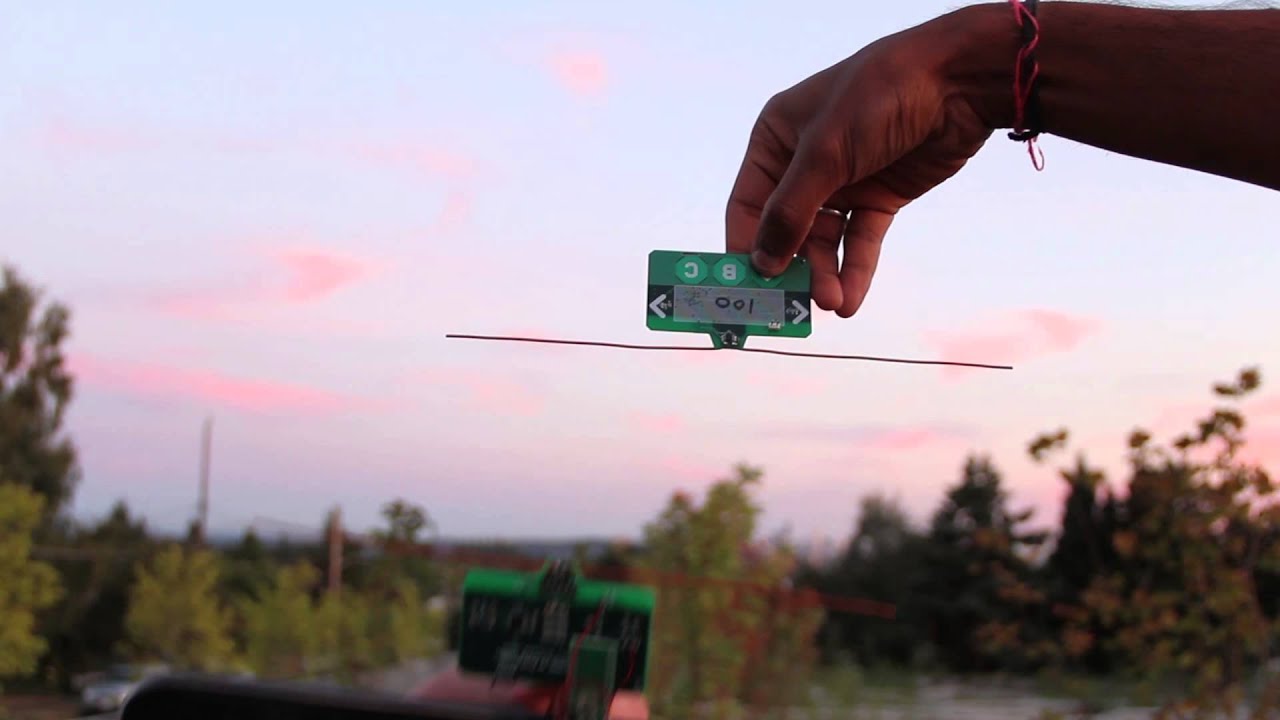
The project introduces Ambient Backscatter, a wireless communication primitive designed to allow interactive computing devices to operate and exchange data without relying on any internal battery power. Traditional wireless communication requires devices to expend significant energy generating their own radio frequency (RF) signals, which inherently limits miniaturization and creates a dependency on batteries or dedicated power infrastructures. To show how this primitive functions in practice, the researchers constructed prototype hardware demonstrating battery-free user interaction and device-to-device data transfer.
In a live demonstration, two small standalone devices sit side by side without power cables or batteries. A user initiates wireless communication simply by swiping a capacitive touch sensor on the left device. In response, the right device flashes an LED to confirm that the transmitted message has been successfully received and decoded. As the presenter highlights regarding the prototype setup, “The cool thing here is that neither of these devices have any batteries.”
```mermaid flowchart LR accTitle: Ambient Backscatter Communication Flow accDescr: Diagram illustrating how ambient TV signals are absorbed or reflected by a transmitting tag to send data to a receiving tag.
subgraph Sources["Ambient RF Environment"] Tower["TV Tower / Ambient RF"] end
subgraph BackscatterLink["Battery-Free Backscatter Link"] Alice["Device 'Alice'<br/>(Modulates signal)"] Bob["Device 'Bob'<br/>(Receives data)"] end
Tower -->|"Incident RF signal"| Alice Tower -.->|"Direct RF signal"| Bob Alice -->|"Absorb = 0-bit<br/>Reflect = 1-bit"| Bob ```
[00:36](https://www.youtube.com/watch?v=gX9cbxLSOkE&t=36s) How It Works: Modulating Ambient RF Signals
Ambient Backscatter circumvents the power bottleneck of conventional radios by harvesting and selectively reflecting the wireless transmissions that are already present in the environment rather than actively generating new signals. In a conceptual scenario where two battery-free devices, designated Alice and Bob, need to share information, Alice utilizes ambient broadcast waves—such as those emitted continuously by a nearby television broadcast tower. Alice encodes binary data onto the ambient transmission by controlling its antenna impedance: absorbing all incident TV signals corresponds to transmitting a `0` bit, while reflecting those incoming signals corresponds to transmitting a `1` bit.
Bob senses these minute changes in the surrounding radio environment to decode Alice’s message. Because both devices harvest operational power directly from the ambient electromagnetic radiation and modulate existing transmissions, they do not require an active RF oscillator or power source. As the narrator summarizes, “Alice and Bob do not generate their own RF signals, and they use no batteries. Thus Ambient Backscatter enables wireless communication out of thin air.”
[01:13](https://www.youtube.com/watch?v=gX9cbxLSOkE&t=73s) Offline Peer-to-Peer Payment Application
To illustrate the practical capability of Ambient Backscatter, the team demonstrates an offline, peer-to-peer digital transaction between two smart cards without requiring an active terminal or external reader during the transfer. Each card maintains an onboard ledger balance. To establish the baseline value, card 100 is placed on a battery-powered payment terminal, which interrogates the card and displays an initial stored balance of 110.
Next, with the payment terminal removed entirely from the setup, the cards conduct a transaction in mid-air. When a user presses a tactile button on card #209, funds transfer directly to card 100 over the air. The complete data exchange and computational execution are powered entirely by harvesting ambient RF energy from the room. When card 100 is placed back on the payment terminal to verify the transaction, the reader confirms that the stored balance has increased from 110 to 130. Reflecting on the significance of the test, the presenter notes, “This is just one example of what we can enable by using existing wireless signals as both a source of power and a communication medium.”
- **Card 100 Initial Balance:** 110 units, verified on the payment terminal. - **Card-to-Card Transfer:** Initiated by pressing a button on card #209 with no terminal present. - **Card 100 Final Balance:** 130 units, confirming the successful wireless receipt of funds.
[01:53](https://www.youtube.com/watch?v=gX9cbxLSOkE&t=113s) Ubiquitous Computing, Smart Environments, and Embedded Sensing
Looking ahead, the researchers envision a ubiquitous computing landscape where everyday personal items—such as keys, wallets, and sunglasses—are augmented with miniature Ambient Backscatter tags. These tags can harvest ambient energy and exchange information using ubiquitous RF sources, including Wi-Fi networks, television broadcast towers, and cellular infrastructure. Because the devices can communicate and localize with one another autonomously, they eliminate common frustrations in the home. In an everyday lost-item scenario, “For example, if a person loses his keys the couch can use Ambient Backscatter to communicate with the lost keys and alert the user.”
Beyond personal consumer gadgets, Ambient Backscatter holds deep implications for civil infrastructure, structural health monitoring, and industrial automation. Because these tags contain no electrochemical batteries that degrade or require replacement over time, they can be permanently sealed inside inaccessible construction elements like concrete walls, subfloors, and building roofs. Operating maintenance-free indefinitely, they can continuously monitor internal moisture, stress, or structural integrity and broadcast telemetry using ambient electromagnetic signals, ultimately laying the foundation for zero-maintenance smart homes, smart cities, and the Internet of Things.
## Mentioned Ambient Backscatter, uwsensor, University of Washington, RFID, Wi-Fi, Alice, Bob
## Video description Ambient Backscatter transforms existing wireless signals into both a source of power and a communication medium. It enables two battery-free devices to communicate by backscattering existing wireless signals. Backscatter communication is orders of magnitude more power-efficient than traditional radio communication. Further, since it leverages the ambient RF signals that are already around us, it does not require a dedicated power infrastructure as in RFID.
http://www.washington.edu/news/2013/08/13/wireless-devices-go-battery-free-with-new-communication-technique/
[Source](https://www.youtube.com/watch?v=gX9cbxLSOkE)