Jobs Unveils Apple Ring Campus, Warns Cupertino of Relocation Risk
City of Cupertino
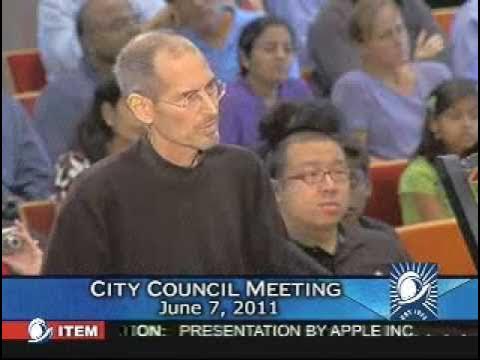
Apple CEO Steve Jobs warned the Cupertino City Council that the company will move to a nearby city like Mountain View, stripping Cupertino of its largest tax base, if officials reject plans for its new 12,000-worker circular headquarters.
AI-assisted summary of Steve Jobs Presents to the Cupertino City Council (6/7/11) — original source. Check the original for full context.
Source published:
Key ideas
- Steve Jobs presented Apple's proposal for a new circular 'spaceship' campus in Cupertino, designed to house 12,000 to 13,000 employees while retaining the existing Infinite Loop headquarters. (3:26)
- The 150-acre site development flips current surface conditions from 80% asphalt parking to 80% landscaped green space, nearly doubling the tree count to over 6,000 native and fruit trees. (6:02)
- The four-story ring structure will feature custom-manufactured curved architectural glass around its entire perimeter, supported by an on-site natural gas energy center and an underground presentation auditorium. (4:02)
- Targeting a 2012 groundbreaking and 2015 completion, Jobs emphasized Apple's status as Cupertino's largest taxpayer, cautioning that an inability to build would force relocation to a city like Mountain View. (10:41)
Detailed notes
## Background Published on YouTube by the City of Cupertino on June 8, 2011, this video documents Apple Inc. CEO Steve Jobs presenting the proposal for a new Apple Campus to the Cupertino City Council. Recorded on June 7, 2011, at Cupertino Community Hall, the presentation outlines Apple's vision for a unified corporate campus to augment its existing Infinite Loop headquarters.
## TL;DR Steve Jobs presents Apple's vision to construct a four-story, ring-shaped campus on roughly 150 acres of land assembled from Hewlett-Packard and adjacent parcels in Cupertino. The project replaces sprawling asphalt parking lots with 80% landscaped open space, thousands of native trees, custom curved glass architecture, and an on-site clean-energy facility to support 12,000 to 13,000 employees. During a cordial council discussion, Jobs addresses Cupertino's economic benefits and traffic mitigation, playfully deflecting council requests for free municipal Wi-Fi and a local retail Apple Store. He concludes by confirming Apple will keep Infinite Loop while targeting a 2012 groundbreaking and a 2015 campus opening.
## Atmosphere & style The presentation carries an engaging blend of routine municipal civic dialogue and visionary architectural ambition, imbued with a warm hometown reverence. Jobs presents with relaxed confidence and dry wit, weaving intimate personal nostalgia about cold-calling Bill Hewlett as a teenager with uncompromising design standards and firm corporate pragmatism. The dynamic between an admiring, playful city council and a focused, legendary CEO gives the hearing an authentic, historic, and surprisingly approachable feel.
## Bulletin - [03:26](https://www.youtube.com/watch?v=gtuz5OmOh_M&t=206s) Steve Jobs presented Apple's proposal for a new circular 'spaceship' campus in Cupertino, designed to house 12,000 to 13,000 employees while retaining the existing Infinite Loop headquarters. - [06:02](https://www.youtube.com/watch?v=gtuz5OmOh_M&t=362s) The 150-acre site development flips current surface conditions from 80% asphalt parking to 80% landscaped green space, nearly doubling the tree count to over 6,000 native and fruit trees. - [04:02](https://www.youtube.com/watch?v=gtuz5OmOh_M&t=242s) The four-story ring structure will feature custom-manufactured curved architectural glass around its entire perimeter, supported by an on-site natural gas energy center and an underground presentation auditorium. - [10:41](https://www.youtube.com/watch?v=gtuz5OmOh_M&t=641s) Targeting a 2012 groundbreaking and 2015 completion, Jobs emphasized Apple's status as Cupertino's largest taxpayer, cautioning that an inability to build would force relocation to a city like Mountain View.
## Key takeaways - [00:04](https://www.youtube.com/watch?v=gtuz5OmOh_M&t=4s) Apple's local workforce grew to roughly 12,000 employees, far exceeding Infinite Loop's capacity of 2,600 to 2,800 and forcing reliance on rented secondary office space. - [01:54](https://www.youtube.com/watch?v=gtuz5OmOh_M&t=114s) Jobs secured a contiguous ~150-acre parcel on Pruneridge Avenue by acquiring land from Hewlett-Packard alongside adjacent parcels, tying back to his childhood summer job with Bill Hewlett. - [03:26](https://www.youtube.com/watch?v=gtuz5OmOh_M&t=206s) The proposed main building is a four-story circular ring surrounding an expansive central courtyard, completely enveloped in custom-manufactured curved glass panels. - [06:02](https://www.youtube.com/watch?v=gtuz5OmOh_M&t=362s) The project dramatically reduces surface asphalt parking by 90%, shifting vehicles primarily into underground parking below the ring and a modest four-story deck. - [06:02](https://www.youtube.com/watch?v=gtuz5OmOh_M&t=362s) Landscape plans guided by a Stanford arborist increase the tree population from 3,700 to over 6,000 native and apricot trees, increasing landscaped area from 20% to 80%. - [06:02](https://www.youtube.com/watch?v=gtuz5OmOh_M&t=362s) The campus infrastructure includes an on-site natural gas Energy Center as the primary power source, an underground product reveal auditorium, and cafeterias seating 3,000 people. - [10:41](https://www.youtube.com/watch?v=gtuz5OmOh_M&t=641s) Jobs affirmed Apple's position as Cupertino's largest taxpayer, noting that without expansion approval, the company would have to relocate to Mountain View and liquidate its land holding. - [10:41](https://www.youtube.com/watch?v=gtuz5OmOh_M&t=641s) Apple mitigates commuter congestion using a private fleet of 20 biodiesel buses serving employees from San Francisco to Santa Cruz alongside bike-to-work adoption. - [13:23](https://www.youtube.com/watch?v=gtuz5OmOh_M&t=803s) Jobs rebuffed a council suggestion to provide free citywide Wi-Fi, arguing with dry humor that corporations pay municipal taxes so the city can fund public services. - [13:23](https://www.youtube.com/watch?v=gtuz5OmOh_M&t=803s) Councilmember Mark Santoro, an HP veteran of 35 years, lauded the architectural design as likely to become the most elegant corporate headquarters in the nation. - [15:03](https://www.youtube.com/watch?v=gtuz5OmOh_M&t=903s) Jobs assured the council that Apple will retain its Infinite Loop campus, representing a net Cupertino workforce increase of approximately 20%. - [15:03](https://www.youtube.com/watch?v=gtuz5OmOh_M&t=903s) Addressing emissions from the nearby Lehigh / Kaiser cement plant, Jobs mentioned growing up five or six blocks away and jokingly noted he would not cry if it were removed. - [17:53](https://www.youtube.com/watch?v=gtuz5OmOh_M&t=1073s) The targeted project timeline set plans for submission in summer 2011, groundbreaking in 2012, and employee move-in by 2015. - [17:53](https://www.youtube.com/watch?v=gtuz5OmOh_M&t=1073s) When asked by Mayor Wong to open a retail Apple Store in Cupertino, Jobs declined due to insufficient foot traffic to sustain a standard store.
## Detailed walkthrough ### [00:04](https://www.youtube.com/watch?v=gtuz5OmOh_M&t=4s) Introduction and Apple’s History in Cupertino
The Cupertino City Council meeting opens as the presiding officer takes the agenda out of order under oral communication to introduce Apple CEO Steve Jobs for a special presentation. Jobs steps up to the podium amid enthusiastic applause and light teasing from the council about his personal fan club in the room. He begins by recounting Apple's deep roots in the city, remarking, “Apple’s grown like a weed and as you know we’ve always been in Cupertino.” He recalls starting out in a small office park before eventually moving into their headquarters at the corner of De Anza Boulevard and Interstate 280 on Infinite Loop.
Those primary buildings comfortably hold roughly 2,600 to 2,800 people, but Apple's local workforce has surged to nearly 12,000 employees. To cope with the overflow, Apple has been forced to rent buildings—which Jobs bluntly characterizes as “not very good buildings either”—at an ever-widening radius from their main campus. Jobs emphasizes that while they have no intention of abandoning the Infinite Loop site, they are completely out of room and urgently need a second campus to augment their existing footprint so they can remain in Cupertino.
[01:54](https://www.youtube.com/watch?v=gtuz5OmOh_M&t=114s) Personal Nostalgia, Bill Hewlett, and Land Acquisition
Jobs transitions to a deeply personal story explaining how the prospective land was acquired. As a 13-year-old boy growing up in the Valley, his heroes were Bill Hewlett and David Packard. Finding Bill Hewlett listed in the Palo Alto phone directory—which Jobs jokes gave a clue to his age—he placed a cold call to request spare parts to build a frequency counter. Hewlett not only provided the components, but also offered Jobs a summer job working on the frequency counter assembly line in Santa Clara off Interstate 280, an experience Jobs describes as being in “heaven.”
Around that exact period, Hewlett and Packard purchased agricultural land along Pruneridge Avenue in Cupertino, which had previously been apricot orchards, to establish Hewlett-Packard’s Computer Systems Division. With HP downsizing and consolidating operations, they placed the property on the market. Apple stepped in to purchase the HP parcel along with several adjacent parcels, assembling a contiguous plot of approximately 150 acres. Jobs notes they attempted to acquire an adjacent apartment complex on the corner as well, but the owners refused to sell, so Apple secured everything else.
[03:26](https://www.youtube.com/watch?v=gtuz5OmOh_M&t=206s) The Vision: A Curved-Glass Ring for 12,000 People
To avoid building typical, uninspired commercial office parks, Apple retained top architectural firms to design an unconventional single-structure concept. As the council offers that Jobs can draw on the presentation touch screen with his finger, Jobs politely demurs: “I don't really need to draw on the screen it's okay you can see it clearly.” Revealing the rendering, he quips, “It’s a little like a spaceship landed, but there it is.” The design envisions 12,000 employees housed inside a massive circular four-story ring enclosing an expansive, lush central courtyard.
Jobs details the structural ambition behind the ring, noting that constructing circular architecture is far from economical: “There’s not a straight piece of glass on this building, it’s all curved.” Drawing on Apple's extensive global experience building flagship retail stores, the company developed the manufacturing capability to produce the largest architectural glass panels in the world. For this campus, custom-manufactured curved glass panes will encompass the entire perimeter of the ring from top to bottom.
```mermaid flowchart TD accTitle: Apple Campus Site Transformation Flowchart accDescr: Comparison of current site conditions versus the proposed Apple Campus transformation plan. subgraph Current["Existing HP / Pruneridge Site"] A1["20% Landscaping"] A2["80% Surface Asphalt Parking"] A3["3,700 Existing Trees"] A4["Conventional Office Park Layout"] end
subgraph Proposed["Proposed Apple Ring Campus"] B1["80% Landscaped Open Space"] B2["Underground Parking & Low Garage (Surface down 90%)"] B3["Over 6,000 Native & Fruit Trees"] B4["Single 4-Story Circular Ring Structure"] end
Current -->|"Apple Redesign & Density Optimization"| Proposed ```
[06:02](https://www.youtube.com/watch?v=gtuz5OmOh_M&t=362s) Environmental Transformation: Landscaping, Trees, and Infrastructure
Jobs outlines a dramatic inversion of the site's surface conditions. Currently, only 20% of the site is landscaped, while the remaining 80% is dominated by massive asphalt surface parking lots. Apple's plan flips these figures, dedicating 80% of the 150 acres to green space and landscaping while pushing the majority of vehicle parking directly beneath the main ring structure, supplemented by a modest four-story above-ground parking structure designed to preserve human scale.
To guide the ecological restoration, Apple hired a senior arborist from Stanford University specializing in indigenous local flora. The tree count across the property will surge from the current 3,700 to nearly double, re-establishing native groves alongside heritage apricot orchards. On-site infrastructure includes: - A dedicated on-site Energy Center designed to serve as the campus's primary power generation facility using clean natural gas, treating the regional utility grid as emergency backup. - An underground presentation auditorium to host company product reveals locally, ending Apple's reliance on renting facilities in San Francisco. - Dedicated fitness centers, employee cafeterias able to serve roughly 3,000 people in a single sitting, and localized R&D testing facilities with minimal staffing.
[08:52](https://www.youtube.com/watch?v=gtuz5OmOh_M&t=532s) Comparative Metrics of the Proposed Campus
Jobs presents a slide summarizing the net changes in density, site usage, and spatial footprint between the existing site and the proposed development:
| Metric | Current Site | Proposed Project | Net Change | |:--- |:--- |:--- |:--- | | **Occupancy** | ~9,000–9,500 people | 12,000–13,000 people | +40% | | **Building Space** | ~2.6M sq. ft. | 3.1M sq. ft. | +20% | | **Building Footprint** | Existing dispersed footprints | Compact circular footprint | -30% | | **Landscaped Area** | ~20% of site | ~80% of site | +350% | | **Tree Count** | 3,700 trees | ~6,000+ trees | +60% | | **Surface Parking** | Widespread asphalt lots | Underground & minimal deck | -90% |
Jobs sums up the philosophy behind the trade-offs: “So we want to take the space and in many cases making it smaller, or putting more of a desirable thing on the space, and that’s what we’d like to do.”
[10:41](https://www.youtube.com/watch?v=gtuz5OmOh_M&t=641s) Council Questions: Economic Benefits, Commutes, and Community Value
Concluding his remarks, Jobs opens the floor to council questions. The presiding mayor jokes about the Apple Company Store merchandise: “If you go to your shop at 1 Infinite Loop, you have a T-shirt that says the mother ship has landed, and if you look at this picture, definitely the mother ship has landed here in Cupertino.”
Councilmember Gilbert Wong poses the first inquiry, asking what tangible benefits Cupertino residents will derive from the new development. Jobs addresses the city’s economic reliance on Apple bluntly:
> “Well, as you know, we’re the largest taxpayer in Cupertino, so we’d like to continue to stay here and pay taxes, that’s number one.”
Jobs cautions that if Apple cannot build the campus, the alternative is relocating outside the city: “Because if we can’t, then we have to go somewhere like Mountain View, and we take our current people with us, and we’d give up and over years sell the land here, and the largest tax base would go away.” He highlights additional community benefits, noting Apple employs thousands of well-compensated workers across all age groups—from Stanford graduates to older personnel like himself in their 50s—many of whom settle locally, patronize businesses, and purchase homes. He points to Apple's environmental transit efforts, including an existing fleet of 20 biodiesel-fueled commuter buses running routes from San Francisco to Santa Cruz to mitigate local traffic congestion, along with extensive bike-to-work adoption. Councilmember Wong responds by asking whether Cupertino residents might receive concrete civic amenities, such as municipal-wide free Wi-Fi.
[13:23](https://www.youtube.com/watch?v=gtuz5OmOh_M&t=803s) Wi-Fi, Taxes, and Council Reactions to the Campus Vision
The exchange begins with Steve Jobs responding to the idea of Apple providing free citywide Wi-Fi to Cupertino residents. Jobs politely pushes back with dry humor, framing municipal services as the responsibility of the city government funded by corporate taxpayers: “See I've always—I'm a simpleton, I've always had this view that that we pay taxes and the city should do those things, that's why we pay taxes.” He quips that if Apple could get out of paying taxes, he would be delighted to put up Wi-Fi, adding, “I think we bring a lot more than a free Wi-Fi.” Council members laugh and agree, noting jokingly that sales tax revenues could be used to provide iPads to residents.
Councilmember Mark Santoro, speaking as a 35-year veteran employee of Hewlett-Packard who spent most of his career on the Cupertino campus in those very HP buildings, reflects on his initial sadness when HP decided to consolidate and vacate. However, looking at Apple’s new plans, he remarks that the word “spectacular” would be an understatement, predicting it will become the most elegant corporate headquarters in the United States. Jobs agrees with the high bar they have set for the project: “I think we do have a shot of building the the the best office building in the world, and I really do think architecture students will come here to see this.”
- **Councilmember perspective:** 35-year former HP employee praises the transition from the old HP campus to Apple's design. - **Architectural ambitions:** Jobs anticipates that the circular campus will attract architecture students worldwide.
---
[15:03](https://www.youtube.com/watch?v=gtuz5OmOh_M&t=903s) Campus Headcount, Safety, and the Lehigh Cement Plant
Councilmember Gilbert Wong discusses his earlier briefing alongside the city manager with Apple executives Tim Cook, Peter Oppenheimer, and Terry O’Reilly (Director of Real Estate and Facilities). He seeks clarification on employee capacity and whether Apple intends to keep its existing Infinite Loop campus. Jobs clarifies that Apple will retain Infinite Loop, noting that Infinite Loop holds roughly 2,600 employees, while the new ring-shaped campus will house 12,000 to 13,000 employees. Wong raises safety and emergency concerns regarding concentrating that many people in a single structure. Jobs assures him that Apple will exceed standard safety codes, emphasizing how deeply Apple values its talent: “The last thing we want is for anybody to get hurt.” When Wong asks about traffic increases, Jobs points out that overall employment will only grow modestly, by about 20%.
```mermaid flowchart TD accTitle: Apple Cupertino Campus Distribution accDescr: Diagram showing total Cupertino workforce distributed between Infinite Loop and the proposed new Apple Park campus. subgraph Campuses["Apple Cupertino Facilities"] IL["Infinite Loop<br/>(~2,600 employees retained)"] AC["New Campus / Apple Park<br/>(~12,000 - 13,000 employees)"] end Tot["Total Cupertino Workforce<br/>(~14,600 - 15,600 employees)"] IL --> Tot AC --> Tot ```
The conversation shifts to environment and health after Wong notes Jobs's strict indoor smoking ban on campus. Jobs shares a personal reason: “Both my parents died of lung cancer from smoking, so I'm a little sensitive on that topic.” Wong then inquires if Jobs is concerned about emissions from the nearby Lehigh Southwest Cement Plant (historically known as the Permanente / Kaiser plant on Stevens Creek). Jobs acknowledges he knows the plant intimately, having grown up just five or six blocks away from it. While noting that the owners bought the land fair and square and likely will not relocate, Jobs adds frankly to general laughter: “If you kick Kaiser out, I wouldn't cry.”
- **Infinite Loop headcount:** ~2,600 people. - **New campus headcount:** ~12,000 to 13,000 people. - **Net employment increase:** Modest increase of approximately 20%. - **Lehigh / Kaiser cement plant:** Jobs grew up five to six blocks from the facility and would welcome its departure, though recognizing its property rights.
---
[17:53](https://www.youtube.com/watch?v=gtuz5OmOh_M&t=1073s) Project Timelines, Hometown Ties, and the Apple Store Request
Councilmember Orrin Mahoney asks Jobs for the target construction and occupancy schedule. Jobs explains that he constantly presses his own teams on schedule milestones: Apple intends to submit formal development plans promptly, break ground the following year (2012), and move into the completed headquarters in 2015.
Mayor Gilbert Wong highlights Jobs's deep personal roots in Cupertino, pointing out that Jobs attended Cupertino Middle School and Homestead High School, making him a true hometown resident who chose to remain and build Apple’s future locally despite interest from states and cities nationwide. Wong then makes a pitch for community amenities: Cupertino residents dislike traveling to Valley Fair in San Jose or to Los Gatos to visit an Apple Store, so the council would love Apple to open a retail store in Cupertino. To demonstrate his enthusiasm, Wong displays his personal iPad 2 and mentions his 11-year-old child's love for the device. Jobs explains the economic reality behind Apple's retail site selection:
> “The problem with putting an Apple Store in Cupertino is there just isn't the traffic, so I'm afraid it might not be successful.”
Jobs notes that if Apple believed a local retail location could succeed, they would gladly build one. Mayor Wong responds that the city would do whatever it takes to help make it successful. The presentation concludes with warm gratitude from the council, recognizing the historical milestone of the 155-acre assemblage (combining an initial 55-acre parcel with the 100-acre Hewlett-Packard acquisition). Jobs thanks the council to enthusiastic applause, stating, “We'll get back to working on our plan so we can get back to you as quick as possible.”
- **Target project timeline:** - Submit plans: Immediately / summer 2011. - Groundbreaking: 2012. - Move-in / completion: 2015. - **Steve Jobs Cupertino educational roots:** Cupertino Middle School and Homestead High School. - **Land assemblage history:** Initial 55 acres acquired roughly 5 years earlier, followed by 100 adjacent acres from HP (totaling ~155 acres). - **Apple Store feasibility:** Jobs states foot traffic in Cupertino is insufficient for a standard retail store.
## Notable quotes > [13:23](https://www.youtube.com/watch?v=gtuz5OmOh_M&t=803s) I think we do have a shot of building the the the best office building in the world, and I really do think architecture students will come here to see this. — Steve Jobs
> [17:53](https://www.youtube.com/watch?v=gtuz5OmOh_M&t=1073s) The problem with putting an Apple Store in Cupertino is there just isn't the traffic, so I'm afraid it might not be successful. — Steve Jobs
> [10:41](https://www.youtube.com/watch?v=gtuz5OmOh_M&t=641s) Well, as you know, we’re the largest taxpayer in Cupertino, so we’d like to continue to stay here and pay taxes, that’s number one. — Steve Jobs
## Mentioned Steve Jobs, Bill Hewlett, David Packard, Gilbert Wong, Mark Santoro, Orrin Mahoney, Tim Cook, Peter Oppenheimer, Terry O’Reilly, Apple Inc., Hewlett-Packard, Lehigh Southwest Cement Plant, Stanford University, Cupertino Middle School, Homestead High School, Infinite Loop, iPad 2, Cupertino Community Hall, Cupertino City Council
## Video description Apple Inc. CEO Steve Jobs presents his proposal for a new Apple Campus to the Cupertino City Council. This presentation was recorded Tuesday, June 7, 2011 at the Cupertino Community Hall.
Additional information is available at http://Cupertino.org/apple
Cite: "The City Channel, City of Cupertino, June 7, 2011, http://www.Cupertino.org/citychannel"
[Source](https://www.youtube.com/watch?v=gtuz5OmOh_M)