Weinstein Applies Physics Gauge Theory to Fix Consumer Price Index
Tom Henderson
Modeling consumer preferences and bilateral trade on curved fiber bundles eliminates massive distortions in conventional price indices by treating path-dependent holonomy as essential economic data rather than an analytical error.
AI-assisted summary of Gauge Theory and Inflation: Enlarging the Wu-Yang Dictionary — original source. Check the original for full context.
Source published:
Key ideas
- Eric Weinstein proposes a gauge-theoretic foundation for economics that extends the 1975 Wu-Yang dictionary into a three-way Rosetta Stone linking particle physics, differential geometry, and market dynamics. (0:00)
- Classical price index formulas, including Laspeyres and Paasche, naturally collapse to the path-dependent Divisia index once they are formulated to be gauge covariant across economic state space. (40:40)
- The upward substitution bias of the Consumer Price Index (CPI) overstates the cost of living at a fiscal scale that rivals major federal outlay programs like Social Security, healthcare, and national defense. (24:39)
- By crossing ordinal preference foliations with price covector spaces, Weinstein constructs a canonical connection with non-zero curvature that resolves the changing-preference problem and recasts economic cycling as holonomy rather than measurement error. (51:28)
Detailed notes
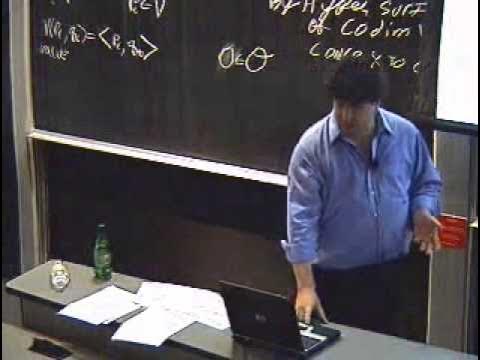
## Background Published on YouTube by Tom Henderson on April 29, 2014, this video documents a seminar originally delivered by Eric Weinstein on May 24, 2006, at the Perimeter Institute for Theoretical Physics. The presentation explores extending the 1975 Wu-Yang dictionary into a broader Rosetta Stone by demonstrating how gauge theory, fiber bundles, and curvature tensors naturally apply to market economics, inflation, and index numbers beyond the traditional confines of fundamental physics.
## TL;DR Weinstein presents a gauge-theoretic formulation of economics to solve the classic index number problem and account for changing consumer preferences without relying on arbitrary cardinal utility metrics. By decomposing price-quantity vector bundles into orthogonal income and substitution sub-bundles, he demonstrates that classical price indices naturally converge to the path-dependent Divisia index under gauge covariance. He extends the model to non-Abelian gauge theory for bilateral international trade and infinite-dimensional principal bundles parameterized by the diffeomorphism group of the circle for consumer welfare. Ultimately, he argues that the mathematical tools of modern differential geometry are not exclusive to theoretical physics, urging physicists to break out of their insular academic culture and apply their methods to economic phenomena.
## Atmosphere & style The lecture combines the rigorous, whiteboard-heavy atmosphere of a theoretical physics colloquium with an energetic, intellectually subversive pitch. Weinstein adopts the tone of a passionate academic insurgent, balancing sharp technical expositions of fiber bundles with wry humor and provocative barbs directed at neoclassical economics and academic insularity. Exchanges with engaged audience members—including physicist Lee Smolin—create an authentic, collegial dialogue where complex geometric intuitions are tested through practical thought experiments like wine substitution and hedge fund trading strategies.
## Bulletin - [00:00](https://www.youtube.com/watch?v=h5gnATQMtPg&t=0s) Eric Weinstein proposes a gauge-theoretic foundation for economics that extends the 1975 Wu-Yang dictionary into a three-way Rosetta Stone linking particle physics, differential geometry, and market dynamics. - [40:40](https://www.youtube.com/watch?v=h5gnATQMtPg&t=2440s) Classical price index formulas, including Laspeyres and Paasche, naturally collapse to the path-dependent Divisia index once they are formulated to be gauge covariant across economic state space. - [24:39](https://www.youtube.com/watch?v=h5gnATQMtPg&t=1479s) The upward substitution bias of the Consumer Price Index (CPI) overstates the cost of living at a fiscal scale that rivals major federal outlay programs like Social Security, healthcare, and national defense. - [51:28](https://www.youtube.com/watch?v=h5gnATQMtPg&t=3088s) By crossing ordinal preference foliations with price covector spaces, Weinstein constructs a canonical connection with non-zero curvature that resolves the changing-preference problem and recasts economic cycling as holonomy rather than measurement error.
## Key takeaways - [00:00](https://www.youtube.com/watch?v=h5gnATQMtPg&t=0s) Gauge theory and fiber bundles are not uniquely privileged features of fundamental physics, but natural geometric frameworks that can describe human-made economic markets. - [01:54](https://www.youtube.com/watch?v=h5gnATQMtPg&t=114s) The 1975 Wu-Yang dictionary revealed that gauge field theories and differential geometry describe identical mathematics under separate vocabularies, raising the question of whether economics possesses an analogous structure. - [09:12](https://www.youtube.com/watch?v=h5gnATQMtPg&t=552s) Ragnar Frisch proved in 1930 that no index number can satisfy even three of Irving Fisher's basic axiomatic tests, formalizing the classical index number problem. - [09:12](https://www.youtube.com/watch?v=h5gnATQMtPg&t=552s) The Laspeyres index fails to account for intermediate price spikes when price and quantity paths cycle back to baseline, whereas the continuous Divisia index captures this path-dependent exposure. - [12:42](https://www.youtube.com/watch?v=h5gnATQMtPg&t=762s) Modern calculus developed through successive 'software upgrades' from single-variable calculus to moving frames in general relativity, Yang-Mills covariant differentiation, and infinite-dimensional gauge theories. - [16:52](https://www.youtube.com/watch?v=h5gnATQMtPg&t=1012s) Marginalist economics historically adopted elementary calculus; replacing its outdated mathematical foundation with modern bundle-theoretic geometry can solve long-standing economic measurement issues. - [19:36](https://www.youtube.com/watch?v=h5gnATQMtPg&t=1176s) Under the 'central dogma' of microeconomics, consumers select baskets where the tangent space of an indifference surface matches the kernel of the price covector, but fixed-basket indices systematically overstate inflation by ignoring substitution effects. - [26:18](https://www.youtube.com/watch?v=h5gnATQMtPg&t=1578s) Mainstream neoclassical economics, notably Gary Becker and the Chicago School, adopted an assumption of fixed tastes as a defensive mechanism to avoid the breakdown of transitivity under shifting preferences. - [30:47](https://www.youtube.com/watch?v=h5gnATQMtPg&t=1847s) Multiplying prices at one time by quantities at another naively transports vectors across base points via a flat trivial connection, necessitating the construction of an intrinsic 'economic connection'. - [34:03](https://www.youtube.com/watch?v=h5gnATQMtPg&t=2043s) The economic connection projects derivatives onto sub-bundles that cleanly separate income effects from substitution effects, ensuring parallel transport modernizes consumption baskets without artificial value distortion. - [40:40](https://www.youtube.com/watch?v=h5gnATQMtPg&t=2440s) Classical price indices collapse to the Divisia index in the finite-dimensional abelian case, demonstrating that economists' historical rejection of path dependence stemmed from an absence of the concept of curvature. - [41:58](https://www.youtube.com/watch?v=h5gnATQMtPg&t=2518s) Modeling bilateral international trade across two pricing systems and consumption vectors requires a non-abelian GL(2, R) gauge theory evaluated via path-ordered Wilson loops. - [46:40](https://www.youtube.com/watch?v=h5gnATQMtPg&t=2800s) An infinite-dimensional principal bundle with structure group Diff+(R) models consumer utility, allowing gauge holonomy to solve the changing-preference problem without cardinal utility metrics. - [51:28](https://www.youtube.com/watch?v=h5gnATQMtPg&t=3088s) A god-given connection emerges on the Cartesian product of utility foliations and market prices, establishing a three-way Rosetta Stone between particle physics, differential geometry, and economics. - [54:00](https://www.youtube.com/watch?v=h5gnATQMtPg&t=3240s) Theoretical physics suffers from an insular monastic culture that treats geometric structures as isolated miracles rather than exporting them to external disciplines. - [58:45](https://www.youtube.com/watch?v=h5gnATQMtPg&t=3525s) A thought experiment involving three hedge fund managers demonstrates that path-dependent Divisia holonomy reveals actual trading performance versus capital flows, proving holonomy is essential economic data rather than an analytical error.
## Detailed walkthrough ### [00:00](https://www.youtube.com/watch?v=h5gnATQMtPg&t=0s) Gauge Theory Beyond Natural Sciences
Following a brief introduction highlighting his enduring dedication to mathematics and mathematical physics, Eric Weinstein introduces his core thesis: a gauge theory of markets. He acknowledges that many in the audience have sat through interdisciplinary presentations—whether from psychology or operations research—promising that some elegant mathematical framework has profound real-world utility, only to leave feeling that the mapping was strained, like someone forcing “a round peg into an oval hole.” Weinstein challenges the audience at the Perimeter Institute to hold his presentation to the highest possible standard: an application of gauge theory, fiber bundles, and connections whose naturality stands on equal footing with their role in fundamental mathematics and theoretical physics.
He clarifies that the "inflation" under discussion is not cosmological cosmic inflation, but the financial phenomenon familiar from market economics. The central question for theoretical physics is philosophical: if a man-made, imperfect system like an economic market naturally lends itself to the very geometric machinery traditionally reserved for fundamental, "god-given" natural laws, what does that imply about the unique status of the Standard Model and General Relativity?
```mermaid flowchart LR accTitle: Conceptual Evolution from Natural Science to Market Gauge Theory accDescr: Diagram tracing the transfer of geometric ideas from physics through the Wu-Yang dictionary to economics.
subgraph Physics ["Fundamental Physics"] YM["Yang-Mills & Gauge Theory"] GR["Curvature & Geometry"] end
subgraph Bridge ["The Dictionary"] WY["Wu-Yang Dictionary (1975)"] end
subgraph Economics ["Economic Application"] MKT["Differential Market Structures"] INF["Economic Inflation & Index Numbers"] end
YM --> WY GR --> WY WY --> MKT MKT --> INF ```
[01:54](https://www.youtube.com/watch?v=h5gnATQMtPg&t=114s) Wigner’s Miracle and the Wu-Yang Dictionary
Weinstein traces the origins of this mathematical mysticism to Eugene Wigner’s famous essay exploring why mathematical constructs such as $\pi$, $e$, and Gaussian distributions persistently find deep application far outside the specific contexts for which they were invented. He observes that while Wigner was meditating on the elusive unification of gravity with other fundamental forces, he anticipated that the unreasonable effectiveness of mathematics might extend well beyond the natural sciences:
> “Eugene Wigner said, and I quote here, that ‘the miracle of the appropriateness of the language of mathematics for formulation laws of physics is a wonderful gift which we neither understand nor deserve.’”
A turning point occurred around 1975 at Stony Brook with the creation of the Wu-Yang dictionary by Tai Tsun Wu and Chen-Ning Yang. Weinstein recounts how mathematician James Simons was invited to deliver lunch seminars to the physics faculty, leading to the startling realization in the cafeteria that differential geometry and gauge field theory were describing the exact same underlying mathematics using entirely separate terminologies. Weinstein quips that shortly after this revelation, Simons stepped away from academia to emerge as a hedge-fund billionaire on Long Island, joking that Simons might have grasped the economic implications of gauge theory long before Weinstein and his wife and collaborator, Pia Malaney.
Weinstein quotes Wu and Yang’s realization directly: > “It is a widely held view among mathematicians that the fiber bundle is a natural geometric concept. Since gauge fields, including in particular electromagnetic field, are fiber bundles, all gauge fields are thus based on geometry.”
This profound correspondence established the paradigm that fundamental interactions in physics are governed by equations either linear in curvature or built from derivatives of curvature. Weinstein asks whether economics possesses anything remotely comparable.
[05:28](https://www.youtube.com/watch?v=h5gnATQMtPg&t=328s) The Index Number Problem and Economic Vector Spaces
Turning to economics, Weinstein points out that while the discipline lacks the clean predictive power of physics, it deals with catastrophic real-world phenomena such as the hyperinflation of Weimar Germany in the early 1920s. Accurately tracking the price level is not merely an academic exercise; it is an urgent practical necessity. However, economic measurement is paralyzed by the classical "index number problem"—the reality that standard methods for calculating price inflation yield conflicting, mutually incompatible results.
To formalize the problem geometrically, Weinstein defines an $n$-dimensional real vector space $V$ representing baskets of goods and services: - **Quantity Vector ($q \in V$):** Represents amounts of goods, assuming divisibility down to a continuum. While typically restricted to the positive orthant, components of $q$ can be negative—such as in currency trading, where going long on one currency requires going short on another by taking on debt. - **Price Co-vector ($p \in V^*$):** Expresses the cost of goods in a chosen currency unit (such as Canadian or US dollars). - **Expenditure Evaluation:** The pairing $p(q)$ is the standard dual pairing (inner product) yielding the total nominal cost of basket $q$ at price vector $p$.
The classical Laspeyres and Paasche price indices attempt to quantify overall inflation by comparing two price co-vectors across time, evaluating them against a fixed reference basket: Laspeyres uses the base-period consumption basket $q_0$, while Paasche uses the current-period basket $q_t$.
In the United States, the Consumer Price Index (CPI) historically relied on the Laspeyres formulation. Weinstein highlights the massive political and economic stakes behind this technical choice: both federal income tax brackets and entitlement programs (such as Social Security) are indexed directly to measured cost of living. Even a "hair's breadth of difference" between competing index formulas automatically generates hundreds of billions of dollars in wealth redistribution.
[09:12](https://www.youtube.com/watch?v=h5gnATQMtPg&t=552s) Frisch’s Impossibility Theorem, the Divisia Index, and Cycling
In the 1920s, Irving Fisher proposed an intuitive set of axiomatic tests that any rational index number ought to obey (such as time reversal and circularity). However, in 1930, Ragnar Frisch—who would later share the first Nobel Memorial Prize in Economic Sciences—proved a devastating impossibility theorem:
> “Ragnar Frisch proved that if you took all of the axioms which Irving Fisher developed in the 1920s as reasonable axioms for an index number to follow, that there was no index number that could be constructed which satisfied even three of these basic axioms.”
The fundamental incompatibility between index methodologies is demonstrated by comparing the Laspeyres index with the continuous, path-dependent Divisia index under two specific behavioral challenges:
| Property / Scenario | Laspeyres Index | Divisia Index | |:--- |:--- |:--- | | **Cycling Problem** (Prices return to original state after intermediate shifts) | Yields **unity** ($1.0$) because it only compares end states $(p_1, q_0)$ to $(p_0, q_0)$. | **Does not yield unity**; it integrates price changes along the consumer's actual changing path. | | **Transitivity / Composition** ($t = 0 \to 1/2 \to 1$) | **Fails transitivity**: the product of intervals $I_{0 \to 1/2} \times I_{1/2 \to 1} \neq I_{0 \to 1}$. | **Satisfies transitivity**: path integration composes cleanly over sub-intervals. |
Weinstein illustrates the cycling problem through a concrete consumer vignette: 1. A consumer starts with minimal wine consumption at baseline $t_0$, when Bordeaux wine is cheap and stable. 2. The consumer gradually develops an expensive taste for Bordeaux, building lifestyle habits around it. 3. Japanese buyers suddenly enter the market, driving Bordeaux prices skyward; the consumer absorbs the price hikes before eventually substituting California wine. 4. Consumption drops, and the Japanese economic bubble bursts, collapsing Bordeaux prices back to their starting levels. 5. Because starting and ending price vectors match, the Laspeyres index records zero net inflation. The Divisia index, by contrast, tracks the consumer's actual exposure to the intermediate price spike, resulting in an index value strictly greater than unity despite identical boundary conditions.
Weinstein explains that resolving these mathematical paradoxes requires revisiting the foundations of calculus. While elementary calculus ("Calculus 1.0") is accepted without second thought for everyday optimization problems—such as designing a swimming pool without objecting that calculus was originally invented for celestial mechanics—a deeper geometric framework is required when path dependence and coordinate choices dominate the underlying physics of measurement.
[12:42](https://www.youtube.com/watch?v=h5gnATQMtPg&t=762s) The Software Upgrade Model of Calculus and the Ubiquity of Fiber Bundles
Standard calculus is anchored in the familiar territory of real numbers, where Cartesian coordinates provide an absolute notion of horizontal and taking tangents feels intuitive. While mathematics and physics comfortably embrace complex numbers, most other disciplines never require individuals to encounter a single complex value. To understand how mathematical tools develop, one can view the history of calculus through the lens of a software company releasing successive major versions:
```mermaid flowchart LR accTitle: Evolution of Calculus Software Upgrades accDescr: Diagram showing the progression from standard calculus up to infinite-dimensional gauge field theory. subgraph Finite["Finite-Dimensional Tools"] V1["v1.0 / v1.1: Single & Multivariate Calculus"] V2["Moving Frames & Absolute Differential Calculus<br>(Einstein & Grossmann / GR)"] end subgraph Gauge["Gauge & Modern Geometry"] V3["Covariant Differentiation & Yang-Mills<br>(Internal symmetries & quantum numbers)"] V4["Gauge Field Theory<br>(Infinite-dimensional groups e.g. Diff(S¹))"] end V1 --> V2 V2 --> V3 V3 --> V4 ```
In this framework, Version 1.0 represents standard differential calculus, while Version 1.1 expands into multivariate calculus. The software picked up a major institutional client through Albert Einstein and Marcel Grossmann’s development of general relativity, incorporating the absolute differential calculus of moving frames. From there, the framework advanced to covariant differentiation, bringing internal symmetry groups, internal quantum numbers, and Yang–Mills theory to extend electromagnetism to the nuclear forces. The latest version enters gauge field theory, where one leaves finite-dimensional territory behind to operate on function spaces with infinite-dimensional symmetry groups such as $\text{Diff}(S^1)$.
Encountering a group like the diffeomorphism group of the circle, $\text{Diff}(S^1)$, outside of string theory—specifically within economics—initially sounds bizarre. Yet fiber bundles appear everywhere within modern geometry and physics while remaining almost entirely absent from other disciplines. This discrepancy poses a foundational question: is theoretical physics uniquely privileged in its geometric nature, or have researchers simply neglected to deploy these universal mathematical gadgets across other domains? To port gauge theory elsewhere, one must identify three structural ingredients: a base space acting like spacetime (which multivariate calculus already approximates), interesting fiber spaces (which in mathematics exhibit exceptional and sporadic structures), and a mechanism to pick out non-trivial horizontal connections. In the immediate framework, connections are treated in a Levi-Civita context as canonical objects determined by underlying structures, paving the way toward connections governed by dynamical field equations.
- “The mystery here is that natural examples of fiber bundles are ubiquitous but they're ubiquitous within the areas in which we're used to finding them and they're all but undiscovered elsewhere.” — Eric Weinstein
[16:52](https://www.youtube.com/watch?v=h5gnATQMtPg&t=1012s) Infiltrating Economics: Upgrading Marginalism with Modern Geometry
The broader objective is to mount an intellectual takeover of economics by replacing its mathematical foundation. In the late nineteenth century, the marginalist revolution swept through economic thought by introducing elementary calculus to analyze market behavior. Because modern differential geometry represents a direct upgrade of that calculus, mathematicians and physicists are well-positioned to replace the antiquated calculus engines embedded in economic theory with modern geometric machinery to resolve problems economists have failed to solve.
To achieve this, one must first translate how economists model consumer choice. The standard economic framework restricts the commodity space strictly to the positive orthant of a vector space, discarding non-positive coordinates. This domain is foliated by codimension-1 hypersurfaces that are convex toward the origin, representing an *indifference map* (denoted by $\mathcal{O}$). Economists explicitly rule out local extrema, known as "bliss points," assuming preferences increase monotonically as one moves away from the origin.
Superimposed on this foliation are budget constraints: affine hyperplanes of codimension one, translated away from the origin and determined by a linear price functional evaluated against a given currency expenditure.
- Marginalism historically imported basic calculus into economic theory; Weinstein proposes replacing it with modern bundle-theoretic machinery: “I think we can take these guys that's my that's my feeling and I could use your help.” — Eric Weinstein - An indifference map $\mathcal{O}$ constitutes a foliation of the positive orthant by convex, codimension-1 hypersurfaces without interior bliss points. - Budget constraints represent affine hyperplanes defined as level sets of a price covector acting on the commodity vector space.
[19:36](https://www.youtube.com/watch?v=h5gnATQMtPg&t=1176s) The "Central Dogma" of Microeconomics and the Substitution Bias
In consumer theory, an established axiom functions much like molecular biology's central dogma: an optimizing agent selects the unique commodity basket where the tangent space of the indifference surface is precisely coincident with the kernel of the prevailing price covector. The evaluation of the price vector against the commodity bundle expends the entirety of the budget constraint. Tracing the locus of these optimal baskets across varying expenditure levels under a fixed pricing regime produces what economists call an Engel curve—prompting Weinstein to joke that “there is no Marx curve.”
Weinstein highlights the Boskin Commission report, which examined how consumer baskets shift between goods like beef and chicken. The commission struggled to attribute substitutions between beef and chicken to anything other than relative price changes, which directly illustrates the geometric mechanism behind index numbers and the overstatement of the cost of living:
| Point / Basket | Geometric / Economic Definition | Implication for Cost of Living Indices | |:--- |:--- |:--- | | **Point A** | Tangency basket under the initial pricing regime. | The starting baseline basket of goods. | | **Point B** | Tangency point on the **original** indifference surface under the **new** price slope. | True economic compensation required to keep the consumer at the same utility level. | | **Point C** | Tangency point on a **higher** indifference surface reached using the original expenditure budget under new prices. | Overcompensation resulting from a standard Laspeyres index that repurchases Basket A at new prices. |
When relative prices rotate the budget line, simply handing a consumer enough money to repurchase their original basket ($A$) fails to reflect true costs. With that expenditure, the consumer will substitute along the new budget constraint to select basket $C$ on a higher indifference surface, leaving them strictly better off. To hold their living standard constant at the original utility level, one only needs to compensate them up to basket $B$. Neglecting this substitution effect causes Laspeyres-type indices to systematically overstate inflation and the true cost of living.
Lee Smolin interjects to clarify that these indifference surfaces represent constant levels of subjective happiness. Weinstein affirms the description, recalling that early utilitarians like John Stuart Mill attempted to quantify happiness cardinality in units called "utils," imagining one could measure a consumer's smile angle. Vilfredo Pareto discarded these unmeasurable cardinal scales in favor of ordinal utility functions, throwing away arbitrary numerical labels while preserving the invariant geometric foliation. Smolin confirms that moving along a curve represents equal satisfaction through varying trade-offs of beef and chicken, while increased wealth enables consumers to jump to higher surfaces further from the origin.
- “There is a central dogma in this story which is that people buy the unique basket whose tangent at the basket to the indifference curve whose tangent space is equivalent to the kernel of the pricing vector in force.” — Eric Weinstein - Pareto replaced cardinal utility ("utils") with ordinal utility, retaining only the geometric foliation of indifference leaves. - Standard fixed-basket consumer price indices overstate inflation because they ignore the consumer's ability to substitute toward goods that have become relatively cheaper.
[24:39](https://www.youtube.com/watch?v=h5gnATQMtPg&t=1479s) The Magnitude of CPI Bias and the Rationalization of Preferences
The conversation returns to the assumption of non-satiation in consumer theory—the premise that more money never makes an individual miserable. The speaker sets aside whether that holds in reality to focus on the concrete danger: the overstatement of the cost of living. This bias is not a mere statistical quirk; in terms of budgetary impact, it rivals major entitlement programs.
```mermaid flowchart TD accTitle: Federal Outlay Scale Comparison accDescr: Diagram ranking US federal budget commitments alongside the CPI upward bias.
subgraph Programs["Major Federal Commitments"] A["1. Social Security"] B["2. Health Care (Medicare/Medicaid)"] C["3. Defense"] D["4. CPI Upward Bias (Counterfactual Program)"] end
A --- B --- C --- D ```
An audience member asks for clarification: does the error stem from the fact that real consumers will substitute goods along their current indifference curve to save money, while the Consumer Price Index (CPI) is calculated assuming they do not adjust their behavior, meaning they actually increase their utility on the same budget? The speaker confirms this enthusiastically: “It's disgusting, isn't it? But that's exactly right: they are going to go off and take the money that we paid them to buy their old basket, and as soon as we turn our backs, they're going to go and buy a completely different basket, making themselves better off.” Compounded by the indexing of tax brackets to this overstated measure, the systemic distortion diverts immense sums of money across the national economy.
- Upward CPI bias alone would represent the fourth-largest U.S. federal outlay program, trailing only Social Security, health care, and national defense. - The combination of over-compensating benefit payments and indexing federal tax brackets creates an compounding drain on public finances.
---
[26:18](https://www.youtube.com/watch?v=h5gnATQMtPg&t=1578s) The Defense Mechanism of Economics: Gary Becker and Fixed Tastes
Relying on indifference curves to measure inflation introduces a fatal conceptual flaw: human preferences are not static over time. Asking whether someone is better off than they were four years ago becomes logically indeterminate if their underlying tastes evolved. If indifference curves at two different times intersect, transitivity breaks down: bundle $A$ can be indifferent to bundle $B$ under the first curve, and bundle $B$ indifferent to bundle $C$ under the second, even though bundle $A$ and bundle $C$ lie along a ray where one strictly dominates the other.
To protect their models from falling apart, mainstream economists adopted what the speaker terms a disciplinary defense mechanism:
> “The combined assumptions of maximizing behavior, market equilibrium, and stable preferences...”
The speaker notes that Gary Becker and the Chicago School embedded unchanging preferences directly into the definition of economic science to ward off this structural vulnerability. While Becker collected accolades and institutional dominance, the speaker contends that this dogmatic refusal to accommodate shifting tastes renders neoclassical theory fundamentally unusable for real-world policy. By contrast, Daniel McFadden acknowledged that the failure to resolve changing tastes for 2,500 years led economists to simply define the problem away, regardless of the cost to empirical realism.
The speaker argues that economists do not lack insight, but rather lack the appropriate mathematical framework. Fearing that admitting changing tastes would destroy their capacity to offer quantitative policy advice, they chose to ignore the phenomenon altogether.
---
[29:13](https://www.youtube.com/watch?v=h5gnATQMtPg&t=1753s) The Problem of Preference Foliations Across Time
To mathematically formulate a genuine solution to changing preferences, one must model how an individual's evaluation of goods evolves without invoking arbitrary cardinal metrics. The Boskin Commission assumed that shifting consumption between chicken and beef could only be triggered by relative price changes, dismissing the possibility that people simply became more health-conscious and decided to eat less red meat.
```mermaid flowchart LR accTitle: Intrinsic Foliation Mapping accDescr: Mapping leaf spaces of indifference foliations across time without cardinal utility labels.
subgraph T0["Time Zero"] F0["Foliation Leaves (Preferences at t=0)"] end
subgraph T1["Time One"] F1["Foliation Leaves (Preferences at t=1)"] end
F0 -->|"Intrinsic Geometric Map (No utils / Cardinal labels)"| F1 ```
A rigorous solution requires constructing an intrinsic map between the leaf space indexing the preference foliation at time $t_0$ and the leaf space indexing the foliation at time $t_1$. One cannot merely rely on utility labels—claiming that curve $B$ at time zero gives "seven utils" of happiness and therefore corresponds to curve $D$ at time one which also gives "seven utils." Because utility is purely ordinal, any valid transformation must be coordinate-free and independent of cardinal normalization:
> “What does it mean to solve the changing preference problem? It means to find a mapping of the set indexing the foliation at time zero to the set indexing the foliation at time one without essential reference to utils.”
---
[30:47](https://www.youtube.com/watch?v=h5gnATQMtPg&t=1847s) Constructing the Gauge Bundle for Economic Indices
The speaker sets out to prove that gauge theory resolves the index number problem, preference shifts, and the CPI overstatement in a single stroke. He begins by auditing the classical Laspeyres price index and its dual quantity index:
$$\text{Price Index (Laspeyres)} = \frac{P_1 \cdot Q_0}{P_0 \cdot Q_0}, \qquad \text{Quantity Index (Laspeyres)} = \frac{P_0 \cdot Q_1}{P_0 \cdot Q_0}$$
To a physicist or gauge theorist, multiplying prices at time $t_1$ by quantities at time $t_0$ in the expression $P_1 \cdot Q_0$ is an immediate red flag. A vector defined at one base point is being paired directly with a covector defined at another:
> “What is this thing here doing at time nought being multiplied by something at time one? How did it get from one place to another? Well, we parallel transported it using some kind of a trivial connection. Why use a trivial connection? Does it make sense? We have to find the economic connection.”
The speaker then defines the geometric setting for "Theory One":
- **Base Space ($M$):** $V \times V^* \setminus \Sigma$, where $V$ represents quantities, $V^*$ represents price covectors, and the singular set $\Sigma = \{(q, p) \in V \times V^* \mid \langle p, q \rangle = 0\}$ consists of price-quantity pairs that annihilate each other. - **Fiber:** The vector space $V \times V^*$. - **Total Space ($E$):** The trivial bundle over the base space, equipped initially with the flat, trivial connection.
---
[34:03](https://www.youtube.com/watch?v=h5gnATQMtPg&t=2043s) The Economic Connection and Splitting the Fiber
Although the underlying bundle appears trivial, the physical base point induces a canonical geometric splitting of the fibers. At any base point $(q, p)$, the quantity space $V$ splits into a one-dimensional line spanned by the consumption bundle $q$ and an $(n-1)$-dimensional complement defined by $\ker(p)$. An identical dual splitting occurs in $V^*$. In economics, these invariant subspaces correspond precisely to familiar behavioral divisions: 1. The **income effect** (movements along the ray of consumption or price scale). 2. The **substitution effect** (reallocations within the hyperplane orthogonal to price or quantity).
```mermaid flowchart TD accTitle: Fiber Subspace Decomposition accDescr: Decomposition of the total fiber into four orthogonal components representing income and substitution effects.
subgraph Base["Base Point (q, p)"] Pt["(q, p) in V x V*"] end
subgraph Fiber["Fiber Decomposition: E = direct sum of E_i (i=1..4)"] V_inc["E_1: Span(q) in V (Income Effect)"] V_sub["E_2: ker(p) in V (Substitution Effect)"] Vs_inc["E_3: Span(p) in V* (Dual Income Effect)"] Vs_sub["E_4: ker(q) in V* (Dual Substitution Effect)"] end
Pt --> Fiber ```
To prevent income effects from mixing with substitution effects across time, the speaker discards the trivial connection and introduces the **economic connection** $A_{\text{econ}}$. Let $\{P_i\}_{i=1}^4$ be the smooth family of projection operators onto these four sub-bundles ($E_1, E_2 \subset V$ and $E_3, E_4 \subset V^*$). The new connection is constructed by projecting the trivial exterior derivative:
$$A_{\text{econ}} = \sum_{i=1}^{4} P_i \circ d \circ P_i$$
Under this connection, parallel transport preserves the distinct sub-bundles. When evaluating how prices or baskets evolve, vectors are not held naively constant across distinct time periods; instead, they are parallel transported along the path traced through base space via $A_{\text{econ}}$:
> “I make sure that I never multiply something across time without transporting it properly. So if I want to use $Q$ as a weight, I take the value of the vector $P_1$, I use the economic connection, and I parallel translate it back.”
An audience member asks for an intuitive interpretation of what this lift through the base space accomplishes physically. The speaker explains that lifting a trajectory of changing prices and quantities via the economic connection represents modernizing a consumption bundle—taking a reference basket purchased in 1960 and continuously adapting its components over time so that it remains genuinely comparable to current economic choices.
[37:51](https://www.youtube.com/watch?v=h5gnATQMtPg&t=2271s) Substitution Effects and Modernizing the Basket
Eric Weinstein explains how a consumption basket should evolve over time without artificially generating or destroying economic value. To compare modern purchases to what was bought in 1990, the consumption vector must be modernized in terms of the ratio of its components. However, to preserve a proper notion of length, the vector can change only via economically permitted substitution effects. Weinstein illustrates this with an extreme contrast: if a consumer purchased an abacus in the year 0 and purchases a computer in the year 2000, they must scale down abacus purchases while shifting toward computers. Crucially, this shift must happen purely through substitution, ensuring one never adds or loses value at any single moment along the path.
When an audience member asks for clarification on what a substitution effect is, Weinstein offers a concrete example involving wine: if you buy a small quantity of California wine and a large quantity of Bordeaux, moving toward California wine without altering your total expenditure on wine represents a substitution effect. The increase in California wine purchases matches the decrease in Bordeaux purchases at current market prices.
Weinstein clarifies the underlying geometry: as prices and quantities move along a path in the base space from an initial basket $q_0$ to an updated basket $q_1$, there is a corresponding vector in the fiber allowed to evolve exclusively by substitution. While an audience member notes this is a specific choice defining "Theory 1," Weinstein counters that it represents a natural, god-given structure intended to keep income and substitution effects strictly distinct.
“Any economist would say that's a perfectly fine thing to do; where they're going to choke is that this doesn't have curvature equal zero, so they're going to have to come to grips with their fears of holonomy,” Weinstein remarks. He jokes that while physicists know holonomy is a great thing, economists do not yet appreciate it, “but they will.”
[40:40](https://www.youtube.com/watch?v=h5gnATQMtPg&t=2440s) Collapse of Classical Indices to Divisia in the Abelian Finite-Dimensional Case
Weinstein points out that the natural setup of Theory 1 leads directly to the Divisia index. All the classical, competing price and quantity indices from traditional index number theory—such as the Laspeyres index, the Paasche index, and the Törnqvist index—converge to the Divisia index once they are made gauge covariant. Historically, François Divisia and others arrived at this formula in 1925 without recognizing the geometric gauge-theoretic context behind it, because in the finite-dimensional abelian case one can stumble into the formula without the broader machinery.
Weinstein highlights the shift in perception: historically, economists considered the path dependence of the Divisia index an illegal defect because of its non-zero curvature and holonomy. He draws an analogy to a Flat Earth perspective, pointing out that an airplane route flying directly over the pole looks completely absurd on a flat Mercator projection. Once economists become accustomed to the curved geometry, the holonomy will no longer look like a flaw, but rather like valuable economic information.
- Classical price indices (Laspeyres, Paasche, Törnqvist) collapse to the Divisia index under gauge covariance. - The Divisia index was introduced in 1925 in an abelian setting without an understanding of the underlying fiber bundle geometry. - Economists long viewed the path dependence of Divisia as a fatal pathology because they lacked the geometric concept of holonomy.
[41:58](https://www.youtube.com/watch?v=h5gnATQMtPg&t=2518s) Case Two: Non-Abelian Gauge Theory in Bilateral International Trade
Weinstein introduces Case Two: a finite-dimensional, non-abelian model representing foreign trade between two countries ($A$ and $B$). In bilateral trade, parties trade across two different pricing systems ($P^A$ and $P^B$) and two consumption vectors ($q^A$ and $q^B$), where Country $A$'s imports are Country $B$'s exports and vice versa. Whenever purchasing power parity (PPP) fails even slightly, and net trade values are non-zero, the relevant geometric structure splits into complementary subspaces: a two-dimensional subspace and an $(n-2)$-dimensional subspace.
```mermaid flowchart TD accTitle: Non-Abelian Bilateral Trade Geometry accDescr: Mapping base space and fiber components through path-ordered exponentials into GL(2,R) matrices. subgraph BaseAndFiber["State Space Geometry"] Base["Base Space:<br/>(V × V × V* × V*) \ Sing"] Fiber["Fiber:<br/>V × V × V* × V*"] Total["Total Space:<br/>Trivial Vector Bundle"] end
subgraph MatrixRep["Matrix Assembly"] MatP["P: 2 × n Matrix<br/>from (P^A, P^B)"] MatQ["Q: n × 2 Matrix<br/>from (q^A, q^B)"] MatPQ["(PQ): 2 × 2 Matrix"] end
subgraph Holonomy["Non-Abelian Parallel Transport"] TOP["Time-Ordered Product:<br/>𝒯 exp( ∫ (PQ)⁻¹ P dQ)"] GL2["GL(2, ℝ) Matrix-Valued Index"] end
Base --> Fiber Fiber --> Total MatP & MatQ --> MatPQ MatPQ --> TOP TOP --> GL2 ```
The base space is $(V \times V \times V^* \times V^*)$ minus the singular set, mirroring a fiber of the same product space over a trivial total space bundle. Because prices and quantities now span across two nations, Weinstein bundles the vectors $q^A$ and $q^B$ into an $n \times 2$ matrix $Q$, and the price systems $P^A$ and $P^B$ into a $2 \times n$ matrix $P$, yielding a $2 \times 2$ matrix product $PQ$.
The resulting parallel transport operator cannot be written as a simple scalar exponential. Instead, it requires a time-ordered product to compute the non-abelian Wilson loop: $$\mathcal{P}\exp\left(\int (PQ)^{-1} P \, dQ\right)$$ This yields a $2 \times 2$ matrix-valued generalization of the Laspeyres and Paasche indices lying in $\mathrm{GL}(2, \mathbb{R})$. Weinstein contrasts this with electromagnetism, noting that the single-country Divisia index is like an abelian gauge theory, whereas international bilateral trade acts like isotopic spin in a non-abelian gauge theory.
An audience member asks whether this is equivalent to trading around a chain of currencies and failing to return to the initial wealth value. Weinstein replies that if spreads approach zero—such as on the EBS electronic spot-trading platform with millisecond execution and "choice pricing" where bid and ask match—pure frictionless round-trips eliminate immediate arbitrage. Holonomy represents a deeper structural divergence: “Holonomy is when you do make money; holonomy is a beautiful thing, but holonomy can cause you to lose money.”
[46:40](https://www.youtube.com/watch?v=h5gnATQMtPg&t=2800s) Case Three: Infinite-Dimensional Non-Abelian Principal Bundles in Consumer Utility
Weinstein turns to his third example: an infinite-dimensional, non-abelian principal bundle governed by $\mathrm{Diff}_+(S^1)$, the group of orientation-preserving diffeomorphisms of the circle, or equivalently diffeomorphisms of the real line fixing a point. In this setting, the bundle is a principal bundle rather than a vector bundle:
- **Base Space:** The space of all ordinal preference maps (suitably topologized and made continuously differentiable), representing the indifference contour surfaces introduced by Vilfredo Pareto. - **Structure Group:** The infinite-dimensional group $\mathrm{Diff}_+(\mathbb{R})$ of monotonic reparameterizations of the real line. - **Total Space:** The space of Cardinal utility functions (as studied by John Stuart Mill) that map surjectively onto the positive reals.
Because any strictly monotonic transformation preserves the level curves of a utility function, infinitely many cardinal utility functions describe the exact same ordinal preference map. Factoring out by the action of $\mathrm{Diff}_+(\mathbb{R})$ projects the space of cardinal utilities down onto the base space of Pareto ordinal preference maps.
When consumer tastes change over time, the consumer traces out a path through the base space of ordinal preference maps. Choosing any arbitrary time-dependent cardinal utility lift $C(t)$ creates ambiguity. However, if a gauge connection is specified, one can project down and canonically lift the path horizontally, yielding an adjustment factor (denoted using a symbol like $\Upsilon$). By pre- and post-composing with this holonomy adjustment factor, the parallel-transported cardinal utility becomes completely independent of the arbitrary initial choice of cardinal lift.
Weinstein concludes that this geometric machinery delivers an invariant, gauge-theoretic framework capable of solving the classical "changing preference problem" in economics without imposing ad-hoc utility scales.
[51:28](https://www.youtube.com/watch?v=h5gnATQMtPg&t=3088s) A God-Given Connection and the Rosetta Stone
Eric Weinstein explains that while economists center their theory on intertemporal welfare comparisons to obtain a consistent notion independent of the choice of cardinal utility function, they lack a natural connection on that space. In fact, he conjectures that no natural, distinguished connection exists on that space alone. However, the market already provides prices. By taking the Cartesian product of the space of utility functions with the space of prices, one constructs a true base space $B_3$. On this total space, Weinstein states a theorem: there exists a natural, “god-given” connection. Because prices are publicly observable in the market, this introduces no extraneous information, yet it cleanly resolves the classic changing-preference problem using gauge theory without relying on any elements foreign to standard economic data.
Turning directly to the audience of theoretical physicists, Weinstein pushes them to consider the deeper epistemological implications. If such mathematical structures exist right in market data, physicists should reconsider the uniqueness of these tools in nature. As Weinstein challenges the room: “what I ask you as physicists aside from your help in overthrowing Chicago is to try to ask the question what does it mean if all of this natural structure is just outside our door for our own theories?” He notes that while no deity designed financial markets, the correspondence between gauge geometry and economic exchange fits as smoothly as hand and glove, mirroring the precision seen in the Standard Model. What emerges is an “unreasonable effectiveness of utility as a gauge theory,” where cardinal utility functions crossed with prices form a fiber bundle endowed with genuine curvature, completing a three-way Rosetta Stone linking particle theory, economic theory, and differential geometry.
```mermaid flowchart LR accTitle: The Three-Way Rosetta Stone accDescr: Diagram illustrating the correspondence between Particle Theory, Differential Geometry, and Economic Theory. subgraph Geometry["Differential Geometry"] G1["Fiber Bundles & Total Space"] G2["Curvature & Connections"] G3["Holonomy Loops"] end subgraph Physics["Particle Theory"] P1["Gauge Fields / Potentials"] P2["Field Strengths (F_μν)"] P3["Aharonov-Bohm Effect"] end subgraph Economics["Economic Theory"] E1["Utility Functions × Price Spaces"] E2["Marginal Rates / Index Drift"] E3["Cycling / Divisia Path Dependency"] end Geometry <--> Physics Physics <--> Economics Geometry <--> Economics ```
---
[54:00](https://www.youtube.com/watch?v=h5gnATQMtPg&t=3240s) Breaking Physics Out of Its Monastic Culture
Weinstein argues that the profound link between physics and geometry is not an isolated miracle of fundamental physics, but rather an artifact of how insular theoretical physics has become. Theoretical physicists have struggled to find applications outside their traditional domain, retreating into an academic echo chamber. He criticizes this insularity directly: “to go a little bit further more provocatively I would say that we're having a problem with our monastic culture integrating the talent and the understanding that exists in theoretical enclaves like this one with the real-world problems right outside our door and this is leading to a distorted way of thinking about theoretical physics and mathematics as well.”
This raises fundamental foundational questions: is geometry emergent, are connections fundamental, and are physicists working with basic or merely effective theories? Weinstein suggests that as gauge-theoretic tools are deployed across other disciplines, these mathematical appearances will look far more commonplace. He references a paper by Lee Smolin asking why modern academia has produced no new Einsteins, suggesting that part of the answer lies in the failure to export the tools of the trade into external fields. If physicists begin applying these geometric methods to external systems like economics, our broader understanding of both physics and mathematics may look radically different.
---
[55:09](https://www.youtube.com/watch?v=h5gnATQMtPg&t=3309s) Explicit Formulas and the Grain of Sand
Weinstein briefly reviews the concrete mathematical machinery underpinning the framework, apologizing that the notation in his slide presentation was not fully unified—using $\Omega$ where he had previously written $\Upsilon$. The adjustment factor in the welfare map is generated through a perturbation series in the standard Dyson form. When individual preferences cannot be observed directly, one can interpolate using standard Cobb-Douglas preferences, where the consumption of good 1 is raised to power $\alpha$, good 2 to power $\beta$, and the final good to the power $1 - (\alpha + \beta)$. This establishes a canonical path between two observed consumption bundles at time $t_0$ and time $t_1$, producing an explicit bilateral price-quantity index that fully accounts for shifting consumer preferences.
Furthermore, he mentions that the framework generates an explicit trade index represented by a $2 \times 2$ matrix-valued operator originating from a non-Abelian gauge theory. Reflecting on the scope of the talk, Weinstein quotes an adage: “I was once told by someone that the Chinese—and I don't know why the Chinese get credit for all these things—say that if you're going to try to see the universe in a single grain of sand, make sure the grain of sand is well chosen.” He concludes by inviting the Perimeter Institute researchers to discuss these ideas during the remainder of his visit through Friday, urging them to apply the tools of their trade to financial markets and reconsider what geometry and physics are truly doing together.
---
[57:13](https://www.youtube.com/watch?v=h5gnATQMtPg&t=3433s) Q&A: Incorporating New Products and Phantom Prices
During the question-and-answer period, an audience member asks whether the framework can handle an expanding product space: in changing preferences, the model seemed to assume a fixed number of goods, but can it accommodate a market where fifteen new products appear overnight? Weinstein confirms that it can, though the solutions are somewhat less aesthetically clean. One approach is to define a universe containing every good and service that will ever exist across history, assigning infinite or prohibitive “phantom prices” to items during eras when they are technologically impossible. As Weinstein jokes: “yes there's a toaster available to the Infant Jesus but unfortunately the price would be prohibitive.”
A second, more practical mathematical alternative is hedonic indexing. Economists implement this without realizing they are defining a linear map from a higher-dimensional vector space of goods to a strictly lower-dimensional vector space of characteristics, creating a non-trivial kernel. In this framing, a toaster is simply classified as a “food preparation device,” making it functionally equivalent to a skillet from an earlier technological era based on their shared efficacy in making toast. Weinstein emphasizes that his primary objective is not resolving edge cases like getting a toaster to the Infant Jesus, but expanding the core geometric framework beyond its historical boundaries.
- **Phantom pricing method:** Include all future goods at all times, driving consumption to zero in earlier periods via infinite or prohibitive shadow prices. - **Hedonic projection method:** Map the vector space of goods to a lower-dimensional vector space of underlying functional attributes, yielding a non-trivial kernel where new products project onto ancient functional equivalents.
---
[58:45](https://www.youtube.com/watch?v=h5gnATQMtPg&t=3525s) Q&A: Holonomy in Action and the Three Hedge Fund Managers
Addressing a question from Lee Smolin regarding the table comparing the Aharonov-Bohm effect to economic cycling—and whether holonomy should be viewed as an error or embraced as a feature—Weinstein constructs an intuitive financial thought experiment. He projects the four-dimensional phase space of two goods and their dual prices down to projective space to eliminate trivial scale factors, leaving a one-dimensional fiber representing pure income effects (ignoring substitution effects). He imagines a closed loop in price-quantity space driven by simple harmonic oscillation, through which three distinct hedge fund managers operate over the course of a calendar year.
```mermaid flowchart TD accTitle: Three Hedge Fund Managers Holonomy Comparison accDescr: Flowchart showing the three hedge fund managers, their Divisia metrics, and how holonomy reveals trading skill versus asset gathering. subgraph Market["Market Cycle: Simple Harmonic Oscillation"] M0["All 3 Start at Initial Prices P0, Initial Quantities Q0"] M1["All 3 End at Final Prices P1 = P0, Final Quantities Q1 = Q0"] end Market --> Mgr1 & Mgr2 & Mgr3 subgraph Outcomes["Year-End Divisia Evaluation"] Mgr1["Manager 1: Divisia P = 2, Divisia Q = 1/2<br/>'Asset Gatherer' (Lost on Trades, Saved by Inflows)"] Mgr2["Manager 2: Divisia P = 1, Divisia Q = 1<br/>'Do-Nothing' (Sat on Cash, Zero Alpha)"] Mgr3["Manager 3: Divisia P = 1/3, Divisia Q = 3<br/>'Misanthrope Trader' (Made Huge Alpha, Lost Capital to Outflows)"] end Mgr2 -->|"Action"| Fired["Fired: Zero Performance"] Mgr1 -->|"Action"| SalesRep["Demoted to Sales Rep for Manager 3"] Mgr3 -->|"Action"| AlphaEngine["Paired with Manager 1 to Stop Redemptions"] ```
All three managers begin on January 1st with identical initial price and quantity vectors ($P_0, Q_0$) and end on December 31st with the exact same holdings ($P_1 = P_0, Q_1 = Q_0$). Standard static metrics would judge them identical, but their path-dependent Divisia indices tell a radically different story: - **Manager 2** registers a Divisia price index of $1$ and a Divisia quantity index of $1$. He did absolutely nothing, simply sitting on his capital throughout the cycle; Weinstein notes he gets fired immediately. - **Manager 1** registers a Divisia price index of $2$ and a Divisia quantity index of $1/2$. Because his portfolio ended up at the starting level despite a quantity contraction index of $1/2$, he must have attracted massive capital inflows (subscriptions) that masked his terrible trading losses. He is what Wall Street calls an “asset gatherer.” - **Manager 3** registers a Divisia price index of $1/3$ and a Divisia quantity index of $3$. He generated massive trading alpha across the cycle, but because his investors found him unbearable, heavy capital outflows (redemptions) bled his fund down to its original size.
The optimal management decision is to fire Manager 2, and turn Manager 1 into the front-facing sales representative for Manager 3. As Weinstein explains, the path-dependent Divisia holonomy is not an analytical flaw, but the only measurement that captures the true underlying dynamics: “the holonomy is a good positive healthy thing that is naturally present in the system it is no there's no sense in flying from London to Los Angeles on a direct route via Mercator projection you should use the pole.” Economic cycling, far from being a pathology, is the natural geometric holonomy of curvature in the market.
[01:04:11](https://www.youtube.com/watch?v=h5gnATQMtPg&t=3851s) Concluding Remarks and Open Discussion
In his final concluding thought, Eric Weinstein reflects on the broader implications of applying gauge-theoretic geometry beyond fundamental physics. He argues that the phenomenon under discussion—transcribed phonetically as the "B Marino effect"—is not merely a mathematical curiosity or an anomaly to avoid, but rather a genuine structural reality that must be confronted directly. As Weinstein emphasizes to the audience, “the B Marino effect is a real feature of the world and should be embraced rather than fear.”
Wrapping up the presentation, Weinstein invites attendees to continue the conversation in person, encouraging anyone interested in discussing gauge theory, inflation, and the extended Wu-Yang dictionary to seek him out during his visit at the Perimeter Institute. Offering an open door to the room, he tells the audience, “I hope you guys will drop through I think I'm in 259 if anybody wants to talk,” prompting the audience's concluding round of applause.
- **Office location for follow-up:** Room 259 at the Perimeter Institute.
## Notable quotes > [12:42](https://www.youtube.com/watch?v=h5gnATQMtPg&t=762s) The mystery here is that natural examples of fiber bundles are ubiquitous but they're ubiquitous within the areas in which we're used to finding them and they're all but undiscovered elsewhere. — Eric Weinstein
## Mentioned Perimeter Institute for Theoretical Physics, Eric Weinstein, Pia Malaney, Eugene Wigner, Tai Tsun Wu, Chen-Ning Yang, James Simons, Irving Fisher, Ragnar Frisch, Albert Einstein, Marcel Grossmann, John Stuart Mill, Vilfredo Pareto, Lee Smolin, Gary Becker, Daniel McFadden, François Divisia, Boskin Commission, Consumer Price Index (CPI), Electronic Broking Services (EBS), Standard Model, General Relativity, Wu-Yang dictionary, Laspeyres index, Paasche index, Törnqvist index, Divisia index, Cobb-Douglas utility function, Aharonov-Bohm effect
## Video description Title: Gauge Theory and Inflation: Enlarging the Wu-Yang Dictionary to a unifying Rosetta Stone for Geometry in Application
Speaker: Eric Weinstein
Abstract: The close relationship between geometry and fundamental physics can be seen from surveying the basic equations underlying the known forces of nature. What has made these repeated appearances of gauge fields and curvature tensors particularly striking in recent years is lack of any comparable applications outside of the Standard Model and General Relativity. In this talk we will pose the question of whether Yang-Mills theory is simply a unifying principle with application well beyond its current use by exhibiting unreasonably effective applications of Gauge Theory beyond those familiar in the Natural Sciences. Armed with these examples, we will then revisit the question about what is most truly special about the Standard Model and Relativity.
Date: 24/05/2006 - 2:00 pm Location: Perimeter Institute for Theoretical Physics
[Source](https://www.youtube.com/watch?v=h5gnATQMtPg)