Raytheon Phaser Microwave Weapon Downs Drone Targets in Army Trials
AviationWeek
Live-fire evaluations at Fort Sill prove trailer-mounted high-power microwave systems can network with battlefield radar to destroy multiple drone classes instantaneously at tactical ranges.
AI-assisted summary of Raytheon’s High-Power Microwave Weapon Downs Drones — original source. Check the original for full context.
Source published:
Key ideas
- The U.S. Army Fires Center of Excellence conducted a directed-energy field evaluation at Fort Sill, demonstrating non-kinetic high-power microwave capabilities alongside kinetic fires against UAS threats. (0:06)
- Raytheon's deployable Phaser HPM weapon successfully downed both Tempest (Tier 2) and Flanker (Tier 1) drones during live-fire tests. (0:42)
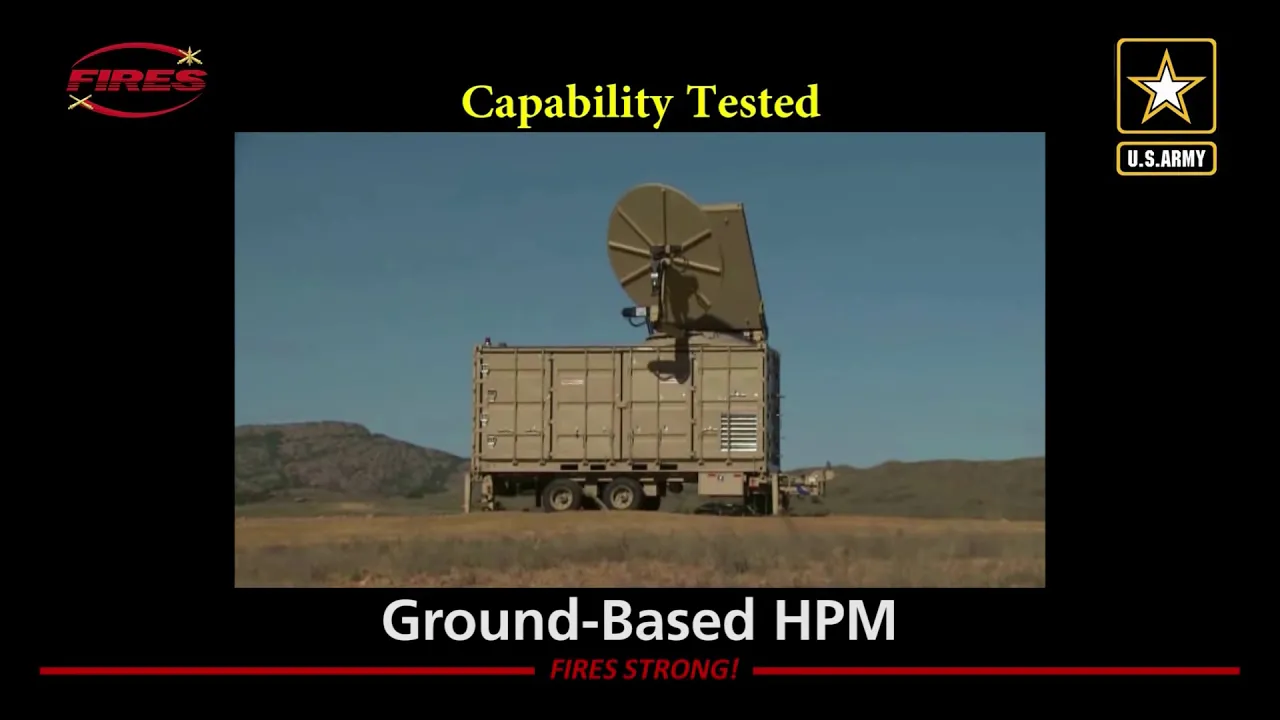
- The Phaser demonstration unit operated as a self-contained mobile system mounted in a 20-foot trailer with an internal diesel generator. (0:42)
- Since the 2013 demonstration, Raytheon reduced the Phaser payload size by 50% and prepared the system for operational deployment.
Detailed notes
## Background Published by AviationWeek on YouTube on November 11, 2016, this video features Defense Department-cleared footage of Raytheon's "Phaser" high-power microwave weapon during a 2013 demonstration at the U.S. Army Fires Center of Excellence at Fort Sill, Oklahoma. According to the page description, the release captures the swarm-destroying system neutralizing Flanker and Tempest drones, noting that Raytheon has since halved the payload's size to offer it for operational service.
## TL;DR The video documents a live directed-energy hardware demonstration conducted by the U.S. Army Fires Center of Excellence to integrate non-kinetic air defense alongside traditional fires. Mounted inside a self-contained 20-foot trailer with an onboard diesel generator, Raytheon's Phaser high-power microwave system was cued using Sentinel and close combat tactical radars tied into the Command View Tactical network. Upon entering the weapon's engagement corridor, incoming Tier 1 Flanker and Tier 2 Tempest drones were struck by speed-of-light microwave energy, resulting in immediate, verifiable kills. The trials confirmed the tactical viability of deploying directed-energy systems to neutralize drone threats at operationally relevant ranges.
## Atmosphere & style The presentation carries the measured, institutional gravitas of a formal military field-test briefing. A steady, authoritative narrator delivers technical objectives and sensor-kill chain milestones in a clear, procedural tone devoid of hype. Watching it feels like viewing an internal Pentagon capability review, where the silent, instantaneous neutralization of aerial targets underscores a clinical leap into the next generation of warfare.
## Bulletin - [00:06](https://www.youtube.com/watch?v=hlmf032NmHU&t=6s) The U.S. Army Fires Center of Excellence conducted a directed-energy field evaluation at Fort Sill, demonstrating non-kinetic high-power microwave capabilities alongside kinetic fires against UAS threats. - [00:42](https://www.youtube.com/watch?v=hlmf032NmHU&t=42s) Raytheon's deployable Phaser HPM weapon successfully downed both Tempest (Tier 2) and Flanker (Tier 1) drones during live-fire tests. - [00:42](https://www.youtube.com/watch?v=hlmf032NmHU&t=42s) The Phaser demonstration unit operated as a self-contained mobile system mounted in a 20-foot trailer with an internal diesel generator. - Since the 2013 demonstration, Raytheon reduced the Phaser payload size by 50% and prepared the system for operational deployment.
## Key takeaways - [00:06](https://www.youtube.com/watch?v=hlmf032NmHU&t=6s) The U.S. Army Fires Center of Excellence (FCoE) hosted a live-fire directed-energy hardware investigation at Fort Sill, Oklahoma, between late September and early October 2013. - [00:06](https://www.youtube.com/watch?v=hlmf032NmHU&t=6s) The evaluation aimed to validate the operational integration of non-kinetic directed-energy fires directly alongside traditional kinetic artillery and air defense capabilities. - [00:06](https://www.youtube.com/watch?v=hlmf032NmHU&t=6s) Testing benchmarks mandated engaging real aerial targets in the field, challenging multiple threat classifications simultaneously, and achieving kills at operationally relevant ranges. - [00:42](https://www.youtube.com/watch?v=hlmf032NmHU&t=42s) The core effector evaluated was Raytheon's Phaser high-power microwave (HPM) weapon system. - [00:42](https://www.youtube.com/watch?v=hlmf032NmHU&t=42s) Phaser offers selectable output parameters, allowing operators to either disrupt drone electronics or inflict permanent structural and functional damage. - [00:42](https://www.youtube.com/watch?v=hlmf032NmHU&t=42s) The system demonstrated flexible cueing capabilities, accepting target data from organic sensors or networked third-party tracking feeds. - [00:42](https://www.youtube.com/watch?v=hlmf032NmHU&t=42s) The demonstration hardware was self-contained within a 20-foot trailer powered by an onboard diesel generator. - [00:42](https://www.youtube.com/watch?v=hlmf032NmHU&t=42s) Target acquisition and tracking were supported by Sentinel radar and close combat tactical radar networked through Command View Tactical C2 and main gate radios. - [00:42](https://www.youtube.com/watch?v=hlmf032NmHU&t=42s) During tests, the Phaser beam maintained coverage over a sky sector, delivering speed-of-light microwave pulses that produced immediate kills on incoming Flanker and Tempest drones. - Footage of the successful 2013 trials was cleared by the Department of Defense for public release three years later in 2016.
## Detailed walkthrough ### [00:06](https://www.youtube.com/watch?v=hlmf032NmHU&t=6s) Objectives of the Fort Sill Directed-Energy Investigation
The U.S. Army Fires Center of Excellence (FCoE) has established the operational capability to integrate non-kinetic capabilities directly alongside traditional kinetic fires. To evaluate this emerging domain, the FCoE hosted a directed-energy hardware investigation at Fort Sill, Oklahoma, conducted between late September and early October of 2013. The exercise pit advanced directed-energy hardware against two distinct classifications of unmanned aerial systems (UAS) to assess tactical feasibility and lethality in the field.
The live demonstration was structured around rigorous operational benchmarks. Rather than conducting an abstract bench test, the evaluation set out to engage realistic aerial targets using a field-deployable directed-energy system, verify the system's effectiveness against multiple target types, engage simultaneous incoming threats, and neutralize those threats at tactically and operationally relevant ranges. As the narrator explains regarding the test parameters, “The objectives of this investigation were to engage real targets with a deployable directed-energy system, attack more than one type of threat, engage multiple threats simultaneously and kill these threats at operationally relevant ranges.”
- **Host Organization:** U.S. Army Fires Center of Excellence (FCoE) - **Location:** Fort Sill, Oklahoma - **Dates of Investigation:** September and October 2013 (live engagements running September 30 through October 3, 2013) - **Primary Goal:** Integration of non-kinetic directed-energy effects with traditional kinetic fires against Tier 1 and Tier 2 UAS threats
---
[00:42](https://www.youtube.com/watch?v=hlmf032NmHU&t=42s) The Phaser System Architecture and Engagement Results
At the core of the evaluation was Phaser, a deployable high-power microwave (HPM) weapon system designed with flexible cueing capabilities, operating via organic sensors or third-party track feeds. Configured for dynamic mission profiles, the weapon provides operators with selectable output parameters, giving them the tactical choice to either disrupt an incoming target’s electronics or deliver irreversible structural and functional damage. Mechanically, the demonstration system was completely self-contained, housed within a single 20-foot trailer that included its own internal diesel power generator.
```mermaid flowchart TD accTitle: Phaser System Architecture and Kill Chain accDescr: Sensor tracking feeds routed to Command View Tactical and dispatched to the Phaser HPM emitter to down aerial drones.
subgraph Sensors ["Surveillance & Tracking"] S1["Sentinel Radar"] S2["Close Combat Tactical Radar"] end
subgraph C2 ["Battle Management"] CVT["Command View Tactical (C2)"] MG["Main Gate Radios (Network)"] end
subgraph Effector ["Directed Energy Weapon"] PH["Phaser HPM System<br>(20-ft Trailer w/ Internal Diesel Generator)"] end
subgraph Targets ["Downed Threat UAS"] T1["Tempest (Tier 2 UAS)"] T2["Flanker (Tier 1 UAS)"] end
S1 --> CVT S2 --> CVT CVT <--> MG MG --> PH PH -->|"Speed-of-light HPM beam"| T1 PH -->|"Speed-of-light HPM beam"| T2 ```
The engagement network integrated multiple tactical radar systems to acquire and track the drone targets. Both a Sentinel radar and a close combat tactical radar tracked the incoming UAS, feeding data through a modernized command-and-control system designated Command View Tactical, with components networked via main gate radios. During this initial hardware investigation, operators kept the Phaser system's main beam oriented toward a fixed sector of the sky while two drone profiles—a Tempest Tier 2 UAS and a Flanker Tier 1 UAS—flew through the engagement zone. The directed-energy beam struck the targets at the speed of light, producing immediate, verifiable kills. Summarizing the strategic significance of the trials, the narrator affirms: “The US Army's fire Centers of Excellence team has clearly demonstrated it has the capability to lead the army and joint war fighters into the next generation of warfare.”
- **Effector Hardware:** Raytheon Phaser deployable high-power microwave (HPM) system - **System Housing:** 20-foot self-contained mobile trailer equipped with an internal diesel generator - **Target Tracking & C2 Sensors:** Sentinel radar, close combat tactical radar, Command View Tactical C2 system, and main gate tactical radios - **Drone Targets Neutralized:** Tempest (Tier 2 UAS) and Flanker (Tier 1 UAS) - **Engagement Mechanism:** Directed microwave energy delivered at the speed of light with instantaneous kill confirmation
## Notable quotes > [00:42](https://www.youtube.com/watch?v=hlmf032NmHU&t=42s) The US Army's fire Centers of Excellence team has clearly demonstrated it has the capability to lead the army and joint war fighters into the next generation of warfare. — Narrator
## Mentioned Raytheon, Phaser, U.S. Army Fires Center of Excellence, Fort Sill, U.S. Department of Defense, Flanker drone, Tempest drone, Sentinel radar, Close combat tactical radar, Command View Tactical, Main gate radios
## Video description A new video cleared by the Defense Department shows Raytheon’s “Phaser” high-power microwave (HPM) weapon in a demonstration at the U.S. Army Fires Center of Excellence at Fort Sill, Oklahoma. Raytheon used the swarm-destroying Phaser to bring down Flanker and Tempest drones during the live-fire demonstration conducted Sept. 30-Oct. 3, 2013. Three years later, the Defense Department has cleared the footage for public release. Raytheon says it has already reduced the size of the Phaser payload by half and is offering the system up for operational use. Credit: U.S. Army Fires Center of Excellence
[Source](https://www.youtube.com/watch?v=hlmf032NmHU)