Joshua Bell Draws Commuter Indifference in DC Metro Recital
Washington Post
A Washington Post experiment shows high-caliber artistry goes largely unrecognized when stripped of concert-hall framing and presented amid rush-hour routines.
AI-assisted summary of Joshua Bell's 'Stop and Hear the Music' metro experiment | The Washington Post — original source. Check the original for full context.
Source published:
Key ideas
- Renowned concert violinist Joshua Bell staged an undercover performance at a Washington D.C. Metro station as part of a Washington Post social experiment titled 'Stop and Hear the Music.' (0:01)
- Dressed in street clothes, Bell performed intricate classical repertoire on a multimillion-dollar Stradivarius violin for spare change during morning rush hour. (0:01)
- The vast majority of commuters rushed past without breaking stride, demonstrating how situational haste and framing can render extraordinary art virtually invisible. (1:17)
- While most adult commuters ignored the performance, several children turned to listen before being hurried along, and a few passersby dropped coins or offered scattered applause. (1:17)
Detailed notes
## Background Published by The Washington Post on YouTube on April 11, 2007, this video documents an experiment featuring world-renowned violinist Joshua Bell playing incognito outside a bustling Washington D.C. Metro station. Using his multimillion-dollar Stradivarius violin, Bell performs for spare change to test whether ordinary commuters would notice elite artistry outside of a traditional concert hall setting, as chronicled by journalist Gene Weingarten.
## TL;DR Dressed in casual street clothes and a baseball cap, virtuoso violinist Joshua Bell sets up beside a wall in the Washington D.C. Metro to perform intricate classical music during the morning rush hour. Despite playing a multimillion-dollar Stradivarius with concert-hall precision, the vast majority of commuters stream past without breaking stride or pausing their routines. A few individuals slow down, children turn to look before being pulled along by hurried parents, and occasional passersby drop coins or offer brief applause. The performance underscores how everyday context, haste, and social framing heavily dictate the perception and appreciation of extraordinary beauty.
## Atmosphere & style The video carries a quiet, observational, and bittersweet tone marked by a stark contrast between sublime artistry and everyday urban indifference. The rich, resonant acoustics of the solo Stradivarius create an intimate, poignant bubble against the harsh, rumbling backdrop of subway trains, announcements, and hurried footsteps. Watching Bell remain intensely focused while surrounded by oblivious commuters evokes a reflective sense of irony, highlighting the fleeting, easily missed beauty embedded within the frantic pace of modern life.
## Bulletin - [00:01](https://www.youtube.com/watch?v=hnOPu0_YWhw&t=1s) Renowned concert violinist Joshua Bell staged an undercover performance at a Washington D.C. Metro station as part of a Washington Post social experiment titled 'Stop and Hear the Music.' - [00:01](https://www.youtube.com/watch?v=hnOPu0_YWhw&t=1s) Dressed in street clothes, Bell performed intricate classical repertoire on a multimillion-dollar Stradivarius violin for spare change during morning rush hour. - [01:17](https://www.youtube.com/watch?v=hnOPu0_YWhw&t=77s) The vast majority of commuters rushed past without breaking stride, demonstrating how situational haste and framing can render extraordinary art virtually invisible. - [01:17](https://www.youtube.com/watch?v=hnOPu0_YWhw&t=77s) While most adult commuters ignored the performance, several children turned to listen before being hurried along, and a few passersby dropped coins or offered scattered applause.
## Key takeaways - [00:01](https://www.youtube.com/watch?v=hnOPu0_YWhw&t=1s) Virtuoso violinist Joshua Bell performed incognito in a bustling transit corridor of the Washington D.C. Metro. - [00:01](https://www.youtube.com/watch?v=hnOPu0_YWhw&t=1s) The experiment was organized by The Washington Post and chronicled by journalist Gene Weingarten with video documentation by John W. Poole. - [00:01](https://www.youtube.com/watch?v=hnOPu0_YWhw&t=1s) Bell performed on his multimillion-dollar handcrafted Stradivarius violin while collecting spare change in an open instrument case. - [00:01](https://www.youtube.com/watch?v=hnOPu0_YWhw&t=1s) By wearing casual attire and a baseball cap, Bell stripped away the prestige, ticketing barriers, and formal staging of a world-class concert hall. - [00:01](https://www.youtube.com/watch?v=hnOPu0_YWhw&t=1s) The experiment was designed to test whether everyday citizens recognize extraordinary beauty and artistic excellence when encountered out of context. - [00:01](https://www.youtube.com/watch?v=hnOPu0_YWhw&t=1s) Hundreds of morning commuters passed through the station, with the vast majority remaining absorbed in their commutes toward escalators and turnstiles. - [01:17](https://www.youtube.com/watch?v=hnOPu0_YWhw&t=77s) Bell maintained technical precision and expressive depth throughout the performance, treating the transit space with the same dedication as a prestigious auditorium. - [01:17](https://www.youtube.com/watch?v=hnOPu0_YWhw&t=77s) Adult commuters consistently maintained focused expressions, checking watches and walking past despite the complex music echoing against the subway tiles. - [01:17](https://www.youtube.com/watch?v=hnOPu0_YWhw&t=77s) Young children frequently turned their heads and showed curiosity toward the music before being guided along by parents rushing to stay on schedule. - [01:17](https://www.youtube.com/watch?v=hnOPu0_YWhw&t=77s) A handful of isolated pedestrians paused briefly to listen, offering modest applause between passages and dropping spare coins into the violin case. - [01:17](https://www.youtube.com/watch?v=hnOPu0_YWhw&t=77s) The outcome highlighted how heavily public perception of value and beauty depends on social framing, context, and the absence of routine urgency.
## Detailed walkthrough ### [00:01](https://www.youtube.com/watch?v=hnOPu0_YWhw&t=1s) Incognito Performance at the Washington D.C. Metro Station
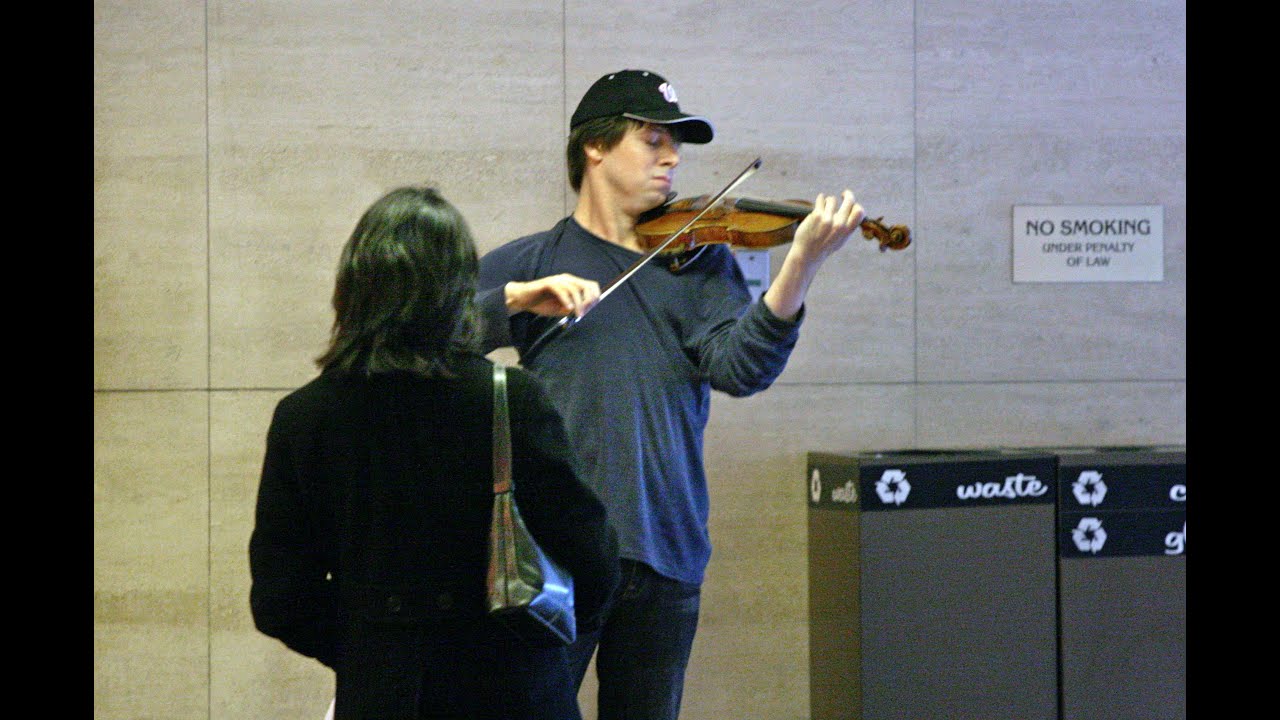
Virtuoso violinist Joshua Bell positions himself incognito beside a wall in the bustling transit corridors of the Washington D.C. Metro to conduct a social experiment organized by *The Washington Post*. Dressed in casual street clothes with a baseball cap pulled low, Bell takes out his multimillion-dollar Stradivarius violin, places his open instrument case on the floor to collect spare change, and begins playing intricate classical compositions for the morning rush-hour crowd. Rather than performing on a world-class concert stage where tickets cost hundreds of dollars, he offers an unannounced public recital to test whether ordinary commuters in an everyday transit environment will stop and recognize extraordinary beauty in the midst of their daily routines.
As the music starts to reverberate through the tiled metro halls, hundreds of commuters stream past on their way to work, most walking briskly toward escalators and turnstiles without breaking stride. Despite the complex, expressive solo violin passage filling the station, the vast majority of passersby remain absorbed in their morning commute. Nevertheless, Bell's playing immediately punctuates the subway ambience, drawing brief, scattered moments of attention and polite applause as a handful of pedestrians acknowledge the music in passing or drop spare coins into his open violin case.
- Joshua Bell, widely recognized as one of the world's greatest violinists, performs incognito in a Washington D.C. Metro station. - Bell plays on his multimillion-dollar handcrafted Stradivarius violin. - The experiment, titled "Stop and Hear the Music," was organized in collaboration with *The Washington Post* and chronicled by journalist Gene Weingarten, with video documented by John W. Poole. - The performance tests public perception, beauty, and context by observing whether commuters pause to listen to elite classical music outside the concert hall.
[01:17](https://www.youtube.com/watch?v=hnOPu0_YWhw&t=77s) Rush-Hour Ambience, Passerby Reactions, and Conclusion
As the performance continues into its later movements, the rich acoustic tones of the Stradivarius echo against the rumbling trains, footsteps, and transit announcements. The interaction pattern remains strikingly consistent: while adults consistently press forward with focused expressions, looking straight ahead or checking watches, occasional moments of curiosity occur. A few individual commuters slow their pace to look over, and young children in particular turn their heads to watch Bell play before being guided along by parents hurrying to stay on schedule.
Between intricate passages, brief intervals of applause rise from the few individuals who take a moment to listen. Bell maintains complete focus on the violin, delivering the same technical precision and expressive depth expected in a prestigious auditorium despite the indifference of the surrounding crowd. As the final notes ring through the corridor, the performance concludes with a modest round of appreciation from the few onlookers nearby, highlighting the stark contrast between the caliber of the artistry and the hurried context of the subway station.
- Commuters largely pass by without stopping, illustrating the powerful effect of context, haste, and social framing on aesthetic perception. - Occasional listeners drop change into the open case, while isolated passersby pause briefly to listen and offer applause between sections. - The experiment demonstrates that extraordinary art presented unexpectedly in an ordinary public setting can go largely unnoticed during the rush of daily life.
## Mentioned Joshua Bell, The Washington Post, Gene Weingarten, John W. Poole, Washington D.C. Metro, Stradivarius
## Video description Joshua Bell is one of the world's greatest violinists. His instrument of choice is a multimillion-dollar Stradivarius. If he played it for spare change, incognito, outside a bustling Metro stop in Washington D.C., would anyone notice?
Read Gene Weingarten's story in The Washington Post: http://wpo.st/-vP (Video by John W. Poole)
#WashingtonPost #JoshuaBell #StopandHeartheMusic
[Source](https://www.youtube.com/watch?v=hnOPu0_YWhw)