Food Waste: Last Week Tonight with John Oliver (HBO)
LastWeekTonight
AI-assisted summary of Food Waste: Last Week Tonight with John Oliver (HBO) — original source. Check the original for full context.
Source published:
Key ideas
- Up to 40% of all food produced in the United States goes uneaten, amounting to $165 billion in discarded food annually and an increase of roughly 50% since the 1970s. (0:04)
- Decomposing food in landfills releases substantial amounts of methane, a greenhouse gas over 20 times more potent than carbon dioxide, while nearly 50 million Americans face food insecurity. (3:19)
- Except for infant formula, the federal government does not mandate expiration dates, and the Bill Emerson Good Samaritan Food Donation Act shields good-faith donors from civil and criminal liability. (10:48)
- Legislation aimed at extending permanent food donation tax deductions to small businesses (H.R. 644) was completely stripped and rewritten in the Senate into a customs and trade bill. (12:49)
Detailed notes
## Background Published on YouTube by the official LastWeekTonight channel on July 20, 2015, this segment features host John Oliver examining the massive scale of food waste in the United States. According to the show's description, producers, retailers, and consumers discard tons of food, prompting Oliver's exploration of the shocking volume of edible goods that never get eaten.
## TL;DR Up to 40 percent of food produced in the United States goes uneaten, squandering $165 billion annually and releasing potent landfill methane while nearly 50 million Americans live in food-insecure households. John Oliver explains that this crisis is fueled by retail overstocking, harsh cosmetic standards that leave blemished produce to rot in fields, and consumer confusion over unregulated expiration and sell-by dates. He dismantles the widespread myth that donating food carries litigation risks, citing the protections of the Bill Emerson Good Samaritan Food Donation Act, while detailing the logistical costs and congressional maneuvers that gutted tax deductions for small business donors under H.R. 644. Ultimately, Oliver argues that addressing the crisis requires structural tax relief alongside cultural shifts, such as embracing imperfect produce and ignoring arbitrary date stamps.
## Atmosphere & style The segment balances John Oliver’s trademark exasperated wit and energetic sarcasm with sobering investigative reporting on poverty and environmental damage. High-energy comedic riffs on over-the-top fast-food marketing smoothly transition into genuine outrage over food-insecure families and massive agricultural waste dumps in California. Watching the piece feels like an eye-opening and fast-paced indictment of institutional absurdity, culminating in an extravagant patriotic parody ad that leaves the audience laughing while confronting uncomfortable realities about modern consumption.
## Bulletin - [00:04](https://www.youtube.com/watch?v=i8xwLWb0lLY&t=4s) Up to 40% of all food produced in the United States goes uneaten, amounting to $165 billion in discarded food annually and an increase of roughly 50% since the 1970s. - [03:19](https://www.youtube.com/watch?v=i8xwLWb0lLY&t=199s) Decomposing food in landfills releases substantial amounts of methane, a greenhouse gas over 20 times more potent than carbon dioxide, while nearly 50 million Americans face food insecurity. - [10:48](https://www.youtube.com/watch?v=i8xwLWb0lLY&t=648s) Except for infant formula, the federal government does not mandate expiration dates, and the Bill Emerson Good Samaritan Food Donation Act shields good-faith donors from civil and criminal liability. - [12:49](https://www.youtube.com/watch?v=i8xwLWb0lLY&t=769s) Legislation aimed at extending permanent food donation tax deductions to small businesses (H.R. 644) was completely stripped and rewritten in the Senate into a customs and trade bill.
## Key takeaways - [00:04](https://www.youtube.com/watch?v=i8xwLWb0lLY&t=4s) American food culture and chain advertising heavily push excessive portions and overconsumption. - [00:04](https://www.youtube.com/watch?v=i8xwLWb0lLY&t=4s) Americans discard roughly 20 pounds of food per person each month, enough annually to fill 730 football stadiums. - [03:19](https://www.youtube.com/watch?v=i8xwLWb0lLY&t=199s) The massive scale of food waste coexists with widespread domestic food insecurity, affecting nearly 50 million Americans in 2013. - [03:19](https://www.youtube.com/watch?v=i8xwLWb0lLY&t=199s) Discarded food squanders vast amounts of agricultural labor, fuel, and scarce irrigation water. - [03:19](https://www.youtube.com/watch?v=i8xwLWb0lLY&t=199s) Organic waste breaking down anaerobically in landfills generates massive volumes of potent methane gas. - [03:19](https://www.youtube.com/watch?v=i8xwLWb0lLY&t=199s) The average American household throws away 15% to 25% of the groceries it purchases. - [06:21](https://www.youtube.com/watch?v=i8xwLWb0lLY&t=381s) Supermarkets deliberately overstock produce displays to combat consumer hesitation to purchase solitary or low-inventory items. - [06:21](https://www.youtube.com/watch?v=i8xwLWb0lLY&t=381s) Stringent USDA grading criteria and supermarket cosmetic standards force growers to leave tons of edible produce to rot in fields. - [09:25](https://www.youtube.com/watch?v=i8xwLWb0lLY&t=565s) Roughly 91% of consumers have discarded food past its printed date under the false assumption that it indicates safety rather than manufacturer-estimated peak freshness. - [10:48](https://www.youtube.com/watch?v=i8xwLWb0lLY&t=648s) With the sole exception of baby formula, the federal government does not require food date labels, leaving nine states with no dating regulations at all. - [10:48](https://www.youtube.com/watch?v=i8xwLWb0lLY&t=648s) Grocery stores frequently refuse to donate surplus food due to an unfounded fear of litigation, despite zero recorded cases of food donors being sued. - [10:48](https://www.youtube.com/watch?v=i8xwLWb0lLY&t=648s) The Bill Emerson Good Samaritan Food Donation Act provides comprehensive civil and criminal liability protection for good-faith food donations. - [12:49](https://www.youtube.com/watch?v=i8xwLWb0lLY&t=769s) Small businesses and farms often discard surplus food because processing, packing, and transporting it to charities without permanent tax incentives is cost-prohibitive. - [12:49](https://www.youtube.com/watch?v=i8xwLWb0lLY&t=769s) H.R. 644 originally sought to make food donation tax deductions permanent for all businesses before being stripped and repurposed into an unrelated trade enforcement bill by the Senate. - [16:03](https://www.youtube.com/watch?v=i8xwLWb0lLY&t=963s) Tackling food waste requires consumers to accept cosmetically imperfect produce, rethink expiration date interpretations, and support tax parity for small-business food donations.
## Detailed walkthrough ### [00:04](https://www.youtube.com/watch?v=i8xwLWb0lLY&t=4s) America's Food Culture and the Massive Scale of Food Waste
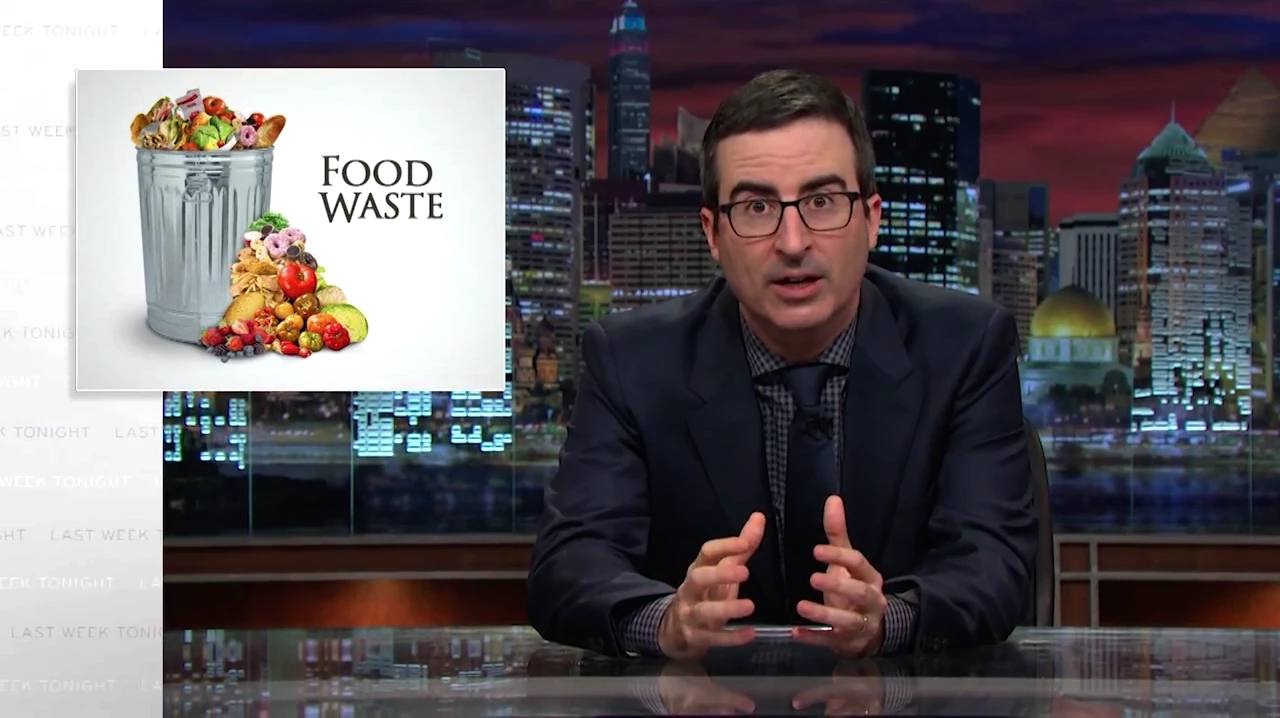
John Oliver begins by announcing that the evening's main story focuses on food—or "the afterlife," as plants and animals might describe it. America’s cultural affection for food is impossible to escape on television, from endless promotions like IHOP's all-you-can-eat pancakes, Golden Corral’s all-you-can-eat wings, and Red Lobster’s annual endless shrimp event, to chain-restaurant commercials that Oliver jokes are essentially saying: "let food replace your sadness stuff riblets in that hole in your heart." Patriotism and excessive food marketing are thoroughly intertwined, exemplified by an ad for Carl's Jr. and Hardee's featuring the "Most American Thickburger"—a cheeseburger piled with a split hot dog and potato chips, held by model Samantha Hoops in a hot tub on a pickup truck driven by a bull rider on an aircraft carrier under the Statue of Liberty. Oliver dubs the burger "the new Confederate flag."
Behind the indulgence lies a troubling counter-reality: the enormous volume of food that is produced but discarded. Citing a study by the Natural Resources Defense Council (NRDC), Oliver explains that up to 40% of all food produced in the United States goes uneaten. Between farmers, distributors, retailers, and end consumers, the nation discards more than a third of its entire food supply, an amount that has risen by about 50% since the 1970s. As Oliver quips about the current trajectory: “At this rate, in 40 years, when you order pizza from Papa John's, they'll just deliver it straight to the nearest dumpster, as they should.” Footage from an agricultural disposal site in California’s Salinas Valley drives home the visual shock, showing massive dumps overflowing with crisp loose organic lettuce, spinach, kale, and broccoli.
- Up to 40% of all food produced in the United States is never consumed. - Americans discard $165 billion worth of food each year. - This waste amounts to roughly 20 pounds of discarded food per person every month. - Annually, discarded American food is enough to fill 730 football stadiums. - The volume of food thrown out by Americans has expanded by roughly 50% since the 1970s.
[03:19](https://www.youtube.com/watch?v=i8xwLWb0lLY&t=199s) Food Insecurity, Environmental Fallout, and Household Financial Waste
The diversion of edible produce from farm to landfill carries severe human, ecological, and economic costs. First and foremost is the human toll: in 2013, nearly 50 million Americans lived in food-insecure households, struggling at points throughout the year to put meals on the table. A news clip shows an emotional mother describing going hungry so her children can eat: “It’s hard. I’ll go without food before my kids will. Budget’s down to the penny, and it’s just not enough.” Oliver emphasizes the glaring paradox: “It is crazy that that is happening in a country with 730 football stadiums full of uneaten food. It's insane.”
Discarded food also wastes all the human labor, fuel, and natural resources required to cultivate it. In California, where extreme drought conditions left the state shriveled, valuable irrigation water was pumped into produce destined only to serve as "a garnish for landfills." Once in those dumps, decomposing food poses a major atmospheric threat. Aggregated organic matter breaks down anaerobically without oxygen, producing methane—a greenhouse gas over 20 times more potent than carbon dioxide at trapping heat in the atmosphere. Oliver illustrates the point: “When we dump food into a landfill, we're essentially throwing a trash blanket over a flatulent food man and Dutch ovening the entire planet.” For viewers unconcerned with social or ecological welfare, Oliver points to household economics: the average American household wastes between 15% and 25% of the groceries it purchases, which is the equivalent of buying four bags of groceries, dropping one on the pavement in the parking lot, and simply leaving it behind.
```mermaid flowchart TD accTitle: The Impacts of Discarding Edible Food accDescr: Diagram mapping the social, environmental, and financial impacts of discarding edible food.
Waste["40% of Food Discarded Annually"]
subgraph Impacts["Consequences"] Human["Human Cost:<br/>~50M Food-Insecure Americans (2013)"] Resources["Wasted Resources:<br/>Labor, Energy & Agricultural Water"] Climate["Climate Threat:<br/>Anaerobic Breakdown & Methane Gas"] Household["Household Cost:<br/>15%–25% of Purchased Food Lost"] end
Waste --> Human Waste --> Resources Waste --> Climate Waste --> Household ```
[06:21](https://www.youtube.com/watch?v=i8xwLWb0lLY&t=381s) Supermarket Overstocking and Cosmetic Rejections in Produce
Oliver acknowledges the convenience of accessible, cheap food in America—defending even obscure variations like Cap'n Crunch's Oops! All Berries—but notes that food waste is driven heavily by retail practices and consumer psychology. Supermarkets and farm stands routinely overstock displays because shoppers avoid the lone remaining item on a shelf, assuming that solitary goods must be defective. A small farmstand operator observes that a single leftover bunch of chard will sit untouched for an hour, whereas a brimming display of 30 bunches will prompt customers to buy 25 of them on impulse.
A far larger volume of waste occurs before produce even leaves the orchard. Retailers enforce cosmetic standards so stringent that imperfect produce is left to rot where it grows. A farmer is shown walking through an orchard carpeted with abandoned, edible peaches dropped by pickers. These cosmetic expectations are formalised in United States Department of Agriculture (USDA) grading categories: a flawless "U.S. No. 1" peach commands full price, whereas a slightly marred "U.S. No. 2" peach can lose two-thirds of its wholesale value despite identical nutritional quality and taste. Many grocery chains apply standards even stricter than USDA benchmarks, forcing farmers to leave tons of sound fruit on the ground rather than absorb the cost of harvesting unsellable inventory.
- Displays are overstocked to counteract shopper bias against purchasing the final remaining item on a shelf. - Edible peaches are systematically discarded in fields if they exhibit superficial blemishes or irregular coloring. - Labeling a peach as a USDA "No. 2" can erase up to two-thirds of its market value for the grower. - Retail chains frequently implement aesthetic acceptance thresholds that surpass official USDA grading guidelines.
[09:25](https://www.youtube.com/watch?v=i8xwLWb0lLY&t=565s) The Expiration Date Myth and Consumer Confusion
Beyond aesthetic bias, Oliver identifies consumer anxiety around expiration dates as another major source of food waste. Around 91% of consumers have discarded edible food past its printed date out of safety fears—a group Oliver admits he belongs to. This behavior persists despite the fact that expiration labels lack uniform meaning or federal regulation. A news broadcast demonstrates this inconsistency by examining cartons of identical 2% milk from the same brand, finding labels marked arbitrarily as "Use By," "Sell By," or just an isolated calendar date. Oliver likens the ambiguity to the label on Smirnoff vodka claiming it is "triple distilled": “Oh, really, Smirnoff? So you ran the potato sweats through the tube sock two extra times? Thanks for spending the effort.”
Shoppers routinely conflate "sell-by" dates with food safety limits, but food experts clarify that these stamps have almost nothing to do with whether an item is safe to consume. Instead, they represent a manufacturer’s subjective estimate of when a product will reach peak freshness and quality. Because manufacturers establish their own guidelines without standardized federal oversight, Oliver points out the commercial incentive: shorter freshness windows nudge customers into throwing away edible goods prematurely and repurchasing them sooner, functioning much like planned obsolescence in consumer electronics.
> “Actually, it has nothing to do with safety at all. It's just a manufacturer's best guess of when that food is going to be the freshest and at the best quality.” — *Food expert in news segment*
[10:48](https://www.youtube.com/watch?v=i8xwLWb0lLY&t=648s) The Expiration Date Illusion and the Fear of Liability
Except for baby formula, the federal government does not require food to carry any expiration date at all, leaving state regulations to form a confusing patchwork where nine states require no date labels whatsoever. Because of this, John Oliver notes that sell-by dates are essentially meaningless suggestions that look official but can be safely disregarded, comparing them to an overzealous child dressed up in a police costume: “Just stop it Tyler, I'm not under arrest, you're under arrest!” Nonetheless, consumers and grocery retailers treat these printed dates as gospel, leading stores to routinely discard products even before they reach their sell-by milestones. When asked why close-dated or surplus food is thrown straight into the garbage rather than donated to local charities, store personnel cite company health and safety rules and express terror over legal consequences, insisting they throw it out because there are simply too many lawsuits.
Oliver dismantles this pervasive assumption, explaining that fear of litigation from donating surplus groceries is entirely unfounded. After looking into the legal record, researchers could not identify a single documented case where a food donor had ever been sued. Oliver compares the myth to the childhood belief that swimming within an hour of eating will inevitably cause cramps and drowning. Under federal law, donors are shielded by the Bill Emerson Good Samaritan Food Donation Act, which explicitly protects individuals and businesses from civil and criminal liability when they make donations in good faith. Oliver quips that this level of immunity must also apply to charitable clothing drop-offs, even though anyone donating an out-of-style cowl neck sweater should probably face legal consequences: “Donating a cowl neck sweater? Hello, the homeless live in shelters, not 2008!”
- With the sole exception of infant formula, the federal government mandates no expiration dates on food products. - Nine U.S. states have zero requirements for food date labeling. - The Bill Emerson Good Samaritan Food Donation Act legally protects donors from liability for food given in good faith, and there is no record of any donor ever being sued for donating food that made someone sick.
[12:49](https://www.youtube.com/watch?v=i8xwLWb0lLY&t=769s) The Financial Hurdles and the Fate of H.R. 644
Even when businesses recognize they will not face lawsuits, the sheer logistical expense of food donation remains a massive barrier. Harold McClarty of HMC Farms explains that while growers would love to send unmarketable produce like surplus peaches to hunger-relief agencies, processing, packaging, storing, and transporting heavy fresh fruit requires significant resources. McClarty notes that “getting it into the hands of somebody to eat it isn't free,” warning that without economic incentives, “it's a lot easier and cheaper just to basically throw it away.” Oliver argues that businesses cannot be faulted for guarding their bottom lines, observing that expecting corporations to act like non-profits without incentives is unrealistic. While large corporations receive permanent federal tax breaks for food donations, small businesses, family farms, and independent restaurants face an unpredictable system where their tax deduction must be continually re-authorized by Congress on a temporary basis, making long-term donation planning financially risky.
```mermaid flowchart TD accTitle: Legislative Fate of HR 644 accDescr: Diagram showing how HR 644 was stripped and rewritten between the House and Senate. subgraph House["House of Representatives"] A["H.R. 644 Introduced<br>(Fighting Hunger Incentive Act)"] --> B["Bundled into<br>America Gives More Act"] B --> C["Passed by House with<br>Permanent Tax Break"] end subgraph Senate["United States Senate"] C --> D["Stripped of all<br>original content"] D --> E["Renamed Trade Facilitation and<br>Trade Enforcement Act of 2015"] E --> F["Replaced with customs &<br>foreign policy provisions"] end ```
In February 2015, lawmakers attempted to rectify this disparity through H.R. 644, known as the Fighting Hunger Incentive Act, which was designed to make the charitable donation deduction permanent for all businesses. A bill sponsor underscored the behavioral necessity of permanent rules, observing: “When something's not permanent, it affects our behavior—that's why we all treat rental cars like we're in a Fast and Furious movie.” The House passed the proposal after bundling it with other tax measures into the “America Gives More Act.” However, once the legislation reached the United States Senate, lawmakers completely hollowed out the measure. Senators stripped the entire food-donation text, renamed it the Trade Facilitation and Trade Enforcement Act of 2015, and filled it with completely unrelated language regarding border enforcement and U.S.-Israel trade relations. Oliver compares this bait-and-switch maneuver to ordering a veggie burger at a diner, only for the server to deliver meatloaf, call it a waffle, and prevent you from giving it away because you cannot be sure you will receive a tax credit.
[16:03](https://www.youtube.com/watch?v=i8xwLWb0lLY&t=963s) Re-evaluating Waste and the Honest Fast Food Ad
Addressing the food waste crisis requires sweeping cultural and structural changes beyond simple legislative fixes. Oliver emphasizes that while everyone across the political spectrum agrees small businesses should receive tax incentives for surplus food donations, solving the broader systemic emergency demands that Americans reconsider their everyday habits. Consumers must become willing to buy aesthetically imperfect or "ugly" produce, stop treating arbitrary sell-by stamps as hard expiration deadlines, and abandon the phantom dread of being taken to court by starving people. Without a comprehensive rethink of the national food supply chain, Oliver warns, commercial marketing will simply have to reflect the grotesque reality of American overconsumption and disposal.
To illustrate this point, the show concludes with a satirical parody of patriotic, over-the-top fast-food commercials from chains like Carl's Jr. and Hardee's. An intense voiceover boasts of a decadent burger piled with a hot dog and potato chips held by a bikini model inside a hot tub on a pickup truck aboard an aircraft carrier in front of the Statue of Liberty. The narrator reveals what is truly American: watching that cheeseburger tossed into the trash alongside fifteen others right in front of an impoverished family of four, who stand atop a mountain of fourteen tons of misshapen produce and eighty tons of dairy discarded one day past its sell-by date. The entire scene culminates in a giant tear falling from Abraham Lincoln's eye on Mount Rushmore, where the monument sits buried chin-deep in decomposing cheeseburgers venting clouds of red, white, and blue methane gas.
- Comprehensive reform requires willingness to eat cosmetically imperfect produce, ignoring non-safety date labels, and supporting permanent donation tax deductions. - John Oliver summarizes the broad consensus: “The insane thing is, everyone basically agrees small businesses should get tax incentives to donate food, so we have to find a way to pass that.”
## Notable quotes > [16:03](https://www.youtube.com/watch?v=i8xwLWb0lLY&t=963s) The insane thing is, everyone basically agrees small businesses should get tax incentives to donate food, so we have to find a way to pass that. — John Oliver
## Mentioned Abraham Lincoln, Bill Emerson Good Samaritan Food Donation Act, Cap'n Crunch's Oops! All Berries, Carl's Jr., Fighting Hunger Incentive Act, Golden Corral, Hardee's, Harold McClarty, HMC Farms, IHOP, John Oliver, Natural Resources Defense Council, Papa John's, Red Lobster, Samantha Hoops, Smirnoff, Statue of Liberty, Trade Facilitation and Trade Enforcement Act of 2015, United States Department of Agriculture, United States House of Representatives, United States Senate
## Video description Producers, sellers, and consumers waste tons of food. John Oliver discusses the shocking amount of food we don’t eat.
Connect with Last Week Tonight online... Subscribe to the Last Week Tonight YouTube channel for more almost news as it almost happens: www.youtube.com/user/LastWeekTonight
Find Last Week Tonight on Facebook like your mom would: http://Facebook.com/LastWeekTonight
Follow us on Twitter for news about jokes and jokes about news: http://Twitter.com/LastWeekTonight
Visit our official site for all that other stuff at once: http://www.hbo.com/lastweektonight
[Source](https://www.youtube.com/watch?v=i8xwLWb0lLY)