Xlinks Plans £16 Billion Morocco Cable to Supply 8% of UK Power
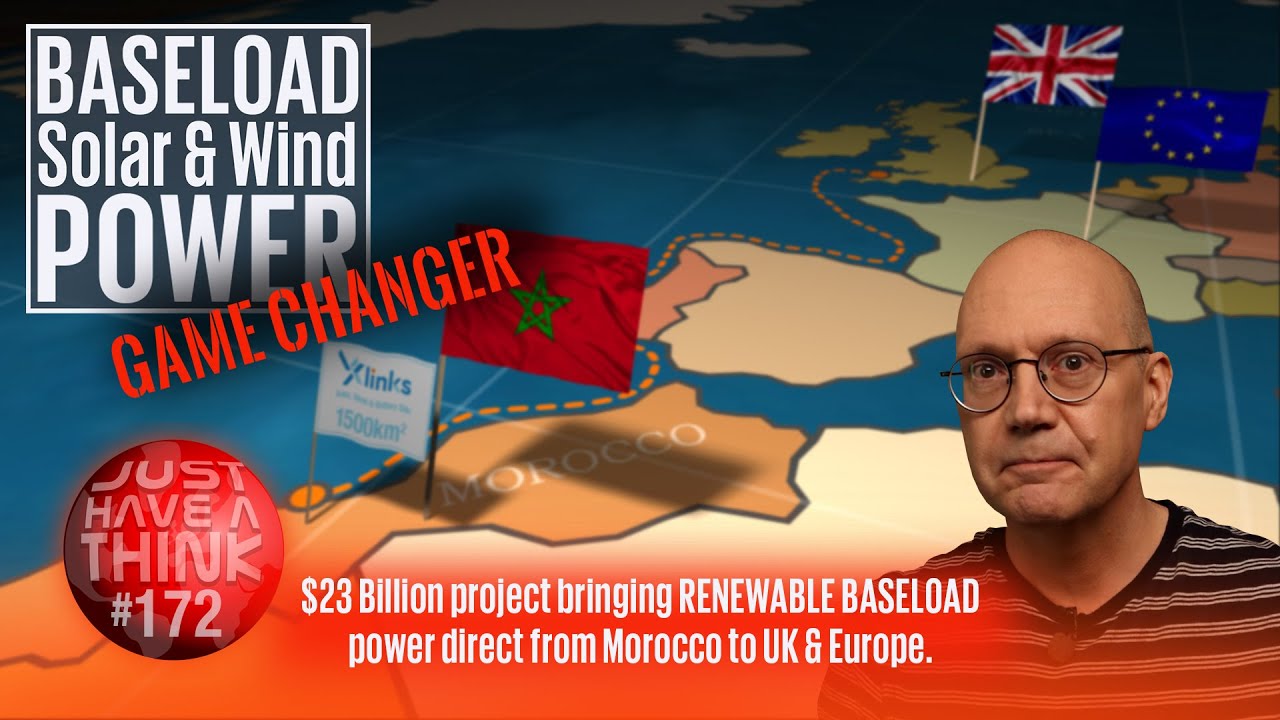
Grid: Renewable Baseload Power from a single desert location. Enough for 7 million homes! — Just Have a Think

Just Have a Think

Importing Saharan renewable baseload through undersea cables offers Britain a viable path to meet its 14-year net-zero grid deadline at roughly half the strike price of delayed domestic nuclear projects.

AI-assisted summary of Grid: Renewable Baseload Power from a single desert location. Enough for 7 million homes! — original source. Check the original for full context.

Source published:

Key ideas

  • UK developer Xlinks announced a £16 billion project combining 7 GW of solar, 3.5 GW of wind, and 20 GWh of battery storage in South Morocco to supply 3.6 GW of reliable power to the UK via subsea HVDC cables. (2:49)
  • The Morocco generation profile achieves an estimated 55% wind capacity factor and an 85% cable load factor, delivering an average of 20 hours of clean electricity daily to meet about 8% of UK power demand. (2:49)
  • Due to a global manufacturing bottleneck of only 4,000 km of subsea HVDC cable annually, Xlinks plans to build the world's largest cable extrusion facility in Hunterston, Scotland, generating 900 manufacturing jobs. (6:48)
  • Xlinks is seeking a £48/MWh Contract for Difference (CfD) strike price, offering firm baseload delivery at roughly half the £92.50/MWh awarded to the Hinkley Point C nuclear plant. (8:26)

Detailed notes

## Background Published on YouTube by the educational channel Just Have a Think on October 17, 2021, this video examines Xlinks' ambitious £16 billion Morocco–UK Power Project. According to the show notes, the proposed venture plans to generate 3.6 GW of solar, wind, and battery power across a desert site in South Morocco and deliver it directly to the UK grid via subsea HVDC cables by 2027.

## TL;DR The video breaks down how global High Voltage Direct Current (HVDC) transmission can solve renewable intermittency by transferring energy from regions with constant sun and wind to distant demand hubs. It details Xlinks' plan to generate 3.6 GW of baseload power in Morocco using 7 GW of solar, 3.5 GW of wind, and a 20 GWh battery, transmitting it over 3,800 km of subsea cables to supply roughly 8% of the UK's electricity. To bypass severe global supply bottlenecks, the company plans to construct its own dedicated cable manufacturing facility in Scotland. The host also evaluates the project's financial model against expensive nuclear baseload alternatives like Hinkley Point C, concluding that large-scale intercontinental interconnectors are critical if the UK is to meet its 14-year net-zero electricity grid target amid retiring fossil and nuclear plants.

## Atmosphere & style The presentation is analytical, measured, and pragmatic, characteristic of an evidence-based explainer that avoids hyperbole while tackling grand engineering concepts. The host speaks in a calm, authoritative, and accessible manner, balancing ambitious technical possibilities against hardheaded logistical challenges and economic realities. Rather than taking a purely utopian stance, the emotional tone reflects a quiet urgency, framing massive international transmission projects not as shiny panaceas, but as practical necessities to prevent a severe baseload deficit.

## Bulletin - [02:49](https://www.youtube.com/watch?v=iJunxkln578&t=169s) UK developer Xlinks announced a £16 billion project combining 7 GW of solar, 3.5 GW of wind, and 20 GWh of battery storage in South Morocco to supply 3.6 GW of reliable power to the UK via subsea HVDC cables. - [02:49](https://www.youtube.com/watch?v=iJunxkln578&t=169s) The Morocco generation profile achieves an estimated 55% wind capacity factor and an 85% cable load factor, delivering an average of 20 hours of clean electricity daily to meet about 8% of UK power demand. - [06:48](https://www.youtube.com/watch?v=iJunxkln578&t=408s) Due to a global manufacturing bottleneck of only 4,000 km of subsea HVDC cable annually, Xlinks plans to build the world's largest cable extrusion facility in Hunterston, Scotland, generating 900 manufacturing jobs. - [08:26](https://www.youtube.com/watch?v=iJunxkln578&t=506s) Xlinks is seeking a £48/MWh Contract for Difference (CfD) strike price, offering firm baseload delivery at roughly half the £92.50/MWh awarded to the Hinkley Point C nuclear plant.

## Key takeaways - [00:00](https://www.youtube.com/watch?v=iJunxkln578&t=0s) Renewable intermittency is largely a localized issue, as global wind and solar resources remain continuously active across changing longitudes and latitudes. - [00:00](https://www.youtube.com/watch?v=iJunxkln578&t=0s) Ultra-high-voltage direct current (HVDC) transmission is an established global technology, demonstrated by China's 1.1-million-volt Changji-to-Guquan link carrying 12,000 MW over 3,000 km. - [02:49](https://www.youtube.com/watch?v=iJunxkln578&t=169s) The Morocco–UK project utilizes a 1,500 km² desert site in South Morocco, matching the area of Greater London without competing with domestic Moroccan energy needs. - [02:49](https://www.youtube.com/watch?v=iJunxkln578&t=169s) Afternoon desert convection generates strong, predictable nighttime winds, driving a 55% capacity factor that outperforms typical UK offshore wind farms. - [02:49](https://www.youtube.com/watch?v=iJunxkln578&t=169s) Integrating 7 GW solar, 3.5 GW wind, and a 5 GW / 20 GWh battery system raises transmission cable utilization from 40% up to approximately 85%. - [02:49](https://www.youtube.com/watch?v=iJunxkln578&t=169s) Four twin subsea HVDC cables will stretch 3,800 km along the continental shelf to deliver 3.6 GW directly to grid substations in North Devon. - [06:48](https://www.youtube.com/watch?v=iJunxkln578&t=408s) The requirement for 15,200 km of subsea cable exceeds global annual manufacturing output, prompting Xlinks to establish its own factory at Hunterston, Scotland. - [08:26](https://www.youtube.com/watch?v=iJunxkln578&t=506s) Intermittent renewables create an asymmetric draw on the Contracts for Difference (CfD) scheme because high generation suppresses market prices while lull periods prevent generation during price spikes. - [08:26](https://www.youtube.com/watch?v=iJunxkln578&t=506s) As a predictable, dispatchable supply, Morocco's imported power is economically comparable to firm nuclear baseload rather than intermittent domestic wind. - [08:26](https://www.youtube.com/watch?v=iJunxkln578&t=506s) The project's £48/MWh target strike price is approximately half that of Hinkley Point C (£92.50/MWh), positioning it as a cost-competitive baseload alternative. - [11:23](https://www.youtube.com/watch?v=iJunxkln578&t=683s) Of the total £16 billion capital expenditure, £40 million has been secured for early-stage development, with on-site construction targeted for 2025 and initial delivery in 2027. - [11:23](https://www.youtube.com/watch?v=iJunxkln578&t=683s) With UK nuclear plants retiring, conventional builds facing delays, and small modular reactors unavailable until at least 2035, intercontinental HVDC links offer a viable pathway to meet the 14-year net-zero grid mandate.

## Detailed walkthrough ### [00:00](https://www.youtube.com/watch?v=iJunxkln578&t=0s) Rethinking Renewable Intermittency and Global Baseload

Energy storage options—from competing battery chemistries to alternative systems like molten salt, hot rocks, liquid air, or domestic hot water cylinders—remain essential for adopting intermittent generation like wind and solar. Yet the pervasive objection that "the sun doesn't always shine and the wind doesn't always blow" holds true only within a localized frame of reference.

Looking at the planet as a whole reveals that sunlight and wind are constantly available somewhere at any given hour. Connecting regions of generation directly to demand centers across latitudes and longitudes creates an effective network of global renewable baseload power. As the host observes:

> “Because of course in reality the sun is always shining and the wind is always blowing somewhere on planet earth 24 hours a day 365 days a year.”

Moving massive quantities of electricity via High Voltage Direct Current (HVDC) transmission is already an established practice worldwide rather than distant science fiction. Long-standing systems run from the Pacific Northwest down to Los Angeles, with numerous interconnectors active across Europe and Asia. The largest operating example is China's 1.1-million-volt Changji-to-Guquan link, which delivers 12,000 MW over 3,000 km from northwestern solar and wind installations to eastern urban centers, powering over 26 million people.

[02:49](https://www.youtube.com/watch?v=iJunxkln578&t=169s) The Morocco–UK Power Project Architecture

Building upon established HVDC technology, UK company Xlinks has designed the Morocco–UK Power Project to tap the desert climate of South Morocco and transmit steady power directly to the British grid via undersea cables. To prevent competition with Morocco's domestic renewable buildout, Xlinks CEO Simon Morrish consulted with the Moroccan government to select a dedicated 1,500 km² (roughly 580 sq mi) parcel—an area matching the footprint of Greater London, yet small relative to the Sahara Desert.

```mermaid flowchart LR accTitle: Morocco-UK Power Project Infrastructure Flow accDescr: Generation assets in South Morocco connect through battery storage and undersea cables to the UK grid. subgraph Desert["South Morocco Generation (1,500 sq km)"] PV["7 GW Solar PV"] Wind["3.5 GW Wind"] BESS["5 GW / 20 GWh Battery Storage"] end

subgraph Transmission["Subsea Transmission"] HVDC["4 x Subsea HVDC Cables<br/>(3,800 km route / 15,200 km total)"] end

subgraph UK["UK Grid Offtake"] Devon["North Devon Substations<br/>(2 x 1.8 GW Grid Connections)"] Homes["7 Million Homes<br/>(8% of UK Electricity Demand)"] end

PV --> BESS Wind --> BESS BESS -->|"3.6 GW avg 20 hrs/day"| HVDC HVDC --> Devon Devon --> Homes ```

The resource dynamics of the desert site provide complementary production profiles. Sunlight remains consistent year-round without high-latitude winter drops. In the late afternoon, thermal convection across the desert drives strong, highly predictable winds that persist through the night. This timing aligns with UK evening demand peaks when domestic electricity consumption surges. Consequently, the Moroccan installation achieves a 55% wind capacity factor, exceeding the roughly 40% typical of UK offshore wind farms. A co-located battery balances power overnight until dawn, yielding an average output of 3.6 GW for 20 hours daily.

- **Solar capacity:** 7 GW of photovoltaic panels - **Wind capacity:** 3.5 GW of wind turbines - **Storage capacity:** 5 GW / 20 GWh battery energy storage system (BESS) - **Transmission capacity:** Two 1.8 GW connections (3.6 GW total) landing on the North Devon coast - **Demand coverage:** Meets approximately 8% of total UK electricity consumption (over 7 million homes) - **Cable load factor progression:** Solar alone provides ~40%; adding wind raises it to ~70%; integrating battery storage achieves ~85%

[06:48](https://www.youtube.com/watch?v=iJunxkln578&t=408s) Supply Chain Bottlenecks and Domestic Cable Manufacturing

Connecting the desert site to Devon requires traversing 3,800 km along the continental shelf. Because security of supply demands redundancy, Xlinks planned four twin cables, totaling 15,200 km of HVDC line. However, global manufacturing capacity for subsea HVDC cable sits at roughly 4,000 km per year, meaning Xlinks would require 100% of the world's cable manufacturing output for four consecutive years. Existing commercial queues meant five-year lead times and steep market pricing.

A factory definition study determined that establishing a dedicated manufacturing plant would prove cheaper and faster than waiting for third-party production slots. Xlinks chose Hunterston on the west coast of Scotland—near a nuclear facility slated to decommission in 2023 with 500 job losses. The proposed six-line extrusion plant is slated to become the largest cable production facility globally, creating 900 high-tech manufacturing positions.

[08:26](https://www.youtube.com/watch?v=iJunxkln578&t=506s) Contracts for Difference: Morocco Baseload vs. Intermittent Wind and Nuclear

Xlinks is targeting an electricity price of £48 per megawatt-hour under the UK's Contracts for Difference (CfD) mechanism. Under CfD contracts, developers agree to a fixed strike price: when wholesale market prices dip below this benchmark, the scheme tops up the difference; when wholesale prices exceed it, the operator refunds the surplus back to the state.

While UK offshore wind has cleared auctions around £40/MWh, intermittency creates asymmetric outcomes under the CfD formula. When winds blow strongly across the British Isles, generation surges, driving wholesale power prices down and triggering subsidy payouts to wind operators. Conversely, when winds drop, wholesale prices climb, but wind operators cannot generate power to capture those prices or repay the scheme.

> “Effectively that's a subsidy that can only be enjoyed by an intermittent power source.”

Because the Xlinks project delivers firm, baseload power across high-demand evening hours, it expects to frequently pay surplus revenues back into the UK exchequer. Consequently, its true economic peer is not intermittent generation, but new firm nuclear baseload. Hinkley Point C was awarded a strike price of £92.50/MWh—nearly double the £48/MWh sought by Xlinks. Commercial negotiations with the British government are led by Xlinks Executive Chairman Sir Dave Lewis (former CEO of Tesco), while Moroccan authorities continue permitting work tied to an estimated 10,000 local jobs created during construction and operation.

[11:23](https://www.youtube.com/watch?v=iJunxkln578&t=683s) Project Costs, Employment, and the Case for Baseload Renewables

The Morocco-UK Power Project brings substantial economic scale alongside its ambitious engineering. During the construction phase, thousands of jobs will be created, with 2,000 of those roles turning into permanent positions once operational. The total project price tag—which incorporates the dedicated cable extrusion factory—stands at £16 billion, with £40 million already secured to finance the initial development phase. On-site construction is slated to kick off in 2025, and the project aims to bring its very first operational transmission system online by 2027.

```mermaid flowchart LR accTitle: Morocco-UK Power Project Timeline and Cost Overview accDescr: Diagram illustrating the capital funding and projected timeline leading to the first system online.

subgraph Financing ["Project Capital"] direction TB A["£40M Secured<br>(Development Phase)"] --> B["£16B Total Budget<br>(Includes Extrusion Plant)"] end

subgraph Execution ["Project Delivery"] direction TB C["2025: Construction Commences<br>(Creates 2,000 Permanent Jobs)"] --> D["2027: First System Online<br>(Subsea HVDC Transmission)"] end

Financing --> Execution ```

While the sheer scope of the Morocco-UK venture undeniably pushes the limits of modern energy infrastructure, it naturally prompts pushback from proponents of decentralized generation. Acknowledging that many critics favor local rooftop solar and community-scale generation over colossal centralized hubs, the host—a rooftop solar owner himself—agrees that distributed generation is indispensable for the green transition. However, the clock is ticking against a rigid legal deadline: the United Kingdom faces an urgent 14-year window to meet its mandated 100% net-zero carbon electricity grid target.

The host argues that meeting this target without large-scale baseload initiatives is nearly impossible given the looming retirement of aging gas and nuclear infrastructure. Traditional new-build nuclear projects in the UK continue to suffer from catastrophic budget overruns and grinding schedule delays, while Rolls-Royce’s small modular reactors (SMRs) will not be ready until at least 2035. As the host bluntly frames the challenge: “There's a lot of nuclear and gas power due to come offline in the coming years and, despite the fine words of our current government, it's difficult to see a legitimate solution for base load energy in the short term without projects like Xlinks.” With conventional alternatives falling behind, transmitting reliable clean power over high-voltage direct current (HVDC) lines emerges as a compelling bridge to fill the UK’s baseload deficit.

- **Total capital expenditure:** £16 billion (encompassing the generation sites and a dedicated cable manufacturing plant). - **Initial funding:** £40 million locked in for the development phase. - **Employment impact:** Thousands of construction jobs, yielding 2,000 permanent operational jobs. - **Key milestones:** Construction starts in 2025; initial power delivery targeted for 2027. - **Grid constraints:** UK mandated target of a 100% net-zero electricity grid within 14 years. - **Nuclear limitations:** Large reactors face massive budget overruns and delays; Rolls-Royce SMRs remain unavailable until 2035 at the earliest.

[12:59](https://www.youtube.com/watch?v=iJunxkln578&t=779s) Channel Support, Community Acknowledgments, and Wrap-Up

Anticipating that viewers will hold spirited opinions on whether mega-scale intercontinental projects are the right answer compared to local microgrids, the host invites the audience to debate the topic directly in the comments section. The channel's editorial independence and ad-free format are sustained entirely by its community, prompting a warm acknowledgment of the platform's financial backers.

Special recognition is given to new patrons pledging at the $10 per month tier or higher, including Scott Ortkiese, Jamie Stillings, Jordie Fitzgerald, Justin Chipman, Don Piccoli, Kasper Nilsson, Peter Holmqvist, Chongololo, Michael Pritchard, Duncan McNeil, Joe Colletti, Clive Thompson, Will Urner, Bill Russell, Miguel Cardenas, Gerald Farmer, Mohammed Syahrial, Neil Gray, Andrew Graham, Neil Oakey, John Sovitsky, Todd Sears, and Andre Canelhas. The host notes that joining through Patreon provides direct perks such as monthly news updates, community discussions, and voting input on future video topics. The episode wraps up with a reminder that viewers can also provide free support simply by subscribing, liking, and enabling notifications, closing on the channel's signature sign-off to "have a great week and remember to just have a think."

## Mentioned Just Have a Think, Xlinks, Simon Morrish, Sir Dave Lewis, Morocco–UK Power Project, Changji-to-Guquan link, Hinkley Point C, Rolls-Royce, Tesco, Hunterston, North Devon, South Morocco, Sahara Desert, United Kingdom, Scotland, China

## Video description Grid: Baseload renewable power is the holy grail of our sustainable energy future and, according to some naysayers, an impossible dream. One UK company begs to differ, and they've just announced a £16 billion project that will be generating 3.6GW of solar, wind and battery capacity in South Morocco for an average of 20 hours a day, transmitted directly into the UK via subsea HVDC cables, by 2027. Could this be the most ambitious renewable energy project yet?

Xlinks Website

https://xlinks.co/morocco-uk-power-project/

Video Transcripts available at our website http://www.justhaveathink.com

Help support this channels independence at http://www.patreon.com/justhaveathink

Or with a donation via Paypal by clicking here https://www.paypal.com/cgi-bin/webscr?cmd=_s-xclick&hosted_button_id=GWR73EHXGJMAE&source=url

You can also help keep my brain ticking over during the long hours of research and editing via the nice folks at BuyMeACoffee.com https://www.buymeacoffee.com/justhaveathink

Interested in mastering and remembering the concepts that I present in my videos? Check out the FREE Dive Deeper mini-courses offered by the Center for Behavior and Climate. These mini-courses teach the main concepts in select JHAT videos and go beyond to help you learn additional scientific or conservation concepts. The courses are great for teachers to use or for individual learning.https://climatechange.behaviordevelopmentsolutions.com/just-have-a-think-jhat

Check out other YouTube Climate Communicators

zentouro: https://www.youtube.com/user/zentouro

Climate Adam: https://www.youtube.com/user/ClimateAdam

Kurtis Baute: https://www.youtube.com/user/ScopeofScience

Levi Hildebrand: https://www.youtube.com/user/The100LH

Simon Clark: https://www.youtube.com/user/SimonOxfPhys

Sarah Karvner: https://www.youtube.com/channel/UCRwMkTu8sCwOOD6_7QYrZnw

ClimateTown: https://www.youtube.com/channel/UCuVLG9pThvBABcYCm7pkNkA

Jack Harries: https://www.youtube.com/user/JacksGap

Beckisphere: https://www.youtube.com/channel/UCT39HQq5eDKonaUV8ujiBCQ

Our Changing Climate : https://www.youtube.com/channel/UCNXvxXpDJXp-mZu3pFMzYHQ

Video Links

[1] Hitachi ABB Power Grids https://www.youtube.com/watch?v=_6pE0z5StI4&t=1s

[2] Paul McLean https://www.youtube.com/watch?v=BYfYuUrgzYE

[3] Hitachi ABB Power Grids https://www.youtube.com/watch?v=je5INqMXN5Q&t=15s

[4] Rolls Royce https://www.youtube.com/watch?v=cFFS_P3EnMk

[Source](https://www.youtube.com/watch?v=iJunxkln578)

中文简报

Xlinks拟耗资160亿英镑铺设摩洛哥海缆,供应英国8%电力 通过海底电缆进口撒哈拉可再生基荷电力,为英国在14年实现电网净零排放的期限提供了一条可行路径,其执行价格约为延期的国内核电项目的一半。 视频详细分析了全球高压直流(HVDC)输电如何通过将能源从光照和风力充足的地区输送到遥远的需求中心,从而解决可再生能源的间歇性问题。内容详述了Xlinks的规划:在摩洛哥利用7吉瓦太阳能、3.5吉瓦风电和20吉瓦时电池储能系统生成3.6吉瓦基荷电力,并通过3800公里的海底电缆进行输送,以满足英国约8%的电力需求。为绕过全球严峻的供应链瓶颈,该公司计划在苏格兰建造专属的电缆制造工厂。主持人还将该项目的财务模型与欣克利角C等昂贵核电基荷替代方案进行了对比,得出的结论是:在化石燃料和核电站相继退役的背景下,如果英国要实现14年内建成净零电力电网的目标,大型跨洲互联电网项目将至关重要。 英国开发商Xlinks宣布了一项耗资160亿英镑的项目,该项目结合了摩洛哥南部的7吉瓦太阳能、3.5吉瓦风电和20吉瓦时电池储能,将通过海底高压直流电缆向英国输送3.6吉瓦的可靠电力。 (2:49) 摩洛哥的发电特性预计可实现55%的风电容量系数和85%的电缆负荷系数,平均每天提供20小时的清洁电力,满足英国约8%的电力需求。 (2:49) 由于全球海底高压直流电缆年产能仅为4000公里的制造瓶颈,Xlinks计划在苏格兰亨特斯顿建造全球最大的电缆挤出工厂,创造900个制造业岗位。 (6:48) Xlinks正在寻求每兆瓦时48英镑的差价合约(CfD)执行价格,以提供稳定的基荷供应,该价格约为欣克利角C核电站获得的每兆瓦时92.50英镑的一半。 (8:26)

Reading summary

Xlinks' proposed Morocco–UK Power Project aims to overcome the geographic limits of intermittent renewables by transmitting dispatchable solar, wind, and battery power over 3,800 km via subsea HVDC cables. Publisher Just Have a Think argues that such intercontinental links offer a faster, cheaper baseload alternative to troubled nuclear projects as the UK faces a 14-year deadline to decarbonize its grid. Global Dispatch and the Morocco Site (0:00) While critics cite localized intermittency—that the sun does not always shine or the wind blow—these conditions do not apply across the globe simultaneously. Long-distance High Voltage Direct Current (HVDC) transmission already shifts large power volumes across regions, exemplified by China's 1.1-million-volt Changji-to-Guquan link delivering 12,000 MW over 3,000 km. Capitalizing on this technology, Xlinks designed a project sited on a dedicated 1,500 km² parcel in South Morocco to feed electricity straight into the UK network. Complementary Generation and High Capacity Factors (2:49) The chosen desert location benefits from consistent solar irradiance and late-afternoon thermal winds that blow predictably through the night, matching UK peak evening demand. By pairing 7 GW of solar PV and 3.5 GW of wind with a 5 GW / 20 GWh battery energy storage system, the site achieves a 55% wind capacity factor—outperforming the roughly 40% typical of UK offshore wind. This configuration achieves an ~85% cable load factor, supplying an average output of 3.6 GW for 20 hours a day through two North Devon substations to serve over 7 million homes, roughly 8% of UK electricity demand. Addressing Global Cable Bottlenecks in Scotland (6:48) The transmission route requires four twin subsea HVDC cables totaling 15,200 km along the continental shelf. Because worldwide manufacturing capacity for subsea HVDC cable is limited to roughly 4,000 km per year with five-year commercial queues, taking existing production would have absorbed global supply for four years. A feasibility study showed that building a dedicated factory would be cheaper and faster. Xlinks sited a planned six-line extrusion plant at Hunterston in western Scotland near a decommissioning nuclear station, aiming to create 900 manufacturing jobs. Contracts for Difference and Nuclear Comparison (8:26) Xlinks is negotiating a strike price of £48/MWh under the UK Contracts for Difference (CfD) mechanism. Unlike domestic offshore wind, which frequently captures low prices during windy periods and relies on subsidy top-ups, Xlinks plans to deliver firm baseload power during higher-priced evening periods, expecting to pay surplus revenue back to the state. The host positions the project against new nuclear baseload rather than intermittent wind, noting that Hinkley Point C was awarded a strike price of £92.50/MWh—nearly double the rate sought by Xlinks. Grid Decarbonization Pressures and Basload Deficits (11:23) Budgeted at £16 billion with £40 million secured for early development, the project plans to begin construction in 2025 and deliver its first power by 2027. While local generation and rooftop solar remain vital, the UK must replace retiring gas and nuclear plants within a 14-year net-zero electricity mandate. Conventional nuclear builds face recurring cost overruns and delays, while Rolls-Royce small modular reactors (SMRs) are not projected to arrive before 2035, leaving high-capacity intercontinental links as a practical near-term remedy for the baseload shortfall. The viability of the Morocco–UK project hinges on securing government CfD terms, financing the £16 billion budget, and completing an unprecedented domestic cable factory on schedule. While intercontinental connections challenge the preference for decentralized microgrids, the host concludes they represent an essential path to meeting legally binding clean energy deadlines.

精炼阅读摘要

节目探讨了英国初创企业Xlinks提出的摩洛哥—英国电力项目,指出可再生能源的间歇性在宏观地理尺度上可以通过跨国特高压直流(HVDC)输电网络化解,从而在不需要高昂核电补贴的情况下为英国提供全天候的稳定基荷清洁电力。 全球视野下化解可再生能源间歇性 (0:00) 传统观点常以“太阳并不总是照耀、风并不总是吹拂”来质疑风电和光伏的可靠性,但主持人指出这一局限仅存在于局部视角。从全球尺度来看,地球表面在任意时刻都有区域处于阳光照射或强风环境下,利用已成熟的特高压直流输电(HVDC)技术将远距离能源基地与负荷中心连接,能够构建出事实上的全球可再生能源基荷供应体系。类似的大规模跨区域输电在现实中已有成熟先例,例如中国投运的昌吉—古泉1100千伏直流输电工程,能够将西北部的风光电力跨越3000公里输送至东部沿海,满足2600万人的用电需求。 摩洛哥—英国电力工程与互补发电设计 (2:49) Xlinks规划的摩洛哥—英国电力项目选址于摩洛哥南部一块面积约1500平方公里的沙漠区域,相当于大伦敦的占地规模。该地区的光照全年保持高水平,且傍晚强烈的沙漠热对流会形成高度可预测的夜间风力,其风电容量系数高达55%,显著高于英国本土海上风电通常约40%的水平。这恰好与英国本土晚间用电高峰高度重合。该项目通过配置7吉瓦光伏、3.5吉瓦风电以及5吉瓦/20吉瓦时的电池储能系统,将电缆负荷因数从单一光伏的约40%提升至综合储能后的约85%。最终系统将通过4根总长达15200公里的海底HVDC电缆,以平均每天20小时输出3.6吉瓦的稳定功率输往英国德文郡北部,满足英国全国约8%的电力需求,覆盖700多万户家庭。 自建海缆产能破解供应链瓶颈 (6:48) 跨越大西洋大陆架的3800公里路由需要4条并行的高压直流电缆以确保供电冗余,这需要15200公里海底电缆。然而全球海底高压直流电缆年产能仅约4000公里,若按现有商业排产,项目不仅面临长达5年的等待周期,还将耗尽全球连续4年的全部产能。可行性研究表明,自行投资建厂比在第三方市场排队更加经济高效。为此,Xlinks选择在苏格兰西海岸亨特斯顿(Hunterston)投资建设拥有6条挤出产线的电缆制造厂,该地原有一座核设施正计划退役并削减500个岗位。新电缆厂预计将成为全球规模最大的电缆生产工厂,并为当地创造900个高科技制造岗位。 差价合约机制与可比基荷经济性 (8:26) 在电价机制方面,Xlinks正向英国政府争取每兆瓦时48英镑的差价合约(CfD)执行价。主持人分析指出,尽管英国海上风电竞标价曾低至每兆瓦时40英镑左右,但间歇性电源具有天然的不对称收益:在大风天全网出力过剩导致批发电价暴跌时,间歇性电厂会触发政府补贴;而在无风缺电、批发电价高企时,这些电厂却无法发电,从而免于向政府返还超额收益。相比之下,Xlinks提供的是可调度的平稳基荷电力,在电价高昂的晚高峰持续供电,更有可能向政府反哺盈余。因此其经济对比对象应为传统核电基荷——如欣克利角C核电站高达每兆瓦时92.50英镑的执行价,相比之下该项目预期的基荷供电成本降低了近一半。 脱碳死线倒逼大规模基荷替代方案 (11:23) 该项目总投资预算为1600亿英镑,前期开发阶段已落实4000万英镑资金,计划于2025年开工、2027年首次并网送电,预计在建设和运营期创造数千个就业岗位及2000个长期运营岗位。面对分布式光伏与微电网支持者的质疑,主持人指出分布式能源固然必不可少,但英国法律规定了在14年内实现电网100%零碳净零排放的紧迫目标。随着大量老旧燃气和核电机组即将退役,英国新建大型核电站屡现预算失控与延期,而劳斯莱斯的小型模块化反应堆(SMR)至少要到2035年才可能就绪。在传统基荷方案短期内难以补位的情况下,跨国HVDC超大型基荷工程成为了保障电网平稳过渡的关键现实选择。 该工程展示了利用跨洲际高压输电化解新能源间歇性的技术可行性与经济竞争力,但其整体实施依然取决于高达160亿英镑的巨额资本筹措、英摩两国的商业与监管谈判进展,以及前所未有的超长海底电缆生产与铺设工程能否如期兑现。

Original transcript

[0:00] I've been talking a lot about energy storage  recently, mostly in the forms of various [0:04] competing battery chemistries, but also in  some other more imaginative technologies [0:09] like molten salt, hot rocks, liquid air,  and even your hot water tank at home. [0:14] Energy storage is, and will continue to be, an  absolutely crucial factor in the mass adoption [0:20] of intermittent renewable power sources like  wind and solar. After all, we've all heard the [0:25] old cliche that the sun doesn't always shine  and the wind doesn't always blow haven't we? [0:30] But that cliche only really holds true if  your horizons are strictly limited to... [0:35] well the horizon! If you're prepared to step  outside your own sphere of existence then a whole [0:40] kaleidoscope of possibilities suddenly comes into  focus. And you don't need hallucinogenic drugs [0:46] for the trip either! It can be achieved by the  simple expedient of taking a look at an atlas. [0:52] Because of course in reality the sun is  always shining and the wind is always blowing [0:58] somewhere on planet earth 24 hours a day 365 days  a year. So if there was a way of sending the power [1:06] from the sun and the wind instantaneously from  wherever it's happening at any given moment [1:11] to wherever it's needed at that precise time  then we'd effectively have ourselves a network [1:17] of global base load renewable energy. Now if  that all sounds a bit 'Star Trek' to you then [1:24] think again because that's precisely the kind  of infrastructure that's already being developed [1:28] to move energy between east and west and from  mid-latitude regions up to the northern hemisphere [1:34] where 90 percent of the human species lives  and works. One of the most ambitious of those [1:39] projects has just been unveiled by a UK  company called X-links, and it looks set [1:44] to blaze a trail for a revolution in the way  we operate the electricity grids of the future. [2:00] Hello and welcome to Just Have a Think. Moving  very large quantities of electricity over very [2:06] long distances through high voltage direct  current or HVDC cables is not a new concept. [2:12] There's been a high voltage cable running from the  pacific northwest down to Los Angeles for decades. [2:17] There are several in Europe and Asia, and  of course there's the monster one-point-one [2:21] million volt, Xiangxi to Guquan project  carrying twelve thousand megawatts of power [2:26] over three thousand kilometres from the wind  and solar farms in the northwest of China [2:31] to the urban conurbations on the country's east  coast, supplying more than 26 million people [2:36] with electricity. So the technology is well  used and well proven, but few projects match [2:43] the scale and scope of the infrastructure  that X-links are currently putting together. [2:49] It's called the Morocco- UK power project and to  borrow a strap line from an old tv commercial, [2:54] it'll do exactly what it says on the tin! That  means harnessing the reliable daily sunshine and [3:00] wind that hits South Morocco 365 days a year  and sending it into the UK electricity grid [3:08] via massive subsea HVDC cables. Morocco is  already aggressively pursuing its own transition [3:15] to a grid supplied by renewables. In a recent  web chat, the founder and CEO of X-links, [3:21] Simon Morrish explained to me that he and his team  were acutely conscious of this vital ongoing work, [3:26] so they liaised very closely with the Moroccan  government to ensure they didn't use any land [3:32] that may otherwise have been allocated for use  by the local population for their own energy [3:36] needs. Nevertheless, the site they've secured  covers approximately 1,500 square kilometres, [3:42] or about 580 square miles. That's an area the  size of London, which for a wind and solar farm [3:48] is enormous. But you could easily fit the lower  48 states of America within the borders of the [3:54] Sahara desert and still have plenty of room  left over, so in that context the footprint [3:59] of the Morocco- UK power plant is actually fairly  negligible. What it'll provide though, is space to [4:06] install seven gigawatts of solar PV panels plus  3.5 gigawatts of wind power and a 5 gigawatt, [4:13] twenty gigawatt hour battery energy storage  facility. Those are some pretty huge numbers! [4:20] When complete, the site will provide enough  power for more than seven million homes, [4:25] representing eight percent of the electricity  demand, via two 1.8 gigawatt grid connections [4:32] that have already been approved by the UK  National Grid for installation on the North Devon [4:37] coast. The solar PV power element of the Morocco  site is fairly self-explanatory I suppose - you [4:45] get sunshine every day for more or less the same  amount of time every day throughout the whole year [4:50] without the daily and seasonal intermittency that  we have to put up with in more northern climes. [4:56] What may not be quite so intuitive though is the  potential of wind power in the same location. It [5:02] turns out that the convection currents caused by  the sun's movement across the desert sky during [5:07] the day cause quite significant and predictable  winds to pick up in the late afternoon. [5:12] And those winds keep blowing all the way into the  late evening and night time. That's perfect timing [5:18] to keep the electrons flowing after the sun's gone  down, but it also beautifully matches the high [5:23] demand spikes of the UK grid, as everyone comes  home from work and puts the kettle on. In fact the [5:29] wind capacity factor at the site- which is how the  industry assesses location feasibility- is 55%. [5:36] That compares very favourably to the 40% capacity  factor that the UK's offshore wind farms achieve. [5:43] The on-site battery storage facility acts like a  kind of massive control box to regulate the supply [5:50] at the right frequency throughout the hours of  darkness reaching a state of full discharge just [5:54] as the sun comes up each morning. All told,  the facility will be producing at a capacity [6:01] of 3.6 gigawatts for an average of 20 hours a  day. Effectively what you've got here is precisely [6:08] the kind of base load power from renewables that  really would have seemed like science fiction just [6:13] a few years ago. The combination of generation  options also optimizes the carrying capacity [6:20] of the HVDC cables. The precise calculations for  establishing cable load factors involve quite a [6:26] lot of complicated variables that are outside  the scope of this video but in round figures [6:31] the solar PV panels just on their own provide a  load factor on the cables of just over 40 percent. [6:36] Adding wind power bumps that number up to  around 70 percent and then when you include [6:41] the battery storage the load factor gets close  to 85 percent. But manufacturing those enormous [6:48] cables has arguably turned out to be one of  the biggest challenges of the entire project. [6:53] The overall distance they'll need to cover is  3,800 kilometres. But to ensure security of supply [7:00] there'll be four cables in total. That's a total  of fifteen thousand two hundred kilometres! Global [7:07] production capacity of this kind of monster  cable is estimated to be something in the [7:11] region of four thousand kilometres a year, so  X-links would require the entire world supply, [7:18] every year, for four years. And guess what...  the entire world supply is unsurprisingly already [7:25] allocated to other projects. So if they were going  to source the kit from existing manufacturers, [7:30] X-links would be facing high prices  and lead times of at least five years. [7:36] A plant definition study commissioned from  a company that specialises in building cable [7:41] extrusion factories revealed that it would be  more cost effective for X-links to set up their [7:46] own production facility from scratch and build the  HVDC cables themselves. So they began looking for [7:53] appropriate sites in coastal locations around the  UK, and they found just the spot up at Hunterston, [8:00] on the west coast of Scotland, where an existing  nuclear power plant is due to close in 2023 with [8:06] the loss of 500 jobs. X-links plan to build a new  six-line cable extrusion factory on a nearby site [8:13] that'll become the largest cable manufacturing  facility in the world, creating 900 well-paid [8:19] high-tech manufacturing jobs, hopefully absorbing  many of the 500 redundancies from the power plant. [8:26] All in, X-links projects to reach an overall cost  of electricity of 48 pounds per megawatt-hour, [8:32] which is the price they're aiming to secure in  the UK government's contracts for difference [8:36] or CFD scheme. CFDs are long-term contracts  between a government and electricity generators [8:43] that allow the generator to stabilize  their revenue at a pre-agreed level, [8:47] known as the strike price, for the  entire duration of the contract. [8:51] When the market price for electricity falls  below the strike price set out in the contract [8:56] the CFD scheme operator makes up the difference  in payments to the generator and when the market [9:02] price is above the strike price the generator  pays that difference back to the scheme operator. [9:09] UK offshore wind for example has a CFD cost of  40 pounds per megawatt hour. Now, if you were [9:14] a minister in the UK government's Department  of Business Energy and Industrial Strategy, [9:19] you might be tempted to compare the 40 pound cost  of offshore wind to the 48 pound projected cost [9:26] of X-link's wind and solar, and come to the  conclusion that you'd be better off sticking [9:30] with the cheaper option. But that would be to  overlook the critical difference between the [9:34] two technologies. UK offshore wind remains a  very intermittent source of power generation [9:40] and without wishing to blow your mind too much  that actually creates an unhelpful contortion [9:45] of the CFD scheme. When there's loads of wind  and the turbines are producing their peak output, [9:50] electricity prices drop, which means the offshore  wind generators are getting money from the CFD [9:56] scheme to guarantee their 40 pound contract price.  But when there's no wind and consequently less [10:02] electricity is being generated, then market  prices tend to go up, often above the strike [10:07] price of 40 pounds. But because the offshore  wind generators are not actually producing very [10:11] much electricity at those times, there's very  little for them to pay back to the CFD scheme [10:16] operator. Effectively that's a subsidy that can  only be enjoyed by an intermittent power source. [10:23] By contrast, the X-links project will  provide reliable base load power, [10:28] so they'll most likely be a significant net  contributor to the coffers of the UK exchequer, [10:34] which makes them an unsubsidized power  source at 48 pounds per megawatt hour. [10:38] Arguably then, a much more appropriate comparison  should be with other base load power generation [10:43] facilities currently being built in the UK, like  the Hinckley Point C nuclear reactor for example. [10:49] Hinckley has secured a CFD price of £92.50  per megawatt hour - nearly twice as much as [10:55] the Moroccan facility. In that context X-links  starts to look like extremely good value indeed. [11:02] Those negotiations are ongoing and are being  led by X-link's Exec Chair Sir Dave Lewis, [11:06] who UK viewers may recognise as the ex-chief  executive of our largest supermarket chain, Tesco. [11:13] Meanwhile back in Morocco, X-links is making  progress in gaining the requisite regulatory [11:18] and government approvals so that the country  can benefit from the 10,000 jobs that will be [11:23] created during the construction of the facility,  2,000 of which will become permanent positions. [11:30] The total cost of the project, including  the new cable extrusion factory, [11:34] is 16 billion pounds, with 40 million pounds  already secured for the development phase. [11:40] Construction is due to commence in 2025 with  the first system scheduled to go online in 2027. [11:48] The Morocco-UK power project is  probably pushing the boundaries [11:51] of what's been achieved to date and I'm sure  there are those who quite understandably argue [11:56] that we should be focusing far more on distributed  energy solutions and be less reliant on large [12:02] centralized facilities like this one. As an owner  of rooftop solar panels myself I'd certainly agree [12:08] that those distributed energy generation  sources will play an absolutely vital role [12:12] in the transition to a more sustainable future,  but here in the UK we now have only 14 years left [12:19] to achieve a mandated 100% net  zero carbon electricity grid. [12:24] There's a lot of nuclear and gas power due to come  offline in the coming years and, despite the fine [12:28] words of our current government, it's difficult  to see a legitimate solution for base load energy [12:34] in the short term without projects like X-links.  The new nuclear power plants currently under [12:40] construction are taking far too long and are  catastrophically over budget, and even the small [12:45] modular reactors being developed by Rolls-Royce  won't be online until 2035 at the very earliest, [12:51] so right now the case for base load renewables via  long distance HVDC cables looks pretty compelling. [12:59] No doubt there'll be plenty of you folks out there  who have strong views on these kinds of projects [13:03] one way or the other. So, if you do, then why  not jump down to the comments section below [13:09] and share your thoughts there. That's it  for this week though. As always a big thank [13:14] you to the folks at Patreon who keep these  videos completely independent and ad free, [13:20] and a quick shout out to the folks who've  joined since last time with pledges of $10 [13:24] or more a month. They are Scott Ortkiese, Jamie  Stillings, Jordie Fitzgerald, Justin Chipman, [13:31] Don Piccoli, Kasper Nilsson, Peter Holmqvist,  Chongololo, Michael Pritchard, Duncan McNeil, [13:38] Joe Colletti, Clive Thompson, Will Urner,  Bill Russell, Miguel Cardenas, Gerald Farmer, [13:45] Mohammed Syahrial, Neil Gray, Andrew Graham,  Neil Oakey, John Sovitsky, Todd Sears [13:52] and Andre Canelhas. And of course a huge thank you  to everyone else who's joined since last time too. [13:59] You can get involved with the team at  Patreon and get the opportunity to exchange [14:03] ideas and information with like-minded folks  plus watch exclusive monthly news updates from me [14:09] and have your say on future programs  in monthly content polls by visiting [14:14] www www.patreon.com/justhaveathink and you can  hugely support the channel absolutely for free [14:22] by subscribing and hitting that  like button and notification bell. [14:26] Dead easy to do all that, you just need to click  down there or on that icon there. As always thanks [14:34] very much for watching have a great week and  remember to just have a think. See you next week [14:50] you