US Air Force Heavy Presses Slash Jet Waste to Eclipse Soviet Capacity
rdwaynes
Replacing multi-piece airframe assemblies with massive unitary forgings cuts hundreds of machining hours and tons of metal scrap per aircraft, securing American industrial superiority over the Soviet Union.
AI-assisted summary of Air Force Heavy Press Program (USAF film) by D.O.D. — original source. Check the original for full context.
Source published:
Key ideas
- Allied intelligence during World War II discovered Germany maintained high aircraft output by replacing multi-piece fastened structures with single large forgings made on heavy hydraulic presses. (0:01)
- Prompted by the Korean War and Soviet acquisition of captured German presses, the USAF launched the Heavy Press Program, retrenching in 1953 to 11 new presses backed by a $235 million investment. (3:01)
- Single-piece heavy forgings for the Convair F-102A eliminated over 200 parts and thousands of rivets per aircraft, saving 120 pounds and nearly $20,000 per airframe. (16:59)
- By 1955, the operational fleet of presses up to 50,000 tons allowed the United States to surpass the Soviet Union in advanced light-metal, titanium, and steel forming capabilities. (21:27)
Detailed notes
## Background Published on YouTube by rdwaynes on November 9, 2017, this archival Department of Defense film details the origin and execution of the United States Air Force's Heavy Press Program. The description notes that the film chronicles how insights gained from an early domestic press and four machines seized from Germany after World War II led the Air Force to sponsor the construction of the world's most powerful forging and extrusion presses for modern aircraft development.
## TL;DR The documentary examines how Allied discoveries of German light-alloy forming techniques during World War II prompted the United States to abandon traditional, labor-heavy 'bits and pieces' airframe construction in favor of super-heavy hydraulic presses. Spurred by Cold War rivalries and the Korean War, the Air Force invested $235 million to erect massive closed-die forging and extrusion presses—reaching up to 50,000 tons of force—across key defense contractor facilities such as Wyman-Gordon, Alcoa, Kaiser, and Curtiss-Wright. The film walks through the immense civil engineering feats required to build these 11-story machines, details step-by-step component runs like the Convair F-102 wing spar and Boeing B-52 landing gear fittings, and demonstrates how unitary forgings slashed machining hours, scrap waste, and structural weight. It concludes by highlighting advancements in titanium and high-temperature steel extrusion, asserting American industrial superiority in both defense and commercial manufacturing.
## Atmosphere & style The presentation embodies the austere, self-assured tone of 1950s military-industrial filmmaking, guided by a steady, authoritative voice-over that treats heavy manufacturing as a pillar of national survival. Watching the film evokes a visceral sense of mid-century mechanical awe, dominated by the imagery of glowing 800-degree billets, subterranean concrete vaults, and colossal press platens shaping metal under thousands of pounds of hydraulic pressure. The narrative arc moves from wartime urgency and strategic vulnerability to deliberate, technological mastery, leaving the viewer with a profound impression of industrial scale, precision engineering, and Cold War technological optimism.
## Bulletin - [00:01](https://www.youtube.com/watch?v=iZ50nZU3oG8&t=1s) Allied intelligence during World War II discovered Germany maintained high aircraft output by replacing multi-piece fastened structures with single large forgings made on heavy hydraulic presses. - [03:01](https://www.youtube.com/watch?v=iZ50nZU3oG8&t=181s) Prompted by the Korean War and Soviet acquisition of captured German presses, the USAF launched the Heavy Press Program, retrenching in 1953 to 11 new presses backed by a $235 million investment. - [16:59](https://www.youtube.com/watch?v=iZ50nZU3oG8&t=1019s) Single-piece heavy forgings for the Convair F-102A eliminated over 200 parts and thousands of rivets per aircraft, saving 120 pounds and nearly $20,000 per airframe. - [21:27](https://www.youtube.com/watch?v=iZ50nZU3oG8&t=1287s) By 1955, the operational fleet of presses up to 50,000 tons allowed the United States to surpass the Soviet Union in advanced light-metal, titanium, and steel forming capabilities.
## Key takeaways - [00:01](https://www.youtube.com/watch?v=iZ50nZU3oG8&t=1s) Allied inspection of a downed Messerschmitt revealed a critical centerpiece made of only five forged components instead of the 18 separate pieces standard in American 'bits and pieces' assembly. - [00:01](https://www.youtube.com/watch?v=iZ50nZU3oG8&t=1s) Germany relied on hydraulic extrusion and forging of light metals like magnesium prior to World War II to offset domestic shortages of iron, steel, and skilled labor. - [03:01](https://www.youtube.com/watch?v=iZ50nZU3oG8&t=181s) The United States did not own a true heavy press until 1946 with Mesta's 18,000-ton forging press, supplemented by four German reparations presses. - [03:01](https://www.youtube.com/watch?v=iZ50nZU3oG8&t=181s) The Soviet seizure of Germany's 33,000-ton press combined with the outbreak of the Korean War accelerated the Air Force's decision to sponsor a domestic heavy press program. - [03:01](https://www.youtube.com/watch?v=iZ50nZU3oG8&t=181s) The Heavy Press Program encompassed two primary metalworking techniques: continuous profile hydraulic extrusion and closed-die forging. - [05:09](https://www.youtube.com/watch?v=iZ50nZU3oG8&t=309s) Civil engineering at Wyman-Gordon's plant required pumping over 3,000,000 gallons of groundwater daily to anchor foundations 100 feet deep into bedrock. - [05:09](https://www.youtube.com/watch?v=iZ50nZU3oG8&t=309s) Due to domestic foundry backlogs, immense structural press castings were contracted to industrial partners in England, France, Scotland, Italy, and Japan. - [10:38](https://www.youtube.com/watch?v=iZ50nZU3oG8&t=638s) Large heavy extrusion presses produced seamless, integrally stiffened aircraft skin panels over 80 feet long, which were subsequently straightened with 3,000,000-pound mechanical stretchers. - [10:38](https://www.youtube.com/watch?v=iZ50nZU3oG8&t=638s) Wyman-Gordon's 50,000-ton press possessed an assembled weight exceeding 11,000 tons—comparable to a naval light cruiser—with two-thirds of its structure underground. - [13:09](https://www.youtube.com/watch?v=iZ50nZU3oG8&t=789s) Forging the Convair F-102 wing spar relied on multi-stage processing, including upsetting in a 7,700-ton press, blocker shaping, and a final squeeze with 33-ton finishing dies. - [15:02](https://www.youtube.com/watch?v=iZ50nZU3oG8&t=902s) Hydropneumatic accumulator systems boosted baseline 4,500 psi water pressure to 7,000 psi using intensifiers to generate the 50,000-ton forging force with feather-touch operator control. - [16:59](https://www.youtube.com/watch?v=iZ50nZU3oG8&t=1019s) Adopting one-piece forged wing spars in the F-102A reduced raw stock waste by nearly 2,000 pounds and eliminated approximately 600 hours of machining time per aircraft. - [18:33](https://www.youtube.com/watch?v=iZ50nZU3oG8&t=1113s) Alcoa's 50,000-ton Mesta press in Cleveland forged B-52 landing gear fittings with only 85 pounds of finish-machining allowance, compared to over 1,300 pounds of waste under older methods. - [21:27](https://www.youtube.com/watch?v=iZ50nZU3oG8&t=1287s) Rising aerodynamic frictional heating at higher jet speeds led the Air Force to activate a 12,000-ton extrusion press at Curtiss-Wright designed for titanium and high-strength steels. - [21:27](https://www.youtube.com/watch?v=iZ50nZU3oG8&t=1287s) Beyond military aircraft production, heavy presses provided structural capabilities for civilian manufacturing, including vehicle wheels, bridge decking, and commercial structural beams.
## Detailed walkthrough ### [00:01](https://www.youtube.com/watch?v=iZ50nZU3oG8&t=1s) Origins of the Heavy Press Program and the German Revelation
For thousands of years, from antiquity and the biblical era of Tubal-cain through the era of the village blacksmith, mankind practiced metal forging as a manual, labor-intensive craft. Only during the mid-20th century did forging make its most revolutionary technological strides, driven substantially by the United States Air Force's Heavy Press Program. The roots of this industrial leap trace back to the height of World War II. In February 1944, Germany was absorbing the most punishing aerial bombardments of the war, losing vast numbers of combat aircraft daily while grappling with acute shortages of skilled labor and raw materials. Despite continuous losses, fresh waves of German fighters appeared consistently on the front lines to replace those shot down, prompting Allied command to question how their aviation factories maintained such high output.
```mermaid flowchart TD accTitle: World War II Forging Evolution accDescr: Comparison between conventional aircraft manufacturing and German heavy press techniques discovered in a downed Messerschmitt.
subgraph OldMethod["Conventional Aircraft Assembly"] A["'Bits and Pieces' Method"] --> B["18 Individual Components"] B --> C["Overlapping Lap Joints"] C --> D["Extensive Hole Boring for Rivets and Bolts"] D --> E["High Manpower and Machine-Hour Waste"] end
subgraph PressMethod["German Heavy Press Method"] F["Hydraulic Heavy Forging Press"] --> G["Single 5-Piece Centerpiece"] G --> H["Massive Light-Alloy Sections (Magnesium)"] H --> I["Uniform High Structural Integrity"] I --> J["Minimal Machining and Fastener Overhead"] end ```
The mystery began unraveling when Allied technical intelligence examined the wreckage of a downed Messerschmitt fighter. Inspection of the airframe showed structural components manufactured with revolutionary techniques: large single-piece sections that could only have been formed by massive hydraulic forging and extrusion presses. For example, a critical forged centerpiece was fabricated from only five integrated parts. Under the traditional American "bits and pieces" method, that same assembly would have required 18 separate components, consuming hundreds of machine and assembly hours while requiring extensive overlap joints and drilled rivet and bolt holes that wasted scarce metal and tied up skilled machinists. Germany had turned to hydraulic forging and extrusion of light metals—particularly magnesium—prior to the war precisely because it lacked abundant iron, steel, and industrial labor. Following combat units into captured territory, American industrial consultants surveyed German heavy industrial plants, confirming that German forging and extrusion machinery far outstripped Allied capabilities.
- In February 1944, Allied intelligence discovered German aircraft production remained resilient despite heavy strategic bombing due to advanced light-metal forming. - A single centerpiece on a downed Messerschmitt airframe used only 5 forged parts, whereas conventional Allied methods required 18 discrete parts fastened together. - Eliminating overlapping joints, boring operations, and riveting drastically reduced raw material waste and reliance on skilled bench labor. - Germany had prioritized hydraulic forging and extrusion before the war to compensate for domestic shortages of steel, iron, and industrial personnel.
---
[03:01](https://www.youtube.com/watch?v=iZ50nZU3oG8&t=181s) The Postwar Race and the Dual Metalworking Processes
Before the postwar era, American manufacturing lacked equivalent forming tools. The nation did not possess a single true heavy press until 1946, when the Mesta Machine Company engineered and constructed an 18,000-ton hydraulic forging press. Operating this domestic machine, alongside four captured presses brought over from Germany as postwar reparations, proved to American military planners that piecing together complex airframes from multiple machined brackets was obsolete. As the narrator explains:
> “Experience with this press, along with four which we acquired from Germany after the war as reparations, convinced American authorities that the bits and pieces method was a thing of the past.”
The strategic urgency skyrocketed in June 1950 with the outbreak of the Korean War, accompanied by intelligence revealing that the Soviet Union had dismantled and seized several massive German presses in 1946—including a 33,000-ton giant, the world's largest at the time. Within thirty days of the Korean invasion, the Munitions Board formally endorsed an American Heavy Press Program. By early 1951, Headquarters United States Air Force ordered the Air Materiel Command to procure the necessary heavy forging and extrusion equipment.
```mermaid flowchart LR accTitle: Extrusion vs Closed-Die Forging Comparison accDescr: Process flow illustrating the mechanical differences between hydraulic extrusion and closed-die forging.
subgraph Extrusion["Hydraulic Extrusion Process"] direction TB E1["Preheated Billet in Container"] --> E2["Pressing Stem Advances"] E2 --> E3["Metal Squeezed Through Shaped Die Orifice"] E3 --> E4["Continuous Fine-Grained Wrought Product"] end
subgraph ClosedDie["Closed-Die Forging Process"] direction TB F1["Preheated Billet on Lower Die"] --> F2["Upper Die Closes Under Immense Pressure"] F2 --> F3["Metal Forced into Upper and Lower Cavities"] F3 --> F4["Precise Structural Duplicate of Die Cavities"] end ```
The Air Force program focused on two distinct forming methods: 1. **Hydraulic Extrusion:** A heated cylindrical billet is inserted into a container faced with a die containing a custom-shaped orifice. A pressing stem advances under tremendous hydraulic force, squeezing the plasticized metal through the die opening to produce continuous, fine-grained wrought structural shapes holding tight dimensional tolerances and high mechanical strength. 2. **Closed-Die Forging:** A preheated billet is positioned inside the lower half of a die set. The heavy press rams closed with millions of pounds of force, squeezing the metal throughout every contour and recess of the upper and lower die impressions to produce an exact structural component.
---
[05:09](https://www.youtube.com/watch?v=iZ50nZU3oG8&t=309s) Program Retrenchment and Civil Engineering at Wyman-Gordon
When authorized in 1951, the ambitious Heavy Press Program called for 22 units: the existing 18,000-ton Mesta, the four acquired German reparations presses, and 17 brand-new presses (9 forging and 8 extrusion units). However, budget pressures, material shortages, and technical realities intervened. In 1953, the Air Force trimmed the new construction target to four forging presses and seven extrusion presses, budgeted at an investment of $235 million. This funding paid not merely for the machinery, but for surrounding industrial plants, specialized heat-treating furnaces, die-sinking machine tools, and testing equipment. Because domestic heavy foundries capable of pouring and casting components of this magnitude were backlogged with industrial orders, the government contracted heavy castings to qualified foundries across Europe and Japan.
At North Grafton, Massachusetts, the expansion of the Wyman-Gordon Air Force plant presented extreme civil engineering hurdles. The location was selected because an existing Air Force press facility operated on the grounds, but the local hydrology was hostile: the subterranean water table sat just 12 feet beneath the ground surface. To anchor the foundations of the planned multi-thousand-ton presses into solid bedrock, contractors had to excavate more than 100 feet down. Sinking deep well points, workers pumped out upward of 3,000,000 gallons of groundwater per day into an adjacent lake to stop cave-ins. Once workers poured massive 13-foot-thick reinforced concrete foundation walls, the structure functioned as a permanent subsurface dam, allowing the surrounding water table to recover while the twin 100-foot-deep foundation pits stayed dry.
```mermaid flowchart TD accTitle: Wyman-Gordon Foundation Engineering accDescr: Sequence of civil engineering steps to lower the water table and construct bedrock foundations at Wyman-Gordon.
A["High Subsurface Water Table (12 ft Below Surface)"] --> B["Deep Well Point Pumping (3,000,000+ Gal/Day into Lake)"] B --> C["Deep Excavation to Solid Bedrock (100+ ft Deep)"] C --> D["Pouring 13-Foot-Thick Concrete Foundation Walls"] D --> E["Foundation Acts as Underground Dam / Bilge Kept Dry"] ```
Transporting the structural components to the job sites required logistical innovations. Bethlehem Steel forged press tie-rod columns exceeding 100 feet in length, while overseas partners supplied single castings of staggering proportions: - A forged crossbeam cast in England weighing nearly 200 tons. - Hydraulic side-cylinder supports fabricated in France weighing roughly 90 tons each. - Massive components sourced from heavy foundries in Scotland, Italy, and Japan. - Purpose-built heavy-duty railroad flatcars with specialized clearance routes to transport items that exceeded standard rail dimensions and axle limits.
---
[08:49](https://www.youtube.com/watch?v=iZ50nZU3oG8&t=529s) Industrial Expansion and Tooling at Alcoa, Kaiser, and Curtiss-Wright
Concurrent construction advanced across several contractor-operated defense facilities. At Halethorpe, Maryland, Kaiser Aluminum broke ground on deep 125-foot foundations for the first pair of fully American-built extrusion presses, manufactured by the Loewy Construction Company. To house these extrusion lines, the Air Force funded a 350,000-square-foot industrial facility. In Cleveland, Ohio, at the Air Force plant leased to the Aluminum Company of America (Alcoa), work commenced on two forging giants: a 35,000-ton press engineered by United Engineering and Foundry Company, and a 50,000-ton press designed by Mesta Machine Company. Meanwhile, at the Curtiss-Wright plant in Buffalo, New York, crews set foundations for a 12,000-ton extrusion press.
```mermaid flowchart TD accTitle: Heavy Press Program Plant Distribution accDescr: Distribution of heavy forging and extrusion presses across partner contractor facilities.
HPP["USAF Heavy Press Program"]
HPP --> WG["Wyman-Gordon (North Grafton, MA)"] WG --> WG1["35,000-Ton & 50,000-Ton Forging Presses"]
HPP --> ALC["Alcoa (Cleveland, OH & Lafayette, IN)"] ALC --> ALC1["Cleveland: 35,000-Ton (United) & 50,000-Ton (Mesta)"] ALC --> ALC2["Lafayette: 14,000-Ton Extrusion Press (Ex-German)"]
HPP --> KAI["Kaiser Aluminum (Halethorpe, MD)"] KAI --> KAI1["Loewy Extrusion Presses (350,000 sq ft Plant)"]
HPP --> CW["Curtiss-Wright (Buffalo, NY)"] CW --> CW1["12,000-Ton Extrusion Press"] ```
Crucial technical experience had already been gained through the earliest heavy press placed in military service: a 14,000-ton extrusion press taken from Germany, installed at the Alcoa plant in Lafayette, Indiana, which began commercial runs in 1953. Because of the size of the Lafayette machine, handling its tooling required unique support machinery. Die blanks were so massive that conventional machining was impossible; Alcoa installed a specialized die-cutting bandsaw where the machine operator sat elevated directly above the work table, peering into an angled mirror to guide the saw blade along scribed layout lines through feet of hardened die steel.
- **Halethorpe, Maryland (Kaiser Aluminum):** Two Loewy-designed extrusion presses placed within a new 350,000-square-foot facility. - **Cleveland, Ohio (Alcoa):** A 35,000-ton press (United Engineering & Foundry) and a 50,000-ton press (Mesta Machine Co.). - **Buffalo, New York (Curtiss-Wright):** A 12,000-ton heavy extrusion press installation. - **Lafayette, Indiana (Alcoa):** The former German 14,000-ton extrusion press operational from 1953 onward, relying on custom mirror-guided bandsaws to contour massive extrusion dies.
---
[10:38](https://www.youtube.com/watch?v=iZ50nZU3oG8&t=638s) Extrusion of Integrally Stiffened Skin and Wyman-Gordon’s Super-Heavy Press
Operational footage of the heavy extrusion process shows preheated metal billets traveling mechanically from heating furnaces onto automatic roll tables feeding into the press container. Because the main ram delivers immense tonnage, the extrusion container walls are manufactured up to two feet thick to prevent hydraulic bursting. Once a heated billet enters the container, a trailing dummy block is inserted, and the hydraulic ram moves forward. The ram forces the solid metal into plastic deformation, squeezing it through the die aperture to emerge as a seamless, integrally stiffened aircraft skin panel exceeding 80 feet in length.
```mermaid flowchart LR accTitle: Integrally Stiffened Skin Production accDescr: Step-by-step production of integrally stiffened skin from extrusion through stretch-straightening.
A["Billet Heated in Furnace"] --> B["Billet & Dummy Block Fed into Press"] B --> C["Ram Presses Billet Through Shaped Die (2-Ft Thick Container)"] C --> D["80+ Foot Ribbed Skin Panel Extruded"] D --> E["Solution Heat Treatment (Induces Warpage)"] E --> F["3,000,000-lb Mechanical Stretcher Grips & Pulls"] F --> G["Final Straight, High-Strength Aircraft Panel"] ```
Subsequent thermal heat treatment often warped these long, thin-gauge cross sections. To correct this, the Air Force installed supporting auxiliary machines, such as a 3,000,000-pound mechanical stretcher. By clamping both ends of the extruded panel and stretching it along its longitudinal axis, the machine pulls out heat distortions, straightens the piece, and refines the metal's internal crystal grain structure. This single-piece integrally stiffened skin replaced early sheet-metal skins that required tedious hand assembly, drilling, and riveting of individual stringers, producing a finished wing skin that was lighter, far stronger, and vastly cheaper to manufacture.
In March 1955, the program reached a historic milestone when the first super-heavy forging press commenced operation at the Wyman-Gordon facility. The scale of this machinery astonished visitors: - The press platen—the working surface upon which forging dies are bolted—is large enough to park four standard passenger automobiles side by side. - The assembled weight of the press exceeds 11,000 tons, equaling the displacement of a naval light cruiser. - The reciprocating, moving components alone weigh as much as 3,000 passenger automobiles. - The vertical structure stands equivalent to an 11-story building, with approximately two-thirds of its mass and support apparatus buried deep within the subterranean concrete vault below ground level.
[13:09](https://www.youtube.com/watch?v=iZ50nZU3oG8&t=789s) Forging the Convair F-102 Wing Spar
The process of manufacturing a single critical structural component—a wing spar for the Convair F-102 Delta Dagger—demonstrates the extensive planning and multi-stage metalworking required by heavy forging presses. The raw material enters the facility as massive aluminum alloy bars weighing over a ton, which are sawed to precise lengths. To enhance its physical properties, the metal is subjected to initial working and heating cycles. The billet is transferred to a furnace and brought to approximately 800 degrees Fahrenheit before being moved to a 7,700-ton press for upset forging. Upsetting is essential whenever specific sections of the component demand a localized concentration of stock; hydraulic plungers compress the material to create a predetermined bulge across multiple passes.
After reheating, the stock is shaped in intermediate presses to approximate the rough outline of the spar. It is then transferred to the primary heavy press for initial shaping within blocker dies. Following this rough shaping, the part undergoes rigorous inspection before receiving its final heating. Concurrently, the finishing dies—weighing approximately 33 tons—are preheated and maneuvered onto the press table. The lower die is secured to the sliding table and moved into place, after which the upper platen descends to lock the mating die into position.
```mermaid flowchart LR accTitle: Convair F-102 Wing Spar Forging Sequence accDescr: Step-by-step process of turning raw aluminum alloy bars into finished F-102 wing spars using multiple heating and pressing stages.
subgraph Preparation ["1. Stock Preparation"] A["Raw Aluminum Bars<br>(> 1 Ton)"] --> B["Sawing & Initial Working"] B --> C["Furnace Heating<br>(~800°F)"] end
subgraph Forming ["2. Progressive Forming"] C --> D["7,700-Ton Press<br>(Upsetting)"] D --> E["Intermediate Press<br>(Rough Shaping)"] E --> F["Heavy Press<br>(Blocker Dies)"] end
subgraph Finishing ["3. Final Squeeze & Finish"] F --> G["Finishing Dies<br>(33 Tons)"] G --> H["50,000-Ton Press<br>(Final Forging)"] H --> I["Chemical Bath &<br>Heat Treatment"] end ```
[15:02](https://www.youtube.com/watch?v=iZ50nZU3oG8&t=902s) Die Duplication and the Hydropneumatic Accumulator System
The mammoth finishing dies require a precise manufacturing lineage. When engineers submit a blueprint, craftsmen build an exact wooden model of the intended forging. Once verified for dimensional accuracy, this model is used to cast a plastic duplicate of the impression. Meanwhile, raw blocks of forged and hardened steel are sent to a massive milling machine to true their surfaces, square their edges, and cut the shank mounting slots. The steel block and the plastic master are then set up in a duplicating die-sinking machine, where a tracer mechanism runs along the plastic model while automatic tool heads simultaneously carve the identical contours into the steel block. Once machined, grinding operators buff away all residual cutter marks before the dies undergo final qualification inspection.
Operating these immense presses requires specialized supporting infrastructure, centered on the hydropneumatic accumulator station. In this station, water stored in accumulator bottles is pressurized to approximately 4,500 pounds per square inch (psi). When maximum force is commanded, hydraulic intensifiers boost the system pressure to nearly 7,000 psi. This delivers the necessary force for the primary press to exert its 50,000-ton squeeze on the heated forging. Despite these titanic hydraulic pressures, the operator retains precise feather-touch control, able to govern the press stroke down to a small fraction of an inch.
- Finishing die set weight: approximately 33 tons. - Tracer mechanism copies contours from a plastic master directly onto hardened steel blocks. - Accumulator bottle baseline pressure: ~4,500 psi. - Intensifier peak pressure: ~7,000 psi. - Primary squeezing capacity: 50,000 tons.
[16:59](https://www.youtube.com/watch?v=iZ50nZU3oG8&t=1019s) Structural and Economic Gains for the F-102A Airframe
Once the 50,000-ton stroke is complete, the press opens and the freshly formed spar is immediately extracted for dimensional inspection. The finished spar forging measures over 100 inches in length, spans up to 18 inches across, and tapers down in select sections to a thickness of only 3/16 of an inch. The part is immersed in chemical wash tanks to strip away residual graphite lubricant, followed by heat treatment to achieve maximum structural temper. It is then finish-machined and shipped to the aircraft assembly plant, where four of these forged spars are installed directly into the wing structure of each Convair F-102A.
The transition from built-up "bits-and-pieces" manufacturing to unitary heavy forgings yields immense structural and monetary efficiencies. For each aircraft, the one-piece spars eliminate over 200 individual detail parts and thousands of rivets, while lopping off roughly 600 hours of machining time and nearly a ton of raw stock waste. Furthermore, the single-piece forged structure trims 120 pounds of deadweight per aircraft while delivering superior overall strength. The narrator underscores the direct financial impact on the defense budget:
> “Using forged bulkheads, fin spars, and other forged components in the F-102A saves us a total of nearly $20,000 per plane in this one type of aircraft alone.”
- Wing spar dimensions: >100 inches long, up to 18 inches wide, down to 3/16 inch web thickness. - Per-plane manufacturing savings on wing spars: ~600 machining hours, ~2,000 lbs raw stock saved, >$4,000 reduced cost. - Weight reduction: 120 pounds lighter than multi-piece riveted assemblies. - Overall savings per F-102A airframe from all heavy-forged structural components: nearly $20,000.
[18:33](https://www.youtube.com/watch?v=iZ50nZU3oG8&t=1113s) Heavy Extrusion and the Mesta 50,000-Ton Cleveland Press
In 1955, the Air Force Heavy Press Program expanded its extrusion capacity by placing two 8,000-ton extrusion presses into operation under lease to Kaiser Aluminum. Highly automated, these presses utilize induction heating furnaces to bring raw billets up to temperature before hydraulic handling mechanisms load the hot billet and dummy block into the press container. Once seated, high-pressure water drives the main extrusion ram forward with an 8,000-ton thrust, forcing the plastic metal through die apertures onto run-out tables to produce continuous wing spar caps. These long extrusions undergo solution heat treating, mechanical stretcher-leveling to relieve internal stresses and straighten distortions, followed by inspection and final machining.
That same year, a super-heavy 50,000-ton forging press designed and built by the Mesta Machine Company entered active service at the Aluminum Company of America (Alcoa) works in Cleveland, Ohio. The operational scale of this machine is highlighted through the production of main landing gear support fittings for the Boeing B-52 Stratofortress. Following preliminary heating, blocking, and graphite spraying, the massive component receives its final shape under the 50,000-ton platen. The tight forging tolerances achieved reduce the post-forge machining allowance to just 85 pounds of metal removal. The narrator contrasts this with previous methods:
> “What a difference from the older forging method, where we had a material waste of over 1,300 pounds.”
Because every B-52 incorporates two support fittings across two separate wing bulkheads—four fittings total per bomber—the reduction in scrap material and machining overhead is substantial. In addition to material savings, the forging process directly aligns the metal's internal grain flow along the component's stress axes, rendering the airframe fitting far stronger than a part cut from plate or assembled from multiple elements.
[21:27](https://www.youtube.com/watch?v=iZ50nZU3oG8&t=1287s) High-Speed Flight, New Materials, and Commercial Potential
As military jet speeds climb, aerodynamic skin friction pushes structural airframes past the thermal limits where conventional aluminum retains its structural integrity. To withstand higher operating temperatures, airframe design must shift to titanium and high-strength alloy steels. To meet this metallurgical challenge, the Air Force activated a 12,000-ton extrusion press in 1955 at the Air Force plant in Buffalo, New York, operated by Curtiss-Wright. Tailored specifically for steel and titanium, this unit operates at vastly higher temperatures and substantially higher ram extrusion speeds, demanding rapid mechanical transfer from the furnace to the press container to prevent heat loss before the push.
Rounding out the Heavy Press fleet are two additional government-owned units leased to the Harvey Aluminum Company in California: an 8,000-ton press engineered by Loewy Construction Company that entered service in late 1956, and a 12,000-ton giant built by the Lombard Corporation. Beyond immediate aerospace requirements, these heavy presses offer substantial civilian manufacturing utility, capable of mass-producing heavy consumer and industrial items like forged aluminum truck wheels, automotive engine components, large architectural sections, weather-resistant framing, extruded railway and bridge decking, one-piece truck chassis beams, and structural ship members. Reflecting on the nation's rapid industrial mobilization, the narrator summarizes the global strategic shift:
> “By 1955, we had surpassed all other nations, including Russia.”
- Curtiss-Wright Buffalo plant: 12,000-ton press tailored for titanium and steel extrusions. - Harvey Aluminum (California): operates an 8,000-ton Loewy press (1956) and a 12,000-ton Lombard press. - Civilian applications: forged vehicle wheels, truck frame components, architectural structural members, marine structural framing. - Strategic conclusion: “As weapons of defense, as powerful tools of industry, our heavy presses are a potent factor in our program of peace through global superiority.”
## Notable quotes > [21:27](https://www.youtube.com/watch?v=iZ50nZU3oG8&t=1287s) As weapons of defense, as powerful tools of industry, our heavy presses are a potent factor in our program of peace through global superiority. — Narrator
## Mentioned Air Force Heavy Press Program, United States Air Force, Department of Defense, Mesta Machine Company, Munitions Board, Air Materiel Command, Wyman-Gordon, Bethlehem Steel, Kaiser Aluminum, Loewy Construction Company, Aluminum Company of America (Alcoa), United Engineering and Foundry Company, Curtiss-Wright, Harvey Aluminum Company, Lombard Corporation, Messerschmitt, Convair F-102 Delta Dagger, Boeing B-52 Stratofortress
## Video description The Air Force Heavy Press Program - by D.O.D.
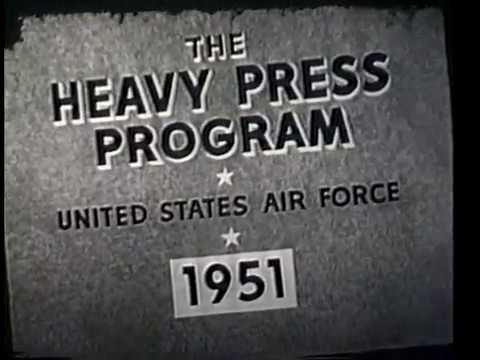
This US Air Force film shows how the development of heavy presses used for aircraft development came about. With the lessons learned from one domestic press and four presses acquired from Germany after the war, the Air Force has sponsored the building of some of the world’s largest and most powerful presses.
Retired military service veteran and vocational educator. Enjoy my posted videos. Thanks for watching and supporting my channel. Subscribe if you like.
[Source](https://www.youtube.com/watch?v=iZ50nZU3oG8)