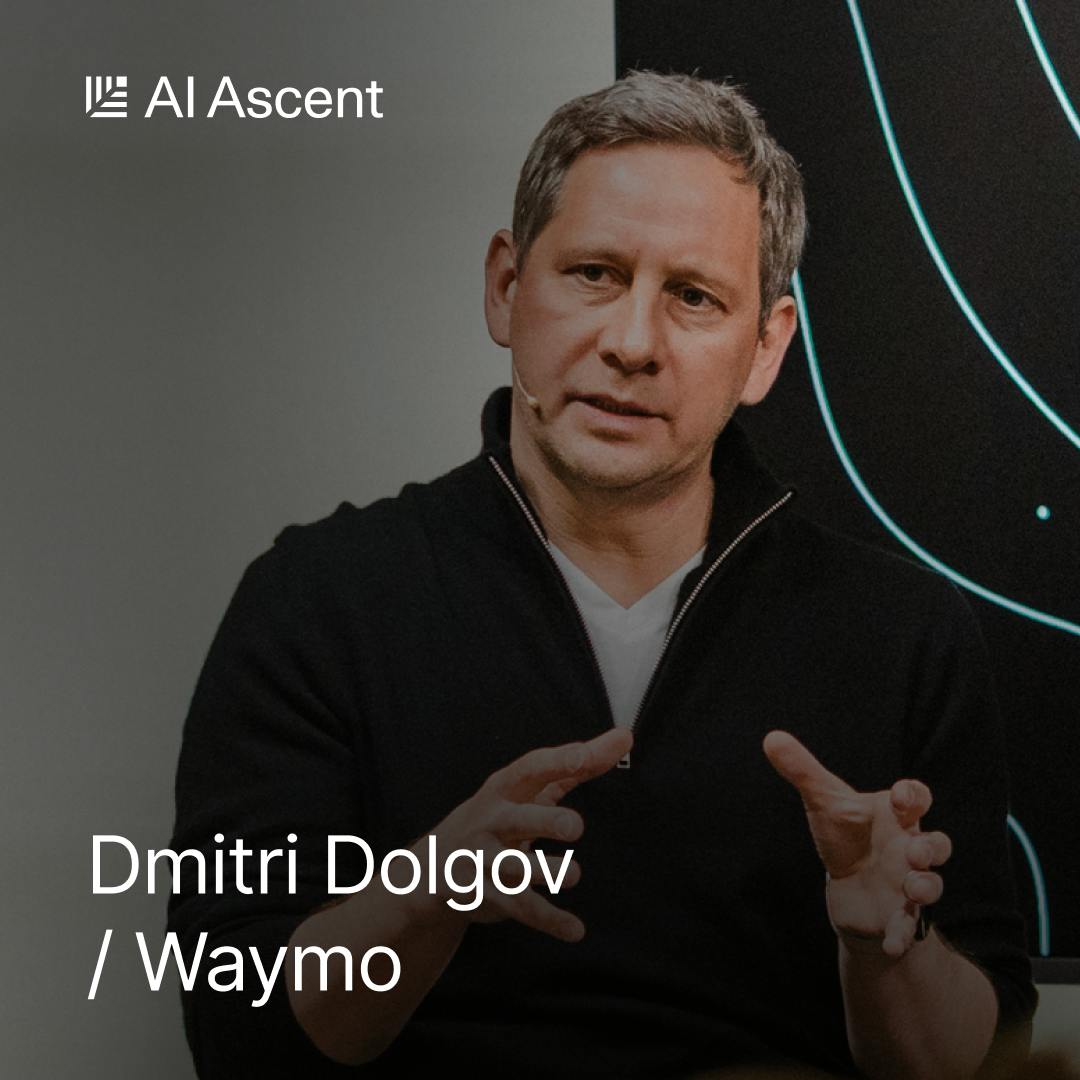
Waymo Commercializes Driverless Fleet Across 11 Cities as Rides Hit 20 Million
Sequoia Capital
Waymo has entered rapid parallel global commercialization after proving its autonomous driver architecture reduces serious injury collisions 13-fold compared to human drivers.
## Background
Published by Sequoia Capital on RSS / web on May 4, 2026, this episode features Waymo co-CEO Dmitri Dolgov in conversation with Sequoia partner Konstantine Buhler at AI Ascent 2026. According to the page description, the episode covers Dolgov's 20-year journey in autonomous driving, Waymo's focus on safety, their recent exponential scaling to 20 million rides, and technical details of the Waymo Foundation Model.
## TL;DR
Dmitri Dolgov reflects on two decades of autonomous driving development, from the early days of the 2005 DARPA Grand Challenge and Google's Project Chauffeur to operating fully autonomous rides across 11 cities. He breaks down the technical architecture of the Waymo Foundation Model—a multimodal world-action model powering the driver, simulator, and critic—and explains why structured intermediate representations remain vital for L4 safety. Highlighting Waymo's 6th-generation hardware and recent phase shift into rapid parallel commercialization, Dolgov shares safety benchmarks showing Waymo is over 13 times safer than human drivers and discusses upcoming international expansions to London and Tokyo.
## Atmosphere & style
The conversation carries a reflective yet highly energized vibe, blending deep technical rigor with the camaraderie of long-time AI insiders. Buhler's enthusiastic admiration as a daily Waymo user complements Dolgov's grounded, pragmatic humility as a pioneer who outlasted multiple industry hype cycles. The emotional arc moves from nostalgic storytelling about early startup struggles to a palpable sense of triumph and momentum as they unpack real-world safety impacts and future global expansion.
## Key takeaways
- `00:00` Waymo co-CEO Dmitri Dolgov brings nearly twenty years of autonomous driving experience, starting from the 2005 DARPA Grand Challenge and his academic background at MIPT and in the U.S.
- `02:45` Waymo began in 2009 as Google's self-driving car project, proving its initial concept by completing 100,000 autonomous miles and 10 difficult Bay Area routes in 18 months.
- `05:20` Waymo survived the post-2016 AV trough of disillusionment by accepting that technological breakthroughs solve initial capabilities quickly but leave a long tail of edge cases required for full autonomy.
- `09:50` The Waymo Foundation Model is a multimodal world-action-language model powering three interconnected pillars: the driver, the simulator, and the critic.
- `09:50` While the Waymo Foundation Model learns end-to-end representations, it incorporates structured intermediate representations to enable runtime safety validation, realistic simulation, and reinforcement learning.
- `15:20` Waymo's Generation 6 hardware platform, integrated into custom Zeekr vehicles, prioritizes cost reduction, high-volume manufacturability, and rider comfort over raw sensor count.
- `15:20` Waymo has entered an exponential scaling phase, serving over 20 million fully autonomous rides (10 million in the last 7 months) and expanding from 4 to 11 active cities.
- `20:00` Safety is treated as a non-negotiable foundation built into model architectures and training rather than retrofitted, driven by the urgency of 1.19 million annual global road deaths.
- `20:00` Across more than 170 million cumulative autonomous miles, the Waymo Driver is proven to be over 13 times safer than human drivers regarding serious injury collisions.
- `22:52` Advanced sensing and perception allow the system to infer hidden hazards, such as using LiDAR reflections underneath a bus to detect and yield to invisible pedestrian feet.
- `25:00` Waymo has transitioned from sequential technology de-risking to rapid parallel global commercialization, with planned expansions into international markets like London and Tokyo.
## Detailed walkthrough
Here is a detailed, faithful walkthrough of this section of the transcript, capturing the key facts, stories, and data points while silently correcting minor auto-generated speech-to-text errors.
---
`00:00` Intro: Two Decades of Persistence in Autonomous Driving
Konstantine Buhler opens the session by welcoming Dmitri Dolgov, co-CEO of Waymo, framing his trajectory as a story of rare, decade-spanning persistence. While many founders only entered the AI space around 2022, Dolgov has been actively building autonomous vehicle (AV) technology for nearly twenty years—weathering multiple hype cycles, tough periods, and industry downturns to build something singular. Before diving into the technical details, Buhler asks Dolgov to reflect on his background, growing up in the Soviet Union, moving to the United States, and later attending a world-class physics program in Moscow.
Dolgov explains that both of his parents attended the Moscow Institute of Physics and Technology (MIPT), and listening to their stories inspired him to follow in their footsteps. His upbringing involved a lot of moving around—including a year living in Japan and attending high school in the United States—before returning to Moscow for his undergraduate studies in math and physics. He credits MIPT with instilling his core technical foundation, emphasizing that the most valuable skill he gained during those early college years was learning how to learn and how to independently explore complex problems.
- **Audience engagement:** Buhler asks the room how many have ridden in a Waymo and how many loved it; nearly every hand in the room goes up, confirming Buhler's description of himself as a daily active user.
- **Academic trajectory:** Dolgov earned his undergraduate degree in math and physics from MIPT before completing his PhD in AI in the United States.
---
`02:45` The 2005 DARPA Challenge and the Early Days of Waymo
Dolgov describes his introduction to autonomous driving as a "light switch moment." Early in college and graduate school, he focused heavily on core fundamentals without a clear vision of his ultimate career path. However, as he was wrapping up his PhD around 2005, the DARPA Grand Challenge and subsequent Urban Challenge took off. The combination of deeply compelling technology, a high-stakes mission, a real physical product, and hands-on execution immediately clicked for him. He committed entirely to autonomy and never looked back.
Waymo originated in 2009 as the Google self-driving car project, spinning out of research tied to the Stanford Artificial Intelligence Laboratory (SAIL) and Stanford Automotive Innovation Center (SAIC). Buhler jokes about his own past choices—recalling how he worked on the solar car side of the building back then and "got that bet very wrong," whereas Dolgov bet on autonomy. Dolgov recounts how the early team of roughly a dozen people approached the problem space, working intense startup hours to achieve two seemingly impossible benchmark goals designed to prove out the core concept.
- **Goal 1:** Drive a cumulative total of **100,000 miles** in full autonomy.
- **Goal 2:** Complete **10 distinct 100-mile routes** across the Bay Area—specifically chosen for their high difficulty—from start to finish without a single safety intervention.
- **Timeline and workload:** A tiny team of about 12 people worked 24/7 for **18 months** to accomplish both goals, writing software and assembling hardware by day, then testing vehicles on public roads at night.
---
`05:20` Navigating the AV Hype Cycle and Building Stamina
Reflecting on the early days of Project Chauffeur (Google's internal codename for the self-driving car project), Dolgov highlights the intoxicating momentum of building a system from scratch. Engineers were personally configuring hardware, calibrating sensors and pose estimation systems, writing core control algorithms, and designing user interfaces all at once. Once those initial 100,000 miles proved the concept, the team doubled down to build a commercial, fully autonomous product.
When Buhler brings up the massive AV hype cycle of 2016–2017—followed by an intense industry slump where many competing startups folded or gave up—he asks how Waymo survived the trough of disillusionment. Dolgov observes that technological breakthroughs (whether convolutional neural networks, transformers, or large language models) consistently trigger rapid early progress and massive initial investment. However, AVs present a unique trick: "it's very easy to get started, but it's very difficult to take all the way to a real product, full autonomy, and superhuman performance." Waymo survived because the team understood that breakthroughs reshape the early part of the development curve without eliminating the long tail of edge cases.
- **Mission urgency:** Dolgov notes that worldwide, a person loses their life in a traffic crash roughly every **26 seconds**, giving the team the deep sense of purpose required to ignore silver bullets and outlast the slump.
- **Engineering mindset:** Avoiding quick fixes or superficial demos allowed Waymo to build the long-term stamina needed to achieve true full autonomy.
---
`09:50` Under the Hood: The Waymo Foundation Model Architecture
Transitioning to modern AI architecture, Buhler asks how Waymo views "world models" compared to industry buzzwords like visual-language-action (VLA) models or omni models. Dolgov explains that at the center of Waymo’s ecosystem is the **Waymo Foundation Model**, a multimodal world-action-language model that simultaneously powers three core pillars: **the driver, the simulator, and the critic**. The foundation model must master physical dynamics, 3D spatial properties, spatial geometry, and the behavioral tendencies of surrounding road actors (pedestrians, cyclists, and other vehicles).
Addressing the debate around pure "end-to-end" deep learning models (mapping raw sensor data directly to steering/acceleration commands), Dolgov notes that while the Waymo Foundation Model is technically end-to-end—learning rich joint representations between perception and planning without engineered interfaces—a basic "vanilla" end-to-end model is completely insufficient on its own for a safe, commercial, L4 autonomous product. To achieve superhuman safety at scale, Waymo augments its learned representations with **structured, materialized intermediate representations**.
- **Multimodal integration:** The model natively ingests and reasons across camera imagery, LiDAR point clouds, and radar data, while being aligned with Large Language / Vision-Language Models (VLMs) to tap into broader general-world knowledge and social semantics.
- **Why structured intermediates matter:** Materialized representations enable runtime safety validation on the physical vehicle, highly realistic closed-loop simulation/evaluations, and fine-grained reward functions for reinforcement learning.
- **Commercial vs. assist:** While driver-assist systems (L2) or prototype demos can rely on basic end-to-end neural nets, safe driverless scale requires the capability to incorporate human feedback, drop-in support, and explicit runtime bounds.
---
`15:20` Generation 6 Hardware and Exponential Scaling
Dolgov introduces Waymo’s 6th-generation driver hardware stack, emphasizing that while sensor performance has increased, the primary focus of Gen 6 was **drastic cost reduction, hardware simplification, and high-volume manufacturability**. Integrated into their latest custom vehicle platform built with Geely's Zeekr (referred to as the "OHI" or "Origin-Style" custom platform in internal/operational contexts), the vehicle is purpose-built around rider comfort. Dolgov shares his personal excitement riding in the driverless Gen 6 vehicle, pointing out its sliding automatic doors and spacious, living-room-like interior despite maintaining an external footprint similar to their Jaguar I-PACE fleet.
Buhler and Dolgov then unpack Waymo's current "phase transition" into exponential scaling. After spending years in slow research and development, the pace of commercial expansion has accelerated dramatically.
- **Miles scaled:** It took roughly 16 years to reach 100 million autonomous miles, but only about 6 months to reach 200 million.
- **Ride volume:** Waymo has served over **20 million fully autonomous rides** to date, with **10 million of those occurring in just the last 7 months**.
- **City launches:** While it took 8 years from starting fully autonomous operations to launch public commercial service across its first 4 cities, Waymo recently launched **4 new cities in a single day**, bringing its active footprint to 11 cities and counting.
- **Personal usage:** Dolgov relies on Waymo as his primary mode of transit, including his commute from Palo Alto to San Francisco over freeways. He shares that his three kids have grown up with Waymo and now get annoyed whenever they have to ride in a human-driven car, noting that the only two things that excite his kids on the road anymore are "doggies and Waymos."
`20:00` Safety as a Non-Negotiable Foundation and Superhuman Driving
Konstantine Buhler highlights the stark reality driving the mission: 1.19 million people die each year in road accidents across the globe, making this work a true matter of life or death that impacts virtually everyone. In a Silicon Valley culture famous for "move fast and break things," Waymo took a deliberately patient approach to safety. Dmitri Dolgov explains that challenging this status quo is what drives the entire company. Unlike standard consumer tech, safety cannot be retrofitted—it must be the non-negotiable foundation built into every layer from day one, including model architectures, training and evaluation recipes, and team mindset. While it is tempting to chase early capability to hit the first 90% quickly, solving the first 90% is a completely different engineering problem than achieving the remaining "nines" required for full autonomy.
Today, Waymo operates more than 4 million fully autonomous miles per week, backed by a dataset of over 170 million fully autonomous miles. In the cities where Waymo operates, the Waymo Driver is proven to be more than 13 times safer than a human driver regarding serious injury-causing collisions. At this scale, a 13x reduction translates to preventing a serious injury every eight days, an impact that will only compound as scaling continues. Dolgov shares a personal example where a young woman lost control of her electric scooter and fell directly in front of a vehicle; the Waymo Driver responded with superhuman accuracy and reaction time by swerving and braking, allowing everyone to walk away safely.
- **Global Road Fatalities:** 1.19 million human deaths per year globally on roads.
- **Weekly Autonomous Mileage:** Over 4 million fully autonomous miles driven per week.
- **Cumulative Autonomous Mileage:** Over 170 million fully autonomous miles driven to date.
- **Safety Metric:** More than 13x safer than human drivers regarding serious injury-causing collisions in operational cities.
- **Real-World Safety Impact:** Preventing a serious injury collision once every eight days.
---
`22:52` LiDAR Footstep Detection and the Physics of Reflection
Buhler brings up a remarkable anecdote about the system detecting a pedestrian hidden behind a bus, asking Dolgov to confirm how it occurred. Dolgov recalls this incident in San Francisco as an emerging capability that genuinely blew his mind. A Waymo vehicle was waiting at an intersection when a bus crossed and stopped, partially blocking the view. When the traffic light turned green and the Waymo vehicle began to proceed, it initiated defensive driving maneuvers for a pedestrian who was completely hidden behind the solid body of the bus—invisible through direct line of sight, standard camera views, or radar. Moments later, a pedestrian emerged from behind the bus, and the vehicle easily nudged around them.
The AI did not magically see through solid matter. Instead, the vehicle's LiDAR system fired beams underneath the body of the bus. The LiDAR signals bounced off the ground under the bus, picked up sparse returns from the movement of the pedestrian's feet, and reflected back to the sensor. The Waymo AI processed these subtle, sparse returns to not only infer that a person was standing behind the bus, but also to accurately predict their trajectory and proactively yield before the person ever stepped into view.
> "Our LiDAR was bouncing the signal under the bus and got a little bit of a sparse return from the movement of the person's feet under the bus. And that was enough for the Waymo AI to not only detect that there's a pedestrian there, but also make a prediction about what's going to happen."
---
`25:00` Rapid Parallel Commercialization and Global Expansion
Opening the floor briefly to the audience, investor Jim asks Dolgov to outline Waymo's vision for the business model, key operational milestones, and how major cities will evolve over the next five to ten years. Dolgov emphasizes that the team is fully in execution mode. Waymo has officially transitioned from sequential, intentional de-risking of the Driver technology and business mechanics into rapid parallel global commercialization.
Waymo is currently active in 11 cities with fully autonomous passenger service. Moving forward, the company is rapidly expanding service boundaries in existing markets, entering new American cities, and launching internationally. Dolgov officially highlights plans to roll out commercial services in major global metropolises, including London and Tokyo. Buhler closes the session by summarizing Waymo's trajectory—from early low-tech breakthroughs and surviving the AV hype cycles to advancing multimodal world models, driver-simulator-critic architectures, and 6th-generation hardware—praising Dolgov for his persistence, performance, and humility in saving lives.
- **Current Operational Footprint:** Fully autonomous commercial operations across 11 cities.
- **International Expansion Targets:** London and Tokyo announced for upcoming service launches.
- **Strategic Phase Shift:** Transitioned from sequential tech de-risking to rapid parallel global commercialization.
## Notable quotes
> `05:20` it's very easy to get started, but it's very difficult to take all the way to a real product, full autonomy, and superhuman performance. — Dmitri Dolgov
> `22:52` Our LiDAR was bouncing the signal under the bus and got a little bit of a sparse return from the movement of the person's feet under the bus. And that was enough for the Waymo AI to not only detect that there's a pedestrian there, but also make a prediction about what's going to happen. — Dmitri Dolgov
## Mentioned
Dmitri Dolgov, Konstantine Buhler, Waymo, Sequoia Capital, AI Ascent 2026, DARPA Grand Challenge, Urban Challenge, Moscow Institute of Physics and Technology, Stanford Artificial Intelligence Laboratory, Stanford Automotive Innovation Center, Waymo Foundation Model, Geely, Zeekr, Jaguar I-PACE, Waymo Driver, Jim, London, Tokyo
Waymo乘车次数突破2000万,在11座城市推进无人驾驶商业化
在证实其自动驾驶架构相比人类驾驶员将严重伤害碰撞事故降低13倍后,Waymo已迈入快速并行的全球商业化阶段。
Dmitri Dolgov回顾了自动驾驶二十年的发展历程,从2005年DARPA Grand Challenge早期阶段以及Google的Project Chauffeur,到如今在11座城市运营全自动驾驶乘车服务。他剖析了Waymo Foundation Model的技术架构——这是一个为驾驶系统、模拟器和评估器提供支持的多模态世界-动作模型,并阐释了为何结构化中间表征对L4级安全依然至关重要。Dolgov着重介绍了Waymo第六代硬件以及近期向快速并行商业化的阶段性转变,分享了显示Waymo比人类驾驶员安全13倍以上的安全基准数据,并探讨了即将向伦敦和东京进军的国际扩张规划。
Waymo 联合 CEO Dmitri Dolgov 回顾了从 DARPA 挑战赛到谷歌自动驾驶项目的 20 年历程,强调面对行业幻灭期,唯有正视长尾极端工况并坚持安全第一的底线思维,才能跨越技术炒作周期实现真正的全无人驾驶。 (5:20)
技术架构方面,多模态世界-动作模型 Waymo Foundation Model 协同驱动着驾驶员、模拟器与评估器三大支柱,通过将端到端表征与结构化中间表征相结合,兼顾了深度学习泛化能力与 L4 商业化运行时的安全验证。 (9:50)
商业化进程迎来指数级扩张:Waymo 累计全无人驾驶订单已突破 2000 万次(其中 1000 万次发生于最近 7 个月),服务城市扩充至 11 个,并推出了依托极氪定制平台、着力降本与高量产可行性的第 6 代硬件套件。 (15:20)
安全表现已超越人类基准:Waymo 全无人驾驶周里程超 400 万英里,严重伤人碰撞率比人类司机降低 13 倍以上(相当于每 8 天避免一起重大伤人事故),公司下一步将向伦敦、东京等国际大都市推进商业化落地。 (20:00)
Reading summary
Waymo co-CEO Dmitri Dolgov argues that reaching true commercial autonomy requires rejecting superficial development shortcuts in favor of long-term architectural rigor, safety-first validation, and multimodal foundation models. After years of deliberate technical de-risking, Dolgov asserts that Waymo has entered an exponential growth phase capable of transforming global transit safety.
Surviving Hype Cycles and the Long-Tail Problem (5:20)
Autonomous vehicle development originated in high-intensity research, such as the 2005 DARPA challenges and Google's 2009 Project Chauffeur, where a 12-person team spent 18 months driving 100,000 autonomous miles and completing ten 100-mile Bay Area routes without interventions. While early breakthroughs in neural networks consistently create rapid initial progress, Dolgov observes that solving the first 90% of autonomous capability is fundamentally different from solving the long tail of edge cases required for full L4 autonomy.
Dolgov attributes Waymo's survival through the industry's post-2016 downturn to an refusal to rely on superficial demos or silver-bullet fixes. Driven by the reality that road collisions claim a human life roughly every 26 seconds globally, the engineering team prioritized long-term technical stamina over quick commercialization, systematically addressing rare edge cases rather than settling for assisted-driving capabilities.
Architectural Balance: Foundation Models and Explicit Constraints (9:50)
At the core of Waymo's modern stack is the Waymo Foundation Model—a multimodal world-action-language system that unifies the driver, the simulator, and the critic. The model ingests camera, LiDAR, and radar data, linking physical dynamics and 3D spatial geometry with high-level semantic reasoning derived from vision-language models.
Dolgov distinguishes Waymo's approach from basic 'vanilla' end-to-end machine learning systems that map raw sensor data directly to vehicle controls. While the architecture jointly learns perception and planning, Waymo deliberately incorporates structured, materialized intermediate representations. According to Dolgov, these explicit representations are essential for commercial L4 safety because they enable runtime safety validation on the vehicle, power realistic closed-loop simulation, and provide granular reward signals for reinforcement learning.
Hardware Optimization and the Inflection to Scale (15:20)
Waymo's commercial scaling relies on its 6th-generation hardware suite, integrated into a custom vehicle platform developed with Geely's Zeekr. Dolgov explains that while Gen 6 improves sensor capability, its primary engineering objectives are aggressive cost reduction, structural simplification, and high-volume manufacturability suited for passenger comfort.
This hardware maturity has coincided with an operational inflection. While Waymo required roughly 16 years to log its first 100 million autonomous miles, accumulating the second 100 million took only six months. The platform has completed over 20 million fully autonomous commercial rides—with 10 million delivered in the last seven months alone. After taking eight years to roll out commercial operations in its first four cities, Waymo launched four new markets in a single day, expanding its active footprint to 11 cities.
Superhuman Safety Metrics and Physical Sensing Limits (20:00)
Dolgov rejects the Silicon Valley paradigm of 'move fast and break things,' asserting that automotive safety cannot be retrofitted and must serve as the primary constraint in model design and operational testing. Operating over 4 million fully autonomous miles weekly across a 170-million-mile dataset, Waymo reports that its Driver is more than 13 times safer than human drivers regarding serious injury collisions in its operational zones, which Dolgov notes prevents a serious injury every eight days.
This benchmark is supported by advanced multimodal sensing capabilities that extend beyond human perception. In one documented incident, the system initiated defensive yielding for a pedestrian entirely obscured by a stopped transit bus. The vehicle's LiDAR bounced beams beneath the chassis of the bus, detected sparse returns from the pedestrian's moving feet, and inferred their trajectory before the person stepped into direct visual range.
Waymo has transitioned from sequential technical de-risking into parallel global commercialization, with planned expansions into complex international environments such as London and Tokyo. However, scaling will test whether the company's foundation model architecture and cost-reduced Gen 6 hardware can adapt seamlessly to disparate regulatory structures, unfamiliar driving behaviors, and dense international urban layouts.
## Background
本期内容由红杉资本(Sequoia Capital)于 2026 年 5 月 4 日在 RSS 及网络平台发布,记录了在 AI Ascent 2026 大会上红杉合伙人 Konstantine Buhler 对 Waymo 联合首席执行官 Dmitri Dolgov 的深度专访。节目聚焦 Waymo 从 DARPA 大挑战赛起步深耕近二十年、穿越自动驾驶炒作周期的历程,探讨其如何以安全为铁律实现指数级规模扩张,并深入揭秘了驱动其驾驶员、仿真器与评价器的底层多模态世界动作模型(Waymo Foundation Model)。
## TL;DR
对话系统回顾了 Waymo 从早年 Google Project Chauffeur 的“双百挑战”到如今在全美 11 个城市实现全无人商业化运营的演进全貌。Dolgov 深度剖析了 Waymo 的技术护城河:基石大模型融合端到端表征与结构化显式验证,使车辆在严重人身伤害事故率上比人类安全 13 倍以上,甚至能利用激光雷达在底盘下方的稀疏地面反射精准预判盲区行人。此外,随着第六代基于极氪平台的“移动客厅”式无人车落地,Waymo 的商业化已从早期的串行去风险阶段彻底转向单日拓展 4 城的快速并行全球扩张,年内还将进军伦敦与东京。
## Atmosphere & style
整场对谈洋溢着极客情怀与深沉使命感的交织,既有硅谷早期睡办公室焊硬件、标定传感器的硬核创业怀旧,又有直面全球交通事故伤亡现实的严谨与敬畏。Dolgov 展现出顶级技术领袖特有的沉稳、谦逊与克制,在谈及底盘激光反射等技术涌现与孩子们对无人车习以为常的生活趣事时,语气中又流露出难以掩饰的兴奋与自豪。Buhler 的主持节奏张弛有度,现场观众互动热烈,整体氛围兼具前沿技术的深度思辨与马拉松式坚守终见曙光的崇高感动。
## Bulletin
- `16:55` Waymo 累计全无人付费出行已突破 2000 万次,其中 1000 万次发生在最近 7 个月内,商业里程从 1 亿英里跃升至 2 亿英里仅用时约 6 个月,业务迎来指数级相变扩张。
- `20:00` 在全自动驾驶涉及严重人身伤害的事故率上,Waymo 经海量现实数据验证比人类驾驶员安全 13 倍以上,以目前车队运营规模每 8 天即可避免一起严重伤害事故。
- `10:00` Waymo 技术底座由基石大模型(Waymo Foundation Model)构成,作为多模态世界动作语言模型,统一驱动驾驶员(Driver)、闭环仿真器(Simulator)与评价器(Critic)三大支柱。
- `25:00` Waymo 正式迈入快速并行的全球商业化阶段,已在全美 11 个城市上线全自动驾驶服务,并计划于年内将无人出租车拓展至英国伦敦和日本东京。
## Key takeaways
- `02:30` Dmitri Dolgov 经历深厚的数理与 AI 学术训练,在参与 DARPA 城市挑战赛时确立了用自动驾驶改变物理世界、拯救人类生命的终身使命。
- `03:45` Google 自动驾驶项目早期仅靠十几人的微型团队,在 18 个月内攻克了 10 万英里行驶及 10 条百英里极难路线零接管挑战,验证了全自主驾驶商业化的工程可行性。
- `06:54` 面对 AI 行业的泡沫与寒冬周期,底层算法演进虽能大幅降低初期门槛,但无法消除长尾效应(long tail)的技术难度,唯有敬畏安全底线方能跑赢马拉松。
- `10:00` Waymo 基石模型是结合 3D 几何、动力学推演与通用语言常识的多模态世界动作模型,为驾驶决策、环境仿真与安全评估提供一致的物理世界理解。
- `12:35` Waymo 认为纯端到端与模块化之争是伪命题,端到端高维特征必须融合结构化中间表征,才能提供超人级无人驾驶所必需的运行时安全验证与强化学习闭环。
- `15:20` 第六代 Waymo Driver 与极氪(Zeekr)合作打造专属无人车平台,不仅大幅精简传感器降本以面向大规模量产,更通过取消前排限制重塑出起居室般的座舱体验。
- `16:55` 从早期的“8 年开拓 4 城”蜕变到“单日上线 4 城”,基石模型的跨城市泛化能力彻底打破了地域扩张瓶颈,主要限制仅剩高精度的安全验证流程。
- `16:55` Waymo 已经在部分地区实现端到端的高速公路全自动驾驶,新生代儿童成长于无安全员无人车环境中,甚至已将无人驾驶视为理所当然的出行常态。
- `20:00` 构建自动驾驶系统的核心文化在于安全不可妥协,实现模型能力的最初 90% 相对容易,但攻克后续“无数个 9”的极端长尾需要完全不同的工程思维与体系化底座。
- `20:00` 旧金山路口的真实感知案例显示,车载激光雷达通过底盘与路面缝隙的反弹光束捕获到了遮挡行人双脚的稀疏点云,AI 成功据此实现防御性避让,展现出惊人的长尾涌现能力。
- `25:00` Waymo 商业发展策略已从早期的“串行去风险化”彻底转入“快速并行全球落地”,在持续深化全美 11 城运营的同时,加速推进英国伦敦与日本东京的国际化布局。
## Detailed walkthrough
### `00:00` 开场:近二十年的自动驾驶坚守与早期求学生涯
红杉资本(Sequoia Capital)合伙人 Konstantine Buhler 热情开场,现场询问台下观众有多少人坐过 Waymo,几乎全场举手;当问及谁喜欢 Waymo 的乘坐体验时,全场更是反响热烈,Buhler 坦言自己现在就是 Waymo 的高频日常活跃用户(DAU)。他随后向大家隆重介绍了 Waymo 联合首席执行官(co-CEO)Dmitri Dolgov——对于 2022 年后才入局的 AI 创业者而言,Dolgov 已经在这条极其艰难的赛道上全情投入了近 20 年,历经行业的所有繁荣与低谷,最终造就了举世瞩目的产品。
谈及个人早期背景,Dolgov 出生于苏联,在美国长大,期间还在日本生活过一年,随后做出一个常人看似罕见的决定:返回莫斯科物理技术学院(MIPT)攻读数学与物理。Dolgov 解释,这所顶级学府也是他父母的母校,他从小听着那里的传奇故事长大;这段严苛的数理训练不仅奠定了极度深厚扎实的技术底座,更关键的是教会了他如何高效地自主学习、独立探索未知,为日后的工程科研生涯打下了关键基石。
- Dmitri Dolgov 的个人特质被团队评价为:技术极其过硬(technically brilliant)、高强度与拼搏(incredibly intense),同时待人亲和且极度谦逊(kind and humble)。
- 求学历程覆盖多国:在美读高中、在日本生活一年,后返回俄罗斯顶尖名校莫斯科物理技术学院(MIPT)打下数理底子,再攻读 AI 方向博士。
---
### `02:30` DARPA 挑战赛:点亮自动驾驶使命的“开关时刻”
在攻读人工智能(AI)博士学位期间,Dolgov 迎来了人生的转折点。2005 年前后,DARPA 大挑战赛(Grand Challenge)及随后的城市挑战赛(Urban Challenge)相继拉开帷幕。对当时的 Dolgov 而言,这如同被瞬间按下了思想的“电灯开关(light switch moment)”。此前他在大学和研究生阶段虽然一直在钻研基础理论,但对未来长远的具体方向并不清晰,而自动驾驶的横空出世,将极其迷人的前沿科技、直面物理世界的产品落地,以及挽救生命的崇高使命完美融合在一起。
Buhler 穿插了一段当年的趣事:Waymo 最早脱胎于斯坦福汽车实验室(Stanford Automotive Lab),那栋大楼一侧做自动驾驶,另一侧做太阳能车;Buhler 自嘲当年怀揣理想主义押注了太阳能车,事实证明完全押错了赛道,而 Dolgov 则坚定地选择了自动驾驶并深耕至今。
- **入局契机**:博士毕业之际恰逢 DARPA 城市挑战赛,Dolgov 亲身参与其中,被这项技术深深吸引。
- **核心吸引力**:不仅是技术硬核,更因为这是一项可以亲自上手触碰、改变物理世界、有着巨大现实社会价值的使命,自此 20 年从未动摇。
---
### `03:45` Google 自动驾驶早期:18 个月啃下“双百挑战”
2009 年,Google 自动驾驶项目(Project Chauffeur,Waymo 的前身)正式启动。早期团队规模极小,只有十几个人,完全处于一种高强度的“硬核初创状态”:白天忙着焊硬件、校准传感器和编写控制核心代码,夜晚则在路面上实测调试。为了彻底摸清在公开道路上运行自动驾驶系统的技术边界,团队给自己设立了两个在当时看来犹如天方夜谭的硬指标:
```mermaid
flowchart TD
accTitle: Project Chauffeur 早期验证路径
accDescr: 展示了 2009 年 Waymo 早期团队设定的两大极限里程碑以及最终达成时间。
subgraph S1["目标设定 (2009)"]
M1["目标 1:累计全自动驾驶里程<br/>达到 100,000 英里"]
M2["目标 2:10 条百英里极难路线<br/>湾区复杂路段 / 零人工接管"]
end
subgraph S2["执行状态"]
E["约 12 人核心极客团队<br/>白加黑 24/7 软硬件全栈迭代"]
end
subgraph S3["成果落地"]
R["历时 18 个月<br/>全部挑战圆满达成"]
end
M1 --> E
M2 --> E
E --> R
```
尽管车上配有安全员可以随时接管,但规则要求那 10 条长达 100 英里、穿越湾区最险峻复杂路段的路线,必须从头到尾在“零接管(zero intervention)”的前提下完全自主开完。团队仅用了 18 个月就攻克了这一巨大里程碑,也正是这次严苛验证,让团队确信这项技术真正具备商业化落地为全自主产品的可行性。
---
### `05:40` 硅谷狂飙岁月:全栈亲历的极客黄金时代
回顾那段常年睡在办公室的拼搏岁月,Dolgov 动情地表示那是自己职业生涯中“最快乐、最过瘾的时光”。当时团队极度精简,每一个人都在高密度的实战中以惊人的速度学习和迭代。团队不仅要亲手将各类传感器安装上车、标定传感器、调试位姿估计算法(pose estimation),还要自研车端底层的决策规划与控制算法,甚至涵盖车内的所有调试工具、人机交互与用户界面(UI)。这种“每小时都在目睹实际进展”的强大势能,锻造了他日后求真务实、深入底层的技术领导风格。
- **工作范畴**:横跨硬件配置、传感器校准、位姿解算、端到端核心算法,乃至车载交互 UI。
- **团队心力**:在极快反馈循环下以近乎疯狂的速度学习进化,完成了从实验室原型向工程化系统的扎实蜕变。
---
### `06:54` 穿越炒作周期:用长尾敬畏抵御行业幻觉
谈到 2016-2017 年的自动驾驶狂潮与随后的资本寒冬,Buhler 提到大量同行在泡沫破裂后纷纷放弃或瓦解,而 Waymo 却始终巍然屹立。Dolgov 分享了他对 AI 行业周期律的深刻洞察:每一次重大底层算法突破(如早期的卷积神经网络 CNN、后来的 Transformer 或大语言模型 LLM),都会大幅降低入门门槛,在技术探索的初期带来迅猛进展,进而引发资本与市场的过度乐观。然而,自动驾驶的本质规律是“极易入门,但极难做成超越人类安全水平的完整产品”。
在 Dolgov 看来,新的技术架构能够重塑技术曲线的前半段,却丝毫无法消除长尾效应(the long tail)的客观难度。支撑 Waymo 熬过寒冬的,是对这一客观规律的敬畏,以及对核心使命的笃定——全球平均每 26 秒就有一人因道路交通事故丧生,自动驾驶是在拯救真实的生命。不被速胜论所诱惑,不迷信单点“灵丹妙药(silver bullets)”,保持足够的战略定力,才让 Waymo 跑赢了这场漫长的马拉松,为行业迎来了今日如魔法般安全可靠的产品体验。随即,对话切入技术核心:在当今业界热议“世界模型(World Models)”的当下,Waymo 的技术体系是如何构建与理解世界模型的?
- **周期诱因**:技术阶跃(CNN、Transformer、LLM 等)往往会让起点阶段的开发显得非常容易,引发过热投资与虚高预期。
- **长尾现实**:技术革新能重构前期的性能爬坡,但无法跳过最硬核的长尾安全问题。
- **破局心法**:拒绝走捷径,牢记全球道路“每 26 秒损失一条生命”的安全使命,以超长耐力直面深水区挑战。
### `10:00` Waymo 基石大模型:驱动驾驶员、仿真器与评价器的多模态世界动作模型
在当前 AI 领域,业内充斥着“世界模型”(World Models)、“世界动作模型”(World Action Models)、“全模态模型”(Omni Models)和“视觉-语言-动作模型”(VLA)等各种新兴概念。Dmitri Dolgov 强调,无论命名如何变化,其核心本质对于 Waymo 的 AI 生态系统始终至关重要。Waymo 技术栈的核心被称为 **Waymo Foundation Model(Waymo 基石模型)**,它同时驱动着三大支柱体系:负责实时控制车辆的“驾驶员”(Driver)、构建闭环推演环境的“仿真器”(Simulator),以及衡量行为优劣的“评价器”(Critic)。这三项任务虽然紧密关联但各有分工,要求底层基石模型不仅要掌握物理世界的运行规律、运动力学,还要深入理解怎样才算是一名优秀的驾驶员,并准确推演自动驾驶汽车的动作会对周围其他交通参与者产生何种连锁反应。
为了实现这一目标,Waymo 多年来打磨的基石模型本质上是一个多模态世界动作语言模型(Multimodal World Action Language Model)。它具备多模态特性,不仅能处理图像与视频流,还能对激光雷达(LiDAR)和毫米波雷达(Radar)的 3D 几何点云进行联合推理;同时它是一个世界动作模型,对 3D 空间属性、动力学物理规律以及汽车、行人、骑行者等主体的行为逻辑具有精准把握,而且模型本身具备“可控性”(Controllable),因为自动驾驶车不是物理世界的旁观者,而是积极的参与者;最后,它与自然语言实现对齐,从而将视觉语言模型(VLM)的海量通用常识迁移进来,极大增强了系统对复杂交通语义和社会化交互潜规则的理解。
```mermaid
flowchart TD
accTitle: Waymo 基石模型核心架构
accDescr: 展示多模态传感器输入如何通过 Waymo 基石大模型赋能驾驶员、仿真器与评价器三大支柱。
subgraph Sensors["多模态输入源"]
S1["LiDAR 激光雷达点云"]
S2["高清摄像头图像/视频"]
S3["毫米波雷达与物理先验"]
S4["语言常识与语义对齐 (VLM)"]
end
subgraph FoundationModel["Waymo 基石模型 (Waymo Foundation Model)"]
FM["多模态世界动作语言大模型<br/>(3D 物理动力学推演 + 交互决策意图建模)"]
end
subgraph Pillars["核心驱动支柱"]
P1["Driver 驾驶员<br/>(车载物理实体实时决策与控制)"]
P2["Simulator 仿真器<br/>(可控交互式闭环仿真世界)"]
P3["Critic 评价器<br/>(安全评判与强化学习奖励函数)"]
end
Sensors --> FoundationModel
FoundationModel --> Pillars
```
- **三大支柱**:驾驶员(Driver)、仿真器(Simulator)、评价器(Critic)共享相同的世界理解与物理规律先验。
- **世界动作特性**:具备对物理空间中车辆、行人、自行车动态行为的因果推演能力,而非静态场景预测。
- **语言对齐优势**:利用通用大模型的常识储备,理解复杂路况下的社会化交往语境(如手势、特殊路标和非言语互动)。
---
### `12:35` 超越纯粹端到端:结构化中间表征与超人级安全验证
针对业界广泛争论的“端到端架构(End-to-End)与传统模块化架构”之争,Dmitri 直截了当地指出,这实际上是一个“伪命题”(false dichotomy)。Waymo 的基石模型本身就是一个端到端模型,它能够直接将传感器原始输入映射为最终的决策动作,这种架构的最大优势在于能够让编码器(Encoder)与解码器(Decoder)、感知层与规划层之间自主学习到丰富而统一的高维特征表示,彻底避免了人工手写规则接口在应对极端复杂驾驶场景时的脆弱性。然而,Dmitri 强调技术路线的关键从来不是“端到端还是其他”,而是“端到端,然后呢?”("end-to-end and then what else?")。
如果目标仅仅是做一个原型系统(Demo)、小规模测试或者辅助驾驶(ADAS),纯粹的基础端到端(Vanilla E2E)或许可行;但如果要实现真正无安全员的完全自动驾驶,达到超越人类水准(superhuman level)的极高安全性,并支撑起数亿英里的商业化规模运营,纯端到端系统就远远不够。因此,Waymo 采取的策略是将学习到的高维连续表征与“结构化、具体化的中间表征”(structured, materialized, intermediate representation)深度融合。这种设计使系统在实际物理道路运行时能够拥有独立的运行时安全验证(Runtime Validation),并在离线端支持高精度的闭环评估、闭环训练以及强化学习奖励函数构建,从而能够顺畅吸收人工客服干预与运营支持的反馈数据。
- **核心架构理念**:拒绝二元对立,采用“端到端学习 + 结构化显式验证”的双重保障机制。
- **纯端到端缺陷**:基础端到端黑盒缺乏可解释性与运行时硬性约束,无法支撑大规模无人驾驶苛刻的超人级安全要求。
- **强化学习与反馈闭环**:结构化中间层为仿真器中的闭环评估、强化学习奖励模型(Reward Function)以及人类支持介入反馈提供了精准锚点。
---
### `15:20` 第六代 Waymo Driver 与极氪平台:从出行工具到“移动起居室”
在推进软件算法迭代的同时,Waymo 的硬件平台也迎来了跨越式升级——推出了第六代 Waymo Driver。Dmitri 阐述,第六代硬件套件不仅是 Waymo 迄今为止性能最强、感知精度最高的传感器与计算架构,其核心目标更是围绕大幅精简系统、大幅降低制造成本以及面向大规模量产进行设计的。该硬件套件率先搭载于 Waymo 与吉利极氪(Zeekr)合作打造的新一代定制化自动驾驶出行专属车辆平台。今年早些时候,该平台已在全无人驾驶状态下投入运营,率先面向 Waymo 内部员工开放测试,并计划在今年晚些时候向广大公众乘客全面推出。
Dmitri 生动地回忆起自己第一次乘坐第六代全自动驾驶车辆时的震撼体验。作为几乎在 Waymo 每一代测试车里都度过了大量职业生涯的研发老将,他表示这种“崭新的第一次体验”依然让他无比兴奋。虽然新车的外廓尺寸与上一代捷豹 I-PACE 相当,但由于专为无人驾驶乘客体验设计,车内空间利用率发生了质的飞跃:“一坐进去,感觉就像走进了一间客厅。”车内后排拥有巨大的腿部和活动空间,配备了全新的车载交互屏幕;当乘客靠近车辆时,双侧电动侧滑门会自动缓缓滑开迎宾。Dmitri 兴奋地感叹自己“玩得不亦乐乎”,迫不及待想看到这款车全面进入 Waymo 车队服务全球用户。
- **第六代设计重点**:在保持超高感知性能的同时,聚焦传感器精简、降本与工业化大规模量产。
- **空间体验突破**:打破传统乘用车前排驾驶位限制,在紧凑外部尺寸下营造出类似“起居室”(living room)的极度宽敞座舱。
- **人性化交互**:集成自动感应滑门、后排专属显示屏与全平地板,带来全新的共享出行体验。
---
### `16:55` 指数级扩张与日常生活:从 8 年 4 城到单日 4 城
谈及 Waymo 当前的商业化进展,Dmitri 确认公司已经迎来了业务扩张的“相变”(phase transition),彻底跨入指数级增长曲线。他分享了一组对比鲜明的惊人数据:从 Waymo 最初开启全无人自动驾驶运营算起,团队用了整整 8 年时间才将无人出租车服务推广到全美 4 个城市;而就在今年早些时候,Waymo 在短短一天之内就同时上线了 4 座新城市。截至目前,Waymo 已累计完成超过 2000 万次全无人付费出行服务,令人惊叹的是,其中整整 1000 万次都是在最近 7 个月内完成的。以往需要 16 年才能积累 1 亿英里测试里程,如今从 1 亿英里跃升至 2 亿英里仅耗时约 6 个月。
Dmitri 拆解了进驻新城市的落地路径:首先是地面前期运营,包括数据采集、道路环境特征提取与模型验证;其次是与当地社区展开深度沟通以赢得信任,因为自动驾驶对公众而言依然是崭新事物;而得益于基石大模型的强大泛化能力,系统跨城市泛化的速度已远超以往,主要的瓶颈仅在于高精度的严格验证与安全评估流程。
在个人生活层面,Dmitri 透露 Waymo 已经完全成为他生活中的主力交通工具。他当天正是乘坐 Waymo,从帕洛阿尔托(Palo Alto)一路通过全自动高速公路行驶抵达旧金山的活动现场。他的三个孩子从小就在 Waymo 的陪伴下长大,甚至已经习惯了没有人类司机的出行方式。Dmitri 笑着分享了一件家庭趣事:“现在如果我们极偶尔必须坐一次由我、我妻子或者其他人驾驶的车,孩子们甚至会觉得烦躁,不解地问:‘这车怎么回事?’”他打趣道,现在带着孩子们开车在路上转悠时,能引起孩子们兴奋尖叫的唯独只有两件事——一个是路边的小狗,另一个就是驶过的 Waymo 汽车。
- **扩张速度相变**:
- 过去需要 8 年时间进入 4 座城市,如今实现单日内同时开通 4 城。
- 累计交付 2000 万次无人出行订单,其中 1000 万次是在最近 7 个月内完成。
- 商业里程从 1 亿英里增长至 2 亿英里仅用时约 6 个月。
- **高速公路常态化**:已实现端到端的高速公路全自动驾驶(如从帕洛阿尔托直达旧金山)。
- **原生代认知转变**:新一代儿童将无人驾驶视为理所当然,对传统人类驾驶汽车反而感到反常与不适。
### `20:00` 安全文化与超人表现:从拒绝妥协到底盘下的微弱回波
Konstantine Buhler 提出,与 Waymo 合作最令人触动的地方在于其背后的沉重现实:全球每年约有 119 万人因交通事故丧生,这是一场关乎生死的考验,几乎每个人身边都有直接或间接被车祸波及的亲友。硅谷长期盛行“快速行动、打破常规”(move fast and break things)并看看会发生什么的风气,而 Waymo 却从第一天起就对安全性展现出非凡的耐心与执着。Dmitri Dolgov 坦言,这组触目惊心的数据正是驱动所有 Waymo 员工的核心动力,公司全员都将“挑战现状、拒绝接受现有安全水平”深植于心。在构建此类系统时,方法论与通常的科技行业截然不同:安全绝非附属品,而是不可妥协的基础底座(non-negotiable fundamental layer)。它必须从第一天起融入模型架构设计、训练评估方案乃至团队的思维模式中。Dmitri 警告道,专注于模型能力以迅速达到 90% 是极具诱惑力的,但如何攻克第一个 90%,与如何拿下后续的“众多 9”(next N 9s)完全是性质不同的难题。
如今 Waymo 每周全自动驾驶行驶里程已超过 400 万英里,累计完成超过 1.7 亿英里的全自动驾驶里程。真实世界的海量数据清晰表明,在开展运营的各大城市中,涉及严重人身伤害的碰撞事故发生率上,Waymo 自动驾驶系统比人类驾驶员安全 13 倍以上。这种“超越人类”(superhuman)的安全表现每天都在街头上演。Dmitri 分享了一起真实的突发案例:一名年轻女子在马路上骑着电动滑板车突然失控摔倒,正好摔在一辆正在行驶的 Waymo 车辆正前方。Waymo 系统在极短瞬间展现出了超人类的精准度与反应时间,迅速执行避让变道与紧急刹车,最终女子安然脱险。在目前的运营规模下,相比人类驾驶水平,13 倍的安全提升意味着 Waymo 每 8 天就能在现实世界中阻止一起严重伤害事故,而且这种社会影响力将随车队扩张呈现滚雪球般的增长。
紧接着,Buhler 问起业界流传的一个传奇案例:传闻 Waymo 曾依靠传感器“透过”公交车探测到了行人的脚步,这到底是如何发生的?Dmitri 证实了这一事件,并感叹这是系统“涌现能力”(emerging capability)带给他最大的惊喜之一。当时场景发生在旧金山的一个十字路口,Waymo 车辆在红灯前停下等待,一辆公交车横向穿过并在路口部分阻挡了前方的直行车道。当 Waymo 侧绿灯亮起、车辆开始向前起步时,系统突然侦测到公交车另一侧有行人动向,并主动开始采取防御性动作。从物理视线上看,无论是激光雷达(LiDAR)、雷达(Radar)还是摄像头,都无法直接穿透公交车的金属实体车身,车窗反射的也全都是车内乘客的景象。但随后,一名行人确实从公交车后方露出身影,Waymo 车辆早已提前减速微调绕行,大家平安通过。事后排查发现,尽管系统无法穿透坚固物体,但车载激光雷达的激光信号打到了地面上,在公交车底盘与路面之间的狭小缝隙中发生多重反弹,恰好捕捉到了行人在底盘另一侧移动的双脚所产生的稀疏点云回波(sparse return)。Waymo 的 AI 模型不仅凭借这一微弱信号识别出了行人的存在,更精准预测了其行进轨迹与行为,从而实现了惊人的防御性避让。
```mermaid
flowchart TD
accTitle: 激光雷达底盘反弹探测行人流程
accDescr: 描述激光雷达在无法直接穿透公交车车身的情况下,通过地面反弹探测行人双脚微弱信号并触发防御性避让的过程。
subgraph Sense ["物理感知与信号捕捉"]
A["Waymo 绿灯起步推进"] --> B["视线受阻:公交车阻挡路口"]
B --> C["LiDAR 光束射向地面"]
C --> D["光线在公交车底盘与地面缝隙反弹"]
D --> E["捕捉到行人双脚移动的稀疏点云回波"]
end
subgraph ReasonAndAct ["AI 预测与控制"]
E --> F["Waymo AI 识别潜在行人实体"]
F --> G["预测行进轨迹:即将走出车体后方"]
G --> H["执行防御性减速并微调绕行 (Nudge)"]
H --> I["行人现身,车辆安全擦肩通过"]
end
```
- 全球道路安全现状:每年约有 119 万人因交通事故丧生。
- 当前运营里程指标:每周全自动驾驶里程超过 400 万英里,累计自动驾驶里程突破 1.7 亿英里。
- 安全对比数据:在产生严重伤害的事故维度上,Waymo 比人类驾驶员安全 13 倍以上。
- 实际减损成效:按照现行车队行驶规模计算,每 8 天即可避免一起严重人身伤害事故。
- 底盘感知案例:在旧金山交叉路口,利用激光雷达在底盘下方路面的反射光捕获稀疏回波,在盲区提前判断遮挡行人动向。
---
### `25:00` 商业化演进与未来愿景:从序列去风险到全球并行扩张
在现场问答环节中,观众席上的 Jim 提问:站在未来 5 到 10 年的时间维度,Waymo 的商业模式与未来里程碑会经历怎样的蜕变?在各大主要城市中,未来与当下的状态会有哪些核心不同?Dmitri 回答道,Waymo 现已全面进入低头苦干的高效执行阶段(heads down in execution mode)。公司在战略上完成了一次根本性跨越:此前数年是“深思熟虑、按部就班的串行去风险阶段”(intentional sequential de-risking),逐步验证司机系统的可行性与各项核心业务构件;而现在则全面转向“快速并行的全球商业化落地阶段”(rapid parallel global commercialization)。
在地域版图上,Waymo 目前已在全美 11 个城市开展全自动驾驶服务,运送真实乘客。接下来的计划不仅要在现有城市大幅扩容服务密度和覆盖范围,还将开辟更多新的地理区域。不仅如此,全球化拓展也已正式拉开序幕:Waymo 已经宣布计划在年内将服务带到英国伦敦和日本东京。最后,Konstantine Buhler 为全场对谈进行总结,回顾了从早期简单技术长途测试,到穿越无人驾驶寒冬、攻坚核心“硬骨头”的长跑之路;梳理了 Waymo 基础模型架构下的世界动作模型(World Action Model)、驾驶员(Driver)、模拟器(Simulator)与裁判(Critic)体系,以及第六代硬件套件与规模化落地。Buhler 高度赞扬了 Dmitri 在面对非凡成就时所保持的专注、毅力与谦逊,感谢他与 Waymo 团队为挽救无数生命所做出的切实贡献。
- 战略演进路线:从最初针对核心驾驶技术及商业模式的“串行去风险化”(Sequential De-risking),全面转向跨区域跨市场的“快速并行全球商业化”(Rapid Parallel Global Commercialization)。
- 现行城市规模:全美已在 11 个城市实现无安全员全自动驾驶商业运营。
- 国际化扩张版图:已公布年内计划将全自动驾驶出租车服务拓展至英国伦敦与日本东京。
## Notable quotes
> `05:40` 那是我职业生涯中最快乐、最过瘾的时光。 — Dmitri Dolgov
> `06:54` 极易入门,但极难做成超越人类安全水平的完整产品。 — Dmitri Dolgov
> `06:54` 全球平均每 26 秒就有一人因道路交通事故丧生,自动驾驶是在拯救真实的生命。 — Dmitri Dolgov
> `12:35` 技术路线的关键从来不是‘端到端还是其他’,而是‘端到端,然后呢?’ — Dmitri Dolgov
> `15:20` 一坐进去,感觉就像走进了一间客厅。 — Dmitri Dolgov
> `16:55` 现在如果我们极偶尔必须坐一次由我、我妻子或者其他人驾驶的车,孩子们甚至会觉得烦躁,不解地问:‘这车怎么回事?’ — Dmitri Dolgov
> `16:55` 带着孩子们开车在路上转悠时,能引起孩子们兴奋尖叫的唯独只有两件事——一个是路边的小狗,另一个就是驶过的 Waymo 汽车。 — Dmitri Dolgov
> `20:00` 安全绝非附属品,而是不可妥协的基础底座。 — Dmitri Dolgov
> `20:00` 专注于模型能力以迅速达到 90% 是极具诱惑力的,但如何攻克第一个 90%,与如何拿下后续的‘众多 9’完全是性质不同的难题。 — Dmitri Dolgov
> `25:00` 此前数年是深思熟虑、按部就班的串行去风险阶段,而现在则全面转向快速并行的全球商业化落地阶段。 — Dmitri Dolgov
## Mentioned
Dmitri Dolgov, Konstantine Buhler, 红杉资本 (Sequoia Capital), Waymo, Google (谷歌), Project Chauffeur, 莫斯科物理技术学院 (MIPT), DARPA 大挑战赛 (DARPA Grand Challenge), DARPA 城市挑战赛 (DARPA Urban Challenge), 斯坦福汽车实验室 (Stanford Automotive Lab), Waymo Foundation Model, 第六代 Waymo Driver, 极氪 (Zeekr), 捷豹 I-PACE, 旧金山 (San Francisco), 帕洛阿尔托 (Palo Alto), 伦敦 (London), 东京 (Tokyo)
## Video description
Dmitri Dolgov, co-CEO of Waymo, joins Sequoia partner Konstantine Buhler at AI Ascent 2026 to talk about the 20-year arc from the DARPA Grand Challenge to fully autonomous service in eleven cities and counting. He explains how Waymo persisted through every AV hype cycle by treating safety as the non-negotiable foundation, why exponential scaling is finally here (10 of Waymo's 20 million autonomous rides have happened in the last seven months), and how the Waymo Foundation Model — a multimodal world action model that powers the driver, the simulator, and the critic — actually works under the hood. Also: why Waymo is now 13x safer than human drivers, and the moment a Waymo detected a pedestrian behind a city bus by reading the LiDAR returns of their feet.
[Source](https://pscrb.fm/rss/p/traffic.megaphone.fm/CPUAI9639393938.mp3)
Source quotes
[5:40] Dmitri Dolgov: 那是我职业生涯中最快乐、最过瘾的时光。
[6:54] Dmitri Dolgov: 极易入门,但极难做成超越人类安全水平的完整产品。
[6:54] Dmitri Dolgov: 全球平均每 26 秒就有一人因道路交通事故丧生,自动驾驶是在拯救真实的生命。
[12:35] Dmitri Dolgov: 技术路线的关键从来不是‘端到端还是其他’,而是‘端到端,然后呢?’
[15:20] Dmitri Dolgov: 一坐进去,感觉就像走进了一间客厅。
[16:55] Dmitri Dolgov: 现在如果我们极偶尔必须坐一次由我、我妻子或者其他人驾驶的车,孩子们甚至会觉得烦躁,不解地问:‘这车怎么回事?’
[16:55] Dmitri Dolgov: 带着孩子们开车在路上转悠时,能引起孩子们兴奋尖叫的唯独只有两件事——一个是路边的小狗,另一个就是驶过的 Waymo 汽车。
[20:00] Dmitri Dolgov: 安全绝非附属品,而是不可妥协的基础底座。
[20:00] Dmitri Dolgov: 专注于模型能力以迅速达到 90% 是极具诱惑力的,但如何攻克第一个 90%,与如何拿下后续的‘众多 9’完全是性质不同的难题。
[25:00] Dmitri Dolgov: 此前数年是深思熟虑、按部就班的串行去风险阶段,而现在则全面转向快速并行的全球商业化落地阶段。
Source quotes
[5:20] Dmitri Dolgov: it's very easy to get started, but it's very difficult to take all the way to a real product, full autonomy, and superhuman performance.
[22:52] Dmitri Dolgov: Our LiDAR was bouncing the signal under the bus and got a little bit of a sparse return from the movement of the person's feet under the bus. And that was enough for the Waymo AI to not only detect that there's a pedestrian there, but also make a prediction about what's going to happen.
Original transcript
[0:00] We have an unbelievable treat next. A founder who's touching a ton of lives and who's been at it for a very long time. How many people here have been in a Waymo? That's a relief. The chef eats his own food. I do. I do a lot of it. All right. And how many people love the Waymo experience? Rock on. I'm a daily active now. It's incredible. Excellent. We have here the creator, a man who has been at this mission for get this founders who've been in AI since 2022, almost 20 years building in the autonomous vehicle challenge. And he has not only been at this, he's been at it in the great times, at the tough times. He's been persistent and he has created something that is unlike anything else on Earth. Truly exceptional. Please join me in welcoming Dimitri Dolgov. Thanks. Great to be here. All right, Dimitri. So we've got about 25 minutes together. The goal is to understand a little bit about you what makes you tick what has made you persist since the early days of the DARPA challenge 21 years ago all the way through Waymo early days to today and the future Let's start on you and then we'll get into technology very quickly. Sound good? Sounds good. Okay. So, Dmitry, you are known by your team as technically brilliant, incredibly intense, but also very kind and humble. You were born in the Soviet Union, raised in the States, and then chose to go back to one of the most prestigious, intense physics programs on the planet in Moscow. How did those first few years of your life shape you, and how did it shape your character? So my parents went to the same school, so that to a large degree drove my decision to go back and went to high school. I actually traveled around quite a bit. I spent a year in Japan, then went to high school in the States, and came back to college to do math and physics in Russia. so that was the same school that my parents went to and I kind of really grew up hearing stories about what it is like to be at that place I really wanted to go back and I think you know in terms of how it shaped me I think it really set the foundation you know technical foundation and the you know in those early days in college one of the most important thing is you know acquiring the ability to learn and independently explore so I think that really helped me in my future career Now you did this very intense program at Moscow Institute of Physics and Technology, and then you decided to keep going on the AI path. You earned your PhD also in AI, and then you pretty quickly were attracted to autonomous vehicles. In 2005, you were part of the DARPA challenge. Can you tell us about those early days? What drew you to autonomy? That was kind of a light switch moment for me. In the early days when I went to college and in grad school, it was more about the learning of the fundamentals. And I didn't have at all a clear picture, an idea of what I wanted to do after. And then I think the timing was just incredibly lucky that this was when I was finishing up grad school, the urban challenges, the grand challenge and then the urban challenge, the one that I took place in, were happening and it clicked. It was just the technology is incredibly interesting. The mission is so powerful that nothing else come close and it a real product there You can be hands on experience it yourself So it really checked all the boxes for me And as you said that been 20 years ago Who counting And then I never looked back and that what I been doing since Amazing. So Waymo started out of a project at Stanford Automotive Lab. There were two sides of this building. There was the autonomy side, and then there was a solar car side. Fun fact, I was an idealist. I worked on the solar car. I got that bet very wrong. You bet on autonomy. Tell us about the first few years of Waymo from 2009 to the formative years. So we started in 2009. That was at the time the Google self-driving car project. And the first couple of years, it was all about learning the problem space, understanding what it means to try to put an autonomous vehicle on public roads. So when we started in service of those goals of learning, understanding the problem space, we created a couple of goals for ourselves. One was to drive 100,000 miles total in full autonomy, which at the time was not heard of. And the second one was to drive 10 routes. Each one was 100 miles long. They were all over the Bay Area, chosen to be very
[5:00] difficult. And we had to do each one from beginning to end in full autonomy. You're still with a person behind the wheel that can take control. But the challenge was to complete each one without an intervention. So it was a small team of us. It was about a dozen people. It was the early crazy startup days. Everybody working 24-7, writing code and building hardware during the day, doing some testing at night. And it took us about 18 months to complete both of those challenges. Incredible. It seemed impossible at the time. Now you guys are on hundreds of millions of miles. Absolutely. Okay, so early Waymo days, extreme challenge starting to achieve there. Next few years, you have a reputation in your team for grinding really hard. You're sleeping at the office. Tell us about Dimitri in the first few years of Waymo and how you formed your leadership style. I got to say, those early days are probably the most fun I've ever had in my professional life. And it is that momentum and that pace of early startup days right When you are making so much progress every hour of every day and you doing everything You are working on setting up the hardware in the cars and then configuring and calibrating the sensors and your pose estimation system. And then you're writing software during the day, and it's everything. It's the core of the software, the algorithms that drive the car. It is all of the tools and UIs and the user experience in the car. So you're doing everything. You're learning at an insane rate, and you're making progress at an insane rate. So those were the early days of Project Chauffeur. And then in those couple of years, we've convinced ourselves that, yes, this is worth pursuing. So we doubled down and started actually building towards the future of a fully autonomous product. Okay, so exciting first few years, intense, fast-paced, technically really difficult. Now take us to 2016-17 for a moment. This was a period where we actually had a hype cycle in AI. Turns out there's been a few of them. And AV, autonomous vehicle, was at the center of that hype cycle. I mean I remember just so many companies going after this And then there was a massive slump And when most people gave up or failed or fell apart you guys persisted And you were a leader in that persistence For all the builders in this room, how did you navigate through the hard times? So first, a comment on what these cycles kind of look like to me and how I've seen them. And you said there's been many, some in an AV, but more generally. And what often leads to a cycle like this is some rapid, some breakthrough that leads to very rapid progress in the early parts of the problem and very rapid investment still in the early part of the problem. And in the AVs, the problem has always had this property that it's very easy to get started, but it's very difficult to take all the way to a real product, full autonomy, and superhuman performance. So it's somewhat natural, given those ingredients, that whenever there's been big breakthrough in technology, whether it's convolutional nets or transformers or large language models, it's led to this cycle. OK now the problem is going to be and it kind of reshapes the early part of the curve but it doesn change the long tail of it So for us I think it was understanding that it not going to be an easy problem but it a very important one And believing in the mission. I think today, worldwide, somebody loses their life to a crash on our roads every 26 seconds. So I guess it's the combination of knowing that the mission is really, really important and then understanding what you're up against and not looking for easy wins or quick solutions or silver bullets that help the team have the right stamina to go the distance. Brilliant. So you guys were in this moment where it was really easy to get started. A lot of people got there. But you guys actually persisted and got through to the other side with a truly magical experience. Pretty much every hand in this room went up. A truly magical experience because of that persistence. Let's talk about technology today. A lot of people are talking about world models. You have had all the components of world models for many years. How do you think about a world model? And what is Waymo's version?
[10:00] of a world model? Yeah, there are a few things that, a few terms that people use nowadays. People talk about world models, world action models, omni models, you know, visual language action models. And at the core of each, there's an ingredient that is relevant and really important for Waymo and for what we've been building in our AI ecosystem. So at the core of our AI ecosystem is what we call the Waymo Foundation model, and it powers three main pillars of our AI and our tech. It's the driver, the simulator, and the critic. And those are very related but distinct tasks. so at the core of what our foundation model needs to be capable of are things like it needs to understand how the world works the physics the dynamics of the the physical world and it needs to understand you know what it is to be a good driver and you know how the effects of the actions of that driver or our agent on other agents in the world and then we need to instantiate those and the physical agent that we putting on the roads So in a way that foundational model that we been building over the years is a multimodal world action language model It's multimodal in that it needs to be able to reason about not just images or video, but also other sensors like lighters and radars. It is a world action model in that it really has to have a deep, precise understanding of the 3D spatial properties of the world, the dynamics, the physics, the behavioral aspects of other agents like cars, pedestrians, cyclists, and so forth. And we are not just passively modeling those worlds. We're an active participant in it. So we not only have to, you know, the world model has to be controllable, but also we need to have a deep understanding of what it means to be a good agent in that world. And finally, it's aligned with language, and that allows us to kind of pull in the general world knowledge of a VLM into our model that is very, very useful in giving us a boost in understanding the semantics and the deep social aspects of driving. And we been working on productionizing that model for years and really it requires an extremely high degree of performance and accuracy and realism in every aspect of what we just talked about. Brilliant. So with this driver-stimulator-critic architecture, there's also been a lot of conversation about end-to-end architectures. Is that the appropriate dichotomy? How do we think about the approach to getting us to extreme performance efficiency, autonomous vehicles that are totally generalizable? That's very clear. You know, the world model that is described, the Waymo Foundation model, is an end-to-end model. So when we talk about an end-to-end model, we typically mean that, you know, it's one model that goes from sensors to decisions or actions. And, you know, there's some very nice properties of such a model. One of the most important ones is that it learns the right rich representations between different components of the system, like the encoder and the decoder or the perception and the planning part of your system, as opposed to something where that interface is engineered, which is not sufficient for a task like driving. Now I do think there a false dichotomy there There end or something else Really in my mind it always been the question of it end and then what else And what else do you need to build if you want to have a product that is fully autonomous has superhuman level of safety and you want to deploy at a scale and drive hundreds of millions of miles And there it turns out that kind of the basic vanilla end-to-end system is insufficient, right? So there's a massive difference between using end-to-end versus purely relying on it. So at Waymo, we've really gone beyond that kind of basic vanilla end-to-end approach, and we've augmented the learned representation with structured, materialized, intermediate representation. And what that allows us to do are a few very important things that you might not actually need if you are building a different product, if you're building a driver assist system, or a prototype, a demo, or a small scale deployment. But again, those things are absolutely critical if you want to go all the way to a fully autonomous, safe system with superhuman performance. And those are things like having extra validation at runtime of the agent that's running on the car in the physical world. It's things like richer,
[15:00] training and evaluation recipes that are very difficult or impractical to do in a pure kind of basic ATN system, where this structured materialized representation gives you a boost in things like closed-loop evaluation, closed-loop training, rich reward functions for reinforcement learning. So that's been our approach. And all the human feedback that you get from support and drivers dropping in and all of that, it's essential to have this type of architecture to do that. Exactly, exactly. Makes perfect sense. So not only have you innovated on the software stack, but also the hardware stack. There's a sixth generation now of Waymo driver, and you guys have always focused on being the driver. Tell us about the new sixth generation, and what was it like the first time you've interfaced with it? So the sixth generation is our most advanced hardware suite and sensor suite yet. But the focus there has been on performance, but also on simplification, drastic cost reduction, and high-scale volume production. This is the driver that's powering our latest vehicle platform. That's the OHI. We earlier this year started fully autonomous operations It currently only open to employees but coming to all of the riders later this year And I had a chance to take a ride in one as soon as we started running fully autonomous operations. And I spent a lot of my life in various generations of our cars. Every once in a while, there is kind of a new first moment, and that was definitely it. It's just that the coal car is designed around the rider experience. It is, even though the external footprint of the car is about the same as the eyepiece, but inside you get in, it feels like it's a living room. There's so much space in the back. We have new screens. We have these doors that slide open and will open automatically when you approach the car. So I had a blast, and I can't wait to have this car in our fleet open to everyone. So you guys are going through a period of incredible scaling. For many years, you were in the lab R&D purely. It took 16 years-ish to get to 100 million miles, six months-ish to get to 200. Things continue to scale really rapidly. 11 cities now, many, many more on the horizon. Tell us what is it like to scale a new city And then tell us about your daily life with Awaymo How do you use it as a creator Well there a lot Okay so exponential scaling First of all absolutely It's been a phase transition for us in how we're scaling. So to give you a couple of additional data points, it took us eight years from the day when we started our fully autonomous operations to the day when we had our service, our driver, providing rides to the public in four cities. Earlier this year, just a few weeks ago, we launched four cities in one day. We've given over 20 million fully autonomous rides. Ten of those million happened in the last seven months. So that's what exponential scaling looks like. Launching new cities, there's operational components show up. You have to collect the data, characterize the environment, validate the driver. A significant part of it is starting the conversation with the local communities because it's a new thing. It's a new product. So it's on us to earn the trust of the people there. And then more often than not today we seeing that the driver is generalizing incredibly well And it just a matter of high fidelity rigorous evaluation and validation before we deploy the fully autonomous product And then, you know, we go from there. And then the last, what was the last part of the question? Oh, what is it? My daily life. It was a multi-part question, yeah. I mean, Waymo is how I get around nowadays. That's how I got here today. It was a great ride from Palo Alto up to San Francisco on freeways. My family use it. I have three kids. They love Waymo. I think nowadays they get annoyed if on a rare occasion we have to be in a car that's driven by myself or my wife or another human being. They're like, okay, what's going on there? I feel the same way at this point. They love it. It's been part of their lives. for the entirety of their lives. When we are driving around, there's two things. There's only two things that get call outs from my kids nowadays. It's doggies and it's Waymos. Nice. OK. Probably similar amounts of cognition between those two. OK. So let's talk about safety. One of the most meaningful, exciting
[20:00] parts of partnering with Waymo has been the fact that there's 1.19 million people a year on Earth that die in road accidents. This is life or death. Not only does it touch everyone in this room, but everybody has some connection who's been impacted by this. You have been about safety from the very beginning. And it's actually pretty hard. In a Silicon Valley where it's move fast and break things and see what happens. You guys have been incredibly patient with safety. Can you tell us about a story that made it very real to you and how you keep that safety culture at Waymo? So the numbers you mentioned, that's what drives all of us at Waymo, and the status quo is not okay. We've kind of grown this over time, but challenging the status quo is really important to everyone at our company. You are absolutely right that how you go about building a system like this is different from you might do in other areas and other fields and other industries where safety has to be the non foundation And you have to build that into everything that you do from day one Your model architecture your training and evaluation recipes the mindset of the team It can be very tempting to focus on capability first and get to the 90% very quickly, but how you go about the first 90% is a totally different problem for how you go about getting to your next N9s. So keeping that in mind and focusing on safety as the non-negotiable fundamental layer from day one is super important. And then, you know, today we're driving more than 4 million miles in full autonomy per week. And you see a lot of events from the field. And today we have the data over 170 million miles, fully autonomous miles, where we see that the Waymo driver is more than 13 times safer than a human driver when it comes to serious injury-causing collisions in the cities where we operate. And you see that sort of superhuman safety behavior manifesting itself on the roads daily. I see examples of recently it was a little while ago there an example that I saw of a person I think it was a young woman on an electric scooter on a road and then she lost control and tripped and fell right in front of the Waymo. And the Waymo driver showed superhuman accuracy and reaction time. I was able to, you know, swerve and brake and everybody walked away. So it's things like this that I myself personally and the team, the whole team, find very rewarding in terms of actually having a real impact on the safety of our roads. And the scale that we're operating, that 13x reduction means that we are preventing a serious injury every eight days. And that impact will just grow as we scale up. Wow. We're going to open the room to audience questions, a couple, in just a moment. But before we jump in, I heard a story about the LIDAR detecting or the radar detecting the footsteps of somebody behind a bus. Did that happen? And how does that work? Yeah, this was one of those moments where I was positively surprised by the emerging capability of our system. And the situation was this was I think in San Francisco The Waymo driver was at an intersection There was a bus that crossed and we sitting there waiting at a red light So the bus crossed and stopped partially blocking the intersection. So our light intersection. So then our light turned green. The Waymo driver started to proceed. And as it's proceeding, it detects a pedestrian on the other side of the bus. and you can't see through the bus. It's not through lighters, not radars, not cameras. The windows are reflecting the people inside the bus and then starts to react defensively. And sure enough, a pedestrian emerges from behind the bus and then we're able to nudge around them and everybody goes on their way. So when I saw that, it blew my mind. I wasn't sure what was going on. I guess, capable and superhuman as the Waymo driver is. It doesn't see through solid objects. So actually what turned out was happening is that our lighter was balancing the signal under the bus and got a little bit of a sparse return from the movement of the person's feet under the bus. And that was enough for the Waymo AI to not only detect that there's a pedestrian there, but also make a prediction about what's going to happen.
[25:00] Sure. And keep everyone safe. Mind blowing. Pretty unbelievable. We've got time for one question from the group. If anybody has a key. Jim, sorry. No free codes. Not at this one. No. Yes, Jim, please. Thank you. Does this work? Yes. I was just saying congratulations on all you've achieved. It's really mind-blowing. If you think about the next five to ten years, really focus on the business model. What are the milestones? What happens in major cities? What's going to be different than where we are today? Just kind of walk us through your vision of the future. So we're heads down in execution mode. We've transitioned from intentional sequential de-risking of the driver and key parts of the business to rapid parallel global commercialization. That means deploying the Waymo driver in more places across the United States. Today, we're in 11 cities operating fully autonomously and serving our riders. We going to expand in those existing places We going to add new geographies new cities We also expanding internationally Announced that this year we plan to offer a service in London and in Tokyo So you will see us just accelerating that deployment all in service of our mission. Good news to our team in London. Well, we covered a lot, Dimitri, from the very early days where you could get a lot of distance with not a lot of technology to then persisting through extremely hard times in autonomous vehicles and getting that extra mile. We talked about world models, driver simulator critic architecture. We got into the hardware, the sixth generation hardware, safety and scaling. But most of all, I hope that we learned a little bit more about Dimitri, the man who's brought the magic that is Waymo to so many of us. And as I've gotten to know you more and more, I'm constantly struck not only by your brilliance and your persistence and performance, but also your humility. It says a lot for accomplishing this much. Thank you, Dimitri. Please join me in thanking Dimitri for all he does. Thank you. And for many lives saved. Thank you.