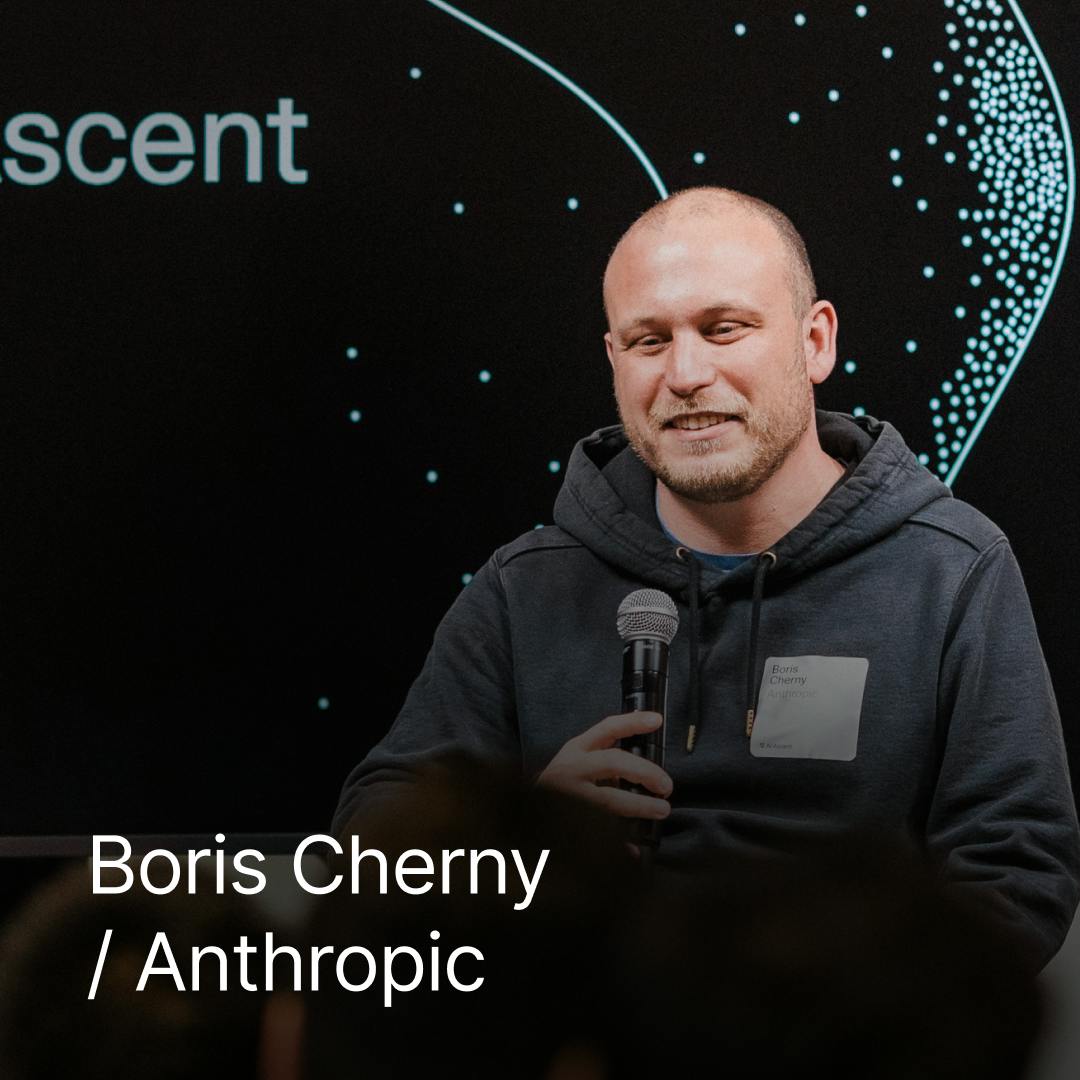
Anthropic's Cherny Automates All Internal Code, Declares Manual Programming Solved
Sequoia Capital
Anthropic's Boris Cherny argues AI agents have effectively solved traditional software development, triggering a printing-press-level democratization that will erode legacy SaaS moats and multiply disruptive startups tenfold.
## Background
This episode was published by Sequoia Capital on their RSS/web platform on May 5, 2026. According to the page description, Boris Cherny, creator of Claude Code at Anthropic, joins Sequoia partner Lauren Reeder at AI Ascent 2026 to discuss why coding is effectively solved, how loops and phone-based agents are redefining software engineering, and why the invention of the printing press is the right historical parallel for the future of software.
## TL;DR
Boris Cherny reveals that he hasn't hand-coded in 2026, instead orchestrating hundreds of concurrent sub-agents and background loops from his phone to ship dozens of PRs daily. He outlines how cross-disciplinary generalists are replacing traditional engineering silos and how AI agents threaten classic SaaS moats like switching costs and process power. Drawing a parallel to the Gutenberg printing press, Cherny argues that software creation is becoming a ubiquitous skill for non-engineers, while Anthropic's internal culture already operates on fully automated, self-communicating agents.
## Atmosphere & style
The session carries a lighthearted, forward-looking energy, opening with audience banter about 'Claude Code psychosis' before diving into deep technical insights. Cherny speaks with the quiet confidence of a seasoned engineer experiencing a paradigm shift, blending humble anecdotes with bold, provocative predictions. The dynamic between Reeder and Cherny creates an engaging, insider-access feel that captures the electrifying atmosphere of high-stakes AI innovation.
## Key takeaways
- `00:00` Boris Cherny believes coding is effectively solved for his own work, revealing he hasn't written a line of code by hand in 2026.
- `00:00` Claude Code originated accidentally in late 2024 to address a 'product overhang' where underlying model capabilities outpaced existing developer tool interfaces.
- `05:00` Anthropic shifted to 100% model-written code for Claude Code within a year, with Cherny shipping up to 150 PRs a day using multi-agent setups.
- `05:00` Continuous loops (/loop) and server-side routines allow background tasks like fixing CI builds, auto-rebasing, and clustering user feedback to run autonomously.
- `08:30` Software development will transition toward cross-disciplinary generalists where roles like product managers, designers, and finance leads all write code directly.
- `08:30` Using Hamilton Helmer's 7 Powers, Cherny predicts AI agents will decrease switching costs and process power, while scale economies and network effects remain unchanged.
- `12:00` As model intelligence advances, the need for product harnesses, safety guardrails, and manual human approvals will gradually fade.
- `15:00` The democratization of software development is analogous to the Gutenberg printing press moment, rapidly transforming coding into a universal skill like text messaging.
- `15:00` Inside Anthropic, software development is fully automated with no manual code or raw SQL written, and agents negotiate project details autonomously over Slack.
- `18:00` Advanced models like Claude 4.7 now proactively initiate parallel tasks and background loops without needing explicit manual orchestration from users.
- `18:00` Decisions around using local versus cloud compute will eventually be abstracted away and handled automatically by autonomous agents.
- `21:00` Anthropic relies on the Model Context Protocol (MCP) for structured system integrations and Computer Use as a fallback for legacy applications lacking APIs.
## Detailed walkthrough
### `00:00` The Origins of Claude Code and the "Product Overhang"
The session opens with humor surrounding the concept of "Claude Code psychosis"—a term affectionately used by developer teams to describe an obsession with using Anthropic’s flagship tool. Boris Cherny, creator of Claude Code, takes the stage with Sequoia partner Lauren Reeder. While Reeder jokingly notes that the entire weight of modern software development rests on Cherny's shoulders, Cherny himself comes from a deep engineering background—having spent his career writing code and authoring textbooks like *Programming TypeScript* (as well as a self-admitted, highly embarrassing middle school guide on TI-83 Plus BASIC programming).
Despite his deep coding background, Cherny reveals that he has not written a single line of code by hand so far in 2026. He recounts the creation of Claude Code, which began almost accidentally in late 2024 within Anthropic Labs—an innovation incubator alongside team members including Mike Krieger (now Anthropic’s Chief Product Officer and co-founder of Instagram). The team observed a massive "product overhang," where the underlying model capability vastly outpaced existing product interfaces. At the time, state-of-the-art coding tools were limited to single-line tab-completion powered by Claude 3 Sonnet. Cherny set out to build an agentic model that wrote the entire codebase itself.
* **Initial Struggles:** The project had no product-market fit (PMF) for its first six months and was barely usable, accounting for only 10% of Cherny's own coding workflow.
* **The Inflection Point:** Exponential growth began with the release of Opus 4 in May and continued to inflect upward across subsequent model releases (4.5, 4.6, and 4.7).
* **Tool Usage in the Room:** A show of hands reveals that the vast majority of the audience utilizes the CLI version of Claude Code, with smaller shares using the desktop app, VS Code/IDEs, or iOS.
---
`05:00` Coding is Solved: Hundreds of Agents and the Power of "Loops"
Cherny boldly states that for his own work, "coding is effectively solved." The Claude Code codebase itself—written in React and TypeScript—was selected early on because it sat firmly "on distribution" for the model's capabilities. By October/November of the prior year, the model was writing 100% of the team's code. Today, Cherny regularly ships dozens of PRs per day entirely through agents, reaching a record peak of **150 PRs in a single day**.
His personal setup relies heavily on his phone via the Claude app rather than a traditional desktop editor:
* **Multi-Agent Workflow:** Manages 5–10 active sessions at any given time, spawning hundreds of sub-agents concurrently, and spinning up thousands overnight for deeper tasks.
* **The Power of Loops (`/loop`):** Uses simple cron-scheduled background jobs that run repeatedly (e.g., every minute or every 30 minutes). Example loops include auto-fixing failing CI builds, auto-rebasing PRs, and clustering user feedback from Twitter.
* **Routines:** Anthropic's server-side evolution of loops, allowing continuous background execution even when a laptop lid is closed.
---
`08:30` Cross-Disciplinary Generalists and the "Saspocalypse"
Looking at how team structures will evolve, Cherny predicts a shift toward hyper-capable "cross-disciplinary generalists." Rather than generalists simply spanning engineering domains (e.g., iOS, web, and backend), future builders will merge product engineering directly with design, data science, or finance.
> "Our engineering manager, our product manager, our designers, our data scientists, our finance guy, our user researcher, every single person on our team writes code."
When asked about the potential "Saspocalypse"—the collapse of SaaS value due to software becoming 10x to 100x cheaper to write—Cherny outlines two core predictions based on Hamilton Helmer’s *7 Powers* framework:
| Power / Moat Category | Impact from AI Agents | Rationale |
|:--- |:--- |:--- |
| **Switching Costs** | **Decreased** | Models make it trivial to port codebases and workflows between platforms. |
| **Process Power** | **Decreased** | Models (especially Claude 4.7) excel at hill-climbing process tasks and iterating autonomously until completion. |
| **Network Effects & Scale Economies** | **Unchanged** | Traditional structural moats retain their core value regardless of code generation speed. |
Cherny concludes that the number of disruptive startups will grow **10x** over the next decade. Tiny, native-AI teams can now compete directly with incumbent enterprises that are bogged down by internal resistance and legacy retraining burdens.
---
`12:00` Harness vs. Model: The Future of Claude Code
During the audience Q&A, Dan asks Cherny to evaluate how much of Claude Code's success stems from raw model intelligence versus fine-tuned product and harness decisions. Cherny shares that while the split felt 50/50 six months prior, the harness inevitably becomes less important as model alignment and intelligence advance.
* **Evolving the Harness:** Future focus is shifting toward native multi-agent orchestration, making loops and routines first-class primitives, and reducing administrative UI friction.
* **Fading Guardrails:** Safety and permission mechanisms needed today—such as human-in-the-loop approvals, static command verification, and prompt injection filters—will gradually become obsolete as future models naturally "do the right thing."
Here is the detailed walkthrough of Part 2 of the transcript:
`15:00` Software's Printing Press Moment and Anthropic’s Internal Culture
Looking at the broader cultural shift driven by tools like Claude Code, the conversation turns to how software creation is being democratized for everyday people—from local shop owners building custom software to non-engineers programming microcontrollers to control door lights. Asked whether software development will become a ubiquitous skill comparable to using Microsoft Office, Boris Cherny emphatically agrees, predicting it will become as fundamental as sending a text message. Drawing on his reading habits, which center almost entirely on science fiction and tech history, Cherny points to the 15th-century invention of the Gutenberg printing press in Europe as the ultimate historical parallel:
* **Historical Parallel:** Prior to the printing press, only ~10% of Europeans were literate, often employed specifically by illiterate kings and lords to handle reading and writing.
* **Literacy Surge:** Within 50 years of the first press, more literature was published in Europe than in the preceding 1,000 years, and book costs dropped roughly 100x. While it took a few hundred years for global literacy to reach ~70% due to the need for formal education systems, anyone today can read and write without needing a degree in it, even though professional writers still exist.
* **The Future of Software:** Cherny emphasizes that software democratization will happen far faster than 50 years. He notes that the best person to write accounting software today might actually be a expert accountant rather than a software engineer, because knowing the domain is the hard part while "coding is the easy part."
When addressed about Anthropic's internal lead over the rest of the industry, Cherny explains that Anthropic engineers use the exact same underlying models as external developers—primarily heavy dogfooding on Opus 4.7 alongside testing Mythos—because building a platform requires experiencing what their users experience. However, the true gap lies in organizational structure and workflow process rather than raw model capability:
* **Total Automation:** Anthropic has no more manually written code anywhere in the company; even all database SQL is generated by AI models.
* **Autonomous Agent Communication:** Internal Claude agents ("Claudes") run in continuous loops all day, communicating autonomously with each other over Slack—one engineer's Claude reaching out to another's Claude—to negotiate and resolve project unknowns without human intervention.
* **Startup Advantage:** Startups hold a structural edge here because it is vastly easier to build around AI-native processes from day one rather than attempting to overhaul legacy workflows.
`18:00` Multi-Agent Workflows, Loops, and the Shift to Local vs. Cloud Compute
Addressing the evolution of multi-agent delegation (such as `/batch`, `/loop`, and agent sub-teams), Cherny reflects on how prompting and harness design drive parallel execution. On the product side, Anthropic fine-tunes system prompts to encourage models to parallelize tasks, but as models get smarter, they begin initiating parallel routines natively.
* **Autonomous Looping:** With Claude 4.7, the model autonomously recognizes when tasks require ongoing execution. For example, when asked to pull a data query, the model will proactively note that the data changes over time, spin up a `/loop` on its own, and offer to deliver periodic reports every 30 minutes via the Slack Model Context Protocol (MCP) integration.
* **Product Philosophy:** Cherny argues that users shouldn't have to manually learn how to hold or orchestrate tools; if a user has to manage parallelization manually, it represents a product design failure. The burden belongs on the model and system prompting.
When an audience member asks about the debate between centralized cloud compute and running open-weight local models to avoid throttling, Cherny suggests the distinction will ultimately become irrelevant to developers:
* **Autonomous Execution:** In a couple of years, the model itself will write all the code, launch agents, and configure environments. If the model determines that executing a task via local models is the optimal path, it will handle that decision automatically without the engineer needing to choose.
`21:00` Local vs. Cloud Context with Cowork, Computer Use, and Future Products
The discussion shifts to knowledge work tools like Cowork and how to give AI agents access to corporate tools, given that knowledge work is heavily distributed across cloud platforms rather than local developer environments.
* **Standardized Access via MCP:** Cherny points to the Model Context Protocol (MCP) as the primary unifying solution. By connecting MCP endpoints for services like Salesforce, Google Docs, and Google Calendar, the host system—whether Claude AI, Claude CLI, or Cowork—can seamlessly access the same enterprise context.
* **Computer Use as a Fallback:** For systems lacking native MCPs, programmatic APIs, or CLI access, Cherny highlights computer use capabilities as the catch-all solution. Anthropic’s computer use models can operate virtually any desktop software application; while currently slow, it operates with high reliability on modern models like Claude 4.
* **Model Perspective:** Ultimately, Cherny notes that protocol types don't matter to the underlying model: "To the model, it's just tokens."
Closing out the session, an audience member asks Cherny to share the "shape" of products Anthropic is building today that will become exponentially more powerful as models progress over the next 6 to 12 months:
* **Claude Design:** Currently functional, but expected to improve dramatically with next-generation model capabilities.
* **Massively Parallel Agents:** Upcoming features in Claude Code focused on refining `/loop`, `/batch`, and large-scale parallel agent coordination.
* **Computer Use:** Continuous optimizations to bridge the gap for legacy software lacking direct API or MCP integrations.
## Notable quotes
> `05:00` coding is effectively solved — Boris Cherny
> `08:30` Our engineering manager, our product manager, our designers, our data scientists, our finance guy, our user researcher, every single person on our team writes code. — Boris Cherny
> `15:00` coding is the easy part — Boris Cherny
> `21:00` To the model, it's just tokens. — Boris Cherny
## Mentioned
Boris Cherny, Lauren Reeder, Mike Krieger, Dan, Claude Code, Claude 3 Sonnet, Opus 4, Opus 4.5, Opus 4.6, Opus 4.7, Mythos, Claude 4, Claude AI, Claude CLI, Cowork, Claude App, React, TypeScript, TI-83 Plus BASIC, Programming TypeScript, Anthropic, Anthropic Labs, Sequoia Capital, Instagram, Twitter, Slack, Salesforce, Google Docs, Google Calendar, Model Context Protocol (MCP), 7 Powers, Hamilton Helmer, Gutenberg printing press, Microsoft Office, VS Code, iOS
Anthropic的Cherny实现内部代码全自动化,称手动编程已被解决
Anthropic的Boris Cherny认为,AI智能体已有效解决传统软件开发问题,引发了一场堪比印刷机革命的大众化浪潮,这将削弱传统SaaS护城河,并使颠覆性初创公司数量增加十倍。
Boris Cherny透露,自己在2026年未曾手写过一行代码,而是通过手机协调数百个并发子智能体和后台循环,每天交付数十个PR。他阐述了跨领域通才如何正在取代传统的工程孤岛,以及AI智能体如何对转换成本和流程能力等经典SaaS护城河构成威胁。Cherny将其比作古腾堡印刷机,认为软件构建正成为非工程师的通用技能,而Anthropic的内部文化已完全基于自动化、可自我通信的智能体运转。
Claude Code 创建者 Boris Cherny 透露自己在 2026 年未手写过一行代码,认为编程在自身工作流中已被实质解决;该工具源于 2024 年底 Anthropic 试图消除模型能力远超现有开发工具界面的“产品过剩”现象。 (0:00)
Anthropic 团队已实现由模型全自动编写代码,Cherny 主要通过手机端应用调度数百个 Agent 并配合后台循环(/loop)与例程,创下单日交付 150 个 PR 的纪录。 (5:00)
结合 Hamilton Helmer 的“7 种力量”框架,Cherny 预测 AI Agent 将降低迁移成本与流程壁垒,促使团队演进为跨学科全才结构,并推动颠覆性初创公司数量增长 10 倍。 (8:30)
Cherny 将软件开发的平民化比作 15 世纪的古腾堡印刷机革命,预测编写软件将如同发短信一样成为全民通用技能,而 Anthropic 内部的 Claude Agent 已开始在 Slack 上自主沟通协作解决问题。 (15:00)
Reading summary
Anthropic's Boris Cherny argues that software engineering has reached a historical inflection point comparable to the invention of the printing press, claiming that manual coding is effectively solved as AI models evolve into autonomous, multi-agent systems.
Autonomous Multi-Agent Orchestration Replaces Manual Coding (5:00)
Cherny states that he has not written any code by hand in 2026, running his engineering workflow primarily from a phone through 5 to 10 active sessions and hundreds of background sub-agents, which have delivered up to 150 pull requests in a single day. Claude Code initially struggled for product-market fit after its late-2024 inception in Anthropic Labs, but usage accelerated exponentially with the release of Opus 4 in May and subsequent updates through Opus 4.7.
Internally, Anthropic has eliminated manually authored code and database queries across the company. Team workflows rely heavily on autonomous background loops and server-side routines that continuously resolve broken CI builds, rebase branches, and aggregate user feedback. Cherny reports that internal Claude agents now communicate autonomously across Slack channels to negotiate and resolve project blockers without direct human intervention.
Democratization and the Gutenberg Printing Press Parallel (15:00)
Cherny compares current AI-assisted software generation to the 15th-century introduction of the Gutenberg printing press, which reduced book production costs roughly a hundredfold and eventually expanded literacy beyond the 10% of Europeans who could read at the time. He predicts that writing software will become as routine as sending a text message, occurring on a significantly faster timeline than historical literacy shifts.
This shift is expected to reorganize workplace talent around cross-disciplinary generalists rather than pure programmers. Cherny observes that every role on his immediate team—including product managers, designers, data scientists, and finance personnel—now writes code. Because model capabilities have made code generation trivial, Cherny contends that domain experts, such as professional accountants, are often better positioned to build vertical software than traditional software engineers.
Erosion of SaaS Moats and Startup Acceleration (8:30)
Evaluating the economic consequences of software becoming 10x to 100x cheaper to produce, Cherny applies Hamilton Helmer’s 7 Powers framework to forecast a structural shakeup in SaaS. He argues that switching costs and process power will sharply decline, as models like Claude 4.7 easily re-platform legacy codebases and autonomously iterate through operational processes. Conversely, he expects foundational moats such as network effects and scale economies to remain intact.
Driven by these lower barriers to entry, Cherny forecasts that the number of disruptive software startups will multiply tenfold over the coming decade. He attributes this advantage to AI-native organizational design, which allows compact teams to outpace established enterprises hindered by legacy workflows and internal resistance to retraining.
Fading Product Harnesses, MCP, and Autonomous Execution (12:00)
Cherny notes that the technical balance between product-level harness design and raw model intelligence—once a 50/50 division—is tipping toward the models. As underlying intelligence and native alignment advance, explicit user management, static guardrails, and manual approval prompts are becoming obsolete. Claude 4.7 already initiates background parallel loops autonomously, recognizing ongoing monitoring requirements without explicit prompting.
To bridge models with corporate workflows, Cherny points to the Model Context Protocol (MCP) as the standard for connecting cloud services like Google Docs and Salesforce. For legacy applications lacking APIs or protocols, vision-based computer use serves as a fallback. Cherny predicts that distinctions between local and cloud execution will soon disappear for developers, as autonomous models will independently determine the most efficient environment to execute tasks.
Cherny's thesis envisions software development transforming from an artisanal engineering discipline into ubiquitous, cross-disciplinary domain automation. The realization of this trajectory hinges on whether enterprises can overcome structural resistance to AI-native delegation, and whether incumbent software defensibility can endure the erosion of traditional switching costs and process moats.
精炼阅读摘要
Anthropic 旗下 Claude Code 创建者 Boris Cherny 指出,软件开发正迎来类似于古腾堡活字印刷术的历史拐点,代码编写本身已基本被 AI 解决;随着模型自主接管全流程编码与多 Agent 编排,软件创新的核心壁垒正在从代码实现能力转向行业领域专长与原生 AI 组织流程。
消除产品悬挂与全自动编码范式 (0:00)
Cherny 阐述了 Claude Code 的诞生背景:2024 年末,Anthropic Labs 观察到底层模型能力与实际产品界面之间存在巨大的“产品悬挂”(Product Overhang),即当时业界主流工具仍停留在基于单行补全的阶段,而模型能力已足以承载更高层级的自主开发任务。在项目启动的前六个月,工具由于可用性不足仅能承担 Cherny 个人 10% 的编码工作,直到 Opus 4 发布及后续 4.5 至 4.7 版本的迭代,该工具才迎来指数级增长拐点,目前现场多数开发者已转向 CLI 命令行界面版本。
在研发实践中,Cherny 认为对于其团队而言“编码已被有效解决”。团队特意选用贴近模型能力分布的 React 与 TypeScript 构建 Claude Code,至前一年底已实现 100% 由模型生成代码。Cherny 本人表示在 2026 年未手写过一行代码,完全依靠移动端 Claude 应用与 Agent 协作完成日常交付,其个人单日最高代码合并记录达到了 150 个 PR。
多 Agent 并发与自主循环机制 (5:00)
现代工程流已转变为基于自主循环的任务编排模式。Cherny 展示的工作流并不依赖传统桌面 IDE,而是通过手机端保持 5 至 10 个活跃会话,每个会话即时分发数百个子 Agent 并行处理任务,夜间则可调用数千个 Agent 进行深度作业。底层执行依赖于类似定时任务的循环机制(`/loop`)及其服务端演化形式“Routines”,即便关闭设备也能持续在后台自动修复 CI 报错、自动 rebase PR 以及每隔 30 分钟自动聚类社交平台用户反馈。
随着 Claude 4.7 等模型的认知能力提升,模型开始展现出自主发起多任务编排的能力。例如在处理周期性变化的数据提取时,模型能够主动判断数据时效性并自行建立循环任务,通过模型上下文协议(MCP)向 Slack 定期发送报告。Cherny 强调,若用户必须手动学习如何协调工具与并行化,这实际上意味着产品设计的失败,系统层面的提示工程与底层智能应当承载全部工具调度的复杂度。
古腾堡时刻与跨学科通才的普及 (15:00)
Cherny 将当前的软件大众化趋势与 15 世纪欧洲古腾堡活字印刷术的诞生进行对比。在印刷术发明前,欧洲识字率仅为约 10%,而随后的半个世纪内印刷文献总量超越了此前一千年,书籍制作成本下降约百倍。Cherny 预测软件研发也将走出高度专业化的象牙塔,在远短于印刷术普及历史的时间尺度内,成为类似发短信一般的人人可用技能。
在这一演进下,工程团队结构正在被深度重构。传统按照前后端或移动端划分的工程边界被打破,转而由深度融合产品工程与设计、数据科学或财务能力的“跨学科通才”所替代。在 Anthropic 团队内部,包括工程经理、产品经理、设计师、财务人员及用户研究员在内的所有成员均在直接利用 AI 产出代码;同时 Cherny 认为未来优秀的行业软件更有可能由精通业务的会计师等领域专员直接创造,因为在基础编码门槛消失后,深度的领域业务洞察才是核心瓶颈。
SaaS 护城河重塑与原生 AI 组织优势 (8:30)
针对软件生产成本下降 10 至 100 倍可能引发的 SaaS 价值重估,Cherny 结合 Hamilton Helmer 的《7 Powers》商业框架进行了分析。他认为由于模型能够无缝迁移代码库并实现流程上的自主爬坡迭代,传统软件公司依赖的“转换成本”与“流程权力”壁垒将显著被削弱,但网络效应与规模经济等结构性壁垒依然稳固。因此,未来十年具备颠覆性的原生 AI 初创公司数量或将增长 10 倍,并依靠组织敏捷性向背负沉重人员培训包袱的传统在位企业发起冲击。
Anthropic 内部的组织运作方式印证了这种结构性代差。公司内部已彻底消除手动编写代码与 SQL,多个 Claude Agent 全天候在 Slack 内部以自主循环的方式直接进行跨 Agent 沟通与方案协商,在无人工干预的情况下推进项目。对于广泛分布的企业云端数据,Anthropic 推动通过 MCP 实现跨平台上下文接入,并以能够模拟人类操作任意桌面软件的计算机使用(Computer Use)技术作为接口缺失系统的数据兜底方案。
Cherny 总结道,当前围绕外围产品脚手架(Harness)、人工审批流程和静态安全拦截的工程设计,最终将随着模型智能的自然对齐而逐步边缘化,未来模型亦将自主在云端与本地算力之间进行调度决策。然而,传统企业在组织流程上能否克服历史阻力实现向原生 Agent 协作的跃迁,以及计算机使用等交互技术在效率与低延迟方面的实质成熟度,仍是产业全面落地中需要观察的变量。
Detailed notes — zh
## Background
该内容由红杉资本(Sequoia Capital)于 2026 年 5 月 5 日在播客及网络平台发布。节目记录了在 AI Ascent 2026 峰会现场,红杉合伙人 Lauren Reeder 对话 Anthropic 旗下 Claude Code 的缔造者 Boris Cherny,探讨软件工程迎来“印刷机时刻”、Boris 为何在 2026 年不再手写一行代码并靠手机日提交上百个 PR,以及自动化循环(Loops)与多智能体如何重塑软件生态。
## TL;DR
Boris Cherny 分享了 Claude Code 从内部实验孵化到实现 100% 模型自举编写代码的演进历程,宣布在其工程范畴内编程已实质性被“解决”。他展示了利用手机端 Claude 会话编排数百乃至数千个子智能体、配合 `/loop` 周期性任务与云端 Routines 自动维护代码的极致日常工作流。此外,他将软件大众化浪潮类比为 15 世纪古腾堡印刷机革命,指出未来的核心人才将是跨学科通才,领域的业务专家将亲自直接构建系统,传统 SaaS 流程壁垒亦将面临原生 AI 初创企业的巨大冲击。
## Atmosphere & style
现场对话兼具硬核极客的幽默自嘲与前瞻视角的时代震撼感,开场关于早期 TI-83 教程与“Claude Code 狂热症”的打趣迅速拉近了与观众的距离。随着话题切入单日 150 个 PR、全天候后台智能体网络互通以及重塑商业护城河,Boris 平实从容的语调与颠覆认知的激进实践形成了强烈的戏剧反差。整场分享节奏紧凑、干货极高,既有深处技术奇点前沿的从容笃定,又让听者清晰感受到旧软件世界秩序加速瓦解的历史临场感。
## Bulletin
- `05:00` Claude Code 缔造者 Boris Cherny 表示自己在 2026 年未写过一行代码,日常主要通过手机端 Claude App 调度数百至数千个并发 Agent,曾创下单日合并 150 个 PR 的纪录。
- `02:35` Claude Code 自 2025 年 10 月至 11 月已实现 100% 由模型自主编写;Anthropic 团队押注“产品悬垂”(Product Overhang),即提前构建跳过单行补全的 Agent 形态以等待下一代大模型能力爆发。
- `15:00` 编程正在迎来“古腾堡印刷机时刻”,边际编码成本降低百倍将促使专业领域专家直接构建专业软件,未来软件团队由既懂产品设计又懂数据落地的跨学科通才主导。
- `10:00` AI 正在严重侵蚀以“转换成本”和“流程能力”为核心的传统商业护城河,大企业面临沉重流程改造与人员重训成本,而原生 AI 初创公司将在未来十年迎来 10 倍速爆发。
## Key takeaways
- `00:00` 曾著有《Programming TypeScript》的 Boris Cherny 自 2026 年起不再手写任何代码,其个人维护的代码库编程问题已 100% 解决。
- `02:35` Claude Code 最初在 Anthropic Labs 内部孵化,前 6 个月仅能处理约 10% 的任务,直到 2025 年 5 月搭载 Opus 4 后才迎来爆发拐点。
- `05:00` Claude Code 初期技术选型选用 TypeScript 和 React,旨在完全契合底层大模型训练数据的高概率分布区间。
- `06:30` Boris 的日常开发转向以 iPhone 为核心,通过 /loop 命令行与服务端 Routines 机制让 Agent 自动巡检 CI、修复脆弱测试并自动 Rebase PR。
- `07:45` 单纯的全栈工程师正在失去竞争壁垒,融合产品思维、设计美学与数据洞察的跨领域通才正成为研发核心。
- `10:00` Anthropic 内部已打破岗位界限实现全员编程,产品经理、设计师和财务人员均在日常流程中深度编写代码。
- `10:00` AI 模型能够自主优化复杂工作流(爬山算法),使得软件转换成本与流程壁垒大幅贬值,唯有网络效应、规模经济与独占资源得以保留。
- `12:45` 围绕模型构建的代码脚手架(Harness)重要性正随模型对齐能力的暴涨而减弱,未来许多安全与校验机制将随模型更聪明而自然功成身退。
- `15:00` 软件革命与 15 世纪印刷术普及读写能力高度契合,写代码不再是瓶颈,深刻理解业务逻辑的行业专家将直接成为顶尖软件创造者。
- `17:35` Anthropic 内部已经基本不存在手动编写的代码或 SQL,后台循环运行的 Claude 智能体会通过 Slack 互相跨节点通信以协商并排查未知依赖。
- `20:00` 新一代模型已涌现出自主 Loop 意识,能够主动察觉数据变化并建议启动轮询,甚至自发展开 Slack MCP 通知打通链路。
- `20:00` 开发者无需再纠结端侧本地计算与云端算力之争,模型将根据任务自适应权衡并在两者间自主动态调度。
- `21:40` 对于未接入 API 或 MCP 的封闭系统,基于视觉模拟键鼠的 Computer Use 构成了终极全软件覆盖的保底方案。
- `23:42` 未来 6 到 12 个月内,超大规模并行化智能体(Massively Parallelizing Agents)、Claude Design 及增强版 Computer Use 将成为最核心的生产力杠杆。
## Detailed walkthrough
### `00:00` 开场:从 TI-83 教程作者到“Claude Code 之父”
活动在一片轻松热烈的气氛中开场。主持人首先向台下观众发起互动,询问在座有多少人在使用 Claude Code,随后打趣地问:“举手看看,谁得了‘Claude Code 精神分裂症’(Claude Code psychosis)?别害羞,我自己的团队就经常开玩笑说我患上了这种狂热症状。”接着,红杉资本合伙人 Lauren Reeder 与 Claude Code 的缔造者 Boris Cherny 一同登台。主持人戏称,如今整个软件开发的未来似乎都压在 Boris 的肩膀上。
Lauren Reeder 在正式对话前补充了 Boris 传奇的工程师背景。作为一名“工程师中的工程师”,Boris 职业生涯写过海量代码,曾撰写知名技术专著《Programming TypeScript》。然而颇具戏剧性的是,这位重度技术极客在 2026 年至今尚未亲自动手写过一行代码。Boris 随后自嘲起一段鲜为人知的往事:他在读初中时曾写过一份在 TI-83 Plus 图形计算器上编写 BASIC 程序的入门指南,前几天搜索发现这份教程居然还挂在网上,“那简直太令人尴尬了,求求大家千万别去搜。”
- **职业反差**:曾出版经典著作《Programming TypeScript》的硬核程序员,进入 2026 年后未手写过一行代码。
- **黑历史趣闻**:初中时期编写的 TI-83 Plus 计算器 BASIC 语言教程至今仍能在互联网上检索到。
---
### `02:35` Claude Code 的诞生:“产品悬垂”与对抗平庸的实验
在进入核心话题前,Boris 对现场使用 Claude Code 的形态做了快速调研:绝大多数现场开发者使用的是 CLI(命令行工具),桌面客户端次之,而 VS Code 与 JetBrains 等传统 IDE 插件的使用比例明显较低;至于 Boris 自己,如今最常用的界面其实是 iOS 移动端。回顾项目的发端,Boris 坦言 Claude Code 的诞生在很大程度上是一场“美丽的意外”。2024 年底,他在 Anthropic 内部一个名为 Anthropic Labs 的创新孵化小组工作,团队仅有寥寥数人。他们最初的目标非常纯粹,就是打造自己想要的东西,先后孵化出了 Claude Code、MCP(Model Context Protocol,模型上下文协议)以及桌面客户端。如今该团队在完成阶段性使命后重组进入第二阶段,由 Instagram 联合创始人、现任 Anthropic 首席产品官 Mike Krieger 亲自带队。
谈及立项初衷,Boris 引入了团队内部极为推崇的一个概念——“产品悬垂”(Product Overhang),即底层模型实际上已经具备了极其惊人的潜在能力,但市面上现有的产品形态却远远未能将其释放出来。2024 年底的代码工具前沿主流依然是“行内补全”(Type-ahead),开发者在 IDE 里按下 Tab 键,模型一次只补全一行代码——这正是 Sonnet 3 最初解锁的能力。但 Anthropic Labs 坚信模型已经接近质变的临界点,软件工程不该止步于补全,而应由 Agent 全权接管代码编写。
在立项后的前 6 个月里,项目举步维艰,工具极不稳定,Boris 自己手头的代码也仅有约 10% 能交给它处理。甚至在公开发布之初,Claude Code 也并未一炮而红,直到 2025 年 5 月 Opus 4 发布,指数级增长的拐点才真正到来。随着后续 Opus 4.5、4.6 到如今 4.7 的迭代,产品能力不断迎来质的跃迁。团队从一开始就清楚,这是一个需要等待“下一代模型”才能迎来 PMF(产品市场契合点)的前瞻性赌注。
```mermaid
flowchart TD
accTitle: Claude Code 演进路径
accDescr: 展示从行内补全到全自动多 Agent 闭环的技术演进与里程碑模型
subgraph Phase1["2024 底:行内补全时代"]
A["Sonnet 3: Tab 单行补全"] --> B["发现 Product Overhang<br/>底层模型潜能未被产品释放"]
end
subgraph Phase2["2025 上半年:早期 Agent 探索"]
B --> C["Anthropic Labs 内部孵化<br/>构建 CLI / MCP / 桌面端"]
C --> D["前 6 个月体验生硬<br/>仅支持 ~10% 编码任务"]
end
subgraph Phase3["2025 年 5 月至今:指数拐点"]
D --> E["Opus 4 发布<br/>触发指数级增长拐点"]
E --> F["Opus 4.5 / 4.6 / 4.7 持续迭代<br/>迈入多 Agent 自动循环"]
end
```
- **初始团队产物**:Anthropic Labs 孵化了 Claude Code、MCP 标准与 Anthropic 桌面应用。
- **技术赌注**:跳过 Tab 键单行补全,提前半年押注尚未发布的下一代模型能力。
- **增长拐点**:项目自 2025 年 5 月搭载 Opus 4 后迎来指数级爆发,此后每次模型大版本更新都会引发新一轮飞跃。
---
### `05:00` 编程已被“解决”:从泄露源码到单日 150 个 PR
针对 Boris 曾公开发表过的“编程问题已被解决”这一激进论断,现场调查显示:依然完全纯手工写代码的工程师已寥寥无几,全靠 Agent 写的和两者参半的开发者各占相当比例。Boris 解释道,至少对自己维护的代码库而言,编程确实已经 100% 解决了。此前 Claude Code 的源码仓库曾被意外泄露,外界得以一窥其全貌:整个项目本质上非常直白干净,完全基于 TypeScript 和 React 构建。
之所以选用 TypeScript 和 React,是因为在项目启动之初,模型的泛化能力远不如今天,必须严格选择处于模型训练数据“最高分布概率”(On distribution)之内的语言与框架。得益于技术栈与模型特性的高度契合,早在去年 10、11 月前后,团队就已经实现了 100% 由模型编写自身全部代码。
现阶段,Boris 每天的研发常态是通过模型提交数十个 PR。在活动前一周的某一天,为了测试工作流的极限承载力,他甚至创下单日合并 150 个 PR 的个人纪录。他坦承,在庞大盘根错节的旧遗留系统或冷门罕见语言中,编程自动化仍面临阻碍,但按照目前的演进速度,大部分工程挑战的终极解决方案非常明确——“静候下一个大模型发布即可”。
- **架构选型逻辑**:Claude Code 核心采用 TypeScript + React,最大化利用当时模型的分布内编码优势。
- **极限吞吐量**:日常稳定输出数十个 PR,单日最高极限测试达到 150 个 PR。
- **自举开发时间节点**:2025 年 10 月至 11 月期间,Claude Code 代码库全面实现 100% 由模型自主编写。
---
### `06:30` 个人工作流演进:手机操作、数千 Agent 与 `/loop` 循环
当被问及目前极度硬核的个人日常开发环境时,Boris 笑着表示半年前在 Twitter 上公开配置时,本以为那只是稀松平常的做法,未曾想引发巨大震动,而如今他的工作流早已彻底重构。现在他的大部分开发工作都在手机端的 Claude App 上完成。他向观众展示手机界面左侧的 Code 选项卡,后台通常同时挂着 5 到 10 个主 Session。
每一个主 Session 下又会进一步派生出大量协同子 Agent,日常运行的并发子 Agent 常年保持在数百个;而在每天夜间,会有数千个深度工作 Agent 持续在云端执行复杂任务。在众多调度机制中,Boris 尤为推崇新加入的 `/loop`(循环指令)。其底层原理极为朴素:通过在本地调用 cron 定时器,让 Claude 按照指定频率(如每分钟、每 5 分钟或每日)周期性唤醒并执行特定维护任务。
此外,Anthropic 最新上线了服务端运行的 Routines 功能,允许类似循环任务直接托管在云端服务器,开发者即便合上笔记本电脑或关闭手机,自动化进程依然不会中断。
```mermaid
flowchart LR
accTitle: Boris 的移动端多 Agent 自动化开发体系
accDescr: 展现从手机端 Session 派发任务到本地与云端循环 Agent 的工作流程
subgraph Client["移动端交互"]
Mobile["iPhone / Claude App<br/>5-10 个并发会话"]
end
subgraph Orchestration["Agent 协同层"]
SubAgents["数百至数千个 Subagents<br/>夜间深度任务调度"]
Loop["/loop 命令行周期任务<br/>基于 Cron 调度"]
Routines["Routines 服务端机制<br/>跨设备常驻运行"]
end
subgraph Tasks["自动化落地场景"]
CI["CI 巡检与坏测试修复"]
PR["PR 托管与自动 Rebase"]
Feed["Twitter 用户反馈抓取与聚类"]
end
Mobile --> SubAgents
Mobile --> Loop
Mobile --> Routines
Loop --> CI
Loop --> PR
Routines --> Feed
```
- **移动端中心化**:日常主力开发设备切换至 iPhone 上的 Claude App,通过多会话并发把控全局。
- **并发规模**:白天保持数百个子 Agent 协作,夜间调度数千个 Agent 跑深度离线任务。
- **典型 `/loop` 监控用例**:
- 自动“照料”PR:监听 CI 状态并在代码冲突时执行自动 Rebase。
- 维护 CI 健康度:自动捕获并修复偶发失败的“脆弱测试”(Flaky tests)。
- 用户心声捕获:每隔 30 分钟抓取社交媒体(如 Twitter)的用户反馈并自动聚类提炼。
---
### `07:45` 未来的软件团队:“跨学科通才”正在取代单纯代码工
面对“未来的研发团队将演变成何种形态”这一宏大命题,Boris 认为代码编写门槛的瓦解必将重构组织的人才结构。未来的行业主导者将是“跨领域通才”(Generalists),且这种通才绝非传统软件工程语境下的全栈工程师(兼通 iOS、Web 端与后端架构):
> “我认为我们将开始看到大量跨学科的通才——他们既精通产品工程,又具备顶尖的视觉与交互设计素养;或者兼具卓越的产品思维、数据科学能力与工程落地水准。”
Boris 指出,这一趋势已经在 Claude Code 的核心团队内部发生。团队中的核心成员大多展现出了极其跨界的复合能力;在全员皆能利用 Agent 快速产出代码的前提下,单纯的代码实现技能不再构成壁垒,对产品、设计与数据的敏锐直觉反而成为了最稀缺的核心竞争力。
### `10:00` 全员编程与“SaaS 启示录”:AI 时代的商业护城河转移
在 Anthropic 团队内部,编程已经彻底打破了岗位的界限。不仅工程经理在写代码,产品经理、设计师、数据科学家、财务人员甚至是用户体验研究员,团队里的每个人都在写代码。他们虽然依然是各自领域的专家,但日常工作已经完全与写代码融为一体。Lauren Reeder 敏锐地指出,当 AI 让编写代码的成本降低 10 倍乃至 100 倍时,软件产品的价值将发生剧烈重塑,这是否意味着行业正在走向大家热议的“SaaS 启示录”(Saspocalypse)?
谈及这个话题,Boris Cherny 难掩兴奋,直言这是他最喜欢的问题。作为商业播客 *Acquired* 的忠实听众(他前不久刚去录制了节目,激动地称感觉像“见到了偶像”),他借用汉密尔顿·赫尔默(Hamilton Helmer)在《商业七大力量》(*7 Powers*)中提出的商业护城河理论来剖析 AI 带来的冲击。在他看来,传统的商业壁垒正在发生分化:
```mermaid
flowchart TD
accTitle: AI 时代商业护城河的演变
accDescr: 展示 AI 如何削弱转换成本与流程能力,同时放大初创公司颠覆大企业的竞争优势
subgraph Weakened["被 AI 削弱的壁垒"]
W1["转换成本<br/>(代码与数据可轻易由模型迁移)"]
W2["流程能力<br/>(模型可自动爬山优化复杂工作流)"]
end
subgraph Maintained["依然稳固的壁垒"]
M1["网络效应"]
M2["规模经济"]
M3["独占资源"]
end
subgraph Disruption["竞争格局演变"]
D1["大企业:面临流程改造阻力与员工重训成本"]
D2["原生初创公司:10 倍速爆发,完全基于 AI 重塑"]
D2 -.->|"平起平坐直接颠覆"| D1
end
```
- **正在贬值的壁垒**:首先是“转换成本”(Switching Costs),因为模型可以轻松将代码和系统从一套体系平移到另一套体系;其次是“流程能力”(Process Power),以往依赖繁复流程和工作流构筑护城河的公司面临巨大挑战,因为 Claude 极其擅长拆解和学习流程。特别是像 Opus 4.7 这样的模型,只要给定目标让它持续迭代,它就能自主完成“爬山算法”(Hill climbing)般的优化,这是以往模型从未达到的境界。
- **依然牢固的壁垒**:网络效应(Network Effects)、规模经济(Scale Economies)以及独占资源(Cornered Resources)并没有因为 AI 的到来而发生本质改变。
- **颠覆性初创公司的爆发**:Boris 预言,未来 10 年内具有全面颠覆能力的新初创公司数量将激增 10 倍。在大企业疲于应付内部阻力、重训员工和改造遗留业务流程时,小型初创团队完全从零构建原生 AI 体系,能够以极小规模正面硬抗并撼动巨头,"现在是创造事物最好的时代,也是做初创公司最好的时代。"
---
### `12:45` 模型演进与产品打磨:脚手架何时功成身退?
现场观众 Dan 提问:既然 Claude Code 在获得产品市场契合度(PMF)之前就研发了半年,如今随着底层模型越发强大,Claude Code 的成功究竟该归功于底层模型能力的跃升,还是产品本身的细节设计?
Boris 坦言这是一种动态的平衡。如果放在一年前甚至半年前,产品打磨与底层模型的贡献占比大概各占 50%。当被追问两年后会如何时,Boris 幽默地笑着说:“老兄,两年后的事我哪知道!我们现在的规划周期甚至只看未来一周。”他解释道,自己早年经历过 Y Combinator(YC),曾作为一家 YC 公司的首位雇员并多次创业,YC 灌输给他最深的一条铁律就是“做人们真正热爱的东西”(build something people love)。正因如此,团队极其在乎产品层面的微小细节,必须保证用户整天沉浸其中使用时能拥有极佳的体验。
然而,随着底层模型能力日益暴涨,围绕模型搭建的“脚手架”(Harness)重要性确实在相对降低。团队当下关注的重点是如何演进这层脚手架:如何让任务循环(Loops)成为一等公民,以及如何更优雅地编排并运行大量子智能体(Sub-agents)。Boris 大胆预测,大约一年之后,底层模型的对齐水平(Alignment)将大幅跃进,如今为了防范 Prompt 注入、静态命令校验、权限控制模式以及各种人类在环(Human-in-the-loop)的安全防御机制,大多都会变得无足轻重,因为未来的模型自然而然“就会做出正确的事情”。
---
### `15:00` 编程的“印刷机时刻”:从精英专精走向全民常识
现场观众提出了一个宏大的文化视角:几个月前 Claude Code 推动了一次大众化浪潮,街边小店主能为自己编写管理软件,普通人也可以用它给微控制器写程序来控制门开时的灯光。未来编写软件是否会变得像“熟练使用微软 Office”一样普及?
Boris 激动地连声赞同:“天哪,绝对是这样!甚至会比这更进一步,它会变得像‘发一条短信’一样稀松平常。”作为一名狂热的科幻小说和科技史读者,Boris 指出人类历史上与当前时刻最契合的类比,就是 15 世纪欧洲古腾堡印刷机的诞生:
```mermaid
flowchart LR
accTitle: 欧洲印刷术与现代 AI 软件民主化对比
accDescr: 展示从印刷术普及读写能力,到 AI 降低编程门槛让领域专家直接构建软件的历史演进映射
subgraph History["15 世纪欧洲印刷术"]
H1["普及前:识字率仅约 10%<br/>国王需雇佣专职书吏"] --> H2["印刷机问世 50 年:<br/>出版量超此前 1000 年总和<br/>图书成本骤降 100 倍"]
H2 --> H3["数百年后:识字率升至 70%<br/>读写成为普遍技能"]
end
subgraph Present["当下 AI 软件革命"]
P1["普及前:极少数工程师精通编程语言"] --> P2["AI 降低百倍边际编码成本<br/>软件总量呈指数级爆发"]
P2 --> P3["领域专家直接构建专业软件<br/>(如优秀会计师手搓财会系统)"]
end
```
- **印刷机的历史震颤**:在印刷术普及前,欧洲仅有约 10% 的人口具备读写能力,连国王和贵族都需要雇佣专人来替自己阅读和书写;但在首台印刷机问世后的短短 50 年内,欧洲出版的书籍文献总量超过了此前 1000 年的总和,书籍成本直线下降了 100 倍。
- **全社会的读写平权**:虽然建立教育体系、解放农耕劳动力花了数百年才让全球识字率提升至 70% 左右,但这彻底打破了特权阶层的知识垄断,如今无需专业学位也能识字读书,但专业作家的价值依然保留。
- **领域专家的软件主权**:Boris 强调,这次软件民主化的演进速度绝不需要 50 年,它会快得多。未来编写专业会计软件最合适的人选根本不是软件工程师,而是一个精通业务的资深会计师。因为“写代码如今已是容易的部分,深刻理解业务领域知识才是真正的难点所在。”
---
### `17:35` 未来已来:Anthropic 内部“智能体相互协作”的工作流
观众引用了此前 Greg 的观点提问:Anthropic 团队在内部能够超前接触到最先进的模型和智能体架构,这意味着他们的工程实践是否领先外界一个月、三个月甚至六个月?这种代际差距是在扩大还是在缩小?
Boris 澄清了一个普遍的误解:在模型层面上,Anthropic 与外界其实并没有明显的代沟。公司极其推崇“吃自己的狗粮”(Dogfooding),内部团队绝大部分主力编程工作完全依赖于所有人都能用到的 Opus 4.7,仅有少部分测试会用到处于内部演进中的 Mythos 模型。作为一家底层平台公司,他们坚信开发者所使用的必须是团队自身日夜打磨的同等能力。
然而在组织流程与协作形态上,他们拉开的差距远比外界想象的要大得多:
```mermaid
flowchart TD
accTitle: Anthropic 内部智能体自主协作流
accDescr: 展示工程师启动的 Claude 智能体如何在循环中运行并通过 Slack 与其他智能体实时交互协作完成任务
subgraph LocalLoop["工程师本地环境"]
A["工程师下发高层指令"] --> B["Claude Code 进入自主执行循环 (Loop)"]
end
subgraph SlackCollab["智能体网络交互"]
B <-->|"通过 Slack 跨节点通信"| C["其他同事正在运行的 Claude 智能体"]
C --> D["智能体之间自动互通信息、排查未知依赖"]
end
subgraph Output["全面自动化交付"]
D --> E["业务代码、脚本与全量 SQL 自动生成"]
E --> F["消除所有手动编写代码环节"]
end
```
- **全流程无手动代码**:在 Anthropic 内部,所有 SQL 语句均由模型直接撰写,全公司上下已经基本不存在纯人工手动编写的代码。
- **智能体跨人员通讯网络**:团队成员日常调用的多个 Claude Code 智能体在后台循环执行任务(coding in a loop)。当遇到跨系统的未知依赖或疑问时,这些智能体会自主在 Slack 上互相对话,与正在为其他同事工作的 Claude 进行多方协商,自动理清上下文。
- **组织架构降维打击**:这种代差本质上不是技术不可得,而是“组织结构和工作流程重塑”所带来的领先。这恰恰也是原生初创企业的巨大优势所在,因为从头构建这套工作流远比大型传统企业去改造旧流程来得轻盈。
---
### `19:15` 多智能体协作与任务并行化的前沿探索
现场观众 Jaron 提及此前在红杉活动上的交流:当时多智能体(Multi-agent)还处于非常初期的雏形阶段,而如今 Claude Code 已经演进出批量处理命令(`/batch`)、循环执行命令(`/loop`)以及子团队(Sub-teams)协作等能力。他提问:在模型底层目标函数以及脚手架层面,团队是如何注入先验知识来优化并行任务委派体验的?在实际使用中,很多工作明明可以并发进行,但用户往往依然不得不依靠自己的人工直觉去指挥模型多开数十个智能体。
Boris 回应称,从现阶段的产品工程角度来看,核心逻辑其实依然归结于提示词工程(Prompting)。团队在不断微调脚手架内部的系统提示词,以引导模型更具自主意识地将任务拆解并在后台并行推进。这一工程仍在持续快速演进中。
### `20:00` 自主 Loop 与模型主动性:从“用户学工具”到“模型找方案”
随着基础模型能力的跃升,模型开始展现出惊人的自发行为,不再单纯被动等待用户输入精确指令。Boris Cherny 分享了一个生动的例子:在最新的模型(如 Claude 3.7 Sonnet)中,类似 Loop(循环轮询)这样的机制已经能够自然涌现。比如当你对它说“去拉取这个数据查询”时,模型在执行过程中会敏锐地察觉到“嘿,我注意到这组数据随时间在动态变化,要不我为你启动一个循环 Loop,每 30 分钟给你生成一份状态报告吧?”面对用户的进一步要求“太棒了,你能通过 Slack 发给我吗?”,模型便会主动调用 Slack MCP(Model Context Protocol)扩展来打通通知链路。Boris 强调,技术演进的核心方向绝不是强求用户去学习“如何更完美地使用工具”——如果产品必须依赖用户掌握精妙的操作姿势,那本质上是产品设计的失败;真正的破局点在于底座模型自身能力的进化,以及设计合理的 Prompt 让模型自然而然地主动把事情办好。
谈及开发者生态中关于“云端集中算力 vs. 本地模型(Local AI)”的长久争论,Boris 提出了一个极具颠覆性的底层视角:“这根本不重要(It doesn't matter)。”眼下行业正在快速跨过临界点,模型已经具备了全盘自主决策的能力。再过几年,写代码、编排启动智能体、搭建底层环境等所有琐碎工作都将由模型独立包揽。如果模型评估后认为当前任务调用本地端侧模型效率最高、成本最低,它就会自主切换去调度本地模型;如果云端集群更合适,它就会调用云端算力。工程师将彻底摆脱基础设施架构层面的纠结,这些决策将不再由人类工程师来制定。
```mermaid
flowchart TD
accTitle: 模型自主决策与工具调用架构
accDescr: 展示了模型根据任务需求自主决定执行模式,无缝对接本地、云端以及外部工具协议。
subgraph Input["任务输入"]
A["用户意图 / 初始指令"]
end
subgraph Decision["模型自主判断与调度"]
B["自适应推理机制"]
B --> C{"执行策略决策"}
C -->|"持续监控"| D["自主启动 Loop 循环"]
C -->|"算力选型"| E["动态权衡: 本地 vs 云端"]
end
subgraph Execution["生态连接层 (MCP)"]
D --> F["MCP 协议连接外部系统"]
F --> G["Slack / Salesforce / 文档"]
end
A --> B
```
### `21:40` MCP 生态与 Computer Use:知识工作全连接与兜底保障
现场观众提问指出,Claude Code 的巨大成功很大程度上得益于软件工程师的工作流与工具链原本就深植于本地终端,但对于更广泛的通用知识工作(涉及大量的云端协同平台),Anthropic 的协同智能体(如 Cowork)该如何打通壁垒,获得同等强大的系统级访问权限?Boris 回顾了自己在大型科技公司的经历:当年大厂为了将所有开发环境从本地搬迁到远程云端,整整耗费了五年之久,这在超大规模下是一项极度艰巨的工程;但知识工作恰恰相反,Salesforce、Google Docs、Google Calendar 等绝大多数资产早已原生在云端了。
在 Anthropic 看来,解决这一互联问题的答案极其纯粹且简洁,那就是 MCP(Model Context Protocol,模型上下文协议)。用户在 Claude 应用中配置的标准 MCP 连接器,可以直接无缝复用在 Cowork、Claude CLI 以及各个场景下的 Claude Code 中。而当面对那些完全没有 API、未接入 MCP 的遗留封闭系统时,“Computer Use(计算机使用)”能力便构成了最强兜底方案:
- **无缝复用体系**:通过标准 MCP 连接器一次性打通 Salesforce、Google Docs、日历等云端 SaaS,所有 Claude 衍生端无感共享。
- **全软件兜底(Computer Use)**:即使没有任何接口,基于视觉与键鼠模拟的 Computer Use 也能接管电脑上运行的任何软件;尽管执行速度较慢,但在新一代模型(如 Claude 3.7 / Claude 4 系列)的支持下表现已相当稳健。
- **统一抽象为 Token**:在模型眼中,无论是 MCP、命令行 CLI 还是底层 API,本质上没有任何高低之分,一切输入输出最终都被压平成了 Token。
### `23:42` 产品悬置与未来发力点:海量并行智能体与新交互形态
讨论的尾声聚焦于“产品悬置(Product Overhang)”现象——即当前基于已有认知设计的产品,往往会在几个月后随着模型智能的代际跃迁而爆发出几何级数的威力。观众提问 Boris:站在今天的时间节点,什么样的产品形态在未来 6 到 12 个月会因模型进化而变得指数级精彩?
Boris 毫不犹豫地点名了多个正在内部孵化和加速演进的核心方向:
- **Claude Design**:目前已经展现出不错的水准,但在更强多模态与审美理解能力的加持下,短时间内会迎来质的飞跃。
- **Claude Code 即将发布的新特性**:团队正在紧锣密鼓筹备多项重磅更新,预计将在未来数周内陆续上线。
- **超大规模并行化智能体(Massively Parallelizing Agents)**:围绕 Loop(持续循环)与 Batch(海量批处理)展开的架构设计,能够驱动成百上千个 Agent 并发攻坚复杂工程,这是模型能力增强后最具潜力的生产力杠杆。
- **持续进化的 Computer Use**:随着感知延迟降低和规划推理能力增强,人机交互的物理边界将被进一步打破。
对话在热烈的掌声与致谢中落下帷幕,Boris 和主持人 Lauren Reeder 随后留在现场与参会者展开进一步的自由交流。
## Notable quotes
> `00:00` 举手看看,谁得了‘Claude Code 精神分裂症’(Claude Code psychosis)?别害羞,我自己的团队就经常开玩笑说我患上了这种狂热症状。 — 主持人
> `00:00` 那简直太令人尴尬了,求求大家千万别去搜。 — Boris Cherny
> `05:00` 静候下一个大模型发布即可 — Boris Cherny
> `07:45` 我认为我们将开始看到大量跨学科的通才——他们既精通产品工程,又具备顶尖的视觉与交互设计素养;或者兼具卓越的产品思维、数据科学能力与工程落地水准。 — Boris Cherny
> `10:00` 现在是创造事物最好的时代,也是做初创公司最好的时代。 — Boris Cherny
> `12:45` 老兄,两年后的事我哪知道!我们现在的规划周期甚至只看未来一周。 — Boris Cherny
> `12:45` 做人们真正热爱的东西(build something people love) — Boris Cherny
> `15:00` 天哪,绝对是这样!甚至会比这更进一步,它会变得像‘发一条短信’一样稀松平常。 — Boris Cherny
> `15:00` 写代码如今已是容易的部分,深刻理解业务领域知识才是真正的难点所在。 — Boris Cherny
> `20:00` 这根本不重要(It doesn't matter)。 — Boris Cherny
## Mentioned
Boris Cherny, Lauren Reeder, Mike Krieger, Dan, Greg, Jaron, Hamilton Helmer, Anthropic, Anthropic Labs, Sequoia Capital, Y Combinator, Instagram, Twitter, Slack, Salesforce, Google Docs, Google Calendar, Claude Code, MCP (Model Context Protocol), Cowork, Computer Use, Claude Design, Claude App, Opus 4, Opus 4.5, Opus 4.6, Opus 4.7, Sonnet 3, Claude 3.7 Sonnet, Mythos, TI-83 Plus, Programming TypeScript, 7 Powers, Acquired
## Video description
Boris Cherny, creator of Claude Code at Anthropic, joins Sequoia partner Lauren Reeder at AI Ascent 2026 to talk about where coding goes from here. He explains why he hasn't written a line of code in 2026, why he now ships dozens of PRs a day from his phone, and why he believes coding is effectively solved — at least for the code he writes. Also: why loops are the future, why he thinks Claude Code itself may be 100 lines of code a year from now, and why the invention of the printing press is the right analogy for what's about to happen to software.
[Source](https://pscrb.fm/rss/p/traffic.megaphone.fm/CPUAI2772021536.mp3)
Source quotes
[0:00] 主持人: 举手看看,谁得了‘Claude Code 精神分裂症’(Claude Code psychosis)?别害羞,我自己的团队就经常开玩笑说我患上了这种狂热症状。
[0:00] Boris Cherny: 那简直太令人尴尬了,求求大家千万别去搜。
[5:00] Boris Cherny: 静候下一个大模型发布即可
[7:45] Boris Cherny: 我认为我们将开始看到大量跨学科的通才——他们既精通产品工程,又具备顶尖的视觉与交互设计素养;或者兼具卓越的产品思维、数据科学能力与工程落地水准。
[10:00] Boris Cherny: 现在是创造事物最好的时代,也是做初创公司最好的时代。
[12:45] Boris Cherny: 老兄,两年后的事我哪知道!我们现在的规划周期甚至只看未来一周。
[12:45] Boris Cherny: 做人们真正热爱的东西(build something people love)
[15:00] Boris Cherny: 天哪,绝对是这样!甚至会比这更进一步,它会变得像‘发一条短信’一样稀松平常。
[15:00] Boris Cherny: 写代码如今已是容易的部分,深刻理解业务领域知识才是真正的难点所在。
[20:00] Boris Cherny: 这根本不重要(It doesn't matter)。
Source quotes
[5:00] Boris Cherny: coding is effectively solved
[8:30] Boris Cherny: Our engineering manager, our product manager, our designers, our data scientists, our finance guy, our user researcher, every single person on our team writes code.
[15:00] Boris Cherny: coding is the easy part
[21:00] Boris Cherny: To the model, it's just tokens.
Original transcript
[0:00] Okay, I'm excited to introduce our next speaker. Show of hands, who here uses Claude Code? Okay, show of hands, who here has Claude Code psychosis? Come on guys, it's okay. It's okay. My team of lovingly says I have Claude Code psychosis, which may or may not be true. We're delighted to have Boris Charny with us today. Boris is the creator, the father of Claude Code, and in the process of doing that, has just had a front row seat to reinventing the modern way of software development. And we're really grateful to you, Boris, for taking the time to speak with us today. We know that the entirety of software development rests on your shoulders. So thank you for taking an hour of your time to be with us today. And interviewing Boris is Lauren Reeder from our team. Thank you. Thank you. We're getting our chairs. You took my opening line. I usually ask who here uses Cloud Code. That was a lot of hints. That's awesome. Thank you for joining us, Boris. It's very special to have you here. As a room full of builders, I think you are changing building entirely And so I very curious to explore how you think about the future of software coding and what we should spend all of our free time on But I give a little bit more background on you so that everyone has a little bit more context. So beyond creating cloud code, Boris is very much an engineer's engineer. You were writing a lot of code through your whole career, writing textbooks about code, including programming and TypeScript. And I think last time we chatted, you hadn't written a single line of code in the last year, or at least so far in 2026, which is quite the change. There's also a little-known thing. Back in middle school, I wrote a guide about writing basic for TI-83 plus calculators. And I just, I searched it. It's actually still on the internet. It's extremely embarrassing, so please don't search it. But it exists. We will definitely be finding that. So we're going to do, I'm going to start with a few questions here. Maybe we'll start with a little bit of the history of cloud code, how you started And then we're going to have a lot of audience Q&A for this one. And so start thinking about your questions in the back of your head and would love to turn it over to you all soon. Yeah. And also, real quick, so for people that use Cloud Code, do people use the CLI mostly? Like, OK, majority CLI? That's a lot. Majority desktop OK majority VS Code or Jeopardy ID OK that actually not a lot Okay other I like iOS mostly these days Yeah. Okay, cool. Yeah, so I started QuadCode kind of accidentally in a lot of ways. I joined this team back in late 2024. It was sort of this incubator within Anthropical, Anthropic Labs. And the team kind of served its purpose. We created QuadCode, MCP, and the desktop app. It was a team. It was just a few of us. So very much like innovation team. We built the thing that we wanted to build. We disbanded the team. Now the team's actually back together for round two. Mike Krieger, who's the chief product officer at Anthropic and used to be one of the founders at Instagram, so he's leading that right now. So kind of the reason that I started to work on coding is we felt like there was this product overhang. And I'm guessing people here use that word a lot, but we definitely use this word a lot in kind of within the lab. There's this idea that the model can do all this stuff that no product has yet captured. And in late 2024, when we were looking at coding, the way that we did coding, the state of the art at the time was type ahead It was you opening your ID and you press tab and you can complete like one line at a time And that was the thing that Sonnet 3 enabled for the first time But the feeling was we could actually go a lot further than that And the model was almost ready for the next big step. So we don't have to do type ahead anymore. We can just have the agent write all of the code. And so I built it. And it just really didn't work for the first six months. It was not very good. It was barely usable. I used it for maybe 10% of my code or something like that. And even after we released quad code initially, it was not a hit. There's a lot of people that used it, but it did not have this exponential growth that it has today. That started with Opus 4 in May. And I remember that very clearly. That's like when the exponential growth started and then it kind of inflected with every model release. Like it started with Opus 4, then 4.5, then 4.6, now 4.7. It just kind of keeps inflecting. But essentially, we were trying to build this thing that was like pre-PMF, and we knew that it wouldn't have PMF for six months because we were building for the next model. And that was the idea pretty much the whole time. And for Anthropic in general, we've always just been very focused. We've always cared about business and enterprise and safety and coding. That's just always been kind of the way that we wanted to build. And so at some point, we kind of knew that we wanted to build a product.
[5:00] So this kind of ended up being the product bet. It's an incredible story, especially that it was an accident. So you've said on the record that you think coding is solved. If this is one of the three bets for Anthropic, can you tell us more about what you mean by that and what might still not be solved or what secondary problems might come? All right. I can ask another question for them. Who writes 100% of their code by hand? Who writes 100% of their code using an agent, like quad code? Okay. Who's like somewhere in between? Okay. So like 50% solved. I mean, for me, it's like, for me, it's 100%. Like the quad code code base, you know, it leaked. So, you know, people know. It's pretty simple. It's just like TypeScript and it's React. Like there's no big secret. There's nothing really complicated. The reason we picked TypeScript and React is it's very on distribution for the model. So when we started building the code base, the model was not as intelligent as it is today, so the language and the framework mattered a lot. Nowadays, it can write whatever, and it can pick up new languages, new frameworks, it hasn't seen. But back then you wanted to use something pretty on distribution Because of that I think fairly early we got to the point where the model just wrote 100 of the code And for us this happened sometime in October November last year And so for me today, you know, like the model writes 100% of my code. I write somewhere, you know, usually a few dozen PRs every day. There was a day last week I did like 150 PRs in a day. That was like, that was a record. I was just trying to kind of push to see how far I can get it. But yeah, it's like for me, for me, it's just solved. But this is not the case everywhere. There's very big, complicated code bases. There's kind of weird languages the model's not good at yet. And as everyone here knows, it's getting there. Usually the answer is just wait for the next model. Can you actually tell us about your personal setup? You walked us through it the other day. It is pretty wild. Yeah. So I shared my personal setup like six months ago or something on Twitter. And it's funny. I actually shared it. I didn't realize that it would be surprising for anyone. That was just like the way that I coded. And it's changed since then. It's changed. And so now, actually, most of my work I do for my phone. And so, I don't know if you guys won't be able to see this, but I have the Cloud app. And if you open the Cloud app on the left side there this little code tab And I just have a bunch of sessions going You probably can see it How many sessions Usually I have maybe like five to ten sessions, and then the sessions usually have a bunch of agents. So I think currently probably like a few hundred agents going. Usually every night I have like a few thousand that are doing kind of deeper work. There's a few ways to manage it. One is that you ask Claude to use a bunch of subagents to do work. Actually, the thing that I've been finding myself using more and more is loop. So this is slash loop. And it's just like the coolest thing. It's like the simplest thing that works. All it is is you have Claude use cron to schedule a job for some point in the future. And it's a repeat job. And it can run every minute, every five minutes, every day, kind of however often you want to schedule it. And at this point, I have like dozens of loops that are running for stuff. for stuff. So I have one that's babysitting my PRs, like fixing CI, auto rebasing. I have another one that keeps CI healthy, so if there's a flaky test or whatever, it'll go and fix it. I have another one that grabs feedback from Twitter and kind of clusters it for me every 30 minutes. So I just have a bunch of these loops running at any time. I sort of feel like loops are the future at this point. If you haven't experimented with it highly highly recommend it And we also just launched routines which is the same thing but kind of on the server So even if you close your laptop it keeps going So that's your personal setup. Tell us about what you think teams will look like in the future. How do you extrapolate from all the work you're doing to keep everyone on the team moving forward, understanding the context, or do you think we need to let go of a lot more to agents to make it work? I think, you know, it's so hard to make predictions, but I'm here to make predictions, so I'll try to make some. I feel like the way that things are going is generally there's going to be a lot more generalists than there are today. And today when we talk about generalists, I think largely we're talking about people that are still engineers. So they're still writing code, but maybe they're kind of product engineers. So maybe when we say generalists, it's like they do iOS and web and server, for example, that's like a generalist in engineering. But I think the thing that we're going to start to see a lot more of is generalists that are cross-disciplinary. So this is engineers that are really good at product engineering, but also really great at design. Or really great at product and data science and engineering. I don't know. It's something that we're starting to see on our team. So actually, like, a lot of people on the Cloud Code team are generalists across disciplines. Everyone on our team code. So like,
[10:00] Our engineering manager, our product manager, our designers, our data scientists, our finance guy, our user researcher, every single person on our team writes code. And so, you know, like, they're specialists in something, but now also everyone's just coding. And, you know, I'm seeing some nods, but I bet also it's actually not that surprising to people in this room because I bet you're seeing the same things. I'll have one more thread of questions and we'll open up to the audience. So we talked a bit about what's changing with coding. I'm curious about what you see changing in the world of software or software products. I think as we see AI making writing code 10 or 100x cheaper, what happens to the value of the products that are produced with software? Do we have a saspocalypse on our hands? How do you think this plays out? And again, you're going to have to make another prediction. The saspocalypse question is my favorite question. I think there's two things that are going to happen, And I don't think either of them is the thing that people have been talking about. I think one is, is anyone here an acquired listener? Like the acquired podcast? Yeah, it's like the best podcast. I actually I got to do an Unplugged with them the other week And I just I felt like I got to like meet my heroes because they just like the hosts are the best So they have this idea of seven powers and this is like Hamilton he kind of wrote he wrote a book about this and this is kind of the seven modes in business And I think what's going to happen is, because of AI, some of these modes are going to get more important, and some are going to get less important. And so, like, for example, one that gets less important is switching costs because you can just use the model and you can kind of port from one thing to a different thing. Another one that gets less important is process power because for companies whose mode is like workflows and process and things like this, Quad is getting really good at figuring out process. And especially with 4.7, it can just hill climb anything. So if you give it a target and you tell it to iterate until it's done, it will just do it. I think this is the first model like that. So I think these are going to get less important, but I think the previous modes actually still matter. So this is like network effects, scale economies, cornered resources, things like that. These are not really changing with AI. I think the second thing is if you look at the number of startups today or maybe in the past 10 years, I think the number of startups in the next 10 years that are just going to disrupt everything is going to increase like 10x. Because right now you can be a tiny startup you could build a thing that as valuable as a large company and you can actually compete head Because the large company has to evolve their business process they have to evolve the way they work they have to retrain everyone to use technology they going to face a lot of internal resistance to that But, you know, no one here has that problem. If you're starting fresh, then you can kind of build with AI natively from the ground up. So, I don't know, I think it's the best time to build, it's the best time to be a startup. There's so much disruption coming. So there is hope for us after all. Thank you, Boris. I would love to open up to audience questions if anyone has anything they would like to ask. Dan? Hi. Yeah, I'm curious. You said that you built six months before there was product market fit, but now, given that the models are good enough, how much do you attribute the success of Cloud Code to the model versus product decisions in the field of the product? I think it's probably a mix. Yeah, I think it's a mix. I think if you asked maybe a year ago, the ratio was maybe something like 50-50. Maybe, I don't know, if you asked me six months ago, the mix would be 50-50. What about in two years? Oh, two years, I don't know, dude. We plan on like, we plan one week out. Whatever six months sometime in the future And by the way I think the reason it was 50 is you know I did YC back in the day I was like the first hire at a YC company and like I did a bunch of startups And in startups, like the thing that they drill into, and especially in YC over and over, is build something people love. And so it doesn't matter what the product is. It doesn't matter like the model and all this stuff. You still in the end have to build a thing that people love. And I think that's why the product matters. is we pay so much attention to the little details so that as you use it all day, it's a really great experience. I think as the model's gotten better, the harness kind of gets less important. And I think a thing that we're thinking about right now is how do we evolve the harness? So how do we make loops more of a first-class thing? How do we make it easier to run a lot of agents? You know, sub-agents is one idea. There's a bunch more stuff that we're cooking. But I think in a year, the model will be much better aligned. And so all the safety mechanisms that we have today around prompt injection and kind of static verification of commands and permission modes, human in the loop, all this kind of stuff, it's just going to be less important because the model will just do the right thing. So, yeah, that's my prediction. Thanks. Thank you. You want to toss the box, Dan?
[15:00] Great. To zoom out a little bit from software, I think Cloud Code did a cultural change a few months ago where it democratized building software. You can see shop owners building their own software for themselves or even programming microcontrollers to control the light when someone opens the door. Do you see in the future building software becoming a skill like I know Microsoft Office? So it's a thing that everybody can do, not just people in the tech industry? Oh, my God. Yes, yes, yes. I think it's going to be even more than that. I think it's going to be, I don't know, it's going to be a skill like, yeah, like I know how to send a text message. I think, you know, like I read, my two genres are essentially sci-fi and tech history. This is what I read a lot of. I think in tech history, there's one thing which I think to me is the clearest parallel for what's happening right now. And this is in the 1400s, the printing press in Europe. And what happened was before the printing press, essentially 10% of the European population was literate. They knew how to read and write. They were often employed by like kings and lords that were not literate. And their job was to read and write And this is not something that everyone knew how to do The printing press was invented then there were two more presses and in the 50 years after the first printing press there was more literature published in Europe than in the 1,000 years before. And over the same period, the cost of literature, the cost of a book went down like 100x. And then it took a couple hundred years, because learning to read and write is hard. You need education systems and government, and everyone can't be working on farms and so on. But over the next few hundred years, literacy globally went up to like 70%. And so now we can all read and write, and you don't need a degree in reading and writing to know how to read and write. Although still there are professional writers, and that is the thing that you can do. So I think the thing that's about to happen, and it's going to be much faster than 50 years, is software will be a thing that is fully democratized, that anyone can do. And there's a lot of corollaries to this. So for example, let's say you're writing accounting software. the best person to write accounting software I think maybe even today is not an engineer it's a really good accountant because they know the domain really well and coding is the easy part it's knowing the domain that's the hard part and I think this is just obviously the future So one of the things Greg said was that you guys are living in the future a little bit because you get to have access to the models and the agents CloudCode is an internal tool before you released it Is the gap between where you guys are in engineering and the rest of the world is that a month Is it three months? There's six months? And is that gap getting bigger or smaller over time? Yeah, so internally we use the same models everyone else does. For us, the dogfooding is really, really important. So we use the thing that everyone else here does. we use a little bit of Mythos to try it and then we use a lot of Opus 4.7 to dog food it and to write most of our code I think on the model side there isn't really a gap it's pretty much Mythos some descendant of that will become available at some point to everyone I think on the product side there's probably a far larger gap and that's just related to us changing all of our processes if you talk to people at Anthropic we use Cloud for literally everything and our Clouds are talking all day as my quads are coding in a loop, they will communicate over Slack to talk to other people's quads that are also running in a loop to kind of figure out unknowns. We have no more manually written code anywhere at the company. All of the SQL is written by models. Everything is just built by the models. So I think actually the place that we're ahead is not the technology because the same technology available to us is available to everyone here because fundamentally we are building a platform And so for us it really important that developers can use the same thing that we using and that we dog food everything that we put out there. But I think there's actually a far bigger lead in kind of the organizational structure and organizational process. And this is a place where, you know, hopefully we can talk about it in places like this and everyone can kind of learn from it and also evolve. Yeah, and I think that's one of the advantages startups have. It's so much easier to start there. Jaron? Yeah. Last time we talked, I think you'd mentioned, we talked a little bit about multi-agent, and it was very incoate at the time at a prior Sequoia event. And you mentioned that there were some things going down the pipeline, there's a thing you're thinking about. Now, obviously, there's slash batch, there's slash loop, there's sub-teams, there's teams. Can you speak some to either at the model level, at the harness level, how you're injecting priors in the harness level, how the objective function is changing at the model level to kind of make this experience around delegating work, putting up agents better? because so much of the work is parallelizable. You can do so many things so much faster, and I feel like I have to overlay my own intuition for when to parallelize things rather than the model kind of understanding that you can spin up tensile agents for something. Yeah, I mean, on the product side, it really just comes down to prompting. That's how it is. And so, you know, we tweak prompts to kind of help the model do stuff in parallel more. But also, honestly,
[20:00] As the model gets better, it just naturally does this. And so something like loop, I found actually 4.7 it just starts doing, which is really cool. It's like it does something like, you know, I'll tell it, go pull this data query. And it's like, hey, I noticed that the data is changing over time. I'll start a loop and I'll give you a report every 30 minutes. And I'm like, great, can you send it to me over Slack? And then it uses the Slack MCP to do that. So I think actually over time, it's not on users to figure out how to hold the tools better. And if that's the case, it's actually a product design problem and, like, I'm not doing a good job. It's really on the model to do this stuff better and on us kind of prompting it so it naturally does this. So right now it seems like a lot of us use, like, Cloud or Codex or these tools in the cloud to do a lot of our computing. But then there are some very vocal advocates of have your AI be local. and I could imagine over time as open-way models and other things catch up that this could be more of a possibility for people to get really high-quality coding assistance. So I curious your vision of say over the next like years or something like that do you see the trajectory of everyone still really relying on the like cloud centralized compute Or is there a pivot to, oh, we all just have our local agents that we can rely on and they don't get throttled and other benefits? Yeah, I think it, I don't know, there's maybe a few ways to answer that. I think maybe, like, kind of the most fundamental way to answer that is it doesn't matter. because I think now we're getting to the point where the model is just able to figure it out. So I think by a couple of years from now, the model is just going to be doing all the code. It's going to be starting the agents. It's going to be building the environments. And so if it decides, actually, I'll use local models to do this, that's what it'll do. I don't think these will be decisions that we are making as engineers anymore. We have time for a couple more questions so I can toss this out. Jamie? Nice to hear. Thank you. It feels like one of the great decisions with Cloud Code was making use of the fact that a lot of developers' tools and workflows are local. But that isn't necessarily always the case for sort of general knowledge work with cloud tools. I curious how you thinking about this with Cowork of how do you give Cowork enough access to the tools that we use to be powerful the same way that Cloud Code is for developers Yeah that a really great question I know when I was at a big company, we took like five years moving all the environments to remote. It's just like so much work, especially at a big scale. But for knowledge work, largely it's there already with like Salesforce and docs and things like that. For us, it's always just the simplest answer. It's just MCP. So the same MCP connector that you have in Quad AI, you hook up Salesforce, you hook up Google Docs, Google Calendar, and then Coorick can use that, Quad CLI can use it, Quad Code everywhere can use it. For the systems that don't have MCPs, do you think that's where computer use is going to be a big opportunity? Yeah, I think computer use is kind of a catch-all. So I think currently, as far as I know, I think Anthropic is pretty far ahead on computer use, and so if you use it through Coorick, it's quite good. So it able to use pretty much any piece of software that you have on your computer It very slow but it does it quite well now especially with 4 Yeah but I think otherwise like MCP is kind of the answer And you know all this stuff just doesn matter that much It could be MCP CLIs APIs just some sort of programmatic access because the model doesn care To the model is just tokens. All right. We have time for one more question. Ryan? Sean, do you want to toss the... Thank you. You've kind of alluded to this, but if, like, some time ago you saw the product overhang and thought to build a product that would then become more interesting once models got better. Could you just talk, even in vague terms, about the shape of a product you'd build today that you think becomes much more interesting as models get better in six months to a year? Yeah, Cloud Design, I think, is a really good example. It's pretty good today. It's going to get a lot better. There's also a few things that we're cooking up for Cloud Code that are going to be landing over the coming weeks, so you'll see those. And then I think Loop and Batch and things like this around massively parallelizing agents, that's going to get better. I think computer use is another good one. All right, Boris, thank you so much for joining us. I think we'll be here for a little longer if anyone has questions. Thanks, guys.