Tesla Unveils Custom D1 Chip and Humanoid Robot to Scale Autonomy
Tesla
Tesla is leveraging its automotive vision networks and automated labeling pipeline to build a custom supercomputer and a humanoid robot that aims to make physical labor optional.
AI-assisted summary of Tesla AI Day 2021 — original source. Check the original for full context.
Source published:
Key ideas
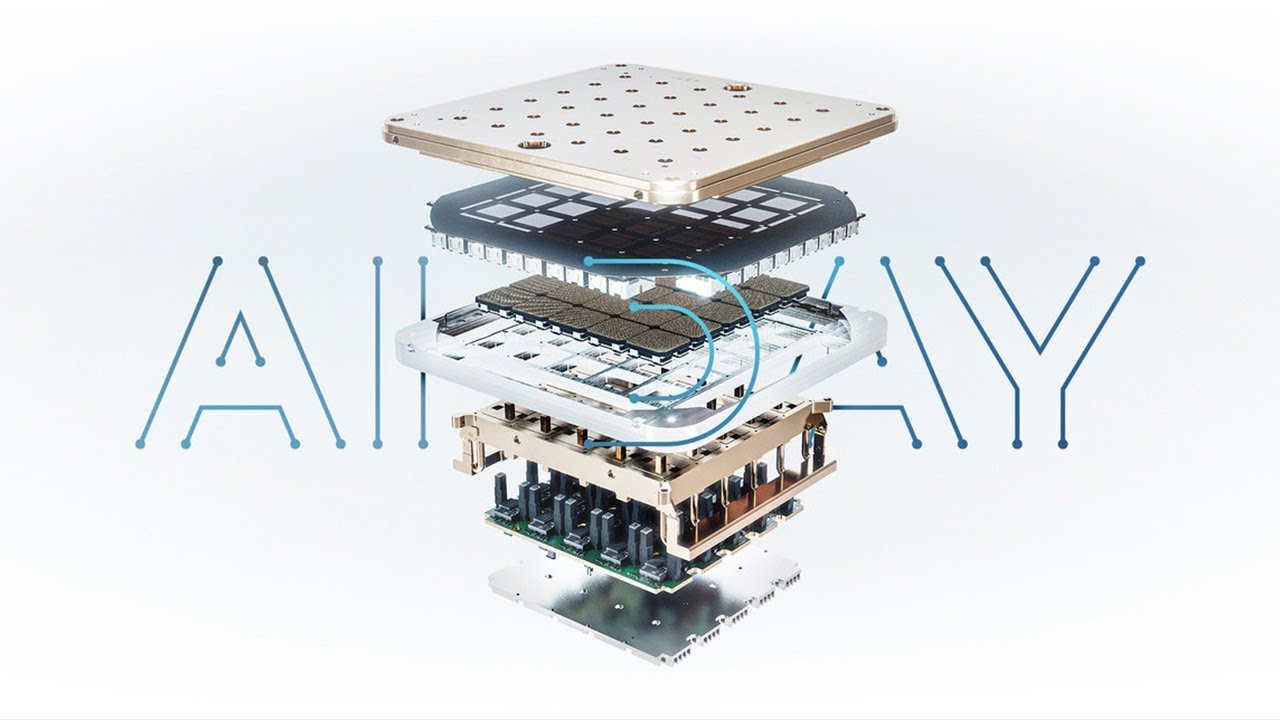
- Tesla unveiled its custom D1 chip and Project Dojo architecture, packaging 25 D1 dies into a 9-petaflop training tile and scaling to an ExaPOD supercomputer capable of 1.1 exaflops of compute to accelerate neural network training. (111:39)
- Tesla Vision shifted completely to multi-camera surround video networks operating directly in 3D vector space, integrating spatial RNNs and feature caching to eliminate millimeter-wave radar from production cars. (69:35)
- Tesla announced the Tesla Bot (Optimus), a 5'8", 125-pound humanoid robot designed to automate repetitive, dangerous manual tasks by repurposing vehicle Autopilot hardware, vision models, and compute. (125:14)
- Elon Musk announced Hardware 4 (FSD Computer 2) will debut with the Cybertruck in roughly a year, delivering approximately 4x greater compute to target a 1,000% safety improvement over human drivers. (171:15)
Detailed notes
## Background Published on YouTube by Tesla on August 20, 2021, this video captures the full broadcast of Tesla AI Day 2021. The event description invites engineers to join Tesla in building the future of AI, laying out a technical schedule spanning Tesla Vision, planning and control, auto-labeling, simulation, custom hardware, Project Dojo, the Tesla Bot, and an audience Q&A.
## TL;DR Tesla engineering leadership presents an in-depth technical breakdown of the company's vertically integrated artificial intelligence stack, framing the vehicle as an embodied synthetic animal. Key presentations detail the evolution of Tesla Vision from per-camera 2D space to multi-camera 3D vector space using spatial RNNs and cross-attention, which enabled the removal of radar, alongside hierarchical multi-agent trajectory planning. The team also demonstrates its massive automated labeling pipeline and photorealistic simulation engine before unveiling Project Dojo—a supercomputing architecture powered by the custom D1 chip and modular training tiles. Concluding the presentation, Elon Musk reveals the humanoid Tesla Bot (Optimus), targeting the automation of repetitive, dangerous, and boring physical labor.
## Atmosphere & style The presentation feels far more like an advanced, highly specialized graduate computer science symposium than a polished marketing keynote, dominated by dense architectural diagrams, code breakdowns, and deep technical transparency. Speakers like Andrej Karpathy, Ashok Elluswamy, and Ganesh Venkataramanan present with rapid-fire, candid precision, highlighting grueling engineering bottlenecks, memory constraints, and practical hardware hurdles. Elon Musk anchors the session with his characteristic mix of dry humor, grand macroeconomic predictions, and philosophical reflections on AI alignment, giving the marathon event an ambitious, intensely focused recruitment vibe.
## Bulletin - [01:51:39](https://www.youtube.com/watch?v=j0z4FweCy4M&t=6699s) Tesla unveiled its custom D1 chip and Project Dojo architecture, packaging 25 D1 dies into a 9-petaflop training tile and scaling to an ExaPOD supercomputer capable of 1.1 exaflops of compute to accelerate neural network training. - [01:09:35](https://www.youtube.com/watch?v=j0z4FweCy4M&t=4175s) Tesla Vision shifted completely to multi-camera surround video networks operating directly in 3D vector space, integrating spatial RNNs and feature caching to eliminate millimeter-wave radar from production cars. - [02:05:14](https://www.youtube.com/watch?v=j0z4FweCy4M&t=7514s) Tesla announced the Tesla Bot (Optimus), a 5'8", 125-pound humanoid robot designed to automate repetitive, dangerous manual tasks by repurposing vehicle Autopilot hardware, vision models, and compute. - [02:51:15](https://www.youtube.com/watch?v=j0z4FweCy4M&t=10275s) Elon Musk announced Hardware 4 (FSD Computer 2) will debut with the Cybertruck in roughly a year, delivering approximately 4x greater compute to target a 1,000% safety improvement over human drivers.
## Key takeaways - [48:44](https://www.youtube.com/watch?v=j0z4FweCy4M&t=2924s) Tesla frames autonomous vehicle development as building a synthetic animal, replacing biological nervous systems and visual cortices with cameras, FSD computers, and deep neural networks. - [51:31](https://www.youtube.com/watch?v=j0z4FweCy4M&t=3091s) The HydraNet vision pipeline uses RegNet backbones and BiFPNs to share feature extraction across dozens of perception tasks, utilizing multi-scale feature caching to accelerate head iteration. - [58:10](https://www.youtube.com/watch?v=j0z4FweCy4M&t=3490s) Direct projection from 2D image space to 3D world coordinates failed due to depth noise; Tesla solved this by mapping raw 8-camera inputs directly into 3D vector space (Bird's Eye View) using transformer cross-attention. - [01:06:54](https://www.youtube.com/watch?v=j0z4FweCy4M&t=4014s) A spatial RNN maintaining a 2D ground-plane lattice acts as an implicit, feature-level HD map, preserving environmental memory during static idling and dynamic occlusions. - [01:09:35](https://www.youtube.com/watch?v=j0z4FweCy4M&t=4175s) Temporal video networks matched and exceeded radar depth and velocity accuracy, enabling Tesla to completely remove radar sensors from production vehicles. - [01:13:11](https://www.youtube.com/watch?v=j0z4FweCy4M&t=4391s) Trajectory planning is handled via a two-stage hierarchical system: discrete coarse search establishes a topological corridor to avoid non-convex local minima, followed by continuous numerical spline optimization. - [01:22:15](https://www.youtube.com/watch?v=j0z4FweCy4M&t=4935s) Tesla is introducing neural network value functions guided by Monte Carlo Tree Search (MCTS) to dramatically cut planning search states in unstructured interactive driving environments. - [01:28:28](https://www.youtube.com/watch?v=j0z4FweCy4M&t=5308s) Automated server-side labeling ingests multi-trip fleet video to reconstruct dense 3D point clouds and implicit NeRF-style road surfaces using temporal hindsight, distilling offline models into vehicle networks. - [01:34:52](https://www.youtube.com/watch?v=j0z4FweCy4M&t=5692s) The custom photorealistic simulation engine generates mathematically ground-truthed edge cases, sensor physics distortions, and digital twin failure replays, having served over 300 million synthetic training images. - [01:51:39](https://www.youtube.com/watch?v=j0z4FweCy4M&t=6699s) The D1 chip features 354 custom 64-bit training nodes on a 7nm process, delivering 22.6 TFLOPs and double the I/O bandwidth of standard networking switch chips. - [01:54:06](https://www.youtube.com/watch?v=j0z4FweCy4M&t=6846s) Dojo training tiles utilize vertical power delivery and dual-sided liquid cooling to overcome extreme sub-one-volt electrical current resistance ($I^2R$) and thermal bottlenecks. - [02:00:28](https://www.youtube.com/watch?v=j0z4FweCy4M&t=7228s) The Dojo compiler dynamically partitions clusters into DPUs, automatically extracting data, model, and graph parallelism from standard PyTorch code without handwritten kernels. - [02:09:00](https://www.youtube.com/watch?v=j0z4FweCy4M&t=7740s) Tesla Bot leverages the vehicle autonomy stack, sensors, and actuators to address labor shortages, with Musk predicting general-purpose humanoid robots will eventually make physical labor optional. - [02:34:56](https://www.youtube.com/watch?v=j0z4FweCy4M&t=9296s) Musk cautions against applying machine learning to factory floor automation and operational workflows, noting deterministic software and mechanical redesign (like single-piece gigacastings) are superior in 99.9% of cases. - [02:51:15](https://www.youtube.com/watch?v=j0z4FweCy4M&t=10275s) Musk projects Hardware 3 is capable of achieving self-driving safety 200% to 300% better than human drivers, with future Hardware 4 pushing that margin toward 1,000%.
## Detailed walkthrough ### [46:54](https://www.youtube.com/watch?v=j0z4FweCy4M&t=2814s) AI Day Begins: Tesla's Mission in Real-World AI
Elon Musk opens the presentation by welcoming the audience and apologizing for the delay caused by minor technical difficulties, joking, “really need AI for this.” He immediately clarifies the true purpose of the event: demonstrating that Tesla is far more than just an electric car company. Beneath the surface, the company maintains extensive artificial intelligence efforts across custom hardware, inference, and training. Musk makes the case that Tesla has become a preeminent force in physical-world applications, stating: “I think we're, I think arguably the leaders in real-world AI as it applies to the real world.”
Musk notes that anyone following the progress of the Full Self-Driving (FSD) beta can directly observe the rapid velocity at which Tesla's neural networks are learning how to drive. While autonomous driving represents an immediate, high-impact demonstration of this technology, Musk hints that the underlying software and hardware foundations will unlock broader applications in the near future. He emphasizes that the primary goal of the event is recruiting elite talent: “We basically want to encourage anyone who is interested in solving real-world AI problems at either the hardware or the software level to join Tesla or consider joining Tesla.” With that invitation, Musk hands the presentation over to Andrej Karpathy to begin the deep dive into the Autopilot stack.
[48:44](https://www.youtube.com/watch?v=j0z4FweCy4M&t=2924s) Tesla Vision: The Synthetic Animal and Vector Space
Andrej Karpathy introduces himself as the lead of the Autopilot vision team, expressing his excitement to walk through the technical architecture that enables the vehicle to drive autonomously. The core objective of the vision system is converting raw sensor streams from eight surround cameras into a unified, real-time 3D representation termed the "vector space." This vector space provides everything required for downstream path planning and vehicle control, including the 3D geometry of lane lines, road edges, curbs, traffic lights, and traffic signs, alongside bounding volumes, dynamic orientations, depths, and velocities of other vehicles.
Karpathy draws an explicit analogy between autonomous vehicles and biological organisms: “What I find kind of fascinating about this is that we are effectively building a synthetic animal from the ground up.” The vehicle navigates the physical world, perceives dynamic stimuli through sensors, and exercises autonomous agency. Tesla develops every layer in-house: the mechanical structure serves as the body, the low-voltage electronics act as the nervous system, the Autopilot computer functions as the brain, and the vision neural networks constitute a synthetic visual cortex. Karpathy illustrates how biological vision routes photonic inputs from the retina through the lateral geniculate nucleus (LGN) into visual cortex areas V1, V2, V4, and IT across the ventral and dorsal streams, explaining that Tesla's engineering task is to mirror this structured flow of information inside an artificial neural network.
```mermaid flowchart LR accTitle: Camera to Vector Space Pipeline accDescr: Pipeline showing raw optical inputs passing through the synthetic visual cortex to output a unified vector space. subgraph Inputs["Sensor Layer"] C["8 Surround Cameras<br/>1280x960 @ 36 Hz"] end subgraph Processing["Synthetic Visual Cortex"] NN["Deep Neural Network Stack<br/>Feature Extraction & Fusion"] end subgraph Outputs["Vector Space Representation"] VS["3D Driving World<br/>• Lane lines & curbs<br/>• Signs & lights<br/>• Vehicle 3D bounds & velocities"] end Inputs --> Processing Processing --> Outputs ```
[51:31](https://www.youtube.com/watch?v=j0z4FweCy4M&t=3091s) Per-Image Neural Networks: RegNets, BiFPNs, and HydraNets
Karpathy reviews the chronological evolution of Tesla's vision networks, starting roughly four years prior when Autopilot's operational domain was predominantly single-lane highway cruising. In that era, the network was tasked primarily with basic lane-keeping and maintaining headway behind a lead vehicle, operating strictly on individual camera frames rather than temporal sequences. The raw sensor input for each camera consists of a 1280×960 resolution image with 12-bit integer depth streaming at approximately 36 Hz.
To process these frames, Tesla uses a residual neural network backbone, specifically adopting RegNets because their parameter design space allows an optimal balance between low compute latency and high accuracy. The RegNet backbone outputs an inverted feature hierarchy: lower layers retain fine spatial resolution with few channels (scrutinizing granular pixel details), while top layers yield coarse spatial resolution with high channel depth (capturing broader scene context). The multi-scale features are fused using a bidirectional feature pyramid network (BiFPN). Karpathy explains the value of cross-scale feedback with an example: if a lower-layer neuron observing a tiny visual patch cannot tell whether it is looking at an actual vehicle, context propagated from top layers indicating that the patch sits exactly on the highway vanishing point quickly resolves the ambiguity.
```mermaid flowchart TD accTitle: HydraNet Architecture accDescr: Diagram illustrating the RegNet backbone feeding into a BiFPN, which fans out to multiple modular task heads. subgraph Backbone["Shared Feature Extractor"] IMG["Raw Image<br/>1280x960 12-bit @ 36Hz"] --> RN["RegNet Backbone<br/>Multi-scale Residual Blocks"] RN --> FPN["BiFPN Layer<br/>Cross-Scale Feature Fusion"] end subgraph Heads["HydraNet Task Heads"] FPN --> H1["Detection Head<br/>YOLO-like Object Raster"] FPN --> H2["Lane Head<br/>Road Geometry & Edges"] FPN --> H3["Traffic Light Head<br/>Detection & State"] FPN --> H4["Auxiliary Heads<br/>Attributes & Static Cues"] end ```
Object detection downstream from the BiFPN utilizes a one-stage, YOLO-like head that initializes a spatial raster, outputting a detection probability bit alongside geometric attributes (x, y offsets, bounding width, height, and vehicle class). Because the vehicle must concurrently handle dozens of perception tasks—including reading lane lines, road markings, and traffic lights—Tesla adopted a branched multi-task architecture called the "HydraNet." The HydraNet utilizes a single shared backbone that fans out into specialized task heads. Karpathy points out two critical advantages of this design: - It amortizes expensive backbone feature extraction over all tasks, keeping inference runtime low on the vehicle's onboard computer. - It decouples tasks during engineering cycles, enabling engineers to independently iterate on datasets or head architectures without unintended cross-task regressions.
[54:40](https://www.youtube.com/watch?v=j0z4FweCy4M&t=3280s) HydraNet Workflows and Feature Caching
Andrej Karpathy explains how the Tesla vision team manages the computational complexity of training their multi-task HydraNets. Because of the architectural bottleneck at the trunk level, validating every single task after a minor modification would be prohibitively expensive. To streamline the workflow, the team frequently caches the intermediate multi-scale trunk features directly to disk. This allows researchers to freeze the heavy backbone and fine-tune individual task heads off the cached representations without repeatedly running full image backpropagation.
Every once in a while, the team executes a joint, end-to-end training run across the entire network to refresh the trunk representations, re-caches the resulting multi-scale feature maps, and resumes head-specific fine-tuning. Karpathy showcases sample outputs from the HydraNet architecture as deployed several years prior: from single image inputs, the network simultaneously predicted stop signs, stop lines, lane edges, vehicles, traffic lights, curbs, parking states, and static obstacles like cones and trash cans. While effective for standalone 2D perception, this setup treated each frame in isolation, which soon proved insufficient for autonomous navigation.
- Training iterations cycle between periodic end-to-end joint optimization runs and cached-feature head-only fine-tuning. - Feature caching isolates individual task heads during development, eliminating the cost of continuous regression testing across unaffected heads. - Legacy HydraNet models produced hundreds of simultaneous image-space predictions per frame, but lacked holistic spatial integration.
---
[55:50](https://www.youtube.com/watch?v=j0z4FweCy4M&t=3350s) The Limits of Image-Space Predictions and Smart Summon
The single-image paradigm met its limits during the development of Smart Summon, where an unoccupied vehicle must navigate complex parking lots to reach a passenger. Driving safely through a lot requires continuous knowledge of curbs, drivable surfaces, and static obstacles across all camera views and over time. To bridge this gap, Tesla initially processed curb detection on individual cameras and piped the predictions into an external, hand-engineered C++ tracking module called the occupancy tracker.
```mermaid flowchart LR accTitle: Legacy Image Space Tracking Failure accDescr: 2D camera detections piped into a hand-engineered C++ occupancy tracker create severe vector space projection errors. subgraph LegacyPipeline["Legacy Image-Space Pipeline"] Cam["8 Separate Cameras"] --> Hydra["Single-Camera HydraNets"] Hydra --> Det["Image-Space 2D Predictions"] Det --> Cpp["C++ Occupancy Tracker (Stitching & Depth Projection)"] Cpp --> BadOut["Distorted Vector Space Output (Undrivable)"] end ```
The occupancy tracker attempted to stitch detections across camera boundaries and track them over time, but the approach quickly unraveled. Manually tuning its complex C++ heuristics and hyper-parameters proved nearly impossible. More fundamentally, Karpathy emphasizes that 2D image space is simply the wrong target output space. When 2D curb lines were cast into 3D world coordinates, the resulting vector-space geometries were severely distorted and erratic because projection requires extreme per-pixel depth accuracy that 2D networks cannot reliably provide. Furthermore, occluded surfaces could not be predicted in image space at all, and large objects—such as a nearby vehicle spanning five of the car's eight cameras—could not be holistically recognized by any single camera.
> “You don't want to do this explicitly by hand in C++, you want this to be inside the neural network and train that end to end.”
> “You see how the predictions are quite bad in vector space and the reason for this fundamentally is because you need to have an extremely accurate depth per pixel in order to actually do this projection and so you can imagine just how high of the bar it is to predict that depth so accurately in these tiny in every single pixel of the image and also if there's any occluded area where you'd like to make predictions you will not be able to because it's not an image space concept in that case.”
---
[58:10](https://www.youtube.com/watch?v=j0z4FweCy4M&t=3490s) The Multi-Camera Vector-Space Vision and Transformer Architecture
Tesla concluded that all eight camera streams had to be fed simultaneously into a single neural network capable of outputting representations directly in vector space (Bird's Eye View, or BEV). Achieving this required solving two major challenges: developing a differentiable neural network layer to transform image-space features into vector space, and creating large-scale 3D vector-space ground-truth datasets. Addressing the architectural challenge, Karpathy details why a naive geometric projection fails: projecting a BEV ground-plane pixel back into camera frames depends heavily on variable road topography, slopes, crests, and dynamic occlusions like parked cars.
```mermaid flowchart TD accTitle: Multi-Camera Transformer BEV Architecture accDescr: Image features from 8 cameras attend to vector-space query vectors via a transformer to produce direct BEV features. subgraph ImageDomain["Image Feature Extraction"] Raw["8 Camera Streams"] --> Rect["Rectification Layer (Virtual Camera)"] Rect --> Backbone["Shared Trunk Backbones"] Backbone --> Feat["Multi-Scale Features (Keys & Values)"] end subgraph TransformerSpace["BEV Transformer Cross-Attention"] Grid["BEV Output Grid + Positional Encodings"] --> MLP["MLP Query Generator"] MLP --> Queries["BEV Queries ('Looking for curbs at position X,Y')"] Queries & Feat --> Attention["Multi-Headed Cross-Attention"] end subgraph VectorOutput["Vector Space Decoding"] Attention --> BEVFeat["Vector Space Feature Map"] BEVFeat --> TaskHeads["Decoders (Curbs, Road Surface, Objects, Kinematics)"] end ```
To handle these data-dependent projections, Tesla implemented an attention-based transformer architecture. The network initializes an output spatial raster representing the desired bird's-eye canvas, tiled with sine and cosine positional encodings, which an MLP maps into a lattice of query vectors. Simultaneously, the backbone features extracted from all cameras emit keys and values. Through multi-headed self- and cross-attention, the queries interact multiplicatively with the image keys—effectively asking what visual evidence exists for a road feature at a specific physical location—and pull the relevant feature values across cameras and occlusions.
> “And so effectively what's happening is that every single image piece is broadcasting in its key what it is, what is it a part of: so hey, I'm part of a pillar in roughly this location and I'm seeing this kind of stuff, and that's in the key. And then every query is something along the lines of: hey, I'm a pixel in the output space at this position and I'm looking for features of this type.”
- The BEV raster uses sine and cosine positional encodings mapped by an MLP into query vectors. - Cross-attention decouples feature lookup from rigid flat-ground projection assumptions, accommodating road slope and camera occlusions. - A single transformer block is capable of performing the spatial re-representation from perspective camera views to bird's-eye view.
---
[01:01:32](https://www.youtube.com/watch?v=j0z4FweCy4M&t=3692s) Synthetic Virtual Camera Rectification and Vector Space Results
Deploying this multi-camera architecture across Tesla's commercial fleet introduced a critical hardware variance issue: physical camera alignments vary across vehicles due to manufacturing tolerances and mounting angles, leaving cameras slightly "cockeyed." Directly concatenating raw calibration matrices into neural network MLPs produced suboptimal results. Instead, Tesla introduced a synthetic virtual camera rectification layer placed directly after image capture.
This calibration-driven transformation warps every incoming frame into a unified, idealized virtual camera frame. Karpathy demonstrates the effect by showing time-averaged views from the rear-facing repeater cameras: unrectified images result in a blurry mess due to mechanical variation across cars, whereas rectified frames snap into alignment, making features like the rear edge of the car crisply defined. Passing these normalized frames into the multi-camera transformer yielded dramatic improvements. Karpathy presents side-by-side comparisons of the legacy C++ occupancy tracker against the new vector-space network: jagged, fragmented curb detections are replaced by smooth, continuous vector boundaries.
> “On the left we are seeing what we had before and on the right we're now seeing significantly improved predictions coming directly out of the neural net; this is a multi-camera network predicting directly in vector space and you can see that it's basically night and day, you can actually drive on this.”
- Raw mechanical misalignment across production cars is corrected by warping frames into a shared virtual camera coordinate space. - Time-averaged overlays of side repeater views reveal crisp alignment of vehicle body panels once the rectification transform is applied. - The end-to-end vector-space model resolves multi-camera stitching artifacts, providing smooth, stable road geometries and unified object detections across camera seams.
[01:03:05](https://www.youtube.com/watch?v=j0z4FweCy4M&t=3785s) Transition from Single-Camera to Multi-Camera Video Networks
Andrej Karpathy illustrates the shortcomings of single-camera predictions compared to multi-camera fusion in vector space. Displaying a video comparison where single-camera detections appear in orange and multi-camera detections appear in blue, he highlights what happens when an object crosses camera fields of view: “Basically if you can't predict these cars if you are only seeing a tiny sliver of a car so your detections are not going to be very good and their positions are not going to be good but a multi-camera network does not have an issue.” In tight spaces, vehicles crossing camera boundaries create severe prediction instability, or "jank," which breaks down entirely when encountering large vehicles. Multi-camera architectures resolve these stitching boundaries by reasoning across sensors simultaneously.
However, resolving cross-camera boundaries at a single static instant is insufficient for driving. Operating purely per-frame leaves critical driving questions unanswered: whether a car is moving or parked, its precise velocity, whether it still exists after being temporarily occluded, and what road geometry lies ahead based on signs passed tens of meters earlier. To solve this, Tesla introduced temporal context into the neural network architecture by inserting a feature queue and a video fusion module between the spatial feature extractors and the output decoding heads, augmented with ego-car kinematics such as velocity and acceleration.
```mermaid flowchart LR accTitle: Video Neural Network Architecture accDescr: Pipeline showing feature extraction, queuing across time and space, temporal fusion, and task decoding heads. subgraph InputStage["Inputs"] CAM["Multi-Camera Images"] KIN["Kinematics (v, a)"] end subgraph FeatureStage["Feature Pipeline"] FEAT["Multi-Scale Features"] QUEUE["Feature Queue (Time & Space)"] VID["Video Module (Temporal Fusion)"] end subgraph OutputStage["Prediction Heads"] HEADS["Vector Space Heads (Road, Objects, Depth)"] end CAM --> FEAT FEAT --> QUEUE KIN --> QUEUE QUEUE --> VID VID --> HEADS ```
[01:04:54](https://www.youtube.com/watch?v=j0z4FweCy4M&t=3894s) Dual Caching: Time-Based and Space-Based Feature Queuing
Building a temporal feature queue requires careful engineering around memory push and pop mechanics. The queue caches concatenated spatial features, ego-kinematics, and positional encodings over time. Karpathy presents an intersection scenario to demonstrate why simple time-based queues fail in autonomous driving: an ego car approaches an intersection, encounters cross-traffic that occludes oncoming vehicles, and then waits at a red light.
If the network relies strictly on a time-based queue (for instance, pushing features every 27 milliseconds), it handles temporary dynamic occlusions effectively by referencing past frames. However, if the car waits stationary at a red light for an extended period, a time-based buffer will overwrite and purge critical environmental context—such as road markings, painted turn arrows, or overhead lane-assignment signs observed 50 meters back. To counteract this limitation, the architecture incorporates both time-based and space-based feature queues:
- **Time-based queue**: Pushes incoming frames at fixed time intervals (e.g., every 27 milliseconds) to preserve high-frequency temporal motion, tracking dynamic obstacles and brief occlusions. - **Space-based queue**: Pushes cached feature representations whenever the vehicle travels a fixed incremental distance, preserving static road markers, lane assignments, and turning constraints indefinitely while the vehicle is idling at red lights or in heavy traffic.
[01:06:54](https://www.youtube.com/watch?v=j0z4FweCy4M&t=4014s) Spatial Recurrent Neural Networks (RNN) and Feature-Level Mapping
When evaluating temporal fusion architectures, the team benchmarked 3D convolutions, standard transformers, axial transformers (evaluated for computational efficiency), and numerous RNN variants. The approach they favored was a spatial recurrent neural network (Spatial RNN). Because driving naturally takes place on a two-dimensional ground plane, the network arranges its hidden state into a 2D spatial lattice. As the ego car maneuvers, ego-kinematics continuously integrate vehicle motion into the grid coordinates, updating the RNN state selectively only where the car is physically located and has clear visibility.
```mermaid flowchart TD accTitle: Spatial RNN Hidden State Updating accDescr: Spatial recurrent network updating a 2D ground plane lattice selectively based on visibility and kinematics. KIN["Ego Kinematics Integration"] --> GRID["2D Hidden State Lattice"] FEAT["Multi-Camera Features"] --> GATE{"Selective Read/Write Gate"} GATE -- "Clear Visibility" --> UPDATE["Update Local Spatial Cells"] GATE -- "Occluded" --> RETAIN["Retain Prior Hidden Memory"] UPDATE --> GRID RETAIN --> GRID GRID --> MAP["Implicit Feature HD Map"] ```
During training optimization, individual channels within the hidden state specialize autonomously, tracking structural elements such as road surfaces, curbs, centerlines, and boundaries. By analyzing activations (such as the mean of the first 10 channels across intersection runs), Karpathy demonstrates how the network dynamically selectively reads and writes memory. If an adjacent vehicle blocks the view, the network skips writing over those spatial coordinates; as soon as the line of sight clears, it commits the newly observed road geometry into memory. Karpathy notes the broader architectural implications of this approach: “Number of cars a number of clips could be collaborating to build this map basically and effectively an HD map except it's not in a space of explicit items it's in a space of features of a recurrent neural network which is kind of cool I haven't seen that before.”
[01:09:35](https://www.youtube.com/watch?v=j0z4FweCy4M&t=4175s) Dynamic Occlusion Handling and Radar Removal
The video architecture produces significant performance gains in both dynamic object persistence and continuous kinematic estimation. Demonstrating an occlusion event where passing traffic momentarily obscures two parked cars, Karpathy compares the output modes: - **Single-frame networks**: Experience total dropouts when objects are occluded, output duplicate bounding boxes from multiple cameras across boundary lines, and fabricate erratic, incorrect bounding box geometry when only tiny, partial slivers of a vehicle re-emerge. - **Video networks**: Retain object states through memory buffers during full occlusion, maintain bounding box stability across camera handoffs, and suppress false geometric jumps during partial reveals because the network contextualizes partial observations with prior visibility states.
These temporal networks proved crucial for Tesla's initiative to remove physical radar sensors from production vehicles. Karpathy showcases comparison telemetry where single-frame camera predictions (orange) struggle to achieve smooth velocity and depth estimation, while the video module (blue) achieves smooth, stable velocity and distance curves that match or exceed the accuracy of physical automotive radar signals (green).
[01:11:02](https://www.youtube.com/watch?v=j0z4FweCy4M&t=4262s) End-to-End Vision Architecture and the Vector Space
Andrej Karpathy demonstrates how temporal video modules dramatically outperform single-frame models when estimating kinematic properties. With single-frame networks, computing velocity requires differentiating noisy depth outputs over consecutive frames, whereas the video module aligns directly with physical radar ground truth. Tying together every vision component developed over the previous years, Karpathy details Tesla's modern network pipeline. Raw images from all surrounding cameras enter a rectification layer to correct for hardware calibration differences and project sensor data into a standardized virtual camera space. These standardized views pass into RegNet residual backbones to extract multi-scale features, merge through a BiFPN (bidirectional feature pyramid network), and project into 3D vector space via cross-attention transformer modules. The vector features accumulate into a spatiotemporal queue processed by a temporal video module (such as a spatial RNN), which ultimately forks into a branching HydraNet structure with individual trunks and task-specific heads.
```mermaid flowchart TD accTitle: Tesla Vision End-to-End Neural Architecture accDescr: Pipeline from raw multi-camera image feeds to multi-task HydraNet predictions in 3D vector space.
subgraph Inputs["Sensor Processing"] A["Raw Camera Images"] --> B["Rectification Layer (Virtual Camera)"] B --> C["RegNet Backbones (Multi-Scale Features)"] C --> D["BiFPN (Feature Fusion)"] end
subgraph VectorFusion["Space & Time Fusion"] D --> E["Transformer Cross-Attention (3D Vector Space)"] E --> F["Spatiotemporal Feature Queue"] F --> G["Video Module (Spatial RNN)"] end
subgraph Outputs["Multi-Task Heads"] G --> H["HydraNet Trunks & Heads"] H --> I["Dense Rasters & Kinematics"] end ```
Karpathy notes how dramatically the visual processing system has expanded: “this architecture has definitely complexified from just a very simple image based single network about three or four years ago and continues to evolve”. Despite these breakthroughs, active engineering efforts target several bottlenecks. Currently, temporal and spatial fusions happen relatively late in the network graph; the team is exploring earlier fusions via cost volumes or optical flow-style lower layers. Additionally, outputting dense rasters creates a latency and computational tax because post-processing these representations directly on car hardware is expensive under real-time constraints. Consequently, Tesla is pursuing sparse geometry predictions—such as directly generating point-by-point road structures—to bypass dense raster post-processing entirely before handing off the 3D vector space to downstream planning.
- Single-frame velocity estimation relies on differentiating depth estimates over time, whereas temporal video modules replicate the accuracy of millimeter-wave radar directly from vision. - Multi-camera rectification normalizes physical camera misalignment into a uniform synthetic viewpoint. - Output rasters currently impose heavy embedded post-processing loads; the vision team is migrating toward direct sparse point-based road geometry prediction.
---
[01:13:11](https://www.youtube.com/watch?v=j0z4FweCy4M&t=4391s) The Planning Problem: Non-Convexity and High Dimensionality
Ashok Elluswamy, director of Autopilot software, introduces the planning, control, auto-labeling, and simulation domains. The planner's core mission is to consume the 3D vector space synthesized by the vision network and maneuver the car to its destination while maximizing safety, passenger comfort, and travel efficiency. While Autopilot handled highway environments reliably as far back as 2019—staying centered in lanes, performing tactical lane changes, and navigating interchange ramps—city driving introduces an entirely different tier of difficulty. Urban environments rarely possess pristine lane markings; instead, they feature free-form trajectories, occluded sightlines, crossing traffic, roadside curbs, and unpredictable pedestrian behaviors.
Elluswamy breaks down the primary mathematical dilemma of real-time autonomous planning into two compounding characteristics: high dimensionality and an intensely non-convex action space. The high dimensionality stems from the necessity of planning a continuous trajectory over a 10-to-15-second rolling horizon, solving for precise positions, velocities, and accelerations across every discrete time increment. Simultaneously, non-convexity implies that driving scenarios contain multiple locally optimal solutions (e.g., passing on the left versus yielding on the right) separated by severe local minima:
> “Discrete search methods are really great at solving non-convex problems because they are discrete, they don't get stuck in local minima, whereas continuous function optimization can easily get stuck in local minima and produce poor solutions that are not great.”
To harness the advantages of both approaches while avoiding their limitations—discrete search cannot scale efficiently in high dimensions because it lacks gradient information, while gradient-based continuous optimization easily traps itself in poor local minima—Tesla uses a two-stage hierarchical planner. First, a coarse discrete search explores the non-convex environment to select a topological decision corridor; second, a continuous gradient-based optimizer refines that corridor into an ultra-smooth, dynamically feasible physical trajectory.
- Trajectory rollouts must anticipate 10 to 15 seconds into the future, spanning dozens of correlated kinematic control variables. - Discrete search methods systematically hop across non-convex topological modes without gradient traps but scale poorly in high-dimensional continuous spaces. - Continuous numerical optimization rapidly converges along smooth gradients but requires a convex bounding corridor to avoid getting pinned in local minima.
---
[01:15:26](https://www.youtube.com/watch?v=j0z4FweCy4M&t=4526s) Hierarchical Trajectory Search and Validation
To illustrate discrete corridor selection, Elluswamy presents an unprotected urban maneuver requiring two consecutive lane changes in rapid succession to execute an upcoming left turn. A naive planner might execute an immediate, aggressive lane change, but hitting the brakes hard causes severe passenger discomfort. Conversely, waiting to accelerate past surrounding traffic down the road results in making the lane change too late, overshooting the turning pocket entirely.
```mermaid flowchart LR accTitle: Hierarchical Planner Architecture accDescr: Flow diagram showing discrete coarse search establishing a convex corridor followed by continuous spline optimization.
subgraph Stage1["Discrete Search"] A["3D Vector Scene"] --> B["Physics-Based Rollouts"] B --> C["Candidate Selection (Safety & Comfort)"] end
subgraph Stage2["Continuous Optimization"] C --> D["Convex Corridor Bounding"] D --> E["Spline Parameterization (Arc Length)"] E --> F["Fine Trajectory (Minimized Jerk & Loss)"] end ```
The system resolves this tradeoff by evaluating thousands of candidate trajectories in fractions of a second using physics-based forward simulation. Each rollout is scored against an explicit cost function balancing collision risk, longitudinal deceleration limits, lateral jerk, and navigation progress. Once the discrete search isolates the optimal sequence, the vehicle executes the maneuver. Telemetry data comparing planned velocity curves against actual recorded execution confirms that the vehicle tracks the planned 10-second trajectory profile with near-perfect fidelity in real-world driving conditions.
- Candidate trajectories are evaluated across multiple criteria, ruling out harsh braking or delayed turns that risk missing routing waypoints. - Physics-based simulation engines simulate thousands of dynamic candidate maneuvers within milliseconds on embedded hardware. - Real-time vehicle telemetry demonstrates tight alignment between planned 10-second longitudinal velocity curves and actual vehicle execution.
---
[01:16:48](https://www.youtube.com/watch?v=j0z4FweCy4M&t=4608s) Joint Multi-Agent Planning in Interactive Driving
Navigating complex human environments requires recognizing that the autonomous vehicle does not operate inside a static vacuum. Safe and natural driving demands anticipating the interactive responses of every surrounding road user. As Elluswamy explains:
> “When driving alongside other agents it's important to not just plan for ourselves but instead we have to plan for everyone jointly and optimize for the overall scenes traffic flow.”
To achieve this, the car does not treat surrounding obstacles as passive bounding boxes moving along static velocity vectors; it actively runs instances of the Autopilot planning algorithm for every relevant nearby vehicle in the scene.
Elluswamy demonstrates this principle using footage of an Autopilot vehicle traversing a narrow, obstructed road corridor flanked by closely parked vehicles, construction cones, and poles. When the first oncoming car approaches, Autopilot briefly decelerates, observes that its own path offers no lateral pull-out space, but calculates that the oncoming vehicle has ample shoulder space and a low enough speed to pull over safely. Rather than phantom-braking or stalling, the system recognizes the mutual game-theoretic dynamic and drives assertively through the opening.
When a second oncoming vehicle approaches at a significantly higher speed, the planner evaluates two branching hypotheses: 1. A yielding hypothesis (represented visually as a green trajectory) where the opposing car slows down. 2. An aggressive bypass hypothesis (represented as a red trajectory) where the driver swerves around parked obstacles directly into Autopilot's lane.
Given the oncoming vehicle's high approach speed and acceleration, Autopilot infers that the driver will not yield and proactively steers into an available side pocket. However, as the oncoming car initiates a turn and alters its yaw rate and deceleration to yield, Autopilot detects this behavioral shift in real time, immediately updates its joint plan, and resumes forward progress. Without this capability to jointly project and react to the intent of other agents, Elluswamy emphasizes that Autopilot would either drive far too timorously or freeze entirely, making autonomous city driving impractical.
- Surrounding dynamic agents are modeled by executing the Autopilot planner from their perspective to predict realistic path intentions. - Game-theoretic joint modeling prevents deadlocks on narrow roads by identifying which vehicle has geometric clearance to pull over and yield. - High-frequency tracking of an oncoming vehicle's subtle yaw rate and longitudinal acceleration allows the planner to adapt within fractions of a second when an opposing driver decides to yield.
---
[01:19:03](https://www.youtube.com/watch?v=j0z4FweCy4M&t=4743s) Continuous Convex Corridor Optimization
Once discrete search and multi-agent intent modeling identify the optimal sequence of actions, the planner constructs a geometric bounding corridor free of non-convex obstacles. Inside this convex corridor, continuous optimization refines the trajectory into an actionable path. The planner initializes a mathematical spline defined in heading, curvature, and acceleration, parameterized explicitly over the arc length of the target path rather than simple time steps.
During optimization, gradient-based numerical routines modify the spline parameters to minimize a combined objective loss function. This objective penalizes proximity to static and dynamic obstacles, excessive total travel time, and sharp vehicle dynamics. Analyzing the lateral acceleration profile generated by this continuous pass reveals smooth, symmetrical trapezoidal curves—a mathematical signature that mirrors the natural driving habits of skilled human drivers while driving lateral jerk down to near zero.
- The coarse discrete search generates a convex spatial corridor that shields the continuous numerical optimizer from local minima traps. - Trajectory splines are parameterized across arc length, optimizing heading, curvature, and acceleration simultaneously. - Objective functions explicitly penalize obstacle margins, travel delays, and comfort metrics, yielding smooth trapezoidal lateral acceleration curves that eliminate steering jerk.
[01:19:53](https://www.youtube.com/watch?v=j0z4FweCy4M&t=4793s) Learning-Based Planning and the Toy Parking Problem
The discussion transitions from structured highway driving to the chaos of real-world urban navigation. Ashok Elluswamy observes that in many parts of the world—including where he grew up—driving is inherently unstructured: cars and pedestrians cut across lanes, drivers brake sharply, and honking is constant. He remarks:
> “We can try to scale up these methods, but it's going to be really difficult to efficiently solve this at runtime. What we instead want to do is use learning-based methods to efficiently solve them.”
To illustrate why traditional heuristics fail, Elluswamy walks through a simplified toy parking simulation. The ego car (rendered in blue) must navigate around curbs, parked vehicles, and orange traffic cones to reach a designated green parking bay. Testing a baseline A* search using standard Euclidean distance to the goal demonstrates catastrophic inefficiency: the planner drives straight toward the target, becomes trapped in a local minimum behind an obstacle, backtracks, and winds up expanding 400,000 nodes before reaching the goal. Augmenting A* with a navigation route helps initially, but encountering unmapped cones still forces the algorithm to backtrack blindly and explore alternative paths without knowing obstacles lie ahead until a collision check fails. That navigation-guided search still requires 22,000 node evaluations. Designing manual heuristics or distance functions to circumvent each obstacle is tedious, hand-tuned, and unable to yield a globally optimal value function.
```mermaid flowchart TD accTitle: Evolution of Planning Approaches in Toy Parking accDescr: Comparison of A* search variants versus neural network Monte Carlo Tree Search node counts.
subgraph Heuristic["Classical Heuristic Search"] A["Standard A* Search<br/>(Euclidean Distance Heuristic)"] -->|"Trapped in local minima<br/>blind backtracking"| A1["400,000 Nodes Expanded"] B["A* + Navigation Route Heuristic"] -->|"No obstacle awareness<br/>checks collision at contact"| B1["22,000 Nodes Expanded"] end
subgraph Learned["Learning-Based Planning"] C["Neural Network Value Function<br/>(Global Scene Context)"] -->|"Monte Carlo Tree Search<br/>One-shot direct path"| C1["288 Nodes Expanded"] end ```
[01:22:15](https://www.youtube.com/watch?v=j0z4FweCy4M&t=4935s) Neural Networks and Monte Carlo Tree Search for Trajectory Planning
Because the vision system compresses camera inputs into a vector space containing moving dynamic agents, Elluswamy compares the self-driving problem directly to a multiplayer Atari game. Consequently, techniques like AlphaZero and MuZero can be brought to bear. Tesla trains neural networks to predict state and action distributions that feed into Monte Carlo Tree Search (MCTS). The search is guided by explicit cost functions—including collision risk, passenger comfort, and traversal duration—combined with imitation signals derived from interventions during human driving events.
When tested on the exact same parking scenario, the MCTS planner equipped with a neural network value function navigates directly to the goal in one clean shot without even needing a navigation route heuristic. While alternate branching paths are evaluated, the planner stays locked on the optimal trajectory because the network digests the global context of the entire scene, yielding a value function that steers straight toward the global optimum instead of stumbling into local minima. This approach reaches the destination using only 288 nodes—several orders of magnitude faster than baseline A*. In the target production architecture, raw video streams are crushed into vector space, which is then consumed simultaneously by an explicit planner and a neural network planner alongside intermediate neural features. Together they output a trajectory distribution optimized end-to-end against explicit safety costs and human intervention data, after which downstream explicit planning functions generate the final steering and acceleration commands.
- Baseline A* with Euclidean distance heuristic: ~400,000 nodes expanded. - A* combined with a navigation path heuristic: ~22,000 nodes expanded. - Neural network-guided MCTS using global scene context: 288 nodes expanded. - Search cost functions integrate collision checks, riding comfort, trip duration, and human disengagement/intervention events.
[01:24:35](https://www.youtube.com/watch?v=j0z4FweCy4M&t=5075s) Manual Labeling: In-House Operations and Vector Space Annotation
Andrej Karpathy returns to address the massive data pipelines required to train these complex networks, noting that model capacity is only as good as the underlying data. He stresses the fundamental relationship between network architecture and dataset scale:
> “So neural networks are just an upper bound; you also need massive datasets to actually train the correct algorithms inside them.”
When Karpathy joined Tesla roughly four years earlier, the company outsourced dataset collection to third-party vendors. The team rapidly discovered that third-party vendors were unsuitable for safety-critical autonomous driving: turnaround latency was crippling and label quality was inadequate. In keeping with Tesla's culture of vertical integration, labeling was brought completely in-house. Tesla built a dedicated organization of over 1,000 professional data labelers based in the United States and co-located near the engineering teams in California, backed by proprietary software tracking latency, per-annotator throughput, and error metrics.
Labeling methodology also underwent a major paradigm shift. Three to four years prior, labelers drew 2D polygons and polylines on single, isolated camera images, a slow and disconnected workflow. Tesla transitioned to 3D and 4D vector space labeling: reconstructing the ground plane driven by the vehicle along with a point cloud, allowing annotators to label bounding boxes and features directly in 3D physical coordinates. These 3D vector labels are then automatically reprojected into all surrounding 2D camera views across time, generating massive multi-camera training targets from a single annotation action.
- Tesla's in-house labeling team grew to over 1,000 dedicated labelers working in close physical proximity with Autopilot engineers. - Custom internal tooling tracks labeling latency, throughput, individual efficiency, and cumulative label growth. - Paradigm shift moved from 2D per-image polygon annotation to 3D/4D vector space labeling with automatic multi-camera reprojection.
[01:27:39](https://www.youtube.com/watch?v=j0z4FweCy4M&t=5259s) The Transition to Automated Labeling
Despite a 1,000-person dedicated human labeling force, human manual annotation cannot keep up with the data appetite of neural networks containing hundreds of millions of parameters. Karpathy outlines the division of labor between biological and machine intelligence:
> “So people are extremely good at things like semantics, but computers are very good at geometry, reconstruction, triangulation, tracking.”
Because computers excel at dense geometric math while humans excel at high-level semantic identification, Tesla shifted toward automated labeling systems where machines handle heavy reconstruction and humans provide semantic validation or edge-case refinement. The presentation then moves into the architecture of Tesla's auto-labeling pipeline, designed to process millions of driving clips containing dense video and vehicle telemetry at fleet scale.
[01:28:28](https://www.youtube.com/watch?v=j0z4FweCy4M&t=5308s) Auto-Labeling the Road Surface via Implicit Representations
Auto-labeling begins by gathering 45-second to one-minute video clips accompanied by IMU, GPS, and odometry telemetry, uploaded from both internal engineering vehicles and customer customer cars across the fleet. These raw streams are ingested by server clusters running massive neural networks offline to extract intermediate representations—including semantic segmentation masks, depth estimations, and feature point correspondences. These primitives are then processed through robotics and optimization algorithms to generate high-fidelity ground truth training labels.
```mermaid flowchart LR accTitle: Tesla Auto-Labeling Pipeline accDescr: Pipeline showing data collection, offline server inference, multi-trip optimization, and training label generation.
subgraph FleetData ["Fleet Collection"] A["IMU, GPS & Odometry"] B["Multicam Video Clips"] end
subgraph OfflineServer ["Server-Side Processing"] C["Offline Neural Nets<br/>(Depth, Seg, Matching)"] D["Implicit Field (x,y -> z)<br/>NeRF-style Optimization"] E["Multi-Trip Alignment<br/>(16+ Passes)"] end
subgraph GroundTruth ["Final Supervision"] F["Dense 3D Labels & Kinematics"] G["Video Neural Net Training"] end
A --> C B --> C C --> D D --> E E --> F F --> G ```
A core challenge is accurately labeling the road surface in 3D. Traditional representations like splines or polygonal meshes struggle because topological constraints make them non-differentiable and cumbersome to optimize across complex terrain. Instead, Tesla adopts an implicit representation inspired by the Neural Radiance Fields (NeRF) formulation. The system repeatedly queries ground coordinates $(x, y)$, prompting the network to predict the surface elevation $z$ alongside rich semantic properties such as curbs, lane lines, road boundaries, and drivable space. This reconstructs a continuous 3D coordinate $(x, y, z)$ that can be back-projected into all camera viewpoints. By generating millions of queries and jointly minimizing the reprojection error against 2D image segmentation predictions over space and time, the model produces a temporally consistent ground surface.
While a single vehicle sweep reconstructs the immediate corridor along its path, Tesla stitches multiple passes from different vehicles together into a joint optimization problem. Sixteen separate trips through the same intersection can be aligned using shared static features—such as lane lines and road curbs—so that all passes agree with one another and align with their respective image-space observations. As the speaker clarifies: “Again, the point of this is not to just build HD maps or anything like that; it's only to label the clips through these intersections so we don't have to maintain them forever, as long as the labels are consistent with the videos that they were collected at.” If necessary, human annotators can inspect these outputs to remove residual noise or inject high-level metadata.
- Clips sent to offline compute clusters typically run between 45 and 60 seconds long. - Elevation and semantics are queried continuously in continuous space rather than discretizing into rigid topological meshes. - 16 or more trajectories through a single intersection are fused to reconstruct areas where an individual vehicle never drove.
---
[01:31:21](https://www.youtube.com/watch?v=j0z4FweCy4M&t=5481s) Dense 3D Point Clouds and the Benefit of Hindsight
Beyond the drivable surface, the server-side auto-labeling engine reconstructs dense 3D point clouds of arbitrary static obstacles. Classical structure-from-motion techniques rely on sharp visual textures to establish point correspondences across frames, causing them to fail on uniform surfaces. Tesla's approach overcomes this limitation, resolving high-density point clouds even across featureless asphalt and plain walls.
```mermaid flowchart TD accTitle: Benefit of Hindsight in Auto-Labeling accDescr: How offline future temporal context resolves occlusions and kinematics compared to online inference.
subgraph OnlineInference ["Online In-Car Model"] direction TB P1["Past Frames Only"] --> Guess["Estimated Kinematics<br/>(Prone to Occlusion Loss)"] end
subgraph OfflineHindsight ["Offline Auto-Labeler"] direction TB F1["Past Frames"] & F2["Future Frames"] --> Solve["Exact Kinematics (v, a)<br/>& Track Stitching Across Occlusions"] end ```
Running these reconstructions offline unlocks an asymmetry that real-time vehicle computers cannot exploit: temporal hindsight. In real time, the in-car neural network can only rely on historical frames to estimate an object's instantaneous velocity and acceleration. Offline servers, by contrast, possess the full recording from start to finish. The speaker highlights this structural advantage: “This is a super useful hack because, say in the car, when the network needs to produce the velocity, it just has to use the historical information and guess what the velocity is. But here, we can look at both the history but also the future, and basically cheat and get the correct answer of the kinematics like velocity, acceleration, etc.”
Access to future trajectory data also resolves tracking loss across prolonged occlusions. By comparing past tracks with reappearing tracks downstream, the pipeline stitches entities together even when hidden behind intermediate geometry. For example, pedestrians on the opposite side of a street remain tracked as a single identity through repeated occlusions by parked and passing vehicles. This supervisory signal directly trains the vehicle's planner, which must preserve occluded obstacles in memory. Tesla aims to generate over one million of these comprehensive auto-labeled clips—containing smooth vehicle paths, verified pedestrian kinematics, and explicit stationary tags for parked cars—to supervise its multi-camera video models.
---
[01:33:36](https://www.youtube.com/watch?v=j0z4FweCy4M&t=5616s) Removing Radar in Three Months with Fleet-Driven Auto-Labeling
The auto-labeling pipeline underwent its trial by fire during the project to transition the vehicle stack off radar sensors, accomplished in roughly three months. Early pure-vision networks struggled during extreme visual edge cases, such as a preceding truck kicking up a dense cloud of snow that blinded forward-facing cameras. The network needed to maintain an active spatial memory of the vehicle ahead despite zero instantaneous optical visibility, but lacked sufficient training samples depicting such rare obscurations.
To solve this, Tesla queried its customer fleet for matching edge-case scenarios, and the fleet surfaced clips capturing rare obscurations, including instances where cargo and debris fell from moving vehicles. “And we send this through our auto-labeling pipeline that was able to label 10K clips within a week; this would have taken several months with humans labeling every single clip here,” the speaker notes. Tesla replicated this workflow across 200 distinct driving conditions, amassing massive datasets that taught the vision networks to retain persistent obstacle positions even when visibility dropped to zero.
- Transition from radar-vision fusion to pure vision was completed in roughly three months. - Fleet triggers identified visual edge cases across 200 separate conditions. - Auto-labeling processed 10,000 targeted video clips in one week, replacing months of manual frame-by-frame labeling.
---
[01:34:52](https://www.youtube.com/watch?v=j0z4FweCy4M&t=5692s) Photorealistic Simulation for Rare Edge Cases and Closed-Loop Control
To demonstrate the capability of their simulation platform, the speaker presents a driving clip containing a Tesla Cybertruck navigating an intersection, challenging the audience to guess its origin. After a brief pause, an audience member correctly guesses it is synthetic. “Someone said it, yes, yes, it’s rendered, it’s our simulation,” the presenter confirms, laughing. “It was hard for me to tell initially, and if I may say so myself, it looks very pretty.”
```mermaid flowchart LR accTitle: Simulation Use Cases accDescr: Three core domains where simulation provides ground truth over real-world data collection.
Sim["Simulation Engine"] --> Rare["Rare Edge Cases<br/>(Pedestrians on Highways)"] Sim --> Dense["Extreme Density Labeling<br/>(Hundreds of Pedestrians)"] Sim --> Closed["Closed-Loop Simulation<br/>(Action-Dependent Dynamics)"] ```
The rendering features photorealistic environmental complexity: uneven ground surfaces scored with cracks, tar seams, and asphalt patches; realistic vehicle dynamics where an articulated semi-truck swings wide and mounts a curb; and naturalistic traffic interactions where simulated cars brake, accelerate smoothly, and avoid collisions. Operating directly within this digital environment, an Autopilot-controlled agent executes unprotected left turns. Because the simulation is synthesized from an underlying vector space, ground truth extraction is mathematically exact. The pipeline produces vehicle 3D bounding cuboids with kinematics, ground-truth depth, surface normals, and dense segmentation masks with zero manual labeling overhead. If engineers devise a new perception task, labeling code can be updated within days.
The presenter outlines three specific operational domains where simulation outmatches physical fleet collection: 1. **Rare, dangerous edge cases:** Scenes that are nearly impossible to harvest safely from fleet driving, such as a couple and their dog running across a high-speed highway. 2. **Dense, occluded scenes:** Crowded downtown intersections where hundreds of pedestrians cross simultaneously. While human annotators would spend hours per clip and auto-labelers struggle with temporal association, the simulator yields ground-truth object cuboids and velocities. 3. **Closed-loop behavior:** Testing scenarios where the ego-vehicle's driving decisions directly affect environmental reactions, requiring deterministic, closed-loop simulation to evaluate policy safety.
[01:37:28](https://www.youtube.com/watch?v=j0z4FweCy4M&t=5848s) High-Fidelity Sensor Simulation and Photorealism
Ashok Elluswamy explains that the core purpose of Tesla's simulation platform is not simply generating pleasing visuals, but reproducing precisely what onboard vehicle cameras and sensors observe in the real world. Demonstrating side-by-side video clips of an actual camera alongside the simulation across varying exposure steps, the synthetic environment matches the real camera feed down to subtle imaging artifacts. Achieving this degree of fidelity requires rigorous modeling of physical sensor dynamics, including sensor noise, motion blur, optical lens distortions, windshield diffraction patterns, and headlight beam transmissions. Beyond evaluating software, Tesla leverages this fine-grained physical sensor modeling to inform downstream hardware decisions, such as custom lens design, camera specifications, vehicle sensor placement, and headlight transmission characteristics.
```mermaid flowchart TD accTitle: Real Camera Matching Pipeline accDescr: Pipeline showing physical sensor modeling feeding both Autopilot software evaluation and hardware design decisions.
subgraph Inputs["Physical Sensor Modeling"] A["Sensor Noise & Motion Blur"] B["Optical Lens Distortion"] C["Windshield Diffraction & Headlight Optics"] end
subgraph Engine["Rendering Engine"] D["Spatio-Temporal Anti-Aliasing (TAA)"] E["Ray Tracing (Global Illumination)"] F["Neural Rendering"] end
subgraph Applications["Downstream Applications"] G["Autopilot Perception & Policy"] H["Hardware Design Decisions\n(Lenses, Sensor Placement)"] end
Inputs --> Engine Engine --> Applications ```
Visual realism also hinges on eliminating synthetic rendering giveaways. Aliasing artifacts—commonly known in the video game industry as "jaggies"—immediately telegraph to a neural network that it is processing simulated data rather than the physical world. To eliminate these visual cues, the engineering team relies on advanced spatio-temporal anti-aliasing (TAA), ray tracing for physically accurate lighting and global illumination, and neural rendering techniques that push visual realism even closer to physical sensor captures.
- “Again the point of the simulation is not to just produce pretty pictures; it needs to produce what the camera in the car would see and other sensors would see,” Ashok Elluswamy emphasized regarding their strict physical accuracy criteria.
[01:38:56](https://www.youtube.com/watch?v=j0z4FweCy4M&t=5936s) Procedural Road Generation, Edge Cases, and Failure Replay
To prevent neural networks from overfitting on fixed shapes and dimensions, Tesla populates its simulation world with a vast catalog of diverse assets, ranging from pedestrians wearing varied clothing and exhibiting realistic motion profiles to uncommon road obstacles such as a moose walking directly across the travel lane. The team has built over 2,000 miles of hand-crafted simulated road surfaces—an expanse roughly equivalent to driving across the United States from coast to coast—backed by tooling that lets a single artist generate several miles of roadway in a single day. However, artist-crafted scenarios represent only a small fraction of the training corpus; the vast majority of simulation training data is synthesized procedurally using algorithms. These procedural pipelines dynamically modulate road curvature, foliage density, traffic cones, utility poles, and surrounding vehicles with variable velocities and interaction profiles, producing an endless stream of novel training scenarios.
```mermaid flowchart LR accTitle: Failure Replay and Closed-Loop Synthesis accDescr: Workflow from real-world autopilot failure to procedural 3D reconstruction and synthetic counterfactual re-simulation.
A["Real Fleet Failure Clip"] --> B["Auto-Labeling Pipeline\n(3D Scene Reconstruction)"] B --> C["Synthetic Simulation Scene"] C --> D["Neural Rendering Filter"] D --> E["Autopilot Counterfactual Replay\n(New Outcomes & Closed Loop)"] ```
Because broad procedural generation often creates mundane driving scenarios that the network can already resolve easily, Tesla deploys closed-loop machine-learning routines to identify model vulnerabilities and intentionally synthesize complex variations centered on those exact failure modes. When an Autopilot intervention or failure occurs in the customer fleet, that specific video clip is run through Tesla's offline auto-labeling pipeline to reconstruct a high-precision 3D digital twin of the static environment and all dynamic participants. Autopilot is then replayed inside this synthetic replica, where alternative vehicle behaviors can spawn counterfactual outcomes and new scenarios to ensure the network is permanently hardened against that failure mode. Applying neural rendering models directly on top of these reconstructed scenes yields near-photorealistic outputs. The onboard production networks have already consumed 300 million simulated images and roughly half a billion synthetic labels.
- “This is amazing because we really don't want Autopilot to fail, and when it fails we want to capture it and keep it to that bar,” Ashok stated when walking through the automated failure reconstruction pipeline.
[01:42:09](https://www.youtube.com/watch?v=j0z4FweCy4M&t=6129s) Hardware Integration and In-Car Neural Network Deployment
Milan Kovac takes the stage to explain how Tesla scales data generation and operationalizes neural networks on edge silicon inside customer vehicles. Transitioning Autopilot away from radar dependencies required monumental compute resources: the team generated more than 10 billion labels across 2.5 million video clips by distributing auto-labeling networks and simulation instances across thousands of GPUs, nearly 20,000 CPU cores, and more than 2,000 physical Full Self-Driving (FSD) computers executing hardware-in-the-loop simulation—which Milan humorously noted is actually their smallest compute cluster.
Deploying large vision networks directly onto the production vehicle requires satisfying strict frame rate and latency bounds, which are essential for passenger safety and for calculating precise velocity and acceleration vectors of dynamic actors. The core engineering effort centers on Tesla's proprietary in-house AI compiler, which translates PyTorch model operations directly into hardware-accelerated instructions on the custom FSD chip. The compiler constructs execution schedules designed for maximum throughput under stringent on-chip SRAM memory limits. Furthermore, the FSD computer incorporates two independent compute engines; while one actively dispatches steering and acceleration commands to vehicle actuators, the secondary unit functions as a parallel compute accelerator, with both engines fully redundant and interchangeable across hardware and software boundaries.
- “And tonight I'd just like to start by giving you some perspective into the amount of compute that's needed to power this type of data generation factory,” Milan Kovac observed when introducing the infrastructure scale behind Tesla's vision-only milestone.
[01:44:14](https://www.youtube.com/watch?v=j0z4FweCy4M&t=6254s) Evaluation Clusters, Developer Tooling, and Training Infrastructure
To maintain developer velocity across hundreds of concurrent model iterations, Tesla built an expansive automated validation pipeline. The system runs more than one million neural network evaluations every week across any new pull request or code change submitted by the autonomy team. These continuous automated regressions execute across an isolated cluster composed of over 3,000 real FSD computers networked together to replicate in-vehicle silicon performance down to the exact clock cycle.
In parallel with automated batch evaluation, Tesla engineers utilize custom visual inspection tools that allow researchers to perform live debugging. These tools run different iterations of a neural network side by side on historical video sequences, rendering bounding volumes, vector predictions, and occupancy grids in real time so engineers can observe minute behavioral regressions or improvements. Fueling the foundation of all these perception networks is an internal training footprint operating just shy of 10,000 dedicated GPUs—a compute footprint surpassing the aggregated GPU capacity of the five highest-ranked publicly known supercomputers in the world. Yet, as the ambition and dimensionality of Tesla's driving models expand, even this compute infrastructure faces significant scaling walls.
- Key fleet validation and training infrastructure metrics: - **Weekly software evaluations:** >1,000,000 automated evaluations per week on incoming code changes. - **Hardware-in-the-loop validation farm:** >3,000 networked in-house FSD computers dedicated to CI/CD evaluation. - **Fleet data generation cluster:** >2,000 FSD computers, ~20,000 CPU cores, and thousands of GPUs. - **Active training infrastructure:** Just shy of 10,000 GPUs dedicated solely to neural network training.
[01:45:40](https://www.youtube.com/watch?v=j0z4FweCy4M&t=6340s) Project Dojo: The Architectural Challenge of AI Training
Ganesh Venkataramanan, who leads Project Dojo, steps up to present Tesla's answer to its escalating compute requirements. Years earlier, anticipating that standard compute platforms would inevitably choke on the data volumes demanded by autonomous driving, Elon Musk instructed the team to design a bespoke high-throughput training supercomputer from scratch. The mandate behind Project Dojo is straightforward: achieve peak AI training performance capable of processing the massively larger neural network architectures envisioned by Andrej Karpathy's team, while maximizing power efficiency and cost-effectiveness.
Ganesh breaks down the fundamental limitations plaguing traditional high-performance distributed architectures. Almost every distributed training computer connects modular compute elements—whether CPUs, GPUs, or bespoke ASICs—across two-dimensional or multidimensional networks. While semiconductor manufacturers find it relatively straightforward to add raw compute units inside a chassis, scaling interconnect bandwidth across distinct nodes remains exceptionally hard, and driving down communications latency across distributed clusters is an even steeper challenge. Addressing this severe communications bottleneck forms the foundational premise of Dojo's architectural design.
- “Elon prefetched this, and a few years back he asked us to design a super fast training computer, and that's how we started Project Dojo,” Ganesh Venkataramanan explained regarding the origin of Tesla's custom supercomputing platform. - “One thing which is common trend amongst this is it's easy to scale the compute; it's very difficult to scale up bandwidth and extremely difficult to reduce latencies,” Ganesh pointed out when diagnosing the core bottleneck of distributed AI training.
[01:47:10](https://www.youtube.com/watch?v=j0z4FweCy4M&t=6430s) Dojo Design Philosophy and the Training Node Architecture
Tesla set out to break the architectural limits of traditional supercomputing by designing Dojo from the inside out as a unified compute plane. The core vision centers on a massive two-dimensional mesh of robust compute elements backed by large pools of local memory and tied together with an ultra-high-bandwidth, low-latency interconnect fabric. At this scale, massive neural networks are partitioned across the plane using model, graph, and data parallelism. Tesla's neural compiler maps workloads to exploit both spatial and temporal locality, containing communications within tight local zones to avoid choking global interconnects. As Ganesh Venkataramanan explained:
> “We wanted to attack this all the way top to the bottom of the stack and remove any bottlenecks at any of these levels.”
The foundational building block of this architecture is the "training node." Selecting the physical boundary of this node involved balancing strict hardware trade-offs: making the node too small would maximize raw clock speed but swamp the system with synchronization and software overhead, whereas making it too large would introduce physical layout complexities and run headlong into memory bottlenecks. Tesla engineered the boundary around physics: engineers determined the absolute maximum physical distance an electrical signal could travel inside a single clock cycle at over 2 GHz, drew a box around that physical perimeter, and packed every available routing channel inside it with wires to maximize bandwidth. Beneath this wiring, they placed machine learning compute engines, a large pool of SRAM, and a programmable core to control execution.
```mermaid flowchart TD accTitle: Dojo Scaling Hierarchy accDescr: Architectural progression from individual training node to the full ExaPOD supercomputer.
subgraph Silicon ["Silicon Level"] A["Training Node<br/>(>1 TFLOP, 1.25 MB SRAM)"] -->|"354 Nodes + 576 SerDes"| B["D1 Chip<br/>(22.6 TFLOPs, 50B Transistors)"] end
subgraph Packaging ["Wafer & Module Integration"] B -->|"25 D1 Dies on Fan-Out Wafer"| C["Training Tile<br/>(9 PFLOPs, 52V DC VRM)"] end
subgraph System ["Cluster & Datacenter Scale"] C -->|"6 Tiles (2x3) per Tray<br/>2 Trays per Cabinet"| D["Dojo Cabinet<br/>(100 PFLOPs)"] D -->|"10 Seamless Cabinets"| E["Dojo ExaPOD<br/>(1.1 ExaFLOPs, >1M Nodes)"] end ```
The resulting training node is a 64-bit superscalar CPU core optimized around dedicated matrix multiply units and SIMD vector pipelines. Architecturally, it operates as an in-order machine featuring four-wide scalar and two-wide vector execution pipes—though the scalar and vector pipes can execute out of order relative to one another. To keep execution units saturated, each core incorporates four-way multithreading, permitting compute tasks and memory transfers to run simultaneously without stalling the engine.
- **Arithmetic formats supported**: FP32, BFLOAT16, and a proprietary configurable FP8 (CFP8) format. - **On-chip memory**: 1.25 megabytes of high-speed, ECC-protected SRAM per training node. - **Node performance**: Over 1 teraflop of machine learning compute per individual node. - **Custom instruction set architecture (ISA)**: Machine learning-specific instructions including hardware-accelerated transpose, gather, broadcast, and link traversals. - **Modular layout**: Physical node boundaries are designed to abut seamlessly in any 2D direction to create arbitrary compute arrays.
---
[01:51:39](https://www.youtube.com/watch?v=j0z4FweCy4M&t=6699s) The D1 Chip: Pure Machine Learning Silicon
When 354 individual training nodes are arrayed together into a contiguous grid, they form the core compute engine of Tesla's custom processor, delivering 22.6 teraflops of compute. To feed this matrix without memory starvation, Tesla ringed the perimeter of the array with 576 high-speed, low-power SerDes lanes. This perimeter interface delivers double the off-chip I/O bandwidth of top-tier commercial networking switch chips, which traditionally define the gold standard for communication throughput.
The fully integrated result is the D1 chip. Fabricated on an advanced 7-nanometer semiconductor process node, the D1 packs 50 billion transistors into a compact 645-square-millimeter die. Unlike general-purpose server processors or standard GPUs, the D1 devotes 100 percent of its silicon footprint exclusively to machine learning compute and high-speed communication fabric. There is no dark silicon, no graphics legacy hardware, and no obsolete architectural overhead. As Ganesh summarized the achievement:
> “This chip is like a GPU level compute with a CPU level flexibility and twice the network chip level I/O bandwidth.”
Every layer of the D1 chip was developed in-house by Tesla's semiconductor team, spanning initial instruction set architecture, microarchitecture design, physical floorplanning, tape-out (GDS out), and advanced flip-chip Ball Grid Array (BGA) package integration. On an architectural plot comparing raw teraflops against available I/O bandwidth, the D1 occupies an uncontested design point that drastically outpaces both conventional commercial accelerators and contemporary AI startup hardware.
---
[01:54:06](https://www.youtube.com/watch?v=j0z4FweCy4M&t=6846s) The 9-Petaflop Training Tile: Wafer-Scale Integration and Vertical Power
Because D1 chips feature perimeter interfaces designed to communicate seamlessly without glue logic, Tesla can tile them directly into larger compute planes. At the datacenter interface layer, Tesla connects these planes through custom Dojo Interface Processors (DIPs). The DIP acts as a host bridge to standard datacenter servers over PCIe Gen4, supplies massive pools of shared high-bandwidth DRAM directly to the D1 array, and provides higher-radix network routing across the wider system.
To build the compute plane at scale, Tesla bypassed standard printed circuit board limitations and created the "training tile"—the foundational unit of scale for the Dojo supercomputer. Each training tile integrates 25 known-good D1 dies onto an advanced fan-out wafer process, creating an organic Multi-Chip Module (MCM) that maintains uninterrupted die-to-die bandwidth across all 25 chips. Custom high-density, high-bandwidth interconnects clip directly to the wafer perimeter to export tile-level I/O without pinching communications. The mechanical and electrical scale was so extreme that standard electronic design automation (EDA) software crashed during modeling, forcing Tesla's engineering team to build proprietary simulation tools and algorithms to complete the design.
Power delivery presented an equally daunting challenge: routing thousands of amperes laterally through circuit board traces would have caused massive resistive losses and blocked signal paths. Tesla solved this by implementing vertical power delivery. Engineers designed custom Voltage Regulator Modules (VRMs) that reflow directly onto the fan-out wafer assembly, stacking the power components directly above the silicon dies.
- **Integrated mechanics**: Combines semiconductor die, advanced fan-out packaging, PCB-level component reflow, direct thermal cold plates, and structural load-bearing hardware into one self-contained assembly. - **Power input**: Feeds directly on a 52-volt DC input bus. - **Orthogonal architecture**: The compute interconnect plane runs horizontally (X-Y), while power delivery and liquid cooling flow vertically (Z-axis), ensuring thermal and electrical delivery never bottleneck communication lines. - **Tile compute throughput**: 9 petaflops of machine learning training performance on a single module.
---
[01:58:09](https://www.youtube.com/watch?v=j0z4FweCy4M&t=7089s) Live Hardware Demo and the ExaPOD Cluster Architecture
To prove the concept had moved out of theory and into physical reality, Ganesh held up a complete, fully manufactured 9-petaflop training tile directly to the AI Day audience. He shared that Tesla's hardware team had powered up their first fully functional training tile just the prior week in a benchtop laboratory setup with temporary cooling. To demonstrate early functionality and validate software readiness, the team immediately loaded and executed a neural network created by Andrej Karpathy:
> “And I was told Andre doesn't believe that we could run networks till we could run one of his creations: this is minGPT-2 running on Dojo—do you believe it?”
With the functional tile proven, Tesla scales Dojo into datacenter clusters by chaining modules together without external switches or protocol converters. Six training tiles are joined in a 2x3 matrix to form a training tray. Two trays are packed into a single Dojo cabinet, delivering 100 petaflops of compute. Rather than isolating systems behind chassis and networking switches, the internal interconnect fabric extends straight through the cabinet walls, preserving unified cross-tile bandwidth with zero cliffs or throughput drops.
Ten interconnected cabinets form the complete Dojo ExaPOD. The ExaPOD unites over one million individual training nodes into an unbroken compute fabric producing 1.1 exaflops of BF16/CFP8 compute, creating a dedicated training platform engineered entirely around the scale of Tesla's autonomous vision models.
[02:00:28](https://www.youtube.com/watch?v=j0z4FweCy4M&t=7228s) Dojo Software Stack, DPUs, and the Compiler Engine
The Dojo hardware architecture links one million compute nodes across an enormous fabric with completely uniform bandwidth, but hardware alone is useless without an equally capable software stack to drive it. Recognizing that neural network workloads vary drastically in scale, the engineering team designed the compute plane to be subdivided and partitioned right from the start. Compute can be partitioned into modular units termed Dojo Processing Units (DPUs). Each DPU consists of one or more D1 chips, interface processors, and one or more host systems, allowing compute resources to scale dynamically up or down based on the exact requirements of any given model or algorithm. Crucially, ML researchers do not need to overhaul their codebase to run on this architecture; they modify their scripts minimally because the compiler suite automatically orchestrates fine-grained parallelism and maps neural network topologies onto the compute plane.
```mermaid flowchart TD accTitle: Dojo Software and Compiler Stack accDescr: Software layers from user-level PyTorch code down to binary generation for D1 hardware. subgraph UserPlane["User Plane"] A["PyTorch Extension API"] end subgraph CompilerSuite["Dojo Compiler Engine"] B["Parallelism Extraction<br>(Data, Model, Graph Parallelism)"] C["Memory Footprint Optimization & Dynamic Control Flow"] D["LLVM Code Generation Backend"] end subgraph ExecutionPlane["Execution & Hardware Control"] E["Driver Stack<br>(Multi-Host / Multi-Partitioning)"] F["Dojo Processing Units<br>(D1 Chips & Interface Processors)"] G["Profilers & Debuggers"] end
A --> B B --> C C --> D D --> E E --> F F -.-> G ```
The Dojo compiler engine relies on multiple advanced techniques to extract data, model, and graph parallelism while applying memory footprint optimizations. Previously, high-bandwidth interconnect limitations restricted model parallelism strictly to individual chip boundaries; with Dojo’s ultra-high-bandwidth fabric, model parallelism can effortlessly span across entire training tiles and beyond. This allows large networks to execute with high utilization even at low batch sizes, opening up completely new performance regimes while simultaneously supporting dynamic control flows like loops and conditional branches. The software suite integrates an extension to PyTorch so practitioners retain familiar user interfaces. Beneath this layer, the compiler generates code on the fly for caching and reuse, routing through an LLVM backend that emits bare-metal binaries for D1 chips. This end-to-end vertical integration produces ultra-optimized execution without needing a single line of handwritten hardware kernels, complete with multi-host driver partitioning, profilers, and debuggers.
- **Dojo Processing Unit (DPU):** Modular slice composed of one or more D1 chips, interface processors, and host machines, scalable up or down per job. - **Compiler Features:** Extracts fine-grained data, model, and graph parallelism; manages dynamic control flow (`if-then-else`, loops); optimizes memory footprint. - **Model Parallelism Expansion:** Extends model parallelism across entire multi-chip training tiles rather than remaining bottlenecked within single-chip boundaries. - **Software Integration:** Standard PyTorch user interface, dynamic JIT binary compilation via an LLVM backend, zero handwritten kernels required.
---
[02:03:51](https://www.youtube.com/watch?v=j0z4FweCy4M&t=7431s) Dojo System Performance and the Next-Generation Roadmap
By vertically integrating every single layer—from custom silicon and packaging to power delivery, cooling, compiler passes, and driver runtime—Tesla eliminates the traditional bottlenecks of distributed compute clusters. The presenter summarizes the culminating impact of Dojo, projecting that it will emerge as the fastest AI training supercomputer in existence while providing unprecedented operational efficiency.
“To sum it all, this is what it will be: it will be the fastest AI training computer, 4x the performance at the same cost, 1.3x better performance per watt that is energy saving, and 5x smaller footprint—this will be Dojo computer.”
The team is already assembling its first complete server cabinets, but they emphasize that the project is merely at its starting line. Architecture work is already underway for a next-generation platform intended to extract another 10x leap in performance across every layer from silicon to software. To pull off that second journey, Tesla closes the compute presentation with an explicit appeal for top talent across chip design, system engineering, and compiler development to join the company.
- **4x Performance:** Same cost profile compared to current state-of-the-art AI training clusters. - **1.3x Better Efficiency:** Higher performance-per-watt yielding substantial energy savings. - **5x Smaller Footprint:** Extreme compute density compared to standard rack server deployments. - **Cabinet Deployment:** Initial production compute cabinets are currently in assembly. - **Next-Gen Dojo Target:** Architecture roadmap targeting an additional 10x performance boost from silicon up through systems.
---
[02:05:14](https://www.youtube.com/watch?v=j0z4FweCy4M&t=7514s) The Tesla Bot Reveal
Following the Dojo presentation, Elon Musk returns to the stage to pivot beyond Tesla’s automotive fleet into general-purpose robotics. The announcement is introduced with an energetic performance by a dancer dressed in a sleek, black-and-white humanoid robot suit, popping and breakdancing under intense stage lighting to heavy electronic music. Once the music fades and the dancer steps offstage, Musk laughs to the audience: “Now unlike, unlike Dojo, obviously that was not real.” He quickly follows up to establish the serious intent behind the spectacle: “So Dojo is real, the Tesla Bot will be real.”
```mermaid flowchart LR accTitle: Tesla Bot Architecture from Vehicle Stack accDescr: How existing Tesla automotive hardware and software stacks transfer directly to the Tesla Bot humanoid robot. subgraph AutoTech["Tesla Vehicle Foundation"] FSD["Full Self-Driving Computer"] CAM["8 Autopilot Cameras"] NN["World-Model Neural Networks"] ACT["Actuators, Battery, & Power Electronics"] end subgraph HumanoidPlatform["Tesla Bot Platform"] BOT["5'8\" Humanoid Form<br>(125 lbs, Screen Head, 5 mph)"] end FSD --> BOT CAM --> BOT NN --> BOT ACT --> BOT ```
Musk argues that Tesla is already arguably the world's largest robotics company because its vehicles are essentially semi-sentient robots on wheels. The hardware and software built for full self-driving—the inference computer, the multi-camera vision networks, real-time spatial navigation, batteries, and advanced actuators—map directly onto a humanoid form factor. The robot is engineered specifically to navigate spaces constructed for human beings and to eliminate dangerous, repetitive, or uninspiring tasks. With light humor, Musk reassures the audience about physical safety constraints designed directly into the robot's mechanical specifications.
“We're setting it such that it is, at a mechanical level, at a physical level, you can run away from it and most likely overpower it.”
- **Target Prototype:** Tesla aims to build a functional prototype within the following year. - **Height & Weight:** Approximately 5 feet 8 inches tall, weighing roughly 125 pounds. - **Top Movement Speed:** Mechanically capped at around 5 miles per hour. - **Head Interface:** Integrated display screen to provide visual status and useful information. - **Sensing & Compute:** Equipped with 8 autopilot cameras and powered internally by the Tesla Full Self-Driving (FSD) inference computer.
---
[02:09:00](https://www.youtube.com/watch?v=j0z4FweCy4M&t=7740s) Humanoid General Intelligence and the Labor Economy
Musk moves into the deeper philosophical and technical hurdles of general-purpose humanoid robots, noting that true utility requires understanding natural language commands without line-by-line programmatic instruction. A capable assistant must navigate unstructured real-world environments dynamically. The objective is to enable an owner to issue conversational requests—such as telling the machine to pick up a specific bolt and attach it to a car using a wrench, or instructing it to travel to the grocery store and return with a specified grocery list.
This level of autonomous physical capability carries profound societal and economic ramifications. Musk reflects on the foundational nature of human economics, noting that capital goods and equipment are ultimately just distilled labor. If physical labor becomes infinite through generalized robotic automation, the traditional limitations of economic output cease to apply.
“I think essentially in the future physical work will be a choice—if you want to do it you can, but you won't need to do it.”
Because unconstrained automated labor could dramatically disrupt employment, Musk highlights that the long-term societal equilibrium will inevitably require policy interventions like universal basic income, though he jokes: “Yeah, but not right now because this robot doesn't work, so we just need a minute.” He closes the monologue with an open invitation for engineers to join Tesla's robotics team before inviting the evening’s engineering presenters back onto the stage for an open audience Q&A session.
---
[02:11:13](https://www.youtube.com/watch?v=j0z4FweCy4M&t=7873s) Q&A: Open Sourcing and Licensing Autonomous Tech
With the full engineering panel reassembled on stage, Musk asks the technicians to dim the intense stage lights, joking that they feel like interrogation spotlights that leave the panel unable to see into the crowd. The floor opens to attendees for technical questions across Tesla's hardware and software divisions.
An audience member steps up to commend the presentations and asks a high-level strategic question: to what extent is Tesla interested in open-sourcing or publishing its proprietary software, models, and architectures in the future?
Musk addresses the economic reality of the massive capital and engineering investments required to invent systems like FSD and Dojo from scratch, pointing out that open-sourcing the entire core IP would leave the company with no mechanism to finance the multi-billion-dollar R&D efforts unless contributors worked for free. However, Musk draws a clear distinction between proprietary development and industry accessibility, revealing Tesla's openness to commercial licensing.
“But I should say that this is—if other car companies want to license it and use it in their cars, that would be cool; this is not intended to be just limited to Tesla cars.”
---
[02:14:05](https://www.youtube.com/watch?v=j0z4FweCy4M&t=8045s) Q&A: Solving Distributed Compiler Scaling on Dojo
A deep learning accelerator researcher in the audience asks about the Dojo supercomputer's software stack, specifically whether Tesla has truly solved the compiler challenge of scaling and distributing models across thousands of custom nodes, or whether that compiler breakthrough is narrowly restricted to the Dojo hardware architecture. The researcher emphasizes that, from an academic and industry research perspective, distributing workloads efficiently even across a single chip is notoriously difficult.
Musk passes the microphone to Bill Chang, who provides a direct and candid assessment of their compiler roadmap:
“Have we solved the problem? Not yet. Are we confident we will solve the problem? Yes.”
Chang explains that Tesla has successfully validated neural network execution on physical prototype hardware and built accurate performance models demonstrating scalable distribution across larger node fabrics. The central engineering challenge lies in preserving locality: if the compiler can apply balanced mixtures of model parallelism and data parallelism, memory access remains confined within local compute domains. As long as parameter working sets fit within the local on-chip SRAM, activations flow cleanly through the processing pipeline. Chang notes that as node scales expand and future revisions incorporate greater local memory, bandwidth-memory trade-offs will expand their design space, but Tesla's compiler team already sees a clear, solved path for its autonomous driving and vision applications.
[02:15:28](https://www.youtube.com/watch?v=j0z4FweCy4M&t=8128s) Dojo Timeline and the Acid Test for Success
Addressing an audience inquiry regarding Dojo's modularity, training memory locality, and potential open sourcing, Elon Musk states that the true validation will be operational deployment. Tesla plans to have Dojo operational the following year. Its primary initial role will be training models on vast amounts of video data as efficiently as possible. Musk emphasizes that innovation speed hinges directly on iteration time: reducing training turnaround from several days down to a couple of hours accelerates the overall rate of improvement.
Musk lays down a sharp, unambiguous benchmark for whether the Dojo hardware and software stack has met its objective:
> “The acid test here, and what I've told the Dojo team, is like it's successful if the software team wants to turn off the GPU cluster, but if they want to keep the GPU cluster on, it's not successful.”
```mermaid flowchart LR accTitle: Dojo Success Metric accDescr: Decision flow showing whether Dojo replaces or fails to replace the GPU cluster. subgraph Benchmark ["Acid Test"] A["Dojo Deployment"] --> B{"Software Team Choice"} B -->|"Wants to turn off GPUs"| C["Dojo is Successful"] B -->|"Keeps GPUs running"| D["Dojo is Not Successful"] end ```
[02:17:38](https://www.youtube.com/watch?v=j0z4FweCy4M&t=8258s) Universal Simulation and the Tesla Bot "Optimus"
An audience member asks whether Tesla’s hyper-realistic simulation platform will be leveraged elsewhere across the company. Ian Glow, head of the Autopilot simulation team, explains that achieving full self-driving necessitates expanding simulation beyond pure vehicle dynamics to incorporate every vehicle subsystem, including the battery management system (BMS) and the media control unit (MCU). This deep, holistic integration makes the simulation infrastructure exceptionally valuable across Tesla.
Glow shares that Tesla aims to evolve the tooling into a universal simulation platform. Before broadening it to general use, however, the simulation team will stand up extensive support for the newly announced Tesla Bot. During this explanation, Glow inadvertently slips the internal code name for the robot:
> “Optimus is the code name for the Tesla Bot.”
Musk jokingly quips, “Optimus Prime,” drawing laughter from the crowd. Glow also hints that, further down the line, Tesla has rough ideas for getting its simulation infrastructure into the hands of developers outside the company.
[02:18:56](https://www.youtube.com/watch?v=j0z4FweCy4M&t=8336s) Multimodal Inputs and Vision Dominance in Autonomous Driving
Audience member Ali Jahanian notes that modern cars are already mobile robots and asks about incorporating multimodal inputs—such as natural language and symbolic reasoning—alongside vision, referencing Andrej Karpathy's open-source miniGPT work.
Musk clarifies Tesla’s core philosophical stance on full self-driving. Driving, he points out, was designed for biological eyes and brains, which means real-world autonomous navigation is predominantly a visual problem solved by silicon neural networks:
> “Driving is fundamentally basically almost entirely vision neural nets; like we're basically it's running on a biological vision neural net and what we're doing here is a silicon camera neural net.”
Musk notes that non-visual modalities still play targeted roles: - **Audio perception:** Detecting emergency vehicle sirens. - **Natural language / interior audio:** Conversing with vehicle occupants. - **External audio understanding:** Interpreting outside speech if a pedestrian or traffic officer is yelling instructions at the vehicle.
[02:21:11](https://www.youtube.com/watch?v=j0z4FweCy4M&t=8471s) Scaling FSD Across International Driving Environments
An attendee asks how Tesla’s autonomous driving stack—which seems primarily trained on United States roadway data—can scale across different countries without having to build everything from scratch. Musk reveals that Tesla actually trains models on video collected from roughly 50 different countries. However, Tesla deliberately focuses initial rollouts on the United States to avoid introducing unnecessary domain complexity before the core problem is solved. When asked why Tesla does not immediately roll out to Canada, Musk notes that Canadian roads are different enough to introduce distinct edge cases.
Andrej Karpathy reinforces that the underlying vision system is fundamentally country-agnostic. Features such as curbs, pavement, drivable free space, and dynamic vehicles behave identically worldwide. Musk adds that the core objective supersedes geographical borders:
> “And there's the the prime directive is don't crash, right, and that's true for every country.”
Musk elaborates on this survival principle: - Even if an unknown object appears—such as an extraterrestrial craft that crash-landed onto the highway—the vehicle must avoid collision. - “You should not need to recognize it in order to not hit it.”
[02:23:20](https://www.youtube.com/watch?v=j0z4FweCy4M&t=8600s) Photometric Multi-View Geometry Accuracy
An attendee asks about the margin of error between synthetically reconstructed 3D geometry and ground-truth geometry in Tesla's auto-labeling pipeline, asking whether it falls within millimeters or centimeters. A member of the Autopilot vision team confirms: - **Geometric reconstruction accuracy:** The standard deviation between synthetic and physical geometry is typically within 3 to 4 centimeters. - **Sensor reliance:** While auxiliary sensors are occasionally mounted on calibration vehicles to establish benchmark baselines, Tesla’s scalable production labeling pipeline relies almost exclusively on passive camera vision.
Musk elaborates that vehicle localization accuracy targets the centimeter level. Because spatial resolution decreases with distance, closer objects are reconstructed with significantly greater precision—matching human driving mechanics, where far-off objects demand less immediate spatial precision until the vehicle approaches.
[02:24:40](https://www.youtube.com/watch?v=j0z4FweCy4M&t=8680s) AI, Manufacturing Automation, and the "Alien Dreadnought"
An attendee asks about the intersection of AI and manufacturing, referencing Musk's past "Alien Dreadnought" concept (an entirely automated factory) and whether the newly announced humanoid Tesla Bot was born out of the "production hell" realization that human labor remains essential.
Musk cautions against taking past extreme statements too literally. Tesla's current factories feature an enormous spread of automation: - **Automation distribution:** Certain sections of the manufacturing line are nearly 100% automated, while other intricate assembly stations remain largely manual. - **Structural castings:** Major manufacturing efficiencies come from mechanical redesign rather than adding robotics. Utilizing massive high-pressure aluminum die-cast machines enables Tesla to cast the entire rear third of the vehicle as a single structural piece, with the front third following. - **Body shop reduction:** By replacing hundreds of stamped, welded metal parts with massive single-piece gigacastings, the total footprint of the body production line drops by 60% to 70%.
Musk concludes that the development of the humanoid Tesla Bot was not prompted specifically by automotive factory floor automation, but rather as a general platform built upon Tesla's advanced real-world AI stack.
[02:26:08](https://www.youtube.com/watch?v=j0z4FweCy4M&t=8768s) Why Tesla Must Build the Humanoid Robot
Elon Musk reflects on the company's trajectory and why developing the Tesla Bot is an almost inevitable step. Rather than setting out with an abstract desire to construct androids, Tesla found itself organically developing all the requisite core technologies—advanced vision, embedded inference computers, spatial navigation, battery packs, and actuators. Because those foundational elements are already being engineered at scale for vehicles, building a humanoid robot became the logical next milestone. Musk stresses that if Tesla does not step up to lead this transition responsibly, another entity inevitably will, making it crucial that Tesla steers the technology to guarantee safety.
Beyond the software and intelligence components, Musk highlights that the single most underappreciated hurdle in robotics is volume manufacturing. While crafting a handful of bespoke research prototypes in a laboratory is manageable, producing capable humanoid robots at a viable price point requires world-class manufacturing prowess. As Elon Musk pointed out, “I should say like also manufacturing volume manufacturing is extremely difficult and underrated and we've gotten pretty good at that.” Bringing down the unit cost so that humanoid robots are not prohibitively expensive remains just as vital as solving the underlying intelligence.
- Tesla's existing engineering pipeline already develops the vision systems, inference compute, and mechanical actuators needed for general robotics. - Safety considerations motivate Tesla to enter humanoid robotics proactively rather than leaving development entirely to outside players. - Scaled, cost-effective volume manufacturing is treated as the primary barrier preventing humanoid robotics from becoming widespread.
---
[02:26:49](https://www.youtube.com/watch?v=j0z4FweCy4M&t=8809s) Scaling Dojo: Power Delivery, Thermals, and $I^2R$ Losses
An audience member asks about the physical constraints of scaling the Dojo supercomputer across cluster racks and multiple data centers, specifically pressing on the immense challenges of thermal dissipation and power delivery. Bill, a Dojo hardware engineer, steps forward to describe the modular architecture engineered to conquer these density bottlenecks. The fundamental building block is the Dojo compute tile, which incorporates integrated dual-sided liquid cooling directly against the top and bottom surfaces. Each tile operates as a self-contained unit under a single cubic foot in volume, designed so that technicians can simply snap it into standard power and liquid coolant lines to achieve instant, fully cooled operation without complex external ducting.
```mermaid flowchart LR accTitle: Dojo Compute Tile Packaging Flow accDescr: Diagram showing how vehicle powertrain technologies feed into Dojo modular cooling and power delivery. subgraph Automotive["Automotive Heritage"] direction TB Powertrain["Powertrain Power Electronics"] CoolingTech["Vehicle Liquid Cooling Systems"] end subgraph DojoTile["Dojo Compute Tile"] direction TB TilePackaging["Compute Tile (under 1 cu. ft.)"] DualCooling["Dual-Sided Liquid Cooling"] LowVolt["Sub-1V High-Amperage Delivery"] end Automotive --> DojoTile DojoTile --> SystemRack["Modular Click-In Rack Integration"] ```
Musk elaborates on how Tesla leveraged its deep institutional knowledge from the automotive sector to make Dojo possible. The team repurposed the power electronics and high-performance cooling architectures originally developed for electric vehicle powertrains and adapted them directly into supercomputer packaging. The primary physics challenge stems from the fact that Dojo chips operate at an extremely low voltage of less than one volt. Pushing tens of thousands of watts at sub-one-volt levels demands colossal electrical current, causing resistive heating losses to skyrocket. As Elon Musk colorfully summarized, “$I^2R$ is what really bites you on the ass.”
- Each compute tile is liquid-cooled on both the top and bottom, packaging compute and power delivery into less than a cubic foot. - System integration is modular: tiles "click" directly into shared cooling and power distribution rails. - Operating Dojo at sub-one-volt rails produces massive amperage, making resistive thermal dissipation ($I^2R$) the core limiting design factor.
---
[02:28:58](https://www.youtube.com/watch?v=j0z4FweCy4M&t=8938s) Dojo’s Purpose: ASICs vs. GPU Emulation and Broader Training Workloads
A questioner asks about the downstream effects of Dojo’s high-throughput hardware: will faster training merely induce engineers to train over massive datasets or build bloated models that become too computationally expensive to run at inference time inside the cars? A Tesla team engineer clarifies that Dojo is not intended solely to train onboard driving networks. Andrej Karpathy’s deep learning pipelines encompass massive server-side models—including heavy auto-labeling networks, synthetic data generators, and foundational multi-modal representations—that operate entirely in the data center to build the datasets that ultimately feed the vehicle stack. Dojo will accelerate all of these upstream training loops.
Musk contextualizes Dojo's broader ambition, stating that while its inaugural role is training neural networks on multi-camera automotive video for the FSD computer, it is fundamentally designed as a general-purpose neural net supercomputer. Musk critiques traditional compute clusters, arguing that CPUs and GPUs were never originally architected for machine learning workloads. Because general-purpose GPUs run neural network mathematics in an inefficient, emulated style, Tesla committed to building Dojo as a dedicated Application-Specific Integrated Circuit (ASIC) from the silicon level up. As Elon Musk asserted, “And just generally any system that is designed for a specific purpose will be better than one that is designed for a general purpose.”
- Dojo's immediate benchmark is outperforming existing high-end GPU clusters at consuming raw multi-camera video for Autopilot training. - Workloads on Dojo extend beyond onboard networks to large-scale data-center auto-labeling and offline curation pipelines. - Modern GPUs execute neural network training effectively in emulation mode, whereas Dojo treats deep learning math as a ground-up native ASIC task.
---
[02:31:14](https://www.youtube.com/watch?v=j0z4FweCy4M&t=9074s) Unifying Vision and Planning into End-to-End Neural Networks
An attendee asks whether Dojo will enable training networks that cross the architectural boundary separating perception and planner/control, and whether Tesla's onboard FSD hardware can run unified networks within strict real-time latency limits. Ashok Elluswamy answers that training planner networks on Dojo or GPUs is platform-invariant, but eliminating the artificial handoffs between perception and planning actually reduces onboard compute overhead. When vision models are forced to serialize and decode high-dimensional scene features into intermediate explicit states, latency and compute cycles are wasted. An end-to-end network circumvents that overhead by only decoding the specific vehicle trajectories and actions required for driving.
Andrej Karpathy reinforces that end-to-end learning represents Tesla's long-term design philosophy. While current production software still maintains a discrete boundary where perception outputs vector space representations consumed by a C++ planning engine, the historical trend across Tesla's stack has been deep learning steadily absorbing neighboring modules. Karpathy notes that nothing prevents the team from passing latent vision features directly into downstream planning blocks to fine-tune the entire network jointly. Ashok adds that the engineering team must purposefully structure network layers—such as embedding spatial RNNs into perception and integrating search and optimization directly into planning architectures—so that neural networks execute trajectory planning with the speed and determinism of classical C++ algorithms.
As Ashok Elluswamy explained: > “If anything once we make this entire thing end to end it'll be more efficient than decoding a lot of these intermediate states so you should be able to run faster if you make the entire thing end to end neural networks.”
Andrej Karpathy agreed with the overall architectural trajectory: > “Certainly end-to-endness is the guiding principle behind a lot of the network developments and over time in the stack neural networks have taken on more and more functionality and so we want everything to be trained end-to-end because we see that that works best but we are building it incrementally.”
---
[02:33:00](https://www.youtube.com/watch?v=j0z4FweCy4M&t=9180s) Hybrid Architectures, Physics-Based Planning, and the Video Game Metaphor
Following up on planning architectures, another audience member asks whether specialized hardware should be designed for convex optimization and Model Predictive Control (MPC) routines. Ashok explains that Tesla is actively creating a hybrid software architecture. Instead of abandoning mathematical control theory, the team replaces specific bottlenecks in MPC algorithms with learned neural network modules, while leaving established physical dynamics intact. Known kinematic laws and vehicle physics are directly incorporated into the forward pass of the neural network itself. By combining explicit physics models for well-understood dynamics with neural network layers that learn complex environmental interactions, Tesla creates an end-to-end optimizable system that does not discard classical mechanics.
Musk offers an intuitive visual metaphor to explain how the current production stack operates. Once multi-camera surround video is translated by neural nets into a unified, three-dimensional vector space, the autonomous vehicle is essentially navigating inside a video game simulation. Musk points out that game engines in titles like *Grand Theft Auto* have long routed non-player vehicles and pedestrian avatars through 3D environments without collisions using conventional procedural code. While neural network-based planners will ultimately offer superior performance, Musk emphasizes that superhuman safety does not strictly require end-to-end machine learning for the planner today. As Elon Musk stated, “In fact I'm sure you can get to much safer than human with control and planning primarily in C++ with perception vision in neural nets.”
- Tesla is constructing a hybrid planning stack that couples neural network blocks directly with physics-based kinematics inside the forward pass. - Vector space vision turns the driving problem into a spatial navigation task akin to non-player AI pathfinding in *Grand Theft Auto*. - Classical deterministic C++ planning paired with neural net perception is already capable of achieving safety margins well beyond human drivers.
---
[02:34:56](https://www.youtube.com/watch?v=j0z4FweCy4M&t=9296s) Machine Learning in Manufacturing: A Last-Resort Tool
A member of the audience asks if Tesla applies machine learning and reinforcement learning internally across its broader business operations, such as optimizing factory power consumption, manufacturing logistics, or vehicle design workflows. Musk's response is immediate and counterintuitive for an AI Day presentation: he actively discourages engineers from reaching for machine learning unless all conventional engineering methods have failed. Because machine learning systems are brittle, labor-intensive, and computationally demanding, applying them to standard operational problems often introduces unnecessary complexity.
Musk explains that whenever an engineering team proposes using machine learning to solve an internal workflow problem, he views it as an immediate warning sign. For the vast majority of factory tasks, deterministic software, standard optimization math, and sound first-principles engineering remain vastly superior. Musk jokes that this calculus might change in the future once intelligent humanoid robots can walk factory floors and parse natural language commands, but for now, traditional methods reign supreme. As Elon Musk bluntly declared, “Unless you basically unless you have to use machine learning don't do it.”
- Musk treats the proposal to apply machine learning to factory or operational workflows as an engineering “red flag.” - In approximately 99.9% of manufacturing and design use cases, classical software and analytical modeling remain superior to deep learning. - Machine learning is treated within Tesla as a tool of absolute necessity rather than a convenient catch-all solution.
[02:36:20](https://www.youtube.com/watch?v=j0z4FweCy4M&t=9380s) Simulation Pipeline and Neural Rendering
An audience member asks about the underlying graphical and neural techniques powering Tesla’s simulator, particularly how neural rendering fits into the pipeline. A Tesla engineer breaks down the simulation stack: at the foundation, it uses traditional game engine techniques such as real-time rasterization—very much like Grand Theft Auto—layered with real-time ray tracing. Beyond rasterization and ray tracing, the team has pushed aggressively into neural rendering, noting that the demo imagery shown earlier had literally come in the previous night. The goal is to use neural rendering as an enhancement layer that prevents downstream perception models from ever overfitting to synthetic artifacts.
Tesla is experimenting with approaches similar to those seen in recent photorealism enhancement literature, but with massive operational advantages: far more compute, far more labeled real-world data, tight control over environments, and specialized engineering to run pipelines in real time. The team aims to reach a stage where full models could theoretically be trained entirely inside the simulator, though real-world data will remain primary. Elon Musk underscores that simulation is fundamentally an edge-case engine: as Tesla vehicles become better at accident avoidance, real-world crash logs become exceedingly rare. The simulator can deliberately recreate pre-crash dynamics—such as an unavoidable collision scenario where the vehicle travels at 20 meters per second with only five meters to spare—to train policies on minimizing injury probabilities for vehicle occupants and pedestrians, or to stress-test cars driving the wrong way down highways.
```mermaid flowchart TD accTitle: Tesla Simulation Technology Stack accDescr: Three-layer simulation stack showing rasterization at the base, ray tracing in the middle, and neural photorealism on top, feeding into policy training.
subgraph SIM_STACK["Simulation Engine Stack"] BASE["Base Layer: Real-Time Rasterization<br/>(Traditional game engine / GTA-style)"] RT["Middle Layer: Real-Time Ray Tracing"] NEURAL["Top Layer: Neural Rendering<br/>(Photorealism enhancement & artifact removal)"] BASE --> RT --> NEURAL end
subgraph USE_CASES["Target Use Cases"] EDGE["Rare Edge-Case Generation<br/>(Wrong-way drivers, odd occlusions)"] CRASH["Crash Dynamics & Injury Minimization<br/>(e.g., 20 m/s with 5m to impact)"] end
NEURAL --> EDGE NEURAL --> CRASH ```
- Traditional game engine rasterization forms the baseline rendering layer. - Real-time ray tracing sits atop rasterization, followed by neural photorealism enhancement models. - Simulation supplies critical training data for rare failure modes that autonomous vehicles rarely encounter in production fleets.
---
[02:38:48](https://www.youtube.com/watch?v=j0z4FweCy4M&t=9528s) The Target Role of Tesla Bot (Optimus)
Asked about the primary use cases and grand engineering challenges for the newly announced humanoid platform, Elon Musk reiterates the machine's core operational premise: tackling work that humans find repetitive, dull, or hazardous. Internally referred to as Optimus or Tesla Bot, the robot is scoped around basic utility rather than advanced social roles at launch.
Musk states the core criterion simply: “Optimus, it's basically going to start with just dealing with work that is boring, repetitive, and dangerous—basically what is the work that people would least like to do.”
---
[02:39:28](https://www.youtube.com/watch?v=j0z4FweCy4M&t=9568s) Sim-to-Real Domain Adaptation and the March of Nines
An attendee questions how Tesla avoids the hazards of deploying networks trained on imperfect synthetic data, asking whether explicit domain adaptation techniques are employed to bridge the sim-to-real gap. The simulation team explains that they generate full kinematic video clips directly from the simulator and train models on them immediately. However, simulated data only constitutes a targeted, small fraction of the total dataset, and all evaluations are performed strictly against real-world road footage. To detect and control domain gaps, the team has even repurposed the in-car neural networks to classify whether an image is simulation or reality, using those signals to guide their 3D art and lighting decisions.
Elon Musk emphasizes that real-world camera feeds from the global fleet remain the backbone of their data pipeline because real environments exhibit unmatched entropy: “Overwhelmingly the data set is the real video from the cars on the actual roads—nothing's weirder or has more corner cases than reality.” When the fleet encounters a rare anomaly on the road, Tesla synthesizes approximately a thousand variants of that quirky scenario in simulation to fill the blind spot. Musk frames this relentless iteration as the “march of nines”—the climb from basic reliability to 99.999999% safety, where each added nine increases engineering difficulty by a full order of magnitude.
- Model performance is evaluated strictly on real-world video benchmarks, never on synthetic benchmarks. - In-car neural architectures are retrained as discriminators (sim vs. real) to diagnose visual rendering discrepancies and guide 3D asset creation. - A single bizarre real-world clip often triggers the procedural generation of roughly 1,000 synthetic permutations to harden the model.
---
[02:41:47](https://www.youtube.com/watch?v=j0z4FweCy4M&t=9707s) Humanoid Applications and Companionship
A follow-up question explores whether the humanoid form factor is chosen for specific mechanical tasks, and whether companionship or emotional interaction appears anywhere on the product roadmap. Musk quips about avoiding dystopian science fiction tropes before returning to first principles: human environments—from stairs and doorways to tools and factory floors—were built exclusively for humanoid bipedal bodies with hands.
Musk clarifies that Tesla is taking a strictly literal, functional path first: “We're trying to be as literal as possible: can it do boring, dangerous, repetitive jobs that people don't want to do? And once you can have it do that, then maybe you can do other things too.” He jokes that if an owner wants to treat the robot as a buddy or friend, people will inevitably find creative uses for it, but functional labor automation remains the active engineering roadmap.
---
[02:43:09](https://www.youtube.com/watch?v=j0z4FweCy4M&t=9789s) Model Scaling, Auto-Labeling Distillation, and Predictive Intuition
An audience member asks whether Tesla observes the dramatic performance gains from model scaling that have transformed large language models. The autonomy team confirms that larger models consistently yield superior results provided they are supplied with proportional training data. In the car itself, strict compute and real-time latency budgets limit model capacity, requiring creative optimizations. However, offline auto-labeling clusters face no such real-time constraints. Tesla trains massive, non-deployable models that run offline across multi-trip data to construct high-precision labels, which are then distilled down into the lightweight networks running on vehicle hardware.
Musk and Andrej Karpathy detail the emergent predictive power of these networks. Rather than stalling latency by analyzing single static frames for 200 milliseconds, modern networks distribute computation across a rolling temporal cache of incoming video frames. The resulting temporal perception exhibits an uncanny, superhuman predictive ability: networks accurately reconstruct road curvature hidden around blind corners and infer cyclists or pedestrians who are almost entirely occluded—glimpsed only through bus windows or by the edge of a wheel. Karpathy observes that in the theoretical limit, a neural network with sufficient capacity trained across entire continents could memorize global geometry, functioning as an implicit high-definition map permanently baked directly into the model's weights.
Musk emphasizes the necessity of this architecture: “Without the auto-labeling, I think we would not be able to solve the self-driving problem—it's kind of a funny form of distillation where you're using these very massive models plus the structure of the problem to do this reconstruction and then you distill that into neural networks that you deploy to the car.”
```mermaid flowchart LR accTitle: Offline Auto-Labeling and Distillation Architecture accDescr: Flow diagram showing fleet multi-trip video ingested into massive offline server models, producing auto-labels, and distilled into compact real-time vehicle models.
subgraph OFFLINE["Offline Server Infrastructure"] RAW["Multi-Trip Fleet Video & Kinematics"] BIG["Massive Large-Scale Models<br/>(No latency / size constraints)"] LABEL["High-Accuracy 3D Ground Truth Auto-Labels"] RAW --> BIG --> LABEL end
subgraph DEPLOY["In-Vehicle Deployment"] DISTILL["Knowledge Distillation"] SMALL["Compact Multi-Camera Temporal Net<br/>(Real-time inference / HW constraints)"] PREDICT["Superhuman Temporal Prediction<br/>(Occlusion reasoning & road geometry)"] LABEL --> DISTILL --> SMALL --> PREDICT end ```
- Offline auto-labeling models run without latency limits to generate near-perfect ground truth labels. - Massive models and spatial reconstructions distill into compact networks deployed onto Tesla’s custom in-car silicon. - Temporal networks reason over partial cues (such as a wheel visible beneath a vehicle or a reflection in a window) to predict unseen obstacles around blind turns.
[02:46:14](https://www.youtube.com/watch?v=j0z4FweCy4M&t=9974s) Tesla Bot Hands and Humanoid Form Factor
An audience member asks about the design constraints of the humanoid robot, wondering how essential it is to keep the human form and whether building five-fingered hands within tight weight limits might force the team into problematic cable-driven setups. Elon Musk responds that this is simply the initial prototype: “I mean, this is just going to be Bot version one, and we'll see.”
Musk clarifies that the robot must be generalized to perform the everyday tasks humans handle in a human-built world. While they could theoretically give it an alternate configuration like two fingers and a thumb, the team plans to stick with five fingers for the first version to evaluate real-world performance. He notes that the hands do not require massive grip strength, but they must be functional enough to carry bags and manipulate everyday tools.
[02:47:15](https://www.youtube.com/watch?v=j0z4FweCy4M&t=10035s) Visual UX and Public Trust in Autopilot
An attendee relays a concern from an old professor whose primary complaint was that the Autopilot user interface failed to inspire confidence, pointing out jittery visualizations such as flickering object classifications and cars that appear to spin on screen. The questioner asks how Tesla intends to convince owners and the general public that the system is safe and reliable. Musk dismisses the visual glitches as a thing of the past: “A while back cars used to spin; they don't—they don't spin anymore, not in the if you've seen the FSD Beta videos, they—they're pretty solid.”
Andrej Karpathy reinforces Musk's observation, explaining that as Tesla trains its multi-camera networks with vast streams of fleet data, stability is improving rapidly. These spatial multi-camera models are only a few months old, and Karpathy emphasizes that the current UI artifacts are just an intermediate stage on an upward trajectory toward superhuman capability. Musk adds that the trajectory is undeniable: “I mean, it's clearly headed to way better than human, without question.”
[02:48:33](https://www.youtube.com/watch?v=j0z4FweCy4M&t=10113s) Short-to-Medium Economics of the Humanoid Robot
A questioner probes the economic viability of the Tesla Bot. While acknowledging the long-term potential of automating physical labor, the audience member points out that repetitive, boring, and dangerous tasks are typically low-wage roles. The attendee asks how Tesla can replicate its automotive playbook—starting with an expensive, high-margin product like the Roadster before moving downmarket—for a humanoid robot. Musk pauses briefly and sidesteps the financial specifics with a humorous brush-off: “Well, I guess you'll just have to see.”
[02:49:16](https://www.youtube.com/watch?v=j0z4FweCy4M&t=10156s) Occupant vs. Pedestrian Safety and Compute Reaction Speeds
An attendee asks how Tesla's onboard AI resolves ethical dilemmas, specifically prioritizing occupant safety versus pedestrian safety. Musk pushes back on the moral dilemma framing, characterizing it as largely a theoretical construct rather than a practical engineering issue: “The—the thing to appreciate is that from the computer's standpoint, everything is moving slowly.”
Musk argues that high-speed computer perception processes the physical environment so quickly that extreme zero-sum trade-offs are exceptionally rare. To illustrate the vast speed mismatch between biological and machine processing, Musk offers an analogy:
- Rendering an advanced video game like *Cyberpunk* with full ray tracing and neural-net-enhanced graphics at 60 frames per second would take a human roughly a month just to draw a single frame by hand without mistakes. - On the rocketry side at SpaceX, humans are physically incapable of piloting a rocket to orbit because the required attitude control reaction speed is roughly 6 to 7 Hz, which exceeds human biological capability; automated control systems operate far higher, around 30 Hz.
[02:51:15](https://www.youtube.com/watch?v=j0z4FweCy4M&t=10275s) Hardware 3 Headroom and Hardware 4 on Cybertruck
An audience member asks about compute limits on Hardware 3 (FSD Computer 1), specifically whether larger neural networks are exhausting headroom and at what point Hardware 4 will become necessary. Musk responds that Hardware 3 remains fully capable of delivering unsupervised autonomy: “Well, I'm confident that Hardware 3, or the Full Self-Driving Computer 1, will be able to achieve full self-driving at a safety level much greater than a human, probably, I don't know, at least two or three hundred percent better than a human.”
Musk reveals that Hardware 4 (Full Self-Driving Computer 2) will debut alongside the Cybertruck in roughly a year, bringing an estimated 4x increase in compute performance. He frames the generational jump not as an absolute requirement to make autonomy work, but as a path to widen the safety margin from 300% safer than a human driver to 1000% safer.
```mermaid flowchart LR accTitle: Tesla FSD Hardware Generations accDescr: Comparison between Hardware 3 capabilities and upcoming Hardware 4 target capabilities. subgraph HW3["Hardware 3 (FSD Computer 1)"] A["Existing Fleet Baseline"] --> B["200%–300% Safer Than Human"] end subgraph HW4["Hardware 4 (FSD Computer 2)"] C["Debuts on Cybertruck (~1 Year)"] --> D["~4x Greater Compute"] D --> E["~1000% Safer Than Human"] end ```
[02:52:39](https://www.youtube.com/watch?v=j0z4FweCy4M&t=10359s) Depth Sensors and Adversarial Camera Attacks
An attendee asks whether the absence of dedicated active depth sensors (such as radar or lidar) leaves the pure-vision neural network vulnerable to adversarial physical exploits, such as someone holding up printed photographs or painting a fake scene. Musk jokes about cartoon tricks: “Yeah, like what, pull some like Wile E. Coyote stuff? You know, like paint the tunnel on the—on the wall? It's like, oops.”
Musk notes that Tesla has not seen serious adversarial attacks in the wild, though he shares an amusing real-world edge case from his own testing: wearing a t-shirt printed with a stop sign and flashing it at the car will cause the vehicle to stop. He explains that when such adversarial quirks surface, the engineering team simply trains the perception networks to recognize context—learning that an image of a stop sign printed on a person's shirt is not an actual roadside regulatory sign.
[02:53:54](https://www.youtube.com/watch?v=j0z4FweCy4M&t=10434s) Handling Uncertainty, Multi-Modal Planning, and Shadow Mode
Asked how the planning system handles uncertainty and whether it assumes surrounding drivers will always behave predictably, the autonomy team and Musk outline a multi-layered defensive strategy:
- The planner models multi-modal futures rather than betting on a single trajectory, calculating surrounding kinematic envelopes to confirm other vehicles have room to yield before the car commits to a move. - When sensory confidence drops or flicker is detected, the car actively slows down to gather more information; as Musk summarizes: “Aspirationally, the car should be—the less it knows, the slower it goes... speed proportionate to confidence.” - Before any new model is deployed to actively drive the fleet, it runs quietly in "shadow mode" across customer vehicles to compare its hypothetical actions against human steering and braking decisions, flagging divergences where the model would have made a different choice.
Musk explains the fleet learning dynamic: “Effectively, the drivers are training the net; so if the neural net would have controlled and, say, veered right, but the person actually went left, it's like, 'Oh, there's a difference, why was there that difference?'”
[02:56:22](https://www.youtube.com/watch?v=j0z4FweCy4M&t=10582s) Identifying the Highest-Impact AI Stack Component
An audience member asks which single layer across Tesla's autonomous stack—simulation, data collection, planning, or control—would yield the greatest performance jump if improved. The team begins answering by describing the system as an interdependent whole, noting that progress reflects “the area under the curve” across all subsystems, while Musk begins to pinpoint the immediate priority of migrating every remaining network over to the unified spatial-temporal architecture.
[02:57:04](https://www.youtube.com/watch?v=j0z4FweCy4M&t=10624s) Legacy Neural Networks and the Engineering Bottleneck
Andrej Karpathy reflects on the state of the Tesla vision architecture, noting that while the team is transitioning the fleet toward processing full surround video, some legacy single-camera or non-temporal neural networks remain active in production. He emphasizes that this is a temporary situation being addressed rapidly, but ideally every network running on the vehicle will operate on surround video. Karpathy observes that all the fundamental puzzle pieces for success are already in place, but executing the transition requires significantly more engineering talent.
Elon Musk chimes in to reinforce Karpathy's point, stating bluntly that engineering talent is the single bottleneck holding back progress: “There’s just a tremendous amount of work to do to make it work so that’s why we need talented people to join in and solve the problem.” Musk reminds the audience that attracting top software and machine learning engineers to solve these challenges is the primary motivation for hosting Tesla AI Day.
[02:57:49](https://www.youtube.com/watch?v=j0z4FweCy4M&t=10669s) Catastrophic Forgetting and Continuous Online Learning
An audience member asks how Tesla deals with the problem of catastrophic forgetting when training neural networks on massive datasets, and whether the company is considering continuous or online learning directly on customer vehicles so individual drivers could have customized driving styles.
Karpathy responds that while he is familiar with the academic literature on catastrophic forgetting, it is not a problem Tesla encounters in practice because they do not perform continuous learning on customer cars. The deployment pipeline requires strict deterministic validation before pushing software over-the-air:
```mermaid flowchart LR accTitle: Tesla Model Training and Deployment Pipeline accDescr: Pipeline showing model training on servers, fine-tuning, extensive evaluation, and deployment to the vehicle fleet with user driving profile toggles. subgraph Offline["Offline Server Fleet"] A["Collect Fleet Data"] --> B["Train Model Once"] B --> C["Fine-Tune Iteratively"] C --> D["Extensive Safety Evaluation"] end subgraph InCar["Customer Vehicle"] D --> E["Deploy Static Weights"] E --> F["Driver Style Selection<br>(Speed / Urgency)"] end ```
The team trains networks offline on server clusters, fine-tunes them a few times, and conducts extensive evaluations to guarantee stability before any weights are loaded onto production vehicles. Musk clarifies that personal customization does not require local neural network re-training. Instead, driving styles can be handled through user-facing settings similar to instructing a human ride-hail driver:
> “Basically the kind of instructions you’d give to your Uber driver: it’s like ‘I’m late for the flight, please hurry,’ or take it easy, or you know whatever your style is.”
[02:59:12](https://www.youtube.com/watch?v=j0z4FweCy4M&t=10752s) AI Alignment and Narrow Versus Superhuman Intelligence
A questioner brings up the issue of AI safety and alignment, asking whether Tesla worries about the risk that increasingly capable models deployed into the physical world might become misaligned with human intentions, or if the team plans to address alignment only as larger problems emerge.
Musk agrees that AI safety is a genuine concern: “I think that we should be worried about AI.” However, he delineates between general intelligence and the focused scope of Tesla's current projects. Tesla is currently engineering narrow AI: teaching a car to drive significantly safer than a human and training a humanoid robot to handle basic, repetitive physical tasks. Musk acknowledges that once systems reach superhuman general intelligence, “all bets are off” regarding predictability. He explains Tesla's core ethos for autonomous development:
> “What we’re trying to do here at Tesla is make useful AI that people love and and is unequivocally good, that’s our—try to aim for that.”
[03:00:35](https://www.youtube.com/watch?v=j0z4FweCy4M&t=10835s) Camera Sensors, Hardware 4, and the Elevator Analogy
An attendee asks about optical sensors, pointing out that earlier presentations compared the vision system to a synthetic animal, yet standard cameras remain a crude approximation of the human biological eye. The attendee wonders whether Tesla has evaluated alternative designs such as event-based neuromorphic cameras or intends to manufacture custom camera sensors in-house.
Musk reveals that Tesla will introduce next-generation cameras with the rollout of Hardware 4 (HW4), but stresses that Tesla is still far from exhausting the limits of its existing sensor suite:
> “I’m confident we can achieve full self-driving with much higher safety than humans with the current cameras and current compute hardware.”
He notes that future hardware revisions will push safety margins from roughly 300% safer than a human to 1,000% safer. Musk draws a historical parallel to the evolution of building elevators, explaining that early elevators relied on fallible human operators who occasionally made fatal errors:
- **Historical elevator operators**: Manually switched large relays to line up elevator cabs with building floors, occasionally slipping up or getting fatigued and shearing passengers in half. - **Modern automatic elevators**: Passengers walk into a 100-story skyscraper, push a button without hesitation, and trust the automated system entirely. - **The future of transportation**: Driving a car manually will eventually be viewed as an archaic, obsolete practice.
Musk concludes the event by stating that while fully autonomous electric vehicles will become the standard, manual and internal combustion cars will still exist in small numbers as niche hobbies, “just like there are still some horses.” He thanks the audience for attending and shuts down the presentation to enthusiastic applause.
## Notable quotes > [02:09:00](https://www.youtube.com/watch?v=j0z4FweCy4M&t=7740s) I think essentially in the future physical work will be a choice—if you want to do it you can, but you won't need to do it. — Elon Musk
> [01:45:40](https://www.youtube.com/watch?v=j0z4FweCy4M&t=6340s) it's easy to scale the compute; it's very difficult to scale up bandwidth and extremely difficult to reduce latencies — Ganesh Venkataramanan
> [01:24:35](https://www.youtube.com/watch?v=j0z4FweCy4M&t=5075s) So neural networks are just an upper bound; you also need massive datasets to actually train the correct algorithms inside them. — Andrej Karpathy
> [02:33:00](https://www.youtube.com/watch?v=j0z4FweCy4M&t=9180s) In fact I'm sure you can get to much safer than human with control and planning primarily in C++ with perception vision in neural nets. — Elon Musk
> [03:00:35](https://www.youtube.com/watch?v=j0z4FweCy4M&t=10835s) I’m confident we can achieve full self-driving with much higher safety than humans with the current cameras and current compute hardware. — Elon Musk
> [01:27:39](https://www.youtube.com/watch?v=j0z4FweCy4M&t=5259s) So people are extremely good at things like semantics, but computers are very good at geometry, reconstruction, triangulation, tracking. — Andrej Karpathy
> [48:44](https://www.youtube.com/watch?v=j0z4FweCy4M&t=2924s) What I find kind of fascinating about this is that we are effectively building a synthetic animal from the ground up. — Andrej Karpathy
## Mentioned Ali Jahanian, AlphaZero, Andrej Karpathy, Ashok Elluswamy, Autopilot, BiFPN, Bill Chang, Cyberpunk, Cybertruck, D1 Chip, Dojo ExaPOD, Dojo Interface Processor (DIP), Dojo Processing Unit (DPU), Elon Musk, FSD Beta, Full Self-Driving (FSD), Ganesh Venkataramanan, Grand Theft Auto, Hardware 3, Hardware 4 (HW4), HydraNet, Ian Glow, LLVM, Milan Kovac, MuZero, Optimus, Project Dojo, PyTorch, RegNet, Roadster, Smart Summon, SpaceX, Spatial RNN, Tesla, Tesla Bot, Tesla Vision, Training Tile, Uber, Wile E. Coyote, YOLO, minGPT-2
## Video description Join us to build the future of AI → https://www.tesla.com/ai 0:00 - Pre-event 46:54 - AI Day Begins 48:44 - Tesla Vision 1:13:12 - Planning and Control 1:24:35 - Manual Labeling 1:28:11 - Auto Labeling 1:35:15 - Simulation 1:42:10 - Hardware Integration 1:45:40 - Dojo 2:05:14 - Tesla Bot 2:12:59 - Q&A
[Source](https://www.youtube.com/watch?v=j0z4FweCy4M)