Niemann Logged Multiple 100% Engine Games, Defying FIDE Review
Yosha - Echecs
A chronological analysis of Hans Niemann's classical tournaments reveals a sustained performance streak with a 1-in-77,000 probability of occurring naturally, contradicting FIDE expert Kenneth Regan's finding of normal variance.
AI-assisted summary of The most incriminating evidence against Hans Niemann — original source. Check the original for full context.
Source published:
Key ideas
- A public dataset compiled by Gambitman catalogs Hans Niemann's 2019–2022 classical over-the-board games, tracking engine correlation scores generated by ChessBase's Let's Check tool with Stockfish 15. (0:00)
- The analysis reveals multiple classical games where Niemann achieved a 100% engine correlation, surpassing the historical record of 98% set by Sébastien Feller during a confirmed cheating run in 2010. (9:23)
- During a five-tournament stretch starting in July 2021, Niemann averaged over 73% correlation, exceeding the career-peak averages of Bobby Fischer, Garry Kasparov, and Magnus Carlsen. (14:34)
- While Kenneth Regan found Niemann's ROI distribution normal in aggregate, evaluating the chronological sequence of six consecutive above-average tournaments yields a joint probability of just 1 in 77,000. (16:23)
Detailed notes
## Background This video was published on YouTube by the channel Yosha - Echecs on September 25, 2022. According to the description, the video presents a new set of compromising evidence against Grandmaster Hans Niemann following cheating accusations made by Magnus Carlsen, relying on data from an over-the-board spreadsheet compiled by Gambitman and statistical analyses from Kenneth Regan.
## TL;DR FIDE Master Yosha analyzes classical over-the-board games played by Hans Niemann between 2019 and 2022 using ChessBase's 'Let's Check' engine correlation tool and public data compiled by Gambitman. The analysis reveals that Niemann achieved an unprecedented series of games with a 100% engine correlation—surpassing the 98% mark set by convicted cheater Sébastien Feller—and maintained an average correlation above 73% across a five-tournament stretch in 2021. Yosha also scrutinizes FIDE statistician Kenneth Regan's Raw Outperformance Index (ROI) model, demonstrating that while individual tournament scores appear standard in isolation, Niemann's consecutive run of high-performing events represents a 1-in-77,000 joint statistical probability under clean conditions.
## Atmosphere & style The presentation carries the methodical, engrossing tone of an analytical chess detective laying out a forensic case file. Yosha delivers the findings with calm, measured articulation mixed with dry, understated disbelief, especially when pointing out repeated 100% engine correlation scores that eclipse known historical benchmarks. Rather than shouting accusations, the video adopts an intellectual, data-focused cadence that invites the audience to weigh statistical oddities and draw their own conclusions from the numbers.
## Bulletin - [00:00](https://www.youtube.com/watch?v=jfPzUgzrOcQ&t=0s) A public dataset compiled by Gambitman catalogs Hans Niemann's 2019–2022 classical over-the-board games, tracking engine correlation scores generated by ChessBase's Let's Check tool with Stockfish 15. - [09:23](https://www.youtube.com/watch?v=jfPzUgzrOcQ&t=563s) The analysis reveals multiple classical games where Niemann achieved a 100% engine correlation, surpassing the historical record of 98% set by Sébastien Feller during a confirmed cheating run in 2010. - [14:34](https://www.youtube.com/watch?v=jfPzUgzrOcQ&t=874s) During a five-tournament stretch starting in July 2021, Niemann averaged over 73% correlation, exceeding the career-peak averages of Bobby Fischer, Garry Kasparov, and Magnus Carlsen. - [16:23](https://www.youtube.com/watch?v=jfPzUgzrOcQ&t=983s) While Kenneth Regan found Niemann's ROI distribution normal in aggregate, evaluating the chronological sequence of six consecutive above-average tournaments yields a joint probability of just 1 in 77,000.
## Key takeaways - [01:18](https://www.youtube.com/watch?v=jfPzUgzrOcQ&t=78s) ChessBase's Let's Check engine correlation metric measures how frequently a player's moves align with top engine suggestions over the course of a game. - [01:18](https://www.youtube.com/watch?v=jfPzUgzrOcQ&t=78s) ChessBase's documentation cites Sébastien Feller's 98% correlation during his 2010 Paris Championship cheating run as the historical record benchmark. - [01:18](https://www.youtube.com/watch?v=jfPzUgzrOcQ&t=78s) Historical baselines show elite grandmasters averaging 62% to 67%, correspondence champions averaging 72% to 75%, and peak world champions averaging around 69% to 72%. - [04:47](https://www.youtube.com/watch?v=jfPzUgzrOcQ&t=287s) Standard over-the-board games by grandmasters, including several of Niemann's games in the 2022 Turkish Super League, typically fall between 45% and 70% correlation. - [04:47](https://www.youtube.com/watch?v=jfPzUgzrOcQ&t=287s) Magnus Carlsen's renowned positional masterclass against Ian Nepomniachtchi registered a 79% correlation, reflecting elite human play at its peak. - [06:57](https://www.youtube.com/watch?v=jfPzUgzrOcQ&t=417s) Niemann's widely scrutinized victory over Abhimanyu Mishra featured an unconventional knight retreat to h2, but registered a normal master-level correlation of 72%. - [09:23](https://www.youtube.com/watch?v=jfPzUgzrOcQ&t=563s) In his victory against GM Matthieu Cornette at Cap d'Agde 2020, Niemann registered a 100% ChessBase Let's Check correlation. - [12:21](https://www.youtube.com/watch?v=jfPzUgzrOcQ&t=741s) Niemann repeated the 100% correlation score across numerous cataloged classical games, including games of 20, 22, 27, 28, 31, 35, 37, 38, and 45 moves. - [14:34](https://www.youtube.com/watch?v=jfPzUgzrOcQ&t=874s) Over a five-tournament sequence starting at the 2021 Philadelphia International / World Open, Niemann recorded consecutive correlation rates of 69%, 70%, 79%, 79%, and 69%. - [16:23](https://www.youtube.com/watch?v=jfPzUgzrOcQ&t=983s) Kenneth Regan's anti-cheating model concluded Niemann's performance was clean by viewing his ROI scores as an aggregate normal distribution centered around 50. - [16:23](https://www.youtube.com/watch?v=jfPzUgzrOcQ&t=983s) Analyzing Regan's ROI metrics chronologically shows six consecutive tournaments above 50, creating a compound probability of 1 in 77,000 for a clean player. - [20:04](https://www.youtube.com/watch?v=jfPzUgzrOcQ&t=1204s) Under Bayesian probability with a conservative baseline assumption of cheater prevalence, an anomaly of 1 in 77,000 points toward an approximately 89% probability of cheating. - [20:04](https://www.youtube.com/watch?v=jfPzUgzrOcQ&t=1204s) In Niemann's head-to-head wins against Magnus Carlsen, Niemann scored a 67% correlation at the FTX Crypto Cup and a 71% correlation at the 2022 Sinquefield Cup.
## Detailed walkthrough ### [00:00](https://www.youtube.com/watch?v=jfPzUgzrOcQ&t=0s) Introduction and the Discovery of the Gambitman Dataset
FIDE Master Yosha introduces the cheating allegations surrounding Grandmaster Hans Niemann following accusations by Magnus Carlsen. While acknowledging the impossibility of providing an absolute mathematical proof, Yosha frames the presentation as a breakdown of the most incriminating publicly accessible material to date: “Obviously I cannot promise that I will give mathematical proof that Hans cheated because it's impossible, but I can guarantee that I will give you the most incriminating evidence publicly available against Hans Niemann.”
The investigation began when an observant friend directed Yosha to an obscure Twitter response to a post by Peter Heine Nielsen that had gathered zero retweets and zero likes. The link led to a detailed Google Sheets spreadsheet compiled by Gambitman, cataloging classical over-the-board games played by Niemann between 2019 and 2022. While initially difficult to parse, the data tracked metric outputs derived directly from ChessBase’s analytical tools.
[01:18](https://www.youtube.com/watch?v=jfPzUgzrOcQ&t=78s) Understanding ChessBase's "Let's Check" Engine Game Correlation
To investigate the dataset, Yosha turns to the "Let's Check" tool in ChessBase, run with Stockfish 15. The feature computes an "engine game correlation" percentage for each player, measuring how frequently their played moves align with top engine suggestions throughout a contest.
```mermaid flowchart TD accTitle: ChessBase Let's Check Workflow accDescr: Diagram illustrating the steps to run Let's Check analysis and obtain engine correlation percentages. subgraph Execution["ChessBase Workflow"] A["Load Game Notation"] --> B["Select Analyze Menu"] B --> C["Run 'Let's Check'"] C --> D["Query Stockfish 15 / Cloud DB"] end subgraph Output["Statistical Result"] D --> E["Overall Move Correlation"] E --> F["White Correlation %"] E --> G["Black Correlation %"] end ```
Yosha reads directly from the official ChessBase documentation explaining the correlation metric. The built-in help text notes that high scores on single tactical games are not proof of cheating, while very low numbers serve to disprove engine usage. Notably, the ChessBase help documentation explicitly states that the historical record correlation was set on October 13, 2011, at 98% by Sébastien Feller at the 2010 Paris Championship—a tournament in which Feller was subsequently convicted of cheating using computer assistance to achieve a 2859 tournament performance rating.
Based on discussions with an analyst who processed thousands of games across the ChessBase engine network, long-term multi-game rolling averages yield recognizable thresholds across chess history:
| Player / Level Category | Multi-Game Average Correlation | |:--- |:--- | | **Sébastien Feller** (Paris Championship 2010 cheat run record) | **98%** (single game high cited by ChessBase) | | **Pre-Engine Correspondence Champions** | **72% – 75%** | | **Bobby Fischer** (Peak 20-game winning streak vs. Taimanov, Larsen, Petrosian) | **72%** | | **Magnus Carlsen** (Peak career play) | **70%** | | **Garry Kasparov** (Peak career play) | **69%** | | **Super Grandmasters** (Elite tier) | **62% – 67%** | | **Standard Grandmasters** (Normal GM baseline) | **57% – 62%** |
[04:47](https://www.youtube.com/watch?v=jfPzUgzrOcQ&t=287s) Baseline Controls: Normal Games and Magnus Carlsen’s Masterpiece
To demonstrate how the correlation works under standard conditions, Yosha examines a sample of classical games played by Niemann in the 2022 Turkish Super League: - A win against a GM rated 2641 produced a standard 49% correlation for White (Niemann) against 37% for Black. - A draw against Yuriy Kuzubov yielded 69% against 61%. - A draw against Maksim Chigaev scored 47% against 46%. - A loss against Sanan Sjugirov resulted in 51% for Niemann against 74% for Sjugirov.
As a reference point for elite human play, Yosha displays Magnus Carlsen's renowned victory against Ian Nepomniachtchi. In that game, Carlsen exerted long-term positional squeeze in an endgame with two bishops and a space advantage, took advantage of Nepomniachtchi's errors, and smoothly converted a two-pawn margin. Carlsen's clinical play earned a 79% correlation score—an exceptionally high mark for an individual game, perfectly reflective of a World Champion playing at his absolute best.
[06:57](https://www.youtube.com/watch?v=jfPzUgzrOcQ&t=417s) Niemann vs. Mishra: The "Suspicious" Knight Maneuver
Yosha next evaluates an encounter between Niemann (playing Black) and Abhimanyu Mishra, often cited by online commentators as one of Niemann's most unnatural and machine-like games. The game featured an extraordinary knight journey: Black pushed...g3, then rerouted the knight through g4 to h2, checked the white queen, harassed the rooks, and left the piece temporarily trapped on h2.
Niemann exchanged rooks and transitioned into an endgame via...Ra6, deliberately accepting an immobilized knight on h2 because White’s king was completely cut off from the action. Because an active king functions as an aggressive endgame piece superior to an immobilized knight, Niemann cleanly converted the technical advantage. Despite public suspicion surrounding these non-human maneuvers, ChessBase’s Let's Check score for Niemann’s side was 72%—a great game, but completely normal for an over-the-board master performance.
[09:23](https://www.youtube.com/watch?v=jfPzUgzrOcQ&t=563s) Niemann vs. Cornette: The 100% Correlation Game
The focus shifts to a game played at the 2020 Cap d'Agde tournament between Niemann (White) and French Grandmaster Matthieu Cornette, a personal friend of Yosha. Out of a symmetrical pawn structure, Niemann sacrificed a pawn, traded queens, and utilized the activity of two dominant rooks against Cornette's disconnected rooks alongside an opposite-colored bishop to regain material and force an early resignation.
When Yosha asked Cornette about the experience, Cornette recalled being outplayed completely, comparing it to an earlier drubbing he had suffered against GM Vladislav Tkachiev. Cornette—who has drawn games against elite competitors like Maxime Vachier-Lagrave and Magnus Carlsen—felt Niemann was simply operating at an overwhelmingly higher level. In the post-game post-mortem, Cornette asked whether his move...Ng4 had been the decisive mistake; Niemann dismissively and provocatively replied that it wasn't the knight move, but rather that Cornette’s entire opening was bad.
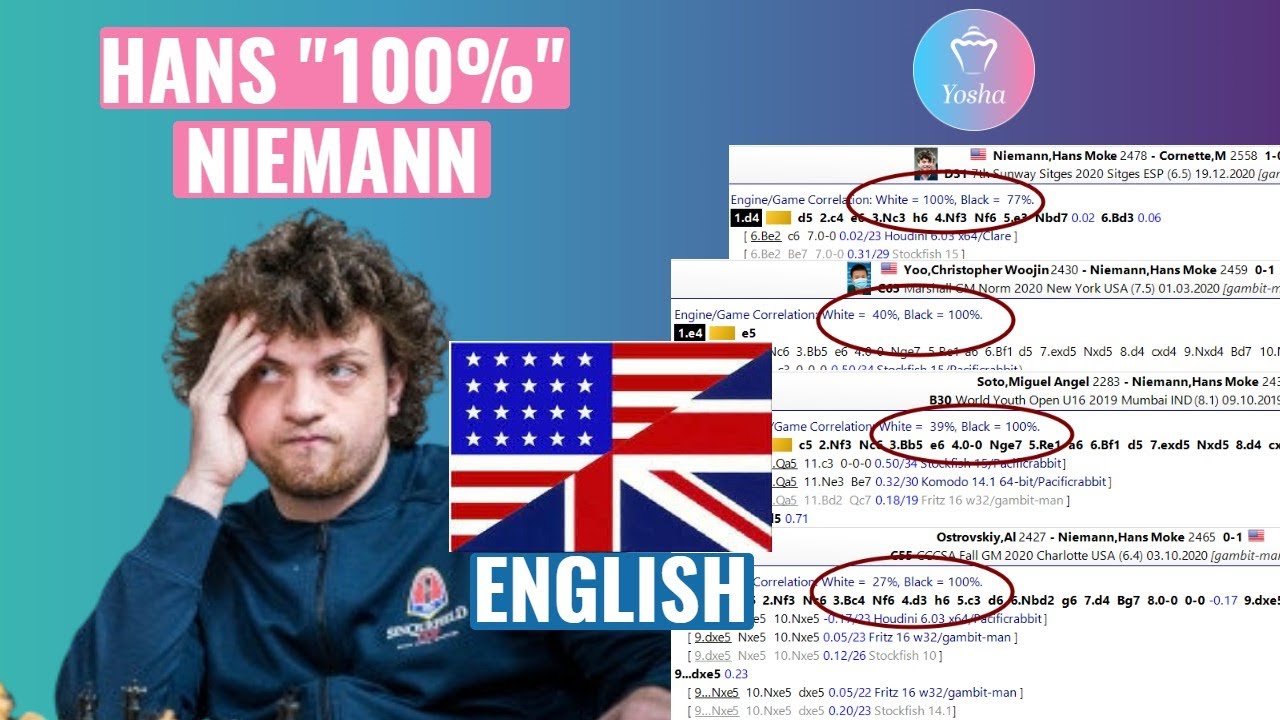
Running the Let's Check analysis on this game reveals an unexpected result: Niemann achieved an engine correlation of 100%. Yosha remarks with dark humor: “Someone should tell ChessBase, because they still pretend in the help menu that the world record is Sébastien Feller’s 98%—no, it's not, it's Hans Niemann.”
[12:21](https://www.youtube.com/watch?v=jfPzUgzrOcQ&t=741s) "Mister 100 Percent": Multiple Perfect Games Uncovered
While an isolated 100% game might theoretically happen by coincidence in a short miniature, Yosha demonstrates that Niemann repeated this feat across numerous games in the Gambitman dataset:
```mermaid flowchart LR accTitle: Hans Niemann 100 Percent Correlation Game Catalog accDescr: Sequence of opponents against whom Hans Niemann scored a 100 percent ChessBase engine correlation. subgraph PerfectWins["Cataloged 100% Engine Correlation Victories"] direction TB G1["vs. Christopher Yoo (22 moves, W)"] G2["vs. Miguel Soto (27 moves, B)"] G3["vs. Ostrovskiy (28 moves, B)"] G4["vs. Martin del Campo (20 moves, B)"] G5["vs. Unnamed Opponent (31 moves, W)"] G6["vs. Liam (35 moves, 2021)"] G7["vs. Unnamed Opponent (38 moves, W)"] G8["vs. Unnamed Opponent (45 moves, W)"] G9["vs. Strong Grandmaster (37 moves, W)"] end ```
- **vs. Christopher Yoo**: A 22-move demolition where Niemann registered a 100% correlation. - **vs. Miguel Soto**: A 27-move victory played as Black ending in 100% correlation. - **vs. Andrey Ostrovskiy**: A 28-move checkmating win playing Black, scoring 100%. - **vs. Martin del Campo**: A miniature lasting just 20 moves playing Black, registering 100%. - **Additional classical games**: Wins spanning 31 moves, 35 moves (against an opponent named Liam in 2021), 38 moves, 45 moves, and a 37-move victory over a strong Grandmaster—all registering a 100% correlation mark in the ChessBase system.
Noting the sheer absurdity of one player repeatedly matching engine lines across full-length classical games, Yosha prepares to cross-reference this cluster of perfect games back into the broader Gambitman database.
[14:34](https://www.youtube.com/watch?v=jfPzUgzrOcQ&t=874s) Gambitman's Dataset and Niemann's 5-Tournament Run
Yosha introduces a detailed spreadsheet compiling ChessBase "Let's Check" analysis for Hans Niemann covering his classical over-the-board games between 2019 and 2022. The document was put together not by Yosha personally, but by an anonymous collaborator going by the handle "Gambitman," with whom Yosha spent extensive time discussing the findings. A public link to the spreadsheet is provided so viewers can download the PGN files and verify the Let's Check evaluations directly within ChessBase.
Beyond isolated 100% engine-correlation games, the spreadsheet exposes an extraordinary five-tournament streak starting with the Philadelphia International / World Open in July 2021. Across these five consecutive tournaments, Niemann recorded engine correlation rates of 69%, 70%, 79%, 79%, and 69%. To contextualize those figures, Yosha reminds the audience that correspondence chess champions typically score around 72% to 75%, and Bobby Fischer during his legendary 20-game winning streak averaged 72%.
“And here for five tournaments in a row, Hans played at more than 73 percent on average.”
This sustained peak performance prompts an obvious question: how could FIDE’s leading anti-cheating expert and renowned mathematician, Professor Kenneth Regan, examine the data and find nothing suspicious?
[16:23](https://www.youtube.com/watch?v=jfPzUgzrOcQ&t=983s) Kenneth Regan's Statistical Model vs. Consecutive Probabilities
To investigate why FIDE detected no foul play, Yosha pulls up Kenneth Regan's publicly accessible data files covering Niemann from 2019 to 2022. Regan's methodology relies on an intrinsic performance metric called ROI (Raw Outperformance Index). Across Niemann’s games, Regan's ROI values range between 36.6 and 62.3. As Regan explained in a ChessBase interview, approximately 50% of Niemann's tournament ROI values fall above 50 and 50% fall below 50.
Regan interprets this spread as a textbook normal distribution centered at 50, where standard deviations ($\sigma$) map to increments of 5 (e.g., $1\sigma = 55$, $2\sigma = 60$, $-1\sigma = 45$, $-2\sigma = 40$). Because Niemann recorded only two or three tournaments above 60 and a comparable number hovering around 42.2, Regan concluded that the entire dataset represents normal variance for a grandmaster.
However, Yosha argues that evaluating the distribution as an unordered aggregate hides a critical anomaly: the chronological clustering of these scores. Looking at Regan's own ROI values for that five-tournament run (and extending to a sixth tournament that also stayed above 50), the individual odds appear modest on their own, but become staggering when multiplied consecutively:
```mermaid flowchart LR accTitle: Cumulative Probabilities Across Consecutive Tournaments accDescr: Diagram tracing the cumulative probability of Niemann's consecutive high-performing tournaments according to Kenneth Regan's ROI metrics. subgraph Run["Consecutive Tournaments Above 50 ROI"] T1["Philadelphia Open<br/>ROI 57.9 (Odds: 1 in 18)"] T2["Tournament 2<br/>(Odds: 1 in 7)"] T3["Tournament 3<br/>(Odds: 1 in 8)"] T4["Tournaments 4 to 6<br/>(Odds: ~1 in 6 each)"] end subgraph Cumulative["Cumulative Joint Probability"] C2["After 2 Tournaments:<br/>P < 1%"] C3["After 3 Tournaments:<br/>1 in 1,000"] C6["After 6 Tournaments:<br/>1 in 77,000"] end T1 --> T2 --> C2 T2 --> T3 --> C3 T3 --> T4 --> C6 ```
- **Philadelphia Open:** ROI of 57.9 corresponds to individual odds of roughly 1 in 18. This is not an 18-to-1 probability of cheating; rather, in a clean player population, one out of every 18 tournament performances will reach this level by pure chance. - **Tournament 2 in a row:** Individual odds of 1 in 7, pushing cumulative joint probability under 1%. - **Tournament 3 in a row:** Individual odds of 1 in 8, dropping cumulative joint probability to roughly 1 in 1,000. - **Six tournaments in a row:** The continuous multiplication of above-average performances reaches an overall joint probability of 1 in 77,000.
“It's not at all proof of cheating or an indication of cheating, it's the probability of it happening in case Hans doesn't cheat.”
[20:04](https://www.youtube.com/watch?v=jfPzUgzrOcQ&t=1204s) Bayesian Priors and the Carlsen Showdowns
Addressing how one translates a 1-in-77,000 statistical anomaly into an actual cheating probability, Yosha points out that the result depends entirely on one's prior probability. If an observer assumes a world where nobody ever cheats, the posterior probability remains zero regardless of the data. Conversely, if one assumes a baseline prior where 1 in every 10,000 competitive players cheats:
- Out of a sample of 80,000 players, 8 would be cheaters. - In that same group of 80,000 clean players, approximately 1 would produce a 1-in-77,000 performance run by pure statistical coincidence. - Encountering a player with this profile yields 9 candidates total—8 actual cheaters and 1 legitimate outlier—meaning an 8-out-of-9 chance (roughly 89%) that the player is cheating.
Yosha distinguishes between French and English legal terminology, noting that in French the word *preuve* covers both, whereas in English there is a meaningful distinction between "proof" and "evidence." While this data does not represent irrefutable mathematical proof, Yosha considers it exceptionally heavy evidence.
Turning finally to Niemann's head-to-head encounters with Magnus Carlsen, Yosha highlights the ChessBase Let's Check numbers for their two most scrutinized clashes:
| Event / Game | Hans Niemann Score | Magnus Carlsen Score | Context | |:--- |:--- |:--- |:--- | | **FTX Crypto Cup (Game 1, chess24)** | 67% | 36% | Niemann wins as Black; produces the post-game quote: *"The chess speaks for itself."* | | **Sinquefield Cup 2022** | 71% | — | Niemann defeats Carlsen with Black in round 3, leading Carlsen to withdraw from the tournament. |
“So do what you want with this information, make up your own mind whether Hans has ever cheated OTB and whether he cheated against the world champion.”
## Notable quotes > [00:00](https://www.youtube.com/watch?v=jfPzUgzrOcQ&t=0s) Obviously I cannot promise that I will give mathematical proof that Hans cheated because it's impossible, but I can guarantee that I will give you the most incriminating evidence publicly available against Hans Niemann. — Yosha
## Mentioned Hans Niemann, Magnus Carlsen, Yosha, Gambitman, Peter Heine Nielsen, ChessBase, Stockfish 15, Sébastien Feller, Bobby Fischer, Garry Kasparov, Yuriy Kuzubov, Maksim Chigaev, Sanan Sjugirov, Ian Nepomniachtchi, Abhimanyu Mishra, Matthieu Cornette, Vladislav Tkachiev, Maxime Vachier-Lagrave, Christopher Yoo, Miguel Soto, Andrey Ostrovskiy, Martin del Campo, Kenneth Regan, FIDE, Philadelphia International / World Open, FTX Crypto Cup, Sinquefield Cup 2022
## Video description I am providing you with a new set of extremely compromising evidence against Hans Niemann, the Grand Master accused of cheating by Magnus Carlsen. ▬▬▬▬▬▬▬▬▬▬▬ POUR ALLER PLUS LOIN ▬▬▬▬▬▬▬▬▬▬▬ ♔ Support the channel on Tipeee ➡️ https://fr.tipeee.com/yosha-echecs ♕ Take a private lesson with me ➡️ https://yoshachess.com/fr/cours-particuliers-echecs-paris-en-ligne/ Hans Niemann (OTB, Classical, 2019-22) by Gambitman ➡️https://docs.google.com/spreadsheets/d/127lwTsR-2Daz0JqN1TbZ8FgITX9Df9TyXT1gtjlZ5nk/edit?usp=sharing Kenneth Regan's analysis ➡️https://cse.buffalo.edu/~regan/chess/fidelity/data/Niemann/
▬▬▬▬▬▬▬▬▬▬ CHAPITRES DE CETTE VIDEO ▬▬▬▬▬▬▬▬▬▬▬ 0:00 - Intro 1:25 - Chessbase's Let's check analysis 9:30 - Niemann vs. Cornette 12:25 - Mister 100 percent 16:23 - Ken Regan's analysis 22:00 - Niemann vs. Carlsen and outro
[Source](https://www.youtube.com/watch?v=jfPzUgzrOcQ)