Drivers Lease Eurofighters to Counter Sukhoi Jets at Roundabouts
Bosnian Ape Society
Because roof-mounted naval CIWS turrets strike highway overpasses, learner drivers must lease Austrian Air Force Eurofighter Typhoons to eliminate overhead Sukhoi Su-35 fighters before safely navigating standard roundabout turns.
AI-assisted summary of Is Your Car Safe From Supermaneuverable Air-Defense Fighter Aircraft? — original source. Check the original for full context.
Source published:
Key ideas
- A standard driver's education curriculum is introduced using a 591 hp Audi RS6 Avant to demonstrate basic four-way roundabout navigation rules. (0:00)
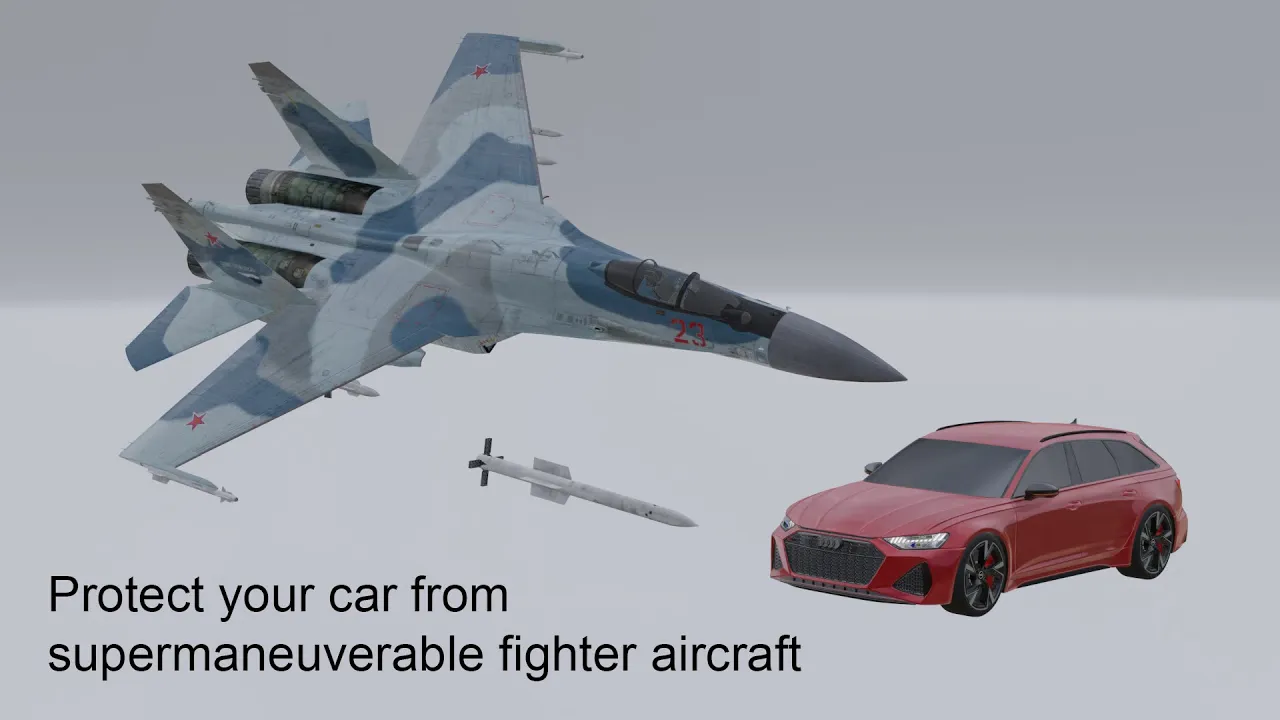
- Novice drivers often fail to scan for airborne threats, leaving vehicles exposed to surveillance and mockery from overhead aircraft like the Sukhoi Su-35 Flanker-E. (1:42)
- Installing a Dutch Goalkeeper CIWS provides 30 mm Gatling anti-air defense but creates severe practical hazards, including collisions with overpasses due to its nearly 4-meter height. (2:28)
- The optimal tactical solution to clear the airspace is leasing a Eurofighter Typhoon from the Austrian Air Force and defeating the adversary in a classic gun-only dogfight before returning to drive within the speed limit. (3:41)
Detailed notes
## Background Published by Bosnian Ape Society on YouTube on March 19, 2021, this video addresses the common mistake beginner drivers make by neglecting defenses against airborne threats like fighter jets and air-to-surface missiles. The channel provides practical methods to safeguard vehicles and avoid steep insurance premiums, including the installation of radar-guided Gatling gun close-in weapon systems.
## TL;DR The video opens as a standard driver's education course demonstrating how to navigate a multi-exit roundabout in a 591-horsepower Audi RS6 Avant. The lesson quickly pivots when an overhead Sukhoi Su-35 Flanker-E fighter jet mocks the learner's driving, prompting a discussion of anti-air defenses. After determining that mounting a four-meter-tall Dutch Goalkeeper CIWS Gatling gun onto the car roof is impractical due to low bridge clearances, the narrator suggests leasing an Austrian Eurofighter Typhoon. Applying basic driving skills to dogfight tactics, the learner shoots down the hostile Su-35 with autocannon fire before returning to ground level to navigate the roundabout safely and legally.
## Atmosphere & style The presentation is delivered with an extraordinarily straight-faced, dry instructional cadence that mimics standard corporate driver-training modules while dispensing increasingly absurd tactical military advice. Detailed aerospace combat doctrine and naval engineering specs are explained with deadpan seriousness, creating a surreal contrast against basic suburban driving tips. The experience feels like stumbling into a fever-dream instructional tape where pedestrian vehicle etiquette and high-g air superiority dogfights occupy the exact same level of mundane necessity.
## Bulletin - [00:00](https://www.youtube.com/watch?v=k7YVxLLIuGM&t=0s) A standard driver's education curriculum is introduced using a 591 hp Audi RS6 Avant to demonstrate basic four-way roundabout navigation rules. - [01:42](https://www.youtube.com/watch?v=k7YVxLLIuGM&t=102s) Novice drivers often fail to scan for airborne threats, leaving vehicles exposed to surveillance and mockery from overhead aircraft like the Sukhoi Su-35 Flanker-E. - [02:28](https://www.youtube.com/watch?v=k7YVxLLIuGM&t=148s) Installing a Dutch Goalkeeper CIWS provides 30 mm Gatling anti-air defense but creates severe practical hazards, including collisions with overpasses due to its nearly 4-meter height. - [03:41](https://www.youtube.com/watch?v=k7YVxLLIuGM&t=221s) The optimal tactical solution to clear the airspace is leasing a Eurofighter Typhoon from the Austrian Air Force and defeating the adversary in a classic gun-only dogfight before returning to drive within the speed limit.
## Key takeaways - [00:00](https://www.youtube.com/watch?v=k7YVxLLIuGM&t=0s) The Audi RS6 Avant, featuring a 4.0-liter twin-turbo V8 producing 591 hp and a top speed of 190 mph, is presented as the ideal beginner's car for driver's education. - [00:35](https://www.youtube.com/watch?v=k7YVxLLIuGM&t=35s) Roundabouts require entering drivers to yield right-of-way to circulating traffic before proceeding to the first exit for right turns, second exit for straight paths, or third exit for left turns. - [01:42](https://www.youtube.com/watch?v=k7YVxLLIuGM&t=102s) Novice motorists frequently commit the tactical error of focusing solely on road traffic while completely ignoring overhead fourth- and fifth-generation air threats. - [01:58](https://www.youtube.com/watch?v=k7YVxLLIuGM&t=118s) A Sukhoi Su-35 Flanker-E tracked the vehicle from above, choosing not to engage only because it viewed the defenseless driver with utter contempt. - [02:28](https://www.youtube.com/watch?v=k7YVxLLIuGM&t=148s) Vehicle vulnerability can be addressed by mounting a Dutch Goalkeeper CIWS equipped with a 30 mm GAU-8/A Avenger Gatling gun and dual-band tracking radar. - [02:52](https://www.youtube.com/watch?v=k7YVxLLIuGM&t=172s) The Goalkeeper CIWS detects and neutralizes aircraft, missiles, and surface threats, with an I-band search radar tracking up to 18 targets simultaneously. - [03:15](https://www.youtube.com/watch?v=k7YVxLLIuGM&t=195s) Mounting a CIWS on a commuter car is practically unviable because its nearly four-meter height leads to bridge collisions and prevents garage parking. - [03:41](https://www.youtube.com/watch?v=k7YVxLLIuGM&t=221s) To bypass vehicle clearance limitations, drivers should lease a Eurofighter Typhoon from the Austrian Air Force to challenge the threat directly. - [04:02](https://www.youtube.com/watch?v=k7YVxLLIuGM&t=242s) The aerial engagement eschews guided missiles in favor of visual-range dogfighting, matching the Typhoon's 27 mm Mauser BK-27 against the Su-35's 30 mm GSh-30-1 autocannon. - [04:28](https://www.youtube.com/watch?v=k7YVxLLIuGM&t=268s) Basic fighter maneuvers learned from driver's education—including rolling scissors, barrel roll attacks, high-side guns passes, and high yo-yos—enable the driver to neutralize the enemy fighter. - [05:32](https://www.youtube.com/watch?v=k7YVxLLIuGM&t=332s) Once air superiority is established, the driver can safely resume navigating the roundabout while adhering strictly to local traffic laws and posted speed limits.
## Detailed walkthrough ### [00:00](https://www.youtube.com/watch?v=k7YVxLLIuGM&t=0s) Beginner Driver's Education and Roundabout Navigation
The instruction begins by presenting what is purportedly the ideal starter vehicle for novice drivers: the Audi RS6 Avant. This estate car comes fitted with a 4-litre twin-turbo V8 generating 591 horsepower, boasts a top speed of 190 miles per hour, and launches from zero to sixty miles per hour in 3.5 seconds. As the narrator deadpans, “What we have here, is the perfect car for inexperienced learners in driver’s education.” With vehicle selection settled, the curriculum moves directly into one of the most notoriously intimidating road features for novice motorists: the roundabout. Defined simply as a circular intersection directing traffic in a continuous single direction around a central island, roundabouts frequently confuse learners despite their fundamental simplicity.
The lesson lays out the systematic procedure for negotiating a standard four-way intersection. Drivers must come to a halt before the yield line and wait for an opening by granting right of way to any vehicles already circulating inside the ring. Once a gap emerges, the car enters the flow. Taking a right turn requires exiting immediately at the first branch. Continuing straight follows the identical entry rule, except the driver remains in the roundabout slightly longer to peel off at the second exit. Finally, executing a left turn simply entails staying in the circular flow until reaching the third exit.
```mermaid flowchart TD accTitle: Standard Roundabout Exit Selection accDescr: Flowchart illustrating entry and exit decisions at a four-way roundabout. A["Approach Roundabout"] --> B["Stop before line & yield to circulating traffic"] B --> C["Enter when traffic clears"] C --> D{"Intended Direction"} D -->|"Right Turn"| E["Take 1st Exit"] D -->|"Straight"| F["Take 2nd Exit"] D -->|"Left Turn"| G["Take 3rd Exit"] ```
- Audi RS6 Avant specifications: 4.0-liter twin-turbocharged V8, 591 hp, 0–60 mph in 3.5 seconds, 190 mph top speed. - Turn protocols: First exit for right turns, second exit for driving straight through, third exit for left turns.
[01:42](https://www.youtube.com/watch?v=k7YVxLLIuGM&t=102s) The Airborne Threat: The Sukhoi Su-35 Flanker-E
Although the mechanical execution of driving through the roundabout was completed satisfactorily, the narrator reveals a catastrophic lapse in defensive awareness. While the learner was fixated solely on lane discipline and traffic flow, an airborne adversary was tracking every move from above: a single-seat, twin-engine, supermaneuverable Sukhoi Su-35 Flanker-E air-defense fighter aircraft. The jet loitered aloft watching the car's movements without ever deeming it worthy of a missile lock or strafing run, viewing the defenseless Audi as nothing more than an injured fish flopping helplessly in the water.
Rather than sensing any danger from the vehicle, the fighter pilot merely observed with scornful amusement. The narrator highlights the psychological toll of this oversight: “It didn’t even consider you a threat because it was too busy laughing at your complete and utter incompetence.” The pilot internally jeered at the driver as a petulant child and a blithering idiot incapable of navigating a basic circle. While thoroughly humiliating, leaving an automobile vulnerable to advanced fourth-and-fifth-generation air threats is framed as a very common rookie mistake that requires immediate corrective countermeasures.
- Threat identified: Sukhoi Su-35 Flanker-E (single-seat, twin-engine, supermaneuverable air-defense fighter). - Tactical assessment: Target disregarded as non-threatening due to utter lack of defensive capability.
[02:28](https://www.youtube.com/watch?v=k7YVxLLIuGM&t=148s) Defense Solution: Installing a Goalkeeper CIWS and Its Practical Drawbacks
To rectify these airborne vulnerabilities, motorists have several hardware solutions at their disposal. The most direct approach is outfitting the car with an autonomous anti-aircraft close-in weapon system (CIWS), specifically the Dutch Goalkeeper CIWS. This self-contained weapon package mounts a GAU-8/A Avenger 30 mm hydraulic seven-barrel Gatling gun, paired with an integrated sensor suite featuring an I-band search radar able to track eighteen targets simultaneously, alongside a dual-band tracking radar dedicated to fire control. Once bolted onto the roof, it guarantees effective defense against conventional combat aircraft, high-speed sea-skimming or air-to-surface missiles, and incoming surface threats.
```mermaid flowchart LR accTitle: Goalkeeper CIWS Target Engagement Flow accDescr: Detection and interception sequence of the Goalkeeper close-in weapon system. subgraph Sensors ["Sensor Suite"] S1["I-band Search Radar<br>(18 targets)"] --> S2["Dual-Band Tracking Radar"] end subgraph Ordnance ["Weapon Unit"] S2 --> G1["GAU-8/A Avenger<br>30 mm Gatling Gun"] end subgraph Interception ["Target Neutralization"] G1 --> T1["Hostile Aircraft / Missiles"] end ```
Despite its formidable protective envelope, grafting a naval CIWS onto an everyday commuter car presents distinct physical challenges. Standing almost four meters tall, the Goalkeeper turret introduces severe clearance hazards on daily drives. The car will inevitably smash into low bridge overpasses and highway structures, and fitting it into a standard residential garage becomes impossible. While structural damage might tally a few million euros in repairs, the broader humiliation is intolerable: “But the cost on your dignity from blundering a multimillion Euro weapons system because you cant drive a car properly is a bit more than that.” Consequently, roof-mounted naval artillery must be ruled out as an impractical defense for normal civilian travel.
- Defensive armament: Dutch Goalkeeper CIWS equipped with a 30 mm GAU-8/A Avenger hydraulic seven-barrel Gatling gun. - Electronics: Dual-band fire-control tracking radar and I-band search radar capable of managing 18 simultaneous targets. - Physical drawbacks: System height approaches 4 meters, resulting in collisions with highway overpasses and inability to park in domestic garages.
[03:41](https://www.youtube.com/watch?v=k7YVxLLIuGM&t=221s) Aerial Retaliation: The Eurofighter Typhoon Dogfight and Peaceful Navigation
With ground-mounted anti-air systems rendered unfeasible by clearance restrictions, the student must adopt an active offensive strategy: leasing a Eurofighter Typhoon twin-engine, canard delta-wing multirole fighter directly from the Austrian Air Force (*Österreichische Luftstreitkräfte*). By taking to the skies personally, the motorist can confront the antagonist on equal terms. The narrator urges the student to reassert dominance: “Take your Typhoon up there and swat the annoying mosquito out of the sky by challenging the infantile pillock to a classic World War II era dogfight like a real man to show them who the real king of European airspace is.”
```mermaid flowchart TD accTitle: Aerial Dogfight Tactical Maneuvers accDescr: Tactical choices during combat against the Su-35 Flanker-E based on relative positioning. A{"Tactical Position"} -->|"Bandit on Six"| B["Execute Rolling Scissors<br>(Force an overshoot)"] A{"Tactical Position"} -->|"Bandit Turns Away"| C["Execute Barrel Roll Attack<br>(Vector crosshairs into lead)"] A{"Tactical Position"} -->|"Altitude Advantage"| D["High-Side Guns Pass<br>(Powered dive, single pass)"] A{"Tactical Position"} -->|"Airspeed Advantage"| E["High Yo-Yo<br>(Conserve energy in turnfight)"] ```
The engagement eschews beyond-visual-range radar tracking and guided missiles in favor of an authentic test of basic fighter maneuvers (BFM) and gunnery. The matchup pits the Eurofighter's 27 mm Mauser BK-27 autocannon against the Su-35's 30 mm Gryazev-Shipunov GSh-30-1 autocannon. Relying on the hand-eye coordination built up over a few hours of driving instruction, the learner applies standard air combat tactics: - Maintaining overall aircraft energy states while keeping the adversary's tail locked in sight. - Executing rolling scissors if the Flanker gets behind, bleeding forward velocity to force an overshoot. - Transitioning into a barrel roll attack when the target breaks away, pulling the crosshairs directly across its flight path. - Initiating a high-side guns pass from an altitude advantage via a high-speed powered dive. - Utilizing a high yo-yo when holding superior airspeed to tighten turn radius during a sustained turnfight without surrendering energy.
As the narrator notes with satisfaction, “With what you have learned from your driver’s education course so far, you should be able to make short work of any enemy aircraft.” Having shot down the Flanker and reclaimed aerial superiority, the learner safely returns to ground level. With the airspace cleared of mocking Russian fighters, the driver proceeds through the roundabout smoothly, remaining fully compliant with all local traffic regulations and safely below the posted speed limit.
## Mentioned Bosnian Ape Society, Audi RS6 Avant, Sukhoi Su-35 Flanker-E, Goalkeeper CIWS, GAU-8/A Avenger, Eurofighter Typhoon, Austrian Air Force, Mauser BK-27, Gryazev-Shipunov GSh-30-1
## Video description Instagram: https://www.instagram.com/bosnianapesociety/
Many beginner drivers make the common mistake of forgoing proper defense against airborne threats such as enemy fighter jets and air-to-surface missiles. In this video, we will explain the best methods to protect your vehicle from such threats and avoid the necessity of paying exorbitant insurance premiums for preventable damages. These include practical measures such as installing anti-air close-in weapon systems utilizing the latest Gatling gun and radar technologies.
[Source](https://www.youtube.com/watch?v=k7YVxLLIuGM)