Nvidia Redesigns GAN Architecture to Control Image Attributes
Tero Karras FI
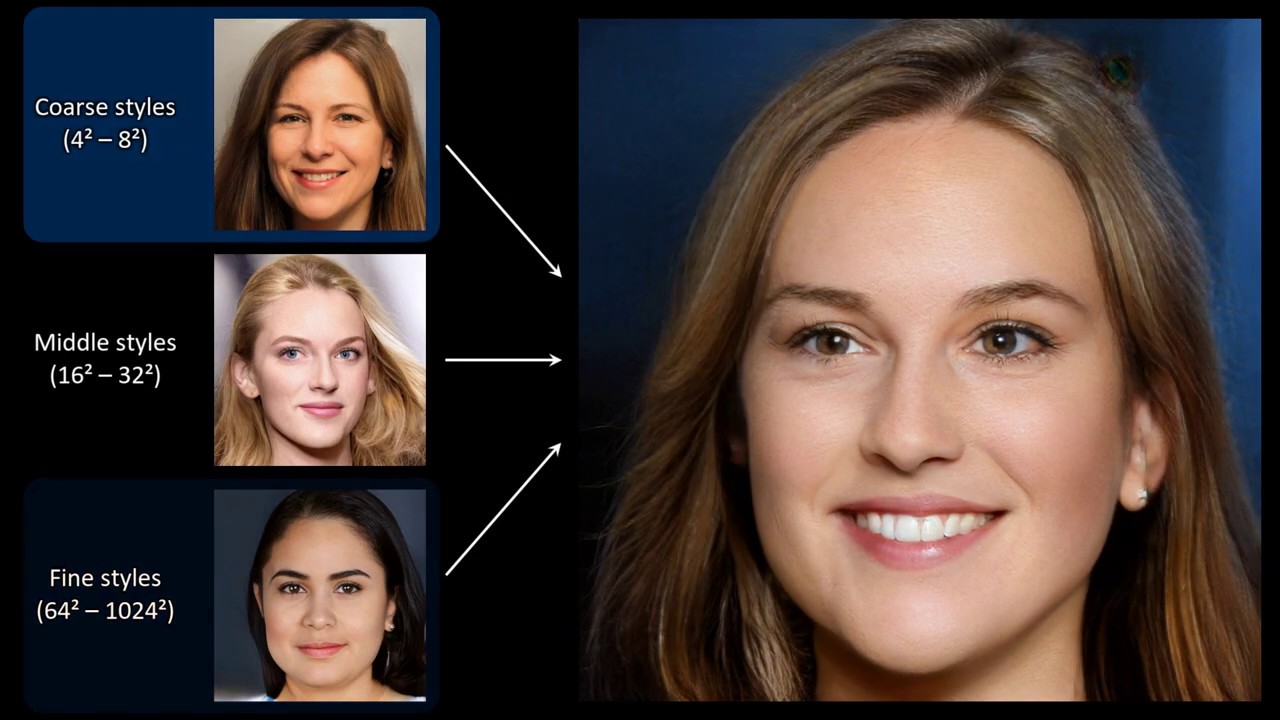
Borrowing from style transfer literature separates high-level attributes from stochastic variation in generative adversarial networks without supervision, improving distribution quality and synthesis control.
AI-assisted summary of A Style-Based Generator Architecture for Generative Adversarial Networks — original source. Check the original for full context.
Source published:
Key ideas
- NVIDIA researchers Tero Karras, Samuli Laine, and Timo Aila present an alternative style-based generator architecture for Generative Adversarial Networks (StyleGAN) borrowing from style transfer literature. (0:00)
- The architecture achieves unsupervised separation of high-level features such as pose and identity from fine-grained stochastic variations like hair and freckles.
- The style-based generator provides intuitive, scale-specific synthesis control while establishing new state-of-the-art benchmarks in traditional distribution quality metrics.
- The research introduces two automated evaluation methods to quantify interpolation quality and factor disentanglement, alongside a new high-quality dataset of human faces.
Detailed notes
## Background Published on YouTube by Tero Karras FI on March 3, 2019, this video accompanies the research paper by NVIDIA researchers Tero Karras, Samuli Laine, and Timo Aila introducing a style-based generator architecture for Generative Adversarial Networks (StyleGAN). The video description outlines a new architecture borrowing from style transfer literature that achieves unsupervised separation of high-level attributes from stochastic variation, improved interpolation properties, and a new high-quality human face dataset.
## TL;DR The video provides a demonstration of the StyleGAN framework, showcasing an alternative generator architecture designed to synthesize high-quality images with scale-specific control. Rather than relying on a continuous technical lecture or spoken presentation, the recorded audio transcript consists entirely of polite acknowledgments repeating 'Thank you' at the beginning and end of the runtime. The presentation frames the underlying work's achievements in disentangling latent factors, measuring interpolation quality, and advancing generative adversarial synthesis.
## Atmosphere & style The presentation has an austere, highly minimalist atmosphere driven by the near-total absence of formal spoken narration. Because the recorded audio layer consists solely of repeated expressions of gratitude at the outset and conclusion, the viewing experience feels understated and observational, leaving the technical demonstration to be carried entirely by its visual output rather than verbal guidance.
## Bulletin - [00:00](https://www.youtube.com/watch?v=kSLJriaOumA&t=0s) NVIDIA researchers Tero Karras, Samuli Laine, and Timo Aila present an alternative style-based generator architecture for Generative Adversarial Networks (StyleGAN) borrowing from style transfer literature. - The architecture achieves unsupervised separation of high-level features such as pose and identity from fine-grained stochastic variations like hair and freckles. - The style-based generator provides intuitive, scale-specific synthesis control while establishing new state-of-the-art benchmarks in traditional distribution quality metrics. - The research introduces two automated evaluation methods to quantify interpolation quality and factor disentanglement, alongside a new high-quality dataset of human faces.
## Key takeaways - StyleGAN introduces an alternative GAN generator architecture inspired by style transfer literature. - The generator enables unsupervised, automated separation of high-level semantic attributes, such as facial pose and identity. - Fine stochastic details, including freckles and individual hair placement, are isolated from macro-level structure. - The design facilitates intuitive, scale-specific control across different levels of the image synthesis process. - The model demonstrates superior interpolation properties compared to standard generator architectures. - The style-based framework improves the disentanglement of underlying latent factors of variation. - The paper defines two new automated evaluation metrics designed to measure latent disentanglement and interpolation quality across any generator architecture. - A new, highly varied, and high-quality dataset of human faces is introduced to benchmark and train the generative model. - [00:00](https://www.youtube.com/watch?v=kSLJriaOumA&t=0s) The video provides a direct visual showcase of the NVIDIA team's style-based generator capabilities. - [05:00](https://www.youtube.com/watch?v=kSLJriaOumA&t=300s) The video presentation relies on visual output rather than a spoken technical lecture, with the audio track capturing repeated acknowledgments at the start and conclusion.
## Detailed walkthrough ### [00:00](https://www.youtube.com/watch?v=kSLJriaOumA&t=0s) Opening Acknowledgments and Audio Capture
The automated audio transcript for the presentation of the style-based generator architecture for Generative Adversarial Networks (StyleGAN)—authored by Tero Karras, Samuli Laine, and Timo Aila from NVIDIA—opens with a sequence of polite expressions. Rather than featuring spoken exposition or technical narration over the visual demonstration of the generator, the audio track registers repeated expressions of gratitude: “Thank you.” This phrase is transcribed repeatedly throughout the initial segment of the video, reflecting automated speech-to-text capture over the introductory playback.
- The provided audio transcript consists of recurring statements of “Thank you.” - The work presented in the video corresponds to the NVIDIA research paper introducing a style-based generator architecture borrowing from style transfer literature, enabling unsupervised separation of high-level attributes and stochastic variation.
[05:00](https://www.youtube.com/watch?v=kSLJriaOumA&t=300s) Concluding Acknowledgments
Toward the final minute of the video presentation, the audio recording concludes in the same manner as the opening, with the speaker or audio track reiterating “Thank you.” This brings the audio layer of the visual demonstration to a close without additional spoken dialogue or verbal debate recorded in the transcript.
## Mentioned Tero Karras, Samuli Laine, Timo Aila, NVIDIA, Generative Adversarial Networks, StyleGAN
## Video description Paper (PDF): http://stylegan.xyz/paper
Authors: Tero Karras (NVIDIA) Samuli Laine (NVIDIA) Timo Aila (NVIDIA)
Abstract: We propose an alternative generator architecture for generative adversarial networks, borrowing from style transfer literature. The new architecture leads to an automatically learned, unsupervised separation of high-level attributes (e.g., pose and identity when trained on human faces) and stochastic variation in the generated images (e.g., freckles, hair), and it enables intuitive, scale-specific control of the synthesis. The new generator improves the state-of-the-art in terms of traditional distribution quality metrics, leads to demonstrably better interpolation properties, and also better disentangles the latent factors of variation. To quantify interpolation quality and disentanglement, we propose two new, automated methods that are applicable to any generator architecture. Finally, we introduce a new, highly varied and high-quality dataset of human faces.
[Source](https://www.youtube.com/watch?v=kSLJriaOumA)