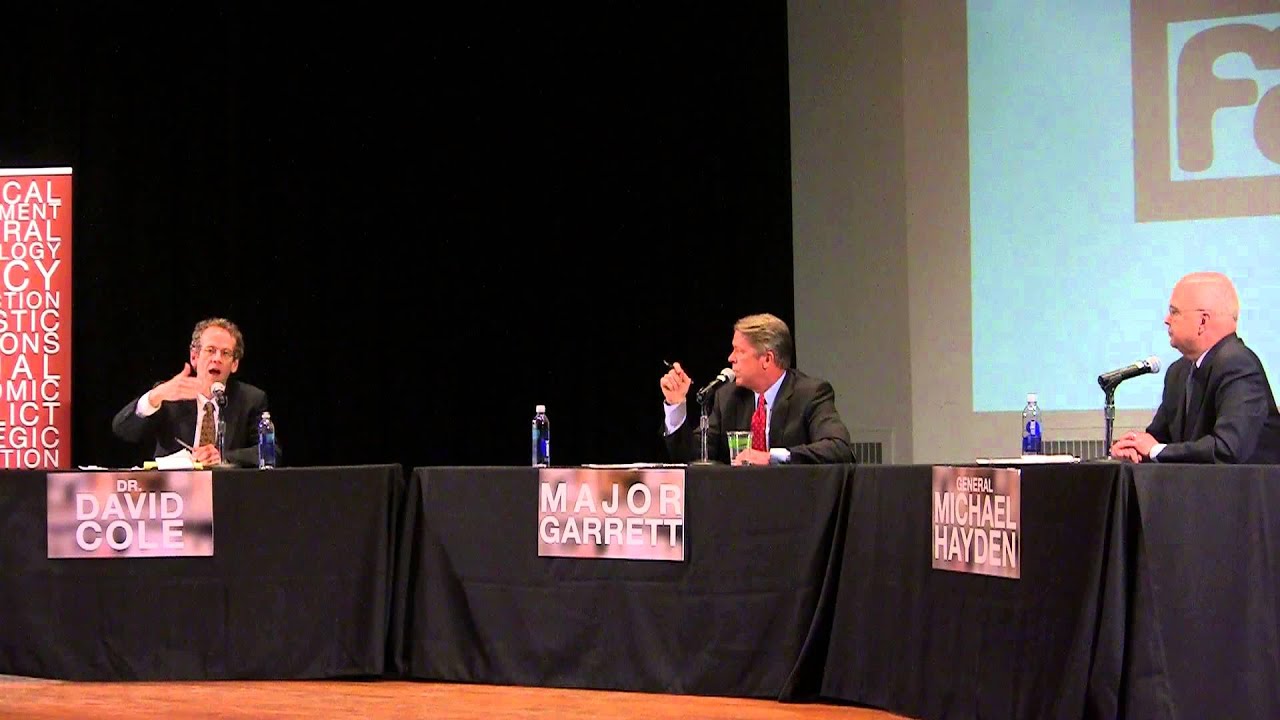
David Cole and General Michael Hayden debate the legitimacy of the NSA's bulk telephony metadata program under Section 215, balancing Fourth Amendment privacy protections against counterterrorism imperatives. (0:21)
Hayden acknowledges that the U.S. government 'kills people based on metadata,' but maintains domestic Section 215 records were confined to an audited 'lockbox' queried only 288 times in a single year. (17:32)
The Privacy and Civil Liberties Oversight Board (PCLOB) concluded that Section 215 bulk phone record harvesting failed to disrupt a single terrorist plot or apprehend an operative over seven years. (27:32)
Due to the shift from landlines to mobile phones, NSA bulk collection captured only 20% to 30% of domestic metadata by 2013, prompting Obama administration proposals to query carrier-stored data directly. (41:30)
Detailed notes
## Background
Published on YouTube by Johns Hopkins University on April 7, 2014, this video documents the Johns Hopkins Foreign Affairs Symposium's annual Presidential Event. Moderated by CBS News chief White House correspondent Major Garrett, the event features a formal debate between former NSA and CIA Director General Michael Hayden and Georgetown University constitutional law professor David Cole on the constitutionality of the NSA and the balance between personal privacy and national security.
## TL;DR
In the wake of the Edward Snowden revelations, David Cole and General Michael Hayden clash over the legal, operational, and democratic legitimacy of mass government surveillance. Cole argues that secret bulk telephony collection under Section 215 and expansive Section 702 programs invert democratic principles by imposing secret law and dragnet surveillance without genuine public consent or demonstrated operational necessity. Hayden defends the intelligence community's record, maintaining that telephony metadata querying operates within constitutional boundaries, requires operational secrecy to protect national security, and represents a necessary, disciplined response to foreign threats. Together, they rigorously debate the third-party doctrine, the definition of metadata, institutional oversight failures, and the unavoidable friction between government transparency and espionage effectiveness.
## Atmosphere & style
The debate crackles with intellectual tension, pairing General Hayden's pragmatic, unvarnished defense of intelligence operations with Professor Cole's precise, principled constitutional critique. Hayden is provocative and candid—admitting bluntly that 'we kill people based on metadata' and dismissing idealistic foreign restraint as unsuited for an adult world—while Cole responds with measured, razor-sharp dissections of secret court orders, misleading official testimony, and executive overreach. Major Garrett's probing moderation keeps the exchange fast-paced and incisive, creating an engrossing, high-stakes dialogue where national security pragmatism directly collides with democratic accountability.
## Bulletin
- [00:21](https://www.youtube.com/watch?v=kV2HDM86XgI&t=21s) David Cole and General Michael Hayden debate the legitimacy of the NSA's bulk telephony metadata program under Section 215, balancing Fourth Amendment privacy protections against counterterrorism imperatives.
- [17:32](https://www.youtube.com/watch?v=kV2HDM86XgI&t=1052s) Hayden acknowledges that the U.S. government 'kills people based on metadata,' but maintains domestic Section 215 records were confined to an audited 'lockbox' queried only 288 times in a single year.
- [27:32](https://www.youtube.com/watch?v=kV2HDM86XgI&t=1652s) The Privacy and Civil Liberties Oversight Board (PCLOB) concluded that Section 215 bulk phone record harvesting failed to disrupt a single terrorist plot or apprehend an operative over seven years.
- [41:30](https://www.youtube.com/watch?v=kV2HDM86XgI&t=2490s) Due to the shift from landlines to mobile phones, NSA bulk collection captured only 20% to 30% of domestic metadata by 2013, prompting Obama administration proposals to query carrier-stored data directly.
## Key takeaways
- [03:35](https://www.youtube.com/watch?v=kV2HDM86XgI&t=215s) A functioning democracy requires government transparency and citizen privacy, an equilibrium inverted by post-9/11 secret surveillance.
- [06:58](https://www.youtube.com/watch?v=kV2HDM86XgI&t=418s) National surveillance governance operates as a dynamic triangle balancing technology, threat environment, and public policy, which produces friction when legal frameworks fail to adapt.
- [13:00](https://www.youtube.com/watch?v=kV2HDM86XgI&t=780s) Metadata reveals comprehensive and intimate personal vulnerabilities without intercepting actual conversation content, effectively mapping an individual's life.
- [17:32](https://www.youtube.com/watch?v=kV2HDM86XgI&t=1052s) General Hayden argues Section 215 operated under strict operational limits, requiring a foreign 'seed number' backed by reasonable articulable suspicion rather than mass pattern-matching.
- [22:07](https://www.youtube.com/watch?v=kV2HDM86XgI&t=1327s) Hayden asserts that over 95 percent of disclosures from the Edward Snowden leaks compromised foreign intelligence operations rather than domestic civil liberties.
- [24:19](https://www.youtube.com/watch?v=kV2HDM86XgI&t=1459s) Sustainable intelligence programs require four concurrent pillars: technical feasibility, operational relevance, legality, and political sustainability.
- [27:32](https://www.youtube.com/watch?v=kV2HDM86XgI&t=1652s) Through multi-hop chaining into the 'corporate store,' a small number of seed queries can pull hundreds of millions of phone records into an analyst-accessible database without further warrants.
- [32:26](https://www.youtube.com/watch?v=kV2HDM86XgI&t=1946s) Public exposure of bulk surveillance led the executive branch to propose reforms, federal courts to question constitutionality, and Congress to introduce dozens of oversight bills.
- [41:30](https://www.youtube.com/watch?v=kV2HDM86XgI&t=2490s) Systemic compliance violations prompted a Foreign Intelligence Surveillance Court judge to temporarily require court pre-approval for every individual metadata query.
- [44:47](https://www.youtube.com/watch?v=kV2HDM86XgI&t=2687s) Cole argues that pre-digital third-party doctrine precedent under Smith v. Maryland collapses in the smartphone era, where modern life necessitates involuntary, continuous data disclosure.
- [50:20](https://www.youtube.com/watch?v=kV2HDM86XgI&t=3020s) Hayden defends foreign intelligence collection outside the U.S. as legitimate international statecraft that cannot be judged by domestic criminal justice concepts of guilt or suspicion.
- [01:00:19](https://www.youtube.com/watch?v=kV2HDM86XgI&t=3619s) Both debaters reject the 'nothing to hide' argument, agreeing that innocent citizens require privacy for personal dignity, free association, and democratic life.
- [01:00:19](https://www.youtube.com/watch?v=kV2HDM86XgI&t=3619s) Commercial app telemetry and consumer data monetization constantly shift the societal and legal benchmarks of Fourth Amendment reasonableness.
- [01:10:10](https://www.youtube.com/watch?v=kV2HDM86XgI&t=4210s) Hayden maintains that intelligence transparency incurs unavoidable operational costs that reduce security, while Cole warns internal oversight fails without democratic transparency.
- [01:13:33](https://www.youtube.com/watch?v=kV2HDM86XgI&t=4413s) Hayden defends Director of National Intelligence James Clapper's inaccurate congressional testimony, arguing Senator Ron Wyden orchestrated a trap regarding classified information in an open hearing.
## Detailed walkthrough
### [00:21](https://www.youtube.com/watch?v=kV2HDM86XgI&t=21s) Introductions and Historical Context of Surveillance
Moderator Major Garrett opens the symposium by complimenting Johns Hopkins University on providing him with the largest nameplate he has ever had in front of him on a panel. He introduces the evening's two debaters as leading voices operating at the intersection of security, privacy, and constitutional law. General Michael Hayden is not merely an intellectual commentator on these subjects, but a direct participant in high-stakes deliberations across the White House, the intelligence community, and the Department of Justice. Hayden served as the 15th Director of the National Security Agency from 1999 to 2005, the Deputy Director of National Intelligence, and the 20th Director of the Central Intelligence Agency from 2006 to 2009. Facing him is David Cole, a professor of constitutional law, national security, and criminal justice at Georgetown University, author of seven books on the topic, and legal affairs correspondent for *The Nation*.
```mermaid
flowchart TD
accTitle: Evolution of U.S. Surveillance Oversight
accDescr: Diagram tracing oversight from early executive control to post-Church Committee reforms and the modern crisis of consent.
subgraph EarlyEra ["Founding to Mid-1970s"]
GW["Executive Primacy\n(George Washington & secret budgets)"]
end
subgraph ModernEra ["Post-Snowden Present"]
Tension["Public Crisis of Legitimacy:\nSurveillance questioned & consent doubted"]
end
GW --> CC
Oversight --> Tension
```
Garrett provides historical framing by recounting his commute to the event. After missing two trains out of Washington, D.C., he took a cab and texted his friend Steve in San Diego, whose father graduated from Johns Hopkins in 1962 with a degree in physics before working on the earliest prototype drones used to spy on the Soviet Union. Surveillance and espionage, Garrett stresses, are neither unprecedented nor novel in the American experience; citizens and government officials have engaged in, adapted to, and argued over national security and constitutional boundaries across generations. He asks both speakers to lay out their fundamental perspectives on balancing practical realism, constitutional protections, and personal privacy.
- General Michael Hayden directed the NSA through September 11, oversaw the stand-up of post-9/11 collection initiatives, served as the first Principal Deputy Director of National Intelligence, and subsequently led the CIA until 2009.
- David Cole teaches at Georgetown University Law Center, focusing on civil liberties, federal counterterrorism authorities, and the Fourth Amendment.
- Garrett emphasizes that espionage technology has long been tied to Johns Hopkins alumni, reaching back to Cold War aerial reconnaissance developments in the early 1960s.
---
[03:35](https://www.youtube.com/watch?v=kV2HDM86XgI&t=215s) David Cole on Democracy, Dragnet Surveillance, and Official Deception
David Cole opens with a wry twist on Garrett’s prompt, claiming that he is the realist while General Hayden is the idealist. Cole grounds his opening case in the disclosures made possible by Edward Snowden, arguing that self-governance hinges on an essential democratic equation that current policy has inverted. As Cole summarizes his core principle: “I think the basic issue is that to have a functioning and healthy democracy I think you need two things: you need transparency from the government and you need privacy for the citizenry.” Without government transparency, citizens cannot hold elected representatives accountable; without personal privacy, individuals cannot cultivate intimate lives, political associations, or independent opinions free from state surveillance. In the modern era, Cole argues, this balance has been turned on its head, leaving citizens fully exposed while the state operates beneath a shield of pervasive secrecy.
Cole details three primary grievances against the NSA's post-9/11 posture:
1. **Dragnet Collection:** The agency gathered vast troves of telecommunications data indiscriminately sweeping up millions of ordinary Americans and foreigners who have no connection to terrorism.
2. **Secret Law:** Authorities relied on classified interpretations of statutes that departed entirely from congressional intent. Representative Jim Sensenbrenner, the conservative Republican author of the USA PATRIOT Act provision relied upon by the government, publicly confirmed that collecting bulk domestic phone records was never authorized or contemplated by the legislation he drafted.
3. **Official Dishonesty:** Executive branch officials misled the public and the legislature to hide the program's existence. Cole points specifically to Director of National Intelligence James Clapper falsely answering “No” when asked under oath in Congress whether the intelligence community collected data on millions of Americans. While Clapper later defended his testimony as the “least untruthful answer” he could offer, Cole notes he could have simply answered truthfully with "yes," or invoked the standard intelligence posture of refusing to confirm or deny classified matters.
Cole observes that as soon as these secret interpretations and dragnet tools were dragged into public view, every branch of government that had quietly acquiesced began reassessing them, making the termination or fundamental reform of bulk domestic phone collection inevitable.
---
[06:58](https://www.youtube.com/watch?v=kV2HDM86XgI&t=418s) General Michael Hayden on the Shifting Triangle of Security and Governance
Major Garrett asks General Hayden to address the sharp accusations of dragnet collection, institutional secrecy, and deliberate government untruthfulness. Hayden begins on a collegial note, emphasizing that he and Cole are friends who share the same political culture rather than alien adversaries. The friction within intelligence policy does not stem from malevolent intent, Hayden maintains, but from the messy friction of conflicting civic imperatives: “We as a free people are not trying to decide between good and evil. We as a free people are trying to balance values.”
To explain the current public friction, Hayden outlines a conceptual model of national security governance structured as a triangle whose three sides consist of:
1. Technology
2. The nature of external threats
3. Law and public policy
```mermaid
flowchart LR
accTitle: Hayden's Governance Triangle
accDescr: Hayden's model showing the dynamic tension between threat, technology, and law and policy.
subgraph DynamicTension ["Dynamic Factors Changing at Unequal Rates"]
T["Technology"]
TH["Threat Environment"]
LP["Law & Policy"]
end
DynamicTension -->|"Synchronized rates"| EQ
DynamicTension -->|"Asynchronous shifts"| ISO
```
When society is contented and unified, Hayden argues, these elements align into a harmonious, equilateral triangle where legal bounds match both technological capabilities and foreign dangers. However, throughout American history, and particularly in recent years, these three factors mutate at drastically different speeds. Technological capacity races ahead, threats shift rapidly, and statutory law and public policy lag behind. The result is a distorted, “violently grotesque isosceles triangle” that generates intense institutional and social anxiety until policy can catch up.
Hayden turns to the historical mechanisms used to restore that equilibrium. For the first two centuries of the Republic—from George Washington managing spy networks and seeking covert action funds from the Continental Congress—surveillance governance remained the exclusive domain of the executive branch. That paradigm ended in the mid-1970s following the Church Committee's investigation into intelligence abuses. The United States chose to abandon unilateral executive oversight, establishing a system of representative democracy applied to espionage: dedicated intelligence committees in the House (HPSCI) and Senate (SSCI), alongside the Foreign Intelligence Surveillance Court (FISC). Hayden concludes by acknowledging the contemporary breakdown in this consensus: a significant segment of the American public no longer accepts classified briefings to congressional committees and secret approvals by the FISA Court as carrying the authentic consent of the governed.
[11:22](https://www.youtube.com/watch?v=kV2HDM86XgI&t=682s) Public Accountability vs. Espionage: The Carly Fiorina Dilemma
General Michael Hayden reflects on the deep tension between classified governance and democratic consent, noting the persistent public objection that informing congressional leaders like Mike Rogers or Dianne Feinstein is not equivalent to informing the citizens whose consent is required. To illustrate this fundamental challenge, Hayden recounts an assignment he gave to a civilian advisory board while serving as Director of the CIA. Before the Edward Snowden revelations, he posed a core philosophical question to a subcommittee chaired by Carly Fiorina, the former CEO of Hewlett-Packard: could the United States continue conducting espionage—which inherently relies on secrecy—within an evolving American political culture that relentlessly demands total transparency and public accountability?
Four months later, Fiorina and her committee returned to Hayden’s conference room across from his 7th-floor office at Langley. When Hayden sat down and asked whether the nation could sustain espionage under such scrutiny, Fiorina looked him dead in the eye and delivered what Hayden considers a profound response: “We’re not sure.” Hayden emphasizes that this uncertainty defines the modern dilemma: how much direct participation and disclosure the public will demand to restore the constitutional balance, and what operational intelligence capabilities—fundamentally the act of “stealing other people's secrets”—society is willing to sacrifice in exchange.
[13:00](https://www.youtube.com/watch?v=kV2HDM86XgI&t=780s) Cole on the Metadata Fiction: "We Don't Even Need Content"
Moderator Major Garrett intervenes to ground the debate in day-to-day administrative reality. Drawing on his experience covering the White House, Garrett outlines the standard government defense: bulk metadata (phone numbers, time stamps, call lengths, and locations) does not equate to eavesdropping, transcribing, or wiretapping contents. Instead, vast algorithms sift through the data rapidly to surface intelligence links, allowing the vast majority of harmless personal data to drop away—theoretically neutralizing any genuine Fourth Amendment or privacy violations.
David Cole rejects this defense entirely, arguing that the Obama administration's soothing talking points conceal a profound threat to civil liberties. Citing Stewart Baker, a former General Counsel of the National Security Agency, Cole points out that metadata is often far more revealing than the contents of a conversation: “Metadata absolutely tells you everything about somebody's life. If you have enough metadata, you don't really need content. It's sort of embarrassing how predictable we are as human beings.”
Cole explains that phone records track every intimate human relationship and vulnerability:
- Calls to an ex-girlfriend, current partner, children, or aging parents.
- Outreaches to Alcoholics Anonymous, drug rehabilitation clinics, or a narcotics dealer.
- Inquiries to specific political parties, religious bodies, and close social associations.
Furthermore, Cole warns that while public debate fixates on the telephony program, the statutory authorities under the Foreign Intelligence Surveillance Act (FISA) are not limited to telecommunications. Under the government's broad interpretation of "business records," the NSA claims legal power to aggregate internet history, email metadata, and Google search queries into an all-encompassing dragnet on the theory that some scrap of data might eventually aid a counterterrorism investigation.
```mermaid
flowchart TD
accTitle: Metadata to Intimate Profile Flow
accDescr: Diagram illustrating how raw business and telephony records reveal intimate personal habits without intercepting call audio.
subgraph DataCollection["Bulk Data Acquisition"]
A["Telephony Records<br>(Time, Duration, Numbers)"]
B["Internet & Business Records<br>(Emails, Google Searches)"]
end
subgraph NSAProcessing["Statutory Aggregation (FISA)"]
C["Algorithmic Dragnet Database"]
end
subgraph IntimateProfile["Revealed Personal Realities"]
D["Health & Addiction<br>(Rehab Centers, AA Meetings)"]
E["Private Associations<br>(Political Parties, Friends)"]
F["Family & Romance<br>(Partners, Ex-Spouses, Children)"]
end
A --> C
B --> C
C --> D
C --> E
C --> F
```
[17:32](https://www.youtube.com/watch?v=kV2HDM86XgI&t=1052s) Hayden's Counter: The Lockbox, "Dirty Numbers," and Operational Restraint
Garrett asks General Hayden whether he is comfortable possessing the operational capability to map the private lives of ordinary citizens. Hayden responds with a candid admission about raw signals intelligence that draws nervous laughter from the audience: “David's description of what you can do with metadata, and quoting a mutual friend, Stewart Baker, is absolutely correct. Okay? We kill people based on metadata. But that's not what we do with this metadata.”
Hayden insists that critics conflate hypothetical capabilities with actual operational practice. Describing the Section 215 domestic bulk telephony program:
- **Storage in a "Lockbox":** Since October 2001, phone records have been collected from telecommunications carriers and stored in an isolated database under strict access controls.
- **No Pattern-Analysis Algorithms:** The NSA is legally and technically prohibited from running pattern-matching algorithms to reverse-engineer domestic social networks or behavioral profiles.
- **The "Seed Number" Standard:** Queries require an independently vetted foreign "seed" or "dirty number" obtained overseas (such as pocket litter or a captured handset from an Al-Qaeda safehouse in Yemen) based on "reasonable articulable suspicion."
- **Transom Inquiries:** Hayden compares the system to shouting through a transom: asking the database whether any domestic caller has contacted that specific foreign terrorist number. If a number in Baltimore's Fells Point has called Yemen weekly, the NSA identifies that contact and immediately hands the lead over to the FBI. At that point, the NSA program ends.
- **Strict Human Auditing:** Hayden discloses that during the last year of full statistics, queries against foreign seed numbers were initiated only 288 times across the entire year. These searches were restricted to fewer than two dozen specially trained analysts at Fort Meade whose keystrokes were continuously audited under FISA Court oversight. Across those 288 seed queries, approximately 6,000 U.S. telephone numbers were flagged and referred to domestic law enforcement.
Hayden argues that opposing a program simply because the technology *could* theoretically be abused is flawed logic: “I mean, if you if you if you take the argument that if it might be done, then I should assume it is being done and therefore I oppose it, uh that's a pretty powerful argument for disarming your local police force.” As Garrett pivots the debate toward Edward Snowden, Hayden reiterates that a mature democracy must evaluate surveillance tools based on real operational limits rather than imagined worst-case scenarios.
[22:07](https://www.youtube.com/watch?v=kV2HDM86XgI&t=1327s) The Snowden Dossier and the Legitimacy of the Debate
Major Garrett presses General Michael Hayden on the origins of the current surveillance debate, arguing that this symposium and the nationwide national security conversation simply would not exist without Edward Snowden’s unauthorized disclosures. Garrett notes that while a select group of congressional members, the intelligence community, and the President of the United States were aware of these extensive NSA operations, White House correspondents and the American public were kept completely in the dark. Recalling that Hayden had previously come close to branding Snowden a traitor on *Face the Nation*, Garrett asks how it could truly be considered traitorous to initiate a debate so central to millions of American citizens.
Hayden responds that judging Snowden requires evaluating his disclosures as a whole, rather than focusing solely on the narrow issue of domestic metadata collection. He acknowledges that Snowden accelerated a public reckoning that was otherwise bound to happen, but insists that the leaks severely damaged foreign intelligence collection without any connection to American civil liberties:
> “More than 95% of the information revealed through the Snowden dossier has nothing to do with your privacy.”
Hayden points out several foreign disclosures that he argues served no domestic civil liberties purpose:
- Exposing that the Menwith Hill monitoring station intercepted the satellite phone call of Russian leader Dmitry Medvedev during the G20 meeting in London.
- Disclosing alleged U.S. computer penetrations within the People’s Republic of China.
- Revealing surveillance operations targeted at foreign heads of state.
Hayden concludes that rather than safeguarding personal privacy, over 95 percent of the leaked dossier simply compromised ongoing espionage operations and made it vastly more difficult for U.S. intelligence agencies to defend the country.
---
[24:19](https://www.youtube.com/watch?v=kV2HDM86XgI&t=1459s) Political Sustainability and the Four Ovals of Espionage
Garrett follows up by challenging Hayden on the shifting White House posture. He points out that President Obama is now calling for an end to the NSA bulk storage of telephony metadata, proposing instead that telecommunications companies retain the records. Garrett stresses that no one within the intelligence apparatus or the executive branch was initiating this debate voluntarily, even as technological surveillance capabilities were rapidly compounding under Obama's tenure. Garrett asks whether Hayden can see anything praiseworthy in Snowden forcing this reassessment.
Hayden declines to praise "young Mr. Snowden" and firmly rejects the notion that the President's policy change is an admission of wrongdoing or executive abuse. He notes that the President's post-commission address explicitly affirmed that the program was lawful, effective, and unviolated by abuse, but recommended procedural adjustments simply to make the American people feel more comfortable. Hayden then outlines the conceptual model he developed during his intelligence career to assess whether an espionage program can survive long term:
```mermaid
flowchart TD
accTitle: The Four Ovals of Espionage Sustainability
accDescr: A diagram illustrating the evolution from Hayden's original three criteria to the essential fourth criterion of political sustainability.
subgraph CoreCriteria["Foundational NSA Criteria"]
A["Technologically Feasible"]
B["Operationally Relevant"]
C["Lawful"]
end
subgraph Sustainability["CIA Realization"]
D["Politically Sustainable"]
end
A --- D
B --- D
C --- D
```
Explaining the shift between his leadership posts, Hayden states:
> “No president, no matter how popular or unpopular, gets to do a program over a sustained period of time without that fourth oval, politically sustainable.”
Hayden reflects that at the NSA he believed operations only needed three traits: technological feasibility, operational relevance, and lawfulness. By the time he became Director of the CIA, he recognized that an administration can execute one-off actions using raw Article II constitutional authority, but an enduring espionage architecture collapses without broad public and political acceptance. Consequently, Hayden views Obama’s proposal not as a retreat, but as the President "doubling down" on the bulk surveillance capability by shifting the storage burden back to the telecom carriers to purchase public reassurance.
---
[27:32](https://www.youtube.com/watch?v=kV2HDM86XgI&t=1652s) The Corporate Store and the Reality of Bulk Collection
Turning to Dr. David Cole, Garrett opens the floor for a response. Cole immediately counters Hayden’s framing, declaring that Snowden is both "a criminal and a hero," and labeling Hayden’s benign characterization of the NSA's activities deeply misleading. Cole challenges Hayden's claim that the public has nothing to fear because the government rarely inspects individual records. While Hayden previously stated that the database was queried only 288 times, Cole explains that a single seed query generates an exponential contact chain:
1. The seed query identifies every phone number that communicated with a target number over the past five years (assuming roughly 100 contacts).
2. The query grabs every number that contacted those second-tier callers ("two hops").
3. The query captures every number connected to that subsequent ring ("three hops").
A single investigation can swiftly sweep up an estimated one million telephone numbers into what the agency calls the **"corporate store."** Across 288 initial queries, that database holds roughly 288 million numbers—an amount nearly equivalent to the entire population of the United States. Once those records reside inside the corporate store, Cole emphasizes, all operational barriers evaporate: analysts face zero judicial checks and no requirement to show reasonable suspicion before mining those accumulated contacts.
Cole argues that the true executive abuse was operating this pervasive domestic apparatus in secret without the public's consent while misleading the citizenry. Cole highlights the independent findings of the congressionally created, executive-appointed Privacy and Civil Liberties Oversight Board (PCLOB). After gaining complete access to the program's classified operations and interviewing all relevant personnel, the PCLOB found:
- Over seven years of domestic bulk telephony data collection, the program failed to disrupt a single terrorist plot.
- The bulk database did not bring a single terrorist operative to justice.
- The lone criminal case identified through the program involved an individual attempting to wire $3,000 to a designated terrorist group in Somalia.
Cole insists that when weighing privacy against national security, the program provided virtually no security benefits. Addressing the standard of review, Cole delivers his critique of the baseline program:
> “Here's what the program was. It was that the NSA could, on a single court order, collect all of our phone records, keep them for five years without any suspicion about any of us, and then without ever going back to a court, they could troll through it when their own people determined that they had reasonable articulable suspicion about a particular phone number.”
Cole concludes that the "reasonable articulable suspicion" threshold used by NSA analysts internally was exceptionally weak—the bare minimum standard a police officer requires to stop and briefly question a pedestrian on the street. Under President Obama's newly proposed framework, the NSA will no longer hold the American public's phone records directly and will instead be compelled to demonstrate cause before a judge prior to obtaining matching data.
[32:26](https://www.youtube.com/watch?v=kV2HDM86XgI&t=1946s) Edward Snowden, Whistleblowers, and the Limits of Government Secrecy
David Cole argues that legitimate intelligence work and standard law enforcement under both the Fourth Amendment and the Foreign Intelligence Surveillance Act (FISA) require the government to justify a specific search before conducting it. While the National Security Agency should have operated under those constraints all along, Cole asserts that it took Edward Snowden’s revelations to expose the reality of bulk collection and alter the national debate. Addressing the charge that Snowden is both a criminal and a hero, Cole concedes that Snowden broke the law by violating the nondisclosure conditions of his security clearance, but notes that this is true of many historic whistleblowers. The critical moral test, Cole contends, lies in the consequences: when a program is kept alive only by secrecy, disclosure serves an indispensable public good.
```mermaid
flowchart TD
accTitle: System Response to Secrecy vs Disclosure
accDescr: Diagram illustrating how the three branches of government acted when surveillance was secret versus when it was publicly exposed.
subgraph Secret["Secret Status Quo"]
S1["Executive: Continues bulk collection"]
S2["Courts: Secretly reauthorize program"]
S3["Congress: Allows program under gag orders"]
end
subgraph Disclosure["Public Disclosure (Snowden)"]
D1["President calls to end bulk storage"]
D2["Courts rule program unconstitutional"]
D3["Congress introduces ~35 reform bills"]
end
Secret -->|"Snowden leaks"| Disclosure
```
Cole points to the dramatic reversal that occurred the moment the public learned of the collection apparatus: the president called for its end, a federal court ruled it unconstitutional, and roughly 35 reform bills were introduced in Congress. Cole acknowledges that the intelligence community has not yet weaponized surveillance to the level of J. Edgar Hoover bugging Dr. Martin Luther King Jr. and threatening blackmail to derail the civil rights movement, but he cautions that avoiding historical worst-case scenarios is hardly a sufficient safeguard for constitutional privacy. Cole also addresses NSA compliance failures, noting internal Inspector General findings and FISA court rulings detailing violations, including instances of "LOVEINT" where analysts spied on personal romantic interests.
- Cole affirms that lawbreakers can still perform vital civic functions: “He had access to this information on the condition that he not disclose it.”
- He emphasizes the institutional failure of oversight under deep secrecy: “And then as soon as the American people learn about it, the president says we should end it, a court says it's unconstitutional, and Congress has about 35 bills pending to reform it.”
- Despite acknowledging Hayden's point that overt Hoover-style domestic blackmail has not surfaced, Cole insists: “We haven't seen that yet. I will give you that. But I don't think that's all that we need to be concerned about in a country that values privacy.”
---
[34:42](https://www.youtube.com/watch?v=kV2HDM86XgI&t=2082s) The Debate Over Foiled Plots and Measuring Intelligence Utility
Moderator Major Garrett intervenes from his vantage point covering the White House, observing a distinct contraction in President Barack Obama’s rhetoric regarding the efficacy of Section 215 metadata collection. Whereas the administration once boldly asserted that upwards of 50 terrorist plots had been thwarted, that talking point evaporated following independent reviews—both by a congressionally mandated board and the president's own advisory panel—which questioned whether bulk telephony surveillance had ever operationally disrupted an imminent attack. General Michael Hayden jokingly objects to Garrett’s intervention, quipping, “The referee just moved the football on me,” expecting the moderator to maintain neutral ground rather than challenge him directly.
Hayden clarifies that the original figure of 50 foiled plots combined both Section 215 and the Section 702 PRISM/upstream internet surveillance programs. He firmly pushes back on the demand for dramatic, operational trophies, arguing that evaluating intelligence tools solely on whether they tackled an operative chambering a rifle round on a rooftop represents an unfair metric. Instead, Hayden frames the data as an indispensable, cumulative layer in building an intelligence picture. When Garrett presses him to define how utility should be weighed against constitutional privacy rights, Hayden offers an intuitive political metric: if President Obama—who campaigned relentlessly on dismantling the legacy of George W. Bush—could have conscience-cleared the cancellation of the program upon taking office, he would have done so instantly.
- Garrett highlights the administration's retreating assertions of operational success: “There has been a contraction in the expansiveness of the president's own rhetoric about what this surveillance has actually achieved.”
- Hayden defends the broader informational value of the system against Hollywood-style expectations: “And if you're going to tell me I only get credit if this program leads to me tackling somebody about ready to chamber a round on the rooftop, then I fully admit: No, we didn't do that.”
- Hayden underscores Obama's quiet continuity with the Bush administration's surveillance framework: “If Barack Obama could have canceled this program in his first month in office, if he could have done it in conscience, he'd have canceled it at the speed of light.”
---
[37:03](https://www.youtube.com/watch?v=kV2HDM86XgI&t=2223s) The "Cryptologic Knothole": Technical Shifts, Telecon Providers, and Gellman’s Report
Hayden offers to pull the audience through what he terms a “cryptologic knothole,” diving into the technical mechanics of the transition from traditional landlines to mobile telephony. When Hayden initiated the program at the NSA in 2001, domestic traffic flowed overwhelmingly across copper landlines, making bulk metadata ingestion straightforward. Over the subsequent decade, however, the shift toward cellular devices complicated billing record architectures. As a consequence, the NSA’s ingestion dropped from near-total coverage down to merely 20 to 30 percent of American phone records by 2013. Under Obama’s proposed reforms, Hayden reveals an ironic twist: by shifting data custody to the telecom providers and requiring the NSA to query them directly—via court approval under the White House proposal, or without direct court pre-approval under the House bill—the government actually expands its query reach to 100 percent of national telephone records.
```mermaid
flowchart LR
accTitle: Structural Shift in NSA Metadata Queries
accDescr: Comparison between legacy NSA bulk storage and the proposed reform querying private telecom databases.
subgraph Legacy["Original Program (2001–2013)"]
direction TB
L1["NSA direct collection"] --> L2["In-house NSA database"]
L2 -.->|"Covers only 20%–30% of records due to mobile shift"| L3["Analyst query"]
end
subgraph Proposed["Obama / Proposed Reform"]
direction TB
P1["Private Telecoms hold records"] --> P2["Court-approved NSA query"]
P2 -->|"Covers 100% of US carrier records"| P3["Results returned to NSA"]
end
```
Hayden also takes aim at a August 2013 front-page exposé by Barton Gellman in *The Washington Post*, which reported that an internal audit revealed 3,600 compliance violations in a single year. Hayden deconstructs that figure: two-thirds of the infractions were inadvertent "roamers"—foreign targets overseas whose cellular calls were routed through foreign providers (such as in Karachi, Pakistan) before physically entering the United States, momentarily hiding their domestic location until physics and call content revealed they had crossed the border. Another 163 violations involved search strings that were typed too broadly into foreign intelligence databases; Hayden notes that these 163 query errors occurred across an enormous volume of 63 million searches during that quarter.
- Hayden outlines the technical trade-off embedded in Obama's proposed statutory compromise: “In other words, this new program has made what existed before far more comprehensive than it has ever been in the past.”
- He breaks down the statistical context of the leak: “That would be 163 times over 63 million inquiries.”
- Hayden suggests a vastly different media framing for Gellman's exposé: “The alternative headline is NSA damn near perfect.”
---
[41:30](https://www.youtube.com/watch?v=kV2HDM86XgI&t=2490s) "Damn Near Perfect" Surveillance vs. Judicial Rebuke
David Cole seizes upon Hayden’s assertion that the NSA was “damn near perfect,” turning the phrase back on the former director. To Cole, an intelligence agency operating with technical perfection is not a comfort but a terrifying prospect: it implies an apparatus approaching total, omniscient visibility over the civilian population. Cole reminds the audience that the judges presiding over the Foreign Intelligence Surveillance Court (FISC) did not share Hayden's sanguine interpretation of agency discipline. In particular, a FISA court judge was so alarmed by the systemic violations of his orders and statutory guidelines that he temporarily revoked the agency's authority to query the metadata on its own, ordering the NSA to seek individual judicial approval for every single inquiry.
- Cole recoils at Hayden's phrasing, pointing out the chilling implications for democratic freedom: “Perfect knowledge of everything that we do. That's the goal here.”
- He emphasizes the gravity of the judicial pushback against internal NSA compliance practices: “I don't think that was the headline for the FISA court judge who was so disturbed by the violations of his own order that he for a period of time required NSA to go to a court each and every time it conducted a query because he was so disturbed by the violations that had gone on under the terms of his order.”
[42:30](https://www.youtube.com/watch?v=kV2HDM86XgI&t=2550s) Dragnet Surveillance vs. Targeted Intelligence
Picking up on reports about how much telephone data the agency was capturing, David Cole points out that while the NSA's take may have dipped, the agency openly acknowledged the issue and asserted it would “be back up to 100% in no time.” For Cole, the fundamental controversy does not turn on percentages, but on the constitutional boundary separating dragnet surveillance from targeted surveillance. The Fourth Amendment, he insists, was deliberately enacted to prevent the executive branch from indiscriminately seizing everyone’s records and later deciding who to scrutinize. Cole emphasizes that critics are not opposed to intelligence gathering or surveillance writ large; rather, legitimate surveillance requires demonstrating a factual justification before an independent entity prior to invading privacy.
Under President Obama’s proposed reforms, the government would be required to show an individualized basis before searching data held outside government hands. By contrast, Cole argues that the NSA’s bulk collection under Section 215 abandoned that principle by sweeping up domestic telephone records indiscriminately. The agency stockpiled that information for five years and allowed executive officials to query it at will without prior judicial approval.
Major Garrett then pauses to manage the “run of show,” telling the audience that despite a slightly delayed start, the discussion is in full swing. He prepares his iPad to feed in submitted questions from the audience, but first puts a core legal question before both debaters: is there an implied, constitutionally protected right to privacy in digital communications, or does established Supreme Court doctrine leave metadata completely unprotected?
- David Cole underscores the core Fourth Amendment principle: “What we want is targeted surveillance, targeted intelligence where you show that you have a basis for acting and you show an independent entity that you have a basis for acting before you intrude on somebody's privacy and that's what President Obama's new program would do.”
- Under the bulk metadata program, domestic records were retained by the government for five years and searched on executive discretion without prior warrant.
[44:47](https://www.youtube.com/watch?v=kV2HDM86XgI&t=2687s) The Third-Party Doctrine in the Digital Age
David Cole tackles Garrett's question by arguing that Fourth Amendment law on third-party disclosure is in flux. With a humorous nod to the era “before Al Gore invented the internet,” Cole explains the historical origin of the third-party doctrine: if you share information with an associate—such as admitting to a crime—you voluntarily assume the risk that they might repeat it to the police, meaning the Fourth Amendment does not bar the government from wearing a wire or questioning that friend. The Supreme Court subsequently extended that doctrine to financial records and telephone numbers dialed, concluding that customers voluntarily disclose routing information to telephone companies for billing purposes.
Cole argues that this rationale collapses in the modern smartphone era. In modern society, everyday life requires continuous, involuntary disclosures to commercial third parties. Merely carrying a phone transmits real-time location data to cellular carriers, entering a query surrenders private intellectual pursuits to Google, and reading an article transmits reading habits to web publishers and subscriber services. Treating all third-party data as fair game without any requirement of suspected wrongdoing would dismantle privacy entirely. Cole highlights the Supreme Court's decision on GPS tracking from two years prior as proof that the judiciary has begun to realize that mechanical pre-digital precedents cannot govern modern data trails.
```mermaid
flowchart TD
accTitle: Evolution of the Third-Party Doctrine
accDescr: Diagram contrasting pre-digital third-party doctrine assumptions with modern digital data realities.
subgraph PreDigital["Pre-Digital Assumptions (Smith v. Maryland, 1979)"]
A["Voluntary Disclosure to Human or Carrier"]
B["Dialed Phone Numbers & Billing Slips"]
C["Assumption of Risk: No Fourth Amendment Protection"]
A --> B --> C
end
subgraph DigitalEra["Modern Digital Realities"]
D["Smartphones & Always-On Connectivity"]
E["Location Traces, Web Searches, Reading History"]
F["Pervasive, Involuntary Commercial Data Sharing"]
D --> E --> F
end
C -.->|"Legal Doctrine Applied to"| F
F --> G{"Legal Tension:\nDoes 'Assumption of Risk' Still Apply?"}
```
- David Cole challenges the persistence of outdated precedents: “I think we have an expectation of privacy, and I think there's a real difference between voluntarily telling Major Garrett or General Hayden something and living in the modern world in which you literally can't exist without at every moment sharing information with a third party.”
- Cole points to the Supreme Court's GPS tracking ruling as an indication that justices across the ideological spectrum recognize that pre-internet legal formulas cannot simply be imported into the digital landscape.
[47:51](https://www.youtube.com/watch?v=kV2HDM86XgI&t=2871s) Smith v. Maryland and Post-9/11 Pressure for Aggressive Surveillance
General Michael Hayden counters Cole's portrayal by disputing the characterization that the NSA is “sucking all the brains out of your cell phones,” stating that he is unaware of any domestic program fitting that description. He grounds the program's legality squarely in the 1979 Supreme Court ruling *Smith v. Maryland*, a 5-to-3 decision establishing that telephone metadata—routing numbers captured via pen registers and trap-and-trace devices—carries no constitutional expectation of privacy. Because metadata lacked Fourth Amendment protection, it provided intelligence agencies legal room to navigate within an existing statutory and judicial framework.
Hayden ties the origin of bulk collection directly to the intense post-9/11 scrutiny directed at the intelligence community. He recalls testifying before the Joint Inquiry Commission alongside FBI Director Robert Mueller and CIA Director George Tenet—an appearance captured on a 2002 *Time* magazine cover showing the three agency heads with their right hands raised to take the oath. Hayden notes that when rereading the commission’s report, the overwhelming criticism from both congressional intelligence committees was that the NSA had been far too cautious when handling terrorist communications that touched the United States. In Hayden’s view, harvesting telephony metadata represented an effort to close that intelligence gap with minimal intrusion.
- General Hayden describes the post-9/11 mandate: “The criticisms in 2002 of NSA, looking back on the 2001 attacks, was simply NSA showed far too much caution with regard to terrorist communications, one end of which was in the United States.”
- Hayden defends the collection choice: “We believe that it was the lightest possible touch on American privacy that we could devise and still respond to the needs articulated by your elected representatives as to what it is we had to do better to defend you.”
[50:20](https://www.youtube.com/watch?v=kV2HDM86XgI&t=3020s) Section 702, Global Surveillance, and the Ethics of Espionage
Cole retorts that if the NSA considered sweeping up every American's domestic call records to be the “lightest touch,” the agency was completely disconnected from the public's understanding of privacy. Furthermore, Cole rejects Hayden’s assertion that the government does not harvest pervasive personal data, citing operations authorized under Section 702 of FISA. Under Section 702 and related authorities, the NSA collects massive volumes of cell phone location information globally, intercepts overseas email address books and contact lists, and has captured the complete audio content of every telephone call within an entire foreign nation for later querying.
While acknowledging that foreigners abroad do not hold U.S. constitutional rights, Cole notes that Americans frequently communicate with people abroad and are swept up in the process. More broadly, he argues that foreigners have basic privacy rights, warning that if the U.S. asserts unlimited authority to harvest foreign populations' personal data, foreign intelligence services in Britain, France, Germany, or Russia will feel justified doing the exact same thing to Americans.
Hayden responds firmly, pointing out that everything Cole highlighted targets foreign communications rather than domestic U.S. persons. Addressing Cole's concern about foreign nations spying on Americans, Hayden dismisses the idea of reciprocal restraint: foreign services already spy aggressively, and nothing stops them. Espionage, he argues, is an unapologetic reality of international statecraft: “This isn't a rated movie. It's for adults. Nations conduct espionage against other nations.” Hayden concludes by cautioning that terms repeatedly used by Cole—such as “guilt,” “innocence,” and “suspicionless”—are law enforcement concepts that have no place in foreign intelligence collection.
- David Cole warns against a double standard in surveillance: “If we say, 'Well, we want to protect our privacy rights, but not the privacy rights of anybody else,' then what's to stop the British intelligence or the French intelligence or the German intelligence, the Russian intelligence from gathering from us all of the exact same stuff?”
- General Hayden insists on separating criminal justice frameworks from intelligence work: “Guilt and innocence and suspicion and suspicionless and so on—those are law enforcement terms. Those are not intelligence terms.”
[53:19](https://www.youtube.com/watch?v=kV2HDM86XgI&t=3199s) "Interesting" Targets and Accidental Surveillance in Saudi Arabia and Brussels
General Hayden wraps up an earlier thought by defining what actually makes someone a target of state surveillance: intelligence services do not strictly seek out bad actors, but rather anyone who possesses relevant information. As General Hayden summarizes, “They don't have to be guilty of anything to be a legitimate foreign intelligence target.” Major Garrett immediately quips, “The greatest ambition of my life is to be bad and interesting.” Transitioning toward audience questions, Garrett illustrates how modern personal technology has democratized and decentralized surveillance, recounting two incidents from his recent travel covering President Obama’s trip to Europe and Saudi Arabia.
During the presidential stop at King Abdullah’s desert retreat, Politico reporter Carrie Budoff Brown snapped candid smartphone photos inside the compound and published them to Twitter. Within ten minutes, she accumulated 8,500 new followers from Saudi Arabia, where citizens virtually never see unscripted or informal images of their monarch. Garrett notes that Brown unwittingly functioned as an ad-hoc surveillance operative for citizens eager for any unscripted glimpse of the king.
Garrett then shares a second episode from Brussels, where an attractive television network producer was approached at a bar by a local security officer. The two flirted and connected on Facebook. Shortly afterward, while riding the White House press bus to the airfield, the producer received a direct Facebook message from the officer's wife, who closely monitored his account: “Did my husband tell you he's married and has a child?” Garrett points out that this instantly “harshed her mellow,” serving as an everyday demonstration of real-time operational surveillance between private citizens. The incident proves that ubiquitous technology has fundamentally expanded ordinary human bandwidth to track, monitor, and investigate one another based on pure hunch or suspicion.
[56:49](https://www.youtube.com/watch?v=kV2HDM86XgI&t=3409s) The "Nothing to Hide" Fallacy and Commercial Privacy Predators
Garrett reads two related questions submitted by the audience. The first asks why an ordinary citizen should care if the government knows they called their mother or emailed a professor if they have nothing to hide. The second asks where commercial data miners like Google and Facebook fit into the debate, and whether they ought to be treated as privacy predators.
David Cole rejects the premise of the first question, arguing that personal privacy is essential to human dignity and freedom regardless of whether someone has committed an offense. He points out that the Framers enshrined the Fourth Amendment precisely because an open society requires safe harbors where people can carry out intimate relations, develop ideas, and engage in political discourse without state oversight. When the government watches everything, it mirrors the telescreens of George Orwell’s *1984*, creating a chilling environment characteristic of totalitarian regimes.
Cole notes that Europe treats personal privacy far more strictly than the United States, shaped largely by the memory of how totalitarian regimes exploited personal records:
> “In Europe, there's a much greater sensitivity to this concern, in part because many of them, their grandparents lived through what the Nazis did with access to private information, and it wasn't pretty.”
Consequently, European regulations prohibit private companies from collecting, trading, or utilizing personal consumer data without explicit approval for each specific use. While this regulatory friction “drives Google crazy” by undermining its core commercial business model, Cole maintains that the United States must adopt similar safeguards. He observes that everyday actions—such as shutting bedroom doors, setting computer passwords, and adjusting social media settings—demonstrate that ordinary people instinctively want to protect their lives from both public visibility and state scrutiny.
[01:00:19](https://www.youtube.com/watch?v=kV2HDM86XgI&t=3619s) Hayden on Angry Birds, Data Collection, and the Shifting Fourth Amendment Line
General Hayden expresses immediate agreement with Cole on the philosophical necessity of privacy, flatly dismissing the idea that innocent people should surrender their civil liberties. As General Hayden puts it, “The argument that, 'Hey, I don't mind you listening to my phone calls. I have nothing to hide.' is not an argument for this.” He stresses that no experienced intelligence professional would ever rely on such an excuse, reaffirming that Americans are entitled to private space.
At the same time, Hayden highlights the dilemma created by the corporate commercial sector. Because citizens continuously reshape the boundary between their public and private lives through commercial digital products, the Fourth Amendment's benchmark of what constitutes a "reasonable" search becomes an ever-shifting target for security agencies. To illustrate, Hayden points to reporting by Glenn Greenwald in *The Intercept* disclosing that the British signals intelligence agency GCHQ intercepted data leaks from the smartphone game *Angry Birds*.
```mermaid
flowchart TD
accTitle: GCHQ Angry Birds Data Interception
accDescr: Flow showing how smartphone apps harvest user data and how intelligence services intercept the transmission stream.
subgraph UserDevice["Consumer Endpoint"]
A["Smartphone User\n(Target downloads app)"]
B["App Functionality\n(Angry Birds)"]
A --> B
end
subgraph CommercialPipe["Commercial Data Harvesting"]
C["App transmits harvested device\n& user metadata"]
D["Commercial Servers\n('Angry Birds starship')"]
B --> C
C --> D
end
subgraph IntelInterception["Signals Intelligence"]
E["GCHQ Interception\n(Targets data stream of interest)"]
C -.->|"Signals Exploitation"| E
end
```
Hayden breaks down the commercial dynamic behind free software, cautioning, “By the way, if you download a free app on the web, you are not the client. You are the product.” *Angry Birds*, he explains, hoovers up extensive device telemetry and sends it back to the corporate mothership to be monetized. When GCHQ tapped into those transmissions to track legitimate foreign intelligence targets who had downloaded the game, Hayden considers it “an intelligence stroke of genius.” The underlying outrage, he argues, should not be directed at intelligence agencies siphoning foreign signals, but at the private app developers who systematically extract personal user data in the first place.
Garrett uses this intersection of vulnerability and surveillance to open the next topic: whether changing national security threat levels alter the constitutional analysis. He reminds the room that Hayden oversaw an intense expansion of NSA activities following September 11, and notes that President Obama acknowledged in a major address at the National Defense University that future administrations will continue to face decentralized, mobile, and malevolent terrorist cells across the globe.
[01:03:37](https://www.youtube.com/watch?v=kV2HDM86XgI&t=3817s) Threat Levels, the Fourth Amendment, and Surveillance Authorities
Major Garrett presses whether an evolving threat level fundamentally alters the balance between security and liberty, asking if near-perfect tracking is becoming an inevitable government imperative. David Cole concedes that threat levels undeniably impact that equation, noting that people living in a war zone cannot realistically expect the same degree of privacy as those in a free society. However, Cole insists that the fundamental flaw revealed by Edward Snowden's disclosures is that the executive branch struck this delicate balance behind closed doors without democratic consent: “And what I think is most troubling about the Snowden disclosures is that what we've learned is that the government has been striking this balance without telling us in a lot of ways that once we learn, we're not very happy about.”
General Michael Hayden agrees that the line moves based on real-world danger, grounding his argument in constitutional text: “Reasonableness is a product of the totality of circumstances in which we find ourselves. So, clearly that line changes based based upon threat.” When Garrett asks if shifting threats will continually test collection limits across data, human intelligence (HUMINT), and satellite reconnaissance, Hayden urges precision regarding statutory authorities. He emphasizes that Section 215 of the USA PATRIOT Act—the bulk telephony metadata program that dominated 90% of their evening's debate—is legally tethered strictly to counterterrorism; if the terrorist threat rises or falls, the program's scope must adjust accordingly. In contrast, Section 702 of FISA targets foreign email content housed on American servers and is legitimately directed toward counter-proliferation, counterterrorism, and cyber threats. Hayden admits that the intelligence community has often erred by attempting to justify virtually all of its tools under the single umbrella of terrorism.
[01:06:36](https://www.youtube.com/watch?v=kV2HDM86XgI&t=3996s) David Cole’s Closing Statement: Dragnet Spying, Internal Checks, and Deception
Called upon by Garrett to deliver his closing vision of an acceptable legal balance, Cole chuckles at the monumental scope of the prompt before laying out his core principles. He clarifies that even staunch civil libertarians do not oppose targeted espionage, searches, or surveillance; what they oppose is dragnet collection where the government scoops up information without showing individualized suspicion based on what a target has done. Cole argues that collecting domestic telephony metadata under Section 215 or recording the content of every single phone call in an entire foreign nation constitutes dragnet surveillance, which undermines basic rights.
Cole points to deep institutional secrecy as the second major issue, concluding that internal oversight mechanisms fail without the pressure of an informed public: “You can set up all the checks and balances in the world within the government... But it's not going to work if at the end of the day the American people had literally no idea what is being done.” Prior to Snowden's leaks, the Foreign Intelligence Surveillance Court (FISC), congressional committees, and the executive branch had all certified these programs as acceptable; only when disclosures made the operations public did those same institutions scramble to change their behavior. Finally, Cole condemns government officials lying to the public, citing Director of National Intelligence James Clapper’s congressional testimony as a travesty that went unpunished. Cole finishes by stating plainly: “I'm not against surveillance. I'm against dragnet. I'm against secrecy. And I'm against American government officials lying to the American people.”
- Individualized need versus mass sweeping defines the line between legitimate foreign intelligence and objectionable dragnet surveillance.
- Internal checks—such as judicial warrants or briefings to congressional committees—proved incapable of holding the intelligence community accountable until public exposure forced reform.
- Meaningful transparency under the Foreign Intelligence Surveillance Act (FISA) historically set clear boundaries that the public understood and accepted.
[01:10:10](https://www.youtube.com/watch?v=kV2HDM86XgI&t=4210s) General Michael Hayden’s Closing Statement: The Cost of Transparency and the Clapper Exchange
General Hayden closes by urging the audience to avoid emotional rhetoric and master the operational nuances of intelligence work. He emphasizes that critics must not conflate "bulk collection" with "mass surveillance," as the two concepts are operationally distinct. Addressing Cole’s outrage regarding the recording of all phone calls across an entire foreign country, Hayden observes that context dictates reasonableness: while doing so in France would be alarming, conducting such collection in an active conflict zone like Afghanistan represents sound military intelligence.
Hayden acknowledges that political sustainability is essential in a democracy and concedes that the intelligence community must embrace far greater transparency to maintain public trust. However, he warns that openness carries an unavoidable trade-off: “What you have to understand is that there is no way that increased transparency does not shave points off of operational effectiveness. There is a cost, an operational cost, in making more of this stuff more public to more people.” Citizens must accept that feeling more comfortable directly correlates with being less safe.
Finally, Hayden addresses the recurring criticism of James Clapper’s testimony before Congress. While acknowledging that Clapper gave a poor answer and that he personally would have handled it differently, Hayden defends Clapper as an honest public servant trapped by bad-faith political theater. Hayden points out that Senator Ron Wyden, every senator on the committee dais, and the Senate Select Committee on Intelligence staff already knew the exact truth because the program had been thoroughly briefed to them multiple times in closed session. Hayden argues that while Clapper should have insisted on taking the question into an executive closed session, Senator Wyden should not be let off the hook for asking an unanswerable classified question in open session.
[01:13:33](https://www.youtube.com/watch?v=kV2HDM86XgI&t=4413s) Defending James Clapper and Concluding the Debate
General Michael Hayden delivers a sharp defense of Director of National Intelligence James Clapper regarding his controversial testimony before Congress, refusing to let Senator Ron Wyden off the hook. Responding to the criticism surrounding Clapper's denial of bulk data collection on millions of Americans, Hayden argues that the senator placed Clapper in an impossible bind regarding classified intelligence. Hayden insists that Wyden was improperly cornering Clapper into committing a crime on the public record, declaring: “If he wanted Jim Clapper to commit a felony and reveal something that at that point was appropriately classified, Senator Wyden should have just acted like a man and revealed it himself, rather than trying to trap a career public servant into what for him would be a criminal act.” Hayden emphasizes that the issue cuts both ways when assessing accountability and integrity in government oversight.
With that final exchange, moderator Major Garrett steps in to bring the symposium to a close, noting that time has run out and David Cole needs to catch a 10:10 train. Garrett thanks the audience for indulging the debate running past its allotted time and asks the crowd to give a warm round of applause to both debaters for an exceptional, rigorous discussion. A symposium host takes the microphone for the final remarks, inviting the audience to join in one last round of applause to thank Cole, Hayden, and Garrett for participating in the evening's presidential event.
## Notable quotes
> [06:58](https://www.youtube.com/watch?v=kV2HDM86XgI&t=418s) We as a free people are not trying to decide between good and evil. We as a free people are trying to balance values. — General Michael Hayden
> [03:35](https://www.youtube.com/watch?v=kV2HDM86XgI&t=215s) I think the basic issue is that to have a functioning and healthy democracy I think you need two things: you need transparency from the government and you need privacy for the citizenry. — David Cole
> [01:06:36](https://www.youtube.com/watch?v=kV2HDM86XgI&t=3996s) I'm not against surveillance. I'm against dragnet. I'm against secrecy. And I'm against American government officials lying to the American people. — David Cole
> [50:20](https://www.youtube.com/watch?v=kV2HDM86XgI&t=3020s) Guilt and innocence and suspicion and suspicionless and so on—those are law enforcement terms. Those are not intelligence terms. — General Michael Hayden
## Mentioned
1984, Al Gore, Angry Birds, Barack Obama, Barton Gellman, Carrie Budoff Brown, Central Intelligence Agency (CIA), Carly Fiorina, David Cole, Dianne Feinstein, Dmitry Medvedev, Dr. Martin Luther King Jr., Edward Snowden, Facebook, Federal Bureau of Investigation (FBI), Foreign Intelligence Surveillance Act (FISA), Foreign Intelligence Surveillance Court (FISC), Fourth Amendment, GCHQ, General Michael Hayden, George Orwell, George Tenet, George Washington, George W. Bush, Georgetown University, Glenn Greenwald, Google, House Permanent Select Committee on Intelligence (HPSCI), J. Edgar Hoover, James Clapper, Jim Sensenbrenner, Johns Hopkins University, Joint Inquiry Commission, King Abdullah, Major Garrett, Mike Rogers, National Defense University, National Security Agency (NSA), Politico, PRISM, Privacy and Civil Liberties Oversight Board (PCLOB), Robert Mueller, Ron Wyden, Section 702, Senate Select Committee on Intelligence (SSCI), Smith v. Maryland, Stewart Baker, The Intercept, The Washington Post, Time magazine, Twitter, USA PATRIOT Act, USA PATRIOT Act (Section 215)
## Video description
The Price of Privacy: Re-Evaluating the NSA, A Debate
This year's Presidential Event was a debate between General Michael Hayden, former director of the CIA and NSA, and Dr. David Cole, Georgetown professor of constitutional law. With the prompting and critical questioning of CBS News chief White House Correspondent Major Garrett, both participants debated the constitutionality of the NSA, and the appropriate balance between personal privacy and national security.
[6:58] General Michael Hayden: We as a free people are not trying to decide between good and evil. We as a free people are trying to balance values.
[3:35] David Cole: I think the basic issue is that to have a functioning and healthy democracy I think you need two things: you need transparency from the government and you need privacy for the citizenry.
[66:36] David Cole: I'm not against surveillance. I'm against dragnet. I'm against secrecy. And I'm against American government officials lying to the American people.
[50:20] General Michael Hayden: Guilt and innocence and suspicion and suspicionless and so on—those are law enforcement terms. Those are not intelligence terms.
Original transcript
[0:21] Use some size walk up here. Uh, it's
[0:24] great to be with you. Great to be at
[0:25] John Hopkins University and uh, I want
[0:27] to thank you for having the largest name
[0:28] plate I've ever had in front of me at a
[0:30] panel I've been able to moderate. Uh,
[0:32] let's get right to it. I want to
[0:33] introduce our two
[0:36] debate participants this evening.
[0:39] Um,
[0:40] General Michael Hayden
[0:41] is with us tonight.
[0:43] He is uh, central not only to the
[0:45] intellectual debate about security, the
[0:48] Constitution, privacy,
[0:51] but he is an actor.
[0:53] A real live actor participant in debates
[0:55] within the White House, within the
[0:57] intelligence community, and within the
[0:58] Justice Department about these very
[1:01] issues. He was the 15th director of the
[1:03] National Security Agency from 1999 to
[1:05] 2005 and he was the 20th director of the
[1:08] Central Intelligence Agency from 2006 to
[1:11] 2009.
[1:13] In between he was the Deputy Director of
[1:15] National Intelligence. Please welcome
[1:17] General Michael Hayden.
[1:33] Also, someone very active in the
[1:35] intellectual and practical dimensions of
[1:37] this debate, David Cole. He teaches
[1:40] constitutional law, national security,
[1:42] and criminal justice at Georgetown
[1:43] University. He has published seven books
[1:46] on this very topic. He is also
[1:48] a legal affairs correspondent for the
[1:50] nation. He is one of the most
[1:52] sought-after thinkers
[1:54] on the the of national security,
[1:56] intelligence, its application, the lines
[1:59] of privacy, and where it intersects or
[2:02] in some cases doesn't intersect with
[2:03] constitutional protections.
[2:06] Ladies and gentlemen, David Cole.
[2:17] I want to begin with a quick note. I
[2:19] missed two trains from DC to try to get
[2:21] up here tonight. So, I was in a cab and
[2:23] I was texting my best friend who lives
[2:24] in San Diego. His father is an 1862
[2:26] graduate of this distinguished
[2:28] university. And I texted him and I said,
[2:30] "Hey, Steve, what did your dad graduate
[2:32] in?"
[2:33] "Physics." "What year?" "1962." "What
[2:36] did he do after that?" "He made the
[2:37] first prototype or was a researcher on
[2:39] the first prototype drones
[2:41] to spy on the Soviets."
[2:44] I bring that up because this issue is
[2:46] not new.
[2:47] National security is not new. Spying,
[2:50] espionage is not new.
[2:52] Americans have participated in it,
[2:54] learned about it, practiced it, and
[2:56] constantly debated
[2:58] within government and with the public at
[3:00] large
[3:02] the limits and the parameters of
[3:04] security, privacy, and how it fits under
[3:06] the umbrella of our constitutional
[3:07] protections. And we're going to do that
[3:09] tonight.
[3:10] What I want to start with both of our
[3:11] guest, I want to start with you, David,
[3:13] and then General Hayden, you.
[3:15] If you could
[3:16] give us your encapsulated
[3:20] sense
[3:21] of the most important underlying issues
[3:24] and where you come down
[3:26] on as our introducers talked about the
[3:28] practical realism of security,
[3:31] constitutional protections, and privacy.
[3:33] David.
[3:35] Well, I think I think I'm clearly the
[3:37] realist here and and General Hayden is
[3:39] the idealist. Um so, so we'll start
[3:42] there. Uh with you know, with respect to
[3:45] the specific uh topic of uh of of of the
[3:49] NSA and what we've learned the NSA has
[3:52] been doing in our name without telling
[3:54] us uh
[3:56] we've learned thanks to Edward Snowden.
[3:58] You know, I I think the the the basic to
[4:00] me the basic issue is that to have a
[4:04] functioning
[4:05] and healthy democracy
[4:08] I think you need two things.
[4:10] You need transparency from the
[4:12] government
[4:13] and you need privacy for the citizenry.
[4:16] We need to know what the government is
[4:17] doing so we can hold those who uh who
[4:20] represent us accountable
[4:22] and we need to have privacy so that we
[4:24] can have the freedom to develop our uh
[4:28] our own intimate lives, our
[4:29] associations, and our political ideals
[4:32] without fear that the government is
[4:34] looking over our shoulders.
[4:36] But it But I worry uh that in the
[4:39] uh modern era
[4:41] we've essentially uh
[4:43] flipped that.
[4:45] Uh with the government insisting on
[4:47] secrecy for itself
[4:50] and transparency
[4:52] uh from all of us.
[4:53] Uh and so what I find most troubling
[4:55] about the disclosures that we have uh
[4:58] we've seen over the last several months
[5:00] is that we have learned that the NSA has
[5:03] engaged in
[5:04] dragnet surveillance, gathering up
[5:07] massive amounts of information about
[5:09] people who have nothing to do with
[5:11] terrorism whatsoever, including all of
[5:13] us.
[5:14] Including all of us.
[5:16] Secondly, that they've done that in
[5:18] secret
[5:19] uh
[5:20] through secret interpretations of laws
[5:23] whose authors, when they learned that
[5:25] this was what the NSA was doing, said
[5:27] this was nothing that I ever authorized.
[5:31] Jim Sensenbrenner, a Republican, very
[5:33] conservative from the House who who
[5:35] drafted the the provision of the Patriot
[5:37] Act that the NSA then used in secret to
[5:40] gather all of our phone data. He said
[5:43] that was never contemplated by the by
[5:46] the law that I drafted. And then
[5:47] finally,
[5:49] we have a government
[5:51] that not only engages in secret again to
[5:54] to gather data on innocent Americans and
[5:56] innocent foreigners as well, but then
[5:59] lies to us about it
[6:02] to keep us from knowing that.
[6:04] So, James Clapper, who you saw briefly
[6:07] in the introduction there, was asked
[6:09] under oath in Congress, "Are you
[6:12] collecting data on millions of
[6:13] Americans?"
[6:16] And what did he say?
[6:17] He said, "No."
[6:19] He later said that that was the least
[6:21] untruthful answer that he could give. I
[6:23] can think of two more truthful answers.
[6:26] One would have been yes, that would have
[6:29] been the truthful answer, and another
[6:30] would have been I can't confirm or deny,
[6:32] which is what the government often says.
[6:34] But he didn't do that. Instead, he chose
[6:37] to lie to Congress, to lie to the
[6:39] American people.
[6:41] Why?
[6:42] Uh presumably, he may well have had good
[6:45] intentions, but it certainly is
[6:47] interesting to me that now that we know
[6:49] about this program,
[6:51] every branch of government that
[6:52] previously said it was fine has begun to
[6:55] question it, and it's it's likely to
[6:57] end.
[6:58] General Hayden.
[7:01] Couple of things were mentioned there
[7:02] that I'm sure rang in your ear. Secrecy
[7:05] over transparency.
[7:06] We have flipped the common understanding
[7:09] of
[7:11] privacy and security, that there is
[7:13] dragnet surveillance that the government
[7:15] has intentionally and in a premeditated
[7:17] way lied about.
[7:19] Your response.
[7:19] Yeah, there there's there's a lot to
[7:20] unpack there, uh Major. But first of
[7:22] all,
[7:23] I want to suggest that, you know, we
[7:25] aren't two alien life forms up here. We
[7:28] we come from the same political culture,
[7:31] and actually we're pretty good friends.
[7:33] Uh
[7:35] But these are very difficult issues
[7:37] in which we as a free people
[7:39] are not trying to decide between good
[7:41] and evil. We as a free people are trying
[7:43] to balance values.
[7:45] Okay? Values that are sometimes very
[7:47] competing. Major, I I'd come at it this
[7:49] in in in two ways, but there are lots of
[7:51] lots of things to talk about. Um
[7:54] I've I've taken in the last couple of
[7:55] weeks to kind of describing the dilemma
[7:56] we're in as as as a triangle.
[7:59] All right? And and when we're all really
[8:01] happy, it it is a very content,
[8:04] harmonized, equilateral triangle in
[8:07] which all of the sides are are are the
[8:09] same length. And the and the three sides
[8:11] are
[8:13] technology,
[8:15] the nature of things that threaten us,
[8:18] and our law and policy.
[8:21] And what's happening to us
[8:23] in recent days, and this isn't new to
[8:26] you know, 2014, it's happened before in
[8:29] our history, but it's happening at an
[8:30] accelerated rate. Those three sides of
[8:33] the triangle, those three angles which
[8:35] create those sides,
[8:37] all three of them are changing per force
[8:41] at different rates.
[8:43] The threat changes at a certain rate,
[8:45] technology changes at another rate, and
[8:47] law and policy changes at a third rate.
[8:49] And so our, you know, when we're all
[8:51] very happy and harmonized and
[8:52] synchronized, our equilateral triangle's
[8:54] like this and we're all in broad
[8:55] agreement. And then when they change at
[8:57] different rates, that happy equilateral
[9:00] triangle turns into this violently
[9:02] grotesque isosceles triangle.
[9:06] That creates all sorts of tension.
[9:10] And we're in tension until we get that
[9:12] triangle back to that equilateral
[9:15] balance. Now now the problem becomes,
[9:18] Major, and this is and and and David,
[9:20] this is the the fundamental issue that I
[9:21] think, frankly, that David and I agree
[9:23] on,
[9:23] is what's the process by we get that by
[9:26] which we get that triangle back
[9:29] more or less into balance.
[9:31] And and that process has been has been
[9:34] changing somewhat throughout American
[9:36] history. I mean, just as just as a
[9:38] matter of fact, not of not of philosophy
[9:41] of reality.
[9:42] Okay. What we're talking about here is
[9:44] surveillance. And and for most of our
[9:46] history
[9:47] surveillance was the pro- what what was
[9:51] was the province of the executive.
[9:54] I mean, our first spymaster was George
[9:55] Washington as head of the Continental
[9:57] Army. And and he gets elected president
[9:58] and he wants a covert action budget. He
[10:00] wants a secret budget from the Congress
[10:04] for his use for covert action. And we
[10:06] kept like most democracies really
[10:10] the governance, how do you get that
[10:11] triangle back to being equilateral
[10:14] equilateral? We kept that governance
[10:16] within the executive branch until the
[10:17] mid-1970s.
[10:19] And then with the Church Commission then
[10:21] and all the thereuntos pertaining about
[10:23] both real and alleged excesses, we
[10:26] decided that we needed to bring the
[10:28] other branches of government
[10:30] into this decision-making process. How
[10:33] do you get the triangle back into
[10:34] balance? And so we set up congressional
[10:36] oversight committees, the House
[10:38] Permanent Select Committee, the Senate
[10:39] Select Committee on Intelligence, and a
[10:41] court, an unusual court, but a court
[10:44] nonetheless
[10:47] that again joined in the process by
[10:49] which we keep these things in balance.
[10:51] Uh that was kind of representative
[10:53] democracy in action. That was our
[10:57] representatives
[10:59] working
[11:00] to balance the triangle again. And
[11:01] what's happened in in recent times, and
[11:03] I understand this okay?
[11:05] That a good portion of the American
[11:07] society now no longer views that process
[11:09] I just described our Senate Intelligence
[11:12] Committees, FISA Court, Executive Branch
[11:15] no longer considers that to be consent
[11:18] of the governed.
[11:20] There are an awful lot of people out
[11:21] there who say, "Okay, you may have told
[11:22] Mike Rogers and Dianne Feinstein, but
[11:24] you didn't tell me.
[11:27] And until you tell me, then you really
[11:29] don't have a legitimate uh consent of
[11:32] the governed.
[11:33] Now, that's that's a a a very
[11:35] challenging issue.
[11:37] When when I was when I was director of
[11:39] CIA,
[11:41] I had a civilian advisory board with
[11:43] some really prominent Americans on it.
[11:44] And one of them was Carly Fiorina,
[11:46] formerly of Hewlett-Packard. And I gave
[11:48] Carly and her subcommittee a very
[11:49] difficult problem.
[11:52] It was this.
[11:53] Seeing this, this is pre-Snowden.
[11:55] Carly,
[11:57] I've been wondering,
[11:58] will America be able to conduct
[11:59] espionage, which after all depends on
[12:01] secrecy?
[12:03] Will America be able to conduct
[12:04] espionage in the future inside a broader
[12:06] political culture that every day
[12:10] demands more transparency and more
[12:12] public accountability from every aspect
[12:14] of national life?
[12:16] Carly and her team went away, studied
[12:17] the problem, came back about 4 months
[12:19] later. They're in my conference room
[12:20] across the the hall from my 7th Deck
[12:23] office at Langley. I walk across, I sit
[12:25] down. Okay, Carly, will America be able
[12:27] to conduct espionage, more transparency,
[12:29] more public She looks me right in the
[12:31] eye and she says,
[12:32] "We're not sure."
[12:33] Okay. Which is a very profound answer.
[12:37] And And that's where we are.
[12:39] Okay. How much transparency, how much of
[12:41] your personal participation in the
[12:43] decision-making process will you demand
[12:47] to get that triangle back into an agreed
[12:49] balance?
[12:50] And at what cost in the capacities for
[12:53] which we had the triangle in the first
[12:55] place,
[12:56] which is fundamentally stealing other
[12:58] people's secrets?
[13:00] All right, I want to bring this to a
[13:01] practical level.
[13:03] Um
[13:05] David, I've
[13:06] dealt with this issue a lot at the White
[13:07] House, and I've listened to countless
[13:09] briefings from all sorts of people
[13:11] within the White House and intelligence
[13:13] community apparatus. And one of the
[13:15] things that they often tell us, and I
[13:17] want your opinion on this, as a matter
[13:18] of judging security, the law, and
[13:21] privacy.
[13:22] Metadata, they say, is all of this
[13:25] data, numbers, and locations.
[13:29] That by itself is not equivalent to
[13:32] eavesdropping,
[13:34] recording, or transcribing any
[13:36] conversation, intent, or anything like
[13:38] that. It is sifted in a vast
[13:42] analytical way using algorithms and
[13:44] other
[13:46] forms of
[13:48] intelligence sifting to call in very
[13:51] fast action those things which might set
[13:54] off
[13:55] legitimate intelligence clues or links
[13:58] to clues. And then everything else falls
[14:00] out.
[14:01] And the fact that the vast majority,
[14:03] they say, falls out
[14:06] makes this much less of a security and
[14:08] pri- a much less of a privacy and
[14:09] constitutional issue than those
[14:12] from your perspective would represent.
[14:15] How do you respond to that?
[14:17] Um well, you know, the the this is this
[14:19] is the the constant mantra. I'm I'm just
[14:22] distilling it. I I I believe I've done
[14:24] so faithfully. I'm not I'm not
[14:25] describing myself to it, but that's what
[14:26] I hear every day. So, it's a great
[14:28] question, right? What you you saw it in
[14:30] uh President Obama, "We're not listening
[14:32] to your phone calls. We're not listening
[14:35] to the content. We're just collecting
[14:37] the metadata, which means
[14:39] who you called, when you called them,
[14:42] how often you called them, how long you
[14:44] talked uh for.
[14:46] Uh that's all we're collecting, just the
[14:48] metadata. So, you shouldn't need to
[14:50] worry about it. Well,
[14:51] you know, I I I take my cue from uh a
[14:54] former general counsel of the NSA,
[14:57] Stewart Baker, who said
[14:59] on this question, "Metadata absolutely
[15:03] tells you everything about somebody's
[15:05] life. If you have enough metadata, you
[15:07] don't really need content. It's sort of
[15:10] embarrassing how predictable we are as
[15:12] human beings."
[15:13] And and and that's the the thing is, you
[15:15] know, with with metadata, we they can
[15:18] know when When called your girlfriend,
[15:22] When you called your ex-girlfriend. When
[15:25] you called your parents. When you called
[15:27] your children.
[15:28] Uh when you called Alcoholics Anonymous.
[15:32] When you called a drug rehab center.
[15:34] When you called your drug dealer. When
[15:36] you called your political party. They
[15:38] know all of that. They can connect up.
[15:40] Who are your closest friends? Who are
[15:43] you most closely associated with? Who do
[15:45] you talk to all the time? Who do you
[15:46] talk to only sometimes? Uh that's a
[15:49] tremendous amount of information that
[15:51] they can get. And we got it from General
[15:53] Counsel of the NSA himself. We don't
[15:55] even need content if we can get
[15:58] metadata. And And let me just add
[16:01] the pro- the program that we've all been
[16:03] talking about is a phone metadata
[16:05] program.
[16:06] But the law under which the NSA gathered
[16:09] this
[16:10] is not a law that limits to phone
[16:13] company and phone data. It's a law that
[16:15] allows the government to get any
[16:18] business records
[16:20] on anybody.
[16:21] And And their interpretation, literally
[16:23] anybody and everybody. And so they could
[16:26] get
[16:27] email
[16:28] uh records, who you've emailed, uh uh
[16:31] who who's emailing you, what what um
[16:34] websites you're uh searching, what
[16:37] searches you put into Google. All of
[16:39] that goes to businesses, which then have
[16:42] those records, and under the NSA's
[16:44] theory of uh how American law should
[16:47] run, they can get any and all of that
[16:49] information because it might happen that
[16:52] at some point some of it might be useful
[16:55] uh to try to find a terrorist. Uh to me,
[16:58] that's dragnet surveillance at its
[17:00] worst, and the distinction between
[17:02] content and metadata really uh
[17:05] is erased. Is erased. And this is all
[17:08] done under the Foreign Intelligence
[17:09] Surveillance Act, and the Foreign
[17:10] Intelligence Intelligence Surveillance
[17:12] Court is the secret court that weighs
[17:16] as I said, in secret.
[17:19] The legal justification for
[17:22] putting together a search of metadata
[17:25] linked to a person or persons, and then
[17:28] gives it an okay or not okay, and it is
[17:31] on a time limit.
[17:32] General Hayden,
[17:34] you can find out all these things David
[17:36] just said about me, about David, about
[17:37] anyone in this audience.
[17:40] That is a function of operational
[17:42] capability. I'd like you to talk about
[17:45] whether you're comfortable with that
[17:46] operational capability. If so, why, and
[17:49] how often is it used in the ways that
[17:51] David described?
[17:52] Yeah. First First of all, David's
[17:54] description of what you can do with
[17:56] metadata, and quoting a mutual friend,
[17:58] Stewart Baker, is absolutely correct.
[18:01] Okay? We kill people based on metadata.
[18:06] But that's not what we do with this
[18:07] metadata.
[18:10] Okay?
[18:10] Thankfully.
[18:13] Wow, I was working up a sweat there for
[18:15] a second.
[18:17] It's really important to understand the
[18:20] program in its entirety.
[18:23] Not the potentiality
[18:25] of the program, but how the program is
[18:27] actually conducted. So, NSA gets phone
[18:30] records, gets them from the telephone
[18:32] company, been getting them since October
[18:35] of 2001 under one one authority or
[18:37] another, puts them in a lockbox, to use
[18:40] a phrase that was popularized a few
[18:42] years ago,
[18:43] and under very strict limitations can
[18:46] access the lockbox. What it cannot do
[18:50] are all those things that that David
[18:51] suggested that allows someone to create
[18:55] your social network, your social
[18:57] interactions, your patterns of behavior.
[19:00] One could make the argument that that
[19:02] may or may not be useful. One can make
[19:03] the argument that may or may not be
[19:05] legal, but it's not done. NSA does not
[19:08] launch powerful algorithms against this
[19:10] domestic database
[19:12] in order to see inherent patterns not
[19:14] visible to the casual observer. It
[19:17] doesn't do that at all. Here's what it
[19:19] does do.
[19:21] When NSA has what it's called a dirty
[19:23] number, a seed number is how NSA refers
[19:26] to it. And a seed number almost
[19:28] universally is a foreign number.
[19:31] And it's a number that NSA has a
[19:33] reasonable articulable suspicion
[19:36] is affiliated with Al-Qaeda. So, you
[19:38] roll up a safe house in Yemen, you get
[19:40] somebody with pocket litter that
[19:42] indicates he's a member of the cell you
[19:44] thought was there, and he's got a cell
[19:46] phone. Now, this is a new cell phone
[19:48] number.
[19:49] What you get to do against that ocean of
[19:52] data that NSA has admittedly collected,
[19:54] your phone bills and mine,
[19:56] what you get to do is kind of
[19:57] figuratively yell through the transom
[19:59] and say, "Hey,
[20:00] anybody in here talk to this number here
[20:02] in Yemen?"
[20:05] And frankly, if a
[20:07] number out there near Fells Point says,
[20:09] "Well, yeah, I got to do that about once
[20:11] a week."
[20:12] NSA gets to ask that number in Fells
[20:14] Point, "So, who the hell are you talking
[20:16] to?"
[20:18] At which point
[20:19] this program is over.
[20:21] That's all that's authorized to be done
[20:24] with the metadata.
[20:26] The last year for which NSA has full
[20:28] statistics,
[20:29] they got the yell through the transom
[20:31] 288 times
[20:34] with foreign seed numbers they had
[20:36] reason to believe were affiliated with
[20:38] Al-Qaeda. By the way, that permission to
[20:40] yell through the transom is confined to
[20:42] fewer than two dozen people at Fort
[20:44] Meade, all specially trained and all
[20:46] whose keystrokes are monitored to make
[20:48] sure that everyone is doing this
[20:50] according to the FISA court direction.
[20:52] 288 times they yelled through that
[20:54] transom and said, "Hey, anybody here
[20:56] talk to this phone number I think's
[20:57] affiliated with the terrorist?"
[21:00] And in those 288 inquiries,
[21:03] 6,000, a total of 6,000 over the course
[21:06] of a year, US numbers were implicated
[21:10] for further examination, but further
[21:13] examination separate from this program
[21:15] and under law enforcement authorities
[21:17] and and court orders under the Federal
[21:19] Bureau of Investigation. So, in this
[21:22] debate, it's important to distinguish
[21:26] what might be done with what is being
[21:29] done. I mean, if you if you if you if
[21:31] you take the argument that if it might
[21:33] be done, then I should assume it
[21:35] is being done and therefore I oppose it,
[21:37] uh that's a pretty powerful argument for
[21:39] disarming your local police force.
[21:42] It's not a way a mature people should
[21:45] look at balancing how they want to
[21:47] defend themselves and preserve their
[21:49] liberties.
[21:50] Let me introduce a name that was raised
[21:52] earlier that is probably familiar to
[21:53] just about everyone in this audience,
[21:55] Edward Snowden. Now, General Hayden, you
[21:57] just said
[21:59] potentiality and reality should be
[22:01] distinguished between and what you can
[22:03] do and what you operationally do are a
[22:05] distinction worth investigating.
[22:07] I think you would also be willing to
[22:09] admit, maybe begrudgingly, that we
[22:11] wouldn't be having this conversation,
[22:12] this symposium would exist, but we
[22:14] wouldn't be participating if it were not
[22:17] for
[22:19] the
[22:20] unauthorized disclosure of the vast
[22:23] array of NSA activities
[22:26] which
[22:28] were known by a select few members of
[22:30] Congress, were known by the intelligence
[22:32] community, were known by the President
[22:33] of the United States,
[22:35] but were not known
[22:36] by those of us who cover the White House
[22:38] or the general public. And that to have
[22:40] this mature debate in the vacuum
[22:44] that existed before, meaning a vacuum of
[22:47] knowledge where nothing existed, would
[22:49] have been impossible.
[22:50] And you have on the program that you and
[22:52] I were on together, Face the Nation, and
[22:54] I was
[22:55] lucky enough to substitute for Bob
[22:56] Schieffer, you came close to labeling
[22:59] Edward Snowden a traitor. How can it be
[23:01] traitorous to kick off and initiate a
[23:03] debate that is obvious
[23:05] obviously of interest to this audience
[23:07] and millions of Americans across the
[23:08] country. Yeah, um you've got to First of
[23:10] all, to make a judgment
[23:13] First of all, to make a judgment about
[23:14] Snowden, you've got to look at his
[23:15] actions in their entirety. But let's
[23:16] start with
[23:18] the narrow slice that you raise.
[23:21] Freely admit uh Edward Snowden
[23:22] precipitated a debate that frankly was
[23:24] inevitable, but he certainly
[23:26] precipitated it. He certainly misshaped
[23:28] it as well. And I can talk about
[23:29] misshaping all you want as we go
[23:31] forward. But I don't understand what the
[23:33] civil liberties quotient of telling the
[23:35] world that Menwith Hill Station was used
[23:38] to intercept the satellite phone call of
[23:40] Dmitri Medvedev during the uh G20
[23:43] meeting in London. I don't understand
[23:45] the American civil liberties quotient of
[23:47] his revealing that the United States may
[23:49] or may not have penetrated computers in
[23:50] the People's Republic of China. I don't
[23:52] understand the American civil liberties
[23:54] quotient of what it is the United States
[23:55] may or may not have done against foreign
[23:57] leaders. And I I can go through a whole
[23:59] series
[24:00] That's strike she was malicious.
[24:01] More than 95%
[24:04] of the information revealed through the
[24:06] Snowden dossier has nothing to do with
[24:09] your privacy.
[24:11] What it has done is made it much more
[24:13] difficult for your intelligence services
[24:16] to defend you.
[24:18] Okay.
[24:19] Well, we'll we'll take that as an
[24:20] answer, but let me follow up and then I
[24:21] want to bring David into this and to
[24:22] respond.
[24:24] But
[24:26] there is now a change in the president's
[24:28] approach to this. He no longer wants the
[24:30] phone companies to store this data He
[24:32] wants the phone companies to store the I
[24:34] I right, once once it well no longer
[24:35] wants the NSA to to store it uh in a
[24:38] retrievable, nearly permanent basis.
[24:41] Once it Once it go back to the phone
[24:42] companies, it's a live issue before
[24:44] Congress.
[24:45] On those issues
[24:47] the president wasn't initiating the
[24:48] debate, the intelligence community
[24:49] wasn't initiating the debate, nobody who
[24:51] was in central operator was initiating
[24:53] this debate. And as the president has
[24:55] admitted on the record numerous times,
[24:57] this technological
[25:00] expansiveness was growing on his watch.
[25:03] And he was quite happy about it.
[25:05] Yeah.
[25:06] This this technological ability to catch
[25:08] more and more things, sift them faster,
[25:11] analyze them more critically
[25:13] was a wondrous thing, all done in
[25:14] secrecy.
[25:17] Identifying that alone, do you not find
[25:19] anything praiseworthy in what Edward
[25:21] Snowden initiated?
[25:22] I'm not I'm not going to go out of my
[25:24] way to praise young Mr. Snowden. All
[25:26] right. Um by the way, all right?
[25:29] The president in his proposal isn't
[25:33] trying to fix any abuses.
[25:36] I mean, he's made that quite clear.
[25:38] You know, this is being done just the
[25:39] way he wanted to be done. And it had not
[25:41] been
[25:41] Just stored differently. It had not been
[25:43] used for any other purpose. I mean, he
[25:46] he has been explicit.
[25:49] I mean, when he made the speech after
[25:51] his commission reported to him, he
[25:53] essentially said this program is
[25:55] effective, this program is lawful, this
[25:58] program has not been abused, and now I'm
[26:01] going to recommend we change this
[26:02] program.
[26:04] And and it followed
[26:06] he wanted to change the program to make
[26:08] you feel more comfortable about it. I
[26:10] get it. That's fair enough, but it's not
[26:12] because it was wrong or misused or was
[26:15] abusing your rights. He just wants you
[26:18] to be more comfortable about it. Look,
[26:20] when I was down the road here at NSA,
[26:22] I used to think there had to be three
[26:24] things to be sustainable in the American
[26:26] political culture in
[26:28] our espionage services. Technologically
[26:31] feasible,
[26:33] operationally relevant, it was possible,
[26:35] it was useful,
[26:36] and lawful.
[26:38] Okay? By the time I got to CIA, my
[26:40] little Venn thing here with
[26:41] technologically feasible, operationally
[26:43] relevant, and lawful, I realized I'd I'd
[26:45] lost one Venn
[26:48] oval in that, and that was politically
[26:50] sustainable.
[26:51] The president gets to do one-offs with
[26:54] raw Article 2 authority and narrow
[26:56] lawfulness.
[26:58] Okay?
[26:59] No president,
[27:00] no matter how popular or unpopular, gets
[27:02] to do a program over a sustained period
[27:04] of time without that fourth oval,
[27:07] politically sustainable.
[27:09] Major, the president's doubling down on
[27:12] the program.
[27:13] He's all in.
[27:15] And in And the trade-off for being all
[27:17] in is to keep the phone records in the
[27:19] hands
[27:20] of the phone companies so that you're
[27:22] comfortable with it.
[27:24] That
[27:25] Make no mistake,
[27:27] he liked the program, and what he's done
[27:30] is continue it.
[27:32] David, I've given you like a like a full
[27:34] field of things to deal with here.
[27:37] And I want you to take them in the order
[27:38] you find most important and have at it.
[27:41] Yeah.
[27:42] So, uh the president is not doubling
[27:44] down. Uh Snowden uh is in is a criminal
[27:48] and a hero.
[27:50] Uh and uh
[27:52] uh General Hayden's description of the
[27:55] uh NSA program that the president has
[27:57] now said he will end was uh very anodyne
[28:00] and I think uh quite misleading.
[28:02] Um so, uh to take the last one first,
[28:05] you shouldn't be concerned because, you
[28:07] know, the government's not really
[28:09] looking at these numbers. It's just
[28:10] collecting all your numbers, and it's
[28:12] only looking at them 288 times.
[28:15] Um
[28:16] Well,
[28:18] the uh
[28:19] the a a a court and the president's
[28:22] review board that looked at this program
[28:24] and examined it found that each query
[28:27] each query can generate a million phone
[28:31] numbers. If you assume that somebody
[28:33] called 100 people over 5 years, which is
[28:37] fair assumption,
[28:39] and you assume that the the NSA with one
[28:41] phone number can get every phone number
[28:44] that communicated with the seed number,
[28:47] and then every phone number that
[28:49] communicated with a phone number that
[28:50] communicated with the seed number. And
[28:52] then any number that communicated with
[28:55] those.
[28:56] You quickly get to about a million phone
[28:58] numbers. What do they do with those
[29:00] phone numbers? They put them in what
[29:01] they call the corporate store.
[29:04] The corporate store. So they have
[29:05] millions. In just one year they have 288
[29:09] million phone numbers in this corporate
[29:12] store. There's only
[29:13] about what?
[29:15] 300 million of us.
[29:17] So they've got a lot of our phone
[29:18] numbers right in the corporate store.
[29:19] And then what are the limits on their
[29:21] ability to look through that corporate
[29:22] store?
[29:23] None.
[29:24] Zero.
[29:26] That corporate store, there's no
[29:27] reasonable suspicion requirement.
[29:28] There's no requirement to go back to
[29:30] court. None. So I'm not so, you know, I
[29:34] don't think it's such a
[29:35] a program that we need not be concerned
[29:37] about. General Hayden also said there
[29:39] was no abuse. The abuse was that the
[29:42] government was doing this
[29:45] in our name without our approval. That
[29:48] was the abuse. And and then lying to us
[29:53] so that we could not check them on what
[29:55] they were doing. Of course political
[29:57] sustainability has to be a core of what
[30:00] a government agency does, General
[30:02] Hayden. In a democracy, that's what it's
[30:05] about. Technical feasibility,
[30:09] sure, but if it's not politically
[30:10] sustainable, you shouldn't be doing it
[30:12] as a representative of the American
[30:14] people. Um whether this is a fact
[30:17] whether this program was effective.
[30:18] Well,
[30:19] uh you know, there've been claims that
[30:21] it was effective. But the privacy uh and
[30:24] civil liberties oversight board, an
[30:26] executive um a congressionally created
[30:29] executive appointed independent board
[30:32] that got access to all of the data
[30:36] and interviewed all the people involved
[30:38] in this program found
[30:40] that in seven years of collecting all of
[30:43] our phone data,
[30:44] the NSA did not stop a single terrorist
[30:48] plot,
[30:49] did not bring a single terrorist
[30:52] criminal to justice.
[30:54] There was one case, only one case that
[30:57] they could point to, where they
[30:59] identified a criminal, a {quote}
[31:01] terrorist criminal through the NSA
[31:03] program.
[31:04] And what was that? It was somebody who
[31:06] gave tried to send $3,000 to a a group
[31:10] in Somalia that's a terrorist group in
[31:12] Somalia. That's it. For seven years of
[31:16] collecting all of our phone data. I
[31:18] don't call that terribly effective. If
[31:20] you're balancing liberty and security,
[31:23] privacy and security, I you don't have
[31:25] much on the security side of the aisle.
[31:27] Was it necessary? Was it necessary?
[31:29] Well, if it was necessary, I would
[31:32] expect the president to be insisting on
[31:34] continuing the program. But instead, he
[31:36] has ended the program. He has called for
[31:38] ending the program. Here's what the
[31:39] program was. It was that the NSA could,
[31:43] on a single court order, collect all of
[31:45] our phone records,
[31:47] keep them for five years without any
[31:50] suspicion about any of us, and then
[31:52] without ever going back to a court, they
[31:54] could troll through it when their own
[31:57] people determined that they had
[31:58] reasonable articulable suspicion about a
[32:00] particular phone number. That's a very
[32:02] low level
[32:04] of
[32:05] uh suspicion. That's the suspicion that
[32:06] a cop needs to stop someone and ask him
[32:08] a couple questions on the street.
[32:10] But they didn't have to go back to a
[32:12] court at all. They had needed no court
[32:14] order, and they were able to collect all
[32:15] of our phone data. Under what President
[32:17] Obama has proposed,
[32:19] the NSA will collect none of our phone
[32:21] data,
[32:22] and they will only be able to search
[32:24] when they first go to a court and
[32:26] demonstrate that they have a justified
[32:28] reason for conducting a specific search.
[32:31] That's the way the Fourth Amendment was
[32:33] designed to work.
[32:34] Uh that's the way law enforcement works.
[32:36] That's the way intelligence works under
[32:38] the Foreign Intelligence Surveillance
[32:40] Act. That's the way the NSA should have
[32:41] been working, but it wasn't until Edward
[32:44] Snowden told us what was going on and
[32:46] suddenly everything has changed. And uh
[32:48] on Edward Snowden, you said he's two
[32:49] things. Uh He's a criminal and a hero.
[32:52] He could He clearly committed a crime.
[32:53] I'm not going to I'm not going to deny
[32:55] that he committed a crime. He He had
[32:57] access to this information on the uh
[33:00] condition that he not disclose it. Um
[33:03] that's true of lots of whistleblowers.
[33:06] They You know, they commit crimes. There
[33:07] It's not the case that they're not
[33:09] criminals.
[33:10] But it's also can be the case that at
[33:13] the same time they commit a crime, they
[33:15] can do an awful lot of good. And I think
[33:17] a situation in which you've gone from a
[33:20] system of purported checks and balances
[33:22] in which the president, the courts, and
[33:25] Congress have all allowed something to
[33:27] go forward as long as it's secret, as
[33:29] long as the American people don't know
[33:30] about it. And then as soon as the
[33:32] American people learn about it, the
[33:33] president says we should end it, a court
[33:35] says it's unconstitutional, uh and
[33:37] Congress has about 35 bills pending to
[33:40] reform it. Uh that suggests that there
[33:42] was some real good done by the
[33:44] disclosure. Couple of footnotes to what
[33:46] David just said. The uh NSA Inspector
[33:48] General did find instances, not under
[33:51] practice, but committed nevertheless, of
[33:55] messing around in this metadata.
[33:56] The the loveint uh Yes. Well, and and
[33:59] and that's not in the metadata.
[34:00] Not in this program, but but they did
[34:01] loveint and they found plenty of
[34:04] violations The the there's plenty of uh
[34:07] FISA court opinions uh finding
[34:10] many, many violations because of the way
[34:13] in which the program was set up, etc. I
[34:15] will agree with General Hayden that we
[34:17] haven't seen uh you know, a J. Edgar
[34:21] Hoover bugging
[34:23] uh you know, Dr. Martin Luther King and
[34:25] threatening to expose secrets unless he
[34:29] uh you you leaves the leaves uh gives up
[34:32] fighting for for civil rights. We
[34:34] haven't seen that yet. I will give you
[34:35] that. Uh but I don't think that's all
[34:38] that we need to be concerned about uh in
[34:40] a country that that values privacy.
[34:42] other thing I would point out covering
[34:43] the White House on a daily basis, there
[34:44] has been a contraction in the
[34:46] expansiveness of the president's own
[34:48] rhetoric about what this
[34:49] surveillance has actually achieved. He
[34:51] started saying dozens of terrorist plots
[34:53] foiled.
[34:55] That doesn't show up in his rhetoric uh
[34:57] with any frequency anymore. And now it's
[34:59] harder and harder to get the president
[35:00] to say actually in public that this did
[35:03] in fact stop terrorist plots. I know
[35:05] General Hayden you believe
[35:07] the referee just moved the football on
[35:08] me. I'm I Well, go ahead then. I
[35:11] I thought you're supposed to be in the
[35:12] middle. No, I'm no I'm just telling you
[35:14] what the president's I'm just I'm just
[35:15] talking about observing the president's
[35:16] rhetoric and the a visible contraction
[35:20] down from saying things
[35:22] which he once did with confidence that
[35:24] that upwards of 50 terror plots have
[35:26] been foiled.
[35:27] 50 includes both this program and the
[35:28] 702 program, the e- email program.
[35:31] Right. And he no longer says that. And
[35:32] one of the reasons he no longer says
[35:34] that is because his own and this is a
[35:36] congressionally mandated board plus the
[35:37] other one he put together questioned
[35:40] just how many times this type of
[35:42] surveillance operationally
[35:45] thwarted terrorist plots. You believe it
[35:48] did. No, I No, I what I what I'm telling
[35:51] you is it was a very useful intelligence
[35:53] tool. All right? And And And if you're
[35:56] going to tell me I only get credit if
[35:58] this program leads to me tackling
[35:59] somebody about ready to chamber around
[36:01] on the rooftop, then I fully admit No,
[36:04] we we didn't do that. All right? But it
[36:06] adds to the intelligence picture and it
[36:08] adds
[36:09] distill for this audience what its value
[36:11] is. If If you would argue and contend
[36:14] that it's a false metric to say this
[36:16] data stopped this plot from happening
[36:19] saving x number of lives, what would you
[36:21] argue is
[36:22] Sure. is the way to measure
[36:24] Yeah. its utility against the
[36:27] Constitution and privacy.
[36:28] Well, let me give you one way to measure
[36:30] it, all right?
[36:31] If Barack Obama could have canceled this
[36:33] program in his first month in office, if
[36:36] he could have done it in conscience,
[36:37] he'd have canceled it at the speed of
[36:39] light.
[36:40] Because he was trying to put as much
[36:41] distance between himself and his
[36:43] predecessor as he could. And so, to me,
[36:47] one one of the almost intuitive
[36:48] endorsements of the program was that
[36:50] this president who so much campaigned on
[36:53] being not the other president said, "You
[36:55] know, I want to keep this around." But
[36:56] let's let's do get to something
[36:58] as it was secret. Well, And as soon as
[37:00] it was out in public, he said, "Let's
[37:01] get rid of it." Which is what he's done.
[37:03] David, I'm I'm going to challenge get
[37:05] rid of it, all right? So, what he's done
[37:06] is NSA will no longer hold I'm I'm I'm
[37:09] First, let me apologize. I'm going to
[37:10] pull you through a cryptologic knothole
[37:12] here because the details matter. Okay?
[37:15] NSA was gathering the data. But it was
[37:17] mostly because the program began with me
[37:20] at the National Security Agency in 2001,
[37:23] it was mostly landline stuff that was
[37:26] being brought in. As our communications
[37:28] patterns have changed from landline to
[37:30] cell phone.
[37:31] And and cell phone
[37:33] represents, in terms of doing this with
[37:36] it, as billing records, a far greater
[37:38] challenge than the old landline system
[37:41] did. The percentage of your phone
[37:44] records ending up in NSA got smaller
[37:48] each year that went by. So, that by the
[37:50] time we get to this current chapter, NSA
[37:54] is getting not 100% of
[37:57] phone bills in the United States, but
[37:59] somewhere between 20 and 30%.
[38:02] Okay? Now, what the president's new
[38:04] proposal does say I'll tell you what.
[38:06] To make you comfortable, to make sure
[38:08] you don't have any fear that there could
[38:10] be any potential abuses, I'm not going
[38:13] to let NSA keep the stuff. I'm going to
[38:15] let the phone companies keep the stuff.
[38:17] But I'm still going to have a system by
[38:19] which I can query it.
[38:21] And I'm going to let NSA form questions
[38:23] in the president's bill, David, you're
[38:25] right, through the court. In the house
[38:27] bill, not through the court. But when
[38:30] the president frames allows NSA to frame
[38:33] the question,
[38:34] NSA gets to address through the
[38:37] telecoms,
[38:38] through the telco providers,
[38:40] 100%
[38:42] of the data.
[38:44] In other words,
[38:46] this new program has made what existed
[38:49] before far more comprehensive than it
[38:52] has ever been in the past. And the
[38:54] trade-off for that is you should feel
[38:57] more comfortable because the government
[38:59] doesn't possess the data in any way that
[39:01] would then allow any potential abuses to
[39:04] occur. There There There are a bunch of
[39:06] other things out there. Um you talked
[39:08] about violations. There was a headline
[39:11] in the in the Washington Post last
[39:12] August. Bart Gellman wrote the story. Uh
[39:15] NSA internal report records thousands of
[39:18] violations per year.
[39:20] If If you If you go through and parse
[39:22] Bart's story, and if you know a little
[39:23] bit of the background, it's it's really
[39:25] interesting. He He catalogs 3,600
[39:28] uh violations in the course of a year.
[39:31] Which of course
[39:32] tracks a lot of headlines.
[39:34] Uh
[39:34] when you read it, 2/3 of the violations
[39:36] were what NSA called roamer. So, NSA is
[39:39] on a foreign phone number. Let's just
[39:41] say it's Pick your foreign country. It's
[39:43] in Pakistan.
[39:45] It's covering a foreign cell phone.
[39:47] Unbeknownst to NSA, that cell phone
[39:49] comes back into the United States.
[39:51] Or comes into the United States.
[39:54] It makes a phone call from the United
[39:55] States, but for billing purposes, it
[39:57] goes back to its telecom provider in
[39:59] Karachi.
[40:01] Otherwise, they don't get their money.
[40:03] And then that phone call then comes back
[40:05] into the United States for its intended
[40:07] recipient here, looking every inch in
[40:10] the world like it's coming from outside
[40:12] this country. And only Only over time
[40:16] does the physics of the intercept or the
[40:17] content of the call tell when NSA oh
[40:21] that foreign guy with that foreign phone
[40:23] is now in the United States and
[40:25] therefore it's protected by by our
[40:27] fourth amendment. It is illegal for me
[40:29] to collect on that phone. In two-thirds
[40:32] of the violations, it was that roamers.
[40:35] There's another violation that the
[40:37] Gellman article listed. Said that there
[40:39] were 160 instances
[40:42] where NSA had put too broad search terms
[40:45] in into already legitimately collected
[40:47] foreign intelligence. And those search
[40:49] terms then because they were too broad
[40:51] brought back information that should not
[40:53] have been brought to the attention of
[40:55] the analyst thereby squeezing the
[40:56] privacy of both US and non-US persons in
[40:59] the database. 163 times that happened in
[41:03] the course of a quarter
[41:04] in that year.
[41:06] That would be 163 times over 63 million
[41:10] inquiries.
[41:11] So let me give you an alternative
[41:13] headline for Bart Gellman's story.
[41:15] Alternative to NSA violates
[41:18] privacy thousands of times a year. The
[41:21] alternative headline is NSA damn near
[41:22] perfect.
[41:25] So we need to keep these things in
[41:27] perspective as we go forward. That's
[41:30] probably a scary headline for you. Well,
[41:32] no. I I
[41:33] I'd be great in the sense that it would
[41:34] be accurate but also uh
[41:38] Yeah, perfect and numerical to your
[41:40] sensors. Perfect knowledge perfect
[41:42] knowledge of of everything that we do.
[41:43] That's that's the goal here. Perfect
[41:45] knowledge of everything that we do. I
[41:47] you know, I I I don't think that was the
[41:49] headline for the FISA court judge who
[41:51] was so disturbed by the violations of
[41:55] his own order that he for a period of
[41:58] time required NSA to go to a court each
[42:02] and every time it conducted a query
[42:03] because he was so disturbed by the
[42:06] by the violations that had gone on
[42:08] under his
[42:10] on on
[42:11] under the terms of his of his order. So,
[42:14] and as to whether or not
[42:16] President Obama is basically just making
[42:19] us feel better
[42:21] and in fact really doubling down and
[42:23] getting 100% where he got 30% it's true
[42:26] that over time because of cell phone use
[42:30] the percent that the NSA was getting
[42:32] dropped but it's also true in the same
[42:34] story the NSA said, yeah we understand
[42:36] that problem and we'll be back up to
[42:38] 100% in no time. Number one
[42:41] and number two the basic difference
[42:44] is the difference between dragnet
[42:45] surveillance
[42:47] and targeted surveillance and that's the
[42:49] that's the difference that our
[42:51] Constitution has long drawn. The Fourth
[42:54] Amendment was adopted out of a concern
[42:56] that we don't want the government to be
[42:58] able to just get everybody's information
[43:00] or have access to everybody's
[43:02] information and then you know
[43:04] decide on its own who it wants to
[43:06] actually search. What we want instead
[43:09] we're not against surveillance nobody's
[43:10] against surveillance or intelligence
[43:12] what we want is targeted surveillance
[43:14] targeted intelligence where you show
[43:16] that you have a basis for acting and you
[43:19] show an independent entity that you have
[43:21] a basis for acting before you intrude on
[43:24] somebody's privacy and that's what
[43:26] President Obama's new program would do
[43:28] that's not what the NSA program did it
[43:30] intruded on all of our privacy without
[43:33] any showing that any of us were engaged
[43:35] in any kind of wrongdoing
[43:37] kept it for 5 years and then searched
[43:40] through it on the on the say-so of of
[43:43] executive officials without ever going
[43:45] to a court. Forgive me I'm going to
[43:46] invoke a TV term here for a second the
[43:49] run of show of the evening we got to
[43:50] talk to a kind of a late start and we're
[43:51] having such a great time up here and I
[43:52] think you are too. So we're going to go
[43:54] for a while but I want to let everyone
[43:56] know that now if this iPad works and I'm
[43:59] able to use it
[44:01] two very important distinctive issues uh
[44:05] I'll start taking questions that you
[44:06] have submitted and arrive to me here,
[44:08] and as I wait for those questions to
[44:10] come in, let me just put something
[44:11] before the two of you.
[44:14] Cuz it sort of goes to the heart of what
[44:17] people's expectations are.
[44:19] David and the new general, is there
[44:23] an implied right to privacy in these
[44:27] kinds of communications that is
[44:30] inviolable?
[44:32] I mean, do we have a constitutionally
[44:34] protected right and assumption of
[44:36] privacy? Cuz there's a Supreme Court
[44:37] case on this that I know General Hayden
[44:39] will invoke in a moment that suggests
[44:41] otherwise. Where do you come down on
[44:43] that and what should this audience know
[44:45] about the legal sinews of that question?
[44:47] Yeah, this is a great question. Um uh
[44:50] and and I think, you know, I don't I
[44:53] actually don't think the the law is is
[44:55] settled on on this. So,
[44:57] back in the day,
[44:58] uh before Al Gore invented the internet,
[45:01] uh the the Supreme Court adopted a rule
[45:05] that said, "If you share information
[45:07] with a third party,
[45:09] uh you assume the risk you voluntarily
[45:12] tell your friend, for example, that you
[45:14] committed a crime, you voluntarily
[45:16] assume the risk that he's going to go go
[45:18] turn around and tell the government that
[45:20] information. So, you don't have a
[45:21] reasonable expectation of privacy in
[45:23] information that you share with your
[45:25] friend, and that means the government
[45:27] can, you know, ask your friend to tell
[45:29] them, it can put a wire on your friend,
[45:31] it can put pressure on your friend to
[45:33] tell them, et cetera, et cetera." And
[45:34] the government does that, right?
[45:36] Um that has was then applied to um bank
[45:41] to to phone to phone metadata. When you
[45:43] make a phone call, the government the
[45:45] the court said, "You tell the phone
[45:47] company who you're calling and for how
[45:49] long because they need that for billing
[45:51] information, and therefore you've shared
[45:53] that with a third party and therefore
[45:54] the government can get that from the
[45:57] phone company without invading an
[45:59] expectation of privacy.
[46:01] You know, in the modern digital age,
[46:03] that
[46:04] principle no longer holds. And I think
[46:07] many, many people across the political
[46:09] spectrum have begun to recognize,
[46:12] including Supreme Court justices, that
[46:14] it just no longer makes sense. Why?
[46:17] Because everything we do
[46:20] today
[46:21] shares information with a third party.
[46:23] Every time, you know, when I walked into
[46:25] this room with my smartphone, I was
[46:28] sharing with Verizon that I'm here with
[46:31] General Hayden.
[46:33] Uh when when I uh search the web, I am
[46:37] sharing with Google my interests. When I
[46:41] read an article online, I'm sharing with
[46:44] whatever uh the both these this the
[46:46] online subscriber service and the uh the
[46:49] the the producer uh that I'm reading uh
[46:52] that information. Should the government
[46:54] be able to get all of that data, your
[46:57] location data, your phone contacts, your
[47:00] emails, your uh your your Google
[47:03] searches? Should they be able to get
[47:05] that without any showing that that
[47:08] there's any basis for suspecting that
[47:10] you've engaged in wrongdoing? I don't
[47:12] think so. I think we have an expectation
[47:14] of privacy, and I think there's a real
[47:16] difference between voluntary my
[47:17] voluntarily telling Major Garrett or or
[47:21] or General Hayden something
[47:23] uh and my, you know, living in the
[47:25] modern world in which you can't you
[47:27] literally can't exist without
[47:29] at every moment sharing information with
[47:31] a third party. I don't think that should
[47:33] mean the government should have it have
[47:35] it. And I think this the Supreme Court
[47:36] in a case just 2 years ago on GPS data
[47:39] showed that it's uh beginning to
[47:42] recognize uh that you can't translate
[47:45] pre-Al Gore rules to the post-Al Gore
[47:49] world. General Hayden.
[47:51] Yeah, um
[47:54] first of all, the the things that that
[47:55] Professor Cole just described about
[47:57] sucking all the brains out of your cell
[47:59] phones. I know of no government program
[48:00] that does that. All right? So, what
[48:02] we're talking about here is what we
[48:03] talked about earlier, which is your
[48:05] telephone metadata. And and Major's
[48:08] right. The Supreme Court decision 1979,
[48:10] Smith versus Maryland, 5 to 3.
[48:13] There is no constitutional,
[48:15] which is different than maybe a
[48:16] limitation in law, but there is no
[48:18] constitutional expectation of privacy
[48:22] with regard to those kinds of records in
[48:24] law enforcement. It's called pen
[48:25] register uh trap and trace. And so,
[48:27] that's uh what was used. Now, that's
[48:30] really important
[48:31] because after 9/11,
[48:34] uh I had to testify in front of a a
[48:36] joint inquiry commission. There's a
[48:38] picture on the cover of Time magazine,
[48:40] probably spring of '02,
[48:43] with me, Bob Mueller, and George Tenet
[48:45] with our right hands in the air. And the
[48:47] joint inquiry commission was a
[48:49] combination of the House and Senate
[48:51] Intelligence Committees. What went wrong
[48:54] for 9/11?
[48:56] All right?
[48:56] And I actually was rereading it last
[48:58] night, not for purposes of this, but
[49:00] just by by happenstance.
[49:02] The criticisms of the JIC, the Joint
[49:04] Inquiry Commission, of NSA,
[49:08] and the criticisms in 2002 of NSA,
[49:10] looking back on the 2001 attacks, was
[49:13] simply
[49:14] NSA showed far too much caution
[49:19] with regard to terrorist communications,
[49:22] one end of which
[49:24] was in the United States.
[49:26] And that the NSA had to be simply far
[49:29] more aggressive
[49:31] in tracking down
[49:34] and detecting and monitoring those
[49:36] calls.
[49:38] The metadata program, because of Smith
[49:40] versus Maryland, because of
[49:49] Mhm? No.
[49:55] Because it wasn't constitutionally
[49:56] protected. Because it was a field in
[49:59] which you had a little more room to run.
[50:01] We believe that it was the lightest
[50:03] possible touch on American privacy that
[50:06] we could devise.
[50:08] And still respond to the needs
[50:10] articulated by your elected
[50:12] representatives as to what it is we had
[50:15] to do better to defend
[50:18] you.
[50:20] Okay. Good. Uh excellent.
[50:22] I would just say if that's what NSA
[50:24] thought the lightest touch was
[50:25] collecting every person's every uh phone
[50:28] data then the NSA is a little bit out of
[50:31] touch with what the lightest touch uh
[50:33] would be.
[50:34] first of all
[50:34] not that's that's uh
[50:37] number one. Number two, you said, "I
[50:39] don't know of any government program
[50:40] that's sucking up all this information."
[50:42] Well, in fact, the NSA is under 702
[50:46] collecting massive amounts of location
[50:48] data from cell phones around the world,
[50:51] uh address books and contact lists
[50:54] wherever it can get them from foreign uh
[50:57] sources. It is collecting the contents
[51:00] of every literally every phone call from
[51:04] one country. We haven't been told what
[51:05] that country is, but from one foreign
[51:07] country every phone call and then they
[51:09] can search through it when they want to.
[51:11] Now,
[51:12] that's not our it's not our data, it's
[51:14] not our phones, it's not our uh
[51:17] locations, etc. At least most of the
[51:19] time it's not, but sometimes we're
[51:21] talking to those people, number one. And
[51:23] number two, those people have privacy
[51:26] rights, too.
[51:27] And if we say, "Well, we want to protect
[51:29] our privacy rights, but not the privacy
[51:31] rights of anybody else." then what's to
[51:33] stop
[51:35] the the British intelligence or the
[51:37] French intelligence or the German
[51:39] intelligence the Russian intelligence
[51:40] from gathering from us
[51:42] all of the exact same stuff and saying,
[51:45] "Well, there's no problem with that
[51:46] because you're doing it to our people,
[51:49] so you don't have no basis for objecting
[51:51] if we do it to you. I think we really
[51:53] need as a as a as a as a world, and this
[51:56] is what you see in the European debate,
[51:59] to agree upon some limits
[52:03] on
[52:04] spy agencies around the world using the
[52:09] new technology to spy not on the, you
[52:12] know, the bad guys, the leaders, the
[52:14] foreign agents. That's expected.
[52:17] But on you and me.
[52:19] Okay,
[52:20] real quick cuz I want to get to these
[52:21] questions, General Hayden. Keep in mind
[52:23] the distinction David made.
[52:25] Everything he just described is foreign,
[52:28] not domestic. Has to do with legitimate
[52:30] foreign intelligence targets, not with
[52:33] US persons, which is a broad definition
[52:35] that includes more than just
[52:37] more than just citizens of the United
[52:39] States. And I I should add, David asked
[52:42] the question, what is to stop those
[52:44] other nations from doing those kinds of
[52:46] things against you? And the legitimate
[52:47] answer is absolutely nothing. And that's
[52:50] a problem and we shouldn't play into
[52:52] that.
[52:53] services do. This isn't a rated movie.
[52:56] It's for adults. Nations conduct
[52:59] espionage against other nations. One
[53:02] additional thought, okay? Because it's
[53:04] it's woven its way into the dialogue and
[53:06] I I should have mentioned it earlier
[53:08] about guilt and innocence and suspicion
[53:12] and suspicionless and so on. Those are
[53:14] law enforcement terms.
[53:16] Those are not intelligence terms.
[53:19] Intelligence doesn't listen to just bad
[53:22] people.
[53:24] Intelligence listens to interesting
[53:25] people.
[53:27] Intelligence listens to people whose
[53:29] communications contain information that
[53:32] help keep you safe and free.
[53:36] They don't have to be guilty of anything
[53:38] to be a legitimate foreign intelligence
[53:41] target. Well, that really worries me,
[53:42] General. The greatest ambition of my
[53:43] life is to be bad and interesting.
[53:47] Um we're going to get to your questions
[53:48] here in just a second. Uh
[53:50] but I want to
[53:52] uh tell you a a quick story. I just got
[53:54] back from the president's trip to
[53:55] Europe. The last stop we made was in
[53:57] Saudi Arabia. And I want to just tell
[53:59] you a couple of quick stories about that
[54:00] trip that are I hope in some small way
[54:02] illuminating to this technology
[54:06] and how surveillance has its own
[54:09] portability, if you will.
[54:11] We were in Saudi Arabia. I was not in
[54:12] the White House pool that day, so I
[54:14] wasn't with the president when he went
[54:15] to see King Abdullah in his desert
[54:18] kingdom hideaway. But several reporters
[54:20] were, and one of them was a good
[54:21] colleague, friend of mine, uh Carrie
[54:23] Budoff Brown of Politico. And she
[54:25] happened with her smartphone to take
[54:27] pictures inside the compound where King
[54:31] Abdullah was seeing the president. She
[54:33] posted those on Twitter, and within
[54:36] about 10 minutes had 8,500 new Twitter
[54:39] followers.
[54:40] All from Saudi Arabia. Why?
[54:43] Because they are completely unaccustomed
[54:45] in that country to seeing anything
[54:47] approximating an impromptu photo of the
[54:50] king.
[54:52] She was unwittingly
[54:55] a surveillance actor for people in the
[54:57] Saudi Arabian kingdom who followed her
[54:59] on social media and wanted to see if
[55:01] there might be more pictures of the king
[55:03] in a somewhat unguarded, non-ceremonial,
[55:06] completely hatched moment. Now, it was a
[55:08] semi-hatched moment because these things
[55:10] always are, but that's just an indicator
[55:12] of how that information
[55:15] had a value, had almost like a
[55:17] surveillance value in the Kingdom of
[55:18] Saudi Arabia. Now, let me tell you a
[55:20] slightly more interesting story from
[55:21] Brussels.
[55:23] I think you'll all find this somewhat
[55:24] fascinating.
[55:25] It's in a bar.
[55:27] There's a colleague of mine who is an
[55:29] attractive producer for a network. She
[55:31] was approached by someone who was in the
[55:33] security forces
[55:35] uh
[55:36] in Brussels.
[55:37] And let us say he was kind of flirting
[55:39] with her.
[55:40] So, they became Facebook friends.
[55:43] Then they left, she left the bag on the
[55:44] bus, go to the plane.
[55:46] On the way to to the plane on the White
[55:48] House bus,
[55:50] she gets a Facebook message from this
[55:52] gentleman's wife
[55:54] who follows him on Facebook
[55:56] relentlessly, saw that he had friended
[55:59] this
[55:59] attractive woman, and immediately said,
[56:03] "Did my husband tell you he's married
[56:06] and has a child?" Which completely
[56:08] freaked out this person. And let's say
[56:11] as my my 17-year-old son would say,
[56:13] harshed her mellow. I mean, it just like
[56:14] completely
[56:16] froze out the moment.
[56:18] I only raise that because it was in
[56:22] a sort of odd way publicly visible
[56:25] operational surveillance
[56:27] in real time
[56:29] of of genuinely innocent human
[56:32] interaction. Technology now creates the
[56:35] literal bandwidth for people to act in
[56:38] ways that they never could before, maybe
[56:40] on their suspicions, maybe on their
[56:41] hunches, but it does, it seems to me,
[56:44] create
[56:46] a different context as we think about
[56:48] these issues. And it brings to the two
[56:49] questions that were here from the
[56:51] audience. One, to you, uh, David.
[56:55] Questioner asked, "Why should I care
[56:56] that the government knows I called my
[56:58] mom and emailed my professor? We should
[57:00] not have anything to hide." Secondarily,
[57:05] "What should private actors like Google
[57:07] or Facebook that mine data for
[57:09] commercial purposes, how does that fit
[57:10] into this debate? Are they also privacy
[57:14] predators?" I put that before both of
[57:15] you. David, you want to start?
[57:17] Yeah, so, um, you know, I I I think
[57:20] that, um, privacy is a critically
[57:23] important value even if you have nothing
[57:26] to hide. I think the I'm not alone in
[57:30] thinking that. The founders of our
[57:32] Constitution uh
[57:34] put it in the Fourth Amendment uh
[57:37] into the Constitution because they
[57:38] understood that to have a free society,
[57:41] you really do need to have some space
[57:44] where you can
[57:46] uh engage with others
[57:49] uh whether in intimate relations or in
[57:51] political dialogue and discourse.
[57:54] Uh and that without that, there is no
[57:57] such thing as a free society. That's
[57:59] why, you know, George Orwell's 1984 has
[58:02] the TVs that are watching you uh all the
[58:05] time. Uh that's the that's the the the
[58:07] sort of the the um the symbol of a kind
[58:11] of uh fascist society, of a totalitarian
[58:14] society where they want to know
[58:15] everything about you and they don't give
[58:17] you any space
[58:20] to dissent, any space to develop, any
[58:23] space to have your own relations without
[58:26] having the government over your
[58:29] uh uh shoulders. So, uh you know, I I I
[58:31] I think privacy is important for those
[58:33] reasons and it remains just as important
[58:36] today as it was uh before the before the
[58:40] internet and before the smartphone. We
[58:42] have to construct new rules to preserve
[58:46] our privacy from the kind of threats
[58:48] that major stories uh illustrate, from
[58:51] indeed from, you know, Google and and
[58:54] and and Yahoo and and the like as well.
[58:57] In Europe, there's a much greater
[59:00] sensitivity to this concern.
[59:03] Um in part because you know, many of
[59:06] them
[59:07] uh their grandparents lived through
[59:10] what the Nazis did with access to
[59:13] private information, and it wasn't
[59:15] pretty. And so and they know therefore
[59:17] that this is incredibly important to
[59:19] keep personal data personal, to keep it
[59:22] private, and they have very strict
[59:24] restrictions
[59:26] not only on the government's ability to
[59:27] get access to your information, but also
[59:29] on private companies' ability to use
[59:32] that information, trade that
[59:34] information, collect that information.
[59:36] They can't can't do that unless they get
[59:39] your specific approval for each use. Uh
[59:43] it drives Google crazy.
[59:45] Um because that's Google's business
[59:47] model. Um but I think, you know, we may
[59:49] have to start thinking about that if we
[59:51] want to maintain uh privacy uh in a in
[59:54] in the modern digital era. And I for one
[59:56] certainly want to, and I think, you
[59:58] know, most of us do. Most of us still,
[60:00] you know, close our bedroom door. Most
[60:02] of us password protect our computers.
[60:04] Most of us don't want have have some
[60:07] kind of privacy
[60:08] uh uh
[60:09] uh
[60:10] provisions on our Facebook accounts. We
[60:12] don't want the whole world to know
[60:14] everything about us, and we certainly
[60:16] don't want the government to know
[60:17] everything about us. General Hayden,
[60:18] real quick.
[60:19] Yeah, violent agreement on David's first
[60:20] point. Um the argument that, "Hey, I
[60:22] don't mind you listening to my phone
[60:23] calls. I have nothing to hide." is not
[60:25] an argument for this. And you don't know
[60:27] anybody who does this for a living
[60:29] claiming that that's a good argument.
[60:31] It's it's a horrible argument.
[60:33] As as Americans, we deserve that private
[60:35] space.
[60:36] All right.
[60:37] Um the second point about what private
[60:39] sector does in terms of gathering
[60:41] information, it's a really powerful
[60:43] question, and one in which we are we are
[60:45] decidedly undecided uh as a people. You
[60:47] know, where is that line that we
[60:49] continue to negotiate between ourselves
[60:51] as private individuals and as public
[60:54] individuals. And that that's shifting on
[60:56] us in ways that are that are very
[60:58] challenging. By the way, Major,
[61:00] that makes it very hard. Remember that
[61:02] triangle thing I started with? It makes
[61:04] it very hard for your security services
[61:07] because they they have to divine almost
[61:08] on a daily basis where that line is
[61:11] because, frankly,
[61:13] they are required
[61:15] by the Fourth Amendment,
[61:17] you know, to to guard to protect you
[61:19] against unreasonable search and seizure.
[61:23] And because of the shifting line between
[61:25] public and private self, that definition
[61:27] of reasonable and unreasonable is is a
[61:29] moving target. Uh final point about the
[61:32] private sector. There was a There was a
[61:34] really interesting story, I think with
[61:36] Greenwald and that new thing he's got
[61:38] with the
[61:41] Right, I think it's called The
[61:42] Intercept. Um talking about GCHQ,
[61:45] uh which is the British equivalent of
[61:47] NSA, uh intercepting Angry Birds
[61:50] signals.
[61:52] Um
[61:53] apparently Angry Birds sucks the brain
[61:54] out of your iPhones.
[61:56] Okay? And sends it back to the Angry
[61:59] Birds starship,
[62:00] where they gather the data and then sell
[62:02] it. So, all those free apps you thought
[62:04] you had, uh
[62:05] Okay. Uh by the way, if you download a
[62:07] free app on the on the on the web,
[62:10] you are not the client. You are the
[62:12] product. Okay?
[62:14] What GCHQ was doing for selected foreign
[62:17] intelligence targets was targeting that
[62:19] link back to
[62:22] back from legitimate foreign
[62:23] intelligence targets
[62:25] who were stupid enough to download Angry
[62:26] Birds as it was sending that information
[62:29] back to, like I said, the Angry Birds
[62:31] starship, GCHQ was intercepting that
[62:33] data. I frankly, it's an intelligence
[62:35] stroke of genius.
[62:37] That's a really great technique.
[62:40] But the real question is, what the
[62:42] hell's Angry Birds doing with all that
[62:44] data?
[62:45] Because it's not GCHQ going out there
[62:47] and pulling it out of your cell phone,
[62:49] it's those free apps you keep
[62:51] downloading.
[62:53] Other questions. Uh several along this
[62:55] line. Does the threat level change this
[62:58] debate?
[62:59] I know, General Hayden, operationally
[63:01] after 9/11, you revisited this issue and
[63:05] dramatically, or if not dramatically,
[63:07] you intensified the search. And you
[63:09] mentioned the criticism of the NSA
[63:11] post-9/11.
[63:12] The president frequently says, David,
[63:14] that the threat remains real, it is
[63:17] changing. It is moving geographically.
[63:20] He gave a huge speech at the National
[63:21] Defense University saying that not only
[63:23] his administration, but any
[63:24] administration of either party that
[63:25] comes after that after his
[63:27] administration is going to have to deal
[63:28] with smaller, more more mobile, but
[63:31] still malevolent cells within al-Qaeda
[63:33] or affiliated or sympathetic units.
[63:37] And that tracking them
[63:39] is going to be a government imperative
[63:41] to achieve, if not near not perfect
[63:44] security, at least near perfect
[63:46] security. Does the threat level change
[63:49] fundamentally this debate?
[63:51] Well, I think the threat level affects,
[63:53] sure, it it affects the balance. You
[63:55] know, if there's a if you're if at the
[63:57] broadest level, we're balancing
[64:00] privacy and liberty and autonomy against
[64:02] security, the greater the threats are to
[64:04] security, the more it may make sense to
[64:07] uh give up some liberty, some um
[64:11] privacy, some autonomy if it in fact
[64:13] make us more secure. So, if you live in
[64:15] an in a war zone,
[64:17] you know, you expect that you're not
[64:19] going to have the same kind of privacy
[64:20] as you do in in a free society. So,
[64:23] yeah, it it it it makes a it makes a
[64:25] difference. I think the key to me though
[64:26] is um that we uh we as a society draw
[64:31] that balance. That we strike the
[64:32] balance. That we make a a you know, a a
[64:35] reasoned and informed decision about
[64:38] where to strike the balance. And what I
[64:39] think is most troubling about the
[64:41] Snowden disclosures is that what we've
[64:42] learned is that the government has been
[64:44] striking this balance without
[64:46] uh telling us in a in a lot of ways that
[64:49] once we learn, we're not very happy
[64:52] about. And there's something
[64:53] fundamentally wrong about that. General
[64:54] Hayden? Yeah, absolutely. I mean, I'll
[64:56] go back to the language of the Fourth
[64:57] Amendment. We are guarded We are
[64:59] protected against unreasonable search
[65:01] and seizure. Reasonableness is a product
[65:03] of the totality of circumstances in
[65:05] which we find ourselves. So, clearly
[65:07] that line changes based based upon
[65:09] threat. There's There's no no question
[65:11] about it. And do you believe, and we've
[65:13] had a conversation about this, that the
[65:15] nature of the threat will continue to
[65:18] change and test the limits
[65:20] Yep. of both surveillance through data
[65:24] and other ways, human intelligence,
[65:26] satellite intelligence, etc.
[65:28] Now, you know, we we need to be careful
[65:30] here, all right? We we we have we have
[65:32] we have looked at the 215 program.
[65:34] That's the metadata program. And 90% of
[65:36] our talk here has been on 215. Snowden
[65:39] revealed a whole bunch of other stuff,
[65:41] which is subject to debate. The 215
[65:44] program, unarguably,
[65:46] is tied to terrorism. There is no other
[65:50] legal justification for it. Terrorism
[65:53] threat goes up,
[65:54] that should go up. Terrorism threat goes
[65:56] down, that goes down. Other programs,
[65:58] 702 is one that David mentioned earlier.
[66:01] That has to do with email content,
[66:03] foreign, but housed on American servers.
[66:06] That's not just terrorism related.
[66:09] It's quite clear that it has to do with
[66:10] proliferation, with terrorism, and with
[66:13] cyber threats. So, there's another body
[66:15] of circumstances that affect the legit
[66:18] the legitimacy of that. My old community
[66:22] has erred in trying to justify too many
[66:25] of the things it does based strictly
[66:28] upon the terrorist threat.
[66:30] But in this case, the 215, the metadata
[66:32] program, that's it. That's the only
[66:34] justification. We're going to get to
[66:36] closing statements now. David, I want to
[66:37] ask you in your closing statement to
[66:39] describe for this audience, articulate
[66:41] if you will, if not a perfect world, a
[66:44] world of balance that you find
[66:47] that you'd be comfortable with legally
[66:49] to weigh and balance these threat versus
[66:52] constitutional versus privacy issue. And
[66:54] if you would amend or intensify the
[66:56] president's proposal on this, describe
[66:58] how. And if you're comfortable with it,
[66:59] describe why.
[67:01] Oh my god. That's That's a closing
[67:03] statement?
[67:04] Uh that's another another evening's
[67:06] discussion. I I you know, I guess my my
[67:09] my bottom line is that these are hard
[67:12] questions.
[67:14] That I don't think anybody even the most
[67:16] ardent civil libertarian is against
[67:19] surveillance.
[67:21] Is against spying.
[67:23] Is against searches.
[67:26] I think you know, what I'm against
[67:29] is dragnet
[67:32] spying, dragnet searches by which I mean
[67:36] situations in which the government is
[67:38] gathering information without
[67:40] showing that it has a need for this
[67:44] based on what the person is doing.
[67:48] And that's what we've seen
[67:51] far too much of both with respect to the
[67:54] local metadata program and with respect
[67:57] I think to the 702 program. When you're
[67:59] collecting literally every the contents
[68:02] of every phone call
[68:05] from a from a foreign country.
[68:07] You're that's that is the definition of
[68:09] dragnet surveillance. That is
[68:11] disturbing. The second thing that's
[68:12] disturbing to me
[68:14] is the secrecy that has surrounded these
[68:17] programs and that secrecy I think it's
[68:20] it's it's been demonstrated and one of I
[68:22] think probably the
[68:24] the most important lesson Edward Snowden
[68:26] has given us
[68:27] is that you can set up all the checks
[68:29] and balances in the world within the
[68:32] government.
[68:33] Having to go to a court, having to tell
[68:36] the the members of Congress, having a
[68:38] president who's elected by the people.
[68:40] You can have all that.
[68:43] But it's not going to work if at the end
[68:45] of the day the American people had
[68:47] literally no idea what is being done.
[68:50] Because what we've seen here is that
[68:52] once the American people before the
[68:54] American people knew what was going on,
[68:56] all those entities lined up and said
[68:59] this program is fine and once it became
[69:01] public every one of those entities
[69:03] changed its behavior in a significant
[69:05] way.
[69:06] Uh publicity and transparency about what
[69:08] the government is doing is is critical.
[69:10] And yes, secrecy is important for
[69:12] surveillance and for espionage and the
[69:14] like, but it's also important to know
[69:16] that the government is following limits
[69:18] that we are are comfortable with. And
[69:21] until this era, we we had that. Under
[69:24] the Foreign Intelligence Surveillance
[69:26] Act, we knew what the general
[69:27] constraints were on the government. Uh
[69:29] and then the third thing that I find
[69:31] just
[69:33] absolutely unacceptable is the
[69:34] government lying to us
[69:36] uh about what it's doing. Uh and and and
[69:39] and uh Mr. Clapper's uh statement in
[69:41] Congress uh being the the the principal
[69:43] example. That's just That has to be
[69:45] unacceptable. Uh he's never been called
[69:48] to account for it. Uh that's that I
[69:51] think is is just is a travesty. Uh so,
[69:54] you know, I I'm not against
[69:55] surveillance. I'm against dragnet. I'm
[69:57] against secrecy. And I'm against
[69:59] American government officials lying to
[70:01] the American people. General Hayden.
[70:10] Yeah, lots lots lots of things to
[70:13] uh to discuss here at the end. I'll try
[70:14] to be very uh
[70:16] very brief.
[70:18] We need to be be precise. These are
[70:21] highly emotive issues. But we need to
[70:23] think through, and I I apologize again
[70:25] for drawing you through very very
[70:28] detailed specific things about how this
[70:29] is done. But frankly, without that kind
[70:31] of knowledge, it's very difficult to to
[70:34] make the the correct kinds of decisions.
[70:36] Let me let me just give you a uh a
[70:38] couple of couple of broad
[70:39] considerations. Um
[70:42] David mentioned about mass surveillance
[70:44] and and and so on.
[70:46] There is actually a distinction
[70:49] between bulk collection and mass
[70:51] surveillance.
[70:53] They are different things.
[70:55] And I I just ask you to when you hear
[70:58] bulk collection, do not automatically
[71:00] assume
[71:02] that it's mass surveillance. They can be
[71:03] quite They can be quite different. So,
[71:05] don't don't confuse those two things. Uh
[71:08] David mentioned that it was a shameful
[71:09] thing that someone is collecting all the
[71:12] all the telephone calls in in in one
[71:14] country on Earth, and I'm able to say
[71:16] what I'm going to say now because I have
[71:17] no idea what country that is.
[71:20] But, I would feel differently about it
[71:21] if it were France
[71:23] or if it were Afghanistan. So, facts
[71:25] matter. Details matter. That the blanket
[71:28] statement isn't that awful may may not
[71:31] apply.
[71:32] David mentioned the need for more
[71:34] transparency. I agree. I'm there. I I
[71:37] understand we That's what we have to do.
[71:39] By the way, those little four Venn
[71:41] circles there were were political
[71:42] sustainability is one thing. Political
[71:44] sustainability and lawfulness are not
[71:46] the same thing. You know, there there
[71:48] are times when things are unpopular
[71:51] but are right.
[71:52] But, over the long term, that democracy
[71:55] does need when it does these kinds of
[71:57] things, it does need the broad support
[71:59] of its people, and therefore my old
[72:01] community is going to have to be
[72:03] markedly more transparent than it has
[72:06] been in the past. We get it. No, I Trust
[72:10] me, I've met with folks still in
[72:11] government. They understand. What you
[72:13] have to understand
[72:15] is that there is no way
[72:17] that increased transparency does not
[72:20] shave points off of operational
[72:22] effectiveness. There is a cost,
[72:26] an operational cost, in making more of
[72:29] this stuff more public to more people.
[72:32] You just have to understand that in
[72:34] order for you and to use David's words,
[72:36] in order for you to be a bit more
[72:37] comfortable, you are indeed going to be
[72:39] a bit less safe. That's just the way it
[72:42] is.
[72:43] One final point. It's two or three times
[72:45] now we brought up Jim Clapper. I would
[72:47] have answered the question different
[72:48] from Jim. All right? Uh but, Jim's a
[72:51] good friend and an honest man.
[72:53] And it was a horrible answer to frankly,
[72:57] and here's the new news, a really
[72:59] horrible question.
[73:01] Ron Wyden knew the answer to that
[73:03] question.
[73:04] Everyone on that dais, every member of
[73:07] that committee, knew the answer to that
[73:09] question. Everyone sitting behind every
[73:12] member of that committee, all those
[73:14] Senate Select Committee on
[73:16] Intelligence staffers, knew the answer
[73:19] to that question. That question had been
[73:21] briefed to them multiple times
[73:24] in closed sessions. What Jim should have
[73:26] said was, "We'll take it to closed
[73:28] session." He didn't.
[73:31] But Senator Wyden doesn't get a free
[73:33] pass, either.
[73:35] If he wanted Jim Clapper to commit a
[73:37] felony
[73:38] and reveal something that at that point
[73:40] was appropriately classified, Senator
[73:43] Wyden should have just acted like a man
[73:45] and revealed it himself,
[73:48] rather than trying to trap a career
[73:50] public servant into what for him would
[73:53] be a criminal act. This thing cuts two
[73:55] ways. And with that, we will conclude
[73:57] our evening. David has a 10:10 train to
[74:00] catch, and I want to make sure he
[74:01] catches his train. Give it up for both
[74:03] of these excellent participants. It's
[74:06] been a pleasure to be your moderator.
[74:07] Thank you very much. I know we went
[74:08] long. Indulge us for that, but thanks
[74:10] very much.
[74:11] Can we get one more round of applause
[74:13] for all three participants in tonight's
[74:15] debate?