Thyssenkrupp Tests Cable-Free Multi Lifts That Travel Horizontally
Tom Scott
While linear induction drives eliminate structural cable limits in skyscrapers, convincing risk-averse developers to adopt the costly infrastructure poses a steeper hurdle than solving the engineering.
AI-assisted summary of An elevator that actually goes sideways — original source. Check the original for full context.
Source published:
Key ideas
- Thyssenkrupp has engineered 'Multi,' a cable-free elevator system capable of independent vertical and horizontal movement, tested in a dedicated 246-meter tower in Germany. (0:00)
- The design eliminates steel hoist cables in favor of permanent-magnet linear induction motors, bypassing the structural weight limits that constrain elevators in ultratall skyscrapers. (0:58)
- Cabins switch between vertical travel and horizontal transit using mechanical 'exchangers' that physically rotate the guide tracks at shaft junctions. (0:58)
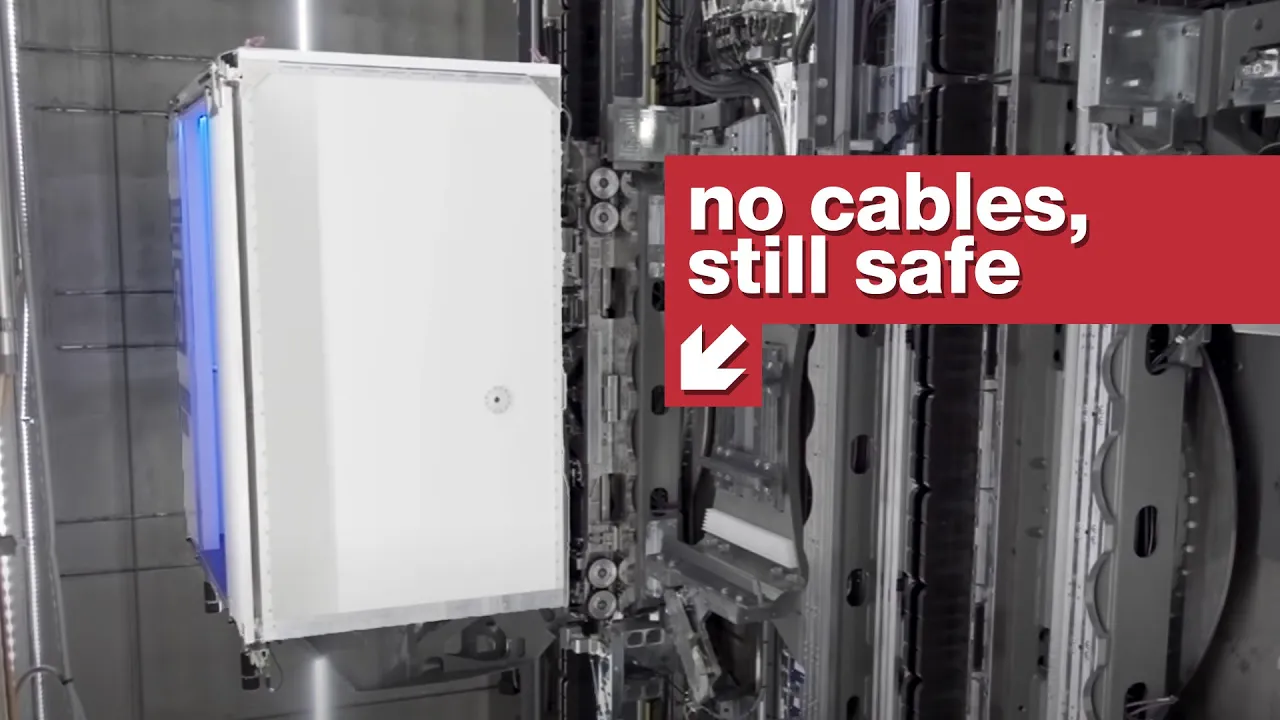
- Because linear motor infrastructure adds substantial weight and expense, cabins are built from carbon fiber and aluminum, with safety brakes mounted directly on the cars. (2:15)
Detailed notes
## Background Published on YouTube by Tom Scott on June 26, 2017, the video documents his visit to Thyssenkrupp's test facility in Germany to see their Multi elevator system. After previously covering a paternoster lift and a hybrid sideways elevator in Genoa, Scott accepted an offer from Thyssenkrupp to tour their newly built test tower and observe a fully multidirectional elevator operating without vertical cables.
## TL;DR Tom Scott tours Thyssenkrupp's 246-meter elevator test tower in Germany to inspect Multi, an elevator system capable of both vertical and horizontal transit. Bypassing the height and weight limits of traditional steel cables, the system uses permanent-magnet linear induction motors and rotating track exchangers that transfer lightweight carbon fiber cabins between shafts in a continuous loop. Although the system incorporates independent onboard brakes and rigorous safety interlocks, its primary remaining challenge lies in convincing risk-averse skyscraper developers to invest in the costly, complex shaft infrastructure.
## Atmosphere & style The video carries an inquisitive, enthusiastic tone characteristic of Tom Scott's explorations into novel engineering feats. Moving through the echoing, cavernous shafts of the massive test tower alongside Thyssenkrupp engineers gives the demonstration a palpable sense of futuristic wonder grounded in physical reality. The narrative balances excitement over rotating track switches and cable-free propulsion with a pragmatic, analytical look at the economic hurdles and strict regulatory realities of the elevator industry.
## Bulletin - [00:00](https://www.youtube.com/watch?v=kdTsbFS4xmI&t=0s) Thyssenkrupp has engineered 'Multi,' a cable-free elevator system capable of independent vertical and horizontal movement, tested in a dedicated 246-meter tower in Germany. - [00:58](https://www.youtube.com/watch?v=kdTsbFS4xmI&t=58s) The design eliminates steel hoist cables in favor of permanent-magnet linear induction motors, bypassing the structural weight limits that constrain elevators in ultratall skyscrapers. - [00:58](https://www.youtube.com/watch?v=kdTsbFS4xmI&t=58s) Cabins switch between vertical travel and horizontal transit using mechanical 'exchangers' that physically rotate the guide tracks at shaft junctions. - [02:15](https://www.youtube.com/watch?v=kdTsbFS4xmI&t=135s) Because linear motor infrastructure adds substantial weight and expense, cabins are built from carbon fiber and aluminum, with safety brakes mounted directly on the cars.
## Key takeaways - [00:00](https://www.youtube.com/watch?v=kdTsbFS4xmI&t=0s) Unlike previous systems that cheated horizontal travel by placing a smaller vehicle inside a vertical frame, Multi achieves genuine multi-axis transit without external carrier cabs. - [00:00](https://www.youtube.com/watch?v=kdTsbFS4xmI&t=0s) Thyssenkrupp built a 246-meter-tall test tower with 1,700 steps to rigorously evaluate Multi rather than testing prototype systems on client sites. - [00:58](https://www.youtube.com/watch?v=kdTsbFS4xmI&t=58s) Multi revives the core efficiency of obsolete paternoster lifts by running multiple circulating cabins simultaneously in a continuous loop. - [00:58](https://www.youtube.com/watch?v=kdTsbFS4xmI&t=58s) The exchanger mechanism physically rotates the drive tracks at intersections, redirecting moving cabins horizontally into adjacent shafts. - [00:58](https://www.youtube.com/watch?v=kdTsbFS4xmI&t=58s) Conventional skyscraper elevators hit strict physical limits where long steel cables become too heavy to support their own dead weight. - [00:58](https://www.youtube.com/watch?v=kdTsbFS4xmI&t=58s) Cable-free propulsion is accomplished by unrolling traditional rotary motors into flat linear induction drives lining the shafts. - [02:15](https://www.youtube.com/watch?v=kdTsbFS4xmI&t=135s) Safety braking systems have been redesigned to sit directly on individual cabins rather than within a traditional machine room at the top of the shaft. - [02:15](https://www.youtube.com/watch?v=kdTsbFS4xmI&t=135s) Safety interlocks constantly verify the position and lock state of each exchanger, triggering an immediate safe stop if operating limits are violated. - [02:15](https://www.youtube.com/watch?v=kdTsbFS4xmI&t=135s) To counter the heavy weight of linear induction motors, cabin structures are manufactured from lightweight aluminum and carbon fiber. - [02:15](https://www.youtube.com/watch?v=kdTsbFS4xmI&t=135s) Lining entire shaft networks with powered magnetic coils presents significant manufacturing, installation, and capital cost challenges. - [02:15](https://www.youtube.com/watch?v=kdTsbFS4xmI&t=135s) Commercial success depends on convincing notoriously risk-averse skyscraper developers to adopt an unprecedented elevator paradigm.
## Detailed walkthrough ### [00:00](https://www.youtube.com/watch?v=kdTsbFS4xmI&t=0s) The Quest for a Sideways Elevator and the Test Tower
Tom Scott recounts his ongoing journey exploring unconventional elevator designs over successive summers. In June 2015, he visited Sheffield to see a paternoster lift—an obsolete elevator mechanism made of a continuous looping chain of open compartments. In June 2016, he traveled to Genoa, Italy, to see an elevator system capable of sideways motion, although Scott notes that setup was essentially a cheat: a small horizontal car riding inside a larger vertical elevator that handled the heavy lifting. By June 2017, he arrived at the newly built Thyssenkrupp Elevator Test Tower in Germany. Thyssenkrupp flew him out to reveal Multi: an actual, full-size, working elevator system engineered to traverse sideways without any shortcuts.
Inside the facility, a Thyssenkrupp engineer explains the critical role of the test tower, stating: “For us, it was very important to have a tower to test the new technology. We don't want to test it at the customers' site.” The testing structure is massive, standing 246 meters tall and containing 1,700 steps—a detail the engineer knows firsthand, having walked up the entire staircase once. The facility functions almost entirely as a cluster of elevator shafts, balancing standard testing for traditional lifts alongside dedicated shafts reserved strictly for the Multi system.
- **Paternoster lift (Sheffield, June 2015):** Looping chain of open cabs. - **Genoa system (Italy, June 2016):** Horizontal passenger cabin carried within a standard vertical elevator frame. - **Thyssenkrupp Multi (Germany, June 2017):** True multidirectional elevator capable of vertical and horizontal movement. - **Test Tower Dimensions:** 246 meters high with 1,700 staircase steps.
[00:58](https://www.youtube.com/watch?v=kdTsbFS4xmI&t=58s) The Exchanger Mechanism and Linear Induction Drives
The foundational concept behind Multi revives an early ideal of elevator engineering: maintaining a continuous, rotating flow of cabins. As a Thyssenkrupp engineer highlights: “The principle of having a continuous rotating flow of cars was one of the best inventions in our industry ever.” To realize this, the system transfers cabins between parallel shafts using a specialized mechanism called an exchanger. Mounted at key junctions within the shafts, the exchanger physically rotates the guide track, redirecting a descending or ascending cabin straight into horizontal transit across to another shaft. These exchangers can be situated at any point in a building's shaft network, enabling highly versatile architectural layouts.
```mermaid flowchart TD accTitle: Multi Elevator Cabin Routing accDescr: Flow diagram showing how elevator cabins travel vertically, rotate at an exchanger, and move horizontally into another shaft. subgraph Shaft_A["Vertical Shaft A"] VDown["Cabin travels vertically"] end subgraph Exchange_Bay["Shaft Junction"] Exchanger["Exchanger Mechanism<br/>Rotates drive tracks"] end subgraph Shaft_B["Vertical Shaft B"] HMove["Horizontal transit"] VUp["Cabin moves into vertical run"] end
VDown --> Exchanger Exchanger --> HMove HMove --> VUp ```
A severe constraint of traditional elevators in ultratall skyscrapers is the vertical cable: past certain heights, a steel cable becomes so long and heavy that it cannot even support its own dead weight, let alone the load of an attached cabin. Multi bypasses cables entirely by using linear induction motors. A representative explains the propulsion mechanism by drawing a comparison to standard motors: “If we just take this motor and cut it on one side and just lay it on a table flat, then you already have a linear drive.” These permanent-magnet synchronous linear drives line the pathways in both vertical and horizontal directions, pushing and pulling cabins electromagnetically.
- **Continuous cabin loop:** Eliminates dead wait time by circulating multiple cabs through linked shafts. - **Exchanger system:** Pivotable track segment that shifts the cabin from vertical rails to horizontal guide paths. - **Cables eliminated:** Bypasses skyscraper cable-weight physics limits via linear induction synchronous motors.
[02:15](https://www.youtube.com/watch?v=kdTsbFS4xmI&t=135s) Safety Systems, Engineering Trade-Offs, and Commercial Hurdles
Traditional traction elevators rely on multiple redundant steel cables—any single one of which can bear more than the design load—alongside deployable friction brakes and bottom buffers designed to downgrade a catastrophic freefall from fatal to survivable. Because passenger elevators are among the most heavily regulated systems in existence, Multi must meet or exceed those stringent safety margins before welcoming the public. A Thyssenkrupp engineer points out a fundamental architectural shift in safety design: “In conventional elevators, you have the brake on the machine on top of the shaft in the machine room; now we have the brake directly on the cars.” Furthermore, safety controllers constantly verify the exchanger status—verifying whether it is properly positioned and locked—and immediately force the elevator into a safe state if any operating rule is breached.
However, the technology introduces substantial engineering and economic hurdles. Linear induction motors are exceptionally heavy and costly to produce. Every individual cabin must be equipped with its own motor drive, and the entire height and breadth of the shaft network must be fitted with magnetic coil tracks to supply power and propulsion. To offset this equipment weight, Thyssenkrupp manufactures the elevator cabs out of lightweight carbon fiber and aluminum. While mathematical models and tower testing show great promise, the ultimate hurdle is commercial adoption. Scott emphasizes that Thyssenkrupp must now convince major skyscraper developers—who are notoriously risk-averse—to purchase the system: “And that might be a greater challenge than making the elevators in the first place.”
- **Onboard Braking:** Traditional machinery-room brakes are replaced with autonomous emergency braking hardware mounted directly on each cab. - **Exchanger Interlocks:** System safety controllers poll lock engagement and position before allowing cabin passage. - **Material Construction:** Cabins utilize carbon fiber and aluminum composites to counteract heavy linear motor assemblies. - **Shaft Infrastructure:** Full shaft runs must be lined with powered magnetic coils.
## Notable quotes > [00:58](https://www.youtube.com/watch?v=kdTsbFS4xmI&t=58s) The principle of having a continuous rotating flow of cars was one of the best inventions in our industry ever. — Thyssenkrupp engineer
## Mentioned Tom Scott, Thyssenkrupp, Multi, Thyssenkrupp Elevator Test Tower, Sheffield, Genoa, Germany, Michelle Martin, Lateral, The Technical Difficulties, Tom Scott Plus
## Video description I've filmed a paternoster lift; I've filmed the strange Genoa elevator that sort-of goes sideways. So when I got an email from Thyssenkrupp, an elevator company, saying "come and see our Multi elevator that actually goes sideways", I wasn't going to turn it down.
Full disclosure: Thyssenkrupp paid for my travel to Germany, but that's all they did. I'd got in touch with them last year asking to see this when it opened; their PR firm replied, offering to fly me out. They had no editorial control over this, and didn't get to see it before it was uploaded!
More information about Multi: https://multi.thyssenkrupp-elevator.com/en/
Thanks to Michelle Martin https://www.youtube.com/@OnTheCrux for help editing the interviews!
🟥 MORE FROM TOM: https://www.tomscott.com/ (you can find contact details and social links there too) ❓ LATERAL, free weekly podcast: https://lateralcast.com/ https://youtube.com/lateralcast/ ➕ TOM SCOTT PLUS: https://youtube.com/tomscottplus 👥 THE TECHNICAL DIFFICULTIES: https://youtube.com/techdif
[Source](https://www.youtube.com/watch?v=kdTsbFS4xmI)