Chomsky Says US Backs Israel as Offshore Outpost to Project Power
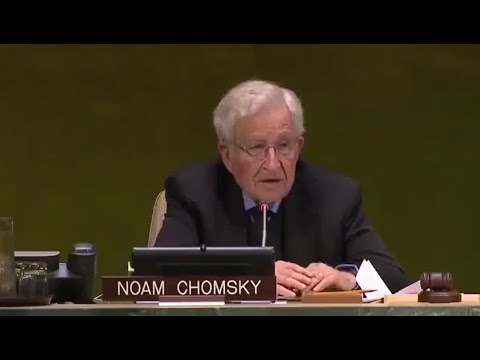
Chomsky's Philosophy
The United States maintains its alliance with Israel because Pentagon planners treat the country as a pre-positioned military surrogate to neutralize regional adversaries and project American power across the Middle East.
AI-assisted summary of Noam Chomsky - Why Does the U.S. Support Israel? — original source. Check the original for full context.
Source published:
Key ideas
- U.S. and British backing for Israel is anchored in Christian Zionism—which long predates Jewish Zionism—and is reinforced by a shared Anglosphere history of settler colonialism. (0:00)
- Declassified records show that the Pentagon viewed Israel as early as 1948 as a vital military asset, solidifying this alliance during the 1958 crisis and the 1967 Six-Day War when Israel crushed secular Arab nationalism. (2:11)
- Israel functions as an offshore U.S. military outpost, evidenced by seamless intelligence integration and Israeli forces drawing directly from pre-positioned Pentagon munitions stockpiles during military operations. (2:11)
- Mainstream Western intellectual culture and media enforce strict doctrinal discipline, framing imperial aggression like the Iraq and Vietnam wars as tactical errors rather than international crimes. (4:46)
Detailed notes
## Background Published on YouTube by the channel Chomsky's Philosophy on July 2, 2016, this video features political theorist and linguist Noam Chomsky addressing the strategic and cultural roots of American support for Israel. The upload provides no additional summary or description in the show notes.
## TL;DR Noam Chomsky explains that the United States' alliance with Israel is grounded in historical Christian Zionism and shared settler-colonial identities across the Anglosphere, alongside hardnosed Cold War military calculations. Beginning with early Pentagon assessments in 1948 and 1958, the relationship fully crystallized following the 1967 Six-Day War, when Israel crushed secular Arab nationalism and became a vital surrogate military outpost for projecting American power. Chomsky further asserts that this geopolitical posture is shielded by an obedient media and intellectual establishment that systematically suppresses the criminal nature of imperial aggression and marginalizes authentic dissent.
## Atmosphere & style The presentation embodies Chomsky's characteristic understated, scholarly delivery, relying on a calm and dispassionate tone that belies the radical severity of his critiques. Free of rhetorical theatrics, his methodical recitation of declassified records and historical comparisons creates an atmosphere of intellectual rigor and quiet moral gravity. Listening feels like an austere, unfiltered seminar that methodically strips away state mythologies to expose the cold mechanics of imperial strategy.
## Bulletin - [00:00](https://www.youtube.com/watch?v=lUQ_0MubbcM&t=0s) U.S. and British backing for Israel is anchored in Christian Zionism—which long predates Jewish Zionism—and is reinforced by a shared Anglosphere history of settler colonialism. - [02:11](https://www.youtube.com/watch?v=lUQ_0MubbcM&t=131s) Declassified records show that the Pentagon viewed Israel as early as 1948 as a vital military asset, solidifying this alliance during the 1958 crisis and the 1967 Six-Day War when Israel crushed secular Arab nationalism. - [02:11](https://www.youtube.com/watch?v=lUQ_0MubbcM&t=131s) Israel functions as an offshore U.S. military outpost, evidenced by seamless intelligence integration and Israeli forces drawing directly from pre-positioned Pentagon munitions stockpiles during military operations. - [04:46](https://www.youtube.com/watch?v=lUQ_0MubbcM&t=286s) Mainstream Western intellectual culture and media enforce strict doctrinal discipline, framing imperial aggression like the Iraq and Vietnam wars as tactical errors rather than international crimes.
## Key takeaways - [00:00](https://www.youtube.com/watch?v=lUQ_0MubbcM&t=0s) Christian Zionism emerged as a powerful ideological force within the British elite well before Jewish Zionism, directly motivating the 1917 Balfour Declaration. - [00:00](https://www.youtube.com/watch?v=lUQ_0MubbcM&t=0s) Prominent U.S. leaders, including Woodrow Wilson, Harry Truman, and Harold Ickes, viewed Jewish settlement in Palestine through the lens of biblical prophecy and scripture. - [00:00](https://www.youtube.com/watch?v=lUQ_0MubbcM&t=0s) The strongest global backing for Israel comes from Anglosphere settler-colonial nations like the U.S., Canada, and Australia, which historically displaced or eliminated indigenous populations. - [02:11](https://www.youtube.com/watch?v=lUQ_0MubbcM&t=131s) In 1948, while the State Department raised concerns over Palestinian refugees and regional stability, the Joint Chiefs of Staff assessed Israel as a premier regional military asset second only to Turkey. - [02:11](https://www.youtube.com/watch?v=lUQ_0MubbcM&t=131s) The 1958 Middle East crisis cemented Israel's strategic value when it proved to be the only regional state actively cooperating with Anglo-American military objectives. - [02:11](https://www.youtube.com/watch?v=lUQ_0MubbcM&t=131s) Israel's victory in the 1967 Six-Day War established the contemporary U.S.-Israel alliance by eliminating secular Arab nationalism, which Washington perceived as a major adversary. - [02:11](https://www.youtube.com/watch?v=lUQ_0MubbcM&t=131s) The destruction of secular Arab nationalism in 1967 paved the way for the rise of radical political Islam, which the U.S. historically favored as a tactical counterweight. - [02:11](https://www.youtube.com/watch?v=lUQ_0MubbcM&t=131s) Israel serves as an offshore base for U.S. power, utilizing pre-positioned American weapons stockpiles stationed on Israeli soil during military operations. - [04:46](https://www.youtube.com/watch?v=lUQ_0MubbcM&t=286s) Mainstream media discourse systematically suppresses accurate terminology such as 'invasion' when describing imperial military aggression conducted by the United States. - [04:46](https://www.youtube.com/watch?v=lUQ_0MubbcM&t=286s) Elite political criticism of the 2003 Iraq War as a 'strategic blunder' parallels the operational objections of the German General Staff during World War II rather than addressing the illegality of the aggression. - [04:46](https://www.youtube.com/watch?v=lUQ_0MubbcM&t=286s) Official historical commemorations of the Vietnam War erase the 1961 invasion of South Vietnam, refocusing public memory exclusively on domestic U.S. sacrifice. - [04:46](https://www.youtube.com/watch?v=lUQ_0MubbcM&t=286s) Mainstream intellectuals function largely as a 'herd of independent minds' that aligns with state power while marginalizing genuine dissident voices.
## Detailed walkthrough ### [00:00](https://www.youtube.com/watch?v=lUQ_0MubbcM&t=0s) Cultural Roots: Christian Zionism and Settler Colonialism
The special relationship between the United States and Israel is rooted in deep historical and cultural traditions that long predate the modern era. Foremost among these is Christian Zionism, an ideological current that emerged well before Jewish Zionism gained prominence. Within the British elite, Christian Zionism was a formidable influence, serving as a key driver behind the 1917 Balfour Declaration and the British Empire's endorsement of Jewish colonization in Palestine based on literal interpretations of biblical narrative. This religious ethos carried over directly into the United States. American presidents such as Woodrow Wilson and Harry Truman were devout Christians who read the Bible on a daily basis. During Franklin D. Roosevelt's administration, Secretary of the Interior Harold Ickes characterized the return of the Jewish people to Palestine as the greatest event in human history, viewing it as the direct fulfillment of biblical prophecy.
Beyond religious conviction, this alignment reflects the historical trajectory of European settler colonialism, representing what can be seen as its final phase. The nations displaying the fiercest, most reflexive backing for Israel are not arbitrary; they constitute the Anglosphere—the United States, Canada, and Australia—all offshoots of the British imperial core. Unlike typical colonial models such as British rule in India, where an administrative elite ruled over an indigenous majority, Anglosphere nations are settler colonial societies. Much like French Algeria or apartheid-era South Africa, incoming settlers largely eliminated the indigenous inhabitants, driven by a fusion of imperial ambition and religious entitlement. As Noam Chomsky explains, “One thing to remember is that Christian Zionism is a very powerful force which goes back long before Jewish Zionism.”
- **Balfour Declaration & British Elites:** Propelled by British Christian Zionism and elite cultural devotion to biblical literalism. - **U.S. Executive Devotion:** Woodrow Wilson and Harry Truman read Scripture daily; Harold Ickes celebrated Jewish settlement in Palestine as history's peak moment. - **The Settler-Colonial Bloc:** Primary support concentrates in settler-colonial Anglosphere nations (the U.S., Canada, Australia) that historically displaced or destroyed their own indigenous populations.
---
[02:11](https://www.youtube.com/watch?v=lUQ_0MubbcM&t=131s) Geostrategic Origins: 1948, 1958, and the 1967 Turning Point
Alongside cultural and religious affinities, hardnosed geostrategic calculations have dictated U.S. policy toward Israel since its founding. In 1948, Washington experienced a sharp bureaucratic divide: the State Department expressed deep reservations regarding Israeli military expansion and advocated for a settlement to the Palestinian refugee crisis, whereas the Pentagon focused entirely on military efficacy. Declassified internal records reveal that the Joint Chiefs of Staff assessed Israel as the second-most potent military power in the Middle East behind Turkey, viewing it as an invaluable potential asset for projecting American power across the region. This utility became increasingly evident during the regional upheaval of 1958, when Israel emerged as the sole regional partner actively collaborating with Anglo-American interests, cementing its value among military and civilian planners.
The foundational architecture of contemporary U.S.-Israeli relations was codified in 1967. During the Six-Day War, Israel rendered what Washington considered an immense strategic service by decimating secular Arab nationalism, then personified by Egypt's Gamal Abdel Nasser and viewed by U.S. planners as a dangerous adversary. In destroying secular nationalism, Israel inadvertently and deliberately bolstered radical political Islam, which the United States supported at the time as a counterweight. This dynamic persists directly into modern conflicts. During recent assaults on the Gaza Strip, when Israel began exhausting its ordnance despite being armed to the teeth, the Pentagon replenished its supplies by drawing immediately from weapons stockpiles pre-positioned on Israeli soil for eventual deployment by U.S. armed forces. This arrangement demonstrates that Israel operates essentially as an offshore military outpost and strategic surrogate of the United States, reinforced by seamless intelligence integration. Emphasizing the early military assessments that drove this policy, Chomsky notes, “If you look back at the internal record, in declassified, the Joint chiefs of staff described Israel as the second largest military force in the region after Turkey and a potential base for US power in the region.”
```mermaid flowchart TD accTitle: Evolution of US-Israel Strategic Alignment accDescr: Diagram tracing the development of US strategic alignment with Israel from 1948 to present day.
subgraph ColdWarFoundations["Cold War Foundations"] A["1948 Pentagon Assessment<br/>(Joint Chiefs value Israel's military power)"] B["1958 Middle East Crisis<br/>(Sole regional partner aiding US/UK)"] end
subgraph StrategicConsolidation["Strategic Consolidation"] C["1967 Six-Day War<br/>(Destruction of secular Arab nationalism)"] D["Rise of Radical Islamist Counterweight<br/>(Tactically favored by US policy)"] end
subgraph ModernIntegration["Modern Integration"] E["Integrated Outpost Status<br/>(Pre-positioned US arms stockpiles & intelligence sharing)"] end
A --> B B --> C C --> D D --> E ```
- **1948 Bureaucratic Split:** State Department prioritized regional stability and refugee rights; Pentagon prioritized Israeli combat capability. - **1958 Crisis Cooperation:** Israel proved its reliability as a Western military asset by standing alone alongside the U.S. and Britain. - **The 1967 Watershed:** Israel destroyed secular Arab nationalism, eliminating Washington's primary regional adversary and solidifying the bilateral alliance. - **Pre-positioned Stockpiles:** Pentagon munitions stored inside Israel are tapped directly during Israeli military operations in Gaza, illustrating structural military interdependence.
---
[04:46](https://www.youtube.com/watch?v=lUQ_0MubbcM&t=286s) Media Conformity, Imperial Aggression, and the Herd of Independent Minds
The unquestioned consensus backing this strategic relationship is sustained by strict conformity across Western intellectual culture and mainstream media. Major media outlets uncritically echo state policy, permitting mild debate only around the cosmetic margins while shielding core imperial actions from scrutiny. A striking parallel is the media coverage of the 2003 invasion of Iraq: the phrase "U.S. invasion of Iraq" remains virtually banned from mainstream discourse, despite the operation being an indisputable act of aggression and a textbook example of what the Nuremberg Tribunal defined as the "supreme international crime." Even President Barack Obama's celebrated opposition to the war rested entirely on tactical grounds—calling it a "strategic blunder" or a "mistake" rather than a crime. Chomsky compares this rhetoric to the internal objections of the German General Staff during Adolf Hitler's invasion of the Soviet Union, who argued that attacking Russia was an operational error and that Britain should have been neutralized first.
This institutional amnesia and doctrinal discipline recur across modern Western history. The official commemoration of the Vietnam War focuses entirely on American suffering and sacrifices, completely erasing the phrase "U.S. invasion of South Vietnam," which began in 1961, from polite discourse; such realities are relegated exclusively to dissident outlets like *Democracy Now!* or marginal publications. The phenomenon is equally visible in the United Kingdom, where elite literary organs like the *Times Literary Supplement* gingerly debate whether the nation should finally acknowledge the genocidal character of British colonization centuries ago. While intellectuals routinely flatter themselves with the self-image of courageous, dissident free-thinkers speaking truth to power, historical evidence proves that authentic dissidents form an isolated, heavily penalized fringe. Delivering a scathing assessment of the intellectual establishment, Chomsky remarks, “The mainstream tends to be what was once called a herd of independent minds marching in support of State power.”
- **Iraq War Framing:** Mainstream media suppresses the term "invasion," while elite political criticism mirrors the German General Staff's tactical complaints during World War II rather than moral or legal objections. - **Vietnam Historical Revisionism:** State-sponsored commemorations elevate U.S. military sacrifices while completely excluding acknowledgment of the direct 1961 invasion of South Vietnam. - **The British Imperial Debate:** Prestigious journals cautiously deliberate whether to label historical imperial conquests as genocidal centuries after the fact. - **The "Herd of Independent Minds":** Intellectual institutions systematically align with state and corporate power while marginalizing genuine anti-imperialist critics.
## Notable quotes > [04:46](https://www.youtube.com/watch?v=lUQ_0MubbcM&t=286s) The mainstream tends to be what was once called a herd of independent minds marching in support of State power. — Noam Chomsky
> [00:00](https://www.youtube.com/watch?v=lUQ_0MubbcM&t=0s) Christian Zionism is a very powerful force which goes back long before Jewish Zionism. — Noam Chomsky
## Mentioned Noam Chomsky, Woodrow Wilson, Harry Truman, Franklin D. Roosevelt, Harold Ickes, Gamal Abdel Nasser, Barack Obama, Adolf Hitler, Balfour Declaration, Joint Chiefs of Staff, U.S. Department of State, The Pentagon, Nuremberg Tribunal, German General Staff, Democracy Now!, Times Literary Supplement
[Source](https://www.youtube.com/watch?v=lUQ_0MubbcM)