Cyclists Must Steer Left to Turn Right, MinutePhysics Demonstrates
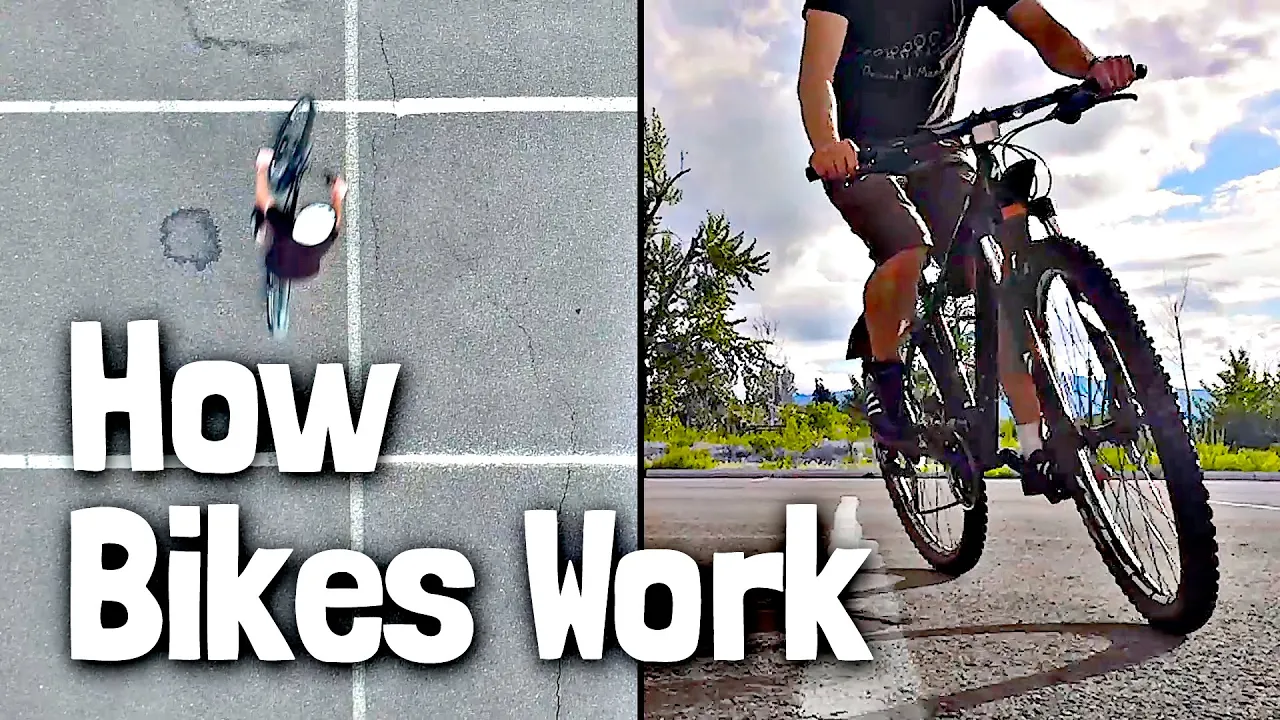
minutephysics
Executing a turn requires riders to steer in the opposite direction to trigger a lateral lean and then maintain counter-torque to prevent the vehicle's self-stabilizing geometry from straightening the frame.
AI-assisted summary of The Counterintuitive Physics of Turning a Bike — original source. Check the original for full context.
Source published:
Key ideas
- Steering a bicycle handlebars directly toward the intended turn direction displaces the contact points outward, tipping the bicycle and rider in the opposite direction. (0:01)
- Initiating a turn requires counter-steering: briefly turning the handlebars left to induce a rightward lean before turning right. (0:01)
- Bicycles and motorcycles feature self-stabilizing geometry that naturally turns deeper into a lean to bring the wheels back under the center of mass. (0:01)
- To sustain a stable turn, riders must exert continuous, subtle opposing torque to prevent the front wheel from tucking too sharply and uprighting the bike. (0:01)
Detailed notes
## Background Published on YouTube on July 15, 2015, by minutephysics (created by Henry Reich), "The Counterintuitive Physics of Turning a Bike" examines the mechanics behind how two-wheeled vehicles steer. The video description highlights research from TU Delft, aerial and slow-motion photography by Michael Aranda, 3D animation assistance from Wren Weichman, and sponsorship from Harry's alongside acknowledgments of numerous Patreon supporters.
## TL;DR While intuition suggests steering handlebars directly toward a desired turn, rotating the wheel rightward pushes the tires out from underneath the rider, causing the bike to lean and turn left instead. To make a true right turn, a rider must employ counter-steering by momentarily steering left to initiate a lean to the right. Because bicycle geometry naturally tries to self-stabilize and upright the frame by steering deeper into the tilt, the rider must maintain a continuous, subtle counter-torque against the turn to prevent the bike from straightening out.
## Atmosphere & style The presentation is crisp, swift, and revelatory, carrying the signature concise clarity of MinutePhysics. Henry Reich playfully dismantles an everyday assumption, turning a motor skill people take for granted into a fascinating physical paradox. The brisk pace and straightforward explanation leave viewers with an eye-opening realization about how physics governs their unconscious habits on two wheels.
## Bulletin - [00:01](https://www.youtube.com/watch?v=llRkf1fnNDM&t=1s) Steering a bicycle handlebars directly toward the intended turn direction displaces the contact points outward, tipping the bicycle and rider in the opposite direction. - [00:01](https://www.youtube.com/watch?v=llRkf1fnNDM&t=1s) Initiating a turn requires counter-steering: briefly turning the handlebars left to induce a rightward lean before turning right. - [00:01](https://www.youtube.com/watch?v=llRkf1fnNDM&t=1s) Bicycles and motorcycles feature self-stabilizing geometry that naturally turns deeper into a lean to bring the wheels back under the center of mass. - [00:01](https://www.youtube.com/watch?v=llRkf1fnNDM&t=1s) To sustain a stable turn, riders must exert continuous, subtle opposing torque to prevent the front wheel from tucking too sharply and uprighting the bike.
## Key takeaways - [00:01](https://www.youtube.com/watch?v=llRkf1fnNDM&t=1s) Unlike driving a car, turning a bicycle handlebars directly to the right does not produce a simple right turn. - [00:01](https://www.youtube.com/watch?v=llRkf1fnNDM&t=1s) Steering inputs on a two-wheeled vehicle directly govern lateral balance and lean rather than simple direction pointing. - [00:01](https://www.youtube.com/watch?v=llRkf1fnNDM&t=1s) Turning handlebars to the right displaces the wheels rightward from beneath the rider's center of mass. - [00:01](https://www.youtube.com/watch?v=llRkf1fnNDM&t=1s) Displacing the contact patches outward causes the bicycle and rider to tip in the opposite direction. - [00:01](https://www.youtube.com/watch?v=llRkf1fnNDM&t=1s) Once a bike leans, ground reaction forces act laterally toward the tilted side. - [00:01](https://www.youtube.com/watch?v=llRkf1fnNDM&t=1s) A leftward lean forces the bike into an actual left turn, requiring the handlebars to swing leftward. - [00:01](https://www.youtube.com/watch?v=llRkf1fnNDM&t=1s) Executing a proper right turn demands counter-steering by momentarily turning the handlebars to the left. - [00:01](https://www.youtube.com/watch?v=llRkf1fnNDM&t=1s) Initial leftward counter-steering triggers the necessary rightward lean for the turn. - [00:01](https://www.youtube.com/watch?v=llRkf1fnNDM&t=1s) Two-wheeled vehicles possess self-stabilizing geometry designed to correct leans automatically. - [00:01](https://www.youtube.com/watch?v=llRkf1fnNDM&t=1s) During a rightward lean, the steering geometry naturally attempts to turn even harder right to tuck the wheels back under the rider. - [00:01](https://www.youtube.com/watch?v=llRkf1fnNDM&t=1s) Riders must maintain a slight, continuous counter-torque to the left to prevent the front wheel from over-correcting. - [00:01](https://www.youtube.com/watch?v=llRkf1fnNDM&t=1s) Turning right on a bicycle paradoxically requires steering left, leaning right, and continually applying leftward torque throughout the turn.
## Detailed walkthrough ### [00:01](https://www.youtube.com/watch?v=llRkf1fnNDM&t=1s) The Counter-Steering Mechanism and Turn Dynamics
When cycling, intuition suggests that to execute a right turn, one should simply rotate the handlebars to the right. Henry Reich points out the fundamental flaw in this assumption, stating: “If you’re riding a bike and want to turn right, you might think that you should turn the handlebars to the right. However, that’s wrong.” Unlike an automobile, where turning the steering wheel simply reorients the direction the vehicle is pointing, steering a bicycle directly affects its lateral balance and lean. When a rider abruptly turns the front wheel to the right, the base of support moves rightward out from underneath the rider and the frame. This motion forces the bicycle and rider to lean toward the left. Once tilted, the ground exerts a lateral reaction force directed to the left, inevitably sending the bicycle in that direction. Because physical dynamics dictate a leftward path at that point, the rider must yield to physics and allow the handlebars to swing left to complete the turn.
```mermaid flowchart TD accTitle: The Physics of Counter-Steering accDescr: Flowchart illustrating how steering right causes a leftward lean and turn, requiring counter-steering to achieve the desired direction.
subgraph CounterSteer ["Initial Input & Lean"] A["Turn handlebars to the right"] --> B["Wheels move right from under rider"] B --> C["Bike & rider lean to the left"] end
subgraph TurnExecution ["Turn Execution"] C --> D["Ground exerts force to the left"] D --> E["Handlebars follow left into left turn"] end
subgraph ProperRightTurn ["Executing a True Right Turn"] F["Counter-steer left"] --> G["Bike leans right"] G --> H["Apply slight left torque"] H --> I["Maintain right turn against self-stabilization"] end ```
Consequently, the proper technique to initiate a rightward turn is counter-steering: momentarily steering left to induce a rightward lean. Even after the bike enters the turn, active control is required because bicycles and motorcycles possess inherent self-stabilizing geometry that works to right the vehicle. When leaning right, the bicycle naturally steers even further into the right turn to reposition its wheels beneath its center of mass. To counteract this straightening tendency, the rider must exert a continuous, slight counter-torque to the left on the handlebars, preventing the wheel from tucking too sharply into the curve. Henry Reich summarizes the paradoxical nature of two-wheeled balance: “Yes, it’s counterintuitive: to turn right on a bike you turn left, then keep trying to turn left while leaning and turning right.”
- Turning the wheel in one direction slides the contact patches out from under the vehicle's center of mass, tipping the bike in the opposite direction. - Ground reaction forces act in the direction of the lean, driving the turn toward the tilted side. - To execute a right turn, the rider must initially steer left (counter-steering) to trigger a rightward lean. - Most bicycles and motorcycles automatically correct leans by steering deeper into the tilt to bring the wheels back under the center of mass. - Riders must maintain a subtle opposing torque throughout a turn to prevent the steering from over-correcting and straightening out.
## Notable quotes > [00:01](https://www.youtube.com/watch?v=llRkf1fnNDM&t=1s) Yes, it’s counterintuitive: to turn right on a bike you turn left, then keep trying to turn left while leaning and turning right. — Henry Reich
## Mentioned Henry Reich, Michael Aranda, Wren Weichman, Nathaniel Schroeder, Harry's, TU Delft
## Video description Thanks to http://www.harrys.com for sponsoring this video – use offer code MinutePhysics for $5 off your first purchase
A HUGE thanks to Michael Aranda for aerial and slow motion photography and Wren Weichman (@wrenthereaper) for helping with the 3D bike animation.
Bike references mainly from:
http://bicycle.tudelft.nl/schwab/Bicycle/
Music by Nathaniel Schroeder http://www.soundcloud.com/drschroeder
And thanks to the following Patreon supporters:
Today I Found Out Jeff Straathof Avi Yashchin Mark Jeremy Cummings Wes Brown John Green Rafael Ferreira Luciano Florian Philipp Rens van der Heijden Risa Galant Ricky Shields Kristina Foss PetWolverine Trent Sutherland Ian Foote Eszter Szikora Tasso Kostalas (MavericSun) Amandeep Hayer Abraão Caldas Eric Ma Conner Fissell Bob Bolch Daniel Ametsreiter Joël Quenneville Richard Pearson David Dailey Steven Mulder Karim Ryan Kyle William Ricketts Collin Mandris Jonathan Foster Siddharth Sadanand Robby Olivam Alan Browning Jonathan Piersa Jake Stolhandske Julia Person James Craver Sarah Chavis Yonatan Bisk Richard Campbell Richie Swift Chris Barrett Jan Amza Christopher Coleman David Tebbe Kelvin Dueck Daniel “YoureDown” Breger Hendrik Payer Greck Cannon Chris Peters Landy Manderson Lewis Goddard Seamus Campbell Greg Holger R. Austin Keller Alejandro Medrano Gil Prof Stick Cora Toner Chris Thompson Alan Lam Andrew Collings Mike McHargue Nicholas Buckendorf Blair Bradimore Michael Biot nir lifshitz Nicholas Carroll Edwin Zea Diana Dial Mitch Etzkin Lightbow Dante Santos Mathias Westad Larssen Tom Headley Michael K Geoff Wallace Fredrik Samuelsson Melissa Harkins Jason Talley Keith Marrocco Maarten Bremer Eric Laberge Lacey Larson Neil Ramroop Matthew Norton Efe Efevich Mark Donal Botkin Sylvan Ruud Daniel Friesen Philipi Adolfo Willemann Jeffrey McCullough Oddgeir Ann Brendon Davis Filip Christopher Jimenez Michel Payette Juha Niittynen Jeff Ross Viktor Liljeblad Robert E DeLapp Sean Linsley Christopher O’Neal Marcus Philip Freeman Matthew Heermann Marsha Woerner Daniel Yip Matt K William Pearson Kevin Lynch Nick Ward Kevin john eriksson Allan Farrell Tobias Olesen Chris Chapin Michael Keefe Jon Mann Bert Joji Wata Adam Naber Rob Ibsen Jacob Gumpert Peter Collier Andi Davis Raymond Cason Evan Gale Paul Tori McClanahan Dominik Danilo Metzger Christian Altenhofen Roy Morgan Olivia Darroch Amber Ciarvella ryan horlacher Keith Chang Janel Christensen Will Scherer Mike Fulcher Larom Lancaster John Harman Matt Christos Papandreou Fernando Pazin Jason Medrano Andrew Barnett Katharina Schuchmann John Gietzen Michael Tardibuono Matthew Hebert Pierre-Louis Bourgeois Genevieve Lawrence Brian D’Agostini Chris Dominik Menzi Ryan A. Schauer Daniel Johnson Nico Houbraken Michael Carr Ragnhild Elizabeth Meisterling Lysann Schlegel Magnus Krokstad Owain Blackwood Russ Arrell Maarten Daalder Brenden Bullock Mark Samberg Tina Johnston Mike Cochrane Tom Murphy Peter L Jeff Erica Pratt David Artur Szczypta David Drueding Nicklas Ulvnäs Nigel W James Nelson Mary Foster-Smith Clayton Neff Michael Merino Jason and Gayle Corfman Mihaly Barasz Steven Klurfeld Richard Bairwell Tamas Bartal Erven Justin Prahl Michael Maitlen Hans van Staveren Kasey Karlin Nazario Marie Conrad Jacques LABBÉ Geralyn Byers jason black Candice Blodgett Daniel Gibbs Henry Berthelsen Andy Kittner Steve Hall Rob Snyder John Kelly Jessica Rosenstein Bill Tomiyasu Vasco Simões Simon Hammersley iain Holger Alexis Carpenter Jay Goodman Joseph Perry Mark Govea Eduardo Rampelotto Gatto Created by Henry Reich
[Source](https://www.youtube.com/watch?v=llRkf1fnNDM)