Initech Worker Struggles to Defend Intermediary Role to Consultants
Ryan Olson
An efficiency audit reveals Tom Smykowski performs virtually no physical handoff of customer specifications, leaving his intermediary position dependent entirely on claimed interpersonal skills.
AI-assisted summary of What would you say...you do here? — original source. Check the original for full context.
Source published:
Key ideas
- Efficiency consultants at Initech scrutinize employee Tom Smykowski, questioning the operational necessity of having an intermediary between customers and software engineers. (0:00)
- Under specific questioning regarding his daily workflow, Tom admits that incoming specifications are handled by a fax machine or secretary, and he only occasionally delivers them to engineers. (0:00)
- When bluntly asked what he actually does at the company, Tom loses his composure, vehemently arguing that his value relies on having 'people skills' to shield technical staff from client interaction. (0:00)
Detailed notes
## Background Published on YouTube by Ryan Olson on May 20, 2007, this clip features the concise title and description asking, "What would you say...you do here?"
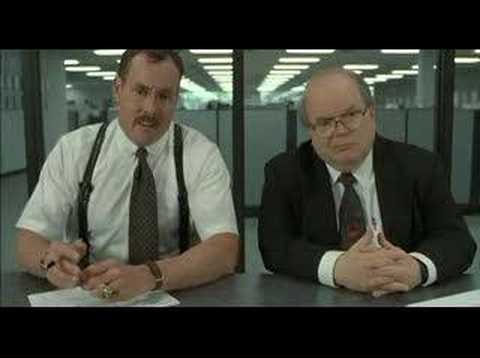
## TL;DR During an efficiency interview at Initech, business consultants interrogate employee Tom Smykowski regarding his purported role of conveying customer specifications to software engineers. Under scrutiny, Tom stumbles and admits that incoming documents are actually received by his secretary or a fax machine and that he only occasionally carries them down to the technical team. Pressed bluntly on what value he actually brings to the company, Tom completely unravels under the pressure. Cornered and desperate, he finishes the interview in an angry, shouting fit, insisting that his interpersonal skills shield the engineers from having to speak with customers directly.
## Atmosphere & style The exchange embodies deadpan corporate satire, marked by a tense and methodical interrogation that progressively strips away bureaucratic jargon. The dynamic contrasts the consultants' calm, clinical persistence with Tom's mounting defensiveness and fumbling rationalizations. What starts as an awkward performance review swiftly devolves into an unhinged, darkly comic meltdown as Tom completely loses his composure.
## Bulletin - [00:00](https://www.youtube.com/watch?v=m4OvQIGDg4I&t=0s) Efficiency consultants at Initech scrutinize employee Tom Smykowski, questioning the operational necessity of having an intermediary between customers and software engineers. - [00:00](https://www.youtube.com/watch?v=m4OvQIGDg4I&t=0s) Under specific questioning regarding his daily workflow, Tom admits that incoming specifications are handled by a fax machine or secretary, and he only occasionally delivers them to engineers. - [00:00](https://www.youtube.com/watch?v=m4OvQIGDg4I&t=0s) When bluntly asked what he actually does at the company, Tom loses his composure, vehemently arguing that his value relies on having 'people skills' to shield technical staff from client interaction.
## Key takeaways - [00:00](https://www.youtube.com/watch?v=m4OvQIGDg4I&t=0s) Efficiency consultants interview Tom Smykowski to evaluate the exact responsibilities and value of his corporate role at Initech. - [00:00](https://www.youtube.com/watch?v=m4OvQIGDg4I&t=0s) Tom describes his primary job function as taking software specifications from customers and delivering them to the engineering team. - [00:00](https://www.youtube.com/watch?v=m4OvQIGDg4I&t=0s) The consultants question why customers cannot bypass him and hand requirements directly to software engineers. - [00:00](https://www.youtube.com/watch?v=m4OvQIGDg4I&t=0s) Tom justifies the buffer position by claiming that technical engineers fundamentally lack the interpersonal ability to deal with clients. - [00:00](https://www.youtube.com/watch?v=m4OvQIGDg4I&t=0s) Consultants examine the mechanical realities of Tom's workflow to see what physical labor he actually performs. - [00:00](https://www.youtube.com/watch?v=m4OvQIGDg4I&t=0s) Tom concedes that incoming client specifications are received via his secretary or the office fax machine rather than by him personally. - [00:00](https://www.youtube.com/watch?v=m4OvQIGDg4I&t=0s) When asked if he at least delivers the specifications to the software engineers, Tom hedges and admits he only does so sometimes. - [00:00](https://www.youtube.com/watch?v=m4OvQIGDg4I&t=0s) The breakdown of Tom's daily tasks reveals a redundant position with virtually no direct hand in document routing. - [00:00](https://www.youtube.com/watch?v=m4OvQIGDg4I&t=0s) The evaluation culminates in the blunt question: 'What would you say you do here?' - [00:00](https://www.youtube.com/watch?v=m4OvQIGDg4I&t=0s) Feeling cornered, Tom becomes agitated and screams that his irreplaceable contribution is having 'people skills.'
## Detailed walkthrough ### [00:00](https://www.youtube.com/watch?v=m4OvQIGDg4I&t=0s) Questioning Tom Smykowski's Role at Initech
During an efficiency interview at Initech, the business consultants probe into the exact nature of Tom Smykowski's job responsibilities. One consultant summarizes Tom's routine duties by observing that he takes specifications directly from customers and brings them down to the software engineers. Tom eagerly agrees with this description, prompting the consultant to press him on why the intermediary step is necessary in the first place, asking why clients cannot simply hand their requirements directly over to the technical team. Tom immediately defends his position by explaining the interpersonal friction between technical staff and clients, insisting, “Well, I'll tell you why: because engineers are not good at dealing with customers.”
The questioning quickly pivots to the mechanics of Tom's day-to-day workflow. When asked if he physically collects the specifications from the clients himself, Tom stumbles and admits that his secretary or the office fax machine actually handles the incoming documents. Pushing further into the breakdown of tasks, the consultant asks if Tom at least physically carries those specifications over to the software engineers, leaving Tom fumbling for an answer as he hedges that he only does so “sometimes.”
```mermaid flowchart LR accTitle: Purported Workflow vs Reality at Initech accDescr: Diagram showing the disconnect between customers, Tom's claimed role, and the software engineers. subgraph Inputs["Document Reception"] C["Customer"] -->|"Specs"| F["Fax / Secretary"] end subgraph Bottleneck["Purported Intermediary"] F -.->|"Unclear handoff"| T["Tom Smykowski<br/>('People Skills')"] end subgraph Tech["Implementation"] T -.->|"Occasional delivery"| E["Software Engineers"] end ```
The interview reaches a boiling point when the consultant delivers the blunt bottom-line question: “What would you say you do here?” Feeling cornered and desperate to justify his corporate existence, Tom completely loses his composure and snaps back at the interviewers. Frustrated that his value is not recognized, he screams in defense of his social abilities, shouting, “Well look, I already told you, I deal with the goddamn customers so the engineers don't have to! I have people skills! I am good at dealing with people! Can't you understand that? What the hell is wrong with you people?”
- The consultants question why customers cannot interface directly with software engineers. - Tom concedes that he does not physically receive client specs himself, relying instead on his secretary or a fax machine. - Tom admits he only physically delivers specifications to the engineering staff on an occasional basis.
## Notable quotes > [00:00](https://www.youtube.com/watch?v=m4OvQIGDg4I&t=0s) Well, I'll tell you why: because engineers are not good at dealing with customers. — Tom Smykowski
## Mentioned Initech, Tom Smykowski
## Video description What would you say...you do here?
[Source](https://www.youtube.com/watch?v=m4OvQIGDg4I)