Google CEO Page Backs Radical Moonshots to Evade Corporate Decline
TED
Page argues that companies fail when they cling to core businesses instead of anticipating shifts, contending that deploying corporate capital toward untended high-risk problems achieves more societal progress than traditional philanthropy.
AI-assisted summary of Where's Google going next? | Larry Page — original source. Check the original for full context.
Source published:
Key ideas
- Google CEO Larry Page views personal computing as still fundamentally awkward and clunky, pushing Google toward deep machine learning and context-aware interfaces to truly understand human intent. (0:13)
- Following the acquisition of DeepMind, Page highlights unsupervised reinforcement learning systems that master arcade games and discover visual concepts like cats purely from raw data without human labeling. (2:29)
- Project Loon aims to bridge the global digital divide by deploying high-altitude stratospheric balloons navigated via computational wind models to connect the two-thirds of humanity without reliable internet. (8:43)
- Page critiques secret government surveillance as an existential threat to democracy, while simultaneously urging society to overcome privacy paranoia so anonymized health data can save an estimated 100,000 lives annually. (11:07)
- Through the lens of 'additionality,' Page defends ambitious corporations as primary engines of societal progress, arguing that companies decline because they miss the future rather than failing at present execution. (17:48)
Detailed notes
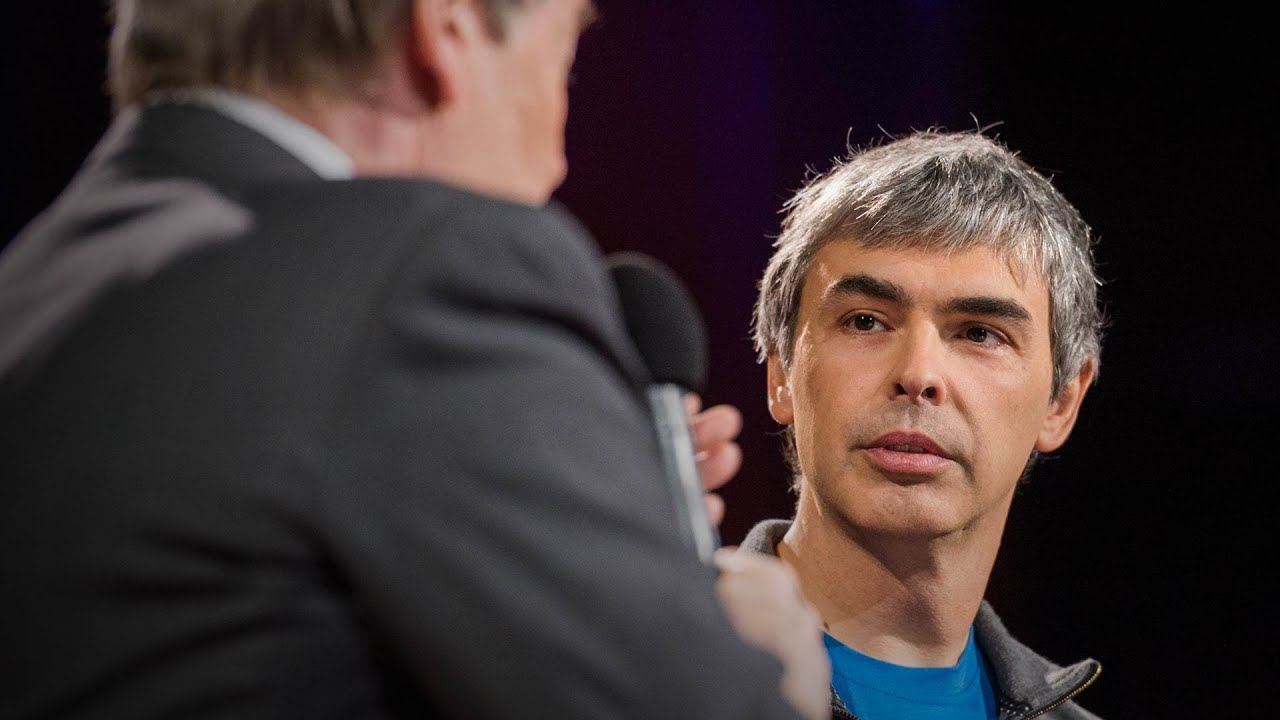
## Background This interview was published by the TED channel on YouTube on March 22, 2014. According to the page description, Charlie Rose interviews Google CEO Larry Page onstage at TED2014 about his far-off vision for the company, spanning aerial bikeways, internet-delivering balloons, and the recent acquisition of artificial intelligence lab DeepMind.
## TL;DR Google CEO Larry Page joins Charlie Rose to discuss the evolving mission of Google beyond traditional search, emphasizing the push toward ambient, context-aware computing and unsupervised artificial intelligence. Page highlights audacious moonshots designed to expand global connectivity and reshape urban infrastructure, including Project Loon's high-altitude stratospheric balloons and autonomous driving technology. Addressing contemporary controversies around surveillance and digital privacy, he advocates for transparent governance, arguing that societal overcaution prevents transformative breakthroughs like anonymized health research. Throughout the conversation, Page champions the economic concept of 'additionality' and defends mission-driven corporations as powerful, essential engines for long-term philanthropic and technological progress.
## Atmosphere & style The conversation carries an intimate, cerebral, and contemplative tone, set against the warm staging of TED with an engaged live audience. Larry Page speaks in a gentle, raspy cadence, balancing self-deprecating humor with quiet, unyielding conviction about high-stakes technological futures. Charlie Rose acts as an inquisitive, conversational prober, nudging Page across technical demonstrations, personal health vulnerabilities, and macro-philosophical reflections on corporate mortality. The dynamic feels less like an executive press briefing and more like a rare, unguarded window into the radical mental models of a visionary builder.
## Bulletin - [00:13](https://www.youtube.com/watch?v=mArrNRWQEso&t=13s) Google CEO Larry Page views personal computing as still fundamentally awkward and clunky, pushing Google toward deep machine learning and context-aware interfaces to truly understand human intent. - [02:29](https://www.youtube.com/watch?v=mArrNRWQEso&t=149s) Following the acquisition of DeepMind, Page highlights unsupervised reinforcement learning systems that master arcade games and discover visual concepts like cats purely from raw data without human labeling. - [08:43](https://www.youtube.com/watch?v=mArrNRWQEso&t=523s) Project Loon aims to bridge the global digital divide by deploying high-altitude stratospheric balloons navigated via computational wind models to connect the two-thirds of humanity without reliable internet. - [11:07](https://www.youtube.com/watch?v=mArrNRWQEso&t=667s) Page critiques secret government surveillance as an existential threat to democracy, while simultaneously urging society to overcome privacy paranoia so anonymized health data can save an estimated 100,000 lives annually. - [17:48](https://www.youtube.com/watch?v=mArrNRWQEso&t=1068s) Through the lens of 'additionality,' Page defends ambitious corporations as primary engines of societal progress, arguing that companies decline because they miss the future rather than failing at present execution.
## Key takeaways - [00:13](https://www.youtube.com/watch?v=mArrNRWQEso&t=13s) Fifteen years after Google's founding, organizing the world's information remains an unfinished challenge hampered by computers that lack context about user location, activity, and knowledge. - [02:29](https://www.youtube.com/watch?v=mArrNRWQEso&t=149s) Google turned to unsupervised machine learning after traditional speech recognition hit a wall, proving that neural models could independently learn complex visual concepts without training labels. - [02:29](https://www.youtube.com/watch?v=mArrNRWQEso&t=149s) DeepMind's unified algorithm achieved superhuman video game performance using only raw screen pixels, controls, and score feedback, demonstrating the potential of combining computer science with cognitive neuroscience. - [06:20](https://www.youtube.com/watch?v=mArrNRWQEso&t=380s) Kenyan farmer Zack Matere's story illustrates that democratized internet access enables individuals to solve critical local problems, which Matere bridged offline through a handwritten village notice board. - [08:43](https://www.youtube.com/watch?v=mArrNRWQEso&t=523s) Two out of three people globally still lack reliable internet connectivity, driving Google's Project Loon to deploy stratospheric balloons steered by dynamic altitude adjustments along atmospheric wind currents. - [11:07](https://www.youtube.com/watch?v=mArrNRWQEso&t=667s) Mass government surveillance conducted in total secrecy undermines democratic governance by forcing technology companies to defend users against covert state programs that never received public debate. - [12:35](https://www.youtube.com/watch?v=mArrNRWQEso&t=755s) An overemphasis on medical privacy prevents research into rare and untreated conditions; anonymizing patient records with transparent access audit logs could save an estimated 100,000 lives each year. - [15:12](https://www.youtube.com/watch?v=mArrNRWQEso&t=912s) Autonomous vehicles address a massive global health crisis—with over 20 million road injuries annually—while offering the potential to reclaim vast urban areas currently consumed by parking and roads. - [17:48](https://www.youtube.com/watch?v=mArrNRWQEso&t=1068s) Nikola Tesla illustrates the limitation of pure inventive genius without commercial and distribution infrastructure, reinforcing the need to pair revolutionary technology with effective business execution. - [17:48](https://www.youtube.com/watch?v=mArrNRWQEso&t=1068s) Corporations should be evaluated as viable vehicles for philanthropy when they pursue 'additionality'—investing substantial talent and capital into transformative, neglected problems that market incentives otherwise ignore. - [21:47](https://www.youtube.com/watch?v=mArrNRWQEso&t=1307s) Dominant companies primarily fail and accelerate corporate turnover because they miss technological shifts in the future rather than executing poorly on their existing business lines. - [21:47](https://www.youtube.com/watch?v=mArrNRWQEso&t=1307s) Page initially felt guilty about devoting time to Android as an acquired startup outside Google's search core, an experience that reinforced the necessity of prioritizing risky, future-defining platforms.
## Detailed walkthrough ### [00:13](https://www.youtube.com/watch?v=mArrNRWQEso&t=13s) Google’s Evolving Mission and the Limits of Clunky Computing
Charlie Rose opens the conversation by revealing a self-deprecating note Larry Page had sent him prior to taking the stage: Page wrote that they needed to ensure they did not appear like “a couple of middle-aged boring men.” Rose jokes back that he was deeply flattered by the comparison, pointing out that he is quite a bit older than Page, while Page possesses considerably more net worth. Rose sets the agenda for the session: an exploration of the internet, search, privacy, Page’s overarching philosophy, and where Google is heading next.
When Rose asks Page where Google currently stands and where it is going, Page reflects on the company’s original founding mission—to organize the world’s information and make it universally accessible and useful. Page admits that people often ask whether that is still Google’s genuine mission, and he frequently asks himself the same question. Ultimately, he sees search as a profound, unfinished challenge. “We've been at it for 15 years already, but it's not at all done,” Page explains, marveling at how society is still in the earliest days of understanding human intent and global knowledge. Asked what the destination looks like when it is finally done, Page points out that the fundamental roadblock is that personal computing remains awkward and unintegrated:
> “You know, your computer doesn't know where you are, it doesn't know what you're doing, it doesn't know what you know, and a lot we've been trying to do recently is just make your devices work, make them understand your context.”
He notes that efforts like Google Now are designed to anticipate what a user needs based on location and schedule, but confesses that modern computing across the board remains far too clunky and disconnected from actual human behavior.
---
[02:29](https://www.youtube.com/watch?v=mArrNRWQEso&t=149s) DeepMind, Unsupervised Learning, and the Path to AI
Rose asks how Google's recent acquisition of DeepMind fits into this broader technological picture. Page explains that the U.K.-based company aligns directly with Google's efforts to move past clunky interfaces. To make computers truly understand speech, Google discovered that existing speech recognition technology was inadequate, prompting them to invest heavily in machine learning research. As they tested machine learning across vast datasets, such as YouTube videos, an unsupervised model famously taught itself the visual concept of a cat completely unassisted, without any labeled training data.
Page shows a video demonstrating DeepMind’s system mastering classic video games without human instructions. Given only the raw screen pixels, the game controls, and the score counter, a single, unified program learned to play multiple games with superhuman skill. Demonstrating a boxing game where the computer takes the left-hand boxer and pins the opponent against the wall to rack up points, Page imagines what will happen when this capability is directed toward managing human schedules and complex information needs.
```mermaid flowchart LR accTitle: DeepMind Unsupervised Learning Architecture accDescr: Diagram showing how raw visual inputs and score feedback train a unified algorithm to take actions and achieve superhuman game performance.
subgraph Inputs["Raw Inputs"] P["Screen Pixels"] S["Game Score"] end
subgraph Agent["DeepMind Unified Program"] ML["Deep Reinforcement<br/>Learning Algorithm"] end
subgraph Output["Autonomous Action"] C["Game Controller Inputs"] P2["Superhuman Gameplay<br/>(e.g., Boxing Pin Strategy)"] end
P --> ML S --> ML ML --> C C --> P2 ```
Discussing the leadership behind DeepMind, Page highlights founder Demis Hassabis, who earned a Ph.D. in cognitive neuroscience after studying computer science in order to map how the human brain functions. Page sees immense promise at the intersection of neuroscience and artificial intelligence. When Rose presents the machine-generated visual composite of a cat on the stage screen, Page stresses why this milestone was so meaningful:
> “And there's no training, no notion of a cat, but this concept of a cat is something important that you would understand, and now that the machines can kind of understand.”
- **Acquisition background**: DeepMind is based in the United Kingdom and founded by Demis Hassabis, who combined computer science with a Ph.D. in neuroscience. - **Unsupervised discovery**: The system identified cats on YouTube purely from raw video feeds without prior labels or human guidance. - **Unified gaming system**: The exact same algorithm tackled different arcade games using only pixels and score feedback to develop optimal, superhuman strategies.
---
[06:20](https://www.youtube.com/watch?v=mArrNRWQEso&t=380s) Access to Information: The Story of Zack Matere
Page transitions back to the core power of search with a video feature Google discovered in the news. The video documents Zack Matere, a farmer living in Soy, Kenya. When Matere planted a crop of potatoes, the plants began withering and dying without apparent reason, and local agricultural books provided no answers. Seeking an explanation, Matere traveled to an internet cafe and searched for “potato diseases.” He discovered an online article suggesting ants could be attacking the roots, recommending that he sprinkle wood ash over the crops. Within days of applying the ash, the ants vanished and his harvest was saved.
Inspired by the power of the web, Matere returned to the cyber cafe with an entrepreneurial friend to research renewable energy designs, which led the friend to construct a working windmill at the local school. Realizing that the majority of his community—including his grandmother—lacked the means or literacy to browse the web, Matere devised an offline solution: a simple wooden community notice board. Whenever he retrieves critical health, agricultural, or educational information on his mobile phone, he hand-writes the findings onto the board for the whole village to read. In the clip, Matere reflects on the transformative potential of democratized knowledge:
> “When people have the knowledge, they can find solutions without having to helped out. Information is powerful, but it is how we use it that will define us.”
Page remarks on how finding this gentleman's story underscored Google's responsibility to deliver information directly into communities that lack standard infrastructure.
---
[08:43](https://www.youtube.com/watch?v=mArrNRWQEso&t=523s) Project Loon and Worldwide Connectivity
Rose points out that Page has long been driven by the conviction that technology must show the way to world-changing improvements, especially through universal connectivity. Page agrees, noting that if one looks at the future, two out of three people on Earth still lack reliable internet access. To overcome the high cost and slow deployment timelines of terrestrial cables and orbital satellites, Google launched Project Loon.
The initiative uses high-altitude balloons floating in the stratosphere to provide cost-efficient wireless internet coverage. Page recalls that Google had researched the concept for over five years before formal development began. While searching online for precedents, Page discovered historical records showing that high-altitude research balloons had successfully circumnavigated the globe multiple times three to four decades earlier. Google used complex computational weather simulations to solve the navigation challenge: by pumping air into or out of the balloon envelope to alter altitude, the balloons can catch distinct stratospheric wind currents heading in different directions. Page emphasizes that this dynamic altitude control enables Google to steer the fleet and build a resilient planetary communication network:
> “You can actually control roughly where they go, and so I think we can build a worldwide mesh of these balloons that can cover the whole planet.”
As the conversation turns from internet infrastructure toward future technologies, Rose notes Page's long-standing passion for automated cars, bicycles, and transportation, before pivoting to a question about global surveillance, digital security, and Edward Snowden—referencing a photo taken the previous day at the conference showing Google co-founder Sergey Brin alongside Snowden. Page acknowledges that security and privacy have become unavoidable, top-of-mind concerns.
[11:07](https://www.youtube.com/watch?v=mArrNRWQEso&t=667s) Government Surveillance and Defending Democracy
Addressing the fallout from Edward Snowden’s disclosures, Larry Page draws a sharp boundary between user privacy and systemic security, emphasizing that privacy is impossible to safeguard without robust underlying security. For Page, the revelations about mass government surveillance were deeply frustrating not because the government seeks to counter terrorism, but because the surveillance apparatus was established in total secrecy without democratic authorization or public discourse. He makes clear that Google should never have been forced into the adversarial role of shielding its own users against covert state surveillance programs that were never put to public debate.
Page clarifies that intelligence agencies do not need to reveal operational specifics or sensitive terrorist threats, but the general parameters, mechanics, and boundaries of surveillance must be publicly defined. When Charlie Rose suggests that the government erred by never coming to Google directly, Page firmly corrects him, pointing out that the fundamental breach was not with tech companies, but with citizens. As Page puts it: “I don’t think we can have a democracy if we’re having to protect you and our users from the government for stuff that we’ve never had a conversation about.” By keeping these programs cloaked in secrecy, he argues, the state has actively undermined democratic governance and done itself a tremendous disservice.
- Page emphasizes that Google's responsibility is protecting users, but insists that doing so against covert government overreach represents an untenable institutional position. - The core requirement for surveillance oversight is public awareness of the scope, methods, and justifications, rather than specific classified targets.
---
[12:35](https://www.youtube.com/watch?v=mArrNRWQEso&t=755s) User Privacy and the Untapped Potential of Anonymized Health Data
Turning to consumer privacy, Page acknowledges that mobile smartphones collect unprecedented quantities of personal information, from real-time location to search histories. He views user transparency and control as Google’s primary obligations, citing tools like Google Chrome’s Incognito mode as steps toward giving individuals granular visibility and autonomy over their footprint. However, Page cautions against an overcorrection toward absolute secrecy, warning that society risks throwing out the baby with the bathwater by ignoring the enormous public good that comes from shared information.
To illustrate this, Page shares an anecdote about his own vocal cord paralysis, which initially developed around the time he previously appeared on Charlie Rose’s show. Poking fun at his raspy voice, Page jokes that Rose should pull out a voodoo doll if it might help him recover it. Page admits he was initially terrified to share his medical struggles, but co-founder Sergey Brin urged him to go public. Once he disclosed his condition, Google conducted an informal survey and gathered data from thousands of people with similar unstudied conditions.
```mermaid flowchart TD accTitle: Anonymized Health Records Research Model accDescr: Flow showing how anonymized medical records pass to researchers with audit transparency to save lives.
subgraph Data["Patient Data"] P["Individual Medical Records"] -->|"anonymize & aggregate"| A["Shared Research Database"] end
subgraph Access["Scientific Research"] A --> R["Research Doctors & Scientists"] R -->|"study conditions"| S["Life-Saving Treatments"] end
subgraph Audit["Patient Transparency"] R -->|"audit log: who & why"| T["Patient Notification Log"] T -->|"personal condition insights"| P end ```
Page connects this experience to the broader healthcare system, arguing that privacy paranoia prevents lifesaving discoveries: “I think if we just did that, we’d save 100,000 lives this year.” He believes that if patient records were made anonymously available to medical researchers—paired with an audit log showing patients exactly which doctor viewed their data and why—it would revolutionize modern medicine.
- Medical data isolation severely restricts research into rare and undertreated conditions due to a lack of shared clinical datasets. - Page's public disclosure generated responses from thousands of individuals whose condition had previously lacked systematic data. - User trust in data sharing relies on two pillars: transparency regarding who accesses the data and verifiable assurances that the information will not be abused.
---
[15:12](https://www.youtube.com/watch?v=mArrNRWQEso&t=912s) Autonomous Vehicles and Reclaiming Urban Space
Page’s fixation on transportation began during his undergraduate years at the University of Michigan, where he spent freezing winters waiting for campus buses and digging into the municipal economics of public transit systems. That early frustration sparked an 18-year obsession with autonomous transit. Moving people through automated vehicles, Page explains, addresses a massive public health crisis: automobile accidents injure more than 20 million people worldwide each year and stand as the leading cause of death for Americans under age 34.
Beyond preserving human life, automated transport reimagines urban architecture. Page observes that modern cities dedicate excessive physical footprints to vehicle storage and roadways: “Los Angeles is half parking lots and roads, half of the area, and most cities are not far behind, actually.” Freeing urban centers from parked and idling cars would unlock land for housing and open community spaces. Asked by Rose how near this reality is, Page notes that Google's autonomous fleet had already logged well over 100,000 miles entirely driverless, indicating that deployment could arrive very quickly.
Rose then plays a video illustrating an alternative transit concept that caught Page’s curiosity: elevated bike tracks built above street grids to segregate human-powered travel from motorized traffic at minimal infrastructure cost. While Page clarifies that Google is not actively developing elevated bikeways, the company provides thousands of free campus bicycles that employees ride around the clock until the components wear out. Page continuously studies ideas that encourage cycling and separate bikes from vehicle flow.
- Automobile accidents cause over 20 million injuries annually worldwide and represent the top cause of mortality for people under 34 in the United States. - Land use in major metropolitan centers like Los Angeles is roughly 50 percent consumed by roadways and surface parking lots. - Google’s autonomous driving initiative had safely completed more than 100,000 miles in full autonomous mode by early 2014.
---
[17:48](https://www.youtube.com/watch?v=mArrNRWQEso&t=1068s) Additionality, Nikola Tesla, and Corporations as Agents of Change
Rose asks Page to describe the operating philosophy behind Google X and his ambition to tackle grand moonshots instead of incremental optimizations. Page invokes the economic principle of “additionality”—investing organizational resources solely into problems that would never be solved unless Google directly pursued them. Broadening technological capabilities expands the visible horizon of what is achievable, whether discovering specific balloon materials that unlocked Project Loon to connect offline populations, or developing advanced artificial intelligence.
Page argues that pure scientific discovery is insufficient on its own, citing the historical tragedy of Nikola Tesla. Tesla invented the alternating current power grid that powers modern society, yet lacked the organizational and commercial capability to distribute it, spending decades struggling while others brought his breakthroughs to market. Page argues that real societal progress requires pairing raw inventive genius with world-class commercial execution:
> “We need, especially in technology, we need revolutionary change, not incremental change.”
This imperative informs Page’s defense of corporations as engines for social progress. Dismayed that many people reflexively view corporations as evil, Page concedes that companies often earn that reputation by pursuing tired, 50-year-old incremental playbooks. Yet he contends that well-run commercial enterprises possess the speed, talent, and resources needed to solve humanity's hardest problems.
Page references his past remark that he would rather bequeath his wealth to an entrepreneur like Elon Musk than to traditional philanthropic foundations. Musk’s ambition to establish human life on Mars to back up humanity constitutes a deeply philanthropic mission, even though it operates as a private company. Page observes that many Google engineers and conference attendees have amassed extraordinary fortunes, yet continue working around the clock to improve the world. He poses a fundamental question: if companies command most of society's best talent, time, and financial capital, society must reconsider corporations as legitimate vehicles for philanthropy and systemic improvement. As the session nears its end, Rose sets up a final question regarding which specific mental habit or quality of mind has served Page best throughout his career.
- Additionality drives Google X: pursuing radical technical projects that no existing commercial actor or market incentive would otherwise attempt. - Project Loon provides an example of technical viability following material science breakthroughs, offering internet access to the two-thirds of the globe lacking reliable connectivity. - Nikola Tesla serves as Page’s cautionary tale about the limitations of invention without the commercial infrastructure needed for global distribution. - Page argues for treating mission-driven corporations as philanthropic vehicles, suggesting that leaving capital to audacious builders like Elon Musk can yield a greater global return than conventional non-profit giving.
[21:47](https://www.youtube.com/watch?v=mArrNRWQEso&t=1307s) Anticipating the Future and the Value of Additionality
As the conversation draws to a close, Charlie Rose invokes Bill Gates and Warren Buffett, noting that both have famously cited "focus" as the ultimate driver of success. Rose asks Larry Page what specific quality of mind has enabled him to simultaneously reimagine the distant future and transform the present. Page reflects on his study of corporate history, observing the increasingly rapid turnover of once-dominant companies and asking himself what they fundamentally did wrong. In his view, the answer is straightforward: “And usually it's just that they missed the future.” Rather than obsessing solely on existing businesses, Page explains that his core imperative is determining what the future will genuinely look like, how to build it, and how to motivate a large organization to pursue that trajectory with intense urgency.
Page credits this mindset to relentless curiosity, examining spaces other people overlook, and committing to areas where nobody else is currently operating. This approach produces genuine "additionality"—making a contribution that would not have happened otherwise—which requires a willingness to take real risks. To illustrate how counterintuitive this can feel inside a running company, Page recalls the early days of mobile development: “I felt guilty about working on Android when it was starting.” Because Android was originally just a tiny acquired startup rather than Google's core search product, he initially felt he was misallocating valuable time. In hindsight, Page dismisses that hesitation bluntly, noting, “That was stupid. That was the future, right? That was a good thing to be working on.” Rose concludes the interview by thanking Page for joining him onstage, prompting an enthusiastic round of applause from the audience.
```mermaid flowchart TD accTitle: Larry Page's Framework for Long-Term Company Survival accDescr: Diagram illustrating how corporate failure from missing the future is countered by curiosity, additionality, and long-term bets like Android.
subgraph FailureMode ["Common Corporate Trap"] A["Focus solely on present core businesses"] --> B["Miss structural technological shifts"] B --> C["Corporate stagnation and turnover"] end
subgraph FutureMindset ["Larry Page's Approach"] D["Lead with curiosity and risk-taking"] --> E["Pursue 'additionality' by tackling untended spaces"] E --> F["Drive organizational execution at high speed"] F --> G["Build the future (e.g., early bet on Android)"] end ```
- **Corporate Mortality**: Page observes that the turnover rate of major corporations is accelerating primarily because leadership teams fail to anticipate and build toward the future. - **The Guilt of Emerging Bets**: When Google first acquired Android, Page felt internal guilt for dedicating executive attention to a small outside project rather than the established core business, only to realize later that mobile was the entire future of computing. - **Additionality**: True impact comes from deliberately deploying engineering talent and resources toward difficult problems that other technology companies are actively ignoring.
## Notable quotes > [11:07](https://www.youtube.com/watch?v=mArrNRWQEso&t=667s) I don’t think we can have a democracy if we’re having to protect you and our users from the government for stuff that we’ve never had a conversation about. — Larry Page
> [17:48](https://www.youtube.com/watch?v=mArrNRWQEso&t=1068s) We need, especially in technology, we need revolutionary change, not incremental change. — Larry Page
> [06:20](https://www.youtube.com/watch?v=mArrNRWQEso&t=380s) Information is powerful, but it is how we use it that will define us. — Zack Matere
## Mentioned Android, Bill Gates, Charlie Rose, Demis Hassabis, DeepMind, Edward Snowden, Elon Musk, Google, Google Chrome, Google Now, Google X, Larry Page, Nikola Tesla, Project Loon, Sergey Brin, TED, University of Michigan, Warren Buffett, YouTube, Zack Matere
## Video description Onstage at TED2014, Charlie Rose interviews Google CEO Larry Page about his far-off vision for the company. It includes aerial bikeways and internet balloons ... and then it gets even more interesting, as Page talks through the company's recent acquisition of Deep Mind, an AI that is learning some surprising things.
TEDTalks is a daily video podcast of the best talks and performances from the TED Conference, where the world's leading thinkers and doers give the talk of their lives in 18 minutes (or less). Look for talks on Technology, Entertainment and Design -- plus science, business, global issues, the arts and much more. Find closed captions and translated subtitles in many languages at http://www.ted.com/translate
Follow TED news on Twitter: http://www.twitter.com/tednews Like TED on Facebook: https://www.facebook.com/TED
Subscribe to our channel: http://www.youtube.com/user/TEDtalksDirector
[Source](https://www.youtube.com/watch?v=mArrNRWQEso)