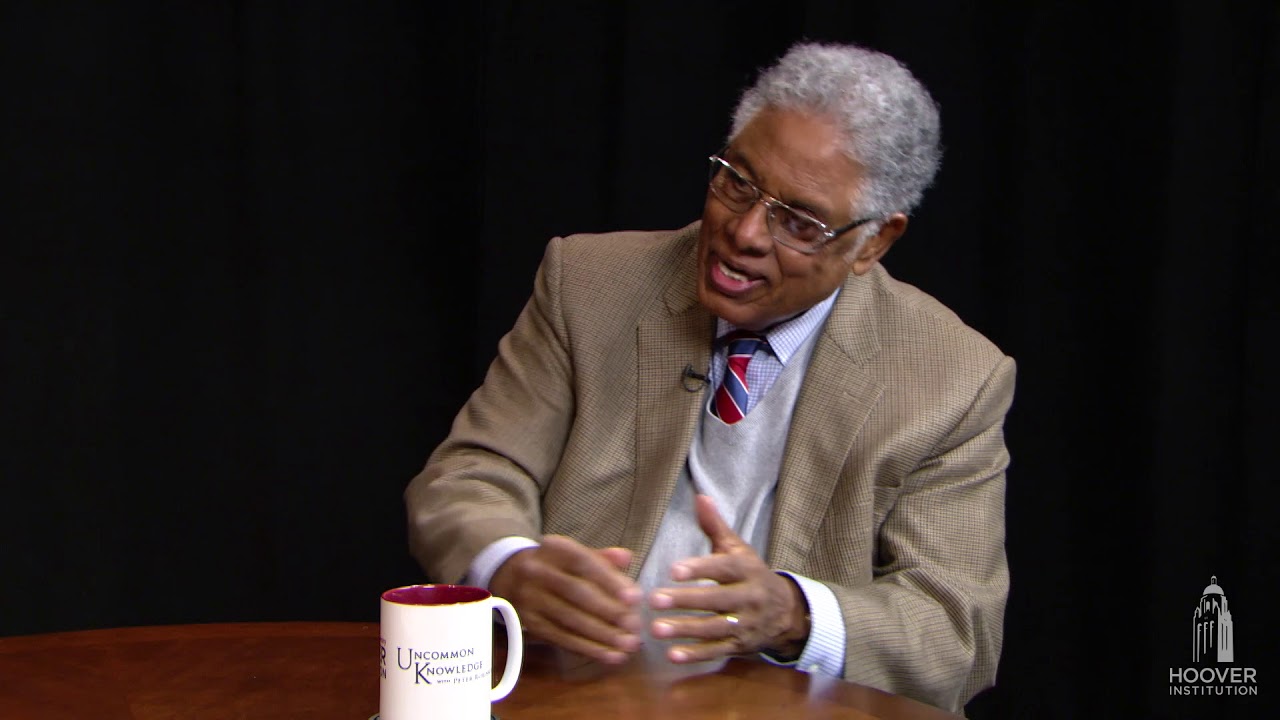
Thomas Sowell Blames Welfare State for Reversing Black Economic Gains
Hoover Institution
Economist Thomas Sowell argues that 1960s Great Society welfare programs decelerated pre-existing drops in black poverty while incentivizing the collapse of two-parent families.
Thomas Sowell explains that his departure from Marxism was driven not by university lectures, but by working at the U.S. Department of Labor, where he realized bureaucratic agencies actively suppress discordant data to protect their institutional budgets and staffing. (5:38)
Historical poverty data counters the standard narrative of Great Society programs: Black poverty dropped by 40 percentage points between 1940 and 1960 before declining only 18 percentage points in the two decades after civil rights and welfare legislation took effect. (16:45)
Preferential university admissions foster 'academic mismatch,' placing qualified students with 75th percentile scores into institutions teaching at a 99th percentile pace, which artificially drives high failure and probation rates. (24:16)
Charter schools like Success Academy demonstrate that low-income minority students can outperform the state's wealthiest traditional districts, yet they face heavy opposition from teachers unions and political establishments seeking to protect public monopolies. (43:25)
Detailed notes
## Background
Published on YouTube by the Hoover Institution on December 3, 2018 (recorded November 15, 2018), this episode of Uncommon Knowledge features host Peter Robinson interviewing senior fellow and economist Dr. Thomas Sowell. According to the page description, Sowell examines the economic and racial myths that distort discussions of poverty, recounting his personal trajectory from high school dropout and youthful Marxist to free-market economist while proposing fact-based alternatives to persistent social challenges.
## TL;DR
Thomas Sowell reflects on his intellectual evolution from an impoverished youth embracing Marxism in Harlem to abandoning central planning after witnessing bureaucratic self-interest firsthand at the U.S. Department of Labor. Framing societal debates around the 'constrained' versus 'unconstrained' visions, Sowell argues that empirical realities, geographic barriers, and human trade-offs explain disparities far better than institutional malice. He contends that post-1960s welfare programs stalled prior Black economic progress, fueled family breakdown, and bred social resentment, while policies like affirmative action create harmful academic mismatch. Concluding with critiques of public school monopolies and surging interest in socialism, Sowell champions rigorous empirical analysis, family stability, and educational alternatives like charter schools over ideological rhetoric.
## Atmosphere & style
The interview has the intimate, measured feel of an intellectual masterclass between longtime colleagues, defined by Peter Robinson’s reverent, prompt-driven questioning and Thomas Sowell’s unflappable, grandfatherly calm. Sowell delivers dry, sardonic wit and uncompromising critiques without raising his voice, shifting smoothly between nostalgic recollections of sleeping on Harlem fire escapes and rigorous dismantlings of economic dogmas. The atmosphere is distinctly cerebral yet accessible, marked by a pervasive, clear-eyed skepticism toward political utopias and an unwavering insistence on empirical evidence.
## Bulletin
- [05:38](https://www.youtube.com/watch?v=mS5WYp5xmvI&t=338s) Thomas Sowell explains that his departure from Marxism was driven not by university lectures, but by working at the U.S. Department of Labor, where he realized bureaucratic agencies actively suppress discordant data to protect their institutional budgets and staffing.
- [16:45](https://www.youtube.com/watch?v=mS5WYp5xmvI&t=1005s) Historical poverty data counters the standard narrative of Great Society programs: Black poverty dropped by 40 percentage points between 1940 and 1960 before declining only 18 percentage points in the two decades after civil rights and welfare legislation took effect.
- [24:16](https://www.youtube.com/watch?v=mS5WYp5xmvI&t=1456s) Preferential university admissions foster 'academic mismatch,' placing qualified students with 75th percentile scores into institutions teaching at a 99th percentile pace, which artificially drives high failure and probation rates.
- [43:25](https://www.youtube.com/watch?v=mS5WYp5xmvI&t=2605s) Charter schools like Success Academy demonstrate that low-income minority students can outperform the state's wealthiest traditional districts, yet they face heavy opposition from teachers unions and political establishments seeking to protect public monopolies.
## Key takeaways
- [01:39](https://www.youtube.com/watch?v=mS5WYp5xmvI&t=99s) Sowell was initially drawn to Marxism as a teenager because it was the only visible framework attempting to explain the stark contrast between affluent Manhattan neighborhoods and impoverished tenements in Harlem.
- [05:38](https://www.youtube.com/watch?v=mS5WYp5xmvI&t=338s) Direct experience at the Department of Labor revealed that government agencies prioritize institutional self-preservation over public welfare, leading Sowell to abandon Marxism.
- [09:31](https://www.youtube.com/watch?v=mS5WYp5xmvI&t=571s) The 'constrained vision' treats social evils as inescapable trade-offs driven by human limitations, whereas the 'unconstrained vision' assumes human nature is innately good and blames bad outcomes entirely on institutions.
- [11:34](https://www.youtube.com/watch?v=mS5WYp5xmvI&t=694s) Persistent poverty across isolated mountain communities globally shows that equal opportunity does not exist in nature, contrary to the foundational assumptions of modern progressive thought.
- [16:45](https://www.youtube.com/watch?v=mS5WYp5xmvI&t=1005s) Black economic advancement significantly preceded Great Society welfare programs, with the black poverty rate plummeting from 87% in 1940 to 47% by 1960.
- [21:10](https://www.youtube.com/watch?v=mS5WYp5xmvI&t=1270s) The expansion of the welfare state inadvertently incentivized family breakdown and single motherhood by financially penalizing two-parent households across Western nations.
- [23:21](https://www.youtube.com/watch?v=mS5WYp5xmvI&t=1401s) Egalitarianism in practice breeds resentment of other people's prosperity and success rather than genuine equity or social harmony.
- [24:16](https://www.youtube.com/watch?v=mS5WYp5xmvI&t=1456s) Affirmative action admissions policies systematically create academic mismatch, harming qualified minority students by pacing instruction beyond their immediate preparation.
- [27:01](https://www.youtube.com/watch?v=mS5WYp5xmvI&t=1621s) Sunset provisions for racial preferences, such as the 25-year estimate in Grutter v. Bollinger, fail universally worldwide because grandfathered interest groups expand and entrench the policies.
- [30:24](https://www.youtube.com/watch?v=mS5WYp5xmvI&t=1824s) Family structure and educational habits are decisive determinants of economic outcomes: the poverty rate among Black married couples has remained below 10 percent every year since 1994.
- [34:51](https://www.youtube.com/watch?v=mS5WYp5xmvI&t=2091s) Post-war inflation rendered the 1938 federal minimum wage negligible by 1948, allowing young, low-skilled workers to find entry-level jobs without statutory wage floors pricing them out of employment.
- [35:59](https://www.youtube.com/watch?v=mS5WYp5xmvI&t=2159s) Slavery was a global human blight spanning Africa, Asia, and the Middle East, making race-based ancestral reparations intellectually and historically unsound.
- [40:27](https://www.youtube.com/watch?v=mS5WYp5xmvI&t=2427s) Intellectuals frequently evade empirical reality with 'anti-fact shots,' maintaining ideological loyalty to welfare programs even as low minority unemployment followed deregulation and tax cuts.
- [43:25](https://www.youtube.com/watch?v=mS5WYp5xmvI&t=2605s) Charter schools in Harlem outperform the wealthiest suburban school districts on standardized math and reading tests despite spending less per pupil and enrolling disadvantaged students via random lottery.
- [46:42](https://www.youtube.com/watch?v=mS5WYp5xmvI&t=2802s) Teachers unions actively coordinate political campaigns to curb the expansion of successful charter schools to defend their public education monopoly from competition.
- [48:25](https://www.youtube.com/watch?v=mS5WYp5xmvI&t=2905s) Historical IRS data refutes the 'trickle-down' critique of Andrew Mellon's 1920s tax rate cuts: lowering top marginal rates raised the share of taxes paid by the wealthy while virtually eliminating income taxes on lower earners.
- [52:24](https://www.youtube.com/watch?v=mS5WYp5xmvI&t=3144s) Adherence to any social vision or political cause must never justify the evasion, suppression, or rationalization of discordant empirical evidence.
## Detailed walkthrough
### [00:00](https://www.youtube.com/watch?v=mS5WYp5xmvI&t=0s) Introduction and the Path from Harlem to Marxism
Peter Robinson opens the program with an anecdote about a young man who approached him to say that watching Dr. Thomas Sowell on a previous episode gave him the impression of “seeing a man who knew how to think.” Robinson highlights Sowell’s long, distinguished academic career teaching economics, intellectual history, and social policy at institutions such as Cornell, Brandeis, UCLA, and Amherst, before serving as a senior fellow at the Hoover Institution. With dozens of published books to his name—including *A Conflict of Visions* and an upcoming revised edition of *Discrimination and Disparities*—Sowell’s path to intellectual prominence was far from conventional.
After growing up in Harlem, Sowell dropped out of high school at age 16 and worked full-time before serving in the Marine Corps during the Korean War. He also famously tried out for the Brooklyn Dodgers. He subsequently earned an undergraduate degree from Harvard, a master’s from Columbia, and a doctorate from the University of Chicago. Yet, despite moving through some of the most rigorous institutions in the world, Sowell spent the majority of his twenties as a committed Marxist. When Robinson asks what could have drawn him to Marxism in the first place, Sowell explains that it began out of sheer bewilderment with the world around him.
- Sowell served in the Marine Corps for “one year, 11 months, and five days, but who's counting.”
- He began reading Karl Marx around the age of 19 after purchasing a cheap, secondhand set of encyclopedias.
---
[01:39](https://www.youtube.com/watch?v=mS5WYp5xmvI&t=99s) Riding the Fifth Avenue Bus: Finding Marx in the Disparities of New York
Sowell clarifies that after dropping out of school at 16, his first full-time job was delivering telegrams across New York City as a Western Union messenger. He worked in the Chelsea district of Manhattan, around 23rd Street and Ninth Avenue. At the end of a shift, he had three options to travel back home: the subway, which cost a nickel; an ordinary city bus, which cost a dime; or, whenever he felt reckless and flush with cash, the elite Fifth Avenue double-decker bus, which cost fifteen cents. Choosing that bus gave the young Sowell an unvarnished tour through the dramatic contrasts of Manhattan’s economic geography.
The Fifth Avenue route wound past the Empire State Building and high-end department stores, turned across 57th Street past Carnegie Hall and Columbus Circle—long before Trump Tower stood there—and continued up to 72nd Street onto Riverside Drive. For miles, Sowell gazed out at grand luxury apartment buildings. But after crossing a viaduct around 129th and 130th Streets, the bus would turn sharply back into the neighborhood, revealing crowded, rundown tenements. He found himself asking why such massive disparities existed. Looking up Karl Marx in his secondhand encyclopedia, Sowell found the only framework being offered at the time that appeared to provide an answer. As Sowell reflects, “And the argument was that the rich had gotten rich by taking from the poor.” It was a message that seemed to make intuitive sense of the physical divide between Fifth Avenue and Harlem, and Sowell points out that even today, higher education rarely provides alternative explanations.
---
[05:38](https://www.youtube.com/watch?v=mS5WYp5xmvI&t=338s) The Labor Department and the Realities of Bureaucracy
Neither his undergraduate studies in economics at Harvard, nor his graduate work at Columbia, nor studying directly under Milton Friedman at the University of Chicago dislodged Sowell from his Marxist views. When Robinson jokes about how anyone could sit through Friedman's classes and remain a Marxist, Sowell replies, “Some people are just stubborn.” What ultimately changed his mind was not academic theory, but practical exposure to how government operates while working as a summer intern at the U.S. Department of Labor during graduate school.
Sowell was assigned to evaluate the economic impact of the minimum wage in Puerto Rico, particularly in the sugarcane industry. He noticed that every time the legal minimum wage was increased, employment dropped. However, there were two competing explanations: the standard economic argument that higher mandated wages priced low-skill workers out of employment, and the department's argument that seasonal hurricanes destroyed crops and reduced labor demand. Applying the empirical methodology he learned at Chicago, Sowell realized that comparing sugarcane standing in the fields immediately before a hurricane made landfall would isolate whether the weather or wage mandates drove job losses. When he proposed collecting this data, the response was shock and panic rather than enthusiasm:
> “The government is an institution, the government institutions have their own institutional interests.”
Sowell realized that the Department of Labor derived roughly a third of its funding and staff positions directly from administering the minimum wage law. Objective evidence showing that the law destroyed jobs would undermine the agency's institutional power. His formal request for crop data from the Department of Agriculture went up the bureaucratic chain and was quietly buried. This experience shattered his belief in the state as an altruistic agent:
- Section 4(d) of the Fair Labor Standards Act required the Department of Labor to evaluate the employment consequences of minimum wage mandates, which Sowell found to be executed as an administrative farce.
- Years later, after publishing an academic exposé detailing how these agency reports were manipulated, Sowell returned to the Labor Department library, where an older staff member introduced him to a colleague as “the man who wrote that article that has everybody up in arms.”
- This bureaucratic self-interest convinced Sowell that public officials do not represent the general will of the public, pushing him away from both Marxism and faith in centralized governance.
---
[09:31](https://www.youtube.com/watch?v=mS5WYp5xmvI&t=571s) A Conflict of Visions: Constrained vs. Unconstrained Perspectives
Robinson shifts the discussion to Sowell’s seminal book *A Conflict of Visions* (first published in 1987 and reprinted in 2007), which outlines two enduring, incompatible frameworks that have shaped political and social thought for centuries: the constrained vision and the unconstrained vision. Robinson reads Sowell's definition of the constrained vision, which conceives the evils of the world not as intentional malice, but as the inevitable result of trade-offs arising from the inherent moral and intellectual limitations of human beings.
Sowell elaborates on this perspective, contrasting it with utopian thinking: “In other words, they cannot proceed as so many do that good things happen automatically, but bad things are somebody's fault.” Robinson notes that within the constrained vision, social progress and the amelioration of human suffering rely primarily on evolved systemic processes—such as moral traditions, the family unit, and competitive free markets—rather than top-down decrees by political leaders. When Robinson asks why the constrained vision distrusts state-directed solutions to human problems, Sowell points out that while the constrained framework recognizes the essential role of law and order—reminding Robinson that European commerce collapsed entirely when the Roman Empire fell—it rejects the assumption that centralized power can improve society simply through good intentions.
[11:34](https://www.youtube.com/watch?v=mS5WYp5xmvI&t=694s) Surrogate Decision-Makers and the Unconstrained Vision
The conversation opens with Thomas Sowell addressing how government intervention removes decision-making from ordinary people: “With the government you have surrogate decision makers and they cannot possibly know as much as the individuals whose personal decisions have been preempted.” Peter Robinson links this dynamic directly to Sowell's concept of the "unconstrained vision." Quoting Sowell, Robinson reminds him: “When Rousseau said that man is born free but everywhere in chains, he expressed the essence of the unconstrained vision, in which the fundamental problem is not nature or man but institutions.”
Sowell elaborates on Jean-Jacques Rousseau’s premise: the unconstrained vision assumes that good things occur naturally, and whenever bad things exist, institutions—or civilization itself—must have caused them. Sowell identifies this belief as the implicit assumption underpinning modern leftist thought. To counter it, Sowell emphasizes that in his recent work, he went to extensive lengths to demonstrate that equal opportunity simply does not exist anywhere in nature. Regardless of whether one looks across the United States or around the globe, people dwelling in isolated mountain regions remain poor and backward, even within the wealthiest nations on earth.
Robinson notes that in the United States, such regions are found in Appalachia, West Virginia, and southern Ohio. Sowell confirms this, observing that the poorest county in America was a mountain community that was almost 100 percent white, where men had a life expectancy ten years shorter than men living in an adjacent or nearby county in Virginia. Robinson summarizes the divergence between the two frameworks: the unconstrained vision insists on passing a law to fix the disparity, whereas the constrained vision acknowledges that when isolated mountain communities worldwide consistently exhibit the same poverty and backwardness, it stems from deep-seated realities that are exceptionally difficult to engineer away.
[13:43](https://www.youtube.com/watch?v=mS5WYp5xmvI&t=823s) Competing Visions, Evidence, and Abandoning Marxism
Robinson turns to Sowell's book *A Conflict of Visions*, remarking that Sowell presented both the constrained and unconstrained visions in an objective, dispassionate manner without overtly declaring one superior to the other. Sowell explains his pedagogical intent: “That is not a book meant to show one vision is better than the other; it's there to show you what they are and what you're assuming if you go one direction or another.” Without understanding these core assumptions, Sowell notes, one is left with intellectual loose ends.
Robinson then reads an excerpt from a column where Sowell responded to *The New York Times* columnist Nicholas Kristof. Kristof had attributed racial disparities in wealth and education to the lingering effects of slavery, to which Sowell had countered: “If we wanted to be serious about evidence, we might compare where blacks stood a hundred years after the end of slavery with where they stood after 30 years of the liberal welfare state. In other words, we could compare hard evidence on the legacy of slavery with hard evidence on the legacy of liberals.” Robinson calls Sowell a man of the constrained vision through and through, which Sowell accepts, dryly calling himself “part of a vanishing breed.”
When Robinson asks how that squares with Sowell's past flirtation with Marxism, Sowell clarifies that his underlying intellectual standards never actually shifted: “Even when I was a Marxist, I had the same intellectual standards and that's what eventually led me away from it.” He simply had not yet gathered the empirical evidence or traveled the world to study reality. Sowell expresses bewilderment at the enthusiasm among young Americans for Bernie Sanders and socialism at the very moment Venezuela—an oil-rich nation—descends into starvation, grocery store looting, and mass refugee flights to poorer neighboring countries: “I don't think most of these people who are out there cheering for Bernie Sanders have given a thought to Venezuela.”
```mermaid
flowchart TD
accTitle: The Divergence of Visions on Inequality
accDescr: A diagram contrasting how the unconstrained and constrained visions interpret and address persistent inequalities.
subgraph Unconstrained ["Unconstrained Vision (Rousseau / Left)"]
U1["Man is naturally free and good"] --> U2["Institutions create inequality and poverty"]
U2 --> U3["Solution: Pass laws and enact federal programs"]
end
subgraph Constrained ["Constrained Vision (Sowell / Empirical)"]
C1["Nature never offers equal opportunity"] --> C2["Poverty recurs globally due to geographic and cultural limits"]
C2 --> C3["Action: Examine empirical evidence and account for trade-offs"]
end
```
[16:45](https://www.youtube.com/watch?v=mS5WYp5xmvI&t=1005s) The "Retrogression" of Black Economic Progress
Robinson introduces Sowell's concept of "the retrogression" regarding the economic history of African Americans. He quotes Sowell directly on the historical record: “Despite the grand myth that black economic progress began or accelerated with the passage of the Civil Rights laws and the 'War on Poverty' programs of the 1960's, the fact is that the poverty rate among blacks fell from 87% in 1940 to 47% in 1960, but over the next 20 years the poverty rate among blacks fell another 18 percentage points. This was just the continuation of a previous economic trend, but at a slower rate of progress. It was not some grand deliverance.”
Robinson asks if Sowell truly stands by a claim so diametrically opposed to standard school curricula and mainstream media narratives. Sowell affirms that data compiled in *Discrimination and Disparities* proves this phenomenon was neither unique to Black Americans nor limited to the United States. In early 20th-century Britain, for instance, the poor were much worse off economically, yet society was remarkably orderly, polite, and law-abiding. Once the welfare state expanded under the premise of improving people's lives and morals, violent crime rates surged on both sides of the Atlantic. Sowell cites the 2011 England riots in London and Manchester—marked by arson, property destruction, and gasoline bombs thrown at police—noting that these urban riots mirrored those in Ferguson and Baltimore years later, despite none of the British rioters being descendants of American chattel slavery.
- Black poverty fell 40 percentage points between 1940 and 1960 (from 87% to 47%) without modern Great Society welfare policies.
- Between 1960 and 1980, under the Great Society programs, the poverty rate fell only another 18 percentage points, representing a deceleration of the previous trend.
- Skyrocketing crime rates followed the expansion of the welfare state in both the United States and the United Kingdom.
[19:12](https://www.youtube.com/watch?v=mS5WYp5xmvI&t=1152s) Community Safety in Harlem and Philadelphia
Sowell shares personal reminiscences to illustrate how dramatically social stability and street safety deteriorated after the rise of the welfare state. While conducting research at a school in Harlem, Sowell casually told students that as a young boy, he used to walk his dog across the local park. To his surprise, looks of sheer terror washed over their faces. The school principal routinely instructed pupils never to set foot in that park—measuring barely a block and a half wide—even when traveling in groups of six.
Furthermore, Sowell mentioned that during sweltering summer nights without air conditioning, he would sleep outside on Harlem fire escapes, a revelation that made the modern students look at him “like I was a man from Mars.” Sowell recalls that sleeping on fire escapes or in public parks on hot nights was once routine across New York, Philadelphia, and Washington, D.C. He cites his friend and fellow economist Walter Williams, who grew up in a Philadelphia public housing project:
- Residents on upper floors slept out on their balconies during summer heatwaves.
- Ground-floor occupants who lacked balconies simply dragged bedding out into the grass yard to sleep.
- Elderly men gathered outside on summer evenings to play cards and checkers uninterrupted into the early morning hours.
Robinson remarks that it was an inherently safe world, to which Sowell replies that it was “infinitely safer.”
[21:10](https://www.youtube.com/watch?v=mS5WYp5xmvI&t=1270s) The Collapse of the Family Structure
Robinson transitions to the collapse of the nuclear family. Quoting Sowell, Robinson highlights: “Most black children were being raised in two-parent families in 1960. 30 years after the liberal welfare state, the great majority of black children were being raised by single parents.” Robinson references the 1965 Moynihan Report, written by Daniel Patrick Moynihan, which sounded a nationwide alarm when the out-of-wedlock birth rate among Black families reached 25 percent. In the modern era, out-of-wedlock births stand above one-third for whites, exceed 50 percent for Hispanics, and top 70 percent among African Americans.
Sowell responds that family breakdown is an across-the-board consequence of welfare policy found across Britain, France, Norway, and the Western world, where roughly 40 percent of children are now raised by single parents. He contrasts extreme cases: in Iceland, two out of three children are raised in single-parent homes, whereas in South Korea, the rate is merely one out of 66. Sowell pins the blame directly on welfare incentives: “When you pay people not to get married, more people don't get married.” Welfare systems explicitly conditioned state financial aid on the father's absence from the household: if the father stayed, aid was denied; if he vanished, checks arrived. Robinson concludes this section by setting up a counterfactual question: what would the country look like today had Lyndon B. Johnson governed not as an architect of the Great Society, but as the skeptical Texas conservative he was early in his political career?
[23:21](https://www.youtube.com/watch?v=mS5WYp5xmvI&t=1401s) The Welfare State Vision and Egalitarian Resentment
Thomas Sowell argues that society would be vastly better off without the social fallout of the welfare state, noting that lower crime rates and stronger social cohesion previously existed. A welfare state cannot be instituted in a democratic society unless voters first embrace the ideological vision that underpins it, and accepting that vision brings catastrophic second-order consequences. To illustrate how this philosophy manifests in daily life, Sowell recounts an episode from a suburb of Paris, France, where North African assailants carried out knife attacks against Chinese residents. When the attackers were questioned about their motives, they did not claim the Chinese victims had harmed them; instead, an attacker simply stated that the victims had nice clothes and big cars, and that "that's not fair." Sowell points out that while egalitarianism sounds appealing as an abstract philosophy, its real-world psychological consequence is breeding deep resentment toward other people’s good fortune.
“I mean that's you know, egalitarianism as a philosophy is one thing but the actual consequences of it mean things like resenting other people's good fortune.” — Thomas Sowell
[24:16](https://www.youtube.com/watch?v=mS5WYp5xmvI&t=1456s) Affirmative Action and Academic Mismatch
Peter Robinson turns the discussion to racial disparities and the standard institutional remedy: affirmative action. He references Sowell’s alma mater, Harvard University, prompting Sowell to joke that he will never live it down, while Robinson recalls Sowell once telling him that the principal benefit of a Harvard degree is never having to be impressed by anyone else who holds one. Robinson cites admissions data published in *The Harvard Crimson* for the Class of 2019, showing average SAT scores of 2149 for Black students, 2218 for white students, and 2300 for Asian students. Sowell contends that while many government policies benefit one demographic group at the expense of another, affirmative action has the perverse distinction of harming everyone involved, albeit in different ways.
```mermaid
flowchart TD
accTitle: Academic Mismatch Flow
accDescr: Diagram showing how affirmative action policies lead to academic mismatch and higher failure rates.
subgraph Admission ["Admissions Policy"]
A["Preferential Admissions Standards"]
end
subgraph Selection ["Student Placement"]
B["Student Qualified for Top 80-90% of Colleges<br/>(e.g., 75th Percentile SAT)"]
C["Placed in Elite Tier Institution<br/>(e.g., 99th Percentile SAT Pace)"]
end
subgraph Outcome ["Institutional Result"]
D["Instruction Geared toward Top 1%"]
E["Academic Probation & Artificial Failure"]
end
A --> B
B --> C
C --> D
D --> E
```
Sowell explains the mechanism of "academic mismatch," in which Black students who possess all the qualifications needed to succeed at 80 or 90 percent of American colleges are placed into elite institutions whose standards they do not meet. He recounts his time teaching economics at Cornell University, where he discovered that half of the Black students were on academic probation. Checking their records in the administration building, he found their average SAT scores sat at the 75th percentile—a respectable score that would place them on the dean's list at most colleges nationwide. However, the average liberal arts student at Cornell scored in the 99th percentile. Teaching at a pace designed for the top one percent of students made it impossible for those at the 75th percentile to keep pace, leading Robinson to observe that Cornell was effectively taking talented Black students and spending four years teaching them to feel inadequate.
“And so there's a lot of evidence that there are black kids who have all the qualifications to be successors in college, who nevertheless are failures because they are systematically mismatched with institutions whose standards they don't meet.” — Thomas Sowell
[27:01](https://www.youtube.com/watch?v=mS5WYp5xmvI&t=1621s) The Illusion of Temporary Preferences: *Grutter v. Bollinger*
Robinson contrasts two passages from the landmark 2003 Supreme Court affirmative action case *Grutter v. Bollinger*. In the 5–4 majority opinion, Justice Sandra Day O'Connor wrote that the Court expected racial preferences would no longer be necessary 25 years in the future. In his dissent, Justice Clarence Thomas argued that Black Americans can achieve in every sphere without administrative meddling, noting that while racial discrimination in admissions would be illegal in 25 years, it was already illegal at that moment. Robinson asks whether O'Connor’s sunset provision represented a pragmatic, constrained vision that acknowledged university practices while establishing a ticking clock.
Sowell wholly rejects O'Connor’s logic, noting that his research for his book *Affirmative Action Around the World* revealed this exact sunset argument to be universally employed and universally fallacious. Setting arbitrary future expiration dates assumes a level of bureaucratic control that human societies have never possessed. In Great Britain, Lord Scarman proposed temporary preferences, while Malaysia instituted a cutoff date around 1990 and Pakistan created a 10-year limit. In every case, preferences expanded rather than expired. When East Pakistan faced severe disparities compared to West Pakistan, preferential quotas were established; yet after East Pakistan seceded to become Bangladesh, the quotas in Pakistan continued because additional interest groups had been grandfathered into the system.
“The argument like so much in the unconstrained vision, it assumes that we have a power that we do not have, cannot have, and never have had.” — Thomas Sowell
- In *Grutter v. Bollinger* (2003), Justice Sandra Day O'Connor suggested racial preferences should sunset in 25 years (by 2028).
- Justice Clarence Thomas counter-argued: “While I agree that in 25 years these practices will be illegal, they are illegal now.”
- Sunset dates failed to end preferential regimes internationally in Malaysia, Pakistan, and the United Kingdom.
[30:24](https://www.youtube.com/watch?v=mS5WYp5xmvI&t=1824s) Lifestyle Choices, Charter Schools, and Historical Employment
Turning to Sowell’s forthcoming edition of *Discrimination and Disparities*, Robinson reads data demonstrating the decisive role of habits and family structure over government interventions:
- The poverty rate among Black married couples has remained below 10 percent every single year since 1994.
- As early as 1969, young Black men raised in homes containing books, magazines, and library cards earned incomes comparable to their white peers.
- Academic performance tracks directly with the amount of time devoted to schoolwork.
Sowell clarifies that while the poverty rate was 22 percent among Black Americans overall and 11 percent among white Americans, it fell to just 7.5 percent among Black married couples—outperforming the white national average. He points out that successful charter schools in Harlem and the South Bronx achieve academic excellence that meets or exceeds national standards without skimming top students. These schools use random lotteries, ignore past academic records, enforce strict behavioral standards, and emphasize rigorous hard work.
“The poverty rate among black married couples has been less than 10% every year since 1994.” — Thomas Sowell (quoted by Peter Robinson from *Discrimination and Disparities*)
Robinson reflects on Daniel Patrick Moynihan's 1965 report, which raised early alarms over a 25 percent out-of-wedlock birth rate among African Americans—a figure influenced by Moynihan’s own childhood trauma after his father abandoned the family. Robinson worries that the world of Sowell's youth, where an impoverished teenager could drop out of school, secure a job, and purchase encyclopedias rather than turn to public assistance, has vanished entirely. Sowell acknowledges that reclaiming this ground will be immensely difficult, but insists it is possible. Reflecting on his own youth, Sowell recalls leaving home in 1948, completely unaware that the unemployment rate for 16- and 17-year-old Black teenagers was only 9.4 percent, compared to 10.2 percent for their white peers. In that era, the jobs were actually there, and society expected young people to work.
“That that's gonna be reconquering the same ground, which is very tough to do but it can be done.” — Thomas Sowell
[34:51](https://www.youtube.com/watch?v=mS5WYp5xmvI&t=2091s) The Minimum Wage Fluke and Youth Unemployment
Thomas Sowell explains that his early entry into the workforce was facilitated by a historical anomaly involving the minimum wage. When the Fair Labor Standards Act was passed in 1938, it mandated a minimum wage of 40 cents an hour. However, rapid inflation during the 1940s quickly rendered that nominal figure obsolete by 1948. Consequently, when Sowell took his first job as a Western Union messenger, the market rate paid him 65 cents an hour at the bottom rung. Because the statutory minimum sat well below prevailing wages, the economy functioned as if no minimum wage existed at all, allowing inexperienced teenagers like himself to easily secure entry-level employment.
```mermaid
flowchart TD
accTitle: Impact of Minimum Wage Policy Over Time
accDescr: Diagram contrasting how 1940s inflation made minimum wage irrelevant versus how later increases led to teenage unemployment.
subgraph Late1940s["Late 1940s (Thomas Sowell's Era)"]
A["FLSA (1938) sets 40¢/hr min wage"] --> B["Rapid 1940s inflation"]
B --> C["Market entry wage: 65¢/hr"]
C --> D["Statutory rate rendered meaningless"]
D --> E["Youth employment remains accessible"]
end
subgraph LaterDecades["20 Years Later (Compassion Policies)"]
F["Statutory minimum wage raised"] --> G["Entry-level costs exceed low-skilled labor value"]
G --> H["Young black jobseekers priced out"]
H --> I["Teenage males left idle on street corners"]
end
```
Contrasting his youth with subsequent eras, Sowell observes that when policymakers later raised the wage floor out of ostensible compassion, it priced unskilled young black workers out of the market. He underscores the devastating social cost of cutting off entry-level work opportunities for urban youths:
> “And I don't think it does any community any good to have a whole lot of teenage males hanging around on the streets with no job and nothing to do.”
[35:59](https://www.youtube.com/watch?v=mS5WYp5xmvI&t=2159s) Jim Crow, Reparations, and the Global History of Slavery
Peter Robinson turns the conversation toward Sowell's firsthand experience with segregation. Sowell recalls that although he grew up in Harlem, he was born in the South and revisited it as a young man courtesy of the Marine Corps, undergoing boot camp at Parris Island in South Carolina and serving at Camp Lejeune in North Carolina. Robinson notes that Sowell is part of the generation that witnessed Jim Crow firsthand. He reads a passage from Ta-Nehisi Coates's widely read *Atlantic* essay, "The Case for Reparations," in which Coates argues that white supremacy is fundamentally woven into America and that reparations are an essential price for the nation to see itself squarely.
Sowell dismisses Coates’s argument for lacking empirical grounding, responding: “It would be nice to know his evidence of what he said, just to be old-fashioned about it.” While acknowledging that Jim Crow was a "rotten system," Sowell disputes the rationale for reparations. He points out that forced servitude was a universal human blight rather than an American or racial anomaly:
- Slavery was practiced across Africa, the Middle East, and Asia, lasting in non-Western societies long after its abolition in the West.
- Sowell suspects that if reparations were paid to everyone with enslaved ancestors, “you would have to give reparations to more than a half the entire population of the globe.”
- He adds that globally, the vast majority of historical slaves and slaveholders were neither white nor black.
Turning to the psychological concept of white guilt and demands for racial atonement, Sowell rejects the transfer of guilt across generations. Citing the late Supreme Court Justice Antonin Scalia, Sowell asserts that an individual living today cannot owe debts or assume guilt for actions committed by someone else in the past simply because they share the same physical appearance. Robinson summarizes Sowell’s practical path forward as finishing school, getting married, and working, to which Sowell readily agrees. Robinson then quotes Charles Murray’s 1984 book *Losing Ground*, which observed that public policy debates treated racial gaps as solely white-created problems that whites had to fix, while failing to treat black Americans as responsible agents; Sowell confirms that this dynamic has not changed.
[40:27](https://www.youtube.com/watch?v=mS5WYp5xmvI&t=2427s) Assessing Trump's Economy and the Intellectuals' "Anti-Fact Shots"
Robinson transitions to contemporary politics by quoting Sowell's longtime friend Walter Williams, who argued that while President Donald Trump lacked an exemplary personal character and had misguided trade policies, he had proven to be a good president. Sowell agrees with Williams’s assessment, stressing that policy outcomes matter far more than executive style or rhetoric:
> “I think his policies have by and large have been policies that were far better than that of previous Democratic or Republican administrations. I go by the consequences.”
Sowell points to concrete economic results: unemployment among low-income African-American and Hispanic workers dropped to multi-decade lows, and the overall economy expanded to record highs—defying dire predictions from intellectuals like Paul Krugman, who had warned that the economy would crash under Trump. Sowell laments that prominent thinkers remain wholly indifferent to real-world outcomes:
> “It's as if they took their anti fact shots every year and the facts will just not affect them.”
Robinson notes that critics often loathe Trump so intensely on television that they ignore the economic boom. Sowell responds that Trump is the second consecutive president whose television appearances prompt him to switch off the screen immediately—the first having been Barack Obama. When Robinson asks why progressive elites persist in defending Great Society programs after six decades of evidence showing entrenched gaps, family dissolution, and rising crime, Sowell explains: “I think people become attached to a vision and that really warps the way they see... human beings have an enormous capacity to rationalize.”
[43:25](https://www.youtube.com/watch?v=mS5WYp5xmvI&t=2605s) The Battle Over Charter Schools and Success Academy
Robinson introduces a recent *New York Times* report describing how the charter school movement—serving over 100,000 students in New York City with tens of thousands more on waitlists—faces severe political pushback from newly elected Democratic lawmakers in the state Senate. Sowell characterizes the political crusade against high-performing charter schools as a profound tragedy:
> “That really is one of the moral outrages that for many kids who were cut from a very poor background and who parents may not have had much education, a decent education is the one thing they have to have to have a better life.”
Sowell highlights the extraordinary academic results achieved by charter networks like Success Academy in low-income neighborhoods:
- In one Harlem charter elementary school, fourth graders passed the statewide math exam at a higher rate than any fourth-grade class in the entire state of New York, outperforming affluent suburbs like Scarsdale and Briarcliff.
- Across the Success Academy network as a whole, predominantly black and Hispanic students pass both statewide math and English exams at higher rates than any traditional school district in New York State.
- The five highest-scoring traditional school districts in New York State have median family incomes ranging from four times to more than nine times higher than the families of students attending Success Academy.
Despite these achievements, Sowell points out that Mayor Bill de Blasio and other politicians across the country actively attempt to halt charter expansions, reserving particular hostility for Success Academy. When Robinson asks what drives this political resistance, Sowell explains that powerful teachers unions are the primary engine of the opposition, using substantial financial contributions to protect public school monopolies.
[46:42](https://www.youtube.com/watch?v=mS5WYp5xmvI&t=2802s) Obstacles to Charter Schools and Political Paralysis
Thomas Sowell explains that political opposition to charter schools is driven by institutional self-interest and electoral calculations, not just in New York, but across the country, including California. Charter schools face systematic administrative hurdles and political maneuvering designed to suppress their growth, resulting in tens of thousands of disadvantaged children stranded on waiting lists. Sowell emphasizes that charter schools are more than willing to expand, but they face deliberate impediments because public schools would struggle to compete on equal terms if educational choices were permitted to operate naturally. To blunt this competition, officials attempt to saddle charter schools with the identical bureaucratic burdens that undermined public education in the first place, such as barring administrators from disciplining or expelling students whose disruptive behavior ruins the classroom environment for everyone else.
Peter Robinson observes that while restoring the historical neighborhood standards of Sowell’s youth in Harlem might seem impossible, modern charter schools prove that delivering high-quality education to children in present-day Harlem is completely achievable right now. Sowell agrees, arguing that nostalgia is unnecessary: “Yeah, you don't have to bring back the past, even if you could, because we have it in the present.” Despite this demonstrable success, Robinson laments the political dynamic surrounding the issue: the Democratic establishment actively works to shut charter schools down, while the Republican establishment remains entirely mute.
---
[48:25](https://www.youtube.com/watch?v=mS5WYp5xmvI&t=2905s) The Rise of Socialism and the Reality of Tax Policy
Robinson turns to the growing appeal of left-wing politics among younger Americans, pointing to a summer Gallup poll revealing that among adults aged 18 to 29, only 45% held a favorable view of capitalism, compared to 51% who viewed socialism favorably. Robinson then plays a video clip of newly elected 29-year-old Democratic Socialist Representative Alexandria Ocasio-Cortez speaking to activists staging a sit-in inside the office of incoming House Speaker Nancy Pelosi, in which she declares: “I just want to let you all know how proud I am of each and every single one of you for putting yourselves and your bodies and everything on the line to make sure that you save our planet, our generation, and our future.” Asked what advice he would give to young Americans drawn to Bernie Sanders and Ocasio-Cortez, Sowell answers plainly: “I would say get some facts first, know what you're talking about before you start spouting out this kind of stuff.”
Sowell illustrates the pervasive gap between political rhetoric and historical facts by examining how standard school textbooks portray the 1920s tax cuts overseen by Secretary of the Treasury Andrew Mellon. While academic texts routinely attack Mellon’s policies as an unfair "trickle-down" giveaway to the wealthy, Sowell encourages students to read Mellon’s original words and consult official Internal Revenue data, which prove the exact opposite outcome occurred:
| Metric | Before Mellon Tax Cuts (Top Rate at 73%) | After Mellon Tax Cuts (Top Rate at 24%) |
|:--- |:--- |:--- |
| **Share of Income Taxes Paid by High Earners (>$100k/yr)** | ~30% of total tax revenue | ~65% of total tax revenue |
| **Share of Income Taxes Paid by Incomes Under $5,000/yr** | ~15% of total tax revenue | Under 0.25% of total tax revenue |
| **Taxes Paid by Millionaires** | ~4% of total tax revenue | ~19% of total tax revenue |
Despite hard revenue records showing that lower earners paid virtually no federal income tax after the rate cuts while upper earners footed the vast majority of the bill, scholarly literature continues to repeat narratives of elite enrichment. As Sowell observes, “They say these words, they say trickle down, and it's like saying abracadabra and all the miraculous things follow from that.”
---
[52:24](https://www.youtube.com/watch?v=mS5WYp5xmvI&t=3144s) A Final Word from 'A Conflict of Visions'
To conclude the interview, Robinson references Sowell’s forthcoming edition of *Discrimination and Disparities* and asks him to read a closing passage from his seminal 1987 work, *A Conflict of Visions*. The passage summarizes Sowell's lifelong critique of ideologues who place political doctrine above observable reality:
> “Logic of course is not the only test of a theory. Empirical evidence is crucial and yet social visions have shown a remarkable ability to evade, suppress, or explain away discordant evidence. Historic evasions of evidence are a warning, not a model. Dedication to a cause may legitimately entail sacrifices of personal interests but not sacrifices of mind or conscience.”
Robinson thanks Sowell for his insights, closing out the broadcast for *Uncommon Knowledge*, the Hoover Institution, and Fox Nation.
## Notable quotes
> [52:24](https://www.youtube.com/watch?v=mS5WYp5xmvI&t=3144s) Dedication to a cause may legitimately entail sacrifices of personal interests but not sacrifices of mind or conscience. — Thomas Sowell
> [21:10](https://www.youtube.com/watch?v=mS5WYp5xmvI&t=1270s) When you pay people not to get married, more people don't get married. — Thomas Sowell
> [11:34](https://www.youtube.com/watch?v=mS5WYp5xmvI&t=694s) With the government you have surrogate decision makers and they cannot possibly know as much as the individuals whose personal decisions have been preempted. — Thomas Sowell
> [05:38](https://www.youtube.com/watch?v=mS5WYp5xmvI&t=338s) The government is an institution, the government institutions have their own institutional interests. — Thomas Sowell
> [23:21](https://www.youtube.com/watch?v=mS5WYp5xmvI&t=1401s) egalitarianism as a philosophy is one thing but the actual consequences of it mean things like resenting other people's good fortune. — Thomas Sowell
## Mentioned
Thomas Sowell, Peter Robinson, Hoover Institution, Cornell University, Brandeis University, UCLA, Amherst College, United States Marine Corps, Brooklyn Dodgers, Harvard University, Columbia University, University of Chicago, Karl Marx, Western Union, Milton Friedman, United States Department of Labor, Fair Labor Standards Act, United States Department of Agriculture, Jean-Jacques Rousseau, Nicholas Kristof, Bernie Sanders, Walter Williams, Daniel Patrick Moynihan, Moynihan Report, Lyndon B. Johnson, Supreme Court of the United States, Sandra Day O'Connor, Clarence Thomas, Grutter v. Bollinger, Lord Scarman, Ta-Nehisi Coates, Antonin Scalia, Charles Murray, Donald Trump, Paul Krugman, Barack Obama, Success Academy, Bill de Blasio, Alexandria Ocasio-Cortez, Nancy Pelosi, Andrew Mellon, A Conflict of Visions, Discrimination and Disparities, Affirmative Action Around the World, Losing Ground
## Video description
Recorded on November 15, 2018
Thomas Sowell discusses economic inequality, racial inequality, and the myths that have continued to falsely describe the system of poverty among different racial and economic classes. He explains the economic theories behind these pervasive myths and proposes fact-based solutions for seemingly intractable situations.
Sowell discusses his early life as a high school dropout and his first full-time job as a Western Union messenger delivering telegrams. He admits to flirting with Marxism in his early twenties as he first tried to grapple with the housing inequality he saw across the neighborhoods of New York City. Marxism, he says, was the only explanation he could find at the time. He went on to serve in the Marine Corps before continuing his education in economics at Harvard and earning a master’s at Columbia and a PhD at the University of Chicago.
Sowell’s first job after his receiving his PhD in economics was working for the Department of Labor, and he says it was there that he realized Marxism was not the answer. He argues that the government has its own institutional interests in inequality that cannot be explained through Marxism. He began to be discouraged by Marxism and the government in general and began searching for better economic ideas and solutions (the free market).
Robinson and Sowell discuss Sowell’s written works, his ideas of racial and economic inequality, the state of the United States today, and much more.
Interested in exclusive Uncommon Knowledge content? Check out Uncommon Knowledge on social media!
Thomas Sowell argues that economic disparities and social outcomes are shaped by inherent trade-offs, cultural habits, and incentives rather than institutional malice alone, contending that empirical data routinely contradicts prevailing ideological assumptions.
Human Nature and Bureaucratic Self-Interest (5:38)
Sowell contrasts the 'unconstrained vision'—which views human nature as inherently good and blames institutions for poverty and inequality—with the 'constrained vision,' which treats trade-offs and human limitations as permanent realities. His departure from youthful Marxism occurred not in academia, but while working at the U.S. Department of Labor analyzing the minimum wage in Puerto Rico's sugarcane industry. When his proposal to collect agricultural data threatened to reveal that statutory wage mandates caused job losses, the agency buried the research. Sowell concluded that public institutions operate primarily in their own self-interest, noting that the department derived roughly a third of its budget and staff from administering the minimum wage law.
The Welfare State and Social Retrogression (16:45)
Challenging the premise that the Great Society initiated Black economic progress, Sowell highlights that the Black poverty rate fell by 40 percentage points between 1940 and 1960 (from 87% to 47%) before modern welfare programs began, compared to a slower 18-point decline over the subsequent two decades. Furthermore, out-of-wedlock births surged from 25% in 1965 to over 70% among Black Americans and over 30% among whites, an outcome Sowell attributes to welfare rules that conditioned state support on a father's absence from the home.
Sowell contends that this family dissolution coincided with surging crime rates and declining community safety in both the United States and Great Britain. Recalling his youth in Harlem, where residents routinely slept on fire escapes and walked in local parks at night, he contrasts past neighborhood stability with modern urban dysfunction that arose after the expansion of state welfare dependence.
Academic Mismatch and Preferential Admissions (24:16)
Sowell criticizes affirmative action policies for creating 'academic mismatch,' placing qualified minority students into elite environments where they are set up to fail. While teaching economics at Cornell University, he observed that half of the Black students were on academic probation despite having average SAT scores at the 75th percentile—credentials that would have placed them on the dean's list at most American colleges, but left them unprepared for Cornell's 99th-percentile instructional pace.
Addressing the legal justification for affirmative action, Sowell rejects Justice Sandra Day O'Connor's opinion in *Grutter v. Bollinger* suggesting racial preferences could sunset in 25 years. Drawing from his international research in *Affirmative Action Around the World*, Sowell emphasizes that temporary preference policies in Malaysia, Pakistan, and Great Britain never expired, expanding instead as newly entrenched interest groups preserved their privileges.
Empirical Evidence Versus Ideological Narratives (34:51)
Sowell argues that ideologically driven policy debates consistently ignore verifiable records. In employment, he notes that 1940s inflation rendered the 1938 federal minimum wage of 40 cents obsolete against 65-cent market wages, which allowed Black teenage unemployment in 1948 to sit at 9.4% (lower than the 10.2% white rate) until statutory wage hikes later priced inexperienced youths out of the workforce. Similarly, while progressive politicians and teachers unions actively oppose charter networks like New York's Success Academy, its predominantly Black and Hispanic student body achieves higher math and English passing rates than affluent suburban districts.
This gap between rhetoric and data extends to tax policy. While academic textbooks routinely denounce Andrew Mellon's 1920s tax cuts as 'trickle-down' favoritism, Internal Revenue records show that slashing top income tax rates from 73% to 24% actually increased high earners' share of federal income taxes from 30% to roughly 65%, while relieving lower earners of nearly all tax obligations.
Sowell concludes that genuine social advancement requires personal responsibility, strong family structures, and educational rigor rather than top-down political benevolence. The central obstacle remains the capacity of political and academic elites to rationalize failures, clinging to ideological visions while ignoring discordant empirical evidence.
## Background
该视频由胡佛研究所(Hoover Institution)于2018年12月3日发布在YouTube平台的《不寻常的知识》(Uncommon Knowledge)节目中。视频记录了主持人彼得·罗宾逊对著名经济学家托马斯·索维尔的专访,主要围绕经济不平等、种族差距以及长久以来围绕贫困系统的种种迷思展开讨论,索维尔结合自身早年经历与扎实的实证研究,提出了基于事实的经济学洞察。
## TL;DR
索维尔在访谈中回顾了自己从哈莱姆区辍学青年、笃信马克思主义,到在劳工部洞悉官僚利益并转向自由市场的思想蜕变历程。他结合经典著作《观念的冲突》与《歧视与差距》,深入批判了“无限愿景”以及福利国家政策对黑人家庭结构、就业激励与社区治安造成的体制性倒退。通过对平权法案导致的学术错配、最低工资法加剧青年失业、以及纽约特许学校遭教师工会政治阻挠等现实案例的实证剖析,索维尔驳斥了以“滴漏理论”为代表的意识形态口号,呼吁社会以冷峻严谨的历史经验与实证数据替代乌托邦式的道德狂热。
## Atmosphere & style
整场对话洋溢着从容睿智的学者风度与洞察世事的冷峻清醒。主持人罗宾逊的提问兼具幽默与深度,索维尔则以沉稳平实的语调娓娓道来,将底层岁月的亲身体悟与学院派的严密逻辑融为一体,时而穿插精妙犀利的自嘲与讽刺。节目没有任何煽动性的辞藻,却通过冰冷扎实的历史数据与社会现实不断解构主流叙事,带给听众一种如沐清风、智力上高度解渴的理性质感。
## Bulletin
- [05:10](https://www.youtube.com/watch?v=mS5WYp5xmvI&t=310s) 托马斯·索维尔指出,官僚机构具有强烈的自我部门利益,当年劳工部刻意回避波多黎各最低工资导致失业的实证检验,彻底打破了他早年的马克思主义与全能政府神话。
- [16:45](https://www.youtube.com/watch?v=mS5WYp5xmvI&t=1005s) 数据表明黑人贫困率在1940至1960年间已从87%骤降至47%,而1960年代福利国家政策介入后的20年里仅再降18%,且反向激励导致黑人单亲率飙升至70%以上。
- [24:16](https://www.youtube.com/watch?v=mS5WYp5xmvI&t=1456s) 平权法案存在严重的“错配效应”,将原本能在80%至90%大学名列前茅的优秀少数族裔学生硬塞入顶尖名校,反使其沦入留校察看并产生自卑挫败感。
- [43:25](https://www.youtube.com/watch?v=mS5WYp5xmvI&t=2605s) 哈莱姆区成功学院等特许学校的数学统考成绩击败了纽约最顶级的富人学区,但因触动传统教育体系与工会利益,遭到民主党建制派与工会的持续政治打压。
## Key takeaways
- [00:00](https://www.youtube.com/watch?v=mS5WYp5xmvI&t=0s) 索维尔早年因在曼哈顿切尔西与哈莱姆区之间目睹悬殊贫富差距,且当时缺乏其他竞争性理论解释,一度坚信马克思主义长达十余年。
- [05:10](https://www.youtube.com/watch?v=mS5WYp5xmvI&t=310s) 在联邦劳工部研究波多黎各最低工资效应时,索维尔发现官僚机构为了维持自身预算与编制,极力回避不利于政策推行的实证检验,促使其思想彻底转向自由市场。
- [09:31](https://www.youtube.com/watch?v=mS5WYp5xmvI&t=571s) 《观念的冲突》将两百年来的西方思潮划分为“受约束愿景”与“不受约束愿景”:前者承认人性与现实规律的局限并依赖社会过程,后者则假定美好自然发生、制度导致罪恶并寄望于行政重塑。
- [11:34](https://www.youtube.com/watch?v=mS5WYp5xmvI&t=694s) 自然界与人类地理中根本不存在所谓“机会平等”,无论全球还是美国本土(如阿巴拉契亚山区),隔绝封闭人群的长期落后反映的是客观现实限制而非单纯的人为歧视。
- [14:24](https://www.youtube.com/watch?v=mS5WYp5xmvI&t=864s) 将当今非裔困境归咎于“奴隶制遗产”缺乏实证支持,黑人社区的经济自立与家庭稳定在废奴后一个世纪均表现优良,反而在推行自由主义福利国家30年后遭遇体制性倒退。
- [21:10](https://www.youtube.com/watch?v=mS5WYp5xmvI&t=1270s) 福利国家的救济机制设置了排挤家庭男性的扭曲激励,形成“父亲离家方能领钱”的制度导向,直接引爆了非婚生率暴增与家庭结构的解体。
- [24:16](https://www.youtube.com/watch?v=mS5WYp5xmvI&t=1456s) 平权法案因学术错配对各方造成伤害,康奈尔大学等顶尖高校招募全美前25%水平的优秀黑人学生,却用适应前1%学生的超高强度教学使半数人陷入留校察看。
- [27:01](https://www.youtube.com/watch?v=mS5WYp5xmvI&t=1621s) 全球历史经验表明,任何声称设立“临时限期”的平权法案(如马来西亚、巴基斯坦)最终都无法退出,反而因利益集团的形成而永久化并持续扩大。
- [30:24](https://www.youtube.com/watch?v=mS5WYp5xmvI&t=1824s) 生活方式与传统婚姻选择具有决定性作用,美国黑人已婚夫妇自1994年以来的贫困率常年低于10%,其当前7.5%的贫困率甚至大幅优于全美白人总体的平均水平。
- [34:51](https://www.youtube.com/watch?v=mS5WYp5xmvI&t=2091s) 法定最低工资法实质上剥夺了低技能年轻人的就业第一步,导致大批无所事事的青少年闲逛街头,加剧了社区的犯罪与动荡。
- [36:00](https://www.youtube.com/watch?v=mS5WYp5xmvI&t=2160s) 奴隶制是全人类普遍存在的历史灾难而非特定族裔的独有原罪,主张现代人为祖辈行为道歉或承担赔偿在法理与道德上完全站不住脚。
- [43:25](https://www.youtube.com/watch?v=mS5WYp5xmvI&t=2605s) 纽约成功学院等特许学校在生源贫困、全凭抽签录取的前提下统考成绩超越全州顶尖富人区,证明贫困生完全能接受良好教育,但该模式遭到了公立教师工会及其政治盟友的极力扼杀。
- [48:20](https://www.youtube.com/watch?v=mS5WYp5xmvI&t=2900s) 针对所谓“滴漏理论”的政治批评是对历史的扭曲,1920年代最高边际税率从73%降至24%后,高收入群体的实际税收负担份额反倒从30%跃升至65%。
- [52:24](https://www.youtube.com/watch?v=mS5WYp5xmvI&t=3144s) 社会愿景具有强大的屏蔽事实与自我合理化机制,索维尔告诫人们献身于某项崇高事业可以牺牲个人利益,但绝不能以牺牲理性头脑和实证良知为代价。
## Detailed walkthrough
### [00:00](https://www.youtube.com/watch?v=mS5WYp5xmvI&t=0s) 从哈莱姆区到马克思主义的青年时代
主持人彼得·罗宾逊(Peter Robinson)在节目开场时分享了一件轶事:就在本周,一位素未谋面的年轻人走上前对他说,当自己在往期节目中看到托马斯·索维尔(Thomas Sowell)时,“感觉自己看到了一位真正懂得如何思考的人。”作为胡佛研究所(Hoover Institution)的高级研究员,索维尔曾在康奈尔大学、布兰代斯大学、加州大学洛杉矶分校(UCLA)和阿默斯特学院等顶尖学府执教与研究经济学、思想史以及社会政策,著有《观念的冲突》(*A Conflict of Visions*)等十余部经典著作,其近期力作《歧视与差距》(*Discrimination and Disparities*)的修订版也即将出版。
罗宾逊梳理了索维尔早年极具戏剧色彩的人生轨迹:在纽约哈莱姆区长大,高中辍学,在朝鲜战争期间加入美国海军陆战队服役;退伍后先后斩获哈佛大学学士学位、哥伦比亚大学硕士学位以及芝加哥大学博士学位——罗宾逊还打趣道,索维尔甚至曾去布鲁克林道奇队(Brooklyn Dodgers)参加过棒球试训。然而,令人意外的是,从走出哈莱姆到在芝加哥大学求学、跨越整个二十多岁的青年时期,索维尔一直是一名坚定的马克思主义者。面对罗宾逊关于“马克思主义为何具有如此吸引力”的追问,索维尔纠正了一个时间细节并解释了其困惑的起源。
```mermaid
flowchart LR
accTitle: Sowell early life path
accDescr: Sowell's life journey from Harlem dropout to Chicago PhD and early Marxist views.
subgraph Early ["底层经历与困惑"]
A["16岁高中辍学<br/>西联汇款递送员"] --> B["乘坐五大道巴士<br/>目睹纽约悬殊贫富差距"]
B --> C["19岁地摊偶得百科全书<br/>接受马克思主义解释"]
end
subgraph Academia ["学院深造与军队"]
C --> D["海军陆战队服役约2年"]
D --> E["哈佛本科 / 哥大硕士 / 芝加哥博士<br/>师从弗里德曼仍坚守马列"]
end
Early --> Academia
```
索维尔回忆,他在16岁辍学后,第一份全职工作是在西联汇款(Western Union)当跑腿信使送电报。他当时在曼哈顿的切尔西区(第23街与第九大道交界一带)工作,下班回家有几种交通方式:最便宜快捷的是5美分的地铁;手头宽裕时会花1毛钱坐普通公交车;而当想要真正“奢侈挥霍”一把时,他会选择乘坐当时票价15美分的五大道双层巴士。这趟“精英巴士”沿着第五大道一路向北,穿过帝国大厦和顶级百货名店,在第57街拐弯经过卡内基音乐厅、哥伦布圆环(当时还没有川普大厦),再开往第72街,沿着富人云集的河滨大道(Riverside Drive)一路前行,窗外是延绵数英里的豪华公寓楼。然而,当车开到第129街、第130街一带跨过长高架桥、右转驶回哈莱姆区时,映入眼帘的瞬间变成了破败不堪的廉租公寓公寓楼。
这种巨大的贫富差距让少年索维尔百思不得其解。他在19岁那年以极其低廉的价格淘来一套二手百科全书,在词条里查到了“卡尔·马克思”的名字。马克思的核心论调——“富人之所以富有,是通过剥夺穷人而实现的”——在当时的索维尔看来完全合情合理。索维尔坦言,之所以接受这一理论,是因为现实中根本找不到其他能够解释这种悬殊差距的学说,而这种思想维度的单一性,“在当今的大学与高等院校中也大体如此”。
- 索维尔服役时间精确为1年11个月零5天。
- 索维尔指出:“论点是富人是通过剥夺穷人而致富的。嗯,这是一种解释,但有趣的是,外面其实根本没有别的解释。”(“And the argument was that the rich had gotten rich by taking from the poor. And well that was one explanation, but what is interesting, there was no other explanation out there really.”)
---
### [05:10](https://www.youtube.com/watch?v=mS5WYp5xmvI&t=310s) 劳工部实习与马克思主义信仰的破灭
罗宾逊感到十分诧异:索维尔在哈佛读完本科,在哥大拿下硕士,甚至进入自由市场经济学圣地芝加哥大学攻读博士、坐在大师米尔顿·弗里德曼(Milton Friedman)的课堂上,竟然都没有动摇他的马克思主义信仰。对此,索维尔笑着自嘲“有些人就是太固执了”。然而,真正促使他思想发生根本逆转的,并非芝加哥大学的课堂讲义,而是他在攻读博士期间的一份暑期实习工作——在美国联邦劳工部(US Department of Labor)担任专业研究人员的经历。
在劳工部工作期间,索维尔开始洞察到官僚机构的本质:政府绝非卢梭等人所设想的“公意”(General Will)的化身,而是一个实打实的官僚实体,拥有其自身独特的部门利益。当时索维尔本是法定最低工资法的坚定拥护者,但也深知经济学界的反对意见——最低工资法实质上会剥夺低技能工人的就业机会,将他们挤出劳动力市场。他在劳工部的首项任务便是研究波多黎各的最低工资效应。当他调阅数据时发现,随着最低工资标准的提高,当地就业岗位确实出现了下降。但部门内部对此有两种争论:经济学家认为这是人为提高劳动成本导致雇主削减雇佣;而劳工部内部的另一派则辩称,是波多黎各在甘蔗收割季节遭遇了飓风灾害,摧毁了大批甘蔗作物,这才导致制糖业雇工需求减少。
```mermaid
flowchart TD
accTitle: Minimum wage data dilemma
accDescr: Sowell attempts to resolve the cause of unemployment in Puerto Rico and faces bureaucratic panic.
A["波多黎各最低工资上调与失业率上升"] --> B{"两种归因假说"}
B -->|"假说 1: 经济学理论"| C["最低工资过高导致雇主缩减用工"]
B -->|"假说 2: 劳工部辩解"| D["飓风摧毁甘蔗作物导致减产缩水"]
C & D --> E["索维尔提出检验方案:<br/>调取飓风来袭前田间存留的甘蔗数据"]
E --> F["劳工部同僚惊恐:<br/>该数据可能证伪飓风说,危害部门利益"]
F --> G["官僚踢皮球:<br/>需层层上报劳工部长并转农业部,申请石沉大海"]
```
在芝加哥大学接受的严格实证训练告诉索维尔:当两种互相对立的理论并存时,原则上总能找到经验数据来区分两者的真伪。苦思数月后,索维尔兴奋地跑向办公室向同事们宣布他找到了检验方法:只要调出飓风袭击波多黎各之前田野里甘蔗的实际存量数据,就能厘清减产究竟是天灾还是政策所致。然而,预想中的赞赏并未到来,满屋子的同事面露惊恐,仿佛看着一个“无意中发现了会彻底毁掉大家饭碗的人”。
同事们冷冷地表示劳工部没有这些数据。当索维尔提议去向农业部索取时,主管则警告他:这必须逐级向上汇报给劳工部长,再由劳工部长与农业部长协调,随后指令传达至农业部基层调取数据,最后再层层传回。年轻气盛的索维尔引用“千里之行,始于足下”提交了正式申请,然而数十年过去,这份申请依然“石沉大海”。
索维尔由此看透了官僚机构的潜规则:劳工部负责执行和监管最低工资法,其三分之一甚至更大比例的预算资金、人员编制与职业前景均完全依附于最低工资法的推行。《公平劳动标准法》第4(d)条虽然明文要求劳工部研究最低工资对就业的影响,但这些官方研究“纯粹是彻头彻尾的闹剧”。多年后,索维尔发表文章公开揭露劳工部此类评估报告的虚伪面目,当他重返该部图书馆查阅资料时,一位老馆员甚至指着他对年轻同事说:“这就是当年写文章把所有人搞得鸡犬不宁的那个人。”这一事件彻底粉碎了他对马克思主义和全能政府的神话认知。
- 索维尔总结政府的自利属性:“政府并不是站在那里充当国家利益的化身。他们有他们自己的利益,而劳工部的利益显然在于维持最低工资法,因为那是他们的工作、前途和权力所在。”(“And of government in general because the government is not out there at the personification of the national interest. They have their own interests and the Labor Department's was clearly an interest in keeping the minimum wage, because that's their jobs and careers and power.”)
---
### [09:31](https://www.youtube.com/watch?v=mS5WYp5xmvI&t=571s) 《观念的冲突》:受约束与不受约束的两种愿景
摆脱对政府的盲目崇拜后,索维尔将其深刻的思想洞见凝结在了1987年的传世之作《观念的冲突》(*A Conflict of Visions*,2007年再版)中。罗宾逊在访谈中拿出一本翻磨损的旧书,指出该书梳理了过去两百多年来贯穿西方经济、社会政策乃至整个人生观的两大针锋相对的世界观:**受约束的愿景(The Constrained Vision)**与**不受约束的愿景(The Unconstrained Vision)**。
罗宾逊在现场朗读了书中关于“受约束愿景”的经典定义:受约束的愿景认为,世间的种种罪恶与不幸,源于人类内在道德与智力局限性下所面临的有限且痛苦的选择。换言之,该愿景清醒地认识到人类必须受到现实规律与客观极限的束缚。索维尔随即补充解释道,信奉受约束愿景的人“绝不可能像许多人那样理所当然地认为好事情会自动降临,而一旦发生坏事就必定是某些人的过错”。
围绕如何改善人类生存处境,两大愿景给出了截然相反的解决路径。受约束的愿景并不寄希望于通过政府法令或掌权者的意志来重塑社会,而是依赖于漫长历史演化而来的**社会过程(Social Processes)**——如市场机制、道德传统和家庭结构。罗宾逊提问:为什么我们应当依赖自发的社会过程,而不是依靠集结了民意诉求的政府强制推行改造?索维尔明确指出,受约束的愿景绝非无视政府的必要职能,即便市场若要正常运转,法治与基础秩序的保障依然离不开政府——正如当年罗马帝国崩溃之后,欧洲各地的经济系统也随之陷入大崩溃一样;然而,盲目将改变人类境遇的希望寄托于行政指令与善意意志,往往会带来灾难性的后果。
- 罗宾逊引述《观念的冲突》中的定义:“为了改善人类的境况,受约束的愿景依赖于某些社会过程,例如道德传统、市场或家庭。而不是政府。”(“For the amelioration improvement of the human condition, the constrained vision relies on certain social processes such as moral traditions, the marketplace, or families. Not government.”)
- 索维尔指出受约束愿景与浅薄乌托邦思维的区别:“换句话说,他们不可能像很多人那样,认为好事情是自然而然发生的,而坏事情则全怪某些人。”(“In other words, they cannot proceed as so many do that good things happen automatically, but bad things are somebody's fault.”)
### [11:34](https://www.youtube.com/watch?v=mS5WYp5xmvI&t=694s) 卢梭的假设与受约束的视野:自然界没有“机会平等”
托马斯·索维尔指出,当政府介入时,官僚和政客就充当了“代理决策者”(surrogate decision makers),但这些人绝不可能比那些个人选择被剥夺的当事人了解得更多。彼得·鲁宾逊随即引出索维尔在《观念的冲突》(*A Conflict of Visions*)中对“无限视野”(unconstrained vision)的界定:卢梭(Jean-Jacques Rousseau)的名言“人人生而自由,却无往不在枷锁之中”精准道出了这种视野的本质——它认为世界的基本矛盾不在于人性的局限或严酷的自然,而在于不合理的社会制度。索维尔进一步剖析,左派往往预设世间一切美好事物都是自然发生的,一旦出现贫穷与苦难,就必定是包括人类文明在内的制度造成的。
为了反驳这种预设,索维尔在其著作中详尽论证:在自然界与人类地理环境中,根本不存在任何类似于“机会平等”的现实。无论是在世界各地还是在美国本土,居住在偏远山区的人群往往普遍贫困且闭塞,即使在最富裕的国家也是如此。索维尔举例说明,美国最贫困的县之一就坐落在山区,居民几乎全是白人(例如西弗吉尼亚或俄亥俄州南部的阿巴拉契亚地区),该县男性的预期寿命比邻近弗吉尼亚州某个县的男性整整少了十岁。无限视野者看到这种悬殊差距,便笃信只要出台法律或制度工程就能解决一切;而受约束视野(constrained vision)者则清醒地指出,如果全球各地与世隔绝的山区人群都存在这种周期性、规律性的贫穷落后,那就说明背后深植着难以被轻易消除的自然与现实限制。针对自己在《观念的冲突》中的立场,索维尔强调:“That is not a book meant to commit to show one vision is better than the other. It's there to show you what they are and what you're assuming if you go one direction or another.” 他写这本书的目的不是急于评判高下,而是让人们看清各自立场背后潜藏的前提假设。
### [14:24](https://www.youtube.com/watch?v=mS5WYp5xmvI&t=864s) 奴隶制遗产还是福利国家代价:事实证据与委内瑞拉的警钟
鲁宾逊提及索维尔数年前反驳《纽约时报》专栏作家尼古拉斯·克里斯托夫(Nicholas Kristof)的一篇文章。克里斯托夫将非裔与白人在财富、学业等方面的巨大差距归咎于“奴隶制的残余影响”,而索维尔当时直切要害地写道:“If we wanted to be serious about evidence, we might compare where blacks stood a hundred years after the end of slavery with where they stood after 30 years of the liberal welfare state.” 鲁宾逊感叹索维尔骨子里是一个彻底依靠实证与受约束视野的学者,索维尔对此幽默地承认,并戏称自己属于“正在消亡的物种”。当被问及早年为何曾是马克思主义者时,索维尔坦言,即便在信奉马克思主义的青年时期,自己也始终坚持同样的严谨求证标准,正是因为后来亲自走遍世界、对照了海量实操证据,他才最终摒弃了马克思主义。
索维尔强调,社会主义停留在理论设想中确实很迷人,但现实却是另一回事。他对当下美国年轻人对伯尼·桑德斯(Bernie Sanders)和社会主义的盲目热情感到极度忧虑。现实中,坐拥丰富石油资源的委内瑞拉正陷入民众被迫破门抢劫食品杂货店、因饥饿逃往邻国的悲惨境地。索维尔批评道:“I don't think most of these people who are out there cheering for Bernie Sanders have given a thought to Venezuela.” 那些在大街上为主张社会主义的政客欢呼雀跃的人,从未认真审视过摆在眼前的残酷事实。
```mermaid
flowchart TD
accTitle: 索维尔对福利国家与社会阶层变迁的因果逻辑图
accDescr: 对比1960年代前后美国黑人经济、家庭与社区治安受福利国家政策影响的演变路径
subgraph Pre1960["1960年代之前:内生发展与稳固秩序"]
A["黑人贫困率快速自然下降<br>(1940年87% -> 1960年47%)"]
B["双亲家庭占绝对主导"]
C["社区道德与治安良好<br>(如哈莱姆区夜宿消防通道/公园)"]
end
subgraph Policy["1960年代转折点"]
D["推行自由主义福利国家<br>『伟大社会』与『向贫困宣战』"]
end
subgraph Post1960["福利国家介入后:体制性倒退"]
E["贫困率降幅明显放缓<br>(后20年仅降18个百分点)"]
F["福利激励排挤男性角色<br>(留家不发补贴,离家方可领钱)"]
G["家庭结构瓦解与非婚生率暴增<br>(非裔单亲率升至70%以上)"]
H["犯罪率骤升与社区恐慌<br>(跨越街区公园成为禁忌)"]
end
Pre1960 --> Policy
Policy --> Post1960
```
### [16:45](https://www.youtube.com/watch?v=mS5WYp5xmvI&t=1005s) 黑人社会的“大倒退”与治安恶化:从哈莱姆区到英格兰骚乱
鲁宾逊引述了索维尔专栏中关于黑人经历的“大倒退”(retrogression)论述。主流舆论普遍构建了一个宏大神话,声称黑人经济的飞跃始于1960年代的民权法案和“向贫困宣战”(War on Poverty)计划。然而冰冷的数据彻底打破了这种叙事:黑人贫困率从1940年的87%大幅腰斩至1960年的47%;而在福利政策出台后的接续二十年里,黑人贫困率仅仅再下降了18个百分点。这根本不是什么划时代的救赎,只是先前既有经济上升趋势的延续,而且改善速度反而明显放缓了。
索维尔指出,这种因福利国家介入导致底层道德和生活秩序崩塌的现象在西方世界普遍存在。他在《歧视与差距》(*Discrimination and Disparities*)一书中论述过,二十世纪初的英国底层穷人在经济上虽然贫困,但整个社会极其彬彬有礼、守望相助;然而随着战后庞大福利制度的推行,大西洋两岸的犯罪率同时飙升。2011年英国伦敦和曼彻斯特爆发了大规模纵火打砸、向警察投掷汽油弹的恶性骚乱,其残暴程度甚至早于数年后美国的弗格森与巴尔的摩骚乱,而那些英国暴徒绝非奴隶的后裔。
谈及昔日黑人社区的真实生活质感,索维尔回忆起自己在纽约哈莱姆区(Harlem)的童年:
- 在一所哈莱姆学校做研究时,索维尔随口提到自己小时候常去窗外不远处的公园遛狗,在场的学生脸上却露出了极度惊恐的表情;当时该校校长严厉警告学生,即便六人结伴成群,也绝不可横穿那座仅有一个半街区宽的公园。
- 过去在炎热的夏夜,由于普通家庭买不起空调,哈莱姆区的居民会直接睡在公寓楼外的防火逃生梯(fire escape)上,或者睡在公园草坪上。
- 索维尔的好友兼学者沃尔特·威廉姆斯(Walter Williams)回忆他在费城公共住房项目长大的岁月:夏夜里,有小阳台的人家全家睡在阳台上,住一楼没有阳台的居民就睡在院子里;老人们通宵达旦地坐在户外下棋、打牌。那是一个极度安全、与今日满目疮痍的治安环境截然不同的世界。
### [21:10](https://www.youtube.com/watch?v=mS5WYp5xmvI&t=1270s) 福利激励机制与家庭解体:从莫伊尼汉报告到当代困境
鲁宾逊随后转向家庭结构的急剧恶化。在1960年,绝大多数美国黑人儿童生活在双亲家庭中;但在自由主义福利国家实行三十年后,绝大多数黑人儿童却在单亲家庭中长大。1965年丹尼尔·帕特里克·莫伊尼汉(Daniel Patrick Moynihan)发表具有里程碑意义的《莫伊尼汉报告》(Moynihan Report)时,黑人社区25%的非婚生子女率曾引发全国震动;而如今,白人的非婚生率已超过三分之一,西裔超过一半,非裔更是高达70%以上。
索维尔强调,这种家庭解体不仅发生在美国,在整个西方世界皆是如此。许多西方国家约有40%的儿童仅由单亲抚养;例如在冰岛,有高达三分之二的孩子在单亲家庭中出生并抚养长大;而在极为强调传统家庭的韩国,这一比例仅为六十六分之一。
谈到福利国家摧毁家庭的核心动力,索维尔直截了当地揭示了政策背后的扭曲激励:“When you pay people not to get married, more people don't get married.” 如果父亲留在家中与妻子孩子共同生活,政府就会拒绝向母亲发放救济金;只有当父亲抛妻弃子离开家庭,政府才会提供源源不断的福利支票。国家实际上是在用真金白银补贴未婚和离异。本节末尾,鲁宾逊抛出核心假设追问:如果林登·约翰逊(Lyndon Johnson)总统当年没有转向激进自由主义、没有推行“向贫困宣战”和“伟大社会”,而是保持其早期来自得克萨斯州保守派那种严谨怀疑的受约束视野,今天的美国又会呈现出怎样的面貌?
### [23:21](https://www.youtube.com/watch?v=mS5WYp5xmvI&t=1401s) 福利国家幻象与平均主义的恶果
Thomas Sowell 指出,若没有当代福利制度,很多社区的状况会好得多,犯罪率也不会像今天这样居高不下。民主国家要建立福利国家,前提是全社会先接纳了“福利国家的愿景”(welfare state vision),而一旦全盘买单这种愿景背后的假设,麻烦就会接踵而至。
Sowell 举了发生在法国巴黎郊区的一个典型案例:几名来自北非的移民用刀袭击了当地的华人。当被警方问及为何要袭击华人时,袭击者的回答并非因为华人伤害过他们,而是说:他们穿着漂亮的衣服,开着大车,这不公平。Sowell 由此反思道:“平等主义作为一种哲学是一回事,但它的实际后果意味着诸如对他人好运的怨恨之类的事情”(“egalitarianism as a philosophy is one thing but the actual consequences of it mean things like resenting other people's good fortune.”)。这种由福利愿景衍生出的怨恨心态,最终催生了暴力与社会割裂。
---
### [24:16](https://www.youtube.com/watch?v=mS5WYp5xmvI&t=1456s) 平权法案、“错配假说”与名校的讽刺
Peter Robinson 将话题转向美国黑人与其他族裔差距的另一项常见对策——平权法案(Affirmative Action),并以此调侃 Sowell 的母校哈佛大学。Robinson 提到 Sowell 曾说过的一句名言:“哈佛学位的主要好处就是从此以后再也不必对任何拥有哈佛学位的人印象深刻了”(“the principal benefit of a Harvard degree was never again having to be impressed by anybody who had a Harvard degree.”)。Robinson 引用《哈佛红报》(Harvard Crimson)公布的 2019 届录取数据:黑人学生的平均 SAT 成绩为 2149 分,白人学生为 2218 分,亚裔学生则为 2300 分。
```mermaid
flowchart TD
accTitle: 大学平权法案中的错配效应机制
accDescr: 展示具有良好学术资质的学生因平权法案被降分录取到顶尖名校后遭遇制度性错配的过程
subgraph Qualifications ["学生资质表现"]
A["黑人学生 SAT 达第 75 百分位<br/>(全美绝大多数大学可名列前茅)"]
end
subgraph CollegeMismatch ["顶尖大学环境 (如 Cornell / Harvard)"]
B["顶尖名校文理学生基准<br/>位于全美第 99 百分位"]
C["授课节奏与海量阅读仅适应前 1% 学生"]
end
subgraph NegativeConsequence ["制度性负面后果"]
D["约半数特定受照顾学生陷入留校察看 (Academic Probation)"]
E["原本优秀的年轻人历经四年被训练得产生挫败感与无能感"]
end
A --> B
B --> C
C --> D
D --> E
```
面对平权法案是否该废止的提问,Sowell 作出了深刻的剖析。他指出,许多政策是一方受损、另一方获益,但平权法案与众不同:“平权法案的独特性在于它伤害了所有人,尽管形式各有不同”(“affirmative action has the distinction of being one that it harms everybody though in different ways.”)。
Sowell 强调了学术错配的恶果:
- 许多黑人青年完全具备在大学取得成功的资质,但在体制性错配下,他们被硬塞进了自身当前标准无法达到的极顶尖学校,从而沦为失败者。事实上,他们的水平足以匹配全美 80% 至 90% 的高校。
- Sowell 回忆自己在康奈尔大学(Cornell University)任教时,发现校内有一半的黑人学生处于留校察看(Academic probation)状态。他亲自去行政大楼查阅档案后发现,这批黑人学生的平均 SAT 位于全美第 75 百分位,放在绝大多数大学都能轻松名列院长荣誉名单(Dean's List)。
- 然而,当时康奈尔文理学院学生的平均水平处于全美第 99 百分位。针对全美前 1% 学生的高强度授课节奏和巨量阅读,任何族裔的普通学生都难以承受。
- Robinson 总结道:康奈尔大学招进了一批极具才华的黑人孩子,却花四年时间让他们深感自己低人一等。Sowell 痛心确认:“是的,而且在这一点上极为成功”(“Yes and succeeding at that.”)。
---
### [27:01](https://www.youtube.com/watch?v=mS5WYp5xmvI&t=1621s) 司法判决的幻想与全球平权法案的无法终结
谈到司法实践,Robinson 引用了 2003 年美国最高法院 landmark 案例“格鲁特诉布林格案”(Grutter v. Bollinger)中的两段交锋:
- **多数意见(桑德拉·戴·奥康纳大法官执笔)**:“法庭预计自现在起 25 年后,将不再需要使用种族偏好。”(以 5:4 裁定维持种族配额偏好)。
- **反对意见(克拉伦斯·托马斯大法官执笔)**:“我相信黑人无需大学行政人员的插手,就能在生活的各个领域取得成功。法庭认为录取中的种族歧视应当再给 25 年期限。虽然我同意 25 年后这些做法将是非法的,但它们现在就是非法的。”
Sowell 驳斥了奥康纳这种给政策设立 25 年“倒计时闹钟”的做法。他提到自己为了撰写《世界各地的平权法案》(*Affirmative Action Around The World*)一书,曾由胡佛研究所资助走访多个国家。他直言,认为平权法案可以在未来适时退出的假设完全是一种致命的自负:“这种论调和无约束愿景中的诸多观念一样,预先假设了我们拥有一种我们根本没有、不可能拥有、也从未拥有过的权力”(“The argument like so much in the unconstrained vision, it assumes that we have a power that we do not have, cannot have, and never have had.”)。
- 英国的斯卡曼勋爵(Lord Scarman)也曾主张过类似“暂时推行以纠偏”的方案。
- 马来西亚在设立平权优惠时曾规定了截至 1990 年左右的截止期限;巴基斯坦最初规定优待期限仅为 10 年。
- 现实中,没有任何一个国家的截止日期发挥过实际约束力。这些项目不仅不会停下,反而范围不断扩大、受惠利益集团不断膨胀。
- 在巴基斯坦,原先针对历史落后的东巴基斯坦人设立了优待配额。结果在配额到期前,东巴基斯坦独立成了孟加拉国,而巴基斯坦境内的优待不仅没有终止,反而被其他新加入的群体瓜分并永久延续。Sowell 直言,一旦形成了利益集团选民(constituency),政治家就再也无法对他们说“不”。
---
### [30:24](https://www.youtube.com/watch?v=mS5WYp5xmvI&t=1824s) 婚姻家庭、生活方式与找回失落的基石
既然福利国家与平权法案均告失败,解决之道何在?Robinson 引用了 Sowell 著作《歧视与不平等》(*Discrimination and Disparities*)新版校样中的论断:
- 自 1994 年以来,美国黑人已婚夫妇的贫困率每一年都低于 10%。
- 早在 1969 年,家里有报纸、杂志和借书证的年轻黑人男性的收入就与白人同龄人相差无几。
- 学业表现的差距,与投入课业学习时间的差距轨迹高度一致。Sowell 在书中写道:“显然,生活方式的选择会带来后果”(“Apparently lifestyle choices have consequences.”)。
Sowell 进一步分析,黑人整体的贫困率约为 22%,白人整体贫困率约为 11%,但黑人已婚夫妇的贫困率仅为 7.5%。这意味着,维持传统婚姻结构的黑人家庭不仅大幅优于黑人总体,甚至优于白人总体。这并非单纯是一张借书证或一张结婚证的作用,而是其背后所代表的生活方式选择(lifestyle choices)在起决定作用。
在教育方面,Sowell 指出哈莱姆区(Harlem)和南布朗克斯区(South Bronx)一些成功的特许学校(Charter Schools)通过严格的纪律和刻苦学习,取得了超越全美平均线水平的成就。这些特许学校绝非掐尖招生(skimming the cream),而是完全通过抽签(lottery)录取,不看学业档案、不测智商,纯粹依靠明确规矩、杜绝胡闹行为与高强度学业训练。
最后,Robinson 谈及 1965 年的《莫伊尼汉报告》(Moynihan Report)。丹尼尔·帕特里克·莫伊尼汉(Daniel Patrick Moynihan)当年因黑人社区 25% 的非婚生育率而敲响警钟(莫伊尼汉自身十岁时父亲便抛弃了家庭,深知单亲之苦),而如今全美各族裔的非婚生率和家庭解体都严重恶化。Robinson 感慨 Sowell 年轻时辍学自立打拼、买打折百科全书自学的时代早已消逝,质疑如今是否还能重新寻回家庭结构。
Sowell 承认收复失地是一场极其艰难的硬仗,但强调那是可以做到的。他分享了自己 1948 年离开家自立时的真实境况:几十年后查阅统计才发现,1948 年美国 16 至 17 岁的黑人青年失业率仅为 9.4%,而同龄白人青年的失业率是 10.2%,失业情况只有今天的极小一部分。Sowell 感叹:“更重要的是,当时的工作机会就在那里等着你”(“And more importantly the jobs were there for you.”),社会普遍抱有靠双手劳动的清晰预期。
### [34:51](https://www.youtube.com/watch?v=mS5WYp5xmvI&t=2091s) 最低工资法与青年失业的意外恶果
Thomas Sowell 指出,他早年之所以能顺利找到工作,完全是出于历史的巧合。美国在 1938 年通过了《公平劳动标准法》(Fair Labor Standards Act),依法设定了雇主必须支付的法定最低工资。然而,1940 年代通货膨胀迅猛爆发,导致法案中原本规定的数字到 1948 年时早已失去实际意义。当年 Sowell 刚步入社会去西联汇款(Western Union)担任送报员时,法定最低工资仅为每小时 40 美分,而他的起薪就已经有 65 美分。法律规定的底线远低于市场自发工资,其效果就如同根本没有最低工资法一样。
然而到了 20 年后,整个社会氛围发生了转变,人们出于“同情心”大幅提高了最低工资标准。这一好心举措带来的实际恶果,是剥夺了大量黑人青年的就业门路,使他们无法再像当年的 Sowell 一样踏上自食其力的第一步。Sowell 直言不讳地指出,让大批无所事事的年轻男性流落街头、没有工作,对任何社区都绝非益事:
> “And I don't think it does any community any good to have a whole lot of teenage males hanging around on the streets with no job and nothing to do.”(“我认为让大批十几岁的年轻男性无所事事地在街头闲晃,对任何社区都没有任何好处。”)
### [36:00](https://www.youtube.com/watch?v=mS5WYp5xmvI&t=2160s) 吉姆·克劳法、全球奴隶制与“赔偿论”的荒谬
主持人 Peter Robinson 提到,Sowell 出生于美国南方,后来去纽约生活,青年时期又通过在海军陆战队(Marine Corps)服役(在南卡罗来纳州参加新兵训练营,并驻扎于北卡罗来纳州的勒琼营 Camp Lejeune),亲眼目睹并切身体验过吉姆·克劳(Jim Crow)种族隔离制度。针对塔-奈西·科茨(Ta-Nehisi Coates)在《大西洋月刊》(The Atlantic)上发表的热门文章《赔偿的理由》(*The Case for Reparations*)中所称“白人至上主义是美国不可或缺的基石,唯有进行赔偿才能正视自身”,Robinson 询问 Sowell 的看法。
Sowell 回应道,吉姆·克劳制度确实恶劣至极,但将历史恶行推导至现代赔偿是完全站不住脚的。奴隶制绝非某个特定种族独有的问题,而是全人类物种的历史诅咒。在全世界范围内,奴隶及奴隶主中的绝大多数既不是白人也不是黑人,并且在西方国家废除奴隶制之后,非洲、中东和亚洲等世界其他地区依然长期存在奴隶贸易。针对所谓由现代人替先祖承担罪责的逻辑,Sowell 指出:
> “On the other hand, I can't get over the idea of A apologizing for what B did.”(“另一方面,我实在无法接受让 A 为 B 的所作所为道歉这种观念。”)
Sowell 援引已故最高法院大法官安东宁·斯卡利亚(Antonin Scalia)的观点指出,任何人都无需因为外貌与自己相似的先人对别人的先人做过某些事而背负道德债务。查尔斯·默里(Charles Murray)早在 1984 年的著作《失去阵地》(*Losing Ground*)中就曾批评,学术界和政府往往将解决种族差距的责任完全推给白人,而在对话中几乎不将黑人视作具有独立责任能力的行动者;Sowell 确认,这种歪曲的对话模式至今没有任何改变。
### [40:28](https://www.youtube.com/watch?v=mS5WYp5xmvI&t=2428s) 特朗普政策成果与知识分子的“事实免疫力”
当谈到当时的政治局势时,Robinson 引用了 Sowell 多年的挚友沃尔特·威廉姆斯(Walter Williams)对唐纳德·特朗普(Donald Trump)的评价:尽管特朗普的个人品行不适合作为孩子效仿的榜样,且其国际贸易政策存在误导,但他大体上是一位优秀的总统。Sowell 表示赞同,强调自己评价政客一向只看实际政策造成的客观后果:
> “I think his policies have by and large have been policies that were far better than that of previous Democratic or Republican administrations.”(“我认为他的政策大体上远远好于以往的民主党或共和党政府。”)
Sowell 列举道,尽管特朗普缺乏令人满意的修辞表达,但在其治下,包括黑人和西裔在内的低收入群体失业率降至数十年来的最低点,经济增长打破了所有专家的悲观预期。此前像保罗·克鲁格曼(Paul Krugman)等学者曾断言特朗普当选将导致经济崩溃,现实却是股市与经济不断创出新高。谈及知识分子阶层对这些现实的漠视,Sowell 讽刺道:
> “It's as if they took their anti-fact shots every year and the facts will just not affect them.”(“这就好像他们每年都注射了‘反事实疫苗’一样,任何事实都影响不到他们。”)
面对电视上频繁露面的特朗普,Sowell 透露自己看电视时一看到他就会关掉,但他对待两党一视同仁——第一位让他产生这种本能关机反应的总统正是奥巴马(Barack Obama)。针对自由派半个多世纪以来在“伟大社会”与“向贫困宣战”彻底失效、家庭解体与犯罪上升的事实面前依然固步自封的现象,Sowell 解释称,这些人已经深深依附于某种崇高构想(vision),从而丧失了客观看待现实的能力,因为人类自我合理化的能力是极其巨大的。
### [43:25](https://www.youtube.com/watch?v=mS5WYp5xmvI&t=2605s) 特许学校的奇迹与政治势力的阻挠
Robinson 援引《纽约时报》的一则报道:纽约特许学校(charter schools)在过去十年取得了巨大成功,拥有超过 10 万名在州统考中表现优异的学生,还有数万人名列候补名单;然而在 2018 年 11 月中期选举后,掌控州参议院的民主党势力却对特许学校表现出极大的敌意。
Sowell 痛心疾首地谴责这种打压行径,称对于出身贫困、父母受教育程度不高的底线家庭儿童而言,良好的教育是改变命运的唯一出路。他列举了特许学校所创造的惊人教育奇迹,特别是成功学院(Success Academy):
```mermaid
flowchart TD
accTitle: 特许学校表现与公立体系阻力对比
accDescr: 展示哈莱姆成功学院的学术成就、生源背景与富裕学区对比,以及其所面临的教师工会政治阻力。
subgraph Achievements["成功学院 (Success Academy) 学术奇迹"]
A["哈莱姆四年级统考通过率<br/>超越全州所有学区(含顶级富人区)"]
B["全网学校数学与英语统考通过率<br/>位列纽约州所有学区榜首"]
end
subgraph Demographics["学生生源与家庭经济背景"]
C["绝大多数学生为黑人与西裔"]
D["顶尖学区家庭收入为成功学院学生的 4 至 9 倍以上"]
end
subgraph Resistance["政治打压与既得利益冲突"]
E["教师工会 (Teachers Unions)<br/>掌控巨额政治献金"]
F["纽约市长(白思豪 Bill de Blasio)全力压制特许学校扩张"]
end
Achievements --- Demographics
Demographics -->|"形成鲜明对照"| E
E -->|"政治利益驱使"| F
```
Sowell 详细指出,哈莱姆区一所特许学校的小学四年级学生在全州数学统考中的通过率,竟然击败了斯卡斯代尔(Scarsdale)、布赖尔克利夫(Briarcliff)等全美最顶级的富人学区。成功学院整个系统的统考成绩跃居全纽约州第一,而其绝大多数学生为黑人和西裔;相比之下,全州成绩排名前五的其他公立学区,其家庭平均收入是成功学院家庭的 4 倍乃至 9 倍以上。当 Robinson 询问纽约市长白思豪(Bill de Blasio)为何要全力压制这一成功模式时,Sowell 明确指出,其核心动力在于公立学校教师工会的阻挠及其庞大的政治献金与政治影响力。
- **成功学院学术优势**:全校区在全州英语和数学测试中通过率领先整个纽约州所有公立学区。
- **阶层倒挂现象**:纽约州传统名列前茅的公立学区,家庭收入最高可达成功学院贫困生源家庭的 9 倍以上,却在学业表现上被特许学校超越。
- **政治阻碍**:由于特许学校的存在衬托出传统公立体系的低效并削弱其控制力,教师工会不惜通过巨额政治献金驱使政客扼杀特许学校的扩展空间。
### [46:42](https://www.youtube.com/watch?v=mS5WYp5xmvI&t=2802s) 特许学校遭遇的阻挠与两党政治的失语
谈及教育现状时,托马斯·索维尔指出,不仅在纽约,包括加利福尼亚州在内的全美多地,公立学校体制与相关政治力量正在使用各种手段阻止特许学校(charter schools)的扩张。这也正是成千上万的孩子依然排在特许学校候补名单上的原因——这绝非特许学校自身不愿扩招,而是前进道路上被设置了各种人为障碍。如果放任特许学校以自然节奏发展,传统公立学校将很难与之竞争。
更为严重的是,管理部门正试图把导致公立学校走向败落的种种严苛限制强加给特许学校。索维尔举例说明,公立学校如今对在校内胡作非为、破坏其他学生受教育权利的孩子束手无策,施加了极多无法开除或管教的限制,而特许学校绝不姑息这种违纪行为;“公立学校所容忍的事情简直令人难以置信。” 彼得·罗宾逊随之总结道,要想恢复索维尔童年时代哈莱姆区(Harlem)的教育水准虽不容易,但人们其实已经掌握了方法,完全有能力在当下的哈莱姆区建立让孩子们获得良好教育的学校。索维尔表示:“哪怕你能够回到过去,你也无需这么做,因为我们在当下就已经拥有了这些成果。” 罗宾逊则感慨,尽管解决方法摆在眼前,纽约的民主党建制派却竭力压制特许学校,而共和党建制派则在一旁保持沉默;索维尔简短而坚定地确认道:“保持沉默。”
### [48:20](https://www.youtube.com/watch?v=mS5WYp5xmvI&t=2900s) 青年群体的社会主义倾向与“滴漏理论”的历史真相
面对令人沮丧的政治现状,罗宾逊转而抛出盖洛普(Gallup)的一项民意调查数据:在 18 至 29 岁的美国年轻人中,对资本主义持好感态度的仅占 45%,而对社会主义持好感态度的却高达 51%。罗宾逊随后播放了年仅 29 岁、自称“民主社会主义者”的新科联邦众议员亚历山德里亚·奥卡西奥-科尔特斯(Alexandria Ocasio-Cortez,简称 AOC)在尚未正式就职前,前往本党国会领袖南希·佩洛西(Nancy Pelosi)办公室参加静坐抗议的视频片段。在视频中,AOC 对抗议者发表讲话说:
> “我只是想让大家知道,我为你们每一个人感到多么自豪,因为你们不惜押上自己的身体和一切,来确保拯救我们的星球、我们的世代和我们的未来。这极其重要。我们必须实现 100% 可再生能源,除此以外别无选择。”
针对 AOC 及伯尼·桑德斯(Bernie Sanders)的青年支持者,索维尔直言:“我想说的是,先去弄清事实,在滔滔不绝讲这些东西之前,先搞清楚你自己在谈论什么。” 索维尔随后以 20 世纪 20 年代的税改历史为例,详细拆解了教科书与政客如何用“给富人减税”与“滴漏理论”(trickle-down theory)歪曲事实。几十年来,众多畅销教科书将时任财政部长安德鲁·梅隆(Andrew Mellon)塑造成为了富人减税的代言人,但索维尔指出,只要学生亲自去阅读梅隆的真实言论,并在国税局(IRS)官方网站核对当年的纳税数据,就会发现梅隆的实际主张与教科书中的说法恰恰相反。
```mermaid
flowchart TD
accTitle: 1920年代税率削减与纳税份额变动
accDescr: 展示最高税率从73%降至24%后,高收入群体与低收入群体纳税份额的戏剧性反向变化。
subgraph Before["税率下调前(最高边际税率 73%)"]
B1["年收入超10万美元群体<br/>(相当于今日数百万美元)<br/>承担全美 30% 税收"]
B2["年收入5000美元以下普通群体<br/>承担全美 15% 税收"]
end
subgraph After["税率下调后(最高边际税率 24%)"]
A1["年收入超10万美元群体<br/>承担全美 65% 税收"]
A2["年收入5000美元以下普通群体<br/>承担全美不足 0.25% 税收"]
end
Before -->|"大幅削减最高税率"| After
```
在最高税率从 73% 骤降到 24% 后,实际纳税情况发生了戏剧性变化:
- **高收入阶层(年入 10 万美元以上):** 税收负担份额从减税前的 30% 飙升至减税后的 65%;百万富翁群体的税收份额也从原先的大约 4% 跃升至 19%。
- **普通收入阶层(年入 5,000 美元以下):** 承担的税收比例从减税前的 15% 断崖式下降到不足 0.25%,在税改后几乎不再需要缴纳任何所得税。
索维尔强调,许多学术著作也充满政治愤慨,将其描绘为“富人的狂欢”,全然不顾真实数据所证明的事实。在政治辞令中,“他们说出这些词,他们说‘滴漏’,就像在念咒语‘阿布拉卡达布拉’(abracadabra)一样,仿佛所有神奇的事情都会随之而来。”
### [52:24](https://www.youtube.com/watch?v=mS5WYp5xmvI&t=3144s) 结语:观念的冲突与理性的坚守
访谈行将结束之际,彼得·罗宾逊提及托马斯·索维尔即将推出的《歧视与差距》(Discrimination and Disparities)新版,并邀请索维尔朗读其 1987 年代表作《观念的冲突》(A Conflict of Visions)中的一段经典文字作为收尾。索维尔为整场对话读下了这段警醒世人的箴言:
> “当然,逻辑并不是检验某种理论的唯一标准。经验证据至关重要,然而各种社会愿景却表现出一种惊人的能力,能够回避、压制或诡辩推卸与其不合的证据。历史上对证据的回避是一种警告,而非榜样。献身于一项事业固然可能合理地要求牺牲个人利益,但绝不能牺牲头脑或良知。”
在罗宾逊的诚挚感谢中,本期《不寻常的知识》(Uncommon Knowledge)访谈节目圆满落幕。
## Notable quotes
> [24:16](https://www.youtube.com/watch?v=mS5WYp5xmvI&t=1456s) 平权法案的独特性在于它伤害了所有人,尽管形式各有不同 — 托马斯·索维尔
> [05:10](https://www.youtube.com/watch?v=mS5WYp5xmvI&t=310s) 政府并不是站在那里充当国家利益的化身。他们有他们自己的利益,而劳工部的利益显然在于维持最低工资法,因为那是他们的工作、前途和权力所在。 — 托马斯·索维尔
> [52:24](https://www.youtube.com/watch?v=mS5WYp5xmvI&t=3144s) 献身于一项事业固然可能合理地要求牺牲个人利益,但绝不能牺牲头脑或良知。 — 托马斯·索维尔
> [23:21](https://www.youtube.com/watch?v=mS5WYp5xmvI&t=1401s) 平等主义作为一种哲学是一回事,但它的实际后果意味着诸如对他人好运的怨恨之类的事情 — 托马斯·索维尔
## Mentioned
托马斯·索维尔 (Thomas Sowell), 彼得·罗宾逊 (Peter Robinson), 胡佛研究所 (Hoover Institution), 西联汇款 (Western Union), 米尔顿·弗里德曼 (Milton Friedman), 美国联邦劳工部 (US Department of Labor), 让-雅克·卢梭 (Jean-Jacques Rousseau), 伯尼·桑德斯 (Bernie Sanders), 尼古拉斯·克里斯托夫 (Nicholas Kristof), 沃尔特·威廉姆斯 (Walter Williams), 丹尼尔·帕特里克·莫伊尼汉 (Daniel Patrick Moynihan), 桑德拉·戴·奥康纳 (Sandra Day O'Connor), 克拉伦斯·托马斯 (Clarence Thomas), 塔-奈西·科茨 (Ta-Nehisi Coates), 安东宁·斯卡利亚 (Antonin Scalia), 查尔斯·默里 (Charles Murray), 唐纳德·特朗普 (Donald Trump), 保罗·克鲁格曼 (Paul Krugman), 巴拉克·奥巴马 (Barack Obama), 白思豪 (Bill de Blasio), 成功学院 (Success Academy), 亚历山德里亚·奥卡西奥-科尔特斯 (Alexandria Ocasio-Cortez), 南希·佩洛西 (Nancy Pelosi), 安德鲁·梅隆 (Andrew Mellon), 《观念的冲突》 (A Conflict of Visions), 《歧视与差距》 (Discrimination and Disparities), 《世界各地的平权法案》 (Affirmative Action Around The World), 《莫伊尼汉报告》 (Moynihan Report), 格鲁特诉布林格案 (Grutter v. Bollinger)
## Video description
Recorded on November 15, 2018
Thomas Sowell discusses economic inequality, racial inequality, and the myths that have continued to falsely describe the system of poverty among different racial and economic classes. He explains the economic theories behind these pervasive myths and proposes fact-based solutions for seemingly intractable situations.
Sowell discusses his early life as a high school dropout and his first full-time job as a Western Union messenger delivering telegrams. He admits to flirting with Marxism in his early twenties as he first tried to grapple with the housing inequality he saw across the neighborhoods of New York City. Marxism, he says, was the only explanation he could find at the time. He went on to serve in the Marine Corps before continuing his education in economics at Harvard and earning a master’s at Columbia and a PhD at the University of Chicago.
Sowell’s first job after his receiving his PhD in economics was working for the Department of Labor, and he says it was there that he realized Marxism was not the answer. He argues that the government has its own institutional interests in inequality that cannot be explained through Marxism. He began to be discouraged by Marxism and the government in general and began searching for better economic ideas and solutions (the free market).
Robinson and Sowell discuss Sowell’s written works, his ideas of racial and economic inequality, the state of the United States today, and much more.
Interested in exclusive Uncommon Knowledge content? Check out Uncommon Knowledge on social media!
Facebook: https://www.facebook.com/UncKnowledge/
Twitter: https://www.twitter.com/UncKnowledge/
Instagram: https://instagram.com/uncommon_knowledge_show
[Source](https://www.youtube.com/watch?v=mS5WYp5xmvI)
[52:24] Thomas Sowell: Dedication to a cause may legitimately entail sacrifices of personal interests but not sacrifices of mind or conscience.
[21:10] Thomas Sowell: When you pay people not to get married, more people don't get married.
[11:34] Thomas Sowell: With the government you have surrogate decision makers and they cannot possibly know as much as the individuals whose personal decisions have been preempted.
[5:38] Thomas Sowell: The government is an institution, the government institutions have their own institutional interests.
[23:21] Thomas Sowell: egalitarianism as a philosophy is one thing but the actual consequences of it mean things like resenting other people's good fortune.
Original transcript
[0:00] - It happens to me all the time
[0:02] and it happened just this week.
[0:04] A young person I'd never
met introduced himself to me
[0:07] and said that when he saw our guest today,
[0:10] on an earlier episode of this program,
[0:12] he felt he was seeing a
man who knew how to think.
[0:16] Dr. Thomas Sowell on
Uncommon Knowledge now.
[0:20] (classical music)
[0:30] Welcome to Uncommon Knowledge.
[0:31] I'm Peter Robinson.
[0:33] Thomas Sowell has studied
and taught economics,
[0:36] intellectual history, and
social policy in institutions
[0:39] that include Cornell,
Brandeis, UCLA, and Amherst.
[0:42] Now a senior fellow at
the Hoover Institution
[0:45] Dr. Sowell has published
more than a dozen books,
[0:47] including the classic
a conflict of visions.
[0:51] Coming soon, a revised edition
of his most recent volume,
[0:54] Discrimination and Disparities.
[0:57] Tom Sowell, welcome.
[0:58] - Thank you.
[1:00] - You grew up in Harlem,
dropped out of high school
[1:03] to join the Marine Corps
during the Korean War,
[1:07] received an undergraduate
degree from Harvard,
[1:09] a masters from Columbia,
[1:11] and your doctorate from
the University of Chicago.
[1:15] All of which pales by
comparison with the fact
[1:18] that you once tried out
for the Brooklyn Dodgers.
[1:20] (laughing)
[1:22] But during this period from Harlem
[1:25] to the University of Chicago,
[1:28] throughout your 20s you've said,
[1:30] you spent most of the decade
of your 20s as a Marxist.
[1:33] - Yes.
[1:35] - Why?
[1:35] What was it...
[1:37] what was the attraction?
[1:39] - Well I guess I first was...
[1:42] very puzzled.
[1:44] See there's one little
correction I would make.
[1:46] At age 16 I was a dropout,
high school dropout,
[1:51] and I went to work full time
as a Western Union messenger.
[2:00] - Delivering telegrams.
[2:02] - Delivering telegrams.
[2:02] - We better say that because
there will be a generation
[2:04] that won't know what Western
Union was, but go ahead.
[2:06] - Yeah that's true too.
[2:09] And so I were I worked
in the area of Manhattan
[2:12] called Chelsea district,
[2:14] which is around 23rd Street, ninth Avenue,
[2:16] and at the end of the day
[2:19] I had several ways of getting back home.
[2:21] The easiest and fastest
way was with a subway,
[2:24] which was a nickel in those days.
[2:26] When I was feeling flushed I
might go for a bus for a dime
[2:31] and then when I was
really getting reckless
[2:34] I would take the fifth Avenue bus,
[2:36] which was the elite of
the buses for 15 cents.
[2:40] So I would walk over the fifth avenue,
[2:42] take that bus, and it would take me up
[2:44] through all the glamorous
parts of fifth avenue,
[2:48] past the Empire State Building,
[2:50] past the great stores
and things of that sort.
[2:55] And then on 57th Street it would turn
[2:58] and this is just a the elite part of town.
[3:02] - Sure, right there what park starts.
[3:03] - Yes and then...
[3:05] park starts at 59th.
[3:07] - Oh, sorry.
[3:08] - 57th that would turn over,
[3:10] again, the same kind of
scene, pass Carnegie Hall.
[3:13] Columbus Circle, there was
no Trump Tower at that time,
[3:17] and on up to about 72nd Street
[3:20] and out to Riverside Drive
which is another elite area.
[3:24] So four miles after that
you'd have all these
[3:27] wonderful luxury apartment
buildings and so on.
[3:30] And finally around 129th, 30th street,
[3:34] it would go on a long viaduct
[3:38] and then he would do a right turn
[3:40] back into the occupied area
[3:42] and there you'd see the tenements.
[3:45] And I would wonder why is this?
[3:48] I mean, why this huge disparity?
[3:50] And there was nobody else,
[3:53] there was no other other
explanation around.
[3:56] There was nothing there
other than Marxism.
[3:59] I stumbled across, I had not read Marx,
[4:03] but I bought a secondhand
pair, set of Encyclopedias.
[4:09] Small set for some ridiculously low price
[4:13] and there they met I looked up Karl Marx,
[4:15] I'd heard the name and
the stuff that he said
[4:18] seemed to make sense.
[4:21] And later on I would get
more and more into it.
[4:27] And the argument was that
the rich had gotten rich
[4:31] by taking from the poor.
[4:33] And well that was one explanation,
but what is interesting,
[4:35] there was no other
explanation out there really.
[4:38] And that's true largely in our
colleges/universities today.
[4:42] - But so by the time you
went to Harvard undergrad,
[4:45] well so wait, you drop
out at the age of 16,
[4:48] and you start reading
Marx in your late teens.
[4:52] - I start reading Marx, yes, at age 19.
[4:57] - Age 19 and then you're
in the Marine Corps
[5:00] for a couple years, what
was it, two, three years?
[5:03] - Two years.
[5:04] It was actually one year,
11 months, and five days,
[5:08] but who's counting.
[5:09] (laughing)
[5:10] - So by the time you went to Harvard
[5:13] you had already become
intellectually engaged with Marxism.
[5:17] - Yes.
[5:18] - And remained, and Harvard
didn't talk you out of it
[5:21] and the study of economics at Harvard
[5:23] didn't talk you out of it,
[5:24] nor did getting a master's at Columbia,
[5:26] nor did getting a doctorate at Chicago
[5:30] dissuade you from Marxism.
[5:31] And you studied with Milton
Friedman of all people,
[5:34] how could you have sat in
Milton Friedman's classroom
[5:36] and remained a Marxist?
[5:38] - Some people are just stubborn.
[5:39] (laughs)
[5:41] But what really changed me
[5:44] was not the University of Chicago,
[5:46] it was my first job working
in a professional capacity
[5:51] for the government.
[5:52] I was a summer intern.
[5:53] - This is after Chicago or?
[5:55] - No, no, while I was
still a graduate student.
[5:57] - Got it.
[5:58] - And so during the summer vacation
[6:00] I worked in the US Department of Labor
[6:03] and I began to realize,
a number of things,
[6:06] that the government is not
simply the personification
[6:10] of the general will
like Rousseau or others.
[6:14] The government is an institution,
[6:15] the government institutions
[6:17] have their own institutional interests.
[6:20] One involved in minimum wage law.
[6:22] I was a big supporter of that,
[6:24] but I also knew that there was
an argument that minimum wage
[6:27] laws simply price low
wage workers out of a job
[6:30] and my first assignment
dealt with minimum wages
[6:34] in Puerto Rico and as I
looked at the numbers,
[6:38] I would see as they would
jack up the minimum wage,
[6:40] number of jobs would go down and so forth,
[6:43] but there were two explanations.
[6:45] One was that of the economists
[6:46] that you priced the people out of a job
[6:49] and the other was that were hurricanes
[6:53] that come through Puerto Rico, you see,
[6:55] during the sugar harvesting and therefore,
[6:59] and I was studying the sugar industry,
[7:00] and therefore it destroyed
a lot of the crop,
[7:03] therefore you wouldn't
hire as many workers.
[7:05] Now in Chicago I'd been taught that
[7:06] if there are two different theories,
[7:08] there should be some empirical
evidence in principle
[7:11] that could distinguish what
would happen under one theory
[7:14] from what would happen under the other.
[7:16] And so I wrestled with that
for the most of the summer
[7:19] and one morning I came
in and I said, I got it.
[7:22] We need a data on the amount of sugarcane
[7:25] standing in the fields
before the hurricane struck
[7:29] and as I waited for the congratulations
[7:31] I could see stricken looks
around me in the room,
[7:34] like this guy has stumbled on something
[7:35] that will ruin us all.
[7:37] (laughing)
[7:40] And they said well, we
don't have those data.
[7:42] I said, oh, I'll bet the
Department of Agriculture has it.
[7:44] He said, well, but that
doesn't mean we have it.
[7:48] You'd have to have a request
go off the chain of command
[7:51] to the Secretary of Labor.
[7:53] He would then confer it with
the Secretary of Agriculture.
[7:56] It would come down the chain of command
[7:58] and the Department of Agriculture,
[7:59] whoever has those numbers and so on.
[8:01] I said, good, well they say
a journey of a thousand miles
[8:04] begins with a single step
[8:06] so I will now submit my request
to the Secretary of Labor,
[8:09] which I did.
[8:10] And I am still patiently
awaiting this reply.
[8:13] (laughs)
[8:15] - And the institutional
fear of the number was what?
[8:17] - Oh, the US Department of Labor
[8:19] administers the minimum wage law
[8:21] and the money and the
careers of perhaps a third
[8:26] or some other significant percentage
[8:28] of the Labor Department's other sources
[8:31] come from administering
the minimum wage law.
[8:34] One of the real forces of all this is
[8:36] that the law itself,
section 4D I still remember,
[8:40] requires a Labor Department to
study the employment effects
[8:43] of minimum wages and those
studies are absolutely a farce.
[8:47] In fact some years after I left,
[8:49] I did an article saying why
those studies were a farce
[8:54] and when I came back later on
[8:56] to the Labor Department
to do some research,
[8:57] one of the older librarians
who remembered me
[9:00] turn to the younger
librarian and she said,
[9:02] this is the man who wrote that article
[9:04] that has everybody up in arms.
[9:06] (laughs)
[9:08] - So you began to be dissuaded of Marxism.
[9:13] - And of government in general
[9:14] because the government is not out there
[9:18] at the personification
of the national interest.
[9:21] They have their own interests
[9:23] and the Labor Department's was clearly
[9:24] an interest in keeping the minimum wage,
[9:27] because that's their jobs
and careers and power.
[9:31] - In your, which brings us if I may,
[9:33] to one of my favorite
books, your 2000 book,
[9:35] this is a beat-up old copy.
[9:37] This book A Conflict of Visions.
[9:40] - Yes.
[9:40] - Which you published in 2007
and you layout, I'm sorry.
[9:43] - 1987.
[9:44] - I beg your pardon, 1987?
[9:45] - Reprinted in 2007.
[9:47] - Well beat up is this book,
it turns out this is a reprint.
[9:50] Sorry, 1987.
[9:52] And you lay out two competing
ways of looking at economics
[9:57] and policy, really two competing
ways of looking at life
[10:00] that go back at least 200 years.
[10:02] The constrained vision and
the unconstrained vision.
[10:06] The constrained vision,
[10:07] I'm quoting from A Conflict of Visions
[10:09] sees the evils of the world
as deriving from the limited
[10:13] and unhappy choices available
given the inherent moral
[10:17] and intellectual
limitations of human beings.
[10:20] Close quote.
[10:22] So the constrained vision
understands itself as constrained
[10:27] by the limitations of reality itself.
[10:29] - Yes.
[10:30] - That's correct?
[10:31] - Yes.
[10:33] In other words, they cannot
proceed as so many do
[10:36] that good things happen automatically,
[10:38] but bad things are somebody's fault.
[10:41] - Got it, got it, and
then to continue here,
[10:44] the constrained vision,
[10:45] again quoting from A Conflict Of Visions,
[10:48] for the amelioration improvement
of the human condition,
[10:52] the constrained vision relies on
[10:55] certain social processes
such as moral traditions,
[10:58] the marketplace, or families.
[11:01] Not government.
[11:03] So explain that.
[11:05] Why do we rely on on processes rather than
[11:10] the will of the people instituting changes
[11:13] to improve our condition?
[11:15] - Well it doesn't ignore government.
[11:18] Even for the market the work
you have to have a government,
[11:22] as Europe discovered when
the Roman Empire collapsed
[11:26] and the economy has collapsed also.
[11:30] But I guess one of the reasons would be
[11:34] with the government you have
surrogate decision makers
[11:37] and they cannot possibly know as much
[11:39] as the individuals
whose personal decisions
[11:42] have been preempted.
[11:44] - I see, I see, all right.
[11:46] Which brings us to the
unconstrained vision.
[11:48] When again, I'm quoting you,
[11:50] when Rousseau said that man is born free
[11:53] but everywhere in chains,
[11:55] he expressed the essence of
the unconstrained vision,
[11:58] in which the fundamental
problem is not nature
[12:01] or man but institutions.
[12:03] Would you explain that one?
[12:05] - Well he has the notion that, again,
[12:08] that good things happen naturally
[12:10] and if they're bad things it's because
[12:13] institutions including civilization itself
[12:16] have have made these bad things happen.
[12:18] And I think that that's
really the implicit assumption
[12:23] behind a lot of things that
are said on the left today.
[12:26] And why in my most recent
book I go to a lot of trouble
[12:30] to show that in nature there is nothing
[12:34] resembling equal opportunity.
[12:36] That wherever you look around the country,
[12:39] around the world, you find people
[12:42] who live up in the mountains
poor and backwards,
[12:45] even in the richest countries.
[12:47] Including the United States.
[12:49] I believe the poorest
country in the United States,
[12:52] county rather, was in
a mountain community,
[12:57] which was almost 100% white.
[13:00] - Somewhere in Appalachia,
West Virginia, Southern Ohio.
[13:03] - Yes and men in that
county had a life expectancy
[13:08] 10 years less than men
in a county in Virginia.
[13:16] - And the unconstrained
vision says let's fix that.
[13:20] Surely we can pass a law
that would improve that
[13:23] and the constrained vision
says well now wait a moment,
[13:25] if people who live in
isolated pockets in mountains
[13:29] are poor and backwards
all around the world
[13:33] and we see this pattern over
and over and over again,
[13:35] maybe there's something very
deeply rooted in reality
[13:38] about that that's hard for us to get at.
[13:41] Correct?
[13:42] - Yes.
[13:43] - All right.
[13:44] So in the book of A Conflict of Visions,
[13:48] you're very dispassionate
and very analytical
[13:51] and you lay out the unconstrained vision
[13:54] and you lay out the constrained vision
[13:56] and you don't really come out blazing
[14:00] in favor of one or the other.
[14:02] - That is not a book meant to commit to
[14:05] show one vision is better than the other.
[14:09] It's there to show you what what they are
[14:11] and what you're assuming if you
go one direction or another.
[14:15] It's to encourage people to understand
[14:17] the implicit assumptions behind all this
[14:20] without which you're just loose ends.
[14:24] - All right.
[14:25] So pondering all this I noticed something,
[14:29] a column that you wrote,
this is a couple years ago,
[14:33] in which you rebutted Nicholas
Kristof of the New York Times
[14:36] and Kristof had ascribed the gaps
[14:39] between African-Americans
and whites in America,
[14:42] gaps in wealth, gaps in
educational achievement,
[14:44] the usual gaps and this is
a quotation from Kristof,
[14:48] to the lingering effects
of slavery, close quote.
[14:51] - Oh yeah.
[14:52] - And here's Tom Sowell, quote,
[14:55] if we wanted to be serious about evidence,
[14:59] we might compare where
blacks stood a hundred years
[15:02] after the end of slavery
with where they stood
[15:04] after 30 years of the
liberal welfare state.
[15:07] In other words, we could
compare hard evidence
[15:10] on the legacy of slavery
with hard evidence
[15:13] on the legacy of liberals.
[15:15] Close quote.
[15:16] And so there it is, life is hard.
[15:18] You use the word hard,
you use the words serious,
[15:22] you use evidence.
[15:24] Tom Sowell is a man of
the constrained vision
[15:27] through and through and through, correct?
[15:28] - Yes.
[15:29] - No, no...
[15:31] - Yes.
[15:32] Part of a vanishing breed I might add.
[15:35] - So when you were a
Marxist, explain that,
[15:41] because the Marxism...
[15:42] - Well but no, no.
[15:43] - So that's complicated.
[15:45] - Even when I was a Marxist,
[15:46] I had the same intellectual standards
[15:48] and that's what eventually
led me away from it.
[15:51] - Oh, I see.
[15:52] - In other words I hadn't
done all the research,
[15:55] I hadn't gone around the world--
[15:57] - Looking for evidence.
[15:58] - Yes, yes.
[15:59] - Okay so...
[16:01] - And so socialism is a great idea.
[16:03] That does not mean it's a great reality.
[16:05] One of the things that disturbs
me tremendously is about
[16:09] this enthusiasm for Bernie
Sanders and socialism
[16:13] at a time when people are
literally starving in Venezuela,
[16:16] an oil-rich country.
[16:19] And you know they're
breaking into grocery stores
[16:23] to try to get food and they're fleeing
[16:25] to neighboring countries,
[16:27] most of which are not all
that prosperous themselves,
[16:30] but at least you don't
starve to death in them.
[16:33] And none of that makes
a bit of difference.
[16:35] I don't think most of these
people who are out there
[16:38] cheering for Bernie Sanders
[16:39] have given a thought to Venezuela.
[16:42] - To the evidence.
[16:43] - That's right.
[16:45] - Which brings us to
something that you refer to
[16:50] in a number of columns
as the retrogression.
[16:53] The experience of
African-Americans in this country.
[16:56] Economic progress, I'm quoting you.
[16:59] Despite the grand myth that
black economic progress
[17:01] began or accelerated
with the passage of the
[17:04] Civil Rights laws and the
'War on Poverty' programs
[17:07] of the 1960's, the fact
is that the poverty rate
[17:10] among blacks fell from 87%
in 1940 to 47% in 1960,
[17:15] but over the next 20 years
the poverty rate among blacks
[17:19] fell another 18% points.
[17:21] This was just the continuation
of a previous economic trend,
[17:25] but at a slower rate of progress.
[17:28] It was not some grand deliverance.
[17:32] Close quote.
[17:34] That is so counter to what
we are taught in school,
[17:40] what appears on the editorial
pages of newspapers.
[17:43] (laughs)
[17:44] I feel as though I want to ask you,
[17:46] you really want to stick
with that assertion.
[17:49] - I have more evidence
in my most recent book,
[17:54] Discrimination and Disparities,
[17:56] I point out that this really is a pattern
[17:57] not peculiar to blacks or
even to the United States,
[18:00] but you can see the same thing in England.
[18:03] You can see it in any
number of other countries,
[18:05] that the poor we're much
worse off economically.
[18:09] Let's say on the first
day after the 20th century
[18:11] and yet the in terms of their own behavior
[18:14] they were far more decent societies.
[18:19] And afterwards, after this welfare state,
[18:25] they're supposed to make them better off,
[18:26] and better human beings.
[18:28] That's when the crime rates skyrocketed
[18:31] on both sides of the Atlantic.
[18:33] The British were famous for being
[18:36] perhaps the most polite,
considerate society in the world
[18:42] prior to that.
[18:44] After that, you get things
like the 2011 riots over there.
[18:48] Went through London Manchester
[18:50] where they anticipated
Ferguson and Baltimore
[18:58] by a few years.
[19:00] And the same things, the
burning down of buildings,
[19:04] the throwing of gasoline bombs at police,
[19:06] the whole schmear and none of those people
[19:09] were descendants of slaves.
[19:12] - So poor people were doing things,
[19:15] the lesson of the 20th
century is something like
[19:18] poor people, including in this
country African-Americans,
[19:21] we're improving their lot
[19:22] and leading fundamentally decent lives
[19:24] until the government decided to help them?
[19:27] - Yes.
[19:28] - That's a fair statement.
[19:30] - They're better off economically
[19:33] because of what's been given,
[19:35] but of course when you
have the crime rate,
[19:39] I mean I got I got the first
inkling of this some years back
[19:43] when I was a at some school
in Harlem doing some research
[19:46] and I looked out the window
and I mentioned in passing
[19:50] that when I was a little kid
[19:51] I used to walk my dog in that park
[19:54] and looks of horror came
over the students faces.
[19:57] Nobody in his right
mind would have a child
[20:01] going to that park walking a dog or not.
[20:05] The principal was warning these students
[20:07] not to cross this park,
[20:09] which is about a block a half wide.
[20:11] Even in groups of six.
[20:13] And when I tell them about
how in these hot summer nights
[20:17] I would sleep out on the
fire escapes in Harlem,
[20:21] they looked at me like
I was a man from Mars.
[20:23] People were are doing
that all over New York.
[20:26] They were doing it in
Philadelphia, Washington,
[20:28] wherever I've known people.
[20:29] That was a common thing.
[20:31] We didn't have the money
for air conditioning.
[20:33] You slept out and on a fire
escape or in the parks.
[20:37] Where Walter grew up in a--
[20:38] - Walter Williams.
[20:39] - Walter Williams grew
up in a housing project
[20:43] in Philadelphia.
[20:44] He was saying on the hot summer
nights the people would be,
[20:47] in this project we had little balconies,
[20:49] they'd sleep out on the balconies
[20:50] and the ones on the first
floor who didn't have balconies
[20:53] would sleep out in the yard.
[20:55] And that there were old
men who you could see sit
[20:58] on a hot summer night sitting outdoors
[21:00] into the wee hours playing
cards or checkers or whatever.
[21:04] it was a different world.
[21:07] - It was a safe world.
[21:09] - Infinitely safer.
[21:10] - Now what about family structure?
[21:12] Tom again, I'm quoting you.
[21:14] Most black children were being raised in
[21:15] two-parent families in 1960.
[21:17] 30 years after the liberal welfare state,
[21:19] the great majority of black children
[21:21] were being raised by single parents.
[21:23] What's the, how does that,
[21:25] by the way we should note
that Patrick Moynihan
[21:30] publishes the Moynihan report in 1965
[21:34] and he's alarmed because
the illegitimacy rate
[21:37] among black families is 25% then.
[21:41] Now among whites it's over a third,
[21:44] Hispanics it's over half
and among African-Americans
[21:47] it's over 70%.
[21:49] What's going on there?
[21:50] - Well this is again, this too,
[21:52] you find the same thing in Britain,
[21:54] you find it in France and Norway,
[21:56] you find it in the Western world.
[21:59] In fact--
[22:00] - Their dissolution of
the family structure.
[22:01] - Oh yeah, there are a
number of Western nations
[22:05] where 40% of the children are
raised with only one parent.
[22:09] At the extremes, I
compared Asian countries.
[22:15] At the extremes Iceland, it's
two out of three children
[22:19] are born are raised in single-parent home.
[22:22] In South Korea is one out of 66.
[22:25] - Wow.
[22:27] Wow and so that's the welfare state?
[22:30] - [Tom] Yes.
[22:32] - It is.
[22:33] - You're creating a situation where the...
[22:36] first of all, well you're
creating a situation
[22:41] where if the man stays there,
[22:43] the government will not
give the woman welfare
[22:46] and if he leaves he it will.
[22:50] And so they're paying,
[22:51] when you pay people not to get married,
[22:54] more people don't get married.
[22:55] - Right, right.
[22:58] Okay so what would have happened
[23:00] if Lyndon Johnson instead
of becoming a liberal
[23:04] had remained a crusty tough
skeptical Texas conservative,
[23:09] which is certainly the
way he started his career.
[23:11] If Lyndon Johnson had embraced
the constrained vision
[23:15] instead of instituting the war on poverty
[23:18] and the Great Society and so forth,
[23:20] what would the country look like today?
[23:21] - A lot better.
[23:22] You would not have the same
rates of crime and so on
[23:25] because you see, you
can't have a welfare state
[23:28] in a democratic country
[23:29] unless you first have
a welfare state vision
[23:32] and when you buy all the
assumptions of that vision,
[23:36] then you're buying a lot of trouble.
[23:37] One of the episodes I think epitomized,
[23:40] it was in France in this case,
[23:42] that there were knife
attacks by various people
[23:44] from North Africa against Chinese people
[23:47] in some suburb of Paris.
[23:49] And one of the things
that the attacker said,
[23:53] you know, why are you
attacking the Chinese?
[23:57] And it wasn't because anything
the Chinese had done to them.
[23:59] He said they have nice
clothes and big cars,
[24:02] that's not fair.
[24:04] I mean that's you know,
[24:06] egalitarianism as a
philosophy is one thing
[24:09] but the actual consequences of it
[24:12] mean things like resenting
other people's good fortune.
[24:16] - All right so one response to the gap,
[24:20] again I return to this gap
between African Americans
[24:24] and other Americans.
[24:26] Affirmative action.
[24:27] Which brings us back to
your alma mater, Harvard.
[24:31] According--
[24:32] - I'll never live it down.
[24:33] - You'll never live it down, yes.
[24:35] You once told me that
the principle benefit
[24:37] of a Harvard degree was never again
[24:39] having to be impressed by
anybody who had a Harvard degree.
[24:42] (laughing)
[24:42] - Absolutely.
[24:43] - These are figures that were published
[24:46] in the Harvard Crimson,
the student newspaper.
[24:48] In the Harvard class of 2019,
[24:50] these are the kids will
be graduating next June,
[24:52] the average SAT score for
black students was 2149.
[24:56] By the way these are all good scores,
[24:58] but for black students
2149, white students 2218,
[25:02] Asian students 2300.
[25:05] Well now that must be reasonable
[25:07] because it's taking place at
Harvard, the seat of reason.
[25:11] - Well that wasn't
quite how I described it
[25:14] when I was there.
[25:16] - Affirmative action.
[25:18] Is that...
[25:19] we ought not to be doing this?
[25:21] - There are various laws and policies
[25:25] that benefit in one group
at the expense of another
[25:27] ut I think affirmative
action has the distinction
[25:31] of being one that it harms everybody
[25:33] though in different ways.
[25:35] And so there's a lot of evidence
that there are black kids
[25:41] who have all the qualifications
to be successors in college,
[25:44] who nevertheless are failures
[25:46] because they are systematically
mismatched with institutions
[25:50] whose standards they don't meet.
[25:52] Even though they may
meet the standards of 80
[25:54] or 90% of the colleges in America.
[25:57] I remember I was first aware of this
[25:59] when I was teaching at Cornell
[26:00] and I found a half the
black students at Cornell
[26:03] were on some kind of academic probation.
[26:05] And so I went over to the
administration building
[26:07] to look up the SATs of these students.
[26:09] The average black student
at Cornell at that time
[26:12] scored at the 75th percentile.
[26:15] - Which is pretty darn good.
[26:16] - Yes and so that means
that in most colleges
[26:20] in this country they would have no trouble
[26:22] and many of them would
be on the Dean's List.
[26:24] But at Cornell, the average
a liberal arts student
[26:27] at that time was in the 99th percentile
[26:30] and when you're teaching
students like that,
[26:34] you teach at a pace that
most people of any race
[26:38] cannot keep up with.
[26:40] It was always complained
that I was assigning
[26:43] all kinds of reading but heck,
[26:46] I'm teaching kids who are in the top 1%,
[26:48] they can keep up with the
reading that I'm assigning.
[26:52] - So Cornell was taking
very talented black kids
[26:54] and spending four years teaching
them to feel inadequate.
[26:57] - Yes and succeeding at that.
[27:01] - A couple quotations.
[27:03] These are both from the
last affirmative action case
[27:05] to reach the Supreme Court,
[27:06] last big affirmative action
case to reach the Supreme Court.
[27:09] 2003 Grutter versus Bollinger.
[27:12] Here's the majority opinion,
[27:13] which was written by
Justice Sandra Day O'Connor,
[27:15] quote: "The court expects
that 25 years from now
[27:20] the use of racial preferences
will no longer be necessary."
[27:24] This upholding the use of
in a decision, 5-4 decision,
[27:27] upholding the use of racial preferences.
[27:30] Now, that's quotation one.
[27:31] Here's quotation two, Justice Thomas.
[27:33] Justice Clarence Thomas in a dissent.
[27:36] Quote: "I believe that blacks can achieve
[27:39] "in every avenue of American life
[27:42] "without the meddling of
university administrators.
[27:45] "The Court holds that
racial discrimination
[27:47] "and admissions should be
given another 25 years.
[27:50] "While I agree that in
25 years these practices
[27:53] "will be illegal, they are illegal now."
[27:56] (laughing)
[27:58] Close quote.
[27:59] So here's...
[28:03] what do you do with the argument
[28:05] that Justice O'Connor writing
that majority opinion,
[28:08] there's something of the
constrained vision there.
[28:10] Look we have these, all
universities across the country
[28:13] are using these racial preferences
[28:15] as the basis of admission.
[28:18] The best we can hope to do is tell them
[28:20] they ought not to be doing it.
[28:22] That they should be
developing other standards
[28:24] and give them a clock.
[28:26] (laughing)
[28:27] Is that a reasonable thing to do?
[28:29] - No, but it's a universal thing to do.
[28:32] I wrote a book about affirmative action,
[28:35] it was called Affirmative
Action Around The World
[28:37] and I made a couple of international trips
[28:40] at the expensive of Hoover Institution
[28:42] around the world to check
out affirmative action.
[28:44] This is one of the most common arguments.
[28:47] It is absolutely fallacious
time and time again.
[28:50] The argument like so much
in the unconstrained vision,
[28:53] it assumes that we have a
power that we do not have,
[28:57] cannot have, and never have had.
[28:59] In England there was a man named Scarm
[29:02] and it was saying for the
now we must do this in order.
[29:05] And in many countries
these programs was set up
[29:09] with an actual cutoff date,
[29:12] so it was set up in
Malaysia with a cut-off date
[29:15] I think of around 1990 and in Pakistan
[29:19] it was supposed to go for 10 years.
[29:22] None of those cut off
dates has meant a thing.
[29:27] These programs not only
continue, they increase.
[29:30] They spread.
[29:32] So the idea that you
can control the future
[29:35] because of these wonderful sounding words.
[29:38] I can't think of a country in the world
[29:41] where that's ever happened.
[29:43] In the case of Pakistan,
[29:45] they did have an actual cutoff date
[29:48] and because people in
the East Pakistan were,
[29:51] for whatever historical reason,
[29:53] way behind the people in West Pakistan,
[29:55] and so there's these preferences
with East Pakistanis.
[29:59] Now before time for this thing to expire.
[30:01] The East Pakistanis succeed from Pakistan
[30:04] and form of a new nation to Bangladesh.
[30:07] And the preferences continued right on
[30:10] because there were other
groups had been added to it
[30:12] and so once you get the constituency,
[30:14] you can't say no to them.
[30:17] It is an argument that
has never worked out
[30:22] anywhere that I've been able to check.
[30:24] - All right.
[30:25] So Tom Sowell says no
to the welfare state,
[30:28] no to affirmative action.
[30:30] What is to be done?
[30:32] And now you were kind
enough to share with me
[30:35] the galleys of your forthcoming edition of
[30:37] Discrimination and Disparities.
[30:39] Let me give you a few quotations from
[30:42] some of the new chapter in that book.
[30:44] Quote, "The poverty rate
among black married couples
[30:49] "has been less than 10%
every year since 1994.
[30:53] "As far back as 1969, young black males
[30:56] "whose homes included
newspapers, magazines,
[30:58] "and library cards had similar incomes
[31:01] "to those of their white counterparts.
[31:03] "Academic outcomes show
a pattern of disparities
[31:06] "similar to the pattern of disparities
[31:08] "in the amount of time
devoted to school work.
[31:13] "Apparently lifestyle
choices have consequences."
[31:18] Close quote.
[31:19] So this is the constrained
vision once again.
[31:22] Welfare state that's government,
we don't rely on that.
[31:26] Affirmative action, government,
we don't rely on that.
[31:30] We rely on hard work.
[31:32] We rely on the institution of marriage.
[31:35] That's correct?
[31:38] - Yes, in other words these things
[31:39] and I don't think it's
the marriage as such,
[31:42] the library cards as such.
[31:44] It's that there are lifestyle
choices that have been made
[31:47] and the comparison I made was between,
[31:49] if you look at the
poverty rate among blacks,
[31:52] it was a 22% and among whites was 11%,
[31:56] but among black married
couples it was 7.5%.
[31:59] So not only do better
than blacks as a whole,
[32:03] they do better than whites as a whole,
[32:05] and so it's lifestyle choices.
[32:08] Similarly with the
results and some of these
[32:11] more successful charter schools
[32:13] that you have these kids not only meeting
[32:16] but exceeding the national standards
[32:19] in places like Harlem
and in the South Bronx.
[32:23] And these are not kids who
are skimming the cream.
[32:27] They're kids chosen by lottery.
[32:29] They don't even test them for ability.
[32:32] They don't even look at
their academic records.
[32:34] They take it into the schools
[32:35] and they and they have hard work
[32:37] and they make it clear at the outset
[32:39] and they don't tolerate a
lot of nonsensical behavior
[32:42] and these kids are doing incredibly.
[32:45] - So Tom, here...
[32:47] Again, I think back to the Moynihan,
[32:50] well no I think the
Moynihan report in '65,
[32:53] and he was very alarmed
by the illegitimacy rate
[32:57] of 25% among African-Americans.
[32:59] By the way in fairness
to the late Moynihan,
[33:01] we should point out, one
reason he was alarmed by this
[33:04] was his own father had
walked out on the family
[33:06] when he was 10 years old.
[33:07] He experienced what it
meant to be two kids
[33:11] to have one parent.
[33:12] Okay and now it's all
gotten dramatically worse
[33:15] for whites and Hispanics
and blacks, for everybody.
[33:18] And then I think back beyond that
[33:21] to your experience of Harlem.
[33:24] You drop out of high school and do what?
[33:27] Go on welfare?
[33:29] Start cashing, no.
[33:31] You went to work and you
spent some of that money
[33:34] to buy some inexpensive Encyclopedias.
[33:38] And Harlem was so...
[33:40] but I feel this counsel, it's
almost a counsel of despair
[33:46] in that world just seems
so utterly vanished.
[33:50] - No question.
[33:51] - So your argument is if we can stand up
[33:54] to the welfare state, we can
somehow get back to that world,
[33:58] a family family structure
will reassert itself?
[34:01] - That that's gonna be
reconquering the same ground,
[34:06] which is very tough to
do but it can be done.
[34:09] I was so lucky at the time I
had no clue about all this.
[34:15] I left home in 1948,
[34:19] many decades later I learned
that the unemployment rate
[34:25] among black teenagers in 1948
16, 17 year olds was 9.4%.
[34:33] Among whites the same age it was 10.2%.
[34:37] So both blacks and white
teenagers had only a fraction
[34:41] of the unemployment that they have today.
[34:44] - You were expected to work,
[34:45] you were expected to be able to get a job.
[34:47] - And more importantly the
jobs were there for you.
[34:51] And this is because of a fluke really.
[34:55] The minimum wage law in the United States,
[34:58] Fair Labor Standards Act of 1938
[35:01] was passed with specified rates of pay
[35:04] that you're supposed to get.
[35:06] Almost immediately inflation
took off during the 1940s,
[35:11] so by 1948 those numbers were
in the law were meaningless.
[35:15] - Oh I see.
[35:16] - In other words when I started out
[35:19] as a Western Union messenger,
[35:20] the minimum wage was 40 cents an hour.
[35:23] I started out at the
bottom at 65 cents an hour.
[35:27] So it was the same as if
there was no minimum wage
[35:29] and this is what happened, you had this,
[35:31] and I was so lucky, I of course,
[35:33] had no clue about any of this.
[35:35] Now a black kid 20 years
later comes in there.
[35:39] People have become compassionate.
[35:42] They've raised the minimum wage.
[35:44] So he can't get a job.
[35:46] And I don't think it does
any community any good
[35:50] to have a whole lot of teenage males
[35:53] hanging around on the streets
with no job and nothing to do.
[35:57] - Right.
[35:59] Tom so...
[36:00] another thought here.
[36:03] You're describing a world,
Harlem the urban world, gone.
[36:08] But you made visits when you were young,
[36:10] you knew the south as well, didn't you?
[36:13] You went back to the
south when you were young
[36:15] from time to time?
[36:16] I said back to the south
because as I recall
[36:18] you were born in the south.
[36:19] - Yeah, I went to New York.
[36:21] Yeah, well I think this was
courtesy of the Marine Corps,
[36:25] which happened to locate the
boot camp in South Carolina
[36:28] and had Camp Lejeune in North Carolina.
[36:31] - So what I'm getting at is
you were of the generation
[36:33] that saw Jim Crow with your own eyes.
[36:36] - Oh, no question, no question.
[36:38] - Okay.
[36:39] So well here's, let me
read you a quotation.
[36:42] This is from a article
that got a lot of attention
[36:45] in the Atlantic a couple years ago called
[36:48] The Case For Reparations
by Ta-Nahesi Coates.
[36:52] Quote, "White supremacy
is a force so fundamental
[36:55] "to America that it is
difficult to imagine
[36:58] "the country without it.
[37:00] "Reparations is the price we must pay
[37:02] "to see ourselves squarely."
[37:05] Close quote.
[37:06] And Tom Sowell who actually
saw Jim Crow with his own eyes
[37:09] and experienced it responds how?
[37:11] - It would be nice to know
his evidence of what he said,
[37:17] just to be old-fashioned about it.
[37:21] No, it was a rotten system,
[37:24] but I don't know how we get
from that to reparations.
[37:28] I mean what we see in the United States
[37:31] in terms of the bad things,
you see all around the world.
[37:36] If you were to give
reparations to everyone
[37:39] whose ancestors had been slaves,
[37:41] I suspect that you would
have to give reparations
[37:44] to more than a half the entire
population of the globe.
[37:47] Slavery was not confined
to one set of races.
[37:51] I suspect that most of the
people who either were slaves
[37:54] or slave owners around the world
[37:56] were neither white nor black.
[37:59] I mean this was this was a universal curse
[38:01] of the human species.
[38:02] - Africa, the Middle East, Asia,
[38:04] slavery took place everywhere.
[38:06] - And continued elsewhere
long after it was abolished
[38:11] in the Western countries.
[38:13] - Let me try is sticking
with Ta-Nahesi Coates.
[38:18] Shelby Steele talks about white guilt.
[38:22] And in Ta-Nahesi Coates you get
[38:25] almost the counterpart of that,
[38:27] a kind of African-American
claim against the white guilt
[38:31] and this seems...
[38:35] beginning with the abolitionist,
[38:36] even beginning before the Civil War,
[38:39] you seem every generation
there's some expression
[38:43] that racism and slavery
as Shelby calls it,
[38:47] correctly of course, the
sin of slavery is so deeply
[38:51] and it's something we still live with,
[38:52] how do we expiate it?
[38:54] How do we get past it?
[38:55] Is there something we can do
[38:57] to relieve ourselves of this legacy?
[39:00] - Oh, I'd like you to repeat
[39:02] If you were a slave owner,
[39:04] I don't see any reason why
you should feel differently.
[39:07] On the other hand, I
can't get over the idea of
[39:10] A apologizing for what B did.
[39:13] Even when their contemporaries much less
[39:16] when one is dead and the others alive.
[39:21] I mean Scalia I remember
was saying you know,
[39:24] that I owe no man anything
[39:27] because people who look like me
[39:30] did something to people
that look like him.
[39:34] - Okay, so just get past it.
[39:36] Get to work.
[39:37] - Yeah.
[39:38] - All right.
[39:39] Tom Sowell's view is get an education,
[39:41] stay married, and do your job.
[39:43] Roughly.
[39:44] - Yeah.
[39:45] - All right.
[39:46] - Charles Murray.
[39:47] You used to write a column every so often
[39:48] called Random Thoughts
on the Passing Scene.
[39:51] So I'm giving you little snippets
here of the Passing Scene
[39:54] in our final questions.
[39:55] Charles Murray in his
1984 book Losing Ground,
[39:58] and Charles Murray writes
about discussions and academia
[40:02] and government about the
effort to close the gap again
[40:05] between African-Americans and whites.
[40:07] Quote.
[40:08] 1984, quote, "White's
had created the problem,
[40:12] "it was up to White's to fix it,
[40:14] "and there was very little in the dialogue
[40:17] "that treated blacks
as responsible actors."
[40:18] Close quote.
[40:20] Has that changed?
[40:21] - No, it has not.
[40:22] - All right.
[40:26] On we go.
[40:27] (laughing)
[40:28] Your friend, your longtime
friend Walter Williams,
[40:31] now we come to current politics.
[40:33] "The bottom line is that
president Donald Trump
[40:36] "does not have the personal character
[40:38] "that we would want our
children to imitate,
[40:41] "but save his misguided
international trade policies
[40:43] "has turned out to be a good president."
[40:47] Tom?
[40:49] - I think his policies have by
and large have been policies
[40:52] that were far better than that
[40:54] of previous Democratic or
Republican administrations.
[40:58] I go by the consequences.
[41:00] - Okay.
[41:01] - I mean he hasn't produced
the right rhetoric,
[41:04] but the fact is that unemployment
among low-income people,
[41:08] black, Hispanic included, is at a level
[41:12] that is far lower than
it's been in decades.
[41:19] The economy is booming in a
way that no one had predicted.
[41:23] People like Paul Krugman was
saying that when Trump gets in
[41:28] the economy is gonna tank.
[41:29] No, the economy to hit new highs.
[41:33] But there there are so many people
[41:36] among the intelligentsia especially
[41:38] who are absolutely immune to facts.
[41:41] It's as if they took their
anti fact shots every year
[41:44] and the facts will just not affect them.
[41:48] - So this brings us back.
[41:50] I can understand, I mean I really can,
[41:52] my understanding is limited which is why
[41:54] I'm going to put this in
the form of a question.
[41:55] I can understand the never Trumpers
[41:58] who don't bother me with economic boom
[42:01] because this man is on
my television screen
[42:03] every single night and I can't stand him.
[42:05] I can understand, I can see that impulse.
[42:07] I can understand what they feel.
[42:09] - This second consecutive
president United States
[42:10] that I automatically turn off
when I'm watching television.
[42:14] - All right.
[42:15] Keep the remote right to next you.
[42:16] - Oh yeah.
[42:17] - Okay, who was the first?
[42:18] - Obama.
[42:19] - Got it.
[42:20] You're totally bipartisan in that regard.
[42:22] - Oh, always.
[42:23] No other way.
[42:26] But the great,
[42:27] the larger point that
you've been making here,
[42:29] the Great Society, the war on poverty,
[42:32] this is now six decades of experience
[42:36] and we have, as you have
said, the gap hasn't closed,
[42:40] we've got dissolution
of the family structure,
[42:43] rising crime rates.
[42:44] That I don't understand.
[42:46] How can it be that the people...
[42:50] now I don't know how to remain bipartisan,
[42:52] but Democrats, liberals, the progressives,
[42:55] just are not...
[42:57] the evidence is in.
[42:59] This has not worked.
[43:00] Like after more than half a century
[43:03] there's still a refusal
to look at the evidence.
[43:05] - Yes and has even a tendency
to falsify the evidence.
[43:10] - And how come?
[43:11] - I think people become
attached to a vision
[43:16] and that really walks the way they see...
[43:20] human beings have any enormous
capacity to rationalize.
[43:24] - All right.
[43:25] Again, notes on the Passing Scene.
[43:27] An article from the New York Times
[43:29] just a couple of days ago, quote,
[43:30] now this is the longest quotation,
[43:33] but it's important to
lay out the facts here.
[43:34] Over the last decade the
charter school movement
[43:36] gained significant foothold in New York,
[43:39] the movement hoped to
set a national example.
[43:40] If charter schools could
make it in a deep blue state
[43:43] like New York that could make it anywhere.
[43:45] Over a 100,000 students in
the city's charter schools
[43:49] are doing well on state tests
[43:51] and tens of thousands are waiting lists.
[43:53] But the election, the
election of this November,
[43:57] suggested that the golden era
of charter schools is over.
[44:01] The insurgent Democrats,
[44:03] Democrats did well across New York
[44:05] but especially in the state Senate,
[44:06] have repeatedly expressed
hostility to the movement.
[44:10] Close quote.
[44:11] And Thomas Sowell responds
to that set of facts how?
[44:15] - That really is one of the moral outrages
[44:19] that for many kids who were
cut from a very poor background
[44:24] and who parents may not
have had much education,
[44:27] a decent education is the
one thing they have to have
[44:30] to have a better life.
[44:32] And these schools have been
absolutely spectacular.
[44:36] - The charter schools.
[44:37] - The charter schools.
[44:38] The successful ones, now
there are few that weren't.
[44:42] But for example a few
years ago on a statewide,
[44:48] New York statewide math test,
[44:50] there was an elementary
school grade four I believe
[44:55] in Harlem whose students
passed those tests
[44:58] at a higher rate than
any fourth grade kids
[45:02] anywhere in the state of New York.
[45:04] I mean we're talking
Scarsdale, Briarcliff,
[45:07] places like that.
[45:09] The Success Academy schools as a whole,
[45:16] their students pass both the math
[45:19] and the English statewide tests
[45:21] at a higher rate than any school system,
[45:25] School District in the
entire state of New York.
[45:29] The vast majority of the kids
in the Success Academy schools
[45:34] are either black or Hispanic.
[45:37] If you look at the five
highest-scoring district,
[45:41] school districts in the state in terms of
[45:44] the percentage of
students who pass the math
[45:47] or the English tests,
their average family income
[45:53] ranges from four times that of the kids
[46:01] in the success Academy Schools
[46:03] to more than nine times the
family income of the kids
[46:08] in the Success Academy schools.
[46:11] And yet the mayor of New
York is doing his darndest
[46:14] to put a stop to the expansion
of schools in general
[46:19] but his special ire is aimed
at the Success Academy schools.
[46:24] And this is happening
all over the country.
[46:26] - Because they make the
teachers unions look bad
[46:28] that run the public schools?
[46:30] What's the political motivation?
[46:32] Why would Mayor De Blasio have it out
[46:34] for the charter schools
such a Success Academy?
[46:36] - Well the teachers union
are the major reason
[46:39] and we're talking about
the money they contribute,
[46:42] the number of votes they contribute,
[46:45] and the schools and
what's happening again,
[46:49] not just in New York but
other parts of the country,
[46:51] including California,
[46:53] is that they have all kind of chicanery
[46:56] to prevent this charter
schools from expanding.
[46:59] That's why you have tens of
thousands on the waiting list.
[47:02] It's not that the charter
school is not willing to expand,
[47:04] but every conceivable
obstacle is put in their way
[47:07] because if you let that
go at the natural pace,
[47:11] it would be very hard for the
public schools to compete.
[47:14] And one of the things
they're doing is imposing
[47:17] the same kinds of restrictions
on the on the charter schools
[47:21] that made this public school so bad.
[47:24] For example of restrictions
on being able to get rid of
[47:26] kids who are running amok in this
[47:29] and ruining the education
of everybody else
[47:31] and the charter schools
don't tolerate that.
[47:34] The things that are tolerated
[47:36] in the public schools are unbelievable.
[47:39] - So when I asked you a moment ago
[47:41] how do we bring back the
the standards of the Harlem
[47:46] in which you grew up, the answer is
[47:47] that's a hard thing to do but we do know
[47:50] how to do one thing.
[47:51] We do know how to establish schools
[47:55] where the kids in present-day
Harlem have a shot,
[47:57] have a chance of getting a good education.
[47:59] - Yeah, you don't have
to bring back the past,
[48:01] even if you could, because
we have it in the present.
[48:06] We have this happening.
[48:07] - And so we know how to do that
[48:09] and the Democratic
establishment in New York
[48:11] wants to shut it down.
[48:12] - Yes.
[48:13] - And the Republican
establishment stands mute.
[48:16] - Stands mute.
[48:20] You know I love talking to you
but I really don't know why.
[48:23] (laughing)
[48:24] It's all discouraging.
[48:25] Tom you mentioned a moment
ago the way young Americans
[48:31] flocked to Bernie Sanders,
Gallup poll this summer.
[48:34] The proportion of Americans aged 18 to 29
[48:37] that holds a favorable
view of capitalism 45%.
[48:41] The proportion that holds a
favorable view of socialism 51%.
[48:45] Now I would like you to
take a look at a brief video
[48:48] of Alexandria Ocasio-Cortez
who at the age of 29,
[48:53] calling herself a Democratic Socialist,
[48:56] has just been elected to
the House of Representatives
[48:59] from New York and although
she's not seated yet
[49:02] in the new Congress,
she went to Washington
[49:05] and one of her first acts was
to participate in a sit-in
[49:08] in the offices of House
Majority Leader Nancy Pelosi.
[49:14] That is to say the
leader of her own party.
[49:17] So here's a brief video.
[49:19] - I just want to let you
all know how proud I am
[49:22] of each and every single one of you
[49:25] for putting yourselves and your bodies
[49:28] and everything on the line
[49:31] to make sure that you save our planet,
[49:34] our generation, and our future.
[49:36] It's so incredibly important.
[49:39] We have to get to 100% renewable energy.
[49:44] There is no other option.
[49:46] - Tom?
[49:48] (laughing)
[49:49] To her supporters, to us
supporters of Bernie Sanders,
[49:51] to young Americans, what would you say?
[49:54] - I would say get some facts first,
[49:57] know what you're talking about
[49:58] before you start spouting
out this kind of stuff.
[50:01] One of the things I do in a
new new book is I suggest that
[50:04] there's a certain opinion about
what happened in the 1920s
[50:09] where the taxes were cut,
[50:11] the highest tax rate was
cut down from 73% to 24%
[50:15] and the argument was oh,
this is tax cuts for the rich
[50:18] and I have suggested that students
[50:20] and that the secretary
of the Treasury did this
[50:24] in support of us trickle-down
theory and so forth.
[50:26] And I suggested to the students,
[50:29] would be a wonderful project to go read
[50:30] what the secretary of the
Treasury actually said.
[50:33] - Andrew Mellon in the
1920s about these tax cuts.
[50:36] - And then go on the Internet
[50:38] and get the Internal Revenue official data
[50:42] on who paid how much taxes in the 1920s
[50:45] and it turns out if you
do that you find that
[50:47] Andrew Mellon said the exact opposite
[50:50] of what is attributed to him in textbooks
[50:54] that have been sold
widely for decades on end
[50:58] through successive editions.
[51:02] And what you'll find is that
[51:05] when the tax rate was a 73%,
the people who are making
[51:11] over a hundred thousand dollars a year,
[51:13] and that's maybe a couple
of million in today's money,
[51:16] paid 30% of the taxes
[51:19] and after the so-called
tax cuts for the rich
[51:22] they pay 65% of all the taxes.
[51:25] And the people with incomes under $5,000,
[51:28] which is also was a nice
income in those days,
[51:31] we're paying 15% when
the tax rate was was cut
[51:38] but before the tax cut
and after it was cut,
[51:41] they paid just under a
quarter of 1% of all the taxes
[51:45] and so there's all kinds of indignation
[51:49] in these scholarly books,
[51:50] we're not talking about
just political propaganda.
[51:53] How this is a bonanza
for the rich and so on
[51:57] and people would ordinary income
[51:59] paid practically nothing in
income tax after the tax cuts
[52:02] and the share of millionaires
was I think 4% before that
[52:08] and and it was 19% afterwards.
[52:12] But the facts simply do not matter.
[52:15] They say these words,
they say trickle down,
[52:18] and it's like saying abracadabra
[52:21] and all the miraculous
things follow from that.
[52:24] - Tom Sowell author of
a forthcoming edition
[52:26] of Discrimination and Disparities.
[52:28] Would you close by
reading a brief quotation
[52:31] from your 1987 book, one of my favorites,
[52:34] A Conflict of Visions.
[52:36] - Logic of course is not
the only test of a theory.
[52:41] Empirical evidence is crucial
[52:43] and yet social visions have
shown a remarkable ability
[52:47] to evade, suppress, or explain
away discordant evidence.
[52:52] Historic invasions of evidence
are a warning, not a model.
[52:57] Dedication to a cause
may legitimately entail
[53:00] sacrifices of personal interests
[53:03] but not sacrifices of mind or conscience.
[53:06] - Dr. Thomas Sowell thank you.
[53:09] - Thank you.
[53:10] - For Uncommon Knowledge
the Hoover Institution
[53:13] and Fox Nation, I'm Peter Robinson.
[53:16] (classic music)