Musk Scales Back Tesla Automation as General Assembly Favors Humans
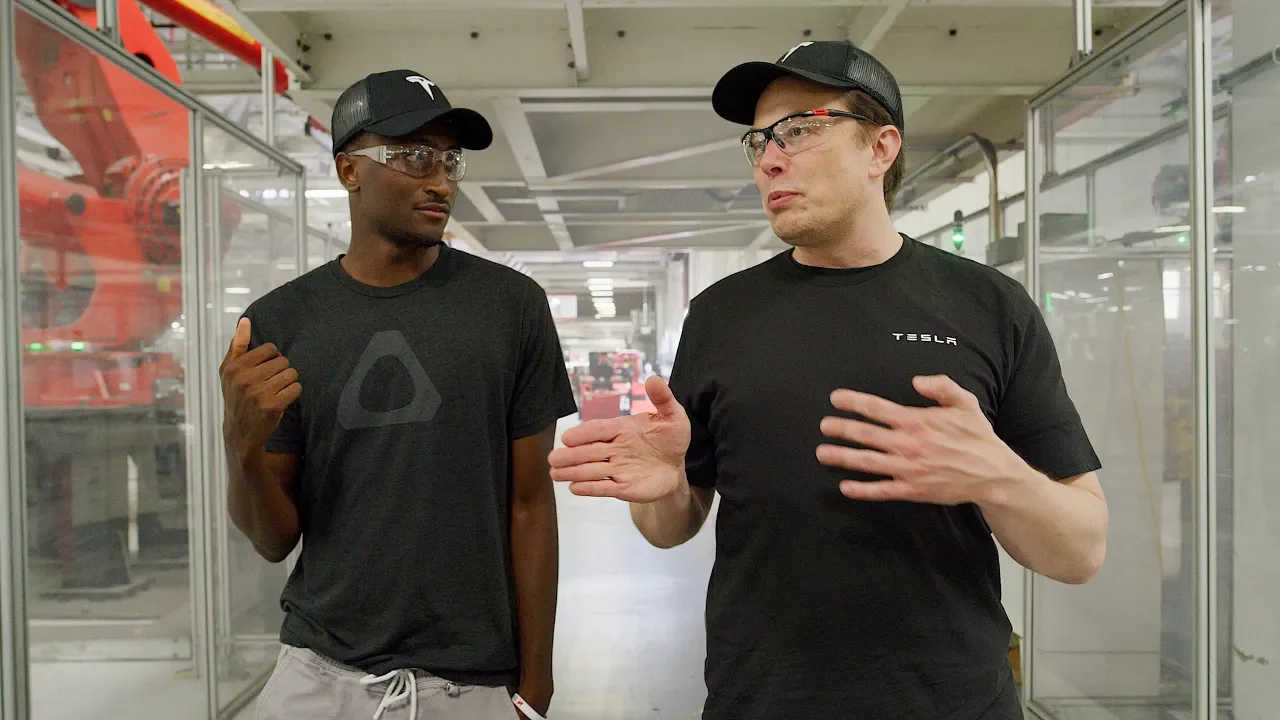
Marques Brownlee
Over-automating vehicle assembly creates severe operational fragility, forcing Tesla to rely on human dexterity for complex installations while stripping out redundant robotic mechanisms to end factory bottlenecks.
AI-assisted summary of Tesla Factory Tour with Elon Musk! — original source. Check the original for full context.
Source published:
Key ideas
- Tesla deliberately favors human workers over automation in General Assembly, as human dexterity easily adapts to flexible wiring harnesses and parts variations that trigger frequent vision-system faults in robotics. (2:25)
- The factory floor relies on simple magnetic-tape-guided AGVs rather than complex LiDAR systems, allowing ground-level staff to rapidly reconfigure transit paths without specialized engineering support. (6:22)
- Model S and Model X production yields approximately 2,000 vehicles weekly on dedicated lines completely separated from Model 3 manufacturing, converging only at the Fremont paint shop bottleneck. (12:05)
- Elon Musk's core manufacturing optimization doctrine is 'the best part is no part, best process is no process,' focusing on removing failure-prone intermediate mechanisms like rotating turntables and auditing automated tool speeds. (12:46)
Detailed notes
## Background Published on YouTube by Marques Brownlee on August 20, 2018, this video serves as a follow-up to his sit-down interview with Elon Musk. The video description outlines an informal walk-and-talk through the Tesla Fremont Factory, offering viewers a firsthand look at the bustling manufacturing floor.
## TL;DR Marques Brownlee joins Tesla CEO Elon Musk on an informal walking tour through the Tesla Fremont Factory, observing the production lines for the Model S, Model X, and Model 3. Musk breaks down the division between automation and human labor, explaining why human dexterity remains essential for flexible components and interior assembly while heavy industrial robots handle structural welding and chassis transfers. The discussion explores factory logistics, ranging from simple magnetic-tape transit carts and paint shop throughput bottlenecks to the hybrid manual-robotic battery pack mating station. Musk also reflects on his hands-on troubleshooting on the factory floor and his core manufacturing doctrine of eliminating unnecessary parts and processes to reduce points of failure.
## Atmosphere & style The tour carries an energetic, candid, and slightly chaotic tone, immersed in the authentic ambient clatter and mechanical bustle of a live automotive plant. Marques acts as an inquisitive guide absorbing the vast scale of operations, while Musk provides direct, unvarnished commentary—pointing out engineering design flaws, dodging moving carts, and greeting floor staff. The dynamic feels casual yet intellectually focused, balancing grand manufacturing philosophy with the granular, physical reality of building cars at scale.
## Bulletin - [02:25](https://www.youtube.com/watch?v=mr9kK0_7x08&t=145s) Tesla deliberately favors human workers over automation in General Assembly, as human dexterity easily adapts to flexible wiring harnesses and parts variations that trigger frequent vision-system faults in robotics. - [06:22](https://www.youtube.com/watch?v=mr9kK0_7x08&t=382s) The factory floor relies on simple magnetic-tape-guided AGVs rather than complex LiDAR systems, allowing ground-level staff to rapidly reconfigure transit paths without specialized engineering support. - [12:05](https://www.youtube.com/watch?v=mr9kK0_7x08&t=725s) Model S and Model X production yields approximately 2,000 vehicles weekly on dedicated lines completely separated from Model 3 manufacturing, converging only at the Fremont paint shop bottleneck. - [12:46](https://www.youtube.com/watch?v=mr9kK0_7x08&t=766s) Elon Musk's core manufacturing optimization doctrine is 'the best part is no part, best process is no process,' focusing on removing failure-prone intermediate mechanisms like rotating turntables and auditing automated tool speeds.
## Key takeaways - [01:19](https://www.youtube.com/watch?v=mr9kK0_7x08&t=79s) General Assembly is configured in a large U-shaped flow where bare stamped vehicle bodies enter, circulate through progressive installation stations, and exit on the opposite side. - [02:25](https://www.youtube.com/watch?v=mr9kK0_7x08&t=145s) While rigid body welding is well-suited for robots, General Assembly favors humans due to the physical complexity of routing flexible wiring harnesses and handling slightly misaligned components from staging bins. - [02:25](https://www.youtube.com/watch?v=mr9kK0_7x08&t=145s) Vehicle assembly lines move at an intentional crawl, advancing at well under 1 mile per hour for the Model S and X lines, and closer to 1 mile per hour for the higher-volume Model 3 line. - [06:22](https://www.youtube.com/watch?v=mr9kK0_7x08&t=382s) Over-automating factory operations introduces severe fragility, where minor fixture collisions can halt 24/7 continuous production and require emergency parts shipments from overseas. - [08:08](https://www.youtube.com/watch?v=mr9kK0_7x08&t=488s) Tesla utilizes off-the-shelf industrial robotic arms for heavy mechanical articulation, but custom-engineers all end-effector grippers, sensors, motion paths, and control software in-house. - [09:19](https://www.youtube.com/watch?v=mr9kK0_7x08&t=559s) Medium-sized industrial assembly robots maintain a precision repeatability of 0.2 to 0.3 millimeters, whereas larger robots carrying full vehicle bodies operate with slightly wider tolerances due to scale and payload mass. - [09:19](https://www.youtube.com/watch?v=mr9kK0_7x08&t=559s) Black is Tesla's most requested paint color worldwide; in the United States, white is nearly as popular as black, whereas white vehicles are exceptionally rare in the European market. - [10:50](https://www.youtube.com/watch?v=mr9kK0_7x08&t=650s) Battery pack installation is executed as a hybrid workstation, combining automated lifting machinery for structural placement with human operators for fine-tuning alignment. - [10:50](https://www.youtube.com/watch?v=mr9kK0_7x08&t=650s) Factory matte paint finishes are currently avoided because minor panel dings cannot be polished out or easily matched, and the Fremont paint shop already operates at maximum production capacity. - [12:05](https://www.youtube.com/watch?v=mr9kK0_7x08&t=725s) The shared Model S and Model X production line outputs roughly 2,000 vehicles per week, with drive units built in adjacent sub-assemblies before entering the main line. - [12:05](https://www.youtube.com/watch?v=mr9kK0_7x08&t=725s) The paint shop is the sole shared facility between the flagship Model S/X and the mass-market Model 3 lines; all other body manufacturing and general assembly operations remain physically isolated. - [12:46](https://www.youtube.com/watch?v=mr9kK0_7x08&t=766s) Line troubleshooting targets incremental, mundane gains multiplied across stations—such as increasing RPM and torque on automated bolt drivers and eliminating non-value-added hardware handoffs.
## Detailed walkthrough ### [00:05](https://www.youtube.com/watch?v=mr9kK0_7x08&t=5s) Tour Introduction and the Logistics of Filming inside Fremont
Marques Brownlee introduces the video as the follow-up to his sit-down interview with Elon Musk, taking viewers inside the Tesla Fremont Factory for an informal walking tour. Filming on the factory floor proved challenging due to extreme noise and continuous industrial activity, capturing roughly 15 to 20 percent of the actual Model S and Model X manufacturing process. Marques describes his role during the walkthrough as being “like a kid in The Matrix just kind of absorbing everything,” while Musk leads the way until abruptly departing for a scheduled meeting at the end. The production was shot with the assistance of Jon Rettinger and the TLD crew, who managed the audio and operated the Steadicam rig throughout the busy facility.
[01:19](https://www.youtube.com/watch?v=mr9kK0_7x08&t=79s) Overhead Car Transfers and the U-Shaped Assembly Flow
The walkthrough begins near a set of heavy industrial robots tasked with transferring vehicle chassis over a central pedestrian corridor to maintain through-access for factory staff. Musk critiques the current multi-stage transfer mechanism—where one robot lifts the car onto an elevated rotating table before a third overhead unit retrieves it—noting that future revisions should streamline the handoff directly from arm to arm. When asked about the overall layout, Musk explains that General Assembly is configured in a large U-shape: vehicles enter on one side, advance down the line, loop around, and gain progressive complexity at every workstation before exiting on the opposite side.
```mermaid flowchart LR accTitle: General Assembly Flow Layout accDescr: U-shaped progression of a vehicle chassis through Tesla General Assembly
subgraph Leg1 ["Inbound Leg"] A["Bare Stamped Body"] --> B["Wiring & Insulation"] end
subgraph Transfer ["Corridor Transfer"] B --> C["Overhead Robot Transfer"] end
subgraph Leg2 ["Outbound Leg"] C --> D["Interior & HVAC Install"] D --> E["Finished Assembly"] end ```
- Elon Musk evaluates the overhead handoff efficiency: “I think like, you know, like a design improvement we should do is like really just the one robot, you just pass it to the other robot.” - Production progress across the floor is incremental, with thousands of subtle layout tweaks implemented over time to shave seconds off cycle times.
[02:25](https://www.youtube.com/watch?v=mr9kK0_7x08&t=145s) Why Humans Beat Robots in General Assembly
Musk walks Marques toward the beginning of General Assembly to illustrate why manual labor remains vastly superior to automated systems for interior fitments. While rigid body welding is easily automated, General Assembly forces machines to navigate complex tolerances and soft materials. If a part arrives in a staging bin sitting an inch off-axis, a human operator effortlessly adjusts their grip and bolts it into place, whereas a robotic arm demands expensive vision systems that frequently trigger system faults. Musk and Marques compare this friction to studio camera rigs halting when vision tracking fails. The difficulty is most evident with flexible components like wiring harnesses and air conditioning assemblies, where human dexterity paired with simple mechanical winches delivers far greater reliability.
```mermaid flowchart TD accTitle: Assembly Task Suitability accDescr: Comparison of task characteristics best suited for humans versus robots
subgraph HumanTasks ["Well-Suited for Humans: General Assembly"] H1["Flexible wiring harness routing"] H2["Handling misaligned parts from bins"] H3["In-line quality checks & defect sorting"] end
subgraph RobotTasks ["Well-Suited for Robots: Body Shop"] R1["Repetitive structural spot welding"] R2["Heavy chassis transfers"] R3["Rigid, repeatable positioning"] end ```
Musk steps aside briefly to greet assembly line technicians and ensure they are comfortable appearing on camera. Looking inside the stripped chassis, he points out acoustic insulation, corrosion coatings, and side curtain airbags that are hidden in the finished vehicle. Musk highlights the speed of the line, explaining that while walking pace is roughly 3 miles per hour, the Model S and Model X lines crawl at well under 1 mile per hour, with the higher-volume Model 3 line moving closer to 1 mile per hour.
- Elon Musk reflects on the division of labor in manufacturing: “General assembly is what I've spoken about as being really well suited to people, because you got a lot of weird things that you got to put together.” - Musk on routing vehicle electronics: “It’s literally like winding like a snake through the car, you got to like poke it through holes and do various things, that’s super difficult for a robot.” - Elon Musk summarizes human adaptability on the line: “Basically, like a pro human can do this super well and it's like hard for the robots to do that.”
[06:22](https://www.youtube.com/watch?v=mr9kK0_7x08&t=382s) Factory Growth, "Dumb" AGVs, and Automation Downtime Risks
As the facility expanded from its historic 5,000-worker roster under previous joint ownership (NUMMI) to over 10,000 Tesla employees on site, commuter infrastructure became a primary operational challenge, necessitating company shuttles, vanpools, and the opening of an adjacent Bay Area Rapid Transit (BART) station. Musk pauses to highlight an automated guided vehicle (AGV) transporting parts along the floor, calling it one of his favorite "dumb robots." Instead of relying on complex LiDAR mapping, the cart simply tracks an adhesive magnetic stripe laid directly on the ground and uses basic frontal proximity sensors to pause when obstacles appear.
Musk warns that over-automating continuous production creates severe operational fragility. In a 24/7 production push, every complex automation cell requires dedicated round-the-clock robotics engineers. A minor collision that damages an alignment fixture can halt the entire line, triggering emergency part shipments across continents.
- Elon Musk describes the high stakes of factory downtime: “And then I get pulled on my cell phone at 2:00 in the morning and it's like trying to fly a part from Germany, it's like we literally had that two days ago.” - Simpler magnetic-tape transit carts prevent line stoppages because any factory worker can reprogram their path instantly by pulling up and repositioning floor tape without software engineering support.
[08:08](https://www.youtube.com/watch?v=mr9kK0_7x08&t=488s) Off-the-Shelf Arms vs. Custom End Effectors
Marques asks whether Tesla manufactures its own industrial assembly robots or procures them from external automation vendors. Musk clarifies that heavy equipment falls into distinct hardware classes: the heavy mechanical articulation arms, such as the large yellow Fanuc units that hoist entire vehicle bodies, are off-the-shelf catalog machinery. However, the software motion paths, safety sensors, structural mounting fixtures, and specialized end effectors—the custom grippers that actually latch onto and release the chassis—are engineered entirely in-house. Musk adds that factory teams nickname these massive machines after X-Men and Marvel comic characters to tell them apart as the facility fills with hundreds of identical robotic units.
- Musk explains the boundary between vendor hardware and Tesla engineering: “You kind of like buy this like powerful arm, but it's just like having an arm stuck in the ground, and then you're like, okay, what does the arm do? You got to tell it everything to do.” - Off-the-shelf arms act purely as raw mechanical muscle; all tooling contacting the vehicle is custom-designed for the specific vehicle architecture.
[09:19](https://www.youtube.com/watch?v=mr9kK0_7x08&t=559s) Robot Precision, Factory Floor Navigation, and Paint Popularity
Continuing through the factory floor, Elon Musk explains the mechanics behind the massive robotic arm carrying car bodies overhead. While the robotic base is an off-the-shelf industrial unit, the end effector that physically grips and supports the vehicle is entirely custom-engineered, requiring custom programming, sensor integration, and wiring. Marques Brownlee asks about the repeatable precision of such a massive machine, wondering if it follows the exact same path down to an inch or a centimeter. Musk corrects him, explaining that while larger robots have slightly less precision than small ones, a medium-sized robot maintains repeatability down to roughly 0.2 to 0.3 millimeters.
```mermaid flowchart TD accTitle: Robot Precision vs Size accDescr: Visual comparison of the precision differences between larger and medium-sized industrial robots. subgraph Precision["Robotic Arm Repeatability"] direction TB Large["Large Robot<br/>(Carrying car bodies)"] -->|"Trade-off"| LessP["Slightly less precision<br/>due to sheer scale"] Medium["Medium-Sized Robot"] -->|"High Precision"| Spec["Accurate to 0.2 - 0.3 mm"] end ```
As they walk, an autonomous ground-guided vehicle creeps across their path, prompting Musk to warn, “Watch out, there's a dumb robot coming through.” Marques jokes about trusting the robot’s sensors as it navigates safely past them before turning the conversation to consumer preferences: what is the most popular paint color coming off the line? Musk reveals that black is the top choice overall, but notes sharp geographic variations. In the United States, black and white run nearly even as the two most dominant shades (with black edging slightly ahead), whereas in Europe, black is significantly more popular and white cars are very rare.
- Medium-sized industrial robots operate with a positional tolerance of 0.2 to 0.3 millimeters. - Large robots have slightly lower precision than smaller robots due to scale and payload mass. - Black is the most requested paint color globally, followed closely by white in the US market. - In Europe, white is considered an exceptionally rare color choice for vehicles.
---
[10:50](https://www.youtube.com/watch?v=mr9kK0_7x08&t=650s) The Battery Pack Mating Station and Matte Paint Feasibility
Musk and Marques arrive at the vehicle "mating station," the critical junction where the structural battery pack is hoisted and bolted to the vehicle chassis. Marques observes that the operation is a hybrid blend of automation and human oversight. Musk agrees, pointing out that while the heavy robotic apparatus handles the lifting and primary alignment, a human operator works alongside the machinery to provide fine-tuning adjustments and guarantee exact fitment.
Marques asks Musk how he feels about offering factory matte or satin paint finishes, noting that fans frequently request them. Musk confesses that he loves the aesthetic appeal of matte colors, but highlights the severe post-sale maintenance challenges: “It's really tricky to to repair a matte, so like with you can polish it out with matte, um if you get like a little ding it's really hard to then rematch the so it looks like an even matte.” Beyond repairability, Musk explains that Tesla’s paint shop is already running at maximum capacity, meaning introducing extra complexity would be counterproductive at this stage, though he hopes to offer it in the future.
- Battery pack installation utilizes an automated robotic lift coupled with manual fine-tuning by human technicians. - Unlike gloss finishes that can be buffed and polished after minor scratches, matte finishes require difficult matching across panels. - Tesla's Fremont paint shop operates at "Full Tilt," precluding the introduction of specialized matte finishes in the immediate term.
---
[12:05](https://www.youtube.com/watch?v=mr9kK0_7x08&t=725s) Production Architecture: Model S/X vs. Model 3
Surveying the massive layout, Musk points out the sub-assembly sections where front and rear drive units are assembled independently before feeding directly into the main vehicle line. This particular line integrates both Model S and Model X, pushing out approximately 2,000 combined vehicles per week. Marques asks whether the Model 3 assembly line is segregated within the factory. Musk confirms that Model 3 assembly is completely independent throughout the building—with body framing, sub-assemblies, and general assembly taking place in isolated areas—save for one single bottleneck.
Musk explains: “The only place where Model 3 uh and S and X come together is in the paint shop, so the paint shop is processing S, 3, and X um simultaneously down the same line.” Everywhere else in Fremont, the production paths for the flagship vehicles and the mass-market Model 3 remain segregated.
```mermaid flowchart LR accTitle: Fremont Production Routing accDescr: Flow showing how Model S, Model X, and Model 3 remain separate except inside the paint shop. subgraph SeparateLines1["Early Stages"] S_X_Body["Model S & X Body"] M3_Body["Model 3 Body"] end
subgraph Bottleneck["Shared Facility"] Paint["Paint Shop<br/>(Processes S, 3, & X simultaneously)"] end
subgraph SeparateLines2["Assembly"] S_X_Line["Model S & X Final Assembly<br/>(~2,000 cars/week)"] M3_Line["Model 3 Final Assembly<br/>(Dedicated lines)"] end
S_X_Body --> Paint M3_Body --> Paint Paint --> S_X_Line Paint --> M3_Line ```
- The joint Model S and Model X line produces approximately 2,000 vehicles per week. - Drive units are manufactured in adjacent sub-assembly areas before joining the main chassis line. - The paint shop is the sole shared facility across Model S, Model X, and Model 3 manufacturing; body manufacturing and general assembly remain separate.
---
[12:46](https://www.youtube.com/watch?v=mr9kK0_7x08&t=766s) Sleeping on the Factory Floor and First-Principles Optimization
Marques brings up the well-known reports of Musk sleeping inside the factories, asking what specific problems actually require the CEO's direct, hands-on intervention. Musk clarifies that during the final three months of the prior year, he spent the vast majority of his time at the Nevada Gigafactory untangling battery module production bottlenecks. He emphasizes that troubleshooting manufacturing is not about single grandiose interventions, but rather resolving thousands of minute, mundane inefficiencies by closing the feedback loop between design engineers and production floor reality.
Musk summarizes his manufacturing doctrine with a core first-principles rule: “Because the best part is no part, best process is no process.” He explains that design teams often mandate steps that turn out to be completely unnecessary in real-world assembly. Immediate optimizations include auditing automated bolt drivers to ramp up their RPM and torque settings, or eliminating wasted motion. He points to an existing station where cars are lifted onto a rotating turntable so a secondary robot can grab them: because the turntable frequently breaks down, Musk wants it eliminated entirely in favor of a direct robot-to-robot handoff. Optimizing production ultimately comes down to weeding out non-value-added steps, maximizing the speed of automated tools, and stripping away redundant hardware that creates unnecessary failure points.
- Musk spent the final quarter of 2017 primarily stationed at the Gigafactory diagnosing automated battery module bottlenecks. - Optimization targets micro-adjustments multiplied across the line, such as increasing the RPM and torque profiles on automated bolt drivers. - Intermediate mechanical steps, such as motorized turntables between robotic arms, are targeted for removal to eliminate mechanical failure points. - Factory redesign centers on removing any motion or mechanism that fails to directly add value to the finished vehicle.
## Notable quotes > [12:46](https://www.youtube.com/watch?v=mr9kK0_7x08&t=766s) the best part is no part, best process is no process. — Elon Musk
> [02:25](https://www.youtube.com/watch?v=mr9kK0_7x08&t=145s) General assembly is what I've spoken about as being really well suited to people, because you got a lot of weird things that you got to put together. — Elon Musk
## Mentioned Marques Brownlee, Elon Musk, Jon Rettinger, TLD, Tesla, Tesla Fremont Factory, Model S, Model X, Model 3, NUMMI, Fanuc, Gigafactory, Bay Area Rapid Transit (BART)
## Video description Walking and talking through the Tesla factory Part 1 Interview: https://youtu.be/MevKTPN4ozw Behind-the-scenes with TLD: https://youtu.be/Tz9ZuI0PSSI
MKBHD Merch: http://shop.MKBHD.com
Video Gear I use: http://kit.com/MKBHD/video-gear#recommendation17959 Tech I'm using right now: https://www.amazon.com/shop/MKBHD
Intro Track: Disarm by Alltta (Instrumental)
~ http://twitter.com/MKBHD http://snapchat.com/add/MKBHD http://google.com/+MarquesBrownlee http://instagram.com/MKBHD http://facebook.com/MKBHD
[Source](https://www.youtube.com/watch?v=mr9kK0_7x08)