Why Swiss Trains are the Best in Europe
Not Just Bikes
AI-assisted summary of Why Swiss Trains are the Best in Europe — original source. Check the original for full context.
Source published:
Key ideas
- Switzerland operates Europe's premier passenger rail network through nationwide clock-face pulse timetabling, achieving an average transfer connection time of 8.4 minutes with 77% of interchanges taking 10 minutes or less. (3:22)
- Swiss Federal Railways (SBB) maintains a 91.9% arrival punctuality rate measured against a strict 3-minute threshold, while securing a 98.9% success rate on scheduled passenger transfers. (5:48)
- Despite nearly half of Switzerland's population residing in settlements of under 10,000 residents, the network overcomes widespread village sprawl by providing regular 30-minute passenger intervals to tiny hamlets and rural request stops. (1:15)
- Universal civic adoption, facilitated by the SwissPass discount system, ensures that affluent professionals regularly commute by train, preserving broad political and financial support for public transit infrastructure. (8:41)
Detailed notes
## Background Published on YouTube by Not Just Bikes on July 18, 2022, this video explores why Switzerland's passenger rail system outclasses even the acclaimed network of the Netherlands. Drawing on a week of hands-on travel across the country, the presenter investigates the operational design, scheduling precision, and passenger experience that make Swiss trains among the finest in the world.
## TL;DR Despite its rugged alpine terrain and dispersed village population, Switzerland operates an exceptionally dense, frequent rail network synchronized around pulse timetabling (Taktfahrplan), ensuring nationwide connection times average just 8.4 minutes. Swiss Federal Railways enforces a rigorous three-minute punctuality threshold and achieves a 98.9% transfer success rate, supported by real-time navigation in the SBB app and universal civic buy-in through fare programs like the SwissPass. From panoramic alpine cars to compact, pedestrian-first towns that eliminate the last-mile problem, the network renders intercity driving completely obsolete. Even rare disruptions—such as a missed connection caused by an international train—result in pleasant layovers rather than highway gridlock, setting a global benchmark for transit freedom.
## Atmosphere & style The presentation is analytical, relaxed, and deeply appreciative, delivered with the host's characteristic dry wit and measured enthusiasm. Viewers are taken on a scenic, vicarious journey through spotless train cars and breathtaking mountain vistas, contrasted against sharp, grounded critiques of North American car dependency. The pacing feels as smooth and unhurried as the rail journeys themselves, creating a palpable sense of envy and admiration for a society where transit is treated as a masterclass in civic infrastructure.
## Bulletin - [03:22](https://www.youtube.com/watch?v=muPcHs-E4qc&t=202s) Switzerland operates Europe's premier passenger rail network through nationwide clock-face pulse timetabling, achieving an average transfer connection time of 8.4 minutes with 77% of interchanges taking 10 minutes or less. - [05:48](https://www.youtube.com/watch?v=muPcHs-E4qc&t=348s) Swiss Federal Railways (SBB) maintains a 91.9% arrival punctuality rate measured against a strict 3-minute threshold, while securing a 98.9% success rate on scheduled passenger transfers. - [01:15](https://www.youtube.com/watch?v=muPcHs-E4qc&t=75s) Despite nearly half of Switzerland's population residing in settlements of under 10,000 residents, the network overcomes widespread village sprawl by providing regular 30-minute passenger intervals to tiny hamlets and rural request stops. - [08:41](https://www.youtube.com/watch?v=muPcHs-E4qc&t=521s) Universal civic adoption, facilitated by the SwissPass discount system, ensures that affluent professionals regularly commute by train, preserving broad political and financial support for public transit infrastructure.
## Key takeaways - [00:00](https://www.youtube.com/watch?v=muPcHs-E4qc&t=0s) Switzerland operates a passenger rail system widely regarded as the finest in Europe and rivaled globally only by Japan. - [01:15](https://www.youtube.com/watch?v=muPcHs-E4qc&t=75s) The railway network provides comprehensive coverage across rural 'village sprawl', offering dependable 30-minute frequencies to tiny hamlets and recreation stops. - [01:15](https://www.youtube.com/watch?v=muPcHs-E4qc&t=75s) While Calgary has zero intercity passenger rail for 1.3 million residents, an equivalent metropolitan area like Zürich handles nearly 3,000 trains every day. - [03:22](https://www.youtube.com/watch?v=muPcHs-E4qc&t=202s) Switzerland synchronizes its national network through pulse timetabling (Taktfahrplan), concentrating arrivals and departures at hubs to minimize interchange layovers. - [03:22](https://www.youtube.com/watch?v=muPcHs-E4qc&t=202s) An analysis of the national network shows an average interchange time of 8.4 minutes, with 77% of transfer itineraries requiring 10 minutes or less. - [03:22](https://www.youtube.com/watch?v=muPcHs-E4qc&t=202s) Precise pulse scheduling maximizes the carrying capacity of restricted alpine corridors, safely coordinating multi-directional traffic across single-track lines and mountain tunnels. - [05:48](https://www.youtube.com/watch?v=muPcHs-E4qc&t=348s) SBB measures on-time performance using a strict 3-minute deviation window, outperforming the more lenient standards used in the Netherlands and North America. - [05:48](https://www.youtube.com/watch?v=muPcHs-E4qc&t=348s) Connection reliability is prioritized above pure arrival timing, with 98.9% of scheduled passenger transfers successfully completed nationwide. - [07:11](https://www.youtube.com/watch?v=muPcHs-E4qc&t=431s) Rolling stock and stations feature modern amenities, quiet environments, scenic panoramic windows, and an aggressive retrofit program for step-free accessibility. - [08:41](https://www.youtube.com/watch?v=muPcHs-E4qc&t=521s) Broad civic use by wealthy commuters—facilitated by SwissPass and Halbtax subscriptions—secures sustained political commitment and funding for transit operations. - [10:04](https://www.youtube.com/watch?v=muPcHs-E4qc&t=604s) The SBB mobile application streamlines navigation by providing platform walking paths, carriage occupancy meters, boarding zone locations, and real-time disruption alerts. - [11:26](https://www.youtube.com/watch?v=muPcHs-E4qc&t=686s) Network disruptions are frequently driven by delayed cross-border trains from neighboring countries like Italy rather than domestic operations. - [11:26](https://www.youtube.com/watch?v=muPcHs-E4qc&t=686s) Even during an unexpected missed connection, small towns with frequent service and pedestrian-friendly surroundings provide a pleasant layover compared to highway traffic. - [13:23](https://www.youtube.com/watch?v=muPcHs-E4qc&t=803s) Swiss rail stations integrate seamlessly into dense, walkable destinations and local transit without relying on car parking or physical fare turnstiles.
## Detailed walkthrough ### [00:00](https://www.youtube.com/watch?v=muPcHs-E4qc&t=0s) Introduction: A Country That Does Trains Better
The presenter opens from the perspective of living in the Netherlands, a country widely recognized for its robust, dense railway system that links virtually all major municipalities. The country’s busiest transport hub, Utrecht Centraal, runs over a thousand departures each day, and international high-speed connections place destinations like Paris less than three and a half hours away. Yet despite the Netherlands’ formidable rail credentials, there is another European nation that elevates passenger rail to an entirely different standard: the Confoederatio Helvetica, affectionately known as Switzerland. Beyond the familiar clichés of jagged alpine peaks, holey cheese, fine chocolate, pocket knives, and luxury wristwatches, Switzerland stands out globally for running an astonishing volume of passenger trains.
Having visited Switzerland repeatedly over the years, the presenter always chose the train as the indisputably superior transit option. To pinpoint exactly why the network is considered the finest in Europe—rivaled globally perhaps only by Japan—he spent an entire week traversing the country, taking multiple journeys per day to examine its infrastructure, reliability, and passenger experience first-hand.
[01:15](https://www.youtube.com/watch?v=muPcHs-E4qc&t=75s) Network Density and Overcoming "Village Sprawl"
The sheer scope and coverage of the Swiss railway network immediately sets it apart. Looking at a transit map of the country reveals an unbroken web of passenger stations, extending far out into the rural periphery. Tiny hamlets and rural outposts enjoy regular, dependable rail service arriving every 30 minutes—places so small that transit agencies in many other nations would deem them unfit even for an infrequent bus route. In some of the quietest settlements, trains operate on a request-stop basis, where passengers simply press a button on the platform to board. In one notable alpine location, an active station that provides access to nothing more than a single café, a ski lift, and a hiking trailhead still receives passenger service on an exact 30-minute cadence.
This extreme accessibility stands in stark contrast to transit standards in North America. For example, the city of Calgary in Alberta, Canada—a metropolitan area home to 1.3 million residents—lacks any intercity passenger rail connectivity whatsoever. By comparison, Zürich, with roughly the same population of 1.3 million across its urban area, handles nearly 3,000 passenger trains per day. Service runs with such rapid frequency that travelers never need to check a timetable before showing up at the station. While observers often dismiss Swiss transit prowess as the natural byproduct of a small land area, surface-level statistics obscure how the country is actually inhabited. Swiss cities are relatively modest; Geneva, the second-largest urban center, has roughly 600,000 residents in its broader region, and nearly half of the entire national population resides in villages of fewer than 10,000 people. Rather than the car-dependent suburban sprawl characteristic of North America, Switzerland exhibits a pattern of widespread "village sprawl," yet coordinates its transit so effectively that its dispersed population remains exceptionally well-served.
- **Calgary vs. Zürich:** Calgary (1.3 million people) has 0 intercity passenger rail services; Zürich (1.3 million people) handles nearly 3,000 trains every day. - **Population dispersion:** Almost 50% of Swiss residents live in communities with fewer than 10,000 residents. - **Rural service standard:** Isolated request stops and recreation-only stations regularly maintain 30-minute service intervals.
[03:22](https://www.youtube.com/watch?v=muPcHs-E4qc&t=202s) Pulse Timetabling and Network Optimization
To tie this rural distribution together without stranding passengers, Switzerland relies on clock-face scheduling (*Taktfahrplan*). Vehicles arrive on memorable, recurring patterns throughout the operational day—such as at 15 and 45 minutes past every hour, or every 15 minutes at consistent minute markers—sparing passengers the burden of memorizing complex schedules. While standard clock-face scheduling is also deployed in countries like the Netherlands and Germany, Switzerland elevates the concept through full national synchronization, known as pulse timetabling or integrated timetabling.
```mermaid flowchart TD accTitle: Integrated Pulse Timetabling in Swiss Stations accDescr: Incoming feeder trains arrive simultaneously before the pulse window, allowing passengers to transfer across platforms before all departing trains leave together.
subgraph Inflow ["Inbound Pulse Window (e.g.,:15 Past Hour)"] A["Incoming Regional Line A"] --> Hub["Central Transfer Station"] B["Incoming Intercity Line B"] --> Hub C["Incoming Mountain Branch Line C"] --> Hub end
subgraph Exchange ["Cross-Platform Transfer (Average: 8.4 Minutes)"] Hub --> Trans["Coordinated Platform Walkways\n(77% of connections ≤ 10 min)"] end
subgraph Outflow ["Outbound Pulse Window (e.g.,:25 Past Hour)"] Trans --> D["Outbound Regional Line A"] Trans --> E["Outbound Intercity Line B"] Trans --> F["Outbound Mountain Branch Line C"] end ```
By concentrating arrivals and departures at designated hub stations into coordinated waves ("pulses"), inbound trains pull into a station at, for instance, 15 minutes past the hour, and onward departures leave in all directions around 25 minutes past. Passengers moving between disparate lines face wait times capped at roughly 10 minutes. An analysis published by viewer Jokteur examined the entire national rail matrix at 10:00 AM on a typical Friday outside the morning commute peak. The data revealed that the average connection time nationwide was an astonishing 8.4 minutes, with 77% of all possible interchange itineraries requiring a layover of 10 minutes or less. Consequently, a complex cross-country journey involving multiple transfers takes only marginally longer than an equivalent direct journey would.
Furthermore, this tight clock-face integration maximizes corridor capacity through inhospitable geography. Constructing rail corridors through the Alps is financially and physically daunting, forcing diverse rail services to share limited infrastructure. Precise synchronization allows high-traffic corridors to run safely and reliably across single-track segments and through single-bore mountain tunnels. Trains traveling through southern Switzerland occasionally pause for brief intervals to let oncoming traffic clear a single-track tunnel, yet the scheduling is calibrated so tightly that journeys remain punctual without cascading delays.
[05:48](https://www.youtube.com/watch?v=muPcHs-E4qc&t=348s) Punctuality That Actually Matters: Transfer Reliability
The entire pulse structure collapses unless trains operate on schedule, and Swiss Federal Railways (SBB/CFF/FFS) maintains an internationally renowned record of timeliness. SBB reports an official arrival punctuality rate of 91.9%, but the underlying metrics reveal that this figure is far more rigorous than foreign equivalents. While the Dutch national operator, Nederlandse Spoorwegen (NS), marks a train as late only after a 5-minute deviation, Switzerland enforces a strict 3-minute threshold. In North America, the comparison degrades further: the Greater Toronto Area's GO Transit permits a generous 15-minute grace period across an operational footprint far smaller than Switzerland with a comparable population count, while Canada’s VIA Rail reports a 71% on-time performance without publicly defining its lateness threshold.
``` +------------------------+-------------------------------+------------------------------+ | Rail Operator / Agency | Stated On-Time Performance | Criteria for "On-Time" | +------------------------+-------------------------------+------------------------------+ | SBB (Switzerland) | 91.9% Arrival Punctuality | Within 3 minutes of schedule | | NS (Netherlands) | High (baseline European peer) | Within 5 minutes of schedule | | GO Transit (Toronto) | Regional Commuter Standard | Within 15 minutes of schedule| | VIA Rail (Canada) | 71.0% | Undisclosed metric | +------------------------+-------------------------------+------------------------------+ ```
Even more critical to daily travel than end-to-end arrival timing is connection reliability. In Switzerland, 98.9% of scheduled passenger transfers are successfully made. As the presenter emphasizes:
> “After all, arriving at home 5 minutes late one day isn’t really a big deal, but just missing your connection to a train that only leaves every 30 minutes, is much worse.”
Because the network protects transfers above all else, passengers can navigate complex multi-train routes without fearing that an initial three-minute delay will strand them on a rural platform for half an hour.
[07:11](https://www.youtube.com/watch?v=muPcHs-E4qc&t=431s) The On-Board Experience and Station Accessibility
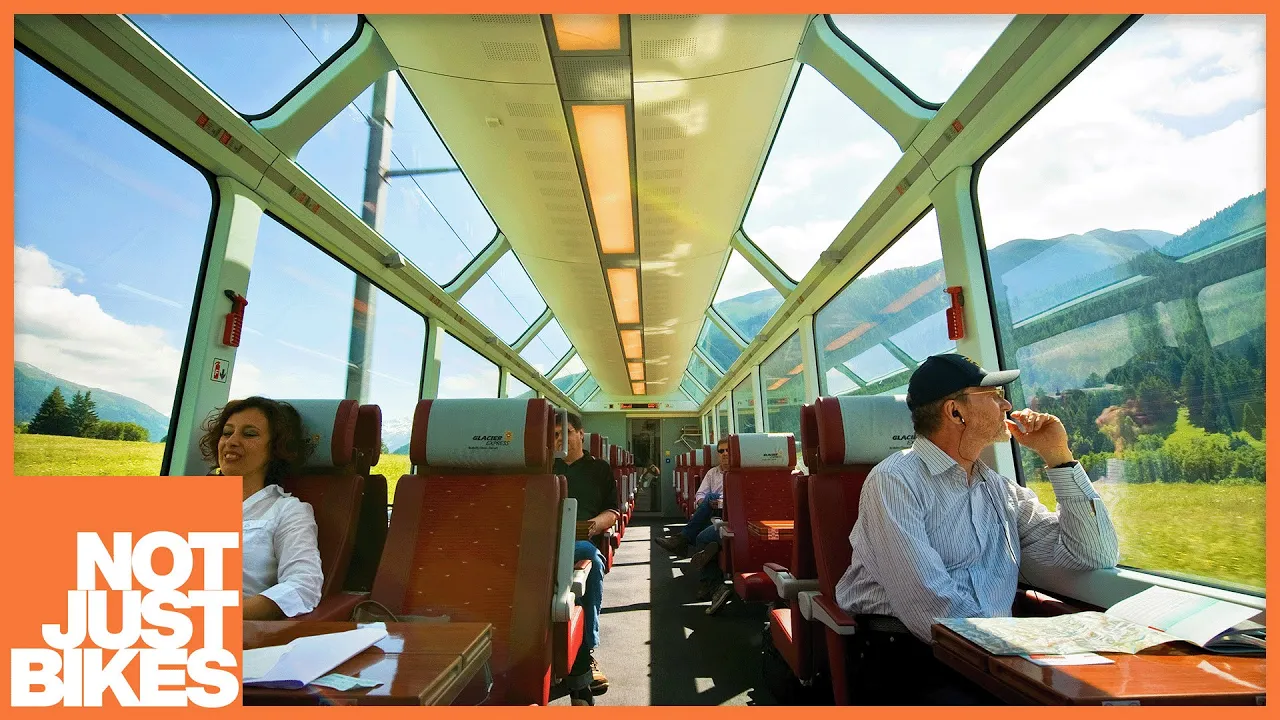
Shifting from abstract timetables to the lived passenger reality, Swiss trains are thoroughly modern, quiet, well-maintained, and comfortable. Regional rolling stock passing through mountain corridors features broad panoramic windows designed to showcase the alpine landscapes, with specialized sightseeing equipment like the Glacier Express providing an even higher scenic benchmark. Ordinary intercity trains provide an appealing, relaxed environment where riders can dine, move freely, read, or use the restroom at will—a calm atmosphere that sharply outclasses the stress, confined seating, and constant vigilance of driving on a congested motorway. The presenter expresses deep admiration for this standard of travel:
> “I refuse to believe that there is any better way to travel, than on a train like this one.”
The physical infrastructure also emphasizes accessibility. A substantial portion of the fleet provides step-free level boarding, accompanied by direct interior access to wheelchair seating areas and accessible lavatories. While not every individual carriage on every older train has been retrofitted, the country is undertaking an aggressive, visible program to achieve universal network accessibility. Stations are consistently equipped with step-free elevators or smooth ramps alongside stairs. This accessibility occasionally produces unexpected moments: while filming a transfer walk, the presenter witnessed a daring passenger navigate a wheelchair directly down an escalator.
[08:41](https://www.youtube.com/watch?v=muPcHs-E4qc&t=521s) Classes of Travel, SwissPass, and Civic Buy-In
Base point-to-point ticket fares in Switzerland are quite expensive for casual tourists, but local residents rarely pay full freight. The overwhelming majority rely on the national SwissPass system to carry discounted fare structures, such as the ubiquitous half-fare card (*Halbtax*) or comprehensive regional and network-wide annual passes, often funded or subsidized as an employment benefit.
Testing both passenger classes, the presenter spent the opening portion of the week in standard second class, finding it exceptionally comfortable and more than adequate for any regular journey. For the final four days, he upgraded to a first-class national pass funded through his Patreon community. First class provides a marginal upgrade—featuring wider seating and quiet "business zones" that allow passengers to work productively on laptops during their commute—though it is generally unnecessary unless taking heavily congested trunk routes during peak periods.
Crucially, the presence of affluent riders across both classes underscores a vital transit principle. Invoking an adage often associated with urban transit philosophy, the presenter notes:
> “There’s a famous quote by the former mayor of Bogotá, ‘A developed country is not a place where the poor have cars. It's where the rich use public transportation.’ And that is absolutely the case in Switzerland.”
In first-class cars, white-collar professionals, executives, and well-dressed commuters routinely set up laptops to debrief business meetings. The presenter argues that having the wealthy actively use public transit ensures the system retains high-level political protection and broad civic investment, because the people who hold administrative and financial influence have an immediate personal stake in maintaining top-tier, reliable service.
[10:04](https://www.youtube.com/watch?v=muPcHs-E4qc&t=604s) Flawless Navigation with the SBB Mobile App
Navigating the Swiss railway network is anchored by the official SBB mobile application. The app guides users through complicated itineraries with surgical clarity. When planning a journey, the software provides:
- An exact schedule calculation detailing travel times, transfer points, and every intermediate station stop along the path. - Visual station maps illustrating the full track layout and tracing the exact physical walking route between departure platforms. - Real-time platform locations for arrival and departure, paired with an occupancy meter estimating the passenger crowd levels inside each carriage. - Precise platform boarding zones indicating where to wait on the platform for specific train classes and rolling stock sections. - Push notifications that alert passengers as their transfer station approaches and confirm the connecting platform number.
During a complex multi-leg journey with several rapid transfers—the sort of routing that would cause severe anxiety in almost any other country—the system functioned flawlessly. In one instance, a connecting train was running nearly three minutes behind schedule, prompting an automated warning within the SBB app that the transfer might fail. However, because cross-platform walking routes are minimized and trains communicate in real time, the connection was completed seamlessly with minutes to spare, even when transitioning from heavy rail to local bus connections.
[11:26](https://www.youtube.com/watch?v=muPcHs-E4qc&t=686s) The Anatomy of a Missed Connection in Switzerland
Even with tightly aligned timetables where buses wait right outside the station doors, travel in Switzerland is not completely immune to disruption. During a trip taking roughly two dozen trains across the country, a missed connection occurred—an outcome described as either unfortunate or lucky for the sake of demonstrating what happens when the Swiss system falters. The delay itself originated beyond the Swiss border, prompting the joke: “Oooh. Switzerland throwing Italy under the bus! I mean … train!” According to local insight, international services running into Switzerland account for many of the network’s delays, making this particular disruption a very typical occurrence.
The contrast between this train delay and delays experienced while driving between cities is stark. On highway trips, unexpected congestion frequently tacks on 30 minutes, an hour, or more, trapping motorists in frustrating, stressful stop-and-go traffic where nobody knows how long the delay will last. By comparison, missing a rail connection took place in a small Swiss town of only 13,000 residents. Instead of enduring road rage, the unplanned layover offered a chance to grab food, walk outside, and take in the surrounding landscape. The author reflects: “This delay was the exact polar opposite of that. In fact, it was a really enjoyable break.”
That experience highlighted the civilizing aspects of Swiss transit design compared to highway travel in North America: “It just blows my mind that even a delayed train trip in Switzerland was better than almost any intercity driving trip I’ve ever done in the US or Canada.” Beyond the pleasant wait, the infrastructure of the location stood out: a modest settlement of just 13,000 people enjoyed frequent, regular passenger rail service, including direct international connections.
```mermaid flowchart TD accTitle: Swiss Train Delay vs Driving Traffic Comparison accDescr: A comparison showing the causes and passenger experiences between a Swiss rail delay and highway driving congestion.
subgraph RailDelay["Swiss Rail Delay"] R1["International train arrives late (e.g. from Italy)"] R2["Missed connection at intermediate station"] R3["Layovers in small towns (e.g. pop. 13,000)"] R4["Predictable schedule: grab food, take a walk, enjoy views"] R1 --> R2 --> R3 --> R4 end
subgraph RoadTraffic["Intercity Driving Delay"] D1["Unexpected car traffic on highway"] D2["Stuck in stop-and-go gridlock"] D3["Unpredictable delay: 30–60+ minutes lost"] D4["Stressful, high-frustration environment"] D1 --> D2 --> D3 --> D4 end ```
- Traveled on approximately 24 individual trains throughout Switzerland. - The single missed connection was caused by a train arriving delayed from another country (Italy). - The station where the connection was missed served a small community of only 13,000 residents, yet maintained regular domestic and international rail service.
---
[13:23](https://www.youtube.com/watch?v=muPcHs-E4qc&t=803s) Walkable Destinations and Returning to the Netherlands
Arriving at any destination across Switzerland revealed another systemic strength: the journey never ends in an asphalt desert. Whether getting off at a city, a mountain village, or a small town, reaching the final destination required only a short walk, a quick tram ride, or a scenic gondola trip directly to where one needed to go. This seamless last mile works because Swiss human settlements are uniformly designed to be compact, mixed-use, and pedestrian-friendly.
This built environment made an unexpected psychological impact upon returning home to the Netherlands. Usually, returning to Dutch infrastructure after a trip to North America triggers a sense of relief because North American planning is so poor by comparison. Returning from Switzerland, however, marked a rare inversion: “This was the very first time that I returned to the Netherlands after a trip abroad, and didn’t think to myself, ‘finally, back to civilization.’” Back at Amsterdam Zuid, even a recently refurbished Dutch train felt somewhat rickety, noisy, and less polished than the rolling stock departed in Zürich.
Moreover, having traveled barrier-free throughout Switzerland without a single turnstile, almost missing the train home occurred because of forgetting to tap the Dutch OV-chipkaart at the platform readers. While Dutch cycling infrastructure remains superior to anything in Switzerland, the overall integration, quality, and punctuality of the Swiss national public transit network sets an unmatched benchmark: “This care-free transportation felt like true freedom, more so than any car-dependent place I’ve ever been.”
- Swiss settlements integrate mixed-use zoning with walking paths, trams, and cable cars/gondolas directly connected to rail nodes. - Unlike the Dutch transit system, which uses platform validators and fare gates for the OV-chipkaart, Swiss rail travel operates without physical fare turnstiles. - Dutch cycling infrastructure surpasses Switzerland’s, but Swiss national rail quality and transit ease deliver a superior level of regional travel freedom.
---
[15:04](https://www.youtube.com/watch?v=muPcHs-E4qc&t=904s) Scenic Rail and Creator Support (Nebula, CuriosityStream, Patreon)
A major experiential contrast between the flat Netherlands and Switzerland is topography. Taking full advantage of the landscape, one of the trip's highlights was riding the Glacier Express, a celebrated scenic route weaving through high-altitude vistas across the Swiss Alps. A dedicated feature video documenting what it is like to ride the Glacier Express was produced for the streaming platform Nebula.
Nebula is highlighted as an independent streaming platform built by and for educational creators, offering completely ad-free and sponsor-free viewing alongside exclusive bonus content from over 150 creators across history, technology, and media analysis. A subscription bundle with CuriosityStream is presented as the most cost-effective path to access both services, with a joint annual subscription costing $14.79—noting that this entire yearly cost amounts to roughly what a traveler would pay for a one-way ticket between Zürich and Basel without a discount card. The video wraps up with an acknowledgment of the channel's Patreon community, joking that their support directly funds first-class travel aboard "those sweet, sweet Swiss trains."
- **Glacier Express**: Featured in a dedicated companion video covering scenic alpine passenger rail. - **Nebula**: Creator-owned streaming service hosting ad-free versions of videos, exclusive content, and 150+ educational creators. - **CuriosityStream Bundle**: Grants access to thousands of documentary titles (such as a documentary on the Engadin wilderness preserve in the Swiss Alps) plus Nebula for $14.79 for the first year. - **Price Reference**: The $14.79 annual streaming price point is roughly comparable to an undiscounted one-way train fare between Zürich and Basel.
## Notable quotes > [11:26](https://www.youtube.com/watch?v=muPcHs-E4qc&t=686s) It just blows my mind that even a delayed train trip in Switzerland was better than almost any intercity driving trip I’ve ever done in the US or Canada. — Not Just Bikes
> [05:48](https://www.youtube.com/watch?v=muPcHs-E4qc&t=348s) Arriving at home 5 minutes late one day isn’t really a big deal, but just missing your connection to a train that only leaves every 30 minutes, is much worse. — Not Just Bikes
## Mentioned Amsterdam Zuid, Calgary, CuriosityStream, Engadin, Geneva, Glacier Express, GO Transit, Jokteur, Nebula, Nederlandse Spoorwegen (NS), Not Just Bikes, OV-chipkaart, Patreon, Swiss Federal Railways (SBB/CFF/FFS), SwissPass, Utrecht Centraal, VIA Rail, Zürich
## Video description https://go.nebula.tv/notjustbikes to get a discounted subscription to Nebula (and support this channel, too)!
Watch this video ad-free on Nebula: https://nebula.tv/videos/notjustbikes-these-are-the-best-trains-in-europe
I live in the Netherlands, where we have some pretty great trains. But there's a country in Europe that does trains better. Much better, in fact.
Switzerland has some of the best trains in the entire world - second, perhaps, only to Japan. What makes these trains so good? And what is it like to actually ride them?
The Slowest Express Train in the World - The Glacier Express https://nebula.app/videos/notjustbikes-the-slowest-express-train-in-the-world-the-glacier-express
Patreon: https://patreon.com/notjustbikes Twitter: https://twitter.com/notjustbikes Reddit: https://reddit.com/r/notjustbikes One-time donations: https://notjustbikes.com/donate
NJB Live (my bicycle livestream channel): https://www.youtube.com/channel/UC9v57F4xz46KaDsvWfCv8yw
--- References and Additional Reading
The integrated timetable of Switzerland https://www.jokteur.com/a/integrated-timetable-switzerland/
Watching the Swiss: A network approach to rural and exurban public transport https://www.sciencedirect.com/science/article/pii/S0967070X16301469
Live map of the Swiss Railways Network https://maps.vasile.ch/transit-sbb/
Trafimage - Live Swiss Railway Punctuality https://maps.trafimage.ch/ch.sbb.netzkarte?baselayers=ch.sbb.netzkarte,ch.sbb.netzkarte.dark,ch.sbb.netzkarte.luftbild.group,ch.sbb.netzkarte.landeskarte,ch.sbb.netzkarte.landeskarte.grau&lang=en&layers=ch.sbb.puenktlichkeit-all&x=918827.18&y=5943148.86&z=8.88&zoom=2
How Punctual is SBB? https://company.sbb.ch/en/the-company/responsibility-society-environment/customers/punctuality.html
SBB Facts and Figures - Punctuality https://reporting.sbb.ch/punctuality
Are Swiss trains becoming less punctual, pricier and more dangerous? https://www.swissinfo.ch/eng/public-transport-in-numbers_are-swiss-trains-becoming-less-punctual--pricier-and-more-dangerous--/45231238
This video contains images and video licensed from Getty Images.
[Source](https://www.youtube.com/watch?v=muPcHs-E4qc)