GNOME Chief Sandler Seeks Open-Source Code for Life-Saving Implants
O'Reilly
Proprietary medical software conceals fatal bugs and wireless vulnerabilities while legal preemption blocks patient lawsuits, making open source an urgent necessity for life-critical technology.
AI-assisted summary of OSCON 2011: Karen Sandler — original source. Check the original for full context.
Source published:
Key ideas
- Karen Sandler highlights the danger of closed-source medical software after discovering she could not inspect the proprietary code controlling her implanted cardioverter-defibrillator. (2:40)
- Research into FDA recalls indicates that roughly 98% of isolated medical software defects could have been detected and prevented using basic all-pairs testing. (4:35)
- Federal preemption case law strips patients of the right to bring state-level product liability lawsuits against medical device manufacturers for software defects. (4:35)
- Security researchers demonstrate that commodity radio equipment can wirelessly intercept and manipulate medical implants, risking battery depletion or unauthorized electric shocks. (8:21)
Detailed notes
## Background This talk was delivered at OSCON 2011 and published on YouTube by O'Reilly on July 31, 2011. The video description highlights speaker Karen Sandler, then the newly appointed Executive Director of the GNOME Foundation and former General Counsel of the Software Freedom Law Center.
## TL;DR After being diagnosed with hypertrophic cardiomyopathy, Karen Sandler was faced with the life-saving necessity of receiving an implanted defibrillator, only to find that manufacturers and regulators completely barred her from inspecting the proprietary software wired to her heart. Investigating the medical device ecosystem, she uncovered systemic regulatory blind spots at the FDA, alarming software defect rates, and vulnerable, unencrypted wireless communications that leave patients physically exposed. Expanding her focus beyond her own chest, Sandler argues that code now governs critical societal infrastructure—from automotive controls and voting machines to mobile healthcare apps. She issues an urgent call to action for developers and consumers to reject closed proprietary systems and instead champion free and open source software, spotlighting user-centric platforms like GNOME 3.
## Atmosphere & style The presentation blends raw, high-stakes personal vulnerability with incisive legal analysis and a passionate rallying cry. Sandler strikes an engaging, warm, and candid tone, using self-deprecating humor about becoming a 'cyborg' to disarm the audience before confronting them with the terrifying reality of unreviewable code controlling human organs. Watching her speak feels both intimately relatable and intellectually alarming, culminating in an impassioned moral challenge that leaves attendees visibly rethinking their everyday relationship with proprietary technology.
## Bulletin - [02:40](https://www.youtube.com/watch?v=nFZGpES-St8&t=160s) Karen Sandler highlights the danger of closed-source medical software after discovering she could not inspect the proprietary code controlling her implanted cardioverter-defibrillator. - [04:35](https://www.youtube.com/watch?v=nFZGpES-St8&t=275s) Research into FDA recalls indicates that roughly 98% of isolated medical software defects could have been detected and prevented using basic all-pairs testing. - [04:35](https://www.youtube.com/watch?v=nFZGpES-St8&t=275s) Federal preemption case law strips patients of the right to bring state-level product liability lawsuits against medical device manufacturers for software defects. - [08:21](https://www.youtube.com/watch?v=nFZGpES-St8&t=501s) Security researchers demonstrate that commodity radio equipment can wirelessly intercept and manipulate medical implants, risking battery depletion or unauthorized electric shocks.
## Key takeaways - [00:05](https://www.youtube.com/watch?v=nFZGpES-St8&t=5s) Sandler was diagnosed with hypertrophic cardiomyopathy, an enlarged heart condition creating a fatal risk of sudden cardiac death. - [00:05](https://www.youtube.com/watch?v=nFZGpES-St8&t=5s) Medical teams urged an implantable cardioverter-defibrillator and pacemaker, forcing Sandler to confront the reality of living as a 'cyborg'. - [02:40](https://www.youtube.com/watch?v=nFZGpES-St8&t=160s) Medical device manufacturers and doctors refused Sandler's requests to inspect the source code running on her heart implant, even under NDA. - [04:35](https://www.youtube.com/watch?v=nFZGpES-St8&t=275s) Complex software inherently carries defects, with industry metrics estimating roughly one bug per hundred lines of code. - [04:35](https://www.youtube.com/watch?v=nFZGpES-St8&t=275s) The FDA does not maintain a central repository of medical device code or routinely perform independent premarket source code audits. - [04:35](https://www.youtube.com/watch?v=nFZGpES-St8&t=275s) Federal tort preemption leaves patients harmed by defective medical devices with virtually no legal recourse under state product liability law. - [08:21](https://www.youtube.com/watch?v=nFZGpES-St8&t=501s) Modern medical implants couple closed, proprietary software with insecure wireless broadcasts susceptible to tampering via off-the-shelf radio equipment. - [08:21](https://www.youtube.com/watch?v=nFZGpES-St8&t=501s) Bodily autonomy and safety require open-source software so that independent researchers and competitors can identify flaws and build patches. - [09:58](https://www.youtube.com/watch?v=nFZGpES-St8&t=598s) Software dependence has spread from specialized technical tools into critical public infrastructure like cars, voting systems, and financial markets. - [11:27](https://www.youtube.com/watch?v=nFZGpES-St8&t=687s) As ordinary consumers integrate software into daily logistics and health tracking, interfaces must be designed for non-technical users. - [11:27](https://www.youtube.com/watch?v=nFZGpES-St8&t=687s) GNOME 3 was intentionally redesigned around ordinary user workflows to make free and open source software accessible to the general public. - [13:00](https://www.youtube.com/watch?v=nFZGpES-St8&t=780s) Technologists must build systems on open platforms rather than proprietary ecosystems to prevent permanent dependence on closed code for human survival.
## Detailed walkthrough ### [00:05](https://www.youtube.com/watch?v=nFZGpES-St8&t=5s) Becoming a Cyborg: Diagnosis and the Need for a Defibrillator
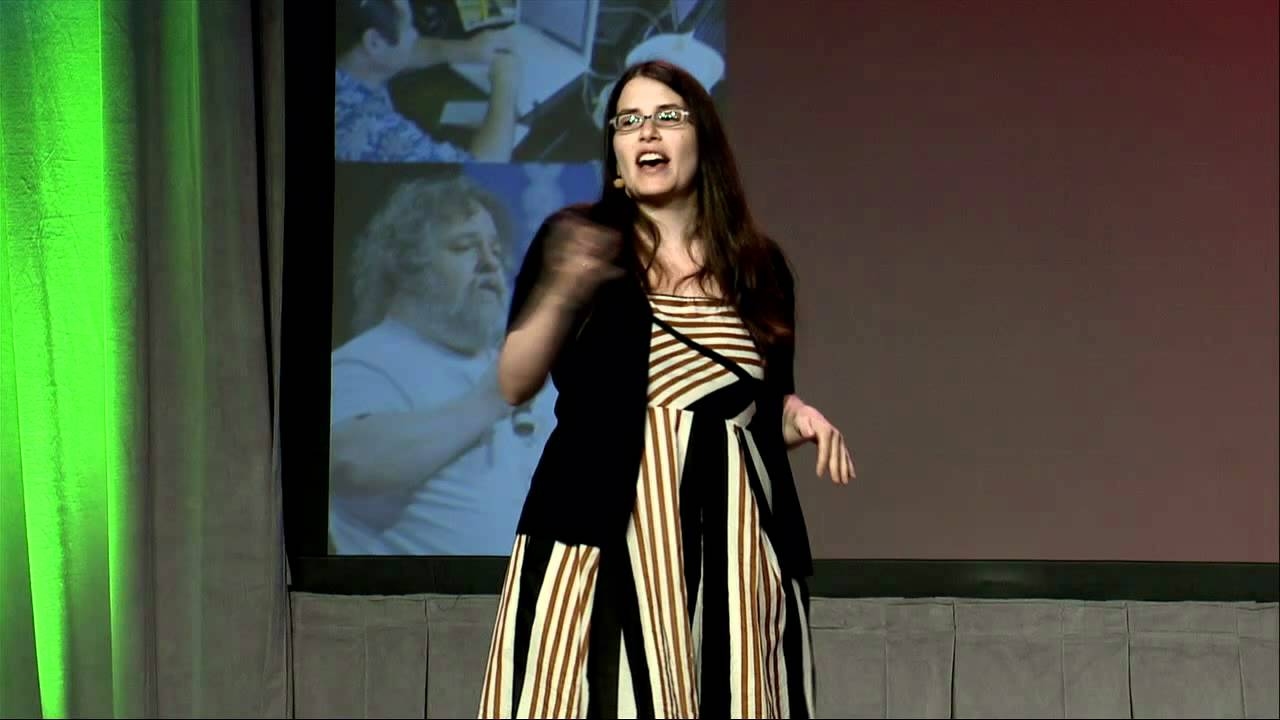
Karen Sandler opens her OSCON talk with a striking declaration she had long waited to deliver: “I am a cyborg lawyer running on proprietary software.” She explains that until about a month prior, she served as general counsel at the Software Freedom Law Center (SFLC). A few years earlier, she discovered that she had an enlarged, obstructed heart—a condition known as hypertrophic cardiomyopathy. While she experienced no outward physical symptoms and felt completely capable in day-to-day life, the condition placed her at an exceptionally high risk of sudden cardiac arrest, known clinically as “sudden death.” Even mundane activities carried dread; she could not sprint to catch a bus without the terrifying knowledge that she might collapse.
To mitigate this fatal risk, her physicians prescribed medication and strongly urged her to receive an implantable cardioverter-defibrillator (ICD) and pacemaker. The device functions as an internal safety net, ready to shock her heart back into rhythm should she collapse, sparing her the gamble of hoping an external automated external defibrillator (AED) and a competent bystander might be nearby. Yet confronting the surgery triggered severe personal reckoning. Sandler struggled with the unsettling identity shift of literally becoming a cyborg, uncomfortable with the prospect of having a mechanical device implanted into her body and screwed directly into her heart muscle. Over time, she reconciled herself to the idea—thinking she could be a “cyborg for good”—partly because living un-implanted was agonizing for her family and friends, who lived in constant terror that she might drop dead on a simple afternoon walk.
[02:40](https://www.youtube.com/watch?v=nFZGpES-St8&t=160s) “What Does It Run?”: Confronting Doctors, Reps, and Manufacturers
When Sandler finally met with her electrophysiologist to proceed with the implant, her professional background in software freedom abruptly collided with standard medical practice. The doctor slid a sample device across the table, pitching its compact, unobtrusive form factor. Sandler responded with a question that completely derailed the consultation:
> “I said great, what does it run?”
Her electrophysiologist looked at her as if she were insane, her mother stared in disbelief, and the entire room ground to a halt. When Sandler pressed further, asking about the software running on the hardware, who audited it, and whether she could inspect the source code, the staff was flabbergasted. The clinic brought in medical device sales representatives from two separate manufacturers who happened to be on-site. Unaccustomed to such inquiries, the representatives became noticeably nervous and offered zero answers.
Refusing to drop the matter, Sandler personally phoned all three major manufacturers of pacemakers and defibrillators. She pleaded her case as an incoming patient about to connect their hardware to her heart, asking to inspect the code to verify its integrity, even offering to sign a Non-Disclosure Agreement (NDA). None of the manufacturers possessed any procedure or willingness to handle her request. Trapped between the absolute refusal of the companies to disclose proprietary code and the looming reality that delay could literally cost her life, Sandler relented and underwent the implantation surgery.
[04:35](https://www.youtube.com/watch?v=nFZGpES-St8&t=275s) Bugs, FDA Loopholes, and the Legal Black Hole of Preemption
Following surgery, Sandler returned to the Software Freedom Law Center determined to investigate the safety and governance of medical device software. She submitted multiple Freedom of Information Act (FOIA) requests to the U.S. Food and Drug Administration (FDA), which remained unanswered years later. Delving into academic studies, Sandler encountered sobering realities about software engineering. Drawing on metrics from the Software Engineering Institute estimating approximately one bug for every 100 lines of code, she realized that complex medical devices inevitably host latent software defects. Reading detailed accounts of device malfunctions and patient deaths proved gut-wrenching, frequently forcing her to put the research aside to cope with the anxiety of hosting an identical device in her chest.
One study examining FDA software-related device recalls particularly stunned her: among cases where the underlying failure mechanism could be isolated and analyzed, researchers estimated that roughly 98% of failures could have been detected and prevented with basic all-pairs testing—a standard industry method for verifying multi-variable interactions. When Sandler looked into how the federal government regulates this software, she uncovered systemic regulatory failures:
```mermaid flowchart TD accTitle: FDA Medical Device Oversight Deficiencies accDescr: Flow diagram showing how device companies self-report while the FDA lacks source code and tort preemption blocks patient lawsuits.
subgraph Manufacturer["Device Manufacturers"] Code["Proprietary Source Code<br/>(Stored Internally)"] SelfReports["Self-Authored Test Reports<br/>(No Fixed Requirements)"] Code -->|"Internal summary"| SelfReports end
subgraph Regulator["Regulatory Oversight (FDA)"] FDA["Food & Drug Administration"] NoRepo["No Code Repository<br/>No Source Audits"] SelfReports -->|"Submitted to"| FDA FDA -.->|"Does not inspect"| Code FDA --- NoRepo end
subgraph LegalGap["Patient & Legal Reality"] Patient["Patient with Implant"] Preemption["State Tort Preemption<br/>(No Right to Sue for Defects)"] Patient -->|"Harm from failure"| Preemption end ```
- **Absence of independent code reviews:** The FDA does not routinely examine medical device source code prior to approval, reviewing code only after serious failures are already suspected. - **Reliance on corporate self-reporting:** Regulators rely almost entirely on summary reports written by the manufacturers evaluating their own proprietary software. - **Lack of concrete standards:** The FDA does not prescribe mandatory, standardized testing benchmarks, arguing that strict requirements might fail to anticipate unique edge cases in novel hardware. - **No centralized code escrow or archive:** Because the FDA never demands the actual source code, the agency maintains no central repository; the code remains exclusively on the servers of the private corporations that wrote it. - **Tort preemption protects manufacturers:** Because medical devices undergo federal premarket approval, established federal preemption case law strips patients of the right to bring product liability lawsuits under state tort law, leaving injured individuals with virtually no legal recourse.
[08:21](https://www.youtube.com/watch?v=nFZGpES-St8&t=501s) Insecure Wireless Broadcasts and the Moral Imperative for Open Source
Sandler emphasizes that patients currently endure “the worst of both worlds”: completely closed, unreviewable software on the inside, coupled with unsecured, vulnerable communications on the outside. Modern ICDs incorporate wireless transceivers designed to communicate with external programming units, yet these broadcasts often lack fundamental security safeguards. She cites security researchers who demonstrated that commodity, off-the-shelf radio equipment can intercept and manipulate ICD communications. Hackers were capable of commanding devices to deliver unwarranted, agonizing electric shocks, withholding life-saving therapies during cardiac arrest, or switching devices into a diagnostic test mode that drains the battery without triggering any alert. Because replacing a depleted battery requires invasive surgical extraction, deliberate battery drain represents a critical physical hazard.
> “I want my heart to be free and open. I want the software in my body to be, you know, reviewable by everyone.”
These revelations transformed Sandler's perception of software freedom from a noble intellectual principle into an urgent physical necessity. For Sandler, bodily autonomy requires code visibility: she wants the software regulating her heartbeat open to peer review by friends, family, independent academic researchers, conference attendees, and even commercial competitors incentivized to locate security vulnerabilities in each other's code so that life-saving software patches can be rapidly developed and deployed.
[09:58](https://www.youtube.com/watch?v=nFZGpES-St8&t=598s) The Blurring Line Between Daily Life and Critical Infrastructure
Karen Sandler emphasizes that relying on a single proprietary vendor is dangerous when stakes are life-or-death, but stresses that this vulnerability extends far beyond her own implanted medical device. As she puts it: “I don't want to rely on one company for something as essential as my heart and I think it's really not a quick leap to say that all of our life and society critical functionality should be the same way.” She points out that society already entrusts code to steer cars safely from point A to point B, tally ballots in voting machines, and manage global financial markets. Anything essential to how communities organize and conduct their collective lives now runs on software, making software freedom a fundamental public safety issue rather than an abstract technical debate.
At the same time, the distinction between what is strictly "life and society critical" and what constitutes ordinary software has become heavily blurred. A decade earlier, the audience in the room comprised the primary computer users, occasionally called upon to help relatives with basic word processing. In the intervening years, software adoption has completely saturated everyday life: parents, siblings, and extended family members rely on software for communication, creativity, and daily tasks. People who were uncomfortable around computers five years earlier are now constantly on Facebook and managing their days through smartphones. Because software has become integral to existence, user expectations have drastically shifted—if an application is not immediately intuitive, simple, clear, and functional right out of the box, users consider it fundamentally broken.
- **Examples of societal infrastructure dependent on software:** Automotive safety systems, electronic voting machines, and financial trading markets. - **Cultural shift over ten years:** From tech-savvy specialists assisting family members with word processors to ubiquitous smartphone usage and social networking across generations.
[11:27](https://www.youtube.com/watch?v=nFZGpES-St8&t=687s) GNOME 3 and the Need to Design for Ordinary Users
This shift in human dependence on software led directly to Sandler’s decision to transition from the Software Freedom Law Center to become the Executive Director of the GNOME Foundation roughly a month prior to the talk. Arriving just after the launch of GNOME 3, she showcases its visual interface to the audience. She recounts showing the desktop environment to her mother, whose immediate reaction was to ask, “Oh, when did Apple have a redesign?” Sandler humorously notes that she assured her mother it was far better, “magical,” “revolutionary,” and completely free, prompting her mother to conclude that it was software she could actually use.
The philosophy driving GNOME 3 was a complete rethink of the desktop interface, purposely designed around the workflow and expectations of regular users rather than catering strictly to traditional technical preferences. Sandler notes that software has woven itself into basic physical activities—from hailing taxicabs to logging fitness and diet. She highlights recent developments where smartphone applications interface directly with implanted insulin pumps to monitor blood glucose levels in real time. While technologically remarkable, it represents the exact same dilemma Sandler faces with her defibrillator: everyday consumers are now walking around with proprietary code interfacing directly with their bodies and health.
```mermaid flowchart TD accTitle: Expansion of Software into Critical Human Health accDescr: Diagram illustrating how software moved from specialist tools to everyday utilities and life-critical medical devices. subgraph Everyday["Everyday Adoption"] A["Communication & Social Media"] B["Hailing Taxis & Daily Logistics"] C["Diet & Exercise Tracking"] end subgraph Critical["Life-Critical Applications"] D["Automotive & Financial Systems"] E["Implanted Insulin Pumps"] F["Sandler's Heart Defibrillator"] end Everyday -->|"Blurring boundaries"| Critical ```
[13:00](https://www.youtube.com/watch?v=nFZGpES-St8&t=780s) A Crossroads for Software Freedom and a Call to Action
Sandler brings her narrative full circle, linking mobile health tracking back to the dilemma of her own heart. Because software that governs life- and society-critical functions is now embedded everywhere, society can no longer predict which devices or systems will suddenly become matters of survival. For this reason, users cannot afford to trust single private vendors with their wellbeing: “I don't want to rely on one company for any part of my life I don't want to rely on Medtronic for my heart and I don't want to rely on any other company for any other thing I want everybody to be able to see the source code and I especially want to see the source code.”
Looking out across the conference hall, Sandler notes the widespread presence of Apple laptops and challenges the audience directly. She urges attendees, as they close their MacBooks and head to the next sessions, to confront the software future they are creating for their families and future generations. She implores the community to build exclusively on free and open source software and open platforms, ensuring that society never finds itself permanently dependent on closed-source, proprietary code for the systems people rely on to stay alive. Sandler concludes with a practical appeal to support the ecosystem: adopt GNOME 3, support software nonprofits that form the bedrock of the movement, and become a Friend of GNOME.
- **Core demand:** Complete transparency and accessibility of source code for all software impacting personal safety and civil society. - **Final actions urged by Sandler:** - Build exclusively on free and open platforms rather than proprietary ecosystems. - Test and run GNOME 3. - Donate to non-profit organizations supporting free and open source software. - Join the GNOME Foundation's donor program by becoming a "Friend of GNOME."
## Notable quotes > [09:58](https://www.youtube.com/watch?v=nFZGpES-St8&t=598s) I don't want to rely on one company for something as essential as my heart and I think it's really not a quick leap to say that all of our life and society critical functionality should be the same way. — Karen Sandler
## Mentioned Karen Sandler, GNOME Foundation, GNOME 3, Software Freedom Law Center, Software Freedom Conservancy, Gibson, Dunn & Crutcher LLP, Clifford Chance, Columbia Law School, The Cooper Union, U.S. Food and Drug Administration, Software Engineering Institute, Apple, Medtronic, Facebook, OSCON 2011
## Video description Karen Sandler
Executive Director, GNOME Foundation
Karen M. Sandler is the Executive Director of the GNOME Foundation. Prior to joining GNOME, she was General Counsel of the Software Freedom Law Center. Karen continues to do pro bono legal work with SFLC and serves as an officer of both the Software Freedom Conservancy and SFLC. Before joining SFLC, she worked as an associate in the corporate departments of Gibson, Dunn & Crutcher LLP in New York and Clifford Chance in New York and London. Karen received her law degree from Columbia Law School in 2000, where she was a James Kent Scholar and co-founder of the Columbia Science and Technology Law Review. Karen received her bachelor's degree in engineering from The Cooper Union.
[Source](https://www.youtube.com/watch?v=nFZGpES-St8)