Tesla Autopilot Fails Self-Parking Tests as BMW and Audi Dominate
RSymons “RSEV”
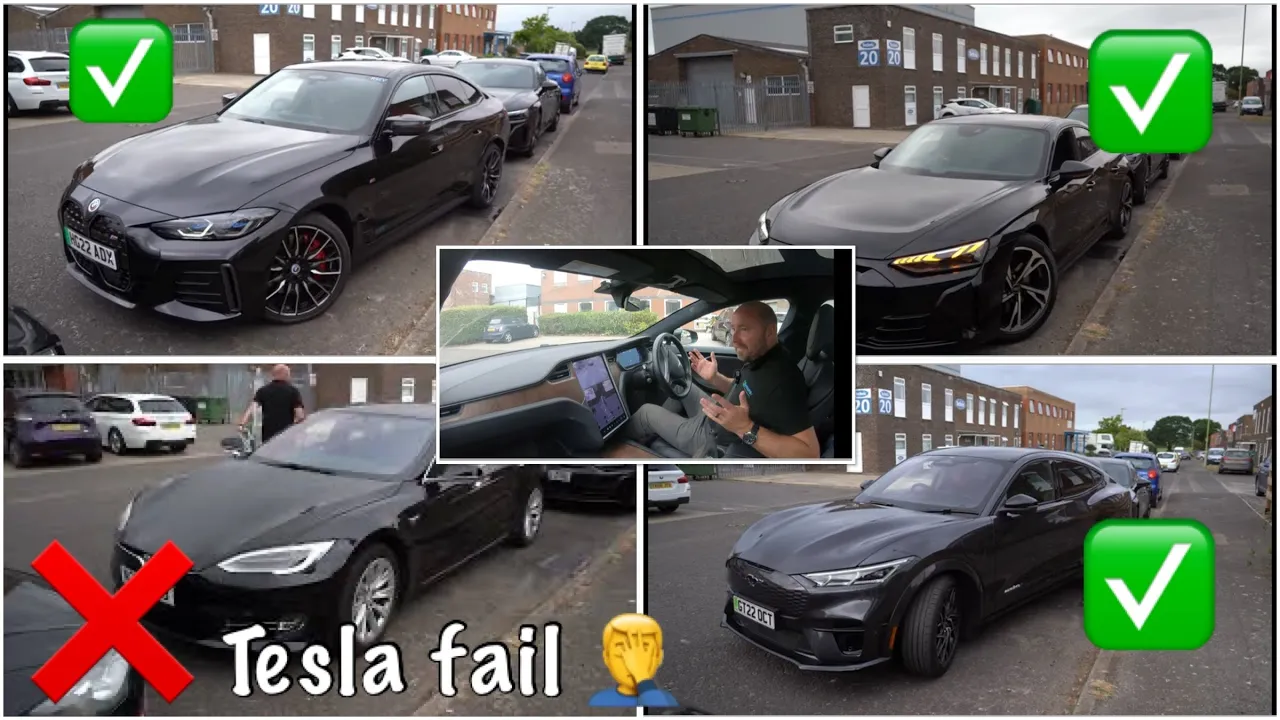
Legacy automakers' automated parking systems easily outperform Tesla's newer Autopilot and Full Self-Driving suites, which repeatedly freeze during parallel maneuvers and fail to detect perpendicular bays entirely.
AI-assisted summary of Self-Parking cars Tesla v Audi v Ford v BMW - test and comparison - are they any good? — original source. Check the original for full context.
Source published:
Key ideas
- In a head-to-head comparison between legacy automakers and Tesla, the BMW i4 M50, Audi e-tron GT, and Ford Mustang Mach-E successfully completed parallel and tight perpendicular parking challenges, while modern Teslas repeatedly failed. (28:20)
- Tesla's original Autopilot 1 (AP1) system significantly outperformed newer Autopilot 2 and Full Self-Driving (FSD) hardware in parallel parking, identifying tight bays immediately and executing clean entries without hesitation. (19:36)
- All three tested Tesla models (Model S AP1, Model S AP2/FSD, and Model 3) completely failed to detect or initiate a maneuver in a realistic, tight perpendicular multi-story parking bay scenario. (26:36)
- Modern Tesla vehicles demonstrated high sensitivity to pedestrians standing on adjacent pavements, causing phantom obstacle stops and abandoned maneuvers that left vehicles obstructing live traffic lanes. (9:10)
Detailed notes
## Background Published on YouTube by the RSymons “RSEV” channel on August 18, 2022, this video tests and compares automated self-parking systems across a lineup of popular electric vehicles. The channel description notes that the comparison pits the Audi e-tron GT, Ford Mustang Mach-E, and BMW i4 M50 against Tesla Models S and 3 (spanning Autopilot 1 and AP2/FSD hardware) across parallel and perpendicular scenarios to see if self-parking aids are genuinely practical.
## TL;DR Host Richard evaluates the automated self-parking capabilities of an Audi e-tron GT, BMW i4 M50, Ford Mustang Mach-E GT, and multiple Tesla models across real-world parallel and tight perpendicular parking challenges. The legacy manufacturers perform remarkably well: the BMW, Audi, and Ford quickly recognize spaces, execute tidy multi-point maneuvers, and protect their alloy wheels from curbs and pillars. In contrast, modern Teslas with Autopilot 2 and Full Self-Driving struggle with phantom pedestrian stops, stranded diagonal alignments, and complete failures to detect perpendicular multi-story bays. Ironically, an older Tesla Model S equipped with original Autopilot 1 effortlessly handles parallel parking, though the overall shootout concludes with traditional automakers soundly beating Tesla's automated parking technology.
## Atmosphere & style The video carries a relaxed, inquisitive, and hands-on dealership workshop vibe that steadily ramps up into nail-biting suspense whenever vehicles reverse inches away from concrete curbs and expensive alloy wheels. Richard delivers candid, conversational reactions, openly sharing his anxiety over rim damage and his mounting bafflement as his initial assumptions are dismantled. What begins as an expectation of Tesla dominance turns into an amusing, slightly exasperated comedy of errors as the newer Teslas saw uselessly at their steering wheels while traditional automakers pull off effortless, textbook maneuvers.
## Bulletin - [28:20](https://www.youtube.com/watch?v=nsb2XBAIWyA&t=1700s) In a head-to-head comparison between legacy automakers and Tesla, the BMW i4 M50, Audi e-tron GT, and Ford Mustang Mach-E successfully completed parallel and tight perpendicular parking challenges, while modern Teslas repeatedly failed. - [19:36](https://www.youtube.com/watch?v=nsb2XBAIWyA&t=1176s) Tesla's original Autopilot 1 (AP1) system significantly outperformed newer Autopilot 2 and Full Self-Driving (FSD) hardware in parallel parking, identifying tight bays immediately and executing clean entries without hesitation. - [26:36](https://www.youtube.com/watch?v=nsb2XBAIWyA&t=1596s) All three tested Tesla models (Model S AP1, Model S AP2/FSD, and Model 3) completely failed to detect or initiate a maneuver in a realistic, tight perpendicular multi-story parking bay scenario. - [09:10](https://www.youtube.com/watch?v=nsb2XBAIWyA&t=550s) Modern Tesla vehicles demonstrated high sensitivity to pedestrians standing on adjacent pavements, causing phantom obstacle stops and abandoned maneuvers that left vehicles obstructing live traffic lanes.
## Key takeaways - [00:41](https://www.youtube.com/watch?v=nsb2XBAIWyA&t=41s) The Audi e-tron GT successfully parallel parks using a continuous dead-man's switch button hold, managing tight gaps with controlled shuffles and safe wheel-to-curb margins. - [04:37](https://www.youtube.com/watch?v=nsb2XBAIWyA&t=277s) The BMW i4 M50 provides a fully hands-off and pedal-off parking experience upon screen confirmation, automatically indicating and parking cleanly inches from obstacles. - [06:40](https://www.youtube.com/watch?v=nsb2XBAIWyA&t=400s) The Ford Mustang Mach-E GT requires shifting into Neutral and holding a console button, delivering predictable, steady maneuvers and allowing mirror adjustments during operation. - [09:10](https://www.youtube.com/watch?v=nsb2XBAIWyA&t=550s) Modern Tesla Autopark lacks a manual scanning button, requiring vehicles to crawl below 12 mph to trigger space detection prompts. - [09:10](https://www.youtube.com/watch?v=nsb2XBAIWyA&t=550s) Pedestrian false-positives frequently disrupt modern Tesla Autopark, causing the Model S and Model 3 to freeze, abort, and leave the car parked diagonally in the street. - [13:24](https://www.youtube.com/watch?v=nsb2XBAIWyA&t=804s) Even with an enlarged parking bay, the AP2 Model S failed to complete a two-point parallel park, continuously sawing at the wheel and drifting back out into the roadway. - [16:00](https://www.youtube.com/watch?v=nsb2XBAIWyA&t=960s) The Tesla Model 3 locks drivers out of manual side-mirror adjustments on the central touchscreen while automated parking maneuvers are active. - [19:36](https://www.youtube.com/watch?v=nsb2XBAIWyA&t=1176s) Tesla's older Mobileye-powered Autopilot 1 vastly outshines newer in-house FSD computer suites at parallel parking, entering tight bays cleanly on the first pass. - [20:45](https://www.youtube.com/watch?v=nsb2XBAIWyA&t=1245s) The BMW i4 M50 easily handled a simulated tight multi-story perpendicular bay, centering itself on the first attempt with a single corrective shuffle. - [21:54](https://www.youtube.com/watch?v=nsb2XBAIWyA&t=1314s) Despite its wide footprint, the Audi e-tron GT successfully navigated the perpendicular bay, actively recalibrating around obstacles to avoid a rear pillar. - [24:26](https://www.youtube.com/watch?v=nsb2XBAIWyA&t=1466s) The Ford Mustang Mach-E executed the perpendicular bay test squarely on its first attempt, maintaining generous buffers around adjacent hazards. - [26:36](https://www.youtube.com/watch?v=nsb2XBAIWyA&t=1596s) Every Tesla tested (Model S AP1, Model S AP2/FSD, and Model 3) struck out completely in perpendicular parking, repeatedly failing to detect the bay. - [28:20](https://www.youtube.com/watch?v=nsb2XBAIWyA&t=1700s) Buyers relying on Tesla's expensive Enhanced Autopilot or FSD upgrades for self-parking receive a flaky real-world system compared to out-of-the-box solutions from BMW, Audi, and Ford.
## Detailed walkthrough ### [00:01](https://www.youtube.com/watch?v=nsb2XBAIWyA&t=1s) Introduction and Lineup Overview
Richard kicks off the comparison by gathering an assortment of modern electric vehicles equipped with automated self-parking systems. Remembering back to his first Tesla fitted with Autopilot 1 (AP1), which featured self-parking years ago, he wants to see how far the technology has come across different manufacturers. The day's lineup features an Audi e-tron GT equipped with the optional Comfort Pack, a Ford Mustang Mach-E GT, a BMW i4 M50, and a Tesla Model S. The plan is to put each car through parallel and perpendicular parking scenarios with real-world curb alignments and tight spaces to determine whether these automated aids are genuine conveniences or mere gimmicks.
Looking ahead to the upcoming tests, Richard outlines the core question: “So we're going to try a couple different scenarios for each parallel and perpendicular parking and see just how they work and how well they work, is it something you're really going to use?”
```mermaid flowchart TD accTitle: EV Self-Parking Interaction Workflows accDescr: Comparison of activation mechanics between button-hold systems like Audi and Ford versus hands-off systems like BMW and Tesla. subgraph HoldSwitch ["Continuous Hold Systems (Audi & Ford)"] A1["Drive past bay scanning for gap"] --> A2["Select bay & switch gear (N or R)"] A2 --> A3["Hold Park Assist button for entire maneuver"] end subgraph HandsOff ["Single Confirmation Systems (BMW & Tesla)"] B1["Drive past bay scanning automatically"] --> B2["Tap screen prompt or select Reverse"] B2 --> B3["Car controls steering, throttle, and braking independently"] end ```
[00:41](https://www.youtube.com/watch?v=nsb2XBAIWyA&t=41s) Audi e-tron GT: Steady Execution in Tight Spaces
Testing begins with the Audi e-tron GT. To initiate the system, Richard drives past the parking space while pressing the dashboard park assist button, which starts actively scanning the roadside for suitable gaps. Once the car detects a gap that fits its substantial footprint, it displays an on-screen graphic illustrating the intended trajectory. To perform the maneuver, the driver must continuously hold down the park assist button, functioning like a dead-man's switch. The e-tron GT reverses smoothly and steadily into the space, tucking in close to the curb without risking the expensive alloy wheels.
``` [Parked Car] ------- [ Target Bay ] ------- [Parked Car] | [Audi e-tron GT reverses] ```
To raise the stakes, the team tightens the gap between the parked vehicles. Even with reduced clearance, the Audi prompts the maneuver and proceeds with high confidence. Richard watches the rear wheels anxiously as the car makes a succession of controlled shuffles back and forth. Although he feels his heart skip a beat near the curb, the car halts independently with millimetric precision and signals completion. Richard then tests his own manual parking ability in the same space; despite the e-tron GT's clear front and rear camera feeds, he struggles with persistent proximity beepers and leaves the car noticeably further out from the curb than the automated system managed.
Richard delivers his verdict on the Audi's parallel parking performance: “Happy with that, I'll call that a pass for the Audi and the parallel, it's quite nice speed; the only thing I thought as it just came in in the back curb there, I'd like to just had it slow down a little bit there really, but that is actually a good result, it's a pass.”
- **System Activation:** Dashboard Park Assist button initiates gap scanning. - **Driver Input Requirement:** Continuous physical press on the Park Assist button throughout maneuvering. - **Visual Feedback:** Overhead graphic trajectory and automatically alternating front/rear camera feeds. - **Result:** Successful dock on standard bay; completed a tight bay with multiple controlled shuffles.
[04:37](https://www.youtube.com/watch?v=nsb2XBAIWyA&t=277s) BMW i4 M50: Stressing Over Wheels and Smooth Maneuvering
Next up is the BMW i4 M50, a vehicle Richard has never used the self-parking function on before. The BMW monitors for available roadside bays autonomously. As soon as Richard rolls past the bay, a chime sounds and a parking prompt appears on the center touchscreen. Selecting "Park" hands over complete control—unlike the Audi, the driver does not need to hold down a button. The BMW automatically engages the turn indicator, checks its surroundings, and initiates its reversing arc.
Watching the car steer towards a raised concrete curb proves nail-biting for Richard, who worries intensely about scuffing the fresh factory alloys. The i4 maneuvers assertively, closing down distances with authority before braking smoothly just inches short of obstruction. On a second run in a tighter gap, the BMW again signals automatically, judges the rear corner perfectly, and backs in cleanly, stopping with a safe, sensible margin to the car behind and alongside the curb.
Relieved that the car protected its rims, Richard praises the car's judgment: “That also has done a pretty excellent job with that to be fair, I was just watching this wheel as it came back and it stopped just the right point.”
- **Control Level:** Fully hands-off and pedal-off after pressing "Park" on the iDrive screen. - **Automation Details:** Automatically activates the turn indicator when commencing the maneuver. - **Curb Proximity:** Stops decisively at the edge of the curb without brushing the wheel rims.
[06:40](https://www.youtube.com/watch?v=nsb2XBAIWyA&t=400s) Ford Mustang Mach-E GT: Step-by-Step Prompts and Confident Parking
Moving into the Ford Mustang Mach-E GT, Richard explores its self-parking suite for the first time. As he cruises past the row of cars, the instrument cluster announces that it is scanning before flashing a clear notification: "Space found - Stop". The vehicle displays step-by-step instructions on the screen: release the steering wheel, shift the rotary gear selector into Neutral (N), release the footbrake, and press and hold the dedicated physical park assistance button located on the center console.
The Mach-E GT carries out the parking routine with calm, progressive steering and steady speed. During the maneuver, Richard is able to adjust his side mirrors on the fly to inspect the wheel-to-curb gap without interrupting the parking routine. The Mach-E executes a couple of clean shuffles, creeps close to the car in front to square itself away, and automatically shifts into Park (P) once aligned. Richard repeats the test on a tighter bay; the Ford handles it predictably, offering sharp 360-degree camera views and a secure, measured pace.
Richard summarizes the Mustang's performance with genuine satisfaction: “Like that's fine, it's good, it does at a steady speed, you feel quite comfortable with it, the cameras are good, so Mustang Mach-E not bad, not bad at all.”
- **Activation Sequence:** Stop vehicle -> Release steering wheel -> Shift into Neutral (N) -> Release footbrake -> Hold Park Assist button. - **Safety Interlock:** Automatic engagement of Park (P) upon completion. - **Convenience Feature:** Side mirror tilt and adjustment remains operational during active self-parking.
[09:10](https://www.youtube.com/watch?v=nsb2XBAIWyA&t=550s) Tesla Model S: Hesitation, Pauses, and Abandoned Attempts
Richard steps into the Tesla Model S, operating under the standard Autopilot parameters where the car scans for spaces while traveling below 12 mph. Once a bay is recognized, a small "P" icon appears on the digital instrument cluster. Selecting Reverse (R) prompts a blue "Start" button on the touchscreen. On the very first run, the Tesla begins reversing, suddenly jerks its steering wheel in an awkward direction, brakes abruptly in the middle of the road, and stalls out in deep indecision. With traffic approaching from behind, Richard is forced to cancel the operation and let oncoming vehicles pass.
``` [Road Traffic] ---> [ Tesla Model S (Frozen in middle of road) ] \ \--- [ Empty Bay ] ```
Subsequent attempts to get the Model S to re-engage prove deeply frustrating. Richard crawls past the exact same bay at speeds between 6 mph and 10 mph, but the car repeatedly fails to register the space at all. After driving back and forth multiple times and wondering if the bay needs to be enlarged, the Tesla finally illuminates the "P" symbol. Richard engages reverse and taps start; the car turns the wrong way initially, begins angling in, and then suddenly freezes with the alert: "Autopark paused for pedestrian". The system has locked onto the cameraman, Gints, standing safely back on the roadside. Even after Gints steps back, the Tesla shuffles back and forth endlessly, steering sideways and leaving its rear quarters protruding diagonally into the road.
Watching the car fail to rectify its diagonal stance, Richard groans in exasperation: “I think I'm more in the road than I'm in the parking space.”
- **Detection Requirement:** Vehicle must crawl below 12 mph; no manual button to force gap scanning. - **Pedestrian Sensitivity:** False-pauses and aborts trajectory due to a bystander standing on the pavement. - **Outcome:** Aborted first run due to freezing; crooked, road-blocking alignment on the second attempt.
[13:24](https://www.youtube.com/watch?v=nsb2XBAIWyA&t=804s) Tesla Model S: Re-testing on a Wider Space and Shuffling Nowhere
Determined to give the Tesla a fair chance, Richard adjusts the bay markers to open up a visibly wider parking space. On the first pass past this generous gap, the Model S registers the space right away. Richard presses "Start" on the touchscreen, hoping for a clean, textbook parallel park. However, the car turns into the bay noticeably late, leaving a wide gulf between its passenger wheels and the curb.
Instead of completing a basic two-point entry, the Model S halts, re-evaluates, and begins pulling all the way back out into the open lane as if starting entirely from scratch. Richard jokes that the car has given up on parking altogether and decided to drive back to the workshop. It swings back in at an altered angle, yet each subsequent forward and backward shuffle fails to bring the car any closer to the curb. Instead of tucking in neatly, the Tesla continuously saws at the steering wheel while stranded at an awkward angle out in the thoroughfare.
Watching the vehicle's persistent, ineffective maneuvers, Richard reflects on how thoroughly the day defied his initial assumptions: “You know what I thought when we started this today, oh the Tesla would do a great job, the others just won't be brilliant, and so far it's proving the other way around.”
- **Bay Adjustment:** Expanded gap between reference vehicles to eliminate clearance excuses. - **Maneuver Behavior:** Overshoots entry angle, drives back out into the roadway, and executes repetitive micro-shuffles without correcting curb distance. - **Verdict:** Complete failure to achieve a road-legal parallel park.
[16:00](https://www.youtube.com/watch?v=nsb2XBAIWyA&t=960s) Tesla Model 3 Parallel Parking Struggles and Pedestrian Sensitivity
Returning to the parallel parking test with a Tesla Model 3, Richard expects a solid showing since he has used the system successfully before. However, the car immediately struggles to locate the space between vehicles. After driving past the gap without detection, he circles back to approach more slowly while monitoring the screen for the elusive "P" icon. Once the parking prompt finally appears, he engages reverse and taps start. The Model 3 begins the maneuver with a peculiar initial swing away from the curb before reversing back in, but the process is repeatedly interrupted.
The maneuver quickly becomes halting and uncertain. Richard wishes he could angle the passenger wing mirror downward to verify his clearance, but the central touchscreen locks him out of mirror adjustments while the parking sequence is active. Worse, the car keeps braking and freezing because it detects a pedestrian on the nearby sidewalk. His colleague Sergiu steps further and further back, but the Tesla continues to halt for phantom footpath traffic across the street. Richard vents his frustration at the logic: “So if you're trying to park on a high street with anyone with a pavement it just isn't going to do it.”
After several jerky starts and stops, Richard aborts and lines up for another run in what should be an easy gap for a car of the Model 3's footprint. The result is just as disappointing; the car gives up prematurely, leaving the vehicle stranded diagonally with its rear half protruding into the live driving lane. Richard looks at the final resting position in disbelief, noting, “That's not really acceptable is it.”
[19:36](https://www.youtube.com/watch?v=nsb2XBAIWyA&t=1176s) Tesla Model S Autopilot 1 Shows Up Newer Hardware
To determine whether the older Mobileye-based hardware performs better, Richard retrieves an original Autopilot 1 (AP1) Tesla Model S from the showroom to take on the exact same tight parallel gap that baffled the newer Autopilot 2 / Full Self-Driving (AP2/FSD) vehicles. The difference is instantaneous. Driving alongside the gap, the AP1 Model S spots the parking space immediately without needing repeated creeping runs. Richard puts the car in reverse, taps start, and lets the steering wheel spin into action.
Unlike the timid, start-stop motions of the AP2 cars, the AP1 Model S maneuvers with authority. It commits to its angles, enters the space cleanly, and executes a single confident forward shuffle to square itself neatly against the curb. Inside the cabin, the steering inputs feel purposeful rather than hesitant. Inspecting the final alignment, Richard observes that the original system completely outclasses Tesla’s newer in-house vision suites in this scenario: “We are consistently AP1 is the better one it's the better Tesla it's better than the FSD newer cars Model 3 or Model S so AP1 for the win.”
- **AP1 vs. AP2/FSD**: The legacy AP1 car identified the parking space on the very first pass, whereas the AP2 Model S and Model 3 failed to recognize or complete the maneuver in the same space. - **Steering behavior**: AP1 executed a direct, fluid reverse arc and one alignment correction without freezing or phantom obstacle braking.
[20:45](https://www.youtube.com/watch?v=nsb2XBAIWyA&t=1245s) Perpendicular Parking: BMW i4 M50
```mermaid flowchart TD accTitle: Perpendicular Parking Test Course accDescr: Layout of the simulated multi-story bay parking challenge featuring obstacles and adjacent vehicles.
subgraph Obstacles ["Tight Multi-Story Simulation"] A["Adjacent Vehicle<br/>(Sacrificial Land Rover)"] B["Target Parking Bay"] C["Opposing Wall & Structural Pillar"] end
Approach["Vehicle Approach & Scanning"] --> B B --> Shuffling["Multi-point Shuffling & Obstacle Avoidance"] Shuffling --> Parked["Centered in Bay"] ```
Moving on from parallel parking, the team transitions to simulating a perpendicular bay parking challenge reminiscent of a tight UK multi-story car park. The bay is hemmed in by a wall featuring a prominent structural pillar behind, another car parked ahead, and a "sacrificial" Land Rover stationed directly adjacent to the target bay. The BMW i4 M50 is the first contender to tackle the course. Richard initiates the space search and drives forward past the bay.
The BMW's system chimes almost immediately, registering the bay on its first pass. Richard selects reverse, taps the parking assist prompt, and takes his hands off the wheel. The i4 navigates the tight approach cleanly, swinging its nose clear of the opposing vehicle while steering smoothly around the sacrificial Land Rover. With a single tight forward shuffle to correct its track, the BMW tucks itself straight into the stall, avoiding both the wall pillar and a stray piece of fruit on the ground, leaving Richard thoroughly impressed with its speed and precision.
[21:54](https://www.youtube.com/watch?v=nsb2XBAIWyA&t=1314s) Perpendicular Parking: Audi e-tron GT
Next up is the Audi e-tron GT, a substantially wider and longer vehicle that faces a steep spatial challenge in the simulated parking bay. Richard presses the parking assist button on the console to activate bay scanning and creeps forward. The Audi identifies the opening right away and automatically pre-selects perpendicular bay parking. Following the on-screen instructions, Richard presses the brake pedal and holds down the physical parking assist button to let the car steer and manage its own pedals.
The Audi maneuvers aggressively into the slot with rapid wheel movement, taking advantage of its tight steering lock. As it cuts close to the vehicle in front, the dashboard flashes an obstacle detection alert and pauses the sequence. Richard maintains pressure on the parking button, and the car recalibrates, reversing back and angling away from the hazard. As the tail edges closer to the concrete wall pillar, Richard gets nervous watching the side mirror and taps the brake himself. Reassured by spotters that there is still clearance, he allows the car to finalize its positioning. While the wide e-tron GT ends up parked slightly biased toward the right side of the bay to clear the pillar, Richard awards it a solid pass for its quick pace and obstacle awareness.
- **System controls**: The Audi requires the driver to continuously depress the physical parking assist button while the vehicle manages steering, throttle, and braking automatically. - **Driver intervention**: Richard braked manually out of caution when the pillar appeared close in the wing mirror, but the car's automated trajectory had calculated adequate clearance.
[24:26](https://www.youtube.com/watch?v=nsb2XBAIWyA&t=1466s) Perpendicular Parking: Ford Mustang Mach-E
The Ford Mustang Mach-E takes the third slot in the perpendicular parking evaluation. Richard engages Ford’s Park Assist Plus via the infotainment screen and sets the target mode to perpendicular parking. As the crossover drives along the corridor, the sensors locate the space without delay. The instrument cluster instructs Richard to drive slightly forward, bring the car to a stop, release the steering wheel, shift the rotary gear selector into Neutral, and hold down the physical park button.
The Mustang rolls backwards into the bay on a wider arc than the Audi or BMW, leaving a generous safety buffer from the car ahead. Realizing it oversteered slightly on the initial angle, the Mach-E smoothly pulls forward to correct its trajectory before backing straight in between the lines. It halts neatly ahead of the rear pillar. Richard squeezes out to inspect the positioning, declaring it an exceptional, centered park. Richard highlights the Ford's consistency: “So the Mustang Mach-E found it every time nice parking on attempt one it had to kind of correct itself a bit but it did it perfectly that one straight in no problem so I think that's good.”
| Vehicle | Space Recognition | Maneuver Effort | Final Result | |:--- |:--- |:--- |:--- | | **BMW i4 M50** | Immediate chime on pass 1 | Hands-free, 1 shuffle forward | Perfectly centered, fast and effortless | | **Audi e-tron GT** | Immediate auto-detection | Hold console button; paused for proximity | Successful; slightly biased right to dodge pillar | | **Ford Mustang Mach-E** | Immediate detection | Shift to N, hold console button; 1 corrective forward pull | Squarely centered, safe margins | | **Tesla Model S (AP1)** | Failed to detect | N/A (did not register space) | Failed (no maneuver offered) | | **Tesla Model 3** | Failed across multiple passes | N/A (did not register space) | Failed (no maneuver offered) | | **Tesla Model S (AP2/FSD)** | Failed across multiple passes | N/A (did not register space) | Failed (no maneuver offered) |
[26:36](https://www.youtube.com/watch?v=nsb2XBAIWyA&t=1596s) Perpendicular Parking: The Tesla Fleet Strikes Out
The perpendicular evaluation concludes by running all three Teslas through the exact same course, beginning with the AP1 Model S that excelled at parallel parking. Richard drives past the bay at creeping speeds, waiting for an indicator on the instrument cluster, but the car fails to register the space. Multiple passes in both directions produce no parking prompt whatsoever. Richard wonders if the system's older logic simply demands a much wider opening for a vehicle of its size.
Next, Richard attempts the run in the Model 3, hoping its smaller footprint and newer camera array will identify the bay. Despite driving slow, methodical passes while watching the touchscreen for the small "P" symbol, the car remains oblivious to the open bay. He points out that while the simulated environment is tight, it accurately mirrors standard UK multi-story parking structures. Finally, the 2019 Model S equipped with the Full Self-Driving computer takes its turn. It duplicates the exact same failure, rolling past the opening repeatedly without registering an available space. All three Teslas finish the perpendicular test without initiating a single parking attempt.
[28:20](https://www.youtube.com/watch?v=nsb2XBAIWyA&t=1700s) Final Comparison and Wrap-Up
Reviewing the day's testing, Richard reflects on the stark divide between Tesla’s autonomous reputation and its real-world self-parking performance. He notes that while both Audi and Tesla feature remote summoning capabilities from outside the vehicle via smartphone apps, those systems proved too inconsistent to include in this shootout and will be reserved for a dedicated follow-up video.
When it comes to onboard self-parking, the legacy automotive manufacturers decisively outperformed Tesla. The BMW i4 M50, Audi e-tron GT, and Ford Mustang Mach-E all detected spaces quickly, navigated tight obstacles, and parked effectively. In contrast, modern Teslas struggled with phantom pedestrians during parallel attempts and completely failed to detect perpendicular multi-story bays. Richard expresses his disappointment with the premium software packages: “If you've bought Enhanced Autopilot or the FSD package and you're dependent on the self parking systems well I think they're a little bit flaky but maybe we see some improvements with some of the software updates that Tesla do continuously.” He concludes by giving full credit to BMW, Audi, and Ford for engineering systems that work straight out of the box.
[29:38](https://www.youtube.com/watch?v=nsb2XBAIWyA&t=1778s) Wrapping Up the Self-Parking Shoot and Signing Off
Richard brings the testing session to a close, explaining that the team took advantage of the morning to run through these self-parking experiments before needing to turn their attention back to their regular day-to-day operations. Reflecting on the morning's trials, he says: “This is something that we've been able to experiment with this morning whilst we've been in here but we've got to go and do some other work now this afternoon so I'm going to call it the end for that video.”
He wraps up by hoping the comparison proved both interesting and useful for viewers evaluating the real-world capabilities of these automated parking systems. Before signing off, he gives a parting reminder to anyone in the United Kingdom looking to buy or sell an electric vehicle to reach out through the links provided in the description or directly visit their dealership website at rsev.com.
## Notable quotes > [28:20](https://www.youtube.com/watch?v=nsb2XBAIWyA&t=1700s) If you've bought Enhanced Autopilot or the FSD package and you're dependent on the self parking systems well I think they're a little bit flaky but maybe we see some improvements with some of the software updates that Tesla do continuously. — Richard
## Mentioned Audi e-tron GT, BMW i4 M50, Enhanced Autopilot, Ford Mustang Mach-E GT, Full Self-Driving, Gints, Land Rover, Mobileye, Richard Symons, RSymons RSEV, Sergiu, Tesla Autopilot 1, Tesla Autopilot 2, Tesla Model 3, Tesla Model S
## Video description NEW TESLA DISCOUNT CODE - available now when you order a new Tesla! Click through (or copy paste) this link below; https://ts.la/r703427 https://ts.la/tom142300 https://ts.la/sergiu26037
(Promotion at time of writing)
#selfparking #autodrive
Hi everyone welcome!
So I happened to have a handful of cars with “self-parking” capability so we rigged up some tests to see just how good these systems are.
Tesla Model S and 3 including AP1 v AP2 Audi E-tron GT Ford Mustang Mach-E BMW i4 M50
Parallel and perpendicular parking tested.
Autopilot 1 is better than AP with Enhanced AP/Full Self Driving
It’s one test where Tesla certainly don’t win!!
Hope you enjoy the video.
Richard
NEW TESLA DISCOUNT CODE - available now when you order a new Tesla! Click through (or copy paste) this link below; https://ts.la/r703427 (Promotion at time of writing)
Simply search RSEV or copy the links below Instagram: https://instagram.com/rsymonsltd/ Facebook: https://www.facebook.com/RSymonsLTD Website: https://www.rsymons.co.uk/
https://www.instagram.com/littlethingsivemade for great gift ideas and art commissions
Our chosen Charity: www.seesaw.org.uk - grief support for young people
[Source](https://www.youtube.com/watch?v=nsb2XBAIWyA)