Trump Attacks Germany Over Russian Gas Reliance at NATO Summit
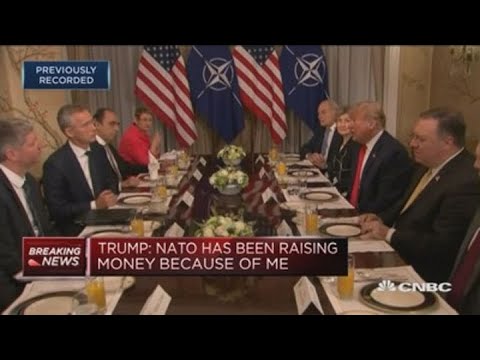
CNBC International Live
Trump claims Germany has compromised its independence and NATO security by funding Moscow through gas pipelines while leaving U.S. taxpayers to shoulder European defense costs.
AI-assisted summary of Germany is 'totally controlled' by Russia, Trump says | Squawk Box Europe — original source. Check the original for full context.
Source published:
Key ideas
- President Donald Trump accused Germany of being 'totally controlled by Russia' due to its reliance on Russian energy imports and support for new pipeline projects. (0:00)
- Trump highlighted a stark defense burden-sharing imbalance, contrasting the U.S. defense expenditure of 4.2% of GDP against Germany's commitment of just over 1%. (0:00)
- Trump rejected Germany's extended timeline to implement minor defense spending increases by 2030, urging the wealthy nation to increase military funding immediately. (0:00)
- NATO Secretary General Jens Stoltenberg defended alliance cohesion, asserting that 29 sovereign nations can hold differing views on energy while remaining stronger together. (3:21)
Detailed notes
## Background This video was published on YouTube by CNBC International Live on July 11, 2018. According to the page description, the clip covers President Donald Trump's sharp criticism of Germany for paying billions of dollars to Russia.
## TL;DR During a bilateral breakfast at the Brussels NATO summit, U.S. President Donald Trump confronts NATO Secretary General Jens Stoltenberg over Germany's energy reliance on Russia, asserting that Berlin is 'totally controlled' by Moscow due to multi-billion-dollar pipeline agreements. Trump criticizes the disparity between Germany's low defense spending and the heavy security burden carried by American taxpayers, insisting Berlin could immediately increase its contributions. Stoltenberg responds by defending NATO's historical unity and sovereign diversity, pointing out that allies maintained trade even during the Cold War. Trump rejects the analogy, arguing that strategic energy dependency uniquely compromises alliance security, before the broadcast concludes with a brief CNBC Middle East outro.
## Atmosphere & style The exchange carries a tense, confrontational, and unvarnished diplomatic tone, playing out in real time over what was ostensibly a routine working breakfast. Trump dominates the conversation with an aggressive, blunt, and unrelenting delivery, visibly brushing past diplomatic decorum to vent long-standing grievances. In contrast, Stoltenberg maintains a composed, patient, and measured defense of multilateralism, creating a gripping, high-stakes dynamic where standard diplomatic pleasantries are stripped away.
## Bulletin - [00:00](https://www.youtube.com/watch?v=nu57D9YcIk0&t=0s) President Donald Trump accused Germany of being 'totally controlled by Russia' due to its reliance on Russian energy imports and support for new pipeline projects. - [00:00](https://www.youtube.com/watch?v=nu57D9YcIk0&t=0s) Trump highlighted a stark defense burden-sharing imbalance, contrasting the U.S. defense expenditure of 4.2% of GDP against Germany's commitment of just over 1%. - [00:00](https://www.youtube.com/watch?v=nu57D9YcIk0&t=0s) Trump rejected Germany's extended timeline to implement minor defense spending increases by 2030, urging the wealthy nation to increase military funding immediately. - [03:21](https://www.youtube.com/watch?v=nu57D9YcIk0&t=201s) NATO Secretary General Jens Stoltenberg defended alliance cohesion, asserting that 29 sovereign nations can hold differing views on energy while remaining stronger together.
## Key takeaways - [00:00](https://www.youtube.com/watch?v=nu57D9YcIk0&t=0s) Trump confronted NATO Secretary General Jens Stoltenberg in Brussels over European energy reliance on Moscow. - [00:00](https://www.youtube.com/watch?v=nu57D9YcIk0&t=0s) Trump criticized the U.S. footing the bill to protect European allies who simultaneously funnel billions of dollars into Russian energy coffers. - [00:00](https://www.youtube.com/watch?v=nu57D9YcIk0&t=0s) Trump singled out former German Chancellor Gerhard Schröder's leadership role in Russian pipeline ventures. - [00:00](https://www.youtube.com/watch?v=nu57D9YcIk0&t=0s) Trump asserted that receiving 60% to 70% of its energy from Russia makes Germany captive to Moscow's leverage. - [00:00](https://www.youtube.com/watch?v=nu57D9YcIk0&t=0s) A significant spending gap was underscored between the U.S. allocating 4.2% of GDP to defense versus Germany's contribution of roughly 1%. - [00:00](https://www.youtube.com/watch?v=nu57D9YcIk0&t=0s) Trump blamed past U.S. administrations for decades of inaction regarding European defense spending obligations. - [00:00](https://www.youtube.com/watch?v=nu57D9YcIk0&t=0s) Trump dismissed Germany's planned defense increases stretching out to 2030, insisting immediate increases are financially feasible. - [00:00](https://www.youtube.com/watch?v=nu57D9YcIk0&t=0s) The domestic phase-out of nuclear and coal energy in Germany was identified as a primary driver of its reliance on Russian gas and oil. - [03:21](https://www.youtube.com/watch?v=nu57D9YcIk0&t=201s) Stoltenberg argued that NATO has historically managed internal policy divisions across its 29 member states while preserving collective security. - [03:21](https://www.youtube.com/watch?v=nu57D9YcIk0&t=201s) Stoltenberg noted that Western allies traded with the Soviet Union during the Cold War without compromising the alliance. - [03:21](https://www.youtube.com/watch?v=nu57D9YcIk0&t=201s) Trump rejected equating general trade with energy dependencies, arguing that energy control delivers direct political leverage. - [03:21](https://www.youtube.com/watch?v=nu57D9YcIk0&t=201s) Poland was praised by Trump for actively refusing Russian natural gas imports to safeguard its national sovereignty.
## Detailed walkthrough ### [00:00](https://www.youtube.com/watch?v=nu57D9YcIk0&t=0s) Trump Confronts Stoltenberg over Nord Stream and German Reliance on Russia
During a bilateral breakfast at the NATO summit in Brussels, U.S. President Donald Trump launches into an impassioned critique of Germany’s energy policy in front of NATO Secretary General Jens Stoltenberg. Trump expresses sharp frustration that while the United States spends massive sums defending European nations such as Germany and France from potential Russian aggression, those same nations turn around and strike multi-billion-dollar energy deals that fill Moscow’s coffers. Pointing directly to the controversial pipeline project and former German Chancellor Gerhard Schröder's leadership role in it, Trump asserts that Berlin is compromising its security and independence. Trump bluntly frames the dynamic: “But, Germany is totally controlled by Russia because they will getting from 60 to 70% of their energy from Russia at a new pipeline.”
```mermaid flowchart TD accTitle: Trump's Critique of German Energy and NATO Defense accDescr: Diagram illustrating the flow of funds and defense dynamics between the US, Germany, NATO, and Russia.
subgraph Defense ["Security Burden"] US["United States (4.2% GDP)"] -->|"Defends against threat"| NATO["NATO Allies (incl. Germany & France)"] end
subgraph Energy ["Energy Dependency"] GER["Germany (~1% GDP to Defense)"] -->|"Billions of dollars"| RUS["Russia (Pipeline Deals)"] RUS -->|"Supplies 60%–70% of energy"| GER end ```
Trump pivots to the issue of burden sharing, highlighting that Germany contributes only slightly above 1 percent of its GDP to defense, whereas the United States contributes 4.2 percent of an exponentially larger economy. He claims that while previous U.S. presidents recognized the issue for decades, they chose inaction because they either failed to understand the situation or simply avoided conflict. Trump emphasizes that American taxpayers can no longer tolerate this imbalance, rejecting extended ten-year timelines and Germany’s plan to implement small defense spending increases by 2030, insisting that as a wealthy country, Germany could easily raise its defense spending immediately.
- Trump highlights that Germany is phasing out domestic coal and nuclear power plants, directly accelerating its dependence on Russian oil and natural gas imports. - Trump asserts that the German pipeline arrangements should never have been approved and insists they represent a direct security threat to the NATO alliance.
[03:21](https://www.youtube.com/watch?v=nu57D9YcIk0&t=201s) Stoltenberg Defends NATO Unity Amid Heated Trade and Energy Clashes
Secretary General Jens Stoltenberg pushes back gently against Trump’s characterization, arguing that NATO is an alliance of 29 sovereign nations where internal differences and policy debates are inevitable. He acknowledges that the pipeline from Russia to Germany is a point of contention among members, but maintains that the core historical purpose of the alliance transcends these disagreements. In defense of the multilateral partnership, Stoltenberg points to historical precedent: “I think that two world wars and the Cold War taught us that uh are stronger together than apart.”
Trump refuses to concede the point, immediately cutting in to ask how allies can stand together when one member is reliant for its very survival on the adversary the coalition is meant to counter. When Stoltenberg reminds him that NATO allies maintained trade ties with the Soviet Union even throughout the Cold War, Trump rejects the comparison outright. Trump differentiates routine commerce from strategic commodities, arguing that energy dependency creates total political leverage. He points to nations like Poland that actively refuse Russian gas to avoid being held captive, reiterating that Germany has subordinated its independence by tying its energy grid directly to Moscow.
[04:50](https://www.youtube.com/watch?v=nu57D9YcIk0&t=290s) CNBC Middle East Bureau Outro
Following the exchange, CNBC anchor Hadley Gamble delivers the network's closing outro, broadcasting from the newly opened CNBC Middle East Bureau in Abu Dhabi. She thanks viewers for watching and directs them to subscribe to the channel or explore related video coverage appearing on screen.
## Notable quotes > [00:00](https://www.youtube.com/watch?v=nu57D9YcIk0&t=0s) Germany is totally controlled by Russia because they will getting from 60 to 70% of their energy from Russia at a new pipeline. — Donald Trump
## Mentioned Donald Trump, Jens Stoltenberg, Gerhard Schröder, Hadley Gamble, NATO, CNBC, CNBC Middle East Bureau, Germany, United States, Russia, France, Poland, Soviet Union, Nord Stream, Brussels, Abu Dhabi
## Video description President Donald Trump criticized Germany for paying "billions of dollars" to Russia.
Subscribe to CNBC Life: http://cnb.cx/2wAkfMv
Subscribe to CNBC International: http://cnb.cx/2gft82z
Like our Facebook page https://www.facebook.com/cnbcinternational
Follow us on Instagram https://www.instagram.com/cnbcinternational/
Follow us on Twitter https://twitter.com/cnbci
[Source](https://www.youtube.com/watch?v=nu57D9YcIk0)