XBOW Autonomous AI Hacker Takes Top Global Spot on HackerOne
Sequoia Capital
Defenders face a six-to-nine-month window to deploy offensive AI tools before open-weight models grant malicious actors identical automated hacking capabilities.
AI-assisted summary of Inside the Rise of Autonomous AI Hackers: XBOW's Oege de Moor — original source. Check the original for full context.
Source published:
Detailed notes
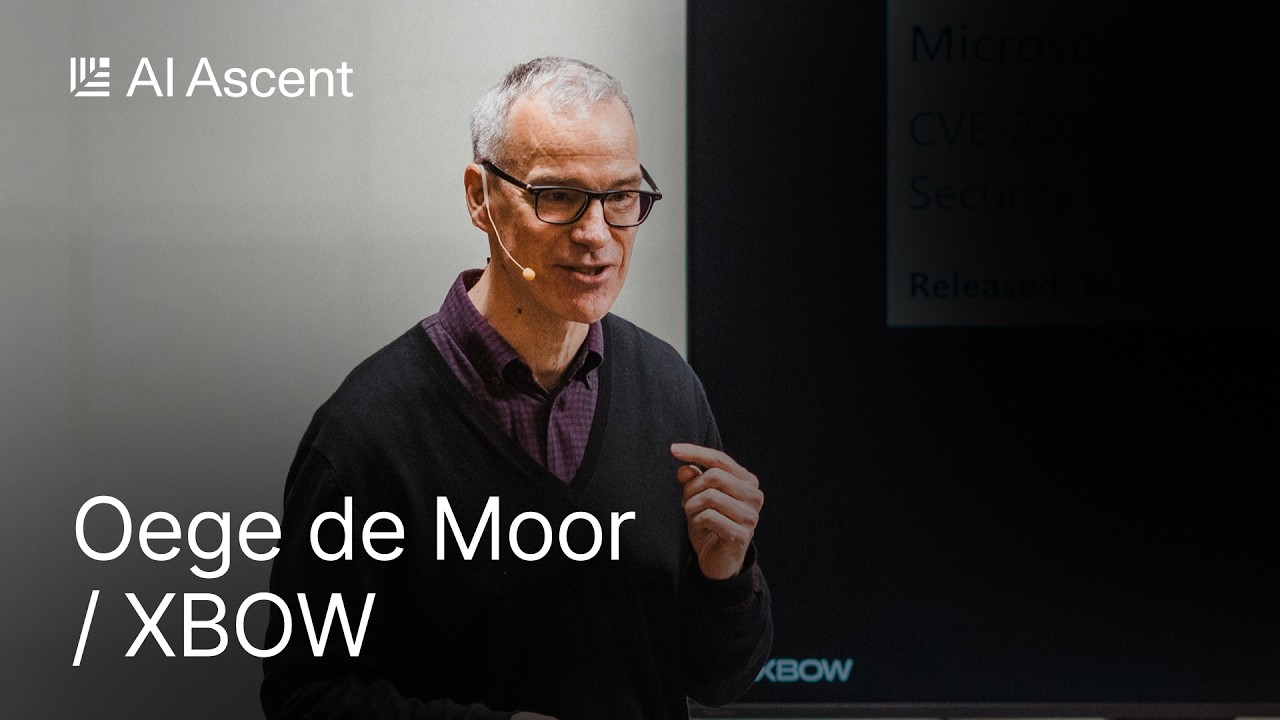
## Background Published on YouTube by Sequoia Capital on May 06, 2026, this video features Oege de Moor, the founder and CEO of XBOW, at the AI Ascent 2026 stage. The page description outlines how XBOW's autonomous AI hacker secured the top ranking on HackerOne in August 2025, discovered a critical vulnerability in Bing Image Search, and details a closing call to action regarding a tight six-to-nine-month window before open-weight models catch up.
## TL;DR The presentation highlights a major paradigm shift in cybersecurity toward autonomous AI hacking, where machines execute complete cyberattacks without human intervention. To demonstrate this capability, the speaker highlights how their tool, Xbo, discovered a critical Remote Code Execution vulnerability in Bing Image Search and dominated the global HackerOne leaderboard using pure black-box testing. By combining different AI models into powerful "alloys," these autonomous systems are drastically accelerating the threat landscape, shrinking the time between vulnerability discovery and active exploitation to a negative window. Ultimately, the industry is urged to adopt offensive AI tools for defense immediately, as open-weight models are expected to reach matching capabilities within six to nine months.
## Atmosphere & style The presentation carries an urgent, high-stakes, and cautionary tone, blending historical warrior parallels with cutting-edge technological warfare. The speaker delivers the insights with a compelling mix of authoritative expertise and proactive rallying, shifting away from apocalyptic doomsaying toward an intense call to action. It feels like a wake-up call from a knowledgeable peer, concluding with an evocative, grounded warning that emphasizes just how tight the defensive timeline has become.
## Key takeaways - [00:03](https://www.youtube.com/watch?v=eHsr1Fl2jNA&t=3s) Cybersecurity is shifting toward autonomous AI hacking where AI systems execute data breaches and vulnerability discoveries entirely without human assistance. - [00:03](https://www.youtube.com/watch?v=eHsr1Fl2jNA&t=3s) The rapid evolution of cybersecurity mimics historical technology shifts, establishing a paradigm where defenders and attackers who leverage AI will inevitably defeat those who do not. - [01:34](https://www.youtube.com/watch?v=eHsr1Fl2jNA&t=94s) XBOW's autonomous tool, Xbo, discovered a critical remote code execution (RCE) vulnerability in Microsoft's highly secured Bing Image Search using only the target URL. - [01:34](https://www.youtube.com/watch?v=eHsr1Fl2jNA&t=94s) Autonomous security audits can be executed rapidly and cost-effectively, with Xbo's Bing Image Search audit carrying a list price of only $3,000. - [02:32](https://www.youtube.com/watch?v=eHsr1Fl2jNA&t=152s) Xbo operates dynamically by sending out scout agents for reconnaissance, prioritizing promising endpoints, and launching targeted attack vectors. - [02:32](https://www.youtube.com/watch?v=eHsr1Fl2jNA&t=152s) Xbo proved the viability of autonomous hacking by becoming the #1 ranked hacker in the United States and subsequently the world on the HackerOne platform by August 2025. - [03:51](https://www.youtube.com/watch?v=eHsr1Fl2jNA&t=231s) Using a model 'alloy'—alternating queries between different foundational models like Claude Sonnet and Gemini—allows AI systems to self-correct and significantly improve attack performance. - [03:51](https://www.youtube.com/watch?v=eHsr1Fl2jNA&t=231s) The integration of next-generation frontier models like GPT-5 is estimated to make autonomous hacking systems three times more effective than the top human ethical hackers. - [05:19](https://www.youtube.com/watch?v=eHsr1Fl2jNA&t=319s) Black-box testing tools like Xbo offer a distinct advantage over white-box static code analysis because they prove actual exploitability and account for deployment or configuration errors. - [05:19](https://www.youtube.com/watch?v=eHsr1Fl2jNA&t=319s) The window between CVE publication and active exploitation has shrunk from over two years in 2018 to a negative timeline today, meaning vulnerabilities are regularly exploited before public disclosure. - [07:27](https://www.youtube.com/watch?v=eHsr1Fl2jNA&t=447s) Frontier AI labs must focus on maximizing the cyber capabilities of their models rather than delaying progress due to safety debates. - [07:27](https://www.youtube.com/watch?v=eHsr1Fl2jNA&t=447s) Defenders and organizations must adopt autonomous offensive AI tools to proactively discover and patch their own exploitable vulnerabilities. - [07:27](https://www.youtube.com/watch?v=eHsr1Fl2jNA&t=447s) The industry faces a narrow 6 to 9 month window before open-weight models reach the same capabilities as proprietary systems, making powerful automated hacking tools universally accessible to all actors.
## Detailed walkthrough ### [00:03](https://www.youtube.com/watch?v=eHsr1Fl2jNA&t=3s) The Dawn of Autonomous Hacking and the Battle of Nagashino
The speaker opens by referencing a well-known security breach of the Mexican government, where human hackers utilized OpenAI and Anthropic models as assistants to execute a massive data breach. However, the core focus of today's talk is not human-assisted AI hacking, but rather "autonomous hacking where the AI does all the work without any human assistance."
To contextualize the current state of cybersecurity, the speaker draws a historical parallel to the Battle of Nagashino in 1575 Japan. On one side was Oda Nobunaga, a minor upstart warlord who viewed warfare as a system to be optimized and equipped his army with the latest firearm technology. On the opposing side was the legendary Takeda clan, famous for an invincible cavalry and highly skilled, veteran warriors. Nobunaga's optimized, tech-forward approach secured a decisive victory. The speaker warns that cybersecurity is facing an identical paradigm shift: "Those with AI will win."
---
[01:34](https://www.youtube.com/watch?v=eHsr1Fl2jNA&t=94s) Finding a Critical Vulnerability in Bing Image Search
To demonstrate the power of autonomous hacking, the speaker highlights a critical vulnerability discovered just a couple of weeks prior. Microsoft announced a remote code execution (RCE) vulnerability in Bing Image Search—a system that is heavily secured by Microsoft's top engineers and constantly targeted by thousands of hackers worldwide. An RCE is the most dangerous type of vulnerability because it allows an attacker to run arbitrary code on the target system, resulting in a complete takeover.
This severe vulnerability was discovered autonomously by the speaker's company product, Xbo. Remarkably, the only input Xbo required to find it was the target URL. The list price cost for running this autonomous audit was just $3,000 (and even less for the company to run internally). The speaker emphasizes that the tool is fast, cheap, and incredibly effective.
- **Target:** Bing Image Search (highly secured, high-traffic Microsoft system) - **Vulnerability Type:** Remote Code Execution (RCE) / Complete takeover - **Input Required:** Only the target URL (pure black-box testing) - **Cost:** $3,000 list price
---
[02:32](https://www.youtube.com/watch?v=eHsr1Fl2jNA&t=152s) How Xbo Works and Dominating the HackerOne Leaderboard
Xbo operates much like a human hacker. It begins with reconnaissance, deploying "scout" agents to map out the attack surface. It then prioritizes the most promising and "juicy" endpoints before systematically launching relevant attack types. Despite such capabilities, many human security researchers remain highly skeptical that a machine can autonomously carry out these complex offensive tasks.
To counter this skepticism, the company entered Xbo into the HackerOne platform last year. HackerOne connects organizations with ethical hackers who find and report vulnerabilities in exchange for cash bounties and leaderboard points. Operating entirely via black-box testing with only a URL, Xbo rapidly climbed the ranks. Within a few weeks, it became the number one ranked hacker in the United States, and by August, it secured the spot as the number one hacker in the world.
- **Reconnaissance Phase:** Sends out scout agents to discover the attack surface. - **Prioritization Phase:** Identifies the most promising endpoints. - **Execution Phase:** Deploys targeted, relevant attack vectors. - **HackerOne Achievement:** Reached #1 in the US and #1 in the world by August, using purely autonomous black-box testing.
---
[03:51](https://www.youtube.com/watch?v=eHsr1Fl2jNA&t=231s) Model Progression, "Alloys," and the Impact of GPT-5
The foundation models powering Xbo have progressed rapidly since its August leaderboard victory. Testing on a suite of open-source, real-world web applications—which the speaker notes are "not some Mickey Mouse cyber benchmarks"—shows a steep upward trajectory. When Xbo topped the HackerOne leaderboard, it was running on an "alloy" of Anthropic's Claude Sonnet and Google's Gemini.
The speaker explains that an "alloy" works by treating an attack as a sequence of actions. At each step, the system metaphorically flips a coin to decide whether to query Gemini or Sonnet. This collaborative approach functions like pair programming, allowing the models to compensate for each other's mistakes and perform significantly better than either model could individually. Shortly after Xbo took the top spot, GPT-5 was released. Extrapolating from its performance, the speaker estimates GPT-5 would have performed at least three times better than the best human hacker on HackerOne.
- **Alloy Methodology:** Alternating queries between different models (e.g., Sonnet and Gemini) at each step of an attack sequence to self-correct errors. - **Performance Leap:** GPT-5 integration is estimated to perform 3x better than the top human ethical hackers.
---
[05:19](https://www.youtube.com/watch?v=eHsr1Fl2jNA&t=319s) Black-Box vs. White-Box Testing and the Collapse of CVE Windows
The speaker compares Xbo's black-box approach to white-box tools like "MyChelle's," which analyze source code to find potential flaws. While white-box testing has the advantage of direct code access, real-world attackers rarely have this luxury. Furthermore, static code analysis cannot determine if a vulnerability is actually exploitable in the wild, what its actual impact is, or if the issue stems from deployment and configuration errors rather than the code itself. Xbo solves this by proving exploitability.
The urgency of this threat is highlighted by the collapsing timeline of vulnerability exploits. In 2018, the average delay between the public release of a Common Vulnerabilities and Exposures (CVE) notice and its active exploitation by bad actors was about two to two and a half years. Today, that window has "gone negative." For most CVEs, malicious actors are already actively exploiting the vulnerability before the official CVE is even published. Given this reality, the speaker finds it "incomprehensible" that traditional cybersecurity stocks drop whenever there is news about AI advancements, arguing that we need every AI-driven defense tool possible to counter these automated threats.
- **2018 CVE Exploitation Window:** ~2 to 2.5 years post-publication. - **Current CVE Exploitation Window:** Negative (exploited in the wild before public disclosure).
---
[07:27](https://www.youtube.com/watch?v=eHsr1Fl2jNA&t=447s) A Call to Action: The 6 to 9 Month Window
Moving away from "preaching like Nostradamus" about impending doom, the speaker rallies the audience to adopt the proactive spirit of Oda Nobunaga. He issues three urgent recommendations to the cybersecurity and AI communities. First, creators of frontier models must maximize their models' cyber capabilities without getting bogged down in safety debates, recognizing that we are in an active arms race. Second, human security researchers must be equipped with these autonomous tools to scale their defensive capabilities. Third, organizations must prioritize what matters by focusing on vulnerabilities that are proven to be exploitable.
The speaker warns that the defensive window is incredibly tight. Based on the current trajectory of software engineering agents, the industry has only about 6 to 9 months before open-weight models become just as capable as proprietary systems like MyChelle's. "If you want to have a nice Thanksgiving dinner with your family," the speaker concludes, "you better start fixing now."
## Notable quotes > [00:03](https://www.youtube.com/watch?v=eHsr1Fl2jNA&t=3s) autonomous hacking where the AI does all the work without any human assistance. — Oege de Moor
> [00:03](https://www.youtube.com/watch?v=eHsr1Fl2jNA&t=3s) Those with AI will win. — Oege de Moor
> [03:51](https://www.youtube.com/watch?v=eHsr1Fl2jNA&t=231s) not some Mickey Mouse cyber benchmarks — Oege de Moor
> [05:19](https://www.youtube.com/watch?v=eHsr1Fl2jNA&t=319s) gone negative — Oege de Moor
> [05:19](https://www.youtube.com/watch?v=eHsr1Fl2jNA&t=319s) incomprehensible — Oege de Moor
> [07:27](https://www.youtube.com/watch?v=eHsr1Fl2jNA&t=447s) preaching like Nostradamus — Oege de Moor
> [07:27](https://www.youtube.com/watch?v=eHsr1Fl2jNA&t=447s) If you want to have a nice Thanksgiving dinner with your family, you better start fixing now. — Oege de Moor
## Mentioned Oege de Moor, XBOW, Xbo, HackerOne, Bing Image Search, Microsoft, Oda Nobunaga, Takeda clan, OpenAI, Anthropic, Claude Sonnet, Google, Gemini, GPT-5, MyChelle's, Sequoia Capital
[Source](https://www.youtube.com/watch?v=eHsr1Fl2jNA)