Torvalds Rejects Visionary Label, Cites Stubborn Labor for Linux, Git
TED
Linus Torvalds argues transformative technology emerges not from grand visionary roadmaps, but from stubborn engineers quietly resolving immediate, practical bottlenecks.
AI-assisted summary of The Mind Behind Linux | Linus Torvalds | TED — original source. Check the original for full context.
Source published:
Key ideas
- Linus Torvalds created Linux and Git—which now power major internet infrastructure and over 1.5 billion Android devices—primarily out of personal necessity and a preference for solitary problem-solving rather than grand strategic roadmaps. (0:13)
- Git was engineered specifically to break the human bottleneck caused by Torvalds managing kernel contributions from approximately 1,000 developers every two to three months. (7:13)
- Torvalds defines 'good taste' in software engineering as an intuitive architectural ability to recognize systemic patterns and eliminate edge cases entirely, rather than handling them with conditional branches. (14:18)
- Torvalds rejects the tech industry's romanticization of visionary savants like Nikola Tesla, aligning his pragmatic, ground-level engineering philosophy with Thomas Edison's emphasis on perspiration and iterative execution. (16:24)
Detailed notes
## Background Published on YouTube by TED on May 3, 2016, this interview features Linux and Git creator Linus Torvalds in conversation with TED Curator Chris Anderson. The session explores Torvalds' unexpected journey in transforming technology twice, highlighting his distinctive personality traits and pragmatic engineering philosophy.
## TL;DR Linus Torvalds reflects on how a solitary hobby project coded in his bathrobe evolved into the foundational operating system of the modern internet and over 1.5 billion Android devices. He explains how bottlenecks in community collaboration compelled him to invent Git, and why open-source models succeed by allowing people with opposing temperaments to build together without needing mutual affection. Torvalds illustrates his concept of 'good taste' in software architecture by demonstrating how elegant pointer design eliminates awkward edge cases in basic code. Ultimately, he rejects the label of visionary futurist, aligning himself instead with Thomas Edison's relentless, unglamorous persistence in fixing immediate, practical problems.
## Atmosphere & style The conversation carries an understated, refreshingly self-effacing tone, deliberately punctured with dry wit that contrasts sharply with typical Silicon Valley grandiosity. Torvalds speaks with disarming bluntness about his social awkwardness, lack of design taste, and introverted isolation, eliciting warm chuckles and spontaneous applause from the audience. Anderson acts as an engaged, curious foil, attempting to draw out visionary narratives only for Torvalds to playfully ground the dialogue back into practical, unromantic reality.
## Bulletin - [00:13](https://www.youtube.com/watch?v=o8NPllzkFhE&t=13s) Linus Torvalds created Linux and Git—which now power major internet infrastructure and over 1.5 billion Android devices—primarily out of personal necessity and a preference for solitary problem-solving rather than grand strategic roadmaps. - [07:13](https://www.youtube.com/watch?v=o8NPllzkFhE&t=433s) Git was engineered specifically to break the human bottleneck caused by Torvalds managing kernel contributions from approximately 1,000 developers every two to three months. - [14:18](https://www.youtube.com/watch?v=o8NPllzkFhE&t=858s) Torvalds defines 'good taste' in software engineering as an intuitive architectural ability to recognize systemic patterns and eliminate edge cases entirely, rather than handling them with conditional branches. - [16:24](https://www.youtube.com/watch?v=o8NPllzkFhE&t=984s) Torvalds rejects the tech industry's romanticization of visionary savants like Nikola Tesla, aligning his pragmatic, ground-level engineering philosophy with Thomas Edison's emphasis on perspiration and iterative execution.
## Key takeaways - [00:13](https://www.youtube.com/watch?v=o8NPllzkFhE&t=13s) Torvalds intentionally keeps his home workspace silent and free of distractions, opting for non-stimulating environments over elaborate setups. - [02:13](https://www.youtube.com/watch?v=o8NPllzkFhE&t=133s) Linux originated at age 21 as an isolated, personal programming exercise rather than an intentional global movement. - [02:13](https://www.youtube.com/watch?v=o8NPllzkFhE&t=133s) The release of Linux was prompted by a desire for feedback rather than a commercial agenda, with free software licensing adopted after an introduction by a university peer. - [04:44](https://www.youtube.com/watch?v=o8NPllzkFhE&t=284s) Asynchronous email communication served as an essential operational buffer that allowed Torvalds to collaborate without face-to-face social friction. - [04:44](https://www.youtube.com/watch?v=o8NPllzkFhE&t=284s) The critical transition for Linux was expanding from solo development to a circle of 10 to 100 contributors; subsequent growth to millions was gradual and organic. - [07:13](https://www.youtube.com/watch?v=o8NPllzkFhE&t=433s) Git was developed as a distributed source control system to eliminate Torvalds as the single point of failure managing kernel patch influx. - [09:23](https://www.youtube.com/watch?v=o8NPllzkFhE&t=563s) Torvalds attributes his accomplishments to unrelenting persistence and stubbornness rather than innate, visionary brilliance. - [11:57](https://www.youtube.com/watch?v=o8NPllzkFhE&t=717s) Open source collaboration succeeds because contributors with divergent personalities, goals, and communication styles can work together without needing mutual affection. - [11:57](https://www.youtube.com/watch?v=o8NPllzkFhE&t=717s) Commercial involvement benefited Linux by handling user interfaces, distribution, and business functions that Torvalds had no interest in managing. - [14:18](https://www.youtube.com/watch?v=o8NPllzkFhE&t=858s) Good taste in programming is exemplified by redesigning data structures to eliminate conditional special cases in favor of unified execution flow. - [16:24](https://www.youtube.com/watch?v=o8NPllzkFhE&t=984s) Torvalds rejects long-term vision and futurism, choosing instead to focus pragmatically on immediate engineering obstacles. - [16:24](https://www.youtube.com/watch?v=o8NPllzkFhE&t=984s) Drawing a comparison between Nikola Tesla and Thomas Edison, Torvalds favors Edison's unglamorous, execution-focused philosophy. - [18:51](https://www.youtube.com/watch?v=o8NPllzkFhE&t=1131s) Torvalds expresses zero resentment toward corporations building multi-billion-dollar businesses on Linux, crediting open access with its global ubiquity. - [18:51](https://www.youtube.com/watch?v=o8NPllzkFhE&t=1131s) Open source methodologies work particularly well in software because code provides objective, binary pass/fail validation that civic and political systems lack.
## Detailed walkthrough ### [00:13](https://www.youtube.com/watch?v=o8NPllzkFhE&t=13s) The "Linux World Headquarters" and Working in Isolation
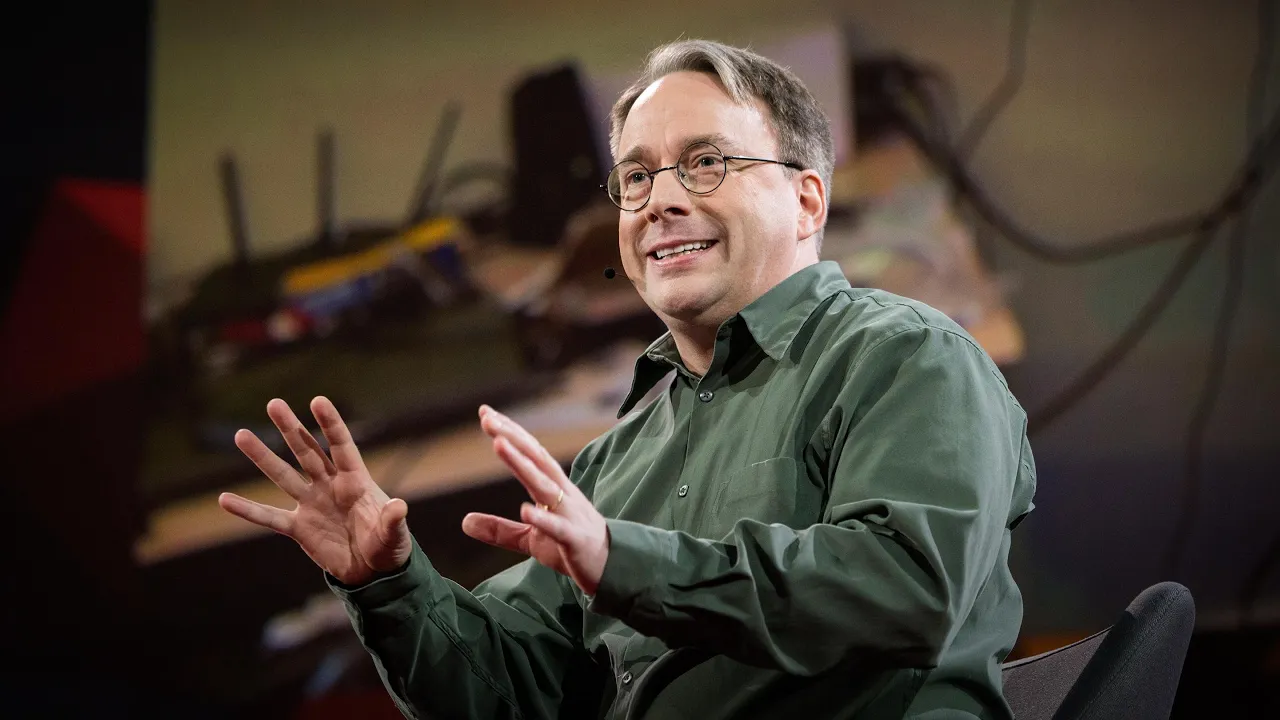
Chris Anderson opens the conversation by highlighting the staggering footprint of Linus Torvalds' work: the Linux kernel runs millions of computers, underpins much of the internet, and powers over 1.5 billion active Android devices. Anderson remarks that one might expect an empire of this magnitude to be directed from an imposing corporate headquarters, yet the actual workspace shown on screen is modest to the point of comedy. Torvalds describes his home office as utterly devoid of excitement, noting that the most talked-about feature in the photo—a walking treadmill desk—is something he has already abandoned. For Torvalds, the work environment must eliminate all external distractions; the walls are painted a muted light green, a shade he wryly points out is often found in mental institutions to keep patients calm.
Torvalds places an extreme premium on absolute silence. While he acknowledges that some Google engineers install miniature data centers in their residences, his only hardware requirement beyond raw performance is that his computer make no audible sound whatsoever. Torvalds explains: “I want to hear the cat purring, not the sound of the fans in the computer.” Working alone in quiet solitude, he finds peace when his cat curls up in his lap, undisturbed by the buzzing machinery of modern computing.
- Linux powers a vast portion of internet infrastructure and over 1.5 billion active Android devices. - Torvalds’ home office setup features light green walls chosen specifically for their non-stimulating, calming effect. - Torvalds discarded his walking treadmill desk and insists on completely silent hardware to avoid distracting fan noise.
---
[02:13](https://www.youtube.com/watch?v=o8NPllzkFhE&t=133s) The Accidental Genesis of Linux and Free Software
Anderson asks how an engineer working alone in such quiet circumstances managed to orchestrate a vast technological movement through open source. Torvalds responds candidly that his day-to-day routine has not changed: he still codes by himself at home, frequently in his bathrobe, dressing up only when a visiting photographer compels him to put on clothes. Linux itself was never envisioned as a sweeping global collaboration. Instead, it originated as one of many personal programming exercises Torvalds undertook strictly for himself, driven partly by a need for the end result, but primarily by pure enjoyment of programming.
When Torvalds first released the code 25 years earlier, the modern open-source development methodology did not exist in his thinking. His initial release was simply an impulse to share what he had built over six months of solitary labor and solicit feedback. At the University of Helsinki, a friend embedded in the free software community introduced him to preexisting software licenses. Although Torvalds initially worried that commercial entities might exploit and take advantage of his labor, he ultimately chose to adopt a free software license, concluding, “What the hell?”
- Torvalds began Linux at age 21 purely as a personal programming project with no collaborative master plan. - The software was made publicly available to show off six months of work and gather critiques, rather than to launch a movement. - A classmate at the University of Helsinki introduced Torvalds to free software licensing, overcoming his initial wariness about commercial exploitation.
---
[04:44](https://www.youtube.com/watch?v=o8NPllzkFhE&t=284s) Community Feedback and the Gradual Scale of Collaboration
The collaborative engine of Linux began not with patches of code, but with external feedback and ideas. For Torvalds, who had already spent roughly half his life programming in complete isolation, having outside observers inspect his source code and offer suggestions felt like a revelation. Although this influx inspired an initial appreciation for other contributors, Torvalds humorously clarifies that he remains deeply introverted. Linus Torvalds remarks: “I don't really love other people -- but I love computers, I love interacting with other people on email, because it kind of gives you that buffer.”
```mermaid flowchart TD accTitle: Evolution of Linux Development accDescr: Diagram illustrating Linus Torvalds' progression from solitary coding to a large distributed open-source community.
subgraph Phase1["Solitary Development"] A["Linus codes in isolation<br/>( bathrobe, silent office)"] --> B["Public release of source code<br/>( seeking feedback)"] end
subgraph Phase2["Early Collaboration"] B --> C["Contributors submit ideas & critiques"] C --> D["First code contributions<br/>( community of 10 to 100)"] end
subgraph Phase3["Massive Scale"] D --> E["Gradual expansion to thousands"] E --> F["~1,000 contributors per release<br/>( every 2-3 months)"] end ```
When Anderson asks whether there was an explosive moment where Torvalds realized Linux was becoming an industry-defining phenomenon, Torvalds downplays the idea of a sudden turning point. The true paradigm shift for him occurred when the project transitioned from absolute solitude to a group of 10 or 100 people. From that baseline, the growth to a community of millions was an incremental, organic evolution spread across many years rather than an overnight commercial takeoff.
- Torvalds started coding around age 10 or 11, working in complete isolation until Linux was published. - The earliest contributions consisted of conceptual ideas, bug reports, and design critiques before actual code patches arrived. - Email communication served as an ideal operational buffer, enabling Torvalds to coordinate technical discussions without face-to-face interaction. - The primary milestone for Torvalds was escaping isolation with a group of 10 to 100 contributors; subsequent growth was gradual.
---
[07:13](https://www.youtube.com/watch?v=o8NPllzkFhE&t=433s) Breaking the Bottleneck: The Invention of Git
As the Linux developer community ballooned toward 10,000 participants—with roughly 1,000 developers contributing patches to every single release cycle every two to three months—the sheer scale broke existing collaboration paradigms. Torvalds found himself serving as an unsustainable human bottleneck. Traditional source code management systems of the era proved unworkable; he detested CVS with a passion and refused to touch it, while alternative tools were widely disliked across the community.
To eliminate this operational impasse, Torvalds designed Git, a distributed source-code management system built specifically to alleviate his own workload. Anderson observes the irony: both Linux and Git, two foundational pillars of modern technology, emerged largely as unintended side effects of Torvalds' desire to avoid interacting with large crowds of people. Torvalds agrees with this assessment, explaining that every major project he has ever tackled was born strictly out of personal technical necessity.
Linus Torvalds explains: “So Git is my second big project, which was only created for me to maintain my first big project.”
- Every Linux kernel release incorporates contributions from approximately 1,000 developers every two to three months. - Torvalds adamantly refused to use CVS, the industry's predominant version control system at the time. - Git was created specifically to remove Torvalds as the single point of failure in managing incoming kernel contributions.
---
[09:23](https://www.youtube.com/watch?v=o8NPllzkFhE&t=563s) Stubbornness, Solitude, and the Geek Temperament
Anderson introduces a childhood photograph of Torvalds alongside his younger brother, with Torvalds intently manipulating a Rubik’s Cube. Torvalds confirms he was the archetypal nerd: absorbed in math, physics, and computer science while lacking natural social instincts. He recalls that his younger sister would routinely brief him before family gatherings, whispering relatives' names to him outside the door to ensure he could navigate the room.
When asked whether innate genius drove his success, Torvalds defers, pointing instead to a character trait his sister identified: absolute, unrelenting persistence. Unlike engineers who chase the next flashy concept, Torvalds fixates on a problem and refuses to let go. This stubbornness manifests in his career choices as well. While Silicon Valley culture prizes job-hopping to accelerate careers, Torvalds spent seven consecutive years at the exact same company after moving to California.
Linus Torvalds reflects: “Apparently, my sister said that my biggest exceptional quality was that I would not let go.”
- Torvalds self-identifies as a classic geek who preferred solving Rubik's Cubes to socializing. - His sister routinely coached him on social dynamics and relative identities prior to family gatherings. - Torvalds spent seven unbroken years at a single company in Silicon Valley, defying the regional norm of frequent job-hopping.
[11:57](https://www.youtube.com/watch?v=o8NPllzkFhE&t=717s) Acknowledging Myopia and Welcoming Different Strengths in Open Source
Returning to his admission that he is not a "people person," Linus Torvalds reflects candidly on his personal shortcomings when dealing with others. He confesses to being somewhat myopic regarding other people’s feelings, acknowledging that this blindness occasionally causes him to say things that inflict emotional hurt—an aspect of his demeanor that he openly states he is not proud of, eliciting spontaneous applause from the audience. He notes the irony that when critics tell him he ought to be nice, his response—suggesting that perhaps they are too nice and should instead be more aggressive—is promptly taken as further proof of his abrasive nature. Rather than offering excuses, Torvalds explains that people are simply wired differently, and open source thrives precisely because it enables individuals with clashing temperaments to collaborate effectively without requiring mutual affection.
Torvalds emphasizes that open source communities can tolerate fierce, heated arguments because participants are often driven by entirely different motivations and care about completely different aspects of a project. He revisits his early skepticism regarding commercial adoption, admitting that the commercial entities he once feared would exploit his software turned out to be "lovely, lovely people" who eagerly tackled the exact tasks he despised. While an open source ecosystem needs warm, communicative individuals who welcome newcomers into the fold, it equally depends on blunt engineers who care strictly about the underlying technology. Torvalds jokes about his total lack of graphical sensibility, noting that while others obsess over interface design, his own abilities are nonexistent: “I mean, if I was stranded on an island and the only way to get off that island was the make a pretty UI, I'd die there.”
- Torvalds observes that participants in open source do not need to like each other, nor do they even have to formally agree to disagree; progress happens simply because different contributors pursue distinct goals. - Commercial enterprises stepped in to supply resources, develop user-facing elements, and pursue distribution strategies that Torvalds had no personal interest in leading.
[14:18](https://www.youtube.com/watch?v=o8NPllzkFhE&t=858s) Good Taste in Code: Eliminating the Special Case
Chris Anderson steers the conversation toward another core attribute Torvalds mentioned in their preparatory discussions: having "taste" in code. Prompted by an audience survey where dozens of hands shoot up to confirm they have written software, Torvalds examines two code slides depicting the deletion of an existing entry from a singly-linked list. He points out that the conventional solution taught to beginner programmers relies on a conditional statement to check whether the targeted node is the first element in the list or one in the middle, because updating the root pointer versus updating a previous node's pointer requires distinct handling.
The second slide, representing what Torvalds considers "better taste," removes the conditional `if` branch entirely by reframing the pointer manipulation so that the boundary case and the standard case are resolved identically. Torvalds clarifies that while this introductory linked-list problem is trivial CS 101 code, the underlying concept is foundational: good taste represents an instinctive ability to perceive systemic patterns and eliminate edge cases so that exceptions become part of the normal flow. For Torvalds, identifying collaborators who possess this higher-level architectural instinct is paramount. As Linus Torvalds argues, “Good taste is about really seeing the big patterns and kind of instinctively knowing what's the right way to do things.”
```mermaid flowchart TD accTitle: Code Taste Comparison in Pointer Manipulation accDescr: Diagram contrasting conventional branching code with good taste pointer architecture that eliminates the special case.
subgraph Conventional["Conventional Approach (Branching)"] A["Node Removal Request"] --> B{"Is it the first entry?"} B -->|"Yes (Special Case)"| C["Update Head Pointer"] B -->|"No (Normal Case)"| D["Update Previous Node's Pointer"] end
subgraph GoodTaste["Good Taste Approach (Unified Pattern)"] E["Node Removal Request"] --> F["Indirect Pointer Target"] F --> G["Uniform Pointer Reassignment without Branching"] end ```
- Singly-linked list deletion conventionally creates two divergent branches: mutating the head pointer versus mutating the `next` pointer of a preceding element. - Good taste transforms an awkward special case into standard behavior, simplifying execution flow and eliminating structural fragility. - Torvalds considers micro-examples like list removal merely illustrative; true taste manifests in larger structural decisions and architectural intuition across complex codebases.
[16:24](https://www.youtube.com/watch?v=o8NPllzkFhE&t=984s) The Engineer versus the Visionary: Edison over Tesla
Anderson attempts to assemble Torvalds's traits—technical mastery, stubborn persistence, and software taste—suggesting that someone who revolutionized modern computing must necessarily be driven by grand visions of the future. Torvalds immediately rejects the label of "visionary," confessing that he felt slightly out of place during his two days at the TED Conference amid so much sweeping futurism. He makes it clear that he operates without a five-year plan, defining himself strictly as a pragmatic engineer grounded in immediate problem-solving rather than skyward ambition: “I'm perfectly happy with all the people who are walking around and just staring at the clouds and looking at the stars and saying, 'I want to go there.' But I'm looking at the ground, and I want to fix the pothole that's right in front of me before I fall in.”
To illustrate his operational mindset, Torvalds references the classic technology dichotomy between Nikola Tesla and Thomas Edison. While modern culture idolizes Tesla as a romantic, visionary savant—even naming prominent tech companies in his honor—Torvalds places himself squarely in the often-maligned camp of Thomas Edison. He cites Edison’s maxim that genius is 1% inspiration and 99% perspiration, pointing out that despite Edison’s unglamorous, pedestrian reputation and perceived lack of intellectual mysticism, it was Edison's relentless practical labor that fundamentally changed the physical world. Anderson playfully dubs Torvalds the antidote to the conference's theme of bold, audacious dreams, to which Torvalds agrees he is deliberately dialing the rhetoric down.
- Torvalds explicitly disclaims having strategic roadmaps, visionary master plans, or long-range predictions for technology. - Modern cultural sentiment strongly favors Tesla's eccentric genius, yet Torvalds prioritizes tangible real-world transformation over theoretical imagination. - Torvalds embraces Edison's perspiration-heavy work ethic as the truer model for enduring technological progress.
[18:51](https://www.youtube.com/watch?v=o8NPllzkFhE&t=1131s) Commercial Billions, Open Source Limits, and Future Frontiers
Anderson asks Torvalds whether he feels any resentment toward massive corporate entities like Google that have generated billions of dollars in revenue from software he built and gave away for free. Torvalds answers without hesitation that he feels no anger whatsoever. First, he notes that he is personally doing very well financially; second, and more importantly, he recognizes that without embracing the open source ethos and relinquishing control, Linux would never have achieved its global scale or ubiquity. While this path thrust him into uncomfortable obligations such as public speaking, he reflects that the cumulative journey has made him a profoundly contented man who feels he made the right life decisions.
When asked whether open source principles can expand beyond software into broader societal systems like open politics, Torvalds expresses measured skepticism. He explains that software is uniquely suited to open collaboration because code is fundamentally binary: it either works or it fails, providing objective criteria to resolve disagreements. In politics and human affairs, by contrast, straightforward black-and-white logic dissolves into shades of gray and subjective hues. Nevertheless, he points to thriving applications of open principles outside traditional software, citing Wikipedia's worldwide impact as well as the open access renaissance in scientific publishing through platforms like arXiv and open-access journals, which counteract expensive closed publishers. Concluding the session, Anderson observes that since Torvalds is an engineer rather than a prophet, it remains up to the global community to build whatever comes next, thanking Torvalds for giving the world Linux, the underlying infrastructure of the Internet, and the foundation of Android devices.
- Torvalds harbors no bitterness toward commercial tech giants monetizing Linux, viewing open access as the essential catalyst that enabled the system's global adoption. - Software benefits from definitive, objective validation criteria: “Code either works or it doesn't, which means that there's less room for arguments.” - Fields like governance lack objective metrics, complicating the direct transfer of open source methodologies to civic systems. - Scientific research is actively reclaiming its open origins through non-commercial pre-print servers like arXiv and open-access academic publications.
## Notable quotes > [18:51](https://www.youtube.com/watch?v=o8NPllzkFhE&t=1131s) Code either works or it doesn't, which means that there's less room for arguments. — Linus Torvalds
> [14:18](https://www.youtube.com/watch?v=o8NPllzkFhE&t=858s) Good taste is about really seeing the big patterns and kind of instinctively knowing what's the right way to do things. — Linus Torvalds
## Mentioned Android, arXiv, Chris Anderson, CVS, Git, Google, Linux, Nikola Tesla, TED, Thomas Edison, University of Helsinki, Wikipedia
## Video description Linus Torvalds transformed technology twice — first with the Linux kernel, which helps power the Internet, and again with Git, the source code management system used by developers worldwide. In a rare interview with TED Curator Chris Anderson, Torvalds discusses with remarkable openness the personality traits that prompted his unique philosophy of work, engineering and life. "I am not a visionary, I'm an engineer," Torvalds says. "I'm perfectly happy with all the people who are walking around and just staring at the clouds ... but I'm looking at the ground, and I want to fix the pothole that's right in front of me before I fall in."
TEDTalks is a daily video podcast of the best talks and performances from the TED Conference, where the world's leading thinkers and doers give the talk of their lives in 18 minutes (or less). Look for talks on Technology, Entertainment and Design -- plus science, business, global issues, the arts and much more. Find closed captions and translated subtitles in many languages at http://www.ted.com/translate
Follow TED news on Twitter: http://www.twitter.com/tednews Like TED on Facebook: https://www.facebook.com/TED
Subscribe to our channel: http://www.youtube.com/user/TEDtalksDirector
[Source](https://www.youtube.com/watch?v=o8NPllzkFhE)