Symbolics Space Cadet Fails Daily Typing Test Under Heavy Springs
Chyrosran22
The legendary MIT Lisp workstation keyboard functions strictly as a historical showpiece because its stiff 70-gram Honeywell Hall effect switches make everyday typing impractical.
AI-assisted summary of Symbolics Space Cadet keyboard review (Honeywell Hall effect 4B3E) — original source. Check the original for full context.
Source published:
Key ideas
- The Symbolics Space Cadet keyboard, originally bundled with the LM-2 Lisp workstation costing roughly $200,000 in modern purchasing power, is regarded as the ultimate vintage keyboard holy grail with only around 100 systems produced. (1:58)
- Featuring seven distinct modifier keys—including introducing Super and Hyper to computing—the keyboard allowed users to chord over 8,000 distinct characters, directly influencing Emacs keybindings. (4:33)
- The keyboard employs Micro Switch Honeywell SD series 4B3E linear Hall effect switches rated for 30 billion keypresses, requiring roughly 70 grams of actuation force and bottoming out around 100 grams. (7:45)
- Constructed with massive double-shot ABS keycaps weighing up to 2.67 grams per 1U key, the keycaps and switches alone total around 700 grams across a 100-key layout. (11:51)
Detailed notes
## Background Published on YouTube by Thomas (Chyrosran22) on December 23, 2017, this video serves as a year-end review of the iconic Symbolics Space Cadet keyboard. According to the show notes, Thomas examines the keyboard and its Honeywell Hall effect switches as the vintage community's 'holy of holies,' concluding with a typing demonstration and reflections on the past year.
## TL;DR Thomas reviews an exceptionally rare new old stock (NOS) module of the Symbolics Space Cadet keyboard, originally bundled with the roughly $200,000 LM-2 Lisp workstation. He details its historical roots in the MIT AI Lab, its seven modifier keys enabling over 8,000 characters and influencing Emacs key-chording, and its uniquely heavy doubleshot ABS keycaps. After evaluating the contactless Micro Switch Honeywell SD-series Hall effect switches—noting their 30-billion-keypress durability alongside their heavy 70g actuation force and sensitivity to dirt—he concludes that while it is an impractical daily driver, it stands as an unmatched historical collector's showpiece.
## Atmosphere & style The presentation is scholarly yet wonderfully eccentric, blending deep hardware archaeology with Thomas's signature dry wit, sharp candor, and colorful turns of phrase. It feels like an intimate, festive celebration for keyboard enthusiasts, balancing genuine awe over pristine vintage engineering with blunt assessments of the switch weighting. Beneath the technical deep dive lies an affectionate, reflective emotional arc, as Thomas shares his sincere gratitude to his audience for encouraging him to continue producing content into 2018.
## Bulletin - [01:58](https://www.youtube.com/watch?v=oDozftThFMw&t=118s) The Symbolics Space Cadet keyboard, originally bundled with the LM-2 Lisp workstation costing roughly $200,000 in modern purchasing power, is regarded as the ultimate vintage keyboard holy grail with only around 100 systems produced. - [04:33](https://www.youtube.com/watch?v=oDozftThFMw&t=273s) Featuring seven distinct modifier keys—including introducing Super and Hyper to computing—the keyboard allowed users to chord over 8,000 distinct characters, directly influencing Emacs keybindings. - [07:45](https://www.youtube.com/watch?v=oDozftThFMw&t=465s) The keyboard employs Micro Switch Honeywell SD series 4B3E linear Hall effect switches rated for 30 billion keypresses, requiring roughly 70 grams of actuation force and bottoming out around 100 grams. - [11:51](https://www.youtube.com/watch?v=oDozftThFMw&t=711s) Constructed with massive double-shot ABS keycaps weighing up to 2.67 grams per 1U key, the keycaps and switches alone total around 700 grams across a 100-key layout.
## Key takeaways - [00:06](https://www.youtube.com/watch?v=oDozftThFMw&t=6s) The Symbolics Space Cadet keyboard is widely recognized as the 'holy grail' of mechanical keyboards due to its extreme rarity, build quality, and deep hacker heritage. - [00:06](https://www.youtube.com/watch?v=oDozftThFMw&t=6s) The review specimen is a pristine 'new old stock' (NOS) drop-in replacement module, preserving the original vibrant gray and blue keycaps without the sun yellowing common to surviving units. - [01:58](https://www.youtube.com/watch?v=oDozftThFMw&t=118s) The keyboard descends from John McCarthy's 1958 invention of Lisp and Tom Knight's earlier Knight keyboard designed for the MIT AI Lab's CONS and CADR Lisp machines. - [01:58](https://www.youtube.com/watch?v=oDozftThFMw&t=118s) Symbolics was established in 1979 to commercialize CADR technology via the LM-2 workstation, producing only about 100 units at an inflation-adjusted cost of roughly $200,000 each. - [01:58](https://www.youtube.com/watch?v=oDozftThFMw&t=118s) Successor Symbolics 3600 workstations used a downscaled layout with fewer modifiers and eventually transitioned to NMB Space Invader switches with rare doubleshot keycaps. - [04:33](https://www.youtube.com/watch?v=oDozftThFMw&t=273s) The Space Cadet layout features seven modifiers (Shift, Top, Front/Greek, Control, Meta, Super, and Hyper), introducing Super and Hyper keys to computing. - [04:33](https://www.youtube.com/watch?v=oDozftThFMw&t=273s) Multi-tier legends on the keycap tops and front faces let users input over 8,000 characters, including the complete native APL mathematical notation set. - [04:33](https://www.youtube.com/watch?v=oDozftThFMw&t=273s) Aligning modifiers in a tight horizontal line facilitated complex single-handed chording, directly inspiring Emacs shortcut ergonomics. - [04:33](https://www.youtube.com/watch?v=oDozftThFMw&t=273s) The layout integrates unusual terminal keys such as Roman numerals I–IV for list buffers, hand-shaped arrow keys, and a dedicated 'Rub Out' key. - [07:45](https://www.youtube.com/watch?v=oDozftThFMw&t=465s) The board uses Honeywell Micro Switch SD series linear Hall effect switches (primarily model 4B3E) manufactured in Freeport, Illinois, with inspection stickers dating to 1982. - [07:45](https://www.youtube.com/watch?v=oDozftThFMw&t=465s) Contactless Hall effect operation uses a moving magnet over a semiconductor sensor to divert electron flow, yielding a lifespan rating of 30 billion actuations per switch. - [07:45](https://www.youtube.com/watch?v=oDozftThFMw&t=465s) Despite contactless electronics, Honeywell Hall effect switches are acutely sensitive to dust and grit around the sliders, which causes scratchiness and off-axis binding. - [10:25](https://www.youtube.com/watch?v=oDozftThFMw&t=625s) Operating force is heavy at approximately 70 grams actuation and 100 grams bottom-out, making switches like green Alps or Fujitsu leaf springs preferable for actual typing comfort. - [10:25](https://www.youtube.com/watch?v=oDozftThFMw&t=625s) The massive switch assemblies and thick ABS keycaps produce an exceptionally loud, deep, and resonant clatter even without an outer case. - [11:51](https://www.youtube.com/watch?v=oDozftThFMw&t=711s) The ultra-thick Honeywell double-shot ABS keycaps weigh 2.67 grams per 1U key, making them some of the heaviest, most crack-resistant caps ever manufactured. - [11:51](https://www.youtube.com/watch?v=oDozftThFMw&t=711s) Wider keys utilize unpopulated dummy switch housings topped with red 'Christmas bonnet' caps or asymmetric stem mounting for stabilization. - [13:20](https://www.youtube.com/watch?v=oDozftThFMw&t=800s) While too stiff and specialized for practical everyday typing, the Space Cadet stands as an unmatched historical centerpiece and collector's item.
## Detailed walkthrough ### [00:06](https://www.youtube.com/watch?v=oDozftThFMw&t=6s) The Holy Grail of Vintage Keyboards
To close out the year, Thomas reviews what is widely considered the "holy grail" of mechanical keyboards: the Symbolics Space Cadet keyboard. Deeply rooted in hacker culture, the Space Cadet is excessively rare, enormously expensive, extraordinarily well-made, and insanely complex. As Thomas jokes, “forget the Happy Hacking Keyboard, real hackers used this.” The review unit was loaned to him by an administrator from Deskthority, which Thomas describes as one of the three major hubs of the Western mechanical keyboard community and the one most dedicated to vintage hardware.
```mermaid flowchart TD accTitle: Space Cadet Lineage and Context accDescr: Chronology of the Space Cadet keyboard within MIT Lisp development and workstation hardware.
subgraph MIT["MIT AI Lab Origins"] A["1958: John McCarthy invents Lisp"] --> B["1973: Knight & Greenblatt start Lisp Machine Project"] B --> C["Knight Keyboard designed by Tom Knight"] end
subgraph Symbolics["Commercialization"] C --> D["1979: Symbolics founded<br/>Space Cadet on LM-2 workstation"] D --> E["Symbolics 3600 Series Keyboard"] E --> F["NMB Space Invader revisions<br/>(Doubleshot keycaps)"] end ```
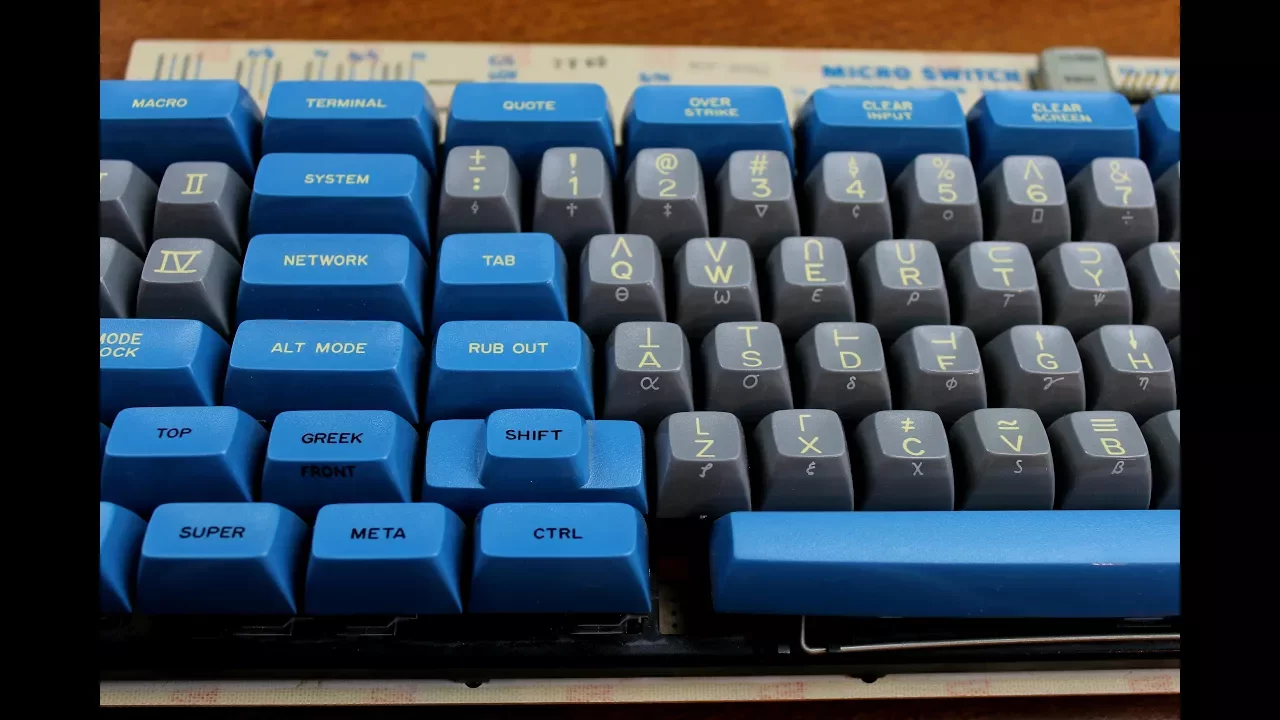
The particular board shown lacks an outer enclosure. While production Space Cadets shipped in an understated white case bearing the Symbolics badge, this unit is a drop-in replacement module preserved as new old stock (NOS). This pristine state proves critical for its appearance. While the well-known Wikipedia photo displays a severely sun-damaged specimen with faded blues and gray keys that turned brown, this NOS unit has perfectly preserved, vivid gray and blue plastic. Thomas challenges the misconception that people in the 1980s lived dull beige lives, admiring the original color palette far above most modern custom keycap sets, even while acknowledging that modern Space Cadet-inspired tribute sets are quite cool.
- **Collector status:** Widely acknowledged as the holy grail due to extreme rarity, complexity, cost, and historical ties to MIT hacker folklore. - **Unit condition:** Caseless new old stock (NOS) drop-in replacement module, avoiding the typical yellowing and fading seen on sun-damaged units.
---
[01:58](https://www.youtube.com/watch?v=oDozftThFMw&t=118s) Lisp Machines and the Birth of Symbolics
The technical pedigree of the Space Cadet traces back to 1958, when John McCarthy devised Lisp during his fellowship at MIT in Cambridge, Massachusetts. Centered around lists, recursive functions, and symbolic expressions, Lisp became one of the earliest high-level programming languages and was inextricably linked to artificial intelligence research. By 1973, Tom Knight and Richard Greenblatt at the MIT Artificial Intelligence Laboratory launched the MIT Lisp Machine Project to develop dedicated hardware optimized for running Lisp environments. Their early prototypes, named the CONS and CADR machines, rapidly grew into indispensable tools for MIT hackers.
In 1979, Greenblatt was approached to commercialize the technology for a broader market, resulting in the formation of Symbolics—a name inspired by Lisp’s reliance on symbolic expressions. Symbolics released its first product, the LM-2, which was essentially a rebadged CADR machine and represented the first commercially available computer workstation in the modern sense. The LM-2 came equipped with the Space Cadet keyboard, designed by Tom Knight as an expanded evolution of his earlier "Knight keyboard." Only about 100 LM-2 systems were ever built, each carrying a price tag equivalent to roughly $200,000 in modern purchasing power, explaining why surviving Space Cadet keyboards are practically unobtainable today.
Later, Symbolics replaced the LM-2 with the 3600 series, which was paired with a simplified, downscaled keyboard. That successor unit retained a very similar internal architecture to the Space Cadet but adopted a plainer white-and-gray color scheme and discarded many dedicated modifier keys. Thomas notes that the fact he can casually mention the 3600 series keyboard in passing—despite it being famous, exceptionally rare, and very expensive in its own right—highlights the legendary tier occupied by the Space Cadet. The 3600 keyboard was eventually superseded by three revisions manufactured by NMB, which utilized "Space Invader" switches alongside doubleshot keycaps, a rare feature for NMB that Thomas had not encountered prior to borrowing this keyboard.
- **Key individuals:** John McCarthy (Lisp creator, 1958); Tom Knight and Richard Greenblatt (MIT Lisp Machine project, 1973; Symbolics co-founders). - **Hardware lineage:** MIT CONS/CADR prototypes → Symbolics LM-2 workstation (bundled with the Space Cadet) → Symbolics 3600 series. - **Rarity factor:** Around 100 LM-2 workstations produced, each originally costing what equates to approximately $200,000 today.
---
[04:33](https://www.youtube.com/watch?v=oDozftThFMw&t=273s) Seven Modifiers and Over 8,000 Characters
The primary design goal of the Space Cadet keyboard was enabling the operator to input as vast an array of characters as possible. To accomplish this, Tom Knight implemented seven distinct modifier keys: 1. Shift 2. Top 3. Front (also labeled Greek) 4. Control 5. Meta 6. Super 7. Hyper
The keyboard introduced Super and Hyper to the computing world. Compared to modern desktop layouts that rely merely on Shift, Control, Alt, and the occasional Windows key, the Space Cadet is an extreme specialty instrument.
```mermaid flowchart LR accTitle: Character Layer Access Logic accDescr: How modifier keys layer character outputs on an individual Space Cadet keycap.
subgraph Modifiers["Layer Modifiers"] S["Shift"] T["Top"] G["Front / Greek"] C["Control / Meta / Super / Hyper"] end
subgraph BaseKey["Key 'A' Examples"] direction TB OutBase["Base: 'a'"] OutShift["Shift + A: 'A'"] OutTop["Top + A: '⊥' (Upside-down T)"] OutGreek["Greek + A: 'α' (Lowercase Alpha)"] OutShiftGreek["Shift + Greek + A: 'Α' (Capital Alpha)"] OutBuckey["Chords: Complex symbols / APL"] end
S --> OutShift T --> OutTop G --> OutGreek S & G --> OutShiftGreek C --> OutBuckey ```
Key legends are divided across multiple faces of each keycap. Pressing `Shift` produces standard uppercase letters. Pressing `Top` activates the character printed on the top face of the keycap (for example, typing `Top + A` outputs an upside-down T, $\bot$). Pressing `Front` (Greek) inputs the character shown on the front face (such as `Front + A` producing a lowercase alpha, $\alpha$), while `Shift + Front + A` produces an uppercase Alpha ($A$). Combining these layers with `Control`, `Meta`, `Super`, and `Hyper` allowed users to type over 8,000 distinct characters, including the complete native APL mathematical character set directly printed on the keys.
Thomas jokes that pressing `Control + Meta + Super + Hyper + C` might yield an emoji of a Coca-Cola bottle or a giant black square for all he knows, marveling: “I didn't even know there were 8,000 characters.” Reflecting on its title, he remarks, “now I have no idea why this thing was called the Space Cadet keyboard, but considering the insane complexity of this thing, it makes me think that if you used to use one of these you must be a bit of a fruitcake.” Thomas points out that having earned a PhD in chemistry himself, if those operators were fruitier than him, “that's really saying something.”
The modifiers were placed close together in a straight horizontal line to let users press several keys simultaneously with one hand. This arrangement directly shaped the key-chording design of the Emacs text editor. Still, contemporary operators joked that the keyboard was best suited to someone with three or four hands. Symbolics seemingly agreed in hindsight that the layout was excessive, reducing the character count on the 3600 keyboard down to roughly 2,000. Beyond the modifier cluster, the layout features unusual terminal keys: Roman numerals I through IV for selecting list buffers, cursor navigation keys printed in the shape of small hands, a host of specialized terminal commands, and a `Rub Out` key, which Thomas quips certainly meant something different at the time than it does today.
- **Total input capability:** Over 8,000 characters via modifier chords, including complete native support for APL notation. - **Modifier lineup:** Seven modifiers (Shift, Top, Front/Greek, Control, Meta, Super, Hyper); introduced Super and Hyper. - **Historical impact:** Modifier alignment influenced Emacs keyboard shortcut ergonomics. - **Novelty keys:** Roman numerals I–IV, hand-shaped arrow keys, specialized terminal controls, and a `Rub Out` key.
---
[07:45](https://www.youtube.com/watch?v=oDozftThFMw&t=465s) Micro Switch Hall Effect Switches: Design and Feel
Examining the metal chassis reveals a production date sticker from 1982 alongside manufacturing marks from Micro Switch, a division of Honeywell, located in Freeport, Illinois. Micro Switch outfitted the board with their legendary SD series linear Hall effect switches. While various spring weights and switch variants exist across the assembly, the predominant switch type used is the `4B3E`. This model is rated at 2.5 ounces of operating force, which Thomas's research converts to approximately 70–75 centinewtons (or grams-force).
Hall effect switches operate contactlessly using a permanent magnet and a semiconductor sensor. Depressing the key brings the magnet toward the semiconductor, which diverts the path of passing electrons and generates a transverse voltage proportional to the magnet's proximity. Because there are no physical electrical contacts scraping together, mechanical wear is practically non-existent; the switches are rated for a staggering 30 billion keypresses per switch. The physical slider is mechanically decoupled from the electronic sensing mechanism—it can simply be pulled out—drastically reducing operational friction.
The main weakness of Honeywell Hall effect boards is their acute sensitivity to dirt and particulate contamination: “although they can potentially be very smooth, they actually really don't like dirt much at all, which is ironic for a contactless switch.” While this NOS unit provides a rare opportunity to test the switches in factory-fresh condition, Thomas observes that it is not 100% spotless. A few specific keys have minor grit around the sliders, causing immediate scratchiness and slight off-axis binding. The vast majority of the keys, however, remain immaculate. The key travel is relatively deep at slightly over 4 mm; while the linear actuation feels somewhat monotonous across the stroke, it remains remarkably smooth and pleasing under typing.
- **Manufacturer & date:** Micro Switch (a division of Honeywell), Freeport, Illinois; chassis inspection sticker dated 1982. - **Switch variant:** Honeywell SD series linear Hall effect, predominantly model `4B3E`. - **Weighting:** 2.5 ounces (~70–75 cN / grams-force). - **Lifespan rating:** 30 billion keypresses per key. - **Travel characteristics:** Contactless linear stroke measuring slightly over 4 mm of travel; exceptionally smooth when clean, but prone to binding and grit if dust enters the housing.
[10:25](https://www.youtube.com/watch?v=oDozftThFMw&t=625s) Switch Weighting and Sound Profile
Evaluating the keyboard's overall typing experience, Thomas notes that the switches are surprisingly not the board's strongest attribute. The Honeywell Hall effect switches feature a heavy weighting of roughly 70 grams of actuation force and a bottom-out weight of around 100 grams, matching the stiff profile of the switches found in his ITT Courier keyboard. While Honeywell manufactured lighter variants, and the natural smoothness of the switch mechanism helps soften the impact of the heavy springs, the action remains noticeably stiffer than Thomas prefers. Comparing them against other vintage linear mechanisms, he finds that switches like green Alps and Fujitsu leaf springs deliver comparable smoothness alongside far more agreeable spring weights. Thomas delivers his verdict on the switches' mythic standing: “I think their legendary reputation is a little bit exaggerated, but at the same time this isn't quite the end of the Honeywell Hall effect story yet; there will be more on that topic at a later point in time in the new year.”
Because the switch assemblies are large and densely constructed, and the accompanying keycaps are massive, the keyboard produces an exceptionally deep, resonant sound. Even without an exterior chassis or bottom case installed to act as an acoustic chamber, typing on the bare metal assembly yields a loud, authoritative clatter that fully delivers on expectations.
- Actuation force: approximately 70 grams - Bottom-out force: approximately 100 grams - Preferred vintage linear alternatives cited: green Alps and Fujitsu leaf spring switches
---
[11:51](https://www.youtube.com/watch?v=oDozftThFMw&t=711s) Honeywell Keycaps and Stabilizer Architecture
The keycaps mounted on the Space Cadet are Honeywell's oversized double-shot ABS blocks, ranking as the second-thickest caps Thomas has encountered behind Fujitsu. Unlike Fujitsu's caps, however, the Honeywell design is less prone to cracking or stem breakage, leading Thomas to describe them as arguably the best keycaps ever produced. A standard 1-unit keycap weighs up to 2.67 grams—more than two and a half times the mass of an equivalent Cherry MX lasered PBT cap, and heavier than an entire Cherry MX switch and keycap combined. With individual switch modules weighing over 4 grams, a 100-key layout carries nearly 700 grams in switches and caps alone. In typical colorful fashion, Thomas marvels at the sheer mass: “That's almost one-and-a-half times the weight of a whole Apple aluminium keyboard—Jesus Christ on a meat popsicle.”
The stabilization method varies across the layout. Wider keycaps are supported using unpopulated dummy switch housings topped with an unusual red cap resembling a tiny Christmas bonnet. Keys too narrow for full wire or dummy stabilization rely on asymmetrically placed switch mounts. While off-center keystrokes can cause noticeable binding on grimy or worn Honeywell boards, the pristine condition of this Space Cadet keeps friction to a minimum. Visually, the board is defined by a muted blue-and-gray colorway complemented by elaborate secondary and tertiary programming legends, including mathematical logic symbols such as NOR.
```mermaid flowchart TD accTitle: Space Cadet Stabilization and Mounting Architecture accDescr: Diagram illustrating how different key widths are stabilized on the Honeywell Hall effect assembly.
subgraph WideKeys["Large Stabilized Keys"] A["Wide Keycap"] --> B["Active 4B3E Switch"] A --> C["Dummy Switch Housing"] C --> D["Protective 'Christmas Bonnet' Cap"] end
subgraph MidKeys["Intermediate Keys"] E["Medium Keycap"] --> F["Off-Center Asymmetric Stem Mount"] F --> G{"Cleanliness Factor"} G -->|"Dirty Unit"| H["Off-Center Binding"] G -->|"Pristine Unit"| I["Smooth Travel"] end ```
- Single 1U keycap weight: up to 2.67 grams - Individual switch module weight: over 4 grams - Combined weight of 100 switches and keycaps: approximately 700 grams - Color scheme: classic two-tone grey and blue featuring complex multi-tier legends
---
[13:20](https://www.youtube.com/watch?v=oDozftThFMw&t=800s) Collector Value, Channel Retrospective, and Typing Demonstration
Weighing the Space Cadet's practical utility against its status in the mechanical keyboard community, Thomas emphasizes that the board exists fundamentally as a historic showpiece. While the heavy switches make it impractical as an everyday driver, its imposing physical presence, striking color combination, and rich Lisp machine lineage give it unrivaled collector appeal. In Thomas's assessment: “Now I'll be brutally honest, the only real reason to get one of these is as a showpiece or a collector's item, but what a collector's item this is!”
Closing out the final video of 2017, Thomas reflects on what proved to be the most successful year in the channel's history. He admits that he originally planned to stop publishing videos altogether at the end of the year—and had contemplated not producing content in 2017 at all—but the overwhelmingly positive reception, along with viewer donations and services, convinced him to carry on into 2018. He notes that with an extensive backlog of hardware to showcase and earlier reviews to revisit, stepping away now would be a waste. Following expressions of gratitude to the audience, the review concludes with an extended typing demonstration on the Symbolics Space Cadet using the practice sentence: *“Hello my name is Thomas and I'm typing on a Space Cadet keyboard right now. Thank you all so much for everything, it's been a wonderful year! I'll see you next time in 2018!”*
## Mentioned Symbolics Space Cadet keyboard, Honeywell Hall effect 4B3E, SD series, Micro Switch, Honeywell, Symbolics, Symbolics LM-2, Symbolics 3600 series, MIT Artificial Intelligence Laboratory, CONS, CADR, Knight keyboard, John McCarthy, Tom Knight, Richard Greenblatt, Lisp, APL, Emacs, Deskthority, NMB, Space Invaders switches, Green Alps, Fujitsu leaf spring switches, ITT Courier keyboard, Happy Hacking Keyboard, Cherry MX
## Video description Skip to 14:40 for a typing demonstration. How Hall effect keyboard switches work: https://www.youtube.com/watch?v=37tdDoC7rGA&t=136s
Follow me on Twitter for updates on my keyboard videos! https://twitter.com/chyrosran22
My other keyboard reviews: https://www.youtube.com/playlist?list=PL285ATFsHGY9JnaQemdjRLEMmLRKpmbfB
I'm Thomas and I do keyboard videos and reviews. Today we look at the Symbolics Space Cadet keyboard. What better way to end the year than by reviewing the holyn of holies? :D
The practice sentence was: "Hello my name is Thomas and I'm typing on a Space Cadet keyboard right now. Thank you all so much for everything, it's been a wonderful year! I'll see you next time in 2018!"
[Source](https://www.youtube.com/watch?v=oDozftThFMw)