Top Gear Reliant Robin Shuttle Explodes After Separation Failure
Top Gear
Explosive bolts connecting the vehicle to its central fuel tank failed to release after booster separation, sending the orbiter into an unrecoverable dive that ended in a catastrophic hillside explosion.
AI-assisted summary of Turning the Robin Reliant into a SPACE SHUTTLE?! | Top Gear — original source. Check the original for full context.
Source published:
Key ideas
- Richard Hammond and James May attempted to turn a lightweight Reliant Robin into a reusable space shuttle, creating the largest and most powerful non-commercial rocket project in European history. (0:01)
- The rocket stack required twelve times the thrust of Top Gear's previous rocket Mini stunt to overcome the Robin's poor aerodynamic profile. (1:20)
- Subscale glider testing demonstrated that the wing-equipped Robin lacked adequate glide performance, entering an immediate nose-dive and crashing during trials. (4:50)
- Despite a flawless launch and clean separation of both solid rocket boosters, the vehicle failed to detach from its central fuel tank and was destroyed upon impacting a hillside. (8:10)
Detailed notes
## Background Published on YouTube by the official Top Gear channel on December 18, 2008, this video features presenters Richard Hammond and James May attempting an audacious engineering stunt. According to the page description, the duo sets out to discover whether a Reliant Robin could serve as a viable space shuttle, questioning if they can get it safely back onto the ground after launch.
## TL;DR Hammond and May collaborate with rocketry engineers from Manchester to convert a lightweight, three-wheeled Reliant Robin into a reusable space shuttle orbiter attached to massive solid rocket boosters and a central external fuel tank. Wind tunnel evaluations and scale-model flight tests reveal abysmal aerodynamic properties, but the full-scale assembly is nevertheless transported to a military facility for launch. The vehicle achieves a spectacular, stable vertical liftoff and successfully jettisons its twin booster rockets. However, an explosive bolt failure prevents the orbiter from separating from the external fuel tank, sending the entire stack into a steep nose-dive that culminates in a massive, fiery hillside explosion.
## Atmosphere & style The segment balances classic Top Gear comedic banter with genuine, palpable tension as a whimsical joke evolves into an awe-inspiring, high-stakes aerospace experiment. Viewers experience an emotional rollercoaster that moves from lighthearted wind tunnel antics to quiet dread beneath the towering launch gantry, capped by the heart-pounding rush of a textbook liftoff. The triumphant cheer of a successful initial climb abruptly shifts into helpless shouting as the staging sequence malfunctions, ending on the bittersweet, dry British irony of total destruction.
## Bulletin - [00:01](https://www.youtube.com/watch?v=pJdrlWR-yFM&t=1s) Richard Hammond and James May attempted to turn a lightweight Reliant Robin into a reusable space shuttle, creating the largest and most powerful non-commercial rocket project in European history. - [01:20](https://www.youtube.com/watch?v=pJdrlWR-yFM&t=80s) The rocket stack required twelve times the thrust of Top Gear's previous rocket Mini stunt to overcome the Robin's poor aerodynamic profile. - [04:50](https://www.youtube.com/watch?v=pJdrlWR-yFM&t=290s) Subscale glider testing demonstrated that the wing-equipped Robin lacked adequate glide performance, entering an immediate nose-dive and crashing during trials. - [08:10](https://www.youtube.com/watch?v=pJdrlWR-yFM&t=490s) Despite a flawless launch and clean separation of both solid rocket boosters, the vehicle failed to detach from its central fuel tank and was destroyed upon impacting a hillside.
## Key takeaways - [00:01](https://www.youtube.com/watch?v=pJdrlWR-yFM&t=1s) Top Gear set out to build a fully functional, reusable space shuttle using a lightweight, three-wheeled Reliant Robin as the orbiter. - [00:35](https://www.youtube.com/watch?v=pJdrlWR-yFM&t=35s) Rocket engineers from Manchester were recruited to design and build the complex propulsion and staging hardware. - [01:20](https://www.youtube.com/watch?v=pJdrlWR-yFM&t=80s) The project became the largest and most powerful non-commercial rocket launch ever attempted in Europe. - [01:45](https://www.youtube.com/watch?v=pJdrlWR-yFM&t=105s) Engineers warned that the Reliant Robin possessed the worst possible aerodynamic shape for rocket flight. - [02:00](https://www.youtube.com/watch?v=pJdrlWR-yFM&t=120s) The flight profile required vertical launch, automated jettison of twin solid rocket boosters, separation from the main fuel tank, and an unpowered remote-controlled glide landing. - [02:20](https://www.youtube.com/watch?v=pJdrlWR-yFM&t=140s) Model aviation specialists were contracted to build scale prototypes and pilot the orbiter via radio control upon descent. - [03:42](https://www.youtube.com/watch?v=pJdrlWR-yFM&t=222s) Wind tunnel tests at the University of the West of England highlighted major aerodynamic turbulence and questionable lift capability. - [04:50](https://www.youtube.com/watch?v=pJdrlWR-yFM&t=290s) A scale glider test model proved the vehicle had a catastrophic glide ratio, crashing immediately upon release from a tow plane. - [06:00](https://www.youtube.com/watch?v=pJdrlWR-yFM&t=360s) The complete stack was assembled vertically on a launch gantry at a secure military facility. - [07:50](https://www.youtube.com/watch?v=pJdrlWR-yFM&t=470s) The rocket achieved a flawless initial vertical climb thousands of feet into the air. - [08:10](https://www.youtube.com/watch?v=pJdrlWR-yFM&t=490s) The twin solid rocket boosters successfully separated from the main stack as programmed. - [08:25](https://www.youtube.com/watch?v=pJdrlWR-yFM&t=505s) The explosive bolts connecting the Reliant Robin to the central external fuel tank failed to release at apogee. - [08:45](https://www.youtube.com/watch?v=pJdrlWR-yFM&t=525s) Trapped against the weight of the fuel tank, the vehicle entered an unrecoverable dive and exploded on a distant hillside at terminal velocity.
## Detailed walkthrough ### [00:01](https://www.youtube.com/watch?v=pJdrlWR-yFM&t=1s) The Concept and the Manchester Rocket Engineers
The Reliant Robin has been a fixture of British motoring for three decades, but for twenty-nine of those years, it has been widely regarded as a running joke. Richard Hammond and James May propose to turn that reputation on its head by discovering whether the lightweight, three-wheeled vehicle has the makings of a spacecraft. Because the Robin is inexpensive, exceptionally light, and naturally tapers to a point, it seems to share basic design cues with a rocket. Rather than simply strapping fireworks to the chassis and launching it into oblivion, they set out to build the most technically demanding spacecraft known to engineering: a reusable space shuttle that must launch, separate its booster stages, and glide back to Earth under controlled guidance for a runway landing.
To turn this vision into reality, Hammond and May enlist rocket experts from Manchester to build the stack. Meeting in an industrial workshop, Hammond outlines the ambitious operational requirements, stressing that while nobody will ride aboard the unmanned craft, it must faithfully replicate the mechanics of a real shuttle launch to test the engineering principles. Hammond optimistically pitches the stakes, declaring, “If you can make all this work and we can bring it into this controlled landing, we will probably get funding from the EU for a proper space mission.” The lead engineer immediately balks at the scale of the challenge, asking if they have a spare billion dollars lying around. Hammond quips that they specifically sought out northern engineers because they could pull off the impossible on a shoestring budget of ten and six, provided there is unlimited tea and chips fried in lard.
The engineers quickly bring harsh physics into the equation. While a Reliant Robin is considered a featherweight road car, it represents a gargantuan payload in the rocketry world, demanding approximately twelve times the propulsive power used in Top Gear's previous rocket-powered Mini stunt. The resulting stack will become the largest and most powerful non-commercial rocket ever launched in Europe. To make matters worse, its blunt profile makes it an aerodynamic nightmare for space flight. When May defensively argues that the car is naturally suited for rocketry because it tapers to a point at the front end, the lead rocket engineer bluntly counters, “As a rocket, it's the most awful shape it could ever be.”
- **Engine power target:** Roughly twelve times the thrust utilized in the Top Gear rocket Mini stunt. - **Record classification:** The most powerful and largest non-commercial rocket project in European history. - **Flight plan:** Vertical liftoff, automated jettison of dual solid rocket boosters (SRBs), separation of the external fuel tank, and an unpowered remote-controlled glide to a safe landing.
[02:20](https://www.youtube.com/watch?v=pJdrlWR-yFM&t=140s) Scale, Hardware, and Remote Control Flying
Recognizing that flying a modified road car back to Earth is well beyond their skill set, Hammond places a cold call to *Model Aeroplane Monthly* to track down specialized remote-control guidance equipment and an expert pilot capable of handling the orbiter once it detaches from the booster assembly. Back at the fabrication shop, Hammond gets his first look at the actual launch hardware and is stunned by the physical magnitude of the components. Staring at an enormous white cylinder, he discovers that it is merely one of two solid rocket boosters (SRBs)—and it has not even had its nose cone fitted yet. Hammond admits that he had naively pictured something akin to a large firework on a stick, only to find industrial-grade aerospace rocketry staring back at him.
May points out that the twin SRBs are not even the largest part of the assembly. Towering over the boosters is the colossal central external fuel tank, packed with its own supplemental rocket motors at the base. Additional thrusters are integrated directly into the Reliant Robin itself, alongside an intricate array of computer-timed explosive bolts designed to blow the stages apart cleanly during ascent. Inspecting the maze of wiring, pyrotechnics, and structural mountings, May observes, “What occurs to me now is the list of things to go wrong is enormous.” While Hammond had spent weeks obsessing exclusively over how they would stick the landing, he suddenly realizes the overwhelming odds against the shuttle even surviving the climb to staging altitude.
```mermaid flowchart TD accTitle: Reliant Robin Space Shuttle Flight Profile accDescr: Step-by-step launch, staging, and intended landing sequence of the Reliant Robin shuttle stack. subgraph Launch["Phase 1: Liftoff"] A["Ground Launch"] --> B["Dual SRBs & External Tank Fire"] end subgraph Staging["Phase 2: Separation"] B --> C["Jettison Twin SRBs"] C --> D["Explosive Bolts Release External Tank"] end subgraph Recovery["Phase 3: Descent"] D --> E["Reliant Robin Orbiter Released"] E --> F["Remote-Controlled Deadstick Glide"] F --> G["Touchdown on Runway"] end ```
[03:42](https://www.youtube.com/watch?v=pJdrlWR-yFM&t=222s) Aerodynamic Testing and Steve's Glider Model
Hammond and May secure access to the wind tunnel at the University of the West of England after a groveling phone call. Operating under the cheeky assumption that free access means self-service, May steps into the airflow chamber himself, trying and failing to contort his body into the aerodynamic shape of a Reliant Robin. The silliness is halted by the arrival of two university aerodynamicists carrying a scale model of the shuttle stack. The engineers explain that they are hunting for severe aerodynamic turbulence or instability, noting that the Robin was never conceived with high-speed flight dynamics in mind. Examining the flat, symmetrical airfoil wings devoid of washout or washin, May asks whether the vehicle will actually produce lift, only to be met with complete, awkward silence from the specialists.
The aerodynamic doubts carry over to the recovery plan. Like the real NASA space shuttle orbiter, the Reliant must glide back to solid ground without engine power. Steve, the veteran model aircraft pilot recruited to fly the craft by radio control, constructs an exact scale glider model to evaluate its glide ratio. When Hammond asks how the vehicle will handle in the sky, Steve pulls no punches about the vehicle's flying characteristics: “Well, it's going to come down like a lift with a cable cut.” Steve explains that where a conventional aircraft might travel forward twenty feet for every foot of altitude it loses, the brick-like Robin inverts that ratio entirely. When the model is released from a tow plane high overhead, it promptly enters a catastrophic nose-dive and smashes into the turf, leaving Hammond openly terrified for the full-scale attempt.
- **Testing facility:** University of the West of England (UWE) wind tunnel. - **Aerodynamic configuration:** Simple symmetrical airfoil section lacking wing washout/washin. - **Standard glide ratio benchmark:** Conventional aircraft glide forward roughly 20 feet for every 1 foot of lost altitude; the Robin model exhibited an inverse plunge.
[06:00](https://www.youtube.com/watch?v=pJdrlWR-yFM&t=360s) Arrival at the Launch Site
The team convenes at a top-secret military installation selected to host the launch. Arriving on a flatbed transporter, the real Reliant Robin orbiter—adorned with wings, aerodynamic cowlings, and Top Gear shuttle livery—is gingerly guided into the assembly hangar. Technicians crane the vehicle into vertical position, bolting it securely to the orange external fuel tank flanked by the massive white solid rocket boosters. Hammond and May watch from below as the full rocket assembly is raised into the vertical launch gantry, marveling at the completed machine.
Standing beneath the exhaust nozzles of the upright orbiter, the magnitude of the stunt begins to take a psychological toll. Hammond attempts to maintain an upbeat facade, insisting the mission will succeed, but May remains deeply uneasy about their history of spectacular failures. May confesses his genuine emotional investment in the project, remarking, “It's just that you know when we do these big things, they usually end in some sort of massive disaster.” Both presenters share a quiet moment on the gantry, desperately hoping that this particular endeavor will break the cycle of catastrophic Top Gear engineering endings.
[07:29](https://www.youtube.com/watch?v=pJdrlWR-yFM&t=449s) Launch, Separation Failure, and the Final Crash
On launch day, the atmosphere at the launch control bunker is wound tight with anxiety. May jokes that the tension is so high you can practically hear Jeremy Clarkson writing gloating, sarcastic lines about them in the event of an explosion. Three life-or-death questions hang over the countdown: whether the rocket can maintain a stable trajectory on ascent, whether the explosive bolts will cleanly sever the boosters and the external fuel tank, and whether Steve—who turned down the safety of a concrete bunker in order to stand in the open with his radio transmitter—can guide the falling vehicle to a survivable landing.
``` [ Ascent ] | v [ SRB Separation ] <-- Successful | v [ External Tank Separation Failure ] <-- Bolt fails to release | v [ Steep Downward Arc ] | v [ Ground Impact & Explosion ] ```
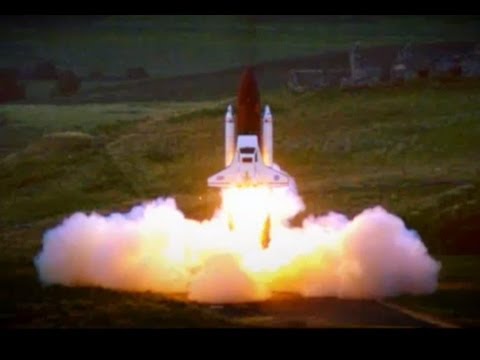
The countdown hits zero and the rocket ignites with an ear-splitting roar, surging off the pad on a pillar of fire and smoke. The initial flight trajectory is flawless, rocketing thousands of feet into the overcast sky in a dead-straight vertical ascent that elicits ecstatic cheers from the ground crew. Right on cue, the explosive charges fire and the twin solid rocket boosters detach cleanly, tumbling away. However, disaster strikes seconds later during the second staging event: the explosive bolts connecting the Reliant Robin to the central external fuel tank fail to release. Trapped against the dead weight of the empty fuel tank, the orbiter cannot deploy its flight control surfaces or level out into a glide.
The stack arcs over at the apex of its flight and enters an accelerating, vertical dive toward the countryside. On the ground, Hammond, May, and the engineers shout helplessly at the sky, pleading, “Separate! Shoot! Shoot!” An emergency parachute charge fires at the very last second, but there is zero altitude left for the canopy to arrest the descent. The entire spacecraft impacts a distant hillside at terminal velocity, detonating in an enormous explosion that sends a massive fireball and plume of black smoke into the air. Staring across the valley at the smoldering crater where their shuttle once was, May turns to Hammond and dryly delivers the verdict: “How are you going to use it again?”
- **Initial ascent:** Flawless vertical climb following ignition from the secret military pad. - **Booster separation:** Both solid rocket boosters successfully separated on schedule. - **Critical failure:** The mechanical/explosive separation between the orbiter and the central external fuel tank failed to release. - **Result:** Complete vehicle loss in a high-speed hillside impact and explosion.
## Mentioned Reliant Robin, Top Gear, Richard Hammond, James May, Jeremy Clarkson, Steve, Model Aeroplane Monthly, University of the West of England, Mini, NASA, European Union
## Video description Hammond and May discover if the Robin Reliant would make for a viable space shuttle. Getting it off the ground won't be a problem, but can they get it to safely land again?
Subscribe for more awesome Top Gear videos: http://www.youtube.com/subscription_center?add_user=Topgear
Top Gear YouTube channel: http://www.youtube.com/topgear TopGear.com website: http://www.topgear.com
Top Gear Facebook: http://www.facebook.com/topgear Top Gear Twitter: http://twitter.com/BBC_topgear
This is a commercial channel from BBC Studios. Service & Feedback https://www.bbcstudios.com/contact/contact-us/
[Source](https://www.youtube.com/watch?v=pJdrlWR-yFM)