Scribes Adopt Bound Codex as Monastic Helpdesk Proves Text Persists
NRK
Scribes can safely replace scrolls with bound books because non-destructive page turning and ribbon bookmarks preserve text without risk of data loss.
AI-assisted summary of Medieval helpdesk with English subtitles — original source. Check the original for full context.
Source published:
Key ideas
- Brother Ansgar struggles to adopt the newly introduced codex, paralyzed by the fear that operating a bound book will corrupt or delete its handwritten contents. (0:02)
- Technical support monk Øystein Backe demonstrates that turning pages provides bidirectional, non-destructive navigation without overwriting prior text. (0:02)
- Backe introduces the integrated fabric ribbon bookmark as a hardware feature that preserves session state across closures. (1:15)
- The demonstration confirms the codex format is stable, crash-proof, and significantly more efficient than continuous parchment scrolls. (1:15)
Detailed notes
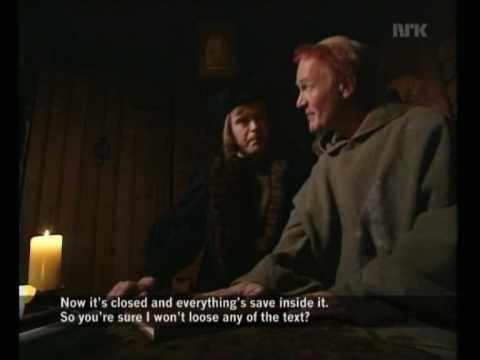
## Background Published on YouTube by Norwegian public broadcaster NRK on February 26, 2007, this comedy sketch originates from the 2001 television program Øystein og jeg, written by Knut Nærum. The clip features Øystein Backe as an IT support monk assisting Rune Gokstad, a desperate scribe bewildered by newly introduced workstation technology.
## TL;DR In a monastic scriptorium, Brother Ansgar is paralyzed by anxiety after receiving an unfamiliar technological upgrade: a bound manuscript, or codex, which replaces his standard parchment scrolls. Technical support specialist Øystein Backe walks the panicked monk through basic system mechanics, demonstrating that turning leaves displays new content without erasing previous text. Under Backe's careful supervision, Ansgar learns manual page navigation and is thrilled to discover seamless bidirectional browsing. Finally, Backe demonstrates session persistence by showing how the integrated ribbon bookmark safely stores the user's place before closing the crash-proof volume.
## Atmosphere & style Deadpan, witty, and understated, the sketch transposes modern corporate desk-side IT support into the austere silence of a medieval scriptorium. The dynamic thrives on the contrast between Rune Gokstad's wide-eyed, tech-phobic dread and Øystein Backe's unflappable, calm customer-service bedside manner. Watching the exchange feels intimately familiar to anyone who has ever guided a novice through basic computer software, turning an ordinary piece of stationery into a marvel of cutting-edge hardware.
## Bulletin - [00:02](https://www.youtube.com/watch?v=pQHX-SjgQvQ&t=2s) Brother Ansgar struggles to adopt the newly introduced codex, paralyzed by the fear that operating a bound book will corrupt or delete its handwritten contents. - [00:02](https://www.youtube.com/watch?v=pQHX-SjgQvQ&t=2s) Technical support monk Øystein Backe demonstrates that turning pages provides bidirectional, non-destructive navigation without overwriting prior text. - [01:15](https://www.youtube.com/watch?v=pQHX-SjgQvQ&t=75s) Backe introduces the integrated fabric ribbon bookmark as a hardware feature that preserves session state across closures. - [01:15](https://www.youtube.com/watch?v=pQHX-SjgQvQ&t=75s) The demonstration confirms the codex format is stable, crash-proof, and significantly more efficient than continuous parchment scrolls.
## Key takeaways - [00:02](https://www.youtube.com/watch?v=pQHX-SjgQvQ&t=2s) The sketch parodies modern IT helpdesk interactions by framing the transition from scrolls to bound books as an unfamiliar technological disruption. - [00:02](https://www.youtube.com/watch?v=pQHX-SjgQvQ&t=2s) Backe concludes an ergonomic assessment regarding quill-induced forearm strain before addressing Ansgar's urgent hardware support ticket. - [00:02](https://www.youtube.com/watch?v=pQHX-SjgQvQ&t=2s) Ansgar treats the codex like an alien device, fearing that improper operation will erase valuable scripture. - [00:02](https://www.youtube.com/watch?v=pQHX-SjgQvQ&t=2s) The binding mechanism replaces continuous unrolling with discrete leaves anchored securely to a central spine. - [00:02](https://www.youtube.com/watch?v=pQHX-SjgQvQ&t=2s) Flipping a page initially alarms Ansgar, who assumes the previous section has been permanently discarded or overwritten. - [00:02](https://www.youtube.com/watch?v=pQHX-SjgQvQ&t=2s) Backe proves navigation is non-destructive by flipping back to the intact preceding text, easing fears of accidental data deletion. - [01:15](https://www.youtube.com/watch?v=pQHX-SjgQvQ&t=75s) Guided tactile instruction teaches Ansgar to grasp the outer corner of the parchment to avoid tearing delicate leaves. - [01:15](https://www.youtube.com/watch?v=pQHX-SjgQvQ&t=75s) Ansgar successfully executes a manual bidirectional page turn, recognizing the efficiency of instant pagination over scrolling yards of parchment. - [01:15](https://www.youtube.com/watch?v=pQHX-SjgQvQ&t=75s) Closing the book's covers raises serious user anxiety about whether unsaved data will disappear upon shutdown. - [01:15](https://www.youtube.com/watch?v=pQHX-SjgQvQ&t=75s) The integrated spine ribbon acts as a physical pointer, allowing immediate state restoration without manual indexing. - [01:15](https://www.youtube.com/watch?v=pQHX-SjgQvQ&t=75s) The codex provides total session persistence, operating as a crash-proof and maintenance-free reading interface.
## Detailed walkthrough ### [00:02](https://www.youtube.com/watch?v=pQHX-SjgQvQ&t=2s) Troubleshooting the Transition from Scrolls to the Codex
In a monastic scriptorium, technical support monk Øystein Backe wraps up a quick consultation with a colleague suffering from an occupational ailment—diagnosing forearm strain from writing with a quill—before answering an urgent on-site support call from Brother Ansgar, played by Rune Gokstad. Ansgar sits at his desk utterly paralyzed by a brand-new technological upgrade that has been delivered to his workstation: a bound manuscript, or codex. Having spent his entire career working strictly with parchment scrolls, Ansgar treats the bound volume like an alien piece of hardware, deeply anxious that mishandling it will corrupt or erase the valuable contents. Backe calmly introduces the unfamiliar apparatus, explaining that this device is known as a "book" and that its operating principles are straightforward once mastered.
```mermaid flowchart TD accTitle: Medieval Helpdesk Workflow accDescr: Flowchart illustrating basic navigation and data retention in a codex.
subgraph Nav["Page Navigation"] A["Open Book Cover"] --> B["Read Active Page"] B --> C["Grip Corner and Turn Leaf"] C --> D["Access Next Page"] D --> E["Flip Back to Previous Page"] end
subgraph Persist["Session Persistence"] E --> F["Insert Fabric Ribbon Bookmark"] F --> G["Close Protective Cover"] G --> H["Reopen Directly at Stored Location"] end ```
Ansgar’s primary confusion stems from how text storage and page display function without continuous unrolling. Backe demonstrates how opening the front cover reveals the first page of writing while the remaining leaves remain securely anchored together by the binding. Ansgar watches suspiciously, struggling to comprehend how one moves to the subsequent text without destroying the current view. When Backe turns the leaf to display the next block of calligraphy, Ansgar becomes alarmed, assuming the previous text has been permanently overwritten or discarded. Backe reassures him that navigation is non-destructive and bidirectional: “No, the text stays right where it is, and you just turn the page to see more.” Flipping the leaf back to show that the initial passage remains intact, Backe alleviates the monk's immediate dread of accidental data deletion.
- **Technician:** Øystein Backe, portraying an IT helpdesk specialist dressed in monk robes. - **End User:** Rune Gokstad, portraying Brother Ansgar, a scribe accustomed only to continuous parchment rolls. - **Core Problem:** User unfamiliarity with the codex form factor, binding mechanics, and non-linear page turning. - **Resolution:** Physical demonstration showing that turning pages caches text across leaves rather than wiping previous entries.
[01:15](https://www.youtube.com/watch?v=pQHX-SjgQvQ&t=75s) Hands-On Navigation, Bookmarks, and System Stability
Having observed the basic mechanism, Ansgar asks permission to operate the device himself under technician supervision. Backe provides guided tactile instruction, directing Ansgar to grasp the outer corner of the parchment leaf between his thumb and index finger rather than pulling from the delicate edge or applying excessive force. Ansgar turns the page with intense concentration and is ecstatic when the action smoothly advances to the next section of scripture without tearing the parchment. He then successfully reverses the motion, returning to the preceding leaf. Overjoyed by this breakthrough in user capability, Ansgar remarks on the sheer brilliance of being able to alternate between pages instantly without having to roll up feet of awkward parchment.
The next crisis occurs when Ansgar considers how to end his reading session safely without inducing a system failure. Terrified that closing the thick wooden covers will crush or erase the unsaved text inside, he questions what happens when the book is shut: “If I close it, won't all the text disappear?” Backe demonstrates closing the volume and reopening it to prove that data persistence is absolute. To solve the problem of locating the user's previous reading position upon rebooting, Backe reveals the built-in cloth bookmark ribbon attached to the spine. Backe explains its functionality as an integrated pointer: “You simply place this ribbon between the pages where you stop, and you will find your place immediately when you open it again.” Satisfied that the book requires no complicated updates, cannot crash, and retains its state through the bookmark, Ansgar finally accepts the new standard format.
- **User Action:** Ansgar performs his first manual page turn, verifying bidirectional reading flow. - **Safety Concern:** Anxiety over closing the volume, mirroring fears of losing unsaved application data during a shutdown. - **Feature Highlight:** The integrated fabric ribbon functions as a physical pointer or bookmark, enabling immediate resumption of reading without manual indexing. - **Reliability:** Backe assures the user that the hardware is crash-proof, permanently persistent, and completely maintenance-free.
## Mentioned NRK, Øystein og jeg, Knut Nærum, Øystein Backe, Rune Gokstad, Brother Ansgar
## Video description Helpdesk support back in the day of the middle age with English subtitles. Original taken from the show "Øystein og jeg" on Norwegian Broadcasting (NRK)in 2001. With Øystein Backe (helper)and Rune Gokstad (desperate monk). Written by Knut Nærum.
[Source](https://www.youtube.com/watch?v=pQHX-SjgQvQ)