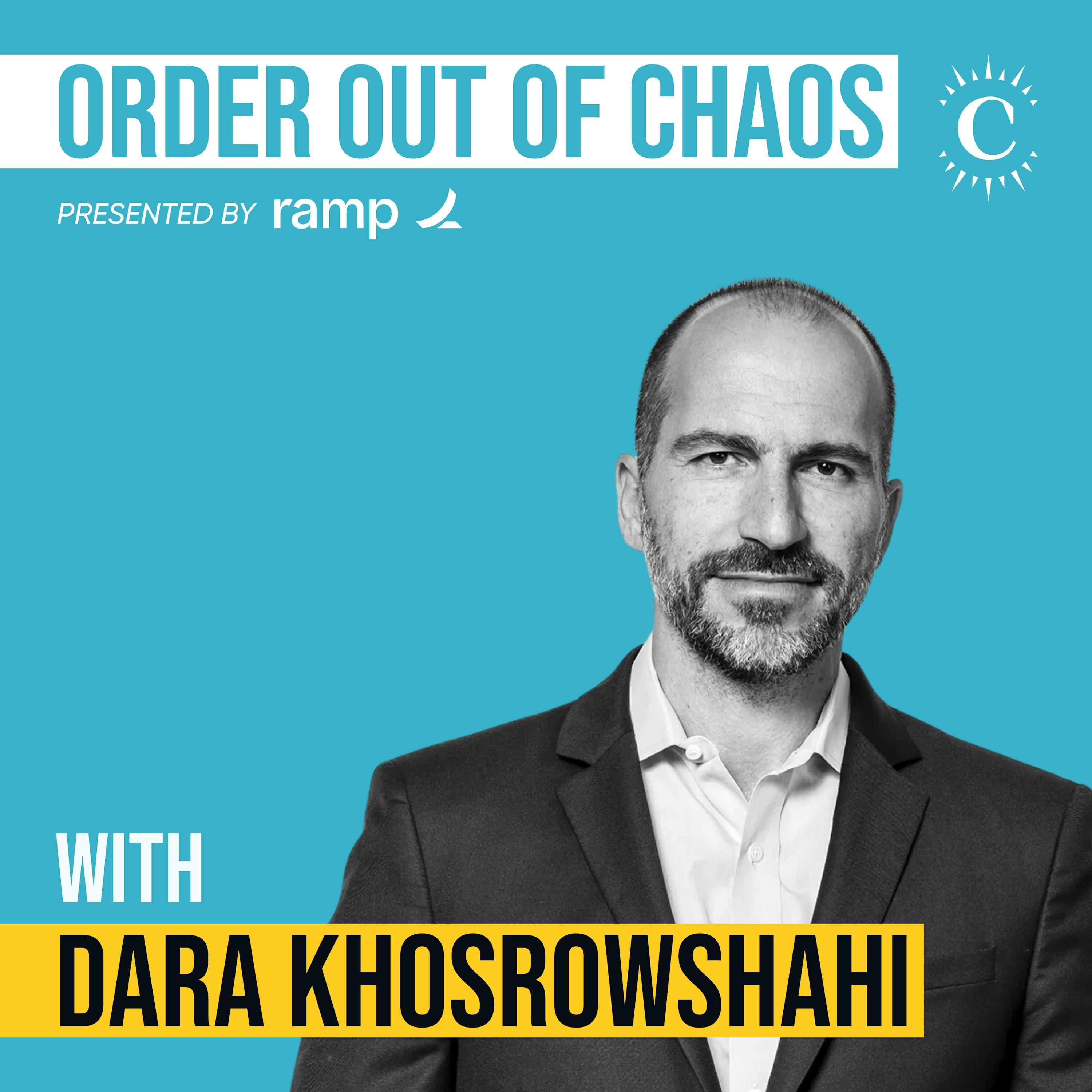
Uber CEO Khosrowshahi Bets $10B Cash Flow on Autonomous Fleet Aggregation
Colossus | Investing & Business Podcasts
Uber aims to secure multi-trillion-dollar market dominance by leveraging its network liquidity to aggregate autonomous vehicle supply across competing developers rather than building first-party hardware.
## Background
Published on June 3, 2026, by Colossus on the podcast *Invest Like the Best*, this episode features an interview hosted by Patrick O'Shaughnessy with Uber CEO Dara Khosrowshahi. The page description highlights Khosrowshahi's transition from Expedia to Uber, his strategies for navigating organizational crisis, Uber's role in autonomous vehicles (AVs) and physical AI, capital allocation, and key leadership lessons learned from figures like Barry Diller and Reed Hastings.
## TL;DR
Dara Khosrowshahi details his leadership journey, from taking over Uber during a period of corporate crisis to positioning the company as a key demand aggregator in the era of autonomous vehicles and physical AI. He explains how Uber leverages supply-led marketplace strategies, unit economics, and multi-modal integration (such as Uber Eats, Uber One, and travel services) to drive compounding growth and over $10 billion in free cash flow. Throughout the conversation, Khosrowshahi balances the technical mechanics of AI adoption and capital allocation with personal reflections on risk, organizational culture, and mentorship.
## Atmosphere & style
The conversation is intellectually rigorous, candid, and reflective, driven by an engaging dynamic between host and guest. Khosrowshahi speaks with an analytical yet deeply human voice, effortlessly blending high-level strategic frameworks and engineering concepts with personal vulnerabilities regarding his family's immigrant history and internal insecurities. The tone feels grounded, thoughtful, and pragmatic, moving seamlessly from granular business mechanics to philosophical reflections on impact, resilience, and personal growth.
## Key takeaways
- `00:00` Dara Khosrowshahi accepted the Uber CEO role after Spotify's Daniel Ek reframed the opportunity around impact rather than comfort.
- `05:00` Upon arriving at Uber, Khosrowshahi used vector mathematics to decompose the crisis, prioritizing board governance, stakeholder trust, and leadership restructuring.
- `09:20` Fleeing the 1979 Iranian Revolution at age nine provided Khosrowshahi with resilience and an engineering mindset to analyze and address business stress objectively.
- `15:00` To drive true innovation with AI, leaders must push teams toward first-principles system redesigns and support internal disruptors rather than relying solely on top-down rollouts.
- `18:00` Uber manages high frontier model compute costs through budget metering and migrating successful initial prototypes to token-efficient open-source models.
- `21:21` Unlike demand-led travel platforms, Uber follows a supply-led strategy, securing physical supply first to naturally drive consumer demand across cities.
- `24:00` Uber acts as the go-to-market demand aggregator for AV developers, leveraging high network utilization, operational infrastructure, and joint fleet financing.
- `26:00` Rapid consumer normalization of breakthrough technologies means high-fixed-cost AV assets require maximum platform utilization to achieve sustainable unit economics.
- `32:05` As autonomous driving costs drop by 30% to 40% per generation, transportation costs will fall, transforming AVs into a multi-trillion-dollar addressable market.
- `35:09` Commercial delivery drones remain constrained by battery density, pushing widespread scalability out by two to five years, while regional AV adoption is driven primarily by local regulatory flexibility.
- `37:35` The cross-platform flywheel between Uber Mobility and Uber Eats, reinforced by Uber One subscriptions, provides a strong structural advantage over single-line rivals.
- `39:44` Because drivers spend hours on the app daily, platform success requires firsthand operational empathy and 'building with heart' to solve real-world logistical friction.
- `42:00` Uber One operates on variable-cost subscription economics that accept initial year-one customer acquisition losses to build profitable, multi-year customer lifetime value.
- `45:00` Uber is expanding into travel and hotel bookings through partnerships, leveraging cross-platform loyalty incentives to capture long-tail travel spending.
- `52:59` User interactions over the next seven years will increasingly shift toward personalized conversational AI agents over standard fixed app interfaces.
- `54:08` Mentorship from Barry Diller taught Khosrowshahi to seek unfiltered 'ground truth' directly from source material and introduce deliberate randomness into executive information streams.
- `56:52` Organizing for long-term growth requires betting on exceptional people and embracing constructive internal 'troublemakers' to keep corporate structures adaptable.
- `01:00:00` Organic reinvestment into high-growth opportunities, such as physical AI and AV fleet capital, takes precedence over share repurchases in Uber's capital allocation strategy.
## Detailed walkthrough
### `00:00` Taking the Reins at Uber: Impact Over Happiness
Dara Khosrowshahi reflects on his transition from a 13-year tenure as CEO of Expedia to leading Uber in 2017. At the time, Expedia was a comfortable, well-loved environment under Barry Diller, whereas Uber was constantly in the headlines for internal drama and corporate chaos. When a headhunter first reached out about the CEO role, Dara dismissed it completely with a firm "no effing way."
The turning point came during a drink at the Allen & Company Sun Valley Conference with Spotify founder Daniel Ek and Dara's wife, Sid. After Ek revealed he was the one who recommended Dara for the job, Dara questioned why he would ever walk into such a storm. Ek responded with a reframing perspective: **"Dara, since when is life about happiness? It's about impact."** Ek argued that Uber was a globally significant company in trouble that needed leadership to secure its future. That evening over a few beers, and after further discussion with his wife, the idea took hold. The next morning in the conference parking lot, Dara called the headhunter back to say, "Tell me more."
- **Prior Role:** 13 years leading Expedia alongside Barry Diller.
- **Key Influence:** Daniel Ek's philosophy that impact matters more than personal comfort or happiness.
- **Mission:** Managing platform operations that support over 10 million drivers and couriers globally.
---
`05:00` Bringing Order to Chaos Through Vector Mathematics
When Dara arrived at Uber, he stepped into total disarray. Co-founder Travis Kalanick had departed, leaving an executive committee running the company amid intense public scrutiny, internal instability, and fierce market competition. To tackle what seemed like an overwhelming crisis, Dara applied a technique he compares to **vector mathematics**: breaking a complex, multidimensional problem down into its individual component vectors, solving each piece, and recombining them.
He systematically addressed three main areas:
1. **The Board of Directors:** The board was locked in a power struggle over who controlled the company's future rather than focusing on what that future should be. To stabilize governance, they brought in Ron Sugar as Chairman.
2. **Public and Stakeholder Trust:** Uber had alienated regulators, drivers, and riders. Dara embarked on a listening tour to understand these grievances and shifted the company's actions to align with stakeholder concerns.
3. **Internal Leadership and Talent:** He restructured the team, parting ways with executives tethered to the old culture while empowering legacy talent like Andrew Macdonald (President and COO) and bringing on new leaders like Chief Legal Officer Tony West.
---
`09:20` Stress, Loss, and the Iranian Immigrant Experience
Dara's steady demeanor under pressure stems from a profound childhood trauma. At age nine, his family fled Iran during the 1979 Revolution, leaving behind a massive family business and all their wealth. Arriving in the United States to stay with his Uncle Nasi, he watched his father—a giant figure in his eyes—lose his entrepreneurial spark as he struggled to rebuild from scratch.
Seeing how financial devastation impacted his father taught Dara to separate his personal identity from professional turmoil. Taking an engineering mindset to business challenges, he treats problems as issues to be analyzed and solved through iterative testing rather than sources of anxiety.
This background also instilled a relentless drive—a "chip on the shoulder" common to many immigrant families who start over from behind. For Dara, this manifests as an "all-in" philosophy, whether he is working, spending undistracted time with his family, or playing sports.
- **Age at Emigration:** 9 years old (fleeing Iran for the United States).
- **Leadership Mindset:** Practical engineering approach focused on breaking problems into testable steps.
- **Parenting Philosophy:** Avoiding "helicopter parenting" and allowing kids to face and overcome their own challenges to build resilience.
---
`17:01` Physical AI and the Frontier of Real-World Complexity
Looking at Uber's current landscape, Dara sees the rise of AI as both a major opportunity and an operational challenge. Unlike purely digital software platforms, Uber operates at the intersection of digital interfaces and physical fulfillment. While user interactions inside the app follow determinative rules, the real world introduces probabilistic outcomes—unpredictable variables like traffic jams, late food deliveries, and driver cancellations.
Uber has long relied on machine learning to manage these real-world disruptions. However, the latest wave of AI technologies represents a shift in how the company builds its internal architecture and optimizes physical logistics on a global scale.
Here is a detailed walkthrough of part 2 of the transcript:
`15:00` First-Principles AI Rebuilding and the "Rebel" Engineers
Reflecting on the sheer speed of technological shift across both digital and physical landscapes, Khosrowshahi notes that he has never seen a faster pace of change. On the digital side, massive models anticipate user intent to drive utilization and elevate engineers into "super engineers," while physical AI—spanning autonomous vehicles (AVs) and drones—is fundamentally altering real-world consumer interactions. Addressing his internal leadership strategy, he stresses that he avoids top-down directives in favor of a bottom-up culture where innovation happens everywhere across the business. While incremental wins—like using AI to optimize an existing process by 20% to 30%—are a good start, his primary focus as CEO is pushing teams to rebuild systems from a first-principles perspective.
The unpredictable nature of AI adoption across the company is already yielding surprising results. In India, for instance, developer teams utilizing autonomous agents are generating a 10x surge in code commits. To capitalize on this, Khosrowshahi emphasizes the importance of supporting internal "rebels" who push boundaries rather than relying on traditional top-down rollouts.
* **Sponsor Notes:** Vanta automates security and compliance for over 16,000 companies (including Ramp, Cursor, and Harvey) using a 24/7 GRC agent to cut vendor assessment time by up to 50% ($1,000 off at `[vanta.com/invest](https://vanta.com/invest)`). Ridgeline offers an all-in-one system of record with embedded AI for investment management firms (`ridgeline.ai`).
* **Engineering Impact:** AI adoption spans every division, from legal and marketing to platform migrations, debugging, and project scoping.
---
`18:00` Managing AI Compute Costs and Frontier Model Exploration
When asked about managing the financial strain of high token consumption, Khosrowshahi candidly shares that Uber "blew through our AI budget in a quarter for the whole year, essentially." As developer throughput rises and engineers achieve superhuman output, the associated compute costs scale significantly. To balance this spend without stifling progress, Uber is actively metering headcount growth while encouraging widespread internal experimentation.
To optimize unit economics, Uber employs a tiered approach to model deployment. Expensive frontier models—such as those from OpenAI or Anthropic (Claude)—are used for front-end exploration, prototyping new interactions, and pushing boundary capabilities. Once a feature or workflow proves its value and requires scaling, the company transitions the workload to lower-cost open-source models or token-efficient alternatives.
* **Free Cash Flow Dynamics:** Uber generates over $10 billion in free cash flow, but because that is spread across well over 10 billion annual trips, it operates as a low-margin business that must prioritize operational efficiency to keep rider prices down and earner pay up.
* **Cost Strategy:** Use top-tier frontier models for early-stage discovery, followed by migration to smaller or open-source models for scaled execution.
---
`21:21` Physical AI and Uber's Supply-Led Strategy
In the physical AI space, Uber operates as a massive demand aggregator, deploying search and feed models that are roughly 10,000 times larger than their legacy predecessors. These universal search models process rich user data to predict user intent across services—enabling seamless one-tap interactions that already correctly predict a rider's destination three-quarters of the time before they type it in.
Drawing on lessons from his 13 years running Expedia, Khosrowshahi contrasts demand-first travel platforms with Uber’s supply-led architecture:
> "At Expedia, we were really focused on demand... and then we would build out hotel inventory and flight inventory in response to demand. At Uber, everything is upside down... the biggest opportunity and challenge we have is making sure that we secure every single supply... If we do that, the demand will take care of itself."
Rather than limiting focus to major global centers, Uber expands its footprint into sparse suburban markets and lower-tier cities by first onboarding drivers, couriers, and merchants, knowing consumer demand naturally follows.
* **Market Scaling:** Growth relies on seeding supply across the next 50 to 200 secondary and tertiary cities in a country, rather than just the top 10 metropolitan hubs.
* **Physical AI Integration:** Future physical touchpoints will blend advanced predictive models with hardware form factors like delivery drones and autonomous vehicles.
---
`24:00` Building the Autonomous Ecosystem and $1B Fleet Financing
Viewing the current AV landscape as the early stage of a rapid S-curve, Khosrowshahi draws parallels to foundation software models: there will not be a single winner, but rather multiple successful AV developers and open-source models. Uber positions itself as the primary go-to-market engine for these autonomous developers, allowing partners to focus on building software drivers while Uber manages marketplace liquidity and local infrastructure.
Uber now maintains over 30 AV-related partnerships—including Waymo, Nuro, Lucid, NVIDIA, Waabi, Wayve, WeRide, and Pony.ai. Beyond software integration, Uber provides comprehensive operational support:
* **Depot Infrastructure & Fleet Operations:** Securing charging depots and managing physical vehicle upkeep in regulatory-friendly markets.
* **Financing & Insurance:** Partnering with Santander on a $1 billion financing line for electric and autonomous vehicle fleets, alongside specialized AV insurance product development.
* **Data & Fleet Utilization:** Collecting real-world street data to feed back into partner training models.
Autonomous vehicles running on Uber’s network achieve 30% or higher vehicle utilization (trips and revenue per day) compared to first-party (1P) standalone AV fleets—a critical ROI driver given the high capital cost of autonomous hardware.
---
`26:00` The "Magic to Normal" Effect and Partnering vs. Competing
Reflecting on consumer habits, Khosrowshahi describes how quickly technological breakthroughs lose their initial shock value—recalling how the early magic of ordering a car via smartphone in New York rapidly degraded into impatience if a ride took six minutes instead of five. The same rapid normalization is happening with AVs:
> "For the first two minutes, you're like, 'Oh my god, this is amazing... Minute three, here you are doing the same thing... what's magical now is going to seem normal to all of us 10 years from now."
When navigating complex dynamics with partners like Waymo or Zoox—who develop both autonomous technology and direct-to-consumer apps—Khosrowshahi leverages his experience from the travel and food delivery sectors. Online Travel Agencies (OTAs) coexisted with major hotel chains like Marriott, just as Uber Eats coexists with restaurant partners like McDonald's, Starbucks, and Chipotle. Because high-fixed-cost assets demand maximum utilization to achieve profitability—where filling 90% of inventory versus 70% makes or breaks unit economics—AV developers naturally lean on Uber’s network liquidity alongside their direct channels. Other partners, like Wave, will focus strictly on licensing models to OEMs while relying on Uber for 100% of consumer demand.
Here is the detailed walkthrough of the transcript segment.
`30:00` Public Perception of AI and AV Scale
The discussion opens with a reflection on the public backlash facing AI and autonomous vehicles (AVs). While corporate leaders focus on driving utilization and efficiency, the average person often sees AI as a threat that raises electricity bills or risks family members' jobs. AV technology faces a similar perception challenge: even though it will ultimately be safer than human drivers, companies must actively address how these vehicles interact with emergency responders, ensure broad access across income levels, and handle the impact on driver earnings.
Addressing these fears requires ongoing dialogue with regulators, local residents, and drivers. However, early data from partnerships with Waymo in Austin and Atlanta shows encouraging results. Drivers on the Uber platform in these cities are actually earning more money, and driver sign-ups are increasing because AVs appear to be generating incremental demand rather than taking business away. To prevent a public backlash, the industry must expand at a speed society is comfortable with.
- **AV Public Challenges:** Safety around emergency services, public access equity, and impact on human driver earnings.
- **Early Partnership Data:** Austin and Atlanta Waymo partnerships show increased driver earnings and higher driver sign-ups due to incremental platform demand.
- **Primary Operational Premise:** Uber's single biggest controllable variable for success is securing access to AV supply.
- **Supply Strategy:** Uber is actively investing time and capital into partnerships with nearly every AV supplier across mobility, delivery, and freight.
---
`32:05` Unlocking the Trillion-Dollar AV Marketplace
Assuming Uber succeeds as the dominant demand aggregator for autonomous vehicles, a brand-new marketplace worth an estimated trillion dollars could be unlocked. Historically, hardware and software costs decline by roughly **30% to 40% per generation**. As midsize AVs—such as the custom vehicles built by Lucid and Nuro for Uber—come down in price, the cost of transportation for the general public will drop significantly.
Because demand expands as transportation costs decrease, the total addressable market for AVs will dwarf the original taxi market, much like Uber's original rideshare service did. Beyond passenger rides, AVs and delivery drones promise to transform everyday consumer habits by dropping delivery times down to **10 to 15 minutes** at lower costs.
```
Cost Curve & Efficiency Impact:
Hardware/Software Cost Reduction --> Lower Trip Prices --> Massive Demand Surge
Average Human Vehicle Usage --> 1x Baseline
Average AV Vehicle Usage --> 3x to 4x Human Mileage
```
Regarding vehicle manufacturing, traditional OEMs are realizing that Level 4 (L4) autonomous driving is much closer to reality than previously anticipated. While AV manufacturing currently sits in the hundreds or thousands, it is poised to scale to tens of thousands and eventually hundreds of thousands of units. Furthermore, an individual AV operates with far greater efficiency than a human-driven vehicle, covering **three to four times the mileage** of a standard human driver. While Chinese manufacturers currently lead the world in low-cost, high-quality vehicle production, equivalent low-cost contract manufacturing capacity still needs to be developed in the Western Hemisphere.
- **Market Potential:** Expanding transport and delivery into a multi-trillion-dollar marketplace as costs fall.
- **Vehicle Manufacturing Scale:** Expected to ramp from thousands to hundreds of thousands of L4-ready vehicles over the next **two to four years**.
- **Vehicle Efficiency:** One AV replaces the operational output of multiple human-driven cars by driving 3x to 4x more miles.
---
`35:09` The Reality of Drones and Regional AV Rollouts
Addressing why delivery drones have not yet scaled to every household despite a decade of hype, the primary bottleneck remains battery technology. Drone development is limited by battery density—specifically, the energy required for a battery to lift its own weight plus a commercial payload, combined with range limitations and recharge times. While human-piloted passenger drones (such as those built by Joby Aviation) and specialized companies like Zipline are making steady progress, commercial food and grocery drone delivery at scale is still **two to five years away**. Initial drone delivery options will cost more than human couriers, but rapid improvements in payload capacity and all-weather operational accuracy will make drones a normal part of life within **five to ten years**.
```
Regional AV Deployment Timeline:
├── Middle East (Abu Dhabi, Dubai, Saudi Arabia) --> Fast-track regulation; driverless vehicles active today
├── United States (California, Texas) --> Early commercial rollouts active
├── United States (New York, Boston) --> Slower adoption due to regulatory/dense urban friction
└── Europe (London, major hubs) --> Catching up; commercial pilots launching by end of year
```
Regional differences in AV adoption are largely dictated by regulatory appetite. The Middle East—particularly Abu Dhabi, Dubai, and Saudi Arabia—is moving fastest due to highly entrepreneurial regulators, with driverless vehicles already operating on roads today. In the United States, states like Texas and California lead the way, whereas dense eastern cities like New York and Boston will take longer. Meanwhile, Europe is accelerating its efforts to avoid being left behind, with commercial robotaxi pilots launching in hubs like London before the end of the year to support European OEMs and local economies.
- **Drone Obstacles:** Battery density, lift-to-payload ratio, range constraints, and recharging cycles.
- **Drone Timeline:** Higher initial costs than human delivery, but scaling within **2 to 5 years**, becoming commonplace in **5 to 10 years**.
- **Middle East:** Regulatory environments in Abu Dhabi and Dubai are aggressively enabling driverless operations right now.
- **Europe:** Starting commercial robotaxi initiatives, including London pilots by the end of the year.
---
`37:35` The Uber Eats International Playbook and Cross-Platform Flywheel
Uber's global success with Uber Eats stems from mastering basic operational blocking and tackling: building comprehensive merchant selection and maintaining reliable **30-minute delivery** times. Across its active cities, Uber has onboarded roughly **40% to 50%** of all addressable restaurant and merchant supply, leaving substantial runway for growth.
Uber's core structural advantage over single-line competitors is its cross-platform integration. By cross-selling ride-hailing users into delivery—both through targeted prompts and by placing Eats directly inside the main mobility app—Uber generates approximately **13% of its Uber Eats bookings** directly from its mobility customer base without additional acquisition costs.
This structural advantage is amplified by the **Uber One membership program**, which has scaled to **50 million members** and is growing at **50% year-over-year**. Uber approaches membership much like Netflix, offering more combined content and value for a single fee than a single-category competitor can match. Members receive discounts on mobility, surge protection, free delivery, waived grocery fees, and **10% cash back on hotels**. This flywheel enables Uber to capture the number-one market position internationally while generating higher profit margins than single-line rivals.
- **Merchant Penetration:** Currently hovering at **40% to 50%** of addressable merchants in active cities.
- **Cross-Platform Conversion:** **13% of Eats bookings** originate directly from the core mobility application.
- **Uber One Scale:** **50 million members**, expanding at a **50% YoY rate**.
---
`39:44` Aggregating Supply and Building with Heart
While Uber excels at supply aggregation, true mastery requires building deep empathy for suppliers, drivers, and couriers. Unlike end-consumers who interact with the app for just 30 seconds at a time, a driver or courier stays logged into the platform for **6 to 10 hours a day**. Consequently, software bugs affect drivers far more frequently; a minor P95 bug that a consumer might experience once a month hits an active driver every single week.
To bridge this gap, leaders must experience their own platform from the worker's perspective. Following the COVID-19 pandemic, Khosrowshahi bought an e-bike to deliver food in San Francisco and drove passengers in his Tesla. He observed firsthand the hidden friction of real-world logistics: navigating crowded restaurant counters, managing batch orders (which make up roughly **50% of deliveries**), and maneuvering through heavy traffic.
"We have a value at our company, which is building with heart. I'm an engineer at heart. I'm very numerical in how I look at things, but there's a craft to building. There's a humanity in our service..."
- **Platform Engagement Contrast:** Consumers spend seconds on the app; drivers and couriers rely on it for **6 to 10 hours daily**.
- **Batching Dynamics:** Approximately **50% of food delivery orders** are batched together.
- **Software Reliability:** Bugs hit high-frequency driver software exponentially harder than consumer-facing interfaces.
---
`42:00` The Economics of the Uber One Membership Model
Designing a successful subscription program depends heavily on a business's underlying cost structure. Models built on fixed costs—like Netflix producing content or traditional travel programs upgrading empty hotel rooms or airline seats—face virtually zero variable cost when a member uses the service. In contrast, delivery and rideshare memberships incur clear variable costs on every single transaction.
```
Amazon Prime & Uber One Unit Economics Curve:
Year 1: [Loss Leader] --> High CAC & heavy user discounts lower initial margin
Year 2+: [Profitability] --> Increased order frequency & platform lock-in generate long-term LTV
```
Taking inspiration from Amazon Prime's willingness to endure short-term public market skepticism while scaling its logistics membership, Uber structured Uber One to prioritize long-term customer lifetime value (LTV) over immediate per-transaction margins. While Uber initially loses money on a new member during their first year due to discounts and cash-back perks, that member becomes highly profitable in years two, three, and four as their platform spending increases dramatically. Today, the Uber One program is solidly profitable overall.
- **Fixed-Cost Subscriptions:** Exemplified by Netflix or travel upgrades, where serving an extra member costs virtually nothing.
- **Variable-Cost Subscriptions:** Exemplified by Amazon Prime and Uber One, where higher usage incurs direct fulfillment and discount costs.
- **Uber One Payback Period:** Program is unprofitable on a customer in **Year 1**, but turns solidly profitable across **Years 2 through 4**.
---
`44:34` Expanding the Platform into Hotels
Uber is moving to connect its logistics platform to the broader travel ecosystem by adding hotel bookings directly into the application. This strategy brings Khosrowshahi's career full circle back to his online travel agency (OTA) roots, leveraging existing user intent and cross-platform loyalty to capture additional high-margin travel spend.
- **Strategic Goal:** Expand the single super-app ecosystem from daily local transportation and dining into long-tail travel accommodation.
- **Loyalty Integration:** Leverage perks like **10% cash back** for Uber One members on hotel stays to drive higher retention and user spend.
`45:00` Expanding into Travel, Trains, and Hotel Bookings
Uber has observed a clear pattern among its user base: frequent travelers are naturally heavy Uber users. With availability in over 70 countries and approximately 15% of all trips taking place to or from airports, the platform completed 1.5 billion trips outside of users' home cities in the past year alone. Identifying travelers as a key cohort led Uber to explore deeper integrations into the travel fulfillment stack beyond traditional online travel agencies. They started by introducing train bookings in markets like the UK and Spain, discovering that adding more travel content directly increases user retention and engagement across the entire ecosystem.
Building on that success, Uber expanded into hotel bookings—a high-value consumer decision. To secure premier inventory, they partnered with Expedia, passing the majority of the deal's economics directly back to Uber One members via discounts (such as 10% off hotels or 20% off selected properties). Khosrowshahi envisions an ultimate end-state where Uber seamlessly integrates into a traveler's entire journey: parsing flight details, automatically pre-booking rides to and from airports, providing front-desk notifications upon arrival, or even allowing users to bypass the front desk entirely by using the Uber app as a digital room key.
- **Global reach**: Uber operates in over 70 countries.
- **Trip metrics**: 1.5 billion trips per year are taken outside users' home cities; 15% of total trips are airport-related.
- **Train rollout**: Live in the UK and Spain as an initial travel content test.
- **Hotel economics**: Partnered with Expedia to pass majority savings to Uber One members (e.g., 10% to 20% discounts).
- **Core thesis**: "More content meant more retention."
`47:41` Shifting Brand Perception from On-Demand to Planned Travel
Addressing potential pre-mortem risks to this travel strategy, Khosrowshahi notes the primary challenge is whether consumers can associate Uber with advance planning rather than spontaneous, on-demand dispatch. Historically, the brand identity has been built around immediate gratification—"push a button, get a car." To prove that user behavior could expand temporally, Uber redesigned its backend for Uber Reserve, ensuring a 99%+ driver reliability rate through upfront driver pre-commitments rather than last-minute dispatches.
Uber Reserve has grown into a multi-billion dollar run-rate business, demonstrating that users are willing to pay higher prices in exchange for guaranteed reliability. Drivers also favor the feature because it allows them to pre-commit to earnings. However, Khosrowshahi acknowledges that getting users to book rides in advance is still a step away from getting them to plan an entire vacation months ahead on Uber, making it an ongoing test of brand elasticity.
- **Uber Reserve run-rate**: Now exceeds $1 billion, having not existed 5–6 years prior.
- **Reliability threshold**: Backend re-engineered to achieve a 99%+ driver reliability rate.
- **Behavioral shift**: Successfully moved both supply and demand toward pre-committed schedules.
`49:44` Marketing Strategy and the Role of Storytelling
Discussing marketing execution across an expanding suite of products, Khosrowshahi admits he originally held a purely product-led mindset: believing marketing should simply acquire app downloads while product surfaces features dynamically. He gives the example of ordering hot coffee during an Uber Reserve ride to the airport, noting the value isn't just selling coffee, but delighting the rider and signaling the broader breadth of Uber's capabilities to increase lifetime value.
His marketing team challenged his initial view, demonstrating that emotional, narrative-driven storytelling is crucial for changing consumer perception. Campaigns highlighting practical, human scenarios—such as Uber Teens safely transporting kids to and from sporting events—remind consumers that Uber is designed to save them time across a variety of daily local needs rather than just providing a taxi replacement.
- **Product feature example**: Ability to add a hot coffee pickup to an Uber Reserve airport trip.
- **Strategic goal**: Focus on increasing overall customer lifetime value (LTV) rather than transactional upselling.
- **Brand perception**: Shifting consumer understanding from single-ride ridesharing to a comprehensive local time-saving platform.
`52:59` App Interfaces vs. Conversational AI Agents in Seven Years
Looking seven years into the future, Khosrowshahi predicts that user interactions will shift significantly toward unstructured, voice- or text-based AI agents. While visually rich native apps will remain necessary for transmitting information that is inherently spatial or graphical—such as tracking a driver on a map or reviewing vehicle options—inbound requests will increasingly happen through natural language interfaces.
Historically, mobile application user interfaces were built for the average user through rigorous A/B testing and statistical optimization, resulting in a single fixed entry point. Generative AI enables hyper-personalization, altering the interface depending on context, such as whether a user just landed at an airport or is commuting to work.
> "I think the inbound interaction is going to move more and more away from apps... Historically, you built UIs for a specific interaction based on optimizing for the overall average... Now, we're going to personalize it."
`54:08` Leadership Lessons from Barry Diller: Unfiltered Ground Truth
Reflecting on his primary business mentor, Barry Diller, Khosrowshahi shares an anecdote from his early career as an analyst at Allen & Company working on an LBO model during the hostile tender offer for Paramount. Diller bypassed managing directors and vice presidents to speak directly with the junior analyst who built the model, ensuring the debt figures were solid before raising billions of dollars.
Working alongside Diller for over 20 years taught Khosrowshahi the critical importance of seeking "ground truth" directly from primary source material rather than relying on polished, processed summaries prepared by corporate ranks. Corporate filtering often smooths out the "edges"—the statistical outliers or 95th-percentile scenarios where strategic advantage actually lies. To counter corporate blind spots, leaders must intentionally create randomness in their daily information flow and maintain brutal transparency with their teams.
- **First interaction**: Meeting Diller while working as a 20-something analyst at Allen & Co on the Paramount LBO model.
- **Key insight**: Standard corporate processes filter out the "edges" where strategic advantage resides.
- **Management practice**: Deliberately inserting randomness into daily schedules and communications to bypass executive filtering.
`56:52` Betting on People and Embracing Internal "Troublemakers"
From Herbert Allen (both the second and third) at Allen & Company, Khosrowshahi adopted the principle of betting on exceptional people rather than static business models. This philosophy inspired his own decision to leave a stable career at Allen & Co to join Diller in building an unproven entrepreneurial venture, a risk that ultimately defined his career trajectory.
When managing Uber, Khosrowshahi applies this human-centric view by seeking out organizational "troublemakers"—individuals who challenge established norms, culture, and standardized processes. He views these disruptors as essential genetic mutations within an enterprise organism. In an era where AI is accelerating the rate of operational change by fivefold, companies that enforce rigid uniformity risk obsolescence, whereas those that embrace internal mutations adapt successfully.
> "Every company is like an organism. Organisms evolve by mutating. And companies that don't mutate, that just sit with a single process, with a single information flow, those are the companies that die."
- **Core belief**: "Great people always stay great," making personal bets superior to institutional bets.
- **Operational change pace**: AI is accelerating internal organizational change by 5x.
- **Culture philosophy**: Actively cultivating random internal interactions to protect constructive disruptors from corporate homogenization.
`01:00:09` Capital Allocation: Free Cash Flow, Buybacks, and Growth
Addressing Uber's evolution into a free cash flow generator producing over $10 billion, Khosrowshahi frames capital allocation as more of an art than a strict academic science. Managing capital requires balancing traditional value-creation mechanics—such as large-scale share buybacks—with aggressive growth investments in physical AI, autonomous technologies, and market expansion.
- **Free cash flow benchmark**: Uber now generates over $10 billion in free cash flow.
- **Allocation levers**: Balancing share repurchases against growth capital expenditures.
`01:00:00` Organic Investment, Capital Allocation, and Balancing Buybacks
When evaluating capital allocation, Dara Khosrowshahi emphasizes that organic investment and long-term growth always take precedence over stock buybacks. Drawing on his background in investment banking, he approaches business management through the power of compounding and a basic financial rule of thumb: ensure costs grow at a slower rate than revenue over a sustained period. He illustrates the power of organic investment through Uber Eats, which generated under $1 billion in gross bookings when he first joined the company and has since scaled to over $100 billion.
Now that Uber generates cash flow well beyond its initial organic needs, Khosrowshahi outlines clear operational priorities. First, the company continues to invest in its core engineering, algorithms, and service offerings. Second, Uber is making substantial capital commitments to the emerging landscape of autonomous vehicles (AVs). Rather than simply sitting back, Uber intends to proactively build and financialize the AV market—evidenced by a recent financing deal with Santander for both electric vehicles (EVs) and AVs—by committing to tens of thousands of autonomous vehicles. Even with these heavy growth investments, the company generates sufficient excess cash flow to fund buybacks simultaneously.
- **Uber Eats Scaled Booking:** Expanded from less than **$1 billion** in gross bookings when Khosrowshahi joined to over **$100 billion** through targeted organic investment.
- **Capital Priorities:** Priority goes to engineering talent, algorithm refinement, and driving market development for AVs, with stock buybacks utilizing remaining excess cash.
- **Strategic Financing:** Mentioned a deal with **Santander** to structure financing for both EVs and AVs to support high-volume vehicle commitments.
---
`01:01:21` Leadership Insecurities, Continuous Learning, and Lessons from Barry Diller
Addressing how he views his own confidence and leadership style, Khosrowshahi clarifies that he does not feel insecure, but remains deeply curious. Reflecting on his mentor Barry Diller, he notes a common trap among successful executives: as leaders gain authority, they tend to talk more, listen less, and expect employees not to challenge them. Diller operates as the exact opposite. While getting into an argument with Diller can be "unpleasant," when someone proves him wrong, Diller lights up with genuine delight because he values learning over being right.
Khosrowshahi shares that his personal drive comes from being a "learning creature," which inherently requires leaning into the discomfort and pain of making mistakes, hearing uncomfortable feedback, and facing unexpected outcomes. For him, a world where a leader is right all the time is simply uninteresting, and real breakthrough moments happen when conventional wisdom is challenged through rigorous debate.
> "What kind of a world is an interesting world if you're right all the time? The magic happens when you learn... and for me, the delight comes from learning. And often that learning has to come with pain and the pain of being wrong."
---
`01:03:01` Structured Innovation: Learning from Reed Hastings
As a self-described "student of business" who appreciates how companies evolve, Khosrowshahi highlights Netflix co-founder Reed Hastings as a major influence on his management approach. He admires how Hastings manages to blend highly structured, logical thinking as an engineer with a willingness to take bold, calculated gambles.
While not every gamble pays off—referencing Hastings' willingness to candidly discuss past failed bets—Khosrowshahi sees Hastings' superpower in his ability to innovate deliberately without getting trapped by standard corporate convention. He points out that true innovation requires balancing clear, structured processes with an open ear to "troublemakers" and wild ideas outside traditional wisdom.
---
`01:04:17` The Kindest Thing: Personal Transformation and Authenticity
In response to the show's traditional closing question regarding the kindest thing anyone has ever done for him, Khosrowshahi points to his wife, Syd. Reframing his earlier discussion about his origins as an Iranian immigrant and carrying a "chip on his shoulder," he admits that before meeting her, he constantly lived the life he thought he was supposed to live and adapted his personality to fit what others expected.
Observing his wife changed his perspective entirely. Whether she was hanging out with everyday friends or attending high-stakes events like the Sun Valley Conference surrounded by billionaires, she remained effortlessly the same person. Seeing her unwavering authenticity gave Khosrowshahi the permission and freedom to drop his guard and become the person he actually wanted to be, calling it a life-changing gift and kindness that he could never replace. Host Patrick O'Shaughnessy warmly echoes the sentiment, noting a remarkably similar personal experience with his own wife.
## Notable quotes
> `03:29` Dara, since when is life about happiness? It's about impact. — Daniel Ek
> `03:29` Tell me more. — Dara Khosrowshahi
> `21:21` At Expedia, we were really focused on demand... and then we would build out hotel inventory and flight inventory in response to demand. At Uber, everything is upside down... the biggest opportunity and challenge we have is making sure that we secure every single supply... If we do that, the demand will take care of itself. — Dara Khosrowshahi
> `26:00` For the first two minutes, you're like, 'Oh my god, this is amazing... Minute three, here you are doing the same thing... what's magical now is going to seem normal to all of us 10 years from now. — Dara Khosrowshahi
> `39:44` We have a value at our company, which is building with heart. I'm an engineer at heart. I'm very numerical in how I look at things, but there's a craft to building. There's a humanity in our service... — Dara Khosrowshahi
> `45:00` More content meant more retention. — Dara Khosrowshahi
> `52:59` I think the inbound interaction is going to move more and more away from apps... Historically, you built UIs for a specific interaction based on optimizing for the overall average... Now, we're going to personalize it. — Dara Khosrowshahi
> `56:52` Every company is like an organism. Organisms evolve by mutating. And companies that don't mutate, that just sit with a single process, with a single information flow, those are the companies that die. — Dara Khosrowshahi
> `56:52` Great people always stay great — Dara Khosrowshahi
> `01:01:21` What kind of a world is an interesting world if you're right all the time? The magic happens when you learn... and for me, the delight comes from learning. And often that learning has to come with pain and the pain of being wrong. — Dara Khosrowshahi
## Mentioned
Dara Khosrowshahi, Uber, Expedia, Barry Diller, Daniel Ek, Allen & Company, Sid Khosrowshahi, Travis Kalanick, Ron Sugar, Andrew Macdonald, Tony West, Uncle Nasi, Vanta, Ramp, Cursor, Harvey, Ridgeline, OpenAI, Anthropic, Claude, Waymo, Nuro, Lucid, NVIDIA, Waabi, Wayve, WeRide, Pony.ai, Santander, Zoox, Marriott, Uber Eats, McDonald's, Starbucks, Chipotle, Wave, Joby Aviation, Zipline, Uber One, Netflix, Amazon Prime, Uber Reserve, Uber Teens, Herbert Allen, Reed Hastings, Patrick O'Shaughnessy
Uber CEO Khosrowshahi以100亿美元现金流押注自动驾驶车队聚合
Uber旨在利用其网络流动性聚合各竞品开发商的自动驾驶车辆供应,而非自研第一方硬件,从而确立数万亿美元的市场主导地位。
Dara Khosrowshahi详细讲述了他的领导历程,从在公司深陷危机时期接掌Uber,到将公司定位为自动驾驶汽车与物理AI时代的关键需求聚合平台。他解释了Uber如何通过供给导向的市场策略、单位经济模型以及多模态业务整合(如Uber Eats、Uber One和出行服务)来推动复合增长并实现超100亿美元的自由现金流。在对话中,Khosrowshahi既阐述了AI应用与资本配置的技术运作机制,也分享了关于风险、组织文化和导师指导的个人思考。
Dara Khosrowshahi 在 Spotify 创始人 Daniel Ek“人生在于追求影响力而非安逸”的启发下接任 Uber CEO,并运用类似向量数学的方法拆解重构了董事会治理、公众信任及领导团队。 (3:37)
在推动 AI 落地时,Uber 采取分层成本控制策略:先利用顶级前沿模型进行早期探索与功能原型构建,规模化部署时再迁移至高 token 效率的开源或轻量化模型。 (18:00)
不同于需求先导的传统旅游平台,Uber 采取“供给驱动”战略,通过在广阔的次级城市优先拓展司机、配送员与商家供给,从而自然带动消费者端的需求增长。 (21:21)
在自动驾驶(AV)领域,Uber 定位为核心需求聚合与落地运营平台,依托超 30 项产业合作以及 10 亿美元车队融资支持,使其网络内 AV 的车辆利用率较独立车队提升 30% 以上。 (24:00)
Reading summary
Uber CEO Dara Khosrowshahi argues that the platform's core advantage lies in its supply-led network liquidity, positioning it to dominate the multi-trillion-dollar transition to autonomous vehicles while expanding cross-platform loyalty into long-tail travel.
Autonomous Vehicle Aggregation and Supply-Led Fleet Strategy (24:00)
Unlike demand-led travel platforms such as Expedia, Uber operates on a supply-first model where securing inventory creates its own liquidity. Khosrowshahi views the autonomous vehicle (AV) transition as an S-curve featuring multiple model winners rather than a single dominant player. To capture this shift, Uber has established more than 30 AV partnerships—including Waymo, Lucid, Nuro, and NVIDIA—acting as the primary marketplace and dispatch layer. Standalone autonomous fleets struggle with unit economics, whereas autonomous vehicles operating on Uber achieve 30% or higher utilization rates compared to direct first-party operations.
Khosrowshahi projects that falling hardware and software costs (historically declining 30% to 40% per generation) will expand transport into a trillion-dollar addressable market. Because an AV operates at three to four times the mileage efficiency of an average human-driven car, scaling Level 4 vehicles to hundreds of thousands of units over the next two to four years requires physical operational support. To bridge this gap, Uber has partnered with Santander on a $1 billion vehicle financing line while securing depot infrastructure, fleet maintenance, and tailored insurance products.
Cross-Platform Synergies and Subscription Unit Economics (37:35)
Uber leverages structural cross-selling between its mobility and food delivery divisions to generate significant customer acquisition advantages over single-vertical rivals. Approximately 13% of Uber Eats bookings originate directly inside the mobility application without incremental marketing expense. This multi-product funnel helped scale Uber Eats gross bookings from under $1 billion when Khosrowshahi joined to over $100 billion.
This cross-platform usage feeds into the Uber One membership program, which has reached 50 million members with 50% year-over-year growth. Unlike digital subscription models such as Netflix, where marginal distribution costs are near zero, Uber One incurs real variable costs on discounts and deliveries for every order. Khosrowshahi structured the model after Amazon Prime: Uber deliberately absorbs negative margins on members in Year 1 to secure customer lifetime value, with accounts turning solidly profitable across Years 2 through 4 as order frequency compounds.
Extending Brand Elasticity into Scheduled Travel Fulfillment (45:00)
Uber is moving upstream from on-demand urban transit into planned travel to capture high-margin consumer spend. With 15% of all rides tied to airports and 1.5 billion trips taken annually outside users' home cities across 70 countries, the company identified frequent travelers as its highest-value cohort. Testing its thesis that broader content improves retention, Uber integrated train reservations in the UK and Spain, followed by hotel bookings through a partnership with Expedia that returns discounts of 10% to 20% to Uber One members.
The central strategic risk is brand elasticity: whether a consumer base conditioned on immediate dispatch will adopt Uber for advance travel planning. Khosrowshahi notes that the backend re-engineering behind Uber Reserve proved this behavioral shift is possible, scaling into an over $1 billion run-rate business that delivers a 99%+ driver reliability rate through pre-committed dispatch windows.
Pragmatic AI Deployment and Organizational Adaptability (15:00)
Internally, Uber approaches artificial intelligence through disciplined bottom-up experimentation rather than top-down directives. While autonomous coding agents have driven a 10x surge in developer code commits in divisions like India, unconstrained token usage led the company to exhaust its annual AI compute budget within a single quarter. To control operational expenditure, Uber established a tiered technical framework: high-cost frontier models (such as OpenAI and Anthropic) are reserved for initial prototyping and complex intent exploration, while scaled workloads are systematically migrated to open-source or lower-cost, token-efficient alternatives.
Managing this operational pace while generating over $10 billion in free cash flow draws directly on Khosrowshahi's background under Barry Diller and Herbert Allen. He argues that executive hierarchies frequently filter out critical edge-case data where competitive advantages reside. To prevent institutional calcification during rapid AI-driven market disruption, leadership must seek unfiltered ground truth, intentionally introduce organizational randomness, and protect constructive internal disruptors who challenge corporate norms.
While Uber has structured its marketplace and $10 billion free cash flow to capture the autonomous transition, the strategy remains vulnerable to societal friction, regulatory resistance, and the unresolved challenge of shifting consumer brand perception from emergency local transit to deliberate travel planning.
## Background
本期节目来自商业与投资类播客频道 Colossus 旗下的《Invest Like the Best》(第 476 期),由 Patrick O'Shaughnessy 主持并于 2026 年 6 月 3 日发布。节目访谈了 Uber 首席执行官达拉·科斯罗萨西(Dara Khosrowshahi),深入探讨了他临危受命接管陷入混乱的 Uber 的内幕、童年流亡经历对其抗压心态的塑造,以及 Uber 在物理 AI 浪潮下如何转型为自动驾驶(AV)与本地生活超级 App 的战略布局。
## TL;DR
达拉·科斯罗萨西详细回顾了在 Spotify 创始人 Daniel Ek“人生的意义在于影响力”的劝说下接任 Uber CEO,并通过工科“向量分解”思维重构公司秩序的历程。他深入阐述了 Uber 作为“供给驱动型”平台的核心逻辑,剖析了如何在物理 AI 与自动驾驶时代成为中立且不可或缺的“数字司机商业化引擎”,并凭借出行与外卖跨品类飞轮及 Uber One 会员生态稳固护城河。此外,他还分享了在年超百亿美元自由现金流下的资本配置哲学,以及从导师 Barry Diller、Reed Hastings 身上汲取的直击底层真相与拥抱组织突变的领导力智慧。
## Atmosphere & style
整场对话兼具顶级商业操盘手的战略锋芒与深刻真诚的人性反思,节奏沉稳而充满思想密度。达拉展现出工科背景特有的冷静理性与自嘲幽默,在谈及九岁逃离伊朗、面对职场风暴以及亲自骑电动车送外卖的经历时毫无上位者的傲慢,显得极度坦率接地气。主持人层层推进的“事后预检”(Pre-Mortem)式提问与达拉直面痛点的开放心态形成精彩碰撞,尾声关于妻子接纳与自我和解的讲述更是充满温情与哲思,令人动容。
## Bulletin
- `25:00` 自动驾驶运力聚合与利用率溢价:接入 Uber 网络的自动驾驶(AV)车辆日均忙碌利用率比独立自营车队高出 30% 以上;Uber 已与超过 30 家 AV 伙伴建联,并联手桑坦德银行设立 10 亿美元专项车队融资授信,旨在成为全球数字司机的首选出海商业化方案。
- `01:00:09` 百亿美元自由现金流与资本配置:Uber 依托年超百亿次出行的薄利规模,通过严控成本增速慢于营收增速,年自由现金流突破 100 亿美元;在资本配置上将算法内生研发与自动驾驶车队承诺置于股票回购之前。
- `37:35` 跨业务双飞轮与超级会员壁垒:全平台约 1/3 的 Uber Eats 外卖订单直接由出行应用跨品类低成本转化;Uber One 会员规模突破 5000 万人且年增 50%,为其横向扩张高客单价酒店预订与本地履约生态构筑了极高护城河。
- `18:25` 第一性原理重构与 AI 算力账单:Uber 驻印度团队部署自主 AI Agent 实现代码提交量 10 倍增长,公司在单季度内耗尽全年 AI 算力预算;管理层选择放缓新增全职招聘节奏,将资本全力倾斜至 Token 与前沿模型推理。
## Key takeaways
- `03:37` 人生的意义在于影响力:Daniel Ek 在太阳谷峰会上用“人生的意义不在于追求快乐,而在于产生影响力”打动 Dara,促使其离开舒适的 Expedia 接下深陷丑闻与危机的 Uber。
- `06:54` 向量分解破局复杂死局:面对接班初期多方交织的动荡,Dara 将混乱拆解为董事会治理、外部信任重塑与内部中坚提拔三个正交维度化整为零攻破。
- `09:20` 难民逆境淬炼的极端抗压心态:九岁流亡美国目睹家族庞大基业清零的经历,让 Dara 形成了将情绪与问题剥离的底线思维,视商业压力为微不足道的工程学迭代挑战。
- `20:00` AI 模型落地的双轨成本策略:在概念探索期大胆采用最贵前沿模型测试新体验,一旦进入每年百亿次出行的规模化铺量阶段,立即切换为开源或优化 Token 成本的高效模型以保住微薄单位经济效益。
- `22:48` 从需求优先转向供给驱动:颠覆在线旅游的流量逻辑,Uber 坚信供给驱动增长,开拓全球郊区和下沉市场的第一步永远是招募司机和点亮商家,运力供给织牢后需求自然涌入。
- `25:00` 自动驾驶生态多元并存:自动驾驶绝不会赢家通吃,Uber 避开自研算法,转而中立布局车辆调度中心、充电桩、保险与 10 亿美元车队融资,为多元数字司机提供重资产落地支撑。
- `27:41` 竞合非二元对立:借鉴航司酒店直销与 OTA 并存、连锁餐企自建外卖仍入驻平台的逻辑,Waymo 等 AV 玩家为维持高昂固定资产满载率,必然与 Uber 形成深度利益绑定。
- `32:05` 万亿美元新市场与中国代工优势:自动驾驶硬件每代降本 30% 至 40% 且单车行驶里程为人类 3-4 倍,将引爆出租车数倍以上的出行红利;中国汽车供应链在物料成本与制造工艺上的极致表现目前全球无可匹敌。
- `40:00` 亲历一线交付与“用心构建”:Dara 疫情期间亲自骑电动车送外卖并开车载客,切身体会全职供给端数小时的高驻留时长与 50% 拼单并发复杂度,推动技术团队在数据理性中注入人文同理心。
- `42:30` 变动成本型会员穿越“绝望之谷”:与 Netflix 等固定成本会员不同,Uber One 每笔订单需补贴履约变动成本,平台承担首年亏损以撬动超长生命周期价值(LTV)与复购频次,现已迈过投入期进入稳固盈利。
- `44:34` 依托 15 亿次差旅布局酒店全流程闭环:基于平台高比例机场与跨城出行数据,Uber 与 Expedia 合作进军酒店业务,长远目标是实现从航班动态匹配、接送机到无感房卡开门的一体化“本地魔力”。
- `54:08` 穿透层级直击底层真相:师从 Barry Diller,Dara 警惕大公司层层汇报抹平边缘棱角的平庸“平均数”,坚持刻意打破日程壁垒直插一线,并保护组织内部勇于挑战现状的“麻烦制造者”以维系组织基因突变。
- `01:00:09` 内生增长优于股票回购:恪守“运营成本增速必须低于营收增速”的复利原则,百亿级自由现金流首先倾斜于算法研发、顶尖工程师扩充及自动驾驶生态承揽承诺,剩余资本再进行股票回购。
- `01:02:18` 顶级领袖的好奇心与认错能力:推崇 Reed Hastings 兼具工程严密逻辑与敢于下重注的冒险精神,认为商业高管最致命的陷阱是将权威等同于正确,唯有从被证实犯错与刺耳反馈中持续学习才是核心驱动力。
## Detailed walkthrough
### `03:37` 缘起太阳谷:Daniel Ek 与“人生的意义在于影响力”
在执掌 Uber 之前,Dara Khosrowshahi 已经在 Expedia 担任了长达十三年的首席执行官,与传媒巨头 Barry Diller 共事多年。当时他的事业稳定而惬意,非常享受当下的工作与生活状态。彼时的 Uber 则因为高管动荡与企业文化丑闻持续登上商业媒体头条,整个公司陷入极端的混乱与危机之中。当猎头冷不丁打来电话,询问他是否有意接任 Uber CEO 时,Dara 的第一反应是果断拒绝,甚至爆了粗口:“门儿都没有(no effing way),这时候谁会脑子抽筋去碰那个烂摊子?”他自认行事低调,根本没打算蹚这趟浑水,便直接把这通电话抛到了脑后。
转折发生在随后的 Allen & Company 太阳谷峰会(Sun Valley Conference)上。在一场酒会中,Dara 与妻子 Sydney 碰巧和 Spotify 创始人 Daniel Ek 坐在一起喝酒聊天。Daniel 突然看着他问:“达拉,有猎头联系你了吗?是我向他们推荐了你,我认为你是掌管 Uber 最合适的人选。”Dara 当时十分惊讶,直截了当地反问:“你疯了吗?我在 Expedia 干了十三年,现在的日子过得不能再舒心了。”Daniel Ek 随即抛出了那句彻底改变 Dara 职业轨迹的名言:
> “达拉,从什么时候开始,人生的意义只是为了追求快乐了?人生的真正意义在于影响力(Life is not about happiness, it is about impact)。Uber 正在深刻改变整个世界的运行方式,它举足轻重,但现在它身陷绝境。你为什么不去放手一搏?我认为你能力挽狂澜。”
这番话深深触动了 Dara。他回顾自己的职业生涯,早年在投资银行 Allen & Company 工作时虽然平台顶尖,但他总觉得投行并没有从根本上改变普通大众的日常生活。而 Uber 平台连接着全球超过一千万名司机和外卖派送员,深度融入了全球数十亿人的出行与生活。当晚,在和喝了几杯啤酒的妻子深入长谈后,第二天清晨,Dara 站在酒店的停车场里拨通了猎头的电话,平静地说道:“跟我多讲讲这个职位吧。”
---
### `06:54` 乱局破题:运用“向量分解”重建秩序与信任
当 Dara 正式踏进 Uber 办公室的第一天起,呈现在他眼前的是彻头彻尾的混乱。前任创始人兼 CEO Travis Kalanick 被迫离职已有一段时间,公司由一个由多名高管临时组成的“管理委员会”代管了数月。外部不仅官司缠身、面临严苛监管,在媒体和公众舆论中更是千夫所指;内部团队人心惶惶,而核心网约车业务本身又处于白热化的激烈竞争之中。如果只看表面,董事会内部的权力博弈、外部丧失殆尽的信任、动荡不安的团队,似乎构成了一个不可收拾的死局。
面对这种常人难以承受的乱象,Dara 采取了源自工科训练的底层思考方式——“向量数学(Vector Mathematics)”思维。他将复杂混乱的交织局面拆解为几个相互独立的正交维度,化整为零逐一攻破:
```mermaid
flowchart TD
accTitle: Uber 危机治理的向量分解模型
accDescr: 将 Uber 初期的混乱拆解为董事会治理、外部信任与内部人才三个正交维度并分别推进破局。
subgraph Problem["复杂多维困局"]
Chaos["多维混乱死局<br/>(控制权争夺 / 外部敌意 / 内部动荡)"]
end
subgraph Decomposition["向量分解维度"]
D1["董事会治理维度"]
D2["外部利益相关者与监管维度"]
D3["内部人才与组织文化维度"]
end
subgraph Solution["针对性求解举措"]
S1["引入独立董事长 Ron Sugar<br/>将焦点从'谁掌控公司'转向'公司的命运'"]
S2["开启全球聆听之旅<br/>将监管与公众诉求置于同等核心地位"]
S3["重组管理层与保留骨干<br/>提拔 Andrew Macdonald 并引入 Tony West"]
end
Chaos --> D1 & D2 & D3
D1 --> S1
D2 --> S2
D3 --> S3
```
- **董事会层面**:董事会成员当时把绝大部分精力消耗在“谁能控制公司的未来”的政治角力上,而非“公司的未来究竟该走向何方”。Dara 引入了德高望重的 Ron Sugar 担任独立董事长,打破了派系内耗,将董事会的焦点重新拉回“拯救并决定公司的命运”。
- **外部利益相关者层面**:Uber 几乎彻底失去了城市监管机构、司机群体和普通大众的信任。Dara 没有选择对抗,而是立即开启了一场全球“聆听之旅(listening tour)”,主动俯身倾听各方诉求,并在行动中向外界证明:外部利益相关者的核心关切,与 Uber 自身的商业利益同样重要。
- **内部人才与文化层面**:整肃管理层体系,果断清退了那些抱残守缺、沉溺于旧日不良企业文化的人员;同时重用并提拔了在动荡中历练出的核心中坚(如早在 Dara 入职前就已在公司并一路晋升为总裁兼 COO 的 Andrew Macdonald),并吸纳了包括首席法务官 Tony West 在内的新高管团队,彻底重塑了组织文化底色。
---
### `09:20` 压力管理与童年烙印:从伊朗难民到“机器人”心态
在面对如此巨大的管理压力与舆论漩涡时,Dara 展现出了一种近乎反常的冷静与抗压能力。他的妻子 Sydney 甚至开玩笑戏称他是个“机器人(robot)”,因为他似乎完全不会被极端严峻的危机环境所压垮。谈及这种超越常人的心理素质,Dara 坦承这完全源于他九岁时经历的重大人生变故。
Dara 出生于伊朗一个显赫的企业家族,父亲与家族亲属共同白手起家缔造了一家规模极其庞大的家族产业集团。然而在 1978 年伊朗政局剧变前夕,九岁的 Dara 随家人逃离伊朗流亡至美国,家族的所有财富和毕生基业一夜之间被彻底洗劫一空。来到美国后,他们寄居在叔叔 Nasi 家中勉强安身。年幼的 Dara 亲眼目睹了失去一切对父亲造成的毁灭性精神打击:
- **看淡 corporate 压力的心理底线**:在经历过国家动荡、失去家园、资产归零并看着至亲被苦难摧毁的绝境之后,商业世界里的一切波折都显得微不足道。正如 Dara 所反思的:“在危机面前过度思虑、惊慌失措毫无用处,那只会让情况变得更糟。既然连一无所有都能挺过来并且重新站起来,现在的这点压力又有什么可在意的?”
- **工程学迭代试错框架**:早年工科的学习经历进一步固化了他的理性思维。面对难题,他的直觉是列出问题清单、设定解决步骤、不断测试与学习(test and learn)。他深知解决复杂问题绝不是线性的平滑路径,保持纯粹的解决问题导向远比沉溺于情绪更有意义。
### `10:00` 移民经历与内心的好胜心(Chip on the Shoulder)
达拉·科斯罗萨西(Dara Khosrowshahi)深情地回忆起自己的父亲。在他的童年记忆中,父亲曾是一个顶天立地、巨人般的企业家,但随着一家人从伊朗流亡至美国,父亲在这里始终未能重振旗鼓、重新开始。尽管父亲竭尽所能尝试了各种生意,却渐渐失去了眼中的光彩。目睹父亲的失落,深深激发了达拉、他的兄弟们乃至整个家族重建家业的决心。达拉坦言,许多移民心头都憋着一股想要证明自己的倔强与好胜心(a chip on the shoulder),而他心中的这股执念尤为强烈。
但他同时也从父亲的经历中汲取了另一个深刻教训:绝不能让工作与运势的起伏将自己作为一个人彻底击垮。他学会了在内心将两者剥离——在事业上,他渴望取得好成绩,也愿意拼尽全身解数去争夺每一寸进展;但归根结底,他清楚自己是谁,并且无论顺境逆境都会坚守自我,绝不让外界的风暴与混乱动摇内心的平静。
### `11:22` 永不知足的进取心与“全力以赴”的人生哲学
当被问及这种好胜心如何随着人生阶段演变、何时才能感到满足时,达拉坦言:“它永远无法被满足。”从小时候的学业、体育运动到后来的商业竞争,他始终追求做到最好。对他而言,核心的驱动力在于一种“全力以赴”(All in)的人生哲学:无论做什么事情,都要全神贯注并排除一切杂念。
达拉提到,当他与妻子和孩子们在一起时,绝不会把手机放在身边,不查阅任何工作消息,完全切断干扰。他坚信,无论是在工作、运动还是个人生活,全身心投入、剔除噪音,才能过上更快乐、更高效的生活。谈到伊朗移民群体在美国乃至全球展现出的非凡成功,他承认这种强烈的竞争意识是刻在家族基因里的;深知自己起点落后于人,因而迫切渴望重新走在时代前列,这种底层动力彻底塑造了他的一生。
### `12:53` 育儿之道:幸福的生活不等于轻松的生活
面对主持人的提问——下一代在优渥环境中长大,未曾经历移民初期的生存逆境,为人父母该如何培养他们?达拉感慨为人父母是一件让人感到极其谦卑的事情。他认为当代许多家庭正在通过“过度给予”和“直升机式育儿”给孩子帮倒忙。他回忆起自己的童年,每到周末母亲只会说“出去玩吧,晚饭时再回来,自己想办法打发时间”,而现在的父母往往无时无刻不围着孩子转。
达拉指出,虽然父母必须给予孩子无条件的爱与认可,但真正塑造一个人心智与品格的,正是生活中的重重挑战;克服困难所带来的成就感,是人类最深层的幸福来源。如果父母替孩子摆平了一切坎坷,短期看似让他们的生活更轻松,长期来看却是在剥夺他们成长的机会。他总结道:“幸福的生活并不等同于轻松的生活。”他和妻子悉尼(Sydney,昵称 Sid)在育儿上始终坚持原则:绝不替孩子包办一切,放学回家必须自己为作业负责,必须在家庭的安全边界内学会独立应对世界的未知与意外挫折。
### `14:15` 数字智能走向物理世界:Uber 的独特定位与物理 AI
谈到当前掌舵 Uber 的感受,达拉感叹这无疑是公司历史上最波澜壮阔的时代,既有难以想象的巨大机遇,也伴随着极其真实的威胁与令人着迷的新竞争者。Uber 与绝大多数纯软件科技公司有着本质区别:它并不仅仅停留在数字空间。用户的每一次交互始于手机屏幕上确定性的软件指令,但最终的交付与履约却完全发生在复杂混乱的现实物理世界中。
在真实世界里,不确定性(probabilistic outcomes)无处不在——交通堵塞、司机临时取消行程、餐厅出餐延误等突发状况层出不穷。正因如此,Uber 早在绝大多数企业之前就长期利用机器学习和 AI 来对冲现实世界的概率性波动。而当前新一轮 AI 浪潮的席卷带来了两股爆发力:数字端的大模型能够更精准地洞察并预测用户需求,将普通工程师变为产出极高的“超级工程师”;而在物理端,“物理 AI”(Physical AI)、自动驾驶车辆(AV)以及无人机配送的崛起,正在以达拉职业生涯中前所未见的速度重塑与现实世界的交互方式。
```mermaid
flowchart TD
accTitle: Uber 从数字交互到物理履约的双层架构
accDescr: 展示 Uber 如何连接数字端的确定性交互与物理世界的概率性交付,并借助 AI 进行系统闭环优化。
subgraph DigitalLayer ["数字交互层(确定性)"]
A["移动端 App 界面"] --> B["超大规模预测模型"]
B --> C["高精度需求预测与调度"]
end
subgraph PhysicalLayer ["物理世界履约(概率性)"]
D["真实路况与交通堵塞"]
E["线下变数:司机取消 / 出餐延误"]
F["物理 AI 落地:自动驾驶 AV 与无人机"]
end
C -->|"任务派发与动态匹配"| PhysicalLayer
PhysicalLayer -->|"实时数据反馈与动态纠偏"| B
```
### `17:01` 自下而上的 AI 变革:从局部优化到第一性原理重构
面对技术一日千里的变革步伐,达拉在公司内部推行的是自下而上(Bottoms-up)的创新文化,而非由上至下的僵硬行政指令。他不希望自己成为公司创新的单一故障点(Single point of failure)。鉴于 Uber 自诞生起就带有深厚的机器学习基因,全公司各部门——从研发工程、项目排期、代码重构、平台迁移,到法务和市场营销团队——都在以惊人的速度自发拥抱 AI。
达拉将自己的角色定位为推手与挑战者。他认为,利用 AI 为现有流程带来 20% 到 30% 的速度提升或成本节约,只是不错的初步尝试;真正的挑战在于从第一性原理出发,利用 AI 的力量将底层的系统、业务流程和协作模式彻底重构。他正在各个业务线推行这种根本性的思维转变。
### `18:25` 赋能内部“反叛者”与被打破的 AI 预算
在全员拥抱 AI 的过程中,最令达拉震撼的现象往往来自公司意想不到的隐秘角落。例如,Uber 驻印度的开发团队通过广泛部署自主 AI Agent(智能代理),代码提交量(code commits)实现了惊人的 10 倍增长。这种生产力的爆发完全打破了传统的晋升与表现预测路径,冲在前沿的往往是那些勇于打破常规的人。达拉明确表示,管理层的核心职责就是把这些内部的“反叛者”(rebels)找出来,并为他们提供舞台与支持,“我们要让这群叛逆者赢”。
然而,对机器智能的无限渴望也带来了真金白银的财务压力。当主持人探讨对算力与智能的需求是否面临成本瓶颈时,达拉苦笑透露:Uber 在短短一个季度内就彻底花光了原本为全年规划的 AI 算力预算("blew through our AI budget in a quarter for the whole year")。这直接倒逼公司动态调整管理节奏:
- **限制人员编制增长**:随着工程师在 AI 赋能下吞吐量暴增、产出达到“超人”(superhuman)水准,Uber 选择收紧(meter)新增全职员工的招聘节奏。
- **承受算力与 Token 成本**:将原本用于扩充团队规模的资本转而投入到昂贵的算力与模型推理消耗中。
- **坚定推进全员采纳**:尽管成本显著上升,达拉依然坚持鼓励全公司最大限度地探索和使用 AI 工具,通过生产力的质变抵消单点成本的激增。
### `20:00` 兼顾前沿探索与单位经济效益:AI 与物理世界的连接点
Dara Khosrowshahi 谈到,Uber 目前坐拥超过 100 亿美元的自由现金流,这确实令人瞩目,但这一数字是建立在每年超过 100 亿次出行的巨大规模之上的。Uber 本质上并不是一家高利润率的企业,每一笔订单的利润空间都很薄,因此提高效率是生命线——只有持续挤出效率,才能为乘客降低价格、为运力提供者带来更多收入。在企业内部推动 AI 落地时,Uber 采取了一种“双轨策略”:在探索阶段,公司毫不吝啬地使用最昂贵的前沿模型(如 OpenAI 的最新模型或头部云服务商提供的尖端模型)去测试全新的交互体验,因为这些模型非常聪明,适合做概念验证和快速试错;但一旦某个体验被验证有效、需要进行规模化铺量时,团队就会迅速切入更注重单位 Token 成本的经济型模型或开源模型,以确保在极高的调用频次下维持健康的单位经济模型。“前沿探索时只管往前冲(go, go, go),但规模化落地时必须讲究效率和成本。”
当主持人问及 Uber 作为少数能在“AI 与物理世界交汇点”拥有品牌、分发规模和需求的聚合者,如何看待自身的取胜权(right to win)时,Dara 表示机会首先来自于那些看似枯燥却极其强大的基础设施升级:比如推荐 Feed 和搜索模型。如今 Uber 底层的模型参数量是过去旧模型的近 10,000 倍,这些大模型能够消化海量的上下文信息,实现极为精准的用户意图预测。现在 Uber 推出了“通用搜索(Universal Search)”,当用户输入关键词时,系统不再将结果生硬地切割在网约车(Rides)、外卖(Uber Eats)或生鲜(Grocery)的单一业务线内,而是全盘盘活整个生态系统的运力与供给。目前在网约车业务中,系统已经能在四分之三(75%)的场景下提前猜中用户的目的地,让叫车变成极其轻量的一键交互;而在物理现实的预测层面,未来不仅交互形式会演进为无人机送餐或自动驾驶汽车(AV)点对点接送,背后对真实世界流动状态的感知与预测能力也因模型体量的大幅增加而产生质的飞跃。
```mermaid
flowchart TD
accTitle: Uber的双轨模型战略
accDescr: 展示Uber如何在前沿模型探索与低成本模型规模化之间取得平衡,并结合物理世界生态
subgraph Exploration["创新探索阶段"]
A["前沿大模型 (OpenAI / 云端 Frontier)"] --> B["新交互与产品体验 A/B 实验"]
end
subgraph Scaling["规模化落地阶段"]
B --> C{"验证通过?"}
C -- "是" --> D["高效率/开源模型 (优化 Token 成本)"]
D --> E["超100亿次出行年交易规模落地"]
end
subgraph PhysicalWorld["物理世界应用"]
E --> F["通用搜索 (跨外卖/出行/生鲜)"]
E --> G["75% 出行目的地预判 (一键叫车)"]
E --> H["无人车/无人机物理调度"]
end
```
### `22:48` 供给驱动增长:从 Expedia 到 Uber 的思维逆转
关于如何在自动驾驶(AV)的“需求聚合赛道”中拔得头筹,Dara 的核心论点极其明确:**Uber 是一家“供给驱动(supply-led)”的公司**。他在从 Expedia 转任 Uber CEO 时学到了深刻的一课:在 Expedia 时代,商业逻辑是“需求第一(demand first)”,公司所有的精力都放在如何把消费者吸引到网站上,然后再根据客流量去反向接入酒店和机票库存;但在 Uber,整个逻辑完全被颠倒过来了。平台上接入的司机越多、点亮餐馆和杂货店越丰富,被唤醒的潜在需求就越庞大。
目前 Uber 极其核心的增长点在于拓展非核心城区(sparse markets)——不仅深耕全球头部大都市,更将触角伸向全球各个国家的郊区、次级城市以及排名第 50 到第 200 位的广阔下沉市场。在开拓这些市场时,团队的第一步永远是先招募司机、签约餐厅、杂货商和配送员;一旦供给网络被织牢,需求往往会自然涌入。“最艰难也是最关键的任务,是确保我们锁定了路面上每一辆能够把你从 A 点送到 B 点的车、锁定了每一个商家。只要我们做好了供给,需求自会水到渠成。”
面对自动驾驶技术的兴起,Dara 认为当前正处于技术采纳 S 曲线的极早期,但发展速度极快。就如同大语言模型领域绝不会演变为“赢家通吃”、而是会出现多家基模供应商与开源生态并存一样,自动驾驶算法与“数字司机(Digital Driver)”也不会只有单一胜者。
- Uber 目前已与超过 30 家自动驾驶及相关伙伴建立了合作关系,涵盖 Waymo、Nuro、Lucid、英伟达(NVIDIA,不仅提供计算与传感器硬件,也在开发软件端 Driver)、Waabi、Wayve,以及中国的文远知行(WeRide)和小马智行(Pony.ai)。
- 基础模型领域多元共存的格局正在自动驾驶领域同频上演,这为 Uber 作为中立需求聚合平台创造了极大的战略空间。
### `25:00` 赋能数字司机与百亿生态:AV 如何落地成为现实
鉴于自动驾驶技术开发商的多元化,Uber 将自身的定位确立为“数字司机的首选出海与商业化方案(Go-to-market solution)”。自动驾驶研发团队可以全身心专注于攻克“司机”软件算法本身,而 Uber 则负责围绕车辆铺设所有的重资产运营与服务支持体系。在监管环境明朗的城市,Uber 提前布局车队驻扎的调度中心(depots)和充电基础设施,并撮合专业车队运营商;在资金端,Uber 不久前与桑坦德银行(Santander)达成了一笔 10 亿美元的融资授信额度,专门用于电动汽车(EV)与自动驾驶(AV)车队的购置与扩张;同时,Uber 还在积极推进针对自动驾驶车辆的专项保险方案。此外,Uber 车队在街道上穿梭所收集的海量实时数据可以直接反哺给合作方的模型训练。
当这些自动驾驶汽车正式下场运营时,Uber 平台能够为其注入源源不断的即时需求。早期的运营数据证明,接入 Uber 网络的自动驾驶车辆,其忙碌利用率比不接入 Uber 网络的自营(1P)自动驾驶车队高出 30% 以上。对于单车造价极其昂贵的自动驾驶汽车而言,每天每辆车的接单频次(trip per vehicle per day)和营收贡献增加 30%,将对整套重资产投资的投资回报率(ROI)带来决定性的生死差距。
谈及自动驾驶产品的实际体验,Dara 分享了一个颇具洞察的观察:“神奇在极短时间内就会退化为稀松平常”。这与多年前 Uber 刚问世时的情景如出一辙——当年他在 Expedia 工作时,在纽约第一次用 Uber,按一下按钮 5 分钟车就到了,那种感觉如同魔法;可现在如果车要等 6 分钟半,用户就会愤怒地抱怨“我的车到底在哪?”。坐进 AV 里也是如此:车内环境整洁私密、没有陌生司机、可以连蓝牙放自己的音乐,前两分钟乘客往往兴奋地四处拍照感叹未来已来;可到了第三分钟,大家就会把注意力收回手机,像平常一样刷屏幕。Dara 强调,今天看似神奇的技术在十年后就是普通日常,最终竞争的核心仍然是能否安全、高效、平价地将乘客送到目的地,并且这项服务绝不能只是大城市核心区富人的特权,必须普及到广泛大众。
- **10 亿美元**:Uber 联手 Santander 敲定的 EV/AV 车队专属融资授信额度。
- **30%+ 利用率溢价**:接入 Uber 网络的 AV 车辆相比独立运营的 1P 车队,每日完成订单量与有效运营时长提升超三成,极大改善了高昂硬件投入的回收周期。
### `27:41` 竞合常态:借鉴旅游与外卖平台的“非黑即白”破局之道
在被问及面对像 Waymo 这样既是合作伙伴、又具备潜在竞争属性的自动驾驶公司(若其自营网络做大且服务足够好,未来必然争夺出行大市场)时如何拿捏“自建、合作、收购(Build, Partner, Buy)”的边界,Dara 展现了从 OTA(在线旅游代理)行业带来的深厚老道视角。他指出,这种竞合(Coexistence)关系在旅游业早已司空见惯:Expedia 等 OTA 平台始终与万豪(Marriott)、达美航空(Delta)以及各大独立酒店争夺直销客户,后者纷纷建立自己的会员忠诚度计划;但与此同时,这些实体巨头依然需要平台带来源源不断的增量客流。因为酒店有巨大的固定资产需要摊销,入住率 70% 和 90% 的财务回报是云泥之别,任何理性的经营者每天都会毫不犹豫地选择 90%。
同样的逻辑早已在 Uber Eats 得到验证:平台上的麦当劳(McDonald's)、星巴克(Starbucks)、奇波雷(Chipotle)都在做自己的点单渠道和私域流量,在某种程度上与 Uber Eats 是直接对手,但这并不妨碍双方保持深度的平台合作。对于 Waymo、Zoox 或 Nuro 这类自动驾驶公司而言,它们自然渴望打造自身的独立品牌与渠道,但接入 Uber 网络能够直接拉满其车辆的运转效率;而对于像英国自动驾驶公司 Wayve 这样专注于构建端到端模型并授权给整车厂(OEM)的软件方案商,Uber 则几乎将全权承担其下游的需求撮合。交通出行的终局绝不是“要么合作、要么竞争”的二元对立,而是多种商业模式并存交织的复合体。
当主持人抛出“事后预检(Premortem)”式的犀利提问——“如果 5 年后 Uber 搞砸了这个万亿级的自动驾驶机遇,最可能的原因是什么?”——Dara 开篇回应道,这未必是 Uber 自身执行力出了偏差,而更可能取决于外部整个自动驾驶生态在安全、法律与监管层面的宏观推进节奏与变数。
- **OTA 启示录**:航空公司与连锁酒店虽有强大的直销通道,但因追求固定资产满载率,始终与第三方聚合平台维持深度绑定。
- **多元商业矩阵**:自动驾驶行业将呈现混合生态——既有自研软硬件并试图双线布局的玩家(如 Waymo),也有纯粹依靠 OEM 制造并全权依赖 Uber 聚合需求的技术授权方(如 Wayve)。
### `30:00` 自动驾驶的技术红利与社会顾虑:管理落地节奏与争夺供给权
谈及人工智能在各行各业的渗透,Dara Khosrowshahi 指出其面临的一个巨大悖论:技术固然极其强大,但公众接受度却往往不如人意。企业界惊叹于 AI 带来的资产利用率提升,但对普通老百姓而言,搜索功能变好了一点,却可能伴随着电费飙升的隐忧,甚至直接引发“AI 会不会让我表哥丢掉饭碗”的生存恐慌。
自动驾驶汽车(AV)同样处于这种微妙的舆论夹缝中。虽然 AV 在安全维度上终将远超人类司机,但它在现实社会中必须解答一系列棘手问题:当遇到紧急救援车辆时如何协调?这项前沿科技是普惠全民还是仅供富人享用?正因如此,Uber 必须走在前面,与监管机构、城市居民以及自身平台的司机保持坦诚对话。许多人担心司机会被替代,但在奥斯汀(Austin)和亚特兰大(Atlanta)这两个 Uber 与 Waymo 开展大规模深度合作的城市,现实数据却完全相反:平台司机的收入不仅提升了,新加入平台的司机数量也在增加。事实证明,自动驾驶带来了额外的增量出行需求。不过 Dara 强调,技术的推进必须“以社会准备好的节奏前进”,否则极易引发严重的社会反弹。
当主持人问到如果公众舆论等外部风险已解决,站在 Uber 内部能够掌控的维度做事前剖析(premortem),最大的生死关卡是什么?Dara 毫不犹豫地回答:“获取供给(access to supply)。”这也是 Uber 选择与几乎所有头部 AV 公司(无论是网约车、即时配送还是长途货运领域)广泛结盟的底层逻辑。Uber 投入了海量的时间与资本,目标是在未来成为全球最大的自动驾驶运力聚合商,正如它过去作为最大交通出行聚合商一样。
- **早期的增量红利**:在奥斯汀与亚特兰大,自动驾驶不仅没有挤压人类司机,反而带来了额外的乘车需求,司机的总收益和注册量均在上升。
- **Uber 的自我防御策略**:AV 时代的核心掌控力在于“锁定供给端”,Uber 正积极向各类 AV 企业开放平台与注资合作,确保自身拥有最丰富的车队供给。
---
### `32:05` 万亿美元的新市场空间与自动驾驶的代工(Foxconn)格局
如果假定 Uber 最终胜出、成为无人驾驶领域绝对的“需求聚合者”,未来会释放怎样的商业可能性?Dara 直言,这将解锁一个“价值万亿美元的全新市场”。回想 Uber 刚创立时,华尔街大多以出租车(Taxi)的市场规模来衡量 Uber 的天花板,而如今 Uber 的体量早已是全球出租车行业的数倍之多。随着自动驾驶软件成本逐步摊薄,硬件制造在每一代产品更迭中通常能迎来 30% 到 40% 的成本下降(例如 Lucid 与 Nuro 联手为 Uber 定制开发的中型乘用车),出行成本的大幅降低将直接引爆更大规模的大众需求。
主持人提到在旧金山街头,人们往往严重高估行驶中的 Waymo 真实数量,这说明高利用率使少量车辆即可支撑庞大运力,由此引出一个关键问题:自动驾驶硬件是否会出现富士康(Foxconn)式的代工制造商?Dara 确认这一趋势正在现实中发生。传统汽车主机厂(OEM)正逐步意识到 L4 级自动驾驶的落地速度远超预期,并纷纷重金研发适配 L4 的底层车辆系统;在未来 2 到 4 年内,车辆生产规模将从百辆、千辆级跃升至数万甚至数十万辆级别。
此外,自动驾驶车辆的日均行驶里程通常是人类司机的 3 到 4 倍,单车运行效率与经济性因此被成倍放大。在代工生态方面,中国汽车制造业展现出了无与伦比的能力。Dara 坦率指出,中国汽车产业链在物料清单(BOM)成本控制与制造工艺上的极致表现令人印象深刻;西方世界急需建立起类似的低成本制造能力,虽然目前有企业在推进,但目前在成本与质量的综合竞争力上,中国制造在行业中依然无可匹敌。
```mermaid
flowchart TD
accTitle: 自动驾驶规模效应飞轮
accDescr: 展示硬件降本、运力利用率提升与出行需求爆发之间的正向循环。
subgraph CostEfficiency["硬件成本与利用率"]
A["硬件成本代际下降 30%-40%"] --> B["车辆利用率大幅提升<br/>(单车行驶里程为人类3-4倍)"]
B --> C["出行单价实质性下调"]
end
subgraph DemandGrowth["需求爆炸与新市场"]
C --> D["催生大众级海量需求<br/>(超越出租车数十倍规模)"]
D --> E["解锁万亿美元级新生态"]
end
E -.-> A
```
---
### `35:09` 配送无人机(Drones)的落地障碍与全球 AV 监管版图
谈及即时配送场景中让人向往的“无人机送餐”,主持人感叹十年前亚马逊便发布了无人机送货宣传片,但至今仍未走入日常生活。Dara 剖析了其背后的技术与物理瓶颈:最核心的制约在于“电池能量密度”——电池自身极重,既要支撑无人机升空,还要承载外包装重量与货物有效载荷(payload),此外还需保证往返续航与频繁充放电效率。尽管 Joby Aviation 正在攻克载人飞行器,即时生鲜配送的无人机也在向 2 到 5 年内的大规模应用推进,但初期成本依然会高于人工配送。不过,随着无人机对全天候气候条件的适应能力增强以及厘米级精准投递技术的发展,无人机将从“2 年内无法全面普及”逐步过渡到“5 到 10 年内成为大众习以为常的生活方式”。
在不同地域的落地进展上,全球呈现出差异巨大的梯队特征:
| 地区/市场 | 落地节奏与推进现状 | 核心特点与推动力 |
|:--- |:--- |:--- |
| **中东(阿布扎比、迪拜、沙特)** | 进展最为迅猛,全无人驾驶商业服务现已上线并运营 | 监管机构极具企业家精神(entrepreneurial),积极拥抱新科技红利 |
| **美国(加州、德州等先行州)** | 商业化已起步,但各州/城市节奏差异大 | 德州与加州走在前列,而纽约、波士顿等稠密都市因监管沟通需耗费更长时间 |
| **欧洲** | 正在加速追赶,年内将在伦敦等核心城市开展试点 | 意识到不能在技术竞争中掉队;欧洲本土 OEM 巨头在制造与就业上极具话语权 |
---
### `37:35` Uber Eats 的全球化破局:双飞轮网络与 Uber One 会员护城河
针对 Uber Eats 拓展国际市场屡次击败本土单线选手夺得第一的现象,Dara 拆解了其制胜公式。在基本功层面,所有配送业务的底线高度一致:搭建丰富的商户供给(目前 Uber 在进驻城市中已签下约 40% 至 50% 的可服务目标商户),并确保卓越的确定性履约——订单不出错、30 分钟内必达。
但 Uber 真正的杀手锏在于“跨平台网络效应(Cross-Platform Magic)”。Uber 以叫车出行(Mobility)起家,出行应用成为了极低甚至零获客成本的天然流量入口:
- 如今用户打开 Uber 打车软件,Uber Eats 的入口就直观呈现在首页;
- **全平台约 1/3 的外卖预订量(Eats bookings)直接来自出行端用户的跨品类转化**。
```mermaid
flowchart LR
accTitle: Uber 跨业务协同与会员体系架构
accDescr: 展示出行与外卖双轮驱动,并通过 Uber One 提升用户粘性与利润率的过程。
subgraph Channels["前端双业务流量互导"]
M["出行服务 (Mobility)"] -->|"约 1/3 外卖订单源自出行端"| E["外卖配送 (Eats)"]
E -->|"回流打车需求"| M
end
subgraph Loyalty["会员价值中心"]
Channels --> U1["Uber One 会员计划<br/>(5000万会员 / 年增50%)"]
end
subgraph ValueAdd["核心权益矩阵"]
U1 --> B1["动态溢价保护 (Surge Protection)"]
U1 --> B2["外卖免运费 & 杂货免手续费"]
U1 --> B3["酒店预订 10% 返现"]
end
```
这种跨品类能力是专注于单一配送赛道的纯选手(monoline players)所无法比拟的结构性优势。此外,Uber One 会员计划已成为超级粘性杠杆:目前会员规模已达 5000 万人,并以每年 50% 的速度高速增长。Dara 将其比作“会员界的 Netflix”——在相同的订阅费下,Uber 提供了远超任何对手的内容厚度:出行折扣、高峰动态溢价保护(Surge protection)、外卖配送免运费、杂货满 60 美元免服务费,甚至近期新加入的酒店预订 10% 返利。凭借强大的会员复购与低廉的获客成本,Uber 在多国市场实现登顶的同时,还能保持显著优于竞对的利润率。
在谈到作为一家平台“聚合供给的精髓(the key to aggregating supply)”时,Dara 坦承 Uber 目前充其量只是“做得还可以”,远未达到极致。迈向卓越的第一步,就是必须推动内部团队彻底摆脱傲慢心态,真正“设身处地地站在供给方(司机、餐厅与合作方)的立场上思考”。
### `40:00` 亲历一线交付:从骑电动车送餐到“用心构建”
在谈到如何真正做好供给端聚合时,达拉·科斯罗萨西指出,Uber 的员工虽然都是打车和 Uber Eats 的高频深度用户,但大家极少能够真正站在餐厅商家和司机的角度看问题。疫情期间,达拉因为被困在家里快要抓狂,同时也为了亲身感受司机和外送员的一线真实体验,便买了一辆电动自行车(e-bike),开始在旧金山街头亲自送外卖,后来甚至开着自己的特斯拉接单载客。
这次体验让他对供给端的软件工程标准产生了全新的敬畏。普通消费者打开 Uber,往往是进来看一眼就走,即便一天使用两三次,每次交互也不过三十秒左右;但全职司机或外送员每天挂在 App 上的时间长达六到十个小时。对于低频消费者而言,一个“P95 偶发性 Bug”可能一个月才撞上一回;但对于每天在线六小时的司机来说,这个 Bug 每周都会准时报到。
当被问及送外卖过程中最令他震惊的是什么,达拉坦言:“实际操作难度远超想象。”外送员不仅需要冲进餐馆、在混乱中搞清取餐位置、核对餐单,还要应对复杂的现实路况。更关键的是,Uber Eats 有大约 50% 的订单都是“拼单”(batched orders),外送员必须在同一家或不同餐馆同时取多份餐,绝不能出错。“对于消费者来说,按一下按钮,车就来了,或者餐就送到了,一切看起来轻而易举;但对于司机和外送员来说,在真实世界中处理如此多的并发信息是一场巨大的考验。”这坚定了 Uber 践行“用心构建”(Building with heart)的企业价值观:即便自身具有极强的工程师数据理性思维,也必须在底层体验中注入手艺人的温度与人性。
```mermaid
flowchart LR
accTitle: Uber 消费者与供给端使用场景对比
accDescr: 对比低频消费者的秒级交互与全职司机的高时长、高容错要求场景
subgraph Consumer["消费者端场景"]
C1["高频/低停留:每日 1~3 次"]
C2["单次交互约 30 秒"]
C3["P95 偶发 Bug 影响频率:约每月 1 次"]
C1 --> C2 --> C3
end
subgraph Driver["供给端场景(司机/外送员)"]
D1["长驻留:每日在线 6~10 小时"]
D2["复杂物理现实:路况、50% 拼单取送"]
D3["P95 偶发 Bug 影响频率:每周必然触发"]
D1 --> D2 --> D3
end
```
---
### `42:30` 会员模式的经济学:Uber One 与跨越“绝望之谷”
当主持人将话题引向已达数千万规模的 Uber 会员体系并与 Costco、亚马逊对比时,达拉剖析了会员模式在商业底层逻辑上的两类截然不同的范式:
* **固定成本型会员模式(Fixed Cost Base):** 以 Netflix、有线电视或传统航旅忠诚度计划为代表。Netflix 投入固定的内容制作预算,会员销售的边际成本仅是获客成本(CAC),交付服务时几乎没有变动成本;航司与酒店会员的升舱待遇,本质上是在消耗原本就空置的座位和客房。此类模式是创立会员制的天然沃土。
* **变动成本型会员模式(Variable Cost Base):** 以亚马逊 Prime 和 Uber One 为代表。会员每次使用权益,平台都要承受真金白银的变动履约成本——会员下单越频繁,平台承担的履约返现与运费成本就越高。
达拉提到,亚马逊当年推出 Prime 时,承受着公开市场长期的不理解与不断扩大的财务亏损,最终凭借对单位经济模型(Unit Economics)的坚守成功穿越了“绝望之谷”(Valley of Despair)。Uber 在孵化 Uber One 时深得这一案例的启发。在获客的第一年,由于给会员提供了大量打折返现,Uber 实际上在每一个新会员身上都是亏损的;但平台押注的是用户的长期生命周期价值(LTV)——会员在平台上的复购频次和综合消费金额会大幅提升。如今,Uber One 已经迈过了初期的投入期,进入全面稳固盈利的收获阶段。
---
### `44:34` 进军酒店业务:打通出行生态与全流程履约
Uber 将业务版图拓展至酒店预订,这一动作引发了外界对于达拉重返其 Expedia 老本行(“回到了原点”)的极大好奇。达拉指出,这项决策源于高度明确的数据指引:Uber 的业务覆盖全球 70 多个国家,仅在过去一年中,非本地出行(跨城或跨境旅行订单)就高达 15 亿次,且整体出行中有约 15% 属于机场往返订单。这意味着 Uber 天然掌握着全球规模最大的差旅人群入口。
Uber 此前在英国和西班牙试水上线了火车票预订服务,验证了一个关键假说:“用户在平台上交互的服务越多,其黏性和留存率就越高,内容丰富度直接驱动用户留存。”既然旅行者一下飞机的第一件事就是打开 Uber,那么拓展高客单价的酒店业务便水到渠成。Uber 选择与达拉的老东家 Expedia 达成供给端合作,并将该交易产生的大部分商业利益直接以折扣形式让利返还给 Uber One 会员(例如全平台酒店 10% 折扣,精选 10,000 家酒店享 20% 折扣),以此构建极高的竞争壁垒。
对于未来五到十年的理想终局状态(End State),达拉描绘了超越传统 OTA(在线旅游平台)的“本地魔力”(In-market magic):
> “如果用户在旧金山预订了酒店,只要获得授权,我们就能同步你的航班信息;在出发地自动预订去机场的 Uber,落地后自动预订接机并送达酒店。当你快到酒店时,系统要么提前通知前台‘帕特里克快到了’,要么让你完全绕过前台,直接用 Uber App 作为房卡开门进房。我们已经在城市内部深深扎根,这种全流程深入线下履约的旅行体验,才是我想带给用户的 Uber 魔法。”
---
### `48:19` 预先检验(Pre-Mortem):从“即时响应”到“远期规划”的心智跨越
针对这一宏大构想,主持人提出了“预先检验”(Pre-Mortem)式的挑战:如果这项战略最终失败了,根源会是什么?达拉诚恳地指出,最大的不确定性在于 Uber 能否成功重塑用户的品牌心智——从“即时需求”(On-Demand)跨越到“远期规划”(Planned)。
长期以来,用户对 Uber 的认知高度固化在“按下按钮,车或食物立刻送到”的即时满足场景。为了打破这种心智枷锁,Uber 在过去几年重构了预约服务(Uber Reserve):
* 在早期版本中,预约用车本质上仍是系统在临近出发时进行的即时派单,缺乏确定性保障;
* 团队随后彻底重构了底层匹配引擎,引入前置锁定与激励机制,实现了 99% 以上的司机履约可靠性;
* 目前 Uber Reserve 的年化营收运行率(run rate)已突破数十亿美元,而这在五六年前根本不存在。
Reserve 的成功证明了用户愿意为高确定性支付溢价,供给端也乐于提前锁定确定行程。然而,达拉保持着清醒的客观看法:“在手机上预订明天的专车,与提前两三个月规划一场全家度假,在心理机制上完全是两码事。我们能否在时间维度上将品牌延展到数月之后,目前仍然是一个开放性问答题。”此外,智能手机屏幕有限的显示空间,也让如何在有限触点内既保住核心心智、又高效向用户传达繁多新业务成为一项长期的营销挑战。
### `50:00` 营销思维的转变:从单一获客漏斗到全场景的情感叙事
达拉·科斯罗萨西坦言,自己在营销理念上发生过一次彻底的观念转变。过去他一直坚信一种纯粹由“产品驱动”的假设:营销团队的核心职责就是尽可能把海量用户拉进 App,至于后续如何在正确的时间向用户展示合适的产品,则是产品团队的任务。他举了 Uber Reserve(预约用车)的一个功能为例:现在用户在预约前往机场的行程时,可以直接顺便点一杯热咖啡,司机在接驾途中会先去咖啡店取上咖啡。达拉指出,这项功能的目的并不是为了单次行程里卖出那杯咖啡赚取差价,而是为了让用户建立认知——原来在 Uber 上不仅能打车,还能顺便搞定咖啡和各种日常需求。这关乎用户的终身价值(LTV)与高频互动,以一种令人惊喜、丝毫不觉被推销的方式让用户感叹:“Uber 真的很懂我,我为什么不多用它做点别的事呢?”
过去达拉总认为这一切完全能靠产品功能自发驱动,营销只需做“获客漏斗”的前端入口。然而 Uber 的营销团队直接当面怼他,说他这种想法“纯粹是个白痴”,而达拉表示自己“非常享受被团队这样当头棒喝”。营销团队随后展现了讲故事的力量:他们围绕 Uber Teens(青少年乘车服务)构建了一系列直击人心的故事线——比如接送孩子参加比赛后回家的真实场景,不论孩子在比赛中是发挥出色还是遗憾失利,车内与家庭的互动都充满真挚的人性温度。通过讲述关于青少年出行、预约用车、生鲜外卖配送的情感故事,营销团队成功让大众认识到:Uber 绝非一个单纯的叫车软件,它的真正价值在于为你节省本地生活方方面面的宝贵时间。
---
### `52:59` 七年后的交互形态:AI Agent、语音交互与视觉界面的并存
当被问及未来七年内,用户究竟会使用更精进的图形界面点咖啡,还是直接对 AI 发送一段文字或语音说“帮我定一辆某时出发的车,顺便带杯咖啡”时,达拉预测,未来的用户肯定会更频繁地直接“和 Uber 对话”。但这并不意味着手机 App 的形态会消亡。达拉分析道,在许多场景下,视觉信息与图文反馈的效率远高于纯语音播报——如果系统仅仅用语音告诉你“车还有 6 分钟到”,其实毫无吸引力;而在手机屏幕上看一张地图、实时追踪车辆的移动轨迹,所带来的确定感是不可替代的。
未来的根本改变在于“输入端”(Inbound interaction):人机交互正迅速摆脱传统结构化表单与按钮的束缚,变得更加非结构化,而这正是生成式 AI 与 AI Agent 所赋予的能量。以往的 UI/UX 设计,都是在海量 A/B 测试和数据迭代中,针对“群体平均值”去寻找最优解,因此所有人面对的叫车界面基本千篇一律;而未来,界面与交互将完全实现高度个性化——当你刚降落在一个陌生城市的机场时,Uber 呈现给你的交互形态与服务,将与你在家准备日常通勤时截然不同。
---
### `54:08` 师从巴里·迪勒:穿透层级,直击没有过滤的“第一手真相”
谈及对自己影响最深的人,达拉深情提到了 IAC 董事长巴里·迪勒(Barry Diller)。迪勒不仅是他二十多年的商业导师,也是他个人的人生指路人。达拉从迪勒身上学到的最核心原则,就是**永远要直奔第一手原始素材(Source Material),获取毫无修饰的真实情况**。
达拉回忆起两人初次相遇的场景:当时达拉还是投行 Allen & Company 的一名初级分析师,正参与维亚康姆(Viacom)对派拉蒙(Paramount)恶意收购战中错综复杂的杠杆收购(LBO)财务模型搭建。面对上百亿美元的巨额债务融资,迪勒来到投行后,根本不想听董事总经理(MD)、副总裁(VP)或协理(Associate)的汇报,直接点名发问:“这个模型是谁搭的?我要直接和那个人谈。如果我要背负几十亿美元的债务,我必须确信数据是站得住脚的。”达拉记得自己当时紧张得浑身冒汗,手忙脚乱地把模型打印出来逐行向迪勒推演。
在为迪勒工作的二十多年间,达拉反复目睹这一幕。大型组织内部往往存在着一层层汇报与过滤机制,这种机制会把所有棱角抹平,只留下平庸的“平均数”。但商业上的超额优势(Edge)往往藏在被磨平的边缘之中——每个人面对平均数据时做出的反应都差不多,真正决定成败的反而是那前 20% 或 P95 极端场景下的真实痛点。迪勒总是固执地穿透层级、直插一线,虽然这种方式有时令人感到不适、也更耗费时间,但唯有未经粉饰的底层真相(Ground Truth),才能赋予决策者逆向思考和对抗平庸的底气。达拉将这套方法带到了 Uber,他意识到许多大公司管理者虽然极其聪明能干,却常年被困在由善意的下属精心安排的日程和加工过的信息茧房中;作为最高领导者,必须刻意在日程和信息流中制造“随机性”,以野蛮而坦诚的态度打破科层过滤。
---
### `56:52` 投资于人与组织基因突变:寻找大公司里的“麻烦制造者”
达拉在 Allen & Company 工作期间,从赫伯特·艾伦(Herbert Allen Jr. 与 Herbert Allen III)身上习得的另一条人生准则则是:**永远押注于人,而非押注于公司**。艾伦家族以对伙伴的极度忠诚著称,赫伯特早年就告诫当时二十多岁的达拉:任何公司都会经历周期性的起伏盛衰,但真正优秀的人才无论何时都会保持卓越。正是信奉这一点,达拉在原本打算终身效力的 Allen & Company 辞职,甚至不惜放弃优渥薪水,投身于追随迪勒开创新事业的未知冒险中,而这成为了他人生中最成功的一笔投资。
提到 Spotify 创始人丹尼尔·埃克(Daniel Ek)长期近距离“影子观察”(Shadowing)其他 CEO 管理方式的习惯,主持人问达拉:如果有人贴身观察达拉数周,会提炼出怎样的成功秘诀?达拉给出了三点回答:
1. **极致透明与坦率(Radical Transparency)**:无论面对哪个层级的员工都绝对坦诚,讲真话、探寻真相,毫无保留地说明哪些做得好、哪些糟糕、哪里自己也没有答案;在工作中,他最享受的时光是与一线产品负责人和工程师坐在一起推敲业务细节。
2. **在日常管理中刻意构建非结构化的随机互动**:打破只与直接下属(Direct Reports)开会的严密日程,随机与一线员工接触,防止自己被精心包装的信息层层屏蔽。
3. **寻找组织内部的“麻烦制造者”(Troublemakers)**:
- 企业规模扩大后,往往会产生要求人人步调一致的强大惯性,建立起僵化的流程并驱逐异见者。
- 达拉将企业比作生命有机体:**生物靠基因突变进化,如果一家企业丧失了突变能力,守着单一流程和信息流原地踏步,最终必然走向灭亡**。
- 那些敢于挑战现状的“麻烦制造者”就是企业的“基因突变体”,达拉不仅要保护他们,还要主动将他们拉入核心视野,从中汲取关键的变革信号。
达拉强调,在 AI 驱动的新时代,信息流动与日常工作方式的变革速率被放大了 5 倍以上。只有那些能从容面对变化、乐于接受组织突变的企业,才能在这一新现实中生存;而固守“我们一贯这么做”的公司,未来将步履维艰。
```mermaid
flowchart TD
accTitle: 组织进化与信息获取机制
accDescr: 对比传统大公司的科层过滤机制与达拉推崇的生物突变进化模型
subgraph Stagnant ["常规大企业模型(走向停滞)"]
A["层层过滤的信息茧房"] --> B["追求共识与统一流程"]
B --> C["排斥'麻烦制造者'"]
C --> D["缺乏突变 / 丧失敏捷性"]
end
subgraph Organism ["达拉倡导的进化模型(持续突变)"]
E["刻意制造随机互动"] --> F["直达底层真实数据 (Ground Truth)"]
F --> G["引入并包容'麻烦制造者' (基因突变)"]
G --> H["适应 AI 时代的 5 倍速进化"]
end
```
---
### `01:00:09` 资本配置的艺术:在巨额自由现金流与 AI 时代之间平衡
访谈进入资本配置的核心议题。主持人指出,当前科技巨头的资本支出(CapEx)图表几乎全都在呈指数级飙升,唯有苹果选择不卷入算力重资产的军备竞赛。而 Uber 已经彻底撕掉了早年“做一单亏一单、何时才能盈利”的烧钱标签,如今每年能够稳稳创造超过 100 亿美元的自由现金流。
手握百亿美元充沛弹药的达拉,不仅已经批准了大规模股票回购以回馈股东、注销股份,同时又面临着自动驾驶(AV)、AI Agent、运力扩张等前所未有的庞大投资机遇。面对“Uber 究竟会成为大举回购的苹果,还是持续激进重投未来的亚马逊”的提问,达拉回应称,Uber 的定位处在两者之间。他认为,资本配置绝非单纯按教科书公式计算的科学,在本质上更是一门需要在股东回报与颠覆性创新投入之间精准拿捏分寸的“艺术”。
### `01:00:09` 资本配置策略:内生增长优先于股票回购
在资本配置与投资决策上,Dara Khosrowshahi 指出,现实世界中必须时刻运用商业判断。对他而言,首要任务始终是**内生性投资(organic investment)与增长**。他以自身经历举例:当他于 2017 年加入 Uber 时,Uber Eats 的年总预订额(gross bookings)还不足 10 亿美元;而如今,这项业务的规模已经突破了 1000 亿美元。这一飞跃并非凭空而来,而是投入了极其巨大的内生资本才换来的成果。如今,Uber 已经实现了充沛的自由现金流,且规模远远超过了内生业务的日常再投资需求。
他将这一成功的数学逻辑归结得非常质朴:确保运营成本的增速始终慢于营业收入的增速,只要将这个公式在长期内贯彻执行,复利就会自然产生神奇的效果。得益于早年的投行职业背景,Dara 对复利的力量有着天然的敬畏与直觉理解。公司的核心经营逻辑非常清晰:首先牢牢抓紧用户指标,再转化映射为健康的财务指标,除非某项支出能带来明确的长期复利价值,否则总开支增速绝不能超过营收增速。
对于公司当前积累的巨额超额资本(excess capital),Dara 明确列出了资本配置的梯队顺序:
- **核心能力再投资**:持续巩固正在推进的各项服务,深耕算法研发,逆势招募顶尖工程人才;
- **重金押注自动驾驶(AV)新现实**:无论是对自动驾驶技术伙伴进行股权/战略投资,还是针对数万辆自动驾驶车辆做出前置承揽承诺(commitments)。这些巨额承诺将逐步金融化,例如 Uber 近期刚刚与桑坦德银行(Santander)达成的战略合作,为其车队提供电动车(EV)与自动驾驶汽车(AV)的专项融资支持;
- **回购与增长的平衡**:在承担开拓市场、培育 AV 生态的重任之余,Uber 仍有大量充足的剩余现金来进行股票回购(buybacks),但 Dara 强调:“我把增长与创新置于回购之前。如果你的公司经营得当,你完全可以两者兼顾。”
```mermaid
flowchart TD
accTitle: Uber 资本配置与复利增长飞轮
accDescr: 展示 Uber 从用户与财务核心指标出发,通过控制成本增速释放超额资本,再投资于内生增长与 AV 生态,最终兼顾股票回购的逻辑。
subgraph Core["核心经营法则"]
A["关注底层用户指标"] --> B["转化出健康财务指标"]
B --> C["严控成本增速 < 营收增速"]
end
subgraph ExcessCapital["超额自由现金流分配"]
C --> D["优先内生增长与创新"]
D --> E["算法研发 & 扩张核心工程师团队"]
D --> F["押注 AV 时代:车队金融化承诺与伙伴投资"]
C --> G["剩余资本:大规模股票回购 (Buybacks)"]
end
```
---
### `01:02:18` 领导者的好奇心:勇于认错与向痛苦学习
面对主持人抛出的评价——“你看起来极其自信,但绝不狂妄自大”,并询问他目前作为商业领袖或对业务本身是否存在什么不安全感时,Dara 直言自己谈不上“不安全感”,但内心始终保持着极度强烈的“好奇心”。
他又一次提及导师 Barry Diller 对自己的深远影响。Dara 观察到,在商业世界里,许多人越是身居高位、取得巨大成功,就越倾向于滔滔不绝地发表高见,而越发丧失倾听的能力。很多高管根本容不得下属反驳,骨子里认为“你知道我是谁吗?我手握绝对权威”。但 Dara 强调,拥有权威绝不代表你就天然正确,可悲的是太多管理者把二者混为一谈。
而 Barry Diller 恰恰相反。跟 Barry 争辩的过程可能极其痛苦,场面甚至火药味十足;但在唇枪舌剑的争论最后,哪怕只有少数几次,当 Barry 意识到下属的观点是对的、自己其实搞错了时,“他会瞬间容光焕发(lights up),因为他意识到自己刚刚又学到了新东西”。Dara 动情地反问:“如果你一辈子都觉得自己绝对正确,这个世界该有多无趣?唯有在你学到未知事物时,奇迹才会降临。”
Dara 坦言,自己对自身的能力非常踏实笃定(comfortable in my own skin),但他本质上是一个“学习型动物”(a learning creature)。对他而言,真正的乐趣就来自于学习,而这种学习往往不可避免地伴随着剧烈痛苦——被证实犯错的痛苦、听到逆耳刺耳反馈的痛苦,以及应对突如其来的意外与危机的痛苦。他说:“这正是驱动我每天前行的力量。如果我不再犯错、不再遭遇偏差,这趟旅程就彻底变得索然无味了。”
---
### `01:04:17` 向 Netflix 创始人 Reed Hastings 学习:严谨逻辑与豪赌冒险
当被问及商业生涯中还有谁深刻影响了他的思维方式时,自诩为“商业学生”(student of business)的 Dara 提到了 Netflix 创始人 Reed Hastings。Dara 长期着迷于伟大企业的演变与塑造历程,而 Reed 在他眼中是一位极具代表性的领袖。
- **工程师般的极致逻辑**:Reed 的思维高度结构化、极具条理性与工程学般的严密逻辑;
- **骨子里的冒险家气质**:在高度理性的外表下,Reed 骨子里却有着敢于下重注的赌徒气质(gambler)。虽然其中有些大胆豪赌以失败告终,但这恰恰展现了他的非凡之处;
- **超级能力的平衡**:Dara 认为,最顶级的商业认知在于“既拥有极其结构化的严谨思维,又不会被结构彻底禁锢,懂得在关键时刻打破常规、随势而动”。
Dara 指出,想要突破传统平庸见识的束缚,商业组织里往往需要那些特立独行的“捣蛋鬼”(troublemakers)或者甚至像“疯狂科学家”一样的狂想者。Reed 本人虽然看起来绝非疯狂科学家,却能以一种极其严密、审慎且有条不紊的方式去推动颠覆式创新。
---
### `01:05:49` 终极问题:妻子带来的生命馈赠
在对话的尾声,主持人抛出了节目的标志性收尾问题:“别人为你做过的最善良的一件事(the kindest thing that someone's done for you)是什么?”
Dara 不假思索地回答,是他妻子 Sydney 对他的接纳(taking me in)。回顾之前聊到的成长历程——9 岁逃离伊朗、初到美国时内心时刻背负着想证明自己的愤懑与包袱(chip on the shoulder),Dara 坦白在遇到妻子之前,他其实一直在过着“别人认为他应该过的生活”,努力扮演着“周遭社会期待他成为的那个人”。
直到他遇见了 Sydney,并在长期的相处中观察她:
- 无论是在私底下与他独处,还是和身边的普通朋友在一起,抑或是在名流云集、遍地顶级亿万富豪的太阳谷峰会(Sun Valley Conference)上,Sydney 始终表里如一;
- 她从不因为周围的环境、阶层或财富而改变自己的底色,永远真实地做自己。
Dara 动情地表示,看着妻子这样坦荡自如地生活,终于卸下了他内心的防备与包袱,让他第一次鼓起勇气去成为“自己真正渴望成为的人”,而不是“被期望成为的人”。对他来说,这份毫无保留的接纳与启迪,是一份无以伦比、终生无可替代的温柔善意。
## Notable quotes
> `03:37` 达拉,从什么时候开始,人生的意义只是为了追求快乐了?人生的真正意义在于影响力(Life is not about happiness, it is about impact)。Uber 正在深刻改变整个世界的运行方式,它举足轻重,但现在它身陷绝境。你为什么不去放手一搏?我认为你能力挽狂澜。 — Daniel Ek
> `09:20` 在危机面前过度思虑、惊慌失措毫无用处,那只会让情况变得更糟。既然连一无所有都能挺过来并且重新站起来,现在的这点压力又有什么可在意的? — Dara Khosrowshahi
> `12:53` 幸福的生活并不等同于轻松的生活。 — Dara Khosrowshahi
> `20:00` 前沿探索时只管往前冲(go, go, go),但规模化落地时必须讲究效率和成本。 — Dara Khosrowshahi
> `22:48` 最艰难也是最关键的任务,是确保我们锁定了路面上每一辆能够把你从 A 点送到 B 点的车、锁定了每一个商家。只要我们做好了供给,需求自会水到渠成。 — Dara Khosrowshahi
> `40:00` 对于消费者来说,按一下按钮,车就来了,或者餐就送到了,一切看起来轻而易举;但对于司机和外送员来说,在真实世界中处理如此多的并发信息是一场巨大的考验。 — Dara Khosrowshahi
> `44:34` 如果用户在旧金山预订了酒店,只要获得授权,我们就能同步你的航班信息;在出发地自动预订去机场的 Uber,落地后自动预订接机并送达酒店。当你快到酒店时,系统要么提前通知前台‘帕特里克快到了’,要么让你完全绕过前台,直接用 Uber App 作为房卡开门进房。我们已经在城市内部深深扎根,这种全流程深入线下履约的旅行体验,才是我想带给用户的 Uber 魔法。 — Dara Khosrowshahi
> `54:08` 这个模型是谁搭的?我要直接和那个人谈。如果我要背负几十亿美元的债务,我必须确信数据是站得住脚的。 — Barry Diller
> `56:52` 生物靠基因突变进化,如果一家企业丧失了突变能力,守着单一流程和信息流原地踏步,最终必然走向灭亡。 — Dara Khosrowshahi
> `01:00:09` 我把增长与创新置于回购之前。如果你的公司经营得当,你完全可以两者兼顾。 — Dara Khosrowshahi
> `01:02:18` 如果你一辈子都觉得自己绝对正确,这个世界该有多无趣?唯有在你学到未知事物时,奇迹才会降临。 — Dara Khosrowshahi
> `01:02:18` 这正是驱动我每天前行的力量。如果我不再犯错、不再遭遇偏差,这趟旅程就彻底变得索然无味了。 — Dara Khosrowshahi
## Mentioned
Dara Khosrowshahi, Daniel Ek, Barry Diller, Reed Hastings, Ron Sugar, Andrew Macdonald, Tony West, Sydney Khosrowshahi, Herbert Allen Jr., Herbert Allen III, Travis Kalanick, Uber, Expedia, Spotify, Allen & Company, Waymo, Nuro, Lucid, NVIDIA, Waabi, Wayve, WeRide(文远知行), Pony.ai(小马智行), Santander, Joby Aviation, Zoox, Netflix, Amazon, Costco, OpenAI, McDonald's, Starbucks, Chipotle, Marriott, Delta, Viacom, Paramount, IAC, Uber Eats, Uber One, Uber Reserve, Uber Teens
## Video description
My guest today is Dara Khosrowshahi, the CEO of Uber. Before Uber, Dara ran Expedia for thirteen years. We start with why he took this job in 2017, and a big part of that story is Daniel Ek, who told him that life is not about happiness, it is about impact.
We talk about what the chaos felt like on day one, and how his family leaving Iran when he was nine shaped the way he handles pressure today.
We spend most of our time on autonomous vehicles and Uber's role as the demand aggregator in a world of physical AI. Dara explains why Uber is a supply-led company, what it will take to win, and why he expects many winners in AVs rather than one.
We also discuss Uber's $10 billion in free cash flow, the push toward a single app for everything, and what he has learned from Allen & Co, Barry Diller and Reed Hastings.
For the full show notes, transcript, and links to mentioned content, check out the episode page here.
-----
Become a Colossus member to get our quarterly print magazine and private audio experience, including exclusive profiles and early access to select episodes. Subscribe at colossus.com/subscribe.
-----
Ramp’s mission is to help companies manage their spend in a way that reduces expenses and frees up time for teams to work on more valuable projects. Go to ramp.com/invest to sign up for free and get a $250 welcome bonus.
-----
Trusted by thousands of businesses, Vanta continuously monitors your security posture and streamlines audits so you can win enterprise deals and build customer trust without the traditional overhead. Invest Like the Best listeners get a special offer of $1,000 off Vanta when you go to vanta.com/invest.
-----
WorkOS is the infrastructure B2B and AI-native companies use to sell to enterprise. It covers everything enterprise security requires: SSO, SCIM, RBAC, Audit Logs, AI governance, and more. Trusted by 2,000+ fast-growing companies, including OpenAI, Anthropic, Cursor, and Vercel.
-----
Rogo is the AI platform for finance. They're building agents for Wall Street that are trained to understand how bankers and investors actually do work: from diligence and modeling, to turning analysis into deliverables. To learn more, visit rogo.ai/invest.
-----
Ridgeline has built a complete, real-time, modern operating system for investment managers. It handles trading, portfolio management, compliance, customer reporting, and much more through an all-in-one real-time cloud platform. Visit ridgelineapps.com.
-----
Editing and post-production work for this episode was provided by The Podcast Consultant (https://thepodcastconsultant.com).
Timestamps:
(00:00:00) Welcome to Invest Like The Best
(00:02:29) Intro to Dara Khosrowshahi
(00:03:37) How Daniel Ek Convinced Dara to Take the Uber Job
(00:06:54) Bringing Order to Chaos
(00:09:20) Managing Stress as a Leader
(00:11:22) The Chip on His Shoulder
(00:12:53) Parenting Lessons
(00:17:01) Mandate for AI Adoption
(00:21:21) Uber's Role in Physical AI
(00:22:48) Winning the AV Demand Race
(00:27:41) Partnering vs. Competing with Waymo
(00:32:05) AV Success Unlocks New Markets
(00:35:09) Why Drones Haven't Arrived Yet
(00:36:27) Regional AV Rollout Differences
(00:37:35) Uber Eats International Winning Formula
(00:39:44) Key to Aggregating Supply Well
(00:44:34) Adding Hotels to Uber Platform
(00:50:46) Lessons in Marketing at Scale
(00:52:59) Apps vs. AI Agents in Seven Years
(00:54:08) What Dara Learned from Barry Diller
(00:56:52) What Dara Learned from Allen & Co
(01:00:09) Buybacks vs. Growth Investing
(01:04:17) Lessons from Reed Hastings
(01:05:49) The Kindest Thing
[Source](https://traffic.megaphone.fm/CLS3105050568.mp3)
Source quotes
[3:37] Daniel Ek: 达拉,从什么时候开始,人生的意义只是为了追求快乐了?人生的真正意义在于影响力(Life is not about happiness, it is about impact)。Uber 正在深刻改变整个世界的运行方式,它举足轻重,但现在它身陷绝境。你为什么不去放手一搏?我认为你能力挽狂澜。
[9:20] Dara Khosrowshahi: 在危机面前过度思虑、惊慌失措毫无用处,那只会让情况变得更糟。既然连一无所有都能挺过来并且重新站起来,现在的这点压力又有什么可在意的?
[12:53] Dara Khosrowshahi: 幸福的生活并不等同于轻松的生活。
[20:00] Dara Khosrowshahi: 前沿探索时只管往前冲(go, go, go),但规模化落地时必须讲究效率和成本。
[22:48] Dara Khosrowshahi: 最艰难也是最关键的任务,是确保我们锁定了路面上每一辆能够把你从 A 点送到 B 点的车、锁定了每一个商家。只要我们做好了供给,需求自会水到渠成。
[40:00] Dara Khosrowshahi: 对于消费者来说,按一下按钮,车就来了,或者餐就送到了,一切看起来轻而易举;但对于司机和外送员来说,在真实世界中处理如此多的并发信息是一场巨大的考验。
[44:34] Dara Khosrowshahi: 如果用户在旧金山预订了酒店,只要获得授权,我们就能同步你的航班信息;在出发地自动预订去机场的 Uber,落地后自动预订接机并送达酒店。当你快到酒店时,系统要么提前通知前台‘帕特里克快到了’,要么让你完全绕过前台,直接用 Uber App 作为房卡开门进房。我们已经在城市内部深深扎根,这种全流程深入线下履约的旅行体验,才是我想带给用户的 Uber 魔法。
[54:08] Barry Diller: 这个模型是谁搭的?我要直接和那个人谈。如果我要背负几十亿美元的债务,我必须确信数据是站得住脚的。
[56:52] Dara Khosrowshahi: 生物靠基因突变进化,如果一家企业丧失了突变能力,守着单一流程和信息流原地踏步,最终必然走向灭亡。
[60:09] Dara Khosrowshahi: 我把增长与创新置于回购之前。如果你的公司经营得当,你完全可以两者兼顾。
[62:18] Dara Khosrowshahi: 如果你一辈子都觉得自己绝对正确,这个世界该有多无趣?唯有在你学到未知事物时,奇迹才会降临。
[62:18] Dara Khosrowshahi: 这正是驱动我每天前行的力量。如果我不再犯错、不再遭遇偏差,这趟旅程就彻底变得索然无味了。
Source quotes
[3:29] Daniel Ek: Dara, since when is life about happiness? It's about impact.
[3:29] Dara Khosrowshahi: Tell me more.
[21:21] Dara Khosrowshahi: At Expedia, we were really focused on demand... and then we would build out hotel inventory and flight inventory in response to demand. At Uber, everything is upside down... the biggest opportunity and challenge we have is making sure that we secure every single supply... If we do that, the demand will take care of itself.
[26:00] Dara Khosrowshahi: For the first two minutes, you're like, 'Oh my god, this is amazing... Minute three, here you are doing the same thing... what's magical now is going to seem normal to all of us 10 years from now.
[39:44] Dara Khosrowshahi: We have a value at our company, which is building with heart. I'm an engineer at heart. I'm very numerical in how I look at things, but there's a craft to building. There's a humanity in our service...
[45:00] Dara Khosrowshahi: More content meant more retention.
[52:59] Dara Khosrowshahi: I think the inbound interaction is going to move more and more away from apps... Historically, you built UIs for a specific interaction based on optimizing for the overall average... Now, we're going to personalize it.
[56:52] Dara Khosrowshahi: Every company is like an organism. Organisms evolve by mutating. And companies that don't mutate, that just sit with a single process, with a single information flow, those are the companies that die.
[56:52] Dara Khosrowshahi: Great people always stay great
[61:21] Dara Khosrowshahi: What kind of a world is an interesting world if you're right all the time? The magic happens when you learn... and for me, the delight comes from learning. And often that learning has to come with pain and the pain of being wrong.
Original transcript
[0:00] Ramp is the only platform built to make your finance team leaner, faster, and better, saving businesses 5% annually on average so you can stay focused on growth. Ramp customers grew revenue 3.2 times faster than the average American business. Visa, Vercel, Cursor, Stripe, Notion, 11Lab, Shopify, and 70,000 other businesses all run on Ramp. Mine does too, and so should yours. Learn more at ramp.com slash invest. Felix by Rogo is a personal finance agent that turns a single prompt into finished client-ready work using your firm's own templates, context, and standards. Send Felix an email like, take these comments and turn them for me, or update my tracker with the context of these emails, or run the ability to pay math on this buyer, and Felix sends back finished PowerPoint decks, Excel models, and sourced research. Felix works the way your team already does, delivering work quickly and accurately around the clock. Learn more at rogo.ai slash Felix. The best AI and software companies from OpenAI to Cursor to Perplexity use WorkOS to become enterprise ready overnight, not in months. Visit WorkOS.com to skip the unglamorous infrastructure work and focus on your product. Hello and welcome everyone I Patrick O and this is Invest Like the Best This show is an open exploration of markets ideas stories and strategies that will help you better invest both your time and your money If you enjoy these conversations and want to go deeper, check out Colossus, our quarterly publication with in-depth profiles of the people shaping business and investing. You can find Colossus along with all of our podcasts at colossus.com. Patrick O'Shaughnessy is the CEO of Positive Sum, All opinions expressed by Patrick and podcast guests are solely their own opinions and do not reflect the opinion of Positive Sum. This podcast is for informational purposes only and should not be relied upon as a basis for investment decisions. Clients of Positive Sum may maintain positions in the securities discussed in this podcast. To learn more, visit PSUM.VC. My guest today is Dara Khadrashahi, the CEO of Uber. Before Uber, Dara ran Expedia for 13 years. We start with why he took this job in 2017, and a big part of this story is Daniel Ek, who told him that life is not about happiness, it's about impact. We talk about what the chaos felt like on day one and how his family leaving Iran when he was nine shaped the way he handles pressure today. We spend most of our time on autonomous vehicles and Uber role as the demand aggregator in a world of physical AI Dara explains why Uber is a supply company what it will take to win and why he expects many winners in AVs rather than just one We also discuss Uber's $10 billion in free cash flow, the push towards a single app for everything, and what he has learned from Allen & Company, Barry Diller, and Reed Hastings. Please enjoy my great conversation with Dara Khosrowshahi. So I think I have to begin with the story you were just telling me about how you took the job here, how you heard about it. And the reason I start there is because I want to know what the company felt like to you when you showed up, how that's evolved. And then very importantly, what the current moment feels like, which I think is the most interesting question for the business possible. But I love the origins. So I would love to hear, how did you hear about this job in the first place? What was the backstory? Yeah. So I've been at Expedia for 13 years, CEO working with Barry Diller and love the experience and I loved where I was. At the time, Uber was in the news all the time, right? It was in the business news if you're interested. So obviously, I was reading about the situation at Uber. It seemed pretty chaotic and pretty difficult. And then a headhunter called me out of the blue and said are you interested in the Uber CEO job And at the time I said you know no effing way Who would even think about it at the time And I had a considerably lower profile as you can imagine So I kind of blew it off. I was at the Sun Valley Conference, Allen & Company Conference, and was having a drink with Daniel Ek and my wife. And Daniel said, hey, Dara, did a headhunter call you? I recommended you for the job. I thought you'd be great for the job. And I was like, oh, that's why it happened. Like, what are you, crazy? He said, well, I think you'd be great for the job. I said, listen, I've been at Expedia for 13 years. I'm so happy with what I'm doing. And I remember Daniel looks at me. He's like, Dara, since when is life about happiness? Interesting comment. He's like, it's about impact. Uber is a company that has impact on the world. It's important. It's in trouble. Why wouldn't you take a shot at this? I think you'd be great. I think a lot of people come to Uber because of the impact that the company has in the world. We are shaping how the world moves. We're a huge part of people's lives. We've got over 10 million couriers and drivers on the platform. And I just wanted to go to a place where I could make a difference. And I wanted to go to a place that was making a difference. When I started in investment banking at Allen and company, it was amazing. It was the best company in the world. But I was like, investment banking is really changing the world. So.
[5:00] For me, it was about having impacted a company that was having fundamental impact in how people lived. We'd had a couple of beers and my wife was there, Sid, and she'd had a couple of beers and we talked about it. And the next morning, actually, in the parking lot, I remember calling the head hunter and I said, tell me more. So that's how it all started. Wow. Okay. So you show up, there's a process. What is the impression on day one through 10 or something like this? Like, What did it feel like? Complete chaos. Travis had not been the lead of the company for some period of time. And there was a group of executives, a committee, if you want to call that, who had been running the company for a few months. And obviously, the company was in the public sphere in many, many bad ways. So lots of things going on, both internally, externally. And the business itself was very dynamic, hugely competitive. So it would have been difficult enough if there weren't any of the external distractions going on coming into the business, which I think fundamentally was strong, but was going through a lot of change. It was just a lot of chaos, both in terms of the board and what the board wanted, in terms of the stability of the management team and then getting structure around the business as well But with time and with a lot of work and working with my team we were able to bring some order to the chaos, both externally and internally. And it's turned out to be a great ride. How did you do that? If you were teaching a college seminar or something, an HBS seminar on a leader bringing and establishing some order and structure in a chaotic situation, what is the how? The most important how is simplifying the situation and breaking down what seems like an unassailable problem into its component parts. Vector mathematics. If you have a three-dimensional complex interaction, you can just break it down to each dimension. And if you solve each dimension and you bring it all together, you can actually solve pretty complex issues and equations into its component parts. And the same is true in business. When I got into Uber, there were very distinct areas that I had to take care of. One, at the board level, the board was fighting for control. And you had a board that was focused on who's going to control the future of the company versus what the future of the company was going to be. And so for example we brought in a new chairman Ron Sugar who has become my partners through all of the years and really brought the board together This isn about who controls it This is about the fate of the company I think the company lost trust with stakeholders with regulators with the public So we went out and first went on a listening tour to understand what the issues were and then started listening, started acting based on that impact and started communicating both internally and externally, which is the concerns of stakeholders externally were just as important as our own concerns as well. And then with employees, it's putting together a team. And there was a lot of talent inside of Uber, but there were some folks who kind of were stuck in the old world who had to get off. And then there was an incredible talent base. Andrew McDonald, who is our president and COO, predated me and has come through many, many years. Many others have been with me since before day one, and then bringing in new management members like Tony West as well, who's been with me ever since. So I think if you focus on each distinct problem, what seems like chaos can become small, surmountable problems that you take on You set initiatives against each of them and over a period of time you can control what gets solved when but over a period of time things get better And I think things got better In situations like that and I sure there been many others at Expedia and Sense, what have you learned about managing your own stress so that you don't get personally overwhelmed by chaos? I think I'm lucky. Sid, my wife, calls me a robot, which is I don't get stressed out by situations. We lost everything when we came here from Iran. And I saw it destroy my father. How old were you? I was nine years old. My father built, along with his family, an incredible family business. We came here, we lost everything. But then we rebuilt. And I think for whatever reason, this doesn't help. Overthinking things doesn't help. It only makes things worse. And I'm able to approach things kind of from an engineering mindset. I studied engineering school, which is, what are the problems? Let me list them and let me have an approach to solving each of them, test and learn, and not everything improved in a linear path, but being stressed out, like, what's the point of it? Who cares? Can you say a little bit more about what that experience was like, like watching your dad go through that at that young age? For us, we came to the States. We got to stay with my uncle Nasi. The adjustment for us was not very difficult, but as I grew up, I have
[10:00] My father, who, when I was a kid, he was kind of a giant of a man, become less giant because I was getting bigger as well. And he just lost that spark. He wasn't able to begin again here in the U.S. He did his very best. He was an entrepreneur. He tried his hand at a lot of things. And I think that, one, it drove myself and my brothers and my family to rebuild. You know, many immigrants have a chip on our shoulder, and I had a particularly big one. But at the same time, I didn't want to be in the same situation, which is for work, for fortune to break me as a person. So I was able to separate the two, which is, yeah, do I want to do well? Absolutely. Am I going to get it every inch that I've got? Absolutely. But in the end, I know who I am and I'm always going to be that same person. I'm not going to let the chaos of the world affect me mentally. What have been the chapters of the chip? How has the chip on the shoulder evolved? Like what satisfied it early on and how has what satisfied it changed or is the chip still? It's never satisfied. I don't know what it is. I always wanted to do well in school, sports. For me I just believe in being all in in anything that you do When I with my kids I with my family I don have this thing around I not checking messages I'm not getting distracted. I believe in if you're going to do something, whether that's work, whether that's sports, whether that's personal life, just go all in. Get rid of the distractions. And I think you'll lead a happier, more effective life. Do you think that Chip is roughly the same today as it was when you were in high school? It's core. I don't know whether I would have been the same person, you know, the counterfactual if I were in Iran. But I know my family is awfully competitive. A lot of Iranian immigrants have come here to the U.S. and many parts of the world have been extraordinarily successful. And yes, of course, starting from behind and knowing that you're starting from behind and having the desire to get ahead again, it absolutely plays a part in your life. in the selfish question, because I have kids, you know, they're growing up fast. How do you think about your kids? My guess is you wouldn't press the red button to undo the experience you had because it made you who you are. And so I think about this a lot as it relates to kids that maybe are not going to have an experience like that that might shape them in a similar way How do you think about that as a dad I figuring it out as we go I think being a parent is so humbling but I think we doing our kids a disservice by giving them too much being around too much I don know about you as a kid, but on the weekends, my mom would be like, get out of here and come back for dinner, figure it out. And I think this, the helicopter parenting, being around your kids all the time, you want to love your kids. You want to know that they're absolutely loved and appreciated, but it's the challenges in life that form you. And it's the overcoming of these challenges that give, I think humans a profound satisfaction. And if you as a parent are overcoming these challenges for your kids, you're actually doing them a disservice long-term, whereas short-term you think that you're doing them a favor, you're giving them an easier life. a happy life is not necessarily an easy life. And so for me, it is a challenge because I love my kids. Sid and I co-parent in a way, which is we're not going to do everything for the kids. They come home, they're responsible for their homework where they've got to learn how to make it in this world themselves within the scope of family, which will prepare them for the outside world which as you know can throw you a lot of curveballs Yeah Speaking of curveballs and challenges if we zoom all the way to today it got to be I curious if you think It seems to me from the outside like the most interesting time to be running this business Oh my God Yeah Because their opportunity is so massive The threats are real. The new entrants are fascinating. AVs we'll talk a lot about, I'm sure. What does it feel like? Ground us today. What feels like the central question to answer as the leader of the business? I tell you that every single year that I've been in Uber has been a challenge and there have been so many answers to questions. and we interact with the world in so many ways. Obviously, the challenge of opportunity now is the rise of AI, both as an internal tool as to how we build. And what's different about Uber than many other companies is we don't just exist in the digital sphere. Our experiences encompass digital first in terms of your interaction with our platform, but then they are delivered or fulfilled in the real world where all kinds of things happen. So you've got kind of determinative structure in terms of the interaction with app, but then probabilistic outcomes. And we always have to deal with those outcomes and the things that go wrong in the real world, traffic, driver canceling, your food being late. But we have always used in that probabilistic world, AI tools to build out our system for much longer than most companies out there. But now with the onset of AI,
[15:00] Both in the digital world, the ability to build much larger models that know much more about you, can anticipate what you want more accurately, can really drive utilization and can drive people work and make an engineer into super engineer to then the rise of physical AI, autonomous vehicles, drones, how they are going to change how we interact with consumers in the real world. I've never, ever seen a pace of change so fast and it's incredibly exciting. Vanta automates security and compliance for over 16,000 fast-moving companies like Ramp, Cursor, and Harvey, keeping them audit-ready around the clock. It's the number one agentic trust platform, and it now helps companies like yours watch for the risks that show up between audits across your vendors, your AI tools, and your whole environment. Every new tool your team signs up for, every vendor that turns on AI features, is an opportunity for something to go ROM, and most security programs weren't built for AI's pace of growth. The Vanta agent works like a 24-7 GRC engineer in the background, finding issues, drafting fixes for you, and cutting vendor assessment time by up to 50%. Whether you're a fast-growing startup or a global enterprise, Vanta helps you earn and prove trust Invest like the best listeners get a special offer for off at vanta slash invest Ridgeline is the first end system of record with embedded AI for investment management firms running portfolio accounting, reconciliation, reporting, trading, and compliance on one unified platform. Firms are moving off legacy technology and onto Ridgeline because of how far ahead Ridgeline's AI features are compared to anything else in investment management software. which is why I believe that firms that come out ahead in the AI era will be the ones running on Ridgeline's unified platform. If you're serious about your firm's AI strategy, Ridgeline should be part of that conversation. You can request a demo at ridgeline.ai. What's your mandate to your team, given how fast things are changing and how much more each person can now do? I'm not a top-down driver, so to speak. We have a bottoms-up culture. which is I want people inventing all over the company. I don't want to be that single point of failure. Obviously, the CEO is important for the company, so I hesitate to drive mandates. And I would tell you that AI adoption of the company, just because we are the AI native company or ML native company in terms of where the technology has come from it been occurring all parts of the business whether it engineers and how they scope projects how they build debugging platform migrations All of that now has enormous AI adoption to our legal team, to our marketing team. So it is happening everywhere. Where I come in is then pushing the teams to fundamentally use the power of AI to rebuild systems and processes from the bottoms up. And by the way, it could be a decent first step to take a process and have AI optimize 20% of it, 30% of it in terms of speed or effectiveness or cost. But to rebuild it from the ground up, that's much harder. And that's where I'm coming in and really pushing the teams to think about processes from a first principles standpoint and the impact of AI on those. What's the most amazing thing you've seen someone do with the technology at Uber? Most amazing thing that I've seen is I'm seeing the impact show up in all kinds of random corners of the company. What we're seeing now is we've got devs in India who all of a sudden are driving 10x the code commits that they used to. They using autonomous agents all over the place So the uptake of the tools that we seeing is not at all predictable in terms of who is racing ahead with this new technology versus what we typically saw And so I think you're going to have very, very unpredictable patterns within the company. It's up to us to find it. And it's up to us to kind of promote those individuals who are kind of the rebels inside the company. We want the rebels to win here. One of the interesting questions today is what is the actual latent demand for intelligence? Like, it's such a weird question. I'm curious if you've had an experience like me, where at first you're like, tell your team, burn tokens. Like, let's use as much intelligence as possible. And then there's a moment where you're like, wow, this is expensive. Intelligence is expensive. How do you think about the tradeoff between it seems like an unbridled good to have more intelligence, but right now it's quite costly? We're dealing with an L actually blew through our AI budget in a quarter for the whole year, essentially. And it is forcing us to adjust. You know, we are going to meet or headcount increases because to the extent that my engineers are getting much more efficient, their throughput is increasing, they're becoming huge, super human in terms of their output. There's a cost to that and it's a significant cost. And at the same time, we're metering the increase in headcount. So my view right now is drive adoption, encourage usage across the company, we do
[20:00] leave in efficiency here. We've got over $10 billion in free cashflow, which is great, but it's on well over 10 billion trips a year. So we are not a high margin business. We want to really drive efficiency in order to lower prices for riders, to give more earnings to our earners, et cetera. So I do think it's a combination for us right now of encouraging adoption, but then driving efficiency. And the way that I put it is we're using the more expensive models to explore. Hey, let's try a new interaction here. And obviously these frontier models, whether it's a open AI model or a cloud model, they really are terrific. And they're great to experiment against. Once we scale some of these experiences and interactions, we'll look to bring in more efficient models that are more efficient on a token basis or open source, again, lower cost. So exploration is go, go, go. But then efficiency and scaling is something that we're also talking about. So you're one of a few companies, many of them amazing companies with amazing leaders that are in this sort of like AI meets the physical world zone where you've got to scale brand and distribution You an aggregator of demand in many ways And I have so many questions about this but I guess the first one is just what that is like how you think about that challenge that problem, that opportunity as one of the small handful of companies that has the right to win in how that new technology links up to the physical world. I think the first is there's an enormous opportunity in just, it's boring, but it's wonderful boring, which is just building larger models. So building our models in terms of our feed models or search models now are probably 10,000 times bigger than our older models. And they're just able to take much more data about you and make predictions about what are you going to search for? Now we have universal search. For example, if you search for something, it's not just classified as rides or eats or grocery. We can show you everything that we have available across our services. So first it's just like the tooling has gone better. The capabilities have gone better. And today we can guess when you take an Uber ride, three quarters of the time, we can guess where you're going and it's just a one tap interaction that can only improve based on these larger models. And as it relates to the real world, we can anticipate what's happening in the real world much more effectively now. And then the form factor with which you operate is going to change as well And more and more and it going to take a while you have drones getting your food to your home or you have AVs delivering you from place A to place B. So everything is changing about it. Some of it is immediate opportunity now, but we think there's a ton of opportunity going forward. What do you think has to be true for Uber to win the demand aggregator, you know, top slot in AV specifically, supply. So we are a supply-led company. The more drivers we have in the marketplace, the more restaurants that we're wiring up for you, a more latent demand that we have. And it's one of the lessons that I learned when it came from Expedia to Uber. At Expedia, we were really focused on demand, how many consumers can we get to the website, et cetera. And we were demand first company, and then we would build out hotel inventory and flight inventory in response to demand. at Uber, everything is upside down. One of our very, very significant growth opportunities right now is building on our surface, not just in big cities, but in the sparse markets in all of the suburbs of the world and smaller cities of the world, not the top 10 cities in a country, but the next 50 cities the next 200 cities in the country The first thing we do is actually go out and recruit drivers recruit merchants and restaurants groceries couriers and then just the demand shows up I don mean it not that easy but the biggest opportunity and challenge we have is making sure that we secure every single supply, every single car out there that's going to take you from point A to B, every single restaurant, every single retailer, every single grocer. If we do that, the demand will take care of itself. In AVs specifically, what does that feel like? It feels obviously like we're just at the very early, early part of the S-curve. I'm sure that if the answer is supply, you want to just be the demand aggregator with the most supply. What does that feel like? Like, what does the state of AVs feel like to you? It's very early, but it's moving very fast. We've got over 30 partnerships now with incredible partners like a Waymo to a Neuro and Lucid to an NVIDIA that is building not just compute and sensors, but also a software driver now to companies like Wabi and Wave, WeRides of the World, Pony AIs of the World. Just like you're seeing in the foundation model space, there isn't going to be a single winner. There are going to be many players in the foundation models. There'll be open source models as well. We're seeing the same kind of acceleration in the development of BayV.
[25:00] As a result, we want to be your go-to-market solution for companies that are building out these digital drivers. What we're allowing these companies is to really focus on building the driver. We are building services around them. We're going out and securing depots and charging in cities in which we see kind of the regulatory landscape moving in the right way. We're working with fleet partners. We're securing financing. We just announced a billion-dollar financing line with Santander for EV fleets and AV fleets. We're working on autonomous insurance as well. So we're building the entire ecosystem so someone who builds a driver can get those cars in the road. And then we have all the supporting infrastructure. We are collecting data as we speak in the streets that we can feed to the model. And then when they hit markets, we've got instant demand for them. And what we're seeing is consumers love the product and AVs that are on our network are 30% or more busy than, let's say, 1P AVs who aren't using our network. That 30 in terms of trip per vehicle per day in terms of revenue per vehicle per day can make a huge difference in terms of your ROI of investing in these expensive cars What has surprised you most so far about the product of AVs Like you get to see all this interesting the 30 thing makes me wonder about this question What is interesting to you about the nature of the product and the physical cars themselves and the consumer experience versus the more traditional experience? So the one thing that is surprising in a different way is how quickly magic turns to normal. When I first experienced Uber, it was in New York City. I was at Expedia. I'm like, oh my God, this thing is absolutely magical. Push a button and a car shows up in five minutes. I say, you're like, where's my damn car? Yeah, exactly. You're like, it was six and a half minutes. I can't believe that. How dare they? And with AVs, you get in them and it's magical. The cars are nice. There's a sense of privacy piece. You play your own music. And for the first two minutes, you're like, oh my God, this is amazing. Look at what's happening. Minute three, here you are doing the same thing. So I think what's incredible is what's magical now is going to seem normal to all of us 10 years from now. And then it's about getting you from point A to B safely efficiently affordably We want to make sure that these AVs aren just available for rich people in the middle of cities We want to make sure that they available everywhere But I think this technology the speed to market is going to be fast and the interactions are going to normalize faster than you think I'm so interested by the whole like build, partner, buy decision that I'm sure you're making a million ways every day. You've got these advantages. You've got all this capital, all this free cash flow you can allocate, all this infrastructure and of course the demand aggregation that you've already built, which are huge advantages for creating liquidity, et cetera. How do you think about partnering with companies like a Waymo or something that you can certainly see being a competitor in part of what you do? If they get a big enough network and the service is good enough, you know, people are always going to buy for huge markets. What is that like navigating in that specific example or in general right now with AVs, partnership versus having your own fleet? It's a coexistence that, frankly, I'm quite used to coming from the travel business. If you think about OTAs, these online travel agents, they compete with the Marriott, they compete with the Delta for the consumer. They compete with the independent hotel as well, all of whom are building a direct channel for the consumer, many of whom have loyalty programs. But at the same time they want incremental consumers coming from the platforms because they have a big box to fill and they want to drive as much utilization of that box as possible and the returns for a hotel that has 70 of its rooms filled versus 90 it night and day You will take the 90 every single day The same is true for example in Uber Eats It we work with McDonald's, we work with Starbucks, we work with Chipotle. All of these companies, to some extent, also compete with Uber Eats as well. And the same will be true of a subset of AVs, which is a Waymo, of course they want to build their own brand and their own channel. But at the same time, we are able to drive more utilization for them when their cars are on our network. The same will be true of Azooks. The same will be true of Neuro, et cetera. So we're going to have some players, for example, a Wave who's focused on building one end-to-end model that they license to OEMs. And we will be responsible essentially for all the demand. So there are going to be lots of bottles, but I don't think it's going to be black or white, which is, do we only compete or do we only work together? We think there's going to be an amalgamation of business models. There already is in travel. There already is in food. Same thing will happen in transportation. What's your premortem for this going wrong? It's five years from now and Uber has screwed up this opportunity. What do you think the most likely reason for it is? I don't think it's necessarily an Uber thing. A big question for
[30:00] industry. You've seen how powerful AI is, but at the same time, how unpopular it is with the general public. And folks like you and me in the corporate world, we're just amazed that we're driving utilization. The way that these AI models interact with the average person is, yes, search got a little bit better. But if it's driving up, or I think it's going to drive up my electricity costs, or if it's going to cost my cousin's job, that doesn't feel that good. And I think the same will be true of AVs, which is it's terrific technology. It is going to be safer than human beings. But how does it interact with emergency service providers? How do we make sure that the technology is available to everybody, not just the wealthy? We've got to have these dialogues with regulators, with real people living in cities, with our drivers whose earnings may get affected. Now, drivers in Austin and Atlanta, where we have two big partnerships with Waymo, drivers on the Uber platform, they're making more money. The number of drivers joining the platform is increasing because it looks like AVs are actually adding incremental demand to the platform. So we have good news early but we got to communicate and we got to go at the pace that society is prepared for us to move Otherwise there will be a backlash and you kind of seeing it in some of the public perception out there. I'm sure your answer is something like not on my watch, but if I were to assume that the public out of your control thing is solved, can you imagine what the same premortem answer would be through something that you do control? I think it's what I said, access to supply. And that's why we have a partnership with basically every AV provider, whether it's in mobility or delivery or even freight. We need access to supply and we're investing time, we're investing capital. And I think we're in a great position to make sure that we are the largest amalgamator of AV supply, just like we are the largest amalgamator of transportation services around the world. We now assume the success scenario where Uber is the clear demand aggregator winner of AVs. What does that unlock, do you think, on the other side of that, whether that's consumer experiences or other things that aren't currently possible? We think it's another trillion-dollar marketplace. We think that over a long period of time, as we see the cost of AV software come down and usually we see the cost of hardware come down this is universal but usually 30 to 40 per generation We think the lucid midsize that they are building for us and neuro together it be car At those kinds of prices, you can actually bring the cost of transportation down for the population. And what we see is as we bring the cost of our services down, demand goes up. Uber was introduced early on, people were sizing the market based on the taxi market. We're multiple times bigger than the taxi market. And I see the same potential with AV, both in terms of the cost of transportation, reliability, safety, all of which are going to improve. And then think about delivery. If delivery is done with a drone, and instead of a 25-minute to 30-minute delivery, you get habituated. The magic is a 10 to 15 minute delivery, cheaper, faster, better. It will change how society operates. Do you think there should be some sort of Foxconn like business for AVs? The stat I heard in San Francisco, someone asked me the quiz question of how many Waymos do you think are driving around? And I overestimated it by some crazy percentage. I was really surprised by that And so it seems like you can be hyper efficient with these things which is cool But the downside of that is maybe you can hit your amount of production to get this cost down and all this sort of thing Should there be a Foxconn contract manufacturer type thing for AVs? It's happening as we speak. Any of the OEMs, the traditional OEMs that we're talking to are now seeing that L4 driving is absolutely a reality that is much closer than they think. And in seeing the services and how popular they are with consumers, they are investing in L4 ready systems. So I think you'll see the traditional players get there over the next two to four years. Right now, the cars are being manufactured in the hundreds and the thousands. It'll get to the tens of thousands. It'll get to the hundreds of thousands. Each of these vehicles probably drives three to four times what a human does. So the efficiency and efficacy of one AV vehicle is substantially higher than a human based on how much humans drive as well. And then we are seeing newer generation companies coming in, all the Foxcons. Now, the Foxcons exist in China. The Chinese players in terms of their capabilities and bill of materials is incredibly, incredibly impressive. And we need that kind of a low cost player in the Western hemisphere. It's being worked on, but we're not there yet. The Chinese capabilities in terms of
[35:00] manufacturing both in terms of quality and cost at this point is unrivaled. Can you teach me about drones? I'll never forget that Amazon video from like 10 years ago, where it feels like, oh my God, the future's happening. It's coming. My drone's going to give me my sandwich in five minutes or whatever. And no drone has yet to show up at my house. What's the story with the technology? I've led you to blind very closely. I think that's a really interesting company. It seems obvious and yet it hasn't happened. And I'm curious if you could teach us why that is. The biggest issue is battery density and the ability of essentially battery to lift itself and then lift the payload and what that payload looks like. And then the requisite range and recharging needs of those drones as well. Joby is building drones for people that's happening. And I think drones for food and other grocery are going to start hitting real scale over the next two to five years, it is going to cost more than a human delivery to start with. But the ramp of the technology in terms of payloads being larger, in terms of being able to operate in whatever weather there is and then being able to very very accurately get you a payload right in front of your house all of it is moving in the right direction So is it going to be a big part of our lives two years from now No But five to 10 years from now, it's going to become more and more normal. I'm always really interested in the regional differences as well. I'm curious what you've learned watching AV start to happen in the US versus Europe versus the Mideast and anywhere else that you've had the experience. What is regional differences teaching you? Middle East is going fast. So the Middle East, especially if you look at Abu Dhabi, Dubai, Saudi Arabia, they are on it. The regulators are very entrepreneurial. They want to lean into new technology. So you're going to see those services. They are happening today. No vehicle operators in Abu Dhabi, Dubai. The U.S. is certainly happening. The California's of the world, Texas's of the world. But we want to make sure kind of the right discussions are happening at a regulatory level. It's going to take longer in New York. It's going to take longer in a Boston, for example. And Europe is starting to happen. We are starting commercial robo-taxi in Europe, and I think we will have pilots, for example, in London before the end of the year. So Europe is starting to recognize that they can't be left behind. European OEMs certainly are a huge player in terms of manufacturing capability and employment in Europe as well So Europe is catching up Another interesting US versus international story with Uber has been as you've gone international with Uber Eats specifically, you've actually won or gotten to the number one position more often. I'm curious what the US experience in that category has taught you that's impacted how you approach strategy when going to an international market. the basics are the same you've got to get selection right you've got to sign up your merchants and when i look at the serviceable addressable market in the cities in which we operate probably signed up around 40 to 50 percent of the restaurants and or merchants that can be on our platform so it's about getting a selection and then making sure that you've got the right reliability every time when you order something we get it right we don't make mistakes we deliver it to you within 30 minutes. And for us, our magic sauce is cross-platform. We started with mobility and we are now able to increasingly upsell the mobility customer, the delivery product, whether or not they want to use it on Uber Eats or they actually, when you open your mobility app now on Uber you going to see Eats right there And about 13 of Eats bookings are actually coming from the mobility business In larger international markets and the US you got to get the basics right but the platform for us is a structural advantage we have versus other model line players. We get a bunch of free customers from our mobility business, and then we have our Uber One membership program, 50 million members now, growing 50% year on year. Every company has a membership program, but the way I look at it is we're kind of like Netflix. For the same price, you get more content than anyone else. You get discounts on mobility. You get surge protection. You get free delivery. You get no fees on groceries, $60 more. Now you're getting 10% back on your hotel. So if we can build this loyalty program that is just bigger than anyone else's, and we have this cross-platform magic, we think we can get to the number one position and at the same time have higher margins than our competitors, and we're proving it out in market after market after market. So much of the story is being good at getting the supply. What does excellence look like there? What makes the best parts of Uber that do this the best? What makes them stand out? What is the key to being great at aggregating supply? I think, honestly, we're okay at it. I think we can get a lot better at it. I think one is I want to get more of our team members to put themselves in the shoes.
[40:00] of our suppliers, to drive more, to go stand behind the counter of a restaurant. All of our employees are crazy users of Uber Eats and Uber Rides, but we don't put ourselves in the shoes of our merchants after COVID, partially because I was going freaking crazy at home, but partially because I wanted to understand, well, what does a driver courier experience feel like? I bought an e-bike and started delivering food in San Francisco. and our drivers and couriers and merchants are on our platform much longer than the typical consumer. Typical consumer, you're in, you're out, maybe use us once a day, twice a day, hopefully three times a day. But the interaction is like a 30 second interaction. A driver will have our app open six hours, eight hours, 10 hours a day. And as a result, the premium that we have to put on quality, making sure everything goes right. Like a P95 bug happened in consumers once a month, maybe for a loyal consumer. A P95 bug is happening every single week for a driver who's on the app six hours a day. We are getting much better. We got to put ourselves in the shoes of our merchant partners of our delivery partners I learned so much delivering food those couple of years in San Francisco driving people in my Tesla in San Francisco I think that what it takes to be a better builder and be better at amalgamating supply, so to speak. We have a value at our company, which is building with heart. I'm an engineer at heart. I'm very numerical in how I look at things, but there's a craft to building. There's a humanity in our service, and we have to make sure that we keep building with heart and I think we can get better there. What surprised you most when you were doing the deliveries, all that experience? How hard it was. Going into the restaurant, figuring out where to pick up, making sure that you got your orders right. About 50% of our orders are batched. So actually you pick up two deliveries, sometimes at the same restaurant or another restaurant and just making sure that you get everything right. There's a reason why things go wrong in the real world. There's a lot to process for couriers, for drivers and then you have to deal with the real world traffic as well. So just all of the things that you have to process for a consumer, you push a button, car shows up, you push a button, your food shows up. It's all easy. But for that driver and courier, there's a lot more going on and processing everything can be a challenge. The thing that you said is interesting is the membership concept 50 million people It feels like this is the feature every big business with lots of people on it would want And some of them have been great stories in business history Costco and Amazon What does each side get out of a great membership program and how much do you have to tweak and design that thing versus it being kind of straightforward of what people want? We've been at it for a while. The ideal membership program is one where essentially you have a fixed cost base. So a Netflix is investing a certain amount in programming and the cost of selling a membership is customer acquisition. And there is no cost for the services that you render. There's no variable cost for the services you render. The benefits of membership programs, travel membership programs are often upgrades to rooms that were empty anyway, or upgrades to seats that were empty anyway. So those membership programs are ideal. And that's why membership started in the travel business and entertainment, for example, as well. Cable is a membership program. if you want to call it that. It becomes much more challenging if the cost to serve is a variable cost. And I think Amazon is the first one that took that on, which is the cost of an Amazon Prime membership is higher the more you use that membership. And Amazon was able to walk through this valley of despair as many people in the public markets didn understand what it was doing and the losses kept increasing But they understood the unit economics of membership and they stuck with it and they were able to brave through those early days And I took a lot of inspiration from that example in the early days of Uber One. And when we acquire a member, you're less profitable. We're essentially trading. We're making a prediction, which is you're going to spend more on our platform, even though your first transaction, second transaction, third transaction is going to be much less profitable because we're giving you back a bunch of money. Over the lifetime, you will be more profitable. And we're seeing that. So the membership program took some time to get up to speed. It is solidly profitable now. But the first year of membership is a year where we lose money on you. But we're going to make money on you two, three, four years from now. The next leg of hooking this platform up to the entire world is hotels. That's so interesting that you've gone full circle. Walk us through the decision logic here. I have a question behind the question, which is how you decide to do these big things in the first place. When we started the conversation with, we used to have this bet sport at Spotify. There's all these different ways that capital allocators decide what to bet on. I'd like to talk about that strategy as well, but starting with hotels, why do it in the first place? What was your thinking? We tend to be pretty data oriented and what,
[45:00] we've seen, and it's relatively obvious, is that people who travel a lot tend to use Uber a lot. We're available in over 70 countries. What's the first thing that you do when you land at an airport often is you open up your Uber app. Just last year, we completed one and a half billion trips for people outside of their home city. About 15% of our trips are to and from airports. So we can identify travelers. It was a use case that was a headline use case. And we started of thinking to ourselves, hey, what more can we do for the travelers? And what differentiates Uber from some of the other places, again, it's not just about the booking experience, but it's about delivering that experience in a reliable way in the real world. We also go much deeper into the fulfillment stack than, let's say, the typical online travel agent. We decided, as you're able to target more, et cetera, let's look at other travel products. We started with trains. We've launch it in the UK and Spain. And we saw the same thing that we've seen over and over again, which is the more you interact with our platform, the more services you have, the more you interact with those services, the more you come back. So more content meant more retention. And so we said, well what content can we find in travel It was very natural for us to go into hotels It a high value decision that you making We went out there talked to the various travel companies to make sure that we had the best supply in the business. And we happened to make a deal with Expedia, my old company. And we're essentially giving the vast majority of the economics of that deal back to Uber One members. The design spec of hotels is, again, how can I make sure that as a person, your life is more deeply integrated with our services, 10% off hotels, 20% off 10,000 hotels, that's a great deal that you're not going to find elsewhere. And it's another reason for you to join Uber One. What's the idealized end state of that part of your business, five years hence or 10 years hence? For me, the idealized end state is obviously we want to bring a lot of value to you as it relates to the booking experience, but I want the value to carry into the market. You book a hotel in San Francisco. We go through your email if you open up for us and we already collect your information on your flight. We pre-book an Uber to the airport. We pre-book an Uber from the airport to your hotel because we already know where you're staying. And ideally, when you get to the hotel we know you approaching the hotel Either we give the front desk a heads up that you going to be there Patrick is going to be there and know you or we allow you to completely bypass the front desk go to your room Maybe you can use your Uber app as a key. I want to bring some in-market magic to you as part of your travel experience. We're already part of your experience in-city. The richer we can make that experience, the better. We're starting with the booking. We've got to start someplace. But that's the Uber magic I want to bring to you. I have the same pre-mortem question, which was, if this doesn't work, why would that be the case? I would have to go wrong. I'd say two things. One is we have debated in the past whether or not people's interaction models with our service can change from on-demand to planned. People get very wed, like our brand has always been known as on-demand. Push a button, get a car, push a button, get your delivery. There was a question mark. Could we go from on-demand to planned? and we started moving in that direction with actually Uber Reserve. In the olden days, Uber Reserve actually, we allowed you to reserve a car, but it was kind of an on-demand dispatch to try to get you that car when you expected it to be there. We have changed the back end to really driver reliability 99 plus percent. So we're pre-booking with the driver, the driver accepts, make sure the driver is there before Reserve et cetera And Reserve now is over billion run rate It didn exist five six years ago If we gave a tangible benefit in this case higher reliability for higher price, clearly we were able to move both demand and supply. Drivers want to pre-commit to your trip. So that gave us the opening to say, wow, this pre-commit thing is another angle that we can explore and travel became natural for us. So I think the question is, is reserving your ride just fundamentally different from thinking about your vacation two or three months from now? Can we stretch that pre-commit and can we stretch a brand in that temporal direction? I think it's an open question. I think we can. We're giving you great deals to make that plan on Uber, but it's not a slam dunk. What have you learned about marketing excellence? Two sources of the question. One is just marketing Uber in general. But the second is, as you do more and more stuff, making sure that even your customers know that it exists. It's such a frustration. Before preparing for this, I didn't know that this was a thing that existed. So it's an interesting question about how you do both the brand staying top of everyone's mind, but also the very tactical specific. We have this cool new thing now that you should try. Totally. The surface that we have on this phone is very limited. Yeah.
[50:00] I changed my mind on this. Originally, I had the hypothesis, which is the marketing team's job is to get as many people onto the apps as possible. And then it's a product team's job to surface the right product to you at the right time. And a small example of that is with Reserve, now we offer the ability for you to order hot coffee and the driver goes out and picks up the coffee wherever. And then it's kind of cool. You have a cup of coffee if you're on the way to the airport. The goal isn't to get you coffee on that ride. The goal is to make you understand that you can get coffee on Uber and or other stuff. It's not about the ride. It's about the lifetime value, the interaction, the introduction of a new service, not in a way that feels like an upsell to you, but feels delightful. This is really cool. Uber knows me. Why not do more with that? All of the different interactions that you can drive on the app. I have always been much more product let's let's build this from a product let standpoint and the job of marketing is just to get people to the app but my marketing team who told me I was an idiot and I loved it they are building out storylines uber teens getting your kid from their game home and the human interaction of when your kid comes home either if they did well in that game or not well in that game There are very human stories that are part of Uber in every way. Our marketing team are telling the stories about teens, about a reserve, about grocery delivery and the convenience then. And those stories are helping people realize that Uber isn't just about getting a ride. It's about giving you your time back across a broad array of services on a local basis. What do you think is more likely in seven years that I do that, whatever the next great version of that coffee thing is, or that I just type into my Uber text, I want a car at this time and I want a coffee. I think you'll be talking to your Uber, right? In seven years? I think you're going to have apps because there are many circumstances where the communication back to you is much more efficient in the written word or in pictures. It's not compelling to say you're Uber six minutes away. seeing the picture and being able to track the car. So I think the inbound interaction is going to move more and more away from apps. I think people are going to use apps, but the inbound interaction is going to be much more unstructured and AI makes it possible. You historically built UIs for a specific interaction based on optimizing for the overall average Our booking experience on Uber it may not be optimized to you exactly but it optimized to overall averages through lots of iteration lots of testing And there's only one way in. Now, we're going to personalize it. So when you land in a city, Uber is going to be different for you than when you're going to work. But the interaction that agents are going to make possible through AI and through words are going to be incredible. Thinking about the people that have influenced you the most, What did you learn from Barry Diller? He's incredible. He's been my business mentor and in many ways a personal mentor as well. I'd say that the thing that I learned from Barry is the value of getting the truth from the source material. The way that I first met Barry, I was an analyst at Allen & Company working on the LBO model for Paramount. There was a hostile tender offer, Viacom and Paramount. I was building out the LBO model, right? Yeah, exactly. And Barry didn't want to talk to the MD or the VP or the associate. He's like, who built the model? I'm going to talk to that guy because if I'm going to raise billions of dollars in debt, I want to know I'm good for it. And I just remember I was like sweating. I was so nervous. I like trying to print out this model and I took him through it And he wanted to hear straight from the source And every time I witnessed them and I worked for him for 20 plus years it the filtering that gets the edge out of the story or out of the situation And it's often the edge that gives you an edge, not the average. Everyone is going to have the same reaction to the average. It's what's that 20 percent? What's that P95 situation? Barry always insisted on going to the source, getting unfiltered data. It was sometimes unpleasant. It took more time. But getting to the ground truth would help his decision making and would allow him to give that edge to kind of go against the grain. And I've taken that with me. I've seen in larger companies, most people who run companies, they're smart, they're capable, they're driven. And the failure most that I see with most companies is that the higher up your organization, often you get a very thin layer of what's going on. Yeah. And everything has been processed for you. Like my schedule today, it's determined by a bunch of well-meaning people who want to give me the best information and have me use my time in the best way, but it's processed. And so it's very important for you to cut through that process sometimes and get to that
[55:00] around truth, you've got to create some randomness in your interactions and your information flow. And Barry often painfully drove to that source. And it's always for me been very, very important part of how I manage, which is the best way to get to the truth is, first of all, as a leader, tell the truth. I'm brutally frank with my team. What's going on? What's good? What's bad? What's okay? Where do I not know the answers? And that helps me then get that truth back from them. sometimes requires me to dig and that can be unpleasant both for me and the team. But getting to the ground truth, I think, is something that I learned for Barry. And it's always stuck with me. What did you learn from the Allens, both the second and the third? Herbert Allen, very, very early on, he always told me that he makes bets on people, not companies. And you see that with the Allens. Like they're so loyal. They build friendships and then they stay with those friendships. And Herbert always told me companies can do well during periods or companies can do poorly during periods, but great people always stay great. And I'm going to make a bet on people. I'm like 20 something. I'm like, yes, sir, Mr. Allen. It's a great learning that is kind of soaked into me 30 years too late Regardless of the circumstance I made a bet on Barry I was going to stay at Allen Company for all my life but he was the one guy that I told myself if I have an opportunity to work with that one person and it was nuts. My salary was gone. It went through this completely entrepreneurial new entity that he was building, but I'd bet on a person. And in my life, my bets on people and those personal bets are probably the best ones I've made. Daniel Eck has this thing that he's famous for, which is that he would go shadow, I think he might still do it, go shadow CEOs of companies for long periods of time and watch how they operate and work. So if I were to go ask the same question I'm asking you about Barry and the Allens, but ask the question about you, what do you think if I were to shadow you for a couple of weeks, I would take away from how you prosecute your life? What do you think the ingredients that I could take away for my own recipe? What do you think I'd write down? I think number one is the transparency that I talked about. I want the truth from everybody and tell the truth. I'm very, very open to the company, whatever level that I talk to. I have a lot of fun working with our product leads and engineers. That is the best part of my job. The last thing I say is you see a lot of random interactions. I don want to have too structured a day I don want to meet with just my direct reports I build out random interactions within the company so that I get that information as well It the same that I say like I look for the troublemakers in the company As companies get larger, there's always this incentive for people to get along. You have a single culture. Everyone is true to the culture of the company. There are processes that get built. There are certain ways of interacting. And certainly the troublemakers often get chased away. I want to find those troublemakers and I want to bring them in. Because every company is like an organism. Organisms evolved by mutating. And companies that don't mutate, that just sit and with a single process, with a single information flow, those are the companies that die. So I'm looking for those mutations. I'm looking for those troublemakers constantly. And that requires random interactions that are less efficient than the structured processes that have been put in front of me. But it's those random interactions that often give me the best signal that sometimes I may not act on it, but I'll take it in. At some point, if the signal becomes strong enough, I'll move. That's a cool idea that the troublemakers are the mutations. Companies need to change. And by the way, with AI now, the rate of change inside companies in terms of how information flows in terms of how we work every single day the rate of change is accelerated by 5x And it the companies that are comfortable with that change that are going to adapt to this new reality And the companies that are like, hey, we do things a certain way, they're going to have a hard time. One of my favorite charts from this era of business has been the time series of CapEx, of the big technology companies, where it all looks like this, except for Apple that just looks like this. They basically haven't changed. They've decided not to play the specific game. And the debate around Uber early on was like, well, these guys ever make any money. They're losing money on all these rides, blah, blah, blah. Now you've got $10 billion plus free cash flow. So you're a capital allocator and you have to make a decision of what to do with this money in this high rate of change environment. How do you prosecute that decision? You've done big buybacks. You've authorized really big buybacks before, which traditionally have done really good things for shareholder value and things like this through business history. But now you have all of these opportunities to spend money, to expand demand, to get new supply to use these new technologies. How do you weigh the trade-off between old school stuff like buybacks and free cashflow generation and share reduction, things like that, with just, wow, this is the most interesting investing? I guess I'm asking, are you Amazon or are you Apple? Somewhere in between. And I'd say capital allocation, I think it's more of an art versus a science. You can read papers on it, but I think
[60:00] You have to use your judgment in real life. And my view is that my priority is first organic investment and growth. Uber Eats, when I joined, was doing under a billion dollars in gross bookings. It's over $100 billion now. That took an enormous amount of organic investment. Now the company has cash flow beyond that organic investment. And the math is simple, which is you want to make sure that your costs grow slower than your revenue and good things happen over a long period of time. And I think for me, because I came from banking, I'm very comfortable with the power of compounding. And so the first thing is you just have to get your core metrics right, starting with the user metrics, get to the financial metrics, make sure your expenses, unless there's a long-term benefit or growing slower than your revenue. And when it comes to excess capital today our priorities are going to be keep building the services that we building now invest in algorithms invest in more engineers we are hiring and then really invest in the new realities of AV whether it investments in our partners or it making commits to tens of thousands of AV vehicles those commitments will be financialized We just announced the deal with Santander for example to finance both EVs and AVs but we got to be the ones developing the market. So we are going to make those capital commitments. And the fortunate thing in all this is we've got plenty of cash left over for buybacks, but I prioritize growth. I prioritize innovation over buybacks. If you're building the company right, you'll do both. You strike me as a very confident but not cocky person and leader. What, if anything, are you insecure about in the business or as a leader right now? I'm not insecure, so to speak, but I'm curious. Again, I'll go back to Barry. I found in my life that the more successful you are, the more you tend to talk and the less you tend to listen. Totally. I see executives who they don want to be talked back to because they view don you know who I am I got authority And authority doesn mean that you right But so many people do And Barry the opposite If you get into an argument with him and oh my God it going to be unpleasant But you bang it out And at the end of that conversation minority of time but sometimes it happens he realizes he wrong He delighted He lights up because he just learned What kind of a world is an interesting world if you right all the time The magic happens when you learn So for me, it's not that I'm not confident. I'm confident. I'm comfortable in my own skin. But I'm a learning creature. And for me, the delight comes from learning. And often that learning has to come with pain and the pain of being wrong, the pain of hearing something that you don't want to hear, the pain of something unexpected happening today or tomorrow or the next day. That's what gets me going. And if I'm not wrong, if I'm not making mistakes, it's just not very interesting. I've loved the Barry story so much. Is there anyone else that comes to mind as someone that's just heavily influenced your way of thinking or behaving? I'm a bit of a student of business, came from my investment banking background. I just love how companies shape themselves. But I'd say one CEO who I really admire is Reed, who built Netflix into the company that it is. He is so logical. I think I watched him talking with you a while ago. He is so logical and structured in his thinking. But at the same time, he's an engineer. But then once in a while he a gambler And some of those don work Like he was talking about some of the gambles that didn work So I find that there a superpower in being structured in your thinking but then not too structured in that you always going with a flow. To be able to, again, listen to the troublemakers and have those wild ideas outside of the conventional wisdom, those two often go together. You need a crazy scientist to do so. Rita's anything but a crazy scientist, but he has innovated in a very structured, deliberate way. And I love what he did with his company. And as a person, I just love how he thinks. So you're a student of businesses. And I think Uber is just one of the most interesting business stories by all accounts, the way that Travis willed this thing into existence as just like a breakdown walls entrepreneur. And then the way that you've matured it into this behemoth of a business and all these exciting new things. It's so cool to hear about. First hand, I love doing this with you. When I have these conversations, I asked everyone the same traditional closing question. What is the kindest thing that someone's done for you? I guess it's Sid, my wife, taking me in. We talked about my origin, where I came from and having a chip on the shoulder. And until I met her, I was always living the life that I thought I was supposed to. And I was always the person who I thought you wanted me to be. When I met her and observed her, she was always the same person with me, with
[65:00] with her friends or the Sun Valley Conference, where there are like these unbelievably accomplished billionaires around. She was always the same core person. She never changed who she was. And meeting her and seeing her operate, I think finally allowed me to be the person I want to be versus the person I thought I was supposed to be. And that was a gift and a kindness that I could never replace. I have a shockingly similar experience with my wife. It's a beautiful place to end. Thanks so much for your time. You bet. you know how small advantages compound over time that Thank you The best AI and software companies from OpenAI to Cursor to Perplexity use WorkOS to become enterprise ready overnight, not in months. Visit WorkOS.com to skip the unglamorous infrastructure work and focus on your product. Ridgeline is redefining asset management technology as a true partner, not just a software vendor. They've helped firms 5x in scale, enabling faster growth, smarter operations and a competitive edge. Visit RidgelineApps.com to see what they can unlock for your firm. Every investment firm is unique and generic AI doesn't understand your process. Rogo does. It's an AI platform built specifically for Wall Street, connected to your data, understanding your process and producing real outputs. Check them out at rogo.ai slash invest.