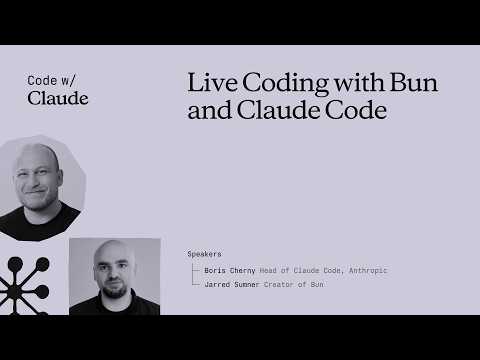
Anthropic Claude Code Team Automates Software Development Via Multi-Agent Loops
Claude
The bottleneck in AI-assisted software engineering has shifted from writing code to human engineering taste and verification, making autonomous multi-agent pipelines the primary driver of development speed.
## Background
Published on YouTube on May 06, 2026, by the Claude channel, this video captures a live coding session between Boris Cherny and Jarred Sumner. The page description outlines an exclusive look at how the Claude Code team uses their own tool internally to streamline everyday development workflows.
## TL;DR
In this live session, Boris Cherny (Head of Claude Code) and Jarred Sumner (creator of Bun) demonstrate how they leverage autonomous AI agents to manage, reproduce, and fix active GitHub issues within the Bun repository. They introduce 'RoboBun,' a Claude-powered bot that automatically reproduces bugs, runs verification loops, and submits pull requests complete with tests. The discussion covers the mechanics of multi-agent adversarial code reviews, the critical role of a well-maintained `CLAUDE.md` file for compound engineering, and how scaling to hundreds of overnight agents shifts the development bottleneck from writing code to engineering taste and higher-level verification. Ultimately, they showcase the rapid evolution of 'auto mode' by successfully pushing four automated PRs during the talk.
## Atmosphere & style
The presentation feels fast-paced, highly collaborative, and deeply practical, geared toward a developer audience with an explicit promise to skip excessive talking and focus on live coding. There is a casual, technical camaraderie between Cherny and Sumner, punctuated by lighthearted jokes about 'classic Jarred' working during a talk and the risky allure of skipping permission prompts. Watching the session brings a sense of rapid momentum and futuristic awe as automated PRs generate seamlessly in the background, shifting the mood from experimental curiosity to genuine excitement about the future of software engineering.
## Key takeaways
- [01:02](https://www.youtube.com/watch?v=DlTCu_pNDHE&t=62s) The Bun codebase utilizes Claude Code in an advanced multi-agent setup to automate the maintenance of its repository.
- [02:08](https://www.youtube.com/watch?v=DlTCu_pNDHE&t=128s) An automated bot named RoboBun reproduces every submitted GitHub issue and automatically generates a corresponding Pull Request with mandatory tests before human review.
- [02:08](https://www.youtube.com/watch?v=DlTCu_pNDHE&t=128s) RoboBun has successfully scaled its contributions over three months to become a larger code contributor to the main branch of Bun than its creator, Jarred Sumner.
- [04:10](https://www.youtube.com/watch?v=DlTCu_pNDHE&t=250s) An 'adversarial code review' loop combines Code Rabbit for style and compliance checking with Claude for complex architectural edge cases, reducing human context-switching costs.
- [08:03](https://www.youtube.com/watch?v=DlTCu_pNDHE&t=483s) Maintaining a meticulous CLAUDE.md file with precise build commands and historical context is critical for preventing models from executing stale code and ensuring successful multi-agent engineering.
- [11:01](https://www.youtube.com/watch?v=DlTCu_pNDHE&t=661s) Robust self-verification loops enable developers to scale workflows up to running hundreds of autonomous agents in parallel every night.
- [14:25](https://www.youtube.com/watch?v=DlTCu_pNDHE&t=865s) The bottleneck for fully automated deployment has shifted away from code quality toward the speed of verification, establishing absolute proof of correctness, and building rollback mechanisms.
- [14:25](https://www.youtube.com/watch?v=DlTCu_pNDHE&t=865s) Claude Code can perform automated 'hill climbing,' iteratively optimizing libraries against specific performance benchmarks by reading system-level code.
- [21:06](https://www.youtube.com/watch?v=DlTCu_pNDHE&t=1266s) The capabilities of Claude 3.5 Sonnet have turned software engineering into a highly asynchronous, multitasking workflow where developers manage multiple background threads of code generation.
- [22:15](https://www.youtube.com/watch?v=DlTCu_pNDHE&t=1335s) The introduction of CLI features like 'auto mode' allows continuous multi-step reasoning without stalling on permission prompts, while 'no flicker mode' optimizes terminal rendering.
- [25:01](https://www.youtube.com/watch?v=DlTCu_pNDHE&t=1501s) As automation eliminates the friction of writing and basic verification, human engineering effort shifts to high-level planning, deep validation, and defining product philosophy and taste.
- [27:30](https://www.youtube.com/watch?v=DlTCu_pNDHE&t=1650s) AI-generated contributions eliminate the emotional friction and guilt of rejecting human pull requests, paradoxically raising the bar for what code actually gets merged.
## Detailed walkthrough
### [01:02](https://www.youtube.com/watch?v=DlTCu_pNDHE&t=62s) Introducing the Bun and Anthropic Setup
Boris Cherny, the head of Claude Code at Anthropic, and Jared Sumner, the "creator of fun" at Anthropic and creator of Bun, take the stage at a developer conference. Sumner notes that because this is a developer conference, they will skip excessive talking and focus primarily on coding. He begins by explaining how the Bun project utilizes Claude Code to build and maintain its codebase, highlighting that their setup is slightly more advanced than what is common today. To demonstrate this live, Sumner kicks off a few automated agents to fix active GitHub issues, joking, "this is classic Jared doing work during a talk."
[02:08](https://www.youtube.com/watch?v=DlTCu_pNDHE&t=128s) RoboBun: Automating Issue Reproduction and Pull Requests
In the Bun repository, every time a user submits a GitHub issue, an automated Claude-powered bot named "RoboBun" immediately runs to reproduce the bug. Sumner shares a recent issue regarding side effects, demonstrating how RoboBun successfully reproduced the problem and automatically submitted a Pull Request (PR). A strict requirement for any PR submitted by the bot is that it must include tests. Specifically, the bot verifies that the newly written test fails on the previous version of Bun but passes on the debug branch. Cherny clarifies this workflow, confirming that RoboBun attempts to reproduce every single issue before a human developer even looks at it. Sumner explains that this saves an immense amount of time, shifting the developer's challenge from debugging and fixing to simply evaluating whether the proposed fix is correct and ready to merge.
- **RoboBun Contribution Metrics**: Over the last three months, looking specifically at the main branch, RoboBun has become a larger contributor to Bun than Sumner himself.
- **Verification Loop**: The bot is blocked from submitting a PR unless it proves the test fails on the old build and passes on the new build.
[04:10](https://www.youtube.com/watch?v=DlTCu_pNDHE&t=250s) Multi-Agent Code Review and the "Adversarial" Loop
Sumner demonstrates how they use a combination of different AI agents to handle code reviews. In the PR comments, an automated code review bot called Code Rabbit and RoboBun can be seen going back and forth, resolving comments as they go. Sumner explains that Code Rabbit is highly effective for stylistic issues and ensuring compliance with the project's `CLAUDE.md` file, whereas Claude-based code review excels at identifying subtle edge cases that would normally require a human to spend 30 minutes reading code to build context. This automated back-and-forth eliminates the high switching costs developers traditionally face when checking out branches locally, fixing lint errors, and pushing them back up. Cherny notes that because Bun is a command-line interface (CLI) tool written in systems code, it is uniquely suited for this verification loop since it does not require a browser to test, though other projects could easily integrate screenshots or video recordings.
- **Agent Collaboration**: Code Rabbit and Claude Code Review work in tandem, sometimes generating over 30 comments of automated back-and-forth discussion on a single PR.
- **Generalizing the Pattern**: Sumner suggests that for closed-source companies, this pattern could be applied to customer support tickets, where an agent automatically attempts to reproduce a reported bug, submits a PR, and triggers an automated code review loop.
- **The "Adversarial Code Review" Concept**: Cherny suggests coining a name like "adversarial code review" to describe this multi-agent feedback loop.
[08:03](https://www.youtube.com/watch?v=DlTCu_pNDHE&t=483s) The Importance of `CLAUDE.md` and Compound Engineering
To make a multi-agent development environment work, Sumner emphasizes that a project's development environment must be meticulously documented. In Bun's codebase, they rely heavily on a `CLAUDE.md` file. This file instructs Claude to run a specific command that both builds the compiled codebase and forwards arguments, preventing the model from running stale debug builds. The document also details how to write, run, and place tests, alongside historical context on previously encountered issues. Sumner's core philosophy is that "every time that you find yourself repeating something, it should probably go in `CLAUDE.md`" so the system remains maintainable. Cherny describes this iterative process of updating instructions based on model mistakes as "compound engineering."
- **`CLAUDE.md` Best Practices**:
- Specify exact build and execution commands to avoid stale compiled code.
- Provide a clear overview of folder structures and dependencies.
- Instruct the model to print error messages before less informative conditions so Claude can easily diagnose failures.
- Ensure the agent is set up to read CI errors and build logs to complete the full loop autonomously.
[11:01](https://www.youtube.com/watch?v=DlTCu_pNDHE&t=661s) Scaling Up to Hundreds of Agents
Cherny recalls when he first met Sumner, who spoke of a vision where developers could run hundreds of agents in parallel. While Cherny did not fully grasp it at the time, he reveals that he now runs hundreds of agents every single night. Sumner explains that this level of scale is only possible when self-verification loops are robust enough to let agents run autonomously. He reflects on the evolution of Bun's automation, which started as a simple Discord bot that spun up containers via user mentions but lacked CI integration and automated code review. The process has dramatically improved with newer models like Claude 3.5 Sonnet (referred to as "Opus 47" or "47"). A live check on the running agents reveals that RoboBun has successfully submitted two highly plausible PRs with tests, maintaining Bun's specific labeling style over Node.js style.
[14:25](https://www.youtube.com/watch?v=DlTCu_pNDHE&t=865s) The Bottleneck of Trust and "Hill Climbing"
When reviewing RoboBun's generated Zig code, Sumner notes that the bot successfully followed the patterns outlined in `CLAUDE.md`, such as using `await using` and resolving promises concurrently. When asked about his workflow, Sumner explains that for simple PRs, he is highly confident in merging them once the tests pass, but he still waits for the Claude code review to run because it excels at tracing control flow to find edge cases outside of the immediate diff. He estimates that the AI's code review is wrong only about 10% of the time, a massive improvement over older code review products which had to be largely ignored.
Cherny asks what is holding them back from fully closing the loop—where an issue comes in and a fix is automatically deployed without human intervention. Sumner responds that the bottleneck is no longer the quality of the code, but rather the time it takes to verify changes, establish sufficient proof of correctness, and build reliable rollback mechanisms. He shares that he has been using Claude Code to land massive PRs recently, including adding an image processing library, an HTTP/3 server, an HTTP/2 server, and an ongoing, highly ambitious Rust rewrite.
- **The Image Processing Benchmark**: Sumner had Claude run a benchmark on a Linux box with the goal of making Bun's new image processing library faster than `sharp`. By instructing Claude to read JavaScriptCore code to avoid unnecessary type array cloning, the model successfully iterated and optimized the library to beat the benchmark.
- **Hill Climbing**: Cherny explains that in AI labs, this process is called "hill climbing"—giving a model a metric and a verification loop, and letting it run in auto mode to iterate continuously until it hits the target. Cherny notes that Claude 3.5 Sonnet is uniquely suited for this underutilized workflow.
[21:06](https://www.youtube.com/watch?v=DlTCu_pNDHE&t=1266s) Multitasking and the Evolution of Claude's Capabilities
The process of managing pull requests (PRs) has transformed into a highly asynchronous workflow. Jared points out a PR containing about 100 comments where Claude is systematically going through and fixing every single issue. While this extensive back-and-forth is happening in the background, Jared is free to work on other tasks entirely. He explains that he was only "maybe like 10% focused on this" and was multitasking across five different things at once. This level of autonomous assistance is incredibly fresh; Jared notes that "this definitely wasn't possible like 6 months ago" or even three months ago, marking it as a very recent breakthrough in AI-assisted development.
As they check on their active sessions, they see one PR ready and another trickier one on the horizon. Although the proposed changes look plausible, Jared observes that the current implementation requires too many checks and will need a more optimized approach.
[22:15](https://www.youtube.com/watch?v=DlTCu_pNDHE&t=1335s) CLI Workflows, Auto Mode, and "No Flicker" Rendering
The discussion shifts to Jared's local setup, where he primarily relies on the command-line interface (CLI). He explains that he uses "auto mode" for permissions, whereas previously he relied on a setting called "dangerously skip permissions." This admission draws laughter and a lighthearted warning from his colleague: "no you guys can delete stuff if you do that. I don't I think I'm not supposed to recommend that." Jared defends his preference by explaining how tedious it is to wait around just to press approve for Claude, which often leads to developers walking away and letting the task sit idle. Auto mode provides a practical, secure way to keep the momentum going without blind trust.
Jared also showcases his use of "no flicker mode," which keeps the input composer pinned to the bottom of the screen and allows for incredibly fast scrolling without visual glitches. His colleague reveals that this feature was actually launched on April Fools' Day, which made some users initially mistake it for a joke. In reality, setting the environment variable `CLAUDE_CODE_NO_FLICKER=1` activates a completely rewritten CLI renderer.
- **Virtualized Scrolling and Selection:** The rewritten CLI renderer utilizes virtualized scrolling and selection to ensure constant memory and CPU usage.
- **Terminal Mouse Events:** The update introduces advanced terminal capabilities, allowing users to actually click around the composer with mouse events.
[23:59](https://www.youtube.com/watch?v=DlTCu_pNDHE&t=1439s) Monitoring PRs and the Robo Bot Ecosystem
Jared demonstrates how he keeps Claude monitoring the active PRs. The tool executes a series of commands and then goes to sleep for 20 minutes before waking up to check the status again. While Jared admits that a 20-minute sleep cycle is probably a bit too long, the automation is highly effective. Within a span of just 25 minutes, they have successfully generated three PRs, with a fourth one on the way as soon as the test suite finishes running.
In parallel to these manual sessions, an automated bot named "Robo" runs continuously in the background to generate even more PRs. The integration is seamless: "every time somebody submits an issue, it it tries to reproduce it." This continuous loop of issue reproduction and PR generation drastically reduces the manual triage workload for the maintainers.
[25:01](https://www.youtube.com/watch?v=DlTCu_pNDHE&t=1501s) Shifting Bottlenecks and the Nuance of Engineering Taste
The rapid evolution of Claude Code forces developers to constantly re-evaluate where they spend their time. Jared reflects on this shifting paradigm, noting that "every time there's a new bottleneck, you have to kind of automate that bottleneck and then there's always some other bottleneck after." Originally, the act of writing code was the primary bottleneck. Once that was automated, the bottleneck shifted to verification and running tests. Now that verification is largely handled, the remaining bottlenecks lie in a "deeper layer of verification" and high-level planning—deciding what features to build, what to avoid, and determining the absolute right way to solve a problem.
While they hope to eventually trust Claude enough to merge PRs entirely on its own, they agree that the Bun project is not quite there yet. Currently, the team uses Robo for feature requests by app-mentioning the bot in Slack or Discord. Jared shares a common scenario: someone will tweet a bug or feature request at him, he will tag the bot, and "maybe like an hour later there's a PR" which he can then tweet back to the user. However, Jared exercises caution regarding total automation, emphasizing the importance of human "engineering taste." For instance, deciding whether to bundle an image processing library directly into Bun requires a level of product philosophy and taste that AI cannot yet replicate.
[27:30](https://www.youtube.com/watch?v=DlTCu_pNDHE&t=1650s) PRs as Suggestions and Raising the Bar for Merges
The ease of generating code changes has fundamentally altered the social dynamics of open-source contributions. Traditionally, maintainers feel a sense of guilt when rejecting a pull request because a human co-worker put genuine time and effort into it. With AI, that emotional friction disappears: "you don't have to feel bad when it's like claude." If a PR generated by Claude is incorrect or unnecessary, the maintainer can simply close it without hesitation.
This psychological shift has the counterintuitive effect of raising the quality bar for what actually gets merged. Because there is no social pressure to salvage wasted human effort, maintainers only accept PRs that are genuinely optimal and necessary. The team's focus shifts away from managing interpersonal dynamics and toward establishing robust automation and collective trust in their automated pipelines.
[28:45](https://www.youtube.com/watch?v=DlTCu_pNDHE&t=1725s) The Fourth PR and the Future of Engineering
As the presentation wraps up, the team watches Claude successfully submit the fourth PR of the session. The tool successfully navigated a loop of finding a bug, fixing it, and pushing the final changes. Jared is particularly excited because this PR addresses a long-standing issue on GitHub that has accumulated 20 upvotes.
Jared attributes this success entirely to the power of auto mode, explaining, "in auto mode I can let like cloud runs like for hours and hours at a time. Like I run it almost every night." Previously, the process would inevitably stall on a permission prompt, but now, a single initial prompt can run autonomously for over 30 minutes to solve complex, multi-step problems. The session ends with warm applause as the speakers celebrate this experimental journey of identifying and breaking down the next bottlenecks in software engineering.
## Notable quotes
> [01:02](https://www.youtube.com/watch?v=DlTCu_pNDHE&t=62s) this is classic Jared doing work during a talk. — Jarred Sumner
> [08:03](https://www.youtube.com/watch?v=DlTCu_pNDHE&t=483s) every time that you find yourself repeating something, it should probably go in `CLAUDE.md` — Jarred Sumner
> [11:01](https://www.youtube.com/watch?v=DlTCu_pNDHE&t=661s) Opus 47 — Jarred Sumner
> [22:15](https://www.youtube.com/watch?v=DlTCu_pNDHE&t=1335s) no you guys can delete stuff if you do that. I don't I think I'm not supposed to recommend that. — Boris Cherny
> [25:01](https://www.youtube.com/watch?v=DlTCu_pNDHE&t=1501s) every time there's a new bottleneck, you have to kind of automate that bottleneck and then there's always some other bottleneck after. — Jarred Sumner
> [23:59](https://www.youtube.com/watch?v=DlTCu_pNDHE&t=1439s) every time somebody submits an issue, it it tries to reproduce it. — Jarred Sumner
> [25:01](https://www.youtube.com/watch?v=DlTCu_pNDHE&t=1501s) maybe like an hour later there's a PR — Jarred Sumner
> [27:30](https://www.youtube.com/watch?v=DlTCu_pNDHE&t=1650s) you don't have to feel bad when it's like claude. — Jarred Sumner
> [28:45](https://www.youtube.com/watch?v=DlTCu_pNDHE&t=1725s) in auto mode I can let like cloud runs like for hours and hours at a time. Like I run it almost every night. — Jarred Sumner
## Mentioned
Boris Cherny, Jarred Sumner, Bun, Anthropic, Claude Code, GitHub, RoboBun, Code Rabbit, Claude Code Review, Discord, Slack, Node.js, Zig, Rust, Linux, JavaScriptCore, sharp
Anthropic Claude Code 团队通过多智能体循环实现软件开发自动化
AI 辅助软件工程的瓶颈已从编写代码转变为人类的工程品味与验证,这使得自主多智能体流水线成为提升开发速度的主要驱动力。
在这场直播分享中,Claude Code 负责人 Boris Cherny 与 Bun 创始人 Jarred Sumner 演示了他们如何利用自主 AI 智能体来管理、重现并修复 Bun 仓库中活跃的 GitHub issue。他们介绍了由 Claude 驱动的机器人“RoboBun”,该机器人能够自动重现 Bug、执行验证循环,并提交附带测试的 Pull Request。讨论内容涵盖了多智能体对抗性代码审查的机制、精心维护的 `CLAUDE.md` 文件对复合工程的关键作用,以及夜间扩展至数百个智能体如何将开发瓶颈从编写代码转移到工程品味和更高层级的验证。最终,他们通过在演讲过程中成功推送四个自动化 PR,展示了“自动模式”的迅猛发展。
Bun 代码库引入了由 Claude 驱动的自动化机器人 RoboBun,能够自动复现每一个 GitHub issue 并提交附带强制测试的 PR;在过去三个月中,它在主分支上的代码贡献量已超越其创始人 Jarred Sumner。 (2:08)
团队构建了结合 Code Rabbit 与 Claude 的“对抗性代码审查”回路,前者专精于代码风格与 CLAUDE.md 规范,后者深挖复杂架构边缘案例,大幅消除了开发者频繁切换上下文的成本。 (4:10)
维护详尽的 CLAUDE.md 文件成为多 Agent 工程化的核心基石,配合健全的自我验证闭环,支撑起开发者每晚自主并行运行数百个 Agent 的高扩展工作流。 (8:03)
完全自动化部署的瓶颈已从代码生成质量转向验证速度、正确性证明与回滚机制;此外,Claude Code 已展现出“爬山式”自主迭代能力,能通过研读系统底层代码持续优化库性能直至超越基准。 (14:25)
Reading summary
Bun creator Jarred Sumner and Claude Code lead Boris Cherny argue that software engineering is shifting from manual coding to managing autonomous multi-agent verification loops. However, they emphasize that human engineering taste and deep verification remain the primary bottlenecks preventing fully autonomous code deployment.
Automated Issue Reproduction and Adversarial Code Review (2:08)
In the Bun repository, every new GitHub issue triggers an automated Claude-powered bot named RoboBun that attempts to reproduce the bug and generate a pull request (PR). A strict verification gate prevents the bot from submitting a PR unless it proves a newly written test fails on the previous build and passes on the debug branch. Over the past three months, Sumner claims RoboBun has become a larger contributor to Bun's main branch than he is.
Once a PR is opened, a multi-agent feedback loop—which Cherny terms "adversarial code review"—engages to refine the implementation. The Code Rabbit bot addresses stylistic consistency and project instructions, while a Claude-based review agent inspects the code for complex edge cases outside the immediate diff. Sumner estimates this AI-driven review is wrong only about 10% of the time, allowing multi-agent discussions spanning dozens of comments to resolve issues without developer intervention.
Structuring Compound Engineering with CLAUDE.md (8:03)
Sumner notes that scaling autonomous agents requires a meticulously documented environment, captured in Bun's `CLAUDE.md` file. This document specifies precise commands to build the compiled codebase and forward arguments, preventing models from executing stale binaries. It also details directory structures, test placements, and rules to print critical error diagnostics before less informative conditions. Cherny refers to this iterative process of updating project instructions based on model mistakes as "compound engineering."
This structured feedback enables optimization workflows known in AI labs as "hill climbing." In one benchmark, Sumner instructed Claude to optimize Bun's new image processing library against `sharp` on a Linux environment. By directing the model to read JavaScriptCore code and eliminate unnecessary type array cloning, Claude autonomously iterated until the implementation beat the performance benchmark.
Autonomous CLI Workflows and Parallel Execution (11:01)
Cherny and Sumner report that development has evolved into a massively parallel, asynchronous operation, with Cherny running hundreds of agents nightly. Sumner relies on Claude Code's CLI in "auto mode," which bypasses continuous manual permission prompts so long-running tasks can proceed autonomously for hours. While an earlier setting completely skipped permissions, auto mode balances uninterrupted progress with safety against unintended file deletions.
To optimize the CLI experience, Anthropic introduced a rewritten renderer activated by `CLAUDE_CODE_NO_FLICKER=1`, incorporating virtualized scrolling and terminal mouse interaction to maintain constant CPU and memory usage. With Claude executing terminal commands and sleeping between polling cycles, maintainers can multitask across several projects while agents resolve dozens of comment threads and submit multiple PRs within single sessions.
Shifting Bottlenecks and Human Engineering Taste (25:01)
Sumner observes that as code generation and basic test verification become automated, the operational bottleneck moves toward higher-level system planning, proof of correctness, and rollback safety. While bots can rapidly triage bug reports and feature requests from social media into functional PRs within an hour, complete end-to-end automation remains constrained by product philosophy. Sumner stresses that deciding whether to incorporate complex features—such as bundling an image processing library or executing large-scale rewrites—still requires human engineering taste.
At the same time, the frictionless generation of code has altered open-source social dynamics. Maintainers no longer feel interpersonal guilt when rejecting machine-generated PRs, which Sumner and Cherny argue counterintuitively raises the bar for what gets merged. Because there is no obligation to salvage wasted human effort, maintainers can reject imperfect contributions freely, focusing solely on optimal solutions.
While multi-agent systems and auto mode have drastically accelerated issue triage and routine code generation, the path to fully closing the loop—automatically deploying fixes from issue intake without human review—remains unresolved. The primary barrier is not the model's ability to generate plausible code, but the development of rock-solid verification guarantees and human-level judgment over software architecture.
[1:02] Jarred Sumner: this is classic Jared doing work during a talk.
[8:03] Jarred Sumner: every time that you find yourself repeating something, it should probably go in `CLAUDE.md`
[11:01] Jarred Sumner: Opus 47
[11:01] Jarred Sumner: 47
[22:15] Boris Cherny: no you guys can delete stuff if you do that. I don't I think I'm not supposed to recommend that.
[25:01] Jarred Sumner: every time there's a new bottleneck, you have to kind of automate that bottleneck and then there's always some other bottleneck after.
[23:59] Jarred Sumner: every time somebody submits an issue, it it tries to reproduce it.
[25:01] Jarred Sumner: maybe like an hour later there's a PR
[27:30] Jarred Sumner: you don't have to feel bad when it's like claude.
[28:45] Jarred Sumner: in auto mode I can let like cloud runs like for hours and hours at a time. Like I run it almost every night.
Original transcript
[1:02] Please welcome to the stage head of Claude [music] Code of Anthropic, Boris Churnney,
[1:07] and creator of fun at Anthropic, Jared Sumner.
[1:22] [music]
[1:23] Hello.
[1:27] All right. So, this is a developer conference. We're going to be doing a little bit of talking,
[1:31] but mostly we're just be like coding. So, this is for the developers in the room.
[1:38] I'm going to start by talking a little bit about how uh
[1:42] how bun uses cloud code to to build and and maintain bond and also kind of how our setup
[1:47] uh works and because it's kind of a a slightly more advanced setup than uh what's common today.
[1:55] Um but first I'm going to get a few agents running to just fix some GitHub issues. Uh
[2:02] this is classic Jared doing work during a talk.
[2:08] Um so so in buns repo uh every time somebody submits an issue uh we have a cloud bot
[2:16] automatically run and try to reproduce the issue. So you can see this person has
[2:21] uh this this side effects and this is like one of the most recent issues. Um
[2:27] and and we can see that Robun which is our our our bot uh uh went and managed to reproduce the issue
[2:34] uh and submitted a PR automatically. Um and and this PR is like it has uh it all these
[2:45] PRs always have tests. Um it's one of the actual hard requirements before it can submit a PR. Um uh
[2:52] and so so the challenge here is like does this code look correct? Um and one of the
[2:59] things we do to to check that is does the test fail in the previous version of bond and pass
[3:05] uh in the in this debug branch. And it the bot actually can't submit a PR without that
[3:10] uh being the case. And so this is just to make sure you understand. So this is like every single
[3:15] issue that goes up in the bun issue tracker, you have Robo Bun automatically try to reproduce it
[3:20] before anyone looks at it. Yeah. And this saves a lot of time because we have so many open GitHub
[3:25] issues. Um it it really moves the challenge from is from just fixing and debugging the issue to
[3:32] is this the right thing to merge? Like is this the right fix? Um how how good is it?
[3:38] Is it is this doing like a 100% of yours? Is it like 10%. We can go to the insights
[3:43] uh uh and go to contributors and then if we go uh last three months uh uh and this is
[3:50] specifically to main we can see that Robbun is now a bigger contributor to Bun than I am [laughter]
[4:00] and that's with merging not all of its PRs for sure. You can see we have a lot
[4:03] of PRs open right now. Um the the challenge is really how do we know can we merge the PR?
[4:10] Um, and that's the tests. Um, and then the other thing that's really interesting about this is uh
[4:16] uh we have automatic code review bots that that run. Um, and then they're going back
[4:23] and forth. So like Code Rabbit leaves a comment and then Roboun leaves a comment
[4:30] and then they go back and forth and they and Code Rabbit did the [laughter]
[4:39] I love this. And it also marks the comments as resolved when it's done. Um,
[4:47] and you you can see they actually went a lot like there's a lot of back and forth here. There's like
[4:50] 30 comments or something. And so you're using like a combination of agents. So this is like
[4:54] code review. This is like quad code review and then also code rabbit and like you're using
[4:59] them together. Yeah. And I I think basically like code rabbit is is good for like kind of stylistic
[5:04] issues and things that are like make sure that it follows the cloud MD and then the the cloud
[5:10] code review is really good at here's this really subtle edge case that would have taken me like 30
[5:15] minutes of reading all the code and having all the context to to like figure out and and so so
[5:22] it's really good at surfacing bugs that you you need the full context to really understand. Um,
[5:30] and I think basically it's it's really hard to to actually have all this automation without
[5:37] having code review that is in the loop with the with claude there replying or replying is like
[5:44] very performative but like at like fixing um and that's also a big part of like what used to take
[5:51] so much time uh when like why PRs would take so much time to merge is because you'd have to like
[5:59] like check out the branch locally, fix a lint error, then run the llinter locally,
[6:04] then push it back up. And there's all this switching cost that's constantly there.
[6:08] And so when you So I think this is like an especially good use case for for LLMs because
[6:15] otherwise like it just takes up so much time to to ship and and I guess like especially for the
[6:21] bun codebase because it's like it's systems code. It's, you know, it's very easy to repro issue and
[6:27] then see if the issue is fixed because this is kind of back to what we were talking about before
[6:32] with like this kind of verification loop. It's all systems code. So, it's really like a test case
[6:37] on a particular architecture and you can essentially like repro or verify anything.
[6:41] Yeah, that's one of one thing that makes it easier in buttons codebase is because it's a a CLI tool.
[6:46] um because uh we don't need to run a browser to test things, but you can also just like
[6:52] have something set up to like take a screenshot or record a video or those sorts of things.
[6:57] Um in Bun's case, we don't need that, at least not yet. Uh uh there's a couple things
[7:03] we could do that for like we have some front end stuff that would be nice. Um
[7:08] but yeah, I think this is like the the direction that I think is really interesting is because
[7:13] it saves so much time. Um and this is not this is something that like this is specifically for bun
[7:20] but the more generalizable thing when because most products are not open source um uh is like instead
[7:27] of an issue maybe the starting point is like a customer support ticket. So like you could you
[7:31] could imagine automatically uh h passing customer support tickets to a cloudbot to then go and try
[7:39] to reproduce the issue and then submit a PR and then uh having code review go back and forth. Um,
[7:45] and that's where I think for a lot of companies it becomes a lot more impactful because it just
[7:51] saves so much developer time. We should think of some kind of name for this pattern. It's
[7:55] like adversarial code review or or something like that. Yeah, I don't know. Um, but I do think like
[8:03] there's also a few other things about this that's uh like the if you just do this then it doesn't
[8:10] quite work. the very first step you need is to like make sure the development environment
[8:14] is set up. Um like I I think this has been talked about before but like uh like cloud MD is uh
[8:21] very important um because otherwise it's going to just submit PRs that don't quite make sense for
[8:26] you to merge. Um so like we very much emphasize in buns codebase that it runs this special command
[8:32] to do the build. Um and this both builds and runs the command. So it like forwards the arguments. Um
[8:39] because that's also one confusing thing is like uh because bun has to be compiled uh you want to
[8:45] make sure that it's running the actual changes and not like a debug build that's like stale. Um
[8:52] we also go into a lot of detail about how to run tests, how to write tests, um where to put the
[8:58] test, um uh and a lot of like here's how here's all the issues that we've run into previously.
[9:06] Like basically the the pattern here is like every time that you find yourself repeating something
[9:12] it should probably go in cloud MD because the the question now is like
[9:17] how do you make it maintainable to have lots of claws running all the time and uh
[9:24] and to do that it needs to be written down. It needs to be documented. Um so like a really small
[9:31] detail is like we we check the we have it like to make sure that claude sees the error message uh we
[9:38] make it print the air message before uh the like less informative uh conditions. So, so this is
[9:44] sort of like you have quad write a test and then the test is bad or something about it doesn't work
[9:50] and then you see this kind of repeated like once or twice and then you just tell Quad add it to the
[9:53] quad MD so that every time in the future when you write a test you do it correctly the first time.
[9:59] Yeah. So this is like uh like compound engineering. It's kind of this.
[10:05] Um and then also it's helpful to like give it an overview of where all the folders are
[10:09] like what all like how the code is laid out. Um, and like about dependencies. Um, uh, uh,
[10:21] another thing I think is interesting is like making sure that it can read your CI errors
[10:25] and like build logs. like you want to you want to set up the agent to be able to
[10:30] be able to read the code like to do the full loop of
[10:34] make of like writing the code testing the code works checking CI monitoring CI um and uh uh
[10:43] reading all the errors so that way by the time it gets to a person everything is like set up
[10:48] like the ideal is that you read the code and you you have very clear indications that you can be
[10:53] high confidence to merge it And the only way for that to be true is if it is set up for success.
[11:01] It's interesting. I remember when we when we first met, you were talking about like your vision of
[11:04] like everyone being able to run hundreds of agents in parallel and how that would work. And I feel
[11:10] like I didn't really get it at the time. Although now like every night I I'm I'm running like
[11:15] hundreds of agents every single night. And I feel like now I'm finally there. But this is a thing
[11:19] that you've been thinking about for a long time. So it feels like this is sort of like the setup
[11:23] in order to be able to kind of scale up agents way more like you need the self-verification so
[11:27] that agents can run autonomously. Yeah. Like this has gone through many iterations in buns codebase.
[11:34] Um we previously just had a discord bot where I could just at mention the bot and it would spin
[11:39] up a container. Um uh it didn't have like the CI stuff. It didn't have uh the code review stuff.
[11:46] Um, and it's so much better now, especially with like Opus 47. Um,
[11:52] uh, uh, it's all this stuff is getting so much better. Um, oh yeah, we can also check on
[12:00] how, uh, how it's going. It looks like it created a PR, the first one. Um, uh,
[12:08] and it wrote tests. Um, so maybe while we look at this, I'm curious for like just to
[12:13] get a show of hands for people in the room, like as people think about their development process,
[12:18] raise your hand if it looks something like this where you have like a bunch of terminal windows
[12:21] or desktop tabs and you're kind of pasting in issues. Okay, so that's like maybe half of people.
[12:27] And then what if it looks like Roboun or something more like that where it's like
[12:30] closing the loop a little more? It's like the next level of abstraction starting to get there.
[12:37] Yeah, I think it's like it's not surprising because I think model capabilities are just
[12:40] getting there. Like I think 47 is the first model where it's really felt like it's able to do this.
[12:45] And in the past maybe you could do it with like a bunch of scaffolding like you just
[12:49] throw a bunch of tokens at it and it can kind of work. But now it's like efficient enough.
[12:52] You can actually do this dayto-day. Yeah. Um let's see. So the first PR is there. Uh
[13:01] let's see if it did any others. Uh okay. It did two PRs. Um uh
[13:10] this looks very plausible. It's cool. And this like this before after is this like
[13:16] do you tell it to do that or sometimes it does it? Um uh it's it's pretty good about knowing
[13:23] like when it should do that like when it's like a string formatting thing. Mhm. Um uh it's also
[13:30] it also kept like bun style of the label which is good because node style is slightly different. Um
[13:40] let's see does this change look good? Um
[13:48] yeah. Uh mostly what I'm thinking right now is uh it it's it did this. This is good because like
[13:55] you don't want to write one bite at a time. You want to write uh
[13:58] in in chunks um and then it used uh saturation uh to to but I don't like
[14:05] that or like it shouldn't have to do that. Does anyone here actually know Zigg sort of
[14:14] I feel looking at this code and and you can see it followed the patterns from the from the cloud MD
[14:19] await using and then that that pattern of of uh reading all the pro like resolving all the
[14:25] promises at the same time and so like what's your workflow like when you when you see something like
[14:30] this are you usually going in and like commenting or are you just going to wait for like code review
[14:35] to come in and and drop a comment? Um, usually it depends on that like how complicated it is. Um,
[14:42] in this case, I'll usually I'll wait for like this one is actually pretty simple. I feel pretty high
[14:46] confidence that if the test pass then uh I would probably merge this. Um but I still would wait for
[14:55] uh the code review for for at least for the cloud code review one to run um uh
[15:01] just in case because what I really like about that is it will find things that
[15:06] like from from that aren't in the diff that are like from tracing the control flow. um
[15:14] which is what you want when it's like a human reviewing it is like somebody who
[15:17] has a lot of context who who can think what are all the edge cases that this might run into and
[15:22] and the signal to noise ratio is pretty good. It's something maybe like 10% of the time it's wrong
[15:29] like that's and and for like how that used to be like with other code review products that
[15:33] we've tried it was like basically you had to ignore most of what it said. Um
[15:40] it's pretty cool. How how long how long has something like this worked? Is it like a latest
[15:43] model thing or like have you had like like Robo Bun or this kind of like automated repro automated
[15:48] fixing like this whole pipeline? Like how how long has that been actually possible? We can probably
[15:53] like see this in a chart somewhere. Um that's kind of a lot of commits but I think that's
[15:59] that might not be on main. That might be that the the Rust thing. Um uh uh
[16:08] yeah I heard bun is going to be written in Rust soon. Is that I don't know.
[16:12] We're there's a I just have a quad running and we'll see what happens. Um uh
[16:20] but you can see like the the the volume of commits there. It's like kind of lower and then it it's
[16:26] it's definitely gotten up a lot and then it's gone up a lot. Uh now really the bottleneck is like
[16:33] do I feel good about merging this? Am I confident that its changes are correct? And that's new
[16:38] because it used to be like the code wasn't good enough. What do you think? What do you
[16:42] think is left like like what's it going to take before well like is there like a missing tool
[16:48] or like a missing model capability or model version or something for you to kind of feel
[16:53] like Robban can fully close the loop. Issue comes in and then like fix goes out automatically.
[16:58] I think it needs a little bit more uh it needs it takes a lot of time to verify the changes
[17:04] are correct. M um this was kind of already true like when it's a person pushing up a PR. Um uh
[17:13] but I think the the challenge is like how do we make it how do we make sure to communicate
[17:21] sufficient proof that the changes are correct. Um or making it easier to like roll back things.
[17:29] Um that's I think those are kind of the two directions. But I think like
[17:35] for the majority of like simple issues, we should probably be pressing merge a lot more. And the
[17:39] bottleneck now is actually like CI and like making sure that uh like like the and and having
[17:49] like fully running the code like the the making sure all the test stuff works. M um
[17:55] but I think it's like basically there for like and the large projects are still non-trivial
[18:01] but also I've been doing some pretty large PRs lately with with cloud mostly with in the
[18:07] not as much with Robo Bun but with like cloud code um like uh we recently added support for uh
[18:14] a built-in image processing library to bond. I could probably pull up the PR. Um,
[18:19] uh, and that was Claude. Um, uh, and also we did a bunch of follow-up PRs, too. Uh, yeah,
[18:27] it's like it's interesting because I think like when I look at different people using quad code,
[18:31] everyone is like at a kind of different level of like sophistication or kind of like adoption
[18:35] of this. And I think for me the hardest thing is the model changes very often. So I have to
[18:39] like constantly reune and kind of recalibrate to what it can do. And like as an engineer, it's hard
[18:44] cuz it's like a very weird technology. It's like the first technology I've used that's like that.
[18:48] And I I sort of feel like this is actually the way that you do it is ahead of how the quad code
[18:53] team does it for quad code itself. And to me like that that like the way the quad code team does it
[18:57] is actually very automated. But this is like even further ahead. This is like almost like
[19:01] full liftoff like full fully closed loop. Like in the last two weeks we've added an HTTP3 server
[19:08] to bun. Uh there's a PR for an HTTP2 server. There's uh fetch support for HTTP 3 and HTTP2.
[19:16] Um there's this image processing API. There's the ongoing Rust rewrite which may not ship. Uh
[19:22] uh uh that that's like the most ambitious one I've done so far.
[19:26] Uh and I done is too strong of a word because it's very much not done. Uh uh so and so even
[19:32] something like this like this is like a benchmark. So Claude ran this benchmark for you. Yeah, Claude
[19:38] ran this benchmark. Uh I gave it like a this ran on like a separate like uh on like a Linux box. Um
[19:45] uh yeah and it and I was like make it faster than sharp and that's basically what I did. Um
[19:53] I gave it like a few ideas like oh you could try like read this code in JavaScript core to like
[19:59] figure out the how to like avoid cloning the type array when it's not strictly necessary. Um,
[20:05] but like it it then went and did it and figured it out. Um, uh, and like uh, yeah, it's pretty crazy
[20:15] honestly because it was these this wouldn't none of this would have worked uh, several months ago.
[20:23] Yeah. I I feel like like within like within anthropic like within an AI lab,
[20:26] you call this kind of thing hill climbing. And this is this idea that like if you give the model
[20:31] some sort of metric and then you give it a way to verify its result, you can just make it iterate
[20:36] and keep going and keep going until it hits that metric. Um, and this is something like
[20:41] 47 I think is uniquely good at. And I think it's something really underutilized because I
[20:46] think it's the first model that's actually very good at that. And if you just give it a target,
[20:50] you give it a way to like improve the performance and you give it a way to measure, it'll just like
[20:53] keep going until until it's done if you let it go in auto mode. Yeah. And we can also see like uh
[21:00] this is another case where like the code review comments was really really helpful because like
[21:06] there was like in this PR there's like 100 comments or something uh
[21:10] and it's just going and fixing everything. Um uh uh like it goes on for a while and
[21:19] in the meantime you're just working on something else. Yeah, I was this was not like my the thing I
[21:23] was 100% focused on. I was maybe like 10% focused on this. I was doing like five things at once. Um
[21:30] uh uh and this definitely wasn't possible like 6 months ago. Um 3 months ago like this is like
[21:40] very recent that this is doable. Okay. So how how are our sessions doing? Yeah. So we have
[21:47] one PR there. There's almost another PR coming up it looks like pretty soon. Um uh
[21:54] this one is should be the trickiest one. Uh
[21:59] um it mostly looks good though. Um like the or like it looks plausible based on this
[22:05] these changes. I wouldn't exactly do it this way, but I think that's we need like a better
[22:10] more optimized way to do this because that's a lot of checks. Um and and looking looking at
[22:15] your setup here, so you're using you mostly use CLI. Yeah. And um do you always use auto mode
[22:22] for permissions? Auto? Yeah. And then before that I used dangerously skip permissions. Um
[22:29] [laughter]
[22:30] no you guys can delete stuff if you do that. I don't I think I'm not supposed to recommend that.
[22:37] Um but I think it's just not fun to wait for Claude to like press approve because then you just
[22:44] like go off and do something else and then it's just been sitting there. So that's why auto mode
[22:48] is really good because it's actually like a real way to fix that instead of just like trusting.
[22:55] And I I also noticed like the the input like the little composer it's stuck to the bottom of the
[22:59] screen. So you're using no flicker mode. Yeah, I'm using no flicker. Honestly, I think we should just
[23:03] like make that the default because it's so much better. Um like you can see I can scroll really
[23:08] fast and like like you could scroll fast before but like sometimes there would be a flicker and
[23:14] now there's not. Um, have have folks tried no flicker mode for CLA?
[23:21] Yeah, a few people. So, it's like we launched it on April Fools. So,
[23:26] you can think it [laughter] in hindsight it came across as a joke a little bit, but
[23:30] if you actually do quad code, no flicker equals 1 quad. So, just like set that environment variable,
[23:36] we totally rewrote the renderer that's running in the CLI. So, it's using virtualized scrolling,
[23:42] virtualized selection. And so what this means is like constant memory usage, constant CPU usage,
[23:47] and also some nice stuff like uh like if Jared types, he can actually like click around the
[23:51] composer. And so you can actually click and mouse events work, which is pretty crazy for a terminal.
[23:59] So I'm just also having it monitor the PR. Um, and you can see it's uh
[24:04] it ran some commands and then it's going to go to sleep for 20 minutes and wake back up. Um,
[24:09] 20 minutes is probably a little bit too long, but it's okay. Um
[24:13] uh oops. And what's that? Is that like using like a loop or something? I think so. Uh uh. Uh
[24:24] yeah. And then it's let's see how else is it doing. And then the other ones are still
[24:29] uh apparently it fixed an extra bug as well. Uh uh. Okay. So we got Okay, so it's been what? It's
[24:38] been like 20 minutes or so. 25 minutes and we got one. How many PRs have we gotten? Two. Uh,
[24:45] three PRs. Three PRs. That's not bad. Yeah. And I think we'll get a fourth one
[24:51] once it finishes running the tests. And then in the meantime, Robo is still running and
[24:56] kind of like generating even even more PRs. Yeah. Every time somebody submits an issue,
[25:01] it it tries to reproduce it. Yeah. I I kind of feel like every like the the way quad code makes
[25:08] you think is every time there's a new bottleneck, you have to kind of automate that bottleneck and
[25:13] then there's always some other bottleneck after and you kind of move on to that and like it
[25:17] started like writing code was the bottleneck and now it's no longer the bottleneck and then like
[25:21] verification and running tests that was like the bottleneck and it's no longer the bottleneck and
[25:25] now there's like a deeper layer of verification maybe that maybe that's it. What do what do
[25:30] you think are the bottlenecks remaining? It's definitely this deeper layer of verification. Um I
[25:34] feel like the bottleneck after that is going to be like planning like what should we do, what should
[25:40] we not do and what is the right way to fix this. Um and like ideally Claude would be smart enough
[25:47] or like we could trust Claude enough to to merge the PRs by itself. Um and I think like in a in
[25:55] certain projects you could pro probably do that um and just have that be automatic completely.
[26:00] Um, I think Bun is not yet or like it's not yet there for Claude or sorry for for Bun. Um,
[26:06] but I think it'd be really cool if if like we had the tooling uh for us to feel confident enough
[26:13] to do that. So So like right now Robbo it doesn't like build features. It it doesn't do like feature
[26:18] requests yet. It it that's true. Yeah, it doesn't do feature requests but it we do also use it
[26:23] sometimes. We we so we can also uh uh appmentntion it in either discord or slack and it will like
[26:31] try to implement the feature. Um uh so sometimes when people are like hey bun is missing this thing
[26:37] um then I just at mention the bot and maybe like an hour later there's a PR. Um
[26:45] a bunch of times I've somebody's like tweeted at me something like
[26:49] this can you fix this bug or whatever and that's basically what I do. Um,
[26:53] and then I reply with a link to the PR. Um, should we add a Robbo account on Twitter? Um uh
[27:03] and I think like so like it can do feature requests, but I'm I'm hesitant for it to
[27:07] implement literally everything anybody asked for in a GitHub issue cuz that's kind of a lot cuz in
[27:14] some ways it's it's kind of crazy to put something like an image processing library inside a bun,
[27:18] but like we talk about engineering taste and there's like an element of taste that goes
[27:21] into that. you felt like that's a good idea and like we're not sure yet if Quad is at the point
[27:27] where you would also think this is a good idea but you know at some point in the future it'll
[27:30] get there maybe it's starting to get and I do think that like PRs become suggestions like
[27:38] having uh like not merging PRs used to be like you feel bad if you don't merge like a co-orker's PR
[27:45] uh because like they put work into that but you don't have to feel bad when it's like claude
[27:51] Um uh so like if the PR is wrong or or or or for for or whatever reason then you can just
[27:59] not merge it. And uh but it does mean that like the like the the bar for uh what you merge is like
[28:11] should should it be there because I think that's also a difference with with when it's like people
[28:15] because with people you want you don't want people to feel bad about their like lost work.
[28:21] Um, so sort of in some ways it does actually end up raising the bar for what you decide to merge.
[28:28] Yeah, it's interesting how like as the bottlenecks move, the dynamics change a little bit.
[28:33] It's sort of like having to trust each other, having to trust people on the
[28:36] team. This kind of changes a little bit. Now it's a little bit more about like do
[28:39] we have the right automation and like do we trust automation like as as a group? Yeah.
[28:45] So I think we're almost at time. Is there any like maybe one last thing we want to
[28:49] we want to show people where we can kind of check in on kind of like the progress that we've made?
[28:55] Um I don't think so. Uh uh yeah, it's it's still going one last
[29:02] onto that fourth PR and it's going back and forth like found a bug and then fixed a bug. Uh
[29:09] looks like it's about to submit the PR now. Okay, let's wait for this one.
[29:16] Love to have one more. This is like the cool thing about auto mode. It's like in auto mode I can let
[29:20] like cloud runs like for hours and hours at a time. Like I run it almost every night. I'll
[29:25] just have a bunch of quads running in auto mode. And I was like before this it just didn't work
[29:29] cuz it always got stuck at some kind of permission request. And that was crazy.
[29:34] Like this entire thing was one prompt and and that just ran for 30 minutes. Yeah. This is all I said.
[29:47] Okay. So, it's pushing at it's about to submit the PR.
[29:57] That sounds like the right fix, too. This has been an issue that's been open for a long time.
[30:04] Okay. And we got a PR
[30:14] Yeah, we can go to this issue and we can see how many up votes it has.
[30:18] 20. Yeah, it's kind of a lot.
[30:23] Cool. Maybe we can pause there. Um, but to me, this is just like such a cool vision
[30:30] of where engineering is going, I think, for everyone in this room. And, you know,
[30:35] we're going to see this first. we're going to have to figure it out first and then everyone
[30:38] else is going to have to figure this out. So, you know, like we were talking about this morning,
[30:42] just excited to be on this journey together. And like you can see, we haven't figured everything
[30:46] out yet. Um, but I think like the mode that we're in is just constantly experimenting,
[30:51] constantly trying to to see what the next bottleneck is so we can solve it.
[30:57] It's very exciting. This is so cool. Like this stuff.
[31:02] [applause] Cool. All right. Should I like Yeah, you can weave it.
[31:12] Come on,
[31:13] bro.