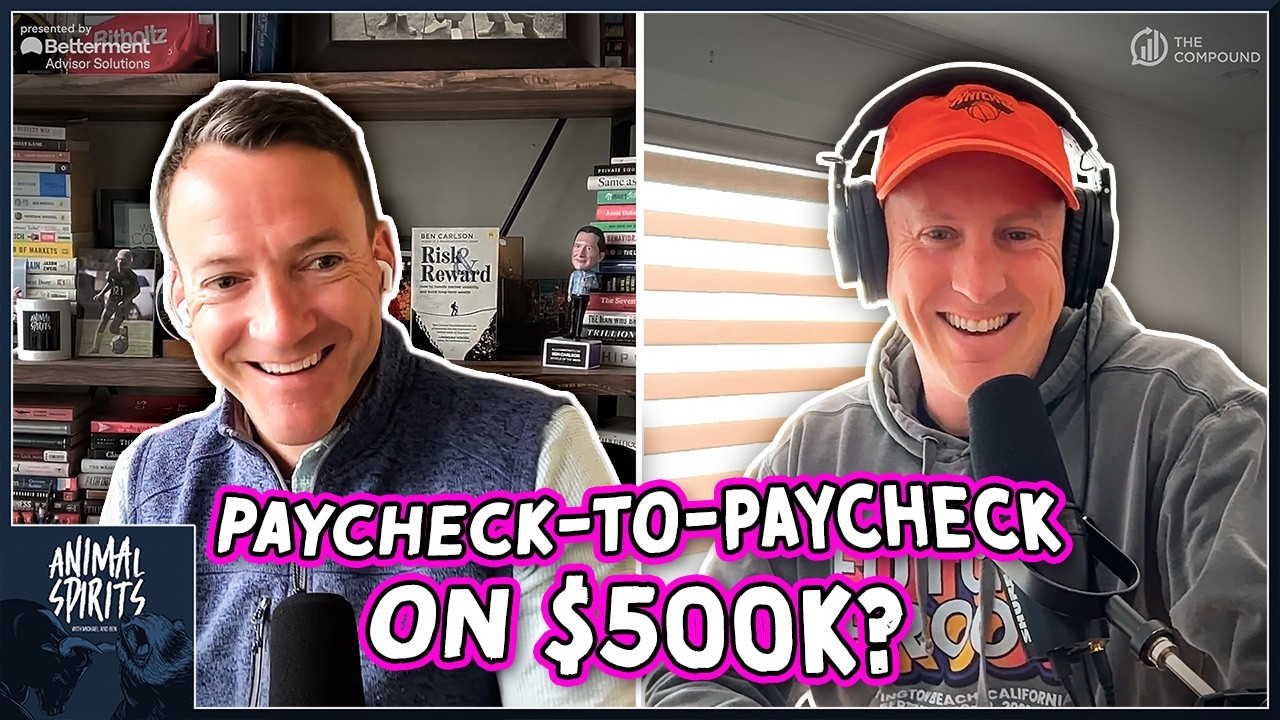
## Background
The Compound channel published episode 462 of Animal Spirits on YouTube on April 29, 2026. According to the page description, hosts Michael Batnick and Ben Carlson discuss the impact of AI on wealth management, a historic stock market boom, why the Fed never caused a financial crisis, an ode to Tim Cook, the world's largest ETF, extreme car payments, AI job market dynamics, broken financial surveys, and the midlife crisis.
## TL;DR
Hosts Michael Batnick and Ben Carlson explore how rapid developments in AI are erasing traditional information asymmetries across financial planning and broader industries, while analyzing Big Tech's massive capital expenditure commitments. They examine the incredible resilience of the long-term bull market alongside contrasting financial realities, including Vanguard's VOO crossing $900 billion in assets versus consumers trapped in severe underwater auto debt. The discussion also critiques private equity accounting practices, evaluates AI's impact on corporate hiring, dissects flawed surveys on high-income living expenses, and concludes with reflections on streaming entertainment, prediction markets, and midlife perspectives.
## Atmosphere & style
The podcast maintains an easygoing, conversational, and energetic rapport between two seasoned market observers who balance serious financial analysis with self-deprecating banter. The host dynamic feels like a fast-paced chat between close friends, blending sharp macroeconomic insights with playful teasing over personal impulse buys and tech gripes. Listeners experience an authentic, candid atmosphere where high-level market data and industry critiques seamlessly merge with lighthearted pop culture nostalgia and everyday relatable observations.
The hosts kick off the show after a short message from sponsor Betterment Advisor Solutions. The opening spot details how leading RIAs scale their practice through client segmentation—delivering deep, ongoing planning for complex client needs while leveraging automated, paperless onboarding and tax-efficient portfolio management for simpler accumulation accounts.
[00:53](https://www.youtube.com/watch?v=HayLAvU5lCE&t=53s) HVAC Upgrades & The AI Information Asymmetry Breakthrough
Michael opens the main episode with a personal update regarding his recent home HVAC troubles. After having four contractors assess his system, the first proposal came in at an eye-watering total of $29,000. Seeking clarity on his choices, Michael uploaded the entire detailed quote into Claude to analyze his options.
The interactive conversation served as an "aha!" moment for Michael regarding artificial intelligence. Claude actively guided him through a decision tree, explaining technical nuances like modular versus standard on/off units. Later that day, during a demonstration of an LLM tailored specifically for financial advisors—which systematically guides users through tax strategies and Roth conversions—Michael realized the profound broader implications:
* **Closing Knowledge Gaps:** The historical information asymmetry where professionals could easily take advantage of uneducated consumers is rapidly vanishing across all industries, from mechanics to financial planners.
* **Table Stakes for Financial Advisors:** While advisors will remain valuable, possessing basic planning and tax knowledge is no longer a unique differentiator; it is now baseline table stakes.
* **The Final HVAC Decision:** Michael ultimately chose to spend $6,000 on a split-level unit dedicated to his bedroom while closing off central ducts to increase airflow throughout the rest of the house.
* **Industry Impact:** Ben argues that AI will squeeze medium-sized firms: massive firms will scale using proprietary AI models, niche boutiques will survive on specialization, and mid-sized advisory firms without a clear niche will face severe headwinds.
> "The information gap—the knowledge that we have about the planning, the tax, the this, the that—that's going to disappear pretty damn quickly." — Michael Batnick
[06:49](https://www.youtube.com/watch?v=HayLAvU5lCE&t=409s) OpenAI's Staggering Burn Rate & Big Tech Capex
Turning to current events, Michael highlights a *Wall Street Journal* report indicating that OpenAI recently missed its internal revenue and user growth targets. This stumble caused ripples across market darlings tied to the company's AI supply chain, sending Oracle stock down 7% in a single session.
Despite having recently raised $122 billion in the largest funding round in Silicon Valley history, OpenAI CFO Sarah Friar expressed serious concerns over future computing contract obligations. Due to massive data center commitments, the company expects to burn through that entire $122 billion within just three years. Ben and Michael debate whether OpenAI is falling behind competitors like Anthropic or if their massive capital runway guarantees survival.
The discussion shifts to broader tech earnings and capital expenditures:
* **S&P 500 Earnings Growth:** Overall blended year-over-year earnings growth sits at 13.7%.
* **Tech Sector Dominance:** Technology earnings grew by an extraordinary 43% year-over-year (and roughly 45% when excluding Nvidia and Apple).
* **AI ROI & Capex Risk:** Big Tech hyperscalers (Meta, Amazon, Microsoft, Alphabet) are projecting around $600 billion in total capital expenditures.
* **The "Bridge Jumping" Debate:** Ben notes the inherent risk that tech executives are collectively overspending on AI out of fear of being left behind, comparing it to tech giants jumping off a bridge together. Michael pushes back, arguing these management teams aren't stupid and that strong underlying earnings suggest the massive spend may actually pay off.
[11:22](https://www.youtube.com/watch?v=HayLAvU5lCE&t=682s) The "Incubation" Bull Market: 2009 to Present
Michael and Ben reflect on the sheer magnitude and resilience of the current secular bull market, drawing historical comparisons to the legendary 1982–1999 expansion.
Ben breaks down the astonishing return profile of modern stock markets:
* **Annualized Returns Since 2009:** The S&P 500 has generated an annualized return of nearly 17% per year over the past 17 years.
* **Decade vs. Decade:** The 2020s are currently outperforming the 2010s, clocking in at 15.1% annualized versus 13.4% per year in the 2010s.
* **Inflation Debunked:** Despite widespread fears that post-GFC zero-interest-rate policy (ZIPR) and quantitative easing would destroy the U.S. dollar and trigger hyperinflation, cumulative CPI inflation from 2009 to 2026 was just 56%—compared to 80% cumulative inflation during the 1982–1999 bull market.
Ben poetically dubs this market the "incubation bull market"—like a premature baby born at 30 weeks that beat all odds to survive and thrive inside an incubator. The hosts emphasize that missing out on a generational run like this due to market timing or macro-doomerism can permanently damage an investor's multi-decade wealth creation.
* **Intel's Rollercoaster Chart:** The segment concludes with a brief look at Intel's volatile trading history, noting its brutal 70% drawdowns and repeated failed recoveries that turned it into "dead money" for decades.
[15:37](https://www.youtube.com/watch?v=HayLAvU5lCE&t=937s) Market Velocity and the End of the Tim Cook Era
The hosts open by marvelling at the absurd speed of modern markets, pointing to Intel's recent explosive rally as an example. The stock completely erased a 70% drawdown in about six months to hit all-time highs not seen since the dot-com bubble, driven in part by government involvement and its strategic position in the tech stack. While attempting to guess the current market cap of the company, Ben and Michael struggle with the numbers—initially throwing out guesses around $200 billion to $300 billion, with Michael mistakenly pulling up Philip Morris's ticker—before realizing the rapid, "blink and you'll miss it" nature of today's market moves.
From there, they transition to a major milestone in tech: Tim Cook's retirement as CEO of Apple. Ben reflects on how wrong the consensus was when Steve Jobs passed away in the fall of 2011—a time coinciding with a nearly 20% S&P 500 market correction and the European debt crisis—when many assumed Apple's growth narrative was finished. Ben recounts buying the stock back then, confident in the iPhone's runway, though no one could have anticipated the multi-trillion-dollar behemoth it would become under Cook. To contextualize Cook's 15-year tenure, Michael shares staggering growth statistics:
* Apple added **$684 million in market cap every single day** under Tim Cook's leadership.
* That breaks down to **$4.8 billion per week** or approximately **$250 billion per year**.
Highlighting specific accomplishments, Michael references Mark Rubinstein’s *Net Interest* Substack regarding Apple Pay. The service now boasts 785 million global users, is accepted at over 90% of US retailers, holds a 14.2% share in online payments, and accounts for 5.6% of in-store purchases. Cook even noted on a recent earnings call that Apple Pay prevented $1 billion in fraud over the past year alone. This leads to a humorous exchange where Ben admits he rarely uses contactless payments in stores, prompting Michael to tease him for taking out a physical wallet rather than tapping his phone.
Michael then breaks down Apple’s trailing 12-month revenue by individual business segments, comparing them to standalone Fortune 500 giants:
The segment ends with Michael discussing his attempt to fix voice-to-text frustrations by downloading an app called Whisper Flow. While it functions much better at dictation—spelling team names like the "Knicks" correctly rather than "next"—Apple requires users to switch screens to activate the microphone, prompting Michael to shout, "Hey Apple, buy Whisper Flow... or build something better, you cheap pricks!" When Ben asks why he doesn't just type out his messages, Michael explains that typing while walking or driving isn't ideal, sparking a side discussion on sidewalk "phone zombies" who stop dead in their tracks in public places.
[22:11](https://www.youtube.com/watch?v=HayLAvU5lCE&t=1331s) Stock Picking Lessons: Airbnb and Zillow
Michael pivots to a confession about two high-profile stock calls he got completely wrong, illustrating the difficulty of individual stock picking even when getting the underlying macro thesis correct.
First, he brings up **Airbnb**, which he bought during its 2021 IPO. Despite the company creating a brand-new category, changing how families travel, and forcing competitors like VRBO to drastically improve, the stock has gone virtually nowhere since its initial pop. Michael notes that all of its gains occurred on its opening day, performing poorly throughout a massive tech bull run. Ben points out that it debuted at a sky-high valuation around 100 times sales, though Michael notes it finally looks like it might be attempting a multi-year breakout.
Second, Michael addresses **Zillow**. He had been heavily bullish on the housing market in the late 2010s and early 2020s, accurately predicting the boom. Because Zillow was the premier brand in real estate with 200–300 million users checking the app, he assumed the equity would thrive. Instead, the stock remains stuck in a 50% drawdown. Even after buying in following an initial 40% decline, he still lost money.
> "I nailed the housing thing. Nailed it. I was bullish on housing at the perfect time. Housing went crazy and Zillow stock stunk. This is why I'm not a stock picker."
[24:41](https://www.youtube.com/watch?v=HayLAvU5lCE&t=1481s) The $900 Billion Index ETF vs. The "Degenerate Economy"
Michael contrasts two competing realities in the modern financial world: the hyper-visible "degenerate" gambling economy versus the quiet, massive triumph of sensible buy-and-hold investing. While headlines focus on day trading, zero-days-to-expiration (0DTE) options, sports betting, and prediction markets, the disciplined investor base completely dwarfs the gamblers.
To prove the point, he cites an *ETF.com* report on Vanguard's S&P 500 ETF (**VOO**):
* VOO became the **first ETF in history to cross $900 billion in assets under management**.
* It pulled in **$36.9 billion in net inflows year-to-date**, pacing toward over **$100 billion in annual inflows for the third consecutive year**—a streak no other fund has achieved even once.
Ben notes that Vanguard now manages $12 trillion in assets while BlackRock approaches $15 trillion, proving that the vast majority of capital is moving into low-cost, tax-efficient, long-term products. Michael quips that boring, positive stories don't get social media traction—noting the VOO article had virtually no retweets—even though the "investor class" is winning. Ben adds that beat-the-market active management is harder than ever because retail "suckers" have largely abandoned traditional stock picking, leaving mostly hyper-intelligent institutional players setting prices. Michael counters that high-frequency market makers like Jane Street (which made more money last year than Walmart) continue to profit off the modern wave of retail gamblers.
[27:13](https://www.youtube.com/watch?v=HayLAvU5lCE&t=1633s) The Car Payment Crisis and Negative Equity
Moving into economic trends, the hosts react to a *Wall Street Journal* article highlighting extreme consumer car debt. They share the story of a dealership owner in Northeast Ohio who encountered a customer attempting to trade in a Ford F-150 Lightning for a Mercedes-Benz GLE Coupe. The customer owed $87,000 on the Ford, but the dealer valued the trade-in at just $47,000—leaving the buyer $40,000 "underwater."
Key metrics from the report highlight how severe auto debt has become:
* In 2026, car buyers rolling negative equity into a new loan financed an average of **nearly $56,000 for a new vehicle** in Q1 (roughly $12,000 more than a buyer with no rolled-over debt).
* The average monthly payment for these negative-equity borrowers reached **$932**, the highest level ever recorded.
Michael admits to his own past struggle with rolled-over auto debt, sharing that he previously paid **$1,270 per month** on an Audi Q7 because he was heavily underwater on his previous trade-in. When that older car suffered a broken engine requiring an $18,000 repair, he had no choice but to roll the balance into a new vehicle. Ben emphasizes that the obvious solution for underwater drivers is simply to keep driving the car until the loan balance is cleared rather than compounding the debt with another upgrade. They conclude that today's auto-debt crisis is largely a lingering hangover from distortionary, overpriced pandemic-era purchases that will take a few years to normalize.
[29:54](https://www.youtube.com/watch?v=HayLAvU5lCE&t=1794s) Wage Growth, Consumer Spending, and Instagram impulse Purchases
Ben highlights the Atlanta Fed Wage Tracker, showing that structural shifts have locked the economy into a paradigm of ~3% inflation alongside higher baseline wage growth. While job switchers still command higher wage gains, Ben asserts that most everyday consumers would prefer the low-inflation, low-wage-growth dynamic of the 2010s over the current higher-inflation environment, as people universally despise rising prices.
Michael jokes that despite his complaints about inflation, he cannot stop buying things. He pulls out his latest impulse purchase—a mechanical boxing/workout resistance tool—prompting Ben to laugh and say, "That looks like a sex toy. What is that?"
Michael defends the purchase, explaining he bought it from an Instagram ad and is already feeling physical results. Ben compares Michael's impulse habit to his own father, who constantly bought infomercial exercise gizmos in the 1990s, such as the "Body Blade" and the "Shake Weight." When Ben advises him to drop the gadgets and just get a standard gym membership, Michael insists he gets up at 6:30 AM and simply doesn't have the time to travel to a gym facility, preferring quick home workouts instead.
Here is a detailed, faithful walkthrough of the transcript.
---
[32:33](https://www.youtube.com/watch?v=HayLAvU5lCE&t=1953s) The AI Content Trap and Standing Out with an Authentic Voice
Ben and Michael discuss the growing prevalence of AI-generated content and how easily readers can spot it. Michael shares that he recently canceled one of his Substack subscriptions after realizing the author was using AI to generate posts, calling it a total turnoff. Ben agrees, noting that the moment he recognizes AI-written text, he immediately checks out and stops reading. In contrast, they highlight writer Nick Maggiulli, who recently published his 500th blog post, which still unmistakably sounds like him "warts and all."
Ben recalls how, when he first started blogging in the early 2010s, he studied early finance bloggers like Eddy Elfenbein, Josh Brown, and Barry Ritholtz. He noticed that back then, websites listed their most popular posts on a sidebar—a feature no longer common today. His biggest takeaway from studying those successful blogs was that writers must write in their own distinct voice to stand out rather than adopting a monotonous, robotic tone. Because AI produces generic content, both hosts agree that human writers with authentic voices will actually stand out much more in the current landscape.
[33:49](https://www.youtube.com/watch?v=HayLAvU5lCE&t=2029s) AI’s Impact on the Job Market: Tulsa Anecdotes, Buy-Side Research, and Recessions
Ben shares several real-world anecdotes regarding AI and employment from a recent trip to Oklahoma, where he spoke at the annual CFA Society Oklahoma conference in downtown Tulsa. He notes that the newly renovated venue had an elaborate Art Deco, Great Gatsby-style 1920s aesthetic that felt strangely "toppy." While there, Ben chatted with a college professor whose students were participating in an equity valuation contest. When asked about the youth job market, the professor explained that outcomes depend entirely on college majors: while humanities majors are struggling, every single finance student is successfully landing a job.
Ben also recounts a conversation with a representative from one of the largest global asset managers. The firm created an internal proprietary AI system to assist its buy-side equity research analysts in tracking companies. Ben quizzes Michael on whether the firm's analyst headcount went up or down by 40% after implementing the tool. While Michael initially assumes headcount dropped, Ben reveals the firm actually *increased* its research staff by 40%. Previously, small-cap and mid-cap stocks were heavily under-covered due to labor constraints. The AI tool made analysts so efficient that the firm expanded its coverage universe to track and sell research on far more companies, requiring more human analysts.
Looking at the broader white-collar economy, Ben predicts that it will be difficult to guess which industries will ultimately suffer from AI disruption until the next economic downturn. Referencing a Substack post by economist Ernie Tedeschi for *Stripe Press*, Ben points out how the historical decline of travel agents did not happen smoothly—it occurred in sharp, downward "waterfall" steps during recessions. Ben argues that the true test for AI job displacement will come during the next recession, when companies execute large layoffs and choose not to rehire workers in specific roles.
[37:33](https://www.youtube.com/watch?v=HayLAvU5lCE&t=2253s) Automated Frustrations and the Rise of the Creator Economy
Michael attempts to reference a recent *Wall Street Journal* article about Verizon's CEO discussing AI-driven job losses, but transitions into his own recent customer service nightmare. Over the weekend, his home internet went out between his kids' sports games. When he called Verizon, he found himself endlessly battling the automated phone tree, repeatedly shouting "operator" to no avail. Both hosts express utter frustration that despite massive technological advancements in AI, automated customer phone systems remain completely useless and haven't improved over time.
Shifting to positive labor trends, Michael cites a *Wall Street Journal* article detailing how major corporations are massively scaling up their ad spending on social media creators. For instance, Unilever (the parent company of Dove) increased its network of creator brand ambassadors from 10,000 to 300,000 in just two years. Driven heavily by the explosive growth of beauty and skincare content among younger demographics, big brands are pouring funds into independent influencers. This prompts Ben to reflect on how technology constantly creates brand-new job categories that didn't exist a decade or two ago—such as Uber drivers, DoorDash couriers, podcast hosts, and social media managers. Looking ahead, Ben envisions new AI-driven job roles emerging, including AI fact-checkers, in-house AI experts, AI video producers, data managers, and AI governance specialists.
[39:04](https://www.youtube.com/watch?v=HayLAvU5lCE&t=2344s) Debate Over Austin's Housing Market: Supply vs. Demand
The hosts address pushback from listeners regarding their analysis of the Austin, Texas real estate market from the previous episode. Several local Austin residents emailed in to argue that Michael and Ben oversimplified the situation by focusing solely on homebuilding. One resident, who has lived in Austin for over 20 years, pointed out that while there was an unprecedented building boom—especially in apartment complexes—the recent drop in rental prices is driven just as much by a sharp slowdown in incoming migration demand as it is by new housing supply.
A debate breaks out between the hosts:
* Michael side with the emailers, noting that demand has clearly cooled off from the height of the pandemic migration boom, meaning both supply and demand dynamics played a role.
* Ben strongly pushes back, arguing that the reduction in rental prices is overwhelmingly a supply story driven by the sheer volume of newly constructed apartment buildings.
* Michael accuses Ben of being overly defensive and refusing to acknowledge that demand had slowed down, while Ben maintains that without the massive influx of new construction, prices would not have dropped regardless of demand shifts.
[41:09](https://www.youtube.com/watch?v=HayLAvU5lCE&t=2469s) Private Equity Accounting Tricks, Secondaries, and Hamilton Lane
Michael brings up a hard-hitting investigative report co-authored by Bethany McLean for *Hunterbrook*, which takes a short position on Hamilton Lane, a publicly traded alternative asset manager. The article shines a spotlight on questionable accounting practices that have become widespread across the private equity industry. Due to a prolonged lack of traditional exit opportunities (like IPOs or M&A sales), the market for "secondaries"—where private equity firms buy existing stakes in private companies—has exploded.
The core issue involves how these secondary assets are valued and marked on the books:
* Private equity firms frequently acquire secondary holdings at steep discounts—for example, buying an asset at 80 cents on the dollar—and then instantly mark its value back up to $1.00 on their financial statements.
* Furthermore, Hamilton Lane altered its fee structure. Previously, the firm earned incentive fees (carry) only when underlying assets were actually sold and cash was distributed to investors. Under the new model, they collect carry regularly based merely on their own internal Net Asset Value (NAV) markups.
* This change enabled Hamilton Lane to pull forward fees that would have taken years to accrue, generating $58 million in incentive fees from private assets in the fiscal year ending March 2025 alone.
When confronted by *Hunterbrook*, Hamilton Lane defended the practice by stating that because semi-liquid funds reinvest proceeds rather than distributing them, traditional distribution-based carry calculations are less appropriate than NAV-based calculations. Michael notes that firms resort to these structures to keep employees compensated when actual exits dry up, though he adds that executive stock packages tied to performance targets also play a major role.
Despite the controversy, Ben and Michael discuss whether these private market issues will cause a systemic collapse:
* Hamilton Lane's stock is down 55% from its peak, while Blue Owl is down 66%.
* Hamilton Lane is particularly vulnerable because of its heavy exposure to retail investors rather than institutional clients like Carlyle.
* While write-downs are inevitable—especially for funds holding distressed software loans—Ben argues that predictions of catastrophic industry-wide blowups are hyperbolic. Instead, funds are more likely to deliver flat or negative annualized returns over a three-year period rather than completely failing.
[45:32](https://www.youtube.com/watch?v=HayLAvU5lCE&t=2732s) Why Wealthy People Claim to Live "Paycheck-to-Paycheck"
Ben addresses a widely circulated Goldman Sachs survey statistic highlighted by Meb Faber on social media, which claimed that 40% of households making between $300,000 and $500,000—and 40% of those making over $500,000 a year—report living "paycheck to paycheck." While social media commentary attributed this strictly to extreme lifestyle creep, Ben dug into the actual survey methodology to discover how the question was framed.
```
Goldman Sachs Survey Breakdown:
• Definition used for "Paycheck-to-Paycheck": Finding it tough to make progress on long-term financial goals.
• $200k - $300k Income Bracket: 16% report living paycheck-to-paycheck.
• $500k+ Income Bracket: 40% report living paycheck-to-paycheck.
```
Ben and Michael critique the survey's bizarre methodology and findings:
* The sudden jump from 16% in the $200k–$300k bracket to 40% in the $500k+ bracket makes little logical sense.
* By defining "paycheck-to-paycheck" as difficulty making progress toward long-term goals, the survey distorts the standard meaning of the phrase. If a high earner's long-term goal is to buy an oceanfront mansion or fly on private jets, they will naturally feel they aren't making fast progress.
* Michael emphasizes that achieving major financial goals inherently takes years of patience unless someone receives an unexpected windfall. He concludes that the survey results don't prove high earners are broke, but rather that financial surveys are fundamentally broken and human expectations are unrealistic.
[047:38] Living Paycheck to Paycheck and Social Media's Impact
The discussion kicks off with a breakdown of what it actually means to live "paycheck to paycheck." Michael and Ben scoff at high earners claiming to be struggling, pointing out that many of these individuals are fully maxing out their 401(k)s, Roth IRAs, HSAs, 529 plans, and even funneling extra cash into taxable brokerage accounts before declaring they have nothing left at the end of the month.
They transition into how social media fundamentally breaks people's perception of wealth. Human brains were simply not evolved to consume a daily feed showcasing how the top 0.1% lives, creating an unquantifiable negative impact on society's collective mental health. Ben highlights a post by Derek Thompson exploring why Americans feel so unhappy despite being historically wealthy, attributing the shift to inflation, social media, and a permanent post-pandemic vibe shift. Thompson's chart on reported happiness showed a stable baseline from 1972 through 2018 before taking a sharp, unrecovered nose-dive.
- Maxing out tax-advantaged accounts (401(k), Roth IRA, HSA, 529) before calculating net pay misleads people into feeling broke.
- Social media forces constant exposure to the top 0.1%, skewing financial self-perception.
- Reported American happiness remained steady for over four decades (1972–2018) before permanently dropping post-2018/pandemic.
---
[049:17] Corporate Earnings Calls vs. Media Headlines
Shifting back to the real-time health of the economy, Michael reads transcripts from recent bank and credit corporate earnings calls. Executives across major financial institutions—including KeyCorp, Synchrony Financial, and Wells Fargo—consistently report that the consumer remains in great shape. They cite mid-to-double-digit year-over-year spending growth, strong credit metrics, tax refund tailwinds, and tightly controlled consumer delinquencies.
Michael shares a recent experience from his book tour where he was asked on a Seeking Alpha podcast how he approaches corporate earnings reports. He notes that while he isn't a forensic accountant, tracking executive commentary from credit card companies, banks, and retailers provides the ultimate macroeconomic truth. Paying attention to earnings calls over sensationalized headlines would have saved analysts from several years of terrible economic takes.
> "If you want to hear about what's actually happening to the consumer, don't read the Wall Street Journal... Earnings calls over headlines."
- **KeyCorp:** Spending is up mid-single to double digits year-over-year; credit metrics remain robust.
- **Synchrony Financial:** Consumer spending patterns have remained strong and consistent across recent quarters.
- **Wells Fargo:** Economy is extremely strong, loan demand is decent, and consumer center delinquencies are well-controlled.
---
[050:44] Streaming Movie Landscapes and Peacock’s Financial Losses
The hosts pivot to entertainment, reminiscing about watching *Kindergarten Cop* (1990) after listening to *The Rewatchables* podcast, praising Arnold Schwarzenegger's iconic, irrepressible presence. Turning to current streaming numbers, Michael points out the stark gap between top-performing streaming titles and overall content quality. The top-rated movie on streaming racked up 94 million minutes—eight times the views of the number two spot—proving that viewers default to Netflix’s Top 10 list rather than doing active research.
They roast several recent streaming duds, including Apple TV's *Outcome* starring Jonah Hill, Keanu Reeves, and Cameron Diaz (which scored a abysmal 29% from critics and 30% from audiences), Netflix's *Balls Up* starring Mark Wahlberg and Paul Walter Hauser, and Charlize Theron's *Apex*. The conversation moves to Peacock’s massive financial drag on Comcast. Despite hosting major live events like the NBA playoffs, NFL games, and the Olympics, Peacock lost $42 million in Q1 alone, bringing its cumulative losses since 2023 to $6 billion (and $11 billion total since its 2020 debut, per Lucas Shaw). Despite subscriber growth reaching 46 million, Peacock suffers from the worst churn rate in the entire streaming ecosystem.
- Netflix dominance: The #1 movie drew 94 million viewing minutes, 8x higher than the #2 spot.
- Apple TV's *Outcome*: 29% Critics / 30% Audience on Rotten Tomatoes; 4.5 IMDb rating.
- **Peacock Financials:** Lost $42M in Q1; cumulative losses stand at $6B since 2023 ($11B total since 2020 launch).
- **Peacock Subscribers:** Rose from 41M to 46M quarter-over-quarter, but plagued by severe churn following major live sports events.
---
[055:24] Box Office Hits and Prediction Market Breakdown
Michael highlights his box office victory over Ben regarding the *Michael* biopic. The Michael Jackson film shattered expectations, opening to $97 million domestically—the biggest opening ever for a biopic, the largest live-action opening of the year, and the first biopic in history to top $100 million worldwide in a single day, eventually reaching $207 million worldwide. Despite its massive success, both hosts admit they skip most musical biopics.
They brief touch upon prediction markets. Data shows a distinct split in platform volume between Polymarket and Kalshi, despite both processing roughly $12 billion in total volume. Kalshi's volume is overwhelmingly sports-driven (87%), leading to intense regulatory battles with individual states, whereas Polymarket is far more diversified, with sports accounting for only 39% of its volume.
- ***Michael* Biopic:** $97M domestic opening; $207M worldwide total; first biopic to cross $100M globally in a single day.
- **Prediction Markets Volume:** Kalshi relies on sports for 87% of its $12B volume, while Polymarket relies on sports for only 39% of its overall $12B volume.
---
[057:00] The Early-40s Perspective and the Midlife Crisis
Ben brings up a viral tweet by Ben Eisenhard reflecting on how bizarre it feels to be in your early 40s. At this age bracket, peers span wildly different stages of life: some are having newborns while others (or at least those in their late 40s) have grandkids; some are dating 25-year-olds while others celebrate 20th wedding anniversaries; some look 30 while others look 60.
Both hosts connect deeply with this sentiment. Ben notes that being positioned right in the middle between youth and retirement makes the traditional "midlife crisis" completely understandable. You look back and realize the wild, reckless days are over. Michael shares that despite mentally feeling like his 25-year-old self who got kicked out of college twice for being a clown, his physical body is constantly reminding him that he's getting older. Everything people warned them about when they were younger—that time speeds up with kids and youth fades fast—turns out to be entirely true.
> "Everything they tell you before... you kind of like brush it off when you're younger... it's all true. Everything they tell you is true."
---
[059:01] Personal Media Recommendations and the Death of Rewatchable Movies
Wrapping up the episode, Ben shares his recent viewing habits. On a flight, he tested *The Housemaid* (starring Sydney Sweeney) and *Mercy* (starring Chris Pratt), cutting his losses five minutes into both. However, based on a listener recommendation, he dove into Amazon's *Patriot*—written by the showrunner behind *DTF St. Louis*. He describes it as a subtle, pitch-dark CIA comedy-drama that polarizing viewers will either love or hate. Michael interjects with a joke about Pitch Perfect ("a toner is a musical boner"), confusing Ben momentarily.
The hosts conclude with a grand theory on modern cinema: why movies made over the last decade just don't hit the same way older ones do. Michael argues that even when modern films are critically great (like *Marty Supreme* on HBO), they lack rewatchability. Ben agrees, pointing out that single-use cinematic experiences ended around 2015, largely because studios stopped producing broad studio comedies. They note exceptions like *Top Gun: Maverick*, and celebrate Jonah Hill's recent social media statement announcing his return to making broad, unpretentious comedies after spending a decade taking himself too seriously.
- **Non-Recommendations:** *The Housemaid* and *Mercy* (abandoned within 5 minutes).
- **Show Recommendation:** Amazon's *Patriot* (recommended for fans of *DTF St. Louis*).
- **Movie Culture Theory:** Modern high-quality films lack "rewatchability," a trend accelerating since roughly 2015 due to the decline of Hollywood comedies.
[01:02:45](https://www.youtube.com/watch?v=HayLAvU5lCE&t=3765s) Wrestling Nostalgia and Hulk Hogan's Fame
Michael and Ben reminisce about professional wrestling, reflecting on how monumental Hulk Hogan was during his peak. Ben mentions that while he was only a casual fan until around age eight, Michael recalls how central wrestling was to his seventh and eighth-grade childhood, pointing to iconic factions and eras like D-Generation X (DX), the Attitude Era, and the New World Order (NWO). They emphasize that Hulk Hogan transcended the sport itself, achieving a tier of worldwide icon status that rivaled top global pop stars.
The hosts compare Hogan's cultural reach to that of later stars like The Rock and Stone Cold Steve Austin, noting that Hulk Hogan was legitimately "up as famous as like Michael Jackson globally." They also recall his later pop-culture footprint through his reality television series, *Hogan Knows Best*. While acknowledging that content about Hogan might not reveal anything new to die-hard wrestling fans, Michael notes that he still thoroughly enjoyed watching it.
- Michael highlights the core wrestling eras of his middle school years: DX, NWO, and the Attitude Era.
- Hulk Hogan's global stardom is compared directly to the height of Michael Jackson's fame.
- Mention of Hogan's reality television show, *Hogan Knows Best*.
[01:03:29](https://www.youtube.com/watch?v=HayLAvU5lCE&t=3809s) Stock Market Calm and Sign-Off
Transitioning away from pop culture, Ben remarks that the stock market feels relatively quiet, saying "there's not a lot of talk about the market these days" and calling it "boring again" over the past week or so. Michael pushes back slightly, insisting there is always tons to talk about, though both agree that a quieter market is "certainly more boring than March, which is a good thing" compared to past periods of volatility.
The hosts wrap up the episode by encouraging listeners to send their thoughts and questions to animalspirits@thecompoundnews.com. Expressing hope that everyone is looking forward to spring weather rolling around, they thank the audience for tuning in and sign off until next time.
- The stock market is noted to have settled into a calmer, more boring stretch relative to March.
- Listener mailbag queries can be submitted to animalspirits@thecompoundnews.com.
年入50万美元也“月光”?| Animal Spirits 462
主持人 Michael Batnick 和 Ben Carlson 探讨了人工智能的迅猛发展如何正在消除财务规划及更广泛行业中的传统信息不对称,并分析了大型科技巨头庞大的资本支出承诺。他们审视了长期牛市惊人的韧性与截然相反的财务现实,包括 Vanguard 旗下 VOO 资产规模突破 9000 亿美元,与消费者深陷汽车负资产债务泥潭形成的鲜明对比。讨论还批评了私募股权的会计处理手法,评估了 AI 对企业招聘的影响,剖析了关于高收入群体生活开支的缺陷调查,并以对流媒体娱乐、预测市场以及中年视角的思考收尾。
Michael 分享了通过 Claude 分析 2.9 万美元 HVAC 报价的经历,指出 AI 正在迅速抹平财务规划与专业咨询领域的传统信息不对称优势。 (0:53)
OpenAI 因数据中心合同面临沉重资本支出压力,预计在三年内烧光最近一轮所筹集的 1220 亿美元资金,引发市场对其巨额投入回报率的广泛担忧。 (6:49)
自 2009 年以来的美股牛市年化收益率接近 17%,先锋领航旗下标普 500 ETF(VOO)资产规模率先突破 9000 亿美元大关,展现被动长期投资的压倒性优势。 (11:22)
美国车贷负资产置换现象加剧,首季度带负债购车者的平均贷款额接近 5.6 万美元,月供创下 932 美元的历史新高。 (27:13)
高盛调查称 40% 年收入超 50 万美元的家庭过着“月光”生活,主持人指责该问卷偷换概念,将“难以推进长期财务目标”混淆为真正的财务拮据。 (45:32)
Reading summary
Michael Batnick and Ben Carlson examine how artificial intelligence and passive indexation are dismantling traditional information advantages, while challenging prevailing narratives regarding consumer distress, private equity valuations, and high-earner budget constraints.
AI Asymmetry, Labor Shifts, and Tech Capex (0:53)
Large language models are rapidly erasing historical information asymmetries across service industries and financial advice. Batnick notes that using Claude to analyze a complex $29,000 HVAC proposal—ultimately resolving the issue with a targeted $6,000 split unit—illustrated that baseline planning and technical knowledge are now table stakes rather than proprietary value. While Carlson anticipates that mid-sized advisory firms without distinct niches will face margin pressure, real-world corporate adoption shows non-linear employment effects: one major asset manager expanded its buy-side equity research headcount by 40% after implementing proprietary AI tools, which made broad coverage of previously neglected small- and mid-cap stocks economically viable.
At the enterprise level, computing commitments are driving unprecedented capital outlays. OpenAI projects burning through its recent $122 billion funding round within three years due to data center obligations, following missed internal growth targets. With hyperscalers forecasting roughly $600 billion in aggregate capital expenditures, Carlson warns of collective overspending risks, though Batnick points out that 43% year-over-year earnings growth across the tech sector indicates substantial underlying financial capacity.
Passive Index Triumph Over Speculative Stock Picking (24:41)
Disciplined, low-cost asset accumulation continues to outpace speculative market activity. Vanguard’s S&P 500 ETF (VOO) reached $900 billion in assets under management, recording $36.9 billion in net inflows year-to-date and pacing toward its third consecutive year of inflows exceeding $100 billion. This passive growth occurs against a secular expansion where the S&P 500 has generated nearly 17% annualized returns since 2009, with cumulative inflation over the period totaling 56% compared to 80% during the 1982–1999 expansion.
This macroeconomic environment highlights the inherent difficulty of single-stock selection. Batnick reflects on holding Airbnb, which has remained largely stagnant post-IPO despite strong brand positioning, and Zillow, which sits in a 50% drawdown despite Batnick accurately forecasting the post-2020 housing boom. In contrast, corporate value creation remained heavily concentrated in mega-cap leaders: under Tim Cook's 15-year tenure at Apple, the company added an average of $684 million in market cap daily, with individual segments like the iPhone ($226 billion) and Services ($103 billion) generating revenues exceeding standalone Fortune 500 corporations.
Flawed Survey Metrics Versus Resilient Consumer Data (45:32)
Widely reported survey findings that 40% of households earning over $500,000 live "paycheck to paycheck" reflect distorted methodologies rather than insolvency. Carlson points out that the survey defined the phrase as difficulty making progress toward long-term financial goals. The hosts emphasize that high earners frequently claim financial strain only after maximizing contributions to 401(k)s, IRAs, HSAs, and taxable brokerage accounts, while social media consumption continually skews perception against top wealth tiers.
Concrete financial stress appears localized in consumer auto financing. In 2026, car buyers rolling negative equity into new vehicle loans financed an average of nearly $56,000 in Q1—roughly $12,000 above borrowers with clean trades—driving average monthly payments for underwater borrowers to a record $932. However, broader macroeconomic health remains supported by corporate reports: executives at KeyCorp, Synchrony Financial, and Wells Fargo reported robust credit metrics, mid- to double-digit spending growth, and stable consumer delinquency rates.
Private Equity Valuation Tactics and Fee Acceleration (41:09)
An investigative report by Bethany McLean for Hunterbrook highlighted questionable valuation and accounting mechanics within private equity. Driven by a prolonged drought in traditional IPOs and corporate sales, asset managers have increasingly turned to secondary markets. Firms frequently acquire secondary stakes at discounts—such as 80 cents on the dollar—and immediately mark them to full face value on internal ledgers.
Asset manager Hamilton Lane modified its incentive compensation model to collect carry fees based on self-reported Net Asset Value (NAV) markups rather than realized cash distributions to investors, generating $58 million in incentive fees from private assets in the fiscal year ending March 2025. While Hamilton Lane maintained that semi-liquid funds require NAV-based metrics due to continuous reinvestment, its stock has declined 55% from its peak. Carlson concludes that while asset write-downs in distressed debt and software holdings are inevitable, the sector faces protracted periods of flat returns rather than systemic insolvency.
While technological disruption, auto-debt hangovers, and opaque private market valuations present ongoing structural frictions, corporate balance sheets, steady banking metrics, and passive capital flows indicate underlying macroeconomic stability.
## Background
本期内容来自 YouTube 频道 The Compound,由迈克尔·巴特尼克(Michael Batnick)与本·卡尔森(Ben Carlson)于 2026 年 5 月 13 日主持发布,节目编号为 Animal Spirits 462。根据页面简介,本期两位主持人深入探讨了 AI 对财富管理与就业市场的重塑、历史级美股大牛市背后的盈利支撑、蒂姆·库克卸任传奇与万亿级 ETF 的崛起,并剖析了车贷负资产危机、高收入伪月光族调查以及中年危机等热点话题。
## TL;DR
迈克尔与本结合个人生活琐事(如维修暖通空调和天价车贷月供)切入宏观议题,阐述了大语言模型如何迅速抹平专业壁垒,并推动大型资管机构逆势扩招。他们回顾了支撑当前世纪大牛市的强劲企业盈利,辩论了科技巨头数千亿 AI 资本开支的成败风险,并揭露了汉密尔顿巷等私募机构通过二级市场调高账面估值提取提成的会计财技。此外,节目还解构了‘年入 50 万仍过着月光生活’的调查统计失真,指出了社交媒体对大众幸福感的侵蚀,以及流媒体平台高流失率与现代好莱坞缺乏重温价值的文化现象。
## Atmosphere & style
整场对谈充满了老友搭档特有的松弛感与幽默互损,从调侃各自在社交媒体上的冲动消费到互相吐槽选股惨剧,气氛轻松惬意。两位主持人在严谨的数据推演与戏谑的市井碎碎念之间切换自如,既有对万亿美元商业帝国与宏观周期的专业透视,又带着步入不惑之年面对中年危机的真实温情。听众既能收获直击华尔街叙事泡沫的犀利洞见,又能感受到一种真实、接地气且充满生活烟火气的聊天质感。
## Bulletin
- [24:39](https://www.youtube.com/watch?v=HayLAvU5lCE&t=1479s) 先锋领航旗下标普500指数ETF(VOO)资产规模正式突破9000亿美元,创下全球ETF行业纪录,且有望达成连续三年单年资金流入超千亿美元的里程碑,展现出长期被动投资在真实资本体量上对短线投机的绝对碾压。
- [08:35](https://www.youtube.com/watch?v=HayLAvU5lCE&t=515s) 美股标普500指数科技板块同比盈利增速高达43%(剔除英伟达与苹果后仍达约45%),强劲的基本面利润表现正在为科技巨头预计高达6,000亿美元的AI资本支出(CapEx)提供关键的投资回报率(ROI)支撑。
- [16:34](https://www.youtube.com/watch?v=HayLAvU5lCE&t=994s) 蒂姆·库克宣布即将退休,在其掌舵苹果的15年间,公司市值平均每周净增48亿美元、每年净增2500亿美元;旗下Apple Pay全球活跃用户达7.85亿,覆盖超90%的美国零售商,过去一年减少了10亿美元的欺诈损失。
- [27:13](https://www.youtube.com/watch?v=HayLAvU5lCE&t=1633s) 美国汽车贷款“负资产”(underwater)危机刷新纪录,以负资产置换新车的车主平均贷款接近56,000美元,推升平均月供至创纪录的932美元,反映出疫情期间车辆高溢价泡沫在实体经济中的长尾消化压力。
## Key takeaways
- [03:47](https://www.youtube.com/watch?v=HayLAvU5lCE&t=227s) AI等大模型技术正在迅速抹平日常生活与专业金融服务中的信息不对称,过往财富管理机构依赖的专业知识垄断正沦为行业“入场券”,无法建立规模效益或深耕小众利基市场的中型机构将面临严重生存挤压。
- [09:35](https://www.youtube.com/watch?v=HayLAvU5lCE&t=575s) 市场对科技巨头在AI领域狂飙的巨额资本开支存在极高分歧:悲观者认为类似元宇宙豪赌的过度投资必将引发产能过剩,乐观者则认为在企业强劲盈利支撑下,没有任何巨头能承担“投资不足”而出局的代价。
- [11:20](https://www.youtube.com/watch?v=HayLAvU5lCE&t=680s) 美股自2009年底部以来的17年里实现了近17%的年化复合回报率,长达近十年的零利率环境既未引发恶性通胀亦未引爆系统性金融危机,因恐惧末日预言而离场观望、试图择时的投资者付出了极其惨重的跨周期财富代价。
- [22:08](https://www.youtube.com/watch?v=HayLAvU5lCE&t=1328s) 宏观趋势的正确预判并不等于选股盈利:Airbnb颠覆了度假住宿行业却上市后长期原地踏步,精准预测美国房市爆发却抄底Zillow同样遭遇惨重回撤,过高的买入估值和商业模式弊端常让个股投资与大势背道而驰。
- [24:39](https://www.youtube.com/watch?v=HayLAvU5lCE&t=1479s) 金融市场呈现极端的两极分化:零日期权、日内高频交易与预测市场在聚光灯下制造了投机虚无主义的狂欢,但先锋领航(12万亿美元)与贝莱德(15万亿美元)管理的纪律性被动资金在规模上彻底统治了市场。
- [29:27](https://www.youtube.com/watch?v=HayLAvU5lCE&t=1767s) 宏观经济正步入以“3%成为新的2%”为特征的高通胀与高薪资常态,跳槽者薪资增速优势明显,但相较于高通胀高增长,绝大多数公众心理上更偏好低通胀低增长的确定性,生活成本的上升正在加剧社会焦虑。
- [33:47](https://www.youtube.com/watch?v=HayLAvU5lCE&t=2027s) AI工具并未必然导致白领失业反而在重塑工作流程:顶尖资管机构利用自研AI大幅降低个股追踪成本,将研报覆盖范围外溢至中小盘股并变现,其股票分析师团队反而扩招了40%。
- [41:09](https://www.youtube.com/watch?v=HayLAvU5lCE&t=2469s) 做空机构揭露汉密尔顿巷等上市私募另类资产机构存在会计估值套路:在二级市场以8折购入流动性匮乏资产后立即在账面上按全额面值重估,并直接基于未实现的账面估值(marks)提前提取数千万美元的业绩提成。
- [45:29](https://www.youtube.com/watch?v=HayLAvU5lCE&t=2729s) 高盛所谓“40%年入超50万美元人群过着月光生活”的调查存在严重语义误导:其问卷将“长期财务目标进展缓慢”曲解为“月光”,且大量高收入者是在顶格存满各类退休金和投资账户后才花光剩余资金,属于伪月光族。
- [49:14](https://www.youtube.com/watch?v=HayLAvU5lCE&t=2954s) 信用卡公司、大型银行在财报电话会议中披露的一手信贷与支出数据,显示美国消费者违约率低、支出稳健,远比社交媒体和新闻头条贩卖的经济衰退与末日叙事更能反映经济真实韧性。
- [50:47](https://www.youtube.com/watch?v=HayLAvU5lCE&t=3047s) 流媒体行业正陷入内容空洞与留存困境:Netflix用户倾向于直接点击Top 10榜单使平庸烂片播放量畸高,而Peacock虽斥巨资买断顶级体育赛事,却因缺乏常态化优质内容在赛季结束后遭遇全行业最高的退订流失率。
- [55:21](https://www.youtube.com/watch?v=HayLAvU5lCE&t=3321s) 预测市场发展规模分化明显:Kalshi平台上87%的交易量源自体育博彩,正面临严峻的州级监管诉讼;而Polymarket的非体育类与宏观政治预测占比更高,在非博彩事件定价上建立了更强的护城河。
## Detailed walkthrough
### [00:04](https://www.youtube.com/watch?v=HayLAvU5lCE&t=4s) 赞助商播客片头:Betterment 顾问解决方案
节目以 Betterment Advisor Solutions 的广告开场。顶尖的注册投资顾问(RIA)机构通常会采用一种大多数同行尚未普及的增长策略——客户分层(Segmentation)。部分客户财务状况复杂,需要进行深入且长期的规划服务;而处于财富积累初期的客户需求则相对简单。聪明的机构深知规划方案不应对所有客户千篇一律,但客户体验必须始终保持卓越水准。Betterment Advisor Solutions 正是为细分客户群体、精简小型和简单账户流程而打造的平台。
该平台提供自动化的无纸化入职体验、高效节税的投资组合管理,以及现代化且统一的客户体验。这种改变不仅惠及客户,更能重塑整个财富管理实践的后台运作,打造顺畅运转的后台、充满活力的团队以及随时可规模化扩展的服务模型。
- **核心价值**:帮助顾问机构实现客户分层管理,简化小微账户管理流程
- **核心功能**:无纸化自动建档开户、高度精简的组合管理、税务优化策略
- **获取途径**:访问 betterment.com/advisors 了解详情
---
### [00:54](https://www.youtube.com/watch?v=HayLAvU5lCE&t=54s) 暖通空调报价与 Claude:信息不对称的瓦解
迈克尔·巴特尼克(Michael Batnick)向本·卡尔森(Ben Carlson)更新了自己家里的暖通空调(HVAC)维修近况。他找了大约四名施工人员上门评估,第一位师傅提供了一份详尽且漂亮的方案,报价高达 18,000 美元,但若算上各类附加项目,总费用直接飙升到了 29,000 美元左右。面对如此高昂的开支,迈克尔把整份维修提案上传到了 Claude 中,与大语言模型展开了一场详细的探讨,询问自己的替代选项到底有哪些。这次经历成为了迈克尔对人工智能的顿悟时刻("Aha moment")。
在对话过程中,Claude 像一个耐心的专家一样不断反问细节,"像牵马饮水一样" 引导他逐步厘清问题,向他普及模块化空调机组与传统定频/变频开关式机组的深层差异。迈克尔仅用了几分钟便迅速补齐了关键知识。巧合的是,他当天晚些时候恰好与一家专门为财务顾问开发垂直领域 LLM 的初创公司沟通,对方演示的功能同样是让用户上传文档后由 AI 提供咨询意见(例如分析是否应该进行罗斯个人退休账户转换/Roth Conversion),通过一连串"是/否"的决策树一步步引导用户得出专业判断。
迈克尔由此得出一个极其清晰的结论:无论是在知识经济还是在日常生活(比如去汽车修理厂被修车工宰割),信息不对称的鸿沟正在被技术迅速抹平。乔希·布朗(Josh Brown)多年前就曾提到,年轻一代投资者在面对财务顾问时是绝不可能被糊弄的,因为他们会当面掏出手机用 Google 进行事实核查;而如今的 LLM 更是将这种事实核查能力提升到了"嗑了兴奋剂"般的超强状态。
```mermaid
flowchart TD
accTitle: 消费者通过 AI 消除信息不对称的流程
accDescr: 展示迈克尔利用 Claude 将 29,000 美元的复杂暖通报价优化为 6,000 美元局部解决方案的决策路径。
subgraph Problem["传统困境:信息不对称"]
A["高额施工提案<br/>总报价约 $29,000"]
B["专业术语壁垒<br/>定频/变频/模块化机组"]
end
subgraph AI_Intervention["AI 介入:Claude 引导决策"]
C["上传完整提案至 Claude"]
D["决策树式交互追问与技术科普"]
end
subgraph Solution["优化结果:打破溢价"]
E["精准识别卧室制冷核心痛点"]
F["安装分体式机组(Mini-split)<br/>总开销降至 $6,000"]
end
A --> C
B --> D
C --> D
D --> E
E --> F
```
迈克尔最终采取的方案是:仅花费 6,000 美元在主卧安装一套分体式空调(Mini-split),同时关闭通往卧室的中央风道,让更多气流导入房屋的其他区域,卧室与全屋分别由不同的温控器独立调节。
---
### [03:47](https://www.youtube.com/watch?v=HayLAvU5lCE&t=227s) 财富管理行业的警钟:大象起舞与小众生存
本调侃迈克尔开局大聊空调维修,证明这是金融市场很长一段时间以来最无聊的一周,而迈克尔则笑称谢天谢地市场终于平静了些。两人谈到虽然市场上仍有人对原油市场的混乱大呼小叫,但在金融市场发出明确信号之前,几乎没人在意——股票市场才是决定大众注意力焦点的指挥棒。
迈克尔进而将 AI 的普及引申至财富管理行业。他认为许多财务顾问如今依然在"方向盘前打瞌睡",根本没有意识到即将到来的冲击。这并不是危言耸听地宣称顾问将变得毫无价值,而是顾问曾经引以为傲的核心资本——关于规划、税务、配置等专业知识的垄断与信息差——正在以惊人的速度消失,瞬间变为行业的"基本入场券"(Table stakes)。
本分享了他上周在行业活动中提出的观点:对于财富管理行业而言,**夹在中间的中型机构将彻底陷入困境**。大型机构拥有充沛的资本去构建强大的 AI 模型与数字化流程,能凭借规模效益进一步做大;超小型机构则可以依托垂直细分领域深耕利基市场(Niche);而那些缺乏鲜明特色、又无法通过规模化分摊技术成本的平庸中型机构,生存空间将被急剧压缩。
面对迈克尔所畅想的"专业壁垒消除让整个经济体系效率飞跃",本提出了一个犀利的反论:
- **搜索引擎的前车之鉴**:Google 已经存在了这么多年,但人类并没有因此变得更聪明,反而可能变得更迟钝;
- **非理性世界与垃圾信息**:迈克尔的构想基于"每个人都是理性人"的大一经济学假设,但现实世界充斥着 AI 生成的粗劣垃圾信息(AI slop)和错误应用;
- **学习意愿的鸿沟**:工具再强大,也取决于使用者是否具备足够的内在动机去正确提问并持续深造。
迈克尔承认人口中很大一部分群体的知识水平有限,变革不会在一夜之间发生,但他依然坚信这种信息平权带来的长期深远影响绝不能被低估。本也补充指出,这一逻辑同样适用于全球金融市场:如果投资者认为未来所有的创新好点子只会诞生在美国、因而拒绝投资全球其他市场,那就是完全忽视了全球知识与机会壁垒正在被全面抹平的现实。
---
### [06:50](https://www.youtube.com/watch?v=HayLAvU5lCE&t=410s) OpenAI 的巨额烧钱竞赛与资本困境
话题转向 AI 前沿公司的商业化现实。迈克尔提到了当天早晨《华尔街日报》(The Wall Street Journal)的重磅头条:OpenAI 未能达到关键的营收和新用户增长目标,引发了管理层内部对其能否支撑庞大数据中心巨额支出的深切担忧。受此情绪冲击,与 OpenAI 生态紧密绑定的科技巨头首当其冲,甲骨文(Oracle)股价盘中重挫 7%。
报道披露,OpenAI 的首席财务官萨拉·弗莱尔(Sarah Friar)已向公司其他高层表达了忧虑:如果营收增长无法保持超高速,公司未来可能根本无力支付庞大的算力合同费用。尽管 OpenAI 在硅谷历史上规模最庞大的融资轮中吸纳了天文数字般的资本,但其签下的算力采购合同规模同样极其惊人,预计将在短短三年内烧光这笔资金。
本和迈克尔围绕"OpenAI 是否完蛋了"展开了争论:
- **资金缓冲期**:本认为 OpenAI 刚刚完成了创纪录的百亿级融资,哪怕按照当前烧钱速度,至少也买到了三到五年的时间,谈论"彻底完蛋"(Screwed)未免太过夸大其词;
- **霸主地位旁落**:迈克尔指出,在 AI 霸权的争夺战中,OpenAI 确实犯下了诸多失误,目前在技术和体验口碑上,Anthropic 的 Claude 显然已经从 OpenAI 手中夺走了金腰带;
- **未上市却享受上市待遇**:市场和媒体已经完全把尚未上市的 OpenAI 当作一家受聚光灯严苛审视的上市公司来对待,任何用户和收入的细微不及预期都会引发科技巨头股价的连锁反应。
---
### [08:35](https://www.youtube.com/watch?v=HayLAvU5lCE&t=515s) 美股盈利支撑:AI 资本支出与投资回报率的对决
在讨论股市整体走向时,迈克尔与本再次达成共识:无论宏观叙事多么喧嚣,驱动这轮美股大牛市的核心力量始终只有一个,那就是实打实的企业盈利(Earnings)。
迈克尔列举了标普 500 指数最新的业绩数据:
- **标普 500 指数整体**:已公布与预期综合的同比盈利增长率达到 **13.7%**。
- **科技板块(Technology)**:同比盈利增速高达惊人的 **43%**。
- **剔除巨头后的表现**:即便利润表现极其亮眼的英伟达(Nvidia)和苹果(Apple)被剔除在外,科技板块其余公司的整体利润增速反而进一步推高至约 **45%**。
迈克尔惊叹于科技巨头们在进行史诗级资本支出(CapEx)的同时,竟然还能持续交出如此炸裂的利润增长答卷。本总结道,市场当前最关心的终极命题正在于此——科技行业投入海量真金白银押注 AI,而强劲的盈利数据似乎正在向市场证明:这场关于 AI 投资回报率(ROI)的超级大赌局,可能真的能够兑现预期。
### [09:35](https://www.youtube.com/watch?v=HayLAvU5lCE&t=575s) AI 资本开支争议:集体跳崖还是理性豪赌?
两人就当前科技巨头在 AI 领域的惊人支出展开交锋。面对 Meta、亚马逊(Amazon)等科技巨擘预计高达 6,000 亿美元的资本开支(capex),市场上充斥着怀疑的声音。Ben 指出,如果说当前市场存在一个显而易见、注定会在未来引发严重产能过剩和大滑坡的风险点,那非 AI 莫属。对此,Michael 提出了质疑:这些企业的最高掌舵人难道真有那么愚蠢,以至于白白将成百上千亿美元挥霍殆尽?
Ben 随即反驳,举出最典型的例子——Facebook 曾直接把整个公司改名为 Meta,全力押注元宇宙,结果随后又近乎全盘推翻退场;科技巨头并非不会做出愚蠢决定。Ben 认为,如今这几大巨头之间形成了一种“如果有人要跳崖,那我们也必须一起跳”的群体博弈心态,就像所有科技高管携手一同从断崖上一跃而下。Michael 则斥责这种“一起跳桥”的说法过于轻佻戏谑。尽管所有巨头都公开表态“宁可过度投资,也绝不能投资不足”,且彼此之间互相投资、互相采购形成了庞大的闭环,但 Michael 依然坚信,指望三年后回头看发现整个 AI 浪潮是个完全破灭的大笑话,这种概率极低,他绝对不会去押注巨头们全盘皆输;Ben 则强调,即便不破灭,如此庞大规模的资本狂飙依然不可避免地会滋生严重的过度与泡沫。
```mermaid
flowchart TD
accTitle: AI Capital Expenditure Dilemma
accDescr: Big tech companies face high-stakes capex spending driven by fear of falling behind.
subgraph Mindset ["巨头博弈心态"]
A["核心认知:宁可过度投资,绝不投资不足"]
B["羊群效应:不能承受单独落后的代价"]
end
subgraph Actions ["资本动作"]
C["巨额资本开支 (约 6,000 亿美元)"]
D["生态互投与算力互采闭环"]
end
subgraph Outcomes ["市场分歧与结局预测"]
E["悲观视点:资本过剩,重蹈元宇宙覆辙引发下行"]
F["客观现实:极高风险但不可承受出局代价"]
end
A --> C
B --> C
C --> D
D --> E
D --> F
```
### [11:20](https://www.youtube.com/watch?v=HayLAvU5lCE&t=680s) 奇迹牛市与被打破的宏观末日预言
Ben 提到了自己最近撰写的一篇分析文章,探讨当前这轮波澜壮阔的超级牛市如何迅速逼近 1980 至 1990 年代的那轮历史性大行情。虽然同事(化名为“Larry”)总会争辩说不能简单地将 2009 年的绝对底部定义为一轮牛市的起点,但 Ben 认为当下市场运转节奏早已脱胎换骨,所有大牛市从定义上几乎都是从底部起步。数据展示的成果令人难以置信:自 2009 年触底以来的 17 年里,标普 500 指数(S&P 500)的年化复合回报率接近 17%。更不可思议的是,2020 年代迄今的年化收益率达到了 15.1%,甚至超越了 2010 年代整个十年的 13.4%。
两人进一步拆解了长达十余年的宏观经济论调。想当年美联储在金融危机后将利率削减至零并启动量化宽松(QE)时,市场上充斥着“美元崩盘”和“恶性通胀爆发”的末日呼声,甚至许多严肃学者也警告零利率必将引爆新的重大金融危机。然而事实给出了戏剧性的反讽:
- 在 1982 年至 1999 年美国历史上最伟大的牛市期间,CPI 累计通胀率约为 80%。
- 从 2009 年到 2026 年,即便经历了疫情后通胀率飙至 9% 的剧烈波动,整个周期的累计通胀率也仅为 56%。
- 零利率维持了长达八九年之久,不仅从未引发所谓的系统性金融危机,美元更在 2010 年代的大部分时间里保持异常强势。
新闻头条永远不会报道“那些被信誓旦旦预测的灾难从未发生”,但这轮牛市确实像一个“在暖箱中奇迹存活的 30 周早产儿”,展现出顽强的生命力。Ben 强调,投资者在熊市中只需咬牙坚持不割肉,但如果因为被末日预言吓退而清仓观望、试图择时,一旦错过了这种跨越数十年的世纪大牛市,对个人财富周期的伤害将延续几十载。至于这场牛市未来会如何落幕,究竟是以一场惨烈爆裂的金融危机收场(a bang),还是仅仅以未来 5 到 7 年股市回报平淡低于均线的方式归于沉寂(a whimper),依然是悬在所有人头上的问号。
### [15:18](https://www.youtube.com/watch?v=HayLAvU5lCE&t=918s) 英特尔的惊天逆转与过山车行情
科技股行情的演进速度之快令人瞠目结舌,英特尔(Intel)近期的走势堪称典范。这只曾经深陷 70% 惊人回撤、被市场彻底视作“死钱”(dead money)的落魄巨头,在经历了数次反弹再暴跌的折磨后,竟然在短短六个月左右的时间里如同火箭般拔地而起。它不仅完全收复了 70% 的失地,更一举打破了自 2000 年互联网泡沫以来尘封二十余年的历史最高纪录。
两位主持人感叹,这一逆转背后自然有其逻辑支撑,包括美国政府在战略层面的入股与扶持,以及其在底层技术架构栈中的独特站位,但对于这种体量的巨头而言,行情修复的速度快得不可思议。两人在现场竞猜英特尔当前的市值时闹了笑话:
- Michael 初步猜测在 3,000 亿美元左右,Ben 顺着猜是 2,500 亿甚至 2,000 亿美元。
- Michael 随后查阅数据惊呼其实际市值已飙升至 4,270 亿美元。
- 原来 Ben 在输入股票代码时忙中出错,错输成了菲利普莫里斯(Philip Morris)的代码。他们感慨,在当今市场中,稍微眨一眨眼,整个估值格局就已经发生了天翻地覆的剧变。
### [16:34](https://www.youtube.com/watch?v=HayLAvU5lCE&t=994s) 蒂姆·库克卸任传奇:万亿美元商业机器与 Apple Pay
苹果公司首席执行官蒂姆·库克(Tim Cook)即将正式退休,这标志着一个商业时代的落幕。Ben 和 Michael 回顾起 2011 年秋天史蒂夫·乔布斯(Steve Jobs)离世时的恐慌景象——当时欧债危机肆虐,标普 500 指数重挫逾 19% 逼近熊市线,整个华尔街普遍充斥着“苹果的神话结束了”的悲观论调,没有任何人能预见到库克会将苹果打造成数万亿美元市值的超级帝国。Michael 当时逆势买入了苹果股票,因为他深知 iPhone 的超级周期才刚刚拉开序幕。
库克掌舵 15 年来创造的财富增长数据堪称天文数字,甚至夸张到了让人必须反复核对的程度:
- 在库克担任 CEO 的 15 年间,苹果市值平均**每天增加 6.84 亿美元**。
- 这相当于**每周增加 48 亿美元**,**每年净增 2,500 亿美元**。
库克不仅巩固了硬件版图,更缔造了庞大的服务帝国。Mark Rubinstein 在其 Substack 专栏《Net Interest》中深度剖析了 Apple Pay 的庞大统治力:
- 全球 Apple Pay 活跃用户已达 7.85 亿人。
- 获得了超过 90% 的美国零售商支持,在线上支付中拿下 14.2% 的市场份额,在店内线下实体刷卡支付中占据 5.6% 的份额。
- 库克在最新的财报电话会议中披露,仅过去一年,Apple Pay 就为系统减少了高达 10 亿美元的欺诈损失。
节目中出现了一段诙谐的插曲:Ben 坦承自己到现在去实体店几乎从不用手机触碰支付,总共也就用过五次,因为他觉得在收银台前特意拿手机去贴感应器“很令人尴尬”,宁可老老实实掏出实体钱包刷信用卡。Michael 则大为不解地调侃:“双击一下电源键就能搞定的事,你居然还不好意思拿手机付款?”
在谈到苹果庞大的营收体量时,Michael 打趣道,如果把苹果每年的营收换成一美元纸币叠起来,高度足以一路连接到月球再折返回来。单就硬件而言,仅 iPhone 单一产品线的年营收就达到了惊人的 2,260 亿美元,其规模足以匹敌甚至碾压全球绝大多数跨国巨头。
### [19:20](https://www.youtube.com/watch?v=HayLAvU5lCE&t=1160s) 苹果各业务线的恐怖营收体量与 AI 语音输入的痛点
在对比科技巨头的财务体量时,苹果各条业务线的庞大规模令人咋舌。英伟达在过去 12 个月的总营收达到了惊人的 2160 亿美元,这一数字本身已经震撼全场。但仔细拆解苹果内部的细分部门,对比其他行业巨头同样令人震惊:苹果的软件与服务业务营收达到了惊人的千亿美元规模(远超特斯拉的 970 亿美元和强生公司的 960 亿美元);穿戴设备(包括 Apple Watch 和 AirPods)的营收达到 350 亿美元,比整个 AMD(346 亿美元)的年收入还要高;Mac 电脑带来了 330 亿美元的营收,甚至压过了跨国快餐巨头麦当劳全年的 270 亿美元;而 iPad 也贡献了 290 亿美元,不仅超过麦当劳,也超越了金融巨头嘉信理财(Charles Schwab,250 亿美元)。苹果仅凭旗下的单个子业务线,体量就能轻易碾压不同行业中首屈一指的标杆企业。
面对如此强大的硬件与生态实力,主持人忍不住吐槽:要是苹果能在手机上打造一个真正好用的 AI 个人助理,那该有多强大。谈及此,Michael 分享了自己试用近期备受推荐的第三方语音转文字工具 Whisper Flow 的体验。虽然这款工具的识别准确率极高,甚至能识别你说话时的指令(比如你说“不不不,删掉”,它真的会执行删除动作,而不是像 Siri 一样把“不不不,删掉”这几个字直接打在屏幕上),但它的交互流程却十分繁琐痛苦。由于苹果的麦克风权限限制,每次在即时通讯应用中使用时,应用内会弹出提示“我们希望您无需切换应用即可使用 Flow,但苹果现在要求我们必须跳转以激活麦克风”,强行将用户带到新界面。Michael 忍不住隔空喊话:“喂,苹果,买下 Whisper Flow 吧!或者你们自己做一个更好的出来,别这么抠门小气!”
Ben 顺势反问:既然语音输入这么麻烦,为什么不直接用手打字?现在的智能手机打字速度明明可以非常快。Michael 则解释,当自己在散步或开车时,手打根本不现实。两人随即调侃起那些在拥挤的街道、人行道或商场里,整个人陷入手机“丧尸模式”(zombie mode)、挡在人群中央寸步难行的人,戏称应该给这些人来一记抱摔或者直接逮捕。
- **英伟达(NVIDIA)过去 12 个月营收**:2160 亿美元
- **特斯拉 vs 强生**:特斯拉 970 亿美元,强生 960 亿美元
- **苹果穿戴设备(350 亿美元)** vs **AMD(346 亿美元,34.6B)**
- **苹果 Mac 电脑(330 亿美元)** vs **麦当劳(270 亿美元)**
- **苹果 iPad(290 亿美元)** vs **嘉信理财(250 亿美元)**
---
### [22:08](https://www.youtube.com/watch?v=HayLAvU5lCE&t=1328s) 选股之痛:Airbnb 与 Zillow 的惨痛教训
随后,Ben 主动承认了自己在选股投资上的严重误判,并分享了两个典型反面案例。第一个是 Airbnb。Airbnb 于 2021 年上市,Ben 在 IPO 时买入。这家公司彻底颠覆了整个住宿行业,几乎凭空创造了一个万亿美元级的新赛道,被市场誉为“房产界的 Uber”,并从根本上改变了无数家庭的度假出行模式(甚至倒逼竞品 Vrbo 不得不升级迭代)。然而,该股自上市以来几乎全无涨幅,整个持股周期的全部收益竟然仅来自上市首日的暴涨。在过去几年波澜壮阔的科技股牛市背景下,Airbnb 的股价却原地踏步。尽管目前该股似乎在低位构筑底部并展现突破迹象,但 Ben 坦言自己早就因其毫无建树而清仓割肉。当时市场普遍质疑其估值过高(传言上市时估值约千亿美元,市销率高达数十倍甚至百倍),但事后证明,即使伟大的商业模式改变了世界,过高的买入估值依然会让投资者颗粒无收。
另一个看走眼的标的则是房地产平台 Zillow。在 2010 年代末至 2020 年代初,Ben 对美国房地产市场的宏观大牛市给出了无比精准的预判。由于极度看好房市,他认定 Zillow 作为全美家喻户晓的房产第一品牌(每月拥有两到三亿的活跃访问用户),必然能够吃尽行业红利。结果令人大跌眼镜:全美房地产市场如期上演了历史性的大爆发,但 Zillow 自身的股价却经历了灾难性崩盘,至今仍处于从高点回撤 50% 的泥潭之中。Ben 苦笑着自嘲,哪怕自己是在该股已经暴跌 40% 之后入场抄底,最终依然以巨亏收场。这一惨痛经历让他深刻意识到,精准预判宏观行业趋势,与选对个股并从中赚钱,完全是两码事,“这也是为什么我不是一个选股者,坦白说,散户或者大部分投资者在选股上犯的错远比对的要多”。
---
### [24:39](https://www.youtube.com/watch?v=HayLAvU5lCE&t=1479s) 投机狂欢 vs 沉默的赢家:VOO 突破 9000 亿美元大关
面对散户投资的困境,Ben 提出了一个看似矛盾但同时成立的宏观观察:当下的金融市场存在极端的两极分化。一方面,由于日内交易、零日期权(0DTE options)和预测市场的泛滥,整个经济似乎被包围在赌博和“金融虚无主义”的浪潮中,投机赌徒遍地开花;但另一方面,守纪律、坚持长期主义的成熟投资者数量同样呈指数级增长,其资本体量甚至能以千倍的优势彻底碾压投机势力。
根据 ETF.com 的报道,先锋领航旗下的标普 500 指数 ETF(代码:VOO)资产规模正式突破 9000 亿美元,创下全球 ETF 历史上的首个里程碑。仅在当年年内,VOO 就已经吸纳了 369 亿美元的净流入,并且正迈向连续第三年单年资金流入突破 1000 亿美元的惊人纪录——在 ETF 行业历史上,此前从未有任何一只基金能够达成一次单年千亿流入的成就。先锋领航目前的整体管理资产规模高达 12 万亿美元,贝莱德(BlackRock)更是逼近 15 万亿美元。这些实打实的万亿资金流动,并非来自跟风炒作的赌徒,而是成千上万脚踏实地将资金投入低费率、高税收效率资产并长期持有(Buy and Hold)的普通投资者。
媒体往往倾向于报道眼球效应十足的投机惨剧(“if it bleeds, it leads”),这类沉闷无趣的指数投资流入文章在社交媒体上几乎无人问津(Ben 在 Twitter 上看到的这篇报道甚至只有 0 转发和 1 点赞)。但 Michael 和 Ben 指出,这恰恰证明了真正的“投资阶级”正在大获全胜。两人探讨了当下的超额收益困境:究竟是因为散户赌徒们纷纷退场导致牌桌上只剩下聪明人,还是因为量化巨头(如华尔街顶级高频做市商 Jane Street,去年的净利润甚至超过了零售巨头沃尔玛)把赌徒当韭菜收割?结论在于,虽然在牌桌上投机的赌徒人头数量激增,但他们代表的总体资金体量其实非常有限;真正通过低成本指数战胜市场的长期资金,已经把主动管理型基金的生存空间挤压到了极限。
```mermaid
flowchart TD
accTitle: 现代金融市场的资金流向两极分化
accDescr: 展示了投机散户与长期指数投资在媒体关注度和实际资金体量上的巨大反差
subgraph Gambler["高调的投机经济 (媒体聚光灯)"]
G1["零日期权 / 日内高频交易"]
G2["预测市场 / 赌博化投机"]
G3["高换手散户资金 (资本体量极小)"]
G1 --- G2 --- G3
end
subgraph Quantitative["超级掠食者"]
Q1["量化做市巨头 (如 Jane Street,利润超越沃尔玛)"]
end
subgraph IndexEmpire["低调的成熟投资帝国 (真正的赢家)"]
I1["先锋领航 (12万亿美元) / 贝莱德 (15万亿美元)"]
I2["VOO: 资产破9000亿美元,年流入连续破千亿"]
I3["长期低成本被动配置人群 (体量碾压投机数千倍)"]
I1 --- I2 --- I3
end
G3 -->|"作为流动性韭菜被收割"| Q1
Gambler -.->|"高关注度、零真实资本优势"| IndexEmpire
```
---
### [27:13](https://www.youtube.com/watch?v=HayLAvU5lCE&t=1633s) 汽车“负资产”危机与天价月供的深渊
话题转入实体经济中的高负债现象。Ben 引用了《华尔街日报》的一篇报道,讲述了俄亥俄州东北部一家梅赛德斯-奔驰经销商负责人 Doug Herr 遭遇的惊人案例:越来越多的消费者在置换新车(trade-in)时,原车所欠的车贷竟然远远高于该车的实际市场残值,即陷入严重的“负资产”(underwater)。最近有一位开着福特 F-150 Lightning 纯电皮卡的客户试图置换一辆奔驰 GLE Coupe,该车主在那辆皮卡上还欠着整整 87,000 美元的贷款,而车行对这辆旧车的估值仅有 47,000 美元——这意味着该客户一进门就背负着高达 40,000 美元的纯负资产。
最新数据显示,在负资产情况下置换新车的购车者,平均新车贷款金额接近 56,000 美元(比正常新车买家高出约 12,000 美元),导致负资产车主的平均月供飙升至每月 932 美元,刷新了历史最高纪录。
听到这里,Michael 忍不住自曝家丑,笑称《华尔街日报》完全可以直接采访他作为典型案例。他透露自己正在为妻子 Robin 开的奥迪 Q7 支付每月高达 1,270 美元的车贷月供。之所以月供高得如此离谱,正是因为他上一辆车深陷极其严重的负资产。他原本的计划是“咬咬牙一直开,直到把上一辆车的车贷彻底还清”,这也是面对此类困境最理性的做法。然而人算不如天算,旧车的发动机突然报废,维修费用高达 18,000 美元。面对已经倒挂 20,000 美元的负资产残车,再掏 18,000 美元去修发动机毫无意义,他被迫只能将旧贷款滚入新车贷款中,最终背上了天价的月度开销。
- **案例倒挂金额**:福特 F-150 Lightning 欠款 87,000 美元,实际残值仅 47,000 美元,倒挂负资产达 40,000 美元。
- **负资产置换贷款平均值**:负资产车主平均贷款近 56,000 美元,比普通购车者多贷约 12,000 美元。
- **平均月供纪录**:负资产购车者平均每月车贷支出达到创纪录的 932 美元。
- **Michael 的亲身经历**:奥迪 Q7 每月月供高达 1,270 美元;此前旧车负资产达 20,000 美元且发动机损坏需 18,000 美元维修费,被迫合并贷款换车。
### [29:27](https://www.youtube.com/watch?v=HayLAvU5lCE&t=1767s) 疫情后遗症:居高不下的车贷与高通胀高薪资的新常态
迈克尔·巴特尼克(Michael Batnick)与本·卡尔森(Ben Carlson)首先探讨了汽车市场的后续影响。本认为,疫情期间把一切价格都推向了极度失控的境地,当前的局面属于一次性的异常冲击,可能需要数年时间来消化和平复那些高价购车的“泡沫”。然而,迈克尔感叹道,目前平均每月车贷高达 900 美元,高得令人不可思议。
随后,本回顾了上周提到的宏观趋势:经济正迈入一个更高通胀的新时代,“3% 正在成为新的 2%”。而这意味着薪资增长也随之进入更高的中枢区间。亚特兰大联储的薪资追踪指数(Wage Tracker)显示,整个 2010 年代薪资处于温和上升态势,但目前整体水平已经明显上移;随着通胀有回升势头,薪资增速也再次抬头。特别是跳槽者(job switchers)的薪资涨幅依然高得多。不过本指出,如果诚实地询问普通大众,绝大多数人其实宁愿回到 2010 年代——宁可要“低通胀与低薪资涨幅”,也不愿意面对“高通胀与高薪资增长”。迈克尔对此表示完全认同,直言:“大家讨厌通胀,它正在撕裂整个国家。”
- 汽车平均月供(Average payment)已飙升至 900 美元左右。
- 亚特兰大联储薪资追踪数据显示薪资中枢整体上移,且换工作者(Job switchers)的薪资增速优势依然十分显著。
---
### [30:45](https://www.youtube.com/watch?v=HayLAvU5lCE&t=1845s) 冲动消费与健身神器:从 Instagram 广告到 Body Blade 的搞笑回忆
两人话锋一转,开始互相调侃起在通胀下的个人消费习惯。迈克尔坦白自己根本管不住钱包,并在镜头前掏出了自己新买的拳击训练小工具,展示其用法。本立刻大笑着打趣:“那看起来像个成人玩具。为了省下每节 200 美元的私人教练费,你就拿这个练?”迈克尔得意地表示自己最近其实买了两个小玩意,而且已经开始感觉有效果了。当被问及在哪看到这种东西时,迈克尔老实招认:“当然是在 Instagram 上买的,我所有的花销都贡献给 Instagram 了。”
这引发了本关于父辈电视购物的回忆。本提到自己的父亲当年总是被电视购物广告(infomercials)忽悠,买过一款名为“Body Blade”(振颤健身棒)的器械——一根拿在手里不断剧烈晃动、利用阻力健身的长条工具,画风极为清奇。迈克尔随即联想到曾在圣诞节“白象礼物交换”(White Elephant)派对上人手必备的恶搞常客“摇摆哑铃”(Shake Weight)。面对迈克尔“没时间去健身房”的借口,本吐槽他明明早上 6:30 就起床,完全可以办张健身房会员去锻炼,两人在日常碎碎念中展开了充满生活趣味的互损。
---
### [32:26](https://www.youtube.com/watch?v=HayLAvU5lCE&t=1946s) 充斥 AI 劣质文章的互联网:为什么“真实的声音”反而更值钱
谈到 AI 话题,迈克尔分享了自己最近的切身体会:他刚刚取消订购了一个 Substack 专栏,原因是文章的 AI 生成痕迹太明显了。他直言,只要一旦察觉到内容是由 AI 代笔的,自己就会立刻失去阅读兴趣并直接关闭,“这完全是一个巨大的劝退点(turnoff),我以后绝不会再看这个人的文章”。对比之下,财经博主尼克·马朱利(Nick Maggiulli)刚发布了他的第 500 篇博客,读起来依然完全是他本人的风格与口吻。迈克尔强调,由真人带着瑕疵与个性写出来的文字("warts and all"),与由电脑拼凑出来的冰冷产物之间存在着天壤之别。
本深有同感,并回忆起自己 2010 年代初刚开始写博客时的经历。当年许多独立博客都会在侧边栏列出“最受欢迎的 20 篇文章”,本逐一精读了埃迪·埃尔芬拜因(Eddy Elfenbein)、乔希·布朗(Josh Brown)以及巴里·里霍尔兹(Barry Ritholtz)等人的老文章。本从中领悟到的最核心一点是:**你必须用属于自己的声音去写作**。那才是脱颖而出的唯一途径,而不是机械、枯燥地堆砌辞藻。在 AI 生成内容泛滥的未来,那些拥有鲜明个人声线的写作者反而会更加闪耀。
---
### [33:47](https://www.youtube.com/watch?v=HayLAvU5lCE&t=2027s) 俄克拉荷马见闻与反直觉案例:大资管公司借 AI 扩招 40%
本分享了自己上周在俄克拉荷马州塔尔萨(Tulsa)参加特许金融分析师(CFA)年度会议时的两则真实见闻。会场位于市中心一处经过翻新的装饰艺术风(Art Deco)建筑内,华丽得宛如《了不起的盖茨比》中 1920 年代的咆哮盛宴。
现场有许多参加股票分析大赛的大学生,本便询问带队教授目前的青年就业市场状况。教授直言就业前景完全取决于专业:“金融专业的学生全部都能找到工作,找工作根本不是问题;真正碰壁的是人文学科以及其他专业。”
紧接着,本透露了他与一家全球顶尖超大型资产管理机构负责人的深入交流。该机构自行开发了一套内部 AI 投研系统,供股票研究团队(买入/卖出/持有分析师)使用,以极高的效率追踪投资范围内的所有上市公司。该负责人向本抛出了一个问题:“在引入这套 AI 工具后,你觉得我们的股票研究团队人数是增加了 40% 还是减少了 40%?”
```mermaid
flowchart TD
accTitle: AI驱动的投研覆盖面扩大与团队扩招逻辑
accDescr: 展示大型资管公司如何利用内部AI系统降低追踪成本,从而下沉覆盖中小盘股并扩招40%分析师
subgraph Tech["投研效率提升"]
A["引入自研内部 AI 投研系统"] --> B["股票追踪与信息处理效率大幅提升"]
end
subgraph Universe["拓展覆盖范围"]
B --> C["突破大盘股局限"]
C --> D["大举覆盖以往缺乏关注的<br/>小盘股与中盘股 (Alpha 来源)"]
end
subgraph Expansion["商业与人员变现"]
D --> E["生产出更多可售卖的研究报告"]
E --> F["分析师团队人数反增 40%"]
end
```
迈克尔本以为答案理所当然是裁员,但意识到这是反问后猜中反转。对方揭晓的真相出人意料:**他们的分析师团队反而扩招了 40%**。原因在于,过去小盘股和中盘股长期无人跟进,而那里恰恰是超额收益(Alpha)的聚集地;AI 工具大幅降低了追踪成本,使得机构能够将覆盖股票池向外延伸至更广阔的盲区,从而生产并销售更多的研报,这反而催生了更多的人员招聘需求。
---
### [35:50](https://www.youtube.com/watch?v=HayLAvU5lCE&t=2150s) 衰退才是 AI 冲击就业的试金石与糟糕的客服电话
本进一步分析认为,AI 真正重塑白领就业市场的时刻可能难以精准预测。他引用了厄尼·特德斯基(Ernie Tedeschi)在 Stripe Economics 专栏中关于旅行社代理人(travel agents)消亡历史的研究:这种职业的淘汰并非平稳缓慢进行,而是在经济衰退期呈现“断崖式下跌”。本预测,在下一次经济衰退来临时,那些大规模裁员后不再重新招募员工的行业,才是真正被 AI 深刻颠覆并替代的领域;衰退中的岗位是否会被回填,将是检验 AI 替代效应的最关键试金石。
迈克尔接着提到了《华尔街日报》一篇关于 Verizon 首席执行官坦诚讨论 AI 与裁员的文章。迈克尔分享了自己的崩溃经历:周日他在带孩子参加体育比赛的间隙回到家,发现家里网络彻底断了。他致电 Verizon 客服,经历了一套冗长死板的语音自动系统。他不断狂按“0”并大喊“人工客服(customer service)”,系统却机械地重复“抱歉,我们无法识别”,让他血压飙升。迈克尔极为困惑:既然 AI 技术已经如此先进,为什么这种自动化电话客服系统丝毫没有在一夜之间变好?本也附和表示,自己每次遇到语音菜单也会狂喊“转接接线员”,但基本毫无作用。
---
### [37:52](https://www.youtube.com/watch?v=HayLAvU5lCE&t=2272s) 创作者经济逆势爆发:联合利华签约 30 万内容创作者
在自动化与 AI 替代的另一面,本提出了一个值得深思的问题:AI 的爆发是否反而会创造大量的“内容创作者”岗位?
本援引《华尔街日报》关于各大品牌大幅增加创作者支出的报道指出,多芬(Dove)的母公司联合利华(Unilever)正带领一众大型跨国企业全面拥抱创作者经济。数据显示,目前为联合利华推荐产品的网络创作者人数已经达到了惊人的 30 万人,而在短短两年前,这一数字还仅为 1 万人。本结合自己养育女儿的家庭生活感叹道,如今护肤、美妆等消费品领域极度依赖真人博主的种草与推荐,真实人类创作者在营销端的影响力正在经历爆炸式的增长。
- 联合利华(Unilever)合作的内容创作者数量由两年前的 10,000 人激增至 300,000 人。
- 护肤与美妆(skincare & beauty)行业对真人创作者网络推荐模式的依赖度达到了前所未有的高度。
### [38:19](https://www.youtube.com/watch?v=HayLAvU5lCE&t=2299s) AI 时代的全新就业岗位
本·卡尔森(Ben Carlson)谈到一家拥有 30 万内容创作者的公司,由此联想到过去从未存在过的各类新兴职业。从打车软件司机(Uber)、外卖配送员(DoorDash),到 YouTube、TikTok、Instagram 等平台上的自媒体创作者、播客主播以及社交媒体经理,科技与平台催生了海量就业机会。
顺着这个思路,本·卡尔森畅想 AI 时代将带来哪些我们目前尚未意识到的新兴工种。尽管许多人对 AI 冲击就业感到悲观,但他试图从积极角度看待:未来必然会催生大量 AI 事实核查员(AI fact checkers)、企业内部 AI 专家、AI 视频制作人、AI 治理专家以及海量数据管理专员(因为数据的重要性将指数级上升)。迈克尔·巴特尼克(Michael Batnick)对此完全赞同。
---
### [39:01](https://www.youtube.com/watch?v=HayLAvU5lCE&t=2341s) 奥斯汀房租下跌之争:供需关系的拉锯
播客收到了多封来自得克萨斯州奥斯汀(Austin)当地居民的来信,听众直指两人在上期节目中的论点“完全脱离实际”。上期节目中,两人将奥斯汀租金下跌简单归结为“供给增加导致价格下跌”(盖了更多公寓,房租就降了)。
一位在奥斯汀生活了 20 多年的听众在邮件中指出,虽然当地确实经历了公寓建设狂潮,但把租金下滑纯粹归咎于住房供应过于简单化。疫情前奥斯汀是典型的繁荣之城(boom town),但疫情后流入人口增长大幅放缓;过去三年迁入人口约为 1.8 万人,较以往明显降温。听众认为,租金下跌是“需求降温”与“供给激增”共同作用的结果。
迈克尔与本针对这封来信展开了激烈辩论:
- 迈克尔坚持己见,认为核心推动力依然是供给:“如果他们没建那么多公寓楼,这一切就不会发生。供给才是价格下跌的决定性因素。”
- 本则吐槽迈克尔“反应过度、防卫心太强(defensive)”,指出听众的意思是供给和需求同样重要,而上期播客完全忽略了需求端的变化,听众的纠偏完全合理。
---
### [41:09](https://www.youtube.com/watch?v=HayLAvU5lCE&t=2469s) 汉密尔顿巷(Hamilton Lane)会计把戏与私募二级市场隐忧
知名调查记者贝瑟尼·麦克莱恩(Bethany McLean)与金融研究机构 Hunterbrook 的作者联合发布针对上市另类资产管理公司汉密尔顿巷(Hamilton Lane)的做空报告,直指私募股权行业的会计估值乱象。
由于私募市场退出渠道匮乏(缺乏 IPO 与并购机会),持有期被拉长至 5 到 8 年,流动性匮乏促使二级市场(secondaries)爆炸式增长。投资者不得不将资产以相对资产净值(NAV)打折的价格抛售。汉密尔顿巷等机构以“8 折”买入这些二级资产,随后却立即在账面上将其按“面值 1 美元”进行重估。
```mermaid
flowchart TD
accTitle: 汉密尔顿巷会计操作模式
accDescr: 展现二级资产折价买入后立即按账面调高估值并提取业绩提成的流程
subgraph DealFlow["资产收购与重估"]
A["缺乏退出渠道\n资产折价转让 (如 80 美分)"] --> B["汉密尔顿巷折价买入"]
B --> C["立即调高账面估值\n按 1 美元全额入账"]
end
subgraph FeeExtraction["薪酬与收费机制变更"]
C --> D["按高估值基数\n收取更高管理费"]
C --> E["2025财年提成变更\n基于NAV账面浮盈提取5800万美元业绩报酬"]
end
```
迈克尔和本深入解析了这种操作带来的弊端:
- **买入即浮盈的逻辑漏洞**:如果一项资产能以 80 美分买到,它本身就不值 1 美元;但通过虚高标价,机构可以立即收取高额管理费。
- **业绩报酬模式暗度陈仓**:以往机构只有在底层资产实际出售、收益变现(realized gains)时才能拿到业绩提成(carried interest)。汉密尔顿巷在截至 2025 年 3 月的财年中更改了机制,允许其仅仅依据自己上调的账面估值(marks)按期提取提成,单此一项就提前锁定了 5800 万美元的业绩费。
- **高管薪酬与行业估值风险**:公司官方声称半流动性基金通常再投资而非直接分配,因此基于 NAV 计算提成更合理;但做空报告指出,这主要是为了向高管发放丰厚的限制性股票激励(RSU)。
两人讨论了私募信贷与另类资产的现状。汉密尔顿巷股价已从高点回落 55%,蓝猫(Blue Owl)更是跌去 66%。尽管二人认为私募信贷不会导致整个行业全面崩盘,但对于底层包含大量软件公司贷款的组合,年化回报率可能会从宣传的 9%~11% 缩水至 2% 甚至负数。底层资产的不透明,让多空双方都极易陷入自说自话的极端立场。
---
### [45:29](https://www.youtube.com/watch?v=HayLAvU5lCE&t=2729s) 调查失真:年入 50 万美元也“手停口停”?
社交媒体上高频疯传高盛(Goldman Sachs)发布的一份调查数据,称年收入在 30 万至 50 万美元之间、以及年收入超过 50 万美元的人群中,竟有 40% 的人声称自己过着“月光/手停口停(paycheck to paycheck)”的生活。相比之下,年收入 20 万至 30 万美元的人群中,只有 16% 表示自己是月光族。
许多评论员借此大谈“生活方式通胀(lifestyle creep)”,声称挣再多不存钱也没用。但本·卡尔森亲自去翻阅了报告原文的问卷设计,发现了令人啼笑皆非的真相:
- **调查问卷与心理认知双重失真**:报告中对“手停口停”的定义是——“我发现很难在任何长期财务目标上取得实质进展”。
- **目标设定的悖论**:如果一个年薪 50 万美元的人把“买海景豪宅”或“坐私人飞机出行”设定为长期目标,他们当然会觉得自己“进展缓慢”。
- **目标的本质需要时间积累**:除非发一笔横财,否则任何长期财务目标的实现本就需要数年甚至数十年的复利和沉淀;将“需要时间达成目标”直接等同于“手停口停过日子”,完全扭曲了大众对财务困境的理解。
### [47:38](https://www.youtube.com/watch?v=HayLAvU5lCE&t=2858s) 伪“月光族”、社交媒体与美国人的幸福感崩塌
Michael Batnick 和 Ben Carlson 继续深入探讨上一节提到的所谓“年入50万仍过着月光生活(paycheck to paycheck)”的荒谬现象。Ben 犀利地指出,很多人根本不能算真正的月光族——他们先是把 401(k)、Roth IRA、HSA(健康储蓄账户)以及给孩子存的 529 大学教育储蓄计划全部顶格缴满,甚至还额外往应税经纪账户里转了一大笔投资,扣除这所有大额储蓄和投资后,才转头抱怨“我把剩下的钱花光了,所以我也是月光族”。这完全扭曲了财务困境的定义。
更深层的原因在于社交媒体对大众心理的侵蚀与重塑。Ben 认为,人类的大脑在进化上根本没有做好准备去每天承受海量的信息冲击,尤其是天天直面“前 0.1% 最顶层富豪的生活方式”。这种无法量化的比较机制直接摧毁了普通人的心理平衡。两人提到了 Derek Thompson 撰写的一篇文章(探讨“如果美国人现在这么富有,为什么大家还是如此不快乐”)。文章指出,通胀和社交媒体固然是推手,但新冠疫情(COVID-19)彻底打碎了一切。数据显示,从 1972 年到 2018 年,美国人报告的幸福感基本维持在一条平稳波动的水平线上;然而疫情之后,这一指标遭遇了永久性的断崖式下跌,且至今毫无反弹迹象。其间 Michael 还插话展示并调侃起自己正在把玩的一件锻炼小器材(Ben 嘲笑他花了 30 美元买这玩意儿纯属被宰)。
### [49:14](https://www.youtube.com/watch?v=HayLAvU5lCE&t=2954s) 财报电话会议 vs 媒体头条:韧性十足的美国消费者
话题随后切换到实体经济。Michael 强调,虽然舆论充斥着悲观情绪,但回顾最新的财报电话会议(Earnings Calls),现实情况依然是“新的一周,同样的故事”——美国消费者的财务状况依然极佳:
- **KeyCorp**:管理层指出消费者状态极佳,信贷指标表现强劲,且大选/预算法案带来的退税规模超过去年,同比支出增长在中个位数,部分甚至达双位数。
- **Synchrony Financial**:表示过去几个季度消费模式持续展现韧性与强势迹象。
- **Wells Fargo(富国银行)**:指出整体经济依旧极为强劲,贷款需求良好,消费领域的违约率被控制得非常平稳。
Ben 分享了自己为新书做宣传时接受 Seeking Alpha 播客采访的经历。他表示,自己并非深入翻查每一笔账目的法务会计师,但倾听信用卡公司、大银行和零售商在财报电话会议中对消费者的第一手描述,构成了极佳的宏观经济晴雨表。如果过去四五年里大家少看《华尔街日报》这类媒体耸人听闻的头条新闻,多听听财报里的真实商业数据,就能避免许多灾难性的错误经济预判。
### [50:47](https://www.youtube.com/watch?v=HayLAvU5lCE&t=3047s) 流媒体乱象:垃圾电影狂揽播放量与 Peacock 的高流失困局
讨论转向娱乐流媒体行业。在怀旧了一番阿诺·施瓦辛格 1990 年的经典喜剧《幼儿园警探》(*Kindergarten Cop*,Ben 表示自家孩子正在“阿诺狂热期”,六个月前给他们看时孩子们爱不释手,赞叹阿诺独一无二的口音无人能替代)之后,他们检视了当前的流媒体收视数据:
```mermaid
flowchart TD
accTitle: 流媒体内容消费与平台留存差异
accDescr: 对比 Netflix 依靠算法推荐驱动高观看量与 Peacock 依赖体育赛事却遭遇严重用户流失的现象
subgraph Netflix["Netflix 模式:算法与榜单驱动"]
N1["用户惰性:直接点击 Top 10"] --> N2["品质平庸但观看量畸高"]
N2 --> N3["播放时长压制对手近 8 倍"]
end
subgraph Peacock["Peacock 模式:赛事引流与留存黑洞"]
P1["重金买入 NBA、NFL 与奥运"] --> P2["引来大量即时观众"]
P2 --> P3["赛事结束即退订:行业最高流失率 (Churn)"]
end
```
Michael 和 Ben 吐槽了当前流媒体内容的“空洞化”与观众的收视习惯:
- **Netflix 的绝对霸权与“烂片走红”**:榜首烂片《垃圾》(*Trash*,或同类低质片)狂揽 9400 万分钟播放量,比第二名高出近 8 倍。Ben 讽刺道,很多人吹捧人们会用 AI 提升自己,现实却是大家打开 Netflix 根本懒得搜索,直接点开 Top 10 第一名看烂片。
- **其他平台作品的惨淡口碑**:排在榜单前列的还包括马克·沃尔伯格与保罗·沃尔特·豪泽主演的《睾丸向上》(*Balls Up*,讲述发明奥运会专用安全套的低俗喜剧),以及 Apple TV+ 斥巨资打造、由乔纳·希尔、基努·里维斯和卡梅隆·迪亚兹主演的《 outcome》(烂番茄影评人仅 29%、观众 30%,IMDb 仅 4.5 分)。此外查理兹·塞隆主演的 Netflix 电影《顶峰》(*Apex*)同样空洞乏味。
- **Peacock 的巨亏危机**:康卡斯特旗下流媒体 Peacock 虽然拿下了 NBA 季后赛转播权,但第一季度仍亏损 4.2 亿美元。自 2020 年上线以来,累计亏损已高达 110 亿美元(2023 年以来也亏了 60 亿)。尽管总订阅用户增长至 4600 万,但据彭博社 Lucas Shaw 的图表显示,Peacock 靠橄榄球、篮球和奥运会吸引了大量观众,可一旦赛季结束便遭遇全行业最恐怖的退订流失率(Churn Rate),这表明其单一依靠体育引流、缺乏持续吸引力的商业模式正面临必须寻求行业并购合并的瓶颈。
### [55:21](https://www.youtube.com/watch?v=HayLAvU5lCE&t=3321s) 《迈克尔》传记片票房爆炸、预测市场格局与四十岁的人生百态
在院线方面,Michael 证明了自己对迈克尔·杰克逊传记电影《迈克尔》(*Michael*)的预测是正确的(尽管两人都表示因为家族深度参与导致剧本刻意避开了其后半生的争议,自己大概率不会去看):
- 北美首周末票房达 9700 万美元,打破影史传记片开画纪录。
- 全球首日票房破 1 亿美元,创造传记片历史;全球首周票房迅速飙升至 2.07 亿美元,成为年度最强真人电影之一。
紧接着两人简要扫视了预测市场(Prediction Markets,本质上类似体育博彩平台)的最新格局:
- **Polymarket vs Kalshi**:两大平台的交易量规模均已达到约 120 亿美元。
- **业务构成截然不同**:Kalshi 平台上有高达 87% 的交易量来自体育博彩,这也是它目前在各州监管层面面临严峻生存诉讼战的原因;相反,Polymarket 的体育类占比仅为 39%,在政治、宏观事件等非体育预测领域占据了绝对主导地位。
最后,Ben 引用了 Twitter(X)用户 Ben Eisenhard 的一条关于中年危机的推文,引发了热烈共鸣:进入 40 岁出头是一个极其诡异的生命阶段,因为你身边的同龄人正处于截然不同的人生轨迹之中——有些人竟然已经当上了祖父母,有些人怀里还抱着刚出生的婴儿,有些人正在跟 25 岁的小年轻约会,而另一部分人却已经在庆祝自己结婚 20 周年。这种剧烈的人生状态撕裂感,生动展现了步入四十岁阶段独特的现实写照。
### [57:18](https://www.youtube.com/watch?v=HayLAvU5lCE&t=3438s) 四十不惑的困惑:中年危机的真实滋味
两人从参加结婚纪念日聚会时的见闻切入,聊到了人到中年的奇妙状态。刚迈入四十岁出头的人群呈现出极其悬殊的衰老分化:有些同龄人看着像六十岁,有些却依然像三十岁出头。本·卡尔森感慨,四十出头正好处于人生的正中间——前连肆意挥洒的二十多岁,后接渐渐逼近的退休年龄。身处这一坐标点,他终于能够感同身受地理解为什么那么多人会遭遇“中年危机”。当你猛然回首,意识到那些无忧无虑、肆无忌惮地狂欢挥霍的日子已经一去不复返时,内心的冲击是无比真实的。
迈克尔·巴特尼克对此深有共鸣。他最近偶遇了一位许久未见的朋友,第一反应也是对方“老了”,随即意识到自己同样不可避免地在变老。迈克尔坦言,自己在三个孩子中排行最小,心理上一直保留着家庭老幺的顽童心态。他在高中时混日子,大学期间因为游手好闲、对待一切都漫不经心甚至被开除过两次。尽管如今的他早已洗心革面,建立起稳健的生活与事业,但内心深处依然觉得自己是个二十五岁的年轻人。现实的残酷在于,精神状态虽然停留在青年,身体机能却在不可逆转地走向衰退,“我依然觉得自己才二十五岁,可身体却因为不断散架而不得不开始靠各种外力保养了”。本总结道,年轻时对长辈那些“时光飞逝”、“孩子转眼就长大”的唠叨总是嗤之以鼻,直到自己走入这个年龄段,才发现所有的陈词滥调竟然全是真的。
### [59:04](https://www.youtube.com/watch?v=HayLAvU5lCE&t=3544s) 避坑烂片与小众神剧《爱国者》
进入推荐环节,本先给出了两部“避坑预警”。他在飞机上尝试观看最近上线的新片,分别是悉尼·妹(Sydney Sweeney)主演的《女佣》(The Housemaid)以及克里斯·帕拉特(Chris Pratt)主演的《慈悲》(Mercy)。结果两部片子都只坚持了五分钟,他就果断“割肉止损”拉下拉环放弃。本吐槽《慈悲》开场仅仅两分钟,就能看出是一部拙劣模仿《少数派报告》(Minority Report)的劣质抄袭之作;迈克尔虽然承认该片很烂,但觉得《女佣》作为飞机消遣片还勉强合格。
紧接着,本分享了自己近期看完的剧集《DTF圣路易斯》(DTF St. Louis),评价其风格“诡异却极为搞笑”。随后有听众发邮件提醒他们,该剧的主创兼制片人也是亚马逊高口碑小众剧集《爱国者》(Patriot)的编剧与制作者。本的兄弟曾无数次向他强烈安利这部剧,于是他趁机刷了前五集。《爱国者》围绕一名中情局特工展开,定位为带有浓郁暗黑色彩的悲喜剧,在基调上同样极其独特怪异。
迈克尔冷不防插了一句荤笑话,询问这部剧是否给本带来了“音调反应”(toner),随后解释这是电影《完美音调》(Pitch Perfect)里的经典双关俚语(意指因音乐而产生的生理冲动)。本表示自己没看过《完美音调》接不住这个梗,并继续评价《爱国者》属于那种“要么极度狂热、要么完全无法接受”的极端分化之作。喜欢它的人会为了维护它“扑向刀刃”,反之则完全无法理解其幽默感。该剧卡司还囊括了在《迷失》(Lost)中饰演约翰·洛克的特里·奥奎因(Terry O'Quinn)以及主演《乔·佩克特》(Joe Pickett)的迈克尔·多尔曼(Michael Dorman)。
- 避坑电影:《慈悲》(克里斯·帕拉特主演,开场即暴露为廉价版《少数派报告》)与《女佣》(悉尼·斯威尼主演)。
- 推荐剧集:《爱国者》(Patriot,亚马逊出品),由《DTF圣路易斯》主创执笔,风格冷峻、荒诞幽默的暗黑中情局间谍喜剧。
### [01:01:20](https://www.youtube.com/watch?v=HayLAvU5lCE&t=3680s) 失去重温价值的现代电影与流行文化杂谈
本由此引发了对近十年电影工业的深刻思考:为什么过去十年间的大多数电影都不再令人动容?即便像近期在 HBO 上线的《玛蒂至尊》(Marty Supreme)这类公认的高质量电影,观众往往也是“只看一遍就够了”,几乎没有人会愿意反复重温。本认为电影的“重温价值”(rewatchability)大约在2015年前后就已经彻底消亡。究其原因,一方面是严肃影片缺乏长尾吸引力,另一方面则是好莱坞纯粹喜剧电影的断代与绝迹。
迈克尔提出了反例《壮志凌云2:独行侠》(Top Gun: Maverick),本承认这确实是少数具备反复重温价值的商业大作,但听说该系列正筹拍第三部时,本直言“他们真不该拍了,下一部汤姆·克鲁斯的角色大概只能光荣牺牲了”。
谈及喜剧电影的衰落,迈克尔分享了在 Instagram 上看到乔纳·希尔(Jonah Hill)的最新动态。乔纳·希尔高调宣布回归:“过去十年我整天严肃沉重、郁郁寡欢。大家做好大脑放空的准备吧,我要重新回来拍你们见过最蠢的破玩意儿了!”两人对此兴奋不已,盛赞乔纳·希尔是好莱坞反讽台词功底最顶级的喜剧演员,期盼无脑纯喜剧的复兴。此外,迈克尔提到自己最近趁着看季后赛的空档补看了胡克·霍根(Hulk Hogan)的纪录片。作为从小看摔角狂热、经历过 DX、NWO 和“态度时代”(Attitude Era)的资深粉丝,迈克尔感叹当年胡克·霍根的知名度甚至超越了摔角这项运动本身,在全球范围内的轰动效应堪比迈克尔·杰克逊,随后推出的家庭真人秀《霍根最清楚》(Hogan Knows Best)更是家喻户晓。
### [01:03:30](https://www.youtube.com/watch?v=HayLAvU5lCE&t=3810s) 趋于平淡的股市与尾声
在节目的尾声,两人简要回顾了近期的金融市场表现。本指出,经历了此前波澜壮阔的波动后,过去一周左右的股票市场重新陷入了平静甚至有些“无聊”,但这与三月份的大幅震荡相比反而是件好事。迈克尔则持不同观点,认为眼下市场上可聊的宏观与微观话题依然堆积如山。最后,两人呼吁听众继续通过邮箱发送反馈与问题,并期待春暖花开的时节到来,正式结束了本期播客。
## Notable quotes
> [29:27](https://www.youtube.com/watch?v=HayLAvU5lCE&t=1767s) 大家讨厌通胀,它正在撕裂整个国家。 — Michael Batnick
> [32:26](https://www.youtube.com/watch?v=HayLAvU5lCE&t=1946s) 这完全是一个巨大的劝退点(turnoff),我以后绝不会再看这个人的文章。 — Michael Batnick
> [32:26](https://www.youtube.com/watch?v=HayLAvU5lCE&t=1946s) 你必须用属于自己的声音去写作。 — Ben Carlson
> [19:20](https://www.youtube.com/watch?v=HayLAvU5lCE&t=1160s) 喂,苹果,买下 Whisper Flow 吧!或者你们自己做一个更好的出来,别这么抠门小气! — Michael Batnick
> [22:08](https://www.youtube.com/watch?v=HayLAvU5lCE&t=1328s) 这也是为什么我不是一个选股者,坦白说,散户或者大部分投资者在选股上犯的错远比对的要多。 — Ben Carlson
> [39:01](https://www.youtube.com/watch?v=HayLAvU5lCE&t=2341s) 如果他们没建那么多公寓楼,这一切就不会发生。供给才是价格下跌的决定性因素。 — Michael Batnick
> [57:18](https://www.youtube.com/watch?v=HayLAvU5lCE&t=3438s) 我依然觉得自己才二十五岁,可身体却因为不断散架而不得不开始靠各种外力保养了。 — Michael Batnick
> [01:01:20](https://www.youtube.com/watch?v=HayLAvU5lCE&t=3680s) 过去十年我整天严肃沉重、郁郁寡欢。大家做好大脑放空的准备吧,我要重新回来拍你们见过最蠢的破玩意儿了! — Jonah Hill
## Mentioned
Michael Batnick, Ben Carlson, Josh Brown, Barry Ritholtz, Nick Maggiulli, Tim Cook, Steve Jobs, Ernie Tedeschi, Bethany McLean, Derek Thompson, Jonah Hill, Hulk Hogan, Betterment Advisor Solutions, Claude, OpenAI, Oracle, Sarah Friar, Nvidia, Apple, Intel, Meta, Amazon, Whisper Flow, Airbnb, Zillow, Vanguard (VOO), BlackRock, Jane Street, Unilever, Hamilton Lane, Blue Owl, Goldman Sachs, KeyCorp, Synchrony Financial, Wells Fargo, Netflix, Peacock, Polymarket, Kalshi, Patriot, DTF St. Louis, Top Gun: Maverick, Marty Supreme
## Video description
On episode 462 of Animal Spirits, Michael Batnick and Ben Carlson discuss: how AI will impact wealth management, a stock market boom for the ages, why the Fed never created a financial crisis, an ode to Tim Cook, the world's biggest ETF, ridiculous car payments, AI job market winners and losers, surveys are broken, the dreaded mid-life crisis and more.
This episode is sponsored by Betterment Advisor Solutions. Learn more at Betterment.com/advisors.
► 00:00 - Betterment Advisor Solutions Ad
► 00:53 - Intro
► 06:49 - Stock Market
► 27:13 - The Economy
► 32:26 - AI
► 39:01 - Real Estate
► 41:09 - Private Markets
► 45:29 - Surveys
► 50:44 - Entertainment
► 56:18 - Prediction Markets
► 59:01 - Recommendations
👕 Check out The Compound shop: https://idontshop.com
🎙️Listen to our podcasts:
TCAF: https://podcasts.thecompoundnews.com/show/TCAF/
Animal Spirits: https://podcasts.thecompoundnews.com/show/animalspirits/
Ask The Compound: https://podcasts.thecompoundnews.com/show/ATC/
The Compound Newsletter: https://www.thecompoundnews.com/subscribe
Linkedin: https://www.linkedin.com/company/the-compound-media/
Instagram: https://instagram.com/thecompoundnews
Twitter: https://twitter.com/thecompoundnews
Tik Tok: https://www.tiktok.com/@thecompoundnews
Investing involves the risk of loss. This podcast is for informational purposes only and should not be or regarded as personalized investment advice or relied upon for investment decisions. Michael Batnick and Ben Carlson are employees of Ritholtz Wealth Management and may maintain positions in the securities discussed in this video. All opinions expressed by them are solely their own opinion and do not reflect the opinion of Ritholtz Wealth Management. See our disclosures here:
https://ritholtzwealth.com/podcast-youtube-disclosures/
The Compound Media, Incorporated, an affiliate of Ritholtz Wealth Management, receives payment from various entities for advertisements in affiliated podcasts, blogs and emails. Inclusion of such advertisements does not constitute or imply endorsement, sponsorship or recommendation thereof, or any affiliation therewith, by the Content Creator or by Ritholtz Wealth Management or any of its employees. For additional advertisement disclaimers see here https://ritholtzwealth.com/advertising-disclaimers.
#thecompound #investing #stockmarket
[Source](https://www.youtube.com/watch?v=HayLAvU5lCE)
Source quotes
[29:27] Michael Batnick: 大家讨厌通胀,它正在撕裂整个国家。
[32:26] Michael Batnick: 这完全是一个巨大的劝退点(turnoff),我以后绝不会再看这个人的文章。
[32:26] Ben Carlson: 你必须用属于自己的声音去写作。
[19:20] Michael Batnick: 喂,苹果,买下 Whisper Flow 吧!或者你们自己做一个更好的出来,别这么抠门小气!
[22:08] Ben Carlson: 这也是为什么我不是一个选股者,坦白说,散户或者大部分投资者在选股上犯的错远比对的要多。
[39:01] Michael Batnick: 如果他们没建那么多公寓楼,这一切就不会发生。供给才是价格下跌的决定性因素。
[57:18] Michael Batnick: 我依然觉得自己才二十五岁,可身体却因为不断散架而不得不开始靠各种外力保养了。
[61:20] Jonah Hill: 过去十年我整天严肃沉重、郁郁寡欢。大家做好大脑放空的准备吧,我要重新回来拍你们见过最蠢的破玩意儿了!
Original transcript
[0:04] What growth strategy are leading RAS
[0:06] using that most firms don't?
[0:08] Segmentation.
[0:10] Some clients needs are sophisticated and
[0:12] require deep ongoing planning. Some
[0:14] clients needs are simple like those in
[0:15] the wealth accumulation stage. The
[0:17] smartest firms know planning shouldn't
[0:18] look the same for every client, but the
[0:20] experience should always be exceptional.
[0:22] And now it can be with Betterment
[0:24] Advisor Solutions. It's the platform
[0:26] built for segmenting your book and
[0:28] streamlining those smaller and simpler
[0:29] accounts. The onboarding experience is
[0:31] automated and paperless to portfolio
[0:33] management to streamline and tax
[0:34] efficient. The client experience modern
[0:36] and consistent. And the impact isn't
[0:38] just felt by your clients, it's felt
[0:40] across your entire practice. Imagine a
[0:42] back office that's humming a team that's
[0:43] thriving in a service model ready to
[0:45] scale. Betterment advisor solutions.
[0:47] Your biggest regret will be not doing it
[0:49] sooner. Learn more at
[0:50] betterment.com/advisors.
[0:54] Welcome to Animal Spirits with Michael
[0:56] and Ben. Update on my uh HVAC issues.
[1:02] So, I got I got a quote from one of the
[1:04] guys and I had like four guys come in
[1:05] here and the first one that I got, he
[1:07] prepared me a very nice detailed
[1:09] proposal and it was $18,000 plus I also
[1:14] need to whatever whatever I I forget
[1:17] what the details are, but it the the the
[1:19] cost ended up being like $29,000.
[1:23] So, I took his proposal and I uploaded
[1:27] it into Claude and we started having a
[1:30] little chitty chitchat about what my
[1:32] options are, what should I be doing. And
[1:36] this was um a oh moment for me with AI.
[1:41] And there's obviously been a few for for
[1:42] me along the way and for everybody
[1:43] listening who's who's experienced the
[1:45] technology.
[1:48] it started asking me questions and it
[1:50] was leading me the horse to water and
[1:53] teaching me about the difference between
[1:54] modular units and on off and this and
[1:57] that. Um, and
[2:00] so I I spent a couple a couple minutes
[2:02] getting educated on the different
[2:04] options that I have. And then later in
[2:06] the day, I was speaking with a company
[2:08] in our space
[2:11] who uh it's like an LLM for advisors
[2:14] basically is the long and the short of
[2:15] it. And part of what they're what they
[2:17] were showing me is you upload a document
[2:21] and um you ask a questions and it's
[2:24] giving you advice and should I do a Roth
[2:26] conversion and like it's leading you
[2:27] right like asking you yes or no
[2:29] questions and then the decision tree and
[2:30] then taking you through the journey. Um,
[2:32] so the takeaway for me was pretty pretty
[2:36] clear. The information asymmetry gap in
[2:42] the knowledge economy and um really
[2:44] everywhere, not even just the knowledge
[2:46] economy, like when you go to a mechanic
[2:47] and you don't know anything. I remember
[2:49] Josh saying years ago like um talking
[2:52] about the the younger generation
[2:54] investors
[2:56] uh that you can't [ __ ] them. And I
[2:58] remember him saying like they'll fact
[2:59] check you right in front of your face.
[3:00] they'll just open Google and say like is
[3:03] this true? And with the LLMs, it's set
[3:05] on steroids. So I thought uh
[3:10] this has this has implications for
[3:12] everybody like everybody of course and I
[3:15] thought about our industry
[3:17] and I think there are a lot of advisers
[3:20] that frankly are asleep at the wheel
[3:25] that don't see what's coming and I am
[3:27] definitely not being hysterical and
[3:30] saying that uh that advises aren't going
[3:33] to be valued or anything like that but
[3:35] the information gap. The knowledge that
[3:38] we have about the planning, the tax, the
[3:41] this, the that,
[3:43] that's going to disappear pretty damn
[3:46] quickly.
[3:47] >> It's table stakes now, right?
[3:48] >> Table stakes.
[3:51] >> Just as a side note, the fact that you
[3:52] started out this podcast talking about
[3:53] your HVAC system shows that this was
[3:55] probably the most boring week we've had
[3:56] in the markets in a long time.
[3:58] >> Thank God.
[3:59] >> It was finally like, all right, not not
[4:01] a lot going on. Okay,
[4:02] >> I know people are still screaming about
[4:04] oil prices and what the how the oil
[4:06] market is messed up. Uh, no one cares
[4:08] about it apparently until the markets
[4:09] tell us to, right? You're right. The
[4:11] stock market is you said last week is so
[4:13] much more important. Financial markets
[4:14] tell us when we should be paying
[4:16] attention to something and when we
[4:17] shouldn't.
[4:17] >> Absolutely. Of course they do. So, I
[4:19] love it. I think I think that
[4:20] >> Oh, wait. Hey, did did you actually like
[4:21] get a better quote from your HVAC
[4:23] because of this? Well, so, so the long
[4:26] and the short of it is, um, I am
[4:30] spending $6,000 on a split level unit in
[4:32] my bedroom. I'm going to close off the
[4:33] the ducks to my bedroom and have more
[4:35] air flow through to the rest of the
[4:36] house, and we're going to start there.
[4:38] >> Okay, that makes sense. You have
[4:39] different gauges. So, you have like one
[4:42] temperature gauge for your bedroom, one
[4:43] for the rest of the house. So any
[4:45] anyway, we we could spend 30 minutes on
[4:46] the implications for advisors, and I do
[4:48] plan on doing a talking wealth episode
[4:49] about about um
[4:50] >> So here's my I was asked this last week
[4:53] at any event, like what is the
[4:55] implication? I I think for the wealth
[4:56] management business, what it means is
[4:58] that anyone stuck in the middle is
[5:00] screwed. The big firms are going to get
[5:02] way bigger because they're going to have
[5:03] really great AI models and systems, and
[5:05] the little firms will have a niche. And
[5:07] if you're stuck in between there, you
[5:08] don't have a niche, and you're not huge
[5:09] and can scale, you're screwed. How's
[5:11] that? Um, it's going to be hard. It It's
[5:15] already hard. It's already a hard
[5:16] business. It's not going to get any
[5:18] easier. But think about think about what
[5:20] this does to the efficiency of the
[5:22] overall system when the ability of
[5:26] people with knowledge to rip off those
[5:28] without closes or shrinks.
[5:31] >> True counterpoint. Google has existed
[5:33] for a long time and it maybe made people
[5:35] dumber. I'm just throwing it out there
[5:37] that this
[5:38] >> that's bad counterpoint. No, you're
[5:40] you're existing in a world of econ 101
[5:42] where everyone is a rational actor.
[5:44] >> No, no, no. There's also going to be so
[5:45] much slop and misuse of this stuff. And
[5:48] I think that's the part that you're
[5:49] missing is that yes, if you take
[5:51] advantage of this stuff, it's going to
[5:53] be it can be so helpful for your
[5:54] knowledge. You can learn anything now.
[5:56] And it can, like you said, it can it can
[5:57] poke and prod you to ask questions. Hey,
[5:59] you you just learned about this. Why
[6:01] don't you read this research paper about
[6:02] like that? That stuff is fantastic. But
[6:04] will people be motivated enough to use
[6:07] it correctly? What's the I don't know.
[6:09] That's that's my big question is like
[6:11] who will use it?
[6:12] >> Yes, you're 100% right. So I don't I'm
[6:14] not suggesting this happens tomorrow.
[6:16] I'm not suggesting that everybody is
[6:17] going to act like you and I do. I
[6:19] understand a lot of the economy, a lot
[6:20] of the population um you know is on a
[6:23] sixth grade education. Uh but the
[6:27] ramifications cannot be overstated of of
[6:29] what's going to happen.
[6:30] >> I agree. And this is one of the reasons
[6:32] I think if we're taking a step further
[6:33] to financial markets, why the the idea
[6:37] that I'm just going to invest in the US
[6:38] and not the rest of the world is nuts.
[6:39] Because the rest of the world things
[6:41] continue to be flattened for the rest of
[6:42] the world in terms of knowledge and
[6:44] opportunities. And if you think like all
[6:46] the good ideas are now going to come up
[6:47] just out of the US, you're nuts.
[6:50] >> So all right, this morning, uh, speaking
[6:52] of AI, OpenAI misses key revenue, user
[6:54] targets, and high stakes sprint toward
[6:55] IPO. That was a Wall Street Journal
[6:57] headline and some of the names the max
[7:00] seven names that are that are really
[7:01] tethered to the OpenAI story like Oracle
[7:03] in particular are getting smoked. So
[7:06] >> it's funny that they're treating this
[7:07] like a public company already.
[7:10] >> Yeah. Well, it will be soon enough. Uh
[7:12] Oracle is down 7%. Um
[7:15] so all right here here's what they said.
[7:16] OpenAI recently missed its own targets
[7:18] for new user and revenue stumbles that
[7:19] have raised concern among some company
[7:21] leaders about whether it will be able to
[7:22] support its massive spending on data
[7:24] centers. CFO Sarah Frier has told other
[7:27] company leaders that she is worried the
[7:28] company might not be able to pay for
[7:30] future computing contracts if revenue
[7:32] doesn't grow fast enough. Here's the the
[7:34] LOL. OpenAI recently raised $122 billion
[7:38] in what was the largest funding round in
[7:41] Silicon Valley history. Um but the
[7:44] company has signed up for so much
[7:45] computing power that it expects to burn
[7:47] through that amount in the next three
[7:49] years. Are you kidding me?
[7:51] >> Jeez. It expects to burn $122 billion in
[7:54] three years. And let's just say that
[7:55] that's even remotely right. Hundred
[7:58] billion, 120, three years, four years,
[8:00] five years, whatever. Holy mackerel.
[8:05] >> Are they screwed?
[8:06] >> Is OpenAI screwed? I think that's that's
[8:08] crazy talk. Screwed. They just raised
[8:11] $120 billion. That buys you some time.
[8:13] >> You just said three years.
[8:15] >> Are they Is open AI screwed
[8:18] >> in the in the in the race to AI
[8:20] supremacy? Would I rather
[8:22] >> I'm too far behind Anthropic at this
[8:24] point.
[8:25] >> Screwed is a strong word, but I hear
[8:26] what you're saying. They've they've made
[8:28] some missteps for sure. And I think
[8:30] Anthropic um has definitely taken the
[8:32] title from them or the belt. Uh all
[8:35] right. We've been speaking a lot about
[8:36] the stock market and what it's doing and
[8:38] why it's doing what it's doing. And we
[8:39] keep coming back to one thing and it's
[8:40] earnings, right? Like that's that's it.
[8:43] That's a whole kit and kaboodleoodle. Is
[8:44] it kit and kaboodleoodle?
[8:47] >> Yes.
[8:49] >> Where did it come from? I don't know.
[8:50] Shakespeare.
[8:51] >> So, um, the S&P 500 blended and actual,
[8:56] so what's already reported and what's
[8:58] expected to report 13.7%
[9:01] year-over-year growth. Technology
[9:05] 43%
[9:07] growth. And even if you take out Nvidia
[9:11] and Apple, I think it goes higher. I
[9:12] think it goes to 45%.
[9:14] >> Geez.
[9:17] So, they're still driving earnings
[9:18] growth even though they're spending so
[9:20] much money.
[9:22] Pretty amazing. Like this whole this
[9:26] whole thing just might happen.
[9:28] >> Which whole thing?
[9:29] >> The whole thing of we're going to spend
[9:30] a lot of money on AI and it's going to
[9:32] work. The ROI piece.
[9:35] I don't think anyone believed that was
[9:37] possible when when you first started
[9:38] seeing the numbers of oh my god. I still
[9:39] think there's a lot of sk there's a lot
[9:40] of skepticism
[9:42] >> that Meta and Amazon and whatever all
[9:44] the other companies that are spending
[9:47] >> $600 billion in capex
[9:48] >> if there's one obvious risk that's going
[9:50] to cause excesses to happen in a big
[9:53] downturn like AI has to be it
[9:55] >> it has to
[9:56] >> yes both things are true but do you
[9:57] think do you think that um the leaders
[10:00] of these companies are really that dumb
[10:02] that they're just pissing away money
[10:04] >> I keep giving this example Facebook
[10:07] literally changed his name to Meta and
[10:08] then
[10:09] got rid of the whole thing. Are they
[10:10] really dumb enough? They can be.
[10:12] >> That's one example.
[10:14] >> A pretty big example.
[10:15] >> You think they're all They're all
[10:17] collectively stupid people.
[10:18] >> No, I I don't think they're collectively
[10:20] stupid. But I think the fact that they
[10:21] all decided if if one person is going to
[10:23] jump off the ledge here, I'm going to do
[10:26] it, too. Like, we have to all jump.
[10:27] >> Oh, come on. Literally, the first thing
[10:29] your parents say is, "Uh, if your
[10:30] friends jumped off the bridge, would
[10:32] you?"
[10:33] >> He was a broken bridge specifically.
[10:34] Come on. I know I know it's I know it's
[10:36] cute to say like yeah Meta was stupid
[10:38] >> but come on.
[10:39] >> But no I'm saying the tech are holding
[10:40] hands jumping off the bridge together.
[10:41] They just they all said like everyone in
[10:44] the boat let's go.
[10:44] >> I think it's like too that's like a
[10:46] jackass comment like too cute behavior.
[10:50] >> Okay. But isn't that what happened
[10:51] though? They all decided it's it's a big
[10:52] circular thing. They invest in them.
[10:54] They invest in them. Like they're all
[10:55] into this regardless of what happens.
[10:58] But they said like remember they all
[10:59] said I'd rather overspend and
[11:00] underspend. That's the risk. But like I
[11:02] I just don't think that they're all
[11:03] willing to risk at all and them just
[11:06] this completely flop. Like I was looking
[11:08] back in three years like what the hell
[11:09] were they doing? Possible obviously, but
[11:10] I I would not I would not bet on that.
[11:12] >> I sure doesn't seem like that right. I
[11:14] agree. It doesn't seem that way right
[11:15] now. But but the thing is all this spend
[11:17] can still create excesses. Sure,
[11:19] >> that that's the thing.
[11:20] >> Um okay, so last week we talked about
[11:22] how this bull market is like fast
[11:24] approaching the 1980s, 1990s one. I
[11:26] wrote a little piece on this and I just
[11:29] want to talk about how crazy this whole
[11:31] run has been. So we're now this is from
[11:33] the bottom and a lot of people every
[11:36] time I write about this someone we work
[11:37] with I'm not going to name any names his
[11:39] name rhymes with Larry he sends me
[11:40] something saying you can't start a a
[11:42] bull market from the bottom like 2009
[11:44] you can't start a bull market and my
[11:45] argument is things are different now
[11:47] like all bull markets almost start from
[11:49] the bottom by now by definition because
[11:51] that's when like things move faster now.
[11:54] This is how markets work regardless
[11:56] splitting hairs. The S&P 500 was up
[11:59] almost 17% per year from the bottom in
[12:00] 2009. So that's 17% per year for 17
[12:03] years. Okay. The
[12:06] >> I can't believe I I can't believe it.
[12:08] >> The 2020s have a higher annualized
[12:11] return than the 2010s did. The 2010s did
[12:13] 13.4% per year. 2020s did 15 are doing
[12:16] 15.1% per year right now.
[12:18] >> Wow.
[12:19] >> Totally different environment. Here's
[12:21] another crazy thing. despite all the
[12:23] government spending and I want to I want
[12:24] to unpack this one a little bit. Okay,
[12:26] that was a podcast line. So
[12:30] you some people here who are younger
[12:32] might not remember this but when the Fed
[12:34] took rates to zero and the government
[12:37] printed money to save us from the great
[12:38] financial crisis, there were tons of
[12:40] people who said the dollar is going to
[12:42] collapse. We're going to have
[12:43] hyperinflation. This was not just like
[12:45] some perma bears spouting off. This was
[12:47] real people saying like oh my gosh the
[12:48] Fed took the rates to 0%. This is going
[12:51] to cause a massive crisis down the line.
[12:53] Just wait. From 1982 to 1999, biggest US
[12:57] bull market in history. Arguably, CPI
[13:00] was up a total of like 80% essentially.
[13:03] Okay, cumulative inflation was 80%. From
[13:06] 2009 to 2026, cumulative inflation is
[13:09] 56%.
[13:10] Despite the 9% huge upswing, right,
[13:13] because it was so low. So 0% rates, and
[13:17] I put the Fed chart in here. We we've
[13:19] had we had 0% rates essentially for
[13:22] eight nine years. They never led to a
[13:24] financial crisis.
[13:26] Of course, there's no headlines that say
[13:28] like, "Hey, this thing some people
[13:30] thought would happen didn't happen."
[13:31] That's not a headline event. This thing
[13:32] didn't happen. Guess what? But there was
[13:36] all these people saying like, "You can't
[13:37] take rates that low without having a
[13:39] financial crisis. It has to happen. We
[13:41] never had one." No, that that all that
[13:43] spending, all the monetary QE, all that
[13:46] stuff, the dollar was stronger
[13:48] throughout most of the 2010s and we and
[13:52] inflation wasn't that much higher than
[13:53] it was in the 80s and 90s.
[13:56] This has been like a miracle of a bull
[13:59] market. You know those stories of people
[14:01] like pre prematurely born babies,
[14:03] they're like, "Oh my gosh, they were
[14:04] born at like 30 weeks. They're in the
[14:06] incubation thing for so long and they're
[14:08] like they can't believe it. They
[14:09] survived." That's this bull market. This
[14:12] is the incubation bull market. It's a
[14:14] preeie. It survived. I can't believe it.
[14:18] I'm just taking a step back and like
[14:20] giving flowers, kudos, whatever you said
[14:22] a couple weeks ago to this bull market.
[14:24] >> It is it is something to marvel at for
[14:26] sure.
[14:26] >> But the thing is this is why bull
[14:29] markets are so important. Like I I think
[14:31] most investors make their money during a
[14:32] bare market by just hanging on and not
[14:35] tapping out and selling. But if you miss
[14:37] this kind of bull market because you got
[14:39] scared and you went to cash or you tried
[14:40] to time the market or some doomer scared
[14:42] you out of it, this can impact your
[14:45] investing life cycle for decades to come
[14:48] if you miss out on something this big.
[14:50] >> Yeah. Yeah.
[14:52] >> This is this is why you stay invested.
[14:54] >> And I think the longer this continues,
[14:57] the the more it feels like this this
[14:59] this has to end eventually and
[15:01] eventually being sooner than later. And
[15:04] it and it will. But does it is it a bang
[15:06] or a whimper? A bang would be a crazy
[15:09] financial crisis. A whimper would be ah
[15:12] returns are lower than average going
[15:13] forward for 5 to seven years or
[15:15] something.
[15:16] >> Yeah.
[15:18] >> Pretty incredible. All right. We've
[15:20] talked a lot about markets moving
[15:22] faster.
[15:24] Intel has one of the craziest charts
[15:26] I've ever seen because this thing was in
[15:28] a 70% draw down. It came back, dropped,
[15:32] came back, dropped, and now
[15:33] >> it was dead. It was dead money.
[15:35] >> Basically, essentially in the last, I
[15:37] don't know, six months, has taken off
[15:40] like a rocket ship and and completely
[15:42] erased a 70% draw down and then some to
[15:44] go back to all-time highs that hadn't
[15:46] been reached since the dot bubble.
[15:49] Markets move so fast these days. And
[15:52] obviously, there's reasons for this. The
[15:53] government taking a piece of Intel and
[15:55] and where they sit in the tech stack has
[15:57] something to do with it. But this move
[15:59] is absolutely insane for a company this
[16:01] size. What's their market cap
[16:03] >> at this point? I don't know.
[16:05] >> Billion. Yeah.
[16:06] >> How much? I guess three. I have no idea.
[16:09] >> I don't either. We We both guessed that.
[16:10] I I feel like for an also ran tech
[16:13] company 300 billion. It's 250. 200
[16:16] billion guess.
[16:18] >> Wait, where did you get 250? It's 427.
[16:22] >> Oh, nope. I put the wrong ticker in.
[16:24] Okay.
[16:25] >> Wow.
[16:26] >> Get Philip Morris. All right. overnight.
[16:28] >> I just
[16:30] market's just blink and you missed it
[16:33] these days.
[16:34] >> Really wild. Um, all right. It's it's
[16:38] the end of an era. Tim Cook is retiring
[16:42] and uh going back to things that people
[16:45] got wrong like every nobody was like
[16:47] don't worry when Steve Jobs died.
[16:50] >> I It was a huge worry. It was in so it
[16:53] was in the fall of 2011 and that was
[16:56] also when the European debt crisis was
[16:58] in full swing. The the S&P was almost in
[17:00] a 20% bare market. It fell 19% in change
[17:03] and Apple was people were like this is
[17:05] it. It's over. Uh not to pat myself on
[17:08] the back and toot my own horn, I was
[17:09] buying Apple then because I said there's
[17:11] no way this company's over. Like they
[17:13] got such a long run with the iPhone. But
[17:16] it was not like people are like, "Oh
[17:17] yeah, Tim Cook's going to take over and
[17:18] it's going to be great. This is a
[17:19] multi-trillion dollar company.
[17:21] So, I've shared this chart before. Um,
[17:25] the numbers are so ridiculous that like
[17:26] I had to fact check them.
[17:30] Since he became CEO 15 years ago,
[17:33] Apple's market cap has added $684
[17:37] million a day.
[17:40] $684 million a day.
[17:44] >> So, 250 billion per year,
[17:48] >> $4.8 billion per week.
[17:51] 4.8 billion a week.
[17:55] Um, here's something that that Tim Cook
[17:57] deserves credit for. Mark uh Rubenstein
[18:01] has a great substack called Then
[18:02] Interest. He wrote about Apple Pay.
[18:05] Apple Pay is used by 785
[18:08] million people worldwide.
[18:11] It is accepted at over 90% of US
[18:14] retailers where it has a market share of
[18:17] 14.2% 2% in online payments and 5.6% of
[18:21] instore purchases. Cook said on his
[18:23] latest earnings call that last year
[18:25] alone it eliminated $1 billion in fraud.
[18:29] >> I still don't know how to use it.
[18:30] >> Stop.
[18:32] >> You're kidding, right?
[18:33] >> I've used it like five at a store. I've
[18:35] used it like five times.
[18:37] >> You just double tap.
[18:39] >> I know. I've used it to pay for stuff on
[18:41] my phone. Obviously,
[18:42] >> you're too embarrassed to tap your
[18:44] phone. You still take out your wallet?
[18:46] Just yeah, use a credit card.
[18:48] >> Okay. Um, you know, your credit card,
[18:51] you know, you could link your credit
[18:52] card to that's what
[18:53] >> it's it's linked.
[18:54] >> Okay. All right. Just checking. Um, last
[18:56] thing on I'm putting Apple revenue
[18:57] context. We've shared this before uh in
[19:00] terms of the services the segments of
[19:01] Apple uh comparing it to other
[19:04] companies. I just want to
[19:05] >> if you if you stacked dollar bills all
[19:06] the way from here to the moon of Apple's
[19:09] revenue, right,
[19:10] >> it would go to the moon in project and
[19:13] back.
[19:13] >> Yeah. It would go to Taetti.
[19:15] So,
[19:17] the iPhone did $226 billion in revenue
[19:20] in the last 12 months. That's more than
[19:23] Nvidia.
[19:26] >> That's pretty nuts.
[19:28] Is that true?
[19:29] >> Nvidia's done $216 billion in revenue
[19:31] over the last 12 months.
[19:33] >> Holy smokes.
[19:35] >> Okay, that's a mind-blower.
[19:37] >> That packs a punch. Uh services
[19:41] $13 billion. Tesla, $97 billion. Johnson
[19:46] and Johnson, $96 billion.
[19:50] Not bad. Wearables, uh, $35 billion.
[19:54] AMD, $34.6 billion. So, watches and
[19:58] AirPods, more than AMD.
[20:02] Uh, the Mac, 33 billion. The Big Mac, 27
[20:08] billion.
[20:11] McDonald's.
[20:13] >> I got it.
[20:14] >> More Macs than McDonald's. And then
[20:17] finally, um,
[20:20] the iPad, $29 billion. And whatever.
[20:23] Again, McDonald's, 27 billion. Charles
[20:25] Schwab, 25 billion.
[20:28] Pretty good business.
[20:29] >> Just think if they could actually get a
[20:30] functioning AI assistant on the phone
[20:32] for you. Speaking of that, um multiple
[20:35] people have recommended a a product
[20:37] called um Whisper Flow, which I
[20:40] downloaded. Um and it does work very
[20:42] well. It's kind of a pain in the ass
[20:44] because every time you use talk to text,
[20:47] you have to like open the app.
[20:51] It's inside the messages, but so it
[20:53] takes you to a new screen and it's
[20:55] annoying that it says, "We wish you
[20:56] didn't have to switch apps to use Flow,
[20:57] but Apple now requires us to activate
[20:59] the microphone." It does work a lot
[21:01] better. It does work a lot lot better.
[21:03] Hey Apple, buy Whisper Flow.
[21:07] Or build something better, you cheap
[21:09] pricks.
[21:11] I'm talking about the Knicks. And it it
[21:13] kept saying next. I'm like nicks. And
[21:16] even if you say,
[21:17] >> why don't you just type?
[21:19] Everyone can type really fast on their
[21:21] phone. Why don't you just type?
[21:22] >> Well, if I'm walking, I'm for a walk or
[21:25] if I'm driving,
[21:27] >> I don't want to. That's fair because
[21:31] >> if you're if you're walking somewhere a
[21:32] sidewalk wherever a store and someone
[21:35] goes into zombie mode on their phone in
[21:37] the middle of everyone I feel like you
[21:38] should be able to like either arrest
[21:40] that person or give them a shoulder to
[21:41] the back because the you just stand
[21:44] there in the middle of everyone in the
[21:45] way says the person who climbed out of
[21:47] his window.
[21:50] >> Yeah, I want to make it a lot. Yeah,
[21:51] that's fair.
[21:53] >> All right, let's talk about something I
[21:54] was wrong about. Um, but what's good
[21:55] about Whisper Flow is at least you can
[21:57] say like, "No, no, no, delete," and it
[21:59] will delete. If you if you type that
[22:01] into server, if you say in Syria, it
[22:02] will it will type out no, no, no,
[22:04] delete.
[22:06] >> Okay. Oh, I gotcha. Okay. I I won't use
[22:08] it. Uh, talk about something I was wrong
[22:11] about. Two things, actually. Airbnb,
[22:13] look at the stock price. This thing went
[22:16] public in 2021,
[22:18] and I bought it at the IPO. And the
[22:21] entirety of the gain in Airbnb's share
[22:23] price is from the opening day pop at the
[22:25] IPO, which how many people actually got
[22:26] subscribed to that? Not many. This stock
[22:29] has gone absolutely nowhere. They
[22:31] completely changed an an industry. They
[22:33] created an industry out of thin air
[22:35] effectively.
[22:36] >> They were they were going to be the Uber
[22:38] of homes.
[22:40] >> Mhm.
[22:40] >> And I it it's it's changed the way that
[22:42] my family vacations. Obviously, rental
[22:44] houses existed, but Airbnb made it so
[22:46] much easier. And I think them getting
[22:48] into it made like a place like VBO 10
[22:50] times better too because we use them a
[22:52] lot as well. And the stock has done
[22:54] absolutely nothing during a boom in
[22:57] technology stocks.
[22:59] Hand up. I never would have expected
[23:00] this.
[23:01] >> Well, two things. It came the the the
[23:03] valuation when it came public was
[23:04] obviously very rich,
[23:06] >> but ironic ironically stocks looking
[23:09] pretty good for the first time in a long
[23:11] long long time. It's might be breaking
[23:13] out here. Ben, do you still own it? No,
[23:16] I got rid of it a long time ago. It
[23:17] didn't do It's not doing anything. So,
[23:19] yeah, I don't know. It came I think it
[23:20] came public at what hundred billion
[23:22] dollars or something.
[23:23] >> Yeah, I forget it. I think it was a 100
[23:25] times sales type of thing.
[23:26] >> But that's the the easy thing to say is
[23:28] oh, it came it was way too pricey. But
[23:30] you would have if this turned into a
[23:32] $600 billion company, you go, "Oh man,
[23:33] it was cheap at the time." Of course.
[23:34] >> Well, yeah. Well, now we have more
[23:36] information. But no, I mean, no, there
[23:38] was people saying like this is a crazy
[23:39] valuation when it IPOed.
[23:41] >> Yes, I do remember that. But it was a
[23:43] crazy time. But uh one more thing,
[23:44] Zillow, I was bullish on the the housing
[23:48] market through the all the early 2020s,
[23:50] late teens, early 20s. And I said
[23:51] >> Zillow is the best brand in housing.
[23:53] Everyone checks it all the time.
[23:55] >> I think they have two or 300 million
[23:58] users or something that check the
[23:59] website. Like look at not that many
[24:01] people obviously buy houses.
[24:03] >> This stock has absolutely stunk
[24:05] >> suck.
[24:06] >> Absolutely horrible. I don't know. It's
[24:07] in a 50% draw down still. I think I
[24:10] bought it after it was down 40%. I still
[24:12] lost money.
[24:14] I don't. It's crazy how the name brand.
[24:16] So, I I nailed the housing thing. Nailed
[24:18] it. I was bullish on housing at the
[24:20] perfect time. Housing went crazy and
[24:23] Zillow stock stunk.
[24:26] >> Well,
[24:27] >> this is why I'm not a stock picker.
[24:28] >> I've I've been way wrong on more stocks
[24:31] than I've been right. So, you're not
[24:32] alone. I think I think everybody
[24:33] listening, if they're being honest with
[24:34] themselves, hey, turns out stock picking
[24:37] is kind of hard.
[24:39] >> True. And this is why. All right. Two
[24:41] things are true. All right. One, there
[24:44] are way more degenerates in the economy
[24:45] right now. Everything is a casino.
[24:47] Everything is a market. People are
[24:49] gambling more. Day trading, zero day
[24:52] options, prediction markets. Two, there
[24:55] are way more people who are behaved. And
[24:57] that swamps the degenerates by a factor
[25:00] of, I don't know, a thousand. Here's
[25:02] from ETF.com. VO becomes the first ever
[25:04] ETF to cross $900 billion in assets. Uh,
[25:08] here's from the story. VO has pulled in
[25:10] $36.9 billion this year. so far, more
[25:13] than any other ETFs, on a pace to
[25:14] surpass 100 billion in annual flows for
[25:16] a third consecutive year, a feat no
[25:18] other ETF has ever accomplished, even
[25:20] once.
[25:21] So, I know we that you get there's a lot
[25:23] of press today about uh how everyone's a
[25:26] gambler and no one invests in financial
[25:28] nihilism. This is the opposite of that.
[25:30] >> Vanguard is Vanguard has 12 trillion in
[25:33] assets.
[25:34] >> Black Rockck is fast approaching $15
[25:35] trillion. This is not the behavior of a
[25:38] bunch of people who are gambling. This
[25:40] is the behavior of people who are
[25:41] putting money away at a low cost in a
[25:44] taxefficient product and leaving it
[25:46] alone.
[25:46] >> This is the classic like if it bleeds it
[25:48] leads. Nobody wants to read these
[25:50] articles. They're boring as [ __ ] But
[25:51] they dwarf the degenerate economy uh
[25:54] 5,000 times over.
[25:56] >> Yes, I found this article on Twitter. I
[25:58] think the article had zero retweets and
[26:00] one like.
[26:01] >> No one cares.
[26:03] >> Nobody cares.
[26:05] >> And this to me is the investor class
[26:07] winning. Mhm.
[26:09] >> And this is why it's so hard to beat the
[26:11] market now, cuz most of the suckers have
[26:14] left the poker table.
[26:16] The only people left are the really
[26:18] smart people trying to beat the market.
[26:19] >> Well, that's not true. The degenerates
[26:22] are the they're the easy pickings.
[26:24] That's why there was an article uh in
[26:26] the FT. Jane Street made more money last
[26:31] year.
[26:32] >> I did see that. Yes.
[26:33] >> Yeah. Jane Street more made more money
[26:34] than Walmart.
[26:37] What? So, your point is well taken, but
[26:40] except for the last part. The suckers
[26:41] have not left the table. They're they're
[26:43] they're actually there's more suckers
[26:45] than ever, even though there's more
[26:46] investors than ever.
[26:47] >> How about this? On a market cap basis,
[26:49] more suckers have left the table.
[26:52] >> Uh
[26:52] >> the sucker the suckers at the table
[26:54] don't have a lot of money.
[26:55] >> Well, but but it's worse because the
[26:57] professional suckers and they're not
[26:59] suckers. So, I don't want being
[27:01] disrespectful. Yeah. the professional
[27:03] active managers. These are extraordinary
[27:04] bright people that set the market
[27:05] prices. They do every single day.
[27:08] They're still there, but their market
[27:09] cap has shrunk
[27:11] >> there.
[27:13] >> All right. Uh,
[27:15] this is not a great story
[27:18] from the Wall Street Journal. Doug her
[27:20] has seen plenty of customers walk into
[27:22] his Northeast Ohio Mercedes-Benz
[27:24] dealership who owe more on their
[27:25] tradeins than those cars are worth.
[27:28] But being $40,000 underwater on a pickup
[27:31] truck is a scary sign of a growing
[27:32] trend. I'd say a prospective buyer
[27:35] recently sought to trade in a Ford F-150
[27:37] Lightning for a Mercedes GLE coupe, but
[27:40] that potential customer owed about
[27:41] $87,000 on the pickup truck. Her
[27:44] estimates the Ford pickup truck was
[27:46] worth about $47,000.
[27:48] Um, check this out.
[27:51] In 2026,
[27:53] buyers with negative equity financed an
[27:56] average of nearly $56,000 for a new car
[27:58] in the first quarter, about $12,000 more
[28:01] than the typical new vehicle buyer. And
[28:03] that translates to a monthly payment
[28:05] averaging $932
[28:07] for negative equity borrowers, the
[28:09] highest level ever recorded. So, Robins
[28:12] Audi,
[28:13] >> wait, they could have interviewed you
[28:14] for this story. Robins Q7. I pay $1,270
[28:21] a month. And I know that car does not
[28:23] cost that much money, but I was
[28:24] underwater, you know, a lot. Big league
[28:27] underwater. Now, my my my uh intention
[28:32] with my previous car that I was
[28:33] underwater on was, "All right, well,
[28:35] just drive it until we pay it off,
[28:38] right?" Like, I don't love being
[28:40] >> That's the obvious advice for this guy
[28:42] who owns 87 owes $87,000. Guess what?
[28:45] Don't buy the Mercedes.
[28:46] >> Yeah.
[28:47] >> Wait it out.
[28:48] >> Of course. So, it's not a catastrophe in
[28:51] general. It's not fun being underwater,
[28:54] but just drive it until you finish the
[28:57] payments and then
[28:58] >> Yes. Exactly.
[28:59] >> with our car. And unfortunately, you
[29:01] know, this is this is not like super
[29:03] unique to us. The car started having
[29:05] problems and we were putting more money
[29:09] into the negative equity. remember my my
[29:11] engine my engine was busted and it was
[29:13] going to cost like $18,000 to fix. I was
[29:15] like no
[29:17] like we already are underwater $20,000.
[29:19] I'm not putting $18,000 into the car for
[29:21] a new engine. So we had we had literally
[29:24] no choice. Um
[29:26] >> but if you are underwater you you just
[29:27] you just drive it until until you're
[29:29] done and then that's it.
[29:30] >> But isn't the p the pandemic everything
[29:32] up?
[29:32] >> Yeah. Isn't this a one-time thing? This
[29:34] this isn't like something that's going
[29:35] to keep happening. This is the car
[29:38] prices got so out of whack. It'll
[29:40] normalize in a few years, but yeah,
[29:41] we're working we're working off all of
[29:43] these all of these overpriced pandemic
[29:45] purchases.
[29:46] >> Yes. But so that average payment of 900,
[29:50] it's crazy how high car payments are
[29:51] now.
[29:52] >> Yeah.
[29:52] >> Just nuts.
[29:54] >> All right. Um last week I talked about
[29:57] how we're in a new era of higher just
[30:00] higher inflation. 3% is a new 2%. What
[30:02] that means is also that we're in higher
[30:04] uh wage growth environment as well. So
[30:06] this is the Fed wage tracker. I think
[30:08] the Atlanta Fed does it. And you can see
[30:10] through the 2010s, it was kind of
[30:12] rising, but it's we're just in a higher
[30:15] shift. And and now that inflation's
[30:16] turning back up, guess what else is
[30:17] turning back up? Wages.
[30:19] >> And look at the job switcher thing is
[30:21] still much higher if you switch jobs. So
[30:24] wages remain much higher. And I still
[30:27] think most people, if you ask them
[30:29] honestly, would rather have the 2010s. I
[30:31] would rather have lower inflation and
[30:33] lower wage growth than higher inflation
[30:34] and higher wage growth.
[30:36] >> Most people would say that. Oh yeah.
[30:40] >> Hate inflation. It's It's tearing our
[30:42] country apart.
[30:45] >> It's funny because we just we just keep
[30:47] making it worse.
[30:49] >> Spend spending more money going to war.
[30:52] Like
[30:52] >> I can't stop spending money, Ben.
[30:54] >> Ever since inflation started.
[30:55] >> Look at this thing. This is my new
[30:57] workout tool.
[30:59] >> What is that?
[31:02] >> That looks like a sex toy. What is that?
[31:04] So, this is uh I'm not a boxer, but
[31:06] look, right?
[31:12] >> So, instead of paying uh your $200 fee
[31:14] for a personal trainer, you're going to
[31:16] do that.
[31:17] >> Listen,
[31:18] >> that looks like something to my dad. So,
[31:19] my dad would always the infomercials
[31:21] back in the day of the exercise tools.
[31:23] My dad would always get taken for those.
[31:24] >> So, I I actually bought two things
[31:25] recently. I bought this thing
[31:27] >> and I'm I'm using it. I don't know if
[31:28] you could tell. Uh I'm starting to feel
[31:30] results.
[31:31] >> Where did you see Is that an Instagram
[31:32] purchase?
[31:34] Yeah, of course. All of my spending
[31:36] happens in Instagram.
[31:38] >> Okay. So, my dad would always get taken
[31:40] for the infomercials and he had this one
[31:41] thing called a body blade and it was
[31:43] like this long thing and you would you'd
[31:46] hold it and you you'd shake it and it
[31:47] would like put resistance against you
[31:49] and it was
[31:51] >> the shake weight the thing
[31:53] >> everyone you'd get one of those for
[31:55] someone at like a white elephant gift
[31:57] party at Christmas. Uh
[31:59] >> I don't remember the body blade. What?
[32:00] So, your dad had this? Well, you listen.
[32:02] Your dad's in great shape. though.
[32:05] >> Get a Just get a membership to a gym.
[32:06] What are you doing?
[32:07] >> I can't I don't have time for a gym.
[32:09] >> Go to the gym.
[32:10] >> I don't have time.
[32:11] >> You're you're you're an early riser.
[32:13] Kids go to school.
[32:15] >> I thought you wake up pretty early.
[32:16] >> Why am I going to the gym? I get up at
[32:17] at 6:30.
[32:20] >> That's pretty early. All right.
[32:23] Let's talk about AI. Oh, you you go
[32:25] first.
[32:26] >> So,
[32:28] for the first time, and maybe I'm
[32:30] oblivious to this stuff. In fact, I
[32:32] think I am. But it's it's it became
[32:33] overwhelming. The AI writing I just
[32:37] canceled one of my Substack
[32:38] subscriptions. I was reading I'm like,
[32:40] "Wait a minute. This is like this is so
[32:43] >> it's a huge turnoff." When I when I
[32:45] notice it, I I immediately check out and
[32:46] I leave. I'm not reading. If I can tell
[32:48] it's a rate, I'm not. Sorry.
[32:50] >> So, I will never read this person again.
[32:52] And like on the flip side, so Nick
[32:53] Majuli um just wrote his 500th blog post
[32:58] and guess what? It sounds exactly like
[33:01] Nick Majuli.
[33:04] >> Yeah, that is true.
[33:05] >> There's such a difference between like
[33:06] what somebody writes warts and all
[33:08] versus
[33:10] >> just something that's like made by the
[33:12] computer. I don't want to read it.
[33:13] >> So, when I first started my blog and I
[33:15] thought about doing it, I went through
[33:17] and I read remember the one thing back
[33:18] in the day in the early 2010s the blog
[33:20] thing was you would have on the side it
[33:22] would list uh the 20 most popular blog
[33:25] posts you did or something. They don't
[33:26] they don't do that anymore, but you
[33:29] So I went through and I read like all
[33:30] the old blog posts from Eddie Alfenbine
[33:32] and Josh and Barry and all these people
[33:34] who are blogging and the one thing that
[33:35] I took away from that is oh these people
[33:37] write in their own voice. That's what
[33:38] you have to do. That's how you stand
[33:39] out. You don't just like have this
[33:41] monotonous robotic thing and that's what
[33:43] AI that's so people who write in their
[33:44] own voice I think are going to be able
[33:45] to stand out more.
[33:47] >> That's what I always try to do. Okay. I
[33:49] got some AI job anecdotes. So I was in
[33:51] Oklahoma last week. I was speaking at
[33:53] the annual Oklahoma CFA conference. Very
[33:56] nice place. It was kind of It was very
[33:57] toppy though because it was in downtown
[33:59] Tulsa in this like uh art deco kind of
[34:02] place and they just re re uh renovated
[34:04] this place and it looks like a great
[34:07] Gatsby kind of hall like 1920s very
[34:10] roaring 20s so it was very toppy.
[34:12] Anyway, talking to people there and sat
[34:15] next to they had all these college
[34:16] students there who were there because
[34:18] they were in this equity contest and so
[34:20] their professor was there. So I asked
[34:21] the professor, I said, "How how is the
[34:22] job market for young people?" Cuz I keep
[34:24] hearing about it. And he said, "It
[34:26] totally depends on what your major is.
[34:28] Every finance student we have is getting
[34:29] placed in a job. That's not a problem
[34:30] anymore." He said, "People in finance
[34:32] are getting hired. It's the humanities
[34:34] and other jobs that are not getting
[34:35] hired." So he said, "It's totally
[34:36] dependent on what you're going into."
[34:39] Another one, I talked to one of the
[34:40] largest asset managers that there is. I
[34:42] will not name them. They told me about
[34:45] how they have built their own AI system
[34:47] internally, okay? Okay. And they use it
[34:48] for their equity research analysts, the
[34:50] buy, sell, hold people. Right? So he
[34:52] asked me a question. He said, "We built
[34:53] this whole AI tool. It allows us to more
[34:55] efficiently track every company we're
[34:56] following. Every company in our
[34:58] universe, we can track them way more
[34:59] efficiently. It's unbelievable how much
[35:01] more efficient this has made us." He
[35:03] said, "Do you think our employee
[35:04] headcount has gone up by 40% or down by
[35:06] 40%." Since they implemented this new
[35:09] tool that allows them to track more
[35:10] companies, what do you think? More or
[35:12] less employees?
[35:13] >> I mean, I would think
[35:15] >> the answer is obvious, right?
[35:16] >> Okay. Right. But it but now that you're
[35:18] asking it that way, is it the opposite
[35:20] of what I would think?
[35:21] >> Yes. He said, "Actually, no. We've hired
[35:23] 40% more people on this staff." He said,
[35:25] "You know why? The whole line used to be
[35:28] in the past that these small cap stocks
[35:30] and midcaps are totally underfollow. And
[35:32] that's where the alpha is." He said,
[35:34] "Guess what? There's so many stocks that
[35:35] aren't being covered that weren't
[35:37] covered before. We can we can cover a
[35:38] wider universe now." And just it's
[35:40] allowed us to hire more people because
[35:41] we can have we can produce more research
[35:43] to sell.
[35:44] >> Interesting.
[35:44] >> So, we actually have hired more people.
[35:46] It's not it wasn't a huge number. I
[35:48] thought that was very interesting.
[35:50] Anyway, I think if there is going to be
[35:52] a moment for AI that actually like
[35:54] resets certain parts of the labor market
[35:56] and and I I my whole point here is
[35:58] you're not going to know which ones they
[35:59] are. I think I think it's going to be
[36:00] hard to guess which which parts of the
[36:03] white collar labor economy are going to
[36:04] be impacted the most. So our uh this is
[36:07] Ernie Teddeski now writing for stripe uh
[36:09] economics which is a great substack and
[36:11] he shows the decline of travel agents
[36:13] over time and he said it's like kind of
[36:15] a slow burn but it really happens during
[36:18] recessions that's when you see this
[36:20] massive waterfall of travel agents going
[36:22] away and I think that's going to be what
[36:25] happens the next recession that's going
[36:27] to be the big tell when you're going to
[36:29] have people who have big layoffs and
[36:31] they don't get hired back that's when
[36:33] you're going to know like okay this is
[36:35] the industry These are the industries
[36:36] that are really impacted here. You're
[36:38] going to see a huge divergence in the in
[36:40] the recessions. Do people get hired back
[36:43] or not? I think that's where that's
[36:45] going to be the tell.
[36:46] >> There was an article in the journal that
[36:47] I've had up uh for two weeks. I haven't
[36:50] read it yet. I don't know why. The CEO
[36:52] preaching straight talk about AI and job
[36:53] losses. It's the Verizon thing. Did you
[36:55] read this article?
[36:56] >> No.
[36:56] >> Okay. Well, I got home uh
[36:59] >> Okay. It's all right. I guess I saw the
[37:01] headlines.
[37:01] >> Okay. I got home
[37:03] >> um
[37:05] on on Sunday between kids sports games
[37:08] and my internet was out like just out
[37:10] like no internet connection.
[37:13] So I called Verizon and I'm going
[37:15] through the automated thing and I was
[37:18] getting so frustrated like pressing zero
[37:21] customer service. Sorry we cannot rec.
[37:24] It's like are youing kidding me?
[37:27] How is this not any better at all? like
[37:30] at all.
[37:33] It's the most frustrating thing. How are
[37:35] these automated phone solutions like not
[37:37] immediately overnight better? And I
[37:39] understand that that like they're not
[37:41] dumb people. They, you know, they're
[37:43] trying to fix it and they know it's
[37:45] frustrating.
[37:46] >> I always just say talk to an operator.
[37:48] Talk to an operator. Talk to an
[37:49] operator. It never works. Um, so how
[37:52] many content jobs do you think AI is
[37:54] going to create? Because the the Wall
[37:55] Street Journal had this piece about how
[37:58] uh big brands boost creator spending and
[38:00] they say Dove parent Unilever has led
[38:04] many other large companies and to its
[38:05] embrace of creators. The company now has
[38:07] 300,000 people recommending its products
[38:09] up from 10,000 to two years earlier.
[38:11] >> Wow. So this is like the and I know this
[38:14] from having daughters like the whole
[38:16] skin care, beauty, whatever is such a
[38:19] huge thing that that's a that's this is
[38:21] one company with 300,000 creators. And I
[38:24] it just got me thinking about all the
[38:25] jobs that exist now that didn't exist in
[38:27] the past. Uber driver, Door Dash Driver,
[38:29] but people who are content creators,
[38:31] right? People who just go create content
[38:33] on YouTube and Tik Tok and Instagram,
[38:36] podcasts, whatever, social media
[38:37] managers. like what is that what is AI
[38:40] going to lead to that we're like oh yeah
[38:41] so obviously it's like AI fact checkers
[38:44] there's going to be in-house AI experts
[38:46] like they have it now AI video producers
[38:49] there going to have to be more data
[38:50] managers because the data is going to be
[38:52] so much more important there'll be like
[38:53] AI governance people but there's going
[38:56] to be all these jobs that exist from AI
[38:57] that we just don't think about
[38:59] >> totally
[38:59] >> I'm trying to look at it on a positive
[39:04] >> all right we got we got a few emails
[39:05] from Austin residents um saying that Our
[39:08] explanation last week was totally off
[39:11] the mark.
[39:12] >> Um,
[39:13] and I think the gist of it was like more
[39:16] supply leads to lower prices, right?
[39:18] Like they built more and prices come
[39:19] down.
[39:19] >> Somebody said, "I've lived in Austin for
[39:21] 20 plus years and I listened to your
[39:22] talk about Austin. Uh, there has been a
[39:23] boom in building, especially apartments,
[39:25] but to say that more housing alone is
[39:26] the reason for lower rents is way
[39:27] oversimplified. I can't tell you just
[39:29] how much of a boom town Austin has been
[39:31] and since the pandemic, that's slowed
[39:32] way down. The fall in rents is as much
[39:35] demand as it is supply. So, I mean, that
[39:37] was pretty much the the long and the
[39:38] short of it.
[39:41] >> I don't buy I don't buy it. The the fact
[39:43] that the p thing is slowed down and they
[39:47] built more that's that's supply.
[39:52] >> Well, this that's what this person said.
[39:54] This person said the fall in rents is as
[39:55] much demand as it is supply. I think
[39:58] what we spoke about last week was only
[39:59] supply.
[40:01] >> Oh,
[40:02] >> there has been there has been a massive
[40:03] slowdown in Austin.
[40:05] >> Okay. So he said there's still 18,000
[40:07] people moving here the past three years.
[40:08] That's a huge slowdown. Um it's not like
[40:10] they're seeing a net migration though.
[40:13] >> That's not what he's saying. Don't move
[40:15] the goalpost. This person
[40:16] >> Yeah. Yeah. I'm reading it. He's saying
[40:17] there's been a huge slowdown in people
[40:19] coming here
[40:22] because they were adding way more people
[40:24] year before.
[40:24] >> The slowdown is is demand slowing down.
[40:28] >> Sure. But this wouldn't have happened if
[40:30] they didn't build all those apartment
[40:31] buildings.
[40:34] I'm I'm disagreeing with the feedback
[40:36] here. Sorry. Great email. I don't
[40:38] believe it. It's the supply. They built
[40:40] more apartments. That's why that's why
[40:41] prices fell.
[40:42] >> This is a weird This is uh you failing
[40:44] to you. This is a weird take by you.
[40:49] This person said this is the fall in
[40:51] rents is as much demand as it is supply.
[40:53] Which part are you disagreeing with?
[40:55] >> I'm saying it's more supply than demand.
[40:57] >> Okay.
[40:59] But last episode we didn't speak about
[41:01] demand at all. And this person's saying,
[41:02] "Hey, it's not that simple."
[41:04] >> Yeah, it's it's
[41:05] >> Don't be so defensive. This person's
[41:06] right. I'm
[41:06] >> not being defensive. I'm just saying
[41:07] it's a
[41:08] >> You're being defensive.
[41:10] >> Um, all right. Bethany Mlan and two
[41:13] other authors from Huntbrook wrote a
[41:16] piece on Hamilton Lane, a publicly
[41:19] traded alternative asset manager, which
[41:20] they are short, and they gave credit to
[41:23] the journal and the FT for highlighting
[41:27] the accounting shenanigans that are
[41:29] commonplace across the industry. It's
[41:30] not just Hamilton Lane. Um, but
[41:33] basically they buy companies that are
[41:37] private equity backed called secondaries
[41:40] and they're buying them for the
[41:42] secondary market has boomed because
[41:43] there's been a lack of exits and you
[41:46] hold the company for 3 years, 5 years,
[41:49] seven years, eight years and there's no
[41:50] exit. Like investors are willing to take
[41:52] a a quote discount to I guess quote
[41:55] again air quote nav. Um and so the
[41:58] explosion of secondaries happened. Fair
[42:00] enough. All you know that all is above
[42:02] board. But the problem is that Hamilton
[42:05] Lane will buy a company for
[42:09] 80 cents on the again air quote dollar
[42:11] and then just mark it up to a dollar.
[42:12] It's like buddy if you could buy a a a
[42:16] company for 80 cents it ain't worth a
[42:18] dollar. Now fine. You buy something for
[42:20] 97 cents. Yeah. It's probably worth a
[42:21] dollar. And not only that, but then
[42:24] they're they're obviously doing that to
[42:25] charge fees on that. And that's
[42:26] responsible for a large portion of the
[42:29] growth of the last three years. Like a
[42:30] large large portion. So they wrote,
[42:32] "Last year, Hamilton Lane brewed another
[42:34] accounting uh portion, changing the way
[42:36] the firm is compensated. It used to be
[42:38] paid incentive fees when gains were
[42:39] realized, meaning when the underlying
[42:41] assets were actually sold. Now it can
[42:44] collect fees regularly based simply on
[42:46] increasing its own marks." Uh the change
[42:49] allowed Hamilton Lane to pull forward
[42:50] fees that may have taken years to acrew.
[42:52] Thanks to the new fee structure,
[42:54] Hamilton Lane took in $58 million of
[42:57] incentive fees from the private vet
[42:58] assets funded in the year that ended in
[43:00] March 2025. In a statement to
[43:02] Hunterbrook addressing the issue, the
[43:05] company said that because semi-liquid
[43:08] funds typically reinvest proceeds rather
[43:11] than distribute them, traditional carry
[43:14] calculations based on distributions are
[43:17] less appropriate, making NAV based carry
[43:20] a better fit. So they do this because
[43:23] they're their employees need to be paid,
[43:26] >> right? They're worried they're going to
[43:27] lose employees if they because they're
[43:28] not getting carried. They're not getting
[43:29] the fee. They're not getting the 20% of
[43:31] the 2 and 20 because there's no
[43:34] >> Well, it might it might not be that
[43:36] quite that innocent. They also wrote
[43:38] later in the article about the cos I
[43:40] believe um getting a huge restricted
[43:43] stock grant with performance-based you
[43:46] know numbers in there like every other
[43:50] executive pay package. Um so
[43:52] >> okay so you going are you going from a
[43:54] long long the private equity industry to
[43:55] short now? No paper wise.
[43:58] >> No, no, no, no, no, no. I think that uh
[44:00] well, first of all, Hamilton is
[44:02] particularly exposed because they are
[44:04] much more in the retail space.
[44:07] >> They are much less of an institutional
[44:10] uh based company as opposed to like
[44:12] Carlile for Carile for example.
[44:15] So the gist of that is like these e
[44:18] these these easy markups
[44:21] it could go the opposite easy come easy
[44:23] go type of thing. the the stock is in a
[44:25] 55% draw down, which is actually not as
[44:27] bad as Blue Owl, which is still 66% down
[44:29] from the highs.
[44:31] >> No, I I I uh I am not pounding the table
[44:33] that I think that like the private
[44:34] credit credit stuff is overblown because
[44:36] how would I know how bad the loans
[44:38] really are, but I do think so. Is there
[44:41] smoke? Yeah, listen, obviously if
[44:42] there's 25% of your of your portfolio is
[44:45] loaning money to these software names
[44:47] that are in in trouble, yeah, you're
[44:50] probably have a few write downs. But I
[44:51] guess my my take is like my take is like
[44:55] yes some of these funds will have maybe
[44:58] negative threeyear returns like forget
[45:00] about the 9 to 11% returns like maybe it
[45:02] goes maybe it goes to 2% maybe it goes
[45:04] to negative 2% ker for the next three
[45:06] years. Do I think that there's going to
[45:08] be like blowups that take down like an
[45:09] entire industry asset class? That's
[45:11] where I think it's hyperbolic.
[45:13] >> This is why it's easy to pound the table
[45:14] on both ends of the spectrum though cuz
[45:16] it's so hard to understand what's going
[45:17] on with these portfolios.
[45:19] >> Yeah. How would we know? That's the
[45:20] thing. We don't That's why you can say
[45:22] like there's way more trouble underneath
[45:24] the surface than you realize or no no
[45:26] things are actually fine. Like people on
[45:27] the outside don't know.
[45:29] >> Correct.
[45:29] >> That's what makes it hard.
[45:30] >> We're speculating.
[45:32] >> Goldman Sachs. This one was flatter on
[45:33] social media
[45:36] and this shows a survey from Goldman
[45:37] Sachs. And I had to look this up because
[45:39] I kept seeing the numbers on social
[45:40] media. So I went to the actual source.
[45:41] Me fab posted it. It says 40,000 or 40%
[45:45] of people who make $300,000 of 500,000
[45:48] and 40% of people who make $500,000 or
[45:50] more live paycheck to paycheck. Okay,
[45:54] 40% people have who make a half billion
[45:57] a year live report living paycheck to
[45:59] paycheck. Now, here's how they define
[46:01] this though. I looked because a lot of
[46:04] people look at this and go, "See,
[46:05] lifestyle creep. It doesn't matter how
[46:08] much money you make. If you spend it
[46:09] all, you're not never going to get
[46:11] ahead." and like they take this stuff at
[46:12] face value. I my way of looking at this
[46:15] is two things. One, surveys are broken.
[46:19] Two, brains are broken. That's way more
[46:22] of a reason here than people who make a
[46:24] half million dollars that aren't saving
[46:25] any because it also
[46:27] living paycheck to paycheck means I find
[46:29] it tough to make progress on any
[46:31] long-term financial goals. That's
[46:32] >> Oh my god.
[46:33] >> That's what they that's how they define
[46:34] living. Glad that you said that, Ben,
[46:37] because almost always we never see the
[46:40] questions.
[46:41] >> I had to go to the actual report to find
[46:43] this.
[46:43] >> Good for you.
[46:44] >> I find it tough. And the funny thing is
[46:46] it says people who make $200 to $300,000
[46:48] a year, only 16% report living paycheck
[46:51] to paycheck. Then all of a sudden it
[46:52] jumps to 40%. For people make a half a
[46:54] million.
[46:55] >> All right.
[46:57] >> I find it tough to make progress on any
[46:59] long-term financial goals.
[47:03] Now, that means you live paycheck to
[47:05] paycheck,
[47:06] >> right? If you make a half million dollar
[47:07] a year, what if your what if your
[47:08] long-term financial goals are, I want to
[47:10] own a big house,
[47:11] >> right,
[47:12] >> on the ocean. I want to fly private.
[47:14] Well, I'm not making any progress toward
[47:15] those goals.
[47:16] >> I think most people find it tough to
[47:18] make progress on any long-term financial
[47:19] goals
[47:21] because it takes time.
[47:23] >> Yes, that's the problem.
[47:24] >> Unless you have a windfall, it takes
[47:26] time to hit your goals. Isn't that like
[47:28] the nature of what a goal is? It's
[47:30] something that you strive for. So, by
[47:32] definition,
[47:34] it takes time to reach.
[47:36] >> Yes. And
[47:37] >> nobody's goals are what they can
[47:38] accomplish tomorrow. This is such
[47:40] nonsense.
[47:42] >> That's why that's not paycheck to
[47:43] paycheck. And there's also a lot of
[47:44] people who max out their 401k and alo
[47:48] also their Roth IRA and their HSA and
[47:50] their 529 and maybe make a brokerage
[47:52] account and then say, "I'm living
[47:53] paycheck paycheck after all that, you
[47:55] know."
[47:55] >> Mhm.
[47:56] >> But I also think the other part is
[47:57] social media is just broken brains. Like
[47:58] we we were not meant to see how people
[48:02] how the other pe how other people live,
[48:03] how the better the top 1.1% live. Like
[48:06] we see that on a daily basis. We just we
[48:08] our brains weren't evolved enough to see
[48:10] that all the time.
[48:11] >> I just don't think social media is great
[48:13] for society. But I think it's just had
[48:15] all sorts of impacts that we can't
[48:16] quantify. So look at this chart from Go
[48:18] ahead. Were you about to say something?
[48:20] >> How much does that thing weigh?
[48:22] >> I don't know. Not It's not that heavy,
[48:24] but it's got some good resistance. Look.
[48:26] Uh one to five. One to five. I'm on
[48:30] five. Not to brag.
[48:32] >> Derek Thompson
[48:32] >> more than 20% on $20 on that. You got
[48:34] ripped off.
[48:36] >> I think it was 30.
[48:37] >> Okay, that's not bad.
[48:38] >> Derek Thompson wrote a post uh like if
[48:41] Americans are so rich, why are they so
[48:42] unhappy? Something like that. And the
[48:44] gist is uh well, there's a bunch of
[48:47] things. It's inflation and social media.
[48:49] It's all that. But it's the the pandemic
[48:50] broke everything.
[48:51] >> Yeah.
[48:51] >> Look at this chart. I forget where he
[48:53] pulled this from. um
[48:56] reported happiness 1972 to 2018. It was
[48:59] steady. You know, you had your ups and
[49:01] your downs, but basically you could draw
[49:04] a straight line through it. And then
[49:06] permanent crash,
[49:08] never to be recovered ever again.
[49:11] >> Yeah, I agree.
[49:14] It was
[49:14] >> it's it's co um All right. All right. On
[49:17] the on the flip side, uh
[49:20] going back to my transcript stuff,
[49:24] new week, same story. The consumer is in
[49:27] pretty good shape. Keycorp, the consumer
[49:30] is in great shape. If you look at all of
[49:32] our credit metrics, if you look at the
[49:33] fact that these tax refunds from the big
[49:35] beautiful bill will exceed what they did
[49:36] last year. If you look at spending,
[49:38] spending is kind of up mid single digits
[49:40] year-over-year. I might spend these up
[49:41] maybe double digits. So on the consumer
[49:43] side, the consumer actually, our
[49:44] consumer is in good shape. Synchrony
[49:46] Financial and then the consumer is still
[49:47] in pretty good shape. It's been very
[49:48] consistent over the past few quarters.
[49:49] We're seeing signs of strength when you
[49:50] get spending patterns. Wells Fargo, the
[49:53] economy is still extremely strong. Uh
[49:55] loan demand is decent. Delinquencies in
[49:56] the consumer center are extremely well
[49:57] controlled. Listen, we're not making
[49:59] this up. As when this when this changes,
[50:02] we'll we'll read the new quotes.
[50:04] >> Someone asked me, I'm I'm going to be
[50:05] doing a lot of podcasts in the month or
[50:07] two ahead. I've already done a lot for
[50:09] book because this is what you do. to go
[50:10] on a podcast book tour and I was on a
[50:13] Seeking Alpha podcast and they asked me
[50:14] about like how I think about earnings
[50:16] reports and I said I think it's it's a
[50:18] great macro tell. I said I don't like
[50:20] I'm not a forensic accountant that digs
[50:22] into the numbers. That's not my forte
[50:23] but if you listen to like the credit
[50:25] cards and the banks and the retail about
[50:27] how they talk about the consumer. I
[50:29] think it would have saved you a lot of
[50:30] poor economic takes over the past four
[50:33] to five years.
[50:34] >> Earnings calls over headlines.
[50:37] If you want to hear about what's
[50:39] actually happened to the consumer, don't
[50:40] read the Wall Street Journal. No
[50:41] offense, you could pick any publisher. I
[50:43] love the Wall Street Journal, but um all
[50:45] right. Uh
[50:47] >> I listened to the Kindergarten Coffee
[50:49] Watchables and I thought this was a
[50:51] movie that I had seen in theaters
[50:52] because I had just seen it so many times
[50:54] as a child. Came out in 1990. Did I see
[50:57] this when I was five? Probably not.
[50:59] >> I showed it to my kids about 6 months
[51:01] ago and they cuz we were going through
[51:03] an Arnold phase and they absolutely
[51:05] loved it. It's so It's so good.
[51:07] >> He's just a one of one.
[51:10] >> Yeah,
[51:11] >> the accent, you can't you can't recreate
[51:13] that. The accent is just perfect how he
[51:15] says words.
[51:16] >> So, that was Did you listen to the
[51:17] Rewatchables episode?
[51:18] >> Yeah, I did.
[51:19] >> Thor really enjoyable.
[51:20] >> It was good.
[51:21] >> Uh, all right. The most watched movies
[51:23] right now on streaming.
[51:27] So, the the shitty movie Thrash
[51:32] >> garbage.
[51:33] >> So bad. 94
[51:37] million.
[51:38] What is that? Minutes, hours,
[51:41] >> whatever it is. Oh. Oh, minutes. There
[51:42] it is.
[51:43] >> Um,
[51:43] >> it's not it's eight times number two.
[51:48] >> Netflix is so dominant. Um, number two
[51:52] is Balls Up, which
[51:55] >> wait. So, here's the thing. You You talk
[51:56] about people using AI to like better
[51:58] themselves. You know what everyone does
[51:59] when they go on Netflix? instead of
[52:01] searching around, they go to the top 10
[52:03] and oh, this thrash movie is number one.
[52:05] I'll watch that. That's what people
[52:06] That's the amount of research people do.
[52:09] They look for shortcuts.
[52:11] >> I've never heard of any of these other
[52:12] movies, by the way. None of all these
[52:14] other four movies. I've never heard any
[52:15] of them.
[52:15] >> So, I started watching Balls Up. I fell
[52:17] asleep after 10 minutes. But it's uh
[52:20] it's Mark Wahberg and who's the guy from
[52:23] Let me just Google his name.
[52:26] Uh Paul Walter Hower.
[52:30] you just muted yourself. Okay.
[52:32] >> So, he invented a condom for the
[52:34] Olympics. Like they're like this this
[52:36] they're the biggest they're the
[52:37] sponsoring condom brand and it goes over
[52:40] your penis and your testicles and it's
[52:42] called Balls Up.
[52:44] >> Okay.
[52:45] >> So, haven't finished it, but
[52:48] >> is that a K Reeves movie on Apple TV?
[52:50] >> All right. So, check this out. What is
[52:52] Apple doing? So, Apple made a movie with
[52:56] Jonah Hill, Kiana Reeves, and Cameron
[52:58] Diaz.
[52:59] Um, and
[53:01] >> seriously, I've never heard of it.
[53:03] >> It Well, it got a 29%
[53:05] from the critics, which is sort of not
[53:07] relevant for a comedy, but it got 30%
[53:09] from the audience, so you know, it's
[53:10] straight trash.
[53:11] >> It's got a 4.5 on IMDb.
[53:14] Holy cow.
[53:17] >> Anyway, um, so Netflix is so dominant.
[53:21] It's it's eight times number two. Number
[53:23] three is Outcome the Counter movie.
[53:25] Number four is The Truth and Tragedy of
[53:27] Mariah Wilson. Another Netflix movie
[53:29] I've never heard of. I watched the most
[53:31] recent one. Um, Apex. It was so It's
[53:34] with Charlies Throne and Parn Eden.
[53:37] >> Okay. George wanted to watch that one.
[53:40] >> So bad. Don't let him watch it. It was
[53:42] like
[53:42] >> But like
[53:44] I know we've mentioned this a million
[53:45] times. There's just something hollow
[53:47] about these Netflix movies.
[53:49] >> Yes, obviously.
[53:50] >> Like this was it was just garbage.
[53:52] Really really really not a good movie.
[53:54] Um, all right. Uh, also in streaming
[53:56] news. So, Peacock is now where a lot of
[54:01] the NBA playoff games are homed, housed.
[54:05] Uh,
[54:06] >> yes. I learned this by we went to a
[54:08] restaurant to try to watch the Pistons
[54:09] game. They're like, "So, we don't have
[54:10] Peacock. Can't watch it."
[54:12] >> So, so they reported earnings last week
[54:14] and they posted a first first quarter
[54:17] loss. This com from Comcast. Peacock
[54:20] lost $42
[54:24] million.
[54:26] They've lost $6 billion dollars
[54:29] cumitively. I mean, that's a lot of
[54:30] money.
[54:31] >> No, Luca Shaw had 11 billion since they
[54:34] debuted in 2020.
[54:35] >> Oh, okay. So, I just pul I just pulled
[54:38] this from since 20. Okay. So, so 6
[54:40] billion was since 2023.
[54:42] >> Okay. So, since they debuted, they've
[54:44] lost 11 billion 20 since 2020.
[54:46] >> Subscriber growth is h it's growing a
[54:48] little bit. You know, 46 million up from
[54:51] 41 million in the previous quarter. But
[54:54] look at their churn.
[54:57] So Lucas Shaw has a chart. Peacock has
[54:59] started to draw in lots of viewers with
[55:00] live sports. So football, basketball,
[55:02] Olympics, but it struggles to keep them
[55:04] as the worst turn of any service by far.
[55:06] Look at that.
[55:08] >> So who do they who do they combine with?
[55:11] Like they need obviously they need to be
[55:13] consolidated into someone else.
[55:17] >> I don't know if I don't know. I don't
[55:18] know what happens, but it's not it's not
[55:21] working. All right. Um I was right about
[55:24] this, Ben. No offense. You were wrong.
[55:25] Uh, Michael Jackson is a Michael Jack.
[55:27] Michael the Michael movie is a smash
[55:29] hit.
[55:31] >> So, I I heard they didn't go into the
[55:33] later stuff of his life.
[55:35] >> No, no, no. Cuz the family had the
[55:36] family was, you know, they had
[55:39] >> they were pick $97 million domestically.
[55:42] Biggest opening for ever for a biopic of
[55:45] any kind.
[55:46] >> Uh, biggest opening of the year for a
[55:47] live action film. First biopic in
[55:49] history to surpass $100 million
[55:50] worldwide in a single day. Monster
[55:53] movie. monster movie.
[55:55] >> Okay.
[55:55] >> Um 200 watching this one. I won't be
[55:57] watching it.
[55:58] >> I'm not watching this one. Uh $27
[56:00] million worldwide.
[56:02] >> Huge numbers. That's Matt Melony. Um no,
[56:04] I I'm don't love these I don't love
[56:06] these movies. I liked Queen, but uh
[56:08] Bohemian Rap City, but I just I just
[56:09] don't care about them. I didn't see
[56:11] Bruce the Bruce one.
[56:12] >> No.
[56:13] >> Um didn't see the Elton John one.
[56:15] >> It's too much.
[56:16] >> Didn't see Oh, I saw the Bob Dylan one,
[56:17] but I fell asleep on the plane. It's
[56:19] just not my thing. Um All right. real
[56:22] quick. Uh, prediction markets, which are
[56:25] essentially just gambling, sports
[56:27] gambling websites. Uh, somebody posted
[56:30] this chart. Outside of sports,
[56:34] Poly Market owns the market. So, Cali is
[56:37] 87% sports.
[56:39] >> Wow.
[56:42] >> Poly Poly Market is only 39% sports.
[56:46] >> Okay. So, most of the So, they have both
[56:48] platforms at 12 billion in volume. Wow.
[56:51] Okay,
[56:52] >> but Calia is predominantly sports which
[56:53] is why they're fighting so heavily with
[56:56] uh you know for their survival I guess
[56:58] with the states and whatnot.
[57:00] >> I saw this tweet uh Ben Eisen Eisenhard
[57:04] on Twitter. Being in your early 40s is
[57:06] weird man. People around your age are in
[57:08] every stage of life. You have people who
[57:09] are grandparents. You have people who
[57:10] have newborns. You have
[57:11] >> people who are grandparents. I don't
[57:12] have people my age that are
[57:13] grandparents.
[57:14] >> Yeah, that'd be weird. I guess late 40s.
[57:16] You have people dating 25y olds. You
[57:17] have people celebrating their 20th
[57:18] wedding anniversary. Some of them look
[57:19] 60 and some look 30. all the bases are
[57:21] covered when you're in your early 40s.
[57:23] Uh I was thinking about this recently. I
[57:26] can be being that like you're you're at
[57:28] a touch point where you're like you're
[57:29] thinking about you're right in the
[57:30] middle of like retirement age and like
[57:31] your 20s and I I guess I'm just my point
[57:34] is I understand where the midlife crisis
[57:36] comes from being at this age. I totally
[57:38] get it. I get why it happens to so many
[57:41] people
[57:42] >> because you look back and you go oh my
[57:44] like super duper fun days like my woohoo
[57:47] those days like those are gone.
[57:49] I've been thinking about this a lot as
[57:50] well. I saw somebody recently who who I
[57:52] haven't seen in a while and they they
[57:53] looked old and I thought, well, yeah, we
[57:55] are getting old. So, I I' I've been
[57:57] thinking a lot about life and our age
[58:00] and our kids and all that stuff. And I
[58:02] still very much view myself as like a
[58:04] baby cuz I was the youngest of three
[58:06] kids. So, I grew up the baby. I was a
[58:08] jackass for for people that have not
[58:10] listened to every episode. I was an
[58:13] idiot in high school. Um I got kicked
[58:15] out of college twice because I was just
[58:17] a clown. I, you know, didn't take
[58:19] anything seriously. And I still very
[58:21] much identify with like being that
[58:23] person, but also obviously like I very
[58:26] much more identified, thank God, at this
[58:27] point in my life with like not being
[58:28] that person. But that push and pull
[58:31] between like I still feel like I'm 25,
[58:34] but I uh need this thing because my body
[58:38] is breaking down. Yeah, man. It's real.
[58:41] It is.
[58:42] >> I just saying I totally get where it
[58:44] comes from. I read all the stuff about
[58:46] like how it happens and why it happens
[58:47] and guess what? It's everything people
[58:50] tell you before and you kind of like
[58:52] brush it off when you're younger like eh
[58:53] like it's all true. Everything they tell
[58:55] you is true. The time goes fast with
[58:57] your kids. All that all that stuff. It's
[58:59] so it's true. Funny how that works.
[59:02] >> Uh that's right.
[59:04] >> All right. Recommendations.
[59:06] Uh I got two non-recommendations.
[59:09] I I was on a flight and I like I'm going
[59:12] to try some new release movies and I
[59:14] tried the housemaid that's a Sydney
[59:16] Sweeney one and I tried Mercy with Chris
[59:18] Pratt and for me they're both
[59:21] >> that sucked.
[59:21] >> Well, they're both fiveinute movies. I
[59:23] five minutes and I ripped the cord and I
[59:24] cut my loser short. Both of them like
[59:25] I'm I'm not going to like these movies.
[59:27] I can tell
[59:28] >> Housemade is a good airplane movie.
[59:30] >> Okay. I can just tell like I'm not gonna
[59:31] I'm not going to like this. So
[59:33] >> Merc Mercy was Mercy was
[59:35] >> I mean it was an obvious Minority Report
[59:37] ripoff 2 minutes into the movie and it
[59:39] you could tell it was going to be worse.
[59:39] So what's the point of watching it,
[59:41] >> right?
[59:42] >> Uh I I did finally finish ETF St. Louis.
[59:45] Just one of the weirdest shows ever.
[59:47] >> Very funny. So weird. Yeah, I enjoyed
[59:49] it. It was very weird. But then someone
[59:51] emailed us last week and said, "Hey, the
[59:53] guy who wrote and produced all these and
[59:55] the showrunner for DTF St. Louis, he
[59:57] also wrote and did one of my favorite
[59:58] shows on Amazon called The Patriot. and
[60:01] my brother pounded the table on this
[60:02] show for me forever. And so I'm like,
[60:04] you know what, fine. I'm gonna watch
[60:05] this. And I'm about five episodes in.
[60:07] And so again, it's the same guy who did
[60:09] DTF. And it's got to be tonally one of
[60:12] the weirdest shows ever. It's a dark
[60:15] comedy dramdy, but a guy in the CIA.
[60:17] >> Did it give you a toner?
[60:20] >> It's And it's one of those shows where
[60:22] the people who love it will like fall on
[60:25] the sword for this movie or this show.
[60:27] It
[60:27] >> But I'm sorry to interrupt. That was a
[60:29] weird reference. That was I didn't I
[60:31] know that was a sexual innuendo that I
[60:32] did not make up that that was a
[60:33] reference of a movie called Pitch
[60:35] Perfect. A toner is a musical boner. So
[60:37] I'm just for the audience.
[60:39] >> Okay. Sorry I'm I'm behind on Pitch
[60:40] Perfect references. I did not get that
[60:42] reference.
[60:43] >> Okay.
[60:44] >> Uh but this this is the kind of show
[60:45] where you either love it or you hate it.
[60:49] There's no in between. You like, "Oh my
[60:51] gosh, this is my kind of comedy." It's
[60:52] very subtle and I really like it and I
[60:55] know I bet a lot of people would
[60:56] probably hate it. But if you like Detail
[60:58] St. Louis, you should probably at least
[60:59] give it a try.
[61:00] >> Okay. I feel like you were talking to me
[61:02] when you said people would hate it.
[61:03] Would I hate it?
[61:03] >> Okay. Well, you liked DTF St. Louis.
[61:05] >> I loved it, but I don't know that I
[61:07] Yeah, I think cuz Baitman and the other
[61:08] guy were so good.
[61:10] >> True. That was part of it. But, uh, it's
[61:12] got John Lock from Lost, the guy who
[61:14] played Joe Picket and the Joe Picket
[61:16] series on Paramount. Anyway, that's what
[61:19] I got. One other thing, I've realized
[61:21] something. Why movies of the past 10
[61:22] years or so just don't hit anymore. Uh,
[61:27] Marty Supreme is on HBO, right?
[61:29] >> Awesome.
[61:30] >> It's a one, but every good movie from
[61:33] the past 10 years is you watch it once
[61:34] and that's it. You never rewatch it
[61:36] again.
[61:36] >> Yeah, it's not not rewatchable.
[61:38] >> There there's like no good movies are
[61:39] rewatchable anymore. That's the problem.
[61:41] >> Ooh. Uh, Top Gun Maverick, by the way.
[61:44] >> Okay, that's fair.
[61:46] >> They're making a third.
[61:47] >> Yeah, they probably shouldn't.
[61:48] >> Yeah. Yeah, they should.
[61:49] >> I'll go I'll obviously I'm in um Tom
[61:52] Cruz probably die. Let's be honest. One
[61:54] of these he should die.
[61:55] >> Did he die? I thought I thought he did
[61:57] die in the last one.
[61:58] >> No, he should have. Uh, okay. That
[62:01] that's my thing. There there's no more
[62:02] rewatchable movies anymore. Like even if
[62:03] they're good, high quality movies,
[62:05] they're very few that are rewatchable. I
[62:06] think that ended in like 2015. The
[62:09] rewatch. And it's probably because
[62:10] there's no comedies anymore.
[62:10] >> Yeah, that's probably right. Oh,
[62:11] speaking of that though, I did see on
[62:13] Instagram a quote from Jonah Hill and he
[62:16] said, "I'm back." Like he basically
[62:18] said, "I spent the last decade being all
[62:20] serious and not happy and uh get ready
[62:23] to turn your brain off because I'm back
[62:24] to making the stupidest [ __ ] you've ever
[62:25] seen." And I can't wait. There was
[62:27] nothing better.
[62:28] >> There was nothing better than Jonah
[62:29] being Jonah.
[62:30] >> He's one of the best like sarcastic line
[62:33] readers that there is.
[62:34] >> The best. The best. So that that's
[62:36] >> No recommendations for you horror movies
[62:38] this week.
[62:38] >> Uh well been busy with playoffs, so
[62:41] that's been cutting into my uh my my
[62:43] watch time. I did watch the Hulk Hogan
[62:45] doc. I think we spoke about Hulk when he
[62:47] died. Were you you were not a wrestling
[62:48] fan, right?
[62:50] >> I mean, until I was like eight.
[62:51] >> Okay. Um, so I wasn't like a weirdo, but
[62:54] like I watched him like in middle school
[62:55] like like DX and the Attitude Era, NWO,
[62:57] like that was a big part of my seventh
[63:00] and eighth grade childhood. Um, and Hulk
[63:03] Hogan was like he was he was bigger than
[63:06] wrestling. I mean, obviously, right? He
[63:07] was like one of the legitimately the
[63:09] most famous people in the world for as
[63:11] big as The Rock is and Stone Cold was.
[63:13] Like Hulk Hogan was up as famous as like
[63:16] Michael Jackson globally
[63:19] >> and then he had the reality show.
[63:20] Remember that one?
[63:21] >> Yeah, Hogan knows best. Sure do. So if
[63:24] you're a wrestling fan, nothing in there
[63:25] that you don't already know, but I
[63:26] enjoyed it. Um
[63:29] Okay. Okay. Okay. Uh All right, Ben.
[63:32] Everything else good.
[63:35] >> There's not a lot of talk about the
[63:36] market these days.
[63:37] >> Oh, there's tons to talk about.
[63:38] >> You think so?
[63:39] >> Oh, yeah.
[63:40] >> Okay. I think the stock market just for
[63:42] the last week or so is boring again.
[63:44] That's all I got.
[63:46] >> Certainly more boring than uh than
[63:47] March, which is a good thing. Okay. Um,
[63:50] animal spirits at the compoundnews.com.
[63:53] Appreciate everybody's emails. Hope
[63:55] everybody's getting ready for uh spring
[63:57] weather to roll around. I sure am. Thank
[63:59] you for listening. We'll see you next
[64:01] time.