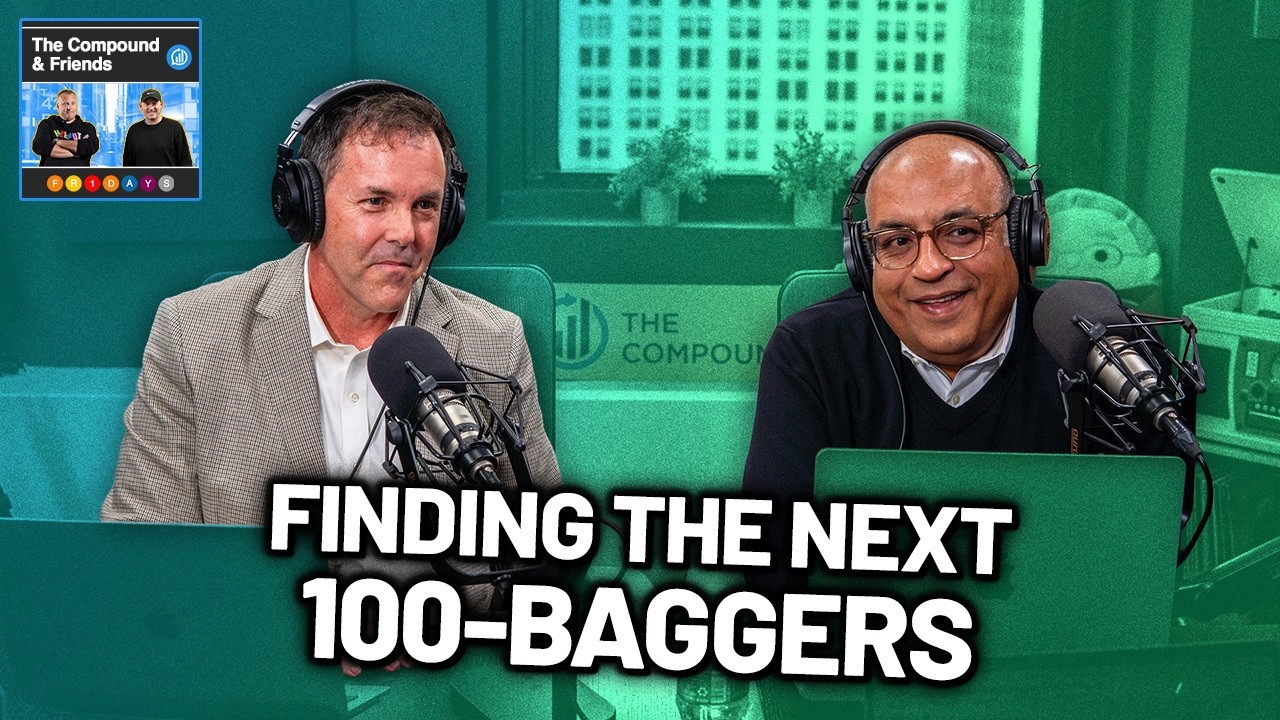
Portfolio Manager Ankrum Picks High-ROTA Stocks for 30-Year Holding Strategy
The Compound
Concentrated holdings in high-quality companies with durable moats generate exponential wealth by enduring temporary market drawdowns over multi-decade time horizons.
## Background
Published on May 1, 2026, by The Compound on YouTube, this video features episode 240 of *The Compound and Friends* hosted by Downtown Josh Brown and Michael Batnick. The episode centers on a discussion with guests Neeraj Khemlani and Matt Ankrum regarding their book, *The Coffee Can Investor*, exploring strategies for identifying 100-bagger stocks and compounding wealth over long horizons. According to the page description, the hosts and guests delve into long-term holding psychology, high-quality company resilience, Charlie Munger's inversion framework, and the impact of AI on legacy software.
## TL;DR
Matt Ankrum and Neeraj Khemlani unpack the 'coffee can' portfolio philosophy—holding a concentrated selection of high-quality, high-ROTA businesses for decades without selling. Ankrum highlights research showing that real wealth creation comes from enduring massive drawdowns in non-cyclical, high-conviction compounders, rather than chasing early-stage, unprofitable growth or quick gains. They address Wall Street's short-sighted sell-off of software incumbents over AI fears, arguing that enterprise software moats and high-consequence data integrations remain durable. The discussion closes with Ankrum's daughter, Morgan, sharing how these long-term investing principles and high-conviction framework are passed down to foster multi-generational financial literacy.
## Atmosphere & style
The episode has a collegial, conversational, and deeply analytical vibe, blending Wall Street wisdom with candid personal anecdotes. Josh Brown and Michael Batnick maintain an engaging, upbeat dynamic with guests Matt Ankrum and Neeraj Khemlani, balancing rigorous financial mechanics with relatable stories of past investing mistakes and family legacy. The emotional arc transitions from high-level market theory and case studies to a warm, inspiring climax when Ankrum's daughter joins the stage to reflect on long-term wealth building.
## Key takeaways
- [00:00](https://www.youtube.com/watch?v=5X4IpdqtFSg&t=0s) Niraj Khemlani and Matt Ankrum co-authored 'The Coffee Can Investor', a book that required a full year of writing and an additional year to navigate Columbia University Press's extensive peer, editorial, and academic review pipelines.
- [02:10](https://www.youtube.com/watch?v=5X4IpdqtFSg&t=130s) Despite Wall Street's short-sighted fears of AI disruption causing a sell-off in legacy software stocks, enterprise incumbents possess structural moats like institutional data and customer integration that allow them to adapt and enhance their services.
- [08:03](https://www.youtube.com/watch?v=5X4IpdqtFSg&t=483s) The 'coffee can' strategy involves investing in a concentrated portfolio of high-quality companies meant to be held completely untouched for decades, minimizing the urge to sell winners prematurely.
- [12:17](https://www.youtube.com/watch?v=5X4IpdqtFSg&t=737s) Achieving a 100-bagger stock return over 30 years requires roughly a 16.6% CAGR, demonstrating non-linear exponential compounding where the vast majority of terminal wealth is generated in the final 5 to 10 years.
- [21:19](https://www.youtube.com/watch?v=5X4IpdqtFSg&t=1279s) A massive hurdle for investors seeking 100-baggers is holding through severe volatility, as almost every 100-bagger stock in Ankrum's study suffered at least one existential drawdown of 50% or more.
- [24:37](https://www.youtube.com/watch?v=5X4IpdqtFSg&t=1477s) To verify business quality and weed out cyclical false positives, the authors focus heavily on a company's return on tangible assets (ROTA) evaluated over a minimum 10-year window.
- [30:09](https://www.youtube.com/watch?v=5X4IpdqtFSg&t=1809s) Hendrik Bessembinder's research highlights extreme market inefficiency and skewness, showing that just 4% of public companies generated 100% of net market wealth relative to T-bills from 1926 to 2022.
- [30:09](https://www.youtube.com/watch?v=5X4IpdqtFSg&t=1809s) Contrary to classic financial risk-return theory, data demonstrates that high-quality stocks exhibit superior long-term returns alongside lower volatility, outperforming low-quality companies 3-to-1 over 35 years.
- [33:53](https://www.youtube.com/watch?v=5X4IpdqtFSg&t=2033s) By applying Charlie Munger's 'invert, always invert' framework, long-term investors can improve their odds by screening out the lower 96% of the market characterized by declining industries, leverage, or zero growth.
- [33:53](https://www.youtube.com/watch?v=5X4IpdqtFSg&t=2033s) The average holding period for stocks has plummeted drastically from 8 years during the mid-20th century to approximately 5.5 months today, driven by short-term trading behaviors.
- [37:06](https://www.youtube.com/watch?v=5X4IpdqtFSg&t=2226s) The Coffee Can framework deliberately avoids pre-profit growth stocks, choosing instead to pay up for proven compounders that maintain strong revenue growth decades after their IPO.
- [52:23](https://www.youtube.com/watch?v=5X4IpdqtFSg&t=3143s) Historical 100-baggers are highly diverse across economic sectors, though they are rarely found in capital-intensive or commodity-dependent spaces like energy, utilities, real estate, and basic chemicals.
- [55:00](https://www.youtube.com/watch?v=5X4IpdqtFSg&t=3300s) Technology constitutes only about one-third of historical 100-baggers, with the remaining two-thirds emerging from retail, industrial distribution, and manufacturing sectors.
- [59:34](https://www.youtube.com/watch?v=5X4IpdqtFSg&t=3574s) Ankrum differentiates between low-consequence software and high-consequence enterprise systems, arguing that highly regulated, mission-critical systems face negligible risk of AI displacement due to the catastrophic costs of errors.
- [01:09:03](https://www.youtube.com/watch?v=5X4IpdqtFSg&t=4143s) Historical market fears concerning structural disruption are often overblown; for instance, despite early expectations that digital startups would kill legacy retail, 15 of today's top 20 e-commerce sites belong to traditional physical retailers.
- [01:16:45](https://www.youtube.com/watch?v=5X4IpdqtFSg&t=4605s) Matt Ankrum structured his personal $5 million Coffee Can portfolio of 20 stocks to serve as a generational wealth vehicle and a real-world tool for teaching financial literacy and passive income creation to his three daughters.
## Detailed walkthrough
### [00:00](https://www.youtube.com/watch?v=5X4IpdqtFSg&t=0s) The Book Creation and Columbia Peer Review Process
The episode kicks off with Downtown Josh Brown and Michael Batnick welcoming guests Niraj Khemlani and Matt Ankrum to discuss their book, *The Coffee Can Investor*. When asked about the timeline, Niraj explains that the process took about a year to write and another full year to publish due to the notoriously slow traditional publishing pipeline. Josh adds from his experience of writing four books that authors usually go through three or four back-and-forth drafts before publication. Niraj highlights that publishing with Columbia University Press involved an intense, rigorous review process—including peer, editorial, and academic committees—which he welcomed because he wanted the thesis to be thoroughly challenged from every direction.
Josh brings up a common trap for finance authors who write in the present tense about market conditions: the world moves so quickly that a book risks feeling outdated by the time it reaches store shelves. He recalls advice from his publisher at Harriman House, Craig Pearce, who reminded him that a book captures "a moment in time" rather than the exact day a reader opens it—a perspective shift that helped Josh transition from a fast-paced blogging mindset to writing timeless long-form literature. The group notes that while digital editions allow authors to update their text over time, a truly great investment book should stand the test of time on its own merits.
* **Publishing Timeline:** Roughly one year to compile the text and one year for press production and publication.
* **Columbia Oversight Committees:** Peer review committee, editorial committee, and academic committee.
* **Key Perspective:** Focus on timeless principles rather than real-time blogging reactions.
---
[02:10](https://www.youtube.com/watch?v=5X4IpdqtFSg&t=130s) Software, AI, and Market Misinterpretations
The conversation pivots to how the timing of the book's release aligns with current market anxiety surrounding Artificial Intelligence and its potential to disrupt legacy software companies. Matt points out that the market is only in "the first year of a 30-year run" for AI technology. He notes that while Wall Street is currently taking a hammer to high-quality software stocks over disruption fears, investors and market algorithms are misinterpreting the long-term impact on incumbent category leaders.
Matt argues that many established enterprise software incumbents possess structural moats and can integrate the exact same AI technologies to enhance their offerings, rather than being instantly replaced by startups. While AI will inevitably create dramatic winners and losers, the current wholesale sell-off of software incumbents presents a classic disconnect between short-term market narrative and long-term business reality. Josh agrees wholeheartedly, opting to pause the deep dive into AI until later in the show so they do not "do the show before the show."
* **Market Misconception:** AI disruption will instantly invalidate incumbent enterprise software platforms.
* **Incumbent Strengths:** Legacy platforms hold institutional data, deep customer integration, and the capacity to adopt the same AI tools.
---
[03:51](https://www.youtube.com/watch?v=5X4IpdqtFSg&t=231s) Intro and Sponsor Breakdown
After a brief pause, the formal podcast intro rolls for Episode 240 of *The Compound & Friends*. The hosts take a moment to thank their episode sponsor, Victory Capital, highlighting two macro-driven active ETFs managed by their West End Advisors franchise:
* **MODL:** VictoryShares West End US Sector ETF (focusing on dynamic US large-cap sector allocation aligned with the economic cycle).
* **GLOW:** VictoryShares West End Global Equity ETF (extending macro allocation discipline across global markets).
---
[04:47](https://www.youtube.com/watch?v=5X4IpdqtFSg&t=287s) Guest Introductions and Bios
Josh officially introduces the two distinguished guests. Niraj Khemlani, co-author of *The Coffee Can Investor: A Stock Picker's Journey to Build Generational Wealth*, boasts an extensive media background. He previously served as President and Co-Head of CBS News and Stations, overseeing legendary flagship programs like *60 Minutes*, *Face the Nation*, and *CBS Evening News*, following earlier senior leadership roles at Hearst and Yahoo Finance.
```
COFFEE CAN INVESTOR AUTHOR BACKBACKGROUNDS
+--------------------------------+ +--------------------------------+
| NIRAJ KHEMLANI | | MATT ANKRUM |
+--------------------------------+ +--------------------------------+
| • Co-author, Coffee Can Investor| | • Portfolio Mgr, Ackermann Cap.|
| • Former President, CBS News | | • Ex-Janus & Latif PM |
| • Executive at Hearst & Yahoo | | • Fortune 500 Strategy Lead |
+--------------------------------+ +--------------------------------+
```
To his right is Matt Ankrum, Portfolio Manager at Ackermann Capital, where he runs a concentrated family office portfolio and institutional investment strategy based on long-term compounders and "100-bagger" stocks. Matt’s deep analytical process forms the core subject of the book, which has drawn praise from investing legends such as Howard Marks and veteran journalist Dan Rather. Matt's background includes serving as an analyst and portfolio manager at Janus and Latif Investment Management, leading strategy for a Fortune 500 corporation, co-founding a SaaS fintech, serving as CEO of a neurorehabilitation company, and teaching as an adjunct professor at UMKC.
* **Niraj Khemlani's Media History:** Former Head of CBS News (*60 Minutes*, *Face the Nation*), Hearst, Yahoo Finance.
* **Matt Ankrum's Profile:** Ackermann Capital PM, ex-Janus/Latif analyst, corporate strategist, entrepreneur, and adjunct professor.
---
[08:03](https://www.youtube.com/watch?v=5X4IpdqtFSg&t=483s) The Origin Story of the Coffee Can Strategy
Niraj lays out the core premise of the book: Matt Ankrum set out to construct a ultimate "lottery ticket" for his three daughters by building a real-world "coffee can" portfolio—targeting 20 carefully picked companies backed by $250,000 each, held over decades with the goal of compounding into half a billion dollars of generational wealth. Niraj clarifies that the "coffee can" is a conceptual metaphor inspired by old Western pioneers who buried their physical cash and valuables in metal coffee cans to protect them from bandits.
```
ORIGINAL COFFEE CAN EXPERIMENT (1980s)
Robert Kirby (Capital Group) Client's Lawyer Husband
| |
|--- 1. Recommends BUY $5,000 Position ------------->|
| |--- Keeps stock cert in Coffee Can
| |
|--- 2. Recommends SELL Position ------------------->|
| |--- Ignores sell call (NEVER SELLS)
| |
v
30 Years Later: Xerox goes $5k -> $800k!
```
Niraj explains that he has known Matt for over 25 years as a trusted market source—what *60 Minutes* producers internally called "Marvin the Explainers." A few years back, Matt shared the story of Robert Kirby, a famed portfolio manager at Capital Group in Los Angeles. In the mid-20th century, Kirby managed money for a wealthy LA heiress whose husband, a lawyer, handled her account details. Whenever Kirby called with a buy recommendation, the husband bought the stock for his wife—but secretly bought an identical position for himself and shoved the paper stock certificates into a physical coffee can. Whenever Kirby later called to sell a stock, the husband sold his wife's position but refused to touch his own.
Decades later, after the husband passed away, the coffee can was discovered containing $5,000 starting positions. While a few stocks had drifted down to $3,000, half a dozen had expanded into $100,000, and one position—Xerox—had grown from $5,000 into $800,000. Realizing the profound lesson of unintentional "action-free" compounding, Kirby wrote a seminal paper in 1984 for the *Journal of Portfolio Management* titled "The Coffee Can Portfolio," ending with the hope that someone would one day repeat the experiment. Matt became obsessed with studying those specific extreme winners—the "100-baggers."
* **The Original Experiment:** $5,000 invested per position in the 1980s.
* **Results of Inaction:** Weak stocks dropped slightly ($3,000), multiple positions reached $100,000, and top performer Xerox expanded to $800,000.
* **Key Concept:** Eliminating human emotion, market timing, and excessive trading fees allows true compounders to realize their full potential.
---
[12:17](https://www.youtube.com/watch?v=5X4IpdqtFSg&t=737s) The Math and Mechanics of 100-Bagger Stocks
Matt introduces a visual chart comparing the long-term compounding trajectory of the S&P 500 against that of a true 100-bagger stock over a 30-year horizon. Assuming the S&P 500 historical average return of 10.8% annually, a single dollar grows steadily over time. However, a stock that turns $1 into $100 over 30 years requires a compound annual growth rate (CAGR) of roughly 16.6%—meaning the position doubles roughly every 5 years.
```
30-YEAR COMPOUNDING TRAJECTORY (LOGIC)
Value ($)
^ / [100-Bagger: ~16.6% CAGR]
| /
| / <-- Explosive 80-fold gap
| / in Final 5-10 Years
| /
|---------------------------------------------------/--- [S&P 500: ~10.8% CAGR]
|__________________________________________________/
0 10 20 30 Years
```
Matt points out two critical takeaways from the math of compounding:
1. **The Invisible Phase:** During the first 10 years, the visual difference between the S&P 500 line and the 100-bagger line is surprisingly modest. Because human brains think linearly rather than exponentially, investors routinely abandon great companies early on because 15% annual gains do not "feel" life-changing in the first decade.
2. **The Terminal Explosion:** An astounding portion of the overall wealth creation happens in the final 5 to 10 years of the horizon. Over 30 years, that extra ~5.8% annual return difference produces an **80-fold overall variance** in final terminal wealth.
Josh and Michael relate this phenomenon directly to Warren Buffett's wealth journey. Over 98% of Buffett's net worth was generated after his 65th birthday—not because his stock-picking skill drastically improved late in life, but because the mathematical exponential curve of multi-decade compounding accelerates exponentially in its final stages. The section closes with a classic thought experiment: putting a grain of rice on a chessboard and doubling it on each square starts out with microscopic pennies, but quickly surpasses the net worth of the richest individuals on Earth once it reaches the final squares.
* **Required Annual Return:** ~16.6% CAGR over 30 years to yield a 100x payoff.
* **Doubling Benchmark:** Doubling capital approximately every 5 years.
* **Wealth Disparity:** An 80-fold total difference in terminal capital between a 10.8% benchmark and a 16.6% compounder over 3 decades.
[15:35](https://www.youtube.com/watch?v=5X4IpdqtFSg&t=935s) The Power of Compounding and Get-Rich-Slow Investing
The conversation opens with a discussion on the exponential nature of compounding, using vivid analogies to illustrate how back-loaded investment gains can be. A guest recounts a story about dominoes: if you start with a standard-sized domino and each subsequent domino it knocks over is twice as large, by the 13th domino you are knocking down a structure the size of the Empire State Building. While the exact domino count might vary slightly, the overarching principle holds firm: the vast majority of compounding's astounding returns occur at the very end of the timeline. Michael Batnick and Josh Brown poke fun at this reality, joking that get-rich-slow concepts require patience that most people lack. "That is boring. Who wants to be rich at the end?" jokes one host, adding, "I want to be rich right now." Because most investors double their money and quickly lock in profits to move on to the next trade, they miss out on the true tail-end magic of compounding.
[16:38](https://www.youtube.com/watch?v=5X4IpdqtFSg&t=998s) The Fastenal Story and Early Career Lessons
Matt Ankrum shares an apocryphal story from his early days as a young analyst at Janus, working under a portfolio manager and covering Fastenal, a company that sells nuts and bolts for construction sites and industrial vending machines. Back before Regulation Fair Disclosure (Reg FD) existed, analysts enjoyed direct access to management and frontline operations. Matt spent time going on customer tours with branch managers and visiting job sites. Fastenal was an attractive holding because its products—screws, nails, and fasteners—accounted for less than 3% of a customer's total project cost, yet missing a single part could shut down an entire labor crew. Fastenal built a moat around service, even machining custom parts on short notice to keep jobs running smoothly.
Through his field research, Matt realized Fastenal was going to miss its upcoming quarterly earnings report. Because Fastenal was a massive 8% position in their portfolio, Matt advised his portfolio manager to sell the stock. Following the earnings miss, Fastenal's stock plummeted 55% while the broader market only dropped 15%, making Matt look like a hero for avoiding the drop. On a split-adjusted basis, the stock fell from about $1.45 to roughly $0.65 or $0.70. However, after that temporary hit, the stock went on an astonishing 19-fold run from where they sold it—massively outperforming the S&P 500's 4-fold return over the same period.
- Fastenal sold nuts and bolts that represented less than **3%** of customers' total project costs.
- The stock formed **8%** of Matt's portfolio at Janus when they decided to exit.
- Fastenal dropped **55%** post-earnings vs. a **15%** broader market decline.
- Split-adjusted, the stock dropped from **$1.45** to **$0.65–$0.70**.
- After selling, Fastenal went up **19-fold**, while the S&P 500 rose **4-fold** over the same timeframe.
- Dan Florness, who originally served as CFO, later took over as CEO of Fastenal.
[21:19](https://www.youtube.com/watch?v=5X4IpdqtFSg&t=1279s) Human Psychology and Enduring Existential Drawdowns
Reflecting on the Fastenal exit, Matt describes it as a true epiphany about human psychology in investing. Even after dodging a 55% drop, buying back into a stock after a brutal collapse is psychologically brutal. Around that time, narrative fear was high, as Wall Street believed Amazon would enter the industrial supply market and decimate Fastenal. In reality, Amazon eventually became one of Fastenal's largest customers. Josh points out that retail investors lack the deep management access and on-the-ground context that Matt had; when a stock gets cut in half on earnings, most people assume it is going to zero or will remain trapped indefinitely. Long-term wealth creation requires the rare psychological willingness to endure 50% or greater drawdowns.
Neeraj Khemlani and Matt note that almost every single top-performing stock in Matt's 100-bagger study experienced at least one seemingly existential crisis that it ultimately survived. Comparing this phenomenon to Joseph Campbell's "hero's journey," Josh jokes that a great stock has to "come back from the dead" to reach its third act. The host references J.P. Morgan's famous 2014 research report, *The Agony and the Ecstasy of Stock Picking*, which highlighted that 40% of all stocks in the Russell 3000 suffer a catastrophic 70% decline from which they never recover. Because four out of ten stocks permanently fail after a crash, investors naturally panic and sell after double-digit losses to avoid being wiped out.
[24:37](https://www.youtube.com/watch?v=5X4IpdqtFSg&t=1477s) Defining High-Quality Companies and Avoiding Zeros
To build a 100-bagger "coffee can" portfolio, the critical task is avoiding the lower-quality businesses that fail permanently. Matt found that the stocks in his study that successfully delivered 100x returns were high-quality businesses right from their initial public offerings (IPOs). When asked to define high quality, Matt highlights a high return on tangible assets (ROTA)—a standard measure of business efficiency that tracks how much operating profit a company generates relative to its assets. Although modern investors often dismiss tangible asset metrics, high returns allow a company to turn rapid growth directly into free cash flow without requiring massive external capital infusions.
To filter out cyclical spikes—such as an energy producer enjoying temporarily high margins during an oil price surge—Matt evaluates companies over a 10-plus year window to ensure returns are consistent and sustainable. He references Warren Buffett's framework for categorizing quality based on return on capital benchmarks:
- **15% or more:** A decent business
- **20% or more:** A good business
- **25% or more:** A great business
- **30% or more:** An exceptional business
Crucially, the companies that turn into 100-baggers do not regress toward the mean. Instead, they maintain enduring competitive advantages that protect their high returns against prospective disruptors.
[27:33](https://www.youtube.com/watch?v=5X4IpdqtFSg&t=1653s) Management Control and Market Outliers
Josh tests Matt's framework using Cheniere Energy as a real-world example, noting that while it might not fit traditional high-quality metrics, its Gulf Coast liquefied natural gas (LNG) export terminals possess an insurmountable geographic and regulatory moat that no competitor will duplicate over the next decade. Matt responds that he would still avoid Cheniere because its profitability remains tied to underlying natural gas commodity prices. Instead of relying solely on entry barriers, Matt looks for companies where management maintains complete pricing power and control over input costs.
Matt then presents data illustrating the steep odds against individual stock selection. Across rolling 10-year periods, 71% of individual stocks fail to match overall market returns. "If you buy 10 stocks, the probability is that for most people, seven of them will underperform the index," the group observes, highlighting how concentrated market gains really are among a small cluster of top-performing outliers.
[30:09](https://www.youtube.com/watch?v=5X4IpdqtFSg&t=1809s) The Market Inefficiency of High-Quality Stocks
The conversation kicks off with a look into Hendrik Bessembinder's landmark study on stock returns from 1926 to 2018 (and later updated through 2022). The hosts and guests dissect a staggering reality: while 80% of market wealth creation is typically attributed to 20% of stocks under the classic Pareto principle, stock market reality is far more extreme. Bessembinder's data proves that relative to T-bills, a mere 4% of companies created 100% of the net wealth generated in the stock market.
Looking closer at Bessembinder’s numbers, Matt Ankrum reveals an intriguing finding: among the top 50 net wealth-creating companies (which accounted for 50% of all net market wealth), 84% were high-quality businesses. High-quality companies tend to outperform low-quality companies by a 3-to-1 margin over a 35-year horizon. Citing Jeremy Grantham's research at GMO, Matt points out what academics call "the weirdest inefficiency in the market": high-quality stocks deliver higher long-term returns while experiencing *lower* volatility. In standard financial theory, risk and reward must scale together—meaning this low-risk, high-return phenomenon shouldn't logically exist.
Michael Batnick and Downtown Josh Brown marvel at why this anomaly persists. Josh notes that in finance, taking on terminal risk (like junk bonds) is supposed to offer higher upside, whereas stable assets yield low returns. However, high-quality, "boring" companies—the ones selling nuts, bolts, and everyday essentials—are often severely underpriced for perfection because investors ignore them in favor of exciting short-term trades.
- **4% Rule:** Only 4% of all public companies created 100% of net stock market wealth over T-bills between 1926 and 2022.
- **Top Performers:** 84% of the top 50 wealth-generating companies in Bessembinder's study met high-quality business criteria.
- **3:1 Outperformance:** High-quality stocks outperformed low-quality stocks 3 to 1 over a 35-year timeframe.
---
[33:53](https://www.youtube.com/watch?v=5X4IpdqtFSg&t=2033s) Inverting the Problem: Screening Out the 96%
Invoking Charlie Munger's famous maxim—"Invert, always invert"—Matt explains that instead of hunting directly for the elusive 4% of winning stocks, investors should focus on eliminating the bottom 96%. By discarding lower-quality businesses, investors drastically increase their odds of selecting a long-term compounder.
> "If you're looking for a needle in the haystack, pull all the hay out."
Matt outlines the criteria sitting inside that bad 96%: declining industries, over-leveraged balance sheets, lack of free cash flow, and zero top-line growth. Co-author Neeraj Khemlani shares a lighthearted anecdote about watching Matt work through his screening process, comparing him affectionately to *Rain Man* as Matt mumbles to himself, scratching companies off his list with a pen if they depend on volatile commodity prices like oil.
The group laments that very few money managers operate this way today. The average holding period for a stock has plummeted from 8 years in the 1950s and 1960s down to just 5.5 months today. Because institutions trade on short time horizons, they miss out on the decade-long compounding trajectories of elite businesses.
- **Elimination Strategy:** Disqualifying poor-quality companies cuts out two-thirds of the market universe upfront.
- **Average Holding Period:** Down from 8 years in the mid-20th century to roughly 5.5 months today.
---
[37:06](https://www.youtube.com/watch?v=5X4IpdqtFSg&t=2226s) Contrasting Investment Styles: Compounders vs. Early Growth
Josh Brown shares his own trading experience, noting that some of his biggest individual stock gains came from buying high-revenue-growth, pre-earnings companies *before* they became profitable, riding them until institutional buyers jumped in. Matt acknowledges this style but emphasizes that his "coffee can" framework intentionally excludes unprofitable growth names. He seeks companies with proven unit economics, durable competitive advantages, and long-term viability.
Matt admits he is perfectly comfortable buying a stock *after* it has already tripled, provided it has officially transitioned into a high-quality compounder. He would rather pay a higher price for a proven, de-risked business model than take on the risk of early-stage failure.
When asked whether he prefers buying a stock that has just doubled or one that was cut in half, Matt admits a slight personal bias toward the beaten-down stock, though he emphasizes that near-term price momentum doesn't matter if you plan to hold a company for 30 years without a market quote. Quoting Charlie Munger, he reminds the hosts that over a long enough holding period, a stock's return inevitably mirrors the underlying return on the business itself.
- **20% CAGR Rule:** The top compounders in Matt's research maintained a 20% compound annual growth rate in revenue even 20 years after their IPO.
---
[41:50](https://www.youtube.com/watch?v=5X4IpdqtFSg&t=2510s) The Latif Experience and the Power of Storytelling
The conversation pivots to Matt Ankrum's professional origin story at Latif, a California-based money management firm in Marin County. Unlike his early days at Janus—where analysts constantly chased short-term quarterly beats—Latif ran extremely concentrated, low-turnover portfolios holding only 15 to 17 stocks.
Because Latif managed Separately Managed Accounts (SMAs) rather than competing in the quarterly mutual fund performance derby, they could afford to act completely differently from mainstream Wall Street. A core part of their strategy was educating clients through deep narrative storytelling. By making sure clients understood the core business models and long-term growth thesis of every company in their portfolio, clients remained calm and held on during major market drawdowns.
Josh Brown vigorously defends the role of narrative in investing, arguing that despite Wall Street's modern disdain for "storytelling," retail investors fundamentally want to know what they own. Reasserting the human element of finance, clear stories keep investors anchored in high-quality businesses when market prices temporarily dislocate from underlying business performance.
[44:47](https://www.youtube.com/watch?v=5X4IpdqtFSg&t=2687s) Explaining the Story Behind the Stocks
The discussion centers on the importance of portfolio managers being able to explain the underlying mechanics and longevity of a company to their clients, particularly business owners. Neeraj Khemlani points out that clients genuinely appreciate working with someone who truly understands a business and can articulate why a company remains relevant even through market down cycles. Neeraj recalls his own learning curve while working with Matt Ankrum, noting that whenever a stock faced trouble, Matt maintained unwavering conviction and viewed price drops as buying opportunities rather than reasons to panic.
Josh Brown frame-checks Matt’s edge, describing Neeraj as a storytelling "producer" who inherently understands character arcs, narrative tension, and resolution, while Matt serves as the grounded, calm analyst source. Operating out of Kansas City—far removed from the daily noise and quarterly hysteria of Wall Street—Matt remains steady by focusing strictly on the numbers and long-term business trajectories over time. The panel notes that Matt spends drastically more time researching and selecting a stock than he ever spends thinking about selling it.
- Matt Ankrum operates out of Kansas City, deliberately positioned away from the short-term noise of Wall Street.
- High conviction and deep business understanding allow managers to guide clients through heavy drawdowns.
- Great long-term investors allocate significantly more effort to initial stock selection than to exit strategies.
[46:24](https://www.youtube.com/watch?v=5X4IpdqtFSg&t=2784s) The Misunderstood Law of Large Numbers and Amazon’s Dominance
The hosts turn their attention to Amazon as a premier example of a 100-bagger, reviewing its latest blowout quarterly earnings report. CEO Andy Jassy reported quarter revenue of $181 billion—a 17% increase year-over-year—led by AWS accelerating to 28% growth (its fastest rate in 15 quarters) to reach an annualized revenue run rate of $150 billion. Josh highlights how rare it is for an enterprise to grow at that speed on such a massive baseline, noting that the last time AWS grew at that rate, it was half its current size.
This prompts a breakdown of the "law of large numbers," a term investors frequently misuse to justify why a massive company cannot keep growing. Josh and Michael Batnick explain that people conflate regression to the mean or the "gambler's fallacy" with mathematical law, incorrectly assuming that a rising business must inevitably slow down. Neeraj provides the actual statistical definition: as the number of independent, identically distributed trials increases, the average result approaches the expected value—like coin flips balancing out over time—which has nothing to do with a competitive corporate moat.
```
AWS Annualized Revenue Run Rate: $150 Billion
AWS Year-over-Year Growth: 28% (Fastest in 15 quarters)
Amazon Total Quarterly Revenue: $181 Billion (Up 17% YoY)
```
- Financial media and investors routinely misuse the "law of large numbers" to mistakenly project growth caps on high-moat companies.
- True high-quality companies defy mean reversion by constantly compounding their competitive advantages.
[48:33](https://www.youtube.com/watch?v=5X4IpdqtFSg&t=2913s) High-Quality Persistence and Reinvesting for the Future
Referencing chart studies from Morgan Stanley, Atlantic, Capital One, and Grantham Mayo (GMO), the panel highlights how high-quality companies outperform low-quality stocks 3-to-1 over 35-year spans, exhibiting both higher returns and lower annualized volatility. Neeraj, a University of Chicago graduate, references the clash between Eugene Fama’s Efficient Market Hypothesis—which preaches that everything regresses to the mean—and Richard Thaler’s behavioral finance, noting that Thaler clearly won given how "good companies become great and stay great."
The group analyzes how Amazon flipped from an intentionally unprofitable B2C/B2B retail engine into a profit powerhouse. For years, the market celebrated Amazon's losses because Jeff Bezos openly reinvested every dollar back into research, development, and logistics—effectively building its own UPS from scratch. Once AWS and cloud computing took off, profits exploded. Matt emphasizes that investors missing out on early runs can still profit enormously by buying when the profit switch flips, comparing it to modern compounding giants like Nvidia or Eli Lilly.
> "Every time they lost more money, the street said, 'This guy is amazing.' And then the switch flipped with the advent of cloud computing... That's nowhere near the end of the run. That's where the run begins."
- High-quality stocks beat low-quality stocks 3-to-1 over 35 years while carrying lower volatility.
- Amazon's heavy R&D spending was essentially pre-funding revenue streams 3 to 5 years into the future.
- Growth isn't over just because a stock has already run up; structural business transformations open up entirely new legs of compounding.
[52:23](https://www.youtube.com/watch?v=5X4IpdqtFSg&t=3143s) Analyzing the 50 100-Bagger Cohorts Across Decades
Josh and Michael run through the list of 50 iconic 100-baggers identified in Matt’s study, featuring names across diverse sectors: Cintas, Adobe, Microsoft, Fastenal, HEICO, Cognex, Nike, Intuit, Cisco, Tractor Supply, Monster Beverage, UnitedHealth Group, Oracle, Nvidia, Expeditors International, Landstar System, Copart, and Pool Corp. Josh points out that nearly every S&P sector is represented—with notable exclusions like traditional energy, utilities, real estate, and basic chemicals, which lack long-term pricing power.
```
Sector Distribution of 100-Bagger Study:
├── Technology & Software: ~33%
├── Retail & Consumer: High Representation (Tractor Supply, AutoZone, Home Depot)
└── Industrial & Manufacturing: High Representation (Amphenol, HEICO, Mettler-Toledo)
```
Matt dispels the myth that all 100-baggers are high-tech, revealing that technology and software combined account for only about one-third of the total. A massive portion comes from "unsexy" manufacturing, specialized distribution, and niche retail. Neeraj jokes that Matt considers himself "personally unsexy," matching his passion for digging deeply into unglamorous, highly lucrative business models that most retail investors completely ignore.
- Technology accounts for only roughly one-third of 100-bagger stocks; retail, industrial distribution, and manufacturing make up the rest.
- Sectors with heavy capital intensity and commodity pricing (utilities, oil, basic chemicals) rarely yield 100-baggers.
- Monster Beverage stands out historically as one of the single best-performing public stocks of all time.
[55:00](https://www.youtube.com/watch?v=5X4IpdqtFSg&t=3300s) Retail Winners and the IPO Vintage Breakdown
Addressing whether new retail 100-baggers can still emerge today, the hosts look globally at powerhouses like Inditex (the Spanish parent company of Zara), whose founder became one of the world's wealthiest individuals selling fast-fashion apparel. Matt then breaks down his study's dataset chronologically in 5-year vintage increments from 1980 to 2000—explaining that pre-1980 financial data was unreliable, and post-2000 cohorts require more time to complete a full 30-year lifecycle.
The historical IPO classes highlight how wealth creation spans across eras:
- **1980–1984 Class:** Home Depot, Apple, Nike, UnitedHealth Group, Amgen.
- **Late 1980s Class:** Oracle, Microsoft, Adobe, Jack Henry & Associates (bank software), Autodesk, Electronic Arts.
- **Early 1990s Class (1990–1994):** Starbucks, AutoZone, Old Dominion Freight Line.
- **Late 1990s Class:** Pool Corp, Amazon, Cognizant, Nvidia, Mettler-Toledo.
Matt shares a personal story about Mettler-Toledo, a manufacturer of high-precision laboratory and highway truck scales. He met with management during their IPO, loved the business, and bought the stock—only to sell it after a quick 30% gain in four months, missing out on its subsequent run to becoming a 100-bagger. When Josh asks if everyday investors should try hunting these stocks themselves, Matt divides his answer: while determined investors *can* learn to do the deep fundamental research, whether they *should* execute a concentrated strategy depends on their psychological ability to endure massive volatility.
- Mettler-Toledo demonstrates how unsexy, dominant niche manufacturers (precision scales) can become 100-bagger stocks.
- Selling great compounders early for modest short-term gains (e.g., a quick 30% profit) is one of the most common investor mistakes.
- Building a 100-bagger portfolio requires both the labor of deep fundamental analysis and the discipline to hold through severe drawdowns.
[59:34](https://www.youtube.com/watch?v=5X4IpdqtFSg&t=3574s) The Reality of AI's Disruption on Software Stocks
Josh Brown initiates a deep dive into the current panic gripping Wall Street regarding the software sector. Many horizontal and vertical Software-as-a-Service (SaaS) companies—alongside iconic giants like Adobe, Salesforce, and Microsoft—are being "marked for death" by investors who fear generative AI tools from OpenAI, Anthropic, and Google will allow anyone to build custom software on the fly. Up until recently, these businesses were viewed as the highest-quality compounders with high margins, sticky revenues, and deep moats as systems of record. Downtown Josh asks Matt Ankrum how a long-term "coffee can" investor should react to this massive sector-wide de-rating.
Matt emphasizes that when the market experiences a radical, sentiment-driven sell-off, investors must remain intellectually honest, check their priors, and examine the underlying numbers rather than blindly panicking. He points out that Wall Street tends to embrace plausible narratives and "sell first, ask questions later" without bothering to talk to actual software customers. Ankrum draws a line between low-consequence software (where a minor error or cheap alternative carries little risk, such as basic marketing tools) and high-consequence software, where errors carry catastrophic regulatory, financial, or legal penalties.
* **Sector Shift:** Wall Street has heavily discounted SaaS multiples over fear of rapid generative AI replication.
* **Low vs. High Consequence:** Distinguishes between low-consequence tools (e.g., website builders) and mission-critical enterprise systems.
[01:03:53](https://www.youtube.com/watch?v=5X4IpdqtFSg&t=3833s) High-Consequence Software: The TechnologyOne Case Study
To illustrate high-consequence software, Matt spotlights TechnologyOne, an Australian enterprise software company held in his portfolio. He asks the hosts to imagine being the CEO of the Brisbane City Council—the largest local council in Australia with 470,000 property owners. The municipality must deliver hyper-accurate tax assessment notices every August across 186 categories and constant regulatory updates. Miscalculating taxes by just 1% results in a $14 million funding mismatch, public backlash, potential legal tribunals, and personal legal accountability for the CEO. Under those stakes, a government executive will not risk switching to an unproven AI startup just to save 20% or 30% on software costs.
Furthermore, Matt highlights that TechnologyOne's software is remarkably cheap relative to its utility—a council often spends less on it than on its Microsoft Office licenses, despite TechnologyOne running their entire operations. Instead of being disrupted by AI, TechnologyOne is leveraging its position as the core system of record. They built an AI orchestration layer ("TechnologyOne Plus") that automates complex enterprise workflows—such as calculating degree-program profitability for university CFOs or creating B2B2C self-service tools for students requesting assignment extensions—making their platform far more essential and sticky.
> "As a CEO, you're actually personally accountable. That's high consequence. In their business, they're highly regulated, highly compliant... they're not worried about saving 20% or 30%."
* **Brisbane Council Example:** 470,000 property owners, 186 tax categories, and 1,500 new subdivisions added monthly.
* **Cost vs. Value:** Municipalities spend less on core operational ERP software than on general Microsoft Office suites.
* **AI Opportunity:** Rather than suffering disruption, incumbent systems of record capture workflow data to sell high-margin AI automation back to customers.
[01:09:03](https://www.youtube.com/watch?v=5X4IpdqtFSg&t=4143s) Incumbent Moats vs. Market Narratives
Neeraj Khemlani joins the discussion to highlight another structural advantage of specialized enterprise software: frictionless deployment. Unlike massive enterprise systems (such as legacy Salesforce or SAP implementations) that require millions of dollars and months of third-party consulting, modern niche platforms are lightweight, de minimis in cost, and ready to use immediately. Khemlani explains that this "essentiality" is a primary criteria for their long-term stock selection.
Addressing Josh's question on whether the market is entirely wrong about AI wiping out SaaS, Matt argues that AI is indeed transformational, but Wall Street is failing to be discerning. He draws an analogy to his time working at Janus Capital during the 1999–2000 Dot-Com Bubble, when consensus dictated that "New Economy" e-commerce startups would immediately wipe out "Old Economy" brick-and-mortar retail. Looking at the top 20 e-commerce sites decades later, only five belong to pure digital natives (like Amazon, eBay, Etsy, and Chewy), while fifteen belong to traditional physical retailers (such as Walmart, Target, Home Depot, and Best Buy) that successfully integrated digital tools into their existing footprints. Matt expects incumbents with deeply embedded workflows and customer trust to adapt similarly to AI.
* **Dot-Com Parallel:** Top 20 e-commerce sites today feature 15 "Old Economy" legacy retailers that successfully adapted to the internet.
* **Incumbent Moat:** Deeply integrated workflows, regulatory trust, and existing network effects make incumbent software exceptionally difficult to displace.
[01:12:44](https://www.youtube.com/watch?v=5X4IpdqtFSg&t=4364s) The Human Element: User Inertia in Niche Software
Josh Brown builds on the idea of incumbent resilience by highlighting user behavior and adoption friction. He argues that in many non-tech verticals, the labor force's willingness to adopt new technology is so low that once workers are trained on a platform, business owners will almost never force them to switch again. To prove his point, Josh brings up two beaten-down software holdings from his own portfolio: Toast and ServiceTitan.
Josh notes that Toast has effectively won the restaurant management sector, taking market share from legacy payment processors like Block (Square) and Fiserv (Clover). Serving 150,000 restaurant locations and expanding into major hotel chains like Marriott, Toast has built a standard workflow that millions of hospitality workers already know how to use. Despite the stock dropping heavily from its peak, Josh contends that a diner owner who spent years onboarding his staff onto Toast will never swap it out for a cheaper or unproven alternative, illustrating why Wall Street's blanket fear of software disruption is overblown.
* **Toast Adoption:** Powering over 150,000 restaurant locations out of a 600,000 U.S. addressable market, plus expanding into hotel chains like Marriott.
* **User Inertia:** The operational friction and retraining effort required to replace entrenched vertical software serve as a powerful defensive moat against AI disruption.
Here is a detailed, faithful walkthrough of this section of the transcript, capturing the substantive insights, specific examples, and back-and-forth dialogue among the hosts and guests.
---
[01:14:27](https://www.youtube.com/watch?v=5X4IpdqtFSg&t=4467s) Software Valuation Multiple Compress and the ServiceTitan Case Study
Josh Brown and Michael Batnick continue exploring field-service software companies, highlighting businesses like exterminators, alarm companies, and home services that send technicians out to homes carrying hand-held devices to print invoices directly on-site. Once a service business adopts this workflow, the technology becomes deeply entrenched and extremely difficult to displace. Brown acknowledges that while SaaS stock prices have pulled back because Wall Street is modeling lower customer Lifetime Value (LTV), he believes these category leaders will maintain—or even expand—their market share three years down the road.
Attention turns to a slide on software multiple compressions based on research from Meritech. Matt Ankrum points out that he has looked closely at ServiceTitan, noting that one of the compelling aspects of its narrative is that the two founders are brothers, sons of an immigrant, and came directly out of the trade industry themselves, giving them a profound domain understanding. Ankrum emphasizes that a massive shift in SaaS stock valuations is playing out across the market. Many software companies went public in the 2021 pandemic boom on sky-high growth rates, and investors were willing to pay extreme multiples. As growth rates normalized, valuations compressed severely across the 25th, 50th, 75th, and 90th percentiles, compounding the stock price drops caused by fears over AI disruption.
* **Key SaaS Multiple Trends:** Meritech data shows how the valuation landscape shifted drastically as hyper-growth software multiples reset from 2021 pandemic highs to historically lower ranges.
* **ServiceTitan Founders:** Founded by two brothers who were sons of an immigrant and came directly from the home services trade, providing them with first-hand industry insight.
---
[01:16:45](https://www.youtube.com/watch?v=5X4IpdqtFSg&t=4605s) The High Bar of the Coffee Can Portfolio and the Threat of Disruption
Michael Batnick pivots to the core structure of Matt Ankrum’s project: placing $5,000,000 across 20 concentrated stock positions ($250,000 each) into a metaphorical "coffee can" portfolio meant to compound over decades for his three daughters. Batnick notes that out of the 13 stocks selected so far, AI models like Claude identify around eight of them as software companies. He asks Ankrum two direct questions: if he had known back in 2017 how powerful AI platforms like Anthropic’s Claude would become, would he still have bought those names? And second, how permanent is this "coffee can" strategy if a company's underlying business is genuinely disrupted?
Ankrum responds that while the barrier to enter his coffee can is very high, the bar to sell out of a position is even higher. He refuses to let short-term market panic dictate his actions, pointing out that false narratives dominate Wall Street cycles. Brown agrees, citing how just a year prior, market consensus held that Google search would be completely cannibalized by AI; yet Google adapted, protected its moat, and drove its stock to a new all-time high. Ankrum argues that top management teams do not suddenly become incompetent overnight when new technology arrives. Companies like C3 AI Solutions have used AI and Nvidia chips for over a decade. While horizontal software businesses with thin moats are vulnerable, high-moat incumbents have navigated massive technological shifts before—such as moving from on-premise software to the cloud.
> "The barrier to entry to get into the coffee can is high... The barrier for me to sell it is even higher."
> "If we loved the management before and we thought they were brilliant and they ran the company, why do we think they all of a sudden got stupid?"
---
[01:20:34](https://www.youtube.com/watch?v=5X4IpdqtFSg&t=4834s) Leaving a Generational Legacy: The Mathematics of the $5 Million Coffee Can
Ankrum explains the deeper emotional motivation behind the portfolio: creating true financial literacy and a lasting legacy for his three daughters alongside his wife. Expressing frustration that financial literacy is rarely taught in high school, Ankrum explains how he teaches his children to view investing as building a primary asset base to generate passive income rather than just seeking a standard career path. The structure of the experiment is concrete: $5,000,000 total capital allocated equally across 20 individual stocks ($250,000 per position) held with a 30-year horizon.
Brown notes the astonishing mathematical upside of the thesis: if an investor successfully picks a collection of long-term compounders aiming for 100-baggers, a $5 million starting portfolio compounding over 30 years could theoretically approach half a billion dollars ($500,000,000). Ankrum humbly cautions listeners that there are no guarantees the portfolio will hit that target, but Brown notes how rare it is for individual investors to even think in terms of decades-long wealth creation. Most people on the street invest purely to "make quick money" without a broader structural goal.
* **Portfolio Mechanics:** 20 stocks funded with $250,000 each ($5 million total principal).
* **Time Horizon:** 30 years of uninterrupted compounding.
* **Potential Upside:** Aiming for multi-bagger returns that could theoretically reach toward $500,000,000 over three decades.
---
[01:25:26](https://www.youtube.com/watch?v=5X4IpdqtFSg&t=5126s) Unlearning Bad Habits and Bringing the Next Generation On Stage
Neeraj Khemlani shares why writing *The Coffee Can Investor* alongside Ankrum was deeply personal. He likens learning to invest late in life to taking a golf lesson at age 50—it requires painful effort to unlearn decades of bad habits. With the average holding period for a stock shrinking to just 5.5 months and the average American retirement balance hovering around $300,000, teaching children to be business owners rather than short-term stock traders is crucial. Khemlani points out that neither his nor Ankrum's children view this money as a passive "inheritance"; rather, they want to learn the analytical process and work to build their own path.
In a lighthearted and touching moment, Brown calls Ankrum's daughter, Morgan, onto the set to ask how she felt when her parents first sat the family down to explain this massive financial portfolio. The hosts joke about whether she is ready to live like Paris Hilton or buy a brand new car, poking fun at how Ankrum lives below his means and drives a beat-up family car with dents and magnetic band-aids that the family affectionately nicknamed "Wilburn Andy."
> "We wanted the kids to understand how to invest in companies and not be a trader... The 5 and a half month hold time for a stock and declining is terrible."
> "Do not compare yourself to others because you will either become vain or bitter."
* **Average Stock Holding Time:** Down to approximately 5.5 months across the market.
* **Average American Retirement Account:** Between $300,000 and $350,000.
* **Family Values:** Ankrum references Max Ehrmann’s famous poem *Desiderata* to explain how he raised his daughters to avoid the trap of social comparison.
---
[01:26:46](https://www.youtube.com/watch?v=5X4IpdqtFSg&t=5206s) A Daughter’s Perspective on Financial Literacy
Taking the microphone, Morgan Ankrum gives her candid reaction to learning about the $5 million coffee can portfolio, calling the revelation "definitely a shock, but exciting." She quickly clarifies with a laugh that she has no intentions of trying to become Paris Hilton or expecting an early payout.
Morgan explains that her father frequently walked his daughters through his investment methodology growing up. His core lesson was the necessity of establishing a reliable "second income" through equity investing to protect against job loss, economic downturns, or unexpected tax burdens. Because of his passion for the market, he introduced his daughters to stock ownership at a very young age before they could fully comprehend the math. When asked what her initial reaction was to the massive potential size of the coffee can, she reveals that rather than asking for luxury goods, her and her sisters' immediate reaction was asking how they could help with research and how they could use the wealth to help other people if the project succeeded.
---
<ElicitationsGroup message="Explore related details from this discussion:">
<Elicitation label="Examine the complete list of 13 Coffee Can stocks" query="What are the 13 stocks currently selected in Matt Ankrum's Coffee Can portfolio discussed in the episode?"/>
<Elicitation label="Analyze Bessembinder's 100-bagger market research" query="What were the key takeaways from Hendrik Bessembinder's research on stock market wealth creation mentioned in the show notes?"/>
<Elicitation label="Review Charlie Munger's 'Invert' mental framework" query="How did the podcast hosts apply Charlie Munger's 'Invert, always invert' framework to stock selection?"/>
</ElicitationsGroup>
[01:27:59](https://www.youtube.com/watch?v=5X4IpdqtFSg&t=5279s) Morgan Steps Up and Shares Her Portfolio Highlights
Despite the strictly long-term, 30-year "coffee can" mandate, curiosity about performance is natural. Morgan Ankrum steps up to the microphone to give her perspective on the portfolio her father built for her and her sisters. She playfully shares that she actually bought Nvidia herself and saw a massive 14-fold return ($14\times$) on that trade, prompting Matt to joke that he is simply turning all the money over to her now. The studio audience reacts with applause and cheers as she praises her parents for involving them early on and teaching them true business and financial literacy—a crucial subject she emphasizes is never taught in traditional schooling.
Morgan mentions that she loves attending the University of Wisconsin, where she is studying nursing. The hosts congratulate her, root for the long-term success of the sisters' portfolios, and let her off the hot seat. Josh humorously points out that putting this portfolio public might attract some "unscrupulous suitors," prompting a lighthearted debate on whether he meant to sound like he was speaking from a previous century.
* Morgan achieved a $14\times$ return on her own purchase of Nvidia stock.
* She attends the University of Wisconsin and is studying nursing.
* Financial literacy is highlighted as a critical life skill that standard school curricula omit.
---
[01:29:38](https://www.youtube.com/watch?v=5X4IpdqtFSg&t=5378s) "The Coffee Can Investor" Book and Quality Framework
The hosts turn the spotlight back to the book *The Coffee Can Investor*, which launched in April. Neeraj Khemlani shares that early reader feedback has been overwhelmingly positive. Readers view the work as a unique cross between *Rich Dad Poor Dad* and Jim Collins’s *Good to Great*, appreciating that it presents a compelling human narrative about family and generational wealth rather than just a dry, step-by-step technical manual. Josh agrees, noting that while there are plenty of generic investment guides, rare books successfully pair rigorous strategy with an engaging personal arc.
Matt Ankrum highlights that while the thesis originates around finding 100-bagger potential in smaller, emerging companies, the underlying framework is universal. It provides a blueprint for how to think about quality rather than prescribing specific picks. Identifying resilient, high-quality businesses using this paradigm is valuable across any market-cap spectrum.
* The book combines personal storytelling with actionable frameworks for stock selection.
* Readers describe it as a mix of *Rich Dad Poor Dad* and *Good to Great*.
* The core methodology focuses on identifying high-quality businesses applicable to all asset classes and market caps, not just small-cap potential 100-baggers.
---
[01:31:02](https://www.youtube.com/watch?v=5X4IpdqtFSg&t=5462s) Future Investing Adventures and Wrapping Up
As the show winds down, Josh asks the guests about their ultimate goals and how far they want to push this message. Neeraj reveals his vision to build a broader series of "investing adventures" that demystify the minds of elite investors. He discloses that he is already finishing another book project tracking a real estate billionaire, following how that investor navigated major systemic events from the Savings and Loan (S&L) crisis to the 2008 Global Financial Crisis (GFC) and current market environments, including taking massive, high-conviction $5 million positions.
Neeraj offers warm praise to Josh Brown and Michael Batnick, calling them some of the best storytellers in financial media today. Josh thanks guests Neeraj Khemlani and Matt Ankrum for sharing their insights, encourages the audience to check out the book, and signs off the episode with the traditional call to like and subscribe.
> "It's not a what to think, it's a how to think."
## Notable quotes
> [02:10](https://www.youtube.com/watch?v=5X4IpdqtFSg&t=130s) do the show before the show — Downtown Josh Brown
> [08:03](https://www.youtube.com/watch?v=5X4IpdqtFSg&t=483s) Marvin the Explainers — Niraj Khemlani
> [15:35](https://www.youtube.com/watch?v=5X4IpdqtFSg&t=935s) That is boring. Who wants to be rich at the end? I want to be rich right now.
> [21:19](https://www.youtube.com/watch?v=5X4IpdqtFSg&t=1279s) The Agony and the Ecstasy of Stock Picking
> [33:53](https://www.youtube.com/watch?v=5X4IpdqtFSg&t=2033s) If you're looking for a needle in the haystack, pull all the hay out. — Matt Ankrum
> [33:53](https://www.youtube.com/watch?v=5X4IpdqtFSg&t=2033s) Invert, always invert — Charlie Munger
> [48:33](https://www.youtube.com/watch?v=5X4IpdqtFSg&t=2913s) Every time they lost more money, the street said, 'This guy is amazing.' And then the switch flipped with the advent of cloud computing... That's nowhere near the end of the run. That's where the run begins.
> [01:03:53](https://www.youtube.com/watch?v=5X4IpdqtFSg&t=3833s) As a CEO, you're actually personally accountable. That's high consequence. In their business, they're highly regulated, highly compliant... they're not worried about saving 20% or 30%. — Matt Ankrum
> [01:16:45](https://www.youtube.com/watch?v=5X4IpdqtFSg&t=4605s) The barrier to entry to get into the coffee can is high... The barrier for me to sell it is even higher. — Matt Ankrum
> [01:16:45](https://www.youtube.com/watch?v=5X4IpdqtFSg&t=4605s) If we loved the management before and we thought they were brilliant and they ran the company, why do we think they all of a sudden got stupid? — Matt Ankrum
> [01:25:26](https://www.youtube.com/watch?v=5X4IpdqtFSg&t=5126s) We wanted the kids to understand how to invest in companies and not be a trader... The 5 and a half month hold time for a stock and declining is terrible. — Neeraj Khemlani
> [01:25:26](https://www.youtube.com/watch?v=5X4IpdqtFSg&t=5126s) Do not compare yourself to others because you will either become vain or bitter. — Matt Ankrum
> [01:31:02](https://www.youtube.com/watch?v=5X4IpdqtFSg&t=5462s) It's not a what to think, it's a how to think.
## Mentioned
Downtown Josh Brown, Michael Batnick, Niraj Khemlani, Matt Ankrum, Morgan Ankrum, The Coffee Can Investor, Columbia University Press, Harriman House, Craig Pearce, Victory Capital, West End Advisors, MODL, GLOW, CBS News, Hearst, Yahoo Finance, 60 Minutes, Face the Nation, CBS Evening News, Ackermann Capital, Janus, Latif Investment Management, UMKC, Howard Marks, Dan Rather, Robert Kirby, Capital Group, Journal of Portfolio Management, Xerox, Warren Buffett, Fastenal, Dan Florness, Amazon, J.P. Morgan, Russell 3000, Joseph Campbell, Cheniere Energy, Hendrik Bessembinder, Jeremy Grantham, GMO, Charlie Munger, Eugene Fama, Richard Thaler, Andy Jassy, AWS, Nvidia, Eli Lilly, Cintas, Adobe, Microsoft, HEICO, Cognex, Nike, Intuit, Cisco, Tractor Supply, Monster Beverage, UnitedHealth Group, Oracle, Expeditors International, Landstar System, Copart, Pool Corp, AutoZone, Home Depot, Amphenol, Mettler-Toledo, Inditex, Zara, Apple, Amgen, Jack Henry & Associates, Autodesk, Electronic Arts, Starbucks, Old Dominion Freight Line, Cognizant, OpenAI, Anthropic, Google, Salesforce, TechnologyOne, Brisbane City Council, eBay, Etsy, Chewy, Walmart, Target, Best Buy, Toast, ServiceTitan, Block, Square, Fiserv, Clover, Marriott, Meritech, C3 AI Solutions, University of Wisconsin, Rich Dad Poor Dad, Good to Great, Jim Collins, Max Ehrmann
投资经理Ankrum精选高ROTA股票践行30年持有策略
集中持有具备持久护城河的优质企业,在数十年跨度中经受暂时的市场回撤以实现指数级财富增长。
Matt Ankrum与Neeraj Khemlani深入剖析了“咖啡罐”投资组合哲学——集中持有精选的高ROTA优质企业数十年而不卖出。Ankrum指出相关研究显示,真正的财富创造来自于在非周期性、高确信度的复利增长企业中承受大幅回撤,而非追逐早期未盈利的增长或快钱。他们探讨了华尔街因担忧AI而对传统软件龙头股的短视抛售,认为企业软件护城河与核心数据集成依然持久稳固。讨论最后,Ankrum的女儿Morgan分享了如何传承这些长期投资原则与高确信度框架,以培育跨代际的金融素养。
Neeraj Khemlani 与 Matt Ankrum 合作撰写《The Coffee Can Investor》,主张构建高度集中且数十年不轻易换仓的“咖啡罐”投资组合,以此规避过早卖出大牛股的人性弱点并实现跨代财富积累。 (8:03)
在30年内实现百倍股回报约需16.6%的年复合增长率(CAGR),而指数级复利的非线性特征决定了绝大部分终值财富都会在最后的5至10年内集中爆发。 (12:17)
持有百倍股的最大心理障碍在于承受剧烈回撤,研究表明几乎所有终成百倍股的企业在其发展史上都曾遭遇过至少一次50%以上的毁灭性暴跌。 (21:19)
根据 Bessembinder 的研究,1926至2022年间仅有4%的上市公司贡献了股市相对于国债的全部净财富;投资者应采用查理·芒格的逆向思维,通过考察至少10年的有形资产回报率(ROTA)直接剔除底层96%的劣质公司以提高胜率。 (33:53)
Reading summary
Portfolio manager Matt Ankrum and co-author Niraj Khemlani argue that achieving generational wealth requires identifying exceptionally high-quality businesses and adopting a strict 'coffee can' policy of multi-decade inaction to exploit the backloaded mathematics of compounding.
The Mathematics and Outliers of Multi-Decade Compounding (12:17)
Turning a stock into a 100-bagger over a 30-year span requires a compound annual growth rate of roughly 16.6%, doubling capital approximately every five years. In comparison to an S&P 500 average return of 10.8%, this ~5.8% annual spread produces an 80-fold variance in terminal wealth over three decades. Ankrum emphasizes that human brains naturally think linearly rather than exponentially: the return curve appears modest during the first ten years before experiencing an explosive expansion in its final decade.
This extreme return distribution reflects broader market realities. Citing Hendrik Bessembinder's historical market study from 1926 through 2022, the authors note that just 4% of all public companies created 100% of net market wealth relative to Treasury bills. Furthermore, 84% of the top 50 wealth-generating companies met high-quality operational criteria, with quality compounders historically outperforming low-quality peers by a 3-to-1 margin over 35-year periods while exhibiting lower volatility.
Inverting Stock Selection by Screening for Quality (33:53)
Invoking Charlie Munger's maxim to 'invert,' Ankrum argues that investors should focus on eliminating the bottom 96% of the market rather than attempting to pick winners outright. The framework automatically excludes businesses trapped in declining sectors, entities with over-leveraged balance sheets, companies without free cash flow, and commodity-dependent operations where management lacks pricing power and cost control.
To identify genuine compounders, the strategy focuses on persistent return on tangible assets (ROTA) across a 10-plus year evaluation window, avoiding cyclical distortions. Drawing from Warren Buffett's quality benchmarks, Ankrum targets firms generating sustained capital returns between 20% and 30%. He notes that these companies rarely conform strictly to high-tech narratives; technology and software account for only about one-third of the 50 studied 100-baggers, with the remainder concentrated in specialized manufacturing, niche distribution, and disciplined retail.
Enduring Existential Drawdowns and Resisting Trading Urges (21:19)
The modern institutional and retail environment works directly against long-term compounding, with the average stock holding period falling from eight years in the mid-20th century to approximately 5.5 months today. Ankrum highlights that nearly every historical 100-bagger endured at least one seemingly fatal business crisis or severe market drawdown of 50% or more. Because research from J.P. Morgan indicates that 40% of Russell 3000 stocks suffer catastrophic 70% declines from which they never recover, panicking out of positions is the default investor response.
Ankrum illustrates this behavioral trap through his early career coverage of industrial distributor Fastenal. Anticipating an earnings miss, he advised selling the stock and successfully avoided a 55% post-earnings drop. However, Fastenal subsequently staged a 19-fold advance against a 4-fold gain in the broader market. Selling high-quality companies to avoid short-term paper losses frequently locks in permanent opportunity costs.
Incumbent Software Moats Amid AI Disruption Fears (59:34)
Addressing recent market sell-offs across the software-as-a-service sector, Ankrum contends that Wall Street is conflating low-consequence applications with high-consequence enterprise platforms. In mission-critical environments where errors incur legal, financial, or regulatory penalties—such as Australian ERP provider TechnologyOne administering local council tax rolls—clients will not jeopardize core operations to save 20% to 30% by shifting to untested generative AI startups.
Rather than facing rapid obsolescence, incumbent systems of record possess embedded customer workflows, regulatory compliance trust, and proprietary transaction histories. Ankrum draws an analogy to the Dot-Com bubble, noting that fifteen of today's top twenty e-commerce websites are legacy brick-and-mortar operators that adapted digital tools rather than pure-play internet startups. Established software platforms are similarly positioned to deploy proprietary AI orchestration layers back into their existing, deeply entrenched customer bases.
While a concentrated 20-stock coffee can portfolio theoretically provides enormous upside over a 30-year horizon, Ankrum acknowledges that the primary obstacle is psychological. The strategy demands that investors possess the research conviction to absorb recurring 50% drawdowns without reacting, while remaining capable of discerning whether technological shifts represent temporary market hysteria or terminal business disruption.
## Background
本期节目由财经播客频道 The Compound 于 2026 年 5 月 13 日在 YouTube 平台发布。节目中主持人 Josh Brown 和 Michael Batnick 邀请了《咖啡罐投资人》(The Coffee Can Investor)的合著者 Neeraj Khemlani 与 Matt Ankrum,共同探讨如何寻找能够实现 100 倍增长的超级牛股,以及如何通过超长期的集中持仓构建跨世代的家族财富。
## TL;DR
节目围绕“咖啡罐投资法”展开,Matt Ankrum 分享了他为三个女儿打造的 500 万美元跨越 30 年的长期投资组合,探讨如何通过严苛的“反向思维”剔除 96% 的平庸资产,聚焦于具备极高资本回报率和深厚护城河的高质量企业。对话深入剖析了百倍股在数十年复利过程中的非线性爆发特征、错失 Fastenal 等真实案例中的人性心理误区,以及投资者面对 70% 极端回撤时所需的定力。此外,嘉宾们还针对当下华尔街对 AI 颠覆 SaaS 软件的恐慌进行了反思,强调了高后果业务中现有巨头的坚固壁垒,并展现了将商业智慧与家庭财商教育相结合的传承意义。
## Atmosphere & style
整场对话在专业严肃的投研洞察与轻松幽默的友人闲聊之间自如切换,彻底抛开了追逐短期热点的市场杂音。Josh 和 Michael 犀利的追问与 Matt 严谨深刻的“雨人式”基本面剖析相得益彰,而 Neeraj 的媒体叙事视角则为冰冷的财务数字注入了鲜活的人性温度。当女儿 Morgan 登台互动时,节目的情绪弧线从宏大理性的财富算式自然流淌为温情动人的代际传承,让观众不仅能感受到长线复利的震撼力量,更能体会到穿越市场周期所必需的心智韧性与纯粹信念。
## Bulletin
- [29:06](https://www.youtube.com/watch?v=5X4IpdqtFSg&t=1746s) 美股极端的财富创造集中于少数离群值:贝森宾德(Bessembinder)研究显示,美股近百年全部净财富仅由 4% 的顶尖公司创造,摩根大通亦证实罗素 3000 中 40% 的股票在暴跌 70% 后永久无法回本。
- [09:07](https://www.youtube.com/watch?v=5X4IpdqtFSg&t=547s) 前 Capital Group 投资专家罗伯特·柯比提出的“咖啡罐投资法”源自真实案例,通过买入优质股票并锁死长达数十年不交易,利用后期指数级复利爆发跑赢频繁调仓的专业组合。
- [31:50](https://www.youtube.com/watch?v=5X4IpdqtFSg&t=1910s) 高质量公司存在高回报与低波动共存的市场异常:跨越 35 年的历史回测显示,高品质股票的复合回报是低质股票的 3 倍,且年化波动率反而更低,彻底打破了“高收益必须承担高风险”的传统 CAPM 理论。
- [01:02:51](https://www.youtube.com/watch?v=5X4IpdqtFSg&t=3771s) 面对 AI 颠覆论,华尔街混淆了低后果与高后果软件:在政务、核心财税与网安等高后果垂直领域,转换成本极高且容错率为零,老牌在位者凭借核心工作流与数据资产构筑了深厚壁垒,韧性远超悲观预期。
## Key takeaways
- [12:17](https://www.youtube.com/watch?v=5X4IpdqtFSg&t=737s) 复利增长具有极强的非线性特征:百倍股在 30 年跨度中前 10 年与大盘差距微乎其微,绝大部分绝对财富都在最后 5 年集中爆发,多数投资者因线性思维和缺乏耐心而在翻倍后过早离场。
- [23:18](https://www.youtube.com/watch?v=5X4IpdqtFSg&t=1398s) 百倍股是先天的“反颠覆者”而非平庸企业的逆袭:历史上的百倍牛股自 IPO 阶段起就展现出极高的有形资本回报率(长期保持在 20%–30% 以上),能够有效打破均值回归的商业定律。
- [34:01](https://www.youtube.com/watch?v=5X4IpdqtFSg&t=2041s) 践行查理·芒格的逆向思维模型:寻找百倍股的首要任务不是大海捞针,而是设立硬性过滤机制,率先淘汰 96% 依赖大宗商品周期、高负债杠杆或缺乏自由现金流的平庸资产。
- [36:17](https://www.youtube.com/watch?v=5X4IpdqtFSg&t=2177s) 持股周期的极度缩短摧毁了长期复利空间:美股平均持有期已从 20 世纪五六十年代的 8 年暴跌至如今的 5.5 个月,短线交易者根本无法让优质资产的基本面复利有发酵的时间窗口。
- [21:19](https://www.youtube.com/watch?v=5X4IpdqtFSg&t=1279s) 每一只百倍股都必然经历残酷的“英雄之旅”:在长达几十年的持有周期中,几乎所有百倍股都曾遭遇看似致命的生存危机,且最大回撤普遍深达 50% 至 70% 以上,极度考验投资者的心智韧性。
- [18:32](https://www.youtube.com/watch?v=5X4IpdqtFSg&t=1112s) 过度择时会导致惨痛的复利代价:Fastenal 案例表明,即便精准预判短期财报暴雷避开了 55% 的深跌,也极易因恐慌叙事而无法重新买回,从而错失后续高达 19 倍的长期复合收益。
- [46:21](https://www.youtube.com/watch?v=5X4IpdqtFSg&t=2781s) 大数定律在商业组织中常被滥用:市场习惯性将“均值回归”套用在具备超级护城河的巨头上,但亚马逊等卓越企业通过持续将自由现金流投入研发与基础设施,能够打破体量限制维持高速复利增长。
- [54:47](https://www.youtube.com/watch?v=5X4IpdqtFSg&t=3287s) 百倍股不仅诞生于高精尖科技:科技与软件仅占典型 50 只百倍股样本的三分之一,大量超级长牛股反而分布在零售(如 AutoZone、Tractor Supply)和工业零配件(如 HEICO、Amphenol)等“不性感”的传统赛道。
- [01:11:20](https://www.youtube.com/watch?v=5X4IpdqtFSg&t=4280s) 电商格局的历史镜像为当下的 AI 软件恐慌提供了参照:前 20 大电商中仅有 5 家是原生互联网企业,其余 15 家全由传统零售巨头转型而来,华尔街往往高估新技术的即时颠覆速度,而低估在位巨头的执行力与黏性。
- [01:16:45](https://www.youtube.com/watch?v=5X4IpdqtFSg&t=4605s) 咖啡罐策略设立了“极高的买入门槛与更高的卖出门槛”:通过苛刻的商业质地筛选建立组合后,原则上绝不因市场先生散播的短期 AI 恐慌叙事而轻易交出筹码。
- [01:25:26](https://www.youtube.com/watch?v=5X4IpdqtFSg&t=5126s) 家庭早期财商启蒙是跨代财富传承的基石:学校体制内普遍缺乏系统投资教育,尽早引导下一代树立资产所有者思维和“第二收入来源”意识,远比单纯给予巨额继承权更有长远价值。
## Detailed walkthrough
### [00:00](https://www.youtube.com/watch?v=5X4IpdqtFSg&t=0s) 录制前热身:成书过程与出版界的“时间差”
录制刚开始,大家在轻松的闲聊中探讨了新书《咖啡罐投资人》(*The Coffee Can Investor*)的诞生过程。Matt Ankrum 透露,从下定决心动笔到成稿大约花了一年时间,而图书出版行业向来节奏缓慢,从正式交稿到付梓面世又耗费了一整年。Josh Brown 对此深有体会,直言自己写过四本书,期间要经历三轮反复修改校对,现在感觉“写够了,再也不想写了”。Matt 补充道,哥伦比亚大学出版社(Columbia University Press)的流程极其严苛,设有同行评审委员会(peer review committee)、编辑委员会(editorial committee)和学术委员会(academic committee),每个环节都会逐字审读所有内容。Matt 反而很享受这一过程,因为他希望在书正式面世之前,观点能在各个维度经受住全方位的考验与质疑。
Josh Brown 借此分享了自己当年写作的困惑。作为一名博主,他习惯了用现在时记录市场动态,追求的是即时反应;但出版社(Harriman House 的 Craig)拿走书稿后表示需要几个月时间处理,Josh 顿时焦虑起来,觉得几个月后整个世界都会变样,恨不得全盘重写。当时出版商点醒他:“你记录的是某一个特定时刻,读者打开书的那一秒并不需要它就是当下的那一秒。”博文追求即时性,而书籍的价值在于历经岁月考验,让读者在多年后翻开依然能有所获。
- **成书周期**:写作耗时约 1 年,从提交稿件到哥伦比亚大学出版社正式出版又耗时 1 年。
- **出版审核**:历经学术委员会、编辑委员会和同行评审委员会的三重严格审阅。
- **写作哲学的转变**:从强调即时更新的博客思维转向旨在“经受时间考验”的长期著作。
---
### [02:10](https://www.youtube.com/watch?v=5X4IpdqtFSg&t=130s) AI 的冲击与市场对投资组合的误解
Michael Batnick 提到,选择当前这个时间点录制播客非常微妙。如果放在六到八个月前,AI 颠覆软件行业的叙事尚未全面爆发。Matt Ankrum 回应称,这项投资计划是一场跨越 30 年长跑的开局第一年。在合著本书时,他和 Neeraj Khemlani 就深入讨论过 AI,并且确信这场技术革命中必将产生大赢家和大输家。
Michael 抛出了一个吊足观众胃口的问题:“AI 对你的投资组合或者持仓中的某些公司判断错了吗?”Matt 斩钉截铁地回答:“是的。”他进一步澄清,并不是 AI 本身错了,而是**投资者对 AI 即将带来的影响的理解与诠释出现了偏差**。市场上不少优质软件标的因为所谓的“AI 颠覆论”被拉到后院痛打(taken to the woodshed)、股价暴跌,但 Matt 坚守阵地。他指出,AI 的确具有变革性,但现有行业巨头(incumbents)拥有强大的护城河与资源,它们同样能够采纳并融合这项新技术,其市场力量远比华尔街想象的更坚韧。
---
### [03:51](https://www.youtube.com/watch?v=5X4IpdqtFSg&t=231s) 拨开市场噪音:两位重磅嘉宾的硬核履历
片头赞助(Victory Capital 旗下 West End Advisors)结束后,节目正式进入第 240 期。Josh Brown 和 Michael Batnick 强调,本期节目与以往大不相同——平时节目充斥着各种短期市场杂音与热点,而这次将把所有噪音推到一边,专注探讨投资中最核心的真相:选股流程、百倍股逻辑、持股定力(gumption)、坚韧不拔的意志,以及如何熬过不同的极端市场周期。
Josh 随后隆重介绍了两位重量级初次登场嘉宾:
- **Neeraj Khemlani**:《咖啡罐投资人》作者,媒体行业资深高管。曾任 CBS News and Stations 总裁兼联合负责人,主管包括《60 分钟》(*60 Minutes*)、《面对国家》(*Face the Nation*)和《CBS 晚间新闻》(*CBS Evening News*)等王牌新闻节目,此前在 Hearst 与 Yahoo Finance 担任高级管理职务。
- **Matt Ankrum**:Ankrum Capital 投资组合经理,负责管理其家族办公室的高度集中型投资组合,并提供机构投资顾问服务。Matt 曾任 Janus 和 Lateef 投资管理公司的分析师兼基金经理,深耕百倍股(100-baggers)研究多年,并将这些经验倾注于超长期集中投资组合中。此外,他曾任某《财富》500 强企业战略主管、联合创立金融科技 SaaS 公司、曾任脑神经康复公司 CEO,并在密苏里大学堪萨斯分校(UMKC)担任客座教授。该书还获得了橡树资本创始人 Howard Marks 及资深新闻主播 Dan Rather 的背书力荐。
---
### [08:03](https://www.youtube.com/watch?v=5X4IpdqtFSg&t=483s) 咖啡罐投资法:留给女儿们的半亿美元“彩票”
Josh 将话题引向本书的核心前提:“到底什么是咖啡罐投资人?”Neeraj Khemlani 解释称,这个概念源于 Matt 为他的三个女儿准备的一份“终极彩票”:建立一个装满精选股票的“咖啡罐”投资组合,目标是在未来数十年内复利滚雪球,最终增值到 5 亿美元(half a billion dollars)。
Josh 和 Michael 随即补充说明,这并非真的去打印纸质股票凭证埋进地下,而是一种高级别的投资思维隐喻。这一概念源自旧西部时代的拓荒先驱:他们习惯将贵重财物塞进咖啡罐,埋在土里多年不加触碰,很久之后再挖出来。Neeraj 表示,作为一名拥有严肃新闻背景的调查报道者,他与 Matt 相识长达四分之一世纪,Matt 一直是他长期信赖的深度背景消息源;当两年前听到 Matt 正在实施的这个真实投资计划时,他立刻意识到这是一个极具穿透力的精彩故事。
### [09:07](https://www.youtube.com/watch?v=5X4IpdqtFSg&t=547s) 罗伯特·柯比与“咖啡罐”投资法的传奇起源
Neeraj Khemlani 回忆起多年前他在新闻界时的经历,当时大家习惯把 Matt Ankrum 称作“解说员马文”(Marvin the Explainer)。每当华尔街或美国企业界有什么大动向,Neeraj 就会打电话向 Matt 请教。大约几年前,Matt 给他讲了一个极其离奇而震撼的真实故事——关于 Capital Group 传奇人物罗伯特·柯比(Robert Kirby)。
柯比毕业于哈佛和斯坦福,是极其德高望重且保守的投资专家,曾在罗纳德·里根总统任期内任职,并且在经历 1987 年(口误为 1986 年)股市崩盘后受邀加入了著名的布雷迪委员会(Brady Commission)。某一天,柯比接触到一位来自洛杉矶的女继承人,询问是否可以为她管理资产。女继承人很喜欢柯比的专业人品,欣然同意,但坦白表示自己不懂投资,日常沟通交由她的律师丈夫全权打理。
于是,柯比展开了日常托管:每隔一段时间,他就会致电这位丈夫,建议“为你的妻子买入这只股票”,丈夫每次都照办不误。然而,这位丈夫背着所有人做了一件私密操作:**每当柯比建议为妻子买入某只股票时,他也会掏自己的钱买入同一只股票,每只建仓 5,000 美元,然后直接把纸质股票凭证锁进一个咖啡罐里**。数年间,柯比频繁建议丈夫卖掉妻子账户里的股票套现或调仓,丈夫在妻子账户上严格执行,但在自己的账户里却全然相反——他心想“去他的吧,我自己花钱买的股票就放在咖啡罐里,绝不卖出一股”。
几年后这位丈夫不幸离世,妻子清理遗物时翻出了这个神秘的咖啡罐。她完全摸不着头脑,便把咖啡罐抱给了柯比。柯比只扫了一眼,瞬间就全明白了:原来这位丈夫多年来一直在跟风搭便车买入推荐的每一只股票,却一次也没卖出过。
这一组合的长期结果令人咋舌:
- 极少数 5,000 美元的仓位随时间缩水下跌到了 3,000 美元。
- 有大约半打(约 6 只)股票从最初的 5,000 美元膨胀到了 100,000 美元。
- 其中表现最惊人的一只甚至一路飙升至 800,000 美元(在那个年代,这只超级牛股不是苹果,而是施乐 Xerox)。
深受震撼的柯比在《投资组合管理杂志》(*Journal of Portfolio Management*,JPM)上发表了一篇论文。他在文末留下了一句充满希冀的结语:“我希望未来某一天,世界的某个地方有人会重新进行这项实验。” Matt 听到这个故事后彻底着了迷,他的关注点不再是普通的中短期波动,而是那些能实现百倍涨幅的“百倍股”(100-Bagger)。
---
### [12:17](https://www.youtube.com/watch?v=5X4IpdqtFSg&t=737s) 复利的视觉魔力:为什么后期的暴发才是主角
Josh Brown 提出问题:对于广大交易员与投资者来说,百倍股的数学定义显而易见(上涨 100 倍),但在投资实践中究竟如何给这类标的定性?
Matt 调出了一张对比图表进行直观拆解:
- **红线**代表标普 500 指数(S&P 500),以其历史长期平均年化复合回报率 10.8% 绘制 30 年的增长曲线。
- **蓝线**代表在 30 年周期内达成百倍股的曲线。
选择 30 年为窗口,是因为其年化收益大约需要达到 16.6%——大约比标普 500 的长期年化翻倍,意味着每 5 年资产规模就要翻一番。
```mermaid
flowchart LR
accTitle: 复利收益爆发阶段对比
accDescr: 展现前10年标普与百倍股微小差距,到第30年爆发为80倍终值悬殊
subgraph Phase1["前 10 年:潜伏期"]
A["标普 500 (年化 10.8%)"]
B["百倍股候选 (年化 16.6%)"]
C["差距极小 / 人性难以察觉"]
A --- C
B --- C
end
subgraph Phase2["第 30 年:终局爆炸期"]
D["两者终值形成高达 80 倍的鸿沟"]
E["绝大部分财富在最后 5 年暴涨诞生"]
D --- E
end
Phase1 ==> Phase2
```
这张图最具有启发性的人性洞见在于两端:
1. **前 10 年的“隐形期”**:在最初的 10 年间,两条线之间的绝对差距微乎其微。这恰恰是大多数人无法坚持的原因——人类大脑习惯于线性思维(比如直觉认为“每年涨 15% 很棒”,预设它是平稳上行的),但指数级曲线是在后期剧烈翘起的。
2. **后期的“爆炸期”**:到达 30 年终局时,两条线产生了近 80 倍的终值悬殊。真正的奇迹与令人惊艳的绝对美元数额,绝大部分都集中在最后的 5 年里爆发。
这正如沃伦·巴菲特(Warren Buffett)的财富神话。大家打趣道,巴菲特 98% 到 99% 的个人净资产都是在 65 岁之后创造出来的。Josh 调侃:“这难道是说他在 65 岁之前其实处于底层 2% 吗?” 现场引来一阵欢笑。
谈及复利不可思议的力量,嘉宾们还引用了两个经典物理与数学隐喻:
- **棋盘放米的故事**:向皇帝请求在棋盘第一格放 1 粒米,随后每一格翻倍(1, 2, 4, 8, 16, 32……)。如果把每粒米赋予一美元的价值,前 9 到 10 天加起来才刚刚凑齐 1 美元;但随着复利滚动,很快就会超越马斯克和巴菲特的财富总和,到第 64 格结束时其金额早已远超全美 GDP。
- **骨牌连锁反应**:从一块普通的多米诺骨牌起步,后续每一块推倒的骨牌尺寸都放大到前一块的 2 倍,据称推到第 13 块左右时其体量就足以推倒整座帝国大厦。
这种机制最大的阻碍在于它是典型的“慢慢变富”(Get Rich Slow)。正如现场吐槽的:“这太无聊了,谁想等到快进棺材时才发财?大家都想立刻暴富!”因此很多人在赚到 100%(翻倍)之后就急于离场,转向下一个短期热点,彻底错过了真正的大头回报。
---
### [16:38](https://www.youtube.com/watch?v=5X4IpdqtFSg&t=998s) 亲历 Fastenal:早期分析师生涯的“致命误判”
在深入讨论体系前,Josh 引导 Matt 分享他的早期职业背景。Matt 曾就职于知名基金公司 Janus,曾亲历过一次关乎投资认知的经典案例。
当时 Matt 还是一名年轻的股票分析师,负责跟踪的第一批公司中就包括 Fastenal。Fastenal 表面上只是一家朴实无华、销售“螺栓螺母”(nuts and bolts)的工业紧固件公司,但它们通过在建筑工地布局自动售货机以及密集的网点直销,渗透率极高。
在公平披露规则(Reg FD)出台之前的时代,买方分析师享有当下难以想象的深度调研特权——由于与管理层的紧密联系,他们能够合法获知比外界更多的细节。Matt 当时与 Fastenal 的创始人兼 CEO 鲍勃·基尔林(Bob Kierlin)非常熟络,经常跟随各分支机构经理巡店跑客户,深入一线拜访区域副总裁。
通过密集的实地调研,Matt 敏锐地测算并提前察觉到:**Fastenal 在即将公布的季度财报中,业绩很可能会不及预期(miss earnings)**。当时,Fastenal 已经是 Janus 该基金的头号重仓股,占到整个投资组合约 8% 的仓位。以为立下大功的年轻分析师 Matt,立刻兴奋地冲进了基金经理的办公室……
### [18:32](https://www.youtube.com/watch?v=5X4IpdqtFSg&t=1112s) Fastenal 的商业护城河与错失 19 倍回报的惨痛教训
Matt Ankrum 深入剖析了工业紧固件分销商 Fastenal 的核心竞争力。Fastenal 实际上在客户工地上扮演了“移动家得宝”(Mobile Home Depot)的角色——他们直接在施工现场或工厂内摆放货架与自动贩卖机,备齐所有可能用到的螺丝、钉子与紧固件,客户随取随用、按需付费。许多外行无法理解这种生意的精妙之处,但 Matt 团队早已算清一笔关键账:Fastenal 所售卖的螺栓螺母,其采购成本仅占客户整个工程项目总预算的不到 3%。
这一看似微小的数字构成了极宽的护城河。对于施工方而言,如果缺少一颗关键规格的螺母,整支薪酬高昂的施工团队和重型机械设备就只能被迫停工,在现场“傻等着一个零件”。因此,价格根本不是客户关心的重点,Fastenal 提供的极致供应链与定制服务才是不可替代的生命线——如果现场没有现成部件,Fastenal 甚至能立刻自行机械加工制造出来。
然而,即便彻底看懂了这种壁垒,Matt 却在战术执行上犯下了典型的投资大忌。当时 Fastenal 占其投资组合的 8%,Matt 敏锐地预测到该公司当季财报即将不及预期,于是决定获利清仓。随后,该股果然惨跌 55%(复权后从约 1.45 美元暴跌至 0.65 至 0.70 美元附近),而同期大盘仅下跌约 15%。短期来看,这笔操作让 Matt 看起来像个避开大跌的“股神”。可残酷的现实是:此后 Fastenal 股价自其卖出点一路狂飙了 19 倍,而同期标普 500 指数仅上涨了 4 倍。
- **成本敏感度极低**:紧固件与螺栓仅占客户整体项目成本的不足 3%,客户对价格极不敏感,但对缺货停工的容忍度为零。
- **错失的复利代价**:Matt 在 1.45 美元左右清仓,股价腰斩至约 0.65 美元;但长期来看,该股从卖出位置上涨了 1900%(19 倍),而同期标普 500 指数涨幅为 4 倍(300%)。
- **优秀的管理传承**:Fastenal 至今仍为公开上市公司,现任首席执行官 Dan Florness 从前首席财务官一路晋升,公司运营持续保持极高水准。
---
### [21:19](https://www.youtube.com/watch?v=5X4IpdqtFSg&t=1279s) 投资者的心理陷阱与 50% 回撤的“英雄之旅”
Michael Batnick 戏谑地调侃道:“我的做法是在你卖出的同时卖掉,然后在它暴跌 55% 时精准买回来,你为什么不这么做呢?”这句玩笑引来了全场的笑声,也随即引出了 Matt 最深切的顿悟:人性心理往往是长期投资中最致命的绊脚石。在理论上,人人都想高抛低吸,但在现实中,当一只股票腰斩暴跌 55% 时,几乎没有人有勇气重新进场买入。不仅因为账面崩塌带来的恐惧,还因为彼时市场上充斥着利空叙事——当时华尔街最流行的恐慌逻辑是“亚马逊要进军该领域并彻底消灭 Fastenal”。然而事实证明,如今亚马逊反倒成为了 Fastenal 最大的客户之一。
Josh Brown 一针见血地指出了专业经理人与散户在面对暴跌时的认知鸿沟:专业投资者经历过实地调研、跟管理层开过路演、拜访过客户,确信当季的业绩暴跌绝非“致命伤”;但普通大众根本没有这样的确定性支撑,当手中股票在财报后腰斩时,大多数人只会认为它要归零,或者死死套牢在阴跌的绝望中。
Matt 与 Neeraj Khemlani 指出,百倍股的历程绝非平步青云,而是一场约瑟夫·坎贝尔(Joseph Campbell)笔下的“英雄之旅”:在 Matt 研究的所有百倍股样本中,几乎每一家都曾遭遇过看似毁灭性的“濒死生存危机”(Existential Event),期间的最大回撤普遍高达 70% 甚至更多。投资者必须熬过这宛如“置之死地而后生”的至暗时刻,才能迎来第三幕的辉煌回报。
```mermaid
flowchart TD
accTitle: 百倍股投资中的心理历程与回撤循环
accDescr: 展示投资者在面对优质股大跌时的心理误区与百倍股必然经历的回撤之路。
subgraph Trap["短线择时心理陷阱"]
A["预判短期财报暴雷<br/>卖出锁定利润"] --> B["股价暴跌 55%<br/>自以为避开风险"]
B --> C["伴生毁灭性叙事<br/>(如亚马逊入局抹杀)"]
C --> D["心理极度恐慌<br/>根本不敢重新买回"]
end
subgraph Reality["百倍股的真实路径(英雄之旅)"]
E["遭遇重大生存危机<br/>最大回撤可达 70%+"] --> F["业务展现韧性与反脆弱<br/>绝境逢生"]
F --> G["重回长期复利轨道<br/>实现 10x 乃至 100x 涨幅"]
end
D -.->|错失数十年暴利| G
```
---
### [23:18](https://www.youtube.com/watch?v=5X4IpdqtFSg&t=1398s) 避开 40% 的毁灭性归零股:何为真正的高质量企业?
Michael 提到了摩根大通在 2014 年发布的一份著名研究报告——《选股的极乐与剧痛》(*The Agony and the Ecstasy of Stock Picking*)。该报告指出,在罗素 3000 指数的所有历史成分股中,有多达 40% 的股票经历过“灾难性下跌”(跌幅达到 70% 且从此再也无法回本)。这意味着投资者手中每 10 只股票就有 4 只会永久性毁灭资本。正因如此,许多投资者在账面翻倍后便急于套现离场,生怕自己持有的股票不幸沦为这 40% 的一员。
Matt 表示,这项惨烈的数据正是他撰写《咖啡罐投资者》(*The Coffee Can Investor*)与系统研究百倍股的核心出发点:通往百倍股的先决条件,首先是在最初就彻底剔除那 40% 永远无法爬起来的劣质资产。在全面回溯历史上的百倍股后,Matt 发现了一个决定性的分水岭:那些最终缔造百倍神话的企业,从上市之初就天然具备“高质量”(High Quality)的基因;而摩根大通报告中那些深跌不起的股票,绝大多数从一开始就是低质量或投机性的公司。
- **40% 永久毁灭定律**:摩根大通报告证实,罗素 3000 样本中 40% 的股票在经历 70% 以上跌幅后永远未能重返此前高点。
- **百倍股的先天基因**:百倍股绝非在岁月洗礼中偶然变成优秀企业的“丑小鸭”,它们早在 IPO 阶段就已经展现出扎实、卓越的高质量特征。
---
### [25:08](https://www.youtube.com/watch?v=5X4IpdqtFSg&t=1508s) 资本回报率的标尺:巴菲特式衡量法与“咖啡罐”考验
面对 Josh 关于“何为高质量”的追问,Matt 给出了明确的量化标准:极高的有形资产回报率(Return on Tangible Assets, ROTA)及资本回报率。尽管在轻资产的现代软件与数字经济中,部分投资者对“有形资产”这类指标嗤之以鼻,但 Matt 强调,它本质上衡量的是企业将资本转化为实际营业利润与自由现金流的绝对效率。一家企业的资本回报率越高,其业务扩张速度越快,所能反哺内生增长的自由现金流就越庞大。这也是为什么直接对比今天与 40 年前的市场估值倍数往往是“关公战秦琼”,无法做到对等比较。
针对周期性行业(如油气公司在高油价与高炼油裂解价差时期能短暂录得极高回报率)的伪高质量表象,Matt 强调必须拉长至 10 年以上的完整周期进行检验。只有在跨越经济周期的 10 年里始终维持高水平且保持稳定的资本回报率,才称得上真正的商业壁垒。Matt 引用了沃伦·巴菲特的核心逻辑,列出了他评判企业成色的回报率标尺:
| 长期有形资本回报率 | 商业质量评级 |
|:--- |:--- |
| **15% 或以上** | 尚可 / 体面的企业(Decent Business) |
| **20% 或以上** | 良好企业(Good Business) |
| **25% 或以上** | 伟大企业(Great Business) |
| **30% 或以上** | 卓越顶尖企业(Exceptional Business) |
在章节最后,Josh 提出了一个尖锐的拷问:许多昔日的高质量企业随着时间推移逐渐退化成了平庸乃至劣质公司;如果投资者完全贯彻“咖啡罐投资法”,买入后直接锁进罐子里几十年不看不动,一旦企业质量滑坡,岂不是在被动下注它们能重获新生?Matt 坚定地予以回应,并指出这恰恰击中了他整个研究中最关键的核心命题。
### [02:09](https://www.youtube.com/watch?v=5X4IpdqtFSg&t=129s) 拒绝均值回归的“反颠覆者”与切尼尔能源案例
高质量公司的核心特征在于它们能够打破经典的“均值回归”宿命。传统商业理论认为,超额利润必然引来竞争对手的蜂拥而至并侵蚀回报,但真正的顶尖企业拥有极度稳固且持久的竞争优势,使得外来资金即便砸入巨资也无法撼动其地位,宛如抵御一切颠覆力量的“反颠覆者”。
为了验证这一筛选标准,Josh Brown 抛出了一个现实案例:切尼尔能源(Cheniere Energy)。Josh 提出,未来十年内几乎绝不可能有人能在墨西哥湾再建起一座液化天然气(LNG)出口码头,其护城河在物理与监管壁垒上无懈可击。现在唯一的问题是管理层能否以足够优质的方式运营并产生高盈利。
然而,Matt Ankrum 明确表示切尼尔能源恰恰是他绝对不会碰的标的。他解释称,切尼尔的利润率很大程度上取决于天然气等大宗商品价格的波动。在挑选值得数十年长持的“咖啡罐”公司时,他核心看重的是管理层对商业模式拥有完全的掌控力——这不仅仅是狭义上的“定价权”,更意味着对成本端各项投入要素的绝对控制力。这一原则直接一票否决了绝大多数依赖大宗商品周期的周期股。
```mermaid
flowchart TD
accTitle: 核心投资标的筛选逻辑
accDescr: 展示从大宗商品暴露到具备绝对控制力的高质量公司的排除法筛选逻辑
subgraph ScreenOut["负向剔除:失去控制力"]
A["大宗商品/周期依赖型企业"] --> B["利润率受外部价格波动支配"]
B --> C["管理层无法掌控输入要素与定价"]
C --> D["直接剔除(例如:能源、材料股)"]
end
subgraph ScreenIn["正向准入:反颠覆护城河"]
E["独立自主型高质量企业"] --> F["管理层掌控投入与终端定价"]
F --> G["拒绝均值回归(长期高资本回报)"]
G --> H["纳入咖啡罐候选池"]
end
```
### [29:06](https://www.youtube.com/watch?v=5X4IpdqtFSg&t=1746s) 贝森宾德的研究:惨烈的“100 对 4”与顶级造富者
在展示的一组最新数据图表时,讨论转向了金融市场残酷的离群值分布。数据显示,在滚动的 10 年周期内,高达 71% 的个股跑输了市场基准指数。这意味着普通投资者哪怕随机挑选 10 只股票,大概率会有 7 只有负贡献。拉长至 20 年的跨度,能存活下来并跑赢大盘的股票仅占五分之一。
这正是亚利桑那州立大学(ASU)教授亨德里克·贝森宾德(Hendrik Bessembinder)在划时代学术论文中揭示的真相:从 1926 年至 2018 年(后更新至 2022 年),美国整个股票市场创造的所有净财富(超越无风险国债回报的部分),实际上仅仅来自于区区 4% 的顶尖上市公司。常人熟知的二八定律(80% 的财富由 20% 的主体创造)在股市面前显得极其温和,这里呈现的是极其极端的“100 对 4”。
Matt 进一步挖掘了贝森宾德的数据,审视了其中创造了全市场 50% 净财富的前 50 家企业。经他逐一评估后发现,这 50 家企业中有 84% 严格符合“高质量公司”的标准。摩根士丹利与亚特兰大资本(Atlanta Capital)历时 35 年的研究同样佐证了这一点:高质量公司的长期回报率以 3:1 的悬殊差距彻底碾压低质量公司。
- 71% 的个股在任意滚动的 10 年期内无法匹敌市场基准收益。
- 仅有 20% 的公司能够在 20 年的周期中存活并击败市场。
- 贝森宾德研究显示:美股百年长河中创造全部净增财富的股票只有 4%。
- 创造了市场一半净财富的前 50 大顶尖企业中,高质量企业占比高达 84%。
### [31:50](https://www.youtube.com/watch?v=5X4IpdqtFSg&t=1910s) 华尔街最诡异的低效:高回报与低波动的共存
资深投资人杰里米·格兰瑟姆(Jeremy Grantham)旗下的 GMO 公司长期研究高质量企业,并将这一现象称为“市场上最不可思议的无效性(the weirdest efficiency in the market)”。按照经典金融学资本资产定价理论(CAPM),风险与收益必然对等:买入低波动的短期国债就只能接受极低的回报;买入高波动、高违约风险的垃圾债,才可能获得超额补偿。
但现实中的高质量资产彻底颠覆了教科书的逻辑:投资者竟然能在承担更低波动和极小归零风险的同时,获得显著超越大盘的长期复合回报。这种异象不仅存在于大盘股,在小盘股、垃圾债等各类资产分层中均普遍存在。
Josh 与 Matt 剖析道,这种反直觉的认知偏差之所以长期存在,是因为这类公司往往处于做“螺栓与螺母”般枯燥乏味的行业。华尔街的资金更喜欢追逐热门风口,比如将十万美元砸向高弹性的 Zoom,而把那些业务无趣的高质量公司弃之一旁。正因缺乏投机追捧,这类资产的定价往往被极度低估,反而给长线耐心的“咖啡罐投资者”留出了凭借时间复利取胜的巨大安全边际。
### [34:01](https://www.youtube.com/watch?v=5X4IpdqtFSg&t=2041s) 查理·芒格的反向思维:先淘汰 96% 的平庸资产
面对贝森宾德“4% 创造全部净财富”的结论,绝大多数投资者的本能反应是立刻跳进去满世界寻找那 4%。然而,Matt 践行了查理·芒格(Charlie Munger)“反过来想,总是反过来想(Invert, always invert)”的思维模型:首要任务绝非盲目寻宝,而是设立极其严苛的过滤器,先行将必定沦为平庸的 96% 彻底排除。
淘汰标准简单而残忍:行业处于不可逆衰退周期的企业、债务杠杆过高的企业、缺乏自由现金流的企业,以及丧失内生增长动力的企业。一旦将这些致命缺陷作为硬性筛选器,投资者就能把庞大的股票池砍掉二分之一甚至三分之二,寻找到真正明珠的概率将呈指数级提升。这正如在草堆里找一根针,明智的做法不是徒手乱翻,而是“先将所有的干草一把火抽走,或者换一个更精细的筛子”。
Neeraj Khemlani 在一旁生动地描绘了 Matt 筛选股票时的“雨人(Rain Man)”状态:Matt 坐在屏幕前自言自语,一手握着笔,嘴里不停念叨着诸如“不行,这家公司依赖石油价格,这一整块细分领域我一眼都不想看”,然后迅速用笔将代码狠狠划掉。在长篇累牍的深入尽职调查开始之前,Matt 已经通过这种冷酷无情的“一票否决法”,将茫茫多的备选名单削减至寥寥数家。这种“先淘汰后研究”的反向逻辑,正是极少数卓越长线投资者与随波逐流的普通散户之间的鸿沟所在。
### [036:17] 持股周期的戏剧性缩短与“复利被抹杀”
Matt Ankrum 指出,尽管“买入优质公司长期持有”听起来显而易见,但市场上真正按这种方式管钱的人凤毛麟角。核心根源在于整个市场的投资期限发生了翻天覆地的剧变:在 20 世纪 50、60 年代,股票的平均持有周期长达 8 年;而到了今天,平均持有周期已经骤降至仅有 5.5 个月。主持人打趣道:“那时候可还没有 Robinhood 呢!”Matt 解释道,持股只有 5.5 个月带来了一个致命问题——投资者不仅不可能在前期做足深度的基本面研究,而且极其优秀的好公司在短短 5 个半月的时间窗口内根本无法展现其复利价值。如果回看图表,哪怕是真正高品质的企业,在最初的 10 年里,其与大盘的业绩分化其实也并不十分明显,唯有拉长时间,复利的剪刀差才会惊人地拉开。
### [037:06] 两种投资流派的交汇:高增长未盈利 vs. 经过验证的优质复利机
Josh Brown 提出了自己的切身体会:他个人在个股上赚得最多的一些钱,往往来自买入高营收增长、但尚未实现盈利(pre-earnings)的成长股。当公司最终开始产生利润时,会吸引全新类别的机构投资者入场接盘,股价从而迎来爆发式上涨。Josh 打了个比方:“这就像冲浪前划水迎浪一样。”只要收入增速极高、管理层执行力强,你几乎能确信公司最终会实现盈利;虽然没人能未卜先知股价何时暴击,但他在实践中已经成功复制了十几次。
```mermaid
flowchart LR
accTitle: 两类投资者的接力路径
accDescr: 展示高成长未盈利阶段与优质复利阶段的投资者转换
subgraph Growth["Josh 的前期波段模式"]
A["高营收增长 / 未盈利"] --> B["商业模式跑通 / 利润兑现"]
end
subgraph Compounder["Matt 的咖啡罐模式"]
B --> C["具备持久竞争壁垒"]
C --> D["持有30年的优质复合机"]
end
style Growth fill:#f9f,stroke:#333,stroke-width:1px
style Compounder fill:#bbf,stroke:#333,stroke-width:1px
```
Matt 对此完全赞同,并坦言两者的风险偏好和游戏规则截然不同:
- **承担不同阶段的风险**:Josh 承担的是业务未盈利、商业化能否成功的初期风险;而 Matt 的策略则严格排除未盈利企业,必须等公司证明了产品契合度(PMF)、验证了商业模式与经济效益后才纳入观察池。
- **不介意接盘涨了三倍的股票**:Matt 坦言:“在你的股票翻了 3 倍之后,我完全不介意从你手里接盘。”因为在涨 3 倍之前,它根本不符合高品质复利机的标准,而在它证明了持久竞争优势后,才真正进入 Matt 的“咖啡罐”候选池。
- **以确定性换取超长持有期**:对于计划持股数十年的投资者而言,最致命的错误就是买入可能无法存活的公司;经过筛选的高品质公司虽然错失了最初的暴击,但下行风险显著降低,最适合终身持有。
### [039:33] 估值、回撤与查理·芒格的复利法则
Michael 抛出一个上周节目中的经典辩题:如果建新仓,更倾向于买入刚刚翻倍并可能继续翻倍的强势股,还是买入惨遭腰斩、市场可能判断错误的超跌股?Matt 回答他个人更偏向于买入腰斩的标的,但本质上两者都可以接受。核心在于心态差异:绝大多数人交易股票是在赌“这只股票短期会不会涨”,而 Matt 的评判标准是:“即便明天股市彻底关门 30 年,这是否依然是一家我想拥有 30 年的企业?”
当被问及 40 倍甚至 60 倍市盈率等高估值是否会构成阻碍时,Matt 引用了查理·芒格的名言:“长期来看,股票的回报率很难超过底层企业本身的资本回报率。”只要企业拥有超高品质和极高资本回报率,即便买入时在短期内付出了一定溢价,30 年漫长的时间跨度也足以原谅并消化所有的估值瑕疵。Neeraj 补充指出,研究中筛选出的百倍股在上市 20 年后依然能够维持每年 20% 的复合年增长率(CAGR);能够在如此体量下持续保持 20% 年增的企业,最终必然成长为统治市场的巨无霸蓝筹股。
### [041:52] 起源故事:Latif 资产管理公司与讲故事的艺术
谈及这种高集中度、极低换手率理念的形成,Matt 回顾了自己的职业生涯:
- **从 Janus 到 Latif**:早年在 Janus 时虽然注重深度基本面研究,但基金经理们总在追逐季度排名的市场轮动;后来他加入位于加州马林县(Marin County)的投资机构 Latif。
- **SMA(独立管理账户)架构的优势**:主持人打趣询问这群加州投资经理是不是嬉皮士,Matt 笑称他们是非常出色的专业人士。Latif 的组合极其集中,常年只持有 15 到 17 只股票。最关键的是,他们管理的是独立账户(SMA),无需参与公募基金每日的“星级锦标赛”(Morningstar 评级厮杀),不用在乎单一季度的相对排名,因此拥有特立独行、保持极低换手率的资本底气。
- **教育客户与“叙事”的力量**:在 Latif,团队花费大量时间与委托人深入交流,了解他们供子女读大学、筹备养老金的真实财务目标。当市场大跌、持仓惨遭抛售时,他们能够底气十足地向客户重温每一家持仓公司的故事与底层业务发展轨迹,帮助客户抵御短期恐慌。
- **认可故事的价值**:Josh Brown 强烈认同这一点,他表示尽管近年来华尔街专业人士常带着蔑视看待“讲故事”(narrative),但普通客户其实根本不在乎这种行业偏见。“任何人都能对着终端照本宣科读出财报收益和每股净资产,但投资者在持有单只股票时,内心深处真正渴望理解的是他们究竟拥有什么。”善于将好公司的发展故事讲透,正是让委托人坚定留在低换手率投资组合中的终极秘密武器。
### [44:47](https://www.youtube.com/watch?v=5X4IpdqtFSg&t=2687s) 远离华尔街噪音的“堪萨斯城哲学家”与持股信念
企业主和深谙商业运作的投资者,往往最看重基金经理是否真正理解底层商业模式,而不仅仅是盯盘交易。在市场剧烈震荡、股价大起大落时,投资人最需要听到的不是技术指标分析,而是投资经理能斩钉截铁地说明:“这家公司为什么仍然不可或缺?它的核心价值为什么依旧成立?” Neeraj Khemlani 回忆起自己的学习曲线,提到早先跟踪某些股票遇到黑天鹅或利空事件时,Matt Ankrum 总能表现出极强的定力,甚至坚定地表示:“我依然深信这家公司,事实上,这反而是绝佳的加仓良机。”
作为媒体制作人和内容专家,Neeraj Khemlani 将这种能力类比为讲故事:理解人物设定、见证遭遇危机、最终走向解决。Matt Ankrum 虽具备顶尖华尔街投研能力,人却身处堪萨斯城(Kansas City),远离了纽约华尔街追逐季度业绩、月度排名的嘈杂与内卷。这种地理与心理上的抽离感,宛如身在奥马哈的沃伦·巴菲特(Warren Buffett)。正是由于长期潜心钻研商业基本面并跟踪真实数据,Matt Ankrum 把绝大部分精力都花在“精选股票”上,几乎极少去考虑何时卖出。
---
### [46:21](https://www.youtube.com/watch?v=5X4IpdqtFSg&t=2781s) 亚马逊财报与被误用的“大数定律”
百倍股(100-Bagger)最典型的代表之一莫过于亚马逊(Amazon)。节目录制当天正值亚马逊公布最新季度财报,其在庞大体量下展现出的扩张能力再次打破了市场认知:首席执行官安迪·贾西(Andy Jassy)宣布单季营收达到 1810 亿美元,同比增长 17%;其中云业务 AWS 的增速更是逆势加速至 28%,创下过去 15 个季度以来的最高增速,使 AWS 成为年化营收高达 1500 亿美元的超级印钞机。贾西在财报中直言:“在一个如此庞大的基数上能维持这种增速极其罕见;上一次 AWS 跑出这种增速时,体量还不到现在的一半。”
这引发了关于“大数定律”(Law of Large Numbers)的讨论。金融圈常常滥用“大数定律”这一术语,将其与“均值回归”甚至赌徒谬误(Gambler's Fallacy)混为一谈,主观认为“涨得太多就一定会跌”、“公司规模变大就必然丧失增长动能”。真正的统计学大数定律指的是当独立同分布的试验次数增加时,样本平均值会无限逼近期望值,绝非预测优质企业的盈利增速必然走向平庸。市场的认知盲区恰恰在于,总有人武断地认定一家巨头不可能再维持 20% 的利润复合增长,然而卓越企业却一次又一次击碎这种悲观预期。
- **亚马逊单季营收**:1810 亿美元,同比增长 17%。
- **AWS 业务体量与增速**:年化营收达 1500 亿美元(Run-rate),同比增速加速至 28%(为近 15 个季度新高)。
- **思维误区**:市场习惯性地将“均值回归”套用在具有超级护城河的商业组织上,低估了顶级巨头的自我迭代能力。
---
### [48:59](https://www.youtube.com/watch?v=5X4IpdqtFSg&t=2939s) 芝加哥学派对决:高质量公司的持久复利与亚马逊的蜕变
Matt Ankrum 引用了展示高质量公司优势的研究图表(来自摩根士丹利及 Grantham, Mayo, Van Otterloo 等机构)。长达 35 年的历史回测表明,高质量股票的复合回报是低质量股票的 3 倍,而且年化波动率反而更低。Matt 作为芝加哥大学(University of Chicago)的毕业生,回忆起母校两大流派的思想交锋:一派是以尤金·法玛(Eugene Fama)为代表的“有效市场假说”与“均值回归”;另一派则是理查德·塞勒(Richard Thaler)开创的行为金融学。事实证明塞勒赢了——低质量股票伴随着更高的波动率和更差的回报,这彻底推翻了“承担更高风险就必然享有更高回报”的教条。卓越企业能做到“从优秀走向伟大,并长期保持伟大”,这正是 Matt 长期持有 Google 和 Amazon 的根本原因。
```mermaid
flowchart TD
accTitle: 高质量企业持续创造超额回报的闭环
accDescr: 展现从研发投入、护城河拓宽到打破大数定律实现复利增长的过程
subgraph CapitalAllocation["资本配置与长线布局"]
A["巨额 R&D 与基础设施投入<br/>(不为单一季度财报妥协)"] --> B["构建跨时代新业务与护城河<br/>(如 Amazon 从零售到 AWS、自建物流)"]
end
subgraph CompetitiveAdvantage["商业护城河确立"]
B --> C["高盈利业务爆发释放充沛自由现金流"]
C --> D["反哺下一代技术与网络效应"]
end
subgraph MarketPerformance["市场回报兑现"]
D --> E["打破常规大数定律限制<br/>长期维持高资本回报率"]
E --> F["高质量百倍股特征:<br/>高超额回报 + 较低年化波动率"]
end
F -.->|"利润持续再投资"| A
```
亚马逊的发展轨迹颠覆了传统华尔街分析框架。Matt Ankrum 大约在 7 到 8 年前建立仓位。早年亚马逊由于大举投资物流与技术长期处于账面亏损状态,杰夫·贝佐斯(Jeff Bezos)的名言“你的利润率就是我的机会”让华尔街逐步理解了其长期掠夺市场份额的野心。随着云计算 AWS 的崛起,其惊人的利润率让亚马逊“想不盈利都难”,而这一点正是整个史诗级行情的真正开端。很多散户在面对英伟达(Nvidia)或礼来(Eli Lilly)等公司的大涨时总会懊恼“自己已经错过了”,但真正的伟大企业是通过持续将营收注入研发(R&D)来构筑 5 年、10 年后的营收护城河,例如亚马逊甚至不惜重金自建了足以匹敌 UPS 的全美物流网络。正如贝佐斯所言,当季呈现的亮眼业绩,其实是管理层三至五年前播下种子的自然收获。
---
### [52:26](https://www.youtube.com/watch?v=5X4IpdqtFSg&t=3146s) 百倍股图谱:跨越周期的伟大企业与被剔除的行业
节目随后展示了 Matt Ankrum 百倍股研究名单中的代表性企业。这张由传奇牛股组成的图谱涵盖了标普 500 指数中的绝大多数行业:
| 行业领域 | 代表性百倍股公司 |
|:--- |:--- |
| **科技与软件** | 微软(Microsoft)、Adobe、思科(Cisco)、财捷(Intuit)、甲骨文(Oracle)、英伟达(Nvidia) |
| **工业制造与商业服务** | 快扣(Fastenal)、信达思(Cintas)、Heico、康耐视(Cognex)、Copart |
| **物流运输** | 康捷国际物流(Expeditors International)、兰星科技(Landstar System) |
| **医疗健康** | 联合健康(UnitedHealth Group) |
| **消费品与零售** | 耐克(Nike)、拖拉机供应公司(Tractor Supply)、怪兽饮料(Monster Beverage) |
Josh Brown 强调,怪兽饮料(Monster Beverage)在过去数十年的总回报表现堪称美股历史之最。但更值得注意的是这份名单中**缺席**的行业:房地产、石油天然气、大宗化工品以及公共事业股。这些行业具有强烈的周期性属性、重资本开支包袱或缺乏自主定价权,天然难以孕育出能够不受宏观摆布、持续几十年轻松复合增长百倍的优质标的。名单中的企业并非短期追涨的“代码推荐”,而是长周期复利机器的典范;即便时至今日,类似泳池设备分销商 Pool Corporation(Pool Corp)这类低调但长牛的行业整合者,依旧能够吸引沃伦·巴菲特等顶尖价值投资大师大举建仓。
### [05:34:47](https://www.youtube.com/watch?v=5X4IpdqtFSg&t=20087s) 百倍股研究中的行业分布与“不性感”的宝藏公司
节目中展示了一张将 50 家百倍股样本按行业拆解的幻灯片。出乎许多人意料的是,包含软件与硬科技在内的整个泛科技行业,在这些百倍股中仅占大约三分之一。相反,消费零售领域诞生了大量的长期大牛股,例如向农村市场农户直接销售物资的拖拉机供应公司(Tractor Supply Company),以及汽配巨头 AutoZone 和家居建材零售龙头家得宝(Home Depot)。此外,先进制造与工业零部件领域同样牛股辈出,比如安费诺(Amphenol)和西科(HEICO)等。
Michael 和 Josh 坦言,名单上超过半数的制造类公司,普通大众甚至根本不知道它们具体是做什么的。Neeraj 指出,他们在《咖啡罐投资法》(*The Coffee Can Investor*)一书中频繁使用“不性感”(unsexy)这个词,而 Matt 本人也常自嘲是个“不性感”的人——他偏爱埋头做深入的基本面研究,翻阅大量晦涩的财报与资料,深挖这些隐藏在聚光灯之外的冷门优质企业。
对于未来是否还能出现来自零售业的百倍股,Michael 提出疑问,认为当前美股生态下优质零售新标的极少上市,似乎很难再诞生下一个百倍零售巨头。Josh 则反驳表示,虽然美国市场看似饱和,但放眼全球这一逻辑依然成立,比如西班牙快时尚巨头 Inditex(Zara 母公司)的创始人阿曼西奥·奥尔特加(Amancio Ortega),凭借“卖 10 美元一件的毛衣”一跃成为全球排名前十的顶级富豪。只要商业模式具备颠覆性或极致效率,零售消费领域依然会源源不断诞生新的超级牛股。
- 科技板块(含软件)仅占 50 只百倍股标的的约三分之一,其余分布于零售、制造、工业服务等传统行业。
- 典型冷门或传统百倍股案例:Tractor Supply Company(农资零售)、AutoZone(汽车后市场配件)、Home Depot(家装建材)、Amphenol(连接器制造)、HEICO(航空零部件)。
---
### [05:55:53](https://www.youtube.com/watch?v=5X4IpdqtFSg&t=21353s) 按五年周期划分的百倍股孵化阵营与错失牛股的遗憾
Matt 进一步展示了按上市时间每 5 年划分的百倍股阵营分布图。他选取的样本区间为 1980 年至 2000 年上市的公司:选择 1980 年作为起点,是因为 1980 年以前的上市公司财务数据库并不健全;而截止到 2000 年,则是为了给投资标的预留足够的复利时间窗口(约 20 至 30 年的检验期),使“百倍”回报有充分的发酵空间。从时代跨度来看,百倍股并非集中在某一个黄金年份,而是均匀诞生于各个不同的经济阶段:
```mermaid
flowchart LR
accTitle: 百倍股年代阵营图谱
accDescr: 1980年至2000年间每五年一批的代表性美股百倍股阵营划分
subgraph C1["1980–1984 阵营"]
A1["Home Depot"]
A2["Apple"]
A3["Nike"]
A4["UnitedHealth"]
A5["Amgen"]
end
subgraph C2["1985–1989 阵营"]
B1["Microsoft / Oracle"]
B2["Adobe / EA"]
B3["Jack Henry"]
B4["Autodesk"]
end
subgraph C3["1990–1994 阵营"]
C1N["Starbucks"]
C2N["AutoZone"]
C3N["Old Dominion Freight Line"]
end
subgraph C4["1995–1999 阵营"]
D1["Amazon / NVIDIA"]
D2["Pool Corp"]
D3["Cognizant"]
D4["Mettler-Toledo"]
end
C1 --> C2 --> C3 --> C4
```
- **1980–1984 届**:群星璀璨的殿堂级阵营,包括家得宝(Home Depot)、苹果(Apple)、耐克(Nike)、联合健康(UnitedHealth)以及生物制药先驱安进(Amgen)。
- **1985–1989 届**:软件与企业服务初露峥嵘,不仅有微创、甲骨文、Adobe 等大众熟知的巨头,还包括专注银行后台软件的 Jack Henry & Associates、建筑工程设计软件巨头欧特克(Autodesk)以及游戏大厂艺电(Electronic Arts)。
- **1990–1994 届**:消费与物流领跑,诞生了星巴克(Starbucks)、AutoZone 以及零担货运巨头奥德道明宁(Old Dominion Freight Line)。
- **1995–1999 届**:互联网泡沫前后诞生的传奇,包括亚马逊(Amazon)、英伟达(NVIDIA)、全球最大泳池设备分销商 Pool Corp、IT 服务巨头高知特(Cognizant),以及精密称量仪器制造商梅特勒-托利多(Mettler-Toledo)。
Matt 特别分享了他在梅特勒-托利多上的切肤之痛:该公司生产能精确到极细微刻度的实验室天平,也制造高速公路上称重卡车的地磅。他在该公司 IPO 时曾深入调研并极其看好管理层,买入后股价仅 4 个月便上涨了约 30%,于是他选择获利了结,随后彻底错过了一只百倍股。Neeraj 补充打趣称,当他问 Matt 某些仍在增长的公司未来空间时,Matt 竟然轻描淡写地回答:“那家公司啊,顶多再涨个三四十倍罢了”,引来全场哄堂大笑。
---
### [05:58:52](https://www.youtube.com/watch?v=5X4IpdqtFSg&t=21532s) 普通投资者的执行悖论与 AI 浪潮下 SaaS 帝国的动摇
面对“普通散户能否复制这种投资策略”的提问,Matt 将其拆解为能力与心理两个层面:“能否做到”(Can they?)的答案是肯定的,只要通过扎实的研究与金融知识学习,普通人完全能够看懂业务;但更关键的命题是“应不应该做”(Should they?)。长期持有百倍股要求投资者拥有极强的心智韧性(intestinal fortitude),能够耐受资产剧烈回撤的煎熬并耐住寂寞,绝大多数人恰恰在心理关卡上败下阵来。
Josh 顺势将话题引向当下市场的最大焦点:华尔街正将一批软件与 SaaS 巨头“判处死刑”。随着 Anthropic(Claude)、Google Gemini 和 OpenAI ChatGPT 等生成式 AI 工具的爆发,整个软件行业遭受严重质疑:
1. **通用型水平 SaaS(Horizontal SaaS)**:如微软、Adobe、Salesforce 等底层系统,市场担忧任何人都能借助 AI 编程工具自行搭建专属工作流,破坏其原本坚不可摧的护城河。
2. **垂直领域 SaaS(Vertical SaaS)**:如康士伯软件(Constellation Software)旗下收购的上千家专注于旅行社后台、快餐店点餐窗口等极度细分场景的软件公司,如今同样四面楚歌。
在过去 15 到 20 年里,这类企业凭借极高的毛利率、极具黏性的客户群以及作为企业“核心记录系统”(System of Record)的不可替代性,被公认为全球品质最高、商业壁垒最深的商业模式。然而过去短短半年内,这一底层叙事被彻底颠覆。
面对这种行业性的估值重杀与抛售潮,Matt 阐述了“咖啡罐投资法”的应对法则:
- **保持智识诚实并审视预设立场(Intellectual Honesty & Check Priors)**:面对板块级剧烈暴跌,绝不能固执己见,必须以开放心态客观评估 AI 的颠覆风险是否真实存在。
- **回归基本面数字与初始投资假设(Back to Numbers & Thesis)**:华尔街目前的平均持仓周期仅有 5.5 个月左右,极易陷入“故事只要听起来合理就全盘相信、先抛售再提问”(Sell first, ask questions later)的恐慌情绪,真正的长期投资者必须穿透情绪杂音,用真实的财务数据与客户流失率来检验长期逻辑是否真正破损。
### [01:02:51](https://www.youtube.com/watch?v=5X4IpdqtFSg&t=3771s) 低后果与高后果软件:被华尔街忽视的客户视角
在讨论人工智能(AI)对软件即服务(SaaS)的颠覆时,华尔街目前最热衷的论调是“开发成本将暴跌至原先的 10%”,AI 原生工具将轻松掀翻所有老牌软件公司。然而,马特·安克鲁姆(Matt Ankrum)指出,市场上的分析师几乎从未停下来问过最关键的一个问题:“客户到底是怎么想的?”
马特提出了一个清晰的评估框架——“低后果(low consequence)”与“高后果(high consequence)”业务的差异:
- **低后果领域**:例如营销技术(MarTech)或基础建站工具。如果系统输出的内容稍微偏离或不够完美,运营者随时可以手动修正,“无伤大雅(no harm, no foul)”。在这类领域,进入门槛极低,初创公司确实能以低廉的价格迅速蚕食传统软件的市场份额。
- **高后果领域**:例如网络安全和核心财税合规系统。在这些行业,微小的误差都会带来毁灭性灾难,企业和机构绝不可能为了省一点钱而承担系统崩溃的代价。正如对谈中所强调的:“在特定的竞技场中,哪怕犯一点点小错都是不可接受的。”
```mermaid
flowchart TD
accTitle: 软件业务的后果分级框架
accDescr: 区分低后果与高后果软件在面对AI冲击时的脆弱度与护城河
subgraph LowConsequence ["低后果软件 (如营销科技、建站)"]
L1["容错率高:轻微偏差可人工修正"] --> L2["进入门槛低 / 价格战激烈"]
L2 --> L3["极易受到 AI 原生工具颠覆"]
end
subgraph HighConsequence ["高后果软件 (如政务、核心财税、网安)"]
H1["容错率极低:系统记录核心数据与合规"] --> H2["转换成本极高 / 客户规避风险"]
H2 --> H3["老牌企业凭借工作流与信任形成深度护城河"]
end
```
### [01:03:53](https://www.youtube.com/watch?v=5X4IpdqtFSg&t=3833s) 高后果案例:澳大利亚政务软件 TechnologyOne
为了具体说明高后果软件坚不可摧的壁垒,马特以《咖啡罐投资法》(The Coffee Can Investor)书中持仓的澳大利亚企业级软件公司 TechnologyOne 为例。设想你是澳大利亚最大地方政府——布里斯班市议会(Brisbane City Council)的首席执行官,手下管辖着 47 万名物业业主:
- 每年 8 月 15 日之前,市政必须准确无误地向每户业主发放税收评估单。
- 房产与税目分类极其繁杂,包含自住房、短租房、工业用地等整整 186 种不同税种分类,此外还必须逐年计算不断调整的昆士兰州储备金征费(Queensland reserve levy)。
- 随着城市扩张,辖区内每个月还会新增约 1,500 个细分地块。
- 如果软件的计算出现仅仅 1% 的误差,就会导致 1,400 万美元的预算资金被错误征收并提前花掉,随之而来的是铺天盖地的市民抗议投诉。
更致命的是法律与合规风险:如果税费计算错误,业主有权直接将市政府告上行政法庭;更关键的是,“作为首席执行官,你个人需要承担法律责任(personally accountable)”。在这类高度受监管的刚需业务中,决策者最在乎的是合规与系统安全,绝不可能为了节省 20% 到 30% 的 IT 采购费用而冒险换掉经过验证的核心系统。这正是华尔街那些只看表面估值倍数的分析师完全没有听到的真实客户声音。
### [01:06:13](https://www.youtube.com/watch?v=5X4IpdqtFSg&t=3973s) 核心工作流垄断与向 B2B2C 延伸的 AI 机遇
TechnologyOne 不仅深嵌于客户的日常命脉,其极佳的性价比与不可替代性也让竞争对手难以切入。布里斯班等地方议会向 TechnologyOne 支付的软件费用,甚至比他们采购微软 Office 办公套件的总额还要低。然而,从市民缴纳税费、申请养狗许可证,到大学的运营流程,全部依托 TechnologyOne 作为底层系统运行。
与其将 AI 视为威胁,不如将其看作老牌软件的巨大增长杠杆。TechnologyOne 布局 AI 已有六七年时间,并推出了名为“Plus”的 AI 产品:
- **作为系统记录(System of Record)的天然数据优势**:因为牢牢掌握了整个组织的核心业务工作流和全部数据资产,老牌软件厂商天然占据了 AI 编排层(orchestration layer)的生态位。
- **替代繁重的人力分析工作**:以高校客户为例,以往财务主管(CFO)若要分析每个专业方向或每位学生的投资回报率与盈利水平,需要初级分析师花费数天跨部门整理表格;现在 TechnologyOne 内嵌的 AI 可以自动化生成深度洞察,直接为客户削减了用工成本。
- **打通 B2B2C 闭环**:该软件甚至进一步延伸到终端用户(居民与学生)。例如,一名大学生在周四下午 4 点面临周五截止的火山学期末论文危机,只需通过手机 App 与 AI 对话求助;系统自动检索该课程大纲与教务规定,发现该学生本学期尚有一次延期提交的机会,不仅指导其确认提交时间,还能代为向教授自动发送合规的请假邮件。
尼拉吉·凯姆拉尼(Neeraj Khemlani)补充道,像大型传统 ERP 系统(如 Salesforce 或 SAP)往往需要雇佣大批外部咨询顾问,花费 6 到 12 个月才能完成昂贵且痛苦的实施交付;而 TechnologyOne 针对地方政府和高校属于即开即用的轻量化平台。这种“不可或缺的本质(essentiality)”与相对于其价值微不足道的极低成本(de minimis cost),构成了高确定性复利企业的核心底色。
### [01:09:59](https://www.youtube.com/watch?v=5X4IpdqtFSg&t=4199s) 市场对 SaaS 的极度悲观与现存者的护城河
针对当前美股公开市场约 150 家 SaaS 公司从曾经的市场宠儿集体沦为“最惨输家”的现象,乔什·布朗(Josh Brown)提出了一个尖锐问题:市场当前对软件行业的全盘看空究竟是彻底错判了 180 度,还是软件行业内部确实正在经历残酷的大分化?
马特认为,AI 技术无疑具有颠覆性,但他结合自己过去创办 SaaS 公司的切身经验指出,市场当下缺乏的是**甄别能力**:
- 很多投资人低估了在企业级市场中挑战在位者(incumbents)的艰难程度。
- 真正具有深厚网络效应、长期积累的客户信任以及已深度嵌入核心工作流的企业,根本不是随便一个依靠 API 拼凑的 AI 原生应用(AI-native software)能够轻易取代的。
- 市场将所有软件企业一竿子打翻的做法过于简单粗暴,老牌核心软件依托对客户实际痛点的理解与数据所有权,其防御韧性远超华尔街目前的普遍悲观预期。
### [01:11:20](https://www.youtube.com/watch?v=5X4IpdqtFSg&t=4280s) 新旧经济的电商启示:市场往往高估颠覆速度,低估巨头执行力
对谈切入了一个关于新技术浪潮与商业颠覆的经典历史对照。现场回忆起 1999 至 2000 年互联网泡沫时代的“新经济 vs 旧经济”大碰撞,当时所有人都坚信,以传统零售为代表的实体商业将被互联网彻底摧毁。然而,嘉宾最近心血来潮查阅了当今排名前 20 的电商网站,并抛出一个问题:在这 20 家头部电商中,真正属于“新经济原生代”的企业到底有几家?Josh 最初猜测可能只有两三家,其余全是由传统零售商转型建立的线上商城。
```mermaid
flowchart TD
accTitle: Top 20 E-commerce Composition
accDescr: Comparison between new economy pioneers and traditional retailers in the top 20 e-commerce websites.
subgraph Top20["全美前 20 大电商网站格局"]
NE["新经济原生电商(仅 5 家)<br/>Amazon、eBay、Etsy、Chewy 等"]
OE["传统零售巨头转型(占 15 家)<br/>Walmart、Home Depot、Best Buy 等"]
end
MarketBelief["市场早期共识:<br/>互联网将彻底消灭传统实体店"] -.->|"遭遇现实修正"| Top20
```
实际数据令所有人大吃一惊:在前 20 大电商中,新经济原生公司仅仅占了 5 家(如 Amazon、eBay、Etsy、Chewy 等),而剩下的 15 家竟然全部是沃尔玛(Walmart)、家得宝(Home Depot)、百思买(Best Buy)这类老牌传统连锁巨头。Josh 调侃道,这些传统实体店最终还是把事情给“理顺办妥”了。这个残酷的历史反差揭示出一个深刻规律:华尔街与大众市场往往过早沉迷于“这项技术太酷、太前沿了,必定会全盘颠覆行业”的宏大叙事,却完全忽视了商业落地中极端繁重、耗时且决定生死的“执行力”(Execution)。
### [01:12:44](https://www.youtube.com/watch?v=5X4IpdqtFSg&t=4364s) 垂直软件的极高转换壁垒:Toast 与 ServiceTitan 的护城河
Josh 顺势提出了一个针锋相对的反思维度:市场在预测 AI 颠覆一切软件时,严重低估了某些垂直行业对于新技术的“接受惰性”。在许多非科技垂直领域,一线从业者对接受新技术的意愿低到令人发指。一旦企业历尽千辛万苦促使这群人习惯了一套数字化工作流程,他们绝无可能再去推翻重学第二遍。Josh 坦言自己持有了两只目前浮亏 30% 到 40% 的垂直软件股,但他坚信这两家公司的护城河根本不可能被所谓的 AI 颠覆:
- **Toast(餐饮业垂直 POS/管理软件)**:Toast 已经正面击败了体量更大的竞争对手 Block(原 Square)以及 Fiserv 旗下的 Clover。在全美约 60 万家餐馆中,Toast 已经拿下 15 万家,并持续蚕食剩余份额,甚至攻入了万豪酒店(Marriott)等头部连锁酒店集团,所有 POS 终端全面切换为 Toast,如今更在加速出海扩张。其核心壁垒在于形成了强大的网络效应与使用习惯迁移:全美的餐饮服务员与后厨人员早已对 Toast 的界面烂熟于心,跳槽到新餐馆后最庆幸的就是“谢天谢地这里也用 Toast,我直接就能上手”。餐馆老板一旦完成安装配置,绝不会为了省一点点钱把它拆掉换成更复杂的系统。
- **ServiceTitan(蓝领及上门家庭服务垂直软件)**:服务对象主要是承包商、施工队、泳池挖掘工、围栏安装工、灭虫队伍等蓝领家庭服务行业。工人们上门时手持终端现场开单、打印发票或即时收款。这类群体的软件替换成本极高,根本不会主动思考“我们怎样才能尽快换掉它”。
华尔街目前的恐慌主要源于认为 AI 会压缩软件公司的客户终身价值(LTV)测算模型,但 Josh 尖锐地反驳道,这些企业在未来三年内的市场份额不但不会缩水,反而很可能进一步扩大。尽管股价腰斩、市场情绪极度悲观,但现实中的物理黏性远比华尔街键盘上的估值模型要牢固得多。
### [01:15:18](https://www.youtube.com/watch?v=5X4IpdqtFSg&t=4518s) 软件股估值均值回归与 Meritech 的估值分位数
嘉宾调出 Slide 28,通过知名风投研究机构 Meritech 的数据图表进一步剖析软件板块的现状。现场指出,ServiceTitan 这家刚刚上市不久的公司虽然目前仍处于亏损状态,但其创始人团队是极大的加分项——两兄弟是第一代移民的后代,本身就从这个行业摸爬滚打出来,对蓝领承包商的业务痛点和运营细节了如指掌,这正是长期优质公司所必须具备的底色。
```mermaid
flowchart LR
accTitle: SaaS Valuation Reset Dynamics
accDescr: Shift in SaaS valuation multiples from the 2021 COVID bubble to current AI panic levels.
subgraph Era2021["2021 年亢奋期"]
A["COVID 红利 + 极高增长"] --> B["估值分位数见顶(75-90th)<br/>市场愿意不计代价买入"]
end
subgraph EraCurrent["当前阶段"]
C["AI 颠覆恐慌叙事"] --> D["估值倍数严重回撤压缩"]
E["业务仍在稳步扩张"] --> D
end
B ==>|"估值均值回归"| D
```
根据 Meritech 针对上市 SaaS 企业的 25 分位数、中位数(50 分位数)、75 分位数和 90 分位数的历史追踪,当前软件股面临的断崖式暴跌,很大程度上是 2021 年估值泡沫破裂后的“均值回归”,而不仅仅是由于“AI 颠覆”这一单一理由。在 2021 年疫情最炽热的阶段,这些软件公司的营收增速处于巅峰,市场情绪亢奋到不问价格、不惜一切代价为高增长买单;如今,极高的买入倍数遭遇了估值大逆转,叠加铺天盖地的 AI 恐慌,才导致了投资者账面上 30% 到 50% 的剧烈回撤。
### [01:16:45](https://www.youtube.com/watch?v=5X4IpdqtFSg&t=4605s) 500万美元的咖啡罐投资组合与应对 AI 叙事的定力
Josh 将话题转向了 Matt Ankrum 的新书及其极具代表性的家庭投资实践:Matt 为他的三个女儿设立了一个长期的“咖啡罐投资组合”(Coffee Can Portfolio),总规模拟定为 500 万美元,拆分为 20 笔、每笔 25 万美元的个股投资,买入后便彻底封存、长期复利。在成书时,Matt 已经完成了其中 13 只股票的建仓,但耐人寻味的是,根据 AI 工具 Claude 的梳理,这 13 只股票中有 8 只居然都是软件类公司。面对当前的 AI 浪潮,Josh 抛出了两个极为尖锐的连环质问:
1. 如果在 2017 年建仓时就预知 Claude 和 Anthropic 这类生成式 AI 势不可挡,还会选择买入这些标的吗?
2. 这个所谓的“永久投资组合”在现实中究竟能有多永久?当某些持仓的商业模式真的面临崩塌危机时,是否会止损并将剩余的本金重新分配?
```mermaid
flowchart TD
accTitle: Coffee Can Entry vs Exit Barriers
accDescr: Demonstrating Matt Ankrum's framework of high barrier to entry versus even higher barrier to exit.
Inflow["选股严苛准入:<br/>极其严密的质地与护城河筛选"] --> CoffeeCan["咖啡罐投资组合<br/>(20 档 x 25 万美元)"]
CoffeeCan --> Outflow["卖出极高门槛:<br/>绝不因市场噪音与短期恐慌止损"]
MarketPanic["市场虚假叙事与情绪崩塌<br/>(例如:'AI 将消灭搜索与软件')"] -.->|"被卖出门槛阻隔"| Outflow
```
Matt 坚定地回答:“我们为咖啡罐设立了极高的买入准入门槛,但我们为自己设立的**卖出门槛比买入门槛还要高得多**。”这种严苛的卖出限制正是为了对抗投资心理中最大的软肋——被市场先生的恐慌情绪牵着鼻子走。所谓咖啡罐投资并不是真的把股票埋进后院再也不闻不问,而是用近乎苛刻的标准约束自己,防止在市场散播虚假叙事时盲目交出筹码。
现场以 Alphabet(Google)作为鲜明例证:去年夏天包括主持人在内的几乎所有人都在恐慌,认为大语言模型将彻底蚕食搜索业务,Google 大势已去;然而 Google 迅速调整身位反击,股价在节目录制当天创下了历史新高。许多被市场判处死刑的垂直 SaaS 公司同样具备自我进化的强大生命力。
Matt 提出了一个发人深省的反问:
> “如果我们从一开始就深爱这家公司的管理层,认为他们才华横溢、经营有方,为什么我们会在一夜之间突然认定他们集体变蠢了?”
例如持仓中的 CCC Intelligent Solutions 等数字化服务商,早在十一二年前就已经深度运用 AI,并且是最早采购英伟达(Nvidia)算力芯片的垂直行业先驱。这些企业对 AI 的理解与融合远早于大众舆论,早已将 AI 内嵌于产品生态中。投资者真正需要提防的,并非具有深厚壁垒的纵向专精龙头,而是那些缺乏专业深度、什么都想做却无法创造核心价值的平庸水平软件(Horizontal Software)。
### [01:19:54](https://www.youtube.com/watch?v=5X4IpdqtFSg&t=4794s) 护城河、市场抛售与“咖啡罐”组合的构想
在探讨软件企业与云计算转型的挑战时,大家谈到了诸如 Salesforce 这样的公司在面对行业竞争时曾经经历的变迁——从本地部署(on-prem)迈向云端。各家公司因其护城河深浅和特定行业动态,抵御冲击的能力截然不同。Josh Brown 和 Michael Batnick 笑着回忆起市场恐慌抛售网安龙头 CrowdStrike 和 Palo Alto Networks 的情景,甚至嘉信理财(Charles Schwab)的股价也被连带波及暴跌 10%,直言这种市场过度反应“简直是个笑话”。
随后,话题切入 Matt Ankrum 为其实践的“咖啡罐投资法”(Coffee Can Portfolio)。Matt 阐述了这个投资计划的核心架构:这不仅是一笔投资,更是为他的三个女儿留下的一份具有深远意义的家族传承。他和 Neeraj Khemlani 多次深入讨论过美国教育体系中极度缺乏高中财商教育的现状,他们希望下一代不仅能专注于职业发展,更能真正理解资产配置、投资逻辑以及构建“双重收入来源”(劳动收入与资本投资收益)的意义。
```mermaid
flowchart TD
accTitle: 咖啡罐投资组合架构
accDescr: 展示Matt为女儿构建的500万美元、20只股票、跨越30年的咖啡罐投资组合及其终极目标。
subgraph FundInput ["资本配置架构"]
A["总资本: 500万美元"] --> B["标的数量: 20只优质股票"]
B --> C["单只配置: 25万美元"]
end
subgraph HoldingPeriod ["持有与复合增长"]
C --> D["持有期限: 30年不卖出"]
end
subgraph LongTermGoal ["远期愿景"]
D --> E["目标实现百倍股潜力: 冲击数亿美元规模"]
end
```
- **投资规模与配置**:精选 20 只具备超长复合增长潜力的优质股票,每只建仓投入 25 万美元,总初始本金达 500 万美元。
- **投资周期**:设定为长达 30 年的锁仓持有期,旨在通过跨周期的复利效应创造跨世代的财富。
- **投资哲学**:除了配偶与子女,金钱是人们拥有的最亲密的个人关系,每个人必须找到与自身契合且能够坚守的投资道路。
---
### [01:22:15](https://www.youtube.com/watch?v=5X4IpdqtFSg&t=4935s) 坦白财富的恐惧与女儿们的意外反应
尽管 Matt 凭借自身奋斗取得了卓越的财务成就,但他和妻子并非含着金汤匙出生。他们长期践行量入为出、远离奢靡的生活方式,连他的女儿开的车都相当朴素——车身两侧被撞得坑坑洼洼,贴着磁性创可贴图案,副驾驶座上还有个破洞,被戏称为“Wilburn Andy”。因此,当夫妇俩决定坐下来向三个女儿摊牌这笔数百万美元的咖啡罐投资计划时,内心充满了焦虑与恐惧。
Matt 坦言他们当时非常害怕孩子们在得知巨额财富后态度大变,变得娇纵或开始索要奢侈消费(正如 Josh 开玩笑模仿的那样:“喂,大金主老爸,这周末我想去看泰勒·斯威夫特的演唱会!”)。Matt 提到了自己非常钟爱的马克斯·埃尔曼(Max Ehrmann)的经典诗作《渴望》(*Desiderata*),里面有一句箴言:“切莫与他人攀比,否则你若非变得虚荣,便是陷入怨怼。”正所谓“攀比是快乐的窃贼”。
然而,女儿们的反应却出乎意料地成熟和纯粹,给予了父母最好的慰藉:
- 虽然最初好奇地询问“一共投入了多少钱”以及“未来可能涨到多少”,但她们随即提出的第一个实质问题却是:“**如果这个计划成功了,我们该如何用这笔钱去帮助其他人?**”
- 她们紧接着主动询问:“**我们怎样才能参与协助你的公司研究?我们能帮上什么忙?**”
- 面对可能通过“百倍股”从 500 万美元跨越式增长到接近 5 亿美元的登月式构想,孩子们并没有产生不劳而获的继承人特权心态,而是依然渴望自食其力。
---
### [01:25:26](https://www.youtube.com/watch?v=5X4IpdqtFSg&t=5126s) 长期投资教育与女儿 Morgan 登场
Neeraj 对这套培养体系深有感触。他用自己 50 岁学高尔夫球的经历打比方,指出成年后再改掉坏习惯极其痛苦;而从小培养投资理念,正是为了让孩子早早学会做企业的所有者,而不是频繁短线进出的投机客。如今美股个股的平均持有期已急剧缩短至 5.5 个月,而普通美国家庭的退休储蓄中位数仅在 30 万美元左右。通过尽早布局跨越数十年的投资,不仅能改变家庭的退休底色,更能让孩子彻底摆脱短期投机的思维定式。
随后,Josh 邀请坐在台下的 Matt 的女儿 Morgan 来到麦克风前进行现场对话。面对“未来可能成为女继承人”的打趣,Morgan 坦率表示这确实让人感到震惊和兴奋,但她幽默地补充道:“我可不希望很快变成继承人”,更无意成为帕丽斯·希尔顿(Paris Hilton)。
Morgan 回忆起父亲从小对她们的言传身教:父亲一直强调人的一生必须拥有“第二收入来源”,以防遭遇失业、税收压力或其他突发变故。正因父亲对投资充满热情与深刻理解,她们姐妹在还无法完全理解复杂财报的幼年时期,就已经在父亲的引导下开始接触并持有一些精选公司的股票,将长期投资的种子深植于心中。
### [01:27:59](https://www.youtube.com/watch?v=5X4IpdqtFSg&t=5279s) 女儿摩根登台互动与下一代的财商教育
主持人 Josh Brown 笑着打趣道,虽然把投资持有 30 年的咖啡罐策略原则上不应该频繁查看账户,但作为女儿不可能不好奇投资组合目前的表现。Matt Ankrum 随即把麦克风递给身旁的女儿摩根(Morgan),并大加夸赞她在投资上的敏锐度——摩根自己买入了英伟达(NVIDIA),并且斩获了整整 14 倍的惊人回报,引得 Matt 开玩笑说干脆把全部资金都交给她打理算了。摩根向大家分享道,父亲从一开始就积极让她们姐妹参与到投资中来,拥有深谙商业运作的父母是极其幸运的事。她特别感慨,财商教育在学校里几乎完全缺失,年轻人往往只能在社会上靠自己摸索,因此家庭教育的启蒙显得弥足珍贵。
随后现场氛围十分轻松热烈,Josh 询问摩根的近况,得知她目前正在威斯康星大学(University of Wisconsin)就读护理专业,全场为她送上热烈掌声,祝愿她学业有成,并祝愿她与姐妹们的投资组合未来继续长红。当摩根走下舞台后,Josh 忍不住开起玩笑,说 Matt 家里还有两个女儿,现在全网都知道这三个年轻女孩坐拥丰厚的长期投资组合,未来恐怕会引来不少“别有用心的追求者”。Michael Batnick 随即吐槽 Josh 用的“追求者”(suitors)这个词实在太有年代感,逗得全场哄堂大笑。
- 摩根在个人投资中独立买入英伟达(NVIDIA),获得了高达 14 倍(14-fold)的投资回报。
- 摩根目前就读于威斯康星大学,专业为护理方向。
- 现场嘉宾一致强调,学校体制内普遍缺乏系统的财商教育,家庭早期的商业思维与投资理念启蒙对于下一代至关重要。
### [01:29:39](https://www.youtube.com/watch?v=5X4IpdqtFSg&t=5379s) 《咖啡罐投资者》:叙事力量与“如何思考”的质量框架
谈及于 4 月正式出版的新书《咖啡罐投资者》(*The Coffee Can Investor*),Josh 询问新书面世以来的市场反馈。Neeraj Khemlani 表示读者的反响非常热烈,许多人将这本书视作《富爸爸·穷爸爸》(*Rich Dad Poor Dad*)与吉姆·柯林斯(Jim Collins)经典名作《从优秀到卓越》(*Good to Great*)的融合体——它既有扎实的商业研究和量化分析,又贯穿了父女之间真实动人的家庭传承关系。更重要的是,读者极为推崇该书的叙事性表达,而非市面上随处可见的干瘪说教。Josh 赞同地指出,市面上教人“如何投资”的书已经汗牛充栋,但能够将投资理论与一个贯穿始终的生动故事和作者真实心路历程结合起来的作品少之又少。
Matt Ankrum 进一步提炼了本书的核心思想,强调它不是灌输“思考什么”(what to think),而是教给读者“如何思考”(how to think)。这套框架的应用场景远不止于寻找百倍股(100-baggers),百倍股或许是激发大家兴趣的切入点,其挑选标的也往往偏向高增长的中小市值公司;但这套甄选高品质企业(high-quality companies)的范式适用于全市场的所有资产类别。无论投资体量大小,追求高资本回报率、坚固护城河与卓越管理层的质量思维,在整个投资谱系中都是通用的底层逻辑。
```mermaid
flowchart TD
accTitle: The Coffee Can Investor Framework
accDescr: A flowchart depicting the dual components and universal application of The Coffee Can Investor methodology.
subgraph Book_Structure ["书籍核心特色"]
A["个人传承叙事<br/>(类比《富爸爸·穷爸爸》)"]
B["商业研究与量化范式<br/>(类比《从优秀到卓越》)"]
end
subgraph Core_Value ["思维方式转变"]
C["传授思考框架<br/>(How to Think)而非给定结论"]
end
subgraph Practical_Scope ["实际投资应用"]
D["起点:中小市值中的百倍股筛选"]
E["延伸:跨越全市值谱系的优质企业评估"]
end
A --> C
B --> C
C --> D
C --> E
```
### [01:31:03](https://www.youtube.com/watch?v=5X4IpdqtFSg&t=5463s) 投资冒险系列展望与节目尾声
节目录制接近尾声,嘉宾们畅谈了未来的媒体推广与创作愿景。Neeraj Khemlani 透露,《咖啡罐投资者》仅仅是他打造一系列“投资冒险故事”(investing adventures)的开端。他目前正在紧锣密鼓地筹备下一本书,该书深入追踪了一位身家数十亿美元的房地产巨头,系统记录了此人从 1980 年代储贷危机(S&L crisis)、2008 年全球金融危机(GFC)一路穿越周期并建立商业帝国的传奇历程。Neeraj 认为,大众传媒极少能够真正深入顶级投资者的内心世界,去还原他们在面对数百万甚至上亿美元的巨额重仓下注时,所展现出的非凡信念感与心理承受力。
节目在互相致敬的温馨氛围中收尾。Neeraj 与 Matt 对 Josh 和 Michael 的对谈水准表达了高度肯定,赞扬他们是当下财经商业媒体中最优秀的叙事者之一。Josh 总结致辞,代表节目组感谢 Neeraj Khemlani 与 Matt Ankrum 带来的深刻洞见,宣布将持续密切关注这套长线投资组合在未来的成长轨迹,并呼吁观众点赞订阅播客频道,为本期精彩的对谈画上圆满句号。
## Notable quotes
> [00:00](https://www.youtube.com/watch?v=5X4IpdqtFSg&t=0s) 你记录的是某一个特定时刻,读者打开书的那一秒并不需要它就是当下的那一秒。 — Craig
> [09:07](https://www.youtube.com/watch?v=5X4IpdqtFSg&t=547s) 我希望未来某一天,世界的某个地方有人会重新进行这项实验。 — Robert Kirby
> [12:17](https://www.youtube.com/watch?v=5X4IpdqtFSg&t=737s) 这太无聊了,谁想等到快进棺材时才发财?大家都想立刻暴富! — Josh Brown
> [34:01](https://www.youtube.com/watch?v=5X4IpdqtFSg&t=2041s) 反过来想,总是反过来想(Invert, always invert) — Charlie Munger
> [37:06](https://www.youtube.com/watch?v=5X4IpdqtFSg&t=2226s) 在你的股票翻了 3 倍之后,我完全不介意从你手里接盘。 — Matt Ankrum
> [39:33](https://www.youtube.com/watch?v=5X4IpdqtFSg&t=2373s) 长期来看,股票的回报率很难超过底层企业本身的资本回报率。 — Charlie Munger
> [39:33](https://www.youtube.com/watch?v=5X4IpdqtFSg&t=2373s) 即使明天股市彻底关门 30 年,这是否依然是一家我想拥有 30 年的企业? — Matt Ankrum
> [48:59](https://www.youtube.com/watch?v=5X4IpdqtFSg&t=2939s) 你的利润率就是我的机会 — Jeff Bezos
> [01:03:53](https://www.youtube.com/watch?v=5X4IpdqtFSg&t=3833s) 作为首席执行官,你个人需要承担法律责任(personally accountable) — Matt Ankrum
> [01:16:45](https://www.youtube.com/watch?v=5X4IpdqtFSg&t=4605s) 我们为咖啡罐设立了极高的买入准入门槛,但我们为自己设立的卖出门槛比买入门槛还要高得多。 — Matt Ankrum
> [01:16:45](https://www.youtube.com/watch?v=5X4IpdqtFSg&t=4605s) 如果我们从一开始就深爱这家公司的管理层,认为他们才华横溢、经营有方,为什么我们会在一夜之间突然认定他们集体变蠢了? — Matt Ankrum
> [01:22:15](https://www.youtube.com/watch?v=5X4IpdqtFSg&t=4935s) 切莫与他人攀比,否则你若非变得虚荣,便是陷入怨怼。 — Max Ehrmann
## Mentioned
Matt Ankrum, Neeraj Khemlani, Josh Brown, Michael Batnick, Morgan Ankrum, The Coffee Can Investor, Columbia University Press, Robert Kirby, Capital Group, Warren Buffett, Charlie Munger, Hendrik Bessembinder, Jeremy Grantham, GMO, Janus, Lateef Investment Management, Fastenal, Bob Kierlin, Dan Florness, Amazon, Andy Jassy, Jeff Bezos, JPMorgan, Cheniere Energy, TechnologyOne, Toast, ServiceTitan, Meritech Capital, CCC Intelligent Solutions, Alphabet, Microsoft, Apple, NVIDIA, Adobe, Oracle, Intuit, Cisco, Cintas, HEICO, Cognex, Copart, Home Depot, AutoZone, Tractor Supply Company, Monster Beverage, Pool Corp, Mettler-Toledo, Max Ehrmann
## Video description
On episode 240 of The Compound and Friends, Downtown Josh Brown and Michael Batnick sit down with Neeraj Khemlani and Matt Ankrum to discuss The Coffee Can Investor, the search for 100-bagger stocks, and what it really takes to build generational wealth through long-term investing.
Matt shares the investing philosophy behind his concentrated “coffee can” portfolio for his three daughters: 20 stocks, $250,000 each, held with the goal of compounding over decades. The conversation covers the psychology of holding through massive drawdowns, why high-quality companies can outperform with lower volatility, and how investors can improve their odds by eliminating the 96% of companies unlikely to create lasting wealth.
They also dig into Charlie Munger’s “invert, always invert” framework, Hendrik Bessembinder’s research on wealth creation in the stock market, the role of AI in disrupting software companies, and why some incumbents may be more resilient than Wall Street thinks.
This episode is sponsored by Victory Capital. To learn more about Victory Capital, visit: https://advisor.vcm.com/products-fa/victoryshares-etfs
►00:00 - Cold Open
►04:43 - Intro
►08:03 - The Coffee Can Investor
►12:17 - The Magic of Compounding
►16:38 - The Fastenal Example
►23:18 - Picking 100 Baggers
►41:52 - The Philosophy and Origin Story
►46:19 - The Amazon Example
►52:23 - 100 Baggers from The Study
►59:44 - The Reality of AI's Disruption
►01:16:41 - Motivation for The Next Generation
Check out the The Coffee Can Investor at: https://cup.columbia.edu/book/the-coffee-can-investor/9780231563529/
👕 Check out The Compound shop: https://www.idontshop.com
🎙️Listen to our podcasts:
TCAF: https://podcasts.thecompoundnews.com/show/TCAF/
Animal Spirits: https://podcasts.thecompoundnews.com/show/animalspirits/
Ask The Compound: https://podcasts.thecompoundnews.com/show/ATC/
The Compound Newsletter: https://www.thecompoundnews.com/subscribe
Linkedin: https://www.linkedin.com/company/the-compound-media/
Instagram: https://instagram.com/thecompoundnews
Twitter: https://twitter.com/thecompoundnews
Tik Tok: https://www.tiktok.com/@thecompoundnews
Investing involves the risk of loss. This podcast is for informational purposes only and should not be or regarded as personalized investment advice or relied upon for investment decisions. Josh Brown and Michael Batnick are employees of Ritholtz Wealth Management and may maintain positions in the securities discussed in this video. All opinions expressed by them are solely their own opinion and do not reflect the opinion of Ritholtz Wealth Management. See our disclosures here:
https://ritholtzwealth.com/podcast-youtube-disclosures/
The Compound Media, Incorporated, an affiliate of Ritholtz Wealth Management, receives payment from various entities for advertisements in affiliated podcasts, blogs and emails. Inclusion of such advertisements does not constitute or imply endorsement, sponsorship or recommendation thereof, or any affiliation therewith, by the Content Creator or by Ritholtz Wealth Management or any of its employees. For additional advertisement disclaimers see here https://ritholtzwealth.com/advertising-disclaimers.
#Investing #StockMarket #TheCompoundAndFriends
[Source](https://www.youtube.com/watch?v=5X4IpdqtFSg)
Source quotes
[0:00] Craig: 你记录的是某一个特定时刻,读者打开书的那一秒并不需要它就是当下的那一秒。
[9:07] Robert Kirby: 我希望未来某一天,世界的某个地方有人会重新进行这项实验。
[12:17] Josh Brown: 这太无聊了,谁想等到快进棺材时才发财?大家都想立刻暴富!
[34:01] Charlie Munger: 反过来想,总是反过来想(Invert, always invert)
[37:06] Matt Ankrum: 在你的股票翻了 3 倍之后,我完全不介意从你手里接盘。
[39:33] Charlie Munger: 长期来看,股票的回报率很难超过底层企业本身的资本回报率。
[39:33] Matt Ankrum: 即使明天股市彻底关门 30 年,这是否依然是一家我想拥有 30 年的企业?
[48:59] Jeff Bezos: 你的利润率就是我的机会
[63:53] Matt Ankrum: 作为首席执行官,你个人需要承担法律责任(personally accountable)
[76:45] Matt Ankrum: 我们为咖啡罐设立了极高的买入准入门槛,但我们为自己设立的卖出门槛比买入门槛还要高得多。
[76:45] Matt Ankrum: 如果我们从一开始就深爱这家公司的管理层,认为他们才华横溢、经营有方,为什么我们会在一夜之间突然认定他们集体变蠢了?
[82:15] Max Ehrmann: 切莫与他人攀比,否则你若非变得虚荣,便是陷入怨怼。
Source quotes
[2:10] Downtown Josh Brown: do the show before the show
[8:03] Niraj Khemlani: Marvin the Explainers
[15:35] That is boring. Who wants to be rich at the end? I want to be rich right now.
[21:19] The Agony and the Ecstasy of Stock Picking
[33:53] Matt Ankrum: If you're looking for a needle in the haystack, pull all the hay out.
[33:53] Charlie Munger: Invert, always invert
[48:33] Every time they lost more money, the street said, 'This guy is amazing.' And then the switch flipped with the advent of cloud computing... That's nowhere near the end of the run. That's where the run begins.
[63:53] Matt Ankrum: As a CEO, you're actually personally accountable. That's high consequence. In their business, they're highly regulated, highly compliant... they're not worried about saving 20% or 30%.
[76:45] Matt Ankrum: The barrier to entry to get into the coffee can is high... The barrier for me to sell it is even higher.
[76:45] Matt Ankrum: If we loved the management before and we thought they were brilliant and they ran the company, why do we think they all of a sudden got stupid?
[85:26] Neeraj Khemlani: We wanted the kids to understand how to invest in companies and not be a trader... The 5 and a half month hold time for a stock and declining is terrible.
[85:26] Matt Ankrum: Do not compare yourself to others because you will either become vain or bitter.
[91:02] It's not a what to think, it's a how to think.
Original transcript
[0:00] All right, guys. This is going to be
[0:00] great. Super excited to have
[0:02] have you here.
[0:04] How How long did the process of
[0:07] getting this together?
[0:09] Like
[0:10] once you committed like we're doing it,
[0:12] then what?
[0:13] >> Um I think it was about a year to put it
[0:15] together. And then
[0:18] you know, the book industry is slow.
[0:19] >> Yes.
[0:20] >> So it takes a year from submission to
[0:23] publication.
[0:24] >> There's like three drafts back and
[0:25] forth. I've I did four books.
[0:27] >> Yeah.
[0:28] >> I think it's enough. I think I'm done.
[0:30] >> It's It's and well, I'll tell you the
[0:31] Columbia process
[0:34] um
[0:35] there's a peer review committee.
[0:37] >> Okay.
[0:37] >> There's an editorial committee.
[0:39] And there's an academic committee.
[0:41] >> And they take it seriously?
[0:42] >> They take it seriously.
[0:42] >> Like they read everything?
[0:43] >> Yes.
[0:44] >> Okay.
[0:44] >> So I I actually enjoyed the process
[0:48] because I wanted to be challenged in
[0:50] every direction before it came out.
[0:53] >> Okay.
[0:53] >> And so many people will write stuff now
[0:55] and there's very little
[0:57] oversight. You know, there's copy
[0:59] editing.
[1:00] >> Uh yeah, but you know what you're
[1:01] talking about.
[1:02] >> [laughter]
[1:03] >> You invented Halo.
[1:04] >> That's true. It's very It's very true
[1:06] that I did do that. Uh the thing with
[1:08] the book that threw me was I write about
[1:10] markets.
[1:12] And I write in I write in present tense.
[1:15] And then they're like, "Okay, we got
[1:17] your manuscript. We'll be back to you in
[1:19] a few months."
[1:21] And I'm like, "All right, great. I'll
[1:22] just rewrite everything I wrote to
[1:24] because the whole world will have
[1:25] changed by then."
[1:27] And my publisher Craig from Harriman
[1:29] House he was just like
[1:30] >> Yeah.
[1:31] >> "You're capturing a moment in time.
[1:33] It doesn't have to be the moment the
[1:35] person opens up the book."
[1:37] And I
[1:38] I found that helpful because keep in
[1:40] mind I'm not a book writer, I'm a
[1:42] blogger. Like that's
[1:44] and blogging is well, was immediate.
[1:47] Like this is happening now. And that's
[1:49] not what this is.
[1:50] >> Yeah.
[1:50] >> This is like
[1:52] write things down that people will get
[1:54] something out of years from from now.
[1:56] >> It's going to stand the test of time.
[1:57] >> Yeah, I agree.
[1:58] >> Um the electronic edition makes it a
[2:00] little bit easier. You can update
[2:01] >> If you if you so choose. If you want to
[2:04] have a book that goes on for the rest of
[2:06] your life.
[2:06] >> That's [laughter] right. That's right.
[2:08] >> Okay.
[2:09] Well, listen, it's a
[2:10] >> Well, speaking of updates, I can't wait
[2:11] to talk to you about obviously the
[2:13] process, but it's a good thing that we
[2:15] have you on now instead of six eight
[2:16] months ago
[2:17] >> [laughter]
[2:18] >> before some of the software AI stuff
[2:19] started to happen.
[2:20] >> Yep.
[2:20] >> So, we could you could digitally update
[2:22] it. Although I know Yeah. I know you're
[2:23] not you're not you're a long-term
[2:24] investor.
[2:25] >> Yeah. No, we are literally in the first,
[2:27] you know, year of a 30-year kind of run.
[2:30] So, yeah, no, I've definitely have got
[2:32] some thoughts. And Niraj and I, you
[2:34] know, when we were writing the book, we
[2:35] actually talked a lot about AI. And so,
[2:38] you know, I think this one of the things
[2:40] that, you know, a lot of people, you
[2:42] know, are going to be surprised that
[2:44] there are going to be winners and
[2:45] there's going to be losers.
[2:46] >> Now, here's a teaser for the audience.
[2:48] Is AI a teaser for the audience?
[2:50] >> Yeah.
[2:50] >> Before we get into the meat of the
[2:51] conversation, is AI wrong about your
[2:53] portfolio or some of the names in your
[2:55] portfolio?
[2:56] >> Yes.
[2:56] >> Love it.
[2:57] >> Wait, what do you mean is AI? Why would
[2:58] AI be wrong?
[2:59] >> AI is not wrong, but the
[3:01] >> investor's interpretation
[3:03] >> Yeah, the interpretation of what AI is
[3:04] going to do. I believe that they're
[3:06] >> Well, cuz there's a lot of names that
[3:07] you've given out that have been taken to
[3:09] the woodshed and you're holding your
[3:10] ground. I love it.
[3:11] >> Yeah.
[3:12] >> Okay.
[3:12] >> Yeah, and you know, it's going to be
[3:13] transformational, um but, you know, at
[3:16] the end of the day, you know, for a lot
[3:17] of these companies, they they can use
[3:19] the same technology. And, you know, the
[3:21] incumbents have a lot of a lot of power
[3:23] that
[3:23] >> Oh, I I have a lot of thought I have a
[3:25] lot of thought I very much agree with
[3:27] that. I have a lot of thought I have a
[3:28] lot of thoughts on that. Let's let's put
[3:29] a pin in that though. I don't want to do
[3:31] the show before the show.
[3:33] >> All righty.
[3:34] >> All right.
[3:34] >> This is the Compound and Friends.
[3:36] >> Yes, it is.
[3:37] >> Episode 240.
[3:49] >> [music]
[3:51] >> This podcast is sponsored by Victory
[3:52] Capital. What if your portfolio could
[3:54] read [music] the economy and act on it?
[3:56] West End Advisors, a Victory Capital
[3:58] Investment Franchise, [music] has done
[3:59] exactly that since 1996. Their
[4:01] macro-driven process tracks over 200
[4:04] economic data series to identify which
[4:06] areas of the market they believe are
[4:07] poised to lead and, importantly, which
[4:09] to avoid. That insight powers [music]
[4:11] two active Victory Shares ETFs. MODL, M
[4:14] O D L, the Victory Shares West End
[4:16] [music] US Sector ETF, a dynamic US
[4:18] large cap strategy that aligns its
[4:20] active sector allocation and avoidance
[4:21] with the economic cycle, and GLOW, the
[4:24] Victory Shares [music] West End Global
[4:25] Equity ETF, which extends that same
[4:27] macro discipline across US sectors and
[4:29] international markets in a single ETF.
[4:31] Two funds, one [music] proven process
[4:33] built to help investors manage risks and
[4:35] capture opportunities in an evolving
[4:36] macroeconomic landscape. Macro drives
[4:38] markets, West End knows macro. Visit
[4:40] victoryshares.com to learn more about
[4:42] [music] MODL and GLOW.
[4:47] >> Good morning. Good afternoon. I don't
[4:48] know when people are going to listen to
[4:49] this, but man, this is going to be
[4:52] Welcome to a very special episode of The
[4:54] Compound & Friends. Is that a fair
[4:56] characterization?
[4:57] >> Extremely special. This is unlike
[4:59] anything we've ever done before.
[5:01] >> It's very It's like when Blossom went to
[5:02] the prom. So, it's a very special
[5:04] episode.
[5:05] >> on the noise most most episodes. [music]
[5:07] We're big on noise.
[5:08] >> Love it. We love it.
[5:09] >> Uh we're going to put the noise aside
[5:11] and we're going to talk about some of
[5:12] the biggest truths about investing, the
[5:15] process, stock selection, um gumption,
[5:20] tenacity,
[5:21] sticking through different market
[5:23] environments.
[5:23] >> Shibboleth.
[5:24] >> Shibboleth. We're going to do a We're
[5:26] going to do a lot.
[5:28] But, let's do our traditional intro
[5:30] while we're all here. What do you say?
[5:32] All right. Bear with me, guys.
[5:34] >> I do.
[5:36] All right. Ladies and gentlemen, welcome
[5:37] to The Compound & Friends. I'm in the
[5:39] wrong doc.
[5:40] >> [laughter]
[5:42] >> That seems to be the That seems to be
[5:43] the problem.
[5:45] >> There we go.
[5:45] >> All right. Here we go.
[5:47] >> I'll do some crowd work. I got some
[5:49] jokes. I'm good.
[5:50] >> Guys, ladies and gentlemen, welcome to
[5:51] The Compound & Friends. And uh
[5:54] we have two first-time guests here on
[5:56] the show.
[5:57] Niraj Khemlani is the author of The
[6:00] Coffee Can Investor, A Stock Picker's
[6:02] Journey to Build Generational Wealth,
[6:05] and is the former president and co-head
[6:07] of CBS News and Stations, where he
[6:10] oversaw flagship programs including 60
[6:14] Minutes,
[6:15] Face the Nation.
[6:17] They like that one.
[6:18] CBS Evening News. Before CBS, he held
[6:21] senior roles at Hearst and Yahoo
[6:23] Finance. Niraj, thank you so much for
[6:25] being here. Welcome to the show.
[6:26] >> Thank you. It's an honor.
[6:29] >> And to Niraj's right, Matt Ackermann is
[6:31] a portfolio manager at Ackermann
[6:33] Capital,
[6:34] which runs a concentrated portfolio for
[6:37] his family office and is an
[6:39] institutional investment advisory. Matt
[6:42] has spent years researching
[6:45] hundred-baggers
[6:46] and applies those lessons to his
[6:48] concentrated ultra-long-term portfolio.
[6:51] His process is the subject of The Coffee
[6:53] Can Investor, earning endorsements from
[6:56] Howard Marks and Dan Rather.
[6:58] Previously, he was an analyst and
[7:00] portfolio manager for Janus and Latif
[7:02] Investment Management. Matt also served
[7:05] as head of strategy for a Fortune 500
[7:07] company, co-founded a fintech SaaS, and
[7:12] was CEO of a brain neurorehabilitation
[7:15] company. Additionally, he is an adjunct
[7:18] professor at UMKC.
[7:21] Matt, welcome to the show.
[7:22] >> Thank you.
[7:24] >> Quite a bio.
[7:25] >> Yeah.
[7:26] >> All right, keep yourself busy. So, uh
[7:29] we're going to do this show in stages.
[7:30] The first thing we're going to do is get
[7:31] into the basic premise of the book, The
[7:33] Coffee Can Investor. Michael and I have
[7:35] a lot of questions about that. Um and
[7:37] then we'll get into the stock selection
[7:40] portion of the conversation. And then
[7:42] we're going to open up to each other,
[7:44] and we're going to get a little bit
[7:45] personal, and we're going to go deep,
[7:47] and we're going we're going to we're
[7:49] going to get into it. So, um
[7:50] >> Here are carbones?
[7:52] >> We'll do it all here. We'll do it all I
[7:53] I'm on a carbone diet.
[7:55] >> And And we watched the last episode, so
[7:57] it's not tip-to-tip, right?
[7:58] >> No, we will not be going tip
[8:00] >> [laughter]
[8:00] >> We will not be going tip-to-tip today.
[8:02] >> Excellent.
[8:02] >> Thank you for watching.
[8:03] All right, Niraj, tell us tell us the
[8:06] basic premise of the Coffee Can
[8:07] Investor.
[8:08] >> The basic premise is, you know, Matt, um
[8:13] he's trying to leave the ultimate
[8:14] lottery ticket to his three daughters,
[8:18] and it's a coffee can full of stocks
[8:21] that he hopes someday will be worth half
[8:24] a billion dollars.
[8:25] >> Metaphorically.
[8:26] >> Metaphor.
[8:26] >> Right, we're not printing out stock
[8:28] certs and putting them into coffee cans.
[8:29] It's a way of thinking about
[8:31] like people put like think think about
[8:33] coffee can money.
[8:35] >> Yeah.
[8:35] >> keep some change in the coffee can. This
[8:38] is obviously a much higher concept
[8:39] version.
[8:40] >> Yeah, I mean, the old Western pioneers
[8:43] used to put their valuables in coffee
[8:44] cans, and you know,
[8:46] bury them under the ground somewhere,
[8:48] and then come back to them a long time
[8:49] ago. And so, that's where the idea comes
[8:51] from.
[8:52] The the story and and the hook for me,
[8:56] um as a reporter, was uh Matt's Matt
[9:00] telling me a story a couple of years
[9:01] ago. And I've known Matt for about a
[9:03] quarter of a century as a sort of deep
[9:04] background source. You know, at 60
[9:07] Minutes we used to call them Marvin the
[9:08] Explainers.
[9:10] And so, I would always call up Matt and
[9:12] say, "What's going on in Wall Street?
[9:13] What's going on in corporate America?"
[9:15] And a couple years ago he tells me this
[9:18] goddamndest story about a guy named
[9:20] Robert Kirby. And Robert Kirby was a cap
[9:23] at the Capital Group in Los Angeles.
[9:26] Um and, you know, very distinguished
[9:28] Harvard Stanford grad who uh worked for
[9:31] Ronald Reagan. Uh he was on the Brady
[9:33] Commission after the '86 stock market
[9:35] crash. Very conservative. Anyway,
[9:37] [clears throat] Kirby uh approaches one
[9:40] day an LA heiress. Says, "Can I manage
[9:43] your money for you?"
[9:44] And she says, "Sure, I like you. I like
[9:47] what you're about.
[9:48] But I don't really know a lot about
[9:50] this. Can you deal with my husband on
[9:52] day-to-day matters? He's a lawyer." So
[9:54] Kirby says, "Sure."
[9:56] And over the years, Kirby would call the
[9:58] husband and say, "Buy this stock for
[10:00] your wife."
[10:01] And so the husband would dutifully buy
[10:04] the stock for his wife.
[10:05] >> Okay.
[10:06] >> But without telling anybody, he bought
[10:07] the same stock for himself.
[10:10] And he would put the stock certificate
[10:12] in a coffee can.
[10:13] >> Literally.
[10:13] >> Literally.
[10:15] And
[10:16] over the years, Kirby would call the
[10:18] husband and say, "Sell this stock for
[10:19] your wife." And he would dutifully sell
[10:21] the stock for his wife.
[10:23] But he was like, "Screw it. I'm keeping
[10:25] the stocks I'm buying with my own money
[10:27] in my coffee can. I'm never selling."
[10:29] >> Right. Churn the wife. And but then keep
[10:32] the [laughter]
[10:32] Keep Keep the position on.
[10:34] >> You said that
[10:35] >> I thought you were going to say he
[10:35] shorted the stocks for himself.
[10:38] >> No, no. He just kept them. He just kept
[10:40] them. And he put $5,000 in each one of
[10:42] the positions of his
[10:43] >> What era is this? 80s?
[10:45] >> In the 80s. And
[10:47] And so over the years So
[10:49] husband unfortunately passes away.
[10:52] They find the coffee can.
[10:54] Gives it to the wife. Wife's like, "I
[10:56] don't know what this is." Gives it to
[10:57] Kirby. And in a hot minute, Kirby
[11:00] realizes what's going on. That the
[11:02] husband's been piggybacking on all the
[11:04] buy recommendations, but never selling.
[11:06] >> Mhm.
[11:07] >> Some of the $5,000 positions trended
[11:10] down to 3,000.
[11:12] >> [sighs and gasps]
[11:12] >> A half dozen of them went from 5,000 to
[11:15] 100,000.
[11:16] And one went to 800,000.
[11:19] >> Probably Apple.
[11:20] >> It was at that time it was Xerox.
[11:22] >> Okay. Close enough.
[11:22] >> Okay. And so he decides to write a paper
[11:26] on this for the, you know, Journal of
[11:27] Portfolio Management that five people
[11:30] including Matt
[11:31] >> Sure. JPM.
[11:32] >> Um and, you know, they do the quant of
[11:34] the year award specials.
[11:36] >> It's like obscure sports quarterly.
[11:39] >> Exactly. [laughter] Exactly.
[11:40] >> I actually I I read it.
[11:41] >> You read it. Okay.
[11:43] And so
[11:44] >> Yes, he does.
[11:44] >> [laughter]
[11:46] >> I trust Michael on this one.
[11:48] And so he writes this paper and he
[11:49] describes this whole experience and at
[11:51] the very end of it he says
[11:54] I hope someday someone somewhere will
[11:58] repeat this experiment.
[12:00] And Matt tells me this story.
[12:03] And he's preoccupied not with you know,
[12:05] Kirby's short and mid-term stocks that
[12:07] he was putting into the can.
[12:09] But the ones that multiplied a hundred
[12:11] times. And he started to study hundred
[12:15] baggers.
[12:16] So I was completely hooked at that
[12:18] point.
[12:18] >> Right. Now, the concept of a hundred
[12:21] bagger
[12:22] just for people that they're investors,
[12:24] they're traders, but they they haven't
[12:26] come across it.
[12:27] How do you define I mean obviously
[12:29] mathematically a stock that goes up a
[12:30] hundred X, but how do you define what
[12:33] these stocks are that you're looking
[12:34] for?
[12:35] >> So I guess the first thing you do is
[12:37] actually define kind of my definition of
[12:39] a hundred bagger.
[12:41] Um
[12:41] I don't know if we can pull up the
[12:42] slide.
[12:43] >> We can.
[12:44] >> Yeah, slide number two.
[12:46] >> Use the AI John.
[12:47] >> [laughter]
[12:51] >> There we go. So for those of you on the
[12:53] audience who just on audio, what this is
[12:56] is a graph of there's a red line and
[12:59] what that's doing is going up. That's
[13:01] the S&P 500 and it's using the long-term
[13:04] average of 10.8% and showing that over
[13:08] 30 years kind of where it goes.
[13:10] The blue line is actually what a hundred
[13:13] bagger would be over a 30 year time
[13:15] frame.
[13:16] >> Okay.
[13:16] >> And the reason why I chose 30 years is
[13:18] because that's about double of what the
[13:21] S&P was doing.
[13:23] And so if you look at that, that's going
[13:24] up about 16.6% a year.
[13:27] Essentially doubling about every 5
[13:29] years.
[13:30] Couple takeaways from that graph though,
[13:33] as you notice
[13:34] as you get out towards the end years
[13:36] you actually have a massive difference
[13:39] kind of between the two. It's actually
[13:40] about an 80-fold difference.
[13:43] But the shorter one is probably the more
[13:45] interesting one. Is that in the first
[13:47] kind of 10 years
[13:48] there's not a whole lot of difference
[13:50] between that. That's where people don't
[13:51] really see it. And this is the kind of
[13:53] the concept that people struggle with is
[13:55] when we talk numbers, we think of things
[13:57] linearly. So when I say things are going
[14:00] up, you know, 15% a year, sounds great,
[14:02] right? And you kind of think every year
[14:04] is kind of going up.
[14:05] But if you go through time, that
[14:07] actually goes to that exponential curve.
[14:09] It goes up.
[14:09] >> If you can compound 16% a year
[14:12] you can be a 100-bagger stock after 30
[14:14] years of that.
[14:15] >> That's correct.
[14:16] >> And so much of the dollar amount
[14:19] the wow factor will happen in the last 5
[14:21] years.
[14:21] >> Exactly. And to put this
[14:23] >> This is like Buffett like
[14:24] >> Exactly.
[14:25] >> Exactly. That's the point. Buffett's
[14:25] wealth
[14:27] went after he passed 65 or 50, that's
[14:30] when it really exploded.
[14:32] >> Well, it's even later than that. It's
[14:33] you know, after the age of 65, he he
[14:36] created 98 to 99% of his total wealth.
[14:39] >> Right.
[14:39] >> Which gives hope for all of us, right?
[14:41] >> 98% of his total wealth was created
[14:43] after 65.
[14:44] >> Yes.
[14:45] >> Wait, so he was in the bottom 2% before
[14:46] he was 65?
[14:47] >> [laughter]
[14:47] >> I'm not a I'm not a math guy.
[14:49] >> Yeah, that's how it works.
[14:50] >> No, but people I so I think people know
[14:53] what compounding is even if it's hard
[14:56] for them to imagine it. Everybody knows
[14:59] the story of the chessboard
[15:01] where the the guy challenges the emperor
[15:04] or something he says uh
[15:06] "I want you to put a grain of rice on
[15:08] every square, but double it each time."
[15:11] >> We
[15:11] >> And it goes 1 2 4 8 16 32. And then by
[15:16] the time you get to the end of the
[15:17] chessboard, it's every grain of rice
[15:18] that has ever been grown in human
[15:20] history.
[15:20] >> we actually assigned a dollar value to a
[15:22] grain of rice.
[15:23] >> Okay.
[15:23] >> In that example, okay? And it takes like
[15:26] 9 or 10 days just to get to a dollar.
[15:29] >> Right.
[15:29] >> And then it keeps compounding and you
[15:32] start to blow past the net worth of Elon
[15:35] Musk and Warren Buffett combined and by
[15:37] the time you're done at 64, you're more
[15:40] than the entire US GDP.
[15:42] >> Somebody told me, I forget the number,
[15:44] so maybe it's not interesting, but
[15:46] um you start with a regular standard
[15:49] domino
[15:50] and each domino it knocks into is twice
[15:52] the size.
[15:53] >> Mhm.
[15:54] >> I think after the 13th domino you're
[15:55] knocking down the Empire State Building
[15:57] or something like that.
[15:58] >> good example.
[15:58] >> So
[15:59] >> Yeah.
[15:59] >> Uh it might not be 13th, but the the
[16:01] point remains people understand the
[16:03] concept of of compounding
[16:06] um and that'll but what people don't
[16:08] know is what you just said which is like
[16:10] just how much of the astounding return
[16:13] happens at the very end, which of course
[16:16] it's hard to get that far.
[16:17] >> That is boring. Who wants to be rich at
[16:18] the end?
[16:19] >> Wait. Wait. And what
[16:19] >> I want to be rich right now.
[16:20] >> Yeah. You have This is a get rich slow
[16:22] um kind of concept, right? And that's
[16:24] why a lot of people, you know, kind of
[16:26] look at it and they make their 100% and
[16:28] then they're, you know, on to the next.
[16:30] >> Bef- before we go into your slides, I
[16:32] want to I want to make sure that for the
[16:34] audience they understand where you're
[16:36] coming from. So
[16:38] uh you and Neraj meet.
[16:40] >> Mhm.
[16:41] >> This story is something that kind of
[16:42] like binds the two of you.
[16:44] >> Mhm. Okay.
[16:45] >> And you have this obsession that you
[16:47] want to learn
[16:48] learn more about what it means to find
[16:50] these stocks and how to do it and okay.
[16:53] I love it.
[16:54] But your background super unique.
[16:57] You were at uh Janus
[16:59] >> Mhm.
[17:00] >> and you sort of tell this apocryphal
[17:02] story of
[17:03] uh you find out as an analyst that a
[17:06] company called Fastenal is going to miss
[17:08] earnings.
[17:09] >> Yep.
[17:09] >> And you go running into I guess the
[17:11] boss.
[17:11] >> Yeah, my portfolio manager.
[17:13] >> So tell us the story.
[17:14] >> So I was a young analyst um and yeah, we
[17:18] followed this company, Fastenal. It was
[17:19] one of the first companies that I had
[17:21] followed. Got to know the team really
[17:23] well. Um, knew the CEO, Bob um, Kierlin,
[17:26] um, very well. This was in the day and
[17:29] age before Reg FD. So, what that meant
[17:31] was I got full access. Um, we we got to
[17:34] go
[17:34] >> You were allowed to know more than other
[17:36] people by virtue of your closeness to
[17:37] the company.
[17:38] >> Exactly. It was, you know, kind of the
[17:39] work that we did, we got we benefited
[17:41] from that. So, I got to go on, um, on
[17:44] tours, if you will, with the uh, the
[17:46] branch managers, going on customer
[17:48] visits and doing that. Well, I got to
[17:50] meet a lot of the regional vice
[17:51] presidents. And what I was able to do
[17:53] is, you know, kind of um, yeah, going
[17:55] through that process, I was able to
[17:56] figure out that they were going to miss
[17:58] that number. Um, now, at the time, it
[18:01] was actually about 8% of our portfolio,
[18:05] um, at at that time.
[18:08] What we didn't know, um, you know, at
[18:10] the time was how great a company this
[18:12] was. I mean, we obviously were, you
[18:13] know, fascinated by who they were and
[18:15] kind of what they had, and that's why it
[18:16] was our largest position.
[18:18] >> And I'll just say that it's a company
[18:19] that sells nuts and bolts.
[18:21] >> literally nuts and bolts.
[18:23] >> Nuts and bolts on construction sites, in
[18:25] vending machines. So, you know, they
[18:27] really penetrated. So, those site visits
[18:29] were important.
[18:30] >> Oh, yeah. Yeah, and
[18:31] >> So, construction company doesn't have to
[18:32] run back and forth to the supply house.
[18:34] Yeah. They will literally set up, here
[18:37] are all the screws and nails and
[18:39] fasteners you might need, yeah, and you
[18:41] just pay as you go.
[18:42] >> mobile Home Depot.
[18:43] >> Yeah.
[18:44] >> Yeah. Yeah, well, well, the greatest
[18:45] thing that a lot of people didn't
[18:46] understand, but we actually had figured
[18:48] out was that the cost of what they were
[18:50] selling, all their nuts and bolts, was
[18:52] less than 3% of the total project cost
[18:55] that their customers had. And so, why
[18:57] that was important is that what really
[18:59] mattered is the service that Fastenal
[19:01] could provide. So, think about it, if
[19:03] they didn't have that nut there, or they
[19:05] didn't have certain things, you would
[19:06] have an entire labor crew that didn't
[19:08] have
[19:09] >> Waiting for a part.
[19:09] >> Yeah, couldn't do it. And, you know, and
[19:11] you'd have the machines that they had to
[19:12] have. So, this was a really big part of
[19:15] that story. And what they realized what
[19:17] Fastenal really created was we're going
[19:19] to be your supplier of choice. We will
[19:21] make sure you will have the right part
[19:23] at the right time and do that. And if
[19:25] you don't have the right part, we can
[19:26] actually machine, you know, tool them so
[19:28] that you actually have that.
[19:30] That's what made them so special.
[19:32] >> And you're running around worrying about
[19:33] they're going to miss the earnings this
[19:35] quarter.
[19:35] >> So, what had happened was, you know,
[19:37] given it was a large position in the
[19:39] portfolio, I had figured out that they
[19:41] were going to miss. And so, um
[19:43] sold the stock.
[19:47] Well, from there, the stock actually
[19:49] went down 55%.
[19:51] Now, the market at that time had gone
[19:52] down about 15%. So, I looked like a
[19:54] genius over that time frame.
[19:55] >> Yeah, you saved you saved the day. 8%
[19:57] position.
[19:58] >> Yeah. Yeah, and and a split-adjusted
[20:00] basis, it was about a dollar 45. It went
[20:02] down to about 70 cents, right? Um
[20:04] somewhere thereabouts. Um 65 cent. And
[20:08] but if we had actually held our
[20:09] position,
[20:10] that it had then went up from there
[20:13] by 19-fold.
[20:14] >> 19-fold?
[20:15] >> 19-fold from where we sold it.
[20:18] >> Did Berkshire end up buying it?
[20:19] >> Uh
[20:20] no, Berkshire hasn't bought that.
[20:22] >> Oh, who who bought Fastenal? Or is it
[20:24] still
[20:24] >> It's still a public It's still public
[20:25] and traded. Yeah. Yeah, and it's still
[20:27] exceptionally well run. The CEO now is
[20:30] Dan Florness. He used to be the CFO. I
[20:32] mean, this is one of those companies
[20:34] that just, you know, is so well run. It
[20:37] just
[20:37] >> 19-fold return over like what's the
[20:40] average annual return of that stock?
[20:41] >> So, to put it in terms versus the S&P,
[20:44] >> Yeah.
[20:45] >> the S&P went up over that time frame
[20:46] four times.
[20:47] >> Okay.
[20:48] >> So, you can tell if we would have just
[20:50] held onto that position, even though you
[20:51] had that down to,
[20:53] you know, we would have had a 19-fold
[20:54] >> what I did. I sold at the same time you
[20:56] did, and then when it fell 55%, that's
[20:59] when I bought it back.
[21:00] >> You're brilliant.
[21:01] >> Yeah. Why don't you do that?
[21:03] >> [applause]
[21:03] >> You know what? It's cuz you know I'm
[21:05] saying
[21:05] >> that's an approach. That's an
[21:07] >> Absolutely.
[21:08] >> Okay, so but that's a very That's a huge
[21:11] That's a huge like
[21:13] um
[21:15] That's a moment where you you say to
[21:16] yourself, I just learned something
[21:18] really important.
[21:19] >> Absolutely. And And this is what you're
[21:21] actually getting into is the real
[21:23] important thing that we talk about in
[21:24] >> Epiphany I was I was trying to say. It's
[21:26] an epiphany.
[21:26] >> It is. It was an epiphany. Is that
[21:29] it's human psychology that plays such a
[21:31] role in how we do as investors. And you
[21:34] know, that was a great one right there
[21:35] because to your point, if I known I knew
[21:38] that to sell it,
[21:40] guess what? When it was down 55%
[21:43] it's really hard to go back and buy it
[21:44] again. Right? Because at that time, too,
[21:47] one of the things that was playing out
[21:48] was Amazon. You know, Amazon's going to
[21:50] enter the market. They're going to
[21:51] destroy Fastenal. They're going to do
[21:52] that.
[21:53] >> Right.
[21:53] >> It never turned out that way. In fact,
[21:54] now Amazon is one of Fastenal's largest
[21:56] customers.
[21:57] >> So, here's the problem, though. And this
[21:59] is what I think our audience, you
[22:02] probably, too, everyone, is what we
[22:03] struggle with. When it's down 55%
[22:07] you now know it's a great company cuz
[22:09] you've been on the road with management,
[22:10] you've met the customers, and you
[22:12] understand
[22:13] whatever's going on this quarter is not
[22:16] existential. You know this.
[22:18] But most people, they're not that close
[22:20] to the situation. They have a stock that
[22:22] just dropped cut in half on earnings.
[22:25] They don't know it's going to go 19-fold
[22:27] after. They think it's going to zero.
[22:28] >> Right.
[22:29] >> Or they Or Or
[22:31] best case scenario, they get stuck in a
[22:32] down stock.
[22:34] So, that to me, that It's not just the
[22:36] length of time to hold the stock, it's
[22:38] the willingness to endure 50% drawdowns.
[22:42] Not everybody has that.
[22:43] >> No, they don't. And And And that's what
[22:45] makes um the long-term investing
[22:47] special, right? You have to be willing
[22:49] to go through that.
[22:50] >> I'll just add Matt. In Matt's uh study
[22:52] about what these companies have in
[22:54] common, nearly every single one of them
[22:56] experienced an existential event.
[22:58] >> Yeah.
[22:59] >> Okay. That they survive and come back
[23:01] from.
[23:02] >> Exactly. Yeah, in in over that time
[23:03] frame from the the max drawdown 70%.
[23:07] So
[23:08] >> It's almost like the hero's journey.
[23:10] It's it's like it's like the Campbell
[23:12] books.
[23:12] >> That's right. Joseph Campbell.
[23:13] >> Like you have to come back from the dead
[23:15] to
[23:16] >> Act three.
[23:16] >> Right. To have your act three.
[23:18] >> So so Matt, you just said this
[23:20] um about the 40% number or the 70%
[23:22] number. I read this in 2014, I believe,
[23:25] and this really stuck with me. There was
[23:27] a research report from JP Morgan called
[23:29] the agony and the ecstasy of stock
[23:31] picking.
[23:31] >> Yep, read it.
[23:32] >> And they said 40% of all stocks in the
[23:36] Russell 3000 experience a catastrophic
[23:38] decline.
[23:39] >> Mhm.
[23:40] >> Meaning a 70% decline from which they
[23:43] never come back.
[23:44] >> Right.
[23:45] >> Four So four out of 10 never never come
[23:47] back.
[23:48] >> So I think what Josh said is is so right
[23:50] that you have unique information that
[23:52] the average investor does not. And I
[23:54] think the reason why it's so hard, I
[23:56] mean, for many reasons to stick with a
[23:57] winner is because A, you know that at
[23:59] some point you will get cut in half.
[24:01] It's just part of the part of the deal.
[24:02] None of these stocks go up 100X in a
[24:04] straight line.
[24:04] >> Right.
[24:05] >> And you don't know which of those are
[24:07] going to come back. And so if you double
[24:08] your money, that's a great investment,
[24:10] that's a great trade, whatever you want
[24:11] to call it. I better not be part of that
[24:13] 40%. Let me just take my my my money and
[24:15] just leave. So for every Fastenal,
[24:17] there's thousands of companies that do
[24:19] go to zero.
[24:19] >> Right.
[24:20] >> Which actually one of the basis of my
[24:23] entire study. So think about what you
[24:26] have is what were those stocks that went
[24:28] down by that never came back.
[24:30] >> Cuz those are the ones you have to
[24:31] avoid.
[24:32] >> Exactly.
[24:32] >> to a 100 bagger. You can't have
[24:35] You might have a few zeros, but you
[24:36] can't have a lot.
[24:37] >> Right. Right. And the biggest difference
[24:39] what I found after going through the 100
[24:41] bagger is
[24:42] that all of the companies that kind of
[24:44] turned out to be 100 baggers were high
[24:46] quality.
[24:47] A lot of the stocks that Morgan Stanley
[24:49] talks about are the ones that actually
[24:51] were lower quality.
[24:52] >> they start out as high quality or do
[24:54] they become that in time?
[24:56] >> They actually all did. Um that they were
[24:59] >> as high quality.
[25:00] >> Yes. Um from the study. So, what I
[25:02] started out with is from the IPO.
[25:04] What happened was that these are really
[25:06] high quality companies. They you know,
[25:07] they were
[25:08] >> What's your definition of high quality?
[25:09] >> Um they had a high returns um on
[25:12] tangible assets, which you know, before
[25:14] you guys roll your eyes that's
[25:16] >> We don't care about that anymore.
[25:17] >> Yeah.
[25:18] >> [laughter]
[25:18] >> Exactly. It it's just a um a definition
[25:21] of efficiency of how, you know, uh kind
[25:23] of how much operating profit they do
[25:26] to the
[25:26] >> But what about in the modern economy?
[25:27] Because not a lot of companies have
[25:29] tangible assets like they used to.
[25:30] >> Right. Right. Well, but that's actually
[25:32] a great definition, right? Because if
[25:34] they can generate those profits and
[25:36] obviously turn that into cash flow, that
[25:39] is a great thing. That means the faster
[25:40] that they grow, the more cash flow that
[25:42] they generate. And that's one of the
[25:44] reasons why, you know, when people like
[25:46] to look at, you know, multiples today
[25:48] versus multiples, you know, 40 years
[25:50] ago, I don't know if that's always
[25:51] apples-to-apples comparison.
[25:52] >> It's not. But what about like the
[25:54] consistency of the returns of tangible
[25:57] assets or whatever you're using? Because
[25:58] any company can have a good couple of
[26:00] quarters or whatever, but what do you
[26:01] look for consistent wise?
[26:02] >> Yeah, no, it has to stay there, right?
[26:05] This is So, think about you taking an
[26:07] energy company, right? In any kind of
[26:09] given time frame, they can actually have
[26:11] very high returns on capital. You know,
[26:13] because oil prices are really high.
[26:14] Their their margins are running really
[26:16] high. Their running utilization of the
[26:18] refineries is really high. So, you can
[26:19] look at it and that What I do is I look
[26:21] at it over a 10-plus year time frame and
[26:24] look at and say, "Are these returns, you
[26:26] know, consistent all the way through
[26:27] that?"
[26:28] >> Stable to and up into the right slowly.
[26:30] >> Well, it doesn't actually have to go up
[26:32] always, but to give you an idea, it's
[26:34] Warren Buffett's, you know, kind of
[26:36] favorite way of looking at
[26:38] the quality of a business. So, he and I
[26:41] I guess can't speak for him, but for me,
[26:43] what I would say is that 15% or more is
[26:46] actually a decent business. 20% or more
[26:49] is a good business. 25% is a great
[26:51] business. And then 30% more is an
[26:53] exceptional business.
[26:54] >> Don't high quality companies though
[26:56] become low quality companies? And if
[26:58] they're shoved into the coffee can,
[27:01] what can you really So you have to bet
[27:03] that it'll become high quality once
[27:04] again.
[27:05] >> Absolutely. You're hitting on the most
[27:07] important point from what I learned from
[27:09] the study. These are companies that
[27:10] don't regress toward the mean.
[27:12] >> They don't.
[27:13] >> They do not. And what what happens is
[27:15] that they have such a strong enduring
[27:17] competitive advantage that that's what
[27:19] keeps them returns high over that time
[27:21] frame.
[27:21] >> It's like anti-disruptors?
[27:23] >> Yeah. Yeah, so so think about
[27:26] that when they actually have something
[27:27] that people can't just, you know, throw
[27:29] a bunch of money and and you know, like
[27:31] that they can't go in and kind of try
[27:33] >> So all right, so let's say all right, so
[27:34] let's let's do like a real world
[27:35] example.
[27:36] >> Yes.
[27:37] >> Let's take a company
[27:39] Cheniere Energy.
[27:41] I'm not saying it's a 100 bagger. I'm
[27:43] not
[27:43] I'm not even saying it might fit your
[27:45] conventional definition of high quality.
[27:48] What I will say is nobody in the next 10
[27:50] years is going to stand up a liquid
[27:53] a liquid natural gas
[27:55] export terminal on the Gulf. Nobody.
[27:58] Like literally nobody. We know this.
[28:01] So now it's only a question of
[28:03] can they run the business in a high
[28:05] quality enough way, I guess, to generate
[28:09] the profitability.
[28:10] Um but we know the moat is there. What
[28:12] do you do with a store Like what do you
[28:14] do with a a story like that?
[28:16] >> So I think this is actually a great
[28:17] example of one that I would not invest
[28:20] in.
[28:20] >> Okay.
[28:20] >> And the reason being I I don't know
[28:22] Cheniere very well. Um but the reason
[28:24] being is that my guess is that
[28:26] Cheniere's margins are a function of
[28:28] what the price of the natural gas is.
[28:31] >> To some extent they have to be.
[28:32] >> Yeah, so what I always kind of look for
[28:34] and I
[28:35] this is kind of part of the kind of the
[28:37] replacing making sure that you don't buy
[28:39] the lower quality one.
[28:41] I look for ones that the management has
[28:42] the most control.
[28:44] >> Pricing power.
[28:45] >> It's
[28:46] not only pricing power, but it actually
[28:48] control over kind of the inputs within
[28:51] that so that they can actually be the
[28:52] ones that can control that. So
[28:54] >> So a lot of commodity stuff gets
[28:55] screened out by that one factor alone.
[28:57] >> Yeah.
[28:58] >> Okay.
[28:58] >> Yeah. So
[28:59] one of the things that you know, and and
[29:02] maybe this is a good time to bring it
[29:03] up. It is the slide that I sent you. So
[29:06] I don't know.
[29:06] >> Uh guys, we are looking at chart a small
[29:09] percentage of outlier companies.
[29:10] >> Yeah.
[29:11] >> One of the first ones.
[29:12] >> Yeah, 16 I think it is.
[29:14] Yeah.
[29:15] >> Okay. What's going on here?
[29:16] >> So
[29:17] These I think are Michael's you know,
[29:18] kind of favorite things to bring
[29:19] >> The Raj, this is from the book.
[29:22] >> This is new.
[29:22] >> Yeah. Oh, this is new.
[29:23] >> This is new.
[29:24] >> Yeah. This is new. So the reason why I
[29:26] actually put this together
[29:28] was that Michael's quoted this a lot and
[29:30] I think this is a really important one
[29:31] for your listenership listeners to
[29:33] understand and for those of you who are
[29:35] listening can't see the screen. The
[29:37] first part is that two-thirds and what
[29:39] it is is two-thirds of companies
[29:40] actually underperform the kind of
[29:43] rolling 10-year
[29:45] index numbers that they have.
[29:47] >> That's a large number.
[29:48] >> It is a very large number.
[29:49] >> just define point over rolling 10-year
[29:51] period 71% of individual stocks fail to
[29:54] match the market return. 71.
[29:57] >> Yes.
[29:57] >> So like buy 10 stocks
[30:00] the probability is that not for me, but
[30:02] for most people seven of them will
[30:04] underperform the index. That's that's a
[30:07] damning
[30:08] like
[30:08] >> very much
[30:09] >> So this is from Bessembinder's famous
[30:10] study and he I think I forgot what the
[30:12] exact number was, but he looks at the
[30:14] number of stocks that failed to beat
[30:15] inflation.
[30:16] >> Wait, that's the third column. So I'm
[30:18] getting to that. So the second one is
[30:20] you know, one out of five of the stocks
[30:23] survive and out outperform over 20
[30:25] years.
[30:26] >> So one out of five
[30:27] >> Right. So let Yeah, so let me go to the
[30:29] one and this is a seminal paper done by
[30:31] Bessembinder
[30:32] from ASU and what he found is to your
[30:35] point Michael, when you were looking at
[30:38] relative to the T-bills rate that only
[30:42] 4% of the uh companies, and this is from
[30:45] 1926 to 2018, and then he redid it in
[30:49] 2022. He found that only 40 4% of those
[30:53] actually
[30:55] had actually created net wealth. Just
[30:57] was what he calls.
[30:59] Think about it. We all know the Pareto
[31:00] principle of 80/20.
[31:03] This is a 100
[31:03] >> 80% of the gains will come from 20% of
[31:06] the right.
[31:06] >> This one is 100 to 4.
[31:09] >> So much worse.
[31:10] >> So much worse. So
[31:12] what I haven't seen a lot of people do
[31:14] is actually go to the last one. And so
[31:16] what I did is I took Bessembinder's
[31:18] numbers, and he had that the top 50
[31:22] companies from the study
[31:24] that created 50% of the net wealth.
[31:28] I then said, "Well, how many of those
[31:30] are high-quality companies?"
[31:32] What I found out is 84% of those were
[31:34] high-quality.
[31:35] >> Wow.
[31:36] >> And here's the the other side of that is
[31:38] Morgan Stanley and Atlanta Capital.
[31:40] They actually did a study that showed
[31:42] that over a 35-year period, high-quality
[31:45] companies outperformed low-quality
[31:47] companies 3:1.
[31:50] Now, you guys had Jeremy Grantham on the
[31:52] show the other day. I love the guy. Um
[31:54] he's fantastic. Their firm has actually
[31:57] done a lot of research on high-quality
[32:00] um companies. And what they found is
[32:01] they call it the weirdest efficiency in
[32:04] the market.
[32:04] >> It shouldn't exist.
[32:05] >> Yeah, it shouldn't exist.
[32:07] >> Right.
[32:07] >> And so
[32:08] >> Say what it is. Say what it is.
[32:10] >> Yeah, so what it is is that you can
[32:11] actually have higher returns with lower
[32:14] volatility.
[32:15] >> Makes no sense. Nothing else in finance
[32:17] works that way.
[32:18] >> I think I think it does make sense. Only
[32:19] it's counterintuitive, of course. These
[32:21] stock These companies are so boring that
[32:23] they're underpriced, and they're
[32:24] underpriced for perfection.
[32:25] >> That's what
[32:26] >> Severely underpriced.
[32:27] >> Yeah. And and what I'd also tell you, I
[32:28] think a lot of it is time.
[32:31] Because they just they're so boring that
[32:32] people, you know, kind of, you know,
[32:34] just, you know, don't watch them, don't,
[32:36] you know, kind of go out there and
[32:37] >> sell
[32:38] >> and bolts. I Let me put 100 grand in
[32:40] Zoom. Nobody wants that.
[32:41] >> So, for So, for the So, for the
[32:42] listeners' benefit, this is so
[32:43] important. What Grantham is saying and
[32:46] and um now what Matt is saying,
[32:48] like if you buy a a 1-year Treasury
[32:52] bill, 2-year Treasury bill, like
[32:54] you should have very little volatility.
[32:57] >> Right.
[32:57] >> Uh and as a result, you should have very
[32:59] little upside.
[33:00] >> Right.
[33:00] >> Because risk Risk is rewarded in the
[33:02] markets.
[33:04] Um and then if you buy junk bonds,
[33:06] you're taking more fluctuation,
[33:08] therefore you should have a higher total
[33:10] return. Doesn't always work out, but
[33:11] like you're at least putting yourself in
[33:13] line to make more money.
[33:14] What Grantham is saying is this makes no
[33:16] sense. These are the highest quality
[33:18] companies,
[33:19] therefore you have the least amount of
[33:21] like
[33:22] terminal risk. Like this This is a zero.
[33:25] >> You can
[33:26] >> Why is it that these are the best
[33:27] performers, too?
[33:28] >> Right.
[33:28] >> You should be getting less return per
[33:31] unit of
[33:32] based on the lack of risk that you're
[33:34] taking there.
[33:35] >> In finance academia, it makes no sense.
[33:36] >> Yeah. Right. In
[33:38] They actually proved this over not just,
[33:40] you know,
[33:41] um high-quality kind of big-cap stock.
[33:43] They looked at small-cap stock. They
[33:44] looked at um junk bonds. Every single
[33:47] Every single category showed this
[33:50] high-quality market inefficiency.
[33:53] The reason why I'm bringing this up is
[33:54] Let's go back to Bessembinder's um you
[33:56] know, finding, right? And one of the
[33:59] things that
[34:01] I love is what you know, Charlie
[34:02] Munger's kind of idea of invert. Always
[34:05] invert. Right? So, if you look at
[34:06] Bessembinder's finding, the easy thing
[34:08] to say is wait, 4% created 100% of the
[34:11] net wealth. Let's do it.
[34:12] >> Just buy those.
[34:13] >> Just buy the 4%.
[34:14] >> Buy the 4%.
[34:15] >> Obviously.
[34:16] >> But the bigger thing is how do you
[34:18] search and eliminate that 96%?
[34:21] That puts you in a much better position
[34:24] to find that 4%. It doesn't guarantee
[34:25] you you're going to find that 4%. But
[34:27] what a lot of people do is that they're
[34:29] constantly looking for, you know, what's
[34:31] working right here right now. And so,
[34:34] what they're not doing, in my opinion,
[34:35] is that they're not focusing on trying
[34:38] to kind of winnow the entire kind of
[34:42] the universe to the things that in the
[34:44] companies that really want to own.
[34:46] So,
[34:47] let's look at what's in that 96%. These
[34:50] are companies that are in declining
[34:51] industries.
[34:52] >> Go next chart.
[34:55] Okay, while you're talking.
[34:56] >> Okay. These are companies in declining
[34:58] industries. They're over levered. They
[35:00] don't have free cash flow. They're not
[35:01] growing. They don't have These are all
[35:04] things that you can go through the
[35:06] process and once you figure that out,
[35:07] you screen those out.
[35:09] Now, maybe you take that, you know, 90,
[35:11] you know, 6% and you can cut that in
[35:13] half, probably cut it down by 2/3. You
[35:15] dramatically improve the probability
[35:17] that you can now look to find a
[35:19] >> if you're looking for a needle in the
[35:20] haystack, pull all the hay out.
[35:22] >> Yes, exactly. And and and actually, you
[35:24] know, go get a better sieve. Don't have
[35:26] a better
[35:26] >> as a blurb on the back if you really
[35:27] like it. I'm not a big rather, I
[35:29] understand, but
[35:30] >> I had a chance to on the next one.
[35:32] >> Okay.
[35:32] >> I had a chance to just watch Matt go
[35:35] through this process.
[35:37] And forgive me, it was a little bit like
[35:39] Rain Man because he'd be mumbling to
[35:41] himself. He'd put up the screens.
[35:43] >> I have quality.
[35:44] >> He'd have [laughter]
[35:46] >> Am I allowed to do that?
[35:47] >> good. I don't know if I'm allowed to do
[35:48] >> very good.
[35:49] >> But, you know, he would do that and he
[35:51] would just I would hear his pen. He'd
[35:52] just be scratching them off, talking to
[35:54] himself, including things like, "No,
[35:56] that's dependent on the price of oil. I
[35:58] don't even want anything in that space."
[36:01] And he would constantly do this and he'd
[36:03] narrow it down to just a couple and then
[36:06] his research would begin.
[36:08] >> Right, after getting rid of all
[36:10] >> Exactly.
[36:10] >> Disqualify first.
[36:12] >> Right.
[36:12] >> Yes.
[36:12] >> Okay. Do you think a lot of investors
[36:14] work that way?
[36:15] >> No.
[36:16] >> You don't?
[36:17] >> No.
[36:18] >> Despite how like as we say it out loud,
[36:20] despite how obvious it sounds, but you
[36:23] don't think that there's a lot of people
[36:25] that are managing money this way?
[36:27] >> And I think it's actually a couple
[36:28] reasons. One is you guys know this, the
[36:31] average holding period
[36:33] >> You can take that off.
[36:33] >> Yeah. The average holding period is 5
[36:35] and 1/2 months today.
[36:36] Back in the 1950s, 1960s, it used to be
[36:39] 8 years.
[36:40] Well, if they're only holding something
[36:41] for 5 and 1/2 months,
[36:43] >> They didn't have Robinhood back then.
[36:44] >> yeah. Well,
[36:46] >> [laughter]
[36:46] >> but one of the problems that you have is
[36:47] not only are you not doing all the
[36:48] research up front, but in a 5 and 1/2
[36:51] month time frame,
[36:52] really good businesses don't, you know,
[36:54] get the benefit of that. So, you're not
[36:56] seeing that compound.
[36:57] Go back to that slide. That first 10
[36:59] years, the differentiation between the
[37:01] market and, you know, these really
[37:02] high-quality companies is not is not
[37:05] particularly large.
[37:06] >> Some of the most money I've ever made in
[37:07] individual stocks has come from
[37:11] um buying I wouldn't say low-quality.
[37:14] I would say high revenue growth
[37:16] pre-earnings.
[37:18] >> Mhm.
[37:18] >> And then eventually, when the earnings
[37:20] kick in,
[37:22] that's when the stocks start to work
[37:25] because a new category of institution is
[37:27] willing to take a look.
[37:28] >> Yeah.
[37:29] >> Whereas previously, you're sort of like
[37:32] paddling in front of a wave. Right. If
[37:34] the growth rate is substantial and the
[37:37] like the revenue is there,
[37:39] and you can see management executing its
[37:42] plan,
[37:43] you sort of know you're going to make
[37:44] money or you know the company will get
[37:46] profitable. You don't know what that
[37:48] will mean for the stock price, of
[37:49] course. If you did, you'd mortgage your
[37:51] house and buy. But I have 10 examples at
[37:53] the tip of my tongue where that's worked
[37:55] for me.
[37:55] >> Mhm.
[37:56] >> I think what I'm trying to say is
[37:58] um
[37:59] that is very far away from what you're
[38:01] attempting to do, but for the listener,
[38:03] this is not the only way to make money
[38:05] in stocks. This is a very specific
[38:08] project that you're embarking on, and it
[38:11] requires you to throw situations like
[38:14] that away because
[38:16] by definition, if you're not profitable,
[38:18] you're not high quality.
[38:19] >> Yes. And but here's what I will tell
[38:21] you. Once it becomes that, if everything
[38:23] that you said before kind of plays out
[38:25] and it's a high return and you get the
[38:27] growth that you know, now you got the
[38:29] compounding and these are the ones if it
[38:30] has an enduring competitive advantage, I
[38:33] can own that for the long term then.
[38:34] >> Right.
[38:35] >> So So I'm actually I might be I might be
[38:37] the buyer, you know, from from you when
[38:39] you're going out and finding another
[38:40] one. I'm actually
[38:41] >> not opposed to coming into a stock
[38:45] after it's three x'd.
[38:47] >> No, not at all.
[38:48] >> Because you would not have bought it
[38:49] earlier prior to it becoming a quality
[38:52] compounder.
[38:53] >> Right.
[38:53] >> And now it is one and now it's in your
[38:55] universe.
[38:56] >> Right.
[38:56] >> Okay.
[38:57] >> Cuz you and I are taking a different
[38:58] risk.
[38:59] >> That's right.
[38:59] >> And so for me, one of the things that I
[39:01] learned from the study is that you
[39:03] actually these are lower risk stocks,
[39:05] you know, because they've already proven
[39:07] out the the business model, they've
[39:08] proven out the product, you know, fit,
[39:10] they've proven out, you know, the
[39:12] economics that they have. So you're it's
[39:15] just kind of a different game that you
[39:16] know, the two are playing. But what I'll
[39:17] tell you is is whatever you, you know,
[39:20] kind of get comfortable with and what
[39:22] your own investment style is.
[39:24] >> Right.
[39:24] >> For me, given I'm looking to hold things
[39:26] for a long time,
[39:27] the last thing that I'd want to do is
[39:28] actually hold, you know, buy one that,
[39:30] you know, didn't even have the
[39:31] likelihood of being viable.
[39:33] >> Now, I'd be curious what your I know it
[39:35] doesn't especially matter if you're
[39:37] holding a stock for 30 years where you
[39:39] buy it at the price, but you hold
[39:40] something for 30 years then a lot will
[39:42] be forgiven. But last week we were
[39:44] talking about would you be more likely
[39:46] to buy a stock that doubled or that just
[39:47] got cut in half and the four of us said,
[39:49] well, double obviously that means it's
[39:50] working. Is that Are you more likely to
[39:53] buy a stock that has just doubled or
[39:55] doubled again or if one that's a new
[39:56] position? Right, new position. Or one
[39:58] that's been cut in half and you think
[39:59] the market is wrong.
[40:01] >> Personally, I'm more to the one that's
[40:03] been cut in half.
[40:03] >> Okay, interesting.
[40:04] >> Because what what I'm But But I can feel
[40:06] comfortable buying both. And the reason
[40:08] why I can have that is I'm not looking
[40:11] at the near term of kind of playing that
[40:13] game. What I'm actually doing is all the
[40:14] research to say, is this a company that
[40:17] I want to own for the next 30 years?
[40:19] That's That's very different than like
[40:21] somebody who comes in and and I think a
[40:22] lot of people can make good money on
[40:24] this where their their view is, you
[40:26] know, is this stock going to go up?
[40:29] My view is, is this a company that I
[40:31] want to own for the next 30 years if
[40:33] there is no market.
[40:34] >> So, how important is the current
[40:35] multiple to you? Because if you say it's
[40:37] trading at 40 times or 60 times
[40:39] earnings, like, I don't care. It's
[40:40] earning $2 today. I think it's going to
[40:42] earn $50 in 2042. Like, how do you think
[40:46] about the earnings trajectory and the
[40:47] current valuation?
[40:48] >> So, you've you've heard, you know, uh
[40:50] Charlie Munger's uh saying, right? That,
[40:52] you know, the return of the stock held
[40:54] for a long enough time frame is going to
[40:56] be match the return of the business. So,
[40:58] this goes back to what we were talking
[40:59] about before with high quality.
[41:01] These are high quality companies that
[41:02] have a high return. So, what happens is
[41:05] if I buy those, even if I might pay a
[41:07] little bit too much in the short term,
[41:09] you know, to your point, I it covers a
[41:11] lot of sin on the long term.
[41:13] >> I'll just add uh in Matt's study on the
[41:15] revenue growth that you were talking
[41:16] about, when you follow those companies
[41:18] over time,
[41:20] they haven't seen growth profiles. I
[41:22] mean, I'm talking about 20% growth year
[41:25] over year over year over year. And that
[41:28] gets harder to do the bigger you become.
[41:32] So, I think 20% I mean, it was 20%
[41:35] growth 20 years into their
[41:37] >> the 20% CAGR 20 years after the IPO.
[41:40] >> You by definition, you have to become
[41:42] one of the largest stocks in the market
[41:43] if you can do that.
[41:44] >> Mhm.
[41:45] >> Like, that's Those are all going to
[41:46] become blue chips.
[41:47] >> Yeah.
[41:47] >> Okay.
[41:48] >> And that And that's the whole idea and
[41:49] kind of when you buy it.
[41:50] >> And so, before we get into the
[41:51] 100-baggers that are in the study and
[41:54] start talking names,
[41:55] I want to come back to the philosophy
[41:57] and the origin story itself. You worked
[41:59] at a firm called Latif.
[42:00] >> Mhm.
[42:01] >> This is what uh
[42:03] This is a kind of an old-line money
[42:05] manager that had this sort of
[42:06] concentrated, long-term, low-turnover
[42:09] portfolio mentality. Like, is that where
[42:11] you first adopted some of these ideas
[42:15] that became core to the type of investor
[42:17] that you are?
[42:18] >> Absolutely. So So when I was at Janus,
[42:21] um you know, it was great because it was
[42:23] all about really deep fundamental
[42:24] research. I was on that team when I
[42:26] started there with
[42:27] >> And got to beat the market this quarter.
[42:28] >> Yeah, exactly. Exactly. And so, you
[42:30] know, they were always kind of, you
[42:31] know, kind of chasing different things.
[42:33] Yeah. Then when I went to Latif, you
[42:34] know, we actually um
[42:36] held 15 to 17 names. That was kind of
[42:39] the, you know, kind of sweet spot.
[42:40] >> you?
[42:41] >> Out in the
[42:42] >> Geographically where were you?
[42:43] >> was out in the California. So it was in
[42:44] Marin County.
[42:45] >> What kind of guys were these? Like
[42:46] hippies or
[42:46] >> No.
[42:47] >> What kind of guys were these?
[42:48] >> [laughter]
[42:48] >> They These were actually great guys.
[42:49] What What I loved about the
[42:51] >> Grateful Dead.
[42:53] >> [laughter]
[42:54] >> But what I loved about um Latif, it was
[42:56] almost all separately managed accounts.
[42:58] >> So this is a very important statement.
[43:00] >> Exactly.
[43:01] >> They are not in the mutual fund derby
[43:04] trying to get Morningstar to add a a
[43:06] fourth or a fifth star. They're not
[43:08] worried about their ranking this
[43:09] quarter. I'm sure they want to perform,
[43:12] but because they're not in the mutual
[43:13] fund derby, they can afford to act
[43:16] differently than everyone else who is.
[43:18] >> That's exactly exactly the point. And
[43:20] And one of the things that I actually
[43:21] loved is that we spent a lot of time
[43:24] with the with the fund holders, right?
[43:27] Because we'd be talking about how you
[43:30] know, how they're going to pay for their
[43:31] kids college, you know, what are they
[43:33] going to do with retirement.
[43:34] >> It's what we do here.
[43:35] >> Yeah, exactly. And And so, one of the
[43:37] things that we spend a lot of time on is
[43:39] we would educate them on the stories.
[43:42] On the companies that we actually owned.
[43:44] And what that allowed us to do is that
[43:46] then when things were down, we just were
[43:48] able to come back to them and say,
[43:49] "Remember what we talked about with this
[43:51] company? Here's where they're at. Here's
[43:53] how the, you know, kind of how the
[43:54] business is trending. Stock market may
[43:56] not like it today, but you know, this is
[43:58] a business that we're going to want to
[43:59] hold long term."
[44:00] >> has taken on a negative connotation in
[44:03] recent years.
[44:05] But I find that investors
[44:08] don't care about the disdain that
[44:10] professionals have for for that negative
[44:13] connotation. Investors like stories.
[44:15] >> Mhm.
[44:16] >> And that works out great for me cuz I
[44:18] like to tell them.
[44:18] >> Big story guy.
[44:19] >> Yeah.
[44:20] >> No, but it Listen, I could recite Here's
[44:23] the earnings, here's the book value, but
[44:24] that doesn't mean it. Everybody could
[44:25] recite that. It's right off a screen.
[44:27] >> Yeah.
[44:28] >> Investors do, when they own individual
[44:30] stocks, they do want to know what they
[44:32] own.
[44:33] >> Yes.
[44:33] >> You could talk them out of it. You could
[44:35] tell them it's irrelevant. You could
[44:37] tell them blah blah blah blah blah. But
[44:38] they still want to know.
[44:40] >> Mhm.
[44:40] >> Okay. So that was a powerful way to keep
[44:42] people in these low turnover portfolios.
[44:45] >> In In the one of the best ways is by
[44:47] helping them understand what the company
[44:49] does.
[44:50] >> Especially business owners. Yes. They
[44:52] especially appreciate a portfolio
[44:54] manager who's willing to spend a minute
[44:56] and say, "Here's why we're investing in
[44:58] this."
[44:58] >> What they really actually appreciated we
[45:01] actually understood the business so that
[45:02] we could explain it to them.
[45:04] >> Yeah.
[45:04] >> Because ultimately, when things go up
[45:06] and things go down, the most important
[45:08] thing you're going to be able to say is,
[45:09] "Here's why they still are relevant.
[45:12] Here's why they still are important."
[45:13] >> feeling the confidence from the person
[45:15] you're working with and the conviction
[45:17] behind the idea is important. And I
[45:19] remember on on you know, I have to go up
[45:21] and through a big learning curve on this
[45:23] one and there were times where there
[45:25] were certain stocks that Matt was
[45:26] following. I'm like, but you know,
[45:28] something happened and he's like, "I
[45:29] still believe. In fact, this is a buying
[45:32] opportunity."
[45:33] >> You're a story guy. You're a producer.
[45:35] >> Yes.
[45:35] >> So you understand the idea of these are
[45:39] the characters. This is how the story
[45:41] starts. Then we run into trouble. This
[45:43] is how it resolves. Like you you
[45:46] innately understand that. So here, you
[45:48] have a source who's a Wall Street
[45:50] source.
[45:50] >> That's right.
[45:51] >> But he's not in Wall Street. He's in
[45:52] Kansas City, which we'll talk about
[45:53] later.
[45:54] Um so he's very far from the melee of
[45:57] quarterly, monthly, daily reports on
[45:59] performance.
[46:00] >> It's It's Omaha.
[46:01] >> And he knows the
[46:03] And he knows the stories of the
[46:04] companies that he's invested in.
[46:06] >> He's calm.
[46:07] >> Yeah.
[46:08] >> He knows what's going on. He's following
[46:10] the numbers. He's been following it over
[46:12] time.
[46:13] >> Right.
[46:14] >> So, I think Matt spends more time
[46:17] choosing the stock
[46:18] than ever thinking about selling it.
[46:21] >> Mhm.
[46:21] >> So, one of one of the 100 baggers um
[46:24] is Amazon.
[46:26] >> Mhm.
[46:26] >> And Amazon reported today and what these
[46:30] companies are able to do
[46:33] is unlike anything we've ever seen at
[46:35] this scale.
[46:36] >> Yeah.
[46:36] >> So, Andy Jassy said, "We're reporting
[46:38] $181 billion in revenue, up 17%
[46:41] year-over-year.
[46:41] >> For the quarter.
[46:42] >> But you you mentioned um Niraj how hard
[46:45] it is for these big companies to
[46:46] continue to grow. He said, "Starting
[46:47] with AWS growth,
[46:49] growth continued to accelerate up 28%
[46:51] year-over-year, the fastest fastest
[46:53] growth rate in 15 quarters.
[46:56] AWS is now a $150 billion
[46:59] annualized revenue run rate business.
[47:01] It's very unusual. This is a quote. It's
[47:04] very unusual for a business to grow this
[47:05] fast on a base this large. And the last
[47:07] time we saw growth at this clip, AWS was
[47:10] roughly half the size.
[47:13] Unbelievable.
[47:14] >> Yeah.
[47:15] >> The classic Is this the classic 100
[47:17] bagger, founder led, B2B? Well, not just
[47:20] B2B, but
[47:20] >> people say the law of large numbers,
[47:23] they're saying it wrong. It doesn't mean
[47:25] what people think it means.
[47:27] There is this
[47:28] there is this human tendency to think
[47:31] uh
[47:32] what goes up must come down, right? We
[47:34] call it the gambler's fallacy. The
[47:36] roulette wheel is red, it's red, it's
[47:38] red, it's red, it's going to be black
[47:39] next, right? So, we have that as part of
[47:42] our DNA. It's the way our minds work and
[47:44] we're programmed, right? Af- After
[47:47] winter, there's spring. We just Okay.
[47:49] And then people trotted out this this
[47:52] trope about um
[47:54] >> the law of large numbers.
[47:55] >> of large numbers meaning like
[47:57] no way it can it can grow its earnings
[48:00] 20% for much longer and then it does and
[48:03] then it does and then it does.
[48:04] >> it means what goes up must come down.
[48:05] >> Yeah.
[48:06] >> It's a regression towards the mean.
[48:07] >> Like the base is too big to sustain a
[48:09] growth rate.
[48:10] >> And the moat.
[48:11] >> So the actual definition, I'm so glad
[48:12] you mentioned this Josh.
[48:14] The law of large numbers states that as
[48:16] the number of independent identically
[48:18] distributed trials increase, their
[48:20] average result approaches the expected
[48:22] value. That's not what we're talking
[48:24] about.
[48:24] >> I have no idea what that means, but
[48:26] >> What this
[48:27] >> It's not what we're saying.
[48:27] >> large numbers is talking about is if you
[48:28] if you spin a
[48:30] heads or tails, you're not going to get
[48:31] 99 tails in a row.
[48:32] >> Right.
[48:33] >> Can we look at slide 25 is I think it
[48:35] hits that
[48:37] right on the head, man.
[48:39] Appendix.
[48:40] >> [laughter]
[48:42] >> 25 26
[48:43] >> So poignant.
[48:44] >> Fantastic.
[48:45] >> Which [clears throat] one did you see?
[48:46] >> The I love what you did on that slide.
[48:48] >> Oh, we [laughter] have our we have our
[48:49] own numbers. We have our own uh
[48:51] >> What is the slide which slide is it?
[48:53] Like what is it what's on the slide?
[48:54] >> It's the one right after the appendix.
[48:56] >> be 17, I think. Number 17.
[48:58] Yeah.
[48:59] Yeah. So this plays into what we were
[49:01] talking about before.
[49:03] So remember, you know, this the one on
[49:05] the left for those who are just
[49:07] listening, it is the, you know, the
[49:09] Morgan Stanley Atlantic Capital One
[49:11] talking about over 35 years how the high
[49:14] quality outperform three to one over the
[49:16] low quality and on the right we actually
[49:18] have the Grantham Mayo showing on that.
[49:22] But what you're getting at Josh was the
[49:24] key thing that came out of that study is
[49:26] that so I'm a University of Chicago
[49:28] grad, right? And we were taught
[49:30] everything regresses towards a mean, you
[49:32] got you know, efficient market.
[49:33] >> Fama.
[49:34] >> Yeah, Fama was you know,
[49:35] yeah. So that was Fama on the other side
[49:37] actually had Richard Thaler from
[49:39] University of Chicago too who behavioral
[49:41] finance and
[49:41] >> Thaler won.
[49:42] >> Yeah.
[49:42] >> That chart that chart the high and low
[49:44] quality stock the fact that low quality
[49:46] stocks have lower performance and higher
[49:48] annualized volatility, Thaler won. That
[49:50] should not be a thing.
[49:51] >> Yeah.
[49:52] Yeah, yeah. I'm I'm in agreement with
[49:53] you. So, but what a lot of it came down
[49:55] to is these were good Remember we talked
[49:58] about before, these are good companies
[49:59] that came great and they stayed great.
[50:02] >> Yeah.
[50:02] >> That's why I I actually own Google, I
[50:04] own Amazon, you know, and I've owned
[50:05] these for years um because they have,
[50:08] you know, they had these characteristics
[50:10] that you feel very comfortable that they
[50:12] >> When did you buy Amazon?
[50:14] >> Uh it's probably about 7 8 years ago.
[50:16] >> Okay.
[50:17] >> Um
[50:17] >> Amazon was so crazy cuz it was B to C
[50:19] and then it was B to B and then it was B
[50:21] to B and that was like where the
[50:22] explosive growth came from.
[50:23] >> So, they lo- So, the stock worked, they
[50:25] lost money every year.
[50:27] The street wanted them to lose money.
[50:29] The street looked at them losing money
[50:30] as validation of Jeff Bezos's
[50:33] overarching worldview, which is
[50:36] a lot of companies have profit margins
[50:38] that we don't think they need to have.
[50:39] >> Yeah.
[50:39] >> We're going to take the customer.
[50:41] So, every time they lost more money,
[50:44] the street said, "This guy is amazing."
[50:46] And then the switch flipped with the
[50:49] advent of cloud computing.
[50:51] They just it was too profitable, they
[50:52] couldn't help but start to report
[50:55] profits.
[50:55] >> Yeah.
[50:55] >> Okay. That's at that point you get in.
[50:58] >> Right.
[50:58] >> That's nowhere near the end of the run.
[51:00] That's where the run begins. That's so
[51:03] important for our listeners
[51:05] that who think
[51:06] >> I messed up.
[51:07] >> How could I buy Nvidia?
[51:08] >> Right.
[51:09] >> How How could I Right. How How could I
[51:11] buy Eli Lilly?
[51:13] This is This is how you can cuz
[51:15] companies reinvent themselves.
[51:17] >> Mhm. And and they keep growing. So, one
[51:18] of the things I think a lot of people
[51:20] miss about Amazon is how much um of
[51:23] their revenue they're investing in R&D.
[51:26] You guys remember that? I mean, it was
[51:27] they were, you know, quote unquote
[51:29] unprofitable and a lot but if you looked
[51:31] at it and you took out the, you know,
[51:33] the R&D, which why would a retail
[51:35] company actually invest in R&D?
[51:38] >> Yeah.
[51:38] >> What they were doing is they were
[51:40] rebuilding the future revenue.
[51:43] And so, you know, a lot of people
[51:44] >> People don't even know they built their
[51:45] own UPS.
[51:46] >> That's right.
[51:47] >> People don't even understand that.
[51:48] >> Yeah.
[51:48] >> I mean they do now, but at that time
[51:50] >> Right.
[51:51] >> Right.
[51:51] >> But that's one of the things I look for
[51:52] in the companies I buy now. Is these are
[51:55] companies that are putting a lot of
[51:56] money back to work. And you know, Jeff
[51:58] Bezos talked about it. It's like the
[52:00] numbers we're putting up this quarter
[52:02] were from things we spent 3 years ago.
[52:04] >> Yeah.
[52:05] >> 5 years ago. These were things that
[52:07] we're putting in place. That's a great
[52:08] management team that don't try to go
[52:11] back and you know, hit a quarter just
[52:13] because you know, you know, they and
[52:15] pull back on the R&D for that. They they
[52:17] are looking at and saying 5 years from
[52:19] now, 10 years from now
[52:20] >> in the shade of trees that they planted
[52:22] 10 years ago. And you you had you had to
[52:25] have believed
[52:26] >> Right.
[52:26] >> Okay, can we get into some of the names
[52:28] in your study? Can we do that slide now?
[52:30] >> Absolutely.
[52:30] >> Okay. Uh John, put up the 100 baggers
[52:33] included in this Oh, here we go. Okay.
[52:35] So uh for the listener who's not looking
[52:37] at this um
[52:39] looking at this tableau of tickers
[52:42] Cintas, Adobe, Microsoft, Fastenal,
[52:46] Heico, Cognex, Nike
[52:48] uh Intuit, uh Cisco, Tractor Supply,
[52:51] Monster. I think Monster's the best
[52:53] stock of all time.
[52:55] Uh I'm I'm pretty sure. Uh United
[52:58] Healthcare, Oracle, Nvidia
[53:01] Expeditors
[53:03] uh Landstar, Copart
[53:05] First observation
[53:08] with maybe one or two exceptions, this
[53:10] is every sector in the S&P.
[53:11] >> Mhm.
[53:12] >> Okay, I don't see
[53:14] I don't see
[53:16] real estate I don't see oil I don't see
[53:20] chemicals.
[53:20] >> Or utilities.
[53:21] >> But you told me why on the chemicals and
[53:23] the energy.
[53:24] >> Yep.
[53:25] >> I don't see good point. I don't see
[53:26] >> He actually sorts this by uh sector.
[53:29] >> Yeah.
[53:29] >> On the next slide.
[53:30] >> uh two two slides down
[53:32] >> These are not These are not stocks to
[53:33] buy today. These are the stocks that are
[53:35] in your study of the best stocks ever,
[53:37] the 100 baggers.
[53:38] >> And I'm not saying they're not willing
[53:40] uh kind of worth buying today. I'm just
[53:42] saying
[53:42] >> Yeah, yeah, yeah. I mean, Warren Buffett
[53:44] actually just went out and bought last
[53:45] year pool corp.
[53:47] So, he put it, you know,
[53:48] >> Bad timing.
[53:49] >> Yeah, it looks like death and we don't
[53:50] know if that was Todd Combs or Warren
[53:51] Buffett.
[53:52] >> Right. So, here is
[53:55] what you're getting at Josh right here.
[53:57] So, for those listeners who can't see
[53:59] the screen, what it is is we broke the
[54:02] all the 50 names in the study, we broke
[54:04] it out by the industry.
[54:07] And this might surprise a lot, but
[54:09] technology, which I put is both software
[54:11] and technology sector, only made up
[54:13] about a third of the total.
[54:16] You actually had a lot in retail.
[54:18] >> That's That's interesting.
[54:19] >> Yes. And so, you know, you look at like
[54:21] Tractor Supply Company, which you guys
[54:23] probably know sells directly to farmers
[54:25] in rural markets or, you know, AutoZone,
[54:28] Home Depot, and like. But then you get
[54:30] into the manufacturing. You've got, you
[54:32] know, Amphenol, Heico,
[54:34] Ion,
[54:34] >> know what half these companies do.
[54:36] >> Yeah, exactly.
[54:37] >> more than half.
[54:37] >> Yeah. And And most people don't.
[54:40] >> Yeah.
[54:40] >> That's one of the big takeaways what,
[54:42] you know, we're going to talk about here
[54:43] in just a second.
[54:44] >> We use the term unsexy a lot in the book
[54:47] and it's funny because Matt considers
[54:49] himself personally to be unsexy.
[54:51] >> Oh, that's not true. That's totally
[54:53] true.
[54:53] >> He likes to do the research. He does a
[54:55] lot of reading on each of these
[54:58] companies and really gets into them.
[55:00] >> Do you think we'll get another retail
[55:01] 100 bagger? It seems unlikely given the
[55:03] current makeup of the market that these
[55:04] names don't come public. And if they do,
[55:06] like a retail name, like how would that
[55:07] even happen?
[55:09] >> [snorts]
[55:09] >> These are such like iconic names. I know
[55:11] I know they had to come from somewhere,
[55:12] but
[55:13] >> Here's what I'll say. I can't predict
[55:15] the future.
[55:16] And so, I don't know. And I think about,
[55:19] you know, if there's a new category
[55:21] that
[55:21] >> There is and we have them. They're not
[55:23] in the United States. Zara,
[55:25] which What's the parent company? The
[55:26] Spanish fast fashion, Inditex or
[55:29] something?
[55:30] >> Uh don't know what it's called. Yeah.
[55:32] >> just like the biggest fast fashion
[55:34] That's what it's called?
[55:35] It's a Spanish business.
[55:37] Guy is now one of the 10 richest people
[55:38] in the world.
[55:39] >> Yeah.
[55:39] >> He's selling schmatta's.
[55:41] >> Yeah.
[55:41] >> It's like literally selling like $10
[55:43] sweaters.
[55:44] >> Yeah.
[55:44] >> But like if the business is completely
[55:46] on So we're still getting new retail.
[55:48] Like we're still getting new consumer
[55:50] brands.
[55:50] >> Yep.
[55:51] >> Uh it does happen.
[55:53] >> up. So that I think the next slide looks
[55:55] at them by 5-year increments. So if you
[55:57] think they all happened
[56:00] >> Uh this is great.
[56:01] >> Yeah, good to slide.
[56:02] >> Explain explain explain explain this.
[56:04] >> Oh this one here is on my something
[56:05] else. But I guess the point is they
[56:06] didn't all just come out in 1985.
[56:08] >> Right. Right. So um
[56:10] if you could go back to slide
[56:13] five.
[56:14] There we go. So here's how I went
[56:16] through and I broke it out because it's
[56:17] the same question you guys are having is
[56:19] it all, you know, first off we looked at
[56:21] it, you know, are they all in the same
[56:22] industry, where we at. Then I actually
[56:24] looked at and said by 5-year increment.
[56:27] So to make sure you viewers understand,
[56:30] so I looked at all companies that went
[56:31] public from 1980 to 2000. The reason why
[56:35] I had to go there is before 1980, there
[56:37] just wasn't very good financial
[56:38] information. And let that let that
[56:40] not easily um
[56:42] being able to take it.
[56:44] But then
[56:44] >> you stop there at 2000?
[56:46] >> Because um when looking at a 30-year um
[56:49] I wanted to give the companies plenty of
[56:51] time.
[56:51] >> more You need more hindsight. Literally.
[56:53] >> Yeah, exactly.
[56:54] >> Right.
[56:54] >> And so we looked at that and said, all
[56:55] right, we had this from 19 So I broke it
[56:58] down by 5 years from 1980 1984
[57:00] >> that By the way, look at the class of
[57:02] 1980 to 84. Home Depot, Apple, Nike
[57:07] United Health, Amgen
[57:09] all in one graduating class. That's
[57:11] pretty It's pretty epic.
[57:12] >> a great cohort.
[57:13] >> Yeah.
[57:13] >> But but then look at the others. So I go
[57:15] the end of the '80s, right? Now you have
[57:17] companies like Oracle, Microsoft, um
[57:20] and Adobe. These are ones people have
[57:22] heard of, but look at like a Jack Henry.
[57:24] You know, that's that's the back office
[57:26] um software for banks. Or or Autodesk,
[57:29] that is the architectural engineering.
[57:31] >> Electronic Arts.
[57:32] >> Yeah. Then then you get into the 90
[57:34] early 90s 1994 and you have names like
[57:37] Starbucks, AutoZone,
[57:39] um Old Dominion Freight Lines, which is
[57:41] the, you know, trucking company that's
[57:43] in last mile.
[57:44] You then get into late 90s and you're
[57:46] looking at, you know, Poolcorp, um
[57:48] Amazon, Cognizant, Nvidia. And one of my
[57:51] favorites, um unfortunately, in the book
[57:53] we talk about this, Mettler-Toledo.
[57:56] Right? They make precision scales. You
[57:58] know, like in the laboratory, these are
[58:00] the ones that can get to the, you know,
[58:01] finest of, you know, precision. But they
[58:03] also make the same scales that when a
[58:05] truck pulls off on the highway, they
[58:06] have to weigh them. They do that.
[58:09] This is a 100-bagger. I had met with
[58:11] them on their IPO. Loved the company,
[58:13] loved the management team.
[58:15] You know, stock went up about 30% in the
[58:17] first like 4 months.
[58:19] We sold it.
[58:20] >> Mhm.
[58:20] >> Never got back in.
[58:22] >> The other The other interesting thing
[58:23] here is when I was interviewing
[58:24] [clears throat] him about all of these
[58:26] and he's trying to identify future
[58:28] 100-baggers.
[58:30] I said, "Well,
[58:31] what about some of these companies? They
[58:33] They're still growing." He's like,
[58:35] "Yeah, you know, uh I won't say which
[58:37] company." But he said, "Um
[58:39] that's only another 30 or 40-bagger."
[58:41] >> Oh, that's [laughter] it?
[58:42] >> That's it.
[58:43] >> I'll take that one.
[58:44] >> I noticed I noticed a lot of these
[58:45] companies start with the letter B. Is it
[58:47] that easy? [laughter]
[58:48] Is it just that simple?
[58:50] >> Good question. I'll have to do a little
[58:51] more research. Yeah.
[58:52] >> Matt, do you think that if the average
[58:53] person like listen, I like this guy's
[58:55] style, this all makes sense to me,
[58:57] analyze the business, invest in things
[58:59] that you think probably aren't going to
[59:00] radically change like nuts and bolts.
[59:02] I'm going to try this. Do you say to
[59:04] them, "Whoa, whoa, whoa, stop the
[59:06] clock." or do you say, uh "Yeah, you can
[59:08] do it, too."?
[59:09] >> So,
[59:10] let me answer in the kind of two parts,
[59:12] right? I think the first part is can
[59:14] they do it? You know, I think it's
[59:16] people like you guys helping educate,
[59:18] helping them learn about companies,
[59:20] helping them do that. I think people can
[59:22] do uh do the research. They can do it.
[59:24] It takes a lot of work.
[59:26] The second part of the question is the
[59:28] bigger one. Should they do this?
[59:30] And the reason why I say should is what
[59:32] we were talking about before. It's the
[59:34] upfront for psychology of that. Can they
[59:37] withstand the volatility? Can they
[59:40] actually have the intestinal fortitude
[59:42] to say, "This is that great company. I
[59:45] know this stock to the
[59:46] moon."
[59:46] >> Let's double click on that then.
[59:48] This would be a good time.
[59:49] A lot of the stocks that you talk about
[59:51] are as we speak
[59:54] being thought of on Wall Street as
[59:57] literally marked for death
[59:59] by Anthropic
[60:01] and Gemini and ChatGPT. We're talking
[60:05] about
[60:06] both horizontal uh SaaS you know, like
[60:10] enterprise software companies that serve
[60:13] companies in every industry um and what
[60:15] they do is a very critical layer
[60:18] um to help manage these companies and
[60:21] people think, "Well, uh these new tools
[60:24] are coming along that are going to
[60:25] enable anybody to build their own."
[60:27] Okay, that might be true it might not.
[60:29] Maybe in some cases Okay. Then the
[60:31] vertical software companies is a company
[60:33] called Constellation
[60:34] >> Mhm.
[60:35] >> that owns, I don't know, a thousand tiny
[60:38] software companies that are specific to
[60:42] all these little niches like travel
[60:44] agency software and you know, I make the
[60:47] software that goes into the drive-thru
[60:50] window for fast food companies and
[60:52] anything you can think of. Um that's
[60:55] under siege.
[60:56] Then you've got
[60:57] Microsoft having to answer for itself
[61:00] and Adobe, Fortune 100 software
[61:03] companies, Salesforce, which is in the
[61:05] Dow. So, we're in that moment and
[61:08] up until the last 6 months
[61:10] these SaaS software companies looked as
[61:12] though they were the highest quality
[61:14] um highest profit margin
[61:18] best growth stories anywhere on the
[61:19] planet.
[61:20] >> Mhm.
[61:21] >> The customers were sticky.
[61:23] Uh they made a ton of money. Um it was
[61:26] very clear that they were a system of
[61:28] record for these businesses and they
[61:30] almost were impervious to competition
[61:32] once they got in, right? And all of a
[61:35] sudden that that story that we were all
[61:38] great with for 15, 20 years just was was
[61:42] uh turned on its head. So, what do you
[61:44] do as the coffee can investor if you've
[61:46] got these types of names in your coffee
[61:48] can? Do you pull them out?
[61:50] >> And you do.
[61:50] >> do you know? And you do. So,
[61:52] tell us.
[61:53] >> So, the first thing I think is always
[61:55] fair is that
[61:57] when the market does a radical kind of
[61:59] down move
[62:01] >> We a we rate lower for a whole sector.
[62:03] >> Yeah. The first thing you have to do is
[62:05] be honest with yourself, intellectually
[62:07] honest, and look at it and say, "Is this
[62:08] real?"
[62:09] >> Check your priors, they they call it.
[62:11] >> you know, the you never want to uh put
[62:14] yourself in a position that you're not
[62:16] open-minded and understanding where
[62:18] things are.
[62:19] The second thing that you have to do is
[62:21] go back to the numbers. Go back to the
[62:23] thesis. Um and really um kind of kind of
[62:26] double-click on that and understand that
[62:28] a little better. So, let's talk about
[62:30] the SaaS companies, right?
[62:32] What's fascinating to me when we look at
[62:34] this, and maybe it's because, you know,
[62:37] market right now holding for 5 and 1/2
[62:39] months. But they hear a native a
[62:42] narrative and the first thing they do is
[62:44] if it sounds plausible, must be. So,
[62:46] what am I going to do? I'm going to
[62:47] just, you know, kind of throw in the
[62:48] towel. So, we're
[62:49] >> Sell first. Ask questions later.
[62:51] >> right now and they're certainly not
[62:52] asking many questions.
[62:54] One question I don't hear them asking a
[62:56] lot yet.
[62:58] What do the customers think?
[63:00] >> Mhm.
[63:01] >> Right? I mean, we talk a lot about, "Oh,
[63:03] you can, you know, kind of build this
[63:04] and it's
[63:05] 10% of the cost to actually develop
[63:07] software."
[63:09] Well, let's actually put this into what
[63:11] I like to term kind of low consequence
[63:13] versus high consequence.
[63:15] So, the low consequence is we go out and
[63:17] we use the software. If it is close
[63:20] enough, you know, we're we're okay with
[63:22] that. Think about like marketing
[63:24] technology or me building a, you know,
[63:26] website. And I'm not making comments on
[63:28] any specific company. But that, you
[63:30] know, if I'm off a little bit,
[63:32] you know, I can go back, I can fix it.
[63:34] No harm, no foul, right? But those, you
[63:36] know, there's there's a reasonable
[63:38] chance that, you know, somebody could
[63:39] come in and, you know, offer a much
[63:41] lower price than they had that.
[63:42] >> Right.
[63:43] >> But let's talk about high consequence.
[63:45] >> Great. Cybersecurity.
[63:46] >> Yeah, cybersecurity is definitely one I
[63:48] I don't know that
[63:49] >> Yeah.
[63:50] >> Right.
[63:50] >> Yeah.
[63:51] >> But can't get little things wrong in
[63:52] certain arenas.
[63:53] >> Right. So, if you guys indulge me for
[63:55] just a minute here,
[63:56] so take a company, you know, one of the
[63:58] companies that in the book that we own,
[64:00] um, a technology one.
[64:02] Right? Here they are. You take Assume
[64:04] that you're imagine that you're the CEO
[64:06] of the Brisbane, you know, um, uh, local
[64:09] council.
[64:10] The largest, uh,
[64:11] local government in Australia.
[64:14] You have 470,000
[64:16] um,
[64:17] uh, property owners there.
[64:19] You have to actually get by August 15th,
[64:21] you actually have to get each one of
[64:23] them your your tax assessment.
[64:26] There's 186 different categorizations of
[64:29] that, um, of those taxes. It's things
[64:32] like owner-occupied, it is, you know,
[64:34] short-term rental, it is industrial,
[64:37] it's, you know, on and on, right? And
[64:39] then you get into the levies, um, on,
[64:41] you know, kind of they have a Queensland
[64:43] reserve levy that they have to kind of
[64:45] put on there. These things change every
[64:47] single year.
[64:48] In addition to that, there's
[64:50] subdivisions are going up, so you get
[64:51] another 1,500 more every single month
[64:54] coming on.
[64:56] You have to actually get these accurate
[64:59] and correct at that time. Otherwise, say
[65:02] you're off by 1%.
[65:04] That's $14 million of miscollected funds
[65:07] that you've already spent the money on.
[65:09] >> Not to mention the phone's lighting up.
[65:11] >> Exactly.
[65:12] >> If you
[65:12] >> God forbid you make an error in against
[65:15] the homeowners.
[65:15] >> Oh, and this is the big one, right?
[65:18] They actually can take you to the
[65:19] tribunal, right? They can take you to
[65:21] court.
[65:22] But here's the one that nobody
[65:24] probably understands.
[65:26] You as a CEO,
[65:27] you're actually personally accountable.
[65:29] >> Mhm.
[65:31] >> That's high consequence.
[65:32] >> Yeah.
[65:33] >> That's what the in their business, they
[65:36] are actually highly regulated, highly
[65:39] compliant. I mean, they're not worried
[65:41] about saving 20%, 30%.
[65:44] >> This is a software provider to a
[65:46] municipality that you're describing.
[65:47] >> Universities.
[65:48] >> Yeah. And And so, think about from what
[65:50] they have. So, they're in there and
[65:53] they're actually, you know, kind of
[65:54] developing this, making sure you don't
[65:56] go to court. You aren't personally
[65:59] That's why I said nobody's talking to
[66:00] them, you know, kind of the users.
[66:02] They're not hearing that side of the
[66:03] story.
[66:03] >> Yeah.
[66:04] >> They're also with universities, same
[66:06] thing, right? So, that they are very
[66:07] niche player. They're in local councils,
[66:09] they're in universities, so like
[66:11] But here's the next one. So, we got um
[66:13] is on the cost side.
[66:15] One of the councils that they have,
[66:18] they're paying less for the
[66:20] TechnologyOne
[66:22] than what they pay for Microsoft Office
[66:24] Suite for their for their, you know,
[66:25] kind of for their council.
[66:27] Yet, TechnologyOne is what they run
[66:30] their entire business on.
[66:31] >> Yeah.
[66:31] >> You have to pay, you know, you have your
[66:33] uh residents actually have to pay taxes
[66:35] or they have to go get a dog permit, it
[66:38] goes to TechnologyOne.
[66:40] But here's the reason why I really, you
[66:41] know, kind of love TechnologyOne because
[66:43] this is the other side of the story.
[66:46] Everybody's concerned about what, you
[66:47] know, the downside is?
[66:49] Let's look at the opportunity.
[66:51] One of the things that they've done,
[66:52] they've been they've been doing AI now
[66:54] for 6 to 7 years.
[66:56] They just actually went out and launched
[66:58] about 6 months ago their is called um
[67:01] Plus. It's their AI. Well, what they've
[67:04] done is they've actually gone through
[67:05] because of the system of record, they
[67:07] actually own you know, kind of they kind
[67:09] of the workflows that they have, they
[67:10] have access to all the data.
[67:12] They just, you know, here they have all
[67:13] these local councils, universities, they
[67:16] actually created the AI for the
[67:18] orchestration layer.
[67:20] What they're able to do there is now for
[67:22] these take the university. Let's say
[67:24] that you're the CFO and you're trying to
[67:25] figure out uh, you know, that I I need
[67:29] to actually go in and figure out the
[67:31] profitability by degree program, by you
[67:33] know, student or whatever it might be.
[67:35] Well, today, you know, or before what
[67:37] they would have to do is they'd have to
[67:38] go get a junior analyst, pull all the
[67:40] stuff together and you know, put it
[67:42] together. There's all coming through
[67:43] technology once.
[67:45] Now, technology once is doing that for
[67:46] them.
[67:47] >> Okay.
[67:47] >> So, the So, the university, they
[67:50] actually have an opportunity to not
[67:52] actually have as much labor.
[67:53] >> So, this software company made itself
[67:55] even more sticky for
[67:57] >> Right, software is labor. But, let me
[67:59] take it one step further.
[68:01] What they've actually also come out with
[68:03] is they've actually gone B2B, now
[68:05] they're going B2B2C.
[68:07] So, think about who their you know,
[68:09] customers' customers are. They're the
[68:11] residents, they are the
[68:13] you know, kind of the students.
[68:15] They've gone out there and said, all
[68:16] right, say you're a student and it is
[68:19] 4:00 on a, you know, Thursday night and
[68:22] you're sitting there you have a paper
[68:24] due tomorrow. What they've actually done
[68:25] is gone in through an app, they can
[68:27] actually just sit and talk and do and
[68:29] say, hey, I've got a paper due tomorrow,
[68:31] I can't get it done. What do I do?
[68:34] They've set it up so that they go
[68:35] through and look at all the curriculum,
[68:37] look at all the stuff and they actually
[68:39] find out, oh, the paper that you're
[68:40] talking about is just the volcanoes that
[68:42] are due tomorrow, you know, um, well, we
[68:44] found out that um, you actually get one
[68:47] late, you know, assignment per per
[68:49] semester.
[68:50] >> Okay.
[68:51] >> When do you think you're going to be
[68:52] able to get your paper done? Uh, it'll
[68:53] be I can get it done in 5 days.
[68:55] Fantastic. Let me actually uh, send an
[68:58] email off to your, you know, professor
[69:00] and let them know that you're going to
[69:01] be, you know, you get it in by next
[69:02] Friday. Right?
[69:03] >> Can Can I add one thing on this? This is
[69:05] what I love about it is, you know, as
[69:07] someone who's operated businesses, there
[69:09] were times where we were looking at
[69:11] Salesforce and all of these big sort of
[69:13] ERP systems.
[69:15] No one ever tells you you have to hire a
[69:17] whole bunch of consultants to put this
[69:19] thing in.
[69:19] >> Oh, I know.
[69:20] >> And it takes 6 months, a year to get it
[69:21] done.
[69:23] One of the things that I discovered
[69:24] through Matt's research on all of this
[69:26] is because you're dealing with
[69:27] universities and because you're dealing
[69:29] with local governments,
[69:31] it's just a it's just a simple platform.
[69:33] There is no installation.
[69:35] >> Right.
[69:36] >> You automatically use it. So, one of the
[69:39] key things that is a common theme
[69:40] throughout the book is Matt's looking
[69:43] for companies that have essentiality.
[69:46] And the idea that these people need to
[69:49] use this in order to operate. I can then
[69:51] do it at the cost that he's talking
[69:53] about where it's de minimis.
[69:56] Those are part of the ingredients that
[69:57] he's looking for for the software.
[69:59] >> this up and to to finish out what
[70:01] Michael's getting at, let's say there's
[70:04] 150
[70:05] of these SaaS companies trading in the
[70:07] United States.
[70:08] >> Mhm.
[70:09] >> Some of these went from being the
[70:10] biggest winners in the market to this
[70:12] year being the biggest dogs.
[70:15] Broadly speaking, how wrong would you
[70:17] say the market is? Is the market
[70:20] completely 180 in the wrong direction
[70:22] and they don't get it? Or will there be
[70:24] genuine winners and losers where before
[70:28] all of these companies look like
[70:29] winners?
[70:29] >> What do you think?
[70:30] >> The way that I describe it, I think AI
[70:32] is transformational. I use AI every day.
[70:34] I think it's going to keep getting
[70:36] better and we're going to go forward.
[70:37] >> However,
[70:38] >> however, it is again back to this, you
[70:41] know, that's going to it has to become
[70:43] more discerning. Because you're going to
[70:44] see companies that have, you know,
[70:46] tremendous network effects that, you
[70:48] know, no AI, you know, native software
[70:51] company is going to do. I I used to run
[70:53] my own software as a service, you know,
[70:55] business. I know how hard it is to
[70:58] compete against
[70:59] incumbent.
[71:00] >> Yeah.
[71:00] >> In fact, for the incumbents, I mean,
[71:02] they have their own
[71:04] you know, kind of way of actually
[71:06] looking at so if it's already deeply
[71:07] embedded into the workflows, they
[71:09] already have that trust. And again,
[71:11] going back to the customer, what do you
[71:12] really care about? So, you guys are
[71:15] probably going to get a you know, kick
[71:16] out of that. So, remember being at
[71:18] Janus, I was there
[71:20] at the you know, kind of we're the
[71:21] epicenter of the new economy versus the
[71:24] old economy.
[71:24] >> Yes.
[71:25] >> Right? Between 99, 2000 era.
[71:27] >> You guys were the center of the whole
[71:29] thing.
[71:29] >> the center, right? And
[71:31] at the
[71:32] kind of the biggest baseline was in
[71:35] retail.
[71:36] Right? That's what was going to get
[71:38] disrupted by
[71:39] the internet and the right?
[71:41] >> Yeah.
[71:41] >> So, just for giggles, last week I went
[71:43] and looked and said, "What are the you
[71:46] know, largest e-commerce you know,
[71:49] websites out there today?" Five on.
[71:51] >> Yeah. walmart.com, target.com.
[71:54] >> two the top 20. How many would you say
[71:57] is new economy versus old economy?
[71:59] >> Uh
[72:00] probably two or three new economy and
[72:02] the rest retail old line retailers that
[72:05] created their own websites.
[72:06] >> Close. There's only five.
[72:07] >> Huh.
[72:07] >> Five new economy, 15 old economy.
[72:10] >> What are the new economy? Chewy, Amazon.
[72:13] >> Amazon,
[72:15] Etsy, eBay and
[72:18] uh
[72:19] >> And everything And everything else is a
[72:21] chain of stores that got their [ __ ]
[72:22] together eventually.
[72:23] >> Walmart, it's Home Depot, it's Best Buy.
[72:26] I mean, I was I was blown away by that
[72:28] because you know, going back to that
[72:29] time, that's what we thought. So, I'm
[72:32] not saying that's necessarily going to
[72:33] be the same thing going forward,
[72:35] but I think too often the market is very
[72:37] quick to say, "This is cool. This is
[72:39] neat. This is going to take over." And
[72:41] then they forget that there's execution.
[72:44] >> I So, I have another category of where I
[72:46] think people are wrong on this.
[72:48] I think there are some verticals
[72:50] where the average willingness
[72:53] to adopt new technology
[72:56] is so low
[72:57] that once you get the workers in that
[73:00] world to do it once, ain't no way you
[73:03] can get them to do it twice. I own two
[73:05] software stocks that I'm underwater 30
[73:07] 40%. Both both of them.
[73:09] >> Mhm.
[73:10] >> Um, I can't imagine a scenario where
[73:13] these companies get disrupted. One is
[73:15] called Toast.
[73:16] >> Mhm.
[73:17] >> Restaurants.
[73:17] >> They already vanquished They already
[73:19] vanquished the bigger competitor, which
[73:21] is uh Block, Square.
[73:23] >> Yep.
[73:24] >> Uh and and Fiserv, which owns Clover.
[73:27] >> Yep.
[73:28] >> Toast Toast won. They have 150,000
[73:32] restaurant locations in a universe of
[73:34] 600,000. They're going to get them all.
[73:36] And now they're getting hotel chains
[73:37] like Marriott. Every point of sale in a
[73:40] Marriott is Toast. I think they won.
[73:42] They're going overseas. I think they'll
[73:43] win there, too.
[73:45] And the the reason that's important is
[73:47] that every hospitality worker now knows
[73:51] how to use Toast. And the next job they
[73:53] get, thank god there's Toast here. I
[73:55] know how to immediately slot in.
[73:57] Um, the stock is cut in half from its
[74:00] high. [snorts]
[74:01] Uh I know for a fact, once you convince
[74:05] a guy that owns a diner
[74:07] to adopt this, he ain't never taking it
[74:09] out. He's definitely not replacing it
[74:11] with something harder to do. So, that's
[74:13] one. The other ServiceTitan,
[74:16] which came public a little bit over a
[74:17] year ago. You won't like it, they're
[74:19] losing money. Um
[74:21] This is basically contractors,
[74:24] construction, people that will dig a
[74:26] swimming pool, people that will put up a
[74:27] fence, alarm companies.
[74:29] >> Home services.
[74:30] >> Exterminators, home services.
[74:32] They literally show up to your house
[74:34] holding the device.
[74:36] And they'll print you out a bill right
[74:37] there, or they'll do the invoice right
[74:39] there on this on the thing that they're
[74:40] holding.
[74:41] Once you have people
[74:44] that are in that world that that adopt
[74:46] the technology, they're not like, oh,
[74:48] how quick can we get rid of this and do
[74:50] something different?
[74:51] So,
[74:53] I don't So, I understand why the stocks
[74:55] are lower cuz people are saying the LTV
[74:58] calculations are going to be lower,
[75:00] right? Like the the the the value of
[75:03] this customer is not going to be what we
[75:05] thought. And I say [ __ ] These would
[75:07] be the same companies [clears throat]
[75:08] that have this market share. They might
[75:10] even have more market share 3 years from
[75:12] now. Wall Street doesn't care what I
[75:14] think, and you must have that same
[75:16] feeling. Wall Street doesn't care what
[75:17] you think.
[75:18] >> Could you pull up slide 28?
[75:20] >> Don't tell me you long toast.
[75:23] >> I I'm not long toast. I
[75:25] but I I will I have looked at
[75:26] ServiceTitan. And I one of the things I
[75:28] actually love about that story is the
[75:30] founders.
[75:31] >> They're still there.
[75:32] >> Yeah, they're still there.
[75:33] >> Two brothers, the sons of an immigrant.
[75:34] >> Yep, and and they know the industry
[75:36] well. They
[75:37] >> from the industry.
[75:38] >> right. That's one of the key things that
[75:40] I try to look at. So, I think this
[75:42] actually tells the bigger story of
[75:43] what's going on in the software stocks.
[75:46] I do think the fear of AI is real, and I
[75:49] think not all AI companies I'm sorry,
[75:52] software companies are going to survive.
[75:55] But, look at what's kind of happened to
[75:58] the multiples. So,
[75:59] >> So, they were too expensive to begin
[76:00] with.
[76:00] >> Yes, exactly right. So, these these are
[76:02] from the guys at Meritech who put out
[76:04] some phenomenal research. But, if you
[76:07] look, they what they did is they break
[76:09] it down by 25th percentile, 50th
[76:11] percentile, 75th percentile, and then
[76:12] the 90th.
[76:13] And
[76:14] And so, what they're showing here is a
[76:16] lot of the companies, the software
[76:18] companies, came public back in the 2021
[76:21] era where their business was just on
[76:22] fire. And they had, you know, and the
[76:24] market was more than happy to give them
[76:26] a
[76:26] >> didn't care. They they would pay any
[76:28] price for any stock.
[76:29] >> Right.
[76:30] >> For a moment.
[76:31] >> Cuz they were high growth, they had the
[76:32] >> And it was COVID.
[76:33] >> Yeah, right.
[76:34] >> Exactly. And so, this I think is
[76:36] actually one of the big stories in the
[76:38] market here is that we've not only have
[76:40] this big fear that's going on, but you
[76:43] played right in when the multiples were
[76:44] high.
[76:45] >> So, I I have two questions for you. Um
[76:47] as we get to talking about the book and
[76:49] why you're even doing this in the first
[76:50] place.
[76:50] >> Yeah.
[76:51] >> So, you're doing something incredible
[76:52] for your three daughters. You're putting
[76:54] $5 million into a metaphorical coffee
[76:56] can. You're You're The idea was I'm
[76:58] going to do 20 $250,000 investments into
[77:02] stocks and we're going to put it away
[77:03] forever. You've done 13 at least as of
[77:05] the writing of the book.
[77:06] >> Yeah.
[77:07] >> Unfortunately, eight of them, at least
[77:09] according to Claude, um ironically but
[77:11] seriously,
[77:12] uh are are software stocks.
[77:13] >> Mhm.
[77:14] >> So, my two parter is
[77:15] >> You want to do over.
[77:16] >> My two My two parter is
[77:18] if you knew
[77:20] that Claude and Anthropic were going to
[77:21] be a thing in 2017 or whenever you sort
[77:24] of sort of
[77:25] uh started to buy these stocks,
[77:27] would you still own these Would you
[77:28] still have decided to buy these names?
[77:29] And part two is
[77:30] how permanent is this portfolio really?
[77:33] Like cuz some of the businesses are
[77:35] disrupted. Are you going to say, "All
[77:37] right, this is obviously not going to
[77:38] happen. I'm just going to take whatever
[77:40] I have left, whether it's 40,000 of the
[77:41] 250, whatever the number is, and we're
[77:43] going to reallocate those resources
[77:44] elsewhere." And of course I want to hear
[77:45] about the kids.
[77:46] >> Yeah.
[77:46] So, the first to your to your question,
[77:50] we have set it up is that the barrier to
[77:53] entry to get into the coffee can is
[77:56] high.
[77:57] Very high. I I you know, go through all
[77:58] the different steps.
[78:00] The barrier to
[78:01] for me to sell it is even higher.
[78:03] >> Mhm.
[78:04] >> Wow.
[78:04] >> And the reason why I do that is the the
[78:07] whole thing that we've talked about in
[78:09] the past is that Yeah, cuz you have that
[78:11] psychological I'm not going to let the
[78:13] market tell me how to think. I have to
[78:15] let to better understand what is going
[78:18] on with these companies. Now,
[78:21] with that said, it does not mean I won't
[78:24] you know, these are not I'm not looking
[78:26] at this uh literally burying it in my
[78:27] backyard and not looking at them. What
[78:29] I'm actually doing is saying, "I'm going
[78:31] to hold myself to a very, you know, kind
[78:33] of tight high standard to make sure that
[78:36] I don't, you know, go to
[78:37] >> There are false narratives all the time.
[78:39] Last summer, myself included, many
[78:42] people thought
[78:43] >> Yeah.
[78:43] >> Google was in big trouble because AI
[78:47] would cannibalize search. Google knew
[78:49] they were in trouble and they responded.
[78:51] >> Yeah.
[78:51] >> And they fixed their own future. Its
[78:54] stock hit a new all-time high today.
[78:55] It's not impossible that some of these
[78:58] almost on the verge of being disrupted
[79:00] SaaS companies does do the same thing.
[79:01] >> So, here's here's a question I always
[79:03] ask.
[79:05] If we loved the management before and
[79:07] they we thought they were brilliant and
[79:09] they ran the company, why do we think
[79:10] they all of a sudden got stupid?
[79:12] Right?
[79:13] >> That's a great point.
[79:14] >> So, what what a lot of people don't
[79:16] understand is that a lot of these have
[79:18] already been doing AI. One of the
[79:20] companies in there, C3 AI Intelligence
[79:22] Solutions, they've been doing using AI
[79:24] for 11, 12 years now. In fact, they were
[79:26] one of the first users of the Nvidia
[79:28] chip.
[79:29] So, you know, it's not like they don't
[79:31] know what AI is and it's not like
[79:32] they're not actually building that into
[79:34] their business. So, same, you know, so
[79:36] that's what I kind of keep coming back
[79:38] to is where you have to be careful is
[79:41] that one, you have an industry that is
[79:44] going to be easily disrupted. You talked
[79:46] about like the horizontal that kind of
[79:48] is all things or all people. The value
[79:50] add doesn't run particularly deep in
[79:52] there.
[79:53] Yeah.
[79:54] >> Salesforce.
[79:54] >> But this is yeah, this is I don't again
[79:57] may come out of it but but this is one
[79:58] of those where
[79:59] um, you know, this is competition. They
[80:01] faced this before, right? When we moved
[80:03] from, you know, the you know, on prem to
[80:06] the cloud. There was there those
[80:07] transitions that they had to go through.
[80:09] >> you have high moat companies, low moat
[80:10] companies. You have industry specific
[80:13] dynamics.
[80:14] >> Right.
[80:14] >> Yep. Michael and I Michael and I looked
[80:16] at the when they finally got around to
[80:18] selling CrowdStrike and Palo Alto, we
[80:21] looked at each other and started
[80:21] laughing and we said, "Okay, this is a
[80:23] joke." And Schwab
[80:24] Schwab got 10% on This is literally a
[80:27] joke. Um, so you're going to take a
[80:29] quarter What What are the Walk us
[80:31] through the numbers of the coffee can
[80:34] endeavor. What are we doing?
[80:35] >> So, first and foremost, what I did this
[80:37] for is my three daughters. All right?
[80:39] And so, my wife and I, you know, I came
[80:41] together and we said, "Look,
[80:43] what how do we leave a legacy for our
[80:45] girls? How do we, you know, how do we
[80:47] leave something that matters?" And so,
[80:49] this is where, you know, Nears and I
[80:50] have talked a lot about is
[80:52] we want our kids to actually have true
[80:54] financial literacy. You know, it's it's
[80:56] in my opinion it's it's abominable that
[80:58] we don't teach financial literacy in
[81:00] high school.
[81:01] Um and so, one of the things that we do
[81:02] with our kids all the time is talk to
[81:05] them about, you know, how to think about
[81:07] not just getting a career, but actually
[81:10] building out your portfolio and how to
[81:11] think about investing and going into
[81:12] kind of the, you know, kind of the two
[81:14] forms of income that you can have. So,
[81:16] that was where we were doing. And so,
[81:18] then we as we talked through it it's
[81:19] like, "Well, what would be, you know,
[81:21] kind of, you know, how do we say that
[81:23] best?" And that's why when we're talking
[81:25] about writing a book is explaining my
[81:27] process. Explaining how that kind of
[81:30] goes through. Now, as you guys said
[81:31] before,
[81:32] everybody has to have their
[81:34] kind of have their own, right? I always
[81:36] like to say, you know, outside of your
[81:37] spouse and your, you know, your kids,
[81:40] there's no more personal relationship
[81:41] people have than with money.
[81:43] So, what you need to do is kind of
[81:45] figure out what is the right kind of
[81:47] direction for you and how you can kind
[81:50] of go forward with that. So, we that's
[81:52] why we put this together, but it is, you
[81:55] know, 20 stocks, $250,000 per stock, and
[81:59] the the goal is over 30 years.
[82:01] >> 5 million into 20 stocks. Okay.
[82:03] >> And so, the goal is, you know, it should
[82:05] be right around there.
[82:06] >> Does each kid have their own coffee can
[82:07] or this is the coffee can forever?
[82:09] >> Okay. It's a general
[82:10] >> I don't know if you this is actually a
[82:11] coffee can. If you wanted to put
[82:12] $250,000 [laughter] in there, you could.
[82:15] >> So, but you but you wrote about this in
[82:16] the book about the story of how you sat
[82:18] your girls down and that must have been
[82:19] quite emotional for you your wife. You
[82:21] you You and your wife did not come from
[82:22] money.
[82:23] >> No.
[82:23] >> So, you obviously did incredibly well
[82:25] financially for you and for your family.
[82:27] And the girls, I'm sure you grew up
[82:29] fine, but they weren't driving the
[82:31] nicest cars and wearing the nicest
[82:32] clothes. Like you grew up them up in a
[82:33] very normal You live below your means.
[82:36] >> Right.
[82:36] >> So this must have been like
[82:37] >> He's not from Long Island.
[82:38] >> not. So this must have been like a
[82:41] >> [laughter]
[82:41] >> the car he he won't buy a new car.
[82:43] >> Yeah.
[82:43] >> He won't buy it.
[82:44] >> Just dip into the coffee can, get a new
[82:46] car.
[82:46] >> Yeah. His daughter's car has dents on
[82:48] both sides, a hole on the passenger
[82:50] seat, and a magnetic band-aid on either
[82:53] side of the car.
[82:54] >> Morgan, you did that? You could do
[82:55] better. You did that?
[82:56] >> Yeah.
[82:57] >> Yeah, they they they call it Wilburn
[82:58] Andy.
[82:59] >> But then that must have been that must
[83:00] have been an emotional shock to their
[83:02] system to see those kind of numbers.
[83:05] >> It was. And and to be honest, we were
[83:08] terrified, you know, as parents um to
[83:10] tell our kids. And they
[83:12] >> What were you What were you afraid of?
[83:13] That they would start acting different
[83:15] or start asking for things?
[83:16] >> Exactly. I mean, I grew up in an era
[83:18] that, you know, I had no idea how my
[83:20] parents were doing. And they didn't
[83:21] share, you know, with us. We
[83:23] >> It's very different now.
[83:24] >> Yeah, we never had, you know, kind of,
[83:25] you know, wants for needs, but we I
[83:28] never knew kind of what my dad um
[83:30] you know, kind of where he stood and how
[83:32] he did versus neighbors and all that. So
[83:35] when we told them, our biggest fear was
[83:37] that, oh, you know, now I'm going to act
[83:39] different or I'm going to do this. And,
[83:41] you know, I've got a um a poem
[83:44] >> Yeah, hey money bags, I want to go to
[83:45] Taylor Swift this weekend.
[83:47] >> That's right.
[83:47] >> [laughter]
[83:47] >> That's right.
[83:48] I mean, one of my favorite poems is Max
[83:50] Ehrmann's Desiderata. And I don't know
[83:52] if you've ever read that, but he has a
[83:54] line in there that says, "Do not
[83:56] yourself to others because you will
[83:57] either become vain or bitter." And
[83:59] that's
[84:00] >> uh comparison is the thief of joy.
[84:02] >> Exactly. Exactly. And so when we told
[84:06] them, we didn't know what to expect,
[84:08] right?
[84:09] And here was the greatest gift I think
[84:11] that we got. And we talk about that in
[84:13] the book is that
[84:14] my girls, you know, from my side, you
[84:16] know, first they're like, "How much?"
[84:18] You know, kind of that. And one was
[84:20] asking how much we're going to put in.
[84:21] The other one was "Can I wear it could
[84:22] go if we did that?" But the first thing
[84:25] that they started talking about
[84:26] is if this works, how can we help other
[84:28] people?
[84:29] What what can we do? And And then they
[84:31] asking, "How How can we help you with
[84:33] your research? How can we be part of
[84:35] >> This cuz what you were talking about is
[84:37] an extraordinary proposition.
[84:39] You've done all this research into 100
[84:41] bagger stocks,
[84:42] and you're literally aiming to land on
[84:44] the moon. You're saying, "I'm going to
[84:46] take $5
[84:50] that I've researched, and by the time
[84:52] we're taking the money out of it for
[84:54] you,
[84:56] it could I We don't know.
[84:57] >> We don't know.
[84:58] >> We're hoping it can approach
[85:01] half a billion dollars.
[85:02] I mean, it's It's an incredi- It's an
[85:04] incredible thing.
[85:05] >> Right. And to be fair, you know, and and
[85:08] to make sure all your listeners
[85:09] understand this,
[85:10] I don't know if it's going to get there,
[85:12] right?
[85:12] >> nobody knows.
[85:13] >> But you
[85:14] >> But nobody thinks this way.
[85:15] >> Right.
[85:16] >> People you ask people on the street Go
[85:18] ask We're in Bryant Park, right? Neeraj,
[85:19] you go ask somebody, "Why are you
[85:20] investing?" "I want to make more money."
[85:22] >> Yeah.
[85:22] >> [clears throat]
[85:23] >> Right?
[85:23] >> Yeah.
[85:23] >> So I guess I have more money. For more
[85:25] money for what?
[85:26] >> Look, I think for both of us this
[85:28] project was really important because we
[85:30] were doing this for our kids.
[85:31] >> Yeah.
[85:32] >> It's kind of like, you know, when I took
[85:34] a golf lesson when I turned 50.
[85:36] >> Mhm.
[85:36] >> It was stupid.
[85:38] I had to unlearn all of these bad habits
[85:40] forever.
[85:42] We wanted the kids to understand how to
[85:44] invest in companies and not be a trader.
[85:47] >> Okay.
[85:48] >> Right? And you know, the 5 and 1/2 month
[85:50] hold time for a stock and declining is
[85:53] terrible.
[85:54] >> Yeah.
[85:54] >> The average American retirement is
[85:56] between $300,000
[85:59] >> Right. Good luck.
[86:00] >> Um and so the idea of being able to
[86:03] start early for your own retirement, and
[86:05] in our case to do something for our
[86:07] kids, was incredible. And not only do
[86:10] they have a hard time understanding 5
[86:12] million,
[86:13] half a billion is beyond their
[86:15] comprehension.
[86:16] >> Right.
[86:17] >> And not once ever have they ever thought
[86:20] about the term inheritance.
[86:23] They just want to do things on their own
[86:25] and they want our love along the way.
[86:27] >> test this. Morgan, can you can you come
[86:29] around this side? All right. Let's say
[86:33] I hear you're I hear you're a smart
[86:35] cookie. What do you think?
[86:37] Okay. She doesn't She doesn't need the
[86:39] headphones. She doesn't need the
[86:40] headphones.
[86:41] All right.
[86:42] You don't go anywhere. I need you I need
[86:44] you after.
[86:45] >> Just stay right there.
[86:46] >> Okay. How do you How do you feel you're
[86:47] going to be an heiress someday? What do
[86:49] you think? Do you like it?
[86:52] >> [applause]
[86:53] >> Don't be Don't be nervous. We won't keep
[86:54] you here that long.
[86:55] >> It's definitely a shock. Um I mean
[86:59] it's exciting. I hope I don't become one
[87:02] anytime soon.
[87:03] >> to be Paris Hilton anytime soon? Okay.
[87:05] >> not.
[87:06] >> Here's what I want to ask you. So, how
[87:08] when you heard about this
[87:10] had you thought about stocks at all
[87:11] before? The markets? I know it's your
[87:13] dad's life's work, but had you given a
[87:15] lot of thought to just what he does all
[87:17] day and and what he's working on?
[87:19] >> Yeah, he's walked us through um his
[87:21] process a lot of times before because
[87:23] his big thing was we should always have
[87:25] a second income.
[87:27] Um in case anything happens, you get
[87:29] fired, you um you know, taxes, all this
[87:32] stuff. It's always important to have a
[87:35] second form of income. And so, him being
[87:38] so passionate and brilliant on the
[87:40] subject, he wanted to get us started on
[87:42] it young. And so, we actually have a few
[87:45] stocks that were invested in and we
[87:48] started at a very young like he got us
[87:50] into this at a very young age um before
[87:53] we could even fully comprehend.
[87:55] >> Are you and your sisters now
[87:57] passionately tracking the ticker symbols
[87:58] of these stocks?
[87:59] >> Um
[88:00] >> Cuz I know that that's antithetical to
[88:02] the the approach of holding for 30
[88:04] years, but you must be curious how
[88:06] things are going.
[88:07] >> [laughter]
[88:09] >> I That's what I've heard. That's what
[88:11] I've heard.
[88:12] Um
[88:13] >> I got to give her some kudos. She
[88:14] actually bought Nvidia.
[88:16] >> Come into the mic.
[88:16] >> Sorry. Uh I got to give her kudos cuz
[88:18] she actually bought Nvidia made a 14
[88:20] fold on it.
[88:20] >> Come on.
[88:21] >> So, I'm just turning the money over to
[88:22] her.
[88:23] >> Okay. [laughter] Good idea.
[88:25] >> Um no, it's been it's been great. Just
[88:29] at the very beginning he's gotten us
[88:31] involved and it's wonderful to have such
[88:35] brilliant parents who understand
[88:36] business.
[88:37] >> Aw, look at that. Look at that. You
[88:39] can't hear but
[88:41] the crowd is going wild right now. Okay.
[88:43] >> And he's taught us financial literacy
[88:46] because truly that is not something that
[88:48] is taught at schools and you have to
[88:50] learn it on your own. And so, I'm so
[88:53] >> college?
[88:54] >> Yes.
[88:54] >> Okay.
[88:55] University of Wisconsin?
[88:57] >> Um yes.
[88:58] >> Okay. How do you like it?
[88:59] >> I love it there.
[88:59] >> All right. You're going to be you're
[89:00] going to go into nursing?
[89:02] >> Yes.
[89:02] >> All right. Good luck.
[89:03] Congratulations. We're rooting for
[89:05] rooting for the portfolio for you and
[89:07] your sisters. All right. You can have a
[89:09] seat. Okay. Morgan, you're off the hot
[89:11] seat.
[89:12] >> [laughter]
[89:12] >> Awesome. Thank you. It was so great
[89:13] talking to you.
[89:14] >> Thanks. Thanks. Thanks for coming on the
[89:15] show. Well done. Round for Morgan.
[89:18] All right. Not easy to do.
[89:19] >> [applause]
[89:21] >> All right.
[89:23] You got And you got two more of those?
[89:24] >> I got two more.
[89:25] >> All right. Good for you.
[89:27] Congratulations.
[89:27] >> Very lucky.
[89:28] >> But but now but now their boyfriends
[89:30] their potential boyfriends are going to
[89:31] know.
[89:31] >> Yeah.
[89:32] >> It's going to attract some unscrupulous
[89:34] suitors.
[89:34] >> I thought you were going to just keep
[89:35] them from having boyfriends.
[89:36] >> Suitors. [laughter] What What century
[89:38] are we in?
[89:38] >> All right.
[89:39] Guys, I want to tell everybody I want to
[89:41] tell everybody first of all, the book is
[89:43] for sale as of came out in April. Okay.
[89:47] >> [clears throat]
[89:47] >> What's the feedback been so far? People
[89:49] are into it? Like people are excited?
[89:51] >> Yeah.
[89:51] >> Okay.
[89:52] >> Yeah. I think I think a lot of people
[89:53] have really liked the
[89:55] They kind of look at it as a cross
[89:57] between Rich Dad Poor Dad and Jim
[89:59] Collins's Good to Great.
[90:00] >> Okay.
[90:01] >> Based on his research and the family
[90:03] relationship.
[90:04] >> Okay.
[90:04] >> And they love that it's a narrative as
[90:06] opposed to just a how-to.
[90:08] >> You know what? That's a great point.
[90:10] There's enough books about how to
[90:11] invest.
[90:12] There's not enough There's not enough
[90:13] books that marry that with a great story
[90:16] and a personal connection between the
[90:19] person writing it.
[90:20] >> Yeah.
[90:20] >> Tracking him through this.
[90:22] >> I love it. And people will come away
[90:23] from this not just with your story, but
[90:25] with like
[90:26] here if you were to begin to search for
[90:29] 100-baggers, this is how you would go
[90:31] about it.
[90:31] >> Right.
[90:32] >> So, there is a how-to-invest component
[90:34] to it wrapped in that story.
[90:36] >> a It's not a what to think, it's a how
[90:38] to think.
[90:39] >> love it. Okay. I love it.
[90:41] >> And And one other thing I'd add on that,
[90:42] too, is that this isn't just for
[90:44] 100-baggers. I mean, this is literally
[90:47] looking for high-quality companies. You
[90:49] know, you can do that. The 100-baggers
[90:51] one is where kind of where you might be
[90:52] a starting point. You know, I go kind of
[90:55] smaller companies, but you can use this
[90:57] at any level. That that quality paradigm
[91:00] is important across the entire spectrum.
[91:02] >> Uh did you guys have fun on the show
[91:04] today?
[91:04] >> Loved it.
[91:05] >> All right. Are you ready for hour two?
[91:07] Or should we
[91:08] >> [laughter]
[91:08] >> Should we leave it there? All right.
[91:09] Guys, this has been This has been
[91:11] amazing, and um
[91:13] we've learned a lot, and now we're
[91:14] rooting for the portfolio, and we
[91:17] encourage everybody to go ahead and
[91:18] check out this book. Uh I want to let
[91:20] people know in addition to the book,
[91:23] uh
[91:24] where else will you got I mean, I know
[91:26] there's a a media push, and you guys are
[91:27] going to be doing a lot of stuff. Like,
[91:30] what's your What's your ultimate goal?
[91:31] Like, how big do you want this story to
[91:33] get? Or like, could this be an Oprah
[91:35] thing at some point? Or
[91:37] >> Look, I think there's a lot of different
[91:38] forms that this can take place in
[91:40] different outlets to share the
[91:41] education.
[91:42] >> guy. You have connections.
[91:43] >> guy, and in fact, you know, I would say
[91:45] to you what I really am trying to do
[91:46] with this is to create a series of
[91:49] investing adventures. So, I'm actually
[91:51] almost done with another book right now
[91:53] where I've been following a billionaire
[91:55] who's a real estate
[91:57] investor.
[91:58] >> Mhm.
[91:58] >> And how they've built everything from
[92:01] the S&L crisis to the GFC to today.
[92:04] >> Okay.
[92:04] >> And so, I don't think we get inside the
[92:07] minds of these investors
[92:09] as much as we should.
[92:11] >> Yeah.
[92:11] >> And not only do they follow the story
[92:13] arc in which they're making a giant bet
[92:15] now, in this case $5 million.
[92:17] >> Right.
[92:17] >> Um so, it takes a lot of conviction and
[92:19] fortitude, and I respect what you guys
[92:22] do. [music]
[92:22] >> Oh, thank you.
[92:23] >> Thank you so much.
[92:24] >> Thank you.
[92:24] >> Thank you, and I think you're some of
[92:25] the best storytellers in the media in
[92:27] the in the business news business.
[92:28] >> Thank you so much. Niraj Kalani, ladies
[92:30] and gentlemen, Matt Ackermann. Guys,
[92:32] thank you so much for being part of the
[92:33] show.
[92:34] >> Thank you.
[92:35] >> I really enjoyed this, and
[92:37] we will follow your career with great
[92:39] interest.
[92:39] >> Thank you, guys.
[92:40] >> All right, guys. Thank you. Thanks for
[92:41] all the listeners. Thanks to the
[92:42] viewers. Like and subscribe. We'll see
[92:44] you soon.
[92:51] >> [music]