Sacks, Brown Challenge Gen Z Financial Doomism With Capital Ownership
The Compound
Young investors must reject learned financial helplessness and build wealth by becoming equity owners rather than relying on high-risk gambling or political promises.
## Background
Published by The Compound on YouTube on May 11, 2026, this episode of Live From The Compound features host Downtown Josh Brown in conversation with financial educator Haley Sacks (aka Mrs. Dow Jones). According to the page description, the episode addresses the financial anxiety facing Millennials and Gen Z, the rise of zero-jargon finance, and key lessons from Sacks's debut book, Future Rich Person: The New Rules for Building Wealth.
## TL;DR
The conversation tackles the prevailing sense of learned financial helplessness among younger generations caused by inflation, high housing costs, and aggressive corporate advertising. Sacks and Brown emphasize abandoning outdated economic rules, avoiding speculative gambling traps like prediction markets, and building wealth by upskilling and leveraging the IBIZA money mindset framework. Rather than protesting capitalism or burnt-out side-hustling, Sacks encourages viewers to optimize their primary income, harness AI as a career tool, and set purposeful personal goals to become part of the capital class.
## Atmosphere & style
The episode is energetic, highly candid, and witty, balancing sharp economic critique with breezy pop-culture references. Downtown Josh Brown and Haley Sacks share an easy, collaborative chemistry that feels like a mentorship dynamic mixed with an engaging late-night chat. The mood shifts fluidly between empathetic recognition of modern financial dread and an empowering, actionable roadmap for overcoming it.
## Key takeaways
- [03:02](https://www.youtube.com/watch?v=qg_SQQpI7j8&t=182s) The macro-level economic crisis has fostered a pervasive 'learned financial helplessness' among Millennials and Gen Z, pushing them toward hopelessness or high-risk financial gambling.
- [06:44](https://www.youtube.com/watch?v=qg_SQQpI7j8&t=404s) The traditional American Dream of lifetime corporate loyalty, pensions, and housing as primary wealth drivers is obsolete for younger generations, requiring new rules for wealth creation.
- [06:44](https://www.youtube.com/watch?v=qg_SQQpI7j8&t=404s) Baseline financial behavior is heavily shaped by childhood exposure, which can be rewired using the structured five-step 'IBIZA' money mindset framework (Identify, Blame, Interrupt, Zhuzh, Act).
- [10:06](https://www.youtube.com/watch?v=qg_SQQpI7j8&t=606s) Modern consumers are bombarded by up to 7,000 ads daily and frictionless payment technology, making intentional 'friction-full finance' essential to curb impulse spending.
- [10:06](https://www.youtube.com/watch?v=qg_SQQpI7j8&t=606s) Long-term wealth is built more effectively by maximizing primary career compensation and upskilling than by burning out on low-value side hustles.
- [15:58](https://www.youtube.com/watch?v=qg_SQQpI7j8&t=958s) AI acts as a massive force multiplier for high-agency workers rather than just replacing jobs outright, widening the economic gap between top performers and passive workers.
- [18:02](https://www.youtube.com/watch?v=qg_SQQpI7j8&t=1082s) Using pop culture narratives functions as a 'Trojan horse' to make intimidating personal finance concepts accessible and relevant to a broader audience.
- [24:56](https://www.youtube.com/watch?v=qg_SQQpI7j8&t=1496s) Being a 'Future Rich Person' is not defined by a specific net worth, but by aligning investments with clear personal life goals to remove financial anxiety.
- [28:02](https://www.youtube.com/watch?v=qg_SQQpI7j8&t=1682s) The rapid growth of prediction markets poses significant societal risks when expanded beyond sports into political manipulation and economic nihilism.
- [30:02](https://www.youtube.com/watch?v=qg_SQQpI7j8&t=1802s) An overlooked economic threat is the breakdown of entry-level workplace onboarding and mentorship as companies increasingly rely on automated AI systems.
The episode opens with a sponsored overview highlighting Janus Henderson Investors and the opportunities available within the $15 trillion securitized market. The segment notes how active securitized ETFs can provide investors with diversifying income, varying credit quality exposures, duration management, and lower volatility via AAA-rated CLOs, higher-income diversified securitized assets, or agency MBS as a core fixed-income allocation.
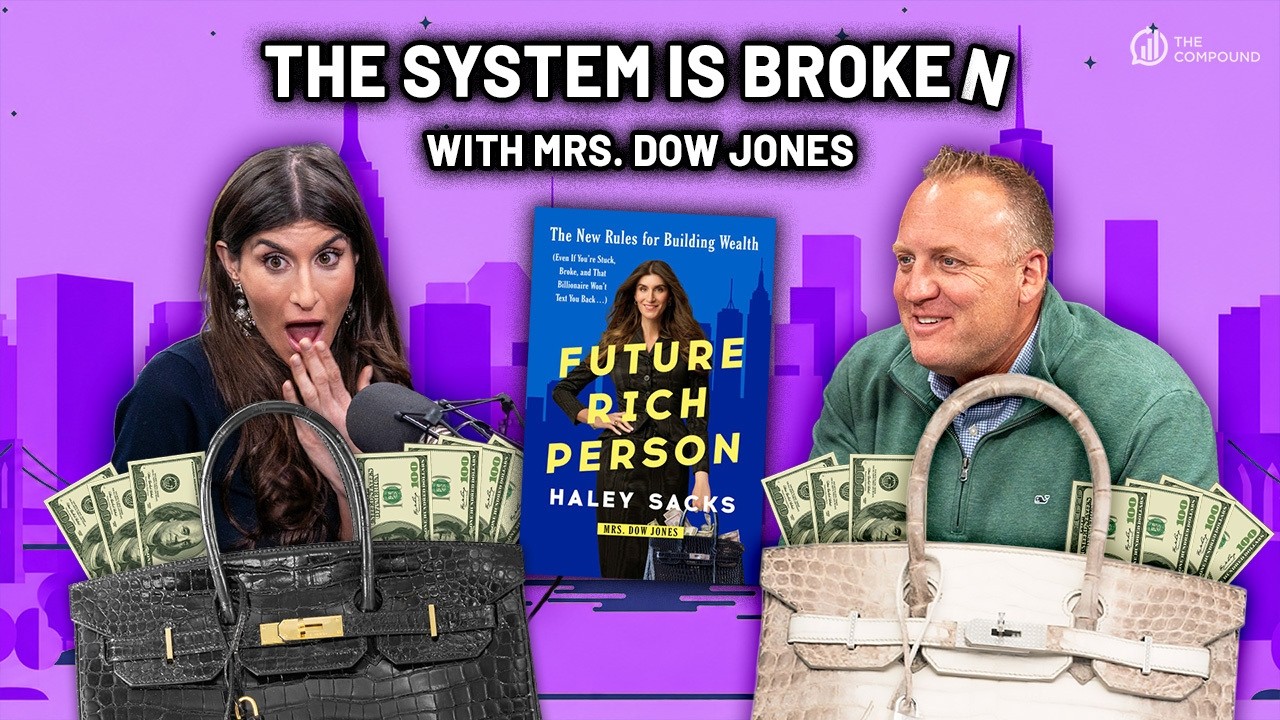
Host Downtown Josh Brown welcomes viewers to *Live From The Compound* and introduces the central theme of the episode: a defining battle for the soul of Gen Z. He contrasts macro-level economic proposals with the grass-roots approach of financial educator, author, and entrepreneur Haley Sacks—widely known to her audience as "Mrs. Dow Jones." Sacks hosts the weekly podcast *Financial Tea with Mrs. Dow Jones*, which she quips is like "if CNBC and Bravo had a baby." Brown introduces her debut book, *Future Rich Person: The New Rules for Building Wealth*, highlighting her mission to make personal finance accessible through zero-jargon content and cultural resonance.
- **Sponsor:** Janus Henderson Investors ([janushenderson.com/securitizedmarkets](https://janushenderson.com/securitizedmarkets))
- **Guest:** Haley Sacks (Mrs. Dow Jones), host of *Financial Tea* and author of *Future Rich Person*
- **Book Release Date:** May 12th
---
[03:02](https://www.youtube.com/watch?v=qg_SQQpI7j8&t=182s) The Financial Zeitgeist: Hopelessness vs. Capitalist Mindset
To frame the current economic mood, Brown plays a viral TikTok video of a young creator ranting about the cost-of-living crisis. The creator argues that concert tour cancellations, dying movie theaters, falling birth rates, and lower homeownership aren't caused by a lack of interest, but simply because "no one has any money." He railingly criticizes system-wide price increases, stagnant wages, and billionaire excesses while young people are left with subscription services and deteriorating quality of life.
Josh Brown points out that this video embodies the prevalent financial zeitgeist among Millennials and Gen Z—a pervasive sense of hopelessness. He warns that this doom-mindset drives two dangerous extremes: leaning into political promises of "free stuff" or turning to high-risk, nihilistic financial behaviors like aggressive daily options trading and sports betting. Brown stresses that Sacks's work offers a vital counter-narrative by teaching young people to become part of the capital class rather than mounting a futile protest against it. Sacks agrees enthusiastically, introducing her concept of "learned financial helplessness"—the belief that because inflation, student debt, housing costs, and AI threaten their future, young people should simply give up and finance short-term lifestyle expenses through Buy Now, Pay Later (BNPL) schemes.
> "The whole country is just a couple greedy billionaires going, 'Give me, give me more'... You're charging more and more for everything, but you're not paying more." — *Viral TikTok Creator*
> "Josh, you 100% nailed it... that is where the urgency came from and it's something in the book that I coin called learned financial helplessness." — *Haley Sacks*
---
[06:44](https://www.youtube.com/watch?v=qg_SQQpI7j8&t=404s) Redefining the Rules: Mindset Rewiring and the "Ibiza" Framework
Transitioning into how to combat financial doomism, Sacks asserts that the traditional "American Dream"—loyalty to a single company for 40 years, relying on a pension, and buying a house as a primary growth vehicle—is dead for younger generations. She notes psychological research indicating that most people's fundamental money mindsets and financial behaviors are set by age seven, largely absorbed by observing their parents' habits and explicit or implicit attitudes toward wealth.
To help readers deconstruct and rebuild their money beliefs, Sacks details her structured five-step money mindset framework, playfully named **IBIZA**:
* **I** – **Identify:** Pinpoint the limiting beliefs, fears, or internalized scripts holding you back financially.
* **B** – **Blame:** Acknowledge where those beliefs originated (e.g., parents, childhood environment, societal messaging) without letting them dictate your future.
* **I** – **Interrupt:** Stop the negative thought patterns or impulsive behaviors in real time before they result in poor decisions.
* **Z** – **Zhuzh:** Refashion and reframe your financial mindset into an empowering, action-oriented approach.
* **A** – **Act:** Take concrete steps forward (opening accounts, budgeting, investing, negotiating salary).
Sacks notes that before anyone can execute tactical advice from top-tier finance shows, they must fix their baseline relationship with money.
- **Money Mindset Formation:** Core financial habits are established by age 7.
- **IBIZA Framework:** Identify, Blame, Interrupt, Zhuzh, Act.
---
[10:06](https://www.youtube.com/watch?v=qg_SQQpI7j8&t=606s) Frictionless Capitalism and "Securing the Bag"
Josh Brown shares a generational perspective, noting that as someone born in 1977 on the cusp of Gen X and Millennials, he had an "analog childhood" with physical toys but became part of the first generation of internet users. He observes that for younger people today, living is inherently expensive: a minor car repair or apartment issue instantly costs $1,000, compounding their sense of frustration.
Sacks explains that modern corporate capitalism has become significantly more aggressive and pervasive. While an individual in the late 1970s or 1980s might have encountered ~700 advertisements a day, modern consumers face upward of **7,000 ads daily**, with roughly 20% of online content serving as direct promotion. Combined with "frictionless finance" tools like Apple Pay and 1-click ordering, culture actively encourages using spending as a mechanism for emotional regulation ("retail therapy").
To counteract this, Sacks advocates for introducing deliberate "friction-full finance"—unsubscribing from marketing emails, removing saved credit cards, and unfollowing tempting influencers. Furthermore, she emphasizes that building wealth in today's economy requires aggressive income generation rather than side-hustle burnout. Instead of taking on exhausted side gigs, people should focus on maximizing their primary career skills, demanding higher compensation, or changing work environments to secure better pay and equity.
> "In that time you were advertised to maybe 700 times a day. Now we are advertised to 7,000 times a day. 20% of what you see online is an ad." — *Haley Sacks*
- **Daily Ad Exposure:** Increased from ~700/day decades ago to ~7,000/day today.
- **Friction-Full Strategy:** Intentionally adding barriers to spending (deleting BNPL apps, clearing stored cards) to curb impulsive habits.
- **Primary Income focus:** Negotiating higher pay and leveraging existing professional skills over unsustainable side hustles.
[15:58](https://www.youtube.com/watch?v=qg_SQQpI7j8&t=958s) The AI Threat: Job Replacement vs. Force Multiplier
Josh Brown and Haley Sacks (Mrs. Dow Jones) unpack the common traps young workers fall into, starting with the sunk cost fallacy. Many people stay stuck in dead-end jobs hoping for a future payout that will never arrive, sacrificing huge amounts of lifetime earning potential in the process. While side hustles—like making balloon animals on weekends—can be a lifeline for those bound by location or a lack of immediate local opportunities, Haley and Josh emphasize that most people shouldn't try to juggle three different jobs. Instead, the real key to building wealth is upskilling: getting so good at your core craft that you command higher compensation and gain recognition.
When addressing the widespread anxiety surrounding Artificial Intelligence taking jobs, Haley urges workers to lean in and learn how to use AI tools to become layoff-proof. Josh adds a stark perspective on why AI is even scarier than direct job displacement. Rather than simply replacing workers outright, AI acts as a massive "force multiplier" for people who already possess high agency and drive.
> "It's going to turn 10% of the people doing that job into gods on earth. And God help you if you're not one of those people."
- **The Sunk Cost Fallacy:** Traps workers in low-paying jobs through false hopes of future advancement, eroding lifetime earning power.
- **Upskilling vs. Side-Hustling:** High-value skill acquisition in one's primary career generally yields better long-term financial results than splitting focus across multiple side gigs.
- **AI as an Economic Wedge:** Josh predicts AI will widen the gap between the "haves" and "have-nots" by turning high-agency workers into super-performers while leaving passive workers behind.
---
[18:02](https://www.youtube.com/watch?v=qg_SQQpI7j8&t=1082s) Blending Pop Culture with Finance: Icons, Memes, and Traps
Josh praises Haley for her signature approach of blending pop culture with personal finance. Haley shares that her passion stems from a childhood obsession with pop culture—she recalls being severely dyslexic yet reading *Us Weekly* cover to cover—combined with a initial feeling that finance was overwhelming and unapproachable. She realized that while people naturally tune out dry money talk, they obsess over celebrity gossip, memes, and internet humor. By hiding the "spinach in the brownie," she uses pop culture as a Trojan horse to teach foundational money concepts.
However, mixing pop culture with markets can also lead people astray if they latch onto the wrong archetypes. Josh points out how during the pandemic, when live sports were canceled and young men were stuck at home, trading became the new form of gambling. The culture rallied around movies like *The Wolf of Wall Street* or *Wall Street*, with beginners glorifying anti-heroes and internalizing toxic, hyper-aggressive behavior. Haley agrees that financial media often highlights rapacious, toxic archetypes rather than models focused on sustainable, long-term wealth creation.
To counteract this, Haley leverages pop culture stories as practical financial lessons:
- **Beyoncé & Jay-Z’s Mortgage:** Why ultra-wealthy individuals take out mortgages rather than paying cash, illustrating how the rich leverage low-interest debt to keep their capital working elsewhere.
- **Prenup Renegotiations:** How power couples renegotiate prenuptial agreements over time, highlighting the necessity of open, equitable financial communication between partners.
- **Kim Kardashian’s Emergency Fund:** Early in her life, when married at 19 to a controlling partner, Kim lacked the funds to leave until her sister Khloé gave her a giant Coca-Cola bottle full of piggy-bank change ($5,000). Haley uses this story to illustrate why a cash buffer is essential for maintaining personal safety and independence.
---
[22:40](https://www.youtube.com/watch?v=qg_SQQpI7j8&t=1360s) "Euphoria" Season 3 and a Sauna Encounter in Rome
Josh and Haley delve into how mainstream entertainment continues to reflect real-world economic pressures, citing the dramatic tone shift in the TV series *Euphoria*. While earlier seasons focused on relationships, drugs, and family dynamics, Season 3 shifts its narrative entirely toward money, side hustles, starting businesses, borrowing from shady figures, and the absurdity of spending $50,000 on wedding flowers. The show mirrors the economic reality of Gen Z, where traditional paths like management consulting are swapped for online content creation, OnlyFans, and internet-driven hustles.
The conversation takes an entertaining, impromptu side quest when Haley reveals she shared a sauna with *Euphoria* star Jacob Elordi. While staying at a hotel in Rome during a layover between wedding events in Florence, Haley was relaxing alone in the sauna when Elordi walked in.
> "Alone in the sauna with Jacob. Yes, we chatted. No, we didn't hook up. That's all you need to know."
Haley jokes that having sat in a sauna with Jacob Elordi provides her with mandatory street cred as a financial author. On a serious note, both agree that the show's complete pivot toward money underscores how central financial survival and the "hustle economy" have become in the modern cultural zeitgeist.
---
[24:56](https://www.youtube.com/watch?v=qg_SQQpI7j8&t=1496s) Defining a "Future Rich Person"
Haley breaks down the core philosophy behind her book, *Future Rich Person: The New Rules for Building Wealth*. Being a "future rich person" is not tied to reaching a specific net worth or dollar figure, because everyone's target lifestyle looks different—whether that means taking one great vacation a year, renting a beach house, or retiring early to surf all day. Achieving this state requires reverse engineering your personal goals and maintaining balance across work, family, and personal life.
The overarching goal is to remove money as the primary source of stress in your life. Haley emphasizes that you don't need to be a financial influencer or Wall Street expert; you simply need to live below your means, put your money to work, and automate your investments so you can focus on living.
Josh connects this idea to his experience working with financial advisors at Ritholtz Wealth Management. When clients in their 50s or 60s are asked why they want to invest, they frequently give vague answers like "to make more money." Without defined goals or an understanding of *what* the money is actually for, investors end up with misaligned portfolios, unnecessary tax liabilities, and an inability to actually enjoy what they've built.
- **Financial Purpose over Ticker Symbols:** You cannot build an effective investment strategy or choose ticker symbols until you define your timeline, tax strategy, and practical life goals.
- **Balance & Enjoyment:** Money is a tool to live your best life, not a scoreboard. Wealth-building requires balancing long-term compounding with taking money off the table to enjoy experiences along the way.
---
[28:02](https://www.youtube.com/watch?v=qg_SQQpI7j8&t=1682s) The Rise of Prediction Markets and Market Nihilism
Looking toward future market trends, Haley highlights the rapid rise of prediction markets (such as Polymarket and Kalshi) as a major force that Gen Z and Millennials are underestimating. Backed by heavy marketing pushes aimed at broadening their demographic reach, prediction markets are reshaping cultural discourse around politics and current events. Haley notes that this trend reflects a broader wave of economic nihilism among younger generations, but warns that without proper government regulation, these platforms could become chaotic and manipulative.
Josh shares statistical context, noting that roughly 88% to 90% of current dollar volume in prediction markets is concentrated in sports betting. While sports wagering poses little systemic threat to society, Josh cautions against the dangerous unintended consequences of branching deeper into political and real-world event markets.
> "If we are manipulating the algorithms to make it look like candidate A is going to win, which then causes voters who would otherwise vote against candidate A from even bothering going to the polls, then we're talking about gambling and manipulating markets having real-world manifestation..."
- **Dominant Volume:** Approximately 88–90% of prediction market dollar volume is tied to sports betting.
- **Political Manipulation Risks:** Manipulating betting odds on political outcomes can create false narratives, directly influencing voter turnout and real-world democratic results.
<FollowUp label="Want to dive into Part 3 of the transcript?" query="Please cover Part 3 of the transcript with the same level of detail."/>
Here is a detailed walkthrough covering the final portion of the transcript:
[30:02](https://www.youtube.com/watch?v=qg_SQQpI7j8&t=1802s) AI, Entry-Level Work, and the Crisis of Onboarding
When asked about underrated trends in the current landscape, Downtown Josh Brown rules out both Artificial Intelligence and GLP-1 weight-loss medications, noting that both are already "fully rated." Instead, he points to a major overlooked issue: the future of entry-level white-collar work in an AI-driven economy. He expresses deep concern over how companies will continue to onboard the next generation of workers, allowing them the space to make mistakes, fail, learn, and receive mentorship when it is simply much easier to rely on automated systems to do the heavy lifting.
Haley Sacks candidly notes that training and mentoring junior employees is notoriously annoying and difficult to execute. Josh agrees, emphasizing that while teaching people is indeed incredibly frustrating, it remains one of the most vital responsibilities for any industry.
- Neither AI nor GLP-1 drugs are underrated; both are fully recognized in the current zeitgeist.
- The key concern lies in how young professionals will acquire foundational skills and mentorship if machine automation replaces entry-level responsibilities.
[30:53](https://www.youtube.com/watch?v=qg_SQQpI7j8&t=1853s) Press Tours, Famous Encounters, and Structuring *Future Rich Person*
Haley reflects enthusiastically on her media tour, calling podcast stops and live appearances the absolute best part of releasing her new book, *Future Rich Person: The New Rules for Building Wealth*. She shares stories of meeting people she admires across television and financial media, including Jim Cramer, Kaitlan Collins, and Josh Brown himself, while joking about her upcoming appearance on the *Today* show and being nervous about wearing heels next to Al Roker.
Addressing the creation of the book, Haley explains that her original vision was to write it as a narrative story, believing a character-driven approach was necessary to keep people reading all the way to the end. While the final product evolved away from pure fiction, she highlights that it maintains the fast-paced, juicy feel of a "binge read." Josh validates this, pointing out that the book is packed with engaging real-life stories and authentic experiences rather than just celebrity anecdotes.
- Media appearances mentioned include *Mad Money* with Jim Cramer, *Today* with Al Roker, and coverage with Kaitlan Collins.
- Haley designed the book to feel like a compelling binge-read to ensure readers stay engaged with financial advice from cover to cover.
[31:50](https://www.youtube.com/watch?v=qg_SQQpI7j8&t=1910s) A Celebratory Finish and Final Recommendations
As the discussion wraps up, the production crew interrupts the shot to bring out a celebratory bouquet of flowers for Haley. Josh jokes about the producer, Nicole, nearly missing her cue to bring them out ten minutes into the taping as originally planned. In a warm moment, Haley credits Josh as her personal mentor, lightheartedly referencing their earlier conversation about how tedious mentorship can be.
Josh encourages viewers to support Haley's book across all major outlets, whether through local independent bookstores or at airport shops. He reminds listeners to follow her handle @MrsDowJones on Instagram and tune into her podcast, *Financial Tea*.
- Haley's book: *Future Rich Person: The New Rules for Building Wealth*.
- Haley's media platforms: Instagram (@MrsDowJones) and her podcast, *Financial Tea*.
## Notable quotes
> [03:02](https://www.youtube.com/watch?v=qg_SQQpI7j8&t=182s) The whole country is just a couple greedy billionaires going, 'Give me, give me more'... You're charging more and more for everything, but you're not paying more. — Viral TikTok Creator
> [03:02](https://www.youtube.com/watch?v=qg_SQQpI7j8&t=182s) Josh, you 100% nailed it... that is where the urgency came from and it's something in the book that I coin called learned financial helplessness. — Haley Sacks
> [10:06](https://www.youtube.com/watch?v=qg_SQQpI7j8&t=606s) In that time you were advertised to maybe 700 times a day. Now we are advertised to 7,000 times a day. 20% of what you see online is an ad. — Haley Sacks
> [15:58](https://www.youtube.com/watch?v=qg_SQQpI7j8&t=958s) It's going to turn 10% of the people doing that job into gods on earth. And God help you if you're not one of those people. — Downtown Josh Brown
> [22:40](https://www.youtube.com/watch?v=qg_SQQpI7j8&t=1360s) Alone in the sauna with Jacob. Yes, we chatted. No, we didn't hook up. That's all you need to know. — Haley Sacks
> [28:02](https://www.youtube.com/watch?v=qg_SQQpI7j8&t=1682s) If we are manipulating the algorithms to make it look like candidate A is going to win, which then causes voters who would otherwise vote against candidate A from even bothering going to the polls, then we're talking about gambling and manipulating markets having real-world manifestation... — Downtown Josh Brown
## Mentioned
Downtown Josh Brown, Haley Sacks, Mrs. Dow Jones, Janus Henderson Investors, The Compound, Future Rich Person: The New Rules for Building Wealth, Financial Tea with Mrs. Dow Jones, Beyoncé, Jay-Z, Kim Kardashian, Khloé Kardashian, Euphoria, Jacob Elordi, Ritholtz Wealth Management, Polymarket, Kalshi, Jim Cramer, Kaitlan Collins, Al Roker, Today, Mad Money, TikTok, CNBC, Bravo, Apple Pay, Us Weekly, The Wolf of Wall Street, Wall Street, OnlyFans
Financial educator Haley Sacks and host Downtown Josh Brown argue that younger generations facing steep economic hurdles must reject nihilistic spending and 'learned financial helplessness' by rewiring their money psychology, maximizing primary earning power, and building automated, purpose-driven wealth.
Confronting Learned Financial Helplessness and Nihilism (3:02)
Framing the modern economic mood around viral social media rants regarding cost-of-living spikes, Brown observes a pervasive sense of hopelessness among Millennials and Gen Z. He warns that this doom-oriented mindset pushes young people into opposite, harmful extremes: relying on political promises of free assistance or engaging in high-risk financial behaviors like aggressive options trading and gambling.
Behavioral Rewiring and Countering Frictionless Consumption (6:44)
To combat financial despair, Sacks contends that the traditional model of corporate loyalty, pensions, and homeownership is broken. Citing research that foundational money mindsets form by age seven, she introduces her five-step 'IBIZA' framework—Identify, Blame, Interrupt, Zhuzh, and Act—to deconstruct inherited money scripts before attempting tactical investing.
Sacks also stresses that modern capitalism has intensified, noting daily advertisement exposure has surged from roughly 700 impressions decades ago to approximately 7,000 today, with roughly 20% of digital content being promotional. Combined with frictionless tools like Apple Pay, culture nudges consumers into retail therapy. In response, Sacks urges practicing 'friction-full finance' by deleting Buy Now, Pay Later applications, removing saved payment cards, and unsubscribing from marketing feeds.
Maximizing Primary Income Amid AI Disruption (15:58)
Instead of burning out across multiple low-yield side gigs or remaining anchored in dead-end jobs through the sunk cost fallacy, Sacks and Brown advocate for upskilling within one's primary career. They argue that mastering a core craft commands higher compensation and greater leverage than spreading focus thin.
Pop Culture Pedagogy and Defining Wealth by Purpose (18:02)
Sacks uses pop culture as an educational entry point to teach financial fundamentals without intimidating jargon. She translates celebrity anecdotes into tactical lessons, pointing to Beyoncé and Jay-Z's use of mortgages to illustrate how the wealthy leverage low-interest debt, and Kim Kardashian's early $5,000 cash reserve to highlight the necessity of an emergency fund for personal autonomy.
Defining the 'Future Rich' Beyond Net Worth (24:56)
In outlining the philosophy of her book, *Future Rich Person*, Sacks asserts that wealth is not defined by an arbitrary net worth figure, but by removing money as a primary source of stress. Achieving this state requires living below one's means, automating investments, and reverse-engineering lifestyle goals rather than treating wealth as a competitive scoreboard.
While Sacks presents an actionable behavioral roadmap for individual wealth-building, broader macroeconomic challenges remain unresolved. In particular, the erosion of entry-level workplace mentorship under rapid AI automation and the growth of speculative prediction markets pose systemic headwinds that personal financial discipline alone may not fully counteract.
## Background
该内容由 YouTube 财经频道 The Compound 于 2026 年 5 月 13 日发布。视频为《Live From The Compound》系列节目,主持人 Downtown Josh Brown 邀请了金融教育家兼《Future Rich Person》作者 Haley Sacks(网名 Mrs. Dow Jones),围绕千禧一代与 Z 世代面临的财务焦虑、“零黑话”理财普及、财富积累新规则以及当下年轻人的财务起步策略展开深度探讨。
## TL;DR
节目深入剖析了当代年轻群体在面对通胀、高物价与体制失灵时所滋生的财务绝望与虚无主义投机倾向,指出抗议资本主义不如主动成为资产所有者。Haley Sacks 阐述了打破“习得性财务无助”的 IBIZA 心智重塑模型,并主张通过为人为消费设置摩擦、拒绝低效副业以聚焦技能跃升来提高收入。对谈还探讨了如何将流行文化与硬核财务原则巧妙结合,强调以人生目标倒推资产配置,同时对预测市场的潜在操纵以及 AI 冲击下白领初级岗位与职场传帮带体系断层的深远隐患表达了警惕。
## Atmosphere & style
整场对谈兼具华尔街资深从业者的敏锐洞察与流行文化的幽默犀利,宛如一场“CNBC 遇上八卦娱乐频道”的精彩碰撞。Josh Brown 展现出导师般的沉稳通透与辛辣点评,Haley Sacks 则语速飞快、金句频出,用生动的比喻化解了严肃枯燥的金融说教。现场互动松弛热烈、笑料不断,但在探讨代际困境与科技冲击时又流露出真诚的关切与紧迫感,结尾献花的一幕更添温情。
## Bulletin
- [00:17](https://www.youtube.com/watch?v=qg_SQQpI7j8&t=17s) Haley Sacks(Mrs. Dow Jones)推出新书《Future Rich Person》,主打“零黑话”理财哲学,旨在帮助陷入财务绝望与习得性无助的年轻一代重塑金钱认知,转型成为资产阶级。
- [11:54](https://www.youtube.com/watch?v=qg_SQQpI7j8&t=714s) 现代商业环境与无摩擦支付加剧了冲动消费,普通人每天暴露在约 7,000 次广告轰炸下;对抗消费主义需主动践行“有摩擦金融”,人为设置消费阻碍并逆向利用科技便利完成自动化投资。
- [14:45](https://www.youtube.com/watch?v=qg_SQQpI7j8&t=885s) 提高收入的关键在于核心技能的跃升(upskilling)而非盲目增加低价值副业;在 AI 普及时代,善用 AI 工具是避免沦为劳动力底层、成为高溢价人才的护城河。
- [28:02](https://www.youtube.com/watch?v=qg_SQQpI7j8&t=1682s) 预测市场正以体育博彩(占交易额 88%-90%)为突破口向政治和文化领域蔓延,其潜在的虚无主义诱导与操纵民意风险亟需严格监管。
## Key takeaways
- [03:02](https://www.youtube.com/watch?v=qg_SQQpI7j8&t=182s) 当下年轻人面临生活成本暴涨与资产脱节,极度绝望的心态容易催生政治民粹化与金融虚无主义(如沉迷期权日内交易、加密货币和博彩)。
- [06:44](https://www.youtube.com/watch?v=qg_SQQpI7j8&t=404s) 传统的“美国梦”(终身服务一家公司、购房养老)已脱离现实,年轻人不应做体制的被动抗议者,而应掌握底层规则成为资本所有者。
- [06:44](https://www.youtube.com/watch?v=qg_SQQpI7j8&t=404s) 人类的金钱心智在 7 岁左右基本定型,克服习得性财务无助需要重塑潜意识认知,打破原生家庭带来的匮乏感。
- [08:21](https://www.youtube.com/watch?v=qg_SQQpI7j8&t=501s) “IBIZA 法则”提供了重塑金钱认知的五步框架:识别瓶颈(Identify)、追溯根源(Blame)、打断惯性(Interrupt)、美化信念(Zhuzh)与付诸行动(Act)。
- [10:05](https://www.youtube.com/watch?v=qg_SQQpI7j8&t=605s) 在生活突发支出动辄上千美元的现实下,细枝末节的极度省钱杯水车薪,年轻人更应注重构建个人专属的财务安全垫与流动性保障。
- [11:54](https://www.youtube.com/watch?v=qg_SQQpI7j8&t=714s) 掠夺性资本主义结合无摩擦金融催生冲动消费,投资者需通过退订促销、移除免密支付等“有摩擦金融”手段阻断消费冲动。
- [14:45](https://www.youtube.com/watch?v=qg_SQQpI7j8&t=885s) 职业规划应避开沉没成本谬误,高负荷劳动者盲目做低端副业不如专注于主业技能跃升,以换取更高的单位时间报酬。
- [17:09](https://www.youtube.com/watch?v=qg_SQQpI7j8&t=1029s) AI 不仅在替代基础岗位,更在充当已有优势人群的力量倍增器,将进一步拉大社会财富与能力的鸿沟。
- [18:49](https://www.youtube.com/watch?v=qg_SQQpI7j8&t=1129s) 将硬核金融与流行文化结合能降低财商门槛,但需警惕过度崇拜投机欺诈等反英雄角色,应从中提炼稳健理财与风险防御理念。
- [20:40](https://www.youtube.com/watch?v=qg_SQQpI7j8&t=1240s) 富人善于运用低息债务杠杆与财务透明沟通,而普通人建立 3-6 个月生活费的应急储备金是摆脱恶劣工作或糟糕关系的底气来源。
- [24:56](https://www.youtube.com/watch?v=qg_SQQpI7j8&t=1496s) “未来富人”追求的是多元平衡而非单一资产数字,其核心法则在于支出小于收入并实现资金自动化运转,让金钱退居生活幕后。
- [27:09](https://www.youtube.com/watch?v=qg_SQQpI7j8&t=1629s) 投资切忌本末倒置:在没有搞清楚资金用途、使用时间线与税务架构之前,盲目打听具体股票代码是缺乏明确目标的危险表现。
- [28:02](https://www.youtube.com/watch?v=qg_SQQpI7j8&t=1682s) 预测市场的高速扩张潜藏着被算法与资金操控并扭曲选情意愿的现实风险,需警惕虚无主义驱动的过度投机。
- [30:08](https://www.youtube.com/watch?v=qg_SQQpI7j8&t=1808s) AI 带来的真正灰犀牛在于对企业初级白领岗位的替代,这可能剥夺年轻一代试错成长的机会,造成职场人才培养与传承的严重断层。
## Detailed walkthrough
### [00:17](https://www.youtube.com/watch?v=qg_SQQpI7j8&t=17s) 赞助商信息与开场介绍
在当今充满不确定性与循环信贷环境的市场中,规模达 15 万亿美元的证券化资产市场为投资者提供了分散化收益的机会。作为主动型证券化 ETF 的领先提供商,Janus Henderson 致力于揭示这一复杂且不断增长的市场,提供横跨收益、久期与信用质量的多样化投资敞口——无论是用于降低波动性的高评级 AAA 级 CLO、跨多个证券化板块的高收益配置,还是作为核心配置的机构 MBS,Janus Henderson 均提供全面的证券化投资解决方案。
随后,主持人 Downtown Josh Brown 正式宣布本期节目开场。他指出,当前一场争夺 Z 世代(Gen Z)“灵魂”的战役正在上演:这是一个具有决定性的关键时刻,稍有不慎,整整一代年轻人都可能演变成一支长期对抗美式资本主义的“抵抗军”。当经济学家和政客们还在兜售复杂的宏观政策与政治方案时,本期嘉宾正试图通过一次影响一位粉丝的方式,将年轻人拉回资本主义的正轨。
这位嘉宾便是知名金融教育家、投资者兼创业者 Haley Sacks(全网知名 IP 为 Mrs. Dow Jones)。Brown 调侃着向观众介绍她的背景:她每周主持播客节目《Financial Tea with Mrs. Dow Jones》,其风格被绝妙地形容为“CNBC 电视台与娱乐频道 Bravo 的混血结晶”;同时,她的新书《Future Rich Person: The New Rules for Building Wealth》(未来富翁:财富积累新法则)也于当周(5 月 12 日)正式发售。该书主打“零行业黑话(zero-jargon)”的财务哲学,将流行文化与真实故事融为一体。两人现场打趣互动,Sacks 笑着对自己没给 Brown 带费城牛肉芝士三明治(cheesesteak)表示抱歉,而 Brown 则笑称自己未来三周内都不想再碰任何芝士三明治了。
---
### [03:02](https://www.youtube.com/watch?v=qg_SQQpI7j8&t=182s) 年轻世代的财务绝望与虚无主义行为
为了剖析当下的年轻人群体心态,Josh Brown 在现场播放了一段在社交网络引发强烈共鸣的短视频。视频中,一名年轻人情绪激动地痛斥现状:各大知名歌手(如 Meghan Trainor、Post Malone 等)纷纷取消巡演,并不是因为音乐难听,而是因为“大家根本没有钱”;电影院日渐式微、年轻人不愿生孩子、再也买不起房,根源都在于年轻群体彻底没钱了。视频中的创作者愤怒控诉主流媒体总在发长文指责“为什么 Z 世代又杀死了某某行业”,却忽视了当代年轻人只能靠零星的订阅服务苟活,日常充斥着高物价却拿不到高薪水,整个社会仿佛被几位贪得无厌的亿万富翁牢牢把控。
Josh Brown 在视频播放后直言,虽然说话方式激烈,但他很喜欢这个年轻人的坦率。这段视频精准折射出当下千禧一代与 Z 世代普遍陷入的“财务时代精神(Financial Zeitgeist)”——一种挥之不去的绝望感与无力感。Brown 分析指出,这种极度绝望的心态会直接催生两种非常危险的负面外部效应:
1. **政治上的轻信与民粹化**:倾向于投票给许诺“投我一票就免费发东西”的极端政客,试图通过简单的选票承诺摆脱困境。
2. **投资上的虚无主义投机**:由于对长期的传统财富积累丧失信心,年轻一代转而投向每日激进的期权日内交易(0DTE options)、加密货币或体育博彩,将其视为唯一的暴富救命稻草,彻底抛弃了长期主义投资。
Brown 指出,这正是 Haley Sacks 出版新书《Future Rich Person》的核心紧迫性所在——教导年轻人成为资产阶级(Capital Class)的一员,而不是单纯站在街头举牌抗议资本主义。正所谓“打不过就加入他们”(If you can't beat them, join them),如果能及早将年轻人转变成懂规则的资本所有者,虽无法瞬间解决生活压力,但能彻底阻断他们滑向极端投机与无意义政治幻觉的深渊。
---
### [06:44](https://www.youtube.com/watch?v=qg_SQQpI7j8&t=404s) 打破旧金钱规则与“习得性财务无助”
Haley Sacks 完全认同 Brown 的判断,并指出新书的立足点正是为了击碎年轻人体内的“习得性财务无助(learned financial helplessness)”。这种心态表现为:年轻人认定整个世界与社会体制都在针对自己,既然身处一颗飘浮在太空的着火岩石上,面对高通胀、沉重的学生贷款以及随时被 AI 取代职位的威胁,那何必还要辛苦存钱?不如彻底放弃规划,用“先买后付”(BNPL)去科切拉音乐节(Coachella)狂欢,沉沦于即时享乐中。
Sacks 坦言,传统意义上的旧体制确实是“由富人创造并为富人服务的”,但这并不意味着普通人就该任人宰割;只要懂得底层运转的游戏规则,任何人都能在其中为自己博得胜局。当被问及哪条传统理财陈规必须被颠覆时,Sacks 斩钉截铁地表示:“美国梦已经死了(The American dream is dead)。”那种在同一家公司忠诚工作 40 年、安稳领取退休金、买下一套作为终身稳健资产的独立住宅、养育两个半孩子的传统路径,对当今的年轻一代而言早已脱离现实。
此外,Sacks 强调了一个至关重要的心理学事实:人类的金钱行为模式在 7 岁左右就已经基本定型。这意味着绝大多数人在成年后做出的每一个财务决策,本质上都在受童年抚养者的潜移默化影响。如果父母灌输的是“渴望赚钱就是贪婪”或者“钱永远都不够用”的匮乏心态,这种潜意识就会把人终身锁死在底层。因此,年轻人要想改变财务命运,必须首先在心智层面对自己的认知进行彻底重构。
---
### [08:21](https://www.youtube.com/watch?v=qg_SQQpI7j8&t=501s) 重塑金钱心智的 IBIZA 五步法则
为了帮助年轻人打破童年期遗留的匮乏创伤与习得性无助,Haley Sacks 在新书中提出了开篇的核心认知重塑模型——“IBIZA 框架”。听到这个以西班牙电音度假胜地命名的缩写词,Brown 忍俊不禁,两人还就其发音展开了一番幽默互动。Sacks 逐字拆解了该法则的五个步骤:
```mermaid
flowchart LR
accTitle: IBIZA 金钱心智重塑模型
accDescr: 展示从识别负面认知到采取行动的五个递进步骤
A["<b>I</b> - Identify<br>识别金钱瓶颈"] --> B["<b>B</b> - Blame<br>追溯根源归咎"]
B --> C["<b>I</b> - Interrupt<br>主动打断惯性"]
C --> D["<b>Z</b> - Zhuzh<br>美化修饰信念"]
D --> E["<b>A</b> - Act<br>付诸现实行动"]
```
- **Identify(识别)**:准确找出到底是哪些潜意识的想法和信念在阻碍自己的财务发展。
- **Blame(归咎)**:理解并追溯这些负面念头的来源(例如原生家庭或童年经历),明确“这不是自己的错”,卸下心理负担。
- **Interrupt(打断)**:当消极的受害者思维再度冒头时,第一时间叫停并截断心理惯性。
- **Zhuzh(修饰/美化)**:借用时尚界与美妆界的俚语“Zhuzh”(意为精心整理、修饰提亮),将原本消极的思维转换成积极向上的视角。正如 Brown 调侃现场造型团队在上镜前帮 Sacks 做妆容打理一样,前面视频中绝望咆哮的年轻人最需要的正是“Zhuzh 他的心态”。
- **Act(行动)**:在重塑积极心智后,立即落地执行具体的财务举措。
Sacks 总结道,心态重构是所有财务自由之路的前提。即便每天风雨无阻地收听全美最顶级的财经播客《The Compound》,如果内心依然充斥着“世界在与我作对、做什么都没用”的受害者思维,这些专业知识根本无法转化为财富。每个人都必须“选择属于你自己的艰难(Choose your hard)”:是选择一辈子自怨自艾、停滞不前的艰难,还是选择主动补齐财商、学习薪资谈判、弄懂股票市场的艰难?唯有战胜内心的无助,年轻人才能真正踏上积累财富的征途。
### [10:05](https://www.youtube.com/watch?v=qg_SQQpI7j8&t=605s) 微代际的视角与“样样都要一千美元”的现实
Josh Brown 探讨了自己所处的代际位置。出生于 1977 年的他介于 X 世代晚期与千禧一代早期之间,常被称为“Xennials”或钥匙儿童一代(latchkey generation)。他回忆道,1975 至 1980 年间出生的人拥有模拟信号时代的童年,玩着真实的物理玩具长大,却又是第一批互联网用户,仿佛亲手缔造了如今这个让所有人生活变得高度数字化的网络世界。
从这个视角审视当今年轻一代,Josh Brown 深刻体会到了生存成本的重压:现在“任何东西都要花上一千美元”。传统的理财建议总是劝人从细枝末节省钱,比如少吃一份牛油果吐司省下 20 美元,但现实中一旦汽车故障或公寓管道出问题,账单动辄就是一千美元起步,这种小打小闹的节流在巨额突发支出面前显得杯水车薪。
Haley Sacks 指出,正因如此,“先戴好自己的氧气面罩”成为了当下财富积累的新法则之一。过去的“美国梦”建立在一个相对值得信赖的体制之上,但对新一代人而言,整个经济体系变得更加冷酷且危机四伏,年轻人必须将生活的主导权牢牢握在自己手中。这并不意味着个体无法取胜,而是必须看清系统的运作逻辑,懂得如何保护自己。
---
### [11:54](https://www.youtube.com/watch?v=qg_SQQpI7j8&t=714s) 掠夺性资本主义、无摩擦消费与“人为制造摩擦”
谈及过去 25 年资本主义是否变得更加具有掠夺性,Haley Sacks 给予了完全肯定的回答。她对比了两个时代的商业环境:
- 在 1975 至 1980 年代,一个人每天接触到的商业广告大约只有 700 次;
- 如今,一个人每天要暴露在 7,000 次广告轰炸之下,网络浏览内容的 20% 都是广告。
现代科技打造出极致的“无摩擦金融”(frictionless finance)。Apple Pay 等便捷支付让冲动消费在两秒钟内即可完成。与此相伴的是流行文化长期以来的心理洗脑——将消费包装为一种“情绪调节”(emotional regulation)手段,也就是俗称的“零售疗法”(retail therapy)。从经典电影《律政俏佳人》(Legally Blonde)中主角心情不好就去美甲,到《欲望都市》(Sex and the City)中 Carrie Bradshaw 用买名牌鞋宣泄情绪,年轻人被不断规训用花钱来治愈不快。
然而,“未来富人”(Future Rich Person)的思维方式在于逆向利用技术红利:以往开立证券账户需要找父母的经纪人,带上出生证明和护照折腾一整天;如今只需在手机上输入社会安全号,五分钟内就能建立投资账户。
为了对抗冲动消费,Haley Sacks 提出了“有摩擦金融”(friction-full finance)的概念。如果自控力较弱,就必须主动给消费流程设置障碍:
- 取消“先买后付”(Buy Now, Pay Later)服务的绑定;
- 取消关注不断种草的网红带货博主;
- 退订各类商家的促销邮件订阅;
- 净化手机应用生态,从物理层面掐断冲动消费的诱因。
Josh Brown 对此深表赞同。他回忆起十年前 Robinhood 刚问世时,自己对零佣金和极简交易体验感到震惊。当时行业标准的股票交易佣金是每笔 7 美元,如果连 7 美元的手续费都无法阻止一笔冲动交易,那这笔交易本身大概率就不该发生。金融界消除了所有摩擦,投资者反而必须亲手把摩擦力加回来。
```mermaid
flowchart TD
accTitle: 冲动消费机制与有摩擦金融对抗策略
accDescr: 展示技术与文化如何加速无摩擦冲动消费,以及如何通过有摩擦金融阻断该链条。
subgraph Trap["外界诱导与消费陷阱"]
A["高频广告轰炸<br/>(每天约7,000次)"] --> B["文化洗脑: 零售疗法<br/>(买鞋/美甲调节情绪)"]
B --> C["无摩擦支付<br/>(Apple Pay / 先买后付)"]
C --> D["两秒内冲动支出"]
end
subgraph Solution["未来富人策略: 人为设置摩擦"]
E["退订营销邮件 & 取关带货网红"] -.-> A
F["移除先买后付与免密支付"] -.-> C
G["手机开立投资账户<br/>(将便利转化为财富积累)"]
end
```
---
### [14:45](https://www.youtube.com/watch?v=qg_SQQpI7j8&t=885s) 拒绝无效副业:技能跃升与摆脱沉没成本
Haley Sacks 强调,积累财富的另一个关键核心在于职业发展和提高收入:“你必须挣更多的钱,把那袋钱牢牢握在手里(secure the bag)。” 很多人根本不敢去谈判薪资,反倒被社交媒体上的不良风潮带偏,盲目追求所谓的“副业”(side hustle)。
她举了一个典型案例:一位每周在医院高负荷工作 100 小时的护士发私信咨询,询问自己是否应该搞个副业多赚点钱。Haley Sacks 感到十分荒谬:在高强度透支的情况下再去做副业,身体只会彻底垮掉。正确的策略绝不是利用周末去扎气球之类的繁琐副业,而是应当进行“技能跃升”(upskilling),在现有本职技能上寻找价值更高的变现路径——例如转去做高薪的私人特护(private nursing),不仅工时减半,生活品质和收入水平还能大幅提升。
两人总结了面对职业瓶颈时的两种不同路径:
- **沉没成本谬误**:许多人被困在毫无前途的死胡同工作(dead-end jobs)中,以为只要不断投入时间未来总会有回报,日复一日推迟改变,最终白白损耗了黄金年龄的盈利潜能;
- **针对性破局**:对于因学历、技能或地域限制缺乏升职空间的人,副业确实是增加收入的好手段;但对于已有专业门槛的人而言,根本不需要打三份工,而是要精进本业、成为不可替代的顶尖高手,并获得合理的市场溢价。
在 AI 时代,提升技能更是一道生存防线。面对大众对“AI 抢饭碗”的普遍恐慌,Haley Sacks 认为唯一的应对之策就是主动学习并掌握 AI 工具,让自己具备免于被裁员的硬实力。
---
### [17:09](https://www.youtube.com/watch?v=qg_SQQpI7j8&t=1029s) AI 作为力量倍增器与流行文化赋能金融
Josh Brown 指出,AI 对普通人最致命的威胁并非单纯地取代岗位,而是充当了“已有主观能动性与优势人群的力量倍增器(force multiplier)”。那些本就拥有护城河和核心竞争力的人,将利用 AI 彻底碾压竞争对手。更残酷的现实在于:你或许保住了工作,但行业内 10% 掌握 AI 的顶尖人才将化身为“人间真神”(gods on earth),导致“拥有者”与“匮乏者”之间的财富和地位鸿沟被进一步拉大到难以企及的地步。
谈话随后转向 Haley Sacks 独特的传播风格——将硬核金融与流行文化无缝融合。Josh Brown 盛赞她是行业内把二者结合得最好的人,并询问这究竟只是为了吸引受众注意力,还是因为影视人物和剧情能让复杂的理财法则更容易被理解与吸收。Haley Sacks 回应称,Josh Brown 本人也是这种风格的代表,他将嘻哈音乐、生动故事与个人魅力融入严肃财经,让金融脱离了枯燥的说教,真正变得生动、清晰且充满趣味。
### [18:49](https://www.youtube.com/watch?v=qg_SQQpI7j8&t=1129s) 流行文化与理财教育的结合及潜在误区
Haley Sacks 谈到自己从小患有诵读障碍(dyslexia),但却能把八卦杂志《Us Weekly》从头到尾一字不差地看完,对流行文化拥有“百科全书般”的记忆与狂热;然而金钱和财务概念对她而言曾经极为陌生且令人望而生畏。她意识到大众都喜欢名人八卦、梗图(memes)和网络幽默,却普遍排斥枯燥严肃的金钱话题,于是萌生了将两者融合的念头——用流行文化包裹严肃的理财知识,就像“把菠菜藏进布朗尼蛋糕里”一样。
Josh Brown 赞同这一创意的同时也指出,依赖流行文化若引导不当很容易误入歧途。例如在疫情大流行期间,由于传统体育赛事停摆、大学改上网课、年轻人被迫留在家中,赌徒心理转向了金融市场,导致大批十几二十岁的年轻男性陷入短线交易热潮。这批人将电影《华尔街之狼》(The Wolf of Wall Street)奉为圭臬(正如 Josh 那一代人将《华尔街》中的 Gordon Gekko 视为偶像一样),误将具有掠夺性、毒性男子气概(toxic masculinity)的反英雄当成榜样,以为投资的真谛在于极其激进甚至欺骗割韭菜,最终蒙受了惨重损失。Haley 认同这一观点,指出媒体对华尔街的描绘往往过于激进,在利用流行文化时必须挑选正向、合理的范式。
---
### [20:40](https://www.youtube.com/watch?v=qg_SQQpI7j8&t=1240s) 从明星八卦中提炼普通人适用的财务原则
流行文化中不乏能够传达长期财富积累与商业智慧的正面案例。正如 Haley 在新书《富豪新规则》(*The New Rules for Building Wealth*)中所写,虽然这套金融系统由富人制定,但普通人只要理解其运行机制,同样可以将其应用到自己身上:
- **债务杠杆与财务透明度**:以碧昂丝(Beyoncé)与 Jay-Z 为例,即便坐拥巨额身家,他们购买房产时依然选择申请抵押贷款,因为富人擅长利用低成本债务撬动杠杆;此外,这对夫妻曾三次重新协商婚前协议(pre-nup),说明了在伴侣之间公开透明地探讨金钱、维持关系平等的重要性。
- **应急储备金(Emergency Fund)的现实意义**:Haley 援引金·卡戴珊(Kim Kardashian)早年的真实经历——她在 19 岁时陷入一段控制欲极强的婚姻,当时她尚未成为知名女强人,经济上并不独立,根本没有足够的钱脱离这段关系;最终妹妹 Khloé Kardashian 砸碎了一个装满硬币的大可乐瓶存钱罐,凑出大约 5,000 美元,金才得以租房搬出。这个故事生动印证了建立应急储备金的必要性:缺乏资金保障,人就容易被困在有害的人际关系或恶劣的工作环境中。
```mermaid
flowchart TD
accTitle: 流行文化故事向普通人财务法则的映射
accDescr: 展示流行文化案例如何转化为普通人可落地的三大核心财务概念
subgraph Celeb["流行文化与名人案例"]
A["Beyoncé & Jay-Z 举债购房"]
B["Beyoncé & Jay-Z 3次重签婚前协议"]
C["Kim Kardashian 靠妹妹的存钱罐逃离糟糕婚姻"]
end
subgraph Principle["对应的核心理财原则"]
D["理解并合理运用债务杠杆"]
E["伴侣间财务透明与平等沟通"]
F["建立个人专属的应急储备金"]
end
subgraph Action["普通人落地行动"]
G["避免盲目全款,优化资产流动性"]
H["坦诚金钱观,订立财务边界与协议"]
I["存足 3-6 个月生活费,掌握人生主动权"]
end
A --> D --> G
B --> E --> H
C --> F --> I
```
---
### [22:40](https://www.youtube.com/watch?v=qg_SQQpI7j8&t=1360s) 影视剧风向转变:《亢奋》与年轻一代的搞钱焦虑
Josh Brown 提到热播美剧《亢奋》(*Euphoria*)剧情主题的戏剧性转变:第一季聚焦毒品与欲望,第二季围绕家庭矛盾,而到了第三季,随着角色步入青年时代,剧情全面转向了“金钱与生存”——谁拿到了什么工作、开展什么副业、试图自主创业、向错误的人借高利贷,以及争论为何不应在一场婚礼的鲜花上挥霍 50,000 美元。甚至剧中由 Jacob Elordi 饰演的争议角色 Nate Jacobs 也被重塑为正面形象。
Haley 顺势分享了一段轶事:她此前在罗马的一家酒店桑拿房中意外与 Jacob Elordi 偶遇并独处闲聊,她幽默地称“如果一位理财专家没和 Jacob Elordi 一起蒸过桑拿,读者怎么能信任她”。两人随后回到电视剧的内核讨论,指出当下流行文化的这种急转弯反映了现实社会中年轻人面对的巨大经济压力。如今的年轻人不再将挤进传统咨询行业作为发财路径,而是转向 OnlyFans、线上博主等各种互联网变现渠道,试图以一切可能的手段靠自己杀出重围。
---
### [24:56](https://www.youtube.com/watch?v=qg_SQQpI7j8&t=1496s) 定义“未来富人”与倒推人生目标
探讨到新书核心概念“未来富人”(Future Rich Person)时,Haley 明确表示,这一概念指的不是一个具体的资产数字,因为每个人对富足的定义截然不同:
- **从愿景倒推财务计划**:对有的人来说,富有意味着每年可以去旅行一次并拥有一处度假出租屋;对另一些人来说,富有是能够提前退休、整天冲浪。理财的关键是明确自己想要的生活方式,然后进行“逆向工程”(reverse engineer)来规划资金。
- **让金钱退居幕后**:成为未来富人追求的是一种各维度的平衡(家庭、工作、友谊),而不是把金钱当成生活的主角。普通人无需成为 Mrs. Dow Jones 或 Downtown Josh Brown 那样的专业人士,核心法则只有两条:**支出小于收入**,以及**理解如何让资金自动运转(自动化投资)**,从而彻底摆脱金钱焦虑去过理想生活。
Josh Brown 补充指出,缺乏明确目标绝不仅仅是年轻人的问题。在 Ritholtz Wealth Management,财富规划师接触许多五六十岁前来咨询的夫妻,当被问及“为什么要投资”时,对方往往只能回答“想赚更多钱”;但再追问“赚钱为了什么”,他们却毫无概念。目标缺失直接导致其资产组合混乱无序,这在各个年龄层的投资者中是一个普遍存在的顽疾。
### [27:09](https://www.youtube.com/watch?v=qg_SQQpI7j8&t=1629s) 倒置的投资思维与金钱的平衡之道
Josh Brown 与 Haley Sacks 深入探讨了年轻人在投资理财时普遍存在的一个严重误区:本末倒置。许多人甚至还没有搞清楚未来要把钱花在哪里,就急匆匆地询问“我该买哪只股票?”或者具体的股票代码(ticker symbol)。Josh 直言,如果连资金的用途、提取的时间线、税收影响以及从哪个账户支取都没有考虑清楚,根本不应该去问具体的股票标的。现实中许多人要么完全没有财务目标,要么目标极其模糊,导致他们在通往财富的路上既迷茫又无法享受生活。
Haley 强调,虽然复利(compounding)的力量令人着迷、“把钱放在市场里继续滚雪球”确实重要,但人也必须学会适时抽身去享受生活、去度假放松。金钱归根结底只是过上理想生活的一种工具,正如她在新书《Future Rich Person》中所倡导的平衡理念——“你可以拥有任何东西,但不可能拥有所有东西”(You can have anything, but not everything)。
```mermaid
flowchart TD
accTitle: 投资思考路径对比
accDescr: 对比错误的反向思考路径与正确的理财规划顺序
subgraph WrongPath["错误模式:本末倒置"]
W1["追问具体股票代码代码/标的"] --> W2["忽略资金用途与提取时间"]
W2 --> W3["缺乏税务考量与账户规划"]
end
subgraph RightPath["正确模式:目标驱动"]
R1["明确具体财务目标与支出计划"] --> R2["确定资金时间线与账户结构"]
R2 --> R3["评估税务后果与风险偏好"]
R3 --> R4["选择匹配的投资工具与标的"]
end
```
---
### [28:02](https://www.youtube.com/watch?v=qg_SQQpI7j8&t=1682s) 预测市场与虚无主义文化带来的现实隐患
当 Josh 问及年轻一代严重低估了哪项趋势对未来的财务与现实影响时,Haley 毫不犹豫地提到了“预测市场”(Prediction Markets)。她指出,预测市场正投入大量营销资金试图吸引女性参与,而且它正以极快速度渗透到政治大选和大众文化讨论中。Haley 认为年轻人对预测市场的热衷在某种程度上源于当下的“虚无主义”(nihilism),大家甚至在没有完全搞清楚其机制与幕后操盘手的情况下,仅仅一年之内就默许并接受了它的存在;如果缺乏政府监管,局势将变得极其混乱。
Josh 补充了一组数据并表达了更深层的忧虑:目前预测市场上约 88% 到 90% 的资金交易量(dollar volume)都集中在体育博彩上,若仅限于此尚无大碍;然而,一旦有人开始利用并操纵预测市场的算法,制造出某位候选人胜券在握的假象,从而导致对立立场的选民丧失投票意愿、放弃前往投票站,那么这种将纯粹的投机赌博与市场操纵结合的产物,将对现实政治产生极其危险的不可预测后果。
- 预测市场目前约 88% 至 90% 的总金额交易量属于体育博彩领域。
- Haley 指出预测平台的过度扩张极需政府层面的严格监管,以防选情与社会共识遭到扭曲操控。
---
### [30:08](https://www.youtube.com/watch?v=qg_SQQpI7j8&t=1808s) 被忽视的真正变量:AI 冲击下的初级白领工作与职场传承
在探讨被低估的科技趋势时,两人一致认为 AI(人工智能)与 GLP-1(减肥药)如今都已被充分定价甚至过度讨论(fully rated),谈不上“被低估”。Josh 指出,大众真正没有想明白的灰犀牛是:在 AI 全面接管思维与分析的时代,白领行业的“初级岗位”(entry-level work)该何去何从?
Josh 表达了强烈的担忧:职场新人的培养依赖于让他们犯错、经历失败、从错误中吸取教训并接受前辈的指导与带教(mentorship)。但现实中指导新人往往极其繁琐费力,如果企业发现直接让机器代替思考更轻松高效,那么年轻一代将彻底丧失试错与成长的阶梯,整个职场体系的代际交接将出现严重断层。
---
### [30:53](https://www.youtube.com/watch?v=qg_SQQpI7j8&t=1853s) 《Future Rich Person》新书巡回与惊喜落幕
对谈进入尾声,Haley 分享了自己新书宣传之旅的兴奋之情。她幽默地提到了自己在巡回中见到的各界偶像,包括知名财经主播 Jim Cramer、Downtown Josh Brown 本人、CNN 主播 Kaitlan Collins,以及即将登上的《Today》节目(她还打趣说主持人 Al Roker 个子不高,而自己会穿高跟鞋)。Haley 表示,她在签约之初就立志写出一本让人读得停不下来的理财书,打破传统财务指南的枯燥感,将其打造成一本充满真实人物经历、兼具趣味与实操性的“八卦下饭读物”(juicy binge read)。
录制接近尾声时,现场工作人员 Nicole 突然送上鲜花庆祝新书发布,现场气氛格外温馨。Haley 深情致谢 Josh 多年来的导师之恩,调侃自己希望没有成为“最烦人的学生”;Josh 则高度赞赏了这本新书,并呼吁观众无论是去机场书店还是独立书店都踊跃支持这本《Future Rich Person》,同时推荐大家关注 Haley 的社交账号(@MrsDowJones)及播客节目《Financial Tea》。
- 书籍名称:《Future Rich Person: The New Rules for Building Wealth》
- 作者相关平台:Instagram 账号 @MrsDowJones、播客节目《Financial Tea》
## Notable quotes
> [06:44](https://www.youtube.com/watch?v=qg_SQQpI7j8&t=404s) The American dream is dead. — Haley Sacks
> [03:02](https://www.youtube.com/watch?v=qg_SQQpI7j8&t=182s) 打不过就加入他们(If you can't beat them, join them) — Downtown Josh Brown
> [10:05](https://www.youtube.com/watch?v=qg_SQQpI7j8&t=605s) 先戴好自己的氧气面罩 — Haley Sacks
> [14:45](https://www.youtube.com/watch?v=qg_SQQpI7j8&t=885s) 你必须挣更多的钱,把那袋钱牢牢握在手里(secure the bag)。 — Haley Sacks
> [18:49](https://www.youtube.com/watch?v=qg_SQQpI7j8&t=1129s) 把菠菜藏进布朗尼蛋糕里 — Haley Sacks
> [27:09](https://www.youtube.com/watch?v=qg_SQQpI7j8&t=1629s) 你可以拥有任何东西,但不可能拥有所有东西(You can have anything, but not everything)。 — Haley Sacks
> [22:40](https://www.youtube.com/watch?v=qg_SQQpI7j8&t=1360s) 如果一位理财专家没和 Jacob Elordi 一起蒸过桑拿,读者怎么能信任她 — Haley Sacks
> [11:54](https://www.youtube.com/watch?v=qg_SQQpI7j8&t=714s) 如果连 7 美元的手续费都无法阻止一笔冲动交易,那这笔交易本身大概率就不该发生。 — Downtown Josh Brown
## Mentioned
Downtown Josh Brown, Haley Sacks (Mrs. Dow Jones), Janus Henderson Investors, Future Rich Person: The New Rules for Building Wealth, Financial Tea with Mrs. Dow Jones, The Compound, Ritholtz Wealth Management, Robinhood, Apple Pay, Beyoncé, Jay-Z, Kim Kardashian, Khloé Kardashian, Jacob Elordi, Euphoria (美剧《亢奋》), The Wolf of Wall Street (电影《华尔街之狼》), Legally Blonde (电影《律政俏佳人》), Sex and the City (美剧《欲望都市》), Jim Cramer, Kaitlan Collins, Al Roker, Today (节目)
## Video description
On this episode of Live From The Compound, Downtown Josh Brown is joined by Haley Sacks, aka Mrs. Dow Jones, to discuss the financial anxiety facing Millennials and Gen Z, the rise of “zero jargon” finance, and the lessons behind her new book, Future Rich Person: The New Rules for Building Wealth. They cover investing culture, money misconceptions, building wealth in today’s economy, and the first financial steps young people should be taking right now.
Order your copy of Haley's book at: https://www.mrsdowjones.com/book
This episode is sponsored by Janus Henderson Investors. Learn more at
https://www.janushenderson.com/securitizedmarkets
►00:00 - Intro
►03:02 - The Financial Zeitgeist Right Now
►06:44 - What Rules Need to be Redefined
►18:02 - Blending Pop Culture and Finance
►22:40 - Finance in Euphoria
►24:56 - What is a "Future Rich Person"
►28:02 - Trends and Prediction Markets
👕 Check out The Compound shop: https://www.idontshop.com
🎙️Listen to our podcasts:
TCAF: https://podcasts.thecompoundnews.com/show/TCAF/
Animal Spirits: https://podcasts.thecompoundnews.com/show/animalspirits/
Ask The Compound: https://podcasts.thecompoundnews.com/show/ATC/
The Compound Newsletter: https://www.thecompoundnews.com/subscribe
Linkedin: https://www.linkedin.com/company/the-compound-media/
Instagram: https://instagram.com/thecompoundnews
Twitter: https://twitter.com/thecompoundnews
Tik Tok: https://www.tiktok.com/@thecompoundnews
Investing involves the risk of loss. This podcast is for informational purposes only and should not be or regarded as personalized investment advice or relied upon for investment decisions. Josh Brown and Michael Batnick are employees of Ritholtz Wealth Management and may maintain positions in the securities discussed in this video. All opinions expressed by them are solely their own opinion and do not reflect the opinion of Ritholtz Wealth Management. See our disclosures here:
https://ritholtzwealth.com/podcast-youtube-disclosures/
The Compound Media, Incorporated, an affiliate of Ritholtz Wealth Management, receives payment from various entities for advertisements in affiliated podcasts, blogs and emails. Inclusion of such advertisements does not constitute or imply endorsement, sponsorship or recommendation thereof, or any affiliation therewith, by the Content Creator or by Ritholtz Wealth Management or any of its employees. For additional advertisement disclaimers see here https://ritholtzwealth.com/advertising-disclaimers.
#thecompound #investing #stockmarket #stocks
[Source](https://www.youtube.com/watch?v=qg_SQQpI7j8)
Source quotes
[6:44] Haley Sacks: The American dream is dead.
[3:02] Downtown Josh Brown: 打不过就加入他们(If you can't beat them, join them)
[10:05] Haley Sacks: 先戴好自己的氧气面罩
[14:45] Haley Sacks: 你必须挣更多的钱,把那袋钱牢牢握在手里(secure the bag)。
[18:49] Haley Sacks: 把菠菜藏进布朗尼蛋糕里
[27:09] Haley Sacks: 你可以拥有任何东西,但不可能拥有所有东西(You can have anything, but not everything)。
[22:40] Haley Sacks: 如果一位理财专家没和 Jacob Elordi 一起蒸过桑拿,读者怎么能信任她
[11:54] Downtown Josh Brown: 如果连 7 美元的手续费都无法阻止一笔冲动交易,那这笔交易本身大概率就不该发生。
Source quotes
[3:02] Viral TikTok Creator: The whole country is just a couple greedy billionaires going, 'Give me, give me more'... You're charging more and more for everything, but you're not paying more.
[3:02] Haley Sacks: Josh, you 100% nailed it... that is where the urgency came from and it's something in the book that I coin called learned financial helplessness.
[10:06] Haley Sacks: In that time you were advertised to maybe 700 times a day. Now we are advertised to 7,000 times a day. 20% of what you see online is an ad.
[15:58] Downtown Josh Brown: It's going to turn 10% of the people doing that job into gods on earth. And God help you if you're not one of those people.
[22:40] Haley Sacks: Alone in the sauna with Jacob. Yes, we chatted. No, we didn't hook up. That's all you need to know.
[28:02] Downtown Josh Brown: If we are manipulating the algorithms to make it look like candidate A is going to win, which then causes voters who would otherwise vote against candidate A from even bothering going to the polls, then we're talking about gambling and manipulating markets having real-world manifestation...
Original transcript
[0:17] In today's market uncertainty and
[0:19] revolving credit conditions, the $15
[0:21] trillion securitized market may provide
[0:25] investors with diversifying income
[0:27] opportunities. As a leading provider in
[0:30] active securitized ETFs, Janus Henderson
[0:33] seeks to demystify a complex yet growing
[0:36] part of the market offering a range of
[0:38] diversifying exposures across income,
[0:42] duration, and credit quality. Whether
[0:44] investors are seeking high-quality AAA
[0:47] rated CLOs for lower volatility
[0:49] exposure, higher income diversified
[0:51] across various securitized sectors, or
[0:54] perhaps agency MBS exposure as part of
[0:58] their core, Janus Henderson seeks to
[1:00] offer a variety of securitized
[1:02] solutions. Janus Henderson investors,
[1:05] investing in a brighter future together.
[1:07] Learn more at
[1:08] janushenderson.com/securitized
[1:12] markets. Past performance is no
[1:14] guarantee of future results. Investing
[1:17] involves risk including the possible
[1:20] loss of principal and fluctuation of
[1:22] value.
[1:23] Hello and welcome to live from the
[1:25] compound. I'm Josh Brown. Right now a
[1:28] battle for the soul of Gen Z is playing
[1:31] out. A defining moment
[1:34] that could turn an entire generation
[1:37] into a permanent resistance army against
[1:40] American-style capitalism.
[1:42] While economists and politicians offer
[1:45] complex economic and political
[1:48] solutions, my guest today is trying to
[1:51] win the kids over to the right side one
[1:54] follower at a time.
[1:56] Haley Sacks, known to her audience, give
[1:59] it up as Mrs. Dow Jones, is a financial
[2:03] educator, investor, and entrepreneur
[2:06] focused on making personal finance
[2:08] accessible to millennials and Gen Z.
[2:11] Haley, welcome to the show.
[2:13] >> My favorite show to be on. Thank you so
[2:14] much.
[2:15] >> to talk about you in the third person
[2:16] for two more sentences. Haley is focused
[2:19] uh Haley is the host of the weekly
[2:21] podcast Financial Tea with Mrs. Dow
[2:24] Jones described as if CNBC and Bravo had
[2:29] a baby which I love. Her debut book
[2:31] Future Rich Person, The New Rules for
[2:34] Building Wealth is being released this
[2:36] week, May 12th. The book champions a
[2:38] philosophy of zero-jargon finance
[2:41] blending pop culture and real stories to
[2:44] share everything she wished someone had
[2:47] told her about money. Haley, welcome to
[2:49] the show. We're so happy to have you.
[2:51] >> I'm so happy to be here and I'm sorry I
[2:52] didn't bring you a cheesesteak.
[2:53] >> Oh, no worries. How's that for an intro
[2:55] though?
[2:55] >> Like literally amazing.
[2:57] >> another I can't eat another cheesesteak
[2:58] probably for at least 3 weeks.
[2:59] >> 3 weeks?
[3:00] >> I need a I I need a All right. Um this
[3:03] is what I want to ask you about and I
[3:04] have to start just by setting the the
[3:06] table. I have a video for you.
[3:08] >> Okay.
[3:08] >> You're not in it. Okay. Uh
[3:11] queue it or play the video.
[3:12] >> the reason all these artists are
[3:13] canceling their tours, Meghan Trainor,
[3:15] Post Malone, etc. It's not cuz their
[3:16] music sucks. People will watch anything.
[3:18] It's the same reason why movie theaters
[3:20] are dying. It's the same reason why no
[3:21] one's having any kids. It's the same
[3:23] reason why no one will ever have a
[3:24] house. And it's because no one has any
[3:27] money. Did we just forget that? WHY IS
[3:30] THERE ALWAYS some think piece about, oh,
[3:32] why doesn't Gen Z want to do this? Why
[3:33] is Gen Z killing this industry? PEOPLE
[3:35] WANT TO HAVE LIVES. THEY JUST CAN'T CUZ
[3:38] THEY DON'T HAVE ANY
[3:40] MONEY. YOU THINK we want to live like
[3:43] this? You think we want to own nothing
[3:45] and all we have is maybe a little
[3:46] subscription here and there and EAT LIKE
[3:48] [ __ ] NO. THAT'S ALL WE CAN DO. YOU JUST
[3:52] STRANGLE US OUR WHOLE LIVES and you're
[3:55] like, "Why aren't you breathing? Why
[3:56] don't you WANT TO BREATHE?" WHAT? YOU'RE
[3:59] DOING THIS. YOU'RE CHARGING MORE AND
[4:01] MORE FOR EVERYTHING, but you're not
[4:02] PAYING MORE. THIS WHOLE COUNTRY IS JUST
[4:04] A couple greedy billionaires going,
[4:06] "Give me, give me more." But it's not
[4:08] ENOUGH CUZ IT'LL NEVER BE ENOUGH. THEY
[4:10] WANT YOU TO love them, too. Oh, look,
[4:12] I'm at the Met Gala. Aren't I cool? [ __ ]
[4:16] you. YOU'RE THE REASON THAT WE'RE IN
[4:18] THIS [ __ ] YOU'RE THE REASON THAT WE
[4:20] CAN'T GO TO COLLEGE
[4:20] >> THAT'S ENOUGH OF THAT. I LIKE THIS KID.
[4:22] Um
[4:23] this is the financial zeitgeist right
[4:25] now for a lot of millennials and a lot
[4:27] of Gen Z and they're sort of
[4:31] um in some way
[4:33] defined by this sense of hopelessness.
[4:35] >> Yeah.
[4:36] >> And the thing that I think about
[4:39] is like the externality of people
[4:41] feeling that way leads to two things
[4:43] that I think are not great. One is
[4:46] electing socialists who have easy
[4:47] answers like "Vote for me, I'll just
[4:50] give you free stuff. It'll be fine."
[4:52] Um but also like these nihilistic
[4:54] financial behaviors like daily
[4:58] aggressive options trading or sports
[5:00] betting in place of long-term investing.
[5:03] I think the urgency for your book,
[5:05] Future Rich Person, is about exactly
[5:08] that.
[5:09] Teaching people to become part of the
[5:11] capital class rather than leading a
[5:13] protest against it. Like if you if you
[5:16] can't beat them, join them. And if we
[5:18] can turn the kids into capitalists early
[5:22] uh it doesn't solve all their problems
[5:24] right away, but it puts them on a path
[5:26] so that they're not out marching with
[5:28] signs or electing people who make
[5:31] [ __ ] promises to them. And I so I I
[5:33] think there's a lot of urgency to your
[5:35] message right now for that generation.
[5:38] Um is that the way you think about it?
[5:40] Do you see it as urgently as I do or
[5:43] um
[5:44] was that part of why you felt like I
[5:47] really have to get this stuff into
[5:48] writing.
[5:50] >> Josh, you 100% nailed it. That I
[5:53] couldn't have said it better myself.
[5:54] That is where the urgency came from and
[5:56] it's something in the book that I coin
[6:00] called learned financial helplessness.
[6:03] And it's this idea that the world is
[6:06] already so pitted against me that I
[6:09] shouldn't even try. That basically we're
[6:13] on a floating rock, the world is
[6:15] burning, we've got inflation and student
[6:17] debt, and AI is taking all the jobs, and
[6:19] so let's finance Coachella. Let's use,
[6:22] you know, buy now pay later. Let's give
[6:25] up. Let's, you know,
[6:27] all of these things. But that's why it's
[6:28] called the new rules of building wealth
[6:30] because yes, the system was built by
[6:33] rich people for rich people. But even if
[6:36] you don't self-identify as a rich
[6:38] person, just by knowing how it works and
[6:41] understanding the game, you can get
[6:43] ahead.
[6:44] >> Okay. What's the central rule of old
[6:47] finance that you felt had to be broken
[6:50] or we defined for this generation?
[6:53] Um like what's that thing that where you
[6:55] said, all right, it is a system for rich
[6:57] people.
[6:58] You're not going to change that. So,
[7:00] what do you do about it? So, tell us
[7:02] about tell us about the new rules.
[7:04] >> Well, I talk about it in the book
[7:06] that the American dream is dead.
[7:09] And what that means basically is this
[7:12] idea that you can be loyal to a company
[7:15] for 40 years, have your pension, buy
[7:18] your house, have your house be an
[7:19] investment, have your 2.5 kids, all
[7:22] these things, that that is realistic for
[7:26] our generation, it's not.
[7:28] And
[7:29] we You look, our financial behaviors are
[7:31] set by the time we're 7 years old, which
[7:33] means whoever raised you is basically
[7:36] what that's what's in your head
[7:39] leading you to make all your financial
[7:40] decisions.
[7:41] >> Seven.
[7:41] >> Seven.
[7:42] >> So, you observe you have observed your
[7:44] parents in action
[7:45] >> Yep.
[7:45] >> long enough by age seven
[7:48] >> Yep.
[7:48] >> that you've internalized
[7:50] >> Mhm.
[7:50] >> some of the things they say about money
[7:52] or saving or not saving.
[7:53] >> greedy. Wanting money is greedy or like
[7:55] there's ever enough or like any of
[7:57] these, you know, mindsets that we have
[7:59] that keep us stuck in place.
[8:01] >> Okay.
[8:02] >> Um and so, it's so important to reframe
[8:06] that, I think, and so that you're able
[8:08] to actually take advantage of all the
[8:11] opportunities that there still is.
[8:12] >> So, give us like give us an example.
[8:14] Like how do we how do we reframe that or
[8:16] how does somebody
[8:17] rewire the way that they're they already
[8:20] think about money?
[8:21] >> Well, I have a five-step money mindset
[8:23] program in the book. That's where we
[8:25] start. Um and it's called Ibiza, which I
[8:27] know that you would love because you
[8:28] obviously
[8:29] >> pronounced Ibiza.
[8:30] >> Ibiza, yeah. There is a list involved,
[8:32] and I am glad that you were able to sort
[8:33] of
[8:33] >> Ibiza, what is it?
[8:34] >> Um it's a five-step money mindset
[8:36] program, and each of the steps is, you
[8:38] know, one for you to work through. It's
[8:40] identify, blame, interrupt,
[8:45] zhuzh, and then A is act.
[8:47] >> you so much.
[8:48] >> Zhuzh, of course, is act. And so, we
[8:50] have to start
[8:51] >> that aren't familiar with zhuzh
[8:53] >> zhuzh.
[8:53] >> watch as much Bravo.
[8:55] So, like your your glam squad was
[8:58] zhuzhing you before we turn the cameras
[8:59] on.
[9:00] >> Yeah, exactly. You've got to like, you
[9:01] know, take those thoughts that are maybe
[9:04] holding you back. Like that guy who we
[9:05] just watched that video, he needs to
[9:07] zhuzh his mindset.
[9:08] >> a little bit.
[9:09] >> going to make any progress with his
[9:10] finances cuz he feels like the world is
[9:12] stacked against him that he might as
[9:14] well just give up.
[9:15] >> went viral now. So, actually now he can
[9:18] sell diet tea or something.
[9:19] >> perfect. I know. And by the way, I miss
[9:21] the age of like diet tea on Instagram.
[9:23] Those gummies, like we need to bring
[9:25] them back.
[9:25] >> Okay.
[9:26] >> Um but you have to start there because
[9:27] you're never going to make you could
[9:28] learn you could listen to the compound
[9:30] every day. You have the best uh
[9:32] financial I think you have one of the
[9:33] best financial advice podcasts. Like I
[9:35] told you, I listen religiously. It's so
[9:37] >> Clip that.
[9:38] >> Clipping, clipping. But uh
[9:40] you're never going to be able to
[9:41] actually use any of the information that
[9:43] you pick up here.
[9:44] >> Without money.
[9:45] >> Without money, but also without having
[9:46] the right mindset. You're going to give
[9:48] yourself up. You have to choose your
[9:49] hard. Do you want the hard to be that
[9:50] you feel like that for the rest of your
[9:51] life and then you're just like staying
[9:53] stuck? Or do you want the hard of like,
[9:54] okay, yeah, I actually do have to like
[9:56] invest in my financial literacy and
[9:58] like, you know, work on my mindset. I
[9:59] have to learn how to negotiate. I have
[10:00] to learn about the stock market. Like
[10:02] the same things that we all talk about,
[10:04] but it's just you know, you got to do
[10:05] it.
[10:06] >> You know what's so hard? And I'm sort of
[10:09] on I'm obviously not of the millennial
[10:11] generation. I'm slightly older. I'm like
[10:13] the youngest of the Gen Xers or the
[10:15] oldest of the millennials depending on
[10:17] when you start counting.
[10:18] >> I think you're millennial.
[10:19] >> So I'm born in '77.
[10:21] Um so I think people say like
[10:25] I think people say like that's like sort
[10:27] of in between or it's a micro
[10:28] generation. I forget what they call it.
[10:30] Whatever. We're the best generation
[10:31] ever. But um
[10:33] >> Is it the latchkey generation or
[10:34] something? Like where it's like you were
[10:35] Yeah.
[10:36] >> Yeah, which I can't relate to. I had a
[10:37] stay-at-home mom thankfully. But like
[10:40] uh
[10:41] I think what they say about the people
[10:42] born between '75 and '80
[10:45] >> Mhm.
[10:45] >> is that we had an analog childhood, but
[10:49] we were the first internet users. So we
[10:51] sort of like invented the digital world
[10:53] that has now poisoned the earth and
[10:54] ruined everyone's lives. But but but we
[10:56] had the benefit of like we had physical
[10:59] toys.
[11:00] >> Mhm.
[11:00] >> Like right? So that makes Okay. But
[11:03] what's so hard from me looking from the
[11:05] outside in at the generation that you're
[11:07] speaking to,
[11:09] first of all, everything costs a
[11:10] thousand dollars.
[11:11] >> It's insane.
[11:12] >> So you say to people like adopt good
[11:14] habit, not you, but like
[11:16] the advice is like say try to save like
[11:18] twenty dollars from like um not doing
[11:21] the the things you like.
[11:22] >> toast. Yeah, whatever. And it's like
[11:24] >> right. And then like um something breaks
[11:26] on your car
[11:27] >> Yeah.
[11:28] >> or something goes wrong in your
[11:29] apartment and you have to repair and
[11:31] it's like automatically it's a thousand
[11:33] dollars.
[11:34] >> Well, I think that that's one of the new
[11:35] rules of building wealth is it you have
[11:37] to put your own oxygen mask on first. I
[11:39] think for the old American dream you
[11:40] could trust the system more, but for the
[11:42] new generations you need to be in
[11:45] control of your own life because it's
[11:46] actually become more corrupt. They're
[11:48] right. More corrupt. There's more to out
[11:50] to get us. It doesn't mean that you
[11:51] can't beat them, but you have to
[11:53] understand how it works.
[11:54] >> Has capitalism gotten more predatory in
[11:57] the last 25 years?
[11:58] >> Yes, it's 100% but it's also with
[12:01] especially with finances.
[12:03] Okay, you're talking about being born
[12:05] the 75 to 80. In that time you were
[12:08] advertised to maybe 700 times a day. Now
[12:11] we are advertised to 7,000 times a day.
[12:13] 20% of what you see online is an ad. So
[12:16] not only that, but you have frictionless
[12:18] finances. So everything which is amazing
[12:20] for you know
[12:21] >> So you can impulse buy something in two
[12:23] seconds.
[12:23] >> Apple Pay like Apple be paying.
[12:25] >> Right.
[12:25] >> So and and we're told by the culture
[12:28] that spending is a form of emotional
[12:30] regulation. So like you have like these
[12:33] big movies, these cult classics like in
[12:35] Legally Blonde whenever she's upset, she
[12:37] goes to the nail salon.
[12:38] >> Retail therapy.
[12:39] >> Yeah, retail Carrie Bradshaw she's
[12:40] buying shoes. Like that's what we're
[12:42] told to do. So it's coming at you from
[12:44] all directions, but the future rich
[12:46] person mindset is to see
[12:49] these technological advances and
[12:50] actually look at the opportunity which
[12:52] is hey, actually on my phone in about
[12:55] five minutes if I had my social security
[12:57] number I could open a brokerage account.
[12:59] You know, like I could you know, start
[13:01] in whereas for our parent for if you
[13:03] were born in if you were you know, 75 or
[13:05] 80 and you were trying to do that it was
[13:06] a full day affair.
[13:07] >> to call your dad's broker.
[13:08] >> Yeah, dad broker. You got to bring your
[13:10] passport. You got to know where your
[13:11] birth certificate is. It's a whole
[13:12] thing. Now it's so easy.
[13:15] >> So you're arguing that for all of the
[13:17] ways in which technology
[13:19] is encouraging us to do things that are
[13:22] not great for us financially,
[13:24] it also is providing on-ramps to go the
[13:28] other way and do things that are
[13:30] beneficial. You just have to like know
[13:32] what you're looking at.
[13:33] >> Yes, but I'm also arguing for
[13:34] friction-full finance. So, I think that
[13:37] like if you are somebody who's
[13:38] struggling with with spending that you
[13:40] need to take a second to realize that
[13:42] about yourself and add friction. Take
[13:44] that "buy now, pay away." Subscribe to
[13:46] the newsletters, unsubscribe the
[13:47] influencer, like try and curate what's
[13:49] on your phone a little bit so that you
[13:51] are less likely to be impulsive.
[13:54] >> I So, I remember when Robinhood came
[13:56] along, I knew a lot of people who were
[13:57] early investors.
[13:58] >> Mhm.
[13:59] >> And they showed me the app and I
[14:02] couldn't believe how easy it was
[14:04] to transact. And this is 10 years 10
[14:07] years ago.
[14:08] And I couldn't believe that they got
[14:11] commissions down to zero
[14:13] prior to like learning, "Oh, I see how
[14:15] they're doing it. They're getting the
[14:16] market maker to to pay pay for fine."
[14:19] Um
[14:20] but I remember saying like, "Wait a
[14:22] minute. The prevailing commission to
[14:23] trade a stock is $7.
[14:26] And the big innovation is now it's
[14:27] zero?"
[14:29] Like it If the $7 was stopping you from
[14:32] doing a transaction, probably it wasn't
[14:34] a good transaction to begin with.
[14:36] I'm with you like some friction is not
[14:38] the worst. But whatever, like we're in a
[14:40] world where you now have to create the
[14:42] friction because they've taken it all
[14:44] the way.
[14:45] >> But okay, but I also think that
[14:47] so we're saying the old generation, you
[14:50] could trust a system more. Maybe you're
[14:51] at Like my dad was at his job for 40
[14:53] years. Now, you also have So about the
[14:56] In my book, where you talked about like
[14:58] that I emphasize career stuff is I'm
[14:59] like, "You got to make more money. You
[15:01] have to make more money." And there's a
[15:02] whole chapter about
[15:03] >> Oh, that's it. That's the secret?
[15:05] >> but you have to secure the damn bag.
[15:06] People aren't negotiating. And it's
[15:08] like, "You know, I'll And they are so
[15:11] convoluted by what's on social media."
[15:12] Everyone thinks, "Oh, they should have a
[15:13] side hustle." Like I'll get a DMs from a
[15:16] nurse who's working 100 hours a week. "I
[15:18] need to make more money. I I should side
[15:20] hustle." And it's like,
[15:21] "Girl, you work at a hospital. You work
[15:23] 100 hours a week. You're going to side
[15:25] hustle with what energy? You're going to
[15:27] pass out."
[15:28] >> Isn't the Isn't the answer so often,
[15:31] "No, keep doing what you do. Find a
[15:33] better version of it. It's going to pay
[15:35] you more
[15:36] and maybe even potential for equity."
[15:39] >> Yes, Josh, we're snapping because with
[15:42] that nurse, what I said to her is, "No,
[15:43] you need to find a place to do private
[15:45] nursing where you don't have to work 100
[15:47] hours a week, where you can take your
[15:48] skills and leverage them so you have a
[15:50] better quality of life and you're making
[15:52] more money." And I think that so many
[15:53] people get stuck where they're at versus
[15:55] you have to really in this day and age,
[15:57] if you want to win, if you want to be a
[15:58] future-rich person, you have got to be
[16:00] like working
[16:02] >> All right, so this is so important.
[16:03] There are a lot of people in dead-end
[16:04] jobs.
[16:05] >> Yeah, sunk cost fallacy where you put
[16:08] all this effort into the job and you
[16:09] think that it someday it's going to pay
[16:10] off, but it never will. And then you
[16:12] tomorrow, tomorrow, tomorrow and you
[16:14] lose so much earning potential.
[16:16] >> some cases, either geographically where
[16:18] they live or lack of skill or lack of
[16:22] education, lack of opportunity,
[16:24] it just is what it is. For those people,
[16:27] the side hustle is
[16:29] >> amazing.
[16:29] >> amazing. But then there are people where
[16:31] it's like, "No, no, no, you don't need
[16:33] to do three different things. You need
[16:35] to get paid more for the one thing that
[16:37] you do.
[16:37] >> Yeah.
[16:38] >> Upskill
[16:39] >> Yeah.
[16:39] >> so that you're an even better version of
[16:41] it than other people and then find a way
[16:43] to get recognized for that. You don't
[16:45] need to like have a whole thing that you
[16:47] do on Satur- like
[16:48] >> But we make good On Saturday I make
[16:49] balloon animals. The whole balloon
[16:50] animals, please. It's no balloon
[16:52] animals. They people make it so
[16:53] complicated. And what you said, Josh, is
[16:55] so right that I talk a lot about in the
[16:57] book, which is upskilling. And I think
[16:58] especially in this age of AI, everyone
[17:00] Oh, I'm so scared. AI's going to take my
[17:02] job, whatever. Learn how to use AI. That
[17:05] if you uplevel those skills, you are
[17:07] going to be layoff-proof.
[17:09] >> The scariest thing about AI for the
[17:11] people that don't see it coming,
[17:13] it's not it's going to replace the jobs.
[17:16] It's actually going to do something that
[17:17] could be worse if you're on the wrong
[17:19] side of it. It's going to be a force
[17:21] multiplier for the people who already
[17:23] have agency.
[17:24] >> Mhm.
[17:25] >> They're going to take these tools,
[17:27] whatever their mode is or their
[17:28] advantage, they're going to
[17:31] run everybody over.
[17:32] >> Yeah.
[17:32] >> And it's almost it's almost worse than
[17:35] taking your job is allowing you to stay
[17:38] in your job, but watching the haves and
[17:40] the have-nots divide uh even further.
[17:43] >> Yeah.
[17:43] >> It could be even more that instrumental
[17:45] than just like what people are assuming.
[17:47] Like, "Oh, yeah, the AI is going to take
[17:49] the job." No, it's going to turn 10% of
[17:51] the people doing that job into
[17:53] >> beast.
[17:54] >> gods on earth.
[17:55] >> Yeah. Yeah.
[17:55] >> And God help you if you're not one of
[17:57] those people. And most people
[17:59] definitionally will not be.
[18:00] >> Yeah.
[18:01] >> So, that's going to be I mean, that's a
[18:03] whole other thing. Um you're known for
[18:05] blending pop culture and finance. I
[18:06] think you do it better than anyone I
[18:08] know.
[18:08] >> That's so nice.
[18:09] >> Um
[18:10] why is that so important? Uh is it just
[18:13] about getting people's and holding their
[18:15] attention? Or are there just like great
[18:18] stories and lessons that are more
[18:21] readily absorbed if we can do it as
[18:23] though it's a TV show or it's a movie
[18:26] and there are characters? Like, what
[18:27] what what's the idea behind that and how
[18:30] are you so good at it?
[18:31] >> Well, Josh, I think you have that
[18:32] special sauce, too. Cuz it's like we all
[18:34] love you cuz you're so smart, but also
[18:36] you make it
[18:37] >> Clear.
[18:38] >> Yeah. You make it sound so fun. And like
[18:40] you bring like all of your like your
[18:42] hip-hop and your this and your that
[18:44] where it's like your your stories are we
[18:46] all love your Instagram stories. So,
[18:47] it's the same thing where you have to
[18:49] have that brownie with spinach in it. I
[18:51] think for me I have a mental illness
[18:52] around pop culture that even when I was
[18:54] little I was like so dyslexic, but I
[18:56] could read Us Weekly cover to cover. So,
[18:58] it's like since I was little I've had
[19:00] this encyclopedic knowledge of pop
[19:02] culture and I've loved it, but money was
[19:04] something that I never really understood
[19:06] and didn't think it was for me. But, I
[19:07] thought, "Okay, if I everyone loves
[19:09] celebrities, they love memes, they love
[19:11] like internet funny. But, you know,
[19:13] people don't really love talking about
[19:15] money. So, if you blend the two, what
[19:16] would happen?
[19:17] >> So, that could also go the wrong way if
[19:19] you take the wrong lessons from pop
[19:21] culture. Like, I'll give you a for
[19:23] instance, during the pandemic,
[19:25] there were all of these young men
[19:28] getting really into trading.
[19:29] >> Oof, I remember this.
[19:31] >> Cuz their, you know, their job told them
[19:32] to stay home, or they were in college
[19:34] taking classes on Zoom. But, like, a lot
[19:37] of young men in their teens and early
[19:39] 20s just became obsessed with finance.
[19:42] You take the sports off TV,
[19:43] >> Mhm.
[19:44] >> what do you think is going to happen?
[19:45] You're not going to stop people from
[19:46] gambling.
[19:46] >> Yeah.
[19:46] >> Just give them a different thing to
[19:47] gamble on.
[19:48] >> Yeah.
[19:49] >> But, all of the memes were Wolf of Wall
[19:52] Street.
[19:53] And so, I guess for my generation, we
[19:55] had the original Wall Street movie with
[19:57] Gordon Gekko.
[19:58] >> Yeah.
[19:59] >> So, these kids like, sort of they
[20:01] understood that he was an anti-hero, but
[20:03] they like patterned the their way of
[20:05] speaking about markets and like, they
[20:07] really internalized that, I think, in
[20:09] the wrong way, and a lot of people lost
[20:11] a lot of money thinking that, like, the
[20:13] name of the game is to scam other
[20:14] people.
[20:14] >> Yeah.
[20:15] >> Or to be as aggressive as possible, or
[20:18] right?
[20:18] >> That is that These are all the
[20:19] archetypes
[20:20] >> So, this this can go wrong in pop with
[20:21] pop culture influence. You have to pick,
[20:24] sort of like, the right archetype
[20:26] >> Yeah, you don't want
[20:26] >> to to follow after.
[20:28] >> Yeah, you don't want I don't think you
[20:29] want the archetype of the cuz like how
[20:31] Wall Street is presented in media,
[20:33] you're right, is is so aggressive.
[20:36] >> Rapacious,
[20:36] >> Yeah, mhm.
[20:37] >> toxic masculinity, like
[20:40] >> All right. But, there are obviously
[20:41] counter examples in pop culture of
[20:43] people who are doing the right thing
[20:45] with money or building, you know,
[20:47] long-term wealth or businesses.
[20:50] >> Well, I think it's sort of the same way
[20:51] with the book called The New Rules of
[20:53] Building Wealth. We talked about how,
[20:54] like, the system was designed by rich
[20:55] people, but if you know how it works and
[20:57] you understand what they're doing and
[20:59] how they're doing it, you can apply it
[21:00] to your own life. And so, it's the same
[21:01] thing with celebrities. And it's like,
[21:03] yeah, you might not have as much money
[21:05] as Beyoncé and Jay-Z, but like let's
[21:08] talk about why they got a mortgage even
[21:10] though they don't necessarily need one
[21:12] because rich people love to leverage
[21:14] debt. Or let's talk about how they have
[21:16] negotiate renegotiated their pre-nup
[21:18] three times and how important it is to
[21:20] talk to your partner about money and
[21:21] like make sure that you know things are
[21:23] equitable in your relationship.
[21:25] >> Right.
[21:25] >> You know, so you can find these examples
[21:28] that bring people in cuz it feels juicy.
[21:30] Money still feels like that you know,
[21:32] that thing that you're not supposed to
[21:33] know about that's a little salacious.
[21:35] Your ears sort of you know
[21:36] >> Sort of still a little taboo.
[21:38] >> Yeah, you're like oh my god like I can't
[21:39] Where did she find this story?
[21:40] >> So the audience reading your book,
[21:41] they're not going to become Beyoncé, but
[21:43] like what are the things about that
[21:46] celebrity
[21:47] level of wealth, that tier that are
[21:50] applicable to everyone's lives or even
[21:52] if it's just conceptually?
[21:54] >> No, I mean there is so much there that
[21:56] that is applicable to every Like even I
[21:58] have an example in the book of Kim
[21:59] Kardashian who is No one talks about it,
[22:01] but she was married at 19 and the guy
[22:03] was super controlling. And she didn't
[22:06] have enough money. She wasn't like girl
[22:07] boss Kim at that time to leave. And so
[22:09] she had to borrow money. Her sister had
[22:11] one Khloé had one of those like big
[22:14] uh like Coke bottle
[22:16] uh piggy banks.
[22:18] >> Yeah.
[22:18] >> And she gave her all the money in it and
[22:19] it was like $5,000 and she was able to
[22:22] leave and like get an apartment.
[22:23] >> Okay.
[22:23] >> And so like that's the importance of an
[22:26] emergency fund. Kim didn't have an
[22:27] emergency fund. She couldn't leave.
[22:28] Thank god she had her sister, but like
[22:30] there that that red light hits for
[22:32] everyone of like okay, here's why you
[22:34] need to have a savings account because
[22:36] anything can go wrong will go wrong and
[22:38] you can get stuck in bad relationships
[22:39] or bad jobs if you don't have that
[22:40] money.
[22:41] >> Are you watching the new season of
[22:42] Euphoria?
[22:43] >> Of course.
[22:44] >> It's all about It's all about money.
[22:46] >> I know. I know.
[22:47] >> craziest thing. I never expected it.
[22:49] >> I know. But I mean I think that's like
[22:51] the culture. What do you think about him
[22:52] lying about his finances?
[22:54] >> So like season 1 was about was about
[22:57] drugs and and lust.
[22:59] >> Yeah.
[22:59] >> Season 2 was about families.
[23:01] >> Mhm. Season 3 is literally they're now
[23:03] all young adults and it's all about
[23:06] >> Mhm.
[23:06] >> who gets what job, what hustle,
[23:09] >> Mhm.
[23:09] >> trying to start a business, borrowing
[23:11] money from the wrong people. Like
[23:14] like the importance of like not spending
[23:16] $50,000 on flowers at a wedding. Like
[23:19] but the entire thing is about money.
[23:21] What a pivot.
[23:22] >> And it's like also
[23:24] >> And they made And by the way, they made
[23:25] Nate Jacobs a good guy
[23:27] because the actor playing him is the
[23:29] most famous actor in the world and
[23:31] people will turn the show off if he's a
[23:33] bad guy.
[23:34] >> And by the way, I went in the sauna with
[23:35] Jacob Elordi. So, I just sort of need to
[23:37] throw that out there cuz you didn't set
[23:38] me up. I swear to god, Josh.
[23:39] >> Did anything happen? Did anything
[23:40] happen?
[23:41] >> Katie wasn't there. My PR No, we were I
[23:43] was in Rome and I was in the sauna at a
[23:45] hotel Yeah, I was one I had a wedding in
[23:47] Florence and they I was stopover in Rome
[23:50] and so I was at this hotel in the
[23:52] sauna.
[23:54] And the door opened.
[23:56] I'm alone in the sauna.
[23:57] >> Right.
[23:58] >> Jacob Elordi.
[23:59] >> Yeah, shut the up.
[24:00] >> I'm not I cannot make this up, Josh.
[24:03] Alone in the sauna with Jacob. Yes, we
[24:05] chatted. No, we didn't hook up.
[24:06] >> Okay.
[24:07] >> That's all you need to know.
[24:08] >> Okay. So, we're not breaking any news
[24:10] here.
[24:10] >> You are not. But it But it's important
[24:11] for everyone to know like you Would you
[24:12] trust an author who hadn't been in the
[24:14] sauna with Jacob Elordi? Like as a
[24:16] financial expert, that's an important
[24:17] moment for me.
[24:18] >> But so the fact that they pivoted
[24:19] completely to like careers, business,
[24:22] money for this season because of the age
[24:25] of the characters and that's just what's
[24:27] going on in in in culture right now.
[24:29] Like how impossible it is to to live.
[24:33] >> Yeah, and but also like to be If you're
[24:34] young and you have that hustle, you're
[24:36] not looking to like go into consulting
[24:39] to make your big bucks.
[24:40] >> No, they're all doing online influencer
[24:42] [ __ ]
[24:42] >> Exactly. And so like with Cassie
[24:44] becoming the OnlyFans
[24:46] like it's all about like internet money
[24:48] and like finding your way to the top by
[24:49] any means necessary. And it really it it
[24:52] is that this is the future rich person,
[24:53] too, where you have to sort of figure it
[24:55] out yourself.
[24:56] >> Okay. Let's talk about
[24:57] >> system.
[24:58] >> Let's talk about what is a future rich
[25:00] person. Just like describe describe what
[25:03] what the concept should mean to the
[25:05] people that are going to read the book
[25:06] and want to become a future rich person.
[25:09] In in what sense are they rich and what
[25:11] does it mean to you?
[25:12] >> I love that. I think for it's so
[25:14] important to know Josh that future rich
[25:16] person is not like a dollar amount
[25:18] because it's different for everyone
[25:19] which I know you talk about too where
[25:21] you know
[25:23] we don't all have the same version of
[25:25] what future rich is. And so it's about
[25:28] figuring out where you want to go. Maybe
[25:30] that's like okay, you want to go on one
[25:32] big trip a year and like have a rental
[25:34] or you you know want to stop working and
[25:38] like you know be able to surf all day or
[25:40] you know figure out what your life wants
[25:42] to look like and then we reverse
[25:44] engineer it from there. But I think
[25:45] future rich person is also someone who
[25:47] has balance because I think it's really
[25:49] easy for us to have a lot of one thing
[25:52] but it's a lot harder to have some of
[25:53] many things. Like I admire you because
[25:55] it's like you have family, you have
[25:56] work, you have friends, like all of
[25:58] these different things and it is sort of
[26:00] in balance. It sound seems like it a
[26:02] little bit.
[26:02] >> Sometimes it is.
[26:03] >> Sometimes.
[26:04] >> Yeah.
[26:04] >> But like you have a lot on your plate
[26:06] and I think that's really cool. And so I
[26:08] think rich people it's also having money
[26:10] not be the main character in your life.
[26:12] Like you don't need to be Mrs. Dow
[26:13] Jones, you don't need to be Downtown
[26:15] Josh Brown to become a future rich
[26:16] person. You just need to spend less than
[26:18] you make and understand how to put that
[26:20] money to work and automate it and then
[26:22] you can go out and live your best life.
[26:24] It's about taking money off the table as
[26:27] this big stress and making it really
[26:29] easy to understand how to get there.
[26:30] >> So funny about that is that's not just
[26:32] applicable to people in their 20s and
[26:34] 30s.
[26:35] My financial planners when they have
[26:37] their initial consultation with a family
[26:39] that reaches out and it's often times a
[26:43] husband and a wife and they're in their
[26:45] 50s, their 60s and you ask why are you
[26:48] investing?
[26:49] The answer is like more money.
[26:50] >> Mhm.
[26:51] >> Yeah, but for like what?
[26:52] >> For what?
[26:53] >> For what?
[26:53] >> And they haven't gotten that far. And as
[26:55] a result, think about it, that dictates
[26:58] you look at the portfolio, they have no
[27:00] idea what they're doing because they
[27:01] don't know what they're doing it for.
[27:03] >> Yeah.
[27:03] >> And that's I mean, that's in that's a
[27:07] it's it's almost universal. Like people
[27:09] that haven't done the exercise, what
[27:11] will I be spending it on?
[27:13] >> Mhm.
[27:13] >> So, how do you know what to invest in?
[27:15] But they start backwards.
[27:17] >> I know.
[27:17] >> What should I invest in?
[27:18] >> Mhm.
[27:18] >> Well, what are we doing with the money?
[27:21] When?
[27:21] >> What are the tax consequences? What
[27:23] accounts are we pulling out for? I I'm
[27:25] not sure yet. Well, don't ask me what
[27:28] ticker symbols.
[27:28] >> Yeah.
[27:29] >> Okay.
[27:30] >> That's such a big thing.
[27:31] >> Okay.
[27:31] >> Yeah, people don't have financial goals.
[27:34] >> Right.
[27:35] >> They're like
[27:35] >> Or they they they have them, but they're
[27:37] like nebulous.
[27:38] >> Like they don't really understand where
[27:40] they're working towards. And then, by
[27:41] the way, like you end up not really
[27:43] being able to enjoy your money. Like
[27:45] what's the point of having Yes, I love
[27:47] compounding. Keep that money in the
[27:49] market, baby. But also pull out
[27:50] sometimes. Have some fun. Go on a
[27:53] vacation. Like there's a lot in the
[27:54] book, too, about balance cuz you can
[27:56] have anything but not everything. And
[27:58] like it's important to you Your money is
[28:00] a tool to live your best life.
[28:02] >> Yeah. Um from a market perspective,
[28:05] what's one trend right now that you
[28:08] think Gen Z or millennials are
[28:11] underestimating
[28:13] how how much of an impact it will have
[28:15] on their future, their financial future?
[28:17] Like what's something that you think
[28:18] doesn't get enough attention that's
[28:20] going on right now?
[28:21] >> Hm, that's a really good question. I
[28:23] think, honestly, like the prediction
[28:25] markets. Like that's going to have a
[28:28] huge impact like on both women's
[28:30] finances, too, cuz they're putting all
[28:32] of the spending behind them to try and
[28:34] get women into it. Um and then also just
[28:37] like how it's going to move the cultural
[28:39] conversation, too. Like I think that
[28:41] with like elections and things like
[28:42] that, it's going to be
[28:45] it's just going to get sort of messy.
[28:46] Like it needs to be regulated by the
[28:48] government.
[28:48] >> Okay. So, you think there will be more
[28:50] adoption of regular people using
[28:52] prediction markets to make money?
[28:54] >> Yeah, I think Well, I think it's part of
[28:55] the nihilism.
[28:56] >> It's part of the I think it's part of
[28:57] the nihilism.
[28:58] >> of the nihilism. Yeah. Yeah.
[29:00] >> Um do you think they'll actually
[29:02] influence real-world things?
[29:03] >> Yes.
[29:04] >> Okay.
[29:04] >> I think they will.
[29:05] >> ready and we're not really ready for
[29:06] that yet. We haven't thought that
[29:08] through. They just kind of came
[29:10] >> Yeah.
[29:10] >> inside of a year and we just all kind of
[29:12] accepted it.
[29:13] >> with the people who started them and
[29:14] it's like we don't even really know
[29:15] what's going on.
[29:16] >> Okay. Um
[29:17] >> How would you answer that? What's yours?
[29:19] >> So, I think that the I think that there
[29:22] are I think the last stat I saw was
[29:25] something like 88 or 90% of all of the
[29:27] volume, dollar volume, not number of
[29:30] trades, but dollar volume on prediction
[29:32] markets is related to sports.
[29:33] >> Mhm.
[29:34] >> If it stays that way, no problem.
[29:36] >> Yeah.
[29:37] >> If it deviates into
[29:39] >> what they're trying to.
[29:40] >> we are manipulating the algorithms to
[29:42] make it look like candidate A is going
[29:45] to win,
[29:45] >> Yes.
[29:46] >> which then causes voters who would
[29:47] otherwise vote against candidate A from
[29:49] even bothering going to the polls,
[29:52] then we're talking about gambling and
[29:55] manipulating markets
[29:56] having real-world manifestation that is
[30:00] probably an unintended consequence.
[30:02] >> No, that's what I'm scared of.
[30:03] >> Okay.
[30:03] >> What do you think is the underrated
[30:06] um
[30:07] trend?
[30:08] >> So, I wouldn't say anything to do with
[30:10] AI is underrated.
[30:11] >> Yeah, I think it's rated and I think
[30:13] GLP-1s are rated.
[30:15] >> Fully Fully rated.
[30:17] >> Uh yeah, I think what we haven't thought
[30:19] through is what does entry-level work
[30:22] look like in white-collar professions
[30:25] because of all of these things?
[30:27] >> not 100% sure how we onboard the next
[30:31] generation, let them make mistakes,
[30:33] fail, learn from those mistakes, and be
[30:36] mentored
[30:37] >> Mhm.
[30:37] >> if it's just so much easier to have the
[30:40] the machine do the thinking.
[30:42] >> It's cuz it's so annoying to teach
[30:43] people.
[30:44] >> It's might be one of the most annoying
[30:46] things, but also one of the most
[30:47] important things.
[30:48] >> important thing. But being like that is
[30:50] really like it's a hard hard to do.
[30:53] >> Are you having fun with the press tour?
[30:55] >> I mean, this is the best part. Like
[30:57] really the best.
[30:57] >> Okay.
[30:58] >> It is fun though. It's fun to like, you
[31:00] know, it's fun to get out there. I've
[31:01] gotten to meet all my heroes. I got to
[31:03] meet Jim Cramer. I love him. Was out
[31:05] like that was so cool. Got to be with
[31:07] Downtown Josh Brown.
[31:09] >> Yep.
[31:09] >> Caitlin Collins. Going on the Today
[31:11] show. I was a little bit scared cuz Al
[31:13] Roker is sort of short and I'm going to
[31:14] be wearing heels, so.
[31:15] >> all the things.
[31:16] >> I'm doing everything. So, you know,
[31:17] giving it my all. But you know, I really
[31:19] believe in the book, too. So, I'm
[31:20] excited for people to get it and I
[31:22] wanted it to feel like a binge read.
[31:24] When I first got the book deal, I
[31:26] initially wanted it to be a story. Cuz I
[31:29] was like, I need to figure out how to
[31:30] write a finance book that people are
[31:31] going to finish.
[31:32] >> Yeah.
[31:32] >> Um and so, but we ended up where we are,
[31:34] which I'm so happy we did. But like I do
[31:36] feel like it's like a juicy binge read.
[31:38] >> tons of great stories in here.
[31:39] >> Yeah.
[31:40] >> And not just celebrity stories, but like
[31:42] real real life stories, things that
[31:44] happened to people. There's There's so
[31:46] much in here. I'm super impressed with
[31:47] it. Guys, the name of the book is Future
[31:50] Rich Per- Oh.
[31:51] >> Oh.
[31:52] >> We got
[31:52] >> Stop.
[31:53] >> We want to say congratulations.
[31:55] >> nice.
[31:55] >> Nicole almost missed our almost missed
[31:57] our deadline.
[31:59] I go Wait, I go, "Nicole, bring these in
[32:01] for Halley 10 minutes into the taping."
[32:03] >> Oh my god.
[32:04] >> All right, this for you.
[32:05] >> And this is America.
[32:06] >> Give me a hug. Give me a hug.
[32:09] Wait, we have We have to finish the
[32:10] show. Hold on.
[32:10] >> And I have to say, we talked about how
[32:12] annoying mentorship is. Josh is my
[32:14] mentor, so I hope that I'm not the most
[32:15] annoying.
[32:16] >> Well, we we are we're so excited for
[32:17] you. Long time friend of the show.
[32:19] >> Yes.
[32:19] >> We're behind the book in a major way.
[32:21] Guys, it's called Future Rich Person.
[32:23] >> Thank you, guys.
[32:23] >> a link to where you can buy it,
[32:25] available in all the places, all the
[32:27] things. If you see it in the airport,
[32:29] buy it there. I think Halley gets a
[32:30] little bit more money if it's not on
[32:32] Amazon.
[32:32] >> Yes. Well, no, it just helps We like to
[32:34] support the Indies. But I will
[32:35] >> Buy it everywhere. Buy it everywhere.
[32:37] All right. Haley Sax, thank you so much.
[32:39] And if you want to follow Haley,
[32:41] @MrsDowJones on Instagram is literally
[32:44] the best. And Financial Tea?
[32:46] >> Financial Tea, you're coming on.
[32:47] >> All right. So, if you're a podcast
[32:48] person, Financial Tea podcast. Congrats
[32:51] on the book. We love you.
[32:52] >> Josh. Love you.