Google Built Go for Inexperienced Recruits, Designer Rob Pike Says
f8C4G86p KbqEFe47
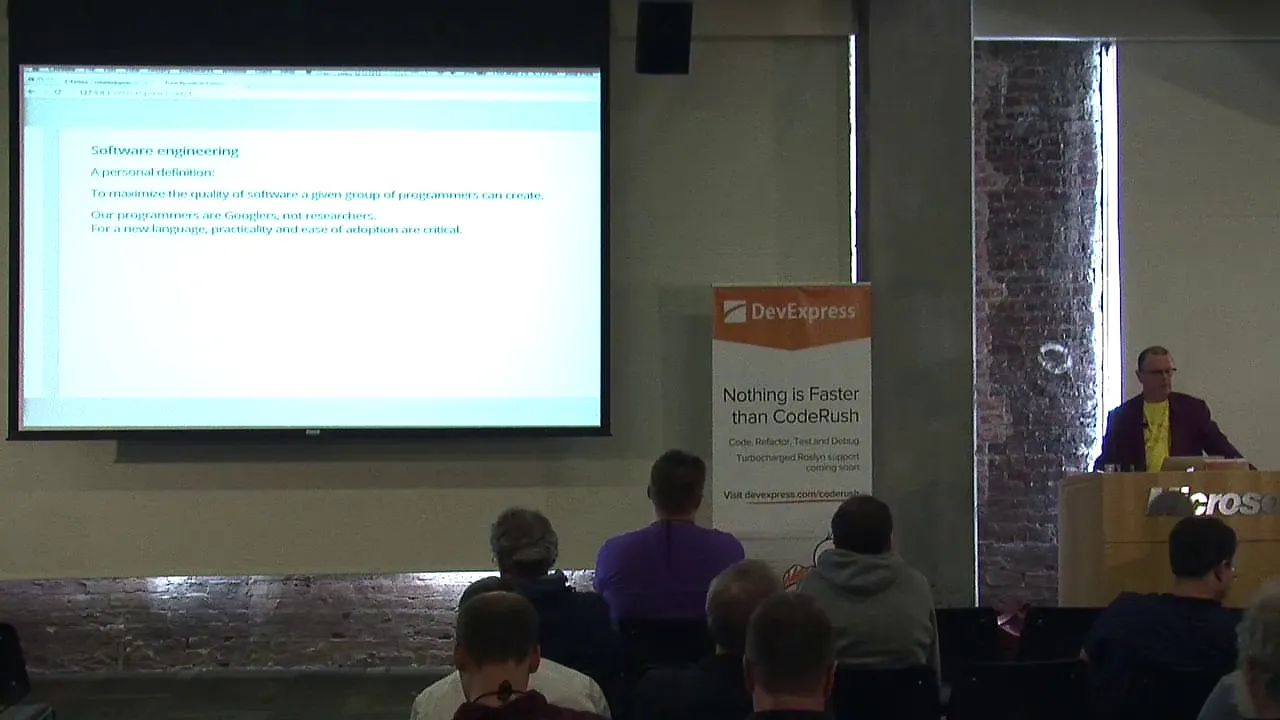
Google designed the Go programming language for simplicity because its young engineering workforce fresh out of school cannot understand complex languages, according to co-creator Rob Pike.
AI-assisted summary of Rob Pike about the target group of the Go programming language (golang) — original source. Check the original for full context.
Source published:
Key ideas
- Rob Pike emphasizes that Go was engineered for working Google developers rather than academic computer science researchers. (0:00)
- The primary demographic for Go consists of young engineers fresh out of school whose background is typically limited to Java, Python, and occasionally C or C++. (0:00)
- To enable broad engineering teams to build solid software, Go intentionally chose simplicity and ease of adoption over theoretical sophistication or language complexity. (0:00)
Detailed notes
## Background Published on YouTube by f8C4G86p KbqEFe47 on January 13, 2020, this short video features an excerpt from Rob Pike's 2014 Lang.NEXT talk, 'From Parallel to Concurrent.' The accompanying description quotes Pike's rationale regarding the demographic profile of Google developers and why Go was designed for rapid comprehension rather than theoretical brilliance.
## TL;DR Rob Pike outlines the target audience that shaped the design philosophy of the Go programming language. Rather than catering to academic researchers, Go was engineered for Google's rank-and-file developers, who are typically young graduates with standard backgrounds in Java, Python, or C/C++. Pike explains that because these engineers are not capable of understanding a highly complex language, Go deliberately prioritizes simplicity and ease of adoption so they can effectively build reliable software.
## Atmosphere & style The delivery is strikingly blunt, matter-of-fact, and unapologetically pragmatic. Pike speaks with casual candor, puncturing the theoretical idealism of programming language design with stark corporate realities. Listening to the brief clip feels provocative and unfiltered, capturing an unvarnished assessment of developer capabilities and industrial engineering priorities.
## Bulletin - [00:00](https://www.youtube.com/watch?v=uwajp0g-bY4&t=0s) Rob Pike emphasizes that Go was engineered for working Google developers rather than academic computer science researchers. - [00:00](https://www.youtube.com/watch?v=uwajp0g-bY4&t=0s) The primary demographic for Go consists of young engineers fresh out of school whose background is typically limited to Java, Python, and occasionally C or C++. - [00:00](https://www.youtube.com/watch?v=uwajp0g-bY4&t=0s) To enable broad engineering teams to build solid software, Go intentionally chose simplicity and ease of adoption over theoretical sophistication or language complexity.
## Key takeaways - [00:00](https://www.youtube.com/watch?v=uwajp0g-bY4&t=0s) Rob Pike draws a clear distinction between academic language researchers and the engineering rank-and-file at Google. - [00:00](https://www.youtube.com/watch?v=uwajp0g-bY4&t=0s) Go's core design philosophy was derived directly from the practical demands and human realities of Google's workforce. - [00:00](https://www.youtube.com/watch?v=uwajp0g-bY4&t=0s) The typical developer at Google is described as young and entering industry straight out of university. - [00:00](https://www.youtube.com/watch?v=uwajp0g-bY4&t=0s) Incoming university graduates generally bring standard exposure to Java and Python, with occasional experience in C or C++. - [00:00](https://www.youtube.com/watch?v=uwajp0g-bY4&t=0s) Pike argues that typical junior developers are not capable of understanding an esoteric or theoretically 'brilliant' language. - [00:00](https://www.youtube.com/watch?v=uwajp0g-bY4&t=0s) Google's business objective remains using this mainstream developer workforce to construct high-quality, dependable software. - [00:00](https://www.youtube.com/watch?v=uwajp0g-bY4&t=0s) A programming language meant for broad organizational deployment must prioritize ease of comprehension and rapid adoption. - [00:00](https://www.youtube.com/watch?v=uwajp0g-bY4&t=0s) Clarity and low cognitive overhead take precedence over complex features to ensure large-scale development productivity.
## Detailed walkthrough ### [00:00](https://www.youtube.com/watch?v=uwajp0g-bY4&t=0s) The Target Demographic for the Go Programming Language
Rob Pike sets out the core rationale behind Go's design philosophy by describing the actual workforce the language was created to serve. Addressing the reality of software engineering at Google, Pike draws a sharp contrast between academic computer science theorists and the engineering rank-and-file. As Rob Pike explains, “The key point here is our programmers are Googlers, they’re not researchers.” He characterizes these developers as typically quite young and fresh out of school, coming in with whatever standard background university curriculums provide—likely having learned Java, perhaps some C or C++, and probably Python.
Because of this background, Pike argues that aiming for theoretical sophistication or esoteric programming language features would run counter to Google's practical business goals. Instead, the design of Go deliberately prioritized clarity, straightforward mechanics, and low cognitive overhead to ensure broad organizational productivity. As Rob Pike candidly puts it, “They’re not capable of understanding a brilliant language but we want to use them to build good software, and so the language that we give them has to be easy for them to understand and easy to adopt.”
- **Developer profile**: Young engineers entering directly from university, rather than specialized programming language researchers. - **Prior language exposure**: Typically Java and Python, with occasional coursework in C or C++. - **Design imperative**: Prioritize rapid adoption and simplicity over language complexity or theoretical brilliance to enable large-scale software development.
## Mentioned Rob Pike, Go, Google, Java, C, C++, Python
## Video description "The key point here is our programmers are Googlers, they’re not researchers. They’re typically, fairly young, fresh out of school, probably learned Java, maybe learned C or C++, probably learned Python. They’re not capable of understanding a brilliant language but we want to use them to build good software. So, the language that we give them has to be easy for them to understand and easy to adopt."
Excerpt of the talk "From Parallel to Concurrent" by Rob Pike from Lang.NEXT 2014
source: https://channel9.msdn.com/Events/Lang-NEXT/Lang-NEXT-2014/From-Parallel-to-Concurrent (starting at 00:20:40)
Rob Pike is one of the main designers of the Go programming language (golang).
[Source](https://www.youtube.com/watch?v=uwajp0g-bY4)