Wilde, Whistler Turn on Shaw as Prince of Wales Flattery Collapses
DanHadan
While Wilde and Whistler salvage insulting comparisons to doughnuts and bat urine with quick wit, George Bernard Shaw faces instant humiliation when his peers abandon him over an irrecoverable venereal disease metaphor.
AI-assisted summary of Oscar, James and George in the company of Bertie — original source. Check the original for full context.
Source published:
Key ideas
- Oscar Wilde and James McNeill Whistler engage in a battle of Victorian drawing-room wit before the Prince of Wales, weaponizing and inverting famous epigrams and intellectual theft. (0:00)
- Wilde and Whistler manage to defuse absurd and offensive comparisons to the Prince of Wales by rapidly improvising flattering poetic interpretations. (1:19)
- George Bernard Shaw completely misjudges the escalation game by comparing the Prince to a venereal disease, leading to his total abandonment and mockery by his artistic peers. (1:19)
Detailed notes
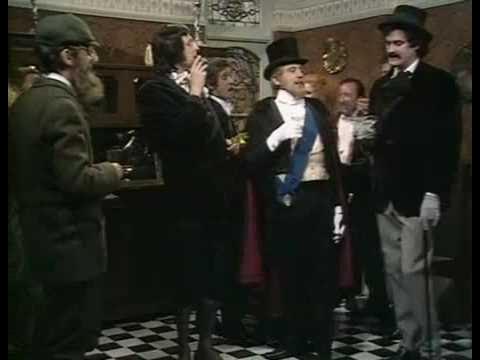
## Background Uploaded to YouTube by DanHadan on October 29, 2009, this video features a classic Monty Python sketch depicting historical Victorian figures in a battle of wits. The page description notes that the clip exemplifies the troupe's studied approach to comedy and role casting, starring Graham Chapman as Oscar Wilde, John Cleese as James McNeill Whistler, Terry Gilliam as George Bernard Shaw, and Terry Jones as Bertie, the Prince of Wales.
## TL;DR In a lavish drawing room, Oscar Wilde and James McNeill Whistler trade barbed aphorisms to impress the visiting Prince of Wales. As Bertie prepares to depart, the encounter rapidly devolves into an escalating contest of absurd royal flattery. Wilde narrowly salvages a bizarre blunder comparing the Prince to a jam doughnut, and Whistler quickly improvises a poetic recovery after comparing him to a stream of bat's urine. The duel ends in disaster when George Bernard Shaw compares Bertie to venereal disease, leaving him completely humiliated as his peers gleefully mock his downfall.
## Atmosphere & style The sketch blends the stiff elegance of a Victorian period drama with Monty Python's signature rapid-fire absurdity and escalating panic. Smug intellectual posturing immediately collapses into desperate improvisation and frantic buck-passing the moment the characters offend royal sensibilities. Watching the encounter feels delightfully tense and chaotic as refined drawing-room decorum devolves into gleeful, petty schadenfreude.
## Bulletin - [00:00](https://www.youtube.com/watch?v=uycsfu4574w&t=0s) Oscar Wilde and James McNeill Whistler engage in a battle of Victorian drawing-room wit before the Prince of Wales, weaponizing and inverting famous epigrams and intellectual theft. - [01:19](https://www.youtube.com/watch?v=uycsfu4574w&t=79s) Wilde and Whistler manage to defuse absurd and offensive comparisons to the Prince of Wales by rapidly improvising flattering poetic interpretations. - [01:19](https://www.youtube.com/watch?v=uycsfu4574w&t=79s) George Bernard Shaw completely misjudges the escalation game by comparing the Prince to a venereal disease, leading to his total abandonment and mockery by his artistic peers.
## Key takeaways - [00:00](https://www.youtube.com/watch?v=uycsfu4574w&t=0s) The Prince of Wales commends Oscar Wilde on the sweeping success of his latest play across London. - [00:00](https://www.youtube.com/watch?v=uycsfu4574w&t=0s) Wilde recycles his well-known aphorism asserting that the only thing worse than being talked about is not being talked about. - [00:00](https://www.youtube.com/watch?v=uycsfu4574w&t=0s) Wilde turns Bertie's praise into another repetitive paradox about the perils of not being witty. - [00:00](https://www.youtube.com/watch?v=uycsfu4574w&t=0s) James McNeill Whistler expresses envy over Wilde's aphorisms, sparking a reversal of the famous 'You will, Oscar' historical anecdote. - [00:00](https://www.youtube.com/watch?v=uycsfu4574w&t=0s) Wilde falters when forcing his paradoxical formula onto the topic of playing squash with the Prince. - [00:00](https://www.youtube.com/watch?v=uycsfu4574w&t=0s) Whistler successfully retaliates with 'You did, Oscar' when Wilde regrets his failed squash remark. - [01:19](https://www.youtube.com/watch?v=uycsfu4574w&t=79s) Bertie's planned departure triggers an escalating contest of flattery and metaphors among the gathered luminaries. - [01:19](https://www.youtube.com/watch?v=uycsfu4574w&t=79s) Wilde compares the Prince to a cream-topped jam doughnut, briefly trying to blame Whistler before framing it as an insatiable appetite for the royal presence. - [01:19](https://www.youtube.com/watch?v=uycsfu4574w&t=79s) Whistler insults the Prince by equating him to a stream of bat's piss, quickly scrambling to pin the comment on Wilde. - [01:19](https://www.youtube.com/watch?v=uycsfu4574w&t=79s) Whistler recovers royal favour by poetically redefining his vulgar metaphor as a shaft of gold piercing the darkness. - [01:19](https://www.youtube.com/watch?v=uycsfu4574w&t=79s) George Bernard Shaw escalates the metaphor into an irrecoverable vulgarity by comparing the Prince to a dose of clap. - [01:19](https://www.youtube.com/watch?v=uycsfu4574w&t=79s) Wilde and Whistler refuse to rescue Shaw, instead relishing and actively cheering on his public humiliation.
## Detailed walkthrough ### [00:00](https://www.youtube.com/watch?v=uycsfu4574w&t=0s) The Battle of Victorian Wits
In a lavish drawing room, the Prince of Wales (“Bertie”) mingles with the literary and artistic luminaries of late Victorian London. Bertie opens the exchange by offering high praise to Oscar Wilde, remarking that his latest theatrical production has taken the capital by storm: “Your latest play is a great success. The whole of London's talking about you.” Wilde immediately seizes the moment to show off his signature conversational style, countering with an effortless aphorism: “There is only one thing in the world worse than being talked about, and that is not being talked about.” The quip earns polite chuckles and admiration from the Prince, who declares it “Very, very witty.” Without missing a beat, Wilde turns the royal compliment into yet another paradoxical observation: “There is only one thing in the world worse than being witty, and that is not being witty.”
Standing nearby, the painter James McNeill Whistler looks on with professional envy. Yearning to claim credit for such a sparkling aphorism, Whistler dryly remarks, “I wish I had said that.” Turning the historical anecdote on its head, Wilde smoothly undercuts him by retorting, “You will, Oscar. You will.” Bertie then acknowledges Whistler, mentioning that the two of them recently played squash together. Wilde cannot resist trying to force the same rhetorical formula onto the sport, chiming in, “There is only one thing worse than playing squash together, and that is playing it by yourself.” Recognizing immediately that the strained line fell completely flat, Wilde sheepishly mutters, “I wish I hadn't said that,” giving Whistler the perfect opportunity to fire back in triumph: “You did, Oscar. You did.”
- Oscar Wilde opens the duel of epigrams by recycling his famous maxim regarding public gossip and vanity. - James McNeill Whistler and Oscar Wilde continuously trade barbed claims of intellectual theft. - Wilde falters when attempting to apply his standard paradox structure to the game of squash.
[01:19](https://www.youtube.com/watch?v=uycsfu4574w&t=79s) Flattery, Insults, and the Jam Doughnut Gambit
As Bertie announces that he must take his leave and return to the palace, the gathered wits scramble to outdo one another in offering flowery, memorable parting compliments to the future king. Wilde takes the first leap, but blunders into absurd bathos: “Your Majesty is like a big jam doughnut with cream on the top.” An uncomfortable, stunned silence falls over the room. Panicking at the Prince's bewildered expression, Wilde frantically attempts to shift the blame onto Whistler, insisting, “It was one of Whistler's.” Whistler angrily denies ownership, but Wilde quickly smooths things over by improvising an elaborate recovery: “What I meant was that like a doughnut your arrival gives us pleasure and your departure only makes us hungry for more.” Delighted by the inventive rescue, Bertie chuckles heartily.
Determined not to be outdone by Wilde's success, Whistler steps up to flatter the Prince, but misjudges his metaphor completely: “Your Highness is also like a stream of bat's piss.” Bertie reacts with stunned outrage, prompting Whistler to panic and try to pin the vulgarity on Wilde: “It was one of Wilde's!” When Wilde indignantly snaps back, “It sodding was not,” Whistler scrambles to invent an elegant poetical justification on the spot: “I merely meant, Your Majesty, that you shine out like a shaft of gold when all around is dark.” Mollified once again, Bertie accepts the flattering interpretation. Seeing both men survive their blunders, George Bernard Shaw steps forward to try his luck, but misreads the room entirely with a catastrophic attempt at wit: “Right. Your Majesty is like a dose of clap.” When Bertie recoils in shock, Shaw tries to push through with an excruciating punchline, adding that before arrival brings pleasure, while the aftermath brings pain. Desperately looking to Whistler to bail him out by claiming the line, Shaw is met with a cold rebuff: “You bastard!” With Bertie glaring and demanding an explanation, Wilde and Whistler delight in Shaw's downfall, gleefully crowding him and shouting, “Let's have a little wit then, man!”
```mermaid flowchart TD accTitle: Escalation of Royal Metaphors accDescr: Diagram tracing the escalating blunders and recoveries by Wilde, Whistler, and Shaw before the Prince of Wales.
subgraph Round1["Wilde's Gambit"] W1["Wilde: 'Like a big jam doughnut'"] --> W2{"Royal Reaction: Bewildered silence"} W2 --> W3["Recovery: 'Arrival gives pleasure, departure leaves us hungry'"] W3 --> W4["Outcome: Royal approval"] end
subgraph Round2["Whistler's Gambit"] Wh1["Whistler: 'Like a stream of bat's piss'"] --> Wh2{"Royal Reaction: Outraged 'What?'"} Wh2 --> Wh3["Recovery: 'Shine out like a shaft of gold'"] Wh3 --> Wh4["Outcome: Royal approval"] end
subgraph Round3["Shaw's Catastrophe"] S1["Shaw: 'Like a dose of clap'"] --> S2{"Royal Reaction: Total disgust"} S2 --> S3["Attempted recovery fails / Abandoned by peers"] S3 --> S4["Outcome: Humiliation and mockery"] end
Round1 --> Round2 Round2 --> Round3 ```
- Wilde compares Bertie to a jam doughnut with cream on top, successfully explaining it as an appetite for the Prince's company. - Whistler insults Bertie by comparing him to bat's urine, narrowly saving himself by likening the Prince to a shaft of gold piercing the darkness. - Shaw disastrously compares the monarch to venereal disease, completely failing to extract himself as Wilde and Whistler egg on his public humiliation.
## Mentioned Bertie (Edward VII), Oscar Wilde, James McNeill Whistler, George Bernard Shaw, Monty Python, Graham Chapman, John Cleese, Terry Gilliam, Eric Idle, Terry Jones, Michael Palin, Oxford Revue, Footlights, Cambridge Circus
## Video description Epitome Monty Python
An excerpt of Monty Python, a British comedy group that consisted of Graham Chapman, John Cleese, Terry Gilliam, Eric Idle, Terry Jones, and Michael Palin. The group wrote and performed original material for revues, TV series and movies.
Palin and Jones read at Oxford University, where they performed together with the Oxford Revue. Cleese, Chapman and Idle read at Cambridge where Cleese and Chapman were cast members of the Footlights. Gilliam met Cleese in New York while the latter was on tour with the Footlights revue Cambridge Circus.
Whatever one might want to label Monty Python's humor, the material treated is never less studied in terms of comedy (think of the French term comédien, actor) than the distribution of roles, make up, et cetera, as is evident in this clip--note the physical resemblance of Oscar Wilde (Chapman), James McNeill Whistler (Cleese), George Bernard Shaw (Gilliam) and Bertie (Jones) a.k.a. Edward VII.
For more details on Monty Python, see Wikipedia; and for more examples of their work, enter & search for them right on this site or got Pythononline period com.
[Source](https://www.youtube.com/watch?v=uycsfu4574w)