NDB Nuclear Battery Outputs Microwatts Despite EV Power Claims
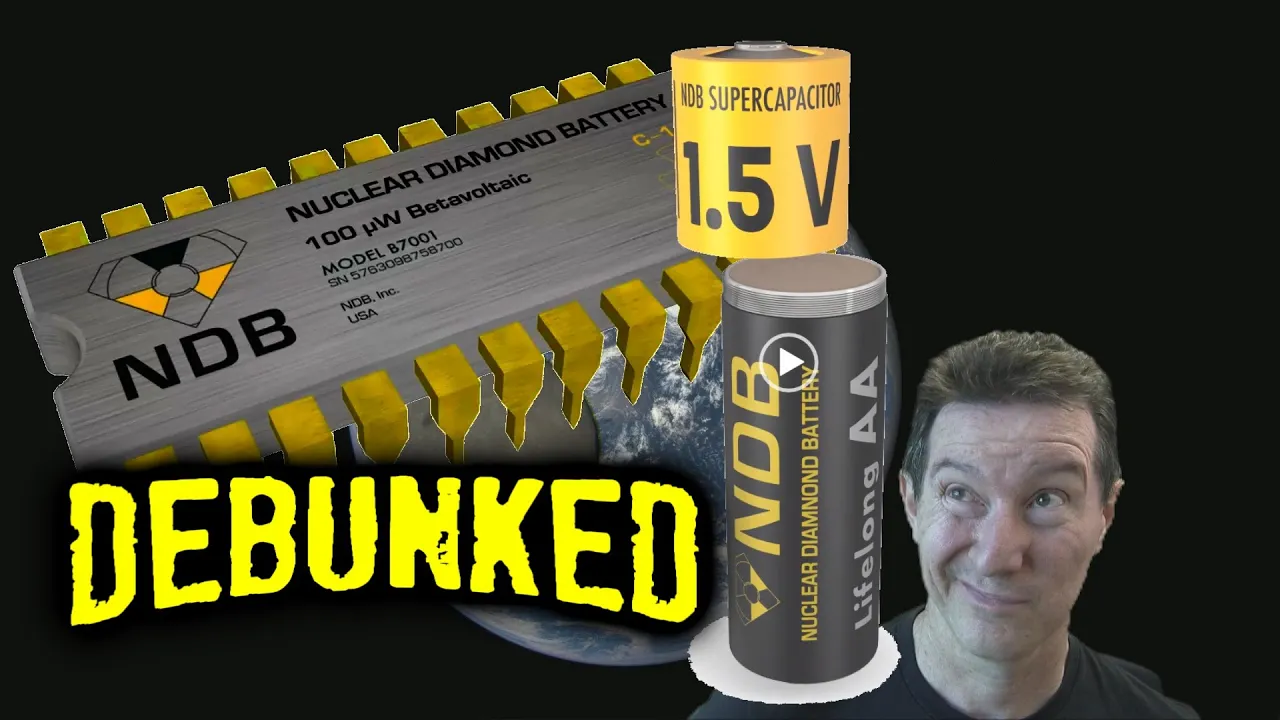
EEVblog
The startup's technology generates only 100 microwatts of continuous power, requiring over two years to match a single AAA battery and rendering its smartphone and electric vehicle claims mathematically impossible.
AI-assisted summary of EEVblog #1333 - Nuclear Diamond Self-Charging Battery DEBUNKED! — original source. Check the original for full context.
Source published:
Key ideas
- Viral marketing claims by startup NDB Inc. touting a self-charging nano diamond battery that could power electric vehicles and smartphones fall apart on a single specification: their own product image rates the cell at just 100 µW. (0:00)
- At a continuous output of 100 µW, it would take more than two continuous years of energy harvesting to match the 1.8 Wh capacity of a single disposable AAA alkaline battery. (6:09)
- Commercial betavoltaic devices providing identical ~100 µW output have been sold off-the-shelf for over a decade by companies like City Labs for specialized low-power, long-life niche applications. (3:08)
- NDB Inc. currently lacks physical prototypes, hardware photographs, or published test data, relying instead on a five-phase roadmap with prototypes not slated until Phase 4. (19:40)
Detailed notes
## Background Published on YouTube by EEVblog (Dave Jones) on August 27, 2020, this video examines the viral marketing claims made by startup NDB Inc. regarding their self-charging nano nuclear diamond battery. The channel description notes that Dave uses the company's own promotional materials to debunk claims of powering electric vehicles and smartphones, concluding that the product is merely an existing 100 µW commercial betavoltaic concept packaged with a graphene supercapacitor.
## TL;DR Dave Jones systematically debunks viral media claims that NDB Inc.'s nuclear diamond batteries will revolutionize energy storage, power smartphones perpetually, or run electric vehicles. By analyzing NDB's own promotional materials—specifically an image of an integrated circuit rated at just 100 microwatts—Dave demonstrates that the technology is fundamentally an energy harvester rather than a high-output power source. Basic arithmetic reveals that a 100 µW generator takes over two years to produce the energy equivalent of a single cheap AAA alkaline cell and more than 2.5 years to self-charge an AA-sized package. Dave points out that commercial betavoltaics from companies like City Labs have existed for over a decade for niche low-drain uses, while NDB's extreme energy density figures, 100% efficiency claims, and buzzword-heavy roadmaps obscure a severe power density bottleneck and a complete absence of working prototypes.
## Atmosphere & style The presentation is energetic, irreverent, and thoroughly grounded in pragmatic engineering skepticism. Dave speaks directly to the camera with characteristic Australian candor, blending quick calculator demonstrations with incredulous sarcasm as he picks apart corporate buzzwords and polished 3D renders. Watching the video feels like an entertaining yet uncompromising reality check, transitioning from exasperation at breathless media hype to methodical, common-sense arithmetic that decisively bursts the startup's bubble.
## Bulletin - [00:00](https://www.youtube.com/watch?v=uzV_uzSTCTM&t=0s) Viral marketing claims by startup NDB Inc. touting a self-charging nano diamond battery that could power electric vehicles and smartphones fall apart on a single specification: their own product image rates the cell at just 100 µW. - [06:09](https://www.youtube.com/watch?v=uzV_uzSTCTM&t=369s) At a continuous output of 100 µW, it would take more than two continuous years of energy harvesting to match the 1.8 Wh capacity of a single disposable AAA alkaline battery. - [03:08](https://www.youtube.com/watch?v=uzV_uzSTCTM&t=188s) Commercial betavoltaic devices providing identical ~100 µW output have been sold off-the-shelf for over a decade by companies like City Labs for specialized low-power, long-life niche applications. - [19:40](https://www.youtube.com/watch?v=uzV_uzSTCTM&t=1180s) NDB Inc. currently lacks physical prototypes, hardware photographs, or published test data, relying instead on a five-phase roadmap with prototypes not slated until Phase 4.
## Key takeaways - [00:00](https://www.youtube.com/watch?v=uzV_uzSTCTM&t=0s) Marketing claims that NDB Inc.'s nuclear diamond battery will revolutionize electric vehicles and consumer smartphones rely on recycled hype from earlier university announcements. - [00:00](https://www.youtube.com/watch?v=uzV_uzSTCTM&t=0s) A photograph of NDB's B7001 betavoltaic package exposes an actual power rating of only 100 µW (0.0001 W), completely debunking claims of high-drain capabilities. - [03:08](https://www.youtube.com/watch?v=uzV_uzSTCTM&t=188s) Betavoltaics are established technology rather than a novel breakthrough; companies like City Labs have sold tritium-based 100 µW cells for niche applications for over a decade. - [03:08](https://www.youtube.com/watch?v=uzV_uzSTCTM&t=188s) Claims of being 14.29 times more efficient than space-grade RTGs are mathematically incompatible with a package delivering only microwatt-scale output. - [06:09](https://www.youtube.com/watch?v=uzV_uzSTCTM&t=369s) Accumulating the ~1.8 Wh energy equivalent of a single AAA alkaline battery requires over two full years of continuous generation from a 100 µW betavoltaic source. - [09:49](https://www.youtube.com/watch?v=uzV_uzSTCTM&t=589s) The startup pairs a betavoltaic trickle harvester with an integrated graphene supercapacitor, relying on popular tech buzzwords to inflate consumer expectations. - [11:22](https://www.youtube.com/watch?v=uzV_uzSTCTM&t=682s) Consumer marketing claims of 100% efficiency directly contradict the company's own press release in TechCrunch, which reported only 40% charge collection efficiency in laboratory tests. - [13:07](https://www.youtube.com/watch?v=uzV_uzSTCTM&t=787s) Recharging an alkaline-equivalent AA battery (4.5 Wh) using an internal 200 µW diamond core would take approximately 22,500 hours (over 2.5 years) of autonomous self-charging. - [16:34](https://www.youtube.com/watch?v=uzV_uzSTCTM&t=994s) Promotional figures boasting of energy density 56,000 times greater than lithium-ion conceal the critical bottleneck of abysmal power density and extraction rates. - [19:40](https://www.youtube.com/watch?v=uzV_uzSTCTM&t=1180s) NDB Inc.'s corporate timeline places working hardware in Phase 4, confirming the company has no physical prototypes or verified electrical power generation data in the public domain. - [21:50](https://www.youtube.com/watch?v=uzV_uzSTCTM&t=1310s) Harvesting an average of 3,600 electrons per junction represents a negligible fraction of the ~6.24 × 10¹⁸ electrons per second needed to produce just one ampere of electrical current. - [24:01](https://www.youtube.com/watch?v=uzV_uzSTCTM&t=1441s) Severe material limitations in thin-film diamond design create an unavoidable trade-off between electron recombination and insufficient radioactive emission capture. - [26:06](https://www.youtube.com/watch?v=uzV_uzSTCTM&t=1566s) Betavoltaics remain viable only as expensive, ultra-low-power trickle generators for decades-long sensor deployments, entirely unsuitable for automotive traction packs or mobile devices.
## Detailed walkthrough ### [00:00](https://www.youtube.com/watch?v=uzV_uzSTCTM&t=0s) The Viral Hype and the 100 µW Reality Check
Dave opens the video explaining that he has been flooded with requests across Twitter, Facebook, and email regarding viral news stories claiming that "nano diamond self-charging batteries could disrupt energy as we know it." He immediately recognizes the familiar scent of marketing hype. A startup company named NDB Inc. (Nuclear Diamond Battery) has re-ignited media buzz by claiming its technology will revolutionize the energy sector. Dave notes that this narrative is completely recycled; similar hype circulated earlier in the year involving the University of Bristol. At that time, fellow YouTuber Thunderf00t released a comprehensive debunking video analyzing the fundamental nuclear physics, radiation safety, and power output. Dave makes clear that he has no intention of repeating Thunderf00t's deep dive into the physics, emphasizing: “So, I won't touch like any of the physics behind any of this because we don't need to to debunk this thing.”
Despite having dozens of browser tabs open to examine the claims, Dave points out that viewers do not need to read the promotional articles, visit the startup's website, or analyze their pitch decks to see that the product is completely overblown. The claim falls apart entirely upon inspecting a single photograph released by NDB Inc. The image depicts an integrated circuit package resembling a standard dual in-line package (DIP) chip labeled as the NDB Inc. Model B7001 betavoltaic battery. Printed clearly across the package is its rated output: 100 µW (microwatts). Dave highlights the absurdity of media outlets claiming an energy revolution based on microwatts of power, mocking the breathless press releases that boast of 28,000-year lifespans, superior energy density to lithium-ion, indestructible crash safety, and promises to power electric cars: “100 microwatts is going to revolutionize the electric car industry.”
- **Claimed lifespan:** Up to 28,000 years without needing an external recharge. - **Physical form factor shown:** A standard IC DIP package (Model B7001). - **Stated output rating on the chip:** 100 µW (0.0001 W).
[03:08](https://www.youtube.com/watch?v=uzV_uzSTCTM&t=188s) Commercial Betavoltaics and Questionable Efficiency Metrics
Dave investigates the origins of the photograph and notices a telling detail: NDB Inc. seems to have scrubbed the image from their website and web archives, likely because it is the only asset that actually features a hard, quantifiable number. In reality, commercial betavoltaic batteries outputting 100 µW are neither new nor disruptive. Companies like City Labs have been manufacturing and commercially selling tritium-based betavoltaic batteries (such as their Model P200) for over fifteen years. Betavoltaics function fundamentally as trickle-power energy-harvesting devices, well suited for niche, ultra-low-power applications requiring nanowatts to microwatts of continuous power, or paired with a secondary storage cell for intermittent milliwatt-to-watt bursts. Pointing out the established commercial baseline, Dave remarks: “And of course, betavoltaics are nothing new.”
The promotional material also makes dubious comparative claims, boasting that the battery is "14.29 times more efficient" than radioisotope thermoelectric generators (RTGs) used in deep-space probes. Dave examines the visual trickery of using an odd decimal like 14.29, which can visually fool a casual reader into seeing 14,000 times at a glance. He then runs the numbers on RTGs: a standard plutonium-based space RTG delivers roughly 0.54 watts per gram. Multiplying that by 14.29 would imply a power density of roughly 7.7 watts per gram. If NDB Inc.'s technology could achieve anything remotely close to that level of power density, a package the size of their DIP chip would output watts, not a mere 100 microwatts. Dave notes dryly that the marketing math simply never adds up.
- **Pre-existing technology:** City Labs Model P200 betavoltaic battery offering 100 µW off-the-shelf for over a decade. - **Typical betavoltaic domain:** Continuous nanowatt-to-microwatt baseline loads, or trickle-charging secondary storage. - **Space RTG baseline:** Approximately 0.54 W/g for plutonium-based radioisotope thermoelectric generators. - **Implied NDB density vs. reality:** An alleged 14.29× increase over RTGs would yield ~7.7 W/g, completely contradicting the 100 µW chip rating.
[06:09](https://www.youtube.com/watch?v=uzV_uzSTCTM&t=369s) The AAA Comparison: Crunching the Numbers
To demonstrate the real-world scale of 100 microwatts, Dave compares the volume of the DIP chip package to an ordinary AAA alkaline battery. Assuming the DIP package has a comparable volume to a AAA cell, Dave establishes that 100 µW represents the absolute maximum continuous instantaneous power the betavoltaic cell can produce. While it might produce that power for centuries, it is physically incapable of delivering higher instantaneous power on its own. Dave pulls up a standard AAA alkaline battery datasheet to contrast this with conventional chemical storage. Under a modest 1 milliamp drain (roughly 1 milliwatt of power, which is 1,000 microwatts—ten times the nuclear chip's output), a single AAA cell lasts approximately 1,400 hours, yielding around 1.8 watt-hours (Wh) of usable capacity.
```mermaid flowchart LR accTitle: Energy Yield Comparison Over Two Years accDescr: Diagram comparing the energy output of a 100 microwatt betavoltaic chip over two years against a single standard AAA battery.
subgraph NDB["NDB Betavoltaic Chip"] P1["Power: 100 µW (0.0001 W)"] Y1["Year 1: 0.876 Wh"] Y2["Year 2: 1.752 Wh"] P1 --> Y1 --> Y2 end
subgraph AAA["Standard AAA Alkaline Cell"] P2["Power: ~1 mW (1,000 µW)"] CAP["Total Capacity: ~1.80 Wh"] P2 --> CAP end
Y2 -.->|"Roughly matches after ~2.05 years"| CAP ```
Dave brings out his calculator to compute the cumulative energy generated by a 100 µW betavoltaic source operating non-stop: 100 µW multiplied by 24 hours per day and 365 days yields approximately 0.876 watt-hours per year. Therefore, it would take more than two entire years of continuous generation just to match the total energy stored inside a single cheap AAA alkaline battery. Dave highlights the absurdity of claiming this technology can run smartphones and electric cars when its volumetric output is so dismal: “So, basically, their little piss-ant energy harvesting betavoltaic battery here, whiz-bang and nano carbon technology, can only generate the same power as a AAA over 2 years.” He points out that this math explains why NDB Inc. removed technical fact sheets and specifications from their website: any engineer performing basic arithmetic can instantly expose that the product is limited strictly to low-drain niche applications.
- **Annual energy output of 100 µW:** 100 µW × 24 h × 365 d ≈ 0.876 Wh/year. - **Two-year energy output:** ~1.75 Wh. - **Single standard AAA alkaline capacity:** ~1.8 Wh (evaluated at a 1 mA drain). - **Time to match one AAA cell:** Approximately 2.05 years of continuous trickle generation. - **Physical prototype evidence:** Zero public test data, discharge curves, power logs, or photographic proof of working hardware.
[09:49](https://www.youtube.com/watch?v=uzV_uzSTCTM&t=589s) Graphene Supercapacitors and Target Market Fantasies
Examining the rest of NDB Inc.'s claims, Dave spots every contemporary startup buzzword imaginable. The company pairs the betavoltaic generator with a "3D graphene supercapacitor" integrated into the package to capture and store the trickle charge, leading Dave to scoff: “Of course it's got graphene. Graphene's the buzzword of the decade for our startups.” The startup claims that this architecture enables a perpetual smartphone battery that will never run flat or require an external charger. Dave scrolls through their target market pitch, which lists augmented reality, smartphones, tablets, gaming consoles, standalone CPUs, virtual reality headsets, smartwatches, and wearable technology.
The company also illustrates a 1.5 V AA-sized nuclear diamond battery. Dave points out that the marketing literature itself betrays the core limitation: the text admits the nanodiamond material merely "generates and harvests electricity." In electronic engineering, the term "energy harvesting" denotes capturing ambient, microscopic trickles of power—such as nanowatts and microwatts. Dave emphasizes the sharp contrast between energy harvesting and the brute force power requirements of consumer electronics: “When you hear energy harvesting, you know it's little bitty, teeny weeny.” Pairing an ultra-low-power trickle harvester with a supercapacitor cannot overcome the fundamental limit of average power consumption in smartphones and vehicles.
- **Secondary storage mechanism:** Built-in 3D graphene supercapacitor to collect trickle charge. - **Proposed consumer products:** "Never-die" phone batteries and a 1.5 V AA-sized drop-in nuclear battery cell. - **Claimed markets:** Consumer mobile devices, AR/VR, smartwatches, wearable electronics, and electric vehicle traction packs. - **Fundamental engineering classification:** An energy harvester, inherently limited to microscopic average energy generation rates.
[11:22](https://www.youtube.com/watch?v=uzV_uzSTCTM&t=682s) Efficiency Claims vs. Reality: Marketing vs. The TechCrunch Press Release
Dave examines NDB’s promotional marketing, which asserts that diamond is an exceptionally efficient charge collector capable of near 100% efficiency. He juxtaposes these marketing claims against a contemporaneous *TechCrunch* article regarding the startup’s self-charging 1,000-year battery. The article reports on tests conducted at Lawrence Livermore National Laboratory and the Cavendish Laboratory at Cambridge, claiming the battery tech managed a “40% charge” (charge collection efficiency), touted as an improvement over the 15% collection efficiency of standard commercial diamond batteries.
Dave points out the immediate contradiction: while NDB boasts 100% efficiency across its consumer-facing marketing materials, their own press release concedes an achievement of only 40%. The design also incorporates an advanced printed circuit board and a supercapacitor to make up for the battery's weak output. To sell the idea that this technology can run electric vehicles and smartphones, NDB leans heavily on buzzwords, promoting the integration of a graphene supercapacitor simply because graphene won the Nobel Prize in 2010.
> “So, in their own press release here they say, 'No, we only achieve 40%.' But in all their other marketing stuff on the page they're happy to talk up 100%, aren't they?” — Dave Jones
- Lawrence Livermore National Laboratory and Cambridge’s Cavendish Laboratory were cited as test sites. - Tested collection efficiency was reported as 40%, compared to 15% for baseline commercial diamond batteries. - Marketing materials routinely claim near 100% collection efficiency despite these laboratory findings. - The battery assembly integrates an internal boost converter PCB and a supercapacitor for energy storage.
---
[13:07](https://www.youtube.com/watch?v=uzV_uzSTCTM&t=787s) Dissecting the NDB AA Concept: Renderings, Reality, and Charging Math
Dave reviews a promotional video showcasing NDB’s proposed AA battery concept, which claims to be made from recycled nuclear waste and nanotechnology, offering 100% efficiency, holding 3.5 times more charge than an alkaline cell, and being 53% smaller with identical weight. Examining their 3D rendering, he mocks the bizarre design errors, such as surface-mount components depicted with through-hole pins on the boost converter PCB. Physically, the bottom of the cylinder houses a tiny betavoltaic nuclear diamond source, while the top holds the energy-harvesting circuitry and a supercapacitor.
```mermaid flowchart TD accTitle: NDB AA Battery Internal Concept accDescr: Diagram illustrating the components inside NDB's proposed AA battery form factor. subgraph BatteryShell["NDB AA Enclosure"] SuperCap["Supercapacitor Storage<br>(Graphene Buffer)"] PCB["Energy Harvesting PCB<br>(Boost Converter Circuit)"] Source["Betavoltaic Nuclear Diamond Core<br>(~100 to 200 µW Output)"] end Source -->|"Trickle charge"| PCB PCB -->|"Store energy"| SuperCap SuperCap -->|"Regulated output"| OutputTerminal["External Terminals"] ```
Dave does not contest that NDB could theoretically build such a package, but he runs the basic physics calculations on recharging it. A standard disposable AA alkaline cell stores roughly 4.5 watt-hours (equivalent to 5 mW over 900 hours). Assuming a generous 200 microwatt (0.0002 W) output from the internal diamond core, Dave calculates the time needed to fully self-charge from empty:
$$\text{Recharge Time} = \frac{4.5\text{ W}\cdot\text{h}}{0.0002\text{ W}} = 22,500\text{ hours} \approx 2.57\text{ years}$$
If a user expends the AA battery's energy in a day or two, they would have to wait over 22,000 hours for the cell to replenish itself via betavoltaics. Dave highlights that the only practical way to use such a cell is by plugging it into a wall charger like any conventional rechargeable battery, rendering the self-charging betavoltaic component virtually useless for high-drain applications.
> “So, your whiz-bang double-A here is is self-charged to self—let's say it comes from the factory, it's pre-charged, it's self-charged, and you used up your double-A capacity, you used up your 4 and 1/2 watt hours, you pissed it away in a day or two, and you want your battery to recharge itself from the built-in 200 microwatt source, then yeah, you're going to have to wait 22,000 hours for this thing to self-recharge.” — Dave Jones
- Standard AA battery energy capacity used for baseline: 4.5 Wh (5 mW across 900 hours). - Generous continuous internal harvesting power: 200 µW. - Calculated autonomous recharge duration: 22,500 hours (over 2.5 years). - NDB marketing claims the cell can produce 3.5 times the capacity of a typical AA cell every single hour.
---
[16:34](https://www.youtube.com/watch?v=uzV_uzSTCTM&t=994s) Marketing Claims vs. Energy Density: Hiding the Microwatt Bottleneck
Dave dismantles NDB's wild marketing claims, including their assertion that the battery can generate 3.5 times the capacity of a standard AA battery every hour, or fully power a smartphone while producing seven times its full charge hourly. He points out that NDB’s own graphic showing a 100 µW power source completely refutes these statistics. Searching their website reveals an intentional lack of technical documentation, power curves, or output specs, because disclosing microwatt outputs undermines the hype.
Instead, NDB relies entirely on energy density figures to impress non-technical investors. They claim the battery is 4,000 times more energy dense than gasoline and 56,000 times denser than lithium-ion cells (like 18650s). Dave notes that while the raw nuclear energy trapped in radioactive carbon may theoretically possess immense volumetric energy density, power density is the real-world limitation: the energy simply cannot be extracted at an acceptable rate. Furthermore, while NDB claims to be 16 times more efficient than standard betavoltaics, existing tritium devices (like City Labs' Model P100/NanoTritium) yield the same ~100 µW output in comparable physical footprints. Even granting their claimed 16× efficiency boost, self-recharging an alkaline-equivalent AA battery would still require roughly 1,400 hours (nearly two months).
> “Their own marketing image disproves their own numbers. No wonder they don't want to show that anywhere on their website or put any technical information whatsoever on their website.” — Dave Jones
- Claimed volumetric density: 4,000× that of gasoline and 56,000× that of lithium-ion (18650) cells. - Real-world extraction rate shown on NDB's own slide: ~100 µW. - Benchmark comparison: City Labs commercial tritium betavoltaic produces ~100 µW in a similar volume. - Even with a hypothetical 16× improvement in efficiency, a AA-equivalent recharge still takes over 1,400 hours.
---
[19:40](https://www.youtube.com/watch?v=uzV_uzSTCTM&t=1180s) Five-Phase Roadmap and Lack of Prototypes
Dave analyzes NDB’s company timeline, which outlines a five-phase roadmap: 1. Identify opportunities and write a initial business plan. 2. Build the scientific and business structure while sourcing capital. 3. Conduct a formal 18-month evaluation. 4. Develop actual physical prototypes. 5. Finalize the product based on beta-tester feedback and launch.
Dave points out that NDB was incorporated on February 4, 2019, meaning they are only in the early planning stages and looking for investor funding. Despite the avalanche of media attention from outlets like *TechCrunch* and *New Atlas*, the company has no working prototypes, no hardware photographs, and zero published performance data. Their so-called proof-of-concept tests merely noted a 40% charge collection efficiency in laboratory conditions, without disclosing any real electrical power generation. Dave concludes that NDB is operating like a classic energy startup selling inflated figures without solving the fundamental physics bottleneck of energy harvesting.
> “There are no prototype photos whatsoever. There's no data at all. Because if this stuff really existed, they'd be publishing the data and they'd be money would be pouring in.” — Dave Jones
- Company incorporation date: February 4, 2019. - Working prototypes are slated only for Phase 4 of their five-phase plan. - Media coverage driven by articles from *TechCrunch* and *New Atlas*. - Zero verified electrical power generation curves or working device prototypes exist in the public domain.
[21:50](https://www.youtube.com/watch?v=uzV_uzSTCTM&t=1310s) The Reality of Betavoltaic Electron Harvesting
Dave combs through the NDB website looking for any genuine technical specifications or test data, urging viewers to link to real figures below the video if they can uncover any. He notes that the website provides pages of conceptual descriptions, manufacturing claims, and electron harvesting explanations, yet conspicuously avoids publishing hard numbers for the cell sizes or test yields. The site claims that an ideal device can harvest a maximum of 11,400 electrons and an average of 3,600 electrons, while stating that the current yield depends heavily on variables like device design, diamond purity, crystallinity, and size.
```mermaid flowchart TD accTitle: Current Scale Comparison accDescr: A comparison showing the vast scale gap between 1 amp of current and NDB's mean electron generation rate.
subgraph ScaleGap["Electron Scale Comparison"] A["1 Ampere of Current<br>(~6.24 × 10¹⁸ electrons/sec)"] B["NDB Harvest Claim<br>(~3,600 mean electrons)"] A -.->|"Vast orders of magnitude gap"| B end ```
Dave puts the company's electron count into perspective for anyone imagining this could drive high-current machinery like an electric vehicle. One ampere of electric current consists of roughly $6 \times 10^{18}$ electrons flowing per second. Generating a mean of 3,600 electrons from a junction does not begin to register on the scale needed for consumer power: “This thing, one junction can generate 3,600. Whoop-de-doo.” Meanwhile, the publicity photograph showing a 100-microwatt dual in-line package (DIP) chip complete with a product number seems to have quietly vanished from the main pitch:
> “You can't find that product—just the DIP product has just mysteriously vanished because, well, you don't want people to know that it's just a piss-ant, you know, betavoltaic generator just like you've been able to buy for the last decade.”
- **Harvested electron claims:** Up to 11,400 maximum electrons, with an average around 3,600 electrons. - **Scale of electric current:** 1 A equals roughly $6 \times 10^{18}$ electrons per second, dwarfing the device's single-junction output. - **The actual underlying concept:** A low-power betavoltaic generator paired with a graphene supercapacitor in a standard package, accompanied by polished marketing materials to draw investor money.
---
[24:01](https://www.youtube.com/watch?v=uzV_uzSTCTM&t=1441s) Nanotechnology Jargon vs. Conceptual Prototypes
Examining the site's diagrams on electron capture as a function of depth and distance, Dave points out how the company relies on sophisticated terminology to describe thin-film diamond optimization. The documentation talks about adjusting diamond layer thickness to generate electrons near the collector surface, using titanium charge collectors because of purported benefits over gold, and employing boron-doped ohmic interfaces. Yet Dave dismisses the elaborate schematics because none of these physical devices exist outside of concept art:
> “Without the actual data, it's all just useless marketing waffle.”
NDB's own literature concedes that nano-batteries represent an emerging field fraught with extreme execution hurdles requiring precise atomic-scale material manipulation. Dave highlights the physical catch-22 outlined in their text: if the diamond layer is too thick, released electrons recombine and are absorbed back into the material; if the layer is made too thin, there is insufficient material to release electrons efficiently. While the underlying physics of betavoltaics is legitimate, the staggering claims that these devices are 10,000 to 50,000 times more energy-dense than lithium-ion batteries obscure the real bottleneck. With only 100 microwatts of continuous output, an AA or AAA battery form factor would require thousands of hours simply to accumulate enough charge for a short burst of work.
- **Collector material:** Conceptual design specifies titanium collectors over gold alongside boron-doped ohmic interfaces. - **Material constraints:** Layer thickness requires precise nanometer tuning to prevent electron recombination without sacrificing radioactive emission capture. - **Energy density vs. power density:** Extreme volumetric energy density over decades does not compensate for sub-milliwatt power delivery rates.
---
[26:06](https://www.youtube.com/watch?v=uzV_uzSTCTM&t=1566s) Niche Betavoltaics and the Automotive Myth
Dave calls out the claims that these cells will disrupt everyday sectors like automotive transport, consumer electronics, medical implants, aviation, and space systems. In reality, the technology is fundamentally identical to commercial betavoltaic cells that have been available for over a decade. Commercial tritium-based chips, such as those from City Labs, run for decades (around 20 to 40 years) and command high prices—often a couple of thousand dollars per chip—because they serve specialized low-power, long-life niches:
> “It's not going to disrupt energy. Anyone who invests money in this thing or spreads this thinking that it's going to change the world and oh, we're going to have nuclear diamond batteries in our EVs. It's just no, it's crap.”
Dave concludes that betavoltaic energy harvesting has a valid place in extreme longevity, low-drain niche monitoring, but will never run cars or smartphones. He wraps up the debunking, declaring the case closed: “Look, 100 microwatts. It's done. It's dusted. This is energy harvesting beta-voltaic battery. The end.” He asks viewers for thumbs-up ratings, invites ongoing discussion on the EEVblog forum, reminds viewers of his alternative channels across Vimeo, BitTube, and Dailymotion, and signs off.
## Notable quotes > [24:01](https://www.youtube.com/watch?v=uzV_uzSTCTM&t=1441s) Without the actual data, it's all just useless marketing waffle. — Dave Jones
## Mentioned EEVblog, Dave Jones, NDB Inc., Thunderf00t, University of Bristol, City Labs, City Labs Model P200, City Labs Model P100, NanoTritium, TechCrunch, New Atlas, Lawrence Livermore National Laboratory, Cavendish Laboratory, Cambridge University
## Video description Dave debunks the marketing claims of self-charging Nano Nuclear Diamond Batteries in the first 10 minutes using their own material. The rest of the video is cream on top. NDB Inc supposedly have a nano diamond self-charging nuclear battery that will revolutionise the energy industry and power electric vehicle and mobile phones. TLDR; it's no better than existing 100uW commercial betavoltaic batteries, but has an added graphene supercapacitor in the AA package.The rest is marketing BS. https://ndb.technology/ Check out the Investor pack!: https://ndb.technology/pitch/NDB_Investor_Pack.pdf
Thunderf00t's Nuclear diamond battery BUSTED video: https://www.youtube.com/watch?v=JDFlV0OEK5E
Betavoltaics presentation from City Labs: https://www.energy.gov/sites/prod/files/2015/08/f26/Cabauy%20Tritium%20Focus%20Group%20Presentation.pdf
Forum: https://www.eevblog.com/forum/blog/eevblog-1333-nano-diamond-self-charging-battery-debunked!/
Subscribe on Library: https://lbry.tv/@eevblog:7 EEVblog Web Site: http://www.eevblog.com The 2nd EEVblog Channel: http://www.youtube.com/EEVblog2 EEVdiscover: https://www.youtube.com/eevdiscover Support the EEVblog through Patreon! http://www.patreon.com/eevblog
AliExpress Affiliate: http://s.click.aliexpress.com/e/c2LRpe8g Buy anything through that link and Dave gets a commission at no cost to you.
Donate With Bitcoin & Other Crypto Currencies! https://www.eevblog.com/crypto-currency/
T-Shirts: http://teespring.com/stores/eevblog #Nuclear #Diamond #Battery
[Source](https://www.youtube.com/watch?v=uzV_uzSTCTM)